 Predictive capacity of phytoplankton functional groups in a tropical wetland (Pantanal, Brazil)
Abstract:
Aim Considering the prediction capacity of the phytoplankton community, this study analyzed the environmental factors that influenced the Reynolds Functional Groups (RFG) in hydrological period (dry, rising, flood and ebb) and the type of environment (river and lake), in the Pantanal wetland (Brazil). We expect environmental variability to reflect in the predictive ability of phytoplankton to describe habitat types and flood-pulse periods, where the seasonality (high and low water) are the main drivers of phytoplankton distribution, biomass and functional groups.
Methods We collected environmental variables and phytoplankton quarterly in 2018 from 18 points in the flood, rising, dry and ebb.
Results recorded 425 taxa distributed into 13 taxonomic groups and 20 RFGs, of which nine groups (D, F, J, G, K, MP, N, S1, and P), represented by green algae, cyanobacteria, and diatoms, had the highest predictive value, characterizing lentic environments as rich in nutrients and light, and the Paraguay River as having a lower availability of these resources for phytoplankton. The variation in biomass was related to the phases of the flood pulse, being higher in low waters in floodplain lakes and smaller in high waters in the river.
Conclusions Thus, the predictability of the phytoplankton community structure was directly associated with the environment types in the Pantanal wetland and with the homogenization or isolation of the systems promoted by the flood pulse that acted as drivers of phytoplankton distribution, biomass and functional groups.
Keywords:
environmental variability; microalgae; wetlands; predictive ability
Resumo:
Objetivo Considerando a capacidade de predição da comunidade fitoplanctônica, este estudo analisou os fatores ambientais que influenciaram os Grupos Funcionais de Reynolds (RFG) no período hidrológico (estiagem, enchente, cheia e vazante) e tipo de ambiente (rio e lago), no Pantanal (Brasil). Esperamos que a variabilidade ambiental reflita na capacidade preditiva do fitoplâncton para descrever tipos de habitat e períodos de pulso de inundação, onde a sazonalidade (águas altas e baixas) são os principais direcionadores de biomassa, distribuição de fitoplâncton e grupos funcionais.
Métodos Coletamos variáveis ambientais e fitoplâncton trimestralmente em 2018 a partir de 18 pontos nos períodos de cheia, enchente, seca e vazante.
Resultados Registramos 425 táxons distribuídos em 13 grupos taxonômicos e 20 RFGs, dos quais nove grupos (D, F, J, G, K, MP, N, S1 e P), representados por algas verdes, cianobactérias e diatomáceas, teve o maior valor preditivo, caracterizando ambientes lênticos como ricos em nutrientes e luz, e o rio Paraguai como tendo menor disponibilidade desses recursos para o fitoplâncton. A variação da biomassa foi relacionada às fases do pulso de inundação, sendo maior em águas baixas nos lagos e menor em águas altas no rio.
Conclusões A previsibilidade da estrutura da comunidade fitoplanctônica esteve diretamente associada aos tipos de ambiente no Pantanal e à homogeneização ou isolamento dos sistemas promovidos pelo pulso de inundação que atuaram como direcionadores de biomassa, distribuição e grupos funcionais do fitoplâncton.
Palavras-chave:
variabilidade ambiental; microalgas; zonas úmidas; capacidade preditiva
1. Introduction
The phytoplankton community responds to variation in hydrology at various spatial and temporal scales (Abonyi et al., 2012, 2014; Bolgovics et al., 2017; Ryo et al., 2019) with compositional changes along the lateral connectivity gradient in river floodplains (Nabout et al., 2006; Mihaljević et al., 2009; Bortolini et al., 2014a). In floodplains, the environments of rivers and lakes are subject to variations in the water level, which, during the process, promote the flow of matter and energy (Junk et al., 1989, 2006). These variations in the level of the water column, especially in periods of high and low water, were identified as possible regulatory factors for the phytoplankton community in flood lakes (Domitrovic, 2003; Bovo-Scomparin & Train, 2008; Loverde-Oliveira et al., 2009, 2012; Loverde-Oliveira & Huszar, 2019). During low water levels, the habitats show less connectivity between them and the main river, and, at high water levels, there is high connectivity and environmental homogeneity, with the effects of floods occurring in different spatial extensions (Thomaz et al., 2007).
The variation in the water level causes constant changes in the composition and abundance of phytoplankton species (Reynolds, 1984). However, the effect of environmental factors on the distribution of phytoplankton species seems to depend on the type of environment and duration of the local states of dynamic stability (Scheffer & Van Nes, 2006; Loverde-Oliveira et al., 2011). In the case of rivers, the distribution of planktonic organisms is strongly influenced by the stochastic dispersion associated with the flow of water, which makes it difficult to identify the role of the environment on the community structure (Soininen et al., 2013).
The functional group approach is an alternative to understanding how environmental conditions influence species distribution (Schleuter et al., 2010). Functional groups are collections of species that share morphological, physiological, and biochemical characteristics or other defining characteristics (Iglesias‐Rodríguez et al., 2002; Quéré et al., 2005). Species within a functional group react to the environment and perform ecosystem services (for example, carbon sequestration) similarly or require similar inorganic and organic processes. The success of the functional group concept suggests that species within functional groups may behave similarly enough to be described by a single set of functional characteristics (Mutshinda et al., 2016).
Within the methodologies of approaching already used of phytoplankton functional groups (e.g., Salmaso & Padisák, 2007; Mieleitner et al., 2008; Kruk et al., 2010; Kruk & Segura 2012; Kruk et al., 2017), Reynolds (2002) approach and updates from Padisák et al. (2009) (hereafter, RFG) work with the concept of the ecological niche of species (Litchman & Klausmeier, 2008; Reynolds, 2012) and consider ecological factors related to habitat and trophic information, as well as functional attributes related to the organisms’ tolerances and sensitivities to environmental variations. The functional clustering system of phytoplankton, RFG, has been widely used to explain the selection of dominant populations in tropical wetlands (Devercelli, 2006; Nabout et al., 2006; Loverde-Oliveira & Huszar, 2007, 2019; Bovo-Scomparin & Train, 2008; Moresco et al., 2020) and temperate regions (Borics et al., 2012; Stanković et al., 2012; Abonyi et al., 2014).
The RFG approach is important to understand the relationship between seasonal environmental changes in rivers and phytoplankton (Abonyi et al., 2020), which justifies its application in the Pantanal, where the seasonality of the flood pulse associated with local factors are the main drivers of the functional groups of phytoplankton. The low water period, with the physical and chemical conditions of water mediated by hydrological variations, with continuous mixing of the water column, high turbidity, and high availability of nutrients is favorable to the functional groups of the diatom, cyanobacteria, chlorophycean and zygnematophycean species (K, P, F, J, H1, H2). The establishment of the flood, decrease turbidity, increase in the availability of light, in addition increasing the contribution of flagellated algae of the groups X3, W1, and Y. These groups are favored in high water periods the tolerance of these functional groups to water flows (Loverde-Oliveira & Huszar, 2019).
In this study, we were interested in analyzing the environmental factors that influence the distribution patterns of phytoplankton species and Reynolds functional groups (RFG) in each type of environment (river and lake) and hydrological period (dry, rising, flood, and ebb), in the Pantanal wetland (Brazil).
We expect environmental variability to reflect in the predictive ability of phytoplankton to describe environment types and flood-pulse periods, where the seasonality (high and low water) are the main drivers of phytoplankton distribution, biomass, and functional groups.
2. Material and Methods
2.1. Study area
The study was carried out on the upper course of the Paraguay River and its floodplain lakes along the fluvial segment between the city of Cáceres and the Taiamã Ecological Station (Federal Unit of Integral Protection and Ramsar site), in Mato Grosso, North Pantanal (Figure 1). The upper Paraguay River Basin is an important ecological region since it is the largest tributary of the Pantanal wetland (Hamilton et al., 1996; Junk & Cunha, 2005; Junk et al., 2011), forming an ecological corridor that crosses the central part of South America.

The flooding occurs during the wet season on a predictive annual time scale by a monomodal flood pulse that increases the river flow (Silva & Girard, 2004) where the connectivity of floodplain lakes with the main channel follows a continuum from permanently connected lakes to isolated ponds that exchange surface water only during the maximum flood peaks (Wantzen et al., 2005).
The region’s climate is characterized as Aw - sub-humid tropical (Peel et al., 2007) with two well-defined seasons (rainy and dry), an annual average temperature of 25 °C and precipitation of 1400 mm, ranging from 800 to 1600 mm (Brasil, 2005; Alho & Silva, 2012).
Samples were collected at nine points on the Paraguay river and nine floodplain lakes. The distribution of the sample points was based on the functional sectors of the Paraguay River described by Wantzen et al. (2005), viz., meanders sector: LAK RV - Retiro Velho (-16°17'97.60S -57°76'92.60W), LAK TV - Toma Vara (-16°32'53.60S -57°77'67.60W), LAK SN - Simão Nunes (-16°32'39.60S -57°75'08.60W); straight sector: LAK CG - Canto Grande (-16°36'06.60S -57°76'19.60W), LAK JV - Jaurú Velho (-16°37'75.60S -57°77'67.60W), LAK BN - Boca do Natalino (-16°50'50.60S -57°79'86.60W); and transition sector LAK DP - Da Pacas (-16°64'36.60S -57°86'39.60W); LAK Mo - Morrinhos (-16°66'64.60S -57°84'78.60W), LAK M - Morro (-16°71'08.60S -57°77'11.60W) (Figure 1).
2.2. Sampling
The sampling was carried out in 2018 in the periods of the flood (April), ebb (July), dry (September), and rising (December). For the qualitative (N = 65) analysis of phytoplankton, we collected using a plankton net (25 µm) and fixed with Transeau. For the quantitative (N = 65) analyses, we collected on the subsurface of the limnetic zone in the lakes (N = 35) and the Paraguay river (N = 30) using 100 mL vials and fixed with an acetic Lugol solution.
The limnological data collected were performed with a Horiba multi-parameter probe (U-55) for the variables water temperature (Temp - °C), turbidity (Turb - NTU), conductivity (Cond - µS cm-1), pH, dissolved oxygen (DO - %), redox potential (ORP - mV). The variables total nitrogen (TN - µg L-1), nitrate (NO3- - µg L-1), ammo (N-NH4+ - µg L-1), soluble reactive phosphorus (orthop - µg L-1) and total phosphorus (TP- µg L-1) were measured followed by the methodology described in APHA (2005).
The identification of phytoplankton species was carried out using qualitative and quantitative samples. The classification of taxonomic groups was established according to van den Hoeck et al. (1997), with identification based on Komárek & Anagnostidis (2000); Komárek & Cronberg (2001), Cronberg & Komárek (2004), Komárek & Anagnostidis (2005), and some help from specialists in the Phytoplankton Ecology Laboratory at the State University of Maringá (Paraná, Brazil).
The phytoplankton density was performed from the quantitative samples according to the sedimentation method (Utermöhl, 1958) using an inverted microscope Olympus CK40 (at 400x magnification). The populations were listed in counts and performed in random fields (Uhelinger, 1964) until reaching 100 individuals of the most frequent species (p < 0.05; Lund et al., 1958). The phytoplankton biomass was determined by biovolume (mg L-1) and was calculated as the product of the density (ind. L-1) by the average volume of each species. The average volume of each cell was calculated from geometric shapes close to the shape of each individual (Hillebrand et al., 1999; Sun & Liu, 2003). The average size of the individuals was based, whenever possible, on the measurements of 30 organisms. The taxa that contributed more than 4% to the total biomass (mg L-1) were grouped into RFGs using the established criteria considering their habitats, tolerances, and sensitivities in Reynolds et al. (2002) and Padisák et al. (2009). In addition to the functional groups, phytoplankton was classified into five groups: green algae (Chlorophyceae), cyanobacteria, diatoms, phytoflagellates (Euglenophyceae, Crysophyceae, Cryptophyceae, Dinophyceae), and xanthophytes.
2.3. Data analysis
To summarize the environmental variability in each type of environment (river and lake) and the hydrological period (dry, rising, flood, and ebb), we performed a Principal Component Analysis (PCA) (Pearson, 1901). The data were transformed into a log (x+1) (except pH) to reduce the discrepancy in the values. The axes to be interpreted were selected according to the broken-stick model (Jackson, 1993).
A Redundancy Analysis (RDA) (Legendre & Legendre, 1998) was performed to analyze the factors influencing the distribution of phytoplankton groups and species in different environments (lake and river) and during the hydrological periods of high water (rising and flood) and low water (ebb and dry). As response matrices, we used a biomass matrix of the functional groups, a biomass matrix of species, and the environmental variables as an explanatory matrix. The Hellinger transformation was applied to biological matrices (Legendre & Gallagher, 2001). We used the variance inflation factor (VIF) to verify the explanatory variables' collinearity. Variables with VIF greater than 10 would be removed from the analysis (Quinn & Keough, 2002). For each RDA, the adjusted R2 values were used to determine the strength of the relationship between the environment and the community, as these values exclude the influence of the number of variables on the explanatory power, allowing for comparison of results (Borcard et al., 2011).
To test differences among types of environments and hydrological season, we performed a PERMANOVA analysis followed by a betadisper test in R software. We used the same matrices applied to the RDAs.
The analyses were performed using R, version 3.6.1 (R Development Core Team, 2020), through the vegan statistical package (Oksanen et al., 2018), and labdsv package (Roberts, 2016). RDA Plots were produced through the ggord package (Beck, 2017).
3. Results
3.1. Environmental viability
The principal component analysis (PCA) explained 50% of the total variability of the sampled data (Axis 1 = 31%; Axis 2 = 19%). The dispersion of the scores in relation to the types of sampled sites showed a clear separation between the environmental types (Figure 2). The lakes were positively correlated to conductivity, pH, total nitrogen, nitrate, ammonium, total phosphorus, and orthophosphate. The points on the river were positively related to redox potential (ORP), water temperature, turbidity, and dissolved oxygen.

PCA carried out for the environmental variables in the two types of locations in Lake and River (A) during the phases of the hydrological period (B) sampled in the floodplain of the upper Paraguay River, in 2018. (NH4 - Ammonium; Cond - Conductivity; TP - Total phosphorus; NO3- Nitrate; TN - Total nitrogen; DO - Dissolved oxygen; ORP - Redox potential; PO4 3 - Orthophosphate; pH; Temp - Temperature; Turb - Turbidity).
Regarding the hydrological period and the type of environment (Figure 2), the lakes presented seasonal separation. The periods of rising and ebb were associated with the conductivity and nitrate (Axis 1), and flood and dry with ammonium, pH, total nitrogen, orthophosphate, and total phosphorus (Axis 2). In the river, there was no separation between the hydrological periods (Axis 1).
The abiotic variables changed spatially and temporally throughout the sampling period. The abiotic variables in the river showed low values of the coefficient of variation (CV - Table 1), except for turbidity, nitrate (NO3-), and TP, while the lakes had a higher temporal variation, such as turbidity, which increased in high water and decreased in low water period. The variables temperature, conductivity, and pH had less variation in the river compared to the lakes. The coefficient of variation was higher in several variables, such as nitrate (NO3-) and ammonium (NH4+). The total nitrogen presented the highest mean values throughout the sampled sites and period (Table 1).
Mean values (M) and coefficient of variation (CV - in %) of the limnological variables in the sampling sites on the Paraguay river and lakes, during the periods of and flood (high water), dry and ebb (low water) in 2018.
The environmental variables varied along with the temporal and spatial variations. In this sense, by the position of the arrows that formed the axes 1 and 2 of the PCA (Figure 2), it is possible to note that the temperature and redox potential are positively related, such as turbidity and dissolved oxygen. On the other hand, the variables that have opposite response were turbidity and conductivity and pH dissolved oxygen, nitrate, redox potential.
3.2. Phytoplankton community and Reynolds functional groups (RFG)
We recorded 425 taxa distributed into 13 taxonomic groups. Zygnematophyceae (39%), Bacillariophyceae (20%), and Chlorophyceae (15%) were the most representative classes in the number of taxa in the qualitative and quantitative samples.
Some taxa had a high biomass contribution to the phytoplankton community, occurring in all hydrological periods throughout the sampling period. They were represented by green algae (Desmodesmus perforatus (Lemmermann) E. Hegewald, Treubaria planctonica (GM Smith) Korshikov and Chroococcales sp.) followed by cyanobacteria (Aphanocapsa delicatissima West & GS West, Dolichospermum solitarium (Klebahn) Wacklin, L. Hoffmann & Komárek, and Pseudanabaena sp.).
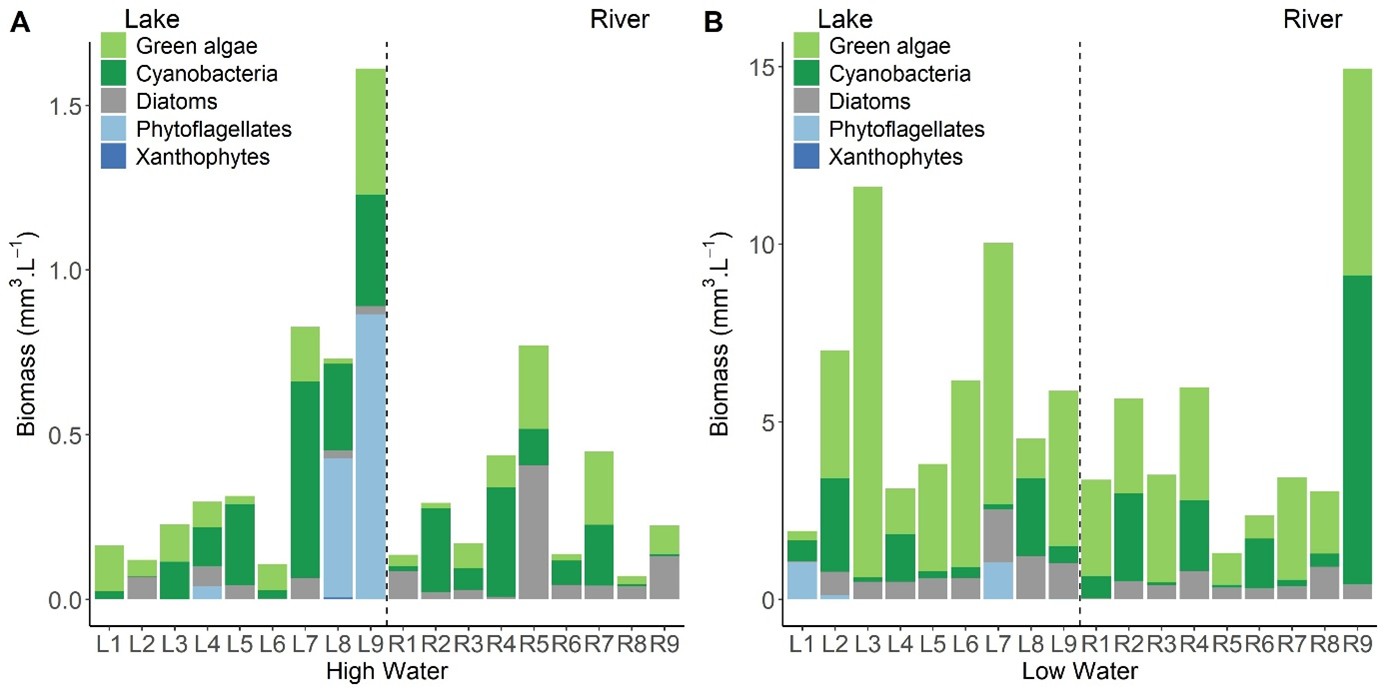
When analyzing the contribution of the type of environment and hydrological periods to biomass, the minimum values occurred in high water (0.0715 mg L-1, Figure 3A) and the maximum values occurred in the low water period (14.947 mg L-1, Figure 3B) and were better represented by green algae and cyanobacteria in both environments. It should be highlighted that flagellates occurred only in the lakes (Lepocinclis acus (OF Müller) B. Marin & Melkonian) (Figure 3A, B).

Total biomass of phytoplankton in both types of environments (lake and river) in the periods of (A) high water (flood and rising) and (B) low water (dry and ebb) sampled in the floodplain of the upper Paraguay river, in 2018. The scales of the graphics are different.
We recorded 20 RFGs (C, D, F, G, H1, J, K, LM, LO, MP, N, P, S1,T, TB, TD, W1, W2, X1, and Z). The phytoplankton community was represented in the high-water period mainly by S1 and P (Figure 4A, B), and in the low water by F, P, K, and G (Figure 4C, D).

Total biomass of phytoplankton (RFG) in both types of environments (lake and river) in the periods of high water: (A) flood, (B) rising and low water: (C) dry, (D) ebb sampled in the floodplain of the upper Paraguay River, in 2018. The scales of the graphics are different.
The largest biomasss in the high-water period were recorded in the lakes (Figure 4) in point L8 in flood (0.947 mg L-1, Figure 5A) represented by the functional group W1 (Lepocinclis acus) and point L9 in rising (1.401 mg L-1, Figure 4B) represented by the functional group S1 (Pseudanabaena sp.). In the Paraguay River in points R4 (0.238 mg L-1- Figure 4A) in flood and R5 in rising (0.597 mg L-1- Figure 4B) by MP (Eunotia sp.) and F (Westella botryoides (West) De Wildeman, and Eutetramorus sp.).

RDA for RFG matrix showing types of environments (A) and phases of hydrological periods (B). Axis RDA 1 concentrated 30.67% of the total variation, and axis RDA 2 captured 19.73%.
In low waters, the highest biomasss in the lakes occurred in points L7 in the dry season (9.305 mg L-1, Figure 4C) and L3 in the ebb season (9.910 mg L-1 - Figure 4D), with a predominance of groups F (Westella botryoides (West) De Wildeman, Treubaria planctonica and Eutetramorus sp.), P (Spirogyra sp., Aulacoseira sp., Fragilaria sp., Closterium incurvum Brébisson and Staurastrum sp.) and J (Desmodesmus sp. and Scenedesmus sp.). On the Paraguay River, the points with the highest biomass were R9 in the dry season (14.462 mg L-1, Figure 4C) and R4 in the ebb season (4.136 mg L-1, Figure 4D), represented by the group’s G, N, and P.
A permutation-based ANOVA (vegan package, R) with 999 permutations was used to assess the significance of environmental variables in a previous RDA model considering all the measured variables. For the functional group's response, the ANOVA results indicate that the most relevant variables influencing the RDA model are Conductivity, Dissolved Oxygen, ORP, Nitrate, and Ammonium. Conductivity, Dissolved Oxygen, and Ammonium are statistically significant (p<0.05), while ORP and Nitrate are significant (p<0.1). Orthophosphate, total nitrogen and pH presented a p-value over 0.5 and were removed from the RDA analysis used to assess the influence of environmental variables on RFGs (Table 2).
Values generated from the redundancy analysis (RDA) concerning the functional groups (RFG) sampled in the floodplain of the upper Paraguay River, in 2018.
The environmental variables influenced the RFGs at 30.67% according to the RDA analysis (Table 2). The first axis is being interpreted. The predictive capacity (adjusted R2) of the environmental variables was 0.07 for the functional group's response (Table 2). No collinearity was detected within the variables of both tested models.
For RFG groups, RDA shows that groups S1 and N are more influenced by changes occurring in lakes (Figure 5A). The hydrological periods are distinct when categorized by functional groups, and the environmental variables that influenced low water were ammonium, and redox potential (ORP) while for high water the more relevant variables was conductivity (Figure 5B).
The PERMANOVA analysis showed that there is a significant effect of the hydrological period for functional groups (Table 3). Betadisper analysis is significant and points to high intern variability when separating the functional groups into hydrological periods.
Parameters of PERMANOVA and betadisper analysis performed for the categories of type of environment (lake and river), and hydrological period (high waters, low waters) concerning the functional groups (RFG) sampled in the floodplain of the upper Paraguay River, in 2018.
4. Discussion
Our results showed that the phytoplankton community presented temporal variation in both environments (lake and river), which demonstrated a regulation by the hydrological period driven by the flood pulse on the community.
The phytoplankton biomass was mainly related to seasonal changes in the water level in the river-floodplain system, with higher biomass in the lowest period and lower in the highest flood period. This response pattern of the phytoplankton community has been documented in floodplains (Bortolini et al., 2014a; Lobo et al., 2018; Loverde-Oliveira & Huszar, 2019), demonstrating that the flood pulse influences the phytoplankton community.
The lowest phytoplankton biomass in the Paraguay River, when compared to its floodplain lake, was probably influenced by factors such as higher and continuous water flow, lower concentrations of nutrients, and higher values of turbidity. The separation between the habitat types (river and lake) and the weak seasonal separation (high and low waters) confirms that, for the Paraguay River, both the local environmental variabilities and the hydrodynamics are better controllers of the phytoplankton community (Reynolds & Descy, 1996; Devercelli, 2010; Fraisse et al., 2013). Although rivers can have optimal concentrations of nutrients for the development of phytoplankton (Jones & Elliott, 2007; Fantin-Cruz et al., 2016), the physical structure of the river systems hinders the establishment and development of phytoplankton due to the runoff that increases the biomass loss (Stanković et al., 2012; Abonyi et al., 2012; Devercelli & O’Farrell, 2013; Fraisse et al., 2013).
In the floodplain lakes of the Paraguay River, the longest water retention time, the light supply, and the concentrations of nutrients above the limitation levels for the phytoplankton population growth (in relation to the soluble reactive phosphorus (3-5 µg.L-1) and dissolved inorganic nitrogen (70-120 µg.L-1; Reynolds, 1997) favored the establishment and development of phytoplankton, especially during low waters, when there is a decrease in the connectivity effect or the complete isolation of the main river lakes, allowing local environmental variability and, above all, the autoecological structuring forces to act more strongly on the colonization and succession processes within the community.
There was a relationship between the phytoplankton biomass and the phases of the hydrological cycle. Similarly, we can relate the largest number of RFGs in the lakes to the typical characteristics of lentic environments (Margalef, 1978; Bortolini et al., 2014b; Török et al., 2016; Moresco et al., 2017; Zanco et al., 2017), whereas in the river it is more difficult to establish the relationship between the environmental conditions and the phytoplankton distribution (Rodrigues et al., 2018).
The RDA suggested that for functional groups the influence of hydrological period is a relevant driver for phytoplanktonic dynamics. The analysis also pointed out that nutrients are the main environmental factors influencing this community in low water period.
Determining patterns of phytoplankton distribution in rivers can be difficult (Nabout et al., 2009) because the distribution of microorganisms is strongly influenced by stochastic dispersion (Soininen et al., 2013). By grouping phytoplankton species into functional groups, we could see the species-environment relationship and understand how the environment can structure the phytoplankton community. The functional groups were able to combine functional traits related to tolerances and sensitivities of specialized species under certain conditions and revealed a significant correlation with the environmental variables.
The period of low water showed greater influence on the variation of the phytoplankton community, considering that it was not possible to establish functional groups that are indicators of predictive capacity in the high waters. It is assumed that this result is related to the higher environmental heterogeneity in periods of dry, to the homogenization caused by the increase in the water levels and by the mass effect of the dispersion of organisms in the rising phase (Thomaz et al., 2007) since phytoplankton have temporal patterns when it comes to environmental changes (Zanco et al., 2017).
We still have to consider the longitudinal heterogeneity of the Paraguay river and the domain theory in our comparisons (Pickett et al., 2007). The lakes located at the end of the section of the Paraguay river presented the largest biomass and phytoplankton functional diversity over the periods of high and low waters, considering that these places occupy a medium section located in an ecotonal area between the deepest sectors of the Paraguay River and the most lacustrine sector, as described by Wantzen et al. (2005). Dunn et al. (2006) argue that higher values of functional diversity in areas similar to those examined in this study are due to the effect of intermediate domain: the contact area between different riverine patterns, higher environmental heterogeneity, and limits of species tolerance.
In the low water season, the environment of the lakes was represented by the RFGs N and G composed of green algae, with requirements of high-water transparency for their development and nutrient-rich conditions in standing water columns (Reynolds et al., 2002; Padisák et al., 2009). The functional groups K and S1 consisted of cyanobacteria that have characteristics of opting for shallow, nutrient-rich water column environments (Padisák et al., 2009), with algae that are widely recognized as typical and abundant in hypereutrophic environments (Borges et al., 2008; Paerl et al., 2011; Soares et al., 2012). The group MP was rather diverse, represented by diatoms, green algae, and cyanobacteria, which have preferences for periphytic and planktonic habitats and can efficiently explore light and nutrients in the surface layers of the water column (Casco & Toja, 1994; Padisák et al., 2009).
In the Paraguay River, the functional groups of the descriptor phytoplankton were the green algae that make up the group J, which is tolerant to the deep mixing and prefers high water transparency (Reynolds, 2002; Padisák et al., 2009; Devercelli et al., 2016). The functional group P is quite typical of lotic environments and, together with D, presented species that were adapted to turbulent environments associated with good mixing and in conditions enriched with nutrients (Reynolds, 1998; Domitrovic et al., 2014). These organisms have a silica cell wall, present a high sedimentation rate (Reynolds et al., 1994; Stević et al., 2013), and depend on the water mixture to remain in the euphotic zone and maintain their biomass (Reynolds et al., 1994; Stević et al., 2013). From the applying the concept of Reynolds Functional Groups (Reynolds, 2002; Padisák et al., 2009) to find dominant species or groups of dominant species that respond to different environmental conditions, we could infer that the floodplain lakes of the Paraguay River are nutrient-rich (nitrogen and phosphate) lentic environments and have good light when compared to the Paraguay River, which, in addition to the continuous flow of water, has physical and chemical characteristics with less availability of these two resources for phytoplankton.
Since organisms that share similar characteristics show a similar response to the organizational factors of the communities (Petchey & Gaston, 2006; Litchman et al., 2012), this study demonstrated that the use of RFGs can be an alternative to obtain ecological and environmental responses in floodplains regarding the seasonal and environmental variation in the landscape. Moreover, it showed that the phytoplanktonic communities in these environments could be regulated by local filters and autecological factors (predation, migration, reproduction rates, and competition) more strongly than the physical and chemical variation of the waters of the studied environments.
5. Conclusion
The relationship between environment and phytoplankton community varied in different types of environment and hydrological periods, thus demonstrating that the species adjust themselves to the changes in the environment in which they live, selecting adapted organisms that when evaluated as phytoplankton functional groups, presented a strong predictive ability describing the characteristics of local habitats.
The structuring of the phytoplankton community was represented by taxonomic and functional groups of phytoplankton of common occurrence in tropical floodplains. Biomass and RFG had variability driven by hydrological periods caused by phases of the flood pulse.
Given the aforementioned aspects, we were able to assess the importance of using functional groups (RFG) to verify the direct association between the phytoplankton community and the floodplain habitats, thus reinforcing the need to maintain the current environmental conditions that mark the peculiarities of the Pantanal wetland, such as the flood pulse.
Data availability
The dataset analyzed in this study can be requested from the corresponding author because the database is being explored by the research group.
Acknowledgements
We thank the Fundação de Amparo à Pesquisa do Mato Grosso for funding this research (Grant Number FAPEMAT 0308817/2017 and CNPq 441563/2016-3) within the scope of the Project Ecological, Economic and Cultural Corridor of the Paraguay River in the Context of Climate Change. We also thank CAPES for granting the Postdoctoral grants to Wilkinson Lázaro, and CNPq for Renata Santos’s scientific initiation and the productivity research fellowship to Carolina J. da Silva within the scope of the Long Duration Ecological Research Project (PELD DARP Pantanal, contribution No. 53). We are grateful to the a Universidade Estadual do Mato Grosso/Centro de Pesquisa em Limnologia, Biodiversidade e Etnobiologia do Pantanal, and to the Instituto Chico Mendes de Conservação da Biodiversidade for field support.
-
Cite as:
Felicio-Santos, R. Predictive capacity of phytoplankton functional groups in a tropical wetland (Pantanal, Brazil). Acta Limnologica Brasiliensia, 2025, vol. 37, e13. https://doi.org/10.1590/S2179-975X7024
References
-
Abonyi, A., Leitão, M., Lançon, A.M. & Padisák, J., 2012. Phytoplankton functional groups as indicators of human impacts along the River Loire (France). Hydrobiologia 69(8), 233-249. http://doi.org/10.1007/s10750-012-1130-0
» http://doi.org/10.1007/s10750-012-1130-0 -
Abonyi, A., Leitão, M., Stanković, I., Borics, G., Várbíró, G. & Padisák, J., 2014. A large river (River Loire, France) survey to compare phytoplankton functional approaches: do they display river zones in similar ways? Ecol. Indic., 46, 11-22. http://doi.org/10.1016/j.ecolind.2014.05.038
» http://doi.org/10.1016/j.ecolind.2014.05.038 -
Abonyi, A., Kiss, K.T., Hidas, A., Borics, G., Várbíró, G., & Ács, E., 2020. Cell size decrease and altered size structure of phytoplankton constrain ecosystem functioning in the middle Danube River over multiple decades. Ecosystems (N. Y.) 23(6), 1254-1264. http://doi.org/10.1007/s10021-019-00467-6
» http://doi.org/10.1007/s10021-019-00467-6 -
Alho, C.J.R. & Silva, J.S.V., 2012. Effects of severe floods and droughts on wildlife of the Pantanal wetland (Brazil). Animals 2(4), 591-610. PMid:26487165. http://doi.org/10.3390/ani2040591
» http://doi.org/10.3390/ani2040591 - American Public Health Association – APHA, 2005. Standard methods for the examination of water and wastewater. Washington: APHA, 21th ed.
-
Beck, M.W., 2017. ggord: Ordination Plots with ggplot2. R package version 1.0.0 [software]. Retrieved in 2024, July 30, from https://zenodo.org/badge/latestdoi/35334615
» https://zenodo.org/badge/latestdoi/35334615 -
Bolgovics, Á., Várbíró, G., Ács, É., Trábert, Z., Kiss, K.T., Pozderka, V., Görgényi, J., Boda, P., Lukács, B.A., Nagy‑László, Z., Abonyi, A., & Borics, G., 2017. Phytoplankton of rhithral rivers: its origin, diversity and possible use for quality‑assessment. Ecol. Indic. 81, 587-596. http://doi.org/10.1016/j.ecolind.2017.04.052
» http://doi.org/10.1016/j.ecolind.2017.04.052 -
Borcard, D., Gillet, F. & Legendre, P., 2011. Numerical ecology with R. New York: Springer. http://doi.org/10.1007/978-1-4419-7976-6
» http://doi.org/10.1007/978-1-4419-7976-6 -
Borges, P.A.F., Train, S. & Rodrigues, L.C., 2008. Spatial and temporal variation of phytoplankton in two subtropical Brazilian reservoirs. Hydrobiologia 607(1), 63-74. http://doi.org/10.1007/s10750-008-9367-3
» http://doi.org/10.1007/s10750-008-9367-3 -
Borics, G., Tóthmérész, B., Lukács, B. & Várbíró, G., 2012. Functional groups of phytoplankton shaping diversity of shallow lake ecosystems. Hydrobiologia 698(1), 251-262. http://doi.org/10.1007/s10750-012-1129-6
» http://doi.org/10.1007/s10750-012-1129-6 -
Bortolini, J.C., Bovo-Scomparin, V.M., Paula, A.C.M., Moresco, G.A., Reis, L.M., Jati, S. & Rodrigues, L.C., 2014a. Composition and species richness phytoplankton in a subtropical floodplain lake: a long-term study. Acta Limnol. Bras., 26(3), 296-305. http://doi.org/10.1590/S2179-975X2014000300009
» http://doi.org/10.1590/S2179-975X2014000300009 -
Bortolini, J.C., Rodrigues, L.C., Jati, S. & Train, S., 2014b. Phytoplankton functional and morphological groups as indicators of environmental variability in a lateral channel of the Upper Paraná River floodplain. Acta Limnol. Bras., 26(1), 98-108. http://doi.org/10.1590/S2179-975X2014000100011
» http://doi.org/10.1590/S2179-975X2014000100011 -
Bovo-Scomparin, V.M. & Train, S., 2008. Long-term variability of the phytoplankton community in an isolated floodplain lake of the Ivinhema River State Park, Brazil. Hydrobiologia 610(1), 331-344. http://doi.org/10.1007/s10750-008-9448-3
» http://doi.org/10.1007/s10750-008-9448-3 - Brasil. Agência Nacional de Águas - ANA, 2005. Strategic action program for the integrated management of the Pantanal and the upper Paraguay river basin. Brasília, DF: ANA/GEF/PNUMA/OEA.
- Casco, M.A. & Toja, J., 1994. The distribution and interaction of algal communities in reservoirs. Arch. Hydrobiol. Beih. Ergenbn. Limnol., 40, 85-96.
-
Cronberg, G. & Komárek, J., 2004. Some nostocalean cyanoprokaryotes from lentic habitats of Eastern and Southern Africa. Nova Hedwigia 78(1-2, Suppl. 78), 71-106. http://doi.org/10.1127/0029-5035/2004/0078-0071
» http://doi.org/10.1127/0029-5035/2004/0078-0071 -
Devercelli, M. & O’Farrell, I., 2013. Factors affecting the structure and maintenance of phytoplankton functional groups in a nutrient rich lowland river. Limnologica 43(2), 67-78. http://doi.org/10.1016/j.limno.2012.05.001
» http://doi.org/10.1016/j.limno.2012.05.001 -
Devercelli, M., 2006. Phytoplankton of the Middle Paraná River during an anomalous hydrological period: a morphological and functional approach. Hydrobiologia 563(1), 465-478. http://doi.org/10.1007/s10750-006-0036-0
» http://doi.org/10.1007/s10750-006-0036-0 -
Devercelli, M., 2010. Changes in phytoplankton morpho-functional groups induced by extreme hydroclimatic events in the Middle Paraná river (Argentina). Hydrobiologia 639(1), 5-19. http://doi.org/10.1007/s10750-009-0020-6
» http://doi.org/10.1007/s10750-009-0020-6 -
Devercelli, M., Scarabotti, P., Mayora, G., Schneider, B. & Giri, F., 2016. Unravelling the role of determinism and stochasticity in structuring the phytoplanktonic metacommunity of the Paraná River floodplain. Hydrobiologia 764(1), 139-156. http://doi.org/10.1007/s10750-015-2363-5
» http://doi.org/10.1007/s10750-015-2363-5 -
Domitrovic, Y.Z., 2003. Effect of fluctuations in water level on phytoplankton development in three lakes of the Paraná river floodplain (Argentina). Hydrobiologia 510(1-3), 175-193. http://doi.org/10.1023/B:HYDR.0000008643.50105.4b
» http://doi.org/10.1023/B:HYDR.0000008643.50105.4b -
Domitrovic, Y.Z., Devercelli, M. & Forastier, M.E., 2014. Phytoplankton of the paraguay and Bermejo rivers. Adv. Limnol., 65, 67-80. http://doi.org/10.1127/1612-166X/2014/0065-0034
» http://doi.org/10.1127/1612-166X/2014/0065-0034 - Dunn, R.R., Colwell, R.K. & Nilsson, C., 2006. The River Domain: why are there so many species half way up the river? Ecography 29(2), 251-259. http://doi.org/10.1111/j.2006.0906-7590.04259.x.
-
Fantin-Cruz, I., Pedrollo, O., Girard, P., Zeilhofer, P. & Hamilton, S.K., 2016. Changes in river water quality caused by a diversion hydropower dam bordering the Pantanal floodplain. Hydrobiologia 768(1), 223-238. http://doi.org/10.1007/s10750-015-2550-4
» http://doi.org/10.1007/s10750-015-2550-4 -
Fraisse, S., Bormans, M. & Lagadeuc, Y., 2013. Morphofunctional traits reflect differences in phytoplankton community between rivers of contrasting flow regime. Aquat. Ecol., 47(3), 315-327. http://doi.org/10.1007/s10452-013-9446-z
» http://doi.org/10.1007/s10452-013-9446-z -
Hamilton, S.K., Sippel, S.J. & Melack, J.M., 1996. Inundation patterns in the Pantanal wetland of South America determined from passive microwave remote sensing. Arch. Hydrobiol., 137(1), 1-23. http://doi.org/10.1127/archiv-hydrobiol/137/1996/1
» http://doi.org/10.1127/archiv-hydrobiol/137/1996/1 -
Hillebrand, H., Dürselen, C.D., Kirschtel, D., Pollingher, U. & Zohary, T., 1999. Biomass calculation for pelagic and benthic microalgae. J. Phycol., 35(2), 403-424. http://doi.org/10.1046/j.1529-8817.1999.3520403.x
» http://doi.org/10.1046/j.1529-8817.1999.3520403.x -
Iglesias‐Rodríguez, M.D., Brown, C.W., Doney, S.C., Kleypas, J., Kolber, D., Kolber, Z., Hayes, P.K. & Falkowski, P.G., 2002. Representing key phytoplankton functional groups in ocean carbon cycle models: coccolithophorids. Global Biogeochem. Cycles 16(4), 47-1-47-20. http://doi.org/10.1029/2001GB001454
» http://doi.org/10.1029/2001GB001454 -
Jackson, D.A., 1993. Stopping rules in principal components analysis: a comparison of Heuristical and Statistical approaches. Ecology 74(8), 2204-2214. http://doi.org/10.2307/1939574
» http://doi.org/10.2307/1939574 -
Jones, I.D. & Elliott, J.Á., 2007. Modelling the effects of changing retention time on abundance and composition of phytoplankton species in a small lake. Freshw. Biol., 52(6), 988-997. http://doi.org/10.1111/j.1365-2427.2007.01746.x
» http://doi.org/10.1111/j.1365-2427.2007.01746.x -
Junk, W. & Cunha, C.N., 2005. Pantanal: a large South American wetland at a crossroads. Ecol. Eng., 24(4), 391-401. http://doi.org/10.1016/j.ecoleng.2004.11.012
» http://doi.org/10.1016/j.ecoleng.2004.11.012 - Junk, W.J., Bayley, P.B. & Sparks, R.E., 1989. The flood pulse concept in river-floodplain systems. Can. Spec. Publ. Fish. Aquat. Sci., 106, 110-127.
-
Junk, W.J., Cunha, C.N., Wantzen, K.M., Petermann, P., Strussmann, C., Marques, M.I. & Adis, J., 2006. Biodiversity and its conservation in the Pantanal of Mato Grosso, Brazil. Aquat. Sci., 68(3), 278-309. http://doi.org/10.1007/s00027-006-0851-4
» http://doi.org/10.1007/s00027-006-0851-4 -
Junk, W.J., Piedade, M.T.F., Schöngart, J., Cohn-Haft, M., Adeney, J.M. & Wittmann, F., 2011. A Classification of major naturally-occurring amazonian lowland wetlands. Wetlands 31(4), 623-640. http://doi.org/10.1007/s13157-011-0190-7
» http://doi.org/10.1007/s13157-011-0190-7 - Komárek, J. & Anagnostidis, K., 2000. Cyanoprokaryota. 1. Teil: Chroococcales. Berlin: Spektrum.
- Komárek, J. & Anagnostidis, K., 2005. Cyanoprokaryota. pt.2 Oscillatoriales. In: Büdel, B., Krienitz, L., Gärtner, G. & Schagerl, M., eds. Süsswasserflora von Mitteleuropa. München: Elsevier, 759 p., vol. 19/1. https://doi.org/10.4236/apm.2015.52012.
- Komárek, J. & Cronberg, G., 2001. Some chroococcalean and oscillatorialean Cyanoprokaryotes from southern African lakes, ponds and pools. Nova Hedwigia. Z. Kryptogamenkunde 73(1-2), 129-160. https://doi.org/10.1127/nova.hedwigia/73/2001/129.
-
Kruk, C. & Segura, A.M., 2012. The habitat template of phytoplankton morphology-based functional groups. Hydrobiologia 698(1), 191-202. http://doi.org/10.1007/s10750-012-1072-6
» http://doi.org/10.1007/s10750-012-1072-6 -
Kruk, C., Devercelli, M., Huszar, V.L.M., Hernández, E., Beamud, G., Diaz, M., Silva, L.H.S. & Segura, A.M., 2017. Classification of Reynolds phytoplankton functional groups using individual traits and machine learning techniques. Freshw. Biol., 62(10), 1681-1692. http://doi.org/10.1111/fwb.12968
» http://doi.org/10.1111/fwb.12968 -
Kruk, C., Huszar, V.L.M., Peeters, E.T.H.M., Bonilla, S., Costa, L., Lürling, M., Reynolds, C. & Scheffer, M., 2010. A morphological classification capturing functional variation in phytoplankton. Freshw. Biol., 55(3), 614-627. http://doi.org/10.1111/j.1365-2427.2009.02298.x
» http://doi.org/10.1111/j.1365-2427.2009.02298.x -
Legendre, P. & Gallagher, E.D., 2001. Ecologically meaningful transformations for ordination of species data. Oecologia 129(2), 271-280. PMid:28547606. http://doi.org/10.1007/s004420100716
» http://doi.org/10.1007/s004420100716 - Legendre, P. & Legendre, L.F.J., 1998. Numerical ecology. Oxford: Elsevier.
-
Litchman, E. & Klausmeier, C.A., 2008. Trait-based community ecology of Phytoplankton. Annu. Rev. Ecol. Evol. Syst., 39(1), 615-639. http://doi.org/10.1146/annurev.ecolsys.39.110707.173549
» http://doi.org/10.1146/annurev.ecolsys.39.110707.173549 -
Litchman, E., Edwards, K.F., Klausmeier, C.A., & Thomas, M.K., 2012. Phytoplankton niches, traits and eco-evolutionary responses to global environmental change. Mar. Ecol. Prog. Ser. 470, 235-248. http://doi.org/10.3354/meps09912
» http://doi.org/10.3354/meps09912 -
Lobo, M.T.M.P.S., Nogueira, I.S., Sgarbi, F.L., Kraus, C.N., Bombim, E.O., Garnier, J., Marques, D.M. & Bonnet, M.P., 2018. Morphology-based functional groups as the best tool to characterize shallow lake-dwelling phytoplankton on an Amazonian floodplain. Ecol. Indic., 95, 579-588. http://doi.org/10.1016/j.ecolind.2018.07.038
» http://doi.org/10.1016/j.ecolind.2018.07.038 -
Loverde-Oliveira, S.M. & Huszar, V.L.M., 2007. Phytoplankton ecological responses to the flood pulse in a Pantanal lake, Central Brazil. Acta Limnol. Bras., 19, 117-130. Retrieved in 2024, July 30, from https://actalb.org/article/627b11ef782aad05cf549235/pdf/alb-19-2-117.pdf
» https://actalb.org/article/627b11ef782aad05cf549235/pdf/alb-19-2-117.pdf - Loverde-Oliveira, S.M. & Huszar, V.L.M., 2019. Phytoplankton functional groups driven by alternative states in a tropical floodplain lake (Pantanal, Brazil). Ecol. Austral 23(04), 926-939. https://doi.org/10.4257/oeco.2019.2304.16.
- Loverde-Oliveira, S.M., Adler, M. & Pinto-Silva, V., 2011. Phytoplankton, periphyton and metaphyton. In: Junk, W.J., Da Silva, C.J., Cunha, C.N. & Wantzen, K.M., eds. The Pantanal: ecology, biodiversity and sustainable management of a large neotropical seasonal wetland. Sofia-Moscow: Pensoft.
-
Loverde-Oliveira, S.M., Huszar, V.L.M., Mazzeo, N. & Scheffer, M., 2009. Hydrology-driven regime shifts in a shallow tropical lake. Ecosystems 12(5), 807-819. http://doi.org/10.1007/s10021-009-9258-0
» http://doi.org/10.1007/s10021-009-9258-0 - Loverde-Oliveira, S.M., Pietro-Souza, W., Cardoso, S.J., Fantin-Cruz, I. & Mateus, L., 2012. Fatores associados à distribuição espacial do fitoplâncton em lagos de inundação (Pantanal Norte, Brasil). Ecol. Austral 16(4), 770-781. https://doi.org/10.4257/oeco.2012.1604.04.
-
Lund, J.W.G., Kipling, C. & Le Cren, E.D.E., 1958. The inverted microscope method of estimating algal numbers and the statistical basis of estimations by counting. Hydrobiologia 11(2), 143-170. http://doi.org/10.1007/BF00007865
» http://doi.org/10.1007/BF00007865 -
Margalef, R., 1978. Life-forms of phytoplankton as survival alternatives in an unstable environment. Oceanol. Acta 1, 493-509. Retrieved in 2024, July 30, from https://archimer.ifremer.fr/doc/00123/23403/
» https://archimer.ifremer.fr/doc/00123/23403/ -
Mieleitner, J., Borsuk, M., Bürgi, H.R. & Reichert, P., 2008. Identifying functional groups of phytoplankton using data from three lakes of different trophic state. Aquat. Sci., 70(1), 30-46. http://doi.org/10.1007/s00027-007-0940-z
» http://doi.org/10.1007/s00027-007-0940-z -
Mihaljević, M., Stević, F., Horvatić, J., & Hackenberger Kutuzović, B., 2009. Dual impact of the flood pulses on the phytoplankton assemblages in a Danubian floodplain lake (Kopački Rit Nature Park, Croatia). Hydrobiologia 618(1), 77-88. http://doi.org/10.1007/s10750-008-9550-6
» http://doi.org/10.1007/s10750-008-9550-6 -
Moresco, G.A., Bortolini, J.C., Dias, J.D., Pineda, A., Jati, S. & Rodrigues, L.C., 2017. Drivers of phytoplankton richness and diversity components in Neotropical floodplain lakes, from small to large spatial scales. Hydrobiologia 799(1), 203-215. http://doi.org/10.1007/s10750-017-3214-3
» http://doi.org/10.1007/s10750-017-3214-3 -
Moresco, G.A., Bortolini, J.C., Rodrigues, L.C., Jati, S. & Velho, L.F.M., 2020. A functional deconstructive approach to mixotrophic phytoplankton responds better to local, regional and biogeographic predictors than species. Austral Ecol. 45(2), 249-263. http://doi.org/10.1111/aec.12852
» http://doi.org/10.1111/aec.12852 -
Mutshinda, C.M., Finkel, Z.V., Widdicombe, C.E. & Irwin, A.J., 2016. Ecological equivalence of species within phytoplankton functional groups. Funct. Ecol., 30(10), 1714-1722. http://doi.org/10.1111/1365-2435.12641
» http://doi.org/10.1111/1365-2435.12641 -
Nabout, J.C., Nogueira, I.S. & Oliveira, L.G., 2006. Phytoplankton community of floodplain lakes of the Araguaia River, Brazil, in the rainy and dry seasons. J. Plankton Res., 28(2), 181-193. http://doi.org/10.1093/plankt/fbi111
» http://doi.org/10.1093/plankt/fbi111 -
Nabout, J.C., Siqueira, T., Bini, L.M. & Nogueira, I.D.S., 2009. No evidence for environmental and spatial processes in structuring phytoplankton communities. Acta Oecol., 35(5), 720-726. http://doi.org/10.1016/j.actao.2009.07.002
» http://doi.org/10.1016/j.actao.2009.07.002 -
Oksanen, J., Blanchet, F.G., Friendly, M., Kindt, R., Legendre, P., McGlinn, D., Minchin, P.R., O’Hara, R.B., Simpson, G.L., Solymos, P., Stevens, M.H.H., Szoecs, E. & Wagner, H., 2018. Vegan: Community Ecology Package [software]. Retrieved in 2024, July 30, from http://CRAN.R-project.org/package=vegan
» http://CRAN.R-project.org/package=vegan -
Padisák, J., Crossetti, L.O. & Naselli-Flores, L., 2009. Use and misuse in the application of the phytoplankton functional classification: a critical review with updates. Hydrobiologia 621(1), 1-19. http://doi.org/10.1007/s10750-008-9645-0
» http://doi.org/10.1007/s10750-008-9645-0 -
Paerl, H.W., Hall, N.S. & Calandrino, E.S., 2011. Controlling harmful cyanobacterial blooms in a world experiencing anthropogenic and climatic-induced change. Sci. Total Environ., 409(10), 1739-1745. PMid:21345482. http://doi.org/10.1016/j.scitotenv.2011.02.001
» http://doi.org/10.1016/j.scitotenv.2011.02.001 -
Pearson, K., 1901. On lines and planes of closest fit to systems of points in space. Philos. Mag., 2(11), 559-572. http://doi.org/10.1080/14786440109462720
» http://doi.org/10.1080/14786440109462720 -
Peel, M.C., Finlayson, B.L. & McMahon, T., 2007. Updated world map of the K ̈oppen-Geiger climate classification. Hydrol. Earth Syst. Sci., 11(5), 1633-1644. http://doi.org/10.5194/hess-11-1633-2007
» http://doi.org/10.5194/hess-11-1633-2007 -
Petchey, O.L. & Gaston, K.J., 2006. Functional diversity: back to basics and looking forward. Ecol. Lett., 9(6), 741-758. PMid:16706917. http://doi.org/10.1111/j.1461-0248.2006.00924.x
» http://doi.org/10.1111/j.1461-0248.2006.00924.x -
Pickett, S.T.A., Belt, K.T., Galvin, M.F., Groffman, P.M., Grove, J.M., Outen, D.C., Pouyat, R.V., Stack, W.P. & Cadenasso, M.L., 2007. Watersheds in Baltimore, Maryland: understanding and application of integrated ecological and social processes. J. Contemp. Watershed Res. Appl., 136(1), 44-55. http://doi.org/10.1111/j.1936-704X.2007.mp136001006.x
» http://doi.org/10.1111/j.1936-704X.2007.mp136001006.x -
Quéré, C.L., Harrison, S.P., Colin Prentice, I., Buitenhuis, E.T., Aumont, O., Bopp, L., Claustre, H., Cotrim Da Cunha, L., Geider, R., Giraud, X., Klaas, C., Kohfeld, K.E., Legendre, L., Manizza, M., Platt, T., Rivkin, R.B., Sathyendranath, S., Uitz, J., Watson, A.J., & Wolf-Gladrow, D., 2005. Ecosystem dynamics based on plankton functional types for global ocean biogeochemistry models. Glob. Change Biol., 11(11), 2016-2040. http://doi.org/10.1111/j.1365-2486.2005.1004.x
» http://doi.org/10.1111/j.1365-2486.2005.1004.x -
Quinn, G.P. & Keough, M.J., 2002. Experimental design and data analysis for biologists. Cambridge: Cambridge University Press. http://doi.org/10.1017/CBO9780511806384
» http://doi.org/10.1017/CBO9780511806384 -
R Development Core Team, 2020. R: a language and environment for statistical computing [software]. Vienna: R Foundation for Statistical Computing. Retrieved in 2024, July 30, from http://www.r-project.org/
» http://www.r-project.org/ - Reynolds, C.S. 1984. The ecology of freshwater phytoplankton. Cambridge: Cambridge University Press.
- Reynolds, C.S., 1997. Vegetation processes in the pelagic: a model for ecosystem theory. Oldendorf-Luhe: Ecology Institute.
-
Reynolds, C.S., 1998. The state of freshwater ecology. Freshw. Biol., 39(4), 741-753. http://doi.org/10.1046/j.1365-2427.1998.00315.x
» http://doi.org/10.1046/j.1365-2427.1998.00315.x -
Reynolds, C.S., 2002. Ecological pattern and ecosystem theory. Ecol. Modell., 158(3), 181-200. http://doi.org/10.1016/S0304-3800(02)00230-2
» http://doi.org/10.1016/S0304-3800(02)00230-2 -
Reynolds, C.S., 2012. Environmental requirements and habitat preferences of phytoplankton: chance and certainty in species selection. Bot. Mar., 55(1), 1-17. http://doi.org/10.1515/bot.2011.121
» http://doi.org/10.1515/bot.2011.121 -
Reynolds, C.S., Descy, J.P. & Padisák, J., 1994. Are phytoplankton dynamics in rivers so different from those in shallow lakes? Hydrobiologia 289, 1-7. http://doi.org/10.1007/BF00007404
» http://doi.org/10.1007/BF00007404 - Reynolds, C.S. & Descy, J., 1996. The production, biomass and structure of phytoplankton in large rivers. Large Rivers 10(1-4), 161-187.
-
Reynolds, C.S., Huszar, V., Kruk, C., Naselli-Flores, L. & Melo, S., 2002. Towards a functional classification of the freshwater phytoplankton. J. Plankton Res., 24(5), 417-428. http://doi.org/10.1093/plankt/24.5.417
» http://doi.org/10.1093/plankt/24.5.417 -
Roberts, D.W., 2016. labdsv: ordination and multivariate analysis for ecology [software]. Vienna: R Foundation for Statistical Computing. Retrieved in 2024, July 30, from https://cran.r-project.org/web/packages/labdsv/labdsv.pdf
» https://cran.r-project.org/web/packages/labdsv/labdsv.pdf -
Rodrigues, L.C., Pivato, B.M., Vieira, L.C.G., Bovo-Scomparin, V.M., Bortolini, J.C., Pineda, A. & Train, S., 2018. Use of phytoplankton functional groups as a model of spatial and temporal patterns in reservoirs: a case study in a reservoir of central Brazil. Hydrobiologia 805(1), 147-161. http://doi.org/10.1007/s10750-017-3289-x
» http://doi.org/10.1007/s10750-017-3289-x -
Ryo, M., Aguilar-Trigueros, C.A., Pinek, L., Muller, L.A.H. & Rillig, M.C., 2019. Basic principles of temporal dynamics. Trends Ecol. Evol., 34(8), 723-733. PMid:31010706. http://doi.org/10.1016/j.tree.2019.03.007
» http://doi.org/10.1016/j.tree.2019.03.007 -
Salmaso, N. & Padisák, J., 2007. Morpho-functional groups and phytoplankton development in two deep lakes (Lake Garda, Italy and Lake Stechlin, Germany). Hydrobiologia 578(1), 97-112. http://doi.org/10.1007/s10750-006-0437-0
» http://doi.org/10.1007/s10750-006-0437-0 -
Scheffer, M. & Van Nes, E.H., 2006. Self-organized similarity, the evolutionary emergence of groups of similar species. Proc. Natl. Acad. Sci. USA 103(16), 6230-6235. PMid:16585519. http://doi.org/10.1073/pnas.0508024103
» http://doi.org/10.1073/pnas.0508024103 -
Schleuter, D., Daufresne, M., Massol, F. & Argillier, C., 2010. A user’s guide to functional diversity indices. Ecol. Monogr., 80(3), 469-484. http://doi.org/10.1890/08-2225.1
» http://doi.org/10.1890/08-2225.1 -
Silva, C.J. & Girard, P., 2004. New challenges in the management of the Brazilian Pantanal and catchment area. J. Ecol. Manage., 12(6), 553-561. http://doi.org/10.1007/s11273-005-1755-0
» http://doi.org/10.1007/s11273-005-1755-0 -
Soares, M.C.S., Marinho, M.M., Azevedo, S.M.O.F., Branco, C.W.C. & Huszar, V.L.M., 2012. Eutrophication and retention time affecting spatial heterogeneity in a tropical reservoir. Limnologica 42(3), 197-203. http://doi.org/10.1016/j.limno.2011.11.002
» http://doi.org/10.1016/j.limno.2011.11.002 -
Soininen, J., Korhonen, J.J. & Luoto, M., 2013. Stochastic species distributions are driven by organism size. Ecology 94(3), 660-670. PMid:23687892. http://doi.org/10.1890/12-0777.1
» http://doi.org/10.1890/12-0777.1 -
Stanković, I., Vlahović, T., Udovič, G.M., Várbíró, G. & Borics, G., 2012. Phytoplankton functional and morpho-functional approach in large floodplain rivers. Hydrobiologia 698(1), 217-231. http://doi.org/10.1007/s10750-012-1148-3
» http://doi.org/10.1007/s10750-012-1148-3 -
Stević, F., Mihaljević, M. & Špoljarić, D., 2013. Changes of phytoplankton functional groups in a floodplain lake associated with hydrological perturbations. Hydrobiologia 709(1), 143-158. http://doi.org/10.1007/s10750-013-1444-6
» http://doi.org/10.1007/s10750-013-1444-6 -
Sun, J. & Liu, D., 2003. Geometric models for calculating cell biovolume and surface area for phytoplankton. J. Plankton Res., 25(11), 1331-1346. http://doi.org/10.1093/plankt/fbg096
» http://doi.org/10.1093/plankt/fbg096 -
Thomaz, S.M., Bini, L.M. & Bozelli, R.L., 2007. Floods increase similarity among aquatic habitats in river-floodplain systems. Hydrobiologia 579(1), 1-13. http://doi.org/10.1007/s10750-006-0285-y
» http://doi.org/10.1007/s10750-006-0285-y -
Török, P., T-Krasznai, E., B-Béres, V., Bácsi, I., Borics, G. & Tóthmérész, B., 2016. Functional diversity supports the biomass-diversity humped-back relationship in phytoplankton assemblages. Funct. Ecol., 30(9), 1593-1602. http://doi.org/10.1111/1365-2435.12631
» http://doi.org/10.1111/1365-2435.12631 - Uhelinger, V., 1964. Étude statistique des méthodes de dénombrement planctonique. Arch. Sci. 17, 121-123.
- Utermöhl, H., 1958. Zur Vervollkommnung der quantitativen Phytoplankton-Methodik. Mitteilungen. Der. Int. Vereinigung. Für. Theor. Und. Angew. Limnol., 9(1), 1-38. https://doi.org/10.1080/05384680.1958.11904091.
- van den Hoeck, C., Mann, D.G. & Jahns, H.M., 1997. Algae: an introduction to Phycology. Cambridge: Cambridge University Press.
- Wantzen, K.M., Drago, E. & Da Silva, C.J., 2005. Aquatic habitats of the Upper Paraguay river-floodplainsystem and parts of the Pantanal (Brazil). Ecohydrol. Hydrobiol., 5, 107-126.
-
Zanco, B.F., Pineda, A., Bortolini, J.C., Jati, S. & Rodrigues, L.C., 2017. Phytoplankton functional groups indicators of environmental conditions in floodplain rivers and lakes of the Paraná Basin. Acta Limnol. Bras., 65(0), 119e. http://doi.org/10.1590/s2179-975x8117
» http://doi.org/10.1590/s2179-975x8117
Edited by
-
Associate Editor:
Carla Ferragut.