 Integrated Organic Geochemistry and Palynofacies Analysis of Organic Matter in the Pirara Formation, Tacutu Basin
Abstract
The Tacutu Basin developed during the Mesozoic from an intracontinental rift related to a triple junction formed in the Jurassic. It is located on the border between the state of Roraima, Brazil, and the Upper Takutu-Upper Essequibo district, Guyana. The Pirara Formation, the focus of this research, represents the rift phase of this basin and is composed of evaporitic, carbonate, and pelitic rocks. The age and depositional environment of this unit remain unclear, generating debate regarding its origin. This study is unique as it’s the first time that these samples from the Pirara Formation, a non-outcrop unit in the Brazilian portion of the Tacutu Basin, are analyzed and integrated in public domain. This material originated from two shallow core wells, approximately 40 m deep, drilled in the border region between Brazil and Guyana. The methodology employed involves organic geochemistry (TOC and Rock-Eval Pyrolysis) and palynofacies. Organic geochemistry data revealed high total organic carbon (TOC) levels, ranging from 2% to 8%, indicating a well-preserved organic matter content and significant hydrocarbon-generating potential. Hydrogen Index (HI) and Oxygen Index (OI) values indicate the presence of Type II, III, and IV kerogens, suggesting continental organic matter that has undergone varying degrees of oxidation and thermal maturation. The palynofacies indicate a predominance of organic matter of terrestrial origin, corroborated by the absence of marine palynological components. These results suggest significant variations in the paleoenvironmental conditions and the deposition and preservation processes of the Pirara Formation.
Keywords:
Jurassic; TOC; Hydrocarbon
Resumo
A Bacia do Tacutu se desenvolveu durante o Mesozóico a partir de um rifte intracontinental relacionado a uma junção tripla formada no Jurássico. Está localizada na fronteira entre o estado de Roraima, Brasil, e o distrito de Upper Takutu-Upper Essequibo, Guiana. A Formação Pirara, foco desta pesquisa, representa a fase de rifte dessa bacia e é composta por rochas evaporíticas, carbonáticas e pelíticas. A idade e o ambiente deposicional dessa unidade permanecem incertos, gerando debates sobre sua origem. Este estudo é único, pois é a primeira vez que essas amostras da Formação Pirara, uma unidade não aflorante na porção brasileira da Bacia do Tacutu, são analisadas e integradas em domínio público. Este material se originou de dois poços rasos com testemunho, de aproximadamente 40 m de profundidade, perfurados na região de fronteira entre Brasil e Guiana. A metodologia empregada envolve geoquímica orgânica (COT e Pirólise Rock-Eval) e palinofácies. Os dados de geoquímica orgânica revelaram altos níveis de carbono orgânico total (COT), variando de 2% a 8%, indicando conteúdo de matéria orgânica bem preservado e significativo potencial gerador de hidrocarbonetos. Os valores de Índice de Hidrogênio (HI) e Índice de Oxigênio (OI) indicam a presença de querogênios dos Tipos II, III e IV, sugerindo uma mistura heterogênea de matéria orgânica marinha e continental que passou por diferentes graus de oxidação e maturação térmica. As palinofácies indicam predominância de matéria orgânica de origem terrestre, corroborada pela ausência de componentes palinológicos marinhos. Esses resultados sugerem variações significativas nas condições paleoambientais e nos processos de deposição e preservação da Formação Pirara.
Palavras-chave:
Jurássico; COT; Hidrocarbonetos
1 Introduction
The Tacutu Basin originated as part of a Mesozoic rift system associated with extensional tectonic activity that influenced the Caribbean region during the early stages of Gondwana's breakup. This rift system, linked to the formation of a Jurassic triple junction during the opening of the Central Atlantic Ocean, is classified as an aborted rift. Structurally, the basin evolved as an asymmetric half-graben within the Guiana Shield, located in the northern sector of the Amazonian Craton.
It is approximately 300 km long and 30 to 50 km wide, trending NE-SW, and lies along the border between the state of Roraima, Brazil, and the Upper Takutu-Upper Essequibo district, Guyana. The basin's filling comprises sedimentary and volcano-sedimentary rocks, stacked in seven main lithostratigraphic units: The Apoteri, Manari, Pirara, Tacutu, and Serra Tucano Formations, from Mesozoic age (Eiras, Kinoshita & Feijó 1994); and the Boa Vista and Areias Brancas Formations, of Cenozoic age (Reis, Faria & Maia 2002).
The sedimentary evolution of the Tacutu Basin during the Mesozoic remains a subject of ongoing debate. While some authors propose a predominantly continental-lacustrine succession (Eiras, Kinoshita & Feijó 1994; Vaz, Wanderley Filho & Bueno 2007; Castro et al. 2021), others suggest the possibility of marine incursions between the Jurassic and Cretaceous periods, potentially linked to the Caribbean rift system that preceded the opening of the Central Atlantic (McConnell 1969). The Pirara Formation, in particular, is poorly studied in Brazil due to limited outcrop exposure and a lack of detailed investigations. Its age and depositional environment remain uncertain, though it is frequently attributed to the Jurassic. However, there is insufficient evidence to confirm this age, and interpretations of its paleoenvironment vary, ranging from continental lacustrine settings to episodic marine influences.
In this context, the integrated application of palynofacies and organic geochemistry emerges as a fundamental methodological approach for advancing knowledge about this unit. These techniques allow the characterization of sedimentary organic matter, offering valuable insights for paleoenvironmental reconstruction, identification of organic preservation conditions, inference of paleoclimates, and delimitation of potential hydrocarbon-generating zones.
Therefore, the main objective of this work is to characterize the organic facies and infer the depositional paleoenvironment of the Pirara Formation, based on the analysis of core samples obtained from two shallow wells, RR01 and RR02. Through the integration of sedimentological, geochemical and palynological data, we seek to establish a better understanding of the depositional processes and chronology of this unit, in addition to highlighting the relevance of organic matter in the exploratory context of the basin.
2 Methodology and Data
The samples came from shallow, continuously and conventionally cored wells RR01 and RR02 (Figure 1) drilled in the municipality of Bonfim, Roraima state. In well RR01, 33 fragment samples from the core were analyzed with an investigation interval starting from 8.70 m to 40.15 m depth, corresponding to the Pirara Formation. In well RR02, 24 fragment samples from the core were analyzed with an investigation interval starting from 12 m to 39 m depth, also corresponding to the Pirara Formation.

2.1 Total Organic Carbon (TOC) and Rock-Eval Pyrolysis
To determine Total Organic Carbon (TOC) percentages, samples were acidified with 50% HCl to remove carbonates and subsequently analyzed using a LECO SC632 analyzer. All sample processing was conducted at the Laboratory of Chemical Stratigraphy and Organic Geochemistry (LGQM), State University of Rio de Janeiro (UERJ), Rio de Janeiro, Brazil. Rock-Eval Pyrolysis was performed using Rock-Eval 6 equipment, following the standardized methodology outlined by (Espitalié et al. 1977). Approximately 70 mg of pulverized sample was subjected to programmed heating in an inert nitrogen atmosphere, with a heating rate of 25°C/min, starting at 300°C and reaching a final temperature of 650°C. The parameters obtained during the test include:
-
S1 (mg HC/g rock): free hydrocarbons present in the rock pores;
-
S2 (mg HC/g rock): hydrocarbons generated by the thermal cracking of kerogen;
-
S3 (mg CO₂/g rock): carbon dioxide released between 300°C and 390°C;
-
Tmax (°C): temperature corresponding to the maximum peak of hydrocarbon release during S2, associated with the degree of thermal maturation of the organic matter.
2.2 Palynofacies
Thin sections of all samples were prepared and assembled for kerogen concentrate screening. A total of 11 samples from well RR01 and 14 samples from well RR02 were selected based on observed kerogen concentrate, totaling 25 samples of fine-grained sedimentary rocks. Kerogen isolation was performed using non-oxidative procedures, according to the protocol described by (Tyson 1995), with adaptations based on (Antonioli et al. 2020), which include the replacement of hydrofluoric acid (HF) with Fluoclor reagent. The samples were initially crushed until the fragments reached approximate dimensions of 2-5 mm. Subsequent acid treatment was conducted in three stages, with neutralization of the solution between each stage: (1) digestion with 37% HCl for 18 hours to remove carbonates; (2) treatment with Fluoclor for 24 hours to dissolve silicates; and (3) a further application of 37% HCl for 3 hours to eliminate any fluorides formed during the process. ZnCl₂ was then added to promote kerogen concentration by flotation. The floated material was then washed and sieved through a 10-μm mesh, and subsequently used to assemble palynological slides. The resulting slides were duly cataloged and are stored at the Palynomaceral Laboratory (LBPM) of the State University of Rio de Janeiro (UERJ), Rio de Janeiro, Brazil.
3 Results
3.1 Total Organic Carbon (TOC)
The TOC contents in the 33 samples analyzed from well RR01 ranged from 0 to 7.78%, with only 19 values above 0.5%, suggesting moderate TOC content, and 5 above 4%, suggesting high TOC content. The highest TOC values were observed in the shale samples at various depths: 14 m, 19 m, 22 m, 30 m, and 37 m (Figure 2). In contrast, the lowest contents, including zero values, were recorded in the siltstone and marl samples.

In well RR02, the TOC contents in the 24 samples analyzed ranged from 0 to 3%, with only 6 samples showing values above 1%. The highest contents were observed in 5 shale samples and in one marl sample, collected at different depths: 14 m, 21 m, 22 m, 33 m and 35 m (Figure 3). Similar to well RR01, the lowest TOC values were found in the siltstone and marl samples.

3.2 Rock-Eval Pyrolysis
All thirty-three samples from well RR01 regardless TOC levels, were analyzed in Rock-Eval pyrolysis. The results demonstrated distinct characteristics among them, which generally indicated a variation in the hydrocarbon generating potential (S2), characterized as: poor, moderate, good, and very good, confirming the previously established classification based on TOC levels. Only five samples at depths (14 m, 19 m, 22 m, 30 m, and 37 m) presented petroleum potential considered between good and very good. It was observed that, in general, the S1 (hydrocarbons present in the samples) and S2 values are directly related (directly proportional). The maximum hydrocarbon generation temperature (Tmax °C) obtained by Rock-Eval pyrolysis ranged from 323°C to 448°C. Some of the values obtained are not suitable for assessing thermal evolution, as they are associated with low S2 values. Reliable values are above 440°C, indicating that the kerogen present in the samples is within the liquid hydrocarbon generation window. Although the HI (Hydrogen Index) values were also considered to be residual, they were used in the Van Krevelen diagram, indicating that the samples contain kerogen types II, III, and IV (Figure 4).

IH and IO parameters of the analyzed samples, plotted in a Van Krevelen diagram, showing the existence of kerogen types II, III and IV in the samples from well RR01.
Similar to RR01, all 24 samples from RR02 were analyzed by Rock-Eval pyrolysis. The results from well RR02 indicated a variation in the hydrocarbon generation potential (S2), characterized as poor, moderate, and good, confirming the classification previously made based on TOC levels. Only five samples at depths (13m, 21m, 22m, 33m, and 35m) (Fig. 7) presented good petroleum potential. It was observed that, in general, the S1 (hydrocarbons present in the samples) and S2 (generation potential) values are directly related (directly proportional). Although the IH (Hydrogen Index) values were also considered residual, they were used in the Van Krevelen diagram, where they indicated that the samples contain kerogen types II, III, and IV (Figure 5). Since the IH values are residual, due to thermal maturity, it is possible that the original values were higher than those presented.

IH and IO parameters of the analyzed samples, plotted in a Van Krevelen diagram, showing the existence of kerogen types II, III and IV in the samples from well RR02.
3.3 Organic Composition and Palynofacies
The organic matter components identified in the samples were quantified, and the data obtained were recalculated, with the absolute values converted to normalized percentages. The material was then evaluated and grouped based on the similarity between groups and subgroups of organic components, allowing the formation of sets with a higher degree of similarity and their subsequent classification. The results indicate the occurrence of organic components representative of the three main groups of particulate organic matter, according to the classification proposed by (Tyson 1995): amorphous organic matter (AOM), phytoclasts, and palynomorphs.
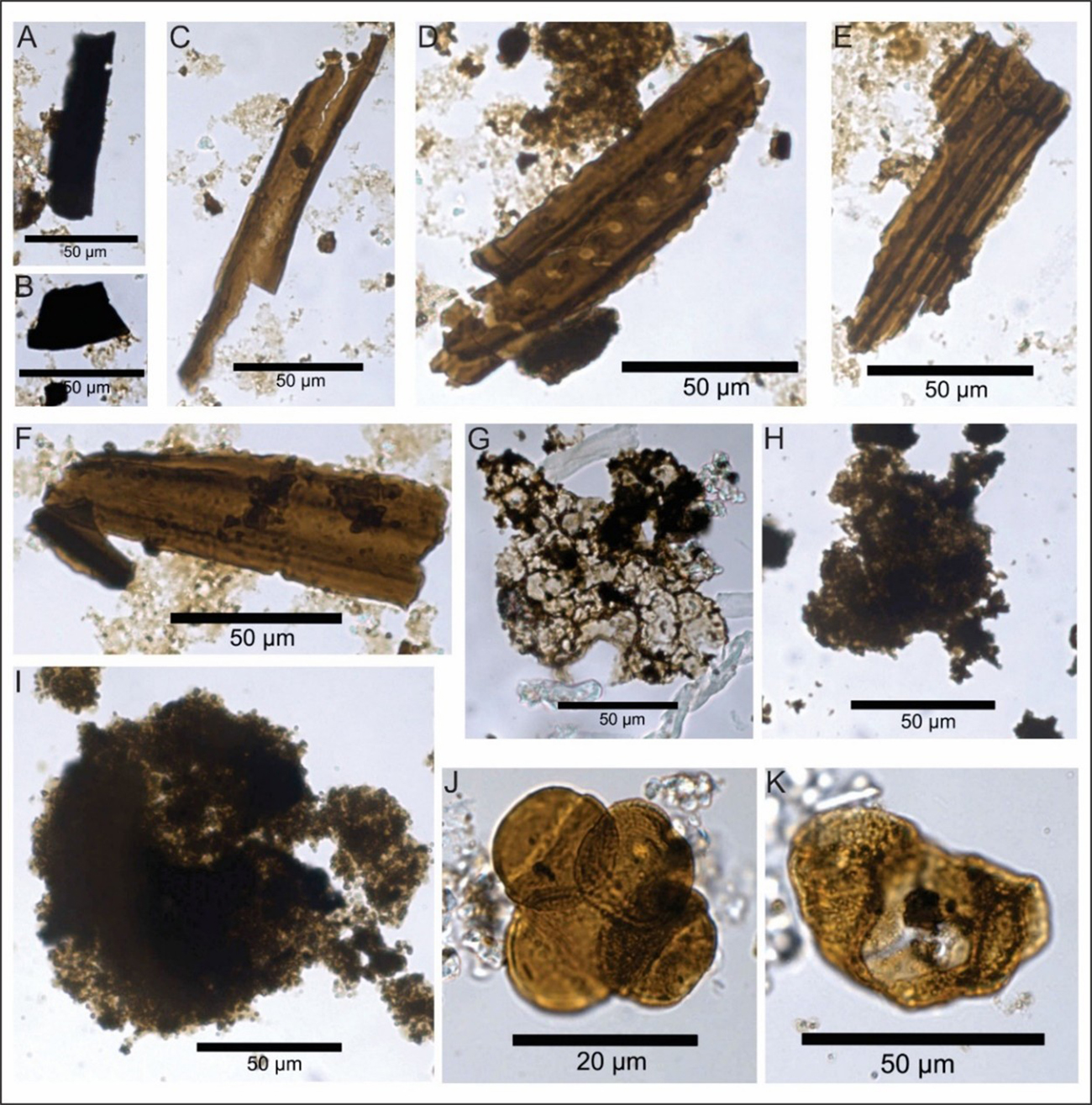
The phytoclast group presents values reaching up to 52.7% in the analyzed samples. This group is composed of opaque phytoclasts (elongated and equidimensional), non-opaque phytoclasts (biostructured and smooth), and cuticles, the latter being very rare in the studied material (Figures 6A). The Amorphous group ranges from 0 to 79.5% and is primarily represented by amorphous organic matter (AOM) derived from higher plants, this characterizing it as a terrestrial AOM (Figures 6G, 6H, and 6I). The Palynomorph group occurs in proportions ranging from 0 to 52.7%. It consists of sporomorphs, including trilete spores and pollen grains, which occasionally appear in tetrads of the genus Classopollis (Figures 6J and 6K).

Photomicrographs of organic components in the studied samples: A.B. Opaque phytoclasts; C. Smooth non-opaque phytoclast; D-F. Biostructured non-opaque phytoclasts; G. Cuticle; H.I. Amorphous organic matter (AOM); J. Tetrad of pollen grains of the genus Classopollis; K. bisaccate pollen grain.
In the palynofacies analyses, the percentage distributions of kerogen components were considered, classified as Amorphous Organic Matter (AOM), phytoclasts, and palynomorphs. This allowed us to assess the similarity between the samples and distinguish three types of palynofacies (Figure 7). Attempts to obtain images using optical microscopy under reflected fluorescent light, aiming to qualitatively characterize the organic constituents, proved unsatisfactory due to the absence of fluorescence emission in the analyzed material.

Correlation of palynofacies of wells RR01 and RR02 Palynofacies III higher concentrations of palynomorphs; Palynofacies II higher concentrations of MOA; Palynofacies I higher concentrations of MOA and Phytoclasts.
Palynofacies I: Presents the lowest TOC contents, ranging from 0.04% to 0.85%. This palynofacies is dominated by components of the AOM Group, which account for 58%-70% of the sample. The AOM is predominantly globose, with degraded contours and color ranging from dark brown to black. Phytoclasts represent between 13.8% and 37.3% of the material, composed primarily of elongated, equidimensional opaque fragments, mostly with sharp and smooth contours. Palynomorphs are absent or highly degraded and oxidized, reaching, when present, a maximum of 17.2%. Palynofacies I was identified at levels 35 m, 24.6 m, and 13 m of well RR01 (Figure 8), and at levels 36 m, 31.5 m, and 30 m of well RR02 (Figure 9).
Palynofacies II: Presents significant TOC content, between 1.10% and 7.45%. The Amorphous Group predominates, with values ranging from 43.8% to 79.5%. Palynomorphs occur with percentages of up to 31.4%, and phytoclasts present values between 9.8% and 30%. Palynofacies II was observed in samples 37 m, 31 m, 29 m, 21 m, 19 m, and 15 m of well RR01 (Figure 8), and 35 m, 33 m, 21.5 m, and 12 m from well RR02 (Figure 9).
Palynofacies III: Presents low TOC content, between 0.24% and 1.67%. The MOA Group is practically absent, reaching a maximum of 12.7%. Palynomorphs have a high average, contributing 40.1%-78.3%, while phytoclasts vary between 21.7% and 52.7%. Palynofacies III was identified in samples 28 m and 11 m from well RR01 (Fig. 8), and 29 m, 26 m, 23.5 m, 18 m, 17.5 m, 14.5 m, 13 m from well RR02 (Figure 9).

Graph showing the correlation of TOC, HI, AOM, Phytoclasts, and Palynomorphs from well RR01.

Graph showing the correlation of TOC, HI, AOM, Phytoclasts, and Palynomorphs from well RR02.
4 Discussion
The results obtained from the Total Organic Carbon (TOC) and Rock-Eval pyrolysis analysis in wells RR01 and RR02 indicate a promising potential for hydrocarbon generation in the shale facies. The Van Krevelen diagram, constructed from the hydrogen (HI) and oxygen (IO) indices, reveals a remarkable heterogeneity in the composition of organic matter throughout the interval studied.
In the marl and siltstone facies, the low HI values and the predominance of type III and IV kerogens indicate an essentially terrestrial organic matter, derived from vascular plants and woody fragments. This type of material, characterized by low lipid content and a high proportion of aromatic and cellulosic compounds, tends to predominantly generate gas during thermal maturation, thus presenting low potential for the generation of liquid hydrocarbons (Tissot & Welte 1984; Peters & Cassa 1994; Hunt 1996).
The predominance of low HI and high OI values, observed in the Rock-Eval analyses, reinforces this interpretation, being typical of oxidized continental organic matter (Espitalié et al. 1977; Killops & Killops 2005). Together, these results point to a depositional environment with a strong continental influence, limited preservation, and a predominance of gaseous kerogens.
The mixture of kerogens of types II and III, represented by intermediate HI values (200-300 mg HC/g TOC), is commonly observed in lacustrine systems associated with rift contexts. This combination suggests a mixed contribution of organic matter from terrestrial (type III, represented by phytoclasts) and aquatic (type II, autochthonous) sources. Type II kerogen, richer in lipids, is mainly attributed to lacustrine algae and the products of intense microbial degradation (Pacton et al. 2011) that occurred in the water column and sediments, commonly identified as Amorphous Organic Matter (AOM) in palynological analyses.
Palynofacies analyses corroborate the interpretations derived from organic geochemistry. Palynofacies I, II, and III are characterized by the predominance of organic material of continental origin, evidencing a strong terrigenous input. In particular, Palynofacies I and III indicate deposition in proximal environments, under the influence of fluvial or deltaic systems, subject to variable oxidation conditions (Tyson 1995).The intense carbonization of palynomorphs, observed both in these palynofacies and in the records described by (Castro et al. 2021) reinforces this interpretation by indicating thermal degradation and partial oxidation of organic matter, factors that hinder taxonomic identification and denote paleoenvironmental conditions less favorable to the preservation of autochthonous organic matter.
The absence of marine palynomorphs throughout the studied interval constitutes additional evidence that sedimentation occurred in a continental, predominantly lacustrine, and not marine environment. Thus, the integration of geochemical and palynofacies data reinforces the interpretation of a depositional system strongly influenced by continental inputs, possibly associated with fluvial and lacustrine environments in a rift context, without evidence of significant marine ingress into the basin.
These results directly contrast with the classic hypothesis of marine ingress proposed by (McConnell 1969) for the region. While the author suggested the presence of marine influences on sedimentation, the data presented here do not corroborate this interpretation. Thus, this study contributes to the refinement of the paleoenvironmental model of the basin, suggesting that the analyzed interval corresponds to an episode of continental sedimentation, contradicting the previously proposed hypothesis of marine ingress.
5 Conclusion
The integrated results of geochemical (TOC and Rock-Eval pyrolysis) and palynofacies analyses of wells RR01 and RR02 indicate that the organic matter present in the shale, marl, and siltstone facies is predominantly continental in character. The dominance of kerogens of types III and IV, associated with low HI values and high OI, points to organic matter derived from terrestrial vegetation and subjected to pronounced oxidation conditions. This set of characteristics reveals a low potential for the generation of liquid hydrocarbons, although it indicates some gasifying capacity.
The occurrence of intermediate HI values and mixed kerogens (types II-III) in some intervals suggests a joint contribution of terrestrial and aquatic organic matter, typical of lacustrine systems in a rift context. This interpretation is corroborated by palynofacies analyses, which reveal a continental depositional environment with fluvial and lacustrine influence, subject to variations in oxidation conditions and in the preservation of organic material.
The absence of marine palynomorphs confirms the lack of marine influence during sedimentation. Therefore, the results presented here refine the paleoenvironmental model of the area, indicating that the studied interval corresponds to an episode of continental sedimentation, linked to the evolution of fluvial and lacustrine systems in a tectonically active environment, contributing to a more detailed understanding of the depositional history and the generating potential of the basin.
1 References
- Antonioli, L., Dino, R., Portela, H.A. & Amaral, P. 2020, ‘New Method of Rock Samples Preparation for Palynological and Palynofaciological Analysis’, Anuário do Instituto de Geociências, vol. 43, no. 1, pp. 339-45.
-
Castro, R., Giorgioni, M., Souza, V., Ramos, M., Feitoza, L.M., Dino, R. & Antonioli, L. 2021, ‘Facies analysis, petrography, and palynology of the Pirara Formation (Upper Jurassic-Lower Cretaceous) - Tacutu Basin (Roraima, Brazil)’, Journal of South American Earth Sciences, vol. 112, pp. 103574, DOI: 10.1016/j.jsames.2021.103574
» https://doi.org/10.1016/j.jsames.2021.103574 - Eiras, J.F., Kinoshita, E.M. & Feijó, F.J. 1994, ‘Estratigrafia das bacias sedimentares do Brasil’, Boletim de Geociências da Petrobras, vol. 8, pp. 17-45.
- Espitalié, J., Laporte, J.L., Madec, M., Marquis, F., Lepat, P., Paulet, J. & Boutefeu, A. 1977, ‘Méthode rapide de caractérisation des roches mère, de leur potentiel petrolier et leur degré d’évolution’, Institute Français du Pétrole, vol. 32, pp. 23-42.
- Hunt, J.M. 1996, Petroleum Geochemistry and Geology, 2nd edn, W.H. Freeman and Company, New York.
-
McConnell, R.B. 1969, ‘Fundamental fault zones in the Guiana and West African shields in relation to presumed axes of Atlantic spreading’, Geological Society of America Bulletin, vol. 80, pp. 1775-82. DOI: 10.1130/0016-7606
» https://doi.org/10.1130/0016-7606 - Killops, S.D. & Killops, V.J. 2005, Introduction to Organic Geochemistry, 2nd edn, Blackwell Publishing, Oxford & Malden, MA.
-
Pacton, M., Acton, M., Gorin, G.E. & Vasconcelos, C. 2011, ‘Amorphous organic matter: Experimental data on formation and the role of microbes’, Review of Palaeobotany and Palynology, vol. 166, pp. 253-67, DOI: 10.1016/j.revpalbo.2011.05.011
» https://doi.org/10.1016/j.revpalbo.2011.05.011 -
Peters, K.E. & Cassa, M.R. 1994, ‘Applied Source Rock Geochemistry’, in L.B. Magoon & W.G. Dow (eds), The Petroleum System from Source to Trap, AAPG Memoir, vol. 60, American Association of Petroleum Geologists, Tulsa, OK, pp. 93-120, DOI: 10.1306/M60585
» https://doi.org/10.1306/M60585 - Reis, N.J., Faria, M.S.G. & Maia, M.A.M. 2002, ‘O quadro Cenozoico da porção norte-oriental do Estado de Roraima’, in Contribuições à Geologia da Amazônia, Sociedade Brasileira de Geologia, Núcleo Norte, Belém, pp. 259-72.
-
Tissot, B.P. & Welte, D.H. 1984, Petroleum Formation and Occurrence: A New Approach to Oil and Gas Exploration, 2nd edn, Springer-Verlag, New York, pp. 699. DOI: 10.1007/978-3-642-87813-8
» https://doi.org/10.1007/978-3-642-87813-8 -
Tyson, R.V. 1995, Sedimentary Organic Matter: Organic Facies and Palynofacies, Chapman & Hall, London, pp. 615. DOI: https://doi.org/10.1007/978-94-011-0739-6
» https://doi.org/10.1007/978-94-011-0739-6 - Vaz, P.T., Wanderley, J.R.Filho & Bueno, G.V. 2007, ‘Bacia do Tacutu’, Boletim de Geociências da Petrobras , vol. 15, pp. 289-97.
Data will be made available on request.