 EFFECT OF EMAMECTIN BENZOATE ON SEVERAL LARVAL STAGES OF COTTON LEAFWORM ALABAMA ARGILLACEA HÜB. (LEPIDOPTERA:NOCTUIDAE)
ABSTRACT
The objective of this work was to determine the performance of emamectin benzoate on several larval stages of cotton leafworm. The statistical design was full random distribution, with seven treatments and four replicates, and the trial was conducted in laboratory conditions. Two types of application were made: directly on the insect and on leaves that were later given to the insects to feed. The four larval stages used were determined as described: under 0.5 cm lenght, between 0.51 and 1.0 cm, between 1.01 cm and 2.0 cm and above 2.01 cm. The direct application was also made on pupae and pre-pupae stages. The treatments were: emamectin at 3.84, 5.76, 7.68 and 9.6 g a.i./ ha; abamectin at 9.0 g a.i./ha; lufenuron at 15.0 g a.i./ha and one untreated check. Larvae mortality was assessed at 12, 24, 48 and 72 hours after the treatment for both direct application and leaf application. The conclusion about the application on leaves was that all larval stages died 12 h after starting eating the leaves treated with emamectin at 9.6 g a.i./ha and 24 h after starting eating the leaves treated with emamectin at 7.68 g a.i./ha. Emamectin at 3.84 and 5.76 g a.i./ha promoted high mortality of larvae under 1.0 cm, 48 hs after start feeding. High larvae mortality was observed on leaves treated with lufenuron 48 hs after feeding started although later stages were able to transform into pupal stage. All treatments applied directly on the insects provided high mortality on larvae smaller than 1.0 cm. The mortality was also high for all treatments on larvae bigger than 2.01 cm but less than the mortality on younger larvae.
KEY WORDS:
Cotton leafworm; emamectin; abamectin; lufenuron.
RESUMO
O objetivo do presente trabalho foi observar a ação do benzoato de emamectin sobre diversos estágios larvais do curuquerê-do-algodoeiro. O delineamento estatístico utilizado foi o inteiramente casualizado, com sete tratamentos e quatro repetições, conduzido no Laboratório Regional de Sanidade Animal e Vegetal de Ribeirão Preto. Foram realizados dois tipos de aplicação: diretamente sobre os insetos e sobre folhas que foram mais tarde oferecidas para alimentação das lagartas. Os quatro estágios utilizados foram determinados pelo tamanho das lagartas, conforme descrito a seguir: menores que 0,5 cm; de 0,51 a 1 cm; 1,01 a 2,0 cm e acima de 2 cm. A aplicação direta também foi feita sobre os estágios pré-pupa e pupa. Os tratamentos foram: emamectin a 3,84; 5,76; 7,68 e 9,6 g i.a./ha; abamectin a 9,0 g i.a./ha; lufenuron a 15,0 g i.a./ha e testemunha. A mortalidade larval foi avaliada 12, 24, 48 e 72 horas após a aplicação direta ou a aplicação foliar. Concluiu-se, com relação à aplicação sobre folhas e oferecimento às lagartas, que todos os estágios larvais morreram 12 horas após iniciada a alimentação com folhas tratadas com emamectin a 9,6 g i.a./ha e 24 h após iniciada a alimentação com folhas tratadas com emamectin a 7,68 g i.a./ha. Emamectin a 3,84 e 5,76 g i. a./ha promoveram alta mortalidade de larvas menores de 1,0 cm, 48 h após o inicio da alimentação. Alta mortalidade foi observada com oferecimento de folhas tratadas com lufenuron a 15,0 g i.a./ha, 48 h após o inicio da alimentação, embora, com respeito a lagartas do último estágio, muitas transformaram-se em pupas. Com relação à aplicação direta, todos os inseticidas promoveram alta mortalidade de larvas menores que 1,0 cm. A mortalidade também foi alta para lagartas maiores que 2,01 cm, porém menor que para lagartas pequenas.
PALAVRAS-CHAVES:
Curuquerê-do-algodoeiro; emamectin; abamectin; lufenuron.
INTRODUCTION
The cotton leafworm, Alabama argillacea Hübner, is currently one of the most important pests on cotton in São Paulo State, requiring several chemical applications to control the insect, wich is present during the whole cycle of the crop, causing up to 28% reduction on productivity (ALMEIDA & CAVALCANTI, 1966). One single larvae is able to destroy 66 cm2 of cotton leaves as determined by MARCHINI (1977). The A. argillacea infestation is associated to precipitation and moisture (GRAVENA et al., 1985). The chemical control of cotton leafworm is mainly performed by pyrethroid insecticides wich show negative side effects on biological balance of the cotton ecosystem. Other insecticides called selectives were tested in relation to its eficcacy and selectivity to natural enemies, trying to maximize the natural biological control. PARO JR. et al. (1972) obtained good results in nursery with endosulfan UBV compared to fenthoate in the control of A. argillacea larvae. BLEICHER & JESUS (1982) compared the action of diflubenzuron (6.3; 12.4; 25.0; 37.5 g a.i./ha), to methyl parathion (187 g i.a./ha) in 2 tests and obtained high efficacy and superior residual effect for the two higher rates 72 hs. after application. MATRANGOLO JR. et al. (1987) working with diflubenzuron too, concluded that it is adequated to integrated pest management programs because of its efficacy and selectivity, mainly in relation to predatory insects. HABIB et al. (1989) concluded that UBV formulations of endosulfan 250 (475 g a.i./ha) and chlorpyriphos 240 (360 g a.i../ha) showed higher efficacy in the control of cotton leafworm. Both UBV products were very efficient in the control of A. argillacea, endosulfan being superior to chlorpyriphos. YAMAMOTO et al. (1990) obtained good control of A. argillacea larvae (more than 90 %) with abamectin at 5 g a.i./ha. The treatment did not affect beneficial arthropods. Avermectins shows a high biocidal activity against a wide spectrum of nematodes, insects and arachnids. Abamectin (avermectin B1) is currently the main avermectin compound used as a mitecide/ insecticide in a great variety of crops. Chemical modifications on its original structure with the aim of increasing its insecticidal spectrum resulted in the discovery of Emamectin benzoate (MK-244, 4” - deoxy-4”-epi-Nmethylamineavermectin B1), one of many 4 ” - substituted analogs that shows an increased potency against lepidoptera larvae (MROZIK, 1994). The mode of action of emamectin benzoate is similar to abamectin (a GABA and glutamate-gated chloride channel agonist) according to DUNBAR et. al. (1998). Emamectin benzoate is a novel semi-synthetic derivative of the natural product abamectin from the avermectin family of 16-membered macrocyclic lactones. This epi-methyl amino derivative is very effective against a broad spectrum of lepidopteran pests, with good photostability and translaminar movement, good field efficacy and lack of crossresistance with other commercially-used pesticides (WHITE et al.1997).
MATERIAL AND METHODS
Insect rearing -A. argillacea were mass-reared in laboratory conditions. The insect colony was originated from Ituverava, São Paulo State, Brazil. In the Laboratório Regional de Sanidade Animal e Vegetal de Ribeirão Preto, moths were maintened inside cages (0,98 X 0,40 X 0,40 m), bottom covered with journal paper, on two cotton plants twenty days old and a recipient with cotton fiber soaked with suggar water. The eggs laid by the moths were daily removed and placed in two cotton leaves fitted on Petri dishes. After egg hatching, ten first instar larvae were transferred into clean Petri dishes supplied with three cotton leaves. A provision of fresh leaves was repeated daily. When the larvae reached the third stage were removed from each Petri dish and the remaining five were maintened.
Bioassay procedure. Two types of application were made: directly on the insect and on leaves that were later given to the insects to feed. For each replicate (four replicates were used) a group of 10 larvae were taken. The four larval stages used were determined as described: under 0.5 cm lenght, between 0.51 and 1.0 cm, between 1.01 cm and 2.0 cm and above 2.01 cm. The treatments were: emamectin at 3.84, 5.76, 7.68 and 9.6 g a.i./ha; abamectin at 9.0 g a.i./ha; lufenuron at 15.0 g a.i./ ha and one untreated check, for both direct and leaf application. The direct application was also made on pupae and pre-pupae stages (four replicates, with a group of 10 insects). The products were topically applied by knapsack CO2, working at 60 psi and delivering 200 l/ha of water. A filter paper disc was placed on the bottom of each Petri dish in order to absorb the excess of spray solution and removed after application. The larvae were then transferred to a clean Petri dish with fresh and insecticide-free leaves of cotton. Larvae mortality (%) was assessed at 12, 24, 48 and 72 hours after the treatment. The emergence of moths was evaluate to determine the survival of pupae and the oviposicion of adults was used to determine the effect on prepupae. For the laboratory feeding experiment, one area of 100 m2 of cotton plants per treatment, at Ribeirão Preto county, São Paulo State, Brasil, was treated in the field with knapsack CO2 sprayer, working at 45 psi and delivering 200 l/ha of water. Treated leaves were daily collected and given to the insects to feed. The number of alive larvae in the Petri dishes was evaluated daily and the cumulative larvae mortality (%) was determined at 12, 24, 48 and 72 hours after the treatment.
Statistical analyses. The ANOVA analysis of variance was performed after data transformation and the means were compared on a Tukey’s test. Statistical analyses were performed using ESTAT software, developed in Jaboticabal, SP (FCAV-UNESP, 1990).
RESULTS AND DISCUSSION
The results based on the number of alive larvae in the Petri dishes, evaluated daily, and the cumulative mortality (%) show, on laboratory feeding experiment (Fig. 1), that emamectin 9.6 g a.i./ha was superior to abamectin 9.0 g a.i./ha, mainly in the third and fourth larval stages. Lufenuron at 15.0 g a.i./ha was less effective than the other insecticides regarding knockdown effect but provided good control after 72 hours. In the third and fourth larval stages the larvae treated with lufenuron were able to pupate. The same was observed on the lower rates of emamectin that was very effective in controlling the cotton leafworm after 72 hours but showed slow initial effect. Similar results were obtained by CORBITT et al. (1989) with abamectin on Spodoptera littoralis. He demonstrated that the residual toxicity of abamectin on chinese cabbage was 15 and 30-fold greater to 1stinstar larvae than to 3rd and 4th instar larvae.
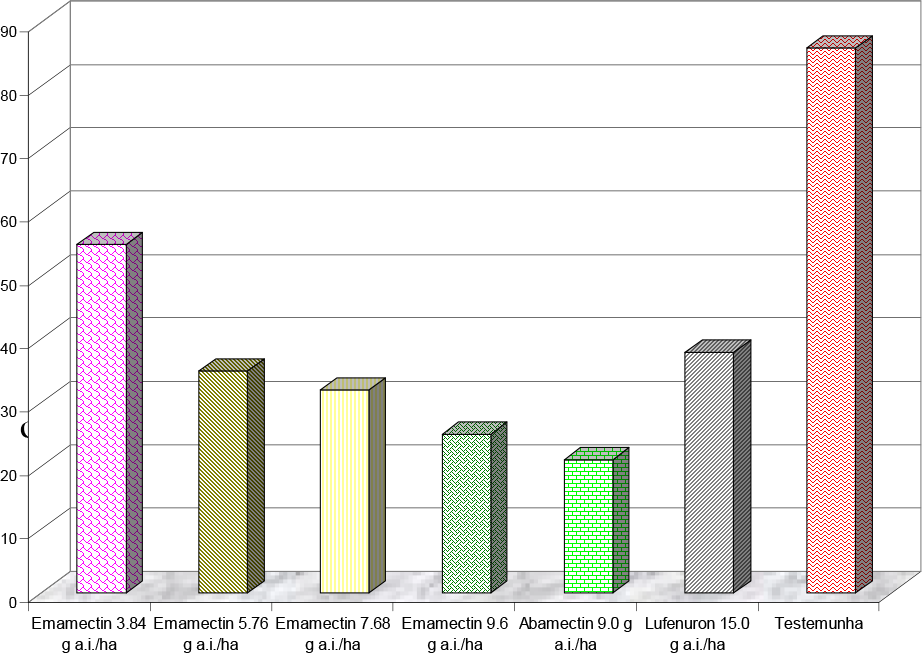
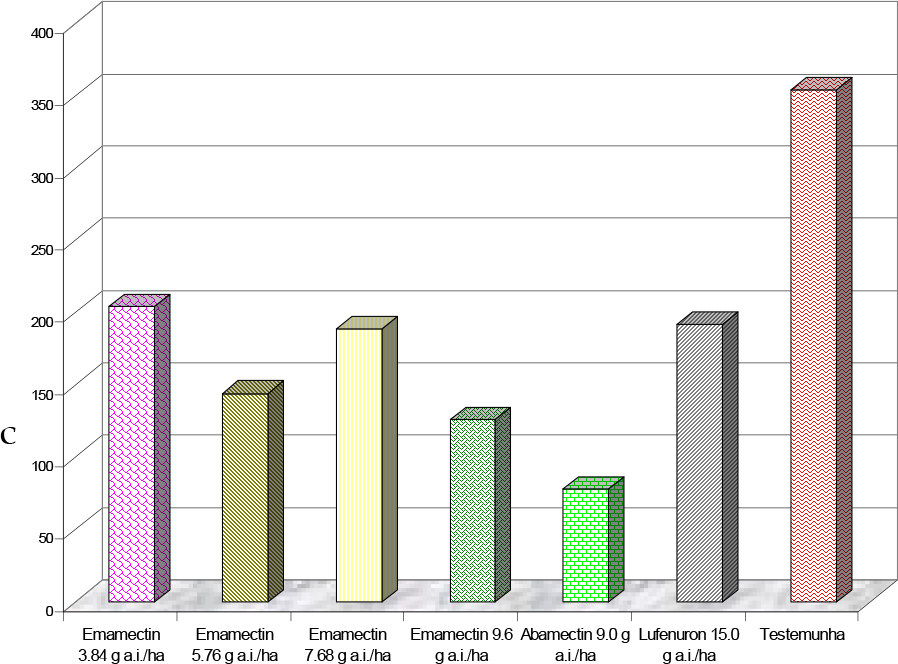
The toxicity of topically applied products decreased according to increase the size of the larvae. All treatments showed good performance on controlling larval stages of cotton leafworm 72 hours after application, with more than 90 % efficiency (Fig. 2). In general the treatments provided higher mortality on first stage than on fourth larval stage, although emamectin at 7.68 and 9.6 g a.i./ha and abamectin at 9.0 g a.i./ha showed excellent efficacy regardless the larval stage. CORBITT et al. (1989) obtained similar effect working with cotton leafworm S. litoranea and demonstrated that when the relative toxicity of abamectin decreased from the third to the fourth and fifty larval stage.

Mortality (%) of A. argillacea larvae fisrt to fourth stage, on laboratory feeding experiment. Mean of four replication. Ribeirão Preto, SP, 1999.

Mortality (%) of A. argillacea larvae first to fourth stage, on topic application experiment. Mean of four replication. Ribeirão Preto, SP, 1999.

Percent survival (%) of A. argillacea pupae after pupae treatment, on topic application experiment. Mean of moth emergence from four replication. Ribeirão Preto, SP, 1999.

Oviposicion of A. argillacea adults after pre pupae treatment, on topic application experiment. Mean number of eggs per female, from four replicates.
Emergence of moths was highly affected in all treatments (Fig. 3) compared to the control. The effect of emamectin and abamectin on pupation was significant, as well as female moth fecundity (Fig. 4), mainly at the high rate. The results obtained in this experiment is similar to the ones obtained by EL-GHAR et al. (1995) working with Bacillus thuringiensis and abamectin against cotton leafworm S. littoralis, with pronounced decrease of pupation (36%) after abamectin treatment, and great reduction on moth fecundity (87,4 %).
REFERENCES
- ALMEIDA, P.R. & CAVALCANTI, R. D. Resultados de experimentos de campo no controle do curuquerê-doalgodoeiro com novos inseticidas. Biológico, São Paulo, v.32 n.10, p.220-222, 1966.
- BLEICHER, E.; JESUS, F.M.M. DE; DE SOUZA, S. L. Uso de inseticidas seletivos no controle do curuquerê-doalgodoeiro. Pesqui. Agropecu. Bras. v.25, n.2, p. 277280, 1990.
- CORBITT, T.S., GREEN, A.ST.J.; WHIGHT, D.J. Relative potency of abamectin against larval stages of Spodoptera littoralis (Boisd.), Heliothis armigera (Hubn.) and Heliothis virescens (F.) (Lepidoptera: Noctuidae) Crop Protection, v.8, n.2, p.127-132, 1989.
- DUNBAR, D.M.; LAWSON, D.S.; WHITE, S.M.; NGO, N.; DUGGER, P.; RICHTER, D. Emamectin benzoate: control of the heliothine complex and impact on beneficial arthropods. In: BELTWIDE COTTON CONFERENCE, 1998, San Diego, California, Procedings, USA. 1998.v. 2, p.1116-1118.
- GRAVENA, S., STERLING, W.L.; DEAN, A. Abstracts, references and Key words of publications relating to the cottonleaf Alabama argillacea (Hübner) (Lepidoptera: Noctuidae) Maryland, College Park: Thomas Say Foundation Monographs, 1985. 45 p.
- EL GHAR, G.E.S.A.; RADWAN, H.S.A.; EL BERMANY, Z.A.; ZIDAN, L.T.M. Sublethal effects of avrmectin B1, betaexotoxin of Bacillus thuringiensis and diflubenzuron against cotton leafworm (Lepidoptera: Noctuidae). J. Appl. Entomol, v.119, n.4 , p.309-313, 1995.
- HABIB, M.E.M.; ANDRADE, C.F.S.; ROSSI, W. L. Eficiência de quatro inseticidas quimicos em formulação UBV no controle do curuquerê-do-algodoeiro Alabama argillacea (Hübn.) (Lepidoptera: Noctuidae). Ecossistema, v.14, p.178-187, 1989.
- MARCHINI, L.C. 1977 Avaliação dos danos do curuquerêdo-algodoeiro Alabama argillacea (Hübner, 1818) (Lepidoptera: Noctuidae) em condições simuladas e redução de sua população usando iscas tóxicas. Piracicaba: 1977. 72 p. [Dissertação (Mestrado) - Escola Super. Agric. “Luiz de Queiroz” - Universidade de São Paulo].
- MATRANGOLO JR., E.; GAVIOLI, L.A.; GRAVENA, S.; MORETTI, F.C.;.ODAKE, N.K. Integração de diflubenzuron com artrópodos predadores de ocorrência natural para manejo do “curuquerê do algodoeiro” Alabama argillacea (Hübner, 1818) (Lepidoptera: Noctuidae). An. Soc. Entomol. Brasil, v.16, n.10, p.5-18, 1987.
- MROZIK, H. Advances in research and development of avermectins. Am. Chem. Soc. Symp. Ser, n.551, p.54-73, 1994.
- PARO JR., L.A.P.; NAKANO, O.; MOSCARDI, F.; DE CAMARGO, A. H. Efeito de dois inseticidas no controle do curuquerê Alabama argillacea (Hübner, 1818) applicado no sistema UBV. Solo, Piracicaba, v.64, n.2, p.17-19, 1972.
- WHITE, S.M.; DUNBAR, D.M.; BROWN, R.; CARTWRIGHT, B.; COX, D.; ECKEL, C.; JANSSON, R.K.; MOOKERJEE, P.K.; NORTON, J. A.; PETERSON, R. F.; STARNER, V.R. Emamectin benzoate: a novel derivate for control of lepidopterous pests in cotton. In: BELTWIDE COTTON CONFERENCES, 1997, New Orleans , Proceedings. v.2, p.1078-1082.