 Effect of temperature, storage period and prepration on spore viability of Metarhizium anisopliae (Metsch.) Sorokin, cultived in rice.
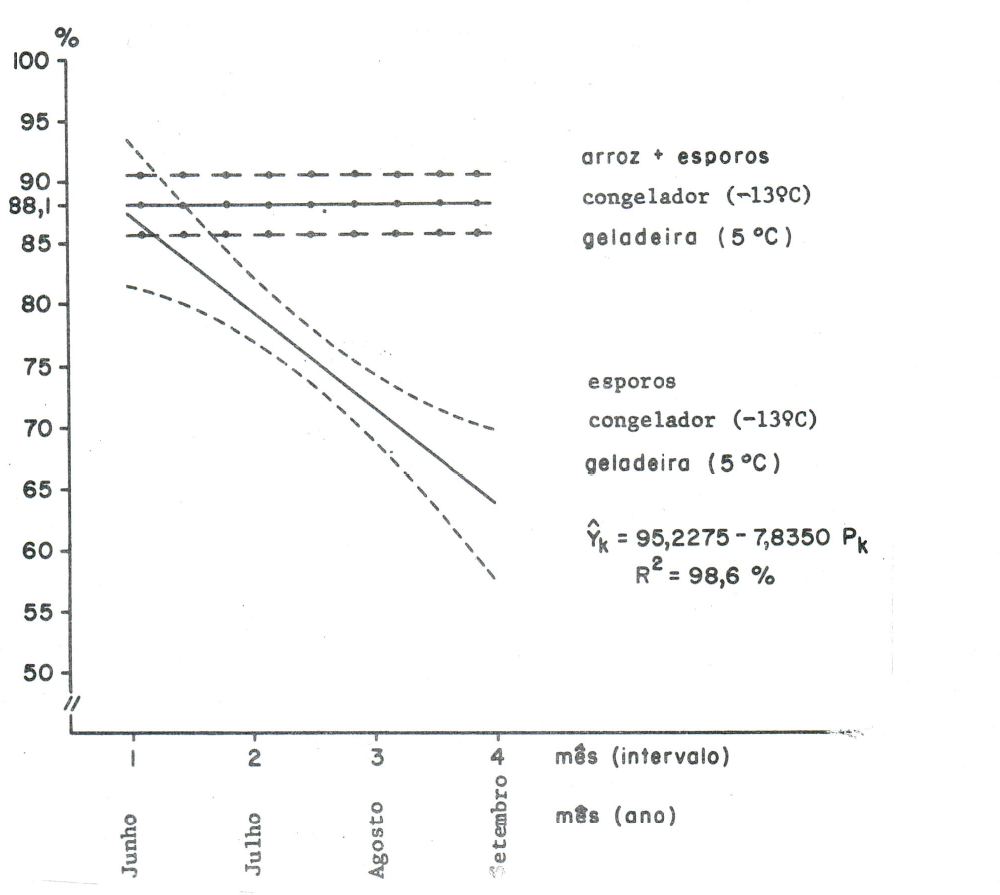
Studies were made to investigate viability of Metarhizium anisopliae spores obtained through three different techniques of preparation and stored under three temperature conditions. The preparations were as follows: mixture of rice and spores, mixture of ground rice and spores and pure spores. Storage temperatures were as follows: room temperature (variable), 5 °C and -13°C. Determination of spores viability was made on 8 samples which had been dried at different periods of time (humidity) and stored for 2 to 8 months at the temperatures above. Spore viability in mixture of rice and spores at cool temperares (5 °C and -13 °C) was constant during the period of the assay. In these temperature conditions loss of spores viability was observed in mixture of gound rice and spores and also in pure spores preparation. It was also observed that conidia viability in the mixture of rice and spore treatment and pure spore treatment was the same at 5 °C and -13°C. At room temperature rapid deterioration of the samples was observed. Handling the microorganism as to grind and sift increased viability loss. Storage at 5 o c and -13 °C caused the growth of contaminant fungi (Aspergillus flavus and Penicillium spp.) to stop. These fungi seriously affected the samples at temperature. As concernes drying time and moisture of the samples, it was not possible to obtain a valid stimate of the results, due to some uncontrolled factors.
KEY-WORDS:
Metarhizium anisopliae; humidity; temperature; storage; techniques of preparations; viability.
 Thumbnail