
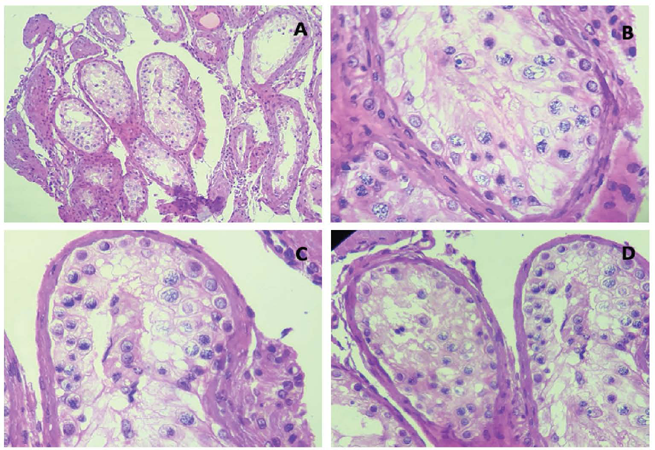
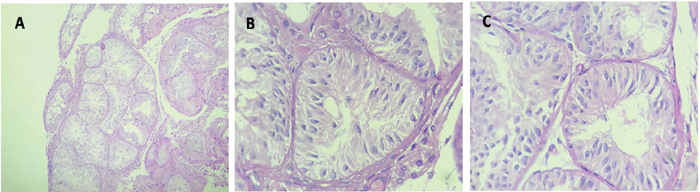
The 46, XY differences in sex development (DSD) caused by 5-alpha reductase type 2 (5ARD2) often presents with bilateral undescended testicles, otherwise normal internal reproductive structures, prostate hypoplasia and undervirilized male genitalia. Notably, as one of the few DSDs where fertility is possible, the clinical presentation of this disease is diverse, and reported cases of assisted reproduction are scarce. The fertility potential, reproductive counseling and treatment depend on the clinical presentation of this DSD, especially the testicular position and urethral anatomy. The influence of the timing and modality of surgery for hypospadias and cryptorchidism should be considered. We aimed to describe the use of microscopic testicular sperm extraction (micro-TESE) in this population. We provide a descriptive analysis of how micro-TESE is a possible potential tool for assisted reproduction in 5ARD2-deficient patients. A 33-year-old male who underwent bilateral orchidopexy, phalloplasty, and urethroplasty at the age of 9 years presented successful sperm retrieval but failed embryo development after intracytoplasmic sperm injection. Testicular histology revealed late spermatogenic arrest. A 28-year-old male with bilateral orchidopexy, phalloplasty, and urethroplasty at age 25 with unsuccessful sperm retrieval. Testicular histology revealed a Sertoli cell-only pattern. 5ARD2-deficient patients are singular patients. The potential impact of the time between atypical genitalia procedures and orchidopexy on fertility should be highly considered. Micro-TESE is a technique that may be used to assist azoospermic patients in this population. Early orchidopexy and penile and urethral corrections should be considered key strategies to preserve the fertility potential of 5ARD2 patients.
case report • Arch. Endocrinol. Metab. 69
(1)
• 2025 • https://doi.org/10.20945/2359-4292-2024-0223 linkcopy
 Microscopic testicular sperm extraction in 46, XY differences in sex development caused by 5-alpha reductase type 2 deficiency
Authorship
person Berenice Bilharinho Mendonça
person William Carlos Nahas
person Marcello Antonio Signorelli Cocuzza
personCorrespondence to: Joao Paulo Cardoso Divisão de Urologia, Hospital das Clínicas, Faculdade de Medicina, Universidade de São Paulo Av. Dr. Enéas de Carvalho Aguiar, 255, 7º andar, sala 710F 05403-000 - São Paulo, SP Brasil
emailjoao.greco@hc.fm.usp.br
emailjoao.greco@hc.fm.usp.br
Disclosure:
no potential conflict of interest relevant to this article was reported.
SCIMAGO INSTITUTIONS RANKINGS
Figures | Tables
 Thumbnail
 Thumbnail
imageFigure 1 Patient 1 histology-late maturation arrest. H&E 100x (A) 400x (B to D) open_in_new
imageFigure 2 Patient 2 histology - Sertoli cell-only. H&E 100x (A) 400x (B to D) open_in_new
table_chartTable 1
Clinical features of newly reported patients
| Patient | Orchidopexy age | FSH (IU/L) | LH (IU/L) | T (ng/dL) | Testicular size | Histology | SRD5A2 Mutation |
|---|---|---|---|---|---|---|---|
| Patient 1 | 9 yo | 8.8 | 6.1 | 559 | RT: 5 × 3 cm LT: 5 × 2.8 cm | Late maturation arrest | p.Gli183Ser/p.Gli183Ser |
| Patient 2 | 25 yo | 19.9 | 11.4 | 918 | RT: 4 × 2.8 cm LT: 3.5 × 2.4 cm | Sertoli cell-only | p.Gln126Arg/p.Gln126Arg |
table_chartTable 2
Fertility and assisted reproduction in 5ARD2 patients
| Reference | SARD2 mutation | TP | MTV (cc) | LH, Ul/L | FSH, Ul/L | Tng/dL | DHT, ng/dL | T/DHT | Vol. | Cone. (106/mL) | Total (x 106) | M(%) | Mo | Age | Method | Pregnancy Outcome |
|---|---|---|---|---|---|---|---|---|---|---|---|---|---|---|---|---|
| 1* Ivarsson (1996) | p.GIi196Ser/p.His231Arg | Palpable | ... | ... | ... | 917a | 19b | 48 | ... | ... | ... | ... | ... | 23 | Natural | Girl |
| 2* Ivarsson (1996) | p.GIi196Ser/p.His231Arg | Not palpable | ... | ... | ... | 271c | ... | ... | ... | ... | ... | ... | ... | 22 | Natural | Boy |
| 3 Katz and cols. (1997) | p.Arg246Trp/p.Arg246Trp | Topic | 22.5 | ... | ... | 669 | 9.8 | 68.2 | 0.5* | 65 | ... | ... | ... |
36 37 |
IUI 1 IUI 2 |
Boy Twins |
| 4 Matsubara and cols. (2010) | p.Arg246Gln/Arg246Gln | Sx 9 yo | 10.0 | 2.1 | 7.0 | 660 | 26 | 25 | 0.3 | 15 | 4.5 | 17 | 8 | 29 | ICSI | Boy |
| 5 Kang and cols. (2011) | p.Arg246Trp/p.Arg246Trp | Topic at puberty | 15.0 | ... | ... | 669 | 23 | 29 | <0.1& | 8.4 | ... | <1.0 | ... | 45 | ICSI | Twins |
| 6** Costa and cols. (2012) | p.Gln126Arg/p.Asn193Ser | Sx 14-17 yo | 4.4 | 16.9 | 13.1 | 340 | 26 | 12 | 0.5 | 0.19 | 0.09 | 21 | ... | 34 | ICSI | Twins |
| 7** Costa and cols. (2012) | p.Gln126Arg/p.Asn193Ser | Sx 15 yo | 9.8 | 4.4 | 3.8 | 551 | 33.8 | 16 | ND | # | ... | ... | ... | 30 | ICSI | Boy |
| 8*** Bertelloni and cols. (2019) | p.Arg103Pro/p.His230Pro | Sx at birth | 12.5 | 6.4 | 25.8 | 320 | ... | ... | ... | ... | ... | ... | ... | 32 | Natural | 2 Girls |
| 9*** Bertelloni and cols. (2019) | p.Arg103Pro/p.His230Pro | Sx at birth | ... | ... | ... | ... | ... | ... | ... | ... | ... | ICSI | Boy | |||
| 10 Present Report | p.GIi183Ser/p.GIi183Ser | Sx 10 yo | 15 | 6.1 | 8.8 | 559 | 6 | 93 | ∅ | - | - | - | - | 38 | Failed ICSI after micro-TESE | - |
| 11 Present Report | p.Gln126Arg/p.Gln126Arg | Sx25yo | 8 | 11.4 | 19.9 | 980 | ... | ... | 0.2 | § | - | - | - | 29 | Failed sperm retrieval micro-TESE | - |
-
TP: testicular position: Sx (orchidopexy surgery) for patients 4, 6, 7, 8, 9, 10 and 11) and testicular position for patients 1, 2, 3 and 5. MTV: mean testicular volume: LH: luteinizing hormone: FSH: follicle-stimulating hormone: T: testosterone: DHT: dihydrotestosterone: T/DHT: testosterone dihydrotestosterone ratio: Mo: morphology: M: motility: Cone: concentration: ICSI: Intracytoplasmic sperm injection: aat 14 yo: bat 10 yo: cat 36 yo. * Patients 1 and 2 brothers. ** Patients 6 and 7 brothers. *** Patients 6 and 7 brothers. & After centrifugation. # Rare motile sperm in the fresh ejaculate. 17 sperm selected for ICSI: ∅ anejaculation: negative post ejaculate urine analysis: § extremely rare immotile sperm
How to cite
location_on
Sociedade Brasileira de Endocrinologia e Metabologia
Rua Botucatu, 572 - Conjuntos 81/83, CEP: 04023-061 , Tel: +55 (11) 5575-0311 / +55 (11) 9 9768-6933 -
São Paulo -
SP -
Brazil
E-mail: aem.editorial.office@endocrino.org.br
E-mail: aem.editorial.office@endocrino.org.br
rss_feed
Acompañe los números de esta revista en su lector de RSS
Versão para download de PDF
Artículos relacionados
Lista de links para artigos relacionados. Os links abrem em nova aba.
Versões e tradução automática
Escolha a versão original do texto ou utilize um serviço de tradução automática.
Versão original do texto
Como citar
Escolha um formato para exportar ou selecione um estilo de citação. O conteúdo abaixo pode ser atualizado após a seleção.