
Laminopathies are genetic disorders associated with alterations in nuclear envelope proteins, known as lamins. The LMNA gene encodes lamins A and C, and LMNA mutations have been linked to diseases involving fat (type 2 familial partial lipodystrophy [FPLD2]), muscle (type 2 Emery–Dreifuss muscular dystrophy [EDMD2], type 1B limb-girdle muscular dystrophy [LGMD1B], and dilated cardiomyopathy), nerves (type 2B1 Charcot–Marie–Tooth disease), and premature aging syndromes. Moreover, overlapping syndromes have been reported. This study aimed to determine the genetic basis of an overlapping syndrome in a patient with heart disease, myopathy, and features of lipodystrophy, combined with severe metabolic syndrome. We evaluated a 54-year-old woman with rheumatoid arthritis, chronic hypercortisolism (endogenous and exogenous), and a history of cured adrenal Cushing syndrome. The patient presented with a complex disorder, including metabolic syndrome associated with mild partial lipodystrophy (Köbberling-like); mild hypertrophic cardiomyopathy, with Wolff–Parkinson– White syndrome and atrial fibrillation; and limb-girdle inflammatory myopathy. Mutational analysis of the LMNA gene showed a heterozygous c.1634G>A (p.R545H) variant in exon 10 of LMNA. This variant has previously been independently associated with FPLD2, EDMD2, LGMD1B, and heart disease. We describe a new, LMNA-associated, complex overlapping syndrome in which fat, muscle, and cardiac disturbances are related to a p.R545H variant.
Case Report • Arch. Endocrinol. Metab. 62
(3)
• June 2018 • https://doi.org/10.20945/2359-3997000000048 linkcopy
 Inflammatory myopathy in the context of an unusual overlapping laminopathy
Authorship
person Cristina Guillín-Amarelle
person Sofía Sánchez-Iglesias
person Antonio Mera
person Elena Pintos
person Ana Castro-Pais
person Leticia Rodríguez-Cañete
person Julio Pardo
person Felipe F. Casanueva
schoolDivision of Endocrinology and Nutrition, University Clinical Hospital of Santiago de Compostela, SpainUniversity Clinical Hospital of Santiago de CompostelaSpainSpainDivision of Endocrinology and Nutrition, University Clinical Hospital of Santiago de Compostela, SpainschoolCIBER Fisiopatología de la Obesidad y la Nutrición (CIBERobn), Madrid, SpainCIBER Fisiopatología de la Obesidad y la NutriciónSpainMadrid, SpainCIBER Fisiopatología de la Obesidad y la Nutrición (CIBERobn), Madrid, Spain
schoolUETeM – Molecular Pathology Group. IDIS-CIMUS, University of Santiago de Compostela, SpainUniversity of Santiago de CompostelaSpainSpainUETeM – Molecular Pathology Group. IDIS-CIMUS, University of Santiago de Compostela, SpainschoolDivision of Endocrinology and Nutrition, University Clinical Hospital of Santiago de Compostela, SpainUniversity Clinical Hospital of Santiago de CompostelaSpainSpainDivision of Endocrinology and Nutrition, University Clinical Hospital of Santiago de Compostela, Spain
Correspondence to: David Araújo-Vilar, UETeM, Department of Medicine, IDIS CIMUS, Facultade de Medicina, University of Santiago de Compostela, Avda de Barcelona s/n 15707 – Santiago de Compostela, Spain,
emaildavid.araujo@usc.es
emaildavid.araujo@usc.es
Disclosure: no potential conflict of interest relevant to this article was reported.
SCIMAGO INSTITUTIONS RANKINGS
UETeM – Molecular Pathology Group. IDIS-CIMUS, University of Santiago de Compostela, SpainUniversity of Santiago de CompostelaSpainSpainUETeM – Molecular Pathology Group. IDIS-CIMUS, University of Santiago de Compostela, Spain
Division of Rheumatology, University Clinical Hospital of Santiago de Compostela SpainUniversity Clinical Hospital of Santiago de CompostelaSpainSpainDivision of Rheumatology, University Clinical Hospital of Santiago de Compostela Spain
Division of Pathology, University Clinical Hospital of Santiago de Compostela, Spain.University Clinical Hospital of Santiago de CompostelaSpainSpainDivision of Pathology, University Clinical Hospital of Santiago de Compostela, Spain.
Division of Endocrinology and Nutrition, University Clinical Hospital of Santiago de Compostela, SpainUniversity Clinical Hospital of Santiago de CompostelaSpainSpainDivision of Endocrinology and Nutrition, University Clinical Hospital of Santiago de Compostela, Spain
Figures | Tables
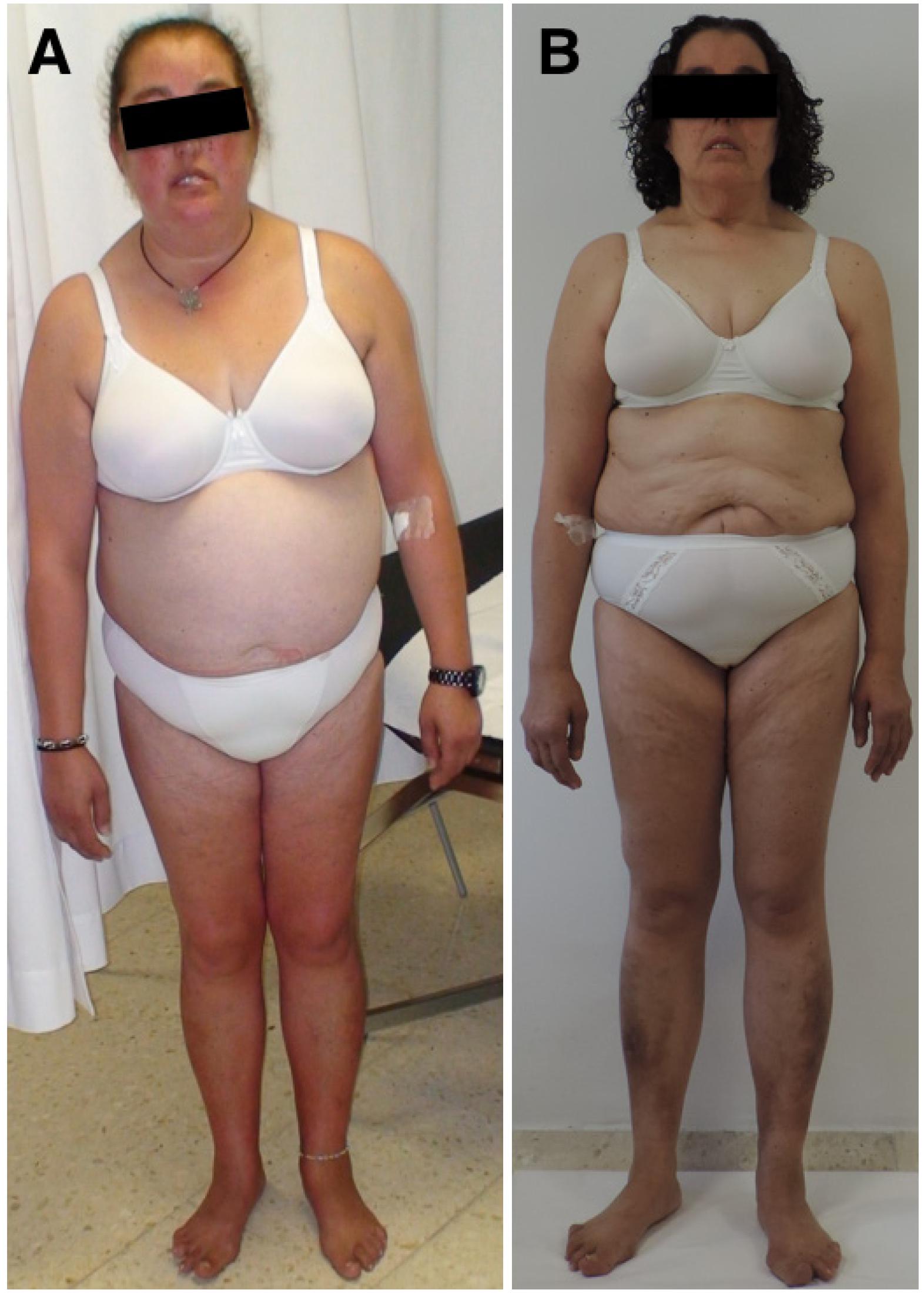
imageFigure 1 Photographs of the patient show body morphology due to a LMNA variant. (A) Before receiving a cure for Cushing's syndrome (46 years old). (B) Six years after receiving a cure for Cushing's syndrome (54 years old). open_in_new
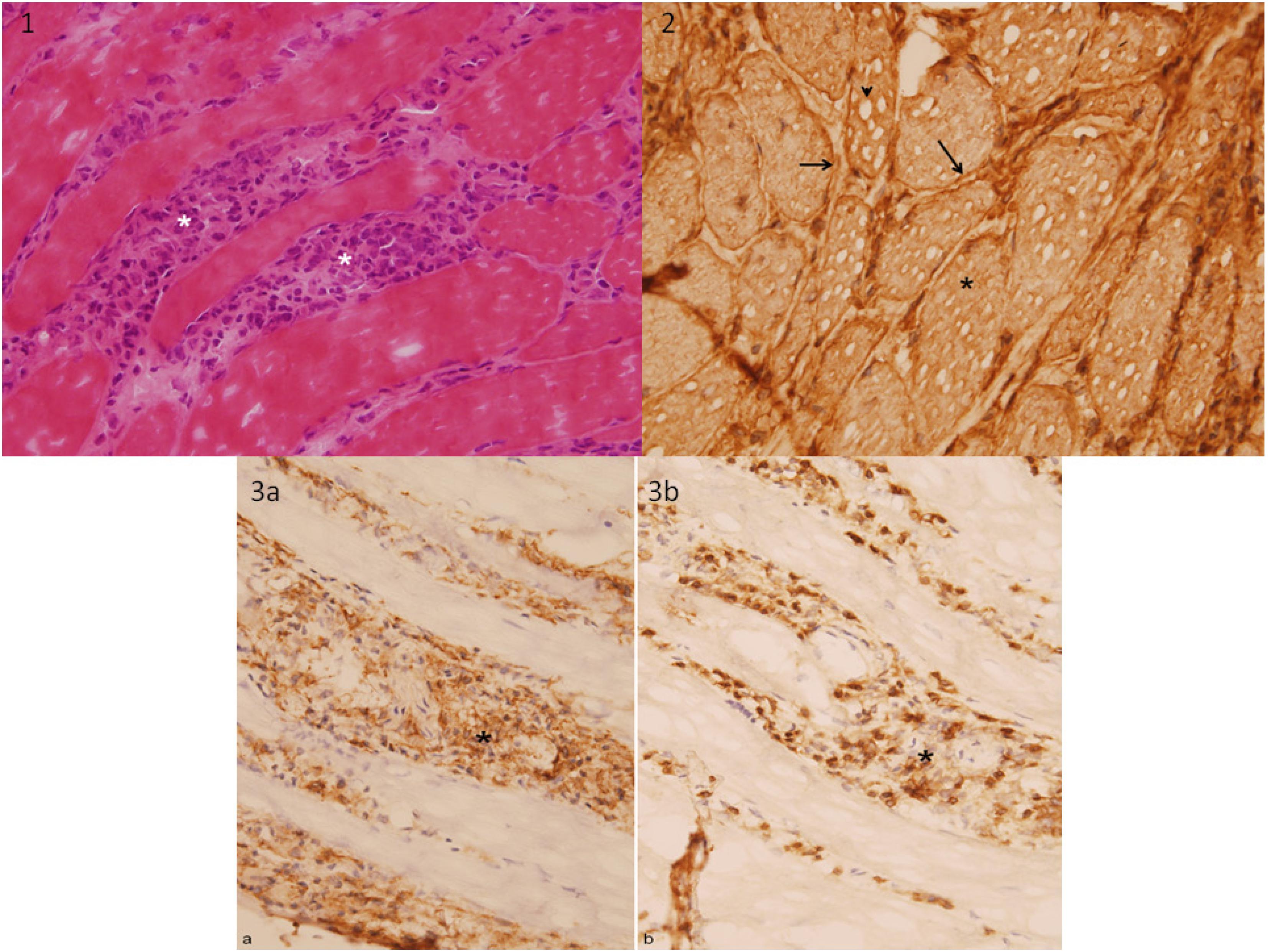
imageFigure 2 (1) Snap frozen cryostat sections of deltoid muscle showing endomisial inflammatory infiltrates composed mainly of hystiocytes (asterisks) (Hematoxylin and eosin, 400x). (2) MHC class I antigen is upregulated in all fibers, with immunolabeling at plasma membrane (arrow) and sarcoplasm (asterisk). See also “pseudovacuoles” secondary to “ice crystals” snap frozen artifact (arrow head) (Immunoperoxidase reaction, diaminobenzidine brown staining chromogen, 400x). (3a) Immunostaining of CD68 (KP1) antibody remark histiocityc inflammatory component between myofibers, with (3b) a minor population of CD3 antibody positive T lymphocytes (asterisks) (400x). open_in_new
table_chartTable 1
Chronological evolution of clinical data
| Age (years) | 45 | 46 | 47 | 48 | 49-52 |
|---|---|---|---|---|---|
| Event | Adrenal | ||||
| Diabetes. Start | Cushing. | Adrenal | |||
| antidiabetic | Start statins | surgery, | Myopathy. | ||
| and | and insulin; | start | Stop statins | ||
| antihypertensi | intensive | hydrocortiso | at 49 | ||
| ve drugs | antihypertensi | ne | |||
| ve therapy | |||||
| BMI | 30.5 | 31.7 | 30.8 | 36.5 | 25-26 |
| BP (mmHg) | 150/90 | 165/109 | 130/9 | 140/93 | 125/80 |
| 0 | |||||
| CPK (UI/L) | - | 176 | 88 | 157 | 378-2500 |
| LDH (U/L) | - | - | - | 556-860 | |
| Glucose (mg/dL) | 250 | 331 | 236 | 137 | 65-91 |
| HbA1C (%) | - | 9.6 | 10.2 | 8.1 | 6-6.1 |
| Triglycerides (mg/ dL) | 164 | 122 | 146 | 254 | 202-214 |
| HDL (mg/dL) | - | 37 | 41 | 30 | 40-40 |
| LDL (mg/dL) | - | 161 | 126 | - | 63-139 |
| Leptin (µg/L) | - | - | 12.7 | 9.9 | 1-8.4 |
| Insulin* (mUI/L) | - | 46.5 | - | - | 43.9 |
| UFC (Ug/24h) | - | 838 | 1014 | - | 36 |
| Cortisol** (ug/dL) | 23 | 30 | 27.4 | 2.2 | 1.6 |
| ACTH | - | 13 | 9 | - | 60 |
-
BP: blood pressure; UFC: urinary free cortisol;
-
*
without exogenous insulin:
-
**
stopping oral corticoid almost 24h before.
table_chartTable 2
Changes in body composition before and after Cushing cure evaluated by anthropometry and DXA
| Active cushing | Cured cushing | Obese control* | Non obese control* | |
|---|---|---|---|---|
| Age | 46 | 48.6 | ||
| Weight (kg) | 82.2 | 65.3 | ||
| Height (cm) | 161 | 161 | ||
| BMI (kg/m2) | 31.7 | 25.21 | 38.1 ± 6.5 | 26.6 ± 2.8 |
| Tricipital skinfold (mm) | 20 | 17 | 38.8 ± 10.0 | 29.4 ± 11.7 |
| Bicipital skinfold (mm) | 15 | 10 | 32.4 ± 11.6 | 21.5 ± 11.8 |
| Suprailiac skinfold (mm) | 42 | 15 | 52.2 ± 14.7 | 30.6 ± 14.4 |
| Subescapular skinfold (mm) | 35 | 18 | 44.2 ± 12.3 | 28.4 ± 16.4 |
| Thigh skinfold (mm) | 19 | 10 | 41.1 ± 14.5 | 22.7 ± 8.6 |
| Calf skinfold (mm) | 6 | 5 | 18.9 ± 14.2 | 11.2 ± 4.8 |
| WHR | 1.0 | 0.93 | 0.89 ± 0.08 | 0.88 ± 0.06 |
| Total fat (kg) | 37.5 | 20.06 | 43.8 ± 11.7 | 26.4 ± 7.7 |
| Total fat (%) | 46.1 | 30.6 | 48.2 ± 6.4 | 39.3 ± 7.0 |
| Upper limbs fat (kg) | 3.48 | 2.26 | 4.44 ± 1.1 | 3.1 ± 1.0 |
| Upper limbs fat (%) | 45.3 | 31.6 | 47.7 ± 5.7 | 42.1 ± 7.3 |
| Lower limbs fat (kg) | 9.69 | 6.16 | 12.4 ± 3.8 | 8.4 ± 2.2 |
| Lower limbs fat (%) | 40.8 | 30.5 | 44.6 ± 6.4 | 39.8 ± 6.4 |
| Trunk fat (kg) | 23.2 | 10.84 | 22.9 ± 5.1 | 14.0 ± 5.7 |
| Trunk fat (%) | 51.7 | 31.8 | 52.5 ± 7.6 | 40.8 ± 10.2 |
| Visceral fat (g) | ND | 764 | 2012 ± 894 | 992 ± 693 |
| Trunkal/Lower limbs fat ratio (kg) | 2.39 | 1.75 | 1.61 | 1.66 |
-
*
Normal ranges from ref. 3; WHR: waist to hip ratio.
How to cite
location_on
Sociedade Brasileira de Endocrinologia e Metabologia
Rua Botucatu, 572 - Conjuntos 81/83, CEP: 04023-061 , Tel: +55 (11) 5575-0311 / +55 (11) 9 9768-6933 -
São Paulo -
SP -
Brazil
E-mail: aem.editorial.office@endocrino.org.br
E-mail: aem.editorial.office@endocrino.org.br
rss_feed
Acompañe los números de esta revista en su lector de RSS
Versão para download de PDF
Artículos relacionados
Lista de links para artigos relacionados. Os links abrem em nova aba.
Versões e tradução automática
Escolha a versão original do texto ou utilize um serviço de tradução automática.
Versão original do texto
Como citar
Escolha um formato para exportar ou selecione um estilo de citação. O conteúdo abaixo pode ser atualizado após a seleção.