 Higher C-reactive protein/albumin ratio is a potential marker for predicting amputation in patients with diabetic foot infection
ABSTRACT
Objective: Non-traumatic amputation resulting from diabetic foot infection (DFI) poses significant clinical and public health concerns. The C-reactive protein (CRP)/albumin ratio represents a combination of the infection level and nutritional status. This study investigated the relationship between the CRP/albumin ratio and amputation in patients with diabetic foot infections.
Subjects and methods: Patients with a DFI of Wagner grade. 3 diagnosed between January 2020 and September 2023 were retrospectively analyzed. The association between the CRP/albumin ratio and amputation was explored using multivariable logistic regression modeling. Stratified analyses were also performed to ensure the reliability of the findings.
Results: Of 301 enrolled patients, 226 underwent amputation and 75 did not. The amputation rate increased with a greater CRP/albumin ratio in the non-adjusted, minimally adjusted, and fully adjusted models, regardless of whether the CRP/albumin ratio was regarded as a categorical or continuous variable.
Conclusion: An increased CRP/albumin ratio was associated with a greater risk of amputation in individuals with DFI.
Keywords:
Diabetic foot infection; C-reactive protein; albumin; amputation
INTRODUCTION
Diabetic foot ulcers (DFUs) are a combination of foot deformities, peripheral arterial disease, neuropathy, and infections (1). Approximately 50%-60% of patients with a DFU develop diabetes-related foot infections (DFIs) (2). Foot ulcer wounds that are difficult to heal for a long duration can seriously affect the quality of life of diabetic patients (3) and are closely related to a high incidence of lower limb amputation and increased mortality (4). Approximately 20% of moderate-to-severe DFIs result in amputation of the lower extremities, and the worldwide 5-year mortality rate for patients with severe amputations exceeds 70% (2,5). In addition, the worldwide burden of DFIs has been growing annually (6,7), imposing a huge economic and social burden on families and society.
Currently, the clinical identification of DFI is based on the signs or symptoms of local or systemic inflammation (8). The International Working Group on the Diabetic Foot (IWGDF) recommends defining severe DFI as any foot infection accompanied by the systemic inflammatory response syndrome (8). C-reactive protein (CRP) is an early stage response substance that has been widely accepted as a sensitive inflammatory serum biomarker. The CRP level is higher among infected patients than controls (9) and, therefore, has been implicated as a potential marker of many diseases. However, the CRP level is not a specific indicator of a single disease (10). Recent research suggests that the CRP/albumin ratio may be a novel marker of infection severity (11). This ratio shows promising potential as a predictive marker for some inflammation-related diseases such as acute pancreatitis (12,13), cancer (14-18), stroke (19,20), cardiovascular diseases (21-23), and COVID-19 (24-26). However, only one study has investigated the connection between the CRP/albumin ratio and amputation risk in patients with a DFI (27), and no data from China have been reported.
Therefore, this study evaluated the correlation between the CRP/albumin ratio and amputation risk in patients with DFI in a Chinese tertiary care hospital. We anticipate that our results will help clinicians predict the likelihood of amputation at the patient’s initial visit and take timely and effective measures to avoid or minimize amputation.
SUBJECTS AND METHODS
This retrospective study was conducted in accordance with the Declaration of Helsinki and approved by the Ethics Review Committee of our hospital (ID: 2024001). The requirement for informed consent was waived because the patient data were anonymized. Consecutive data of patients diagnosed with DFI at our hospital between January 2020 and September 2023 were retrospectively reviewed. DFI was diagnosed based on IWGDF guidelines (8), and the severity of DFU was graded according to Wagner’s classification (28). The inclusion criteria were 1) diagnosis of Wagner grade ≥ 3 DFI, 2) age ≥ 18 years old, and 3) complete clinical data. The exclusion criteria were 1) DFI with Wagner grade 0, 1, or 2; 2) complications with other inflammatory diseases such as Buerger’s disease, inflammatory bowel disease, rheumatic diseases, or cancer; 3) multiple hospitalizations; and 4) missing data on CRP or albumin levels.
Data collection
The following data were obtained from our hospital information system: 1) baseline characteristics including sex, age, body mass index (BMI), systolic blood pressure, diastolic blood pressure, smoking status, and complications (hypertension, coronary heart disease, and cerebrovascular disease) and 2) laboratory test results including red blood cell (RBC), white blood cell (WBC), and platelet counts; neutrophil percentage; and hemoglobin, fasting glucose, glycosylated hemoglobin (HbA1c), CRP (mg/L), and albumin (g/L) levels. Laboratory tests were performed on the morning of admission. Smoking status was categorized as current, former, or never smoker. The CRP/albumin ratio was calculated as the ratio of CRP level to albumin level.
Amputations were categorized as minor or major, defined as amputation with the ankle joint left intact and complete wound healing or amputation above the ankle joint, respectively (29). DFI without systemic manifestations, involving only the skin or subcutaneous tissue (no deeper tissue), or any erythema that did not extend > 2 cm was regarded as a mild infection. DFI-affected tissues deeper than the skin and subcutaneous tissues with erythema extending > 2 cm without systemic manifestations were classified as moderately affected. DFI was categorized as severe when two or more systemic symptoms were present, such as body temperature > 38 °C or < 36 °C, heart rate > 90 beats/min, respiratory rate > 20 breaths/min, PaCO2 < 4.3 kPa (32 mmHg), WBC count > 12,000 or < 4,000 cells/mm3, or immature (banded) leukocytes > 10%.
Statistical analysis
The CRP/albumin ratio was regarded as a categorical variable; patients were categorized based on the tertiles of the CRP/albumin ratio, and patient characteristics were analyzed according to tertiles. Categorical variables are presented as numbers and percentages. The normal distribution of continuous data was initially examined using the Kolmogorov-Smirnov test, and normally distributed data are presented as the mean ± standard deviation and non-normally distributed data as the median and interquartile range. The Chi-square test, Student’s t-test, or Mann-Whitney U test was used to compare categorical variables, normally distributed continuous variables, and non-normally distributed continuous variables, respectively.
Multivariable logistic regression analyses were performed to evaluate the independent association between the CRP/albumin ratio and amputation in patients with DFI. First, analyses were performed without adjustments. The minimally adjusted model was adjusted for age and sex. The fully adjusted model was adjusted for age, sex, smoking status, hypertension, coronary heart disease, cerebrovascular disease, mean arterial pressure (MAP), fasting glucose levels, and HbA1c levels. Subgroup analyses were stratified according to relevant covariates. The diagnostic value of related factors was predicted using receiver operating characteristic (ROC) curves.
All analyses were performed using R statistical software (version 4.2.2; The R Foundation, Indianapolis, IN, USA) (30) and Free Statistics Analysis Platform version 1.9. Two-tailed P values < 0.05 were regarded as statistically significant.
RESULTS
Baseline characteristics
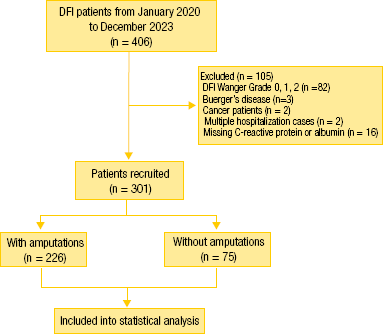
Initially, 406 patients were eligible to participate. After excluding patients with Wagner grade 0, 1, or 2; patients with complications such as another inflammatory disease or cancer; and patients with incomplete data, 301 patients, including 208 men and 93 women, were ultimately enrolled and evaluated (Figure 1). Table 1 shows the general characteristics of the participants according to CRP/albumin ratio tertiles. Patients were aged 65.2 ± 12.0 years with an average interval since diabetes diagnosis of 15.4 ± 9.5 years. Sex, age, BMI, MAP, smoking status, diabetes duration, DFI microbial community, coronary artery disease, and cerebral infarction were comparable among the tertiles (P > 0.05). However, individuals with a higher CRP/albumin ratio tended to have a more severe DFI, a higher incidence of hypertension, and higher WBC and platelet counts, neutrophil percentage, and fasting glucose, HbA1c, and CRP levels but lower RBC, hemoglobin, and albumin levels (P < 0.05). The IWGDF DFI grading revealed that 235 individuals (78.1%) had mild and moderate infections, whereas 66 (21.9%) had severe infections. The patients were further divided into mild and moderate infection (n = 235) and severe infection (n = 66) groups. Statistical analysis demonstrated that patients with severe infections had a higher CRP/albumin ratio than those with mild or moderate infections (P < 0.001) (Table S1).
Relationship between the CRP/albumin ratio and amputation
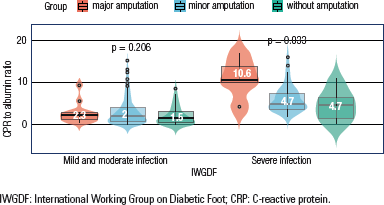
Of 301 patients, 226 (75.1 %) underwent amputation, including 18 major amputations (8.0%) and 208 minor amputations (92.0%). Of the 66 patients with severe infections, 54 (81.8%) underwent amputation. The CRP/albumin ratios of patients who underwent major amputation, minor amputation, and no amputation in the mild and moderate infection group were not significantly different, whereas those who underwent major amputation had the highest CRP/albumin ratios among patients with severe infection (P < 0.05) (Figure 2).

Distribution of CRP/albumin ratio in patients with amputation by severity of diabetic foot infection.
Univariate analysis suggested that MAP, HbA1c, RBC, hemoglobin, WBC, neutrophil percentage, and CRP/albumin ratio were significantly associated with amputation rate (P < 0.05, Table 2). Furthermore, the association between the CRP/albumin ratio and amputation rate was detected using multivariable logistic proportional hazard regression analysis. As shown in Table 3, when the CRP/albumin ratio was incorporated as a continuous variable in the analysis, the amputation rate rose along CRP/albumin ratios in the non-adjusted model (odds ratio [OR]: 1.13, 95% confidence interval [CI]: 1.03-1.25; P = 0.012] (crude model), minimally adjusted model (OR: 1.14, 95% CI: 1.03-1.25; P = 0.008), and fully adjusted model (OR: 1.19, 95% CI: 1.07-1.34; P = 0.002). As a categorical variable, a CRP/albumin ratio ≥ 3.841 indicated a significant association with the amputation rate in the crude model (OR: 2.03, 95% CI: 1.06-3.9; P = 0.033), minimally adjusted model (OR: 2.16, 95% CI: 1.11-4.18; P = 0.023), and fully adjusted model (OR: 2.73, 95% CI: 1.25-5.98; P = 0.012).
Associations between CRP to albumin ratio and DFI amputations in the multiple regression model
Subgroup analyses
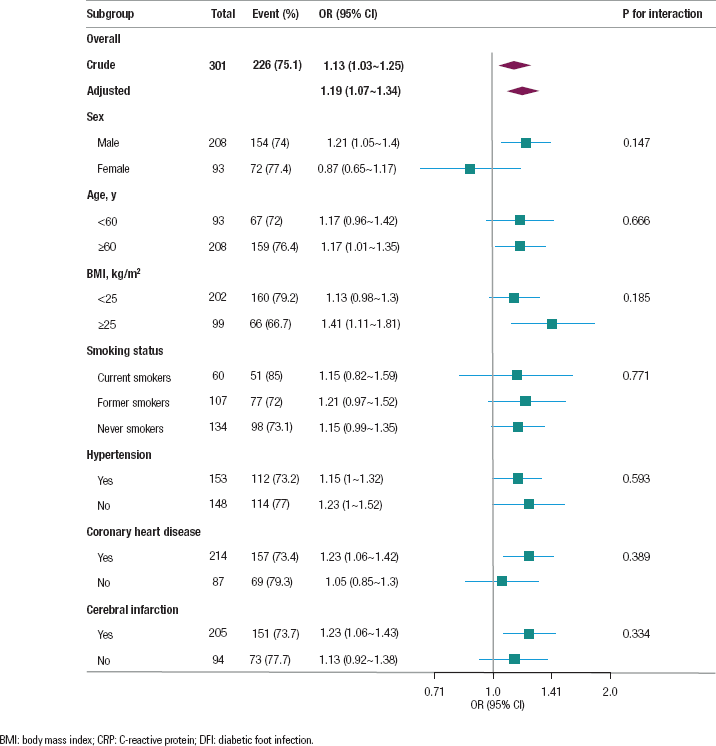
To explore the potential effect of the CRP/albumin ratio more accurately, a stratified analysis was performed to evaluate its relationship with amputation rate (Figure 3). The CRP/albumin ratio was a risk factor in male patients, those aged ≥ 60 years old, and those with a BMI ≥ 25 kg/m2, coronary heart disease, or cerebral infarction. No significant interaction was observed between the subgroups (P > 0.05).

Stratified analyses of the association between CRP/albumin ratio and DFI amputation risk according to baseline characteristics. Except for the stratification factor itself, the stratifications were adjusted for all variables, including age, sex, smoking status, hypertension, coronary heart disease, cerebrovascular disease, mean arterial pressure, fasting glucose level, and glycosylated hemoglobin.
ROC analysis
ROC curves were generated to evaluate the baseline risk model consisting of age, sex, smoking status, BMI, diabetes duration, hypertension, coronary heart disease, cerebrovascular disease, MAP, fasting glucose level, HbA1c, and the fitting model of the baseline risk model and CRP/albumin ratio. The results demonstrated that the fitting model slightly increased the area under the ROC curve from 0.705 (95% CI: 0.635, 0.774) to 0.733 (95% CI: 0.664, 0.802), although the difference was not statistically significant (P = 0.153) (Figure 4).

ROC curves evaluated the predict value of baseline risk model and fitting model. Model 1 is the baseline risk model including age, sex, smoking status, BMI, diabetes duration, hypertension, coronary heart disease, cerebrovascular disease, mean arterial pressure, fasting glucose level, and glycosylated hemoglobin and model 2 is the fitting model of the baseline risk model and CRP/albumin ratio.
DISCUSSION
DFI-associated amputation is a major cause of mortality in patients with diabetes (31). In the present study, the CRP/albumin ratio was significantly and positively correlated with amputation rate. This relationship persisted after adjusting for potential confounders and was more pronounced in patients with severe infections. The association between the CRP/albumin ratio and DFI-associated amputation remained stable in subgroup analyses, suggesting that the CRP/albumin ratio is an independent prognostic predictor in patients with DFI.
A large Chinese multicenter cohort study conducted by Jiang and cols. indicated that the overall amputation rate in individuals with DFI was 19.03% (major and minor amputation rates: 2.14% and 16.88%, respectively) (32). Between 2017 and 2019, the average annual rough amputation prevalence of non-traumatic major and minor amputations in individuals with diabetes was 41.5/100,000 and 86.9/100,000, respectively, in Zwolle, the Netherlands (33). In Romania, the overall incidence of diabetes in patients undergoing non-traumatic amputation increased from 80.61/100,000 in 2015 to 98.15/100,000 in 2019 (34). In Africa, the lower limb amputation rate in individuals with diabetes is 1.9% (35). Few studies have been conducted on amputation due to infected DFUs in China, particularly in patients with severe infections. In the present study, the amputation rate was 75.08% (226/301), which was significantly higher than rates reported in previous studies. We believe this is because the included populations had DFI with Wagner grades ≥ 3, as an increment of 1 point in the Wagner ulcer classification criteria corresponds to a 65% increase in the risk of amputation (36).
Several studies have been conducted to identify risk factors associated with amputation in patients with DFI. Zhu and cols. identified five independent risk factors for DFU-related amputation: peripheral arterial disease, ulcer site, ulcer severity, neutrophil-to-lymphocyte ratio (NLR), and nutritional status (37). Zhang and cols. demonstrated that the WBC count, NLR, CRP level, and Wagner grade were independent risk factors for amputation (38). Aragón-Sánchez and cols. showed that skin necrosis, low serum albumin levels, high erythrocyte sedimentation rate (ESR), and high NLR were significantly associated with a higher rate of amputation and recurrence, longer duration of antibiotic therapy, and prolonged hospitalization (39). Guo and cols. observed that higher HbA1c levels, lower triglyceride levels, and higher Wagner grades were independent risk factors for lower limb amputation in patients with DFU in central and southern China (29).
CRP is a marker of systemic inflammation and severe infection. One study of individuals with DFU and osteomyelitis found that ESR, WBC count, CRP level, and the CRP/albumin ratio were significantly elevated, whereas the albumin level was drastically decreased in patients with osteomyelitis compared to those without osteomyelitis (40). In a prospective study, Das and cols. (41) demonstrated that an albumin level < 3.0 g/dL and CRP level > 5.0 mg/dL were independent predictors of impaired wound healing after an initial successful endovascular treatment. Another retrospective study in Turkey showed that elevated serum CRP levels and older age were reliable prognostic indicators in patients with DFU (42).
Decreased albumin levels in patients with DFU are usually indicative of malnutrition and delayed wound healing. Meanwhile, inflammation lowers albumin levels (29). A low serum albumin level is indicative not only of a patient’s state of nutrition but also of the severity of the patient’s condition. A study on the relationship between dietary intake of essential nutrients and inflammation in individuals with DFI showed that high-quality diets are beneficial for decreasing inflammation (43). Multiple studies have shown that hypoalbuminemia may be a risk factor for amputation (39,44-46) which is consistent with our findings. Exudation of DFUs, frequent dressing changes, and surgeries lead to a large loss of albumin. These factors further weaken the patient’s immunity, and pathogenic microorganisms can easily invade. Therefore, albumin levels should be dynamically monitored in clinical practice, and timely replenishment of albumin is important for improving disease prognosis in patients with DFI.
The CRP/albumin ratio is a potential predictive marker of several inflammation-related diseases (12-26). Consistent with Karaca’s study (27), we also found that the CRP/albumin ratio was a predictive factor for amputation risk in patients with DFI. We also observed that patients with severe infections who underwent major amputation had higher CRP/albumin ratios. Therefore, CRP and albumin levels should be assessed immediately after admission of patients with severe DFIs, and the CRP/albumin ratio should be calculated. However, the only laboratory indicator included in the Infectious Diseases Society of America and IWGDF (8) guidelines for diagnosing the severity of DFIs is a WBC count of > 12,000 or < 4000 cells/mm3. In patients with high CRP/albumin ratios, clinicians should pay greater attention to avoiding or minimizing the occurrence of amputations whenever feasible.
CRP and albumin tests are readily accessible in clinical practice and important in primary care hospitals. The CRP/albumin ratio reflects both the degree of infection and the nutritional status of patients with DFI. Therefore, based on the DFI guideline indicators, clinicians should consider the CRP/albumin ratio in the initial diagnosis of patients with DFI to offer a more comprehensive understanding of the severity of DFI and the nutritional status of the patient. Moreover, more detailed treatment plans for patients should be formulated to reduce the length of stay, hospitalization costs, and amputation rates.
This study had some limitations that must be noted. First, DFI is a dynamic pathological process; therefore, dynamic monitoring of infective indicators is essential for infection control. We collected the data at the time of admission; therefore, the results of this study reflect the extent of DFI only at the time of admission. Second, owing to the observational research design, causality could not be deduced from the results. Third, as in all observational studies, uncontrolled potential confounders may exist. Additionally, owing to the limitations of the database, we had no information on other nutritional indicators. This should be considered carefully in future real-world studies. Future studies should include randomized controlled trials to confirm the causal relationship between the CRP/albumin ratio and amputation.
In conclusion, the CRP/albumin ratio is a potential predictive factor for amputation in patients with DFIs. Consequently, physicians should pay close attention to screening and initiate timely interventions to improve patient outcomes and avoid or minimize amputation.
-
Funding:
Taiyuan Bureau of Science and Technology, Science, Technology, and Innovation Program of National Regional Medical Center (NO. 202210)
REFERENCES
-
1 Pitocco D, Spanu T, Di Leo M, Vitiello R, Rizzi A, Tartaglione L, et al. Diabetic foot infections: a comprehensive overview. Eur Rev Med Pharmacol Sci. 2019 Apr;23(2 Suppl):26-37. doi: 10.26355/eurrev_201904_17471.
» https://doi.org/10.26355/eurrev_201904_17471 -
2 Armstrong DG, Tan TW, Boulton AJM, Bus SA. Diabetic Foot Ulcers: A Review. JAMA. 2023 Jul 3;330(1):62-75. doi: 10.1001/jama.2023.10578.
» https://doi.org/10.1001/jama.2023.10578 -
3 Oe M, Saad SS, Jais S, Sugama J. Impact of foot ulcer-related factors on quality of life in patients with diabetes: Prospective observational study. Int Wound J. 2024 May;21(5):e14895. doi: 10.1111/iwj.14895.
» https://doi.org/10.1111/iwj.14895 - 4 Matheson EM, Bragg SW, Blackwelder RS. Diabetes-Related Foot Infections: Diagnosis and Treatment. Am Fam Physician. 2021 Oct 1;104(4):386-94.
-
5 Vuorlaakso M, Kiiski J, Salonen T, Karppelin M, Helminen M, Kaartinen I. Major Amputation Profoundly Increases Mortality in Patients with Diabetic Foot Infection. Front Surg. 2021 Apr 30;8:655902. doi: 10.3389/fsurg.2021.655902.
» https://doi.org/10.3389/fsurg.2021.655902 - 6 Boulton AJM, Armstrong DG, Kirsner RS, Attinger CE, Lavery LA, Lipsky BA, et al. Diagnosis and Management of Diabetic Foot Complications. Arlington (VA): American Diabetes Association; 2018 Oct.
- 7 Armstrong DG, Boulton AJM, Bus SA. Diabetic Foot Ulcers and Their Recurrence. N Engl J Med. 2017 Jun 15;376(24):2367-75.
-
8 Senneville É, Albalawi Z, van Asten SA, Abbas ZG, Allison G, Aragón-Sánchez J, et al. IWGDF/IDSA Guidelines on the Diagnosis and Treatment of Diabetes-related Foot Infections (IWGDF/IDSA 2023). Clin Infect Dis. 2023 Oct 2:ciad527. doi: 10.1093/cid/ciad527.
» https://doi.org/10.1093/cid/ciad527 -
9 Li S, Gu J, Nan W, Zhang N, Qin L, Su M, et al. Procalcitonin and C-reactive protein predict infection in hematopoietic stem cell transplantation patients. Leuk Res. 2021 Jun;105:106574. doi: 10.1016/j.leukres.2021.106574.
» https://doi.org/10.1016/j.leukres.2021.106574 -
10 Rizo-Téllez SA, Sekheri M, Filep JG. C-reactive protein: a target for therapy to reduce inflammation. Front Immunol. 2023 Jul 26;14:1237729. doi: 10.3389/fimmu.2023.1237729.
» https://doi.org/10.3389/fimmu.2023.1237729 -
11 Güneş H, Yurttutan S, Çobanuşağı M, Doğaner A. CRP/albumin ratio: A promising marker of gram-negative bacteremia in late-onset neonatal sepsis. Turk Arch Pediatr. 2021 Jan 1;56(1):32-6. doi: 10.14744/TurkPediatriArs.2020.99076.
» https://doi.org/10.14744/TurkPediatriArs.2020.99076 -
12 Piñerúa-Gonsálvez JF, Ruiz Rebollo ML, Zambrano-Infantino RDC, Rizzo-Rodríguez MA, Fernández-Salazar L. Value of CRP/albumin ratio as a prognostic marker of acute pancreatitis: a retrospective study. Rev Esp Enferm Dig. 2023 Dec;115(12):707-12. doi: 10.17235/reed.2023.9345/2022.
» https://doi.org/10.17235/reed.2023.9345/2022 -
13 Tarar MY, Khalid A, Choo XY, Khurshid S, Tumeh H, Muhammad K. Use of the C-Reactive Protein (CRP)/Albumin Ratio as a Severity Tool in Acute Pancreatitis: Systematic Review. Cureus. 2022 Sep 16;14(9):e29243. doi: 10.7759/cureus.29243.
» https://doi.org/10.7759/cureus.29243 -
14 Arakawa Y, Miyazaki K, Yoshikawa M, Yamada S, Saito Y, Ikemoto T, et al. Value of the CRP-albumin ratio in patients with resectable pancreatic cancer. J Med Invest. 2021;68(3.4):244-55. doi: 10.2152/jmi.68.244.
» https://doi.org/10.2152/jmi.68.244 -
15 Tamai K, Okamura S, Makino S, Yamamura N, Fukuchi N, Ebisui C, et al. C-reactive protein/albumin ratio predicts survival after curative surgery in elderly patients with colorectal cancer. Updates Surg. 2022 Feb;74(1):153-62. doi: 10.1007/s13304-021-01011-9.
» https://doi.org/10.1007/s13304-021-01011-9 -
16 Song DH, Cho IK, Shin DW, Lee JC, Cho JY, Yoon YS, et al. The clinical significance of preoperative C-reactive protein/albumin ratio in patients with resected extrahepatic bile duct cancer. Surg Today. 2021 Jun;51(6):978-85. doi: 10.1007/s00595-020-02188-z.
» https://doi.org/10.1007/s00595-020-02188-z -
17 Bekki T, Shimomura M, Hattori M, Sato S, Watanabe A, Ishikawa S, et al. C-Reactive Protein/Albumin Ratio Is an Independent Risk Factor for Recurrence and Survival Following Curative Resection of Stage I-III Colorectal Cancer in Older Patients. Ann Surg Oncol. 2024 Jul;31(7):4812-21. doi: 10.1245/s10434-024-14961-2
» https://doi.org/10.1245/s10434-024-14961-2 -
18 Inoue H, Shiozaki A, Fujiwara H, Konishi H, Kiuchi J, Ohashi T, et al. Absolute lymphocyte count and C-reactive protein-albumin ratio can predict prognosis and adverse events in patients with recurrent esophageal cancer treated with nivolumab therapy. Oncol Lett. 2022 Jun 14;24(2):257. doi: 10.3892/ol.2022.13377.
» https://doi.org/10.3892/ol.2022.13377 -
19 Yuan J, Cheng Y, Han X, Zhu N, Ma W, Li J, et al. Association between C-reactive protein/albumin ratio and all-cause mortality in patients with stroke: Evidence from NHANES cohort study. Nutr Metab Cardiovasc Dis. 2024 Oct;34(10):2305-14. doi: 10.1016/j.numecd.2024.05.024.
» https://doi.org/10.1016/j.numecd.2024.05.024 -
20 Huang L, Zhang R, Ji J, Long F, Wang Y, Lu J, et al. Hypersensitive C-reactive protein-albumin ratio is associated with stroke-associated pneumonia and early clinical outcomes in patients with acute ischemic stroke. Brain Behav. 2022 Jul;12(7):e2675. doi: 10.1002/brb3.2675.
» https://doi.org/10.1002/brb3.2675 -
21 Xu X, Zhu X, Wang H, Liu X, Yang C, Liu L, et al. Evaluation of the Prognostic Role of Neutrophil-Lymphocyte Ratio, C-Reactive Protein-Albumin Ratio, and Platelet-Lymphocyte Ratio in Patients with the Co-Presentation of Coronary Artery Disease and COVID-19. Infect Drug Resist. 2024 Mar 7;17:885-97. doi: 10.2147/IDR.S450318.
» https://doi.org/10.2147/IDR.S450318 -
22 Zhao X, Bie M. Value of C-reactive protein/albumin ratio in predicting the development of preoperative oxygenation impairment in patients with Stanford type-B acute aortic dissection. Int J Cardiol Heart Vasc. 2024 Jan 11;50:101337. doi: 10.1016/j.ijcha.2024.101337.
» https://doi.org/10.1016/j.ijcha.2024.101337 -
23 Yang J, Li C, Zheng Y, Gao J, Liu YP, Wang JJ, et al. The Association Between High-Sensitivity C-Reactive Protein/Albumin Ratio and Cardiovascular Prognosis in Patients Undergoing Percutaneous Coronary Intervention. Angiology. 2022 Oct;73(9):818-26. doi: 10.1177/00033197221110715.
» https://doi.org/10.1177/00033197221110715 -
24 Amini A, Yeh N, Gaspar LE, Kavanagh B, Karam SD. Stereotactic body radiation therapy (SBRT) for lung cancer patients previously treated with conventional radiotherapy: a review. Radiat Oncol. 2014 Sep 19;9:210. doi: 10.1186/1748-717X-9-210.
» https://doi.org/10.1186/1748-717X-9-210 -
25 Cekic D, Issever K, Genc AC, Yaylaci S, Genc AB, Tamer A. Association of C-reactive Protein/Albumin, Procalcitonin/Albumin, Platelet/Lymphocyte, and Lymphocyte/Monocyte Ratio with Mortality in Hospitalised COVID-19 Patients. J Coll Physicians Surg Pak. 2022 Sep;32(9):1191-5. doi: 10.29271/jcpsp.2022.09.1191.
» https://doi.org/10.29271/jcpsp.2022.09.1191 -
26 Çelikkol A, Güzel EÇ, Doğan M, Erdal B, Yilmaz A. C-Reactive Protein-to-Albumin Ratio as a Prognostic Inflammatory Marker in COVID-19. J Lab Physicians. 2022 Jan 13;14(1):74-83. doi: 10.1055/s-0041-1741439.
» https://doi.org/10.1055/s-0041-1741439 -
27 Karaca B, Ormen B, Kiris T, Sener A. Predictive Value of C-Reactive Protein to Albumin Ratio for Amputation Risk in Diabetic Foot Infection. Angiology. 2025 Apr;76(4):391-7. doi: 10.1177/00033197231218330.
» https://doi.org/10.1177/00033197231218330 -
28 Wagner Jr FW. The dysvascular foot: a system for diagnosis and treatment. Foot Ankle. 1981 Sep;2(2):64-122. doi: 10.1177/107110078100200202.
» https://doi.org/10.1177/107110078100200202 -
29 Guo Z, Yue C, Qian Q, He H, Mo Z. Factors associated with lower-extremity amputation in patients with diabetic foot ulcers in a Chinese tertiary care hospital. Int Wound J. 2019 Dec;16(6):1304-13. doi: 10.1111/iwj.13190.
» https://doi.org/10.1111/iwj.13190 -
30 Giorgi FM, Ceraolo C, Mercatelli D. The R Language: An Engine for Bioinformatics and Data Science. Life (Basel). 2022 Apr 27;12(5):648. doi: 10.3390/life12050648.
» https://doi.org/10.3390/life12050648 -
31 Das SK, Roy P, Singh P, Diwakar M, Singh V, Maurya A, et al. Diabetic Foot Ulcer Identification: A Review. Diagnostics (Basel). 2023 Jun 7;13(12):1998. doi: 10.3390/diagnostics13121998.
» https://doi.org/10.3390/diagnostics13121998 -
32 Jiang Y, Ran X, Jia L, Yang C, Wang P, Ma J, et al. Epidemiology of type 2 diabetic foot problems and predictive factors for amputation in China. Int J Low Extrem Wounds. 2015 Mar;14(1):19-27. doi: 10.1177/1534734614564867.
» https://doi.org/10.1177/1534734614564867 -
33 Rosien L, van Dijk PR, Oskam J, Pierie MEN, Groenier KH, Gans ROB, et al. Lower Extremity Amputation Rates in People with Diabetes Mellitus: A Retrospective Population Based Cohort Study in Zwolle Region, The Netherlands. Eur J Vasc Endovasc Surg. 2023 Aug;66(2):229-36. doi: 10.1016/j.ejvs.2023.05.030.
» https://doi.org/10.1016/j.ejvs.2023.05.030 -
34 Rusu E, Coman H, Coșoreanu A, Militaru AM, Popescu-Vâlceanu HC, Teodoru I, et al. Incidence of Lower Extremity Amputation in Romania: A Nationwide 5-Year Cohort Study, 2015-2019. Medicina (Kaunas). 2023 Jun 25;59(7):1199. doi: 10.3390/medicina59071199.
» https://doi.org/10.3390/medicina59071199 -
35 Tuglo LS. Prevalence and determinants of lower extremity amputations among type I and type II diabetic patients: A multicenter-based study. Int Wound J. 2023 Apr;20(4):903-9. doi: 10.1111/iwj.13935.
» https://doi.org/10.1111/iwj.13935 -
36 Quilici MT, Del Fiol Fde S, Vieira AE, Toledo MI. Risk Factors for Foot Amputation in Patients Hospitalized for Diabetic Foot Infection. J Diabetes Res. 2016;2016:8931508. doi: 10.1155/2016/8931508.
» https://doi.org/10.1155/2016/8931508 -
37 Zhu Y, Xu H, Wang Y, Feng X, Liang X, Xu L, et al. Risk factor analysis for diabetic foot ulcer-related amputation including Controlling Nutritional Status score and neutrophil-to-lymphocyte ratio. Int Wound J. 2023 Dec;20(10):4050-60. doi: 10.1111/iwj.14296.
» https://doi.org/10.1111/iwj.14296 -
38 Zhang X, Li Q, Zhou X, Xu Y, Shu Z, Deng H. Risk factors for amputation in diabetic foot ulcers: A retrospective analysis. Int Wound J. 2024 Apr;21(4):e14832. doi: 10.1111/iwj.14832.
» https://doi.org/10.1111/iwj.14832 -
39 Aragón-Sánchez J, Víquez-Molina G, López-Valverde ME, Aragón-Hernández J, Rojas-Bonilla JM, Murillo-Vargas C. Clinical, microbiological and inflammatory markers of severe diabetic foot infections. Diabet Med. 2021 Oct;38(10):e14648. doi: 10.1111/dme.14648.
» https://doi.org/10.1111/dme.14648 -
40 Eren MA, Güneş AE, Ceylan MR, İncebıyık H, Aydın MS, Dusak A, et al. Pilot study of the diagnostic value of CRP: albumin ratio for osteomyelitis in patients with diabetic foot ulcers. J Wound Care. 2022 Mar 1;31(Sup3):S25-8. doi: 10.12968/jowc.2022.31.Sup3.S25.
» https://doi.org/10.12968/jowc.2022.31.Sup3.S25 -
41 Das SK, Yuan YF, Li MQ. Predictors of delayed wound healing after successful isolated below-the-knee endovascular intervention in patients with ischemic foot ulcers. J Vasc Surg. 2018 Apr;67(4):1181-90. doi: 10.1016/j.jvs.2017.08.077.
» https://doi.org/10.1016/j.jvs.2017.08.077 -
42 Metineren H, Dülgeroğlu TC. Comparison of the Neutrophil/Lymphocyte Ratio and C-Reactive Protein Levels in Patients with Amputation for Diabetic Foot Ulcers. Int J Low Extrem Wounds. 2017 Mar;16(1):23-8. doi: 10.1177/1534734617696729.
» https://doi.org/10.1177/1534734617696729 -
43 Basiri R, Spicer M, Levenson C, Ledermann T, Akhavan N, Arjmandi B. Improving Dietary Intake of Essential Nutrients Can Ameliorate Inflammation in Patients with Diabetic Foot Ulcers. Nutrients. 2022 Jun 9;14(12):2393. doi: 10.3390/nu14122393.
» https://doi.org/10.3390/nu14122393 -
44 Gong H, Ren Y, Li Z, Zha P, Bista R, Li Y, et al. Clinical characteristics and risk factors of lower extremity amputation in the diabetic inpatients with foot ulcers. Front Endocrinol (Lausanne). 2023 Mar 31;14:1144806. doi: 10.3389/fendo.2023.1144806.
» https://doi.org/10.3389/fendo.2023.1144806 -
45 Xu S, Wang Y, Hu Z, Ma L, Zhang F, Liu P. Effects of neutrophil-to-lymphocyte ratio, serum calcium, and serum albumin on prognosis in patients with diabetic foot. Int Wound J. 2023 May;20(5):1638-46. doi: 10.1111/iwj.14019.
» https://doi.org/10.1111/iwj.14019 -
46 Dmitriyeva M, Kozhakhmetova Z, Urazova S, Kozhakhmetov S, Turebayev D, Toleubayev M. Inflammatory Biomarkers as Predictors of Infected Diabetic Foot Ulcer. Curr Diabetes Rev. 2022;18(6):e280921196867. doi: 10.2174/1573399817666210928144706.
» https://doi.org/10.2174/1573399817666210928144706