
Turner syndrome is one of the most common aneuploidies. In vitro fertilization with oocyte donation is the usual method of assisted conception, but spontaneous pregnancy can also occur. Although pregnancies in Turner syndrome are widely accepted to be associated with small for gestational age foetuses, neither the causal role of placental insufficiency nor the contribution of maternal and foetal factors is well understood. Between 2009 and 2023, we followed 75 patients diagnosed with Turner syndrome at our university clinic, and four Turner syndrome patients became pregnant (4/75; 5.3%): ten pregnancies with seven live births (7/10; 70%) were reported. Conception was spontaneous in 6/7 patients (86%), and one patient had in vitro fertilization with oocyte donation. Two Turner syndrome patients with karyotype 45,X and two Turner syndrome patients with mosaicism (45,X/46,XX) were identified. Prenatal transabdominal amniocentesis revealed aneuploidy (45,X) in two foetuses. The most common obstetric complication was placental insufficiency, which presented as intrauterine growth restriction and foetal distress. Four early-term deliveries, one late-term delivery, one preterm delivery, and one extremely premature delivery occurred, and all pregnancies were terminated by caesarean section. No severe maternal complications during pregnancy were reported. Only newborns with Turner syndrome had long-term health problems. In Turner syndrome patients, even if pregnancy is conceived spontaneously, no maternal complications occur, and the foetus also has a normal karyotype, there is still a high prevalence of placental insufficiency and foetal compromise. The presented cases highlight the possible role of inherent maternal factors in Turner syndrome-associated intrauterine growth restriction and emphasize the importance of enhanced obstetric surveillance even in apparently uncomplicated Turner syndrome pregnancies.
case series • Arch. Endocrinol. Metab. 69
(1)
• 2025 • https://doi.org/10.20945/2359-4292-2024-0144 linkcopy
 Placental insufficiency irrespective of offspring karyotype in maternal Turner syndrome: a case series and literature review
Authorship
read · approved the final manuscript · analysed · interpreted the patient data
person Olga Török
read · approved the final manuscript · participated in karyotyping · contributed to the writing of the manuscript
person Zoárd Tibor Krasznai
read · approved the final manuscript · contributed to the writing of the manuscript
person Zsuzsanna Buczkó
read · approved the final manuscript · participated in karyotyping · contributed to the writing of the manuscript
person Péter Juhász
read · approved the final manuscript · carried out the histologic · FISH examinations · contributed to the writing of the manuscript
person Gábor Méhes
read · approved the final manuscript · carried out the histologic · FISH examinations · contributed to the writing of the manuscript
person Mónika Orosz
read · approved the final manuscript · contributed to the writing of the manuscript
person Attila Jakab
read · approved the final manuscript · contributed to the writing of the manuscript
person Tamás Deli
read · approved the final manuscript · analysed · interpreted the patient data
Conflict of interest: the authors report that there are no competing interests to declare.
Figures | Tables
 Thumbnail
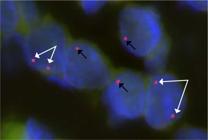
imageFigure 1 Fluorescent in situ hybridization of the ovarian biopsy specimen of Patient 1. Evaluation was performed with fluorescence in situ hybridization (chromosome X, centromere region red signal, nucleus blue signal). Picture represents five cells: two of five cells contain two (white arrows), and three of five cells contain one hybridization signal (black arrows). open_in_new

table_chartTable 1
Patient characteristics and medical histories
| Patient No. | Age at (last) delivery (years old) | Age at diagnosis (years old) | Karyotype | Menstrual cycles | Adult height (cm) | Adult BMI (kg/m2) | Dysmorphological features | Concomitant diseases and treatments | Obstetric history |
|---|---|---|---|---|---|---|---|---|---|
| 1 | 20 | 1 | 45,X/46,XX* | Irregular | 149 | 24.3 | Short stature (GH therapy) | Benign frontal haemangioma Tachycardia |
G:2, P:1† |
| 2 | 34 | 17 | 45,X | Primary amenorrhoea | 154 | 20.9 | Short stature (GH therapy) Dysmorphic face, low-set ears, clitoromegaly |
Mitral prolapse Hypothyroidism Benign breast tumour |
G:1, P:1 |
| 3 | 25 | 12 | 45,X | Irregular | 149 | 20.8 | Short stature (GH therapy) Dysmorphic face, low-set ears, hypertrichosis, pterygium colli, acanthosis |
Benign frontal haemangioma Tachycardia |
G:2, P:2 |
| 4 | 25 | 12 | 45,X/46,XX | Irregular | 150 | 22.7 | Underdeveloped breasts, dysmorphic face, low-set ears | Mitral prolapse Hypertension Allergic asthma Otologic surgery |
G:5, P:3‡ |
-
*
Histology of ovary at caesarean section: stroma-rich ovarian tissue, 50% stroma, 50% regular ovarian tissue with some sporadic primordial follicles.
- X chromosome centromere specific fluorescence in situ hybridization of somatic cells of ovarian tissue: 0 hybridization signal with 80%, 1 hybridization signal with 13.2%, 2 hybridization signals with 6.8%;
-
†
Patient 1 had one artificial abortion;
-
‡
Patient 4 had two early miscarriages.
- BMI: body mass index; GH: growth hormone; G: gravidity; P: parity.
table_chartTable 2
Obstetric outcomes of Turner syndrome pregnancies and neurodevelopmental outcomes and comorbidities of the offspring
| Patient No. |
Pregnancy No. | Mode of conception | Time of delivery (gestational week) | Obstetric complication | Mode of delivery | Birth weight | Karyotype of offspring | Neurodevelopment and comorbidities of offspring |
|---|---|---|---|---|---|---|---|---|
| 1 | 1 | Spontaneous | 37 | IUGR, oligohydramnios* | C/S | 1,880 g | 46,XY | Normal development |
| 2 | 1 | IVF (DO, sister) | 39 | Unstable lie | C/S | 3,520 g | 46,XY | Normal development |
| 3 |
1 | Spontaneous | 38 | IUGR, foetal distress | C/S | 2,030 g | 45,X | Short stature, Strabism |
| 2 | Spontaneous | 24 | IUGR, oligohydramnios Foetal distress |
C/S | 300 g | 45,X | Somatomental retardation, short stature, Hypothyroidism, Ophthalmological disorders | |
| 4 | 1 | Spontaneous | 36 | IUGR, foetal distress | C/S | 2,360 g | 46,XX | Normal development |
| 2 | Spontaneous | 38 | IUGR, foetal distress | C/S | 2,720 g | 46,XY | Normal development | |
| 3 | Spontaneous | 38 | IUGR, transverse position | C/S | 2,070 g | 46,XX | Normal development |
-
*
Histology of placenta and cord: negative.
- IVF: in vitro fertilization; DO: donor oocyte, IUGR: intrauterine growth restriction; C/S: caesarean section.
How to cite
location_on
Sociedade Brasileira de Endocrinologia e Metabologia
Rua Botucatu, 572 - Conjuntos 81/83, CEP: 04023-061 , Tel: +55 (11) 5575-0311 / +55 (11) 9 9768-6933 -
São Paulo -
SP -
Brazil
E-mail: aem.editorial.office@endocrino.org.br
E-mail: aem.editorial.office@endocrino.org.br
rss_feed
Acompañe los números de esta revista en su lector de RSS
Versão para download de PDF
Artículos relacionados
Lista de links para artigos relacionados. Os links abrem em nova aba.
Versões e tradução automática
Escolha a versão original do texto ou utilize um serviço de tradução automática.
Versão original do texto
Como citar
Escolha um formato para exportar ou selecione um estilo de citação. O conteúdo abaixo pode ser atualizado após a seleção.