 Validation of an educational resource for speech therapists on the use of video feedback in training families of hearing-impaired children
ABSTRACT
Purpose To develop and validate an educational resource aimed at speech therapists for the application of video feedback in training families of children with hearing impairments.
Methods a methodological validation study. The educational resource developed consisted of a manual that covers the basics of video feedback and provides a step-by-step guide for its application adapted to training families of hearing-impaired children, with a tutorial video to review the content, as well as a special section with two family-child interaction videos and an analysis form for case studies. Seven speech therapists from a hearing rehabilitation service in Brazil’s National Health System participated in the study. They evaluated the manual and the tutorial video using an adaptation of the Health Education Content Validation Instrument.
Results the educational resource was considered valid in terms of relevance and adequacy of content and presentation, with a Content Validity Index of over 0.80, incorporating suggestions from the evaluating speech therapists. The final product of this study can be accessed and is available as an Open Educational Resource on the institutional website.
Conclusion the educational resource has been validated and could contribute to the continuous training of speech therapists on the video feedback procedure applied to the training of families of hearing-impaired children. This resource has the potential to improve the therapeutic results of such a population and promote family-child interaction.
Keywords:
Education, continuing; Feedback, sensory; Family; Correction of hearing impairment; Validation studies as topic
RESUMO
Objetivo desenvolver e validar um recurso educacional direcionado aos fonoaudiólogos para a aplicação do videofeedback na capacitação de famílias de crianças com deficiência auditiva.
Métodos estudo metodológico de validação. O recurso educacional desenvolvido consistiu em um manual que aborda os fundamentos do videofeedback e fornece um guia passo a passo para sua aplicação adaptada à capacitação de famílias de crianças com deficiência auditiva, com tutorial em vídeo para revisão do conteúdo, além de uma seção especial com dois vídeos de interação família-criança e um formulário de análise para estudo de caso. Participaram da pesquisa sete fonoaudiólogos de um serviço de reabilitação auditiva do Sistema Único de Saúde, que julgaram o manual e o tutorial em vídeo por meio de uma adaptação do Instrumento de Validação de Conteúdo Educativo em Saúde.
Resultados o recurso educacional foi considerado válido em termos de relevância e adequação de conteúdo e apresentação, com Índice de Validade de Conteúdo superior a 0,80, incorporando sugestões dos fonoaudiólogos avaliadores. O produto final deste estudo pode ser acessado e está disponível como Recurso Educacional Aberto em site institucional.
Conclusão o recurso educacional foi validado e contribuirá para a formação contínua de fonoaudiólogos sobre o procedimento de videofeedback aplicado na capacitação de famílias de crianças com deficiência auditiva, com potencial de melhoria nos resultados terapêuticos dessa população e aperfeiçoamento da interação família-criança.
Palavras-chave:
Educação continuada; Feedback visual; Família; Correção de deficiência auditiva; Estudos de validação como assunto
INTRODUCTION
Children's linguistic, cognitive, and socio-emotional development is associated with the quality of social interactions and early exposure to the mother tongue in meaningful contexts(1-3). For hearing-impaired children, factors such as limited access to sounds(4,5)and their parents' psychological state(6-8) can be considered hurdles to their performance.
Therefore, considering that the diagnosis of hearing loss in a child can lead to a variety of reactions in the family dynamic, ranging from parents feeling incapable of dealing with their child's needs to high levels of stress(8), family-child interactions can be out of sync, with insufficient stimuli to support child development(1).
On the other hand, it is possible to provide a welcoming and responsive context for the child when caregivers are sensitive and can respond to the child's attempts at contact(1). In this sense, it is essential to welcome and train families at every stage of their hearing rehabilitation journey(3,4,9).
Thus, parental training focused on improving interactions is promising, as it helps families optimize their interaction patterns(1,3), through goals to increase parents' confidence in adopting more attuned and responsive communication solutions(1).
One of the tools that has been studied and used to train parents of hearing-impaired children is Video Intervention Guidance (VIG), or video feedback. This method uses video clips to give parents better feedback on their interaction and communication with the child, by recording the caregiver-child interaction and then analyzing and selecting its positive moments(10). As such, in the video feedback session, the therapist reflects with the family on the success of the interaction and discusses ways of reproducing the successful actions in the communication opportunities with the child(10).
Research carried out with hearing-impaired children and their families has shown that video feedback results in more connected interaction and positive effects on communication with the child, as well as on the self-esteem of families(11-14). Two Brazilian studies point out that the procedure allows the family to see how their behaviors directly affect the child's development(12,14). Then, by seeing themselves as capable of interacting in an attuned way, the negative opinions that the family can often have about themselves are confronted(10) and a positive cycle of interactions begins.
Therefore, knowing that parents can be the best language facilitators for their children(1) and that hearing-impaired children need an enriching environment to develop their skills(1-5), speech therapists must pay attention to parental training to train caregivers to be facilitators in their children's development(5).
In this context, professionals must be properly trained to use the tools available for intervention with families.
One way of providing support to healthcare professionals is to develop validated educational resources, to favor the provision of services based on good practices(15). Therefore, before they can be disseminated and used effectively by the target population, it is important that, in addition to the careful development process, the educational resources are validated(16-18).
Given the relevance of resources that objectively establish steps and conducts for professional practice(15) and the scarcity of materials aimed at speech therapists on the use of video feedback, the creation and validation of an educational resource that contributes to speech therapy in the rehabilitation of hearing impaired children and to the dissemination of scientific knowledge in the area is justified.
In this view, this study aimed to develop and validate the content and structure of an educational resource aimed at speech therapists for the implementation of video feedback in the training of families of hearing-impaired children. The educational resource consists of a manual accompanied by video tutorials and its validation process includes the initial evaluation of the video tutorial, followed by the evaluation of the manual.
METHODS
Ethical considerations
The research was approved by the Research Ethics Committee of the Onofre Lopes University Hospital at the Federal University of Rio Grande do Norte (HUOL/UFRN), under Opinion No. 3,440,683. Professionals invited to participate in this study were informed about the research objective and the nature of the data collection, before signing the Free and Informed Consent Form.
Study design, period, and location
This is a methodological, technological, and applied study. The development and validation stages of the educational resource were conducted over six months, in a virtual format.
Sample characterization
Fourteen professionals from a hearing rehabilitation service in Brazil's National Health System (SUS) were invited to participate. Of these, seven speech therapists took part in the study. The invitation was extended in person and through a team study group, electronically, via WhatsApp®. Evaluators who met the following criteria were included: having at least one year's professional experience in hearing rehabilitation, as well as being familiar with the video feedback tool.
The average training period of participants was five years and they all worked in the Northeast of Brazil, grounded in the Aurioral Method for developing the listening and language skills of children with hearing loss. Among the evaluators, there were five specialists, of whom two specialized in Audiology and the others in Language, Primary Health Care, or Family Health. Two of the five specialists also had a master's degree in speech therapy, with an emphasis on hearing and language. The other two evaluators had further training in Language and Audiology; one obtained a certificate from the “Training Speech and Hearing Therapists in Pediatric Hearing Health” course, offered by the Brazilian Academy of Audiology (ABA, for its acronym in Portuguese).
As for the professionals' knowledge of the video feedback tool, four of them stated having extensive knowledge, and three, little knowledge. With regard to the use of the video feedback procedure, one of them considered himself as experienced, four as not very experienced, and two as not experienced, despite being aware of the tool.
Procedures and tools
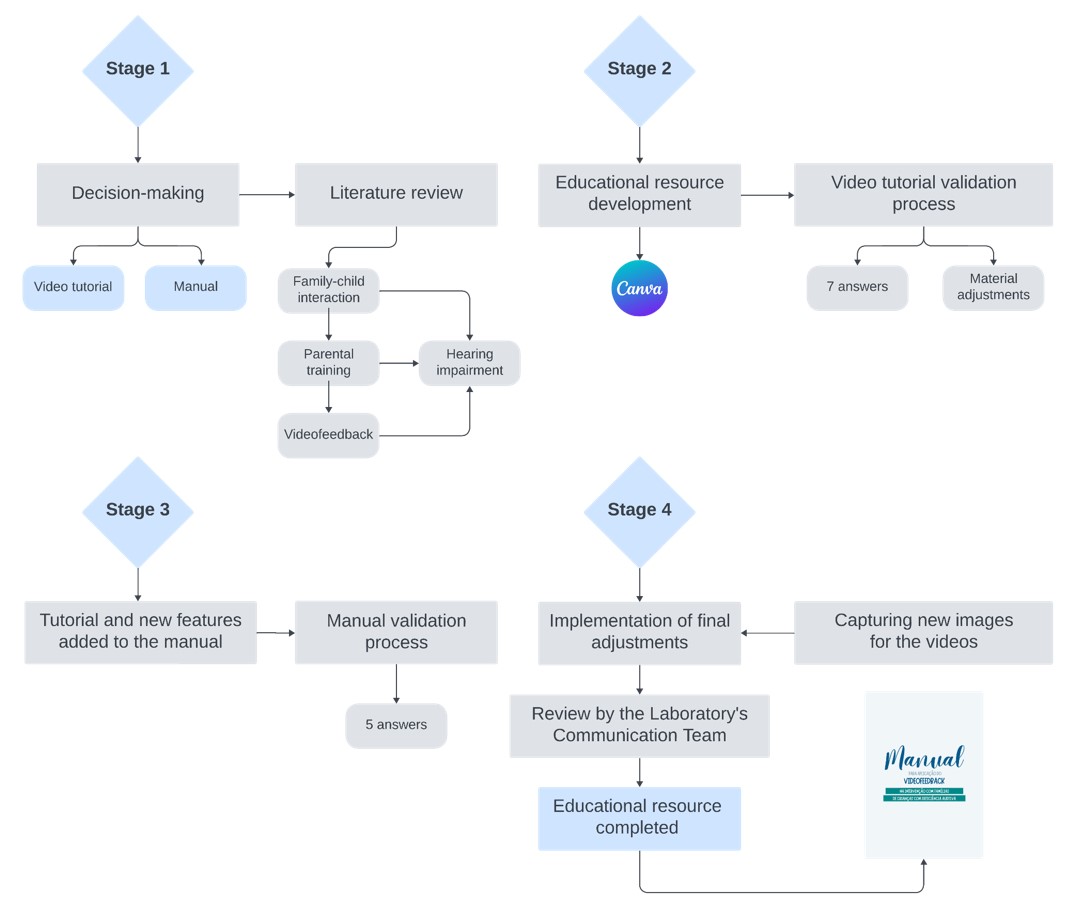
The research consisted of four stages (see Figure 1):
-
First stage: discussion on the educational resource to be produced, with the decision to produce a manual with a video tutorial to facilitate learning. After the discussion, a literature review was carried out to select the content to be covered;
-
Second stage: preparation of the educational resource. Both the tutorial and the manual were designed with Canva®, using free images and authorized images of a family and a child from a rehabilitation service. In addition, the video tutorial on video feedback was validated and subsequent adjustments were made according to the evaluators' suggestions;
-
Third stage: validation of the manual, with the inclusion of the revised video tutorial and a special section designed to train clinical reasoning, using two interactive videos combined with a form for analyzing family-child interaction;
-
Fourth stage: shooting new images for the tutorial videos and interactive videos in order to complete the educational resource for publication. It is worth noting that no modifications to the content and structure of the educational resource were made, only image replacements.
The video tutorial briefly outlines the contents of the manual and follows the structure below:
-
Introduction to the video-feedback procedure and its theoretical foundations;
-
Step-by-step description of how the speech therapist should approach the provision of training to families of hearing-impaired children using video feedback;
-
Presentation of televideo feedback, involving the application of the video-feedback procedure via teleconsultation.
After the evaluation process, the suggestions provided by the evaluators for improving the video tutorial were implemented. Speech therapists had the opportunity to revisit the material during its evaluation, as the tutorial was fully incorporated into the educational resource file. Additionally, the manual discusses the role of interaction in the development of hearing-impaired children, featuring a special section with two videos of family-child interaction and an analysis form for case studies. Such interactive videos were recorded with a real family, in one case in a clinical setting and the other, in a home environment.
In this sense, the educational resource developed consists of a manual in .pdf format with text structured in short paragraphs, with references, a section for clinical reasoning training, and a video tutorial for content review with external links.
In the validation of the content and structure of the video tutorial and the manual, an adaptation of the Educational Content Validation Instrument in Health (ECVIH)(16) was applied and provided to the evaluators via Google Forms®. The form is straightforward and short to fill in, with an average analysis time of ten minutes, allowing one to start answering it, pause, and later resume. The version adapted by the research group has 14 items distributed over the three domains of the instrument: objectives, structure/presentation, and relevance, with all questions being mandatory. When evaluating the materials, speech therapists had to classify each item covered by the questionnaire as inadequate (0), partially adequate (1), or adequate (2). At the end of each domain, the evaluators could contribute comments to improve the material.
The evaluation questionnaires, the tutorial, and the manual were sent to the speech therapists via the team's study group. At each validation stage, the professionals were given up to 15 days to review the material and fill in the corresponding evaluation form. In terms of evaluation time, the speech therapists needed to devote eleven minutes to watching the video tutorial and, on average, an hour and a half to reading and exploring the resources in the manual. Of the seven professionals participating in the study, seven responded to the tutorial in the first evaluation stage and five in the evaluation of the complete educational resource (manual).
Analysis of results
After the above steps, the data was tabulated in Excel® and analyzed descriptively and inductively. The content validity index (CVI) was employed in the analysis of the agreement rate observed in the experts' evaluation of the representativeness of each item of the ECVIH for the material being evaluated. Since the ECVIH has a Likert-type scale ranging from 0 to 2 points, only the sum of the answers classified as adequate (2), divided by the sum of all the answers, was considered for CVI calculation. To calculate the overall CVI of the educational resource, an average was taken of all the CVI values calculated separately(19), with values of at least 0.80 being consistent for acceptable agreement between the evaluators. A qualitative analysis, by categorizing the suggestions made by the evaluators, was also performed to organize the improvements implemented in the video tutorial.
RESULTS
Regarding the video tutorial (see Table 1), perfect agreement values were obtained predominantly, with the exception of the items “encourages use”, “interactive language”, and “adequate size”, which received a score of partially adequate (1). For the item “encourages use”, the CVI was less than 0.80. Based on the qualitative analysis of the evaluators’ suggestions, the following improvements were highlighted: divide the tutorial into short videos, insert subtitles to improve accessibility, increase the text font of some information, add an initial summary to introduce the parts of the video and vary the text, narration, and images. After analysis, the contributions mentioned were implemented and the video tutorial was incorporated into the manual for the second validation stage.
In addition to the suggestions provided, the professionals highlighted as positive points the clarity of the scientific language used and the clarifications that the tutorial provides to professionals on the application of video feedback in the intervention focused on parental training.
Regarding the evaluation of the manual, the professionals evaluated it to be adequate for the 14 items assessed, i.e. with agreement between the evaluators (Table 2). The experts did not indicate any improvements but only highlighted the organization of the material as a positive point.
Therefore, the content and structure of the educational resource were considered by the evaluators to be suitable for providing speech therapists with knowledge about video feedback, with a CVI above 0.80 for all the items assessed.
At the end of the validation stages by the evaluators, a professional from the research laboratory's communications team revised the manual so that it could be made available as an Open Educational Resource (OER) on the institutional repository's website(20).
DISCUSSION
This educational resource contributes to clinical and scientific practice since there is a lack of material in the literature that shows the video feedback procedure step by step, especially when it comes to resources aimed at training speech therapists to work with families of hearing-impaired children.
Regarding the validation process, the speech therapists' evaluation was essential, since it was desirable to meet their expectations and needs. In this sense, the educational resource fulfills its objective when there is a consensus between what it is intended to inform and what the target audience considers important(17).
It is essential that experts evaluate an educational resource on aspects considered crucial for the development of educational materials, such as the quality of the information and the way it is presented(16). For this reason, an adaptation of an already validated questionnaire, the ECVIH, was used to evaluate the video tutorial and the manual.
In general, the analysis of the evaluations showed that the content was approached in a meaningful and appropriate way for the teaching-learning process, since the topic was covered through the presentation of correct, objective, relevant, and enlightening information, with appropriate language and logical sequence. In order to obtain this result, it was necessary to consult scientific knowledge in the literature, followed by the selection of important information for the context and the transformation of the language for the target population. These steps made it possible to create a sufficient and relevant educational resource(16,17).
Thus, it was found that the educational resource is suitable for the continuing education of speech therapists about the video feedback tool. Therefore, this study has contributed to the need raised in the literature about training parents and caregivers of hearing-impaired children to improve their interactions and language environment at home(1,3-5,9,11-14).
When evaluating the video tutorial, it scored partially adequate (1) for the items “encourages use”, “interactive language” and “adequate size”. Regarding length, the suggestion to split a single video into shorter videos was implemented, resulting in a series of three tutorial videos, which were incorporated into the manual to make it more didactic.
Furthermore, considering that the item “encourages use” had a CVI of less than 0.80 in the first evaluation of the material, a section was added to the manual with two interaction videos and a family-child interaction analysis form for training. This was done to encourage the use of the video feedback tool and ensure greater interactivity, providing the active involvement of the speech therapist in the educational process.
The changes made to the video tutorial and the implementation of interactive resources were reflected in the results of the evaluation of the manual since there was agreement in the evaluators' analysis of all the ECVIH items.
As a limitation of the study, we highlight the variation in the number of evaluators responding throughout the validation process (seven evaluated the video tutorial and five evaluated the manual), which may have affected the representativeness of the results, although there was no disagreement in the evaluation of the complete educational resource.
With regard to its potential, the manual can be accessed free of charge and could help speech therapists reflect on the role of interaction in the development of children with hearing loss. The manual may also contribute to the provision of knowledge about the video feedback tool. In addition, the material encourages the speech therapist to apply video feedback in parental training, with the potential to improve children's hearing and language results(12).
In view of the above, it is important to continue with studies that evaluate training programs for speech therapists in hearing rehabilitation services in Brazil, since the quality of the programs offered interferes in various spheres of the care network, improving therapeutic results and minimizing resources, including financial ones.
CONCLUSION
The educational resource was validated in terms of its objectives, structure/presentation, and relevance, and is suitable for providing audiologists with knowledge about the use of video feedback in training families of hearing-impaired children.
The educational resource is available free of charge on the institutional platform in a way that can be evaluated in a multicenter way in future studies, with contributions to children's hearing rehabilitation.
ACKNOWLEDGMENTS
To SUVAG RN - Hearing Health Center of Rio Grande do Norte, Brazil, for the partnership in the research, and to CNPq (PIBIC-UFRN 03/2022), for the financial support.
-
Study carried out at Universidade Federal do Rio Grande do Norte – UFRN – Natal (RN), Brazil.
-
Funding:
Conselho Nacional de Desenvolvimento Científico e Tecnológico - CNPq (Programa Institucional de Bolsas de Iniciação Cientifica - Universidade Federal do Rio Grande do Norte - PIBIC - UFRN - 03/2022).
References
-
1 Giallini I, Nicastri M, Mariani L, Turchetta R, Ruoppolo G, de Vincentiis M, et al. Benefits of parent training in the rehabilitation of deaf or hard of hearing children of hearing parents: a systematic review. Audiology Res. 2021 Dez 13;11(4):653-72. http://doi.org/10.3390/audiolres11040060 PMid:34940018.
» http://doi.org/10.3390/audiolres11040060 -
2 Morgan G, Curtin M, Botting N. The interplay between early social interaction, language and executive function development in deaf and hearing infants. Infant Behav Dev. 2021 Ago;64:101591. http://doi.org/10.1016/j.infbeh.2021.101591 PMid:34090007.
» http://doi.org/10.1016/j.infbeh.2021.101591 -
3 Su PL, Roberts MY. Quantity and quality of parental utterances and responses to children with hearing loss prior to cochlear implant. J Early Interv. 2019 Dez 1;41(4):366-87. http://doi.org/10.1177/1053815119867286 PMid:33311963.
» http://doi.org/10.1177/1053815119867286 -
4 Provenzi L, Scotto di Minico G, Giusti L, Guida E, Müller M. Disentangling the dyadic dance: theoretical, methodological and outcomes systematic review of mother-infant dyadic processes. Front Psychol. 2018 Mar 19;9:348. http://doi.org/10.3389/fpsyg.2018.00348 PMid:29615947.
» http://doi.org/10.3389/fpsyg.2018.00348 -
5 Lind-Combs HC, Holt RF. Associations between parent mental state language and child inhibitory control in children who are deaf or hard of hearing. J Speech Lang Hear Res. 2022 Ago 17;65(8):3129-45. http://doi.org/10.1044/2022_JSLHR-22-00005 PMid:35944046.
» http://doi.org/10.1044/2022_JSLHR-22-00005 -
6 Marie A, Clabaut L, Corbeil M, Vanlerberghe C, Vincent-Delorme C, Le Driant B. Parenting stress and needs for social support in mothers and fathers of deaf or hard of hearing children. Front Psychol. 2023 Ago 30;14:1229420. http://doi.org/10.3389/fpsyg.2023.1229420 PMid:37720653.
» http://doi.org/10.3389/fpsyg.2023.1229420 -
7 Continisio GI, D’Errico D, Toscano S, Maldonato NM, De Falco R, Nunziata F, et al. Parenting stress in mothers of children with permanent hearing impairment. Children (Basel). 2023 Mar 1;10(3):517. http://doi.org/10.3390/children10030517 PMid:36980075.
» http://doi.org/10.3390/children10030517 - 8 Gunjawate DR, Ravi R, Driscoll C. Stress among parents of children with hearing loss and how they deal with it: a systematic review. Int Arch Otorhinolaryngol. 2022 Ago 1;27(1):e166-77. PMid:36714900.
-
9 Holzinger D, Hofer J, Dall M, Fellinger J. Multidimensional family-centered early intervention in children with hearing loss: a conceptual model. J Clin Med. 2022 Mar 11;11(6):1548. http://doi.org/10.3390/jcm11061548 PMid:35329873.
» http://doi.org/10.3390/jcm11061548 - 10 Kennedy H, Landor M, Todd L. Video Interaction Guidance: a relationship-based intervention to promote attunement, empathy and wellbeing. London: JKP; 2011.
-
11 Lam-Cassettari C, Wadnerkar-Kamble MB, James DM. Enhancing parent– child communication and parental self-esteem with a video-feedback intervention: outcomes with prelingual deaf and hard-of-hearing children. J Deaf Stud Deaf Educ. 2015;20(3):266-74. http://doi.org/10.1093/deafed/env008 PMid:25819293.
» http://doi.org/10.1093/deafed/env008 -
12 Santos IRD, Brazorotto JS. Intervenção guiada por videofeedback a famílias de crianças com deficiência auditiva. CoDAS. 2018;30(1). http://doi.org/10.1590/2317-1782/20182016256
» http://doi.org/10.1590/2317-1782/20182016256 -
13 Wadnerkar Kamble M, Lam-Cassettari C, James DM. Communication skills and communicative autonomy of prelinguistic deaf and hard-of-hearing children: application of a video feedback intervention. Front Psychol. 2020 Ago 18;11:11. http://doi.org/10.3389/fpsyg.2020.01983 PMid:32973615.
» http://doi.org/10.3389/fpsyg.2020.01983 -
14 dos Santos IRD, Carvalho WLO, Brazorotto JS. Teleintervenção guiada por videofeedback à família de uma criança usuária de implante coclear: estudo de caso. CoDAS. 2023;35(6):e20220231. http://doi.org/10.1590/2317-1782/20232022231en PMid:37991028.
» http://doi.org/10.1590/2317-1782/20232022231en -
15 Salomé GM, Cunha AL, Pereira AP, Miranda FD, Alves JR. Educational handbook for healthcare professionals: preventing complications and treating peristomal skin. J Coloproctol. 2019 Dez;39(04):332-8. http://doi.org/10.1016/j.jcol.2019.07.005
» http://doi.org/10.1016/j.jcol.2019.07.005 -
16 Leite SS, Áfio ACE, Carvalho LV, Silva JMD, Almeida PC, Pagliuca LMF. Construction and validation of an Educational Content Validation Instrument in Health. Rev Bras Enferm. 2018;71(Suppl 4):1635-41. http://doi.org/10.1590/0034-7167-2017-0648 PMid:30088634.
» http://doi.org/10.1590/0034-7167-2017-0648 -
17 Zombini EV, Pelicioni MCF. Estratégias para a avaliação de um material educativo em saúde ocular. J Hum Growth Dev. 2011;21(1):51-8. http://doi.org/10.7322/jhgd.19995
» http://doi.org/10.7322/jhgd.19995 -
18 Sena JF, Silva IPD, Lucena SKP, Oliveira ACS, Costa IKF. Validation of educational material for the care of people with intestinal stoma. Rev Latino-Am Enfermagem. 2020;28:e3269. http://doi.org/10.1590/1518-8345.3179.3269
» http://doi.org/10.1590/1518-8345.3179.3269 -
19 Polit DF, Beck CT. The content validity index: are you sure you know what’s being reported? Critique and recommendations. Res Nurs Health. 2006;29(5):489-97. http://doi.org/10.1002/nur.20147 PMid:16977646.
» http://doi.org/10.1002/nur.20147 -
20 Brazorotto JS, Santos IRD, Martins GS. Manual para aplicação do videofeedback na intervenção com famílias de crianças com deficiência auditiva [Internet]. Natal: UFRN; 2024 [citado em 2024 Abr 2]. Disponível em: https://repositorio.ufrn.br/handle/123456789/55303
» https://repositorio.ufrn.br/handle/123456789/55303