
 Investigation of the effects of nicotinamide mononucleotide on kidney damage in rats with cecal ligation and perforation sepsis model
Purpose: To evaluate the protective effects of nicotinamide mononucleotide (NMN), a NAD+ precursor, on kidney tissue in rats with sepsis induced by cecal ligation and puncture model.
Methods: In this study, 28 female Sprague Dawley rats were randomly divided into four equal groups: control, sham, sepsis, and sepsis+NMN (500 mg/kg, i.p.). Kidney tissues taken 24 hours after the sepsis model were histopathologically evaluated under light microscopy for tubular damage, glomerular congestion, and inflammatory infiltration parameters.
Results: Histopathological examination revealed severe tubular injury, marked glomerular congestion, and dense inflammatory cell infiltration in the kidney tissues of the sepsis group. In the group treated with NMN, a significant reduction in these pathological findings was observed, while the glomerular structure and tubular architecture were preserved. Semi-quantitative histopathological scoring confirmed significantly increased renal injury in the sepsis group and significant attenuation of tissue damage following NMN treatment.
Conclusion: The data obtained showed that NMN may play an important cytoprotective role in sepsis-induced acute kidney injury by preserving tissue architecture. More comprehensive molecular and biochemical studies are needed to fully elucidate the therapeutic potential and mechanisms of action of NMN.
Key words
Sepsis; Nicotinamide Mononucleotide; Kidney
 Thumbnail
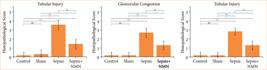 Thumbnail
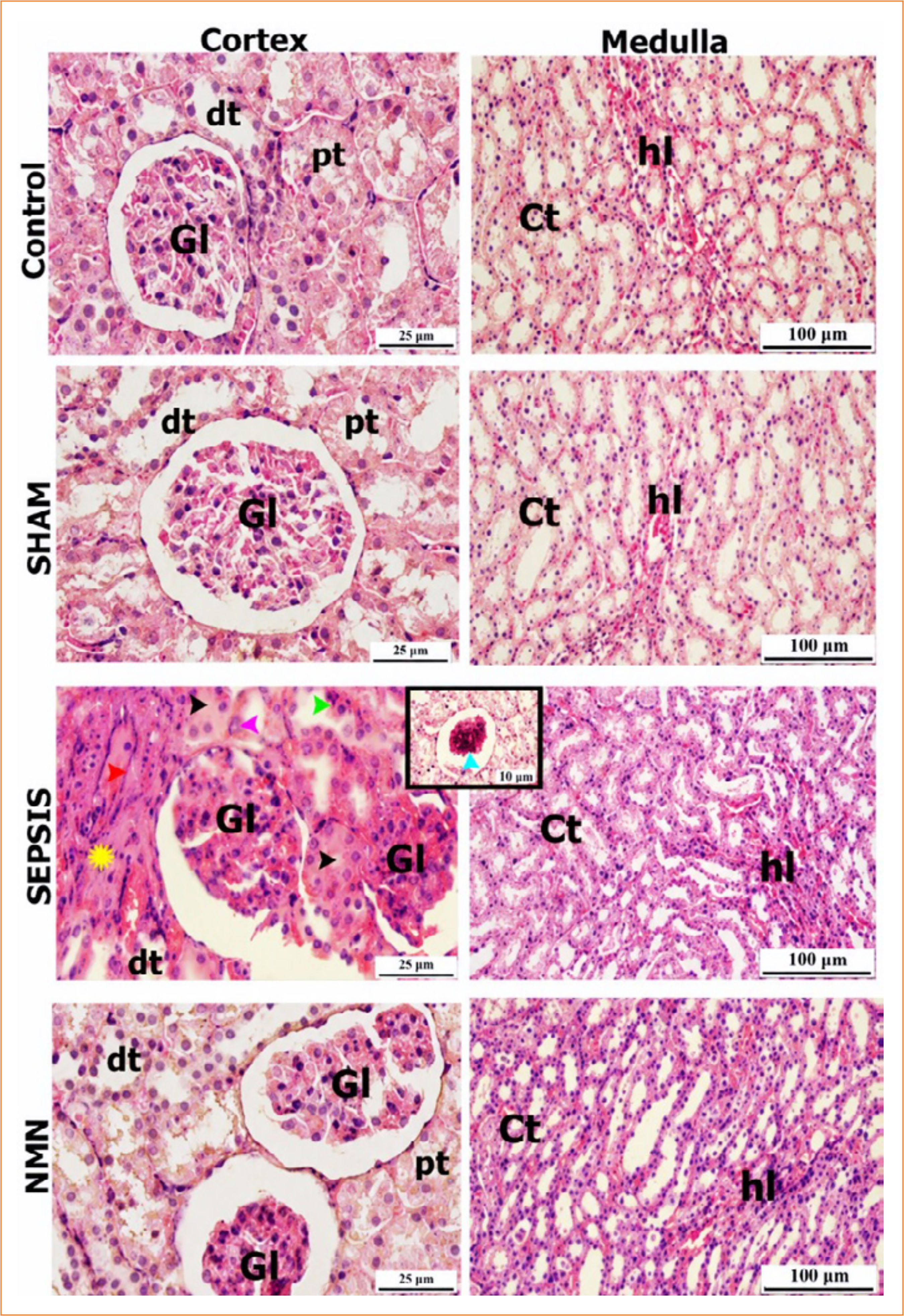 Gl: glomerulus; pt: proximal tubule; dt: distal tubule; hl: loops of Henle; Ct: collecting tubules; blue arrowhead: glomerular atrophy and thrombus formation; green arrowhead: cells with eosinophilic cytoplasm and pyknotic nuclei; pink arrowhead: hypertrophic cells; red arrowhead: impaired vascular wall; yellow star: fibrotic interstitial connective tissue. Source: Elaborated by the authors.
 ns: not significant; *p < 0.05 versus the control and sham groups; ***p < 0.001 versus the control and sham groups; #p < 0.05 versus the sepsis group. Source: Elaborated by the authors.