
 Evaluation of agmatine efficacy in contrast-induced nephropathy: experimental evidence in rat model
Purpose: To investigate the biochemical and histopathological efficacy of agmatine as a protective agent in experimental rat contrast-induced nephropathy (CIN) model.
Methods: Twenty-eight male Sprague Dawley rats were randomized into four groups: sham (no intervention), contrast agent (single dose 10 mL/kg iohexol iv), contrast agent + agmatine (single dose 10 mL/kg iohexol iv + 20 mg/kg po agmatine three days) and contrast agent + placebo (single dose 10 mL/kg iohexol iv + 1 mL of 0.9% saline ip). Biochemical and histopathological evaluations were accomplished on the fourth day, including measurements of cystatin-C, malondialdehyde (MDA), glutathione peroxidase (GPx), interleukin (IL)-1 β, superoxide dismutase (SOD), and tumor necrosis factor (TNF)-α.
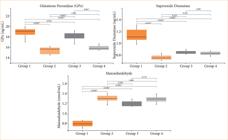
Results: The contrast agent group exhibited elevated cystatin-C, IL-1β, TNF-α, and MDA levels, with decreased SOD and GPx levels. The agmatine treatment group showed decrease in cystatin-C, IL-1β, TNF-α, and MDA, along with increased GPx and SOD levels. Histopathological evaluation revealed nephrotoxic effects in the contrast agent and placebo groups, whereas agmatine-treated rats displayed a significant reduction in tubular damage.
Conclusion: Agmatine administration along side contrast exposure demonstrated protective effects against CIN, evidenced by biochemical and histopathological improvements.
Key words
Agmatine; Iohexol; Contrast Media
 Thumbnail
 Thumbnail
 Thumbnail
 Source: Elaborated by the authors.
 Source: Elaborated by the authors.
 Source: Elaborated by the authors.