
 Soundscape as an element of the museological experience: case study at the Ipiranga Museum
Abstract
Museums combine education, entertainment, and exhibition in the visitor experience. The soundscape in museological environments affects the interpretation of art and the spatial enjoyment. The acoustic characterization of these spaces is therefore justified, as it guides projects according to principles of acoustic comfort. This study aims to quantitatively and qualitatively assess the visitor experience in relation to the museum’s soundscape. The case study was conducted in the Noble Hall of the Ipiranga Museum in São Paulo city, on a day open to visitors, with acoustic measurements and questionnaire application, according to ISO 12913 and a simplified method from the Brazilian standard NBR 10152. The results show an A-weighted equivalent continuous sound pressure level averaging 61.3 dB, above the values recommended by the Brazilian standard for museums. Concerning the identification of perceived sound sources, most of the visitors identified sounds of human activities, whereas natural sounds were minimally perceived. Although the value was above the recommended level, the environment soundscape was evaluated as pleasant. This work contributes to future research and reinforces the relevance of the soundscape in museum projects.
Keywords
Acoustics; Museums; Art interpretation; Soundscape
Resumo
Museus unem educação, entretenimento e exposição na experiência do visitante. A paisagem sonora em ambientes museológicos afeta a interpretação da arte e a fruição espacial. A caracterização acústica desses espaços justifica-se, portanto, por orientar projetos segundo preceitos de conforto acústico. Este estudo objetiva avaliar quantitativa e qualitativamente a experiência do visitante perante a paisagem sonora museológica. O estudo de caso ocorreu no Salão Nobre do Museu do Ipiranga, na cidade de São Paulo, em dia aberto à visitação, com medições acústicas e aplicação de questionários, segundo a norma ISO 12913 e um método simplificado da norma brasileira NBR 10152. Os resultados fornecem nível de pressão sonora contínuo equivalente com ponderação A médio de 61,3 dB, acima das recomendações normativas brasileiras para museus. Com relação à identificação das fontes sonoras percebidas, a maioria do público respondente identificou sons de atividades humanas, ao passo que sons naturais foram minimamente percebidos. Apesar do valor acima do recomendado, a paisagem sonora do ambiente foi avaliada como agradável. Este trabalho contribui para futuras investigações e reforça a relevância da paisagem sonora em projetos de museus.
Palavras-chave
Acústica; Museus; Interpretação da arte; Paisagem sonora
1 Introduction
By the definition of the International Council of Museums (ICOM),
[…] a museum is a not-for-profit, permanent institution in the service of society that researches, collects, conserves, interprets, and exhibits tangible and intangible heritage. Open to the public, accessible and inclusive, museums foster diversity and sustainability. They operate and communicate ethically, professionally and with the participation of communities, offering varied experiences for education, enjoyment, reflection, and knowledge sharing
( ICOM Brasil, 2026 ).
Thus, the existence of an ideal exhibition space is a question within the field of museology. As Cury (2005, p. 10) states, “[…] the goal of every exhibition is to create the conditions for the public to have a unique appreciation experience […]”.
Acoustics is a heterogeneous field of environmental comfort that studies not only sound itself, but also social, psychological, and physiological aspects. The soundscape is not merely an understanding of signals, but also a physiological, cultural, and perceptual one (Yilmazer; Yilmazer; Acun, 2019). Therefore, arises the concept of building with the ear, as well as with the eye (Schafer, 2012), an ideology linked to acoustic quality in museums, which should ensure adequate communication, acoustic insulation in spaces that aim at art appreciation without distractions, and visitor comfort, so that there are no barriers between the spectator and the art.
In Brazil, the acoustic quality of indoor environments is addressed by a series of technical standards, such as NBR 10152 (ABNT, 2020), which deals with sound pressure levels in indoor environments of buildings, and NBR ISO 3382 (ABNT, 2017), which concerns the measurement of room acoustic parameters. It is also worth highlighting the relevance of NBR 12179 (ABNT, 1992), related to acoustic treatment in enclosed spaces, despite being a less up-to-date standard than the others, with recent studies aimed at its revision. However, when it comes to museum acoustics, little can be found in the literature.
The idea of museality, even prior to that of the museum itself, intertwines with the human act of intervening in reality (both natural and human), by recognizing within it objects and elements to be preserved, collected, exhibited, and attributed with meanings (Duarte, 2007). The historical and architectural value that museums represent for the societies in which they are inserted has been verified by numerous studies concerning architecture, management, and historical heritage. However, this is not the case when addressing the acoustic characterization of such buildings.
According to ISO 12913-1 (ISO, 2014), the soundscape addresses the acoustic environment as it is understood or experienced by users of a place, within a given context. The acoustic environment perceived by the receiver originates from various sound sources and is modified by the surroundings, including the effects of sound propagation, such as meteorological conditions, sound absorption, diffraction, reverberation, and reflection.
The lack of studies on museum acoustics reveals the relevance of understanding the relationship between space, artwork, and visitor, which justifies research adopting this approach. Therefore, the present study aims to investigate the acoustic quality of the Noble Hall of the Ipiranga Museum – a gallery that houses an emblematic artwork in Brazilian history – and its impact on the visitor’s experience. It intends to quantitatively and qualitatively examine the soundscape and the interpretation of art, as well as to assess the potential of Method A – questionnaires – described in ISO/TS 12913-2 (ISO, 2018).
2 Theorical framework
2.1 Soundscape
The term soundscape, referring to the sonic landscape, was first introduced by Schafer (2012) as an indicator related to sound, comparable to the landscape, to define an environment created by sound without judgments about what is heard. The soundscape was formally defined by ISO 12913-1 (ISO, 2014, p. 1) as “[…] acoustic environment as perceived or experienced and/or understood by a person or people, in context […]”.
Schafer (2012) categorized the main components of a soundscape into keynotes (the fundamental sounds of the landscape created by its geography and climate), signals (foreground sounds that are unexpected, sudden, or annoying), and soundmarks (sounds by which a place can be identified and the acoustic character of the environment defined). In this regard, Drever (2005) highlights the role of soundmarks as elements with cultural and historical significance, used in soundscape studies to refer to community sounds that are unique or possess qualities that make them especially notable or perceived by members of the community.
Prior to Schafer, however, the work of Pierre Schaeffer (1910–1995) stands out, in his book Treatise on Musical Objects, in which four modes of listening are identified. The first mode – écouter – deals with the act of listening and the impulse to associate sound with an origin. According to Meneguello (2017), if the act of listening (écouter) reveals an active attitude, the second mode he identified – ouir (hearing) – reveals a passive attitude on the part of the listener, because, even if unable to refrain from hearing the sound, the one who hears shows no intention of listening to it. This phenomenon is treated by Schaeffer as the raw perception of sound, linked to its physical nature and the general laws of perception (Schaeffer, 1993).
The third mode of perception – entendre – leads the listener to perform a qualified listening, that is, it represents devoting attention to each detail of the sound phenomenon. The last mode of listening – comprendre – deals with the conventionalism of sound. Again according to Meneguello (2017), the listener no longer contents himself with accepting an immediate meaning, but rather operates by abstracting, comparing, and deducing information in search of a specific meaning, based on qualified perceptions.
In museums, the soundscape depends on all the sounds present in an exhibition space, together with the perception of its users. The sound sources encompass intentional auditory elements, such as music, narration, and sound effects, as well as occasional noises, including footsteps, conversations, and environmental sounds external to the exhibition area. In these environments, according to Pireddu et al. (2025), the concept of soundscape can be used to describe a layered auditory environment that contributes to the sensory experience of the museum. The author highlights the role of audio guides, which provide technical support to integrate words (as in narratives and descriptions) and sounds (such as background settings). The sounds can be selected and organized to create specific atmospheres and enhance the interpretative experience of the exhibited objects. The soundscapes, in this case, are designed to evoke emotional responses, as well as to reinforce and immerse visitors in a specific time, place, and/or culture.
In museums that do not use sound systems, such as immersive exhibitions, noise can disturb and distract visitors’ attention, hindering communication and the space-art relationship (Castillo, 2008; Bubaris, 2014). Moreover, museums are fundamental spaces to foster the educational and cultural interest of people of diverse ages and backgrounds (Gob; Drouguet, 2019; Cavalcanti, 2013; Veiga, 2013; Almeida, 2004, 2012), so that considering acoustic conditions is essential for achieving buildings with environmental quality.
2.2 Context and expectation in the evaluation of the sound environment
Context is defined as “the interrelationships between person and activity and place, in space and time” (ISO, 2014; Brown; Kang; Gjestland, 2011). In this sense, auditory perception refers to the unconscious and conscious processing of the auditory signal to create useful information, which can lead to the understanding of the acoustic environment. As stated in the first chapter of Soundscape and the Built Environment (Kang; Schulte-Fortkamp, 2016), context is a generic term that includes the non-acoustic components of a place (including a person’s prior experiences and memories) and plays a fundamental role in the perceptual construction of an acoustic environment.
Context affects the soundscape through auditory sensation, interpretation of this auditory sensation, and response to the soundscape (Sudarsono; Lam; Davies, 2017). The auditory sensation represents the hearing process that begins with the arrival of sound in the ear, leading to a neurological response. The interpretation of the auditory sensation represents the process of interpreting the sound signal, creating the understanding of the soundscape. The response to the soundscape, in turn, represents the effect it generates and the feeling that arises from the acoustic environment.
The awareness of the acoustic environment, contextualized, represents an experience of this environment (ISO, 2014; Zwicker; Fastl, 2013). Auditory awareness of space, therefore, is not limited to identifying sound changes, but encompasses the emotional and behavioral experience provided by the environment.
According to physical conception and cultural context, the sound experience in a space can stimulate anxiety, tranquility, social integration, isolation, among other sensations (Blesser; Salter, 2006). The space-time connection between visitor and artwork in museums was mentioned by Castillo (2008), who stated that the understanding of exhibitions involves spatial awareness. Museum architecture is linked to the space-art-visitor relationship, delivering the experience that the visitor will have to the interlacing of the whole.
Bruce and Davies (2014) also point out that the human reaction to the soundscape largely depends on the expectation regarding the space and the events occurring in it. Thus, a visitor’s perception of a given space is affected by the sound experience, since it builds a perspective that results in a positive or negative evaluation of the environment.
Yilmazer and Orhan (2019) conducted a case study in a museum in Ankara, Turkey, in which they concluded that participants’ expectations regarding museums generally involve a quiet and calm environment. However, most respondents stated that completely silent museum spaces can be irritating, as there is concern about distracting other visitors. Background music was mentioned by participants as an alternative to this issue.
Yilmazer, Yilmazer and Acun (2019) state that familiarity is the most recurrent parameter and can potentially affect visitors’ expectations, annoyance with sound levels, and the presence of residual noise. Previous experiences mainly influence expectations and affect not only individual behavior but also the evaluation of both sound and the built environment.
The studies available in the literature cover visitors’ perception in both real and virtual environments. Carvalho, Gonçalves and Garcia (2013) conducted case studies to acoustically characterize typical modern and old museums and indicated optimal values for acoustic parameters. In the following year, the same authors proposed an acoustic quality index in museums to quantify acoustic discomfort (Carvalho; Garcia; Gonçalves, 2014). Yang and Sörös (2019) sought to improve the museum experience through auditory augmented reality, allowing users to hear objects and scenes in paintings, feeling more engaged in the museum experience and the interpretation of art. The study by Jelinčić, Šveb and Stewart (2022), in turn, related sensory characteristics to visitors’ emotional responses, while Bedigan (2016) associated expectations and perceptions of emotions in museums.
Yilmazer and Acun (2018) analyzed the soundscape of a mosque through interviews. The authors point out that visitors do not give priority to the acoustic environment. However, the study made it possible to verify that the elements that compose the soundscape contribute to the identity of the mosque, despite the low sound awareness presented. In this study, the role of context becomes evident, demonstrating its relevance in the way the soundscape is interpreted, responded to, and evaluated. Intrinsically related to the function of space, context determines both sound preference and individuals’ expectations.
Orhan and Yilmazer (2021) investigated the soundscape of two museums with historical themes, one in a traditional building and the other in a contemporary one. The authors concluded that both architecture and the theme of the exhibitions affect visitors’ perception. Furthermore, the study found that the use of the acoustic environment as part of the exhibition increased public interest by promoting a sense of historical immersion.
In an acoustic consulting project for the renovation of a museum with an exhibition about wars, Pitone and Harvie-Clark (2023) began a study based on the client’s expectations. Given the sound juxtaposition of a traditional museum compared to a contemporary museum, one of the adjectives used in the study to refer to the traditional museum was “imposing”, demonstrating the cultural connotations evoked by the space and the role of the sound environment in building local cultural identity.
In the same theme, Mackinnon (2019) presents, based on case studies in England and Scotland, an analysis model to examine museum exhibitions that incorporate soundscapes related to battles of the Modern Age, analyzing the ways in which emotions are generated, performed, and produced through the soundscapes created for the battlefields.
2.3 Psychoacoustics and acoustic quality indices
Sound quality should be understood as a three-pillar system, which considers the combination of measured objective data, calculated data, and subjective evaluation results. Traditionally, the quantities used in acoustics quantify parameters such as sound pressure level, sound power level, and sound intensity level. According to Brizon (2012), these quantities characterize noise, yet they fail to reflect human perception.
Also according to the author, the first pillar concerns the objective characterization of the acoustic environment through physical and acoustic parameters, which describe the measurable behavior of sound in space. The second pillar addresses the subjective dimension of acoustic quality, recognizing that comfort and intelligibility depend on human perception and judgment. The third pillar integrates objective and subjective aspects in order to represent the overall acoustic experience. This approach acknowledges that acoustic quality cannot be fully described by isolated parameters, but emerges from the interaction between the physical characteristics of the environment and the perceptual response of users.
Bodden et al. (1998) defines psychoacoustics as the science that deals with the relationship between acoustic wave parameters and the attributes of auditory events. The relationship between a listener's subjective impressions and measurable physical phenomena is called psychoacoustics.
According to Bastos (2010), advances have been made in an attempt to relate subjective evaluations of room acoustic quality to objective parameters, that is, physically quantifiable factors that can be calculated prior to the construction of the space using acoustic simulation software. According to the author, the dominant effect on auditory impression in a room is the sensation of reverberation, namely, the decay of sound after a source has ceased its sound emission.
Reverberation results, based on the concept of geometric acoustics, from sound reflected numerous times off the boundaries of a space (Isbert, 1998). This parameter indicates, therefore, the sound perception of the environment surrounding the listener. Paulo (2009) observes that when a room has a very low reverberation time, it causes sensations of claustrophobia in the listener, as the sense of space is lost, and when this time reaches high values, it becomes difficult to distinguish sounds.
Olshausen (2019) discusses the acoustic challenges associated with the design of exhibition halls in the Munch Museum in Oslo, particularly those related to large room volumes and elevated ceiling heights. The author shows that, due to architectural and curatorial constraints, such as limited availability of sound-absorbing surfaces and the predominance of artworks on walls, exhibition rooms may present reverberation times exceeding the values recommended by Norwegian acoustic regulations. Simulation results indicate that, especially in empty halls, reverberation times tend to be higher than recommended, making it difficult to rely solely on passive acoustic treatments to achieve optimal speech conditions. In this context, the study introduces the concept of acoustic capacity, emphasizing that the number of visitors present in the space plays a critical role in the overall acoustic performance. The author concludes that, even when reverberation times are higher than desirable, acceptable conditions for speech communication can be achieved through operational strategies, particularly by limiting the number of visitors and managing occupancy levels within the exhibition halls.
Paulo (2009) highlights, based on his investigations for the acoustic characterization of spaces, that the study of another parameter, the early decay time (EDT), is useful, given that it takes more into account the energy contained in the early reflections within the space, which more closely aligns with the sensory aspects of the human ear.
Early decay time (EDT) is a parameter influenced by the listener's position and can vary depending on the receiver's proximity to reflective or absorptive surfaces, or even due to their proximity to the sound source (Barron, 2009; Bradley, 2011). EDT is calculated from the sound decay interval between 0 dB and -10 dB. This means that it also includes the direct sound component and the early reflections (Jordan, 1970).
The signal-to-noise ratio (SNR) is defined as the difference, expressed in decibels (dB), between the interlocutor’s voice and background noise generated by human activity, and it is widely used as an indicator of speech intelligibility in occupied environments (D’Orazio; Montoschi; Garai, 2020). Classical studies on verbal communication in noise indicate that speech intelligibility strongly depends on maintaining a positive SNR. Gardner (1971) demonstrated that a minimum SNR of approximately +5 to +6 dB is generally sufficient to ensure intelligible face-to-face communication, a threshold corroborated by subsequent research. Hodgson, Steininger and Razavi (2007) reaffirm that signal-to-noise differences below 5 to 6 dB(A) are insufficient to support effective verbal communication, even when speakers increase their vocal effort.
Speech intelligibility may also be expressed as the ratio between spoken and correctly understood words. Nepomuceno (1994) states that effective communication requires intelligibility levels above 90%, while achieving full intelligibility of simple words may demand voice intensities approximately 10 dB(A) above background noise, a condition frequently associated with vocal strain and reduced cognitive comfort in noisy urban environments (Pimentel-Souza, 1992).
In this context, ISO 9921 (ISO, 2003) establishes reference speech levels for different vocal efforts, reinforcing the requirement that speech levels must exceed background noise by several decibels to ensure satisfactory communication. Together, these contributions consolidate the SNR and intelligibility criteria as fundamental parameters for assessing acoustic comfort and verbal communication quality in built environments.
3 Materials and methods
The study consisted of a qualitative and quantitative evaluation of the soundscape of the Noble Hall of the Paulista Museum (Ipiranga Museum), located in the city of São Paulo. The qualitative stage was carried out through the administration of questionnaires, in accordance with parts 2 and 3 of ISO 12913 (ISO, 2018, 2025), while the quantitative data were obtained through sound pressure level measurements, based on a simplified method of the protocol established in the NBR 10152 (ABNT, 2020) standard for the assessment of indoor sound pressure levels.
3.1 Materials
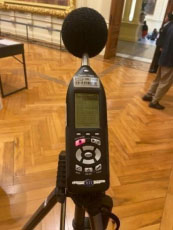
The materials used in the study comprised, for the acoustic measurements, a Class 1 sound level meter (Larson Davis 831-RI) equipped with a one-third-octave filter and time-history recording, along with a Class 1 acoustic calibrator (Larson Davis CAL200) (Figure 1). The qualitative component was conducted using physical questionnaires, which required only printed paper sheets and pens for participants to complete.

3.2 Characterization and selection of the study object: Ipiranga Museum
The Ipiranga Museum, located in the Independence Park (Parque da Independência) in the city of São Paulo, houses objects, iconography, and textual documentation from the 17th to the 20th centuries. The building, constructed between 1885 and 1890, was designed as a monument to Brazil’s independence, which occurred in 1822. Shortly after its construction, beginning in 1894, the building became the new headquarters of the State Museum, officially named the Paulista Museum (Brefe, 2003, p. 80). The museum received around 350,000 visitors per year until 2013, when it was closed for a major renovation project, remaining closed until September 2022 (Jornal da USP, 2022). The museum is an institution affiliated to the University of São Paulo (USP) and specializes in cultural and material history, hosting exhibitions and spaces for educational and cultural activities. Figure 2 shows an external view of the Ipiranga Museum and Independence Park, characterized by a symmetrical garden with vegetation arranged toward the museum’s façade, reinforcing the monumental image attributed to the building.

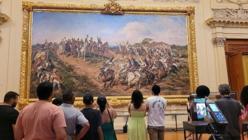
Data collection was conducted in the Noble Hall, which has an area of 182 m², with a length of 20 m, a width of 9.1 m, and a ceiling height of 10.4 m. The space is notable for housing the oil painting Independência ou Morte measuring 4.15 m in height and 7.6 m in length, created by the painter Pedro Américo between 1886 and 1888. As the main attraction of the Noble Hall, the painting has been installed in this location since the museum opened to the public and has not been removed, even for restoration purposes (Talhari, 2024). Figure 3 shows an image of the Noble Hall on the day of data collection, with the painting visible on the right.

3.3 Data collection: acoustic measurements
Data collection was conducted on September 11, 2024, a Wednesday, when admission to the museum was free and during the week following the national holiday celebrating Brazil’s Independence. This context, aligned with the museum’s theme, tends to attract a higher flow of visitors. The survey was carried out throughout the day, aiming to cover a sufficient number of measurement points to ensure accuracy in the acoustic assessment of the studied environment. In addition, efforts were made to collect a number of responses in the qualitative stage of the study that would allow a coherent statistical evaluation of visitors’ overall perception.
The quantitative assessments were conducted through measurements of A-weighted equivalent continuous sound pressure level (LAeq) and A-weighted, slow response, maximum sound pressure level (LASmax), in accordance with a simplified method of the procedure described in the technical standard NBR 10152 (ABNT, 2020). The A-weighted, sound level exceeded for 95% of the measurement period (LA95) was also calculated, as this indicator is relevant for disregarding higher-intensity, intermittent noises.
In this sense, background noise, characterized as the set of sounds in a location that do not originate from the source or the listeners and includes noises considered stable and continuous, interferes with the intelligibility of the primary sound produced and heard in the space. LAeq measurements provide a perception of background noise because they reduce all values measured during the monitoring period to an equivalent value. Additionally, the LA95 indicator served in this study as a complementary statistical sound level that is useful for noise characterization and allows for conclusions regarding the homogeneity of noise over time.
According to NBR 10152 (ABNT, 2020), measurements must be performed at a minimum of three measurement points distributed throughout the indoor environment being evaluated. Furthermore, the standard recommends that for environments exceeding 30 m², an additional measurement point should be added for every 30 m² of additional area (ABNT, 2020). Therefore, to define the number of measurements conducted in the Noble Hall, the room’s area, the high visitor flow, and the intent to avoid accidents with materials were considered.
Based on these considerations, it was deemed appropriate to perform a total of seven measurements, each lasting five to ten minutes. The sound level meter was positioned at a minimum distance of 1.5 m from any surface and at a fixed height of 1.6 m. It was placed so as not to interfere with visitor flow, at points within the study environment: in the corners of the room, away from the access door, near the access door, and in the center of the room (Figure 4).

In this work, the NBR 10152 (ABNT, 2020) standard was followed through a simplified method with an analysis based on global descriptors instead of the prescribed detailed method. Thus, the standard was used as a reference for the contextualization of the acoustic environment and the assessment of indoor sound pressure levels. Therefore, it is not intended for the direct evaluation of soundscape and visitor experience, as such procedures are duly grounded in the ISO 12913 (ISO, 2014, 2018, 2025). Figure 5 shows an image taken during the measurements, with the sound level meter near the center of the room and visitors viewing the painting.
3.4 Data collection: questionnaires
The qualitative assessment was conducted through the administration of questionnaires previously approved by the Research Ethics Committee of Brazil (CAAE: 79620324.0.0000.5390, opinion: 7.002.698). International standards regarding soundscapes (ISO, 2014, 2018, 2025) were followed.
Part 2 of ISO 12913 (2018) is a technical specification that presents procedures for data collection and requirements for application in soundscape assessment. The standard outlines different methods, including questionnaires, soundwalks, and interviews. In the present study, Method A, which relates to questionnaires, was adopted. Physical parameters and perception-related data are combined to explore the relationship between people, the acoustic environment, and the context. Part 3 (ISO, 2025), also a technical specification, refers to the analysis of data collected in accordance with the second part of the standard.
The questions covered visitors’ level of knowledge regarding acoustics and art, frequency of museum visits, and expectations regarding the acoustic quality of the space. Respondents were also asked to identify the sounds they perceived, divided into three categories (human activity sounds, natural sounds, and noise). Responses were obtained through a random approach to visitors, with each participant signing the Informed Consent Form (ICF). A total of 21 questionnaires were completed, this being a representative sample size for an exploratory study of the specific context analyzed and should not be generalized to other visitation contexts or to the museum as a whole, given that the study addressed only the Noble Hall. The full questionnaire, consisting of 22 questions, is presented in Table 1.
3.4.1 ISO/TS 12913-3: soundscape data analysis
Visitors were asked to evaluate the surrounding acoustic environment on a 5-point scale (“strongly agree”, “agree”, “neither agree nor disagree”, “disagree” and “strongly disagree”) for each of the 8 attributes related to soundscape perception – perceived affective qualities (PAQs): pleasant, calm, uneventful, monotonous, annoying, chaotic, eventful and vibrant (Figure 6).

It should be noted that, due to the absence of a soundscape standard translated into Portuguese, the translation of these 8 attributes is not yet consolidated. This study adopted the Portuguese translation of the original English terms proposed by Antunes et al. (2023) and Michalski et al. (2024): “agradável/prazeroso”, “tranquilo/calmo”, “estático/sem acontecimentos”, “monótono”, “irritante/desagradável”, “caótico”, “agitado/movimentado” and “animado”.
For this analysis, ISO/TS 12913-3 (ISO, 2025) provides a method for calculating the coordinate pair in the two-dimensional pleasantness-eventfulness model. According to the standard, ordinal responses are coded from 1 (strongly disagree) to 5 (strongly agree) as ordinal variables. Based on this coding, and with the aim of reducing the 8 attributes to a coordinate pair that can be plotted in the two-dimensional model, the standard presents a trigonometric analysis. This analysis is based on the 45° relationship between the diagonal axes and the “pleasantness” and “eventfulness” axes, so that this coordinate pair summarizes information from all 8 perceptual attributes. The coordinates are therefore calculated according to Equation 1 and Equation 2 below.
Where:
P represents the values of pleasantness on the two-dimensional models;
E represents the values of eventfulness on the two-dimensional models;
p represents the score for “pleasant”;
a represents the score for “annoying”;
ca represents the score for “calm”;
ch represents the score for “chaotic”;
v represents the score for “vibrant”;
m represents the score for “monotonous”;
e represents the score for “eventful”; and
u represents the score for “uneventful”.
From the equations, the resulting coordinates are scaled to the range (–1, 1), allowing the construction of the two-dimensional model within this interval. According to Mitchell, Aletta and Kang (2022), it is not evident from the calculations presented in the standard whether a single point in the two-dimensional model can be considered a realistic representation of the average perception of the acoustic environment. In practice, the limitation of the soundscape analysis method provided by the standard lies in the fact that there is no representation of the dispersion in soundscape evaluations, making it impossible to identify trends among respondents. Therefore, plotting multiple points – one for each respondent – provides an indication of such trends.
In the present study, the two-dimensional representation model for the perceived affective qualities (PAQs) was generated using an open-source Python package called Soundscapy. This package implements a visualization approach for soundscape data analysis using a probabilistic method that represents collective perception as a distribution of responses within the circumplex.
4 Results and discussion
Based on the analysis of the environmental measurements, as well as the responses to the questionnaires administered to the visitors of the museum, the results obtained are presented.
4.1 Quantitative analysis: sound pressure level measurements
The measurements aimed to obtain data on the equivalent continuous A-weighted equivalent continuous sound pressure level (LAeq), the A-weighted, slow response, maximum sound pressure level (LASmax), and the A-weighted, sound level exceeded for 95% of the measurement period (LA95). Following a simplified method of the procedure detailed in the NBR 10152 (ABNT, 2020) standard, measurements were taken at seven points within the environment, resulting in an average LAeq of 61.3 dB. The highest value recorded for this indicator was 64.7 dB, while the lowest was 58.9 dB. The measurement results for each point are presented in Table 2 below. It can be observed that point P3, located near one of the access doors, presented the highest LAeq value recorded.
According to NBR 10152 (ABNT, 2020), appropriate values for museums are 40 dB for equivalent sound pressure level (RLAeq) and 45 dB for maximum sound pressure level (RLASmax), with a tolerance of up to 5 dB. Additionally, the standard defines appropriate values for circulation areas as 50 dB for equivalent sound pressure level (RLAeq) and 55 dB for maximum sound pressure level (RLASmax), also allowing a tolerance of up to 5 dB (ABNT, 2020).
Analysis of the results shows that the recorded LAeq and LASmax values exceed the reference values established by the standard (Figure 7). However, the LA95 indicator, used in the study as a complementary parameter for noise characterization, was below the recommended value for circulation areas in some measurements of equivalent sound pressure level (RLAeq) and in all measurements of maximum sound pressure level (RLASmax), although in both cases, the value recommended for museums was not met. This situation indicates that, regardless of momentary noise peaks (such as those generated by visitor groups and children, common in museum environments), the recorded sound pressure levels do not comply with the reference standard for the study environment.
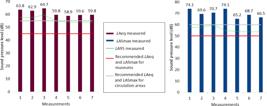
Comparison of the measurements with the reference values according to NBR 10152 (ABNT, 2020)
In this study, the signal-to-noise ratio (SNR) was defined as the difference between the sound pressure level associated with normal vocal effort and the residual noise level measured in the environment. According to ISO 9921 (ISO, 2003), speech produced with normal vocal effort corresponds to an equivalent continuous sound pressure level of LAeq 60 dB measured at a distance of 1 m in front of the mouth, which provides a reference for assessing speech intelligibility conditions.
The literature indicates that acceptable face-to-face communication requires an SNR between +5 and +6 dB (Gardner, 1971; Hodgson; Steininger; Razavi, 2007). The SNR values obtained in the present study are below this reference range, indicating acoustically unfavorable conditions for verbal communication in the analyzed environment. Under such conditions, achieving speech intelligibility above 90% would require vocal effort levels around LAeq 70 dB, corresponding to approximately 10 dB above the residual noise level, a condition identified in the literature as necessary to reach high intelligibility.
In this sense, according to ISO 9921 (ISO, 2003), this vocal effort is classified as loud speech and is neither common nor desirable in museum environments. Although the standard defines reference levels at a distance of 1 m, studies conducted in museum settings indicate that typical interpersonal distances are relatively short (≈1.80 m) and that excessive occupancy or prolonged visiting times may substantially increase human-generated noise, further compromising acoustic comfort (D’Orazio; Montoschi; Garai, 2020).
It should be noted that the study presents results from a single day of measurements under high visitor flow. Although a comprehensive soundscape assessment would require investigations across different periods, such as paid-entry days and weekends, the scarcity of studies addressing museum soundscapes, particularly in the Brazilian context, underscores the relevance of these results.
4.2 Qualitative analysis: questionnaires
The questionnaires aimed to analyze visitors’ individual perceptions of the acoustic quality of the studied space, as well as to identify possible factors affecting this scenario. Signing the Informed Consent Form (ICF) was essential for confirming respondents’ age and validating the questionnaire. Responses were collected from 21 participants, aged between 25 and 70 years.
The sample size used in the study, with 21 participants, considers data collection based on a single day of the year, with high attendance and free admission, not necessarily corresponding to average operating conditions. However, it is important to emphasize that the results presented characterize an exploratory study, relevant to fostering the discussion about museum acoustics and the visitor experience, which is still lacking in the literature. Therefore, the collected data are representative of the specific context analyzed and should not be generalized to other visitation contexts or to other areas of the museum beyond the Noble Hall.
Regarding the field of acoustics (Question 2 in Table 1), all respondents stated that they were neither specialists nor had any prior contact with the study of acoustics or related areas. In contrast, concerning the study of art (Question 3 in Table 1), 8 participants (38%) reported having had some prior contact with the field or related areas, although none identified themselves as specialists. The analysis of these data is relevant, as prior knowledge influences visitors’ expectations, their individual perception of artworks and the built environment, and consequently, the space-art-visitor relationship.
Additionally, the study aimed to investigate possible influences of visit frequency and the type of activity performed (Questions 4 and 5 in Table 1), factors that affect participants’ expectations. In this regard, 18 participants (85.7%) reported having visited the museum only once or a few times, without regular attendance. Regarding the purpose of their visit, all respondents stated that they engaged in leisure activities at the museum. Figure 8 presents these results.

When addressing questions regarding the perception of the sound environment, visitors were asked about their expectations for this aspect (Question 6 in Table 1). Accordingly, 57% of respondents expected a partially quiet environment, 19% had no expectations, and 14% expected a predominantly quiet environment. Only 10% of respondents expected a predominantly noisy environment (Figure 9).

In the analysis of noises identified in the Noble Hall (Questions 7 to 12 in Table 1), 13 participants (62%) reported perceiving internal noises, of which 12 (57%) cited sounds coming from the floor, such as creaking wood and footsteps, and 8 (38%) reported being able to hear others’ conversations. Among the respondents who identified internal noises, 4 (31%) stated they did not feel any emotions in response to these sounds, 8 (61.5%) found them unpleasant, and only 1 (7.5%) considered these sounds pleasant. Approximately 70% of study participants reported that these noises did not interfere with their experience of interpreting the art, while the remaining respondents indicated that the noises affected them only partially. All respondents stated that internal noises did not affect conversations with friends; however, 7 participants (33%) reported that they partially interfered with concentration and/or immersion during the visit. Additionally, 14 participants (67%) reported being able to understand conversations in the same room.
Participants were also asked to identify different types of sounds in the surrounding environment, encompassing three classes of sound sources: external noise, human activities, and natural sounds (Question 13 in Table 1). The analysis considered only participants who fully responded to the question. The results of this investigation are presented in .
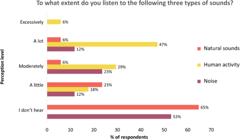
Nine participants (53%) reported not hearing external noises and no respondents reported hearing these noises excessively. The main sources in this class are traffic noise, characterized by the presence of horns, sirens, engine noise, tire-pavement noise, and braking noise; construction noise, characterized by impact noise, falling debris, and the use of power tools and heavy machinery; and industrial noise, generated by operating machinery, electric motors, and gears. This investigation contributes to identifying possible interferences from the surrounding environment on the perceived soundscape.
Regarding human activity sounds, 8 respondents (47%) reported hearing them a lot, and 1 participant (6%) considered these sounds excessive. The main sources in this class are conversations, laughter, and footsteps. This investigation allows for a discussion regarding visitor behavior during the visiting period, as well as constructive aspects, such as the wooden flooring.
Regarding the perception of natural sounds considering the proximity to Independence Park – a potential source of these sounds – 11 participants (65%) reported not hearing them. The main sources in this class are birds singing, flowing water, and wind in vegetation. This result can be attributed to two main factors: the occupancy of the Noble Hall, which contributes to internal noise, and the need for the studied room to remain closed to the park gardens, a measure essential for the preservation of the artworks.
In order to obtain more precise data on individual sound perception, as well as the variables of familiarity and expectation associated with it, respondents were asked to indicate, at any point on a 0-to-100 scale – where 0 represents “does not bother” and 100 represents “bothers a lot” – their level of discomfort with human activity sounds, as this was the most frequently identified type of sound (Question 14 in Table 1). According to the responses obtained, 3 participants stood out for marking above 50, while another 3 indicated 0, showing no discomfort with human activity sounds. The number 40 was the most frequently chosen, selected by over 26% of respondents. The results yielded a mean of 33.95, a median and mode of 40, and a standard deviation of approximately 26.9.
The standard deviation is a relevant measure because it indicates variability in responses, reflecting different perceptions of a sound category. For human activity sounds, the standard deviation shows significant variability, indicating a lack of consensus and subjectivity in participants’ levels of discomfort. Participants can thus be grouped according to their level of discomfort as “tolerant” (0-40), “moderate” (41-60), and “critical” (61-100).
The analysis of the soundscape in the qualitative study was strongly linked to Question 15 in Table 1: “For each of the 8 scales below, to what extent do you agree or disagree that the current surrounding acoustic environment is?”. The responses allowed the generation of the pleasantness-eventfulness graph (Figure 11), defined by the eight attributes adopted in Method A of ISO/TS 12913-2 (ISO, 2018). Aggregated response values were used, along with a numerical base defining the coordinates between –1 and 1 (according to ISO/TS 12913-3 (ISO, 2025)). It can be observed that most responses fall within the “vibrant” and “calm” quadrants.

In a general analysis (Questions 16 and 17 in Table 1), the majority of respondents rated the sound environment as “good” and considered it “slightly appropriate”. Broader questions, such as Questions 18 and 19 in Table 1 – “How loud is it here?” and “How unpleasant is it here?”– received the most frequent responses of “moderately” (47%) and “not at all” (63%), respectively.
The identified sound pressure levels, which exceed the values recommended by NBR 10152 (ABNT, 2020), contrast with the overall positive assessment of the acoustic environment. Although specific acoustic quality indices were not analyzed in the present study, discussing the relationship between the quantitative and qualitative data collected based on these parameters is pertinent.
The positive assessment of the environment demonstrates that the perception of acoustic comfort is associated with the suitability of sounds to the social and cultural experience provided by the space. Complementarily, certain acoustic quality indices serve as an indication of speech intelligibility. However, given the specific nature of the exhibition space, these values may suggest a good understanding of discourse that, in practice, is not necessarily observed.
In this sense, the literature indicates that full speech intelligibility requires vocal intensity to exceed background noise levels. In the present study, this condition tends to adversely affect visitors’ concentration and immersion, which is consistent with the 33% of respondents who reported interference in these aspects due to internal noise sources, such as overheard conversations, even within a context of overall satisfaction.
Furthermore, from a management perspective, limiting the number of visitors during peak periods is recommended. This approach is consistent with the findings of D’Orazio, Montoschi and Garai (2020), who demonstrated that controlling occupancy levels and visiting time is essential to limit the increase in human-generated background noise, thereby preserving adequate speech intelligibility, reducing the need for increased vocal effort, and improving overall acoustic comfort.
Similarly, Olshausen (2019) showed that limiting the number of visitors in exhibition rooms is an effective strategy to mitigate the negative effects of excessive reverberation, contributing to lower residual noise levels and improved acoustic conditions.
This study examines the relationship between the soundscape and the interpretation of art in shaping the museum experience. Accordingly, visitors were asked about the impact of the museum’s acoustic quality on their immersion and interpretation of the art (Question 20 in Table 1). The results indicate that 74% of respondents believed that the acoustic quality did not affect their experience of interpreting the art (Figure 12).

Auditory awareness of the space, a concept discussed in the Theoretical framework of this study, is revisited in this context. Beyond the perception of sound variations, this awareness encompasses the emotional and behavioral responses elicited by the environment. Therefore, the evaluation of the acoustic environment and its interferences is not an objective act, as it is linked to the physical and social elements that compose the environment and to the individual characteristics of those present. The conscious and unconscious processing of acoustic signals generates different understandings of the surrounding environment.
Regarding overcrowding in the exhibition rooms (Questions 21 and 22 in Table 1), only two participants (9.5%) identified such a scenario, and around 80% stated that the presence – or absence – of crowding did not affect their visit experience.
The setting under investigation is a highly frequented museum in São Paulo on a free admission day. It can be argued that these conditions, together with expectations surrounding the visit and the symbolic significance of the artwork Independência ou Morte in the national imagination, influenced visitor perception. Awareness of the space, a concept applied to acoustics in this study, is also relevant for overcrowding in exhibition areas, demonstrating that all factors act together in shaping the visitor experience, even when not consciously recognized.
5 Conclusions
This study was structured as a quali-quantitative assessment of the role of the soundscape in museums on the visitor experience and art interpretation. The methodology was based on a case study conducted in the Noble Hall of the Paulista Museum (Ipiranga Museum), encompassing measurements of sound pressure levels and the administration of questionnaires.
The measurement results indicate that short-term temporal variations allow for significant differences in sound pressure levels to be recorded. It can be concluded that the measured values, obtained through a simplified method of the NBR 10152 (ABNT, 2020), are not in accordance with the aforementioned standard, which establishes reference levels for this parameter, a situation that affects visitors’ acoustic comfort and the overall museum experience.
Regarding the qualitative data, visitors were more responsive to questionnaires with few questions and multiple-choice answers. This finding supports future stages of the study, involving the application of Methods B and C – soundwalks and interviews, respectively – outlined in ISO/TS 12913-2 (ISO, 2018), to identify the most effective approach for collecting qualitative data in museums.
During the random sampling of visitors, a significant presence of non-Portuguese speakers was observed, who were therefore unable to contribute to the study. Incorporating English-language questionnaires is relevant for advancing the research, enabling the inclusion of a broader segment of museum-goers and promoting discussion on sound perception among individuals with diverse experiences and cultural backgrounds.
Additionally, the sample size presents limitations, given that the study was conducted on a day of high attendance and free admission. These conditions directly influence sound pressure levels, the predominance of sounds associated with human activities, and the perceptive evaluation of the environment. While the study fosters a discussion that is still very scarce in the literature, future studies are necessary to expand the sample size. Furthermore, collections should be carried out in different contexts to achieve greater precision and data comparison.
The results indicate that personal expectations and the visit context influence visitors’ experiences, with most respondents expecting a partially quiet environment in the Noble Hall. It was also found that external noises were minimally perceived, whereas internal noises were noted, particularly sounds from the wooden floor, the primary element highlighted by visitors and considered unpleasant by the majority.
Human activity sounds were widely observed, with variable levels of discomfort, reflecting the subjectivity inherent to sound perception. In contrast, natural sounds (such as birdsong and wind in vegetation, present in the nearby gardens of Independence Park) were minimally perceived, a scenario explained by the closed nature of the studied environment.
Most visitors evaluated the examined sound environment as pleasant, calm, and vibrant, and disagreed that it was chaotic or static. Qualitative data indicate that only a minority of visitors felt that acoustic quality impacted art interpretation or the overall visit experience. In this context, personal expectations, visit context, familiarity, and auditory awareness of the space play a significant role in the visitor-art-space relationship. It can also be concluded that the day analyzed (a Wednesday, free-admission day) affected visitor flow and, consequently, the perceptions recorded.
Visitors evaluated the acoustic environment as “good” and “slightly appropriate”. In conclusion, future studies in different contexts are necessary to obtain a comprehensive soundscape assessment of the analyzed environment. Furthermore, the data presented foster the discussion on museum acoustics and visitor experience, serving as a reference for future work in the field.
As highlighted in the literature, visitor management plays a crucial role in the acoustic performance of museum environments. Therefore, future studies should include measurements conducted on days with lower occupancy levels in order to verify whether reduced human-generated residual noise leads to differences in the observed acoustic results.
Building on this perspective, further investigations are warranted not only to improve acoustic comfort in relation to artistic immersion, but also to support the systematic incorporation of acoustic criteria into the education and training of architecture, engineering, and design professionals, reinforcing the relevance of sound as a key component of museum experience and spatial quality.
-
Declaration of Generative AI and AI-Assisted Technologies in the Writing Process
The authors declare the use of generative artificial intelligence tools exclusively to support the linguistic revision and grammar refinement. The authors take full responsibility for the final version of the manuscript and declare that no AI tools were used to generate study results, data interpretation, or the conclusions presented.
-
Financial Support
This study was supported by the Fundação de Amparo à Pesquisa do Estado de São Paulo (FAPESP), and by Conselho Nacional de Desenvolvimento Científico e Tecnológico (CNPq).
-
MICHALSKI, R. L. X. N.; BARBO, M.; MIYAZAKI, J. A. Soundscape as an element of the museological experience: case study at the Ipiranga Museum. Ambiente Construído, Porto Alegre, v. 26, e151604, jan./dez. 2026. ISSN 1678-8621 Associação Nacional de Tecnologia do Ambiente Construído. http://dx.doi.org/10.1590/s1678-86212026000100992
Data Availability Statement
Data will be made available on reasonable request.
References
- ALMEIDA, A. M. A observação de visitantes em museus: sobre ratos e seres humanos. Museologia & Interdisciplinaridade, v. 1, n. 2, p. 10–10, 2012.
- ALMEIDA, A. M. Os visitantes do museu paulista: um estudo comparativo com os visitantes da pinacoteca do estado e do museu de zoologia. Anais do Museu Paulista: História e Cultura Material, v. 12, p. 269–306, 2004.
- ANTUNES, S. M. et al A European and Brazilian cross-national investigation into the Portuguese translation of soundscape perceptual attributes within the SATP project. Applied Acoustics, v. 211, 2023.
- ASSOCIAÇÃO BRASILEIRA DE NORMAS TÉCNICAS. NBR 10152: acústica: níveis de pressão sonora em ambientes internos a edificações. Rio de Janeiro, 2020. Versão Corrigida.
- ASSOCIAÇÃO BRASILEIRA DE NORMAS TÉCNICAS. NBR 12179: tratamento acústico em recintos fechados. Rio de Janeiro, 1992.
- ASSOCIAÇÃO BRASILEIRA DE NORMAS TÉCNICAS. NBR ISO 3382-1: acústica: medição de parâmetros de acústica de salas: parte 1: salas de espetáculo. Rio de Janeiro, 2017.
- BARRON, M. Auditorium acoustics and architectural design 2nd ed. New York: Spon Press, 2009.
- BASTOS, L. J. R. Qualidade acústica de auditórios Aveiro, 2010. Dissertação (Mestrado em Engenharia Civil) - Universidade de Aveiro, Aveiro, 2010.
- BEDIGAN, K. M. Developing emotions: perceptions of emotional responses in museum visitors. Mediterranean Archaeology and Archaeometry, v. 16, n. 5, p. 87-87, 2016.
- BLESSER, B.; SALTER, L.-R. Spaces speak, are you listening? Experiencing Aural Architecture. Cambridge: MIT Press, 2006.
- BODDEN, M. et al Sound quality evaluation of interior vehicle noise using an efficient psychoacoustic method. In: EUROPEAN CONFERENCE ON NOISE CONTROL-EURONOISE, 3., Munich, 1998. Proceedings […] Munich, 1998.
- BRADLEY, J. S. Review of objective room acoustics measures and future needs. Applied Acoustics, v. 72, n. 10, p. 713–720, 2011.
- BREFE, A. C. F. História nacional em São Paulo: o Museu Paulista em 1922. Anais do Museu Paulista: História e Cultura Material, v. 10, p. 79–103, 2003.
- BRIZON, C. J. da S. Metodologia para avaliação e determinação de índices de conforto acústico em engenharia automobilística Belo Horizonte, 2012. Tese (Doutorado em Engenharia Mecânica) — Programa de Pós-Graduação em Engenharia Mecânica, Universidade Federal de Minas Gerais, Belo Horizonte, 2012.
- BROWN, A. L.; KANG, J.; GJESTLAND, T. Towards standardization in soundscape preference assessment. Applied Acoustics, v. 72, n. 6, p. 387–392, 2011.
- BRUCE, N. S.; DAVIES, W. The effects of expectation on the perception of soundscapes. Applied acoustics, v. 85, p. 1–11, 2014.
- BUBARIS, N. Sound in museums–museums in sound. Museum Management and Curatorship, v. 29, n. 4, p. 391–402, 2014.
- CARVALHO, A. P. O.; GARCIA, L. M. M.; GONÇALVES, H. J. S. A multi-criteria method to assess the acoustic quality in museums. In: Proceedings of the NOISE-CON 2014, Noise-Con 2014, Fort Lauderdale, 2014.
- CARVALHO, A. P. O.; GONÇALVES, H. J. S.; GARCIA, L. M. M. Acoustics of modern and old museums. In: INTER-NOISE and NOISE-CON Congress and Conference Proceedings, Noise-Con 2013, Denver, 2013.
- CASTILLO, S. S. del. Cenário da arquitetura da arte: montagens e espaços de exposições. São Paulo: Martins Fontes, 2008.
- CAVALCANTI, C. Arquitetura de museus nas cidades contemporâneas. Tríade: Comunicação, Cultura e Mídia, v. 1, n. 1, 2013.
- CURY, M. X. Exposição-concepção, montagem e avaliação São Paulo: Annablume, 2005.
- D’ORAZIO, D.; MONTOSCHI, M.; GARAI, M. Soundscape perception in museums: a study at the Archaeological Museum of Florence. Applied Acoustics, London, v. 159, 107070, 2020.
- DREVER, J. L. Soundscapes and acoustic ecology-origins and prospects London: The World Forum for Acoustic Ecology, 2005.
- DUARTE, A. M. da C. O Museu Nacional da Ciência e da Técnica: 1971-1976. Coimbra: Ed. da Universidade de Coimbra, 2007.
- GARDNER, M. B. Factors affecting individual and group levels in verbal communication. The Journal of the Acoustical Society of America, New York, v. 49, n. 2B, p. 560–571, 1971.
- GOB, A.; DROUGUET, N. A museologia: história, evolução, questões atuais. Rio de Janeiro: FGV Editora, 2019.
- HODGSON, M.; STEININGER, G.; RAZAVI, Z. Measurement and prediction of speech and noise levels and the Lombard effect in eating establishments. The Journal of the Acoustical Society of America, New York, v. 121, n. 4, p. 2023–2033, 2007.
-
ICOM Brasil. Nova definição de museu Available: https://www.icom.org.br/?page_id=2776 Access: 24 jan. 2026.
» https://www.icom.org.br/?page_id=2776 - INTERNATIONAL ORGANIZATION FOR STANDARDIZATION. ISO/TS 12913-1: acoustics: soundscape: part 1: definition and conceptual framework. Genebra, 2014.
- INTERNATIONAL ORGANIZATION FOR STANDARDIZATION. ISO/TS 12913-2: acoustics: soundscape: part 2: data collection and reporting requirements. Genebra, 2018.
- INTERNATIONAL ORGANIZATION FOR STANDARDIZATION. ISO/TS 12913-3: acoustics: soundscape: part 3: data analysis. Genebra, 2025.
- INTERNATIONAL ORGANIZATION FOR STANDARDIZATION. ISO/TS 9921: ergonomics: assessment of speech communication: Geneve, 2003.
- ISBERT, A. C. Diseño acústico de espacios arquitectónicos Barcelona: Edicions UPC, 1998.
- JELINČIĆ, D. A.; ŠVEB, M. E.; STEWART, A. Designing sensory museum experiences for visitors’ emotional responses. Museum Management and Curatorship, v. 37, n. 5, p. 513-530, 2022.
- JORDAN, V. L. Acoustical criteria for auditoriums and their relation to model techniques. The Journal of the Acoustical Society of America, v. 47, n. 2A, p. 408-412, 1970.
-
JORNAL DA USP. Linha do tempo resume trajetória do Museu Paulista da USP 02 de setembro de 2022. Available: https://jornal.usp.br/universidade/linha-do-tempo-resume-trajetoria-do-museu-paulista-da-usp/ Access: 10 fev. 2025.
» https://jornal.usp.br/universidade/linha-do-tempo-resume-trajetoria-do-museu-paulista-da-usp/ - KANG, J.; SCHULTE-FORTKAMP, B. (ed.). Soundscape and the built environment Boca Raton: CRC press, 2016.
-
KON, N. Modernização e restauro do Museu do Ipiranga, H+F Arquitetos - São Paulo/SP 2022. Available: https://www.nelsonkon.com.br/modernizacao-e-restauro-do-museu-do-ipiranga/ Access: 11 jun. 2026.
» https://www.nelsonkon.com.br/modernizacao-e-restauro-do-museu-do-ipiranga/ - MACKINNON, D. Hearing early modern battles: Soundscape audio as a way of recreating the past. Parergon, v. 36, n. 2, p. 115-140, 2019.
- MENEGUELLO, C. Das ruas para os museus: a paisagem sonora como memória, registro e invenção. MÉTIS: História & Cultura, v. 16, n. 32, 2017.
- MICHALSKI, R. L. X. N. et al Perceptual attributes for soundscape assessment: translation into Portuguese. In: INTERNATIONAL CONGRESS AND EXPOSITION ON NOISE CONTROL ENGINEERING, 53., Nantes, 2024. Proceedings […] Nantes, 2024.
- MITCHELL, A.; ALETTA, F.; KANG, J. How to analyse and represent quantitative soundscape data. JASA Express Letters, v. 2, n. 3, p. 037201, 2022.
- NEPOMUCENO, L. A. Elementos de acústica física e psicoacústica São Paulo: Editora Edgar Blücher, 1994.
- OLSHAUSEN, J. Acoustic regulations and design of the multipurpose hall and exhibition halls of the new Munch museum in Oslo. In: INTERNATIONAL CONGRESS ON ACOUSTICS, 23., Aachen, 2019. Proceedings […] Aachen, 2019.
- ORHAN, C.; YILMAZER, S. Harmony of context and the built environment: soundscapes in museum environments via GT. Applied Acoustics, v. 173, 2021.
- PAULO, J. P. Técnicas experimentais para a caracterização acústica de espaços Lisboa: DFA-IST, 2009.
- PIMENTEL-SOUZA, F. Efeitos da poluição sonora no sono e na saúde em geral: ênfase urbana. Revista Brasileira de Acústica e Vibrações, v. 10, p. 12-22, 1992.
- PIREDDU, S. et al Voices in the museum: exploring soundscapes in curatorial practices. PUNCTUM. International Journal of Semiotics, v. 10, n. 2, p. 111-133, 2025.
- PITONE, R. R.: HARVIE-CLARK, J. Decolonising museum soundscapes: a practice-based enquiry. In: FORUM ACUSTICUM, Turin, 2023. Proceedings [...] Turin: Institute of Acoustics, 2023.
- SCHAEFFER, P. Tratado dos objetos musicais (I. Martinazzo, Tran.) Brasília: Editora Universidade de Brasília, 1993.
- SCHAFER, R. M. A afinação do mundo 2. ed. São Paulo: Editora Unesp, 2012.
- SUDARSONO, A. S.; LAM, Y. W.; DAVIES, W. J. The validation of acoustic environment simulator to determine the relationship between sound objects and soundscape. Acta Acustica United with Acustica, v. 103, n. 4, p. 657-667, 2017.
- TALHARI, J. C. Entre a imagem e o discurso: magia e ciência no Museu do Ipiranga. São Paulo, 2024. Tese (Doutorado em Antropologia Social) – Universidade de São Paulo, São Paulo, 2024.
- VEIGA, A. C. R. Gestão de projetos de museus e exposições Belo Horizonte: C/Arte, 2013.
- YANG, J.; SÖRÖS, G. Audio-augmented museum experiences using wearable visual-inertial odometry. In: INTERNATIONAL CONFERENCE ON MOBILE AND UBIQUITOUS MULTIMEDIA, 18., Pisa, 2019. Proceedings […] Pisa, 2019.
- YILMAZER, S.; ACUN, V. A qualitative approach to investigate indoor soundscape of the built environment. In: INTER-NOISE and NOISE-CON Congress and Conference Proceedings Institute of Noise Control Engineering, Chicago, 2018.
- YILMAZER, S.; ORHAN, C. Auditory environment in the museums: the case of Erimtan archaeology and arts museum. In: INTER-NOISE and NOISE-CON Congress and Conference Proceedings Institute of Noise Control Engineering, Madrid, 2019.
- YILMAZER, S.; YILMAZER, C.; ACUN, V. A Comparative study on prediction of the indoor soundscape in museums via machine learning. In: INTER-NOISE and NOISE-CON Congress and Conference Proceedings Institute of Noise Control Engineering, Madrid, 2019.
- ZWICKER, E.; FASTL, H. Psychoacoustics: facts and models. Springer Science & Business Media, Berlin, v. 22, 2013.
Edited by
-
Editor-in-chief:
Enedir Ghisi
-
Guest editor:
Fernando Sá Cavalcanti

 Source: Nelson Kon (


 Source: ISO/TS 12913-3 (


 Source: Generated using Soundscapy (2026). Adapted from