
 Thermomechanical performance and water absorption of concrete with electronic waste as coarse aggregate
Abstract
The increasing generation of waste electrical and electronic equipment (e-waste) and the environmental impacts of natural aggregate extraction have driven the search for more sustainable concrete materials. This study evaluates whether the partial replacement of coarse aggregate with acrylonitrile butadiene styrene (ABS) plastic waste from e-waste can improve the thermal performance—particularly thermal conductivity—of conventional concrete, while assessing its effects on mechanical behavior and water absorption to identify an optimal incorporation level without significantly compromising strength and durability. Concrete mixtures with 0%, 10%, 12.5%, and 15% ABS were produced and evaluated in terms of workability, compressive and tensile strengths, thermal conductivity, surface temperatures, water absorption, and mesostructural characteristics. Results showed a progressive reduction in mechanical strength with increasing ABS content; however, mixtures with up to 12.5% replacement remained suitable for non-structural applications. Improved thermal performance was observed, with reduced thermal conductivity, especially at the 12.5% replacement level. This ratio is identified as an optimal solution, contributing to the understanding of the thermo-mechanical behavior of concrete incorporating e-waste and supporting the development of more sustainable cementitious materials.
Keywords
Sustainable concrete; Electronic waste; ABS plastic; Strength; Thermal performance; Durability
Resumo
A crescente geração de resíduos de equipamentos eletroeletrônicos (REEE) e os impactos da extração de agregados naturais impulsionam a busca por concretos mais sustentáveis. Este estudo avalia se a substituição parcial do agregado graúdo por resíduos plásticos de acrilonitrila butadieno estireno (ABS) provenientes de e-waste pode melhorar o desempenho térmico — especialmente a condutividade térmica — do concreto convencional, analisando também seus efeitos no comportamento mecânico e na absorção de água, a fim de identificar um teor ótimo de incorporação sem comprometer significativamente resistência e durabilidade. Foram produzidas misturas com 0%, 10%, 12,5% e 15% de ABS, avaliando-se trabalhabilidade, resistências à compressão e à tração, condutividade térmica, temperaturas superficiais, absorção de água e aspectos mesoestruturais. Os resultados indicaram redução progressiva das resistências mecânicas com o aumento do teor de ABS; entretanto, misturas com até 12,5% permaneceram adequadas para aplicações não estruturais. Observou-se melhoria do desempenho térmico, com redução da condutividade térmica, especialmente para 12,5% de substituição. Conclui-se que esse teor representa solução ótima, contribuindo para a compreensão do comportamento termo-mecânico de concretos com REEE e para o desenvolvimento de materiais cimentícios mais sustentáveis.
Palavras-chave
Concreto sustentável; Lixo eletrônico; Plástico ABS; Resistência mecânica; Desempenho térmico; Durabilidade
1 Introduction
The improper disposal of waste electrical and electronic equipment (WEEE), or e-waste, represents a growing environmental challenge due to the presence of toxic substances such as lead, mercury, and cadmium, which are capable of contaminating soil and water resources (Ali; Mahrukh, 2020; Shams; Idris; Yusof, 2024). Brazil is the largest generator of electronic waste in South America, with an annual production of 2.4 billion kilograms (11.4 kg per capita), of which only 3.6% is recycled (Dias et al., 2022; Baldé et al., 2024). This scenario intensifies the generation of electronic plastic waste (e-plastics), originating mainly from the casings of televisions, refrigerators, and mobile devices (Sinha; Hamdan, 2022).
In parallel, the construction industry, a major consumer of mineral resources, faces increasing pressure to reduce the environmental impacts associated with the extraction of natural aggregates and the sector’s high carbon footprint (Campbell; Adamowicz, 2014; Massara, 2018; Bendixen et al., 2021). In this context, the use of e-plastics as alternative aggregates in concrete has emerged as a promising strategy to mitigate environmental impacts while valorizing polymeric waste.
Plastics account for approximately 20% of the mass of WEEE (Sahajwalla; Gaikwad, 2018) and have been extensively investigated due to their potential to reduce concrete density and thermal conductivity. Reductions in thermal conductivity from approximately 1.7 W/mK to as low as 0.5 W/mK have been reported, enhancing thermal insulation and the energy efficiency of buildings (Basha et al., 2020). Farah et al. (2024) observed reductions of up to 61% in thermal conductivity with 25% replacement using polyethylene terephthalate (PET), while Suvidha, Jain, and Kumar (2024) reported reductions of 30–35%. Concretes containing up to 50% PET exhibited thermal conductivity below 0.71 W/mK and reduced density, making them suitable for non-structural applications (Qaidi et al., 2023). However, such thermal gains are often accompanied by mechanical losses, attributed to the weak interfacial bonding between polymers and the cementitious matrix, which requires careful control of replacement levels (Singh; Patel, 2021; Bamigboye et al., 2021; Ali et al., 2023).
Concrete workability is also sensitive to the incorporation of plastic aggregates. Low replacement levels (≤5%) may maintain or even increase slump, whereas higher contents tend to reduce workability due to increased surface area, roughness, and particle agglomeration (Jain et al., 2018; Ammari; Sezen; Castro, 2025). Intrinsic polymer properties, such as density, texture, and particle geometry, directly influence fresh-state behavior: smaller and more rounded particles favor flow, while angular particles impair mixture mobility, particularly at high replacement levels (Hama; Hilal, 2019; Saleh; Hama, 2024).
From a mechanical standpoint, replacement with plastic aggregates generally leads to reduced density and lower compressive and tensile strengths, while remaining adequate for non-structural elements such as blocks, partition panels, and low-load pavements (Hama; Hilal, 2019; Rao; Hagare; Tao, 2024; Farah et al., 2024). Reductions of up to 32% in compressive strength and 33% in tensile strength have been reported and may be partially mitigated by the use of silica fume (Ali et al., 2023). PET replacement levels of up to 10% are considered acceptable for concretes subjected to low structural demands (Abubakar; Yeasmin; Bhattacharjee, 2024), whereas high polypropylene (PP) contents may reduce strength by up to 60% (Paliwal; Kushwaha, 2025). For WEEE-derived residues, studies indicate satisfactory performance at moderate contents of acrylonitrile–butadiene–styrene (ABS) and high-impact polystyrene (HIPS), with progressive losses at higher replacement levels due to increased porosity and reduced composite density (Sinha; Hamdan, 2022; Srinivasan; Premalatha; Ranganayagi, 2022; Paramasivan; Rajagopal, 2023).
Durability, particularly water absorption, is another critical aspect, as it is directly related to the ingress of aggressive agents and the reduction of service life (De Schutter; Audenaert, 2004). This property is influenced by composition, cracking, and environmental conditions (Weiss; Geiker; Hansen, 2015; Zhuang; Wang; Zhang, 2022) and is sensitive to the use of alternative aggregates (Alqahtani; Zafar, 2023). In the case of electronic plastic waste, the hydrophobic nature of polymers such as HIPS and ABS tends to reduce water absorption by limiting moisture migration within the cementitious matrix (Chunchu; Putta, 2019). However, high replacement levels (≥30%) may increase absorption due to the higher porosity of the concrete (Kumar; Premalatha; Baskar, 2017). Basha et al. (2023) reported increases of 14–35% in water absorption for concretes containing 25–100% plastic aggregates (WPA), although mixtures with up to 50% replacement maintained performance compatible with applications requiring low to moderate durability.
Polymer type exerts a significant influence: polyethylene and polypropylene tend to increase water absorption, whereas PET may reduce it (Correa et al., 2021). ABS, being non-porous, shows potential to limit water absorption when used as a partial replacement for natural aggregates, as observed by Kaur and Pavia (2020) in mortars with up to 15% ABS. In addition, parameters such as the water-to-binder ratio and the use of supplementary cementitious materials are decisive in balancing mechanical performance and durability (Srinivasan; Premalatha; Ranganayagi, 2022).
Recent reviews indicate that the partial replacement of coarse aggregates with plastic electronic waste leads to moderate mechanical losses, offset by thermal gains, improved workability, and reduced sorptivity when combined with mineral additions or superplasticizers (Ullah et al., 2021; Ali et al., 2021; Danish et al., 2023).
Despite the growing body of research on plastic aggregates in concrete, most studies focus predominantly on mechanical performance or isolated durability indicators, while fewer investigations address thermal conductivity using standardized heat flow methods. Furthermore, limited research has examined ABS derived specifically from electronic waste as a partial replacement for coarse aggregate, particularly through an integrated assessment combining mechanical strength, water absorption behavior, thermal conductivity, and mesostructural analysis. In addition, the identification of an optimal replacement level based on multi-criteria performance – rather than on a single property – remains insufficiently explored in the literature. This gap restricts a comprehensive understanding of the thermo-hygro-mechanical behavior of ABS-modified concretes and their practical applicability in sustainable construction.
Against this background, this study aims to evaluate whether the partial replacement of coarse aggregate with acrylonitrile butadiene styrene (ABS) plastic waste derived from e-waste can enhance the thermal performance – particularly thermal conductivity – of conventional concrete, while assessing its effects on mechanical behavior and water absorption to identify an optimal incorporation level without significantly compromising strength and durability.
2 Method
The methodology adopted consisted of an experimental study based on concrete casting tests, developed in six stages:
-
material characterization;
-
workability assessment;
-
determination of water absorption;
-
evaluation of mechanical performance;
-
evaluation of thermal performance; and
-
mesostructural analysis.
Statistical analysis of the results began with verification of data normality and homogeneity of variances among groups. For datasets that met both assumptions, one-way analysis of variance (ANOVA) was applied, followed by a post hoc t-test with Bonferroni correction. When these assumptions were not satisfied, nonparametric tests were employed, namely the Kruskal–Wallis test complemented by Dunn’s post hoc test with Bonferroni correction. All statistical analyses were performed using RStudio software.
2.1 Material characterization and mix proportions
High early-strength Portland cement (CP V-ARI, according to Brazilian standard classification), fine sand, and crushed stone (size 0) sourced locally from Curvelo/MG and Belo Horizonte/MG were used, together with plastic waste from waste electrical and electronic equipment (ABS), employed as partial substitutes for the coarse aggregate. The physical properties of the materials are presented in Table 1. The specific gravity of the sand was determined in accordance with NBR 9776 (ABNT, 1988), while the specific gravities of the crushed stone and ABS followed NBR 16917 (ABNt, 2021). The maximum particle size and fineness modulus were obtained according to NBR 17054 (ABNT, 2022). The particle size distribution of the fine aggregate was determined following NBR 7211 (ABNT, 2022) (Figure 1a), whereas the gradation curves of the crushed stone and ABS are shown in Figures 1b and 2b, respectively. Potable water was used in all mixtures.

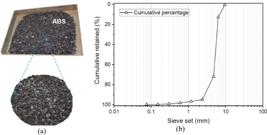
ABS plastic was employed as a partial replacement for crushed stone in order to evaluate its impact on the thermomechanical properties and water absorption of concrete. Four mixtures were analyzed: a reference concrete (REF, 0%) and mixtures with 10%, 12.5%, and 15% replacement of the coarse aggregate by ABS (EW10, EW12.5, and EW15). The adopted mix proportion was 1:1.64:2.60 (cement:sand:coarse aggregate), with a water-to-cement ratio (w/c) of 0.50, designed according to the Associação Brasileira de Cimento Portland (ABCP) method for concrete with a slump between 80 and 100 mm. Details of the mix proportions are presented in Table 2. The selection of these mixtures considered the potential reduction in thermal conductivity associated with plastic incorporation, as well as the expected effects on mechanical performance.
2.2 Workability assessment
Concrete workability is an essential quality control parameter, as it directly influences compaction, final density, and, consequently, the mechanical strength and durability of the material. Adequately compacted concretes exhibit lower permeability and greater resistance to environmental actions (Salman; Zghair; Jumaa, 2021; Kang; Shin; Kim, 2023), an aspect that is particularly relevant in mixtures with partial replacement of coarse aggregate by electronic waste (ABS).
Workability was assessed using the slump cone test, conducted in accordance with NBR 16889 (ABNT, 2020), allowing an objective determination of consistency and comparison among the different mixtures with and without ABS. In addition, visual and manual evaluations of the fresh mixtures were performed, considering flowability after discharge, cohesion, handling with tools, the occurrence of segregation or bleeding, and behavior during placement. These observations supported the interpretation of the standardized results and contributed to the overall technological control of the mixtures.
2.3 Water absorption evaluation
Concrete durability is directly related to its porosity and permeability, as higher values favor the ingress of aggressive agents and accelerate degradation processes. In this context, water absorption was used to assess hygric behavior of the concrete and its relationship with thermomechanical performance, through immersion and capillary absorption tests.
For both tests, three cylindrical specimens (10 × 20 cm) were cast per mixture, totaling twelve samples per test procedure. The specimens were molded in accordance with NBR 5738 (ABNT, 2016) and kept under moist curing for 7 days in lime-saturated water. Subsequently, the samples were oven-dried at 105 ± 5 °C for 72 h, after which their dry masses (ms) were recorded.
In the immersion test (A), three dried specimens were fully immersed in water at 23 ± 2 °C for 72 h. Their immersed masses were determined using a hydrostatic balance (mi). After removal, the specimens were wiped with a damp cloth and weighed to obtain the saturated mass (msat). The absorption value (A) was calculated according to Equation 1, following NBR 9778:2009. This standard also allowed the determination of the void index (Iv) and the real density (ρr), using Equations 2 and 3, respectively.
For the capillary absorption test (C), the remaining three dried specimens were partially immersed to a constant water level of 5 ± 1 mm above the lower surface, preventing wetting of the other faces, without the specimens touching the bottom of the container (Figure 3a). The saturated masses were recorded after 3, 6, 24, 48, and 72 h from initial contact with water. Before each measurement, the specimens were wiped with a damp cloth, and after weighing, they were immediately returned to the test container. The capillary absorption coefficient (C) was calculated for each exposure time in accordance with NBR 9779 (ABNT, 2012), using Equation 4. To determine the maximum capillary rise height, the specimens were subjected to splitting tensile failure according to NBR 7222 (ABNT, 2011) (Figure 3b), enabling visual inspection of the internal moisture distribution and measurement of the penetration depth reached (Figure 3c).

Capillarity test (a), splitting tensile failure (b), and mapping of internal water distribution (c)
Where:
A is the absorption of water by immersion (%);
Iv is the void ratio (%);
ρr is the real density (g/cm³);
C is the absorption of water by capillarity (g/cm²);
msat is the mass of the specimen saturated in water (g);
ms is the oven-dry mass of the specimen (g);
mi is the apparent mass of the saturated specimen immersed in water after boiling (g); and
S is the cross-sectional area (cm²).
2.4 Mechanical performance evaluation
The mechanical performance of the concretes was evaluated through axial compressive strength and splitting tensile strength tests. For each mixture and test type, five cylindrical specimens (10 × 20 cm) were cast, totaling 40 specimens. Specimen preparation followed the procedures established in NBR 5738 (ABNT, 2016). After casting, the specimens were cured for 7 days in lime-saturated water.
The tests were carried out using a hydraulic EMIC universal testing machine, in accordance with NBR 5739:2018 for axial compression and NBR 7222 (ABNT, 2011) for splitting tensile strength. The experimental setup adopted is illustrated in Figure 4. The compressive (fc) and splitting tensile (fct,sp) strength of the specimens were calculated using Equations 5 and 6, respectively.

Where:
fc is the compressive strength (MPa);
fct,sp is the splitting tensile strength (MPa);
Fc is the maximum load recorded during the compressive strength test (N);
Fct is the maximum load recorded during the splitting tensile strength test (N);
d is the specimen diameter (mm); and
l is the specimen length (mm).
2.5 Thermal performance assessment
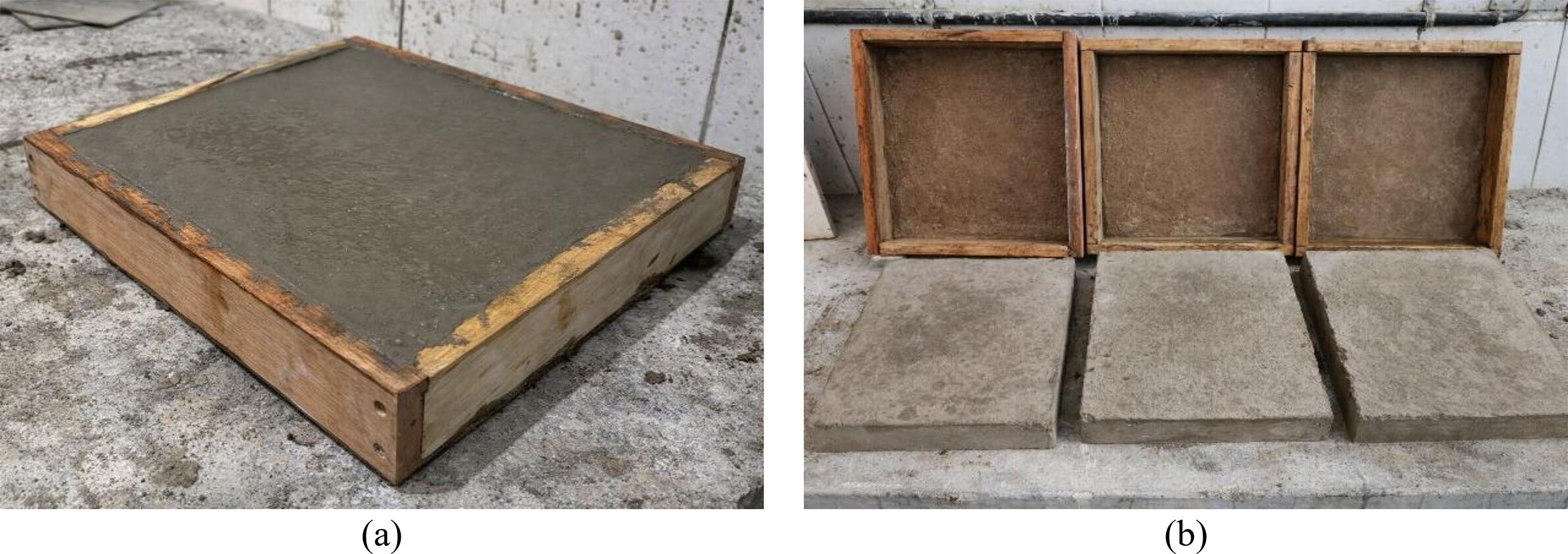
Thermal performance was evaluated by determining the thermal conductivity of the material. Since the thermal conductivity of concrete is influenced by factors, such as composition, aggregate type and content, cementitious materials, and moisture level (Misri et al., 2018), measurements were conducted using the HFM method. For this purpose, three slabs per mixture were cast with dimensions of 30 × 30 × 5 cm (Figure 5), totaling 12 specimens.

After casting, the specimens were cured for seven days in lime-saturated water and subsequently oven-dried for 24 h to standardize moisture content prior to testing. However, the thermal conductivity tests were performed seven days after drying, during which the specimens may have reached moisture equilibrium with the ambient environment. Thermal conductivity was determined in accordance with C518-21 (ASTM, 2021) and EN 12667 using a NETZSCH HFM 436 Lambda heat flow meter.
According to the adopted method, test repetition is not required for specimens produced from the same batch and with equivalent geometric and material characteristics. Therefore, for each mixture, the specimen exhibiting the best surface finish, minimal cracking, greater uniformity, and lower roughness was selected. The selected specimens were lightly sanded on the most irregular surfaces to ensure proper thermal contact during testing.
In the HFM 436 apparatus (Figure 6a), each specimen was positioned between two heated plates maintained at different, automatically controlled temperatures (Figure 6b). The tests were conducted under steady-state conditions, with data acquisition initiated after thermal equilibrium was achieved. The heat flux (Q) per unit time and area was measured by calibrated transducers, whose electrical signal, in volts, is proportional to the incident heat flux (Baldinelli et al., 2019).

General view of the thermal conductivity apparatus (a) and positioning of the specimen inside the equipment (b)
Testing conditions were standardized for all specimens, adopting plate temperatures of 25 °C and 40 °C, with the Idle Setpoint defined as Mean: 10 °C and Delta: 20 °C. Prior to testing, the specimens were identified and weighed. Each slab was tested individually, ensuring adequate contact between the specimen and the measuring plates, with continuous data recording after thermal stabilization.
2.6 Mesostructural study
The mechanical performance of concrete is strongly influenced by the properties of the aggregates, the mortar, and especially the interfacial transition zone (ITZ), a critical region where damage initiation and crack propagation typically occur (Zhang et al., 2019). In concretes incorporating non-conventional materials such as ABS plastic, analysis of the ITZ is essential to understand its effects on strength and durability.
Accordingly, after the axial compressive strength and splitting tensile strength tests, visual and microscopic analyses of the fractured surfaces were performed to identify the paste–aggregate interface, the distribution of voids, and possible heterogeneities associated with the incorporation of ABS. Mesostructural characterization was carried out by optical microscopy, a technique suitable for assessing morphological changes in the ITZ and the mortar matrix (Gao et al., 2023), using a portable optical microscope equipped with an HD CMOS sensor, a 24-bit Digital Signal Processor (DSP), and adjustable focus ranging from 15 to 40 mm.
3 Results and discussion
3.1 Workability
The slump test results indicated minimal or zero slump for all mixtures. The reference concrete exhibited a slump of 8 mm, whereas mixtures containing electronic waste (ABS) showed zero slump (Figure 7a), highlighting the discrepancy between the slump predicted by the ABCP mix design method (80–100 mm) and the experimentally observed behavior.
This outcome is associated with the limitations of the ABCP method when applied to non-conventional aggregates, as emphasized by Frasson Junior (2000), Freitas (2018), Leite, Figueiredo Filho and Lima (2013) and Santos and Leite (2018), who report its low sensitivity to the particularities of recycled materials and its tendency to produce drier and less cohesive mixtures.

In addition, the findings corroborate studies reporting a loss of workability in concretes incorporating shredded plastics (Sahajwalla; Gaikwad, 2018; Jain et al., 2018; Hama; Hilal, 2019; Ammari; Sezen; Castro, 2025). The irregular and angular geometry of the ABS particles (Figure 2b), combined with the high fines content with particle size close to that of fine sand, increases the specific surface area of the mixture. Although hydrophobic, ABS requires greater paste coating, which increases viscosity, reduces internal mobility, and hinders compaction.
Visual inspection of the mixtures (Figure 7b) confirms this behavior, showing a progressive reduction in cohesion with increasing ABS content, characterized by the formation of paste agglomerates adhered to the aggregates. This effect results from mechanical interlocking among angular particles and the difficulty of paste dispersion, as discussed by Santos and Leite (2018), indicating the need for specific mix design adjustments when e-waste aggregates are used. Overall, the results reinforce that workability is strongly dependent on the morphology and particle size distribution of the incorporated polymer.
Measured results of dry mass (ms), saturated mass (msat), and immersed mass (mi), used in the calculation of water absorption by immersion (A), void index (Iv), and real density (ρr)
3.2 Water absorption study
Durability was evaluated through water absorption by immersion (A), voids index (Iv), real density (ρr), and capillary water absorption (C). The experimental results indicate that the partial replacement of crushed stone with ABS (10–15%) led to moderate changes in hygric properties, without substantial deviations from the reference concrete.
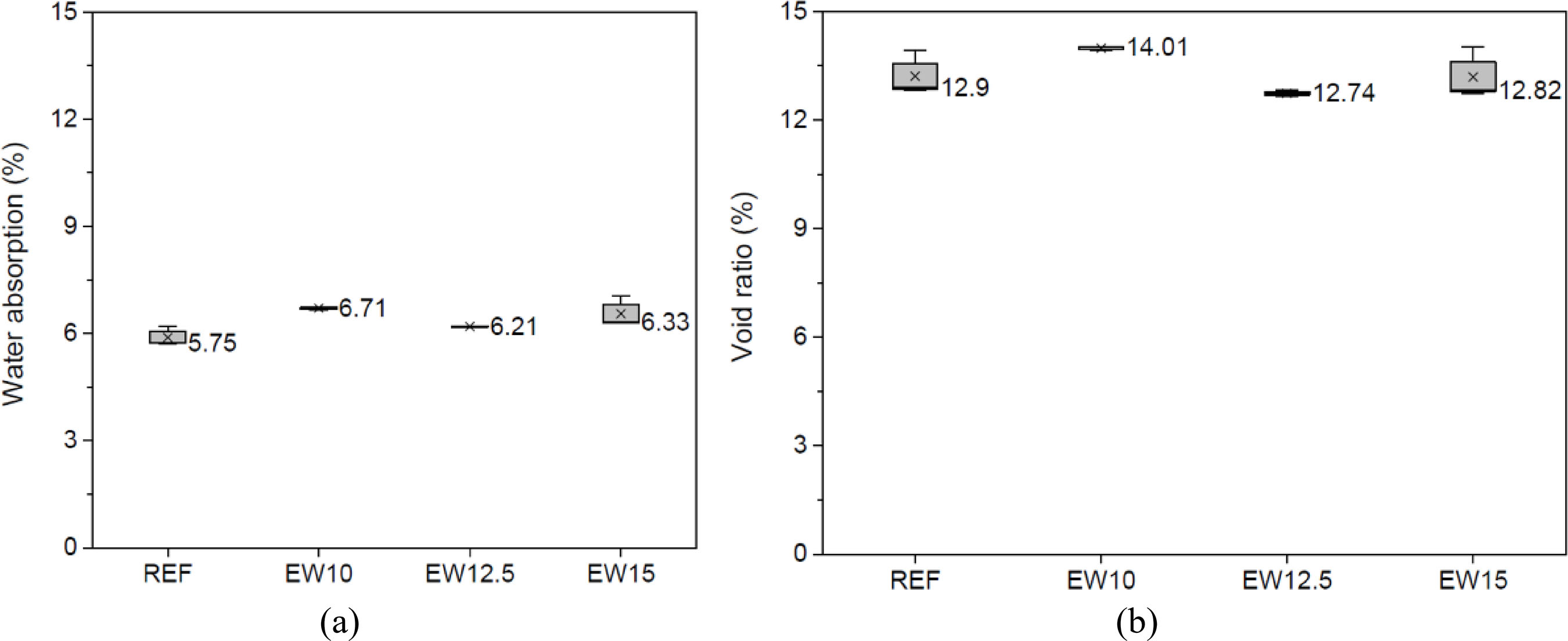
The measured dry mass (ms), saturated mass (msat), and immersed mass (mi), used to calculate A, Iv, and ρr, are presented in Table 3. Water absorption by immersion (A) showed moderate increases for EW10 (+16.7%), EW12.5 (+8.0%), and EW15 (+10.1%) (Figure 8a). Although the Kruskal–Wallis test yielded a marginal p-value (≈0.05), Dunn’s post hoc test with Bonferroni correction did not identify significant pairwise differences (p > 0.05), indicating a trend without robust statistical evidence (Table 4). This behavior is consistent with studies reporting a limited impact of hydrophobic and non-porous polymers, such as ABS, at moderate replacement levels (Chunchu; Putta, 2019; Kaur; Pavia, 2020).
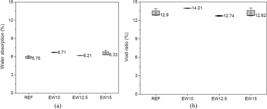
For the voids index (Iv), an increase was observed for EW10 (+8.5%), along with slight reductions for EW12.5 (−1.2%) and EW15 (−0.6%) relative to the control (Figure 8b), with no statistically significant differences (p > 0.05), as shown in Table 4. These results indicate that the 10–15% ABS range did not promote a consistent increase in connected porosity, in agreement with studies emphasizing the influence of polymer type and morphology on Iv and sorptivity (Correa et al., 2021; Basha et al., 2023; Danish et al., 2023).
The maintenance of A and Iv within ranges similar to the control suggests that moisture transport in the concrete was not adversely affected. The hydrophobicity of ABS likely contributes to limiting preferential moisture migration pathways, and the matrix–aggregate interface, although less adherent, did not generate sufficient connected porosity to increase permeability.
The real density (ρr) decreased progressively with increasing ABS content, reaching −5.8% (EW10), −8.9% (EW12.5), and −10.5% (EW15) (Figure 9), with statistical significance observed only between REF and EW15 (p ≤ 0.05) (Table 4). This trend reflects the lower density of ABS (≈1,140 kg/m³) compared with crushed stone (≈2,670 kg/m³) and is widely reported in the literature (Hama; Hilal, 2019; Qaidi et al., 2023; Rao; Hagare; Tao, 2024), indicating potential for applications requiring reduced weight and enhanced thermal insulation.

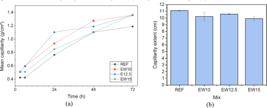
In the capillary absorption (C) tests, the saturated masses recorded at 3 h (msat,3h), 6 h (msat,6h), 24 h (msat,24h), 48 h (msat,48h), and 72 h (msat,72h), used to determine C, are presented in Table 5. Higher absorption rates were observed during the first 24 h, particularly for EW12.5 (+44.4% relative to REF), followed by EW10 (+22.2%) and EW15 (+11.1%) (Figure 10a). After approximately 72 h, the coefficients converged among the ABS-containing mixtures. Regarding penetration depth, the reference concrete exhibited the highest value, followed by EW12.5, EW10, and EW15 (Figure 10b). Despite visual and temporal differences, statistical tests did not indicate significance (p > 0.05), as shown in Table 6.
Dry mass (ms) and saturated mass at 3 h (msat,3h), 6 h (msat,6h), 24 h (msat,24h), 48 h (msat,48h), and 72 h (msat,72h), used to determine capillary water absorption (C)
Overall, the results indicate that:
-
ABS incorporation leads to a slight tendency toward increased A and small fluctuations in Iv, without statistically significant differences;
-
the reduction in ρr confirms the dilution of mineral aggregate by the polymer; and
-
capillary absorption is more pronounced only at early stages, without a sustained increase.
These findings corroborate studies reporting a limited impact on hygric properties when non-porous polymers are used at replacement levels ≤15% (Kaur; Pavia, 2020; Srinivasan; Premalatha; Ranganayagi, 2022) and contrast with results reported for higher replacement levels (Basha et al., 2023). Accordingly, concretes containing 10–15% ABS exhibited durability performance compatible with non-structural applications in environments of low to moderate aggressiveness.
3.3 Mechanical performance
The maximum loads (Fc and Fct) recorded during the compressive strength (fc) and splitting tensile strength (fct,sp) tests are presented in Tables 7 and 8, respectively.
Figure 11 presents the mechanical performance of the different mixtures. The reference mixture (REF) achieved a compressive strength of 37.19 MPa and a splitting tensile strength of 3.29 MPa, values consistent with the expected behavior of CP V-ARI cement at 7 days (Oliveira et al., 2021). Overall, a tendency toward reduced compressive and tensile strengths was observed with increasing contents of waste electrical and electronic equipment (WEEE). However, this relationship was not linear. For compressive strength, the largest reduction occurred at the initial replacement level, followed by stabilization at higher ABS contents. A similar trend was observed for tensile strength, with an initial decrease from REF to EW10, intermediate variation at EW12.5, and a further reduction at EW15, indicating partial stabilization behavior.

Partial replacement of the coarse aggregate with plastic e-waste resulted in progressive reductions in strength (Table 9). The EW15 mixture reached 27.80 MPa in compression and 2.22 MPa in tensile strength, corresponding to decreases of 25.2% and 32.3%, respectively. These losses are attributed to the lower stiffness of the polymer, deficient bonding in the interfacial transition zone, and the thermal shrinkage of ABS, which promotes the formation of internal defects and increases susceptibility to cracking, as reported by Arnandha et al. (2017), Needhidasan, Ramesh, and Prabu (2020), Arivalagan (2020), Ahmad et al. (2022), and Mashaan and Silva (2024). Nevertheless, the results indicate potential applicability of these concretes in light structural and non-structural uses, such as interlocking pavements, sidewalks, and low-volume roads (Sojobi; Aladegboye; Awolusi, 2018; Saranya; Ramadevi, 2022; Mashaan; Silva, 2024).
Quantitative analysis confirmed this trend. Compressive strength (fc) decreased by 18.1% (EW10), 25.3% (EW12.5), and 25.2% (EW15) relative to the reference mix (Figure 11a and Table 9). ANOVA indicated overall differences among groups; however, the Bonferroni-corrected t-test identified statistical significance only between the e-waste mixtures and the reference concrete (p ≤ 0.05), suggesting similar mechanical behavior among the different ABS replacement levels.
Similarly, splitting tensile strength (fct,sp) showed reductions of 19.4% (EW10), 17.7% (EW12.5), and 32.3% (EW15) compared with the control (Figure 11b and Table 9). Although two atypical values were identified, not classified as extreme outliers, ANOVA remained applicable. The global test indicated statistical significance, but the Bonferroni-corrected t-test showed a significant difference only between REF and EW15, indicating that ABS replacement levels of 10% and 12.5% do not significantly affect tensile strength when compared with natural coarse aggregate.
3.4 Thermal performance
Thermal conductivity results (Table 10) confirm the influence of ABS on the thermal performance of concrete. Compared with the reference mixture (≈0.37 W/m·K), reductions were observed for EW10 (0.34–0.35 W/m·K) and, more markedly, for EW12.5 (0.29–0.30 W/m·K), demonstrating the insulating effect of the polymer. This reduction is associated with the low intrinsic thermal conductivity of ABS and the decrease in composite density, a behavior widely reported in the literature, with reductions on the order of 30–60% at moderate replacement levels (Basha et al., 2020; Farah et al., 2024; Suvidha; Jain; Kumar, 2024).
In contrast, the EW15 concrete exhibited an increase in thermal conductivity (0.41–0.43 W/m·K), exceeding the value of the reference mixture. Joint analysis with the voids index (Figure 12) suggests that this behavior is related to increased pore connectivity, which promotes preferential heat transfer paths and reduces the effectiveness of entrapped air as an insulating medium. Although increased porosity generally tends to reduce thermal conductivity, the presence of interconnected pores can reverse this trend, leading to higher thermal conductivity values (Kamseu et al., 2012). Overall, the results indicate that an ABS content of 12.5% represents the optimal condition among the mixtures evaluated, resulting in the lowest thermal conductivity. Above this threshold, thermal gains are compromised, reinforcing the need to control the replacement level to maximize the thermo-energetic performance of concrete.

3.5 Mesostructural analysis
Multiscale analysis of concrete is essential to understand the interaction among its constituents and the effects of these interactions on the overall performance of the material (Wriggers; Moftah, 2006). Figures 13 and 14 present optical microscopy (OM) images highlighting the mesostructure of concretes containing e-waste residues (EW).

OM images of the specimen section with 15% e-waste replacement: (a) conventional coarse aggregate, showing heterogeneous mineral phases; (b) e-waste aggregate, with monophasic composition and rough surface. The ITZ is more continuous in the conventional aggregate
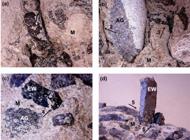
OM images of fractured specimens with 15% electronic waste replacement: (a–b) fractured surfaces showing (detail 1) exposed EW particle, (detail 2) fractured AG particle, and (detail 3) EW partially embedded in the matrix; (c) rough EW surface (detail 4), promoting mechanical interlocking; (d) extracted EW particle (details 5–6), indicating weak bonding with the matrix
In Figure 13a, the typical heterogeneity of conventional coarse aggregate (AG) is observed, consisting of mineral particles of different natures. In contrast, the e-waste aggregate (Figure 13b) exhibits a monophasic composition and a rough surface. In both cases, the cementitious matrix (M) appears relatively dense, with a visually cohesive interfacial transition zone (ITZ). However, the ITZ associated with AG shows greater continuity, indicating better physicochemical affinity with the cement paste.
Figures 14a and 14b show fractured surfaces, highlighting an exposed EW particle (detail 1), a fractured AG particle on one face (detail 2), and an EW particle partially embedded in the matrix (detail 3). The reduced coverage of EW by the cement paste suggests limited affinity with the fresh matrix, possibly related to the physicochemical characteristics of the polymer. Although the higher surface roughness of EW (Figure 14c, detail 4) promotes mechanical adhesion through interlocking, this mechanism proved insufficient to ensure effective anchorage. Figure 14d illustrates an EW particle extracted with low frictional force (details 5 and 6), indicating weak bonding with the matrix, which supports the observed reductions in mechanical strength, in agreement with Ullah et al. (2021).
Overall, the mesostructural analysis confirms that the reduced continuity of the ITZ and the limited adhesion between ABS and the cementitious matrix are key factors governing the lower mechanical performance, in addition to influencing void formation and the microstructural heterogeneity observed at higher replacement levels.
4 Limitations of the study
This study has limitations that should be considered when interpreting the results. All mechanical and water absorption tests were performed after only 7 days of curing. Although CP V-ARI cement supports early-age evaluation, concrete properties continue to develop beyond this period. Therefore, the reported strengths may be underestimated and the water absorption results may not fully represent the behavior at 28 days or later ages. The short curing time may also have limited the development of the cementitious matrix and the interfacial transition zone, particularly in mixtures containing ABS. In addition, the thermal conductivity tests were conducted under controlled laboratory conditions, which do not fully reproduce real environmental exposure.
Another important limitation concerns the relatively small number of specimens in some tests. Water absorption and capillarity were evaluated with three specimens per mixture, mechanical performance with five specimens, and thermal conductivity with a single representative slab per mixture, as permitted by the adopted standard. Although appropriate statistical analyses were applied, the reduced sample size limits statistical power and may have hindered the detection of subtle differences among mixtures. Furthermore, the durability assessment was restricted to early-age absorption tests, without investigating long-term mechanisms such as carbonation or chloride penetration, which should be addressed in future studies.
5 Conclusions
The results demonstrate that the partial replacement of coarse aggregate with plastic residues from waste electrical and electronic equipment (ABS) is technically feasible for non-structural applications, provided that controlled replacement levels are adopted. The integrated assessment of fresh-state behavior, mechanical properties, durability, and thermal performance showed that the overall performance of the concrete strongly depends on the replacement level and on the angular morphology of the polymer.
In the fresh state, all mixtures exhibited minimal or zero slump, indicating that crushed ABS, characterized by high angularity and a high fines content, adversely affects workability. This behavior highlights the need for mix design adjustments or the use of chemical admixtures for practical applications, especially at higher replacement levels.
From a mechanical standpoint, a progressive reduction in compressive and tensile strengths was observed with increasing ABS content, associated with the lower stiffness of the polymer and limited adhesion in the interfacial transition zone. Nevertheless, all mixtures met the target design strength (fck), and concretes with up to 12.5% replacement maintained strength levels compatible with non-structural elements such as masonry blocks, panels, and pavements subjected to low mechanical demand.
Durability, assessed through water absorption by immersion and capillarity, showed moderate variations with no statistically significant differences compared to the reference concrete. The hydrophobic nature of ABS contributed to maintaining void index and permeability values close to those of the control mixture, while the reduction in real density indicates potential for producing lighter concretes without relevant impairment of moisture-related integrity within the investigated replacement ranges.
Regarding thermal performance, the incorporation of ABS reduced thermal conductivity up to an optimal replacement level. Concretes containing 10% and 12.5% ABS exhibited lower thermal conductivity than the reference mixture, with the 12.5% replacement level showing the best thermal performance. In contrast, the 15% replacement level resulted in increased thermal conductivity, surpassing that of conventional concrete. This behavior is associated with greater microstructural discontinuity and the formation of interconnected voids, which promote preferential heat conduction paths.
The combined analysis of the results indicates that a 12.5% replacement of coarse aggregate with ABS represents the optimal condition among the evaluated mixtures, providing the best balance between mechanical losses, durability preservation, density reduction, and thermal gains. The 10% replacement level also showed satisfactory overall performance, although with less pronounced thermal benefits, whereas the 15% replacement level simultaneously compromises mechanical and thermal performance and is therefore not recommended.
In conclusion, the controlled incorporation of ABS residues from e-waste into conventional concrete represents a promising strategy for the development of more sustainable materials, offering relevant gains in thermal performance and reductions in density while maintaining adequate strength and durability for non-structural applications. The findings demonstrate that the success of this approach depends on strict control of the replacement level, with 12.5% being the percentage that best reconciles workability, mechanical performance, durability, and thermal behavior under the experimental conditions investigated.
This study contributes by providing an integrated evaluation of ABS e-waste as a partial replacement for coarse aggregate, considering workability, mechanical performance, durability, and standardized thermal conductivity. The results reveal a non-linear relationship between ABS content, porosity, and thermal performance, indicating the existence of an optimal replacement level. From a practical perspective, replacements of up to 12.5% proved suitable for non-structural applications, reducing density and thermal conductivity without compromising strength and durability, while also promoting circular economy practices in the construction sector.
The main limitations of this study include the limited number of specimens in some tests, the execution of thermal tests under controlled laboratory conditions, and the restricted scope of durability assessment. Future studies are recommended to expand the experimental database, investigate long-term degradation mechanisms such as carbonation and chloride penetration, evaluate thermal performance under real environmental conditions, and explore strategies to improve the polymer–matrix interface, including surface treatments of ABS, the use of admixtures, or supplementary cementitious materials.
Acknowledgements
The authors acknowledge the Federal Center for Technological Education of Minas Gerais (CEFET-MG), Curvelo and Nova Gameleira campuses, for the technical support provided during the development of this study. The authors also acknowledge the Civil Construction Materials Laboratory (LMC²), Department of Civil Engineering, School of Mines, Federal University of Ouro Preto (UFOP), for the technological infrastructure and support that enabled the thermal conductivity tests to be carried out. The authors further acknowledge the financial support from the Coordination for the Improvement of Higher Education Personnel – Brazil (CAPES) and the National Council for Scientific and Technological Development (CNPq). Finally, the authors thank CityMix Concreto and E-mile Reciclagem de Eletrônicos for donating the materials that made this research possible.
-
VIEIRA, J. C.; MOURÃO, A. B.; MORAIS, I. B.; SOARES JUNIOR, P. R. R.; MALAQUIAS, D. E.; SOUZA, W. J. de; ROSAS, M. H.; PEIXOTO, R. A. F.; LIMA, W. E. F.; GONZAGA, L. G. das M.; LUDVIG, P. Thermomechanical performance and water absorption of concrete with electronic waste as coarse aggregate. Ambiente Construído, Porto Alegre, v. 26, e152382, jan./dez. 2026. ISSN 1678-8621 Associação Nacional de Tecnologia do Ambiente Construído. http://dx.doi.org/10.1590/s1678-86212026000100970
-
Declaration of Generative AI and AI-Assisted Technologies in the Writing Process
The authors used generative AI tools to assist with language revision and translation of the manuscript. The authors reviewed and edited the output and take full responsibility for the final content.
-
Financial Support
This study was supported by the Coordination for the Improvement of Higher Education Personnel – Brazil (CAPES) – Finance Code 001 – and by the National Council for Scientific and Technological Development (CNPq).
Data Availability Statement
The data supporting the findings of this study are available from the corresponding author upon reasonable request.
References
- ABUBAKAR, L.; YEASMIN, N.; BHATTACHARJEE, A. Waste Polyethylene Terephthalate (PET) as a Partial Replacement of Aggregates in Sustainable Concrete. Construction Materials, v. 4, n. 4, p. 738–747, 2024.
- AHMAD, F. et al. performance evaluation of plastic concrete modified with e-waste plastic as a partial replacement of coarse aggregate. Materials, v. 15, n. 1, p. 175, 2022.
- ALI, K. et al. Effect of waste electronic plastic and silica fume on mechanical properties and thermal performance of concrete. Construction And Building Materials, v. 285, p. 122952, 2021.
- ALI, K. et al. Influence of recycled plastic incorporation as coarse aggregates on concrete properties. Sustainability, v. 15, n. 7, p. 5937, 2023.
- ALI, S. R.; MAHRUKH. Impacts of e-wastes on water resources and their management. In: ADVANCES in environmental pollution management: wastewater impacts and treatment technologies. Haridwar: Agriculture and Environmental Science Academy, 2020.
- ALQAHTANI, F. K.; ZAFAR, I. Construction of green concrete incorporating fabricated plastic aggregate from waste processing. Sustainability, v. 15, n. 5, p. 4114, 2023.
- AMERICAN SOCIETY FOR TESTING AND MATERIALS. C518-21: standard test method for steady-state thermal transmission properties by means of the heat flow meter apparatus. West Conshohocken, 2021.
- AMMARI, M. Z. J.; SEZEN, H.; CASTRO, J. Effect of different plastics on mechanical properties of concrete. Construction Materials, v. 5, n. 3, p. 60, 2025.
- ARIVALAGAN, S. Experimental study on the mechanical behaviour of concrete by partial replacement of waste iron powder as fine aggregate: a green concrete approach. International Journal for Modern Trends in Science and Technology, v. 6, n. 11, p. 126-130, 2020.
- ARNANDHA, Y et al. Physical and mechanical properties of WPC board from sengon sawdust and recycled HDPE plastic. Procedia Engineering, v. 171, p. 695-704, 2017.
- ASSOCIAÇÃO BRASILEIRA DE NORMAS TÉCNICAS. NBR 16917: agregado graúdo: determinação da densidade e da absorção de água. Rio de Janeiro, 2021.
- ASSOCIAÇÃO BRASILEIRA DE NORMAS TÉCNICAS. NBR 17054: agregados: determinação da composição granulométrica: método de ensaio. Rio de Janeiro, 2022.
- ASSOCIAÇÃO BRASILEIRA DE NORMAS TÉCNICAS. NBR 5738: concreto: procedimento para moldagem e cura de corpos de prova. Rio de Janeiro, 2016.
- ASSOCIAÇÃO BRASILEIRA DE NORMAS TÉCNICAS. NBR 7211: agregados para concreto: requisitos. Rio de Janeiro: ABNT, 2022.
- ASSOCIAÇÃO BRASILEIRA DE NORMAS TÉCNICAS. NBR 7222: concreto e argamassa: determinação da resistência à tração por compressão diametral de corpos de prova cilíndricos. Rio de Janeiro, 2011.
- ASSOCIAÇÃO BRASILEIRA DE NORMAS TÉCNICAS. NBR 9776: agregados: determinação da massa específica de agregados miúdos por meio do frasco chapman - método de ensaio. Rio de Janeiro, 1988.
- ASSOCIAÇÃO BRASILEIRA DE NORMAS TÉCNICAS. NBR 9779: argamassa e concreto endurecidos: determinação da absorção de água por capilaridade. Rio de Janeiro, 2012.
- BALDÉ, C. P. et al. The Global E-waste Monitor 2024 Bonn: UNITAR, 2024.
- BALDINELLI, G. et al. Thermal conductivity measurement of insulating innovative building materials by hot plate and heat flow meter devices: a round Robin test. International Journal of Thermal Sciences, v. 139, p. 25–35, 2019.
- BAMIGBOYE, G. O. et al. Evaluation of eco-friendly concrete having waste PET as fine aggregates. Cleaner Materials, v. 2, p. 100026, 2021.
- BASHA, S. I. et al. Durability of recycled waste plastic aggregate concrete. European Journal of Environmental and Civil Engineering, v. 27, n. 2, p. 663–684, 2023.
- BASHA, S. I. et al. Mechanical and thermal properties of lightweight recycled plastic aggregate concrete. Journal of Building Engineering, v. 32, p. 101710, nov. 2020.
- BENDIXEN, M. et al. Sand, gravel, and UN sustainable development goals: conflicts, synergies, and pathways forward. One Earth, v. 4, n. 8, p. 1095-1111, ago. 2021.
- CAMPBELL, B.; ADAMOWICZ, W. L. Aggregate Resource Extraction: examining environmental impacts on optimal extraction and reclamation strategies. In: AGRICULTURAL AND APPLIED ECONOMICS ASSOCIATION, Minneapolis, 2014. Proceedings [...] Minneapolis: AgEcon Search, 2014.
- CHUNCHU, B. R. K.; PUTTA, J. Effect of recycled plastic granules as a partial substitute for natural resource sand on the durability of SCC. Resources, v. 8, n. 3, p. 133, 2019.
- CORREA, P. M. et al. Potential use of PET and PP as partial replacement of sand in structural concrete. Matéria, Rio de Janeiro, v. 26, n. 3, p. e13009, 2021.
- DANISH, A. et al. A compendious review on the influence of e-waste aggregates on the properties of concrete. Case Studies in Construction Materials, v. 18, e01740, p. 1-24, 2023.
- DE SCHUTTER, G.; AUDENAERT, K. Evaluation of water absorption of concrete as a measure for resistance against carbonation and chloride migration. Materials and Structures, v. 37, p. 591–596, 2004.
- DIAS, P. et al. Electronic waste in Brazil: generation, collection, recycling and the covid pandemic. Cleaner Waste Systems, v. 3, p. 100022, 2022.
- FARAH, E. et al. Assessing the impact of shredded Polyethylene Terephthalate (PET) post-consumer plastic as a partial replacement for coarse aggregates in unreinforced concrete. Materials, v. 17, n. 21, p. 5208, 2024.
- FRASSON JUNIOR, A. Proposta de metodologia de dosagem e controle do processo produtivo de blocos de concreto para alvenaria estrutural. Florianópolis, 2000. 145 f. Dissertação (Mestrado em Engenharia Civil) - Curso de Engenharia Civil, Universidade Federal de Santa Catarina, Florianópolis, 2000.
- FREITAS, P. N. L. de. Estudo comparativo dos métodos ABCP e IPT modificado para dosagem de concreto de cimento portland. Mossoró, 2018. 34 f. Trabalho de Conclusão de Curso (Graduação em Engenharia Civil) - Universidade Federal Rural do Semi-Árido, Mossoró, 2018.
- GAO, Z. et al. Characterization of interfacial transition zone of fly ash concrete with different coarse-aggregates by optical microscopy and digital image correlation coupled method. Materials Today Communications, v. 34, p. 105099, 2023.
- HAMA, S. M.; HILAL, N. N. Fresh properties of concrete containing plastic aggregate. In: USE OF RECYCLED plastics in eco-efficient concrete. London: Woodhead Publishing, 2019.
- JAIN, A. et al. Fresh, strength, durability and microstructural properties of shredded waste plastic concrete. Iranian Journal of Science and Technology, Transactions of Civil Engineering, v. 43, n. 1, p. 455–465, 2018.
- KAMSEU, E. et al Bulk composition and microstructure dependence of effective thermal conductivity of porous inorganic polymer cements. Journal of the European Ceramic Society, v. 32, n. 8, p. 1593–1603, 2012.
- KANG, I. K.; SHIN, T. Y.; KIM, J. H. Observation-informed modeling of artificial neural networks to predict flow and bleeding of cement-based materials. Construction and Building Materials, v. 409, p. 133811, 2023.
- KAUR, G.; PAVIA, S. Physical properties and microstructure of plastic aggregate mortars made with acrylonitrile-butadiene-styrene (ABS), polycarbonate (PC), polyoxymethylene (POM) and ABS/PC blend waste. Journal of Building Engineering, v. 31, p. 101341, 2020.
- KUMAR, K. S.; PREMALATHA, P. V.; BASKAR, K. Evaluation of Transport Properties of Concrete Made With E-waste Plastic. Journal of Testing and Evaluation, v. 45, n. 5, p. 1849–1853, 2017.
- LEITE, M. B.; FIGUEIREDO FILHO, J. G. L.; LIMA, P. R. L. Workability study of concretes made with recycled mortar aggregate. Materials and Structures, v. 46, p. 1765–1778, 2013.
- MASHAAN, N. S.; SILVA, A. de. Review on assessment and performance mechanism evaluation of non-structural concrete incorporating waste materials. Applied Mechanics, v. 5, n. 3, p. 579-599, 2024.
- MASSARA, V. M. The Brazilian legislation for the reuse of civil construction waste. MedCrave Online Journal of Civil Engineering, v. 4, n. 5, p. 410-412, 2018.
- MISRI, Z. et al. Review on factors influencing thermal conductivity of concrete incorporating various type of waste materials. IOP Conference Series: Earth and Environmental Science, v. 140, p. 012141, 2018.
- NEEDHIDASAN, S.; RAMESH, B.; PRABU, S. J. R. Experimental study on use of E-waste plastics as coarse aggregate in concrete with manufactured sand. Materials Today: Proceedings, v. 22, n. 3, p. 715-721, 2020.
- OLIVEIRA, D. R. B. et al. Resíduo de concreto como substituto ao cimento: avaliação da resistência à compressão e das emissões. In: ENCONTRO NACIONAL DE APROVEITAMENTO DE RESÍDUOS NA CONSTRUÇÃO, 7., Porto Alegre, 2021. Proceedings [...] Porto Alegre: ANTAC, 2021.
- PALIWAL, M. C.; KUSHWAHA, S. S. Assessment of mechanical and physical properties of concrete with polypropylene plastic granule aggregates. Journal of Information Systems Engineering and Management, v. 10, n. 40s, p. 303–309, 2025.
- PARAMASIVAN, S.; RAJAGOPAL, T. Strength studies on concrete using e-plastic waste as coarse aggregate. Global Nest Journal, v. 25, n. 10, p. 212-215, 2023.
- QAIDI, S. et al. Investigation of the physical-mechanical properties and durability of high-strength concrete with recycled PET as a partial replacement for fine aggregates. Frontiers in Materials, v. 10, p. 1101146, 2023.
- RAO, J.; HAGARE, D.; TAO, Z. Upcycling of End-of-Life-Vehicle (ELV) plastics as a replacement for natural fine aggregate in concrete. Resources, Conservation & Recycling Advances, v. 21, p. 200210, 2024.
- SAHAJWALLA, V.; GAIKWAD, V. The present and future of e-waste plastics recycling. Current Opinion in Green and Sustainable Chemistry, v. 13, p. 102-107, 2018.
- SALEH, A. M.; HAMA, S. M. Impact of new type of plastic as aggregate on fresh and hardened, microstructure properties of concrete. Salud, Ciencia y Tecnología - Serie de Conferencias, v. 3, p. 815, 2024.
- SALMAN, M. M.; ZGHAIR, L. A. G.; JUMAA, N. H. The Interrelationship between the Methods used to Determine the Workability of Concrete. IOP Conference Series: Materials Science and Engineering, v. 1094, n. 1, p. 012022, fev. 2021.
- SANTOS, A. A. M. dos; LEITE, M. B. Avaliação de concretos reciclados com agregado graúdo de concreto dosados pelo método da ABCP modificado. Ambiente Construído, Porto Alegre, v. 18, n. 4, p. 341–359, out./dez. 2018.
- SARANYA, K.; RAMADEVI, K. Electronıc waste management: an overview. In: INTERNATIONAL CONFERENCE ON I-SMAC, 6., Dharan, 2022. Proceedings [...] Dharan: IEEE, 2022.
- SHAMS, S.; IDRIS, P. R.; YUSOF, I. Toxicity characterization and environmental impact of e-waste processing. In: MANAGEMENT of Electronic Waste: Resource Recovery, Technology and Regulation. London: John Wiley & Sons, 2024.
- SINGH, V.; PATEL, M. R. A Comparative study on plastic concrete and partially replaced plastic concrete using plastic aggregate with conventional concrete. International Journal for Research in Applied Science & Engineering Technology, v. 9, n. 6, p. 390–397, 2021.
- SINHA, A.; HAMDAN, A. Impact of partial replacement of coarse aggregate with electronic plastic waste on compressive strength of concrete. Materials Today: Proceedings, v. 56, n. 3, p. 143-149, 2022.
- SOJOBI, A. O.; ALADEGBOYE, O. J.; AWOLUSI, T. F. Green interlocking paving units. Construction and Building Materials, v. 173, p. 600-614, 2018.
- SRINIVASAN, K.; PREMALATHA, J.; RANGANAYAGI, G. Strength and durability properties of concrete with partial replacement of coarse aggregates with e-waste aggregates. AIP Conference Proceedings, v. 2446, n. 1, p. 180037, 2022.
- SUVIDHA; JAIN, S.; KUMAR, C. A. Studies on durability, thermal and morphological property with partial replacement of single use waste plastic and complete recycled aggregate in eco-friendly self-compacting concrete. Research on Engineering Structures & Materials, v. 11, n. 4, p. 1413–1426, 2024.
- ULLAH, Z. et al. An experimental study on the mechanical and durability properties assessment of E-waste concrete. Journal Of Building Engineering, v. 38, p. 102177, 2021.
- WEISS, J.; GEIKER, M. R.; HANSEN, K. K. Using X-ray transmission/attenuation to quantify fluid absorption in cracked concrete. International Journal of Materials and Structural Integrity, v. 9, n. 1–3, p. 3–20, 2015.
- WRIGGERS, P.; MOFTAH, S. O. Mesoscale models for concrete: homogenisation and damage behaviour. Finite Elements in Analysis and Design, v. 42, n. 7, p. 623-636, 2006.
- ZHANG, Y. et al. Validation and investigation on the mechanical behavior of concrete using a novel 3D mesoscale method. Materials, v. 12, n. 16, p. 2647, 2019.
- ZHUANG, S.; WANG, Q.; ZHANG, M. Water absorption behaviour of concrete: novel experimental findings and model characterization. Journal of Building Engineering, v. 53, p. 104602, 2022.
Edited by
-
Editor in-chief:
Enedir Ghisi
-
Guest editor:
Lourdes Souza






 Note: OM - Optical microscope, M – Cementitious matrix, AG – Conventional aggregate, EW – Electronic waste aggregate, ITZ – Interfacial transition zone.
 Note: OM - Optical microscope, M – Cementitious matrix, AG – Conventional aggregate, EW – Electronic waste aggregate.