Grain breakage in demolition waste from Maceió (AL) induced by CBR tests
Abstract
This study investigates the grain breakage behavior of demolition waste (DW) sourced from five districts of Maceió, Brazil, affected by ground subsidence resulting from rock salt extraction. The research evaluates the feasibility of reusing this material in urban pavement layers. Geotechnical characterization included particle-size analysis, Normal and Intermediate Proctor compaction tests, California Bearing Ratio (CBR), and X-ray diffraction to assess mineralogical composition. The objective was to examine how compaction energy influences particle fragmentation. Results showed that higher compaction energy increases material densification and reduces optimum moisture content but intensifies particle breakage, particularly within the gravel-sized fraction. Breakage indices (B45 and B75) indicated greater susceptibility of larger particles to fragmentation under the Normal Proctor effort. In contrast, the Intermediate Proctor test resulted in lower degradation and improved particle interlock, enhancing mechanical performance. Overall, the findings indicate that DW exhibits technical potential for use as a subgrade reinforcement layer when compacted under controlled conditions. The study underscores the relevance of recycling demolition materials as a sustainable engineering practice, reducing the demand for natural aggregates and promoting solutions aligned with circular economy principles.
Keywords
Demolition waste; Grain breakage; Urban pavements; Sustainable construction
Resumo
Este estudo investiga o comportamento de quebra de grãos em resíduos de demolição (RD) provenientes de cinco bairros de Maceió/AL, afetados por subsidência decorrente da lavra de sal-gema, com foco na viabilidade de reutilização desses materiais em camadas de pavimentação urbana. Para avaliar o desempenho geotécnico dos RD, foram realizados ensaios de granulometria, compactação Proctor Normal e Intermediário, Índice de Suporte Califórnia (ISC) e difração de raios X. A análise buscou compreender a influência da energia de compactação na fragmentação das partículas. Os resultados evidenciaram que maiores energias de compactação aumentam a densificação do material e reduzem a umidade ótima, mas intensificam a quebra de grãos, especialmente na fração pedregulho. Os índices de quebra (B45 e B75) demonstraram maior suscetibilidade à fragmentação das partículas maiores sob Proctor Normal. Por outro lado, o Proctor Intermediário apresentou menor degradação e melhor intertravamento, favorecendo o desempenho mecânico do material. Assim, os RD, quando compactados adequadamente, exibem potencial técnico para aplicação como camada de reforço de subleito. A pesquisa reforça a relevância da reciclagem de resíduos como alternativa sustentável, contribuindo para a redução da demanda por agregados naturais e promovendo soluções de engenharia alinhadas às práticas de economia circular.
Palavras-chave
Resíduo de demolição; Quebra de grãos; Pavimentação urbana; Construção sustentável
1 Introduction
The increasing generation of construction and demolition waste (CDW) has become a significant challenge for urban and environmental sustainability. Estimates indicate that large volumes of CDW are produced annually worldwide, resulting in an urgent need for effective management and reuse strategies for these materials. Reusing CDW reduces environmental impact and promotes the circular economy by minimizing the extraction of new natural resources and reducing the costs associated with disposal and the acquisition of construction materials (Pacheco-Torgal et al., 2020).
In Europe, the recycling and management of waste are supported by robust policies and ambitious targets set by the European Union (EU). The Waste Framework Directive (União Europeia, 2008) establishes a waste hierarchy prioritizing prevention, reuse, recycling, and other forms of recovery, with landfill disposal as the last option. The EU mandates that up to 70% of construction and demolition waste be recycled or reused by 2020. Specific regulations govern the management of CDW to ensure source separation, selective collection, and efficient recycling processes. Countries like Germany, the Netherlands, and Denmark have implemented rigorous CDW management programs, promoting using recycled materials in public works and encouraging sustainable construction practices. For example, Germany boasts a CDW recycling rate exceeding 90% due to effective waste management policies and a robust market for recycled materials.
Recognizing the need to properly manage construction and demolition waste (CDW) in Brazil is relatively recent. Although recycling plants began to be established in the country in the 1990s, it was not until 2004 that the first national standards related to recycled aggregate from construction waste were published. Brazilian legislation (Brasil, 2002) assigns responsibility for proper disposal to the waste generator. This regulation has spurred interest among construction companies in finding methods to make the reuse of construction and demolition waste feasible in new projects, besides encouraging the development of more sustainable construction techniques, thereby impacting the amount of waste generated by new constructions.
Despite recent advancements, the recycling rate of CDW in Brazil remains low compared with countries that have consolidated waste management policies. According to ABRECON (2022), only about 15–20% of the CDW generated in the country is recycled, which corresponds to an annual production of approximately 16 to 21 million tons of recycled aggregates. This figure contrasts with the European Union scenario and demonstrates the challenges in expanding recycling practices nationwide. In the Northeast region, the situation is even more critical, with an average recycling rate of only 7%, mainly due to the scarcity of recycling plants, the lack of consistent local public policies. This highlights the urgent need for region-specific policies to promote infrastructure for recycling and encourage the demand for recycled aggregates, particularly in public works.
Over the past decade, there has been growing interest in research related to the application of CDW in civil engineering. Several researchers (Motta, 2005; Leite, 2007; Disfani et al., 2011; Gómez, 2011; Arulrajah et al., 2014) have investigated the feasibility of using CDW for paving purposes. The results have been quite promising, indicating a high potential for employing these materials.
Recycled aggregates from CDW in Brazil are primarily applied in three key areas:
-
road paving, particularly as recycled blended gravel for base and sub-base layers;
-
precast industry, where fine recycled aggregates are used for blocks, curbs, and interlocking pavements; and
-
geotechnical and stabilization works, which commonly employ coarse recycled aggregates.
Despite this potential, the recycling market still faces significant barriers. These include limited separation of materials at the source, resulting in high levels of contaminants; the scarcity of recycling plants in several regions, especially in the Northeast; persistent concerns about quality assurance; and strong competition with natural aggregates, whose extraction often disregards environmental and logistic costs. Overcoming these barriers requires regulatory incentives, strict technical requirements for beneficiation processes, and public procurement policies prioritizing recycled materials (ABRECON, 2022).
However, Miranda, Ângulo and Careli (2009) discusses the importance of the homogeneity of recycled aggregates to enhance their market acceptance. The solution lies in intensifying the quality control of CDW, which is relatively low-cost and could reduce variability and improve the quality and reliability of the product.
The quality of recycled aggregates depends directly on the processing operations carried out in recycling plants. Critical steps include:
-
efficient initial sorting to remove contaminants such as wood, plastics, gypsum, and metals;
-
controlled crushing and screening to refine particle size distribution and reduce heterogeneity;
-
advanced processes like air classification and washing, which lower the content of light and fine contaminants and improve aggregate purity; and
-
density-based separation, when available, to distinguish between concrete and ceramic fractions, with positive impacts on absorption and strength.
Implementing these operations systematically is essential to ensure recycled aggregates achieve normative performance levels, particularly in technically demanding applications such as paving (ABRECON, 2022).
Additionally, some studies show that grain breakage occurs during the compaction process despite the excellent quality of aggregates from CDW (Motta, 2005; Miranda; Ângulo; Careli, 2009; Arulrajah et al., 2014). Grain breakage results in changes in the particle size of CDW and, consequently, in the acting stresses.
The composition of recycled aggregates varies depending on the source and the separation processes employed, ABRECON (2022) identifies three main classes:
-
cementitious recycled aggregate (CRA), consisting mainly of concrete, mortar, and prefabricated elements;
-
mixed recycled aggregate (MRA), composed of both cementitious and ceramic materials, with ceramic contents above 20% defining the aggregate as mixed; and
-
concrete recycled aggregate (CORA), derived predominantly from concrete waste, often obtained from controlled demolition processes.
A significant distinction exists between concrete recycled aggregates (CORA) and the mixed aggregates (MRA) that dominate the Brazilian market. CORA aggregates, originating from more homogeneous concrete flows, are characterized by greater consistency in particle size distribution, lower water absorption, and superior mechanical properties. These characteristics make CORA particularly suitable for high-responsibility applications, such as pavement base layers. In contrast, MRA, which is more typical of Brazilian recycling plants, contains a heterogeneous mixture of cementitious materials, ceramics, and clayey soils. This heterogeneity leads to variable performance, often requiring granulometric stabilization or chemical treatment with binders to meet technical standards (NBR 15115 (ABNT, 2004) and NBR 15116 (ABNT, 2004).
A detailed geotechnical characterization of the recycled materials is essential to ensure the technical feasibility and safety of these applications. In this context, granulometry, compaction, and California Bearing Ratio (CBR) tests play a crucial role (Silva et al., 2018). The geotechnical characterization of CDW allows for the evaluation of its mechanical properties and behavior under different laboratory conditions.
Recent studies have demonstrated the potential of CDW to replace conventional materials in engineering applications, provided they are adequately characterized and treated. Silva et al. (2018) investigated grain breakage in construction waste induced by compaction, concluding that mineralogy and compaction density are determining factors in the integrity of the grains during the process. Moreover, Rocha, Marques and Oliveira (2021) highlighted the importance of comparative analysis between empirical and mechanistic methods for pavement design using recycled aggregates, reinforcing the need for comprehensive geotechnical characterization.
The present work aims to evaluate the grain breakage behavior in demolition waste (DW) from five neighborhoods in the municipality of Maceio/AL. These neighborhoods have experienced soil subsidence and building cracks attributed to decades of rock salt extraction in underground caves, compromising the surface structure. In this context, the DW samples were characterized for reuse as urban pavement layers. Through the comparison of results, it is found that the grain size distribution, mineralogical composition, moisture content, and compaction energy in the process control grain fragmentation.
2 Materials and methods
The methodological approach employed to evaluate the impact of the CBR test on the grain breakdown of demolition waste (DW), which is a sub-type of mixed recycled aggregate (MRA), was structured in several phases. The first phase consisted of collecting representative samples of demolition waste (DW). Subsequently, sample preparation for the research laboratory campaign was carried out. Following this, a granulometric analysis was conducted to establish the granulometric curve of the sample. The compaction test was performed sequentially using both Normal and Intermediate Proctor energies. The compaction test determined the optimum moisture content and maximum density for the CBR test at both energy levels. Finally, after the CBR tests, the material was subjected to another granulometric analysis to evaluate grain breakage under conditions similar to those employed in subgrade, sub-base, and base reinforcement layers for reusing recycled demolition aggregate in urban pavements.
2.1 Sample collection and preparation
Demolition waste (DW) was collected from the industrial yard of the company responsible for the demolition of the neighborhoods affected by soil subsidence in the city of Maceió, AL, Brazil (Figure 1). To mitigate issues related to the variability of the DW composition, approximately 1,200 kg of material was collected, enabling the execution of all planned tests in the research.

After collection, the sample was transported to the laboratories' warehouse at the Federal University of Alagoas (UFAL). Subsequently, the material was transferred to the UFAL Geotechnics Laboratory, where the sample, already homogenized and quartered, weighing approximately 50 kg for the tests campaign, was dried at 105 °C until the mass was constant, for preliminary preparation according to the standard NBR 6457 (ABNT, 2024), equivalent to D 421-85 (ASTM, 2003) (Figure 2).

2.2 Gravimetric composition of Demolition Waste (DW)
According to Boscov (2008), the gravimetric composition of construction and demolition waste (CDW) is the most influential characteristic governing its geomechanical behavior, as it conditions properties such as porosity, water absorption, strength, and susceptibility to particle breakage. It is defined as the mass percentage of each constituent relative to the total sample mass. Determination is carried out by weighing the bulk sample, followed by manual and/or mechanical separation of materials into categories, individual weighing of each fraction, and subsequent calculation of percentages.
2.3 Chemical characterization of the DW sample
The chemical characterization of construction and demolition waste (CDW) is essential to understanding its properties and potential for reuse in engineering and construction applications. One of the most effective techniques for this characterization is X-ray diffraction. This test allows the identification of the crystalline phases present in the waste, providing information on its mineralogical and chemical composition.
The mineralogical characterization of the DW samples was conducted using X-ray diffraction (XRD). The tests were carried out at the Optics and Nanoscopy Group (GON) at UFAL. The XRD 6000 Shimadzu diffractometer was used, operating at a voltage of 40 kV and a current of 30 mA. Diffraction patterns ranged from 5 to 70°, with a step size of 0.02 and an angular speed of 2 degrees/min. The divergence and scatter slits were set at 1°, and the receiving slit was 0.30 mm, using CuKα radiation.
2.4 Physical/Mechanical characterization of the DW sample
Granulometric analysis of a sample determines the particle size distribution, which is crucial for predicting the behavior of these materials when used in engineering projects. The test used standard D 6913-04 (ASTM, 2009). After preliminary sample preparation, approximately 10 kg of the DW sample was weighed for sieving with a #10 sieve (2.00 mm). The material retained on the #10 sieve (2.00 mm) was used for coarse soil sieving. About 120 g of the material passing through the #10 sieve (2.00 mm) was used for fine sieving.
The grain shape test was conducted following the standard D 4791-99 (ASTM, 1999). Determination of Shape Index by Caliper Method, as recommended by NBR 15115 (ABNT, 2004). The grain shape was obtained by dividing the average length and thickness of the grains by the ratio between them.
The compaction tests using Normal and Intermediate Proctor energies are standardized by D 698-07 (ASTM, 2007) and D 1557-07 (ASTM, 2010), indicating that five determinations of dry density-moisture content relationship are sufficient to represent the soil compaction curve graphically. The CBR test procedure is standardized by the norm D 1883-16 (ASTM, 2016). The sample was air-dried, disaggregated, and passed through a 19 mm sieve. Then, the hygroscopic moisture content was determined, and water was added to achieve the optimum moisture content corresponding to the maximum density.
The objective of this study is to evaluate demolition waste (DW) as a material for subgrade reinforcement and subbase layers of urban roads with low to medium traffic demand, in alignment with NBR 15115 (ABNT, 2004) and prevailing national practice, in which Intermediate compaction energy is customary and technically sufficient. Experimental evidence indicates that the effects of Modified energy on particle breakage and particle shape do not differ substantially from those obtained with Intermediate energy, although the Modified level increases load-bearing capacity (Leite et al., 2011). Accordingly, the methodological choice prioritizes representativeness of the target application, reduces heterogeneity across comparisons, and remains compliant with the relevant standards.
2.5 Grain breakage index
At this research stage, the grain breakage after the CBR tests using Normal and Intermediate Proctor energies was investigated. The samples were subjected to granulometric analysis by sieving to quantify grain breakage at different points of the compaction curve. The granulometric curves obtained for the optimum moisture content and maximum density were compared with the characteristic granulometric curve of the DW sample before compaction.
The grain breakage index proposed by (Lee; Farhoomand, 1967) relates to the granulometric curves obtained before and after the test, based on comparing diameters D15, D15final, and B15. The Equation 1 used is presented below:
Where:
D15 is the diameter corresponding to the 15% passing percentage before compaction (mm);
D15 final is the diameter corresponding to the 15% passing percentage after compaction (mm); and
B15 is the breakage index (%).
In this study, the breakage index (B) was calculated for the DW sample considering the percentages of 15%, 45%, and 75%, i.e., B15, B45, and B75.
2.6 Bg breakage index
Research conducted by Marsal (1967) observed significant material breakage during large-scale triaxial tests on rockfill aggregates. Marsal (1967) proposed the breakage index (Bg), which analyzes the change in the particle size distribution of materials after breakage. The aggregates are sieved before and after the tests to determine the Bg Index. The percentage difference of material retained on each sieve (Wk = Wki - Wkf) is calculated, where Wki is the percentage retained on sieve k before the test. Wkf is the percentage of material retained on the same sieve after the tested material.
3 Results
3.1 Gravimetric composition of Demolition Waste (DW)
The result of the gravimetric composition of the DW sample from Maceió was: 23.3% sand and soil; 21.7% mortar; 15.1% concrete; 12.6% white brick; and 27.3% corresponding to the ceramic group (red clay brick + ceramic tile). Figure 3 indicates the gravimetric composition of the demolition waste sample.

Based on the gravimetric composition results of the demolition waste (DW) sample collected from subsidence-affected neighborhoods in Maceió, Alagoas, the material is classified, according to ABRECON (2022), as a mixed recycled aggregate (ARM), since the ceramic fraction exceeds 20% (27.3% when combining red ceramics and ceramic tiles). This classification was corroborated by X-ray diffraction (XRD), which identified mineralogical phases consistent with a mixture of cementitious and ceramic constituents – particularly quartz, kaolinite, and calcite.
3.2 X-Ray diffraction
Figure 4 presents the X-ray diffraction (XRD) pattern for the DW sample. The interpretation of the diffractogram was based on the works of Ângulo et al. (2009), Menezes et al. (2009), Alexandrigou, Angelopoulos and Coutelieris (2014) and Silva et al. (2018). It can be observed that the crystalline phases present in DW belong to three main groups of materials: tectosilicates (natural rocks), phyllosilicates (clay minerals), and carbonates. The analysis of the DW sample indicates a composition based on quartz, kaolinite, and calcite. It is noteworthy that quartz is a predominant mineral in nature. Calcite is present in the DW due to cement and possibly lime. Ângulo (2005) observes that the type of clay minerals varies according to the origin of the demolition and construction waste. Clay minerals such as kaolinite are likely related to granite rocks and red clay ceramics (Ângulo et al., 2009).

X-ray diffraction (XRD) corroborated the gravimetric composition percentages of the demolition waste (DW), evidencing a correspondence between the relative peak intensities and the measured mass fractions (23.3% sand/soil, 21.7% mortar, 15.1% concrete, 12.6% white brick, and 27.3% ceramic group). Characteristic quartz (SiO₂) peaks confirm the high contribution of the sandy fraction; the prominent detection of kaolinite (Al₂Si₂O₅(OH)₄) substantiates the presence of clayey soil and the proportion of the ceramic group, and the identification of calcite (CaCO₃) supports the fractions associated with cementitious materials (mortars and concretes). Mechanistically, Whitney, Broz and Cook (2007), presents quartz, as silicate mineral of high hardness, imparts intrinsic strength to the grain cores. Shah et al. (2018), relates calcite, a carbonate phase typical of matrices and interfacial transition zones (ITZ), exhibits weaker interfaces prone to microcracking under compaction energy and moisture and kaolinite, a layered silicate with distinct basal planes and plate-like morphology, exhibits significant surface adsorption of water, increasing fines-related porosity/absorption and reducing paste–aggregate bond when present as coatings (Kumar et al., 2017; Mitchell; Soga, 2005; Bergaya; Lagaly, 2013; Alexander; Mindess, 2005).
The XRD test results allow for identifying the mineral phases that compose the aggregates, such as quartz, feldspar, calcite, and clays. This analysis is crucial for understanding the susceptibility of the grains to breakage under load. Minerals with fragile crystalline structures, such as certain types of clays and micas, can contribute to the degradation of aggregates under heavy vehicle traffic, influencing grain breakage. Aggregates that quickly fragment under load can lead to the formation of undesirable fines, which reduce the load-bearing capacity and wear resistance of the pavement layer.
3.3 Granulometric analysis
Figures 5 and 6 present the granulometric compositions for the DW sample before the CBR test, corresponding to Normal Proctor and Intermediate Proctor, respectively. Tables 1 and 2 present the coarse and fine sieving test data for the DW sample at the respective compaction energies.


From the presented gradation tests, it is possible to observe that Sample DW has a coarser texture in both characterizations for the compaction and CBR tests. More than 41% of it consists of sand, followed by gravels, with more than 40%, and the remaining material composed of clays and silt, approximately 17%.
The statistical parameters for the granulometric data before the compaction and CBR tests in the Normal and Intermediate Proctor were calculated and are presented in Table 3.
A low absolute dispersion was observed between the samples Standard Proctor and Intermediate Proctor. The sample standard deviations by class were: Gravel = 0.099 p.p., Coarse sand = 0.0778 p.p., Medium sand = 0.0354 p.p., Fine sand = 0.1485 p.p., and Sand (total) = 0.2617 p.p.. The magnitudes of the deviations indicate granulometric stability prior to CBR across compaction protocols, suggesting the absence of appreciable pre-breakage and differences compatible with sampling heterogeneity and routine sieve-testing uncertainties.
An analysis based on the coefficient of variation confirms the low variability: Medium sand exhibited 0.13%, Gravel 0.24%, Sand (total) 0.63%, and Coarse sand 0.67%. These values reinforce that the Normal versus Intermediate differences were modest and did not materially alter the overall particle-size distribution before mechanical testing.
Table 4 compiles normative requirements (ABNT, 2004; PMSP, 2003) and academic references (Leite, 2007; Motta, 2005; Beja, 2014) for the Characteristic Maximum Particle Size (Dₘₐₓ) and the Percent Passing the 0.42 mm Sieve, alongside the gradation of the DW sample prior to the CBR test prepared under Standard and Intermediate Proctor conditions. The objective is to benchmark the laboratory gradation against specification bands commonly adopted for recycled aggregates in base/sub-base applications and against values reported in the literature. The 0.42 mm sieve is emphasized because it delineates the fines fraction that most influences compaction behavior, moisture sensitivity, and drainage performance.
Particle-size analysis reveals a divergence between the tested demolition waste (DW) sample and the supply bands prescribed by standards and reference studies. Whereas NBR 15115 (ABNT, 2004) and ETS-001/2003 (PMSP, 2003), specify coarse blends with a typical Dmax of 50–63.5 mm (in line with Leite, 2007; Motta, 2005; Beja, 2014), the laboratory specimen was prepared with Dmax = 9.5mm, a condition that increases the relative fines content. Consequently, the percent passing the 0.42 mm sieve was 39.45% (Standard Proctor) and 39.14% (Intermediate Proctor) values that meet the upper limit of NBR 15115 (ABNT, 2004) (10–40%) but exceed the ETS-001 limit (10–30%) and surpass the percentages reported in the literature (11–21%). The proximity between the two results prior to the CBR test indicates an absence of appreciable pre-breakage in this size range as a function of the compaction energy applied.
Relative to a geotechnical standpoint, the finer gradation (Dmax = 9.5 mm) implies higher specific surface area, reduced permeability, and greater moisture sensitivity, with a tendency toward lower drained moduli when compared with blends having 𝐷max = 50–63.5mm at the same relative density. Thus, the laboratory results should be interpreted as a conservative scenario for fines-related effects.
3.4 Shape test
Figure 7 presents the result of the Shape Test on Sample DW. It shows a predominance of particles with cubic shapes, representing 59% of the total. The percentage of particles with lamellar shape was 37%. There is a discrete presence of elongated grains, corresponding to 5%, and elongated-lamellar grains, representing 1%. These characteristics are consistent with the observations found in the studies conducted by Barreto and Amorim (2020) and Leite (2007).

Regarding the percentage of flaky grains, the sample exhibits a proportion of 36.5%, exceeding the maximum limit of 30% established by the standard NBR 15115 (ABNT, 2004), aligning with similar results identified by Leite et al. (2011). The shape of the aggregates has a significant impact on the properties of road pavement layers. Aggregates with irregular shapes, such as very elongated or flattened particles, can hinder compaction and reduce the mechanical strength of the final material.
In determining the Shape Index, the average particle length was 43.44 mm, and the average thickness was 16.26 mm. The calculation of the Shape Index resulted in a value of 2.67, meeting the established normative limits. These results are consistent with studies conducted by other researchers (Leite et al., 2011; Orioli et al., 2018; Barreto; Amorim, 2020). This consistency reinforces the reliability of the data obtained in determining the shape index and its conformity with references in the scientific literature.
3.5 Compaction and CBR tests
The curves resulting from the Compaction Test on the DW sample at the energy levels of the Standard Proctor and Intermediate Proctor are presented in Figures 8 and 9. Based on the Compaction Test results of the DW sample, the maximum dry density values were 1.73 g/cm³ and 1.84 g/cm³, respectively, for the Standard Proctor and Intermediate Proctor. The optimum moisture content was 11.86% and 10.69%, respectively, for the Standard Proctor and Intermediate Proctor.


It is also observed that the optimum moisture content decreased and the maximum dry density increased when comparing the compaction curves under intermediate energy with those under standard energy, as anticipated in the literature. The conditions for conducting the CBR test are established based on the Compaction results. The results of the expansion and CBR tests at the respective Standard and Intermediate energies are presented in Table 5.
Concerning the results presented, it is observed that there was a reduction in the optimum moisture content from 11.86% to 10.69% when the compaction energy was increased from standard to intermediate. This behavior is expected as the application of higher compaction energy reduces the voids between particles, allowing for greater density with less water content. In terms of expansion, there was a reduction from 0.035% to 0.026% with the increase in compaction energy. This reduction in expansion indicates that the higher density obtained with the intermediate energy contributes to better volumetric stability of the materials, reducing susceptibility to expansion. Regarding the CBR index, there was a significant increase from 20.3% to 42.03% with the application of intermediate energy. This increase reflects the more significant densification of the aggregates, providing a much higher bearing capacity. The intermediate compaction energy results in a more cohesive and resistant material suitable for supporting higher traffic loads.
3.6 Evaluation of grain breakage after CBR test
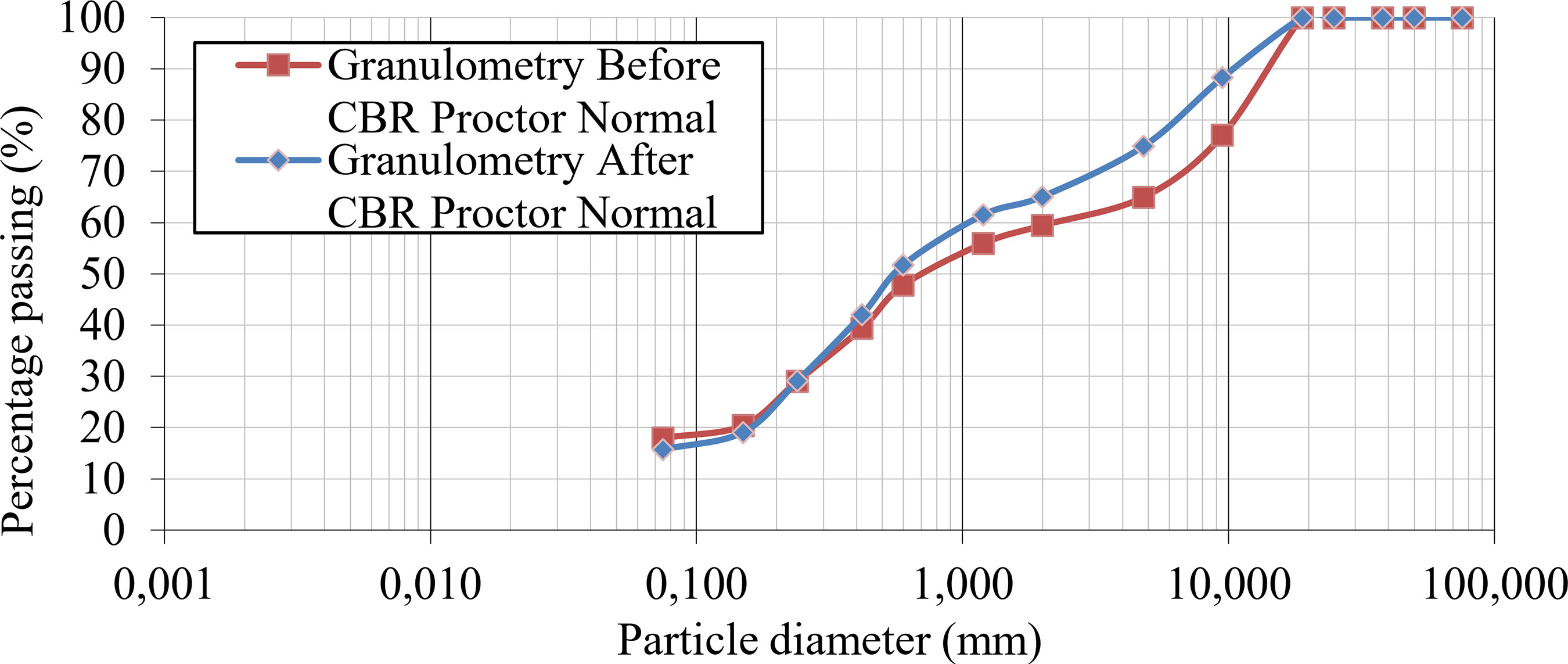
Granulometric analyses were performed to verify the breakage of grains after the CBR tests for the DW sample. The results are presented in Figures 9 and 10, respectively, for the Standard and Intermediate Proctor, where the granulometric range of the soil before the CBR tests is also presented. Tables 6 and 7 also present the data obtained from the granulometric test after the CBR test in the Standard and Intermediate Proctor for the DW sample.


In terms of statistical analysis, Table 8 presents the mean and standard deviation for each particle size fraction evaluated after the CBR test.
The post-CBR gradation demonstrates a systematic transfer of mass from the coarse fraction to sands. The mean contents (percentage by mass) were 33.885 for gravel, 15.41 for coarse sand, 28.34 for medium sand, 4.02 for fine sand, and 47.77 for total sand. Dispersion, summarized by the sample standard deviation, remained modest for gravel (𝑠 = 1.465, CV = 4.32%) and for total sand (𝑠 = 1.965, CV = 4.11%), indicating limited global variability of the granular skeleton after loading. By contrast, the sand subfractions exhibited the largest relative variability: coarse sand showed 𝑠 = 2.943(CV = 19.09%), and fine sand 𝑠 = 0.652(CV = 16.22%), consistent with sensitivity of these size ranges to particle breakage and reclassification during compaction and CBR loading. Medium sand presented intermediate behavior (𝑠 = 1.626, CV = 5.74%).
A comparison with the pre-CBR condition highlights the magnitude and direction of the redistribution. Mean gravel decreased by 6.745 percentage points, while total sand increased by 6.125 points. Within the sand domain, coarse sand rose by 3.715 points, medium sand by 0.905, and fine sand by 1.505. Concomitantly, dispersion increased across all fractions: the standard deviation grew from 0.099 to 1.465 for gravel, from 0.0778 to 2.943 for coarse sand, from 0.0354 to 1.626 for medium sand, from 0.1485 to 0.652 for fine sand, and from 0.2617 to 1.965 for total sand. These shifts indicate that mechanical action primarily fractured coarse particles and redistributed mass toward the sand sizes, with a pronounced accumulation in the coarse-sand band and only a moderate rise in fine sand. The pattern suggests fragmentation largely confined within the sand domain, with limited production of ultrafine material—an outcome that tends to preserve drainage capacity and drained stiffness in unbound layers.
In this context, the results obtained from the grain size distribution tests, Figures 11 and 12 present the difference in the percentages passing before and after the CBR test in the DW sample. Figure 13 presents the measurements of grain breakage among the gravel, coarse sand, medium sand, and fine sand fractions, as well as clays and silts, before and after the CBR test.

Difference in Percentages Passing in Grain Size Distribution Tests Before and After the CBR Test – Standard Proctor

Difference in Percentages Passing in Grain Size Distribution Tests Before and After the CBR Test – Intermediate Proctor

Through the analysis of all the presented results, it is observed that under the energy of the Standard Proctor, there was a reduction in the percentage of gravel size fraction (from 40.56% to 34.92%), indicating fragmentation of larger grains during the CBR test, increasing smaller fractions. For the coarse sand fraction, an increase in the fraction is noted (from 11.64% to 13.33%), indicating that part of the gravel was fragmented into coarse sand-sized particles. Similarly, the medium sand fraction also increased (from 27.41% to 29.49%), supporting the hypothesis of larger grains breaking into smaller particles. In this context, an increase in the fine sand fraction is also observed (from 2.41% to 3.56%), indicating additional grain breakage into even smaller sizes. Thus, the comparative analysis shows a trend of larger grains fragmenting into smaller particles. This fragmentation is evidenced by the reduced gravel percentages and the increase in coarse, medium, and fine sand fractions (from 41.43% to 46.38%). Notably, the fine fraction passing through the 0.075mm sieve (silts and clays) increased from 17.99% to 18.70% after the CBR test.
In terms of sieve analysis results from the grain size distribution test before and after the CBR, under the Standard Proctor (Figure 11), it is observed that grain fragmentation is more pronounced in the larger sieves (9.5 mm and 4.8 mm), decreasing progressively as the sieve diameter reduces. This indicates that larger particles break into smaller ones that pass through intermediate sieves (2 mm to 0.42 mm), with a smaller proportion of additional fragments in the finer sieves (0.25 mm to 0.075 mm). In this context, larger particles are more susceptible to fragmentation under load, while fine particles are sufficiently reduced in size and do not undergo significant additional fragmentation.
In this perspective, when the evaluation of grain fragmentation focuses on the Intermediate Proctor, the behavior across grain size fractions shows a certain symmetry. For the gravel fraction, the data indicate a fragmentation of approximately 7.85% (from 40.70% before CBR to 32.85% after CBR) in the larger diameter sieves. The coarse sand fraction showed an increase of 5.74%. On the other hand, the medium sand fraction maintained its percentage with slight variation. In contrast, the fine sand fraction increased by 2.37%, indicating that it accumulated part of the breakage of the larger fractions. There was no significant alteration in the passing percentages in the silt and clay size fractions, showing that the breakage was more pronounced in the gravel fraction.
The breakage percentage between the sieves used in the grain size distribution test was also analyzed for the Intermediate Proctor (Figure 12). For the 9.5mm sieve, there was a difference of 1.95% before and after the CBR test, indicating a slight increase in the amount of material passing, which indicates minimal fragmentation of the larger grains. Moderate fragmentation was observed for the 4.8mm sieve, with a 3.24% increase in material passing after the CBR test. In the 2mm sieve, a significant increase of 7.85% occurred, demonstrating considerable fragmentation of the gravel fraction into sand. Regarding the 1.2mm sieve, there was a notable increase in particle breakage, 6.02%, similar to the 2mm sieve, with gravel breaking down into sand fractions. Similar particle fragmentation values were observed in the 0.6mm and 0.42mm sieves, 2.11% and 2.68%, respectively, indicating a minimization in breakage in this size fraction. These particles likely originated from the disintegration of gravel and coarse sand. Moderate fragmentation was observed for the 0.25mm and 0.15mm sieves, 3.52% and 2.38%, respectively, behavior similar to the previously mentioned sieves. The difference found was minimal for the 0.075mm sieve, indicating little or no additional fragmentation.
3.7 Grain breakage index
The evaluation of grain fragmentation or breakage during compaction and CBR processes is essential to understanding the evolution of pavement materials' mechanical properties. The results obtained for the Breakage Index proposed by Lee and Farhoomand (1967) for the DW sample are presented in Table 9 for both Standard and Intermediate Proctor energies.
Grain breakage in granular materials is a critical phenomenon affecting materials' mechanical properties and durability in geotechnical applications. Values close to unity (1.0) indicate proximity to the original grain size distribution, while higher values, on the other hand, indicate more significant grain breakage. However, the B15 index with zero values indicates that it was impossible to calculate due to the absence of values at this percentage.
Based on the results presented for DW, it is observed that the B45 Index shows slight grain breakage, suggesting that standard compaction did not cause substantial fragmentation in this grain size range. When analyzing the B75 Index, a more pronounced grain breakage indicates that larger particles are more susceptible to fragmentation under standard compaction conditions. Regarding intermediate compaction, a lower value was obtained than the Standard Proctor for B45 and B75. This indicates that intermediate compaction results in less grain breakage, possibly due to the higher density achieved, which generates interlocking between particles.
In comparing the data from the DW sample with the construction and demolition waste studied by Nascimento et al. (2020) and Silva, Correia and Kühn (2022), it is noted that the B45 values for the RCC and RCD samples under Intermediate energy are significantly higher than those for the DW sample, indicating much more pronounced grain breakage. Thus, it is observed that the RCC and RCD samples are more susceptible to fragmentation in this grain size range, possibly due to differences in material composition or the physical properties of the grains. For B75, the interpretation of the data follows the same pattern identified for B45, as DW has the lowest index among the analyzed samples. The RCC and RCD materials exhibit higher values, indicating significant fragmentation into coarser particles in the grain size distribution curve. For the B15 index, a higher value is identified for the RCC material compared to RCD, indicating greater susceptibility to breakage.
3.8 Bg breakage index
Based on the grain size distribution curves of the DW sample and the respective percentages retained on each sieve, the Bg breakage index was determined at the energy levels of the Standard and Intermediate Proctor. Table 10 presents the results of the Bg indices.
A comparison of Bg indices between the two compaction energies reveals that the energy of the Standard Proctor causes more significant grain fragmentation than the Intermediate Proctor's. The Bg index of 43.86% for the Standard Proctor indicates significant grain breakage during the CBR test. In this context, the Bg index of 30.27% for the Intermediate Proctor also represents a considerable degree of particle fragmentation. These Bg indices corroborate previous results in Figures 11, 12, and 13, where the percentage passing mainly through the coarser sieves is significant. The rationale for this behavior is that the higher compaction energy applied in the Intermediate Proctor results in more efficient compaction and, consequently, a redistribution of particles, possibly minimizing additional grain fragmentation. Another aspect to consider regarding the Bg indices is the shape of the grains in each specimen related to the type of compaction energy; possibly, the Standard Proctor cylinder was filled with more lamellar than cubic particles, while the Intermediate Proctor cylinder contained more cubic than lamellar grains.
In this context, it is essential to highlight that the fragmentation performance of the particles in the DW sample is also influenced by the nature of the constituent materials, mainly based on the mineralogical phases of quartz, kaolinite, and calcite. Quartz is a hard mineral resistant to abrasion, with a hardness of 7 on the Mohs scale. It is chemically inert, making it one of the most durable components in the DW sample. Conversely, Kaolinite is a clay mineral with a lamellar structure, exhibiting low hardness (about 2.0-2.5 on the Mohs scale). It is more susceptible to degradation and fragmentation under mechanical loads due to its layered structure, which is predominantly found in clay materials and bricks. Calcite is a calcium carbonate mineral with a hardness three on the Mohs scale. It is chemically reactive and can fragment more easily than quartz, commonly found in cement and concrete.
4 Conclusion
This research aimed to evaluate the grain breakage in demolition waste (DW) from five neighborhoods in the municipality of Maceió (AL), which underwent subsidence processes due to rock salt mining before and after the execution of compaction and CBR tests under Standard and Intermediate Proctor conditions. It is important to emphasize that the compaction and CBR processes are related to pavement construction. In this context, it is essential to quantify the potential for grain fragmentation and understand the direct effects on the material.
In terms of breakage performance for the DW sample under different compaction energies and CBR tests, it was possible to verify that various factors interact and influence the behavior, such as the material's heterogeneity, mineralogical composition, the nature and shape of the grains, the percentage passing before and after the CBR process, and breakage indices.
Regarding the heterogeneity of the material, demolition waste is characterized by a high diversity due to its varied composition, which includes materials such as concrete, bricks, ceramics, metals, and wood, defined as Class A by CONAMA Resolution 307/2002 (Brasil, 2002). The presence of different types of materials and their variable proportions can significantly influence the results of granulometric tests. This translates into challenges in standardizing material properties in a practical scenario, making each sample's composition and mechanical behavior unique.
Concerning the mineralogical composition, the DW sample consists of quartz, kaolinite, and calcite. Quartz is a hard, abrasion-resistant mineral, contributing to the material's durability. Kaolinite is more susceptible to fragmentation due to its lamellar structure and low hardness. Calcite, common in cement and lime, exhibits intermediate hardness and contributes to grain cohesion. These minerals indicate a mixture of components with different resistances to fragmentation. The interaction among these mineralogical phases results in a complex granulometric distribution, influencing the results, especially after the CBR test.
Relative to the shape test, a predominance of cubic particles (58.5%) was revealed, with a small proportion of elongated (4.5%) and elongated-lamellar grains (0.5%). However, 36.5% of the grains are lamellar, exceeding the 30% limit set by NBR 15115 (ABNT, 2004). The cubic shape of the grains favors compaction and mechanical resistance, while lamellar grains hinder compaction and reduce resistance. This behavior can create discrepancies in the percentages of retained material compared to more equidimensional-shaped particles. Moreover, during compaction and CBR tests, these particles fracture and redistribute randomly, affecting the final granulometry of the sample.
The breakage indexes (B45) and (B75) showed moderate grain breakage under Standard Proctor energy and reduced fragmentation for Intermediate Proctor energy. The Bg Index values obtained confirm greater comminution under Standard compaction than Intermediate. This difference is attributed to the Intermediate Proctor's higher compaction efficiency and particle redistribution, resulting in less additional breakage.
Concerning the passing percentages after CBR, granulometric tests showed significant fragmentation of larger particles. In the Standard Proctor, the gravel fraction decreased from 40.56% to 34.92%, while the coarse, medium, and fine sand fractions increased. In the Intermediate Proctor, the gravel fraction decreased from 40.70% to 32.85%, with a corresponding increase in sand fractions. This redistribution indicates that larger particles are more susceptible to fragmentation under load. The changes in passing percentages suggest that the CBR test significantly impacts the particle size distribution, influencing the final granulometric composition of the DW sample.
Based on the laboratory results, demolition waste (DW) complies with the minimum performance criteria of NBR 15115 (ABNT, 2004), for granular layers: the CBR was 20.3% under the Standard Proctor and 42.03% under the Intermediate Proctor, with minor expansion (0.035% and 0.026%, respectively). In light of these parameters, the use of DW is recommended for subgrade reinforcement and subbase, since the material satisfies the normative threshold in the most conservative condition (Standard Proctor) and provides substantial structural margin when compacted with Intermediate energy. Additionally, strict control of optimum moisture and field density (degree of compaction) during construction is recommended, as well as gradation selection in line with current guidance and controlled fines content. As a reference for thickness design, 15 cm for the subbase and 15 cm for the base have been adopted in national demonstrative applications, subject to adjustment as a function of traffic demand and local subgrade conditions.
In terms of sustainability, the use of demolition waste (DW) in urban pavements would provide an immediate material benefit: for a typical section with 15 cm (base) + 15 cm (subbase), full substitution with DW can avoid the extraction and hauling of approximately 1.8–2.0 kt of natural aggregate per lane-kilometer (3.0 m lane width), while remaining compliant with layer thicknesses and execution procedures commonly recommended for recycled aggregates. This diversion of materials from quarries and spoil/disposal sites contributes to the conservation of mineral resources, the reduction of clearing and excavation impacts, and the decrease of transport flows (with potential co-benefits in fuel consumption, local emissions, noise, and dust), while simultaneously strengthening circular-economy supply chains with shorter urban logistics radii.
Based on the above, the grain breakage process in demolition waste is a highly complex phenomenon. It is notably verified that various factors, such as mineralogical composition, grain shape, and compaction energy, contribute to the fragmentation process. In this regard, careful planning and execution of pavement layers are necessary to ensure the quality and durability of the road pavement.
-
Declaration of Generative AI and AI-Assisted Technologies in the Writing Process
The authors declare that no generative artificial intelligence (AI) or AI-assisted technologies were used in the writing, editing, or development of the text of this manuscript. All sections of the manuscript were conceived, written, revised, and approved exclusively by the authors. AI-based tools were used only to enhance the resolution and visual quality of images and photographs included in the manuscript. No AI system contributed to the creation, interpretation, or modification of scientific content, data analysis, methodologies, or conclusions. The authors affirm that the integrity, originality, and scientific rigor of the manuscript are entirely their own responsibility.
-
Financial Support
The authors declare that no financial support, funding, or external resources were received for the development of this research. All activities related to the conception of the study, data collection, experimental procedures, analysis, and manuscript preparation were conducted without any institutional, governmental, or private financial assistance.
-
SILVA JUNIOR, J. B. da; MEILI, L ; BARROS JÚNIOR, H. V. de; TEIXEIRA, F. A. R. de V.; SANTOS, R. L. dos; COSME, J.; FERNANDES, D. P. Grain breakage in demolition waste from Maceió, AL, induced by CBR tests. Ambiente Construído, Porto Alegre, v. 26, e147414, jan./dez. 2026. ISSN 1678-8621 Associação Nacional de Tecnologia do Ambiente Construído. http://dx.doi.org/10.1590/s1678-86212026000100957
Data Availability Statement
Data will be made available on reasonable request.
References
- ALEXANDER, M.; MINDESS, S. Aggregates in concrete. Boca Raton: CRC Press, 2005.
- ALEXANDRIDOU, C.; ANGELOPOULOS, G. N.; COUTELIERIS, F. A. Physical, chemical, and mineralogical characterization of construction and demolition waste produced in Greece. International Journal of Civil and Environmental Engineering, v. 8, n. 9, 2014.
- AMERICAN SOCIETY FOR TESTING AND MATERIALS. D 1557-07: standard test methods for laboratory compaction characteristics of soil using modified effort. West Conshohocken, 2010.
- AMERICAN SOCIETY FOR TESTING AND MATERIALS. D 1883-16: standard test method for California Bearing Ratio (CBR) of laboratory-compacted soils. West Conshohocken, 2016.
- AMERICAN SOCIETY FOR TESTING AND MATERIALS. D 421-85: standard practice for dry preparation of soil samples for particle-size analysis and determination of soil constants. West Conshohocken, 2003.
- AMERICAN SOCIETY FOR TESTING AND MATERIALS. D 4791-99: standard test method for flat particles, elongated particles, or flat and elongated particles in coarse aggregate. West Conshohocken, 1999.
- AMERICAN SOCIETY FOR TESTING AND MATERIALS. D 6913-04: standard test methods for particle-size distribution (gradation) of soils using sieve analysis. West Conshohocken, 2009.
- AMERICAN SOCIETY FOR TESTING AND MATERIALS. D 698-07: standard test methods for laboratory compaction characteristics of soil using standard effort. West Conshohocken, 2007.
- ANGULO, S. C. Caracterização de agregados de resíduos de construção e demolição reciclados e a influência de suas características no comportamento de concretos São Paulo, 2005. Tese (Doutorado em Engenharia de Construção Civil e Urbana) – Escola Politécnica, Universidade de São Paulo, 2005.
- ANGULO, S. C. et al Chemical–mineralogical characterization of C&D waste recycled aggregates from São Paulo, Brazil. Waste Management, v. 29, p. 721–730, 2009.
- ARULRAJAH, A. et al. Physical properties and shear strength responses of recycled construction and demolition materials in unbound pavement base/subbase applications. Construction and Building Materials, v. 58, p. 245–257, 2014.
- ASSOCIAÇÃO BRASILEIRA DE NORMAS TÉCNICAS. NBR 15115: agregados reciclados de resíduos sólidos da construção civil: execução de camadas de pavimentação: procedimentos. Rio de Janeiro, 2004.
- ASSOCIAÇÃO BRASILEIRA DE NORMAS TÉCNICAS. NBR 6457: preparo de amostras de solos. Rio de Janeiro, 2024.
- ASSOCIAÇÃO BRASILEIRA PARA RECICLAGEM DE RESÍDUOS DA CONSTRUÇÃO CIVIL E DEMOLIÇÃO. Pesquisa setorial 2022: reciclagem de resíduos da construção e demolição no Brasil. São Paulo, 2022.
- BARRETO, A. C.; AMORIM, E. F. Avaliação do desempenho técnico de diferentes misturas de solo com resíduos de construção (RCD) para uso em obras viárias. HOLOS, v. 36, n. 7, 2020.
- BEJA, I. A. Agregado reciclado de construção e demolição com adição de aglomerantes hidráulicos como sub-base de pavimentos São Paulo, 2014. Dissertação (Mestrado em Engenharia de Transportes) – Escola Politécnica, Universidade de São Paulo, São Paulo.
- BERGAYA, F.; LAGALY, G. (ed.). Handbook of clay science 2. ed. Amsterdam: Elsevier, 2013. (Developments in Clay Science, v. 5).
- BOSCOV, M. E. G. Geotecnia ambiental São Paulo: Oficina de Textos, 2008.
- BRASIL. Conselho Nacional do Meio Ambiente. Resolução nº 307, de 5 de julho de 2002. Estabelece diretrizes, critérios e procedimentos para a gestão dos resíduos da construção civil. Diário Oficial da União, Brasília, DF, 2002.
- DISFANI, M. M. et al Recycled crushed glass in road work applications. Waste Management, v. 31, p. 2341–2351, 2011.
- GÓMEZ, A. M. J. Estudo experimental de um resíduo de construção e demolição (RCD) para utilização em pavimentação Brasília, 2011. 123 f. Dissertação (Mestrado em Geotecnia) – Universidade de Brasília, Brasília, 2011.
- KUMAR, N. et al. Probing the surface charge on the basal planes of kaolinite particles with high-resolution Atomic Force Microscopy. Langmuir, v. 33, n. 50, p. 14226–14237, 2017.
- LEE, K. L.; FARHOOMAND, I. Compressibility and crushing of granular soil in anisotropic triaxial compression. Canadian Geotechnical Journal, v. 4, n. 1, p. 68–86, 1967.
- LEITE, F. D. C. et al Laboratory evaluation of recycled construction and demolition waste for pavements. Construction and Building Materials, v. 25, n. 6, p. 2972–2979, 2011.
- LEITE, F. da C. Comportamento mecânico de agregado reciclado de resíduo sólido da construção civil em camadas de base e sub-base de pavimentos São Paulo, 2007. 185 f. Dissertação (Mestrado em Geotecnia) – Escola Politécnica, Universidade de São Paulo, São Paulo, 2007.
- MARSAL, R. J. Large scale testing of rockfill materials. Journal of the Soil Mechanics and Foundations Division, v. 93, n. 2, p. 27–43, 1967.
- MENEZES, R. R. et al. Reciclagem de resíduos da construção civil para a produção de argamassas. Cerâmica, v. 55, p. 263–270, 2009.
- MIRANDA, L. F. R.; ANGULO, S. C.; CARELI, É. D. A reciclagem de resíduos de construção e demolição no Brasil: 1986-2008. Ambiente Construído, Porto Alegre, v. 9, n. 1, p. 57–71, jan./mar. 2009.
- MITCHELL, J. K.; SOGA, K. Fundamentals of soil behavior. 3. ed. Hoboken: Wiley, 2005. ISBN 978-0471463023.
- MOTTA, R. D. S. Estudo laboratorial de agregado reciclado de resíduo sólido da construção civil para aplicação em pavimentação de baixo volume de tráfego São Paulo, 2005. 134 f. Dissertação (Mestrado em Geotecnia) – Escola Politécnica, Universidade de São Paulo, São Paulo, 2005.
- NASCIMENTO, L. H. F. do et al Análise de quebra de grãos de misturas de solo com resíduos de construção civil para camadas de pavimento. Revista Tecnológica, v. 29, n. 2, p. 526–540, 2020.
- ORIOLI, M. A. et al. Estudo do uso de agregado reciclado misto (ARM) em misturas solo-agregado. In: CONGRESSO DE PESQUISA E ENSINO EM TRANSPORTE DA ANPET, 32., Gramado, 2018. Anais [...] Gramado, 2018.
- PACHECO-TORGAL, F. et al Advances in construction and demolition waste recycling: management, processing and environmental assessment Cambridge: Woodhead Publishing, 2020.
- PREFEITURA MUNICIPAL DE SÃO PAULO. Especificação Técnica de Serviço – ETS-001/2003: camadas de reforço do subleito, sub-base e base mista de pavimento com agregado reciclado de resíduos sólidos da construção civil. São Paulo: Secretaria de Infraestrutura Urbana, 2003.
- ROCHA, M. L.; MARQUES, G. L. de O.; OLIVEIRA, T. M. de. Avaliação dos resíduos de construção e demolição no dimensionamento de camada de reforço de pavimentos flexíveis. Revista Ibero-Americana de Ciências Ambientais, v. 12, n. 2, p. 377–393, 2021.
- SHAH, V. et al. Changes in microstructure characteristics of cement paste on carbonation. Cement and Concrete Research, v. 109, p. 184–197, 2018.
- SILVA, N. M. da et al Quebra do grão em Resíduos de Construção Civil (RCC) induzida pelo processo de compactação. Ambiente Construído, Porto Alegre, v. 18, n. 1, p. 281–298, jan./mar. 2018.
- SILVA, T. B. da; CORREIA, N. D. S.; KÜHN, V. D. O. Effect of compaction energy on grain breakage of CDW, local soil, and soil-CDW mixtures. International Journal of Geotechnical Engineering, v. 16, n. 2, p. 165–175, 2022.
- UNIÃO EUROPEIA. Diretiva 2008/98/CE do Parlamento Europeu e do Conselho, de 19 de novembro de 2008. Jornal Oficial da União Europeia, Bruxelas, v. 312, p. 1–40, 2008.
- WHITNEY, D. L.; BROZ, M.; COOK, R. F. Hardness, toughness, and modulus of some common metamorphic minerals. American Mineralogist, v. 92, n. 2/3, p. 281–288, 2007.
Edited by
-
Editor-in-chief:
Marcelo Henrique Farias de Medeiros