Environmental assessment of rammed earth construction systems: comparison between traditional and contemporary methods
Abstract
Considering the significant environmental impacts of the civil construction sector, the use of earth has been rediscovered as a sustainable alternative to help mitigate such impacts. This study aims to assess three construction scenarios for rammed earth walls, investigating the influence of mechanization, chemical stabilization, and formwork type on environmental damage indicators such as CO2 emissions, energy consumption, and land use. The Life Cycle Assessment (LCA) method was applied using SimaPro v.9.1 software, the IMPACTWorld+ method, and the Ecoinvent database, covering raw material extraction and processing as well as construction processes. The scenarios compared manual and mechanized extraction and compaction, as well as stabilization with 5% Portland cement. The results indicate that adding cement significantly increases the system’s impacts, while the use of electric compactors results in only minor variations. Regarding formwork, the use of film-faced plywood increased water and fossil energy consumption, but reduced land use compared to wooden boards. The study concludes that the sustainability of the technique is sensitive to process and material choices, demonstrating that mechanization does not compromise the environmental profile as much as chemical stabilization does.
Keywords
Earth construction; Mechanization; Stabilization; Environmental impacts; Life Cycle Assessment
Resumo
Considerando o significativo impacto ambiental do setor da construção civil, a utilização da terra tem sido redescoberta como uma alternativa sustentável para mitigar tais impactos. Este trabalho tem como objetivo avaliar os impactos ambientais de três cenários construtivos de paredes de taipa de pilão por meio da Avaliação do Ciclo de Vida (ACV), investigando a influência da mecanização, do tipo de fôrma e da estabilização química em categorias de danos como emissões de CO2, consumo energético e ocupação do solo. O método de Avaliação do Ciclo de Vida foi aplicado através do software SimaPro v.9.1, método IMPACTWorld+ e base de dados Ecoinvent, abrangendo a extração e processamento da matéria-prima e os processos construtivos. Os cenários compararam extraçãoe compactação manual e mecanizada, além da estabilização com 5% de cimento Portland. Os resultados indicam que a adição do cimento aumenta significativamente os impactos do sistema, enquanto o uso de compactadores elétricos apresenta variações pouco expressivas. Quanto às formas, o uso do compensado aumentou o consumo de água e energia fóssil, porém reduziu a ocupação do solo em comparação às tábuas de madeira. Pode-se concluir que a sustentabilidade da técnica é sensível às decisões de processos e materiais, evidenciando que a mecanização não compromete o perfil ambiental tanto quanto a estabilização química.
Palavras-chave
Construção com terra; Mecanização; Estabilização; Impactos ambientais; Avaliação do Ciclo de Vida
1 Introduction
Although civil construction is fundamental to the socioeconomic development of cities, its activities generate significant environmental impacts. In 2023, the Architecture, Engineering and Construction (AEC) industry was responsible for 34% of global energy consumption and 34% of global carbon dioxide emissions (UNEP, 2025). Despite some advances such as the growth of green certification and the increased participation of renewable sources in the sector’s energy mix, progress remains insufficient, with a cumulative emissions increase of 5% since 2015, placing the sector far from the reduction target established by the Paris Agreement. In this context, the search for more sustainable alternatives is urgent.
The environmental impacts of a building are related to its entire life cycle, from raw material extraction to post-demolition disposal. To support AEC professionals in decision-making, it is essential to quantify the potential impacts generated at each stage. Life Cycle Assessment (LCA) is the methodology used to quantify the potential impacts of activities, processes, or products, including in the construction sector (Caldas; Lira; Sposto, 2017).
Recovering vernacular construction practices that use local materials such as soil, wood, and bamboo is a viable path toward reducing environmental impacts and promoting sustainability in its various dimensions: environmental, economic, social, and cultural. Earth architecture stands out because the material is natural, abundant, recyclable, and associated with low energy consumption and low CO₂ emissions (Minke, 2022). In addition to these advantages, the use of simple equipment facilitates operation promotes the inclusion of vulnerable groups and individuals without formal education in the construction process.
In Brazil, earth played a significant role in urban development, becoming part of popular heritage and local knowledge, and being recognized by many scholars and architects as “material and immaterial heritage” (Mascarenhas, 2022). The most widely used systems were rammed earth, adobe, compressed earth blocks, and wattle and daub. Among these techniques, rammed earth stands out for its historical relevance and for its strong revival in contemporary architecture, driven by its distinctive aesthetic of stratified layers. This renewed interest has led to new compositions and tools that meet current market demands, moving beyond traditional vernacular models (Heise; Minto, 2022).
This study aims to assess the environmental impacts of three construction scenarios for rammed earth walls, investigating the influence of mechanization, formwork type, and chemical stabilization through LCA. To this end, the sequencing of construction processes was structured into flowcharts based on the Building Environmental Performance Information System (SIDAC) model, and the modeling was performed in SimaPro v.9.1, using the Ecoinvent database and the IMPACTWorld+ method.
The results expand the literature by showing that sustainability cannot be measured using only CO₂ emissions and embodied energy. The scientific relevance of this study lies in its expanded analytical scope, simultaneously investigating 18 impact categories to reveal trade-offs that traditional carbon-focused analyses often overlook. In addition, given the absence of consolidated national data, the study offers a methodological contribution through modeling based on the SIDAC framework, providing the Brazilian context with an unprecedented reference inventory. In this way, the research supports decision-making by AEC professionals, disseminating information that may guide material and construction-process choices in line with the United Nations Sustainable Development Goals.
2 Theoretical background
The use of earth as a construction material can be traced back to the earliest stages of human history, dating to the Mesolithic period, when it was used to line shelters (Houben; Guillaud, 1985). Despite regional variations, earth construction knowledge spread through migration and cultural exchange, becoming part of traditional architecture across all continents. It was the most important material throughout four-fifths of Brazil’s history, yet it gradually lost prominence with the rise of industrialized techniques. Although proponents of industrialization tend to discredit the use of earth in construction, it is precisely the environmental impacts generated by the construction sector that make the recovery of vernacular techniques increasingly necessary (Weimer, 2005).
Practiced for centuries, rammed earth is a construction system of monolithic walls in which earth is compacted between formwork panels. Historically, it was used in military and ecclesiastical buildings as a protective measure due to its robustness. It arrived in Brazil with the Portuguese and became widespread through the expeditions of the bandeirantes in São Paulo and the mining expeditions in Minas Gerais. The wide geographic and temporal dissemination of rammed earth led to a broad range of techniques and materials used in the system, resulting in typological diversity that makes standardized terminology difficult (Mileto; Vegas; López, 2011). According to Heise (2004), the basic production process of a monolithic earth structural element can be divided into six stages: two outside the construction site, the definition of the quarry location and the site planning, and four inside the site: mixture preparation, formwork preparation and assembly, compaction, and stripping.
Its practice has evolved by incorporating different formwork systems and materials and by mechanizing soil extraction, preparation, and compaction processes. Minke (2022) argues that these updates make rammed earth an interesting alternative for industrialized countries, economically and ecologically viable when compared to conventional masonry. For the purposes of this study, traditional rammed earth refers to the method using wooden formwork and manual tamping tools, while contemporary rammed earth refers to the system using metal-framed formwork with film-faced plywood side panels, combined with mechanical compaction.
In Brazil, rammed earth is regulated by NBR 17014 (ABNT, 2022), which defines the minimum requirements for quality assurance in construction. However, regulatory compliance does not guarantee environmental optimization. Although the material has intrinsic ecological qualities, its impact profile varies due to factors such as chemical stabilization and mechanization. Decisions regarding soil origin, compaction method, and formwork material are crucial to the technical and environmental performance of the building.
In this context, LCA, defined by NBR 14040 (ABNT, 2014, p.) as the “[…] compilation and evaluation of the inputs, outputs and potential environmental impacts of a product system throughout its life cycle […]”, becomes an indispensable scientific tool for quantifying impact variations and guiding effective decarbonization. By identifying environmental bottlenecks and the origin of emission flows, this methodology becomes a strategic instrument for designers and managers in resource optimization and waste management.
However, practical application of this tool to low-impact materials faces methodological challenges. Ben-Alon (2019) notes that most LCA studies on natural materials are limited to inventory analysis, which is still insufficient for broader comparisons. These analyses use highly specific local material and process data, making direct comparisons difficult. This scarcity highlights the importance of studies that provide more robust and accurate information on the environmental impacts associated with rammed earth, contributing to the advancement of knowledge in the field. Similarly, Carvalho and Silvoso (2022) point to a gap in the LCA literature on earth architecture, still sparse and relatively recent compared with research on conventional materials such as concrete. Nevertheless, they conclude that LCA contributes significantly to understanding that earth construction techniques play a crucial role in sustainable development and in the search for lower-impact alternatives, with superior environmental performance compared with conventional industry solutions.
Beyond the scarcity of studies, the systematic review of the state of the art on LCA applied to rammed earth, conducted by Dai (2026), emphasizes the lack of methodological standardization. This results in inconsistent system boundaries and makes it difficult to formulate definitive guidelines for the sector. According to the author, there is a critical environmental trade-off in chemical stabilization, since the inclusion of cement increases the wall’s global warming potential, offsetting the material’s intrinsic ecological advantages. The literature review shows an almost exclusive concentration on Global Warming Potential (GWP) and embodied energy (Dai, 2026), indicating a methodological gap that neglects other essential impact categories for a comprehensive ecological assessment.
Studies indicate that improper soil extraction may have severe implications for land use and biodiversity, aspects that are rarely reported in current assessments. For a holistic understanding, it is necessary to move toward methods that capture not only costs, but also the positive externalities of earth construction, such as hygrothermal regulation and improved indoor air quality, avoiding the displacement of environmental burdens to unmonitored life-cycle phases. In addition, Dai (2026) stresses that the prevalence of studies restricted to the production phase (“cradle to gate”) tends to underestimate the material’s real performance, recommending the transition to an integrated Life Cycle Sustainability Assessment that considers the full cycle (“cradle to grave”), operational energy-efficiency gains due to thermal mass, and the socioeconomic dimensions of the construction system.
In the Brazilian context, Caldas, Martins and Toledo Filho (2021) show that the environmental competitiveness of rammed earth is maximized when performance criteria such as thermal capacity and acoustic insulation are integrated into the functional unit. The authors emphasize that cement and formwork are the main drivers of negative impact, but the system outperforms conventional partitions in scenarios requiring high thermal inertia. Their work contributes to regression-based impact parametrization, allowing global warming and resource depletion to be estimated based on wall thickness and stabilizer content.
Complementing this perspective, Milani and Iunes (2023) reinforce that the transport phase of inputs is the most critical stage for vernacular materials and can account for most CO₂ emissions and energy consumption, especially when stabilizer manufacturing sites are far from the construction site. The authors also emphasize the value of material reversibility. While stabilized rammed earth generates construction and demolition waste at the end of its service life, unstabilized rammed earth allows for a full life-cycle closure, enabling the soil to return to the environment or be reintegrated as raw material without new energy costs.
In emerging economies, Dormohamadi, Rahimnia and Bunster (2024) investigated alternative wall systems, comparing earth-based techniques with conventional masonry. The results confirm that unstabilized earth variants have the lowest overall environmental impacts, with unstabilized compressed earth blocks reaching highly efficient levels. A critical point revealed by the study concerns the transport stage, which becomes predominant in total impact when materials are not sourced locally. The authors recommend maximum use of in situ excavation soil to reduce logistical burdens.
On the other hand, the study by Dai, Bai and Xiao (2024) in rural China highlights the need to balance environmental impact and climatic practicality. The authors argue that although cement increases embodied carbon, stabilized rammed earth still emits significantly less than fired clay brick masonry. In high-humidity regions, stabilization acts as a necessary adaptation strategy, improving resistance to rainfall erosion during construction and increasing durability. From a socioeconomic standpoint, this approach reduced costs by about 50% compared with conventional systems, becoming the main driver of social acceptance in low-income communities.
However, for this viability to translate into real performance, recent literature emphasizes that decision-making must be supported by advanced simulation tools. Guo, Yan and Dai (2024) propose a data-driven workflow that integrates LCA with Building Performance Simulation (BPS) from the earliest design stages. The main goal is to overcome the lack of adoption of low-carbon practices in developing countries through a design that is both sustainable and affordable. The dynamic analysis showed that factors such as solar orientation and wall thickness are decisive for operational energy efficiency, confirming that rammed earth offers advantages not only in embodied carbon, but also in reduced heating and cooling needs. The simulations demonstrated that integrated workflows allow architects to validate the advantages of earth over the full life cycle, facilitating the implementation of low-impact housing on a scale.
These variations in impact profiles are tied to the evolution of construction methods that distinguish traditional from contemporary rammed earth. In the traditional model, the use of entirely wooden formwork, held together by ties crossing through the wall and leaving holes called cabodás, requires greater care to ensure alignment and leveling of the layers. Contemporary rammed earth, by contrast, has been enhanced by appropriate tools such as film-faced plywood side panels supported by metal bracing, which prevent deformation and eliminate the need to reassemble the formwork for each section (Heise; Minto, 2022; Neves; Faria, 2011).
At the same time, mechanization of excavation and preparation processes introduces new variables into the energy inventory. Although pneumatic or electric tampers improve soil densification and shorten construction time, thereby enhancing the economic feasibility highlighted by Dai, Bai and Xiao (2024), this technological shift may also lead to higher energy consumption and CO₂ emissions during the construction phase. Thus, the environmental advantage of contemporary rammed earth depends on its ability to balance productivity gains with the emissions embodied by mechanization and transport.
In short, the main recurring issues identified in the literature converge on three key issues: the environmental cost of transport, where the use of local soil emerges as the most advantageous strategy; the impact of chemical stabilization, which improves mechanical performance at the expense of a high environmental burden; and the mechanization of processes, which changes the system’s embodied energy. Thus, the literature review shows that the environmental viability of contemporary rammed earth lies in the balance between durability and environmental impact. While chemical stabilization increases resistance to erosion and social acceptance (Dai; Bai; Xiao, 2024), it also imposes an environmental burden that must be mitigated through mineral additions or geometric optimization.
An integrated assessment accounting for thermal inertia benefits during the operational phase and full building-level dynamic modeling would therefore provide a more comprehensive understanding of rammed earth's environmental performance. Although such simulations lie beyond the scope of this research, the results presented here consolidate the life cycle inventory (LCI) and the database needed to support these future advanced design workflows in Brazilian sustainable architecture.
3 Methods
Based on the preceding review, the objective of this analysis is to quantify the potential environmental impacts resulting from the use of different formwork types, the mechanization of construction processes, and the chemical stabilization of soil in rammed earth wall construction, through Life Cycle Assessment. Data collection and organization follow the processes described in the SIDAC methodology, which is based on NBR 14040 (ABNT, 2014):
-
definition of goal and scope;
-
inventory data collection;
-
environmental impact quantification; and
-
result interpretation.
3.1 Scope definition
To demonstrate that using earth as a construction material is not, by itself, sufficient to classify a building as sustainable, and that each decision made in the different design stages is essential to reducing environmental ipacts, this study analyzes different scenarios for rammed earth wall construction.
The design and execution guidelines for the models followed the requirements of NBR 17014 (ABNT, 2022), which establishes a minimum wall thickness of 30 cm for load-bearing walls and a slenderness ratio of 10 or less. However, the standard also states that the use of chemical stabilizers allows the cross-section to be reduced to 12 cm, with a maximum slenderness of 23, provided structural performance requirements are met.
To establish a reference against which the LCA inputs and outputs could be related, the functional unit of the study was defined as 1 m² of wall area, considering a thickness of 35 cm. The thickness was kept constant at 35 cm even in stabilized scenarios in order to isolate the variable stabilization in the LCA and ensure direct comparability between the thermal and environmental performance of the different construction methods.
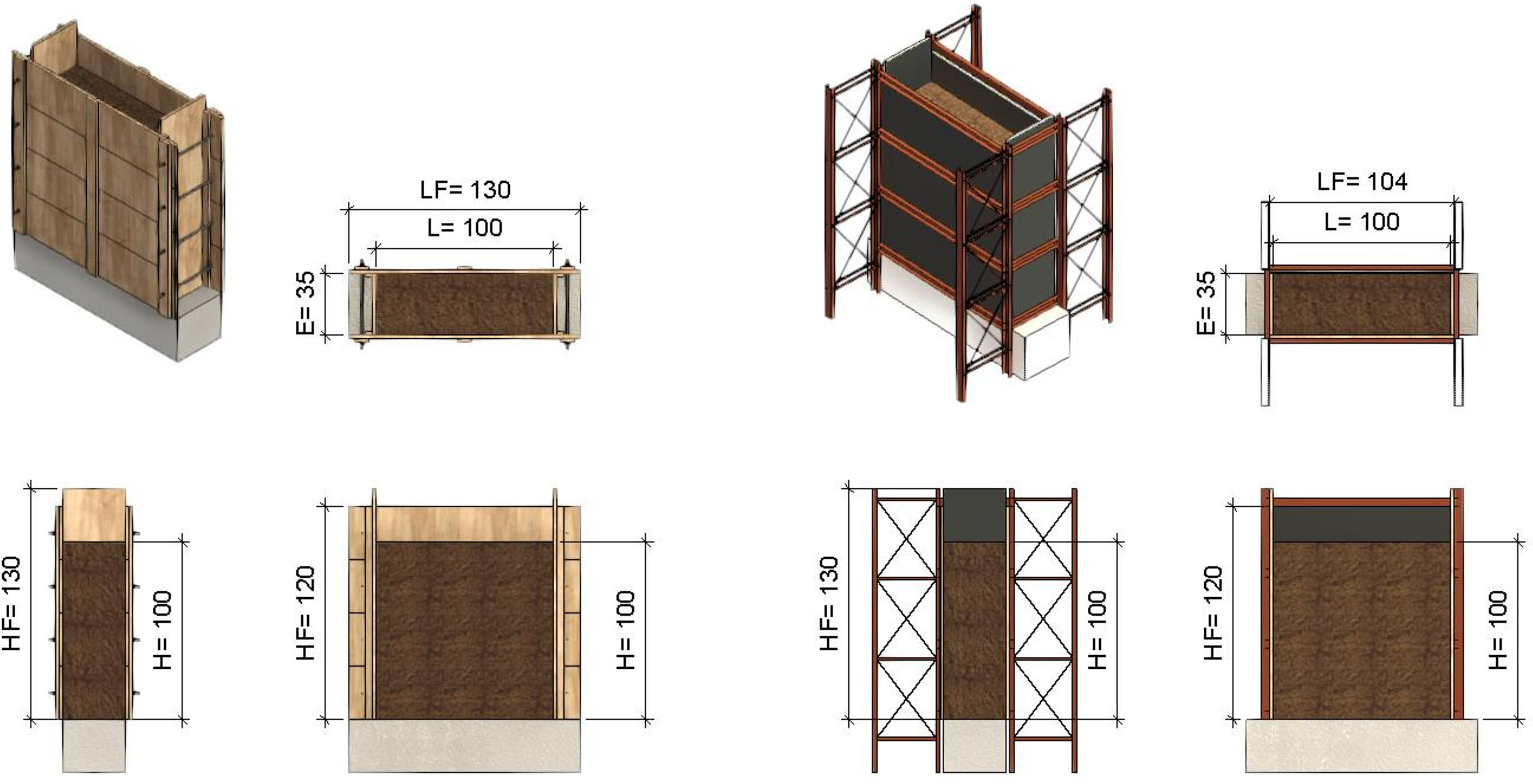
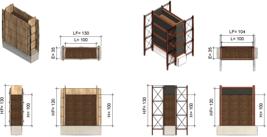
For a clearer understanding of products assessed, the rammed earth walls were modeled in Revit 2024, from which material quantities were extracted in volume, based on the materials assigned in the model. Figure 1 shows the rammed earth walls: on the right are the traditional rammed earth configurations, with wooden formwork; on the left are the contemporary configurations, with film-faced plywood formwork and metal trusses. In the image, the dimension labeled H refers to the height of the soil volume, while HF refers to the height of the formwork required to build this wall section; dimension L refers to the width of the earth wall, while LF refers to the width of the wooden boards or film-faced plywood panels that make up the formwork.
According to NBR 14040, system boundaries are the set of criteria that specify which unit processes are part of a product system (ABNT, 2014). The system boundary established for this study was “cradle to gate”, covering the pre-operational stage of the building: (A1) raw material extraction, (A3) processing, and (A5) construction. It is important to note that transport stages (A2 and A4) were excluded, on the understanding that the earth is assumed to be excavated in situ. This boundary definition was a deliberate methodological choice to isolate the exclusive variables of execution process and material composition (formwork geometry, mechanization, and chemical stabilization), preventing fixed road transport distances from distorting the direct comparison of the intrinsic environmental profile of each construction system.
Thus, the scope of the analysis focuses strictly on the direct transformation operations of the material, whose technical sequence begins at the Raw Material Extraction (A1) stage. At this stage, the set of activities considered, once completed, yields soil prepared for use in rammed earth construction. These include material extraction, lump breaking, and sieving. Extraction can be performed manually using a hoe or shovel, or through mechanized processes using excavators and wheel loaders. Soil preparation is carried out through lump breaking, which consists of disaggregating clay and sand clods, and sieving, which separates the soil according to particle size, removing coarse material such as gravel.
In line with the technical standard, the soil must meet the following characteristics:
-
100% of the material passing through a 50-mm mesh sieve for wall thicknesses greater than 20 cm, or through a 19-mm mesh sieve for thicknesses between 12 and 20 cm;
-
50% to 80% of the soil retained between the 2 mm and 0.075 mm mesh sieves; and
-
20% to 35% of the particles passing through the 0.075 mm mesh sieve.
Both processes can be performed manually or mechanically. Manual procedures carry no energy costs in the LCA, whereas mechanized procedures include energy consumption.
Moving to the Manufacturing or Processing (A3) stage concentrates the homogenization of the components. At this stage, the dry and previously disaggregated soil is mixed with water and, when required by the design, undergoes granulometric correction with sand or chemical stabilization. In strict compliance with NBR 17014 (ABNT, 2022), the material must be free of organic matter or contaminants, and homogenization must continue until a visually uniform appearance is obtained. Water is introduced gradually, seeking to reach the ideal compaction moisture content so that the dry apparent density is achieved in the subsequent stage.
Finally, the Construction (A5) stage consolidates wall execution through three operational fronts: formwork assembly, soil placement, and compaction. The formwork system may be composed of wooden boards or film-faced plywood, supported by metal or wooden elements, whose environmental impacts and reusability are fundamental to understanding the reversibility of the construction system. Soil placement inside the formwork is done manually, while compaction is carried out in successive layers of no more than 20 cm (ABNT, 2022). This densification, performed through continuous impacts distributed along the panel, aims to ensure that material density matches normative expectations. The process allows either manual execution, using rammers or tamping tools, or mechanized execution, through electric or pneumatic compactors, resulting, after stripping, in a monolithic compacted earth panel.
The structuring of this production sequence enabled the definition of the comparative methodological scenarios of the study. By translating each technical stage into input-output flows, a mapping of chained unit processes was generated, forming the life cycle production of the rammed earth wall, based on the SIDAC model.
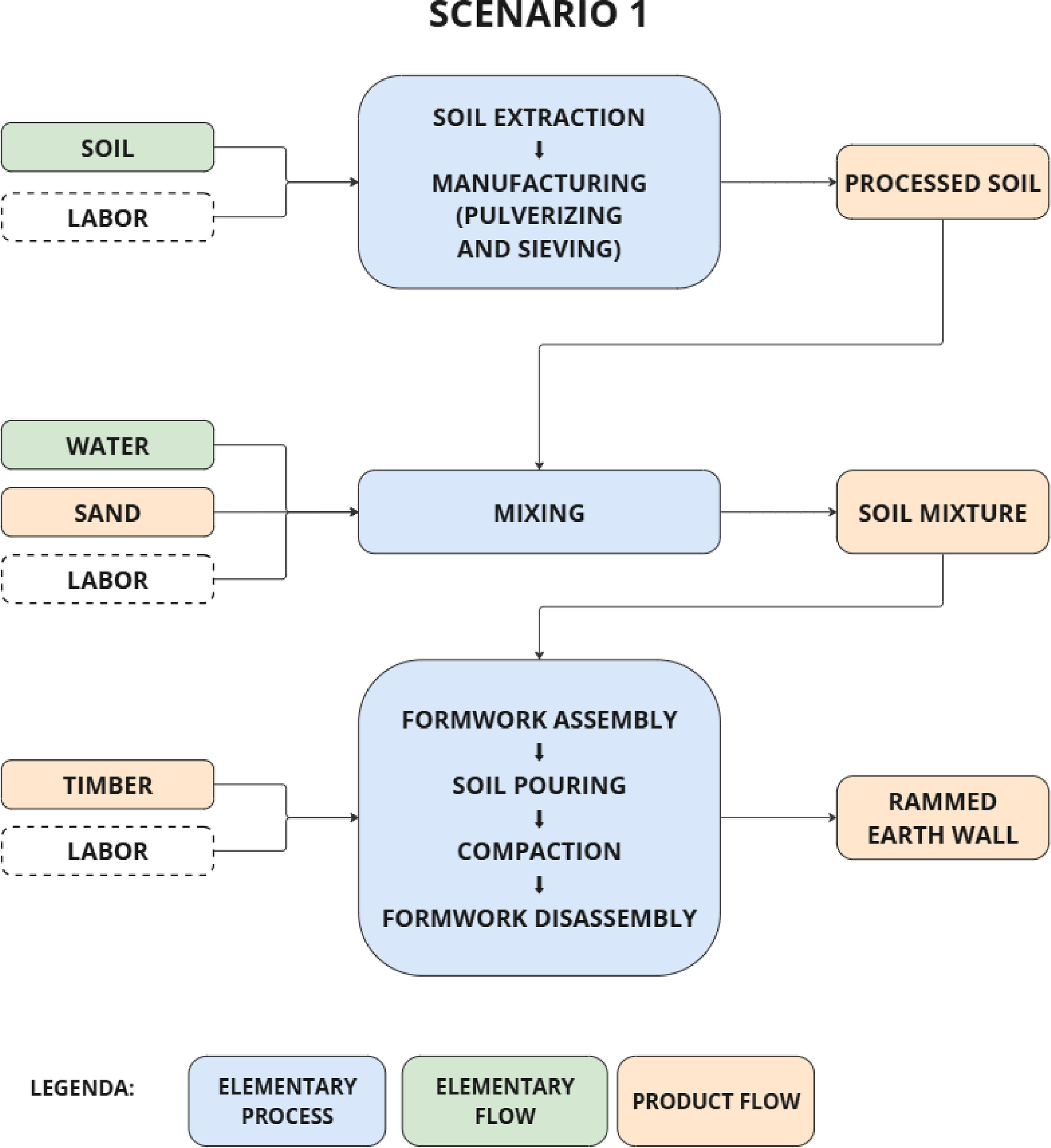
Scenario 1 reproduces the conditions necessary for producing 1 m² of rammed earth wall according to the Traditional Rammed Earth method. In this case, extraction, preparation, and compaction are carried out entirely by hand, using formwork made of rough wooden boards and braced by threaded rods. The detailed sequence of this artisanal method, from extraction (A1) to wall consolidation (A5), is shown in Figure 2.

By contrast, the following scenarios are based on the logic of Contemporary Rammed Earth. Scenario 2A is characterized by full mechanization of the preparation and compaction stages, using film-faced plywood formwork structured by metal trusses. Expanding this configuration, Scenario 2B maintains the execution and technological premises of the previous scenario but introduces chemical stabilization through the inclusion of 5% Portland cement in the soil mix. The unit processes governing these contemporary variants are illustrated in the flowchart in Figure 3, highlighting the distinctions in energy and input consumption relative to the traditional method.

3.2 Inventory data collection and impact quantification
According to the Brazilian Standard, inventory analysis includes data collection and calculation procedures for quantifying the relevant inputs and outputs of the product system studied. These data may refer to energy and raw material inputs, products, waste, atmospheric emissions, and releases to water and soil. This section presents the calculation assumptions for each unit flow and product flow that compose the unit processes for producing 1 m² of rammed earth wall with 35 cm thickness.
According to NBR 17014 (ABNT, 2022), the dry density value is the specific weight of the rammed earth to be considered in design. If test results are not available, a value in the range of 1750 kg/m³ to 2200 kg/m³ may be used. The adopted density value was the average of these two values, equivalent to 1975 kg/m³. Therefore, to build 1 m² of rammed earth wall according to the established characteristics, 0.35 m³ of soil is required, equivalent to 691.25 kg. The clay-to-sand ratio chosen to compose the walls was based on literature data. For both techniques, the most suitable soils are sandy soils with low silt content; therefore, a proportion of 30% clay and 70% sand was adopted (Neves; Faria, 2011). Consequently, the raw material demand per functional unit totaled 207.375 kg of clay and 483.875 kg of sand.
In addition, to mitigate uncertainties associated with the void ratio of uncompacted soil, swelling factor, and intrinsic losses during internal transport and handling on site, it was methodologically stipulated that the volume of soil processed in the extraction (A1) and processing (A3) stages corresponds to a unified gross volume of 1 m³ of earth per functional unit.
The energy consumption of mechanized operations was modeled by dividing the nominal equipment power by its operational productivity. For the mechanical sieving stage (A1), the electricity demand ( was calculated as the ratio between the nominal power of the vibrating sieve ( and its hourly productivity (, as expressed in Equation 1. Based on the adopted equipment parameters, the resulting electricity consumption was 0.123 kWh/m³.
Similarly, the electricity demand for the homogenization and mixing stage () was calculated as the ratio between the nominal power of the planetary mixer ( and its operational productivity , as shown in Equation 2. The estimated electricity consumption for this process was 0.9194 kWh/m³.
The soil compaction stage in contemporary rammed earth was modeled using the CP003 pneumatic compactor, by Chicago Pneumatic. In the absence of nominal data in the catalog, a power of 5 hp, equivalent to 3.75 kW, was assumed. Considering the adopted construction procedure, compacting 1 m² of wall requires approximately 1 hour of equipment operation, resulting in an electricity consumption of 3.75 kWh per functional unit.
Mechanical soil extraction in Scenarios 2A and 2B was calculated based on fuel consumption data and cycle efficiency of a compact excavator with 44 kW of power. The excavator productivity () was determined as the product of the bucket volume (), the number of operating cycles per hour (, and the operator efficiency factor , as structured in Equation 3.
The amount of fuel consumed to excavate 1 m³ of earth is 4.58 L. The density adopted for diesel is 0.853 kg/L; therefore, the mass is obtained by multiplying the volume (4.58 L) by the density. Thus, the diesel mass consumed is 3.907 kg.
Regarding the formwork, two main types of enclosure were considered: the traditional rammed earth system, with support structure and closure in pine boards, and the contemporary rammed earth system, with closure in film-faced plywood panels. In Scenario 1 (traditional rammed earth), based on data obtained from the Revit model, 0.096 m³ of pine wood is required for each square meter of wall, while in Scenarios 2A and 2B the film-faced plywood consumption is 0.068 m³. However, for this study it was assumed that the formwork has a useful life of 10 uses, so this value must be divided by the number of reuses. The threshold of 10 reuses was adopted as a conservative premise for Brazilian construction sites, reflecting the mechanical wear imposed by impact compaction (manual and pneumatic) on raw pine and film-faced plywood panels, allowing the physical depreciation of auxiliary formwork to be balanced across contemporary and traditional scenarios.
Modeling data selection depends on the analyst's judgment, and therefore the choices made here must be justified. Table 1 summarizes the quantities of materials used in Scenarios 1, 2A, and 2B, and their respective selected data from the Ecoinvent v.3.6 database within SimaPro v.9.1. Priority was given to data compatible with Brazilian reality, identified by the {BR} label; when unavailable, international data were used, identified by the {RoW} and {GO} labels.
Since no single Ecoinvent entry matches the required soil composition, a clay-and-sand blend was created with the proportions appropriate for this technique: 30% clay and 70% sand. As for Portland cement, the database does not distinguish the binder according to the exact content of active mineral addition (such as blast-furnace slag or pozzolanic material typical of CP II, CP III, or CP IV cements). Since mineral additions reduce the clinker fraction, the most carbon- and energy-intensive component, the lack of specific national inventory data for cement subtypes is a recognized limitation of this study. This may cause slight overestimation or underestimation of the impacts in Scenario 2B.
For traditional formwork, the volume of wood used was calculated from pine wood, a coniferous species, so data on softwood in raw form, without planing or additional finishing, dried to 10% moisture content, were selected.
It is worth noting that the water added to the process was excluded from the inventory, following the same procedure adopted by Caldas, Martins and Toledo Filho (2021), since in their results the contribution of this input to the assessed environmental impact was below 1%.
4 Results and discussion
The potential environmental impacts associated with the three rammed earth production scenarios are presented in Table 2. Scenario 2B, even with only 5% cement, shows the highest values in 16 of the 18 categories analyzed, suggesting that the stabilizer was the aggravating factor; in other words, minimizing cement use may be the most sustainable path.
The impact category “Climate change, long term” presents values in kilograms of carbon dioxide equivalent, a unit that measures global warming potential associated with greenhouse gas emissions, converting all of them to a common reference: the impact they would have if they were CO₂. Numerically, the difference between Scenario 2B and the others is clear. The 412% increase in CO₂eq emissions relative to Scenario 1 confirms Dai’s (2026) finding that even low cement additions can neutralize the environmental advantages of raw earth. On the other hand, the 75% increase from Scenario 1 to 2A is due to mechanization and, crucially, the replacement of wooden boards with film-faced plywood. This finding aligns with the observations of Milani and Iunes (2023) and Caldas, Martins and Toledo Filho (2021), who identify formwork as a relevant impact driver in the rammed earth life cycle.
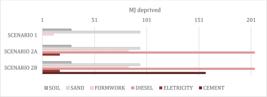
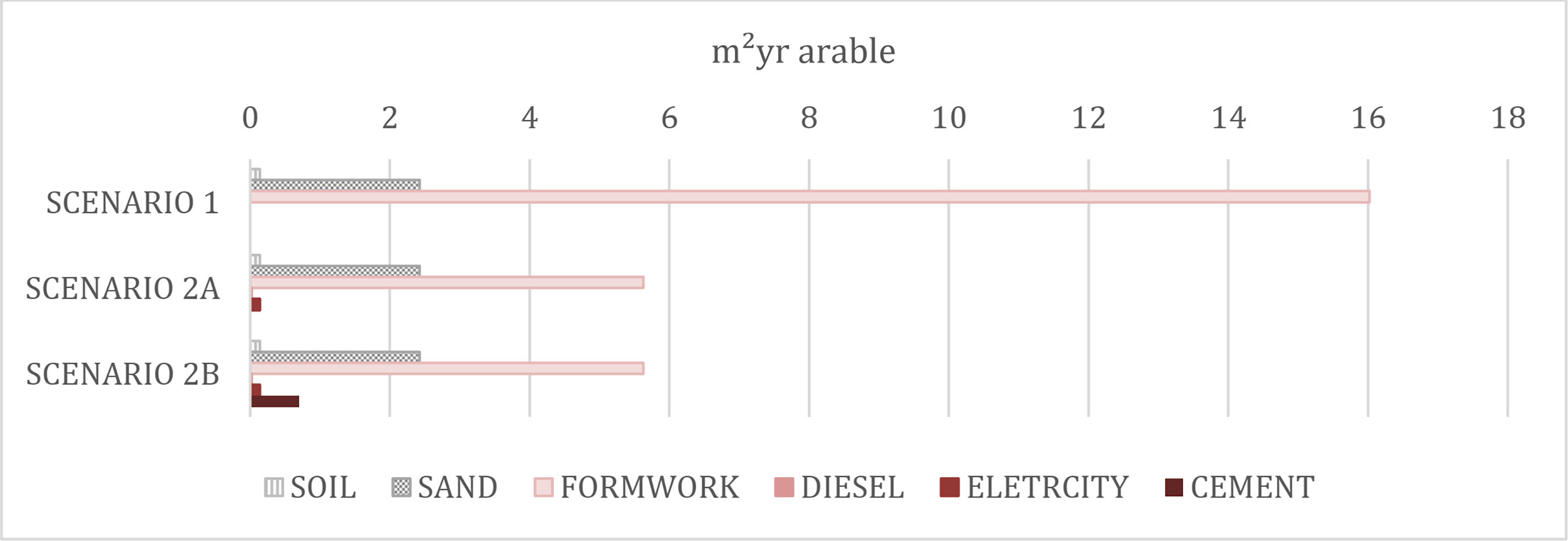
The category “Fossil and nuclear energy use”, expressed in megajoules deprived, follows the same pattern. Figure 4 makes it clear that the 218% increase of Scenario 2A relative to Scenario 1 is driven by the prominence of diesel in mechanized excavation and by the substitution of wooden boards with film-faced plywood, whose industrial production process is intensive. In Scenario 2B, the graph illustrates the cumulative nature of this impact: keeping diesel and formwork fixed, the mere addition of 5% cement to the mix increases energy demand by 36%. In contrast, the share attributable to electricity remains residual and does not emerge as a dominant factor. This aligns with the findings of Caldas, Martins and Toledo Filho (2021) on the low influence of mechanization within the Brazilian energy matrix, suggesting that using energy to increase compaction is a valid strategy to decrease dependence on chemical stabilizers.
The category “Water scarcity” reveals the impact of industrialization of inputs, with high values in Scenarios 2A and 2B due to the manufacture of film-faced plywood. This is because it is an industrially produced material whose fabrication process requires water. Meanwhile, in the category “Mineral resource use”, the small variation between scenarios occurs because soil and sand consumption is constant in all scenarios. As suggested by Dormohamadi, Rahimnia and Bunster (2024), the use of residual soils from earthworks, excavated in situ, is the path to mitigate impacts related to diesel consumption in excavation and to mineral resource use.
From the perspective of system boundaries, it should be noted that excluding transport stages in this study serves the methodological purpose of isolating the exclusive variables of process composition. However, a sensitivity analysis grounded in the literature reveals the critical nature of this boundary. If transport distances were expanded, the environmental profile of the contemporary scenarios (2A and 2B) would be drastically penalized due to their dependence on industrial inputs. As Milani and Iunes (2023) and Dormohamadi, Rahimnia and Bunster (2024) point out, transporting processed materials over long distances can account for 70% to 95% of the total impact in complex supply chains. This sensitivity analysis reinforces that the highest environmental efficiency of contemporary rammed earth depends on the regionalization of construction materials, under the risk of logistical burdens offsetting the advantages of locally sourced raw earth.
Unlike the other categories, Scenario 1 showed the highest impacts in “Land occupation, biodiversity” and “Land transformation, biodiversity.” These categories express results in m²yr arable, a unit that estimates pressures on biodiversity and ecosystems due to the conversion and occupation of productive land. Figure 5 makes it clear that Scenario 1 is dominated by the formwork vector, which reaches levels three times higher than those of contemporary scenarios. This pattern confirms that the use of natural wooden boards requires a larger forest plantation area per cubic meter extracted when compared with the industrial yield of film-faced plywood panels in Scenarios 2A and 2B. This highlights Caldas, Martins and Toledo Filho’s (2021) premise that maximizing reuse rates and formwork circularity is necessary to amortize biotic pressure on land across multiple construction cycles.

This scenario reveals the hidden benefit of industrial formwork and confirms the scientific value of an assessment that goes beyond carbon footprint alone. A limited approach would penalize the use of plastified film-faced plywood because of its higher emissions associated with industrial processing.
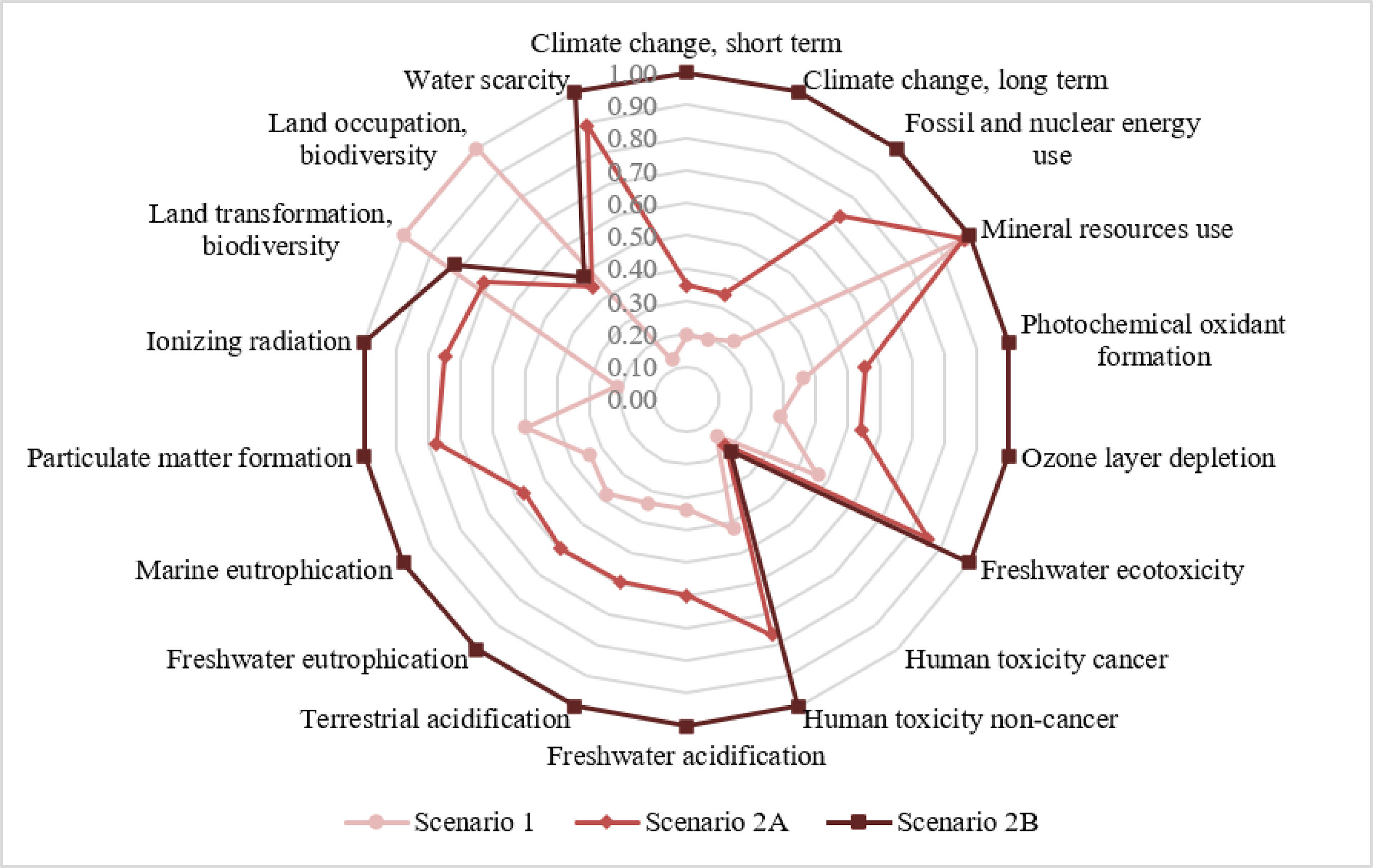
To allow direct comparison between categories with different units (kg CO₂eq, MJ, CTUh, etc.), the results were normalized. As shown in Figure 6, the environmental superiority of unstabilized rammed earth becomes evident. The polygon representing Scenario 2B expands almost concentrically to the maximum boundary in most categories. By contrast, the polygonal profile of Scenario 2A remains substantially lower across most of the spectrum. This result supports the development of contemporary techniques that prioritize mechanical compaction over chemical stabilization to achieve low-carbon performance.

However, the marked disadvantage of Scenario 2B calls for a systemic reading that considers market realities in construction. As discussed by Dai, Bai and Xiao (2024), chemical stabilization often acts as a necessary technical compromise in regions of high rainfall and aggressive climates, improving resistance to construction-stage erosion and extending structural durability. From a socioeconomic standpoint, this increase in physical resilience directly reduces maintenance costs and increases the social acceptance of the technique among financing agents and end users, mitigating the historical stigma of precariousness associated with raw earth architecture. Therefore, the complete elimination of cement presupposes the use of complementary bioclimatic design strategies, such as large eaves or water-repellent surface treatments, to ensure the same service life without the environmental burden of the binder.
5 Conclusions
This study reinforces that using earth as a construction material alone is not sufficient to ensure a building’s sustainability. The environmental profile of a building is related to all decisions made throughout the design process, such as the choice of construction techniques, equipment, and complementary materials. The results show that the transition from traditional to contemporary methods significantly alters emissions and resource consumption, requiring a critical view of soil mechanization and chemical stabilization.
The addition of only 5% Portland cement (Scenario 2B) was responsible for a 412% increase in global warming potential compared with the traditional method. This demonstrates that cement, even in reduced proportions, acts as the main driver of environmental impact in rammed earth, neutralizing the material’s intrinsic advantages in 16 of the 18 categories analyzed.
From the perspective of process modernization, the study quantified that the impact associated with the energy consumption of mechanical mixers and compactors is residual in the national matrix compared with the impact of cement. This finding establishes a practical direction for the formal market: mechanical compaction is the ideal route to achieve density and durability requirements, making the system environmentally viable while reducing its carbon intensity by reducing dependence on chemical stabilizers.
In addition, given the persistent lack of data for natural materials in the country, modeling based on SIDAC guidelines represents a relevant methodological contribution, providing an unprecedented reference inventory for the national context. In short, the viability of contemporary rammed earth as a decarbonization strategy depends on an integrated approach that prioritizes formwork reuse, in situ soil extraction, and restricting cement to cases of strict structural necessity.
Although there are limitations related to the availability of national and specific data for earth-based construction systems, the application of LCA proved effective in quantifying and comparing the environmental impacts of different rammed earth configurations, enabling the identification of the system’s main critical points. For future research, it is recommended to broaden the scope to cradle-to-grave dynamic analyses. The transition to this expanded boundary would further highlight the environmental benefit of unstabilized rammed earth at end of life due to its full reversibility and cycle closure potential, in contrast to the waste generated by stabilized rammed earth. In addition, modeling the operational phase would make it possible to quantify how the system’s high thermal inertia mitigates energy consumption for artificial climate control over the years, potentially offsetting the unfavorable carbon balance of the cement scenario.
-
ZARONI, J. V. M.; SILVOSO, M. M. Environmental assessment of rammed earth construction systems: comparison between traditional and contemporary methods. Ambiente Construído, Porto Alegre, v. 26, e154556, jan./dez. 2026. ISSN 1678-8621 Associação Nacional de Tecnologia do Ambiente Construído. http://dx.doi.org/10.1590/s1678-86212026000101009
-
Declaration of Generative AI and AI-Assisted Technologies in the Writing Process
During the preparation of this manuscript, the authors used Inner AI exclusively for translation, grammar checking, and language improvement purposes. After using these tools, the authors carefully reviewed and edited the content as necessary and take full responsibility for the final content of the publication. No AI system was used to generate scientific ideas, conduct data analysis, develop methodologies, interpret results, or draw conclusions. All scientific content, analyses, and conclusions presented in this manuscript were conceived, developed, and validated by the authors.
-
Financial Support
This study was supported by the Coordenação de Aperfeiçoamento de Pessoal de Nível Superior (CAPES) - Finance Code 001, through a master's scholarship awarded to the first author (Process No. 88877.153816/2025-00).
Data Availability Statement
The data that support the findings of this study are available from the corresponding author upon reasonable request.
References
- ASSOCIAÇÃO BRASILEIRA DE NORMAS TÉCNICAS. NBR 17014: taipa de pilão: requisitos, procedimentos e controle. Rio de Janeiro, 2022.
- ASSOCIAÇÃO BRASILEIRA DE NORMAS TÉCNICAS. NBR ISO 14040: gestão ambiental: avaliação do ciclo de vida: princípios e estrutura. Rio de Janeiro, 2014.
- BEN-ALON, L. et al. Cradle to site Life Cycle Assessment (LCA) of natural vs conventional building materials: A case study on cob earthen material. Building and Environment, v. 160, p. 1-22, 2019.
- CALDAS, L.; LIRA, J. S. M. M.; SPOSTO, R. M. Avaliação do Ciclo de Vida de habitações de alvenaria estrutural de blocos cerâmicos e painéis pré-moldados de concreto considerando diferentes zonas bioclimáticas. Revista Latino-Americana em Avaliação do Ciclo de Vida, Brasília, v. 1, p. 30, 2017.
- CALDAS, L.; MARTINS, A.; TOLEDO FILHO, R. Construção com terra no Brasil: avaliação ambiental da taipa de pilão. PARC: Pesquisa em Arquitetura e Construção, Campinas, v. 12, n. 00, p. e021015, 2021.
- CARVALHO, B.; SILVOSO, M. Avaliação do Ciclo de Vida da arquitetura com terra: uma revisão sistemática da literatura. In: CONGRESSO DE ARQUITETURA ARQUISUR, 25., Porto Alegre, 2022. Anais […] Porto Alegre, 2022.
- DAI, S. A state-of-the-art review of the life cycle assessment of rammed earth building construction. Energy and Buildings, v. 350, 116643, 2026.
- DAI, S.; BAI, W.; XIAO, J. Balancing environmental impact and practicality: a case study on the cement-stabilized rammed earth construction in Southeast rural China. Sustainability, v. 16, n. 20, 8731, 2024.
- DORMOHAMADI, M.; RAHIMNIA, R.; BUNSTER, V. Life cycle assessment and life cycle cost analysis of different walling materials with an environmental approach (comparison between earth-based vs. conventional construction techniques in Iran). The International Journal of Life Cycle Assessment, v. 29, n. 3, p. 355–379, 2024.
- GUO, X.; YAN, J.; DAI, S. A Design workflow based on Life Cycle assessment, for a rammed earth house in rural Yunnan. Energy Proceedings, v. 48, 2024.
- HEISE, A. F. Desenho do processo e qualidade na construção do painel monolítico de solo-cimento em taipa de pilão Campinas, 2004. 155 f. Dissertação (Mestrado em Engenharia Civil) - Faculdade de Engenharia Civil, Arquitetura e Urbanismo, Universidade Estadual de Campinas, Campinas, 2004.
- HEISE, A. F.; MINTO, F. C. N. Recolocação contemporânea da terra como material de construção. In: NEVES, C. et al. Arquitetura e Construção com Terra no Brasil Tupã: Anap, 2022.
- HOUBEN, H.; GUILLAUD, H. Manuel de construction en terre. Bruxelles: CRATerre/PGC/CRA/UNCHS/AGCD, 1985.
- MASCARENHAS, A. Subsídios para história da arquitetura e construção com terra no Brasil. In: NEVES, C. et al. Arquitetura e construção com terra no Brasil. Tupã: Anap, 2022.
- MILANI, A. P. S.; IUNES, I. M. C. Aspectos ambientais do inventário do ciclo de vida da taipa de pilão. Mix Sustentável, Florianópolis, v. 9, n. 3, p. 117–130, 2023.
- MILETO, C.; VEGAS, F.; LÓPEZ, J. M. Criterios y técnicas de intervención en tapia: a restauración de latorre Bofilla de Bétera (Valencia). Informes de la Construcción, v. 63, n. 523, p. 81-96, 2011.
- MINKE, G. Manual de construção com terra: a terra como material de construção e seu uso na arquitetura. Bahia: Solisluna Editora, 2022.
- NEVES, C.; FARIA, O. B. Técnicas de Construção com Terra. Bauru: Proterra, 2011.
- UNITED NATIONS ENVIRONMENT PROGRAMME. Global Alliance for Buildings and Construction. Not just another brick in the wall: the solutions exist – Scaling them will build on progress and cut emissions fast. Global Status Report for Buildings and Construction 2024/2025. Nairobi: UNEP, 2025.
- WEIMER, G. Arquitetura popular brasileira. São Paulo: Martins Fontes. 2005.
Edited by
-
Editor-in-chief:
Enedir Ghisi
-
Guest editor:
Aline Maria Costa Barroso