Residual fines as potential raw materials for M-S-H cements: processing and characterization
Abstract
This study presents the characterization and a strategy for processing residual fines for their application in the production of magnesium silicate hydrate (M-S-H) binders. Quartzite mining waste (QW), soapstone waste (SW), and sugarcane bagasse ash (SCBA) were evaluated. Initially, the raw materials were characterized by XRF, XRD, FTIR, SEM/EDS, and thermogravimetry. The samples were then subjected to a grinding study and characterized by laser granulometry and SEM/SE. The processed QW and SW samples exhibited high fineness (D90 of 13.5 and 42.9 µm, respectively) and a well-graded and continuous particle size distribution. The processed SCBA presented a high SiO₂ content (60.1%), predominance of amorphous phase (53.7%), and a high specific surface area (49.9 m2/g). Based on the results, the QW and SW are expected to perform effectively as fillers, reducing costs and contributing to the microstructure and mechanical performance of the matrices. The SCBA, in turn, stands out as a potential source of reactive silica (SiO2) for the synthesis of M-S-H cements. The study aligns with circular economy principles and offers alternatives for utilizing industrial waste in the Brazilian construction industry, opening new possibilities for research on eco-efficient M-S-H systems.
Keywords
Magnesium silicate hydrate; Magnesium-based cements; Industrial waste; Sugarcane bagasse ash; Quartzite mining waste; Soapstone waste
Resumo
Este estudo apresenta a caracterização e uma estratégia de beneficiamento de finos residuais para aplicação na produção de ligantes de silicato de magnésio hidratado (M-S-H). Foram avaliados resíduos da mineração de quartzito (RQT) e pedra-sabão (RPS) e uma cinza de bagaço de cana-de-açúcar (CBCA). Inicialmente, as matérias-primas foram caracterizadas por FRX, DRX, FTIR, MEV/EDS e Termogravimetria. Em seguida, as amostras foram submetidas a um estudo de moagem e posteriormente caracterizadas por granulometria a laser e MEV/SE. As amostras beneficiadas de RQT e RPS exibiram elevada finura (D90 de 13,5 e 42,9 µm, respectivamente) e distribuição granulométrica bem graduada e contínua. A CBCA beneficiada apresentou elevado teor de SiO2 (60,1%), predominância de material amorfo (53,7%) e elevada superfície específica (49,9 m2/g). A partir dos resultados obtidos, pode-se estimar um comportamento adequado do RQT e do RPS como fíleres, reduzindo os custos e contribuindo na microestrutura e no desempenho mecânico das matrizes. A CBCA, por sua vez, se destaca como potencial fonte de sílica reativa na síntese de cimentos M-S-H. O estudo alinha-se com os princípios da economia circular e oferece alternativas para o aproveitamento de resíduos industriais na construção civil brasileira, apresentando novas possibilidades para o desenvolvimento de sistemas M-S-H ecoeficientes.
Palavras-chave
Silicato de magnésio hidratado; Cimentos magnesianos; Resíduos industriais; Cinza de bagaço de cana-de-açúcar; Resíduo de quartzito; Resíduo de pedra-sabão
1 Introduction
The elevated rate of CO2 emissions and the massive consumption of non-renewable raw materials intrinsic to the production of ordinary Portland cement (OPC), have driven the development of low-carbon cementitious composites and the utilization of industrial waste in the construction sector (Scrivener; John; Gartner, 2018). In this context, the development of magnesium silicate hydrate (M-S-H) cements using residues from agribusiness and mining emerges as a promising alternative for the Brazilian scenario (Bernard, 2022; Lopes et al., 2023).
1.1 M-S-H binders
The production of M-S-H cements involves the in situ mixing of a magnesium oxide (MgO) source and a reactive silica (SiO2) source, typically silica fume, with the potential inclusion of a filler (Tran; Scott, 2017; Walling; Provis, 2016). The precipitation of M-S-H (MgO-SiO2-H2O) occurs upon mixing these binders with water, leading to MgO hydration and the formation of magnesium hydroxide [Mg(OH)2], also known as brucite, followed by the partial dissolution of SiO2 and its gradual reaction with Mg(OH)₂ (Szczerb et al., 2013; Temuujin; Okada; MacKenzie, 2005).
M-S-H gels are poorly crystalline phases with a high capacity for particle agglomeration (Mármol et al., 2016; Szczerb et al., 2013), similar to the calcium silicate hydrate (C-S-H) formed during OPC hydration. The lower alkalinity of M–S–H systems (pH < 11), compared with C-S-H systems, represents an advantage for incorporating plant fibers as reinforcement (Mármol et al., 2016; Mármol; Savastano, 2017) and for immobilizing hazardous waste and heavy metals (Walling et al., 2015; Zhang; Vandeperre; Cheeseman, 2012). Additional benefits of these binders include their potential for CO₂ capture (Abdel-Gawwad et al., 2020) and their suitability for emerging manufacturing technologies such as 3D printing (Panda et al., 2021).
1.2 Sugarcane bagasse ash
Brazil is the world’s largest producer of sugarcane, with a harvest of 713.2 million tons in the 2023/2024 season (CONAB, 2024). The plant is primarily utilized by the sugar-ethanol industry, whose processes generate a fibrous by-product known as sugarcane bagasse. The bagasse is commonly burned (300-900°C) in thermoelectric power plants, producing a residual ash with properties of interest to the construction sector, particularly for the production of cementitious composites (Cordeiro et al., 2008; Khalil; Aslam; Ahmad, 2021; Paris et al., 2016).
The production of sugarcane bagasse ash (SCBA) in Brazil is estimated at approximately 4 million tons per year, with most of this output concentrated in the Southeast, Midwest, and Northeast regions of the country (Cordeiro, 2006; Lopes et al., 2023; Andrade Neto et al., 2021). The material exhibits a predominantly amorphous structure and is composed mainly of SiO2 and the presence of various other oxides, including Al2O3, CaO, and Fe2O3 (Li et al., 2022). The reactivity of SCBA has been demonstrated to be associated with its fineness, amorphous content, and notably, its specific surface area (Figueiredo; Pavía, 2020). To optimize these properties, its processing for use as a raw material in construction typically involves a series of steps, including oven drying, grinding, and recalcination. Mechanical activation aims to refine the particles and increase the ash’s surface area (Cordeiro et al., 2009), whereas secondary calcination enhances amorphicity and reduces the material’s loss on ignition (Yadav et al., 2020). This process, however, increases the carbon footprint and cost of SCBA and may be omitted without significant loss in performance, depending on the raw material used and the initial burning conditions (Cordeiro et al., 2008, 2009; Cordeiro; Tavares; Toledo Filho, 2016; Figueiredo; Pavía, 2020; Sousa et al., 2022).
Several studies have evaluated SCBA as a partial replacement for OPC. In addition to reducing costs (França et al., 2023), the incorporation of SCBA in mortars and concretes enhances mechanical performance and refines the pore structure of the matrices (Amin, 2011; Ganesan; Rajagopal; Thangavel, 2007), also contributing to improved durability (Le; Sheen; Lam, 2018; Mello et al., 2020). The presence of amorphous silica imparts pozzolanic properties to the material, as it reacts with calcium hydroxide [Ca(OH)2] during cement hydration, leading to the supplementary formation of C-S-H (Cordeiro; Toledo Filho; Fairbairn, 2009).
Studies have also demonstrated the feasibility of using SCBA as an alternative precursor in alkali-activated binders (Castaldelli et al., 2016; Sousa et al., 2022; Yadav et al., 2020). As in OPC-based matrices, the reactivity of SCBA is a determining factor in the alkali-activation process (Yadav et al., 2020). In addition to being a sustainable alternative, the residue can enhance the physical and mechanical properties of the composites when incorporated at optimized dosages (e.g., appropriate SiO2/Al2O3 ratio) (Sousa et al., 2022). In this regard, the high SiO2 content and predominantly amorphous structure of SCBA, combined with its already demonstrated performance in reactive systems, suggests its potential use as a SiO2-rich precursor for the development of M-S-H binders.
1.3 Quartzite waste
Quartzite, a metamorphic rock, is frequently utilized in civil construction as an ornamental stone for countertops and coating (Martins; Peixoto; Mendes, 2023). The extraction process entails the removal of the soil cover, the extraction of the friable quartzite, and the implementation of blasting techniques (Santos, 2015). Following the extraction process, the material is then fragmented into slabs or blocks and subsequently processed for commercialization (Santos, 2015). These operations generate granular and powdery wastes, which can account for more than 90% of the extracted material (Collares; Francklin; Motta, 2012). When these materials are deposited in the environment, they accumulate and alter the original landscape, potentially silting watercourses and polluting the atmosphere (Reis; Ribeiro; Reis, 2020).
In Brazil, quartzite extraction occurs primarily in the state of Minas Gerais, with notable production centers in the regions of Alpinópolis, Diamantina, São Thomé das Letras, and Ouro Preto (FEAM, 2015). Despite the compositional variability among these regions, quartzite mining waste (QW) consists mainly of SiO2. This characteristic is attributable to the elevated quartz content in its mineralogical composition (Martins; Peixoto; Mendes, 2023). The material may also contain other oxides (e.g., Al2O3, K2O, CaO, and MgO), which are associated with different minerals such as feldspar, mica, dolomite, muscovite, and kaolinite (Carvalho et al., 2021; Dantas Júnior; Barros; Neves, 2018; Martins et al., 2024; Martins; Peixoto; Mendes, 2023).
Due to its chemical stability and low amorphous content, QW aggregates exhibit structural and performance similarities to conventional aggregates when incorporated into cement-based matrices (Martins; Peixoto; Mendes, 2023; Mendes et al., 2019). Furthermore, the waste generated during quartzite extraction and processing can be used as a partial replacement for OPC in cement-based composites. Carvalho et al. (2021) evaluated the performance of processed QW as a filler in mortars. In their study, the material was obtained through high-efficiency grinding (180 min in a 200-rpm horizontal ball mill followed by 45 min in a 400-rpm planetary ball mill). As a result, the mortar produced with 25% volumetric replacement exhibited mechanical strength and setting time equivalent to those of the reference mortar. This performance was attributed to the nucleation effect promoted by QW, which enhanced the hydration of cement particles (Carvalho et al., 2021). Li et al. (2021) also highlighted processed QW filler as a sustainable alternative for OPC-based matrices. A replacement level of 30% was adopted, and the powder with the highest specific surface area led to greater mechanical strength and improved pore structure refinement (Li et al., 2021). In both studies, mechanical activation by grinding was crucial for optimizing the material’s performance. In this context, considering that fillers commonly incorporated into conventional cement-based matrices have demonstrated satisfactory performance in M-S-H systems (Capelo; Mármol; Rossignolo, 2023; Tran; Dhakal; Scott, 2020; Tran; Scott, 2017), QW represents a promising component for this class of magnesium-based cements.
1.4 Soapstone waste
As with quartzite, the state of Minas Gerais also stands as a major producer of steatite, popularly known as soapstone. The Ouro Preto-MG microregion contains numerous deposits of soapstone, particularly in the district of Santa Rita de Ouro Preto, where approximately 4,800 tons of the rock are extracted annually (Rodrigues; Lima, 2012). This metamorphic material is extensively utilized as an ornamental stone in civil construction and in the production of handicrafts (Huhta; Kärki, 2018; Rodrigues; Lima, 2012).
Soapstone is composed primarily of talc, a hydrated magnesium silicate mineral that has the lowest hardness on the Mohs scale (Sudalaimani; Shanmugasundaram, 2014). This characteristic contributes to the material’s high softness and workability, which is reflected by its elevated SiO2 and magnesium oxide (MgO) contents. According to Rodrigues and Lima (2012), only about 40% of the extracted soapstone is recovered, resulting in a disposal of approximately 60% of the original rock. Additionally, handicraft production generates significant amounts of fine dust, which poses risks to both the environment and the health of artisans (Carneiro et al., 2010; Santos, 2009). An alternative to mitigate these impacts and support the economic development and production chain of these workshops is the use of these residual fines in the construction industry.
Sudalaimani and Shanmugasundaram (2014) incorporated 0-25% of a soapstone powder as a partial replacement for OPC in mortar production. Mortars containing up to 20% powder exhibited higher mechanical strength than the unmodified mortar (Sudalaimani; Shanmugasundaram, 2014). In studies conducted by Gnanaraj and collaborators (Gnanaraj et al., 2021; Gnanaraj; Chokkalingam; Thankam, 2020), a soapstone powder was evaluated as a mineral addition in self-compacting concrete. Replacement levels of 0-25% by mass and fixed water-to-fines ratio were adopted. As a result, the incorporation of soapstone increased mechanical strength up to the 20% dosage and improved durability-related properties (e.g., water absorption, porosity, and chloride penetration) across all replacement levels. The pore refinement promoted by the powder was attributed to its filler effect and the formation of M-S-H (Gnanaraj et al., 2021). Studies have also demonstrated the feasibility of using soapstone waste (SW) powder in the production of soil-lime bricks (Ferreira; Reis; Lima, 2015), red ceramic bricks (Souza et al., 2016), and epoxy resin-based polymer composites (Alves et al., 2020). However, its use in the manufacture of M-S-H binders has not yet been reported in the literature.
1.5 Research aim
Although the incorporation of waste materials into conventional cement matrices has been extensively documented in the extant literature, the utilization of these materials within M-S-H systems remains underexplored. Studies addressing this topic to date have focused primarily on the total or partial replacement of commercial silica fume with alternative SiO2 sources such as metakaolin (Shah; Scott, 2021), fly ash (Zhang et al., 2016), ground glass (Liang et al., 2023), and rice husk ash (Capelo; Mármol; Rossignolo, 2023; Sonat; Unluer, 2019). The latter has emerged as an abundant and effective source of amorphous silica, reinforcing the potential for utilizing other agricultural ashes produced on a large scale in Brazil, such as that derived from sugarcane bagasse combustion.
In addition to their use as alternative precursors, industrial wastes may also be incorporated into M-S-H cement-based composites as fillers within the mixtures. The incorporation of fillers has been demonstrated to reduce production costs, refine the microstructure, and enhance the mechanical performance of M-S-H matrices (Capelo, 2021; Tran; Dhakal; Scott, 2020; Tran; Scott, 2017). Such benefits can be achieved by valorizing inert industrial wastes generated from mining and the processing of natural stones, such as quartzite and soapstone.
This study aims to characterize industrial residues and propose a processing methodology for their use in the production of M-S-H cement-based binders. To this end, a SCBA sample was evaluated as a prospective SiO2 source, while QW and SW samples were investigated as potential filler materials through a grinding study and a comprehensive characterization of their chemical, mineralogical, physical, and morphological properties. The study considers the social, environmental, and economic context of Brazil, with emphasis on the micro-region of Ouro Preto-MG. It also presents alternatives for the valorization and optimized use of agro-industrial and mining residues, aiming at the development of more eco-efficient cement-based composites.
2 Materials and methods
2.1 Materials
The industrial residues used in this study are Illustrated in Figure 1. The SCBA was supplied by the sugar-ethanol plant BEVAP Bioenergia Company (João Pinheiro, Minas Gerais, Brazil). The QW was obtained from Sulminas Sílicas Company (Três Corações, Minas Gerais, Brazil), and the SW was provided by Ouro Preto Pedra-Sabão Company (Ouro Preto, Minas Gerais, Brazil).

2.2 Chemical and mineralogical characterization
For the chemical and mineralogical characterization tests, the samples were dried at 100 °C to constant mass and then comminuted in a porcelain mortar until passing through a 45 µm sieve. The proposed industrial residues (SCBA, QW, and SW) were chemically characterized by X-ray fluorescence (XRF; PANalytical Epsilon3x) and Fourier transform infrared spectroscopy (FTIR; Thermo Scientific Nicolet iS5). For the XRF analysis, the samples were placed in a polymeric sample holder covered with a 5 µm polypropylene film. The loss on ignition test was performed in a muffle furnace at 1200 °C for 3 h. For the FTIR analysis, the samples were prepared as KBr pellets (1:120 ratio). The spectra were recorded by accumulating 50 scans at a resolution of 8 cm⁻¹ over the range of 400-4000 cm⁻¹. The preparation of the pellets and the measurements were carried out under ambient temperature and relative humidity conditions. The data were processed using the “automatic baseline correction” function in OMNIC software.
The mineralogical profiles of the materials were determined by X-ray diffraction (XRD; Bruker D2 Phaser). To reduce the preferential orientation of residual fines, the samples were loaded into a PMMA sample holder using the back-loading method. The analyses were performed using CuKα radiation at 40 kV and 40 mA, with a step size of 0.02° 2θ over a 6-80° 2θ range. Mineralogical quantification by XRD (QXRD) was performed using Rietveld refinement with PANalytical X’Pert HighScore Plus V3.0 software and the 2024 Crystallography Open Database. For this purpose, 20 wt.% of zincite (ZnO, analytical grade, 99% purity) was added to the samples as an internal standard.
The analysis of the material composition was complemented by scanning electron microscopy coupled with energy-dispersive spectroscopy (SEM/EDS; TESCAN Vega3) and thermogravimetry/derivative thermogravimetry (TG/DTG; Shimadzu DTG-60H). For the SEM/EDS analysis, the powder samples were deposited onto metal stubs coated with carbon tape and sputter-coated with gold (Quorum Q150R ES). For the TG/DTG analysis, the powder samples were placed in alumina crucibles and analyzed under the following conditions: heating rate of 10 °C/min, an isothermal step at 25 °C for 30 min, followed by heating from 25 to 1100 °C under an N2 atmosphere (50 mL/min).
2.3 Grinding study
The materials were dried in an oven at 105 °C for 24 h and then subjected to a high-energy grinding program (Restch PM 100 planetary ball mill; 400 rpm) based on the procedure proposed by Carvalho et al. (2019). The grinding process was conducted for up to 60 min, with samples collected at 5 min intervals. Table 1 presents detailed information on the grinding program and the configuration parameters adopted.
The raw samples and the samples collected during the grinding studies were characterized by laser diffraction using a Bettersize 2000 analyzer (dispersion medium: distilled water), applying the Fraunhofer model. Since mineral comminution is an energy-intensive process (Deniz, 2013), continuing the grinding process after the stabilization of the characteristic diameter (D90) can potentially result in increased energy consumption without substantial gains in particle size reduction. Consequently, as a technical criterion, the optimal grinding times were defined as the points at which the reduction observed between two consecutive grinding intervals was less than 2 µm.
2.4 Physical and morphological characterization
The specific densities of the SCBA, QW and SW samples were determined by vacuum pycnometry (adapted from ABNT, 1984). The specific surface areas of the fines obtained at the optimal grinding times were measured using the BET method (Anton Paar Nova 600; N2 adsorption). Finally, the morphological characteristics of the processed residues were analyzed by scanning electron microscopy in secondary electron mode (SEM/SE; TESCAN Vega3), using gold-coated samples.
3 Results and discussion
3.1 Chemical and mineralogical properties
Table 2 presents the chemical compositions of the SiO2 source and the residual fillers evaluated in this study. SCBA is predominantly composed of silicon and aluminum, with other elements in smaller proportions, such as iron, calcium, and magnesium. Its reactivity is directly related to the amorphous SiO2 content (Zhang et al., 2020). These results are consistent with studies that have assessed the material as a pozzolanic agent in Portland cement matrices (Frías; Villar; Savastano, 2011; Andrade Neto et al., 2021) and as an alternative precursor in alkali-activated matrices (Sousa et al., 2022). The QW evaluated in this study originates from a rock composed predominantly of quartz, which explains the high SiO2 content in its composition (Martins; Peixoto; Mendes, 2023). The SW, in turn, contains high levels of silicon and magnesium. This is due to the fact that steatite is a rock rich in talc [Mg3Si4O10(OH)2], a hydrated magnesium silicate mineral (Luukkonen et al., 2019; Souza; Silva; D’Almeida, 2021). The material analyzed also exhibits notable amounts of iron, calcium, and aluminum, likely associated with the presence of dolomite [CaMg(CO3)2] and phyllosilicate minerals from the chlorite group [(Mg,Fe)3(Al,Si)4O10(OH)2.(Mg,Fe)3(OH)6] (Rodrigues; Lima, 2012). Overall, the contents of the compounds identified in the compositions of the studied residues fall within the ranges reported in the literature.
Chemical composition of the proposed residues and ranges of occurrence according to the literature data
Figure 2 and Table 3 present the results of the XRD analysis and the mineralogical quantification by Rietveld refinement (QXRD), respectively. In the QW sample, quartz (SiO2) accounted for 96.8% of the identified phases. Minor amounts of biotite [K(Mg,Fe)3(AlSi3O10)(F,OH)2] and kaolinite [Al2Si2O5(OH)4] were also detected, which justify the presence of MgO, Al2O3, Fe2O3, and K2O in its chemical (Table 2). As expected, SW sample presents significant contents of phyllosilicates such as talc, chlorite, and clinochlore [(Mg5Al)(AlSi3)O10(OH)8]. The QXRD analysis also confirms the presence of dolomite, as well as measurable amounts of magnesite (MgCO3) and tremolite [Ca2Mg5Si8O22(OH)2]. The mineralogical heterogeneity of steatite has also been reported in previous characterization studies (Ilyina; Klimovskaya; Bubnova, 2023; Luukkonen et al., 2019; Rodrigues; Lima, 2012). It's worth mentioning that, despite its predominantly crystalline structure and inert nature, studies have reported that mechanical activation can promote amorphization of talc (Andrić et al., 2014; Liao; Senna, 1992), which includes the formation of amorphous silica in its composition and the potential reactivity of SW in M-S-H systems. Finally, the only crystalline phase identified in the SCBA sample was quartz (SiO₂). Although the composition of SCBA is influenced by the combustion process, the material exhibits a predominantly amorphous structure (53.7%), evidenced by the halo observed between 20° and 30° 2θ (Capelo; Mármol; Rossignolo, 2023; Cordeiro; Toledo Filho; Fairbairn, 2009; França et al., 2023). The presence of crystalline quartz in SCBA can be attributed to impurities adhered to the material during harvesting, such as sand (Pereira et al., 2018).
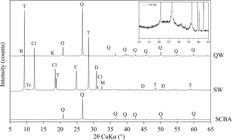
Figure 3 presents the FTIR spectra of SW, QW, and SCBA. All samples present peaks at 3436-3444 cm-1 and 1618-1638 cm-1 in the FTIR spectra. In previous studies related to SCBA (Frías; Villar; Savastano, 2011; Pantongsuk et al., 2026), as well as for talc (Yang et al., 2006), similar bands near those observed in the present study were related to water. Based on this, the observed bands may be derived from sample preparation and measurement, considering exposure to humidity, which may increase the water content in the samples and influence the FTIR spectra.

The bands at approximately 1168, 1081, 795, 779, 693, and 459 cm-1 identified in QW and SCBA correspond well to characteristic quartz bands in the ranges 1080-1175, 780-800, 695, and 464 cm-1 associated with Si–O (Saikia; Parthasarathy; Sarmah, 2008). Similar bands (1086, 798, 778, 695, and 468 cm-1) have also been attributed to quartz in a clay characterization study (Jozanikohan; Abarghooei, 2022). The presence of quartz in SCBA has already been reported in previous studies (Cordeiro et al., 2009; Soares et al., 2016; Frías; Villar; Savastano, 2011; Pereira et al., 2018). The assignment of quartz-related bands in the FTIR characterization of SCBA shows consistency with findings from other studies on Brazilian SCBA. For example, in the FTIR analysis of SCBA conducted by Frías, Villar and Savastano (2011), the bands at 1176, 1106, 1093, 798, 696, and 472 cm-1 bands were correlated to quartz. The presence of quartz is further supported by good correspondence with the reference FTIR bands reported for mineral quartz (SiO2) (RRUFF, 2025a).
Regarding QW, the bands at 3694, 3617, 1034, 796, and 459 cm-1 may be associated with kaolinite, as they show good correspondence with the reference bands reported for this phase (3693, 3620, 1031, 792, 471 cm-1) by Van Der Marel and Beutelspacher (1976), in agreement with the QXRD results (Figure 2). Additionally, the bands at 459 and 519 cm-1 are close to the bands at 451-462 and 520 cm-1, also present in the biotite spectra (Van Der Marel; Beutelspacher, 1976).
FTIR analysis of SW reveals bands at 3676 and 3660 cm-1, which may be associated with -OH group (Karagöz et al., 2025; Pinto et al., 2018). Bands in the spectra of tremolite (3675 and 3653 cm-1), talc (3680, 3658 cm-1), chlorite (3670 cm-1), and clinochlore (3678 cm-1) are similar to those identified in this region (Van Der; Beutelspacher, 1976). The band at 3567 cm-1 is likely related to chlorite and clinochlore as well, given the 3560-3572 cm-1 bands reported for spectra chlorite minerals (Van Der Marel; Beutelspacher, 1976).
QXRD analysis of SW revealed 15.6% carbonate phases associated with dolomite and magnesite (Table 3). The FTIR bands identified at 2527, 1443, 884, and 728 cm-1 show good similarity to those reported by Manni et al. (2022) and associated by the authors to the carbonate group (CO32-). These bands also correlate well with the FTIR bands of the dolomite (728, 882, 1432 cm-1) and magnesite (748, 886, 1445 cm-1) based on Van Der Marel and Beutelspacher (1976). Other identified bands also approximate those attributable to talc, including 1045 (Si-O), 1017 (Si-O-Si), 673 (Si-O-Mg), 463 (Mg-O), and 451 (Si-O-Mg) cm-1 (Van Der Marel; Beutelspacher, 1976). The occurrence of the clinochlore phase in a previous study on a steatite sample (Pinto et al., 2018) was reported with the presence of a shoulder at 951 cm⁻¹, which is also observed in the present study. This band may be associated with the Si–O–Mg (956 cm−1) of clinochlore, further supported by the identification of bands at 1045 (Si-O), 665 and 451 (Si-O-Mg), and 463 (Si-O) cm-1 (Van Der Marel; Beutelspacher, 1976). Some bands in the FTIR spectrum of SW also approach 437,640, 683, 945, and 3672 cm−1, which correspond to bands reported in the tremolite spectrum (RRUFF, 2025b), a phase that was likewise identified by QXRD. Overall, the results show good compatibility with the phases identified through QXRD analysis. However, given the multiphase characteristic of the samples, overlapping bands associated with different minerals are expected.
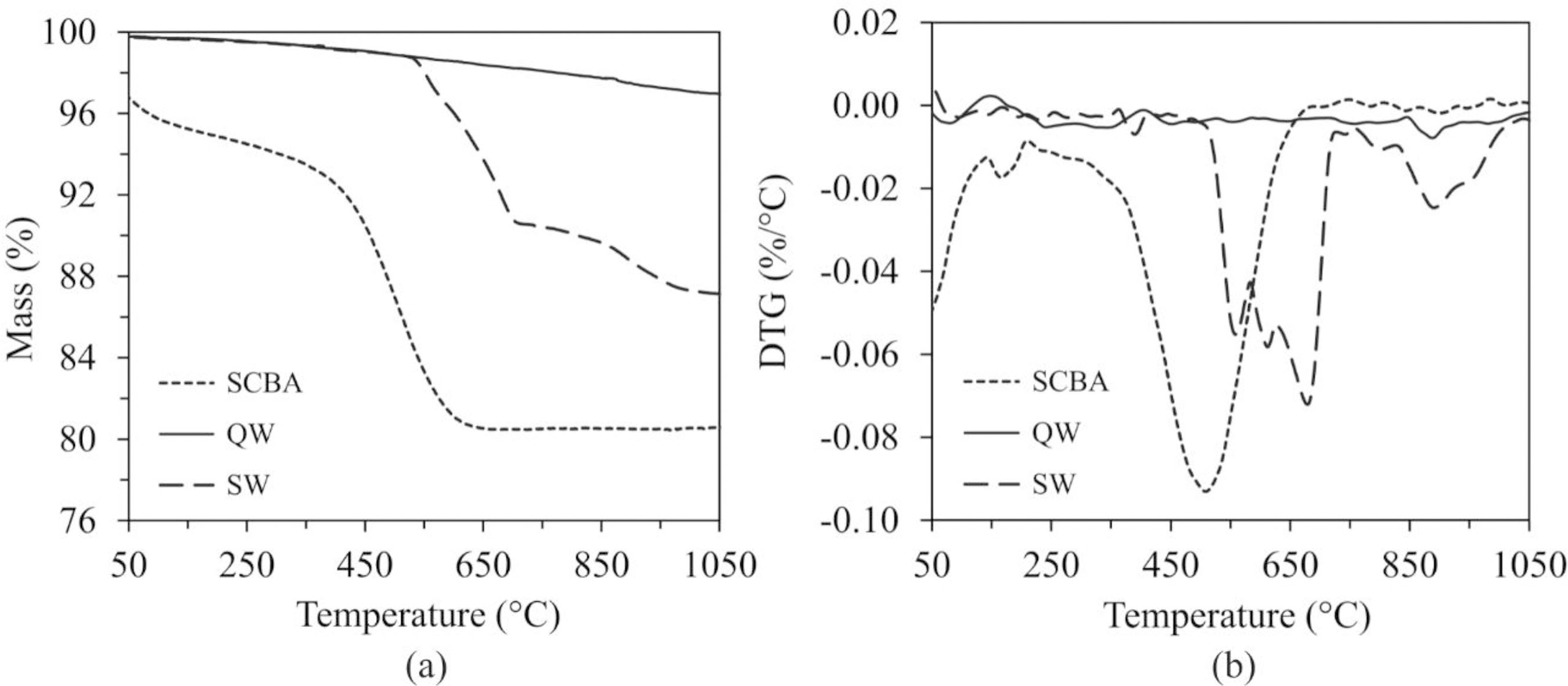
As with the FTIR data, the thermogravimetric behavior of the raw materials, shown in Figure 4, aligns with the QXRD results. The SW exhibited an initial mass loss of 7.9% between 540 ºC and 710 ºC, followed by a secondary mass loss of 2.9% between 850 ºC and 1080 ºC. The first range of mass losses is possibly related to the dehydroxylation within the brucite layer of chlorite and the decarbonations of dolomite and magnesite (Demir et al., 2003; Ilyina; Klimovskaya; Bubnova, 2023). The second range can be mainly associated with the dehydroxylation of talc and its transformation into enstatite and amorphous silica (Liu; Liu; Hu, 2014; Ward, 1975; Wesolowski, 1984). The SCBA presented an initial mass loss of 2.0% between 30 ºC and 150 ºC, attributed to moisture evaporation, followed by a mass loss of 13.0% between 410 ºC and 640 ºC, associated with organic matter volatilization (Tabish; Zaheer; Baqi, 2025). The mass losses of the SW and SCBA samples below 1000 °C justify their loss on ignition values indicated in Table 2. Finally, the analysis of QW indicated that the specimen did not exhibit a defined mass loss peak within any temperature range, with a total mass loss of 3.0%.

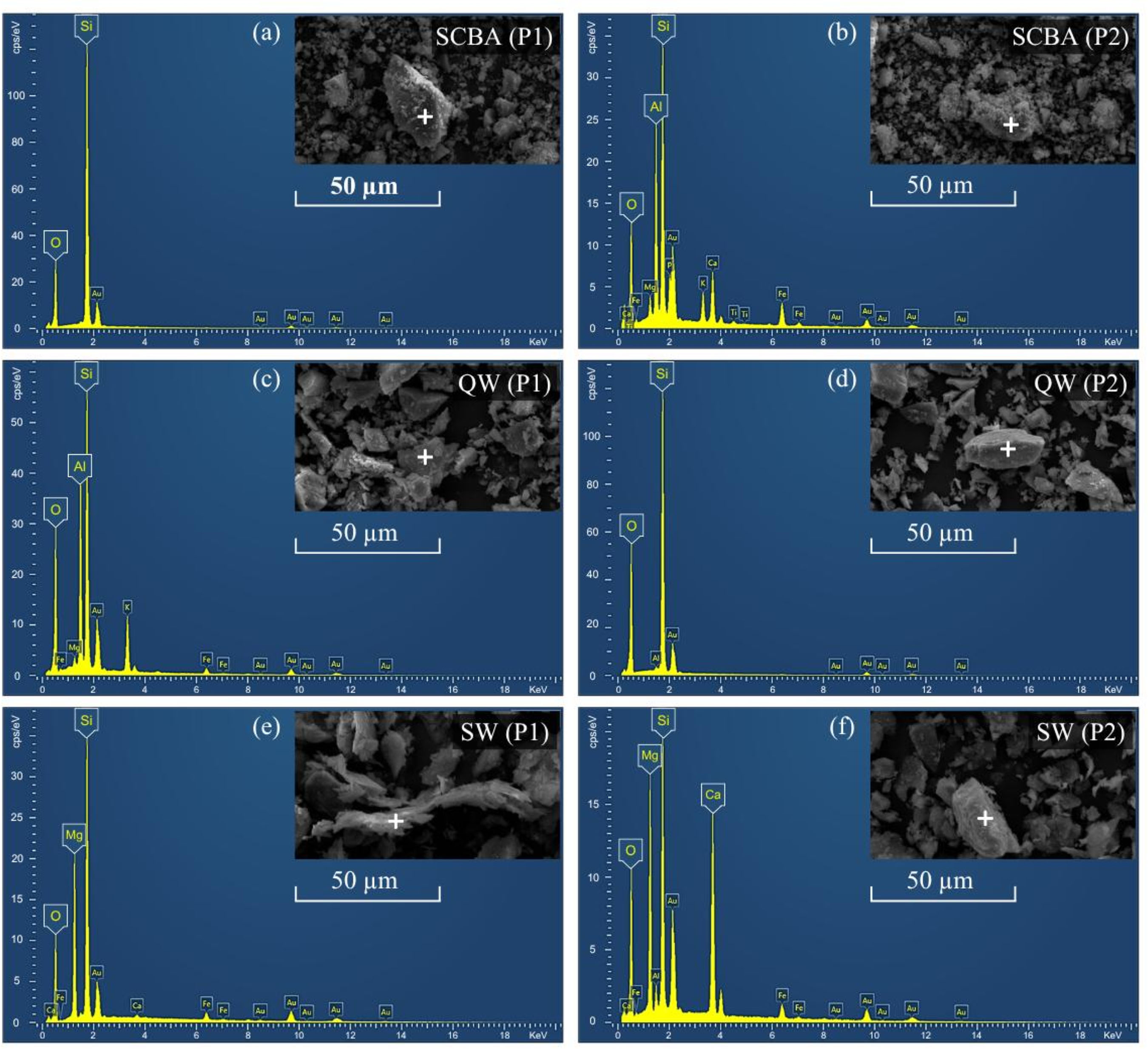
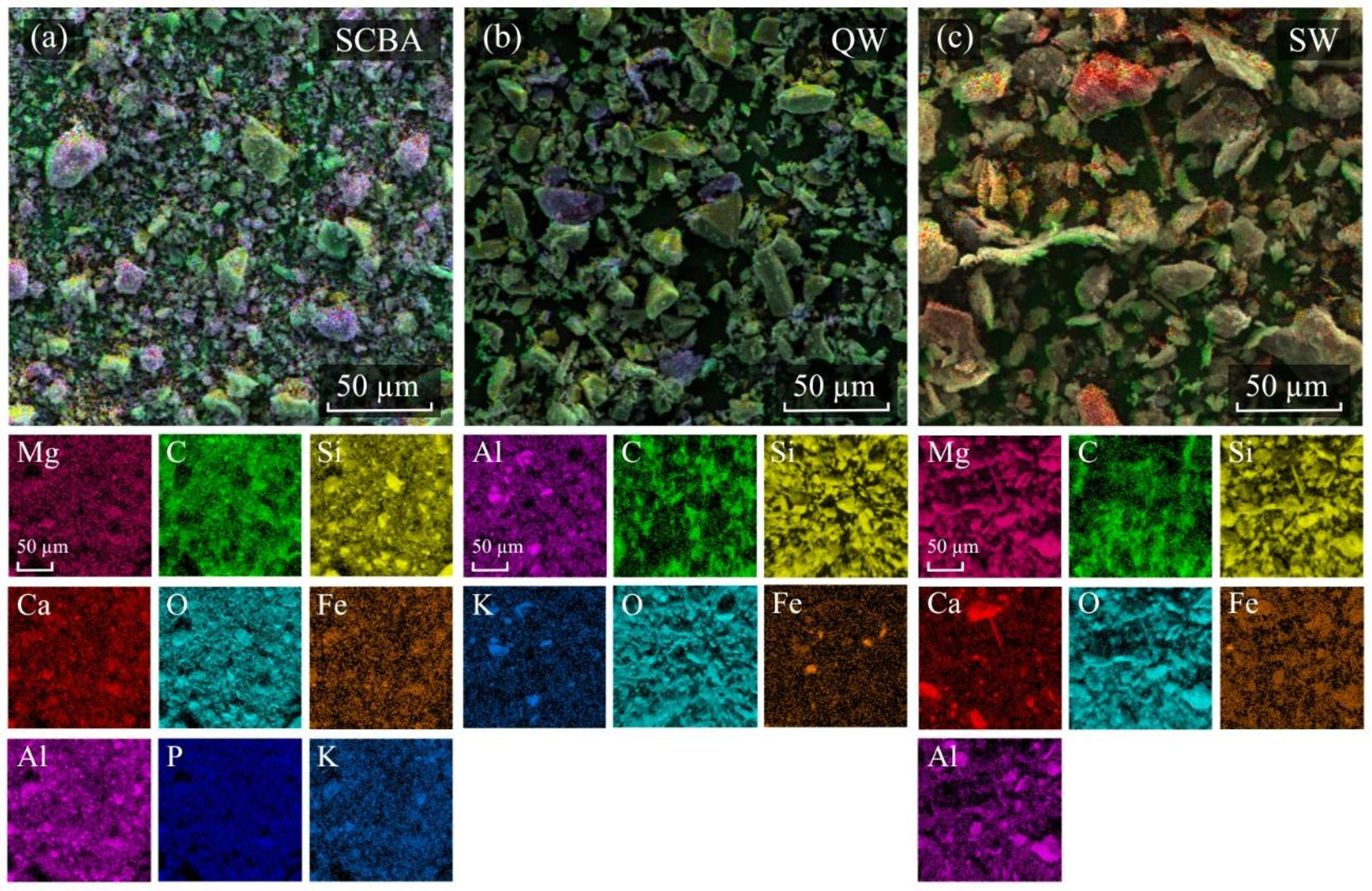
Figures 5 and 6 present the results of the SEM/EDS analysis. Point P1 in the SCBA sample indicates a predominance of silicon and oxygen and is therefore attributed to a quartz grain. At the second point (P2), the presence of various elements is identified, including silicon, aluminum, oxygen, potassium, calcium, and phosphorus. Given that quartz was the sole crystalline phase identified SCBA (see Table 3), the presence of aluminum can be attributed to amorphous alumina (Al2O3) (Zhang et al., 2020). In addition, phosphorus, magnesium, potassium, and calcium are likely present in the form of soluble salts (e.g. potassium phosphate) and are related to the vegetal ash nature of the material (Lyra et al., 2021; Zhang et al., 2020). With respect to QW, the first point (P1) indicates the predominance of silicon, aluminum, and oxygen and can thus be associated with kaolinite [Al2Si2O5(OH)4]. Point P2, in turn, indicates only the presence of silicon and oxygen, representing quartz grain. Finally, point P1 in the SW sample mainly identifies silicon, oxygen, and magnesium, corresponding to a talc grain [Mg3Si4O10(OH)2]. At the second point (P2), silicon, magnesium, calcium, and oxygen are predominantly detected and may be associated with tremolite [Ca2Mg5Si8O22(OH)2]. It is worth noting that the identification of gold in all points is due to the gold coating applied to the samples during preparation. The color-based elemental identification (Figure 6) corroborates the point analysis results and is consistent with the chemical compositions of the studied residues (Table 2), as well as with the other characterization tests performed.


The differences in the composition of the residues are also reflected in their visual appearance (Figure 1). SCBA presents a dark color, typically associated with the presence of unburned carbon and iron oxides. In contrast, QW displays a very light color, consistent with its high quartz content. The SW residue shows a light greenish tone, which is characteristic of minerals commonly found in soapstone, such as talc and chlorite.
3.2 Determination of grinding times
Figure 7 presents the results of the grinding studies for SCBA, QW, and SW. The curves demonstrate a correlation between the duration of high-energy grinding and the fineness parameters D50 and D90, which represent the particle diameters corresponding to 50% and 90% of the accumulated volume in the particle size distribution respectively.

The reduction in D90 between 45 and 50 minutes was 1.3 µm for the SCBA sample, suggesting that additional grinding provides limited improvement in particle size refinement. Therefore, considering the diminishing grinding efficiency, an optimal grinding time of 45 minutes was established for material processing, yielding D50 and D90 values of 3.7 and 10.6 µm, respectively. Regarding QW, a significant reduction in the fineness parameters is observed after the first 5 minutes of grinding. However, grinding efficiency becomes marginal after 20 minutes, with a 1.2 µm reduction in D90 between 20 and 25 minutes. Considering the limited additional refinement beyond this point, an optimal grinding time of 20 minutes was established for material preparation. The processed QW exhibited a D50 of 3.6 µm and a D90 of 13.5 µm. Finally, the curves associated with SW demonstrated a plateau from 30 minutes of grinding, indicating that further grinding leads to negligible changes in particle size distribution. Considering the small reduction in D90 (0.3 µm) observed between 30 and 35 minutes, an optimal grinding time of 30 minutes was established, resulting in a material with D50 and D90 values of 6.4 and 42.9 µm, respectively. The reduction in D90 from the raw materials to the processed materials was 90.7% for SCBA, 84.6% for QW, and 69.5% for SW.
3.3 Physical and morphological properties
Table 4 presents the physical properties of the SiO2 source and the residual fillers after the determination of the optimal grinding times (45 min for SCBA, 20 min for QW and 30 min for SW). SCBA exhibited the highest fineness (D90 of 10.6 µm), followed by QW (D90 of 13.5 µm). The results obtained for these materials were significantly lower than those of SW (D90 of 42.9 µm). Overall, the processed residues evaluated in this study exhibited high fineness when compared with those reported in the literature. Sousa et al. (2022) and Zhang et al. (2020) processed SCBA and obtained D90 values of 64.4 and 22.1 µm, respectively. In addition, Carvalho et al. (2021) and Li et al. (2021) processed QW and used powders with a D90 of 13.0 µm and D50 of 6.3 µm, respectively. For the purpose of comparison, all materials investigated in this study exhibited a fineness equal to or higher than that of OPC, whose D90 typically ranges from 30 to 60 µm (Carvalho et al., 2019, 2023; Costa et al., 2022).
The higher density of SW (2.78 g/cm³) is possibly related to its higher iron content (5.3% de Fe2O3), as shown in Table 2. The iron oxide present in the material composition may also have contributed to its lower grinding efficiency (Pan et al., 2016). Although SCBA contains a significant amount of Fe2O3 (4.3%), the material exhibits a loss on ignition of 10.8%, which is primarily associated with the release of CO2 during combustion. Therefore, the higher density of QW (2.61 g/cm³) compared to SCBA (2.32 g/cm³) can be justified by the higher molar mass of SiO2 relative to CO2, considering that the loss on ignition of the quartzite residue is considerably lower (0.4%).
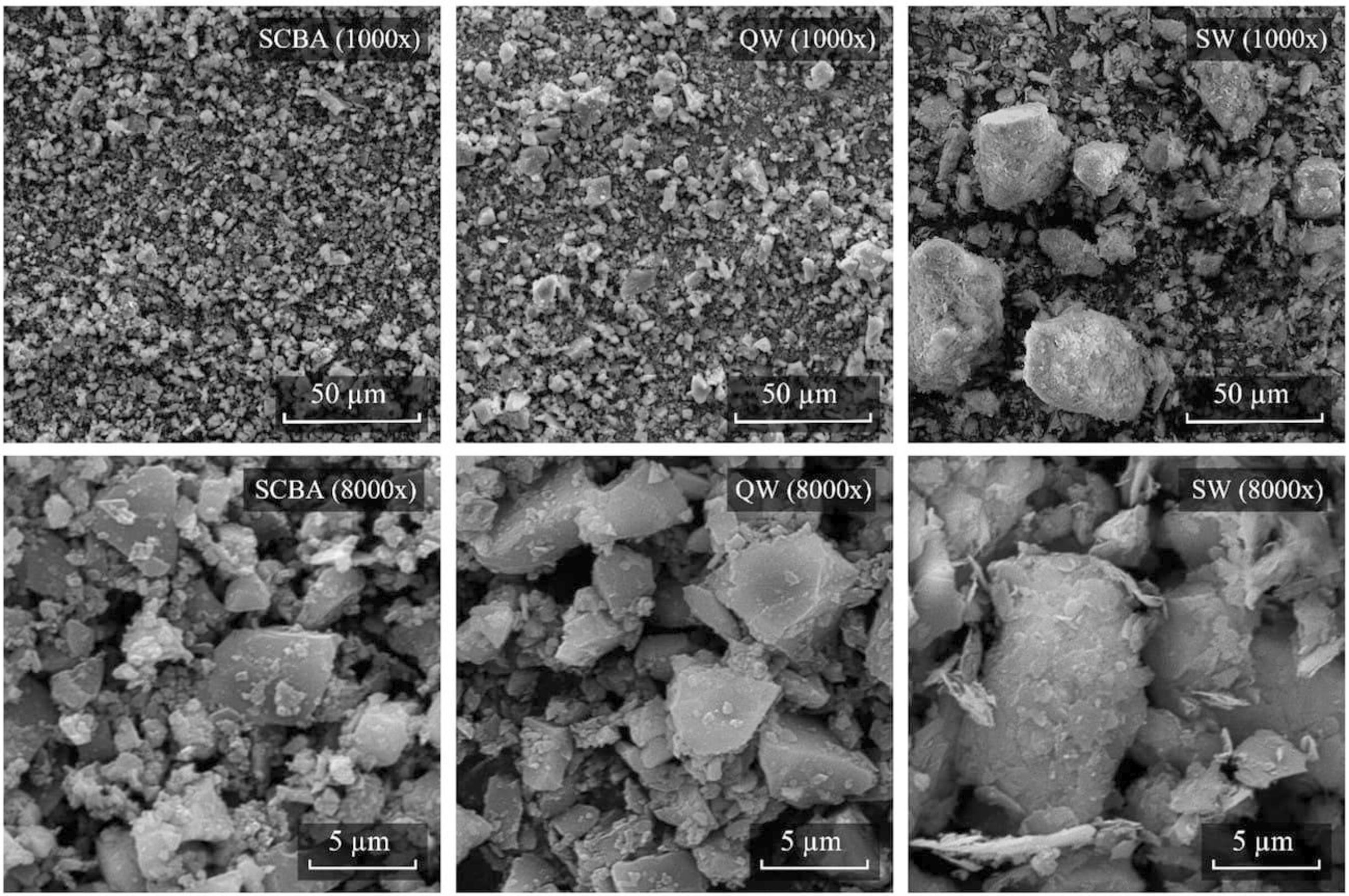
The SEM images (Figure 8) complement the results presented in Table 4. The micrographs acquired at 1000x magnification confirm that the processed SW exhibits large particle sizes, whereas the processed SCBA is the finest material.

The SCBA image, acquired at 8000x magnification, reveals the presence of grains exhibiting irregular shapes and disparate sizes, as reported in previous studies (Pereira et al., 2018; Sousa et al., 2022; Zhang et al., 2020). The finest particles of the material, which are primarily composed of silicon and aluminum oxides, have a propensity to agglomerate around larger and more angular particles, which likely correspond to quartz grains (Cordeiro et al., 2009; Frías; Villar; Savastano, 2011). The high fineness and agglomeration tendency of the material likely contributed to its high specific surface area (49.9 m²/g), a key property for assessing its reactivity (Figueiredo; Pavía, 2020). Regarding the processed QW, its grains, mainly composed of quartz, exhibit angular shape and lower surface roughness, as reported by Li et al. (2021) and demonstrated by the SEM/EDS analysis (point QW-P2 in Figure 5). Additionally, smaller particles with irregular shapes can be observed, indicating a reduced tendency for agglomeration in comparison to the ash. The processed SW, in turn, presents spherical and rough particles, as reported by Kannaiyan et al. (2022). Lamellar and elongated shapes with pointed ends can also be observed, which are characteristic structures of talc (Al-kroom et al., 2024; Ding; Ouyang; Yang, 2016). These filaments were also clearly observed in the SEM/EDS analysis (see point SW-P1 in Figure 5). The differences in morphological characteristics, particularly surface roughness, explain the higher specific surface area of SW (14.4 m²/g) compared to QW (4.8 m²/g).

Finally, Figure 9 presents the particle size distributions of the studied residues. The curves for QW and SW indicate a satisfactory gradation and the absence of discontinuities. Although correlated, higher surface area is commonly associated with the filler effect, as it provides additional nucleation sites for hydration products, whereas particle size distribution and fineness play a key role in improving particle packing and matrix densification (Carvalho et al., 2019; John et al., 2018; Oey et al., 2013). In this sense, despite its lower fineness, the roughness and favorable particle size distribution of SW suggest its potential as a component of M-S-H-based cements. In addition, the processed SW may still exhibit reactivity due to the mechanical activation of talc promoted by high-energy grinding (Andrić et al., 2014; Liao; Senna, 1992), which may further contribute to the formation of M-S-H gel.
4 Conclusion
This study involves the advanced characterization and subsequent processing of quartzite mining waste (QW), soapstone waste (SW), and sugarcane bagasse ash (SCBA), seeking to valorize them as potential raw materials for the production of M-S-H binders. The findings revealed that:
-
the SCBA contains 60.1% SiO2 in its chemical composition and 53.7% amorphous phase in its mineralogical composition;
-
the physical analyses of the SCBA indicated a high fineness (D90 of 10.6 µm) and specific surface area (49.9 m²/g) after 45 minutes of high-energy grinding;
-
the mineralogical structure of QW is predominantly composed of quartz (96.8%), while SW contains mainly magnesite (8.1%), dolomite (7.5%), and phyllosilicate minerals (30.3% chlorite, 25.7% talc, and 21.9% clinochlore); and
-
the QW and SW samples presented D90 values of 13.5 and 42.9 µm after 20 and 30 minutes of high-efficiency grinding, respectively. Despite its coarser particle size, the SW exhibited a higher specific surface area (14.4 m²/g) compared to the QW (4.8 m²/g), and both presented a particle size distribution without discontinuities after processing.
The advanced characterization techniques employed (XRF, XRD, FTIR, TG/DTG, and SEM-EDS) have enabled a deep understanding of the chemical and mineralogical properties of the residual fines. Additionally, the grinding studies and subsequent physical and morphological characterizations allowed the optimization of material processing in terms of energy consumption, as well as the discussion of the preliminary technical suitability of the materials based on their physicochemical properties.
The results indicate that SCBA is a potential source of reactive silica, being an alternative SiO2-rich precursor. Its good physical and morphological properties may also promote the filler effect as a secondary mechanism. Regarding the mining residues (QW and SW), both showed potential for application as mineral fillers, also considering their performance in conventional cement-based composites reported in the literature. For future research, the authors suggest determining the amorphous phases of SCBA (e.g., using the PONKCS method) and evaluating the role of mechanical activation of talc on the reactivity of SW in M-S-H systems.
The processing and characterization strategies presented reveal new opportunities for the valorization of agro-industrial and mining residues. The results show that proper treatment of fines and systematic analysis of their physicochemical properties can broaden the applicability of these residues, supporting technically feasible and environmentally relevant solutions. Overall, the study contributes to advancing research on M-S-H binders and highlights the potential of industrial residues as promising raw materials for the construction industry.
Acknowledgements
We gratefully acknowledge the Ministry of Science, Technology, Innovation Communications and the agencies CAPES, CNPq [403545/2020-0; 304108/2022-7], and FAPEMIG [RED-00191-23] for providing financial support. We are also grateful for the infrastructure and collaboration of the Research Groups on Solid Waste (Reciclos/CNPq) and Alkali-Activated Cements (Ative/CNPq), the Federal University of Mato Grosso (UFMT), the Laboratory of Sustainable Innovative Materials (LAB-SIM) at the Federal Center for Technological Education of Minas Gerais (CEFET-MG), and the laboratories of Civil Construction Materials (LMC2) and Electron Microscopy (NanoLab) at the Federal University of Ouro Preto (UFOP).
Declaration of Generative AI and AI-Assisted Technologies in the Writing Process
Data Availability Statement
Data will be made available on request.
References
- ABDEL-GAWWAD, H. A. et al. Towards a clean environment: the potential application of eco-friendly magnesia-silicate cement in CO2 sequestration. Journal of Cleaner Production, v. 252, 2020.
- AL-KROOM, H. et al. Investigating the promising effect of thermally-treated talc powder on the performance of alkali-activated slag cement. Innovative Infrastructure Solutions, v. 9, n. 8, 2024.
- ALVES, R. A. A. et al Mixture design applied to the development of composites for steatite historical monuments restoration. Journal of Cultural Heritage, v. 45, p. 152–159, 2020.
- AMIN, N. Use of bagasse ash in concrete and its impact on the strength and chloride resistivity. Journal of Materials in Civil Engineering, v. 23, n. 5, p. 717–720, 2011.
- ANDRADE NETO, J. da S. A. et al. Effects of adding sugarcane bagasse ash on the properties and durability of concrete. Construction and Building Materials, v. 266, 2021.
- ANDRIĆ, L. et al Comparative kinetic study of mechanical activation process of mica and talc for industrial application. Composites Part B: Engineering, v. 59, p. 181–190, 2014.
- ASSOCIAÇÃO BRASILEIRA DE NORMAS TÉCNICAS. NBR 6508: grains passing through the 4.8 mm sieve mesh: determination of the bulk specific gravity. Rio de Janeiro, 1984.
- BERNARD, E. Research progress on magnesium silicate hydrate phases and future opportunities. RILEM Technical Letters, v. 7, p. 47–57, 2022.
- CAPELO, A. R. S. M. Cement based on magnesium oxide and rice husk ash Pirassununga, 2021. Dissertation - University of São Paulo, Pirassununga, 2021.
- CAPELO, A. R.; MÁRMOL, G.; ROSSIGNOLO, J. A. Optimization of the rice husk ash production process for the manufacture of magnesium silicate hydrate cements. Journal of Cleaner Production, v. 425, 2023.
- CARNEIRO, A. P. S. et al. Pneumoconiose em artesãos de pedra-sabão na região de Ouro Preto, MG. Revista Médica de Minas Gerais, v. 20, p. 31–37, 2010.
- CARVALHO, J. M. F. de et al. Influence of particle size-designed recycled mineral admixtures on the properties of cement-based composites. Construction and Building Materials, v. 272, 121640, 2021.
- CARVALHO, J. M. F. et al. More eco-efficient concrete: An approach on optimization in the production and use of waste-based supplementary cementing materials. Construction and Building Materials, v. 206, p. 397–409, 2019.
- CARVALHO, V. R. et al. Performance of low-energy steel slag powders as supplementary cementitious materials. Construction and Building Materials, v. 392, 131888, 2023.
- CASTALDELLI, V. N. et al Study of the binary system fly ash/sugarcane bagasse ash (FA/SCBA) in SiO2/K2O alkali-activated binders. Fuel, v. 174, p. 307–316, 2016.
- COLLARES, E. G.; FRANCKLIN, I.; MOTTA, L. A. C. Evaluation of the aggregate produced from wastes of quartzite mining sites to use in concrete. Soils and Rocks, v. 35, n. 3, p. 251–266, 2012.
- COMPANHIA NACIONAL DE ABASTECIMENTO. Acompanhamento da safra brasileira de cana-de-açúcar Brasília, 2024. v. 11.
- CORDEIRO, G. C. et al. Pozzolanic activity and filler effect of sugar cane bagasse ash in Portland cement and lime mortars. Cement and Concrete Composites, v. 30, n. 5, p. 410–418, 2008.
- CORDEIRO, G. C. et al. Ultrafine grinding of sugar cane bagasse ash for application as pozzolanic admixture in concrete. Cement and Concrete Research, v. 39, n. 2, p. 110–115, 2009.
- CORDEIRO, G. C. Use of sugarcane bagasse and rice ashes as mineral admixture in concrete Rio de Janeiro, 2006. Thesis - Federal University of Rio de Janeiro, Rio de Janeiro, 2006.
- CORDEIRO, G. C.; TAVARES, L. M.; TOLEDO FILHO, R. D. Improved pozzolanic activity of sugar cane bagasse ash by selective grinding and classification. Cement and Concrete Research, v. 89, p. 269–275, 2016.
- CORDEIRO, G. C.; TOLEDO FILHO, R. D.; FAIRBAIRN, E. M. R. Effect of calcination temperature on the pozzolanic activity of sugar cane bagasse ash. Construction and Building Materials, v. 23, n. 10, p. 3301–3303, 2009.
- COSTA, L. C. B. et al Mechanical and durability performance of concretes produced with steel slag aggregate and mineral admixtures. Construction and Building Materials, v. 318, 2022.
- COTA, F. P. et al. Physical properties and microstructure of ceramic-polymer composites for restoration works. Materials Science and Engineering: A, v. 531, p. 28–34, 2012.
- DANTAS JÚNIOR, C. M.; BARROS, S. V. A.; NEVES, G. A. Utilização de resíduos de quartzito para aplicação em pavimentos intertravados. Revista Eletrônica de Materiais e Processos, v. 13, n. 3, p. 196–200, 2018.
- DEMIR, F. et al. Kinetic of magnesite from thermogravimetric data. Chemical Engineering Research and Design, v. 81, n. 6, p. 618–622, 2003.
- DENIZ, V. Comparisons of dry grinding kinetics of lignite, bituminous coal, and petroleum coke. Energy Sources, Part A: Recovery, Utilization, and Environmental Effects, v. 35, n. 10, p. 913–920, 2013.
- DING, W.; OUYANG, J.; YANG, H. Synthesis and characterization of nesquehonite (MgCO3·3H2O) powders from natural talc. Powder Technology, v. 292, p. 169–175, 2016.
- FERREIRA, W. L.; REIS, E. L.; LIMA, R. M. F. Incorporation of residues from the minero-metallurgical industry in the production of clay-lime brick. Journal of Cleaner Production, v. 87, n. 1, p. 505–510, 2015.
- FIGUEIREDO, R. L.; PAVÍA, S. A study of the parameters that determine the reactivity of sugarcane bagasse ashes (SCBA) for use as a binder in construction. SN Applied Sciences, v. 2, n. 1515, 2020.
- FRANÇA, S. et al. Feasibility of using sugar cane bagasse ash in partial replacement of portland cement clinker. Buildings, v. 13, n. 4, 2023.
- FRÍAS, M.; VILLAR, E.; SAVASTANO, H. Brazilian sugar cane bagasse ashes from the cogeneration industry as active pozzolans for cement manufacture. Cement and Concrete Composites, v. 33, n. 4, p. 490–496, 2011.
- FUNDAÇÃO ESTADUAL DO MEIO AMBIENTE, FEDERAÇÃO DAS INDÚSTRIAS DO ESTADO DE MINAS GERAIS. Guia técnico ambiental da indústria de rochas ornamentais Belo Horizonte, 2015.
- GANESAN, K.; RAJAGOPAL, K.; THANGAVEL, K. Evaluation of bagasse ash as supplementary cementitious material. Cement and Concrete Composites, v. 29, n. 6, p. 515–524, 2007.
- GNANARAJ, S. C. et al. Durability properties of self-compacting concrete developed with fly ash and ultra fine natural steatite powder. Journal of Materials Research and Technology, v. 13, p. 431–439, 2021.
- GNANARAJ, S. C.; CHOKKALINGAM, R. B.; THANKAM, G. L. Influence of ultra-fine steatite powder on the fresh and hardened properties of self-compacting concrete. IOP Conference Series: Materials Science and Engineering, v. 988, n. 012040, 2020.
- HUHTA, A.; KÄRKI, A. A proposal for the definition, nomenclature, and classification of soapstones. GFF, v. 140, n. 1, p. 38–43, 2018.
- ILYINA, V.; KLIMOVSKAYA, E.; BUBNOVA, T. Ceramic materials based on clay and soapstone waste: thermo-mechanical properties and Application. Minerals, v. 13, n. 11, 2023.
- JOHN, V. M. et al. Fillers in cementitious materials: experience, recent advances and future potential. Cement and Concrete Research, v. 114, p. 65–78, 2018.
- JOZANIKOHAN, G.; ABARGHOOEI, M. N. The Fourier transform infrared spectroscopy (FTIR) analysis for the clay mineralogy studies in a clastic reservoir. Journal of Petroleum Exploration and Production Technology, v. 12, n. 8, p. 2093–2106, 2022.
- KANNAIYAN, S. et al. Effect of ball-milled steatite powder on the latent heat energy storage properties and heat charging–discharging periods of paraffin wax as phase change material. Micromachines, v. 13, n. 9, 2022.
- KARAGÖZ, İ. et al. A comprehensive study on the effect of small rates of walnut shell and talc fillers on the thermal, mechanical, and morphological properties of epoxy hybrid composites. Biomass Conversion and Biorefinery, v. 15, n. 6, p. 8439–8450, 2025.
- KHALIL, M. J.; ASLAM, M.; AHMAD, S. Utilization of sugarcane bagasse ash as cement replacement for the production of sustainable concrete: a review. Construction and Building Materials, v. 8, 2021.
- LE, D. H.; SHEEN, Y. N.; LAM, M. N. T. Fresh and hardened properties of self-compacting concrete with sugarcane bagasse ash–slag blended cement. Construction and Building Materials, v. 185, p. 138–147, 2018.
- LI, H. et al. Effect of different lithological stone powders on properties of cementitious materials. Journal of Cleaner Production, v. 289, n. 125820, 2021.
- LI, Y. et al. Utilization of sugarcane bagasse ash (SCBA) in construction technology: A state-of-the-art review. Journal of Building Engineering, v. 56, 2022.
- LIANG, S. et al. Milled Waste glass powder in magnesium-silicate-hydrate cement: technical and environmental assessment. Journal of Materials in Civil Engineering, v. 35, n. 1, 2023.
- LIAO, J.; SENNA, M. Thermal behavior of mechanically amorphized talc. Thermochimica Acta, v. 197, p. 295–306, 1992.
- LIU, X.; LIU, X.; HU, Y. Investigation of the thermal decomposition of Talc. Clays and Clay Minerals, v. 62, p. 137–144, 2014.
- LOPES, C. de M. N. et al. Residues in cement-based composites: occurrence mapping in Brazil. Case Studies in Construction Materials, v. 18, 2023.
- LUUKKONEN, T. et al. Alkali-activated soapstone waste - Mechanical properties, durability, and economic prospects. Sustainable Materials and Technologies, v. 22, 2019.
- LYRA, G. P. et al. Comparison of original and washed pure sugar cane bagasse ashes as supplementary cementing materials. Construction and Building Materials, v. 272, 2021.
- MANNI, A. et al. Magnesite and dolomite micro-particles: preparation, physical properties and application in bio-based polymer composite. Polymer Bulletin, v. 79, n. 4, p. 2149–2171, 2022.
- MÁRMOL, G. et al. Optimization of the MgO-SiO2 binding system for fiber-cement production with cellulosic reinforcing elements. Materials and Design, v. 105, p. 251–261, 2016.
- MÁRMOL, G.; SAVASTANO, H. Study of the degradation of non-conventional MgO-SiO2 cement reinforced with lignocellulosic fibers. Cement and Concrete Composites, v. 80, p. 258–267, 2017.
- MARTINS, L. M. et al. Thermal insulating coating mortars with mining and steel residues and the proposition of a “thermal insulating admixture”. Journal of Material Cycles and Waste Management, v. 26, n. 3, p. 1432–1449, 2024.
- MARTINS, L. M.; PEIXOTO, R. A. F.; MENDES, J. C. Quartzite tailings in civil construction materials: a systematic review. Clean Technologies and Environmental Policy, v. 25, n. 6, p. 1807–1824, 2023.
- MELLO, L. C. A. et al. Effect of high temperatures on self-compacting concrete with high levels of sugarcane bagasse ash and metakaolin. Construction and Building Materials, v. 248, 2020.
- MENDES, J. C. et al. On the relationship between morphology and thermal conductivity of cement-based composites. Cement and Concrete Composites, v. 104, 2019.
- OEY, T. et al. The filler effect: the influence of filler content and surface area on. Journal of the American Ceramic Society, v. 96, n. 6, p. 1978–1990, 2013.
- PAN, S. et al. Integrated and innovative steel slag utilization for iron reclamation, green material production and CO2 fixation via accelerated carbonation. Journal of Cleaner Production, v. 137, p. 617–631, 2016.
- PANDA, B. et al. Use of magnesium-silicate-hydrate (M-S-H) cement mixes in 3D printing applications. Cement and Concrete Composites, v. 117, 2021.
- PANTONGSUK, T. et al. Enhancing the performance of acid-activated geopolymer by substituting sugarcane bagasse ash with effective pre-treatment strategies. Cement and Concrete Composites, v. 169, 2026.
- PARIS, J. M. et al. A review of waste products utilized as supplements to Portland cement in concrete. Journal of Cleaner Production, v. 121, p. 1–18, 2016.
- PEREIRA, A. M. et al. Valorisation of sugarcane bagasse ash (SCBA) with high quartz content as pozzolanic material in Portland cement mixtures. Materiales de Construcción, v. 68, n. 330, e153, 2018.
- PINTO, P. C. C. et al. Synthesis of flexible polyurethane foams by the partial substitution of polyol by steatite. Polimeros, v. 28, n. 4, p. 323–331, 2018.
- REIS, F. M. D.; RIBEIRO, R. P.; REIS, M. J. Physical-mechanical properties of soil-cement bricks with the addition of the fine fraction from the quartzite mining tailings (State of Minas Gerais – Brazil). Bulletin of Engineering Geology and the Environment, v. 79, p. 3741–3750, 2020.
- RODRIGUES, M. L. M.; LIMA, R. M. F. Cleaner production of soapstone in the Ouro Preto region of Brazil: a case study. Journal of Cleaner Production, v. 32, p. 149–156, 2012.
- RRUFF. Quartz – ID R050125 Comprehensive Database of Mineral Data, 2025a.
- RRUFF. Tremolite – ID R040109 Comprehensive Database of Mineral Data, 2025b.
- SAIKIA, B. J.; PARTHASARATHY, G.; SARMAH, N. C. Fourier transform infrared spectroscopic estimation of crystallinity in SiO2 based rocks. Bulletin of Materials Science, v. 31, n. 5, p. 775–779, 2008.
- SANTOS, D. H. Substituição total do agregado natural por quartzito friável para produção de argamassas mistas de assentamento e revestimento Ouro Preto, 2015. Dissertation - Federal University of Ouro Preto, Ouro Preto, 2015.
- SANTOS, R. de C. P. Análise dos entraves para a criação de um arranjo produtivo local (APL) de base mineral da pedra-sabão na região de Ouro Preto, Minas Gerais Ouro Preto, 2009. Dissertation - Federal University of Ouro Preto, Ouro Preto, 2009.
- SCRIVENER, K. L.; JOHN, V. M.; GARTNER, E. M. Eco-efficient cements: Potential economically viable solutions for a low-CO2 cement-based materials industry. Cement and Concrete Research, v. 114, p. 2–26, 2018.
- SHAH, V.; SCOTT, A. Hydration and microstructural characteristics of MgO in the presence of metakaolin and silica fume. Cement and Concrete Composites, v. 121, p. 104068, 2021.
- SOARES, M. M. N. S. et al. Comparing the pozzolanic behavior of sugar cane bagasse ash to amorphous and crystalline SiO2. Cement and Concrete Composites, v. 71, p. 20–25, 2016.
- SONAT, C.; UNLUER, C. Development of magnesium-silicate-hydrate (M-S-H) cement with rice husk ash. Journal of Cleaner Production, v. 211, p. 787–803, 2019.
- SOUSA, L. N. et al. Effect of non-calcined sugarcane bagasse ash as an alternative precursor on the properties of alkali-activated pastes. Molecules, v. 27, n. 4, 2022.
- SOUZA, G. S.; SILVA, G. de A. S.; D’ALMEIDA, J. R. M. Influence of soapstone waste on the mechanical and rheological properties of high-density polyethylene. Journal of Applied Polymer Science, v. 138, n. 38, 2021.
- SOUZA, H. N. et al Using soapstone waste with diesel oil adsorbed as raw material for red ceramic products. Ceramics International, v. 42, n. 14, p. 16205–16211, 2016.
- STRECKER, K. et al. The effect of incorporation of steatite wastes on the mechanical properties of cementitious composites. Materials and Structures, v. 43, n. 7, p. 923–932, 2010.
- SUDALAIMANI, K.; SHANMUGASUNDARAM, M. Influence of ultrafine natural steatite powder on setting time and strength development of cement. Advances in Materials Science and Engineering, v. 2014, 532746, 2014.
- SZCZERB, J. et al Influence of time and temperature on ageing and phases synthesis in the MgO-SiO2-H2O system. Thermochimica Acta, v. 567, p. 57–64, 2013.
- TABISH, M.; ZAHEER, M. M.; BAQI, A. Utilization of agro-based waste as SCM: a systematic study on sugarcane bagasse ash characteristics and pozzolanic reactivity. Journal of Building Engineering, v. 109, 2025.
- TEMUUJIN, J.; OKADA, K.; MACKENZIE, K. J. D. Formation of layered magnesium silicate during the aging of magnesium hydroxide–silica mixtures. Journal of the American Ceramic Society, v. 81, n. 3, p. 754–756, 2005.
- TRAN, H. M.; SCOTT, A. Strength and workability of magnesium silicate hydrate binder systems. Construction and Building Materials, v. 131, p. 526–535, 2017.
- TRAN, H.; DHAKAL, R.; SCOTT, A. Mechanical and durability properties of magnesium silicate hydrate binder concrete. Magazine of Concrete Research, v. 72, n. 13, p. 693–702, 2020.
- VAN DER MAREL, H. W.; BEUTELSPACHER, H. Atlas of infrared spectroscopy of clay minerals and their admixtures Amsterdam: Elsevier Scientific Publishing Company, 1976.
- WALLING, S. A. et al. Structure and properties of binder gels formed in the system Mg(OH)2-SiO2-H2O for immobilisation of Magnox sludge. Dalton Transactions, v. 44, n. 17, p. 8126–8137, 2015.
- WALLING, S. A.; PROVIS, J. L. Magnesia-based cements: a journey of 150 years, and cements for the future? Chemical Reviews, v. 116, n. 7, p. 4170–4204, 2016.
- WARD, J. R. Kinetics of talc dehydroxylation. Thermochimica Acta, v. 13, p. 7–14, 1975.
- WESOLOWSKI, M. Thermal decomposition of talc: a review. Thermochimica Acta, v. 78, p. 395–421, 1984.
- YADAV, A. L. et al Synthesis and characterization of geopolymer from metakaolin and sugarcane bagasse ash. Construction and Building Materials, v. 258, 2020.
- YANG, H. et al Preparation of porous material from talc by mechanochemical treatment and subsequent leaching. Applied Clay Science, v. 31, n. 3–4, p. 290–297, 2006.
- ZHANG, P. et al Characterization of sugarcane bagasse ash as a potential supplementary cementitious material: Comparison with coal combustion fly ash. Journal of Cleaner Production, v. 277, 123834, 2020.
- ZHANG, T. et al Development of magnesium-silicate-hydrate cement by pulverized fuel ash. Key Engineering Materials, v. 709, p. 61–65, 2016.
- ZHANG, T.; VANDEPERRE, L. J.; CHEESEMAN, C. R. Magnesium-silicate-hydrate cements for encapsulating problematic aluminium containing wastes. Journal of Sustainable Cement-Based Materials, v. 1, n. 1–2, p. 34–45, 2012.


 Note: B: biotite; C: Chlorite; Cl: clinochlore; D: dolomite; K: kaolinite; M: magnesite; Q: quartz; T: talc; Tr: tremolite.