Relationships between physical-mechanical properties of Brazilian hardwoods
Abstract
Native Brazilian hardwood species have structural potential, yet knowledge of their design properties is limited. Furthermore, available data often originates from different testing standards. This study analyzed physical-mechanical property relationships using 345 experimental entries from 195 native species. Comparative regression showed distinct relationships among standards. Suggesting the need for an individualized assessment of normative results, justifying the exclusive use of NBR 7190 (ABNT, 2022) data for in-depth analysis. Although the Akaike Information Criterion (AIC) favored complex models, the linear model was adopted for its simplicity and robustness. Regressions were evaluated using R2, MRE, and p-value metrics. The analysis indicated that linear models adequately represent most relationships between the physical and mechanical properties studied. However, significant relationships could not be established for fc90 and ft90 due to limited data and high variability. Comparisons with NBR 7190 (ABNT, 2022) standard revealed discrepancies, indicating that the generic characteristic values do not represent the behavior of these species well. The correlation coefficients obtained in this study were stronger than the generic ones reported by the JCSS (2004) and are more suitable for modeling variable dependency in structural reliability analyses.
Keywords
Brazilian hardwood; Physical-mechanical properties; Regression models; Testing standard; Timber structure
Resumo
As espécies de madeiras nativas brasileiras apresentam potencial estrutural, contudo, o conhecimento sobre suas propriedades para dimensionamento é limitado. Além disso, os dados disponíveis frequentemente provêm de diferentes normas de ensaio. Este estudo analisou a relação entre propriedades físico-mecânicas usando 345 experimentos de 195 espécies nativas. Comparativo de regressão identificou relações distintas entre as normas, sugerindo a necessidade de uma avaliação individualizada dos resultados normativos e justificando o uso exclusivo de dados da NBR 7190 (ABNT, 2022) para a análise aprofundada. Embora o Critério de Informação de Akaike (AIC) tenha apontado para modelos mais complexos, o modelo linear foi adotado devido à sua simplicidade e robustez. Regressões foram avaliadas utilizando R², MRE e valor-p. A análise indicou que os modelos lineares representam adequadamente a maioria das relações entre as propriedades físico-mecânicas estudadas. Entretanto, não foi possível estabelecer relações significativas para fc90 e ft90 devido limitação de dados e a alta variabilidade. As comparações com a norma NBR 7190 (ABNT, 2022) revelaram discrepâncias, indicando que os valores característicos genéricos não representam bem o comportamento dessas espécies. Os coeficientes de correlação obtidos neste estudo foram superiores aos valores genéricos reportados pelo JCSS (2004) e são mais adequados para a modelagem da dependência entre variáveis em análises de confiabilidade estrutural.
Palavras-chave
Madeira folhosas Brasileiras; Propriedades físico-mecânicas; Modelos de regressão; Normas de ensaio; Estruturas de madeira
1 Introduction
Wood is widely used in civil engineering for its mechanical strength and lightness. Its physical-mechanical properties are influenced by grain direction, density, moisture content, and edaphoclimatic conditions (Bodig; Jayne, 1982). Wood behavior can be approximated by an orthotropic model with three principal directions: longitudinal, radial, and tangential (Ritter, 1990). Considering that the behavior of mechanical properties in radial and tangential directions is deemed equivalent, the evaluation of mechanical properties of wood can be performed for directions perpendicular and parallel to the grain (Bodig; Jayne, 1982). Mechanical strengths in these directions are fundamental for the design of structural elements. The estimation of mechanical and stiffness properties of wood is independent of species but related to wood density. However, the material exhibits inherent variability, as different species possess distinct microstructures that are not discernible at the macroscopic level (Ravenshorst; van de Kuilen, 2016). A literature review on the mechanical properties of wood can be found in Arriaga et al. (2023), which is limited to discussing what is presented in the Eurocode 5 (ECS, 2004) and D143-83 (ASTM, 1994), D143-94 (ASTM, 1995), D143-2000 (ASTM, 2004), D143-14 (ASTM, 2014) and D143-25 (ASTM, 2025).
Relationships between properties of wood can be represented by different types of models, such as regressions and neural networks. Numerous studies (Pellicane; Mieike, 1993; Dias; Lahr, 2004; Araújo, 2007; Ravenshorst; van de Kuilen, 2016; Stangerlin et al., 2017; Hein; Brancheriau, 2018; Wolenski et al., 2020; Haftkhani et al., 2021; Vilela; Mascia, 2021) predominantly utilize least square method for fitting these regression models and the coefficient of determination (R²) for evaluating the goodness-of-fit and explanatory power of the models (Steyerberg et al., 2010; Chirico; Gramatica, 2011). However, other metrics exist for evaluating the quality of fit, such as the mean relative error (MRE) (Cabrero; Yurrita, 2018). Additionally, the Akaike Information Criterion (AIC) can be used to compare and select the model that best generalizes the data, balancing goodness-of-fit and complexity (Ehlers, 2009). Unlike R², the AIC introduces a penalty term for the number of parameters used. This mathematical penalty forces a balance between maximizing the goodness-of-fit and minimizing the model complexity. Consequently, selecting the model with the lowest AIC value ensures the choice of a model that best generalizes the data without capturing random noise or overfitting the data. Finally, goodness-of-fit tests, evaluated through the calculation of the p-value, can be utilized to assess the suitability of the model for representing the data at a predefined statistical significance level.
The physical-mechanical properties required for the design of timber structures are determined by laboratory tests, in accordance with established standards such as NBR 7190 (ABNT, 1997, 2022b, 2022c), D143-25 (ASTM, 2025), Comissão Panamericana de Normas Técnicas (COPANT, 1974) and EN 384 (ECS, 2016). However, the testing methodologies differ significantly regarding dimensions and geometry of the specimens, types of equipment, loading rates, and statistical evaluation methods. Due to these inconsistencies, the comparability of results from tests performed according to different standards cannot be guaranteed.
Despite the existence of several literature reviews on the physical-mechanical properties of native Brazilian hardwoods (Dias; Lahr, 2004; Araújo, 2007; Wolenski et al., 2020; Gomes; Rabbani; Oliveira, 2024), the literature demonstrates a lack of suitable data for structural design. Although these reviews highlight the potential use of various species, the availability of robust information for structural design is limited. This knowledge gap corroborates the earlier observation by Dias and Lahr (2004) that, presently, no comprehensive model exists to effectively correlate the properties of Brazilian hardwoods. This absence significantly impedes the full integration and utilization of these species within structural engineering applications.
Creating a comprehensive database for native Brazilian hardwoods is fundamental to overcoming this limitation. It would enable the identification of which properties exert the greatest influence on the variance of experimental results. Consequently, it would be possible to develop predictive models for estimating these properties, determine representative design parameters and adjust safety factors and structural calculation models. This approach would contribute to a more rational and safer use of these species in engineering.
The Brazilian standard NBR 7190 (ABNT, 2022a) reflects this previously identified knowledge gap by not providing specific characteristic values for strength and moduli of elasticity for native species. Instead, the standard incorporates property tables derived from Eurocode 5 (ECS, 2004), which was calibrated exclusively using European timber species. Consequently, the reliance on data from non-native species limits the reliability and optimization of structural designs using local timbers, reinforcing the need for in-depth research on Brazilian species. Therefore, this study focuses on Brazilian hardwoods to enable a specific and comparable analysis within this taxonomic group.
Conducting experimental investigations for the complete determination of the mechanical properties of wood demands significant financial resources, infrastructure, and time. The main objective of this work is to evaluate and establish the existing correlations and regressions between different physical-mechanical properties of Brazilian hardwood species. This approach aims to identify patterns that can be used to complement the NBR 7190 (ABNT, 2022a), support the development of structural projects and enhance structural reliability analyses.
This study conducted a systematic review to synthesize experimental data on the physical-mechanical properties of Brazilian hardwoods. For the analysis, mean values of the reported properties were used, aiming to standardize the results obtained from distinct experimental methodologies. From this data, regression models were developed to establish relationships between physical-mechanical properties. Additionally, the correlation coefficients between the properties were calculated and organized into a correlation matrix. The generated correlation matrix constitutes a fundamental input for the reliability assessment of timber structures, being particularly useful in probabilistic modeling of dependent variables for Monte Carlo simulations. The obtained results provide reference data for the calibration of design standards, such as NBR 7190 (ABNT, 2022a), and contribute to the advancement of probabilistic safety assessment of timber structures.
2 Methodology for regression performance evaluation
In this section, the steps and criteria adopted to evaluate the performance of the regressions obtained from the dataset are presented.
2.1 Regression models
To evaluate and establish the relationships between physical-mechanical properties of Brazilian hardwoods, different regression models were tested. The application of multiple mathematical functions enables the assessment of which one best describes the relationships between properties. The fitting of the coefficients for each function to a dataset can be performed using the least squares method (Melchers; Beck, 2017). The mathematical expressions for each type of function used in this work are presented in Table 1.
2.2 P-value
In linear regression, the p-value assesses the statistical significance of individual coefficients or the model, determining if there is sufficient evidence to reject the hypothesis that these coefficients are null. For a specific coefficient (such as the intercept or slope coefficient), the p-value tests the null hypothesis (H0) that the coefficient is equal to zero. A low p-value (generally < 0.05) indicates that there is statistical evidence to reject H0, suggesting that the coefficient is statistically significant and the associated variable has an impact on the model. A high p-value (generally > 0.05) suggests that there is insufficient evidence to reject H0.
2.3 Metrics for linear regression performance evaluation
The performance evaluation of a model, such as a regression, can be performed using metrics like the coefficient of determination (R²) (Steyerberg et al., 2010; Chirico; Gramatica, 2011) and the mean relative error (MRE), used by Cabrero and Yurrita (2018). The coefficient of determination (R²), calculated using Equation 1, was employed to verify the goodness-of-fit of the model. Chirico and Gramatica (2012) recommend a minimum value of 0.7 for R².
Where:
yi are the observed experimental values
fi are the values obtained by the models; and
is the mean of the experimental values.
The mean relative error (MRE) can be calculated by Equation 2 (Cabrero; Yurrita, 2018), and the recommended value for this metric is a maximum of 20%.
2.4 Correlation analysis
Correlation analysis is a statistical tool widely used to quantify the relationship between two variables. The correlation coefficient (ρXY), presented in Equation 3, provides a dimensionless measure that quantifies the intensity and direction of the linear relationship between two random variables (Melchers; Beck, 2017). The Pearson correlation coefficient ranges from -1 to 1, where -1 implies a perfect negative correlation and 1 implies a perfect positive correlation. A correlation is generally considered strong for absolute values greater than 0.8. The Joint Committee on Structural Safety (JCSS, 2004) presents correlation values between mechanical properties of wood.
Where:
Cov is the covariance between two random variables X and Y; and
σX and σY are the standard deviations of the two random variables.
2.5 Akaike information criterion
To evaluate the relative quality among candidate models, information criteria can be used, such as the Bayesian Information Criterion (BIC) and the Akaike Information Criterion (AIC) (Ehlers, 2009). The AIC estimates the relative amount of information lost by a given model, the less information a model loses, the higher its quality. It does not provide an absolute assessment of model quality. If all the different candidate models to represent the data perform poorly, the criterion will not provide an evaluation on this aspect.
The criterion is calculated by applying the natural logarithm to the maximized likelihood function (L), which estimates model parameters (θ) by finding values that maximize the probability of observing given data (y), and incorporating a penalty for the number of estimated parameters (k). This penalty discourages overfitting. Because increasing the number of parameters almost always results in a mathematically closer fit to the dataset, the AIC forces a balance between goodness-of-fit and model complexity. The information criterion is given by Equation 4:
To apply the AIC in practice, a set of candidate models is selected, and their respective AIC values are calculated. The process of ranking the candidate models begins with identifying the model with the lowest AIC value (AIClow), which is the one that minimizes the loss of information. Then, the AIC difference (ΔAIC) is calculated for the model to be compared (AICcomp), using Equation 5.
This difference is used to quantify the plausibility of the compared model relative to the best performing one, by means of the Relative Likelihood (RL), whose expression is given by Equation 6.
For practical interpretation of these values, a rule of thumb from Burnham and Anderson (2002) is applied, an RL greater than 36.8% indicates that the compared model has substantial support and is considered equivalent to the best model. Conversely, for values between 36.8% and 3%, the model has considerably less support, while an RL below 3%, the model suggests essentially no support.
3 Experimental studies on the physical-mechanical properties of Brazilian hardwoods
In this study, only woods from native Brazilian hardwood species were considered, whose physical-mechanical properties were compiled from experimental studies available in the literature. The survey resulted in the compilation of 345 experimental entries from 41 scientific papers, encompassing 195 species with distinct scientific names. The database is heterogeneous, as the studies employ testing methodologies based on the COPANT (1974), D143-25 (ASTM, 2025) and NBR 7190 (ABNT, 1997, 2022b, 2022c) standards. These standards show significant differences among themselves, especially in specimen dimensions and testing methodologies, introducing a source of variability to be considered in subsequent analyses. In Table 2, the experimental studies obtained from the literature are summarized. The complete tables, containing the list of species and the mean values of the mechanical properties obtained in each study, are presented in the data repository.
Summary of experimental studies on the physical-mechanical properties of Brazilian hardwoods
4 Results and discussion
4.1 Physical-mechanical properties of Brazilian hardwoods obtained from different standards
In Table 3, the evaluation metrics (R², MRE, and p-value) for the linear regressions correlating density (basic, ρbas, and apparent, ρ12) with the mechanical strength properties (fc0, fm) and the bending modulus of elasticity (EM0), considering different standards and testing methodologies, are presented. It is observed that the linear regressions exhibited robust evaluation metrics. Such results indicate that linear regressions provide a good fit to the data, with adequate precision and statistical significance. The exceptions were the ρ × fc0 and ρ × fm regressions from the D143-25 (ASTM, 2025) Secondary method. Nevertheless, these values were still close to the threshold considered adequate. Thus, it is concluded that linear regressions are suitable for representing these relationships.
Evaluation of linear regressions between physical-mechanical properties of hardwoods, for different testing methodologies
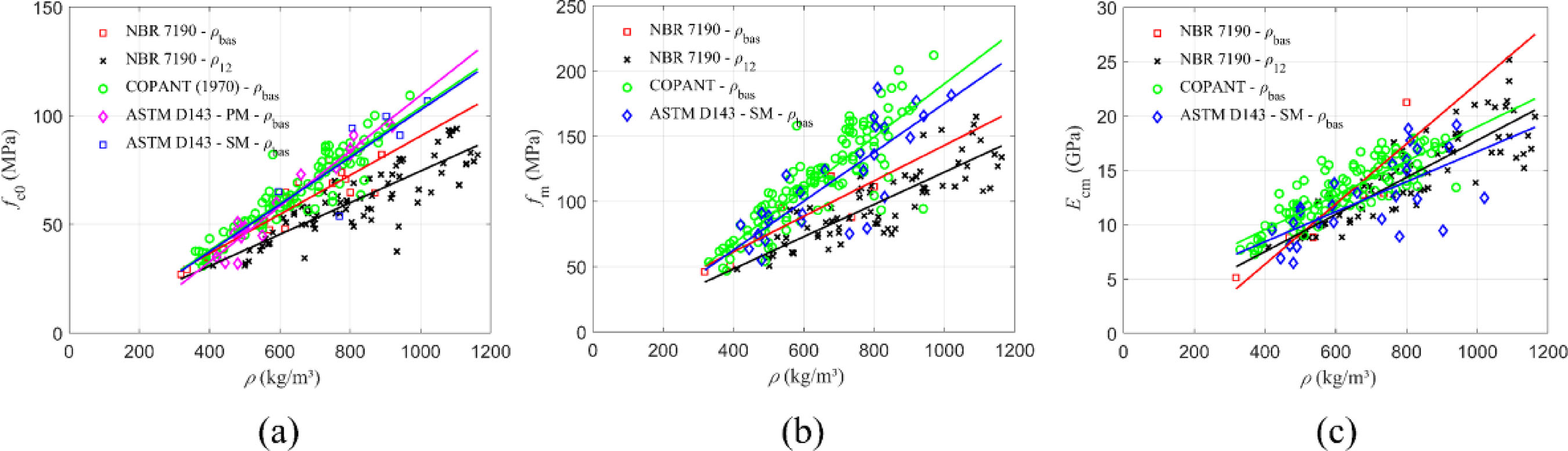
Figure 1 presents the linear regressions and the experimental data scatter obtained from the different standards for the ρ × fc0, ρ × fm and ρ × EM0. relationships. In Table 4, comparisons between the regressions obtained for the different standards are presented. The evaluation was performed using the p-value to verify if the slope and intercept of the regressions are statistically different.
Linear regressions and data scatter between density and mechanical properties obtained from different standards
In Table 4 is show that for the ρ × fc0 relationship the NBR 7190 (ABNT, 2022b) regressions, for both density parameters, are statistically distinct from the D143–PM (ρbas) and COPANT (ρbas) regressions, however, most comparisons were statistically indistinguishable. The D143–SM (ρbas) and COPANT (ρbas) regressions did not differ significantly, with high p-values (0.99 and 0.96), suggesting high similarity. Notably, some of these results considered indistinguishable, including NBR 7190 (ρbas) × COPANT (ρbas) and D143–PM (ρbas) × COPANT (ρbas), show p-values close to the 0.05 threshold (between 0.05 and 0.08). Although the test failed to demonstrate the difference with 95% confidence, the proximity to the threshold suggests that a real difference might exist, indicating low statistical power in these specific comparisons. Furthermore, in Figure 1(a) it can be noted that the data obtained from NBR 7190 (ABNT, 2022b) resulted in lower values and greater variability compared to COPANT (1974), which can be attributed to the differences in specimen dimensions established by each standard. The evaluation of the ρ × fm relationship, illustrated in Figure 1(b), indicated that the NBR 7190 (ρ12) regression is statistically different from the COPANT (ρbas) regression. The remaining analyzed regressions were considered indistinguishable. Figure 1(c) presents the ρ × EM0 relationship, most of the regressions involving the NBR 7190 (ABNT, 2022c) are statistically different. The comparison between NBR 7190 (ρbas) and D143 – SM (ρbas) resulted in statistical indistinguishability but represents a borderline case. The p-value for the slope (0.07) was close to the 0.05 threshold, suggesting that the test lacked sufficient statistical power to prove a difference that may be real.
The comparative analyses lead to the conclusion that data originating from different standards should not be pooled to evaluate the physical-mechanical properties of Brazilian hardwoods. NBR 7190 (ABNT, 2022b, 2022c) shows clear statistical differences compared to the D143-25 (ASTM, 2025) and COPANT (1974) standards, especially regarding strength properties. Furthermore, many of the comparisons are statistically inconclusive, reinforcing the need for a separate analysis of the results obtained from different testing methodologies.
4.2 Modeling the relationships between physical-mechanical properties of wood
Regression models were fitted to evaluate the relationships between physical-mechanical properties. In Table 5, a comparison is made between the regression with the lowest AIC value and the linear regression for each relationship. The differences in AIC values were evaluated by the relative likelihood (RL), quantifying whether the best-fit model was substantially superior to the linear model. For most relationships, the linear model was considered statistically equivalent or with minimally less support than the best-fit model (lowest AIC). The regression equivalence was considered to have essentially no support (RL < 3%) for the fm × fv0, ft90 × fm and EM0 × Et relationships. For the fc90 × fv0 relationship, the regression equivalence was also considered to have essentially no support, although the R² increased significantly (from 0.58 to 0.76), this may be an artifact of overfitting, given the complexity of the model and the reduced sample size (21).
Comparison between the lowest-AIC regression and the linear regression for the relationships between physical-mechanical properties
Given that the AIC tends to favor complex models (overfitting) in situations with a limited sample size, and that most regressions were classified as statistically equivalent, the linear function was chosen to represent the regressions between properties. This choice prioritizes the simplicity of the function, providing greater robustness to the analyses. Additionally, a residual analysis was conducted, verifying that the linear approach is suitable for characterizing the relationships between properties despite the high natural variability inherent to the wood species. This observation supports the assumption of constant variance, reinforcing the validity of the linear models and the evaluation metrics presented.
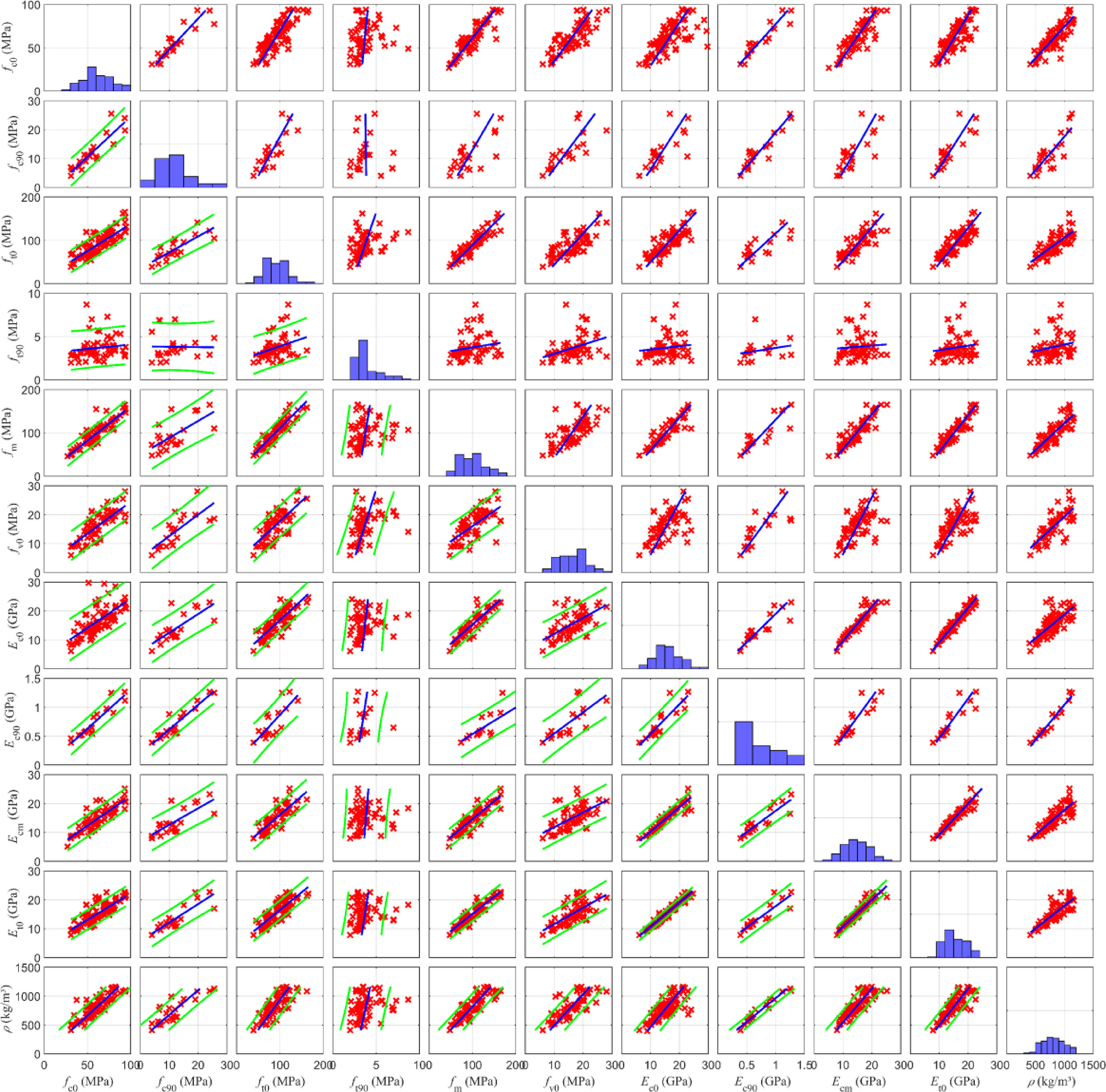
Table 6 presents the linear regression equations, the evaluation metrics, the Pearson correlation coefficient between the properties and the number of available pairs used to perform the regressions. Figure 2 illustrates the scatter plots, the linear regressions, and the 5% and 95% characteristic value curves for the mechanical properties from the experimental results. The R² values obtained in the linear regressions were consistent with those found in previous studies in literature (Dias; Lahr, 2004; Araújo, 2007; Ravenshorst; van de Kuilen, 2016; Hein; Brancheriau, 2018; Wolenski et al., 2020; Haftkhani et al., 2021). This consistency corroborates the validity of the values obtained in this study for the relationships between the physical-mechanical properties of Brazilian hardwoods.

Scatter plots and linear regressions between the mechanical properties from the experimental results
The evaluation metrics revealed three distinct performance groups among the linear regressions. The first group demonstrated predictive capability to represent the relationships, successfully meeting all established thresholds for R², MRE, and p-value. This category predominantly includes relationships between fc0, fm, Ec0, Ec90, EM0, Et0 and ρ12, confirming their reliability for practical modeling.
A second group of regressions proved statistically significant (p-value < 0.05) but failed to achieve adequate explanatory power, presenting R² values below 0.7 and, in some cases, inadequate MRE. This group encompasses several relationships involving fc90, fv0 and ft0. Failure in fc90 occurs through the structural collapse of the tubular wood cells, a process dependent on the proportion of earlywood to latewood and the width of the growth rings within the specimen. Furthermore, as demonstrated by Bodig and Jayne (1982), distinct failure patterns emerge depending on the orientation of the growth rings relative to the applied load. The fv0 and ft0 properties are associated with fragile failure modes. Christoforo et al. (2020b) investigated the relationship between ρ12 and properties of Brazilian hardwoods that present fragile failures and find out that fv0 could be estimated by ρ12 with a 0.51 for the R², a value close to the 0,61 obtained in the present work. Therefore, these regressions do not possess adequate capability to explain the variability of the data, which limits their explanatory power and prevents them from being used to make reliable predictions.
Finally, most of the regressions involving the tensile strength in the transverse directions (ft90) largely failed to yield adequate evaluation metrics and statistically significant models. The ft90 failure is characterized by separation of wood cells perpendicular to their axes, this low resistance mechanism produces splitting or cleavage along the grain that significantly affects structural integrity (Bodig; Jayne, 1982). The poor fit quality of fragile properties such as ft90 may be partly explained by anatomical wood issues, as indicated by Christoforo et al. (2020b). Combined, these anatomical and geometric factors introduce inherent variability into the experimental data for this property. Consequently, meaningful relationships could not be established with other properties. These inadequate results obtained are likely attributed to the reduced number of experimental pairs available, compounded by the high variability associated with transverse wood behavior.
4.3 Linear regressions passing through the origin of characteristic values
In Table 7, the property relationships prescribed by the NBR 7190 (ABNT, 2022b) are compared with those determined in the present study. For this analysis, the methodology was segmented: the characteristic values (fc0,k × ft0,k, ft0,k × fm,k, fc0,k × fc90,k) were determined by quantile regression (5th percentile), while mean values (Ec0,m × Ec90,m) were obtained by linear regression passing through the origin. It is observed that the slopes of the relationships obtained for fc0,k/ft0,k (0.86), fm,k/ft0,k (0.90) and fc90,k/fc0,k (0.14) were divergent from those presented in the NBR 7190 (ABNT, 2022b). In contrast, the Ec90,m/Ec0,m (1/19) relationships demonstrated similarity. The existence of these discrepancies indicates that the generic values adopted by the NBR 7190 (ABNT, 2022b) are not adequate to accurately represent the set of hardwood species analyzed.
Linear regressions passing through the origin of wood mechanical properties presented in NBR 7190 (ABNT, 2022b) and those obtained in this study
4.4 Correlations between physical-mechanical properties
Table 8 presents the correlations between physical-mechanical properties reported by the JCSS (2004), while Table 9 displays the Pearson correlation coefficients obtained in this study, relative to the relationships that demonstrated linear regression with adequate statistical significance. The JCSS (2004) reports predominantly moderate correlations (between 0.4 and 0.8), whereas the correlations determined in this study are stronger, exceeding the 0.8 threshold for several relationships, such as fc0 × fm (0.91), fc0 × ρ12 (0.86), ft0 × fm (0.90), fm × Et0 (0.92) and EM0 × Et0 (0.95). The discrepancy is even more pronounced for Et0 × ρ12 (0.95), compared to the 0.6 value from JCSS (2004). Higher correlations than those presented by JCSS (2004) were also found in Araújo (2007).
Correlation coefficients between the physical-mechanical properties of wood presented in the JCSS (2004)
Correlation coefficients between the physical-mechanical properties of wood obtained in this study
The substantially higher correlation values indicate a greater dependency between the variables, possibly attributable to specific characteristics of the Brazilian hardwood samples. Thus, the correlations obtained in this study are more suitable for representing Brazilian hardwoods in structural reliability analyses, as they were derived from an experimental dataset focused on this specific group of species.
5 Conclusions
In this study, experimental data on the mechanical properties of Brazilian hardwoods, tested according to the NBR 7190 (ABNT, 1997, 2022b, 2022c), D143-25 (ASTM, 2025), and COPANT (1974) standards, were compiled. A comparative analysis was conducted between the results derived from different standards. Subsequently, using only the data in compliance with the NBR 7190 (ABNT, 2022b, 2022c) standard, linear regressions were fitted between the mechanical properties. The performance of these regressions was evaluated using the R², MRE, and p-value metrics, and the correlation coefficients between properties were presented. From the results, it is concluded that:
-
physical-mechanical property data should not be pooled when originating from different testing standards. The comparative regression analysis proved that statistically significant differences exist between the models, particularly regarding the NBR 7190 (ABNT, 2022b, 2022c) compared to D143-25 (ASTM, 2025) and COPANT (1974), requiring that testing methodologies be treated separately to avoid methodological biases;
-
linear function is statistically equivalent to the best-fit model. Although the AIC suggested complex models in certain cases, these were justified not by a practical improvement, but rather by: overfitting in samples with a low number of pairs, relationships where no model performed well, or marginal gains over a linear model that was already adequate;
-
for Brazilian hardwoods, linear regressions are capable of adequately representing the relationships between fc0, fm, Ec0, EM0, Et0, Ec90 and ρ12 properties;
-
relationships involving fc90, associated with transverse direction, fv0 and ft0, associated with fragile failure modes, did not present adequate capability to explain the variability of the data, which limits their use to make reliable predictions;
-
it was not possible to establish meaningful relationships for linear regressions involving the ft90 property, due to the high intrinsic variability from anatomical and geometric complexities of the wood structure in the transverse direction;
-
substantial discrepancies found regarding NBR 7190 (ABNT, 2022b, 2022c) highlight the inadequacy of the generic values of the standard for the studied hardwoods; and
-
correlation coefficients between properties obtained for Brazilian hardwoods were stronger than those found in the JCSS (2004), which can be used in structural reliability analysis models, as they more accurately represent the dependency between the properties of Brazilian hardwoods.
-
MARCOLAN JÚNIOR, A. C.; MORAES, P. D. de. Relationships between physical-mechanical properties of Brazilian hardwoods. Ambiente Construído, Porto Alegre, v. 26, e153462, jan./dez. 2026. ISSN 1678-8621 Associação Nacional de Tecnologia do Ambiente Construído. http://dx.doi.org/10.1590/s1678-86212026000100988
-
Declaration of Generative AI and AI-Assisted Technologies in the Writing Process
The authors declare that no generative artificial intelligence (AI) or AI-assisted technologies were used in the writing, editing, or development of the text of this manuscript. All sections of the manuscript were conceived, written, revised, and approved exclusively by the authors. No AI system contributed to the creation, interpretation, or modification of scientific content, data analysis, methodologies, or conclusions. The authors affirm that the integrity, originality, and scientific rigor of the manuscript are entirely their own responsibility.
-
Financial Support
This study was financed, in part, by the Coordenação de Aperfeiçoamento de Pessoal de Nível Superior – Brasil (CAPES) – Finance Code 001.
Data Availability Statement
The complete dataset was deposited in the SciELO Data repository: https://doi.org/10.48331/SCIELODATA.AZSXAM.
References
- ALMEIDA, A. S. Estimativa das propriedades físico-mecânicas de madeiras tropicais brasileiras através da análise de porosimetria por intrusão de mercúrio São Carlos, 2022. PhD Thesis, Universidade Federal de São Carlos, São Carlos, 2022.
- AMERICAN SOCIETY FOR TESTING AND MATERIALS. D143-14: standard test methods for small clear specimens of timber. Philadelphia, 2014.
- AMERICAN SOCIETY FOR TESTING AND MATERIALS. D143-2000: standard test methods for small clear specimens of timber. Philadelphia, 2004.
- AMERICAN SOCIETY FOR TESTING AND MATERIALS. D143-25: standard test methods for small clear specimens of timber, Philadelphia, 2025.
- AMERICAN SOCIETY FOR TESTING AND MATERIALS. D143-83: standard test methods for small clear specimens of timber. Philadelphia, 1994.
- AMERICAN SOCIETY FOR TESTING AND MATERIALS. D143-94: standard test methods for small clear specimens of timber. Philadelphia, 1995.
- ARAÚJO, H. J. B. Relações funcionais entre propriedades físicas e mecânicas de madeiras tropicais brasileiras. Floresta, v. 37, p. 399–416, 2007.
- ARAUJO, K. A. S. Caracterização mecânica da madeira jovem de Tectona grandis Vitória, 2022. Bachelor's Thesis, Universidadade Federal do Espírito Santo, Vitória, 2022.
- ARRIAGA, F. et al. Mechanical properties of wood: a review. Forests, v. 14, p. 1202, 2023.
- ASSOCIAÇÃO BRASILEIRA DE NORMAS TÉCNICAS. NBR 7190: projeto de estruturas de madeira. Rio de Janeiro, 1997.
- ASSOCIAÇÃO BRASILEIRA DE NORMAS TÉCNICAS. NBR 7190: projeto de estruturas de madeira: parte 1: critérios de dimensionamento. Rio de Janeiro, 2022a.
- ASSOCIAÇÃO BRASILEIRA DE NORMAS TÉCNICAS. NBR 7190: projeto de estruturas de madeira: parte 3: métodos de ensaio para corpos de prova isentos de defeitos para madeiras de florestas nativas. Rio de Janeiro, 2022b.
- ASSOCIAÇÃO BRASILEIRA DE NORMAS TÉCNICAS. NBR 7190: projeto de estruturas de madeira: parte 4: métodos de ensaio para caracterização peças estruturais. Rio de Janeiro, 2022c.
- BAENA, J. S. Comparação dos critérios de dimensionamento de ligações por pinos metálicos (parafusos) em estruturas de madeira São Carlos, 2015. MSc Dissertation, Universidade de São Paulo, São Carlos, 2015.
- BATISTA, M. et al Representativeness of the fiber parallel elasticity modulus value referring to the Brazilian standard C40 strength class in the design of timber structures. Ciência Rural, v. 53, 2022.
- BODIG, J.; JAYNE, B. A. Mechanics of wood and wood composites New York: van Nostrand Reinhold, 1982.
- BRANDÃO J. B. Estudo das propriedades físicas e mecânicas de três espécies florestais Manaus, 2010. MSc Dissertation, Universidade Federal do Amazonas, Manaus, 2010.
- BRAZ, R. L. et al. Propriedades físicas e mecânicas da madeira de toona ciliata em diferentes idades. Floresta, v. 43 n. 4, p. 663–670, 2013.
- BRITO, M. L. G. et al. Resistência mecânica da madeira de Rhizophora mangle L. da reserva extrativista marinha Caeté- taperaçu, Bragança – Pará In: CONGRESSO BRASILEIRO DE CIÊNCIA E TECNOLOGIA DA MADEIRA, 5, Goiânia, 2022. Proceedings [...] Goiânia, 2023.
- BURNHAM, K. P.; ANDERSON, D. R. Model selection and multimodel inference: a practical information-theoretic approach. 2nd ed. New York: Springer, 2002.
- CABRERO, J. M.; YURRITA, M. Performance assessment of existing models to predict brittle failure modes of steel-to-timber connections loaded parallel-to-grain with dowel-type fasteners. Engineering Structures, v. 171, p. 492–504, 2018.
- CARDOSO, C. C. et al. Caracterização físico-mecânica de madeiras amazônicas com aptidão tecnológica para comercialização. Revista de Ciências Agrárias, p. 157–164, 2012.
- CEZARO, J. A.; TREVISAN, R.; BALBINOT, R. Propriedades físico-mecânicas da madeira de Chrysophyllum marginatum. Brazilian Journal of Forestry Research, v. 36 n. 86, p. 135–143, 2016.
- CHIRICO, N.; GRAMATICA, P. Real external predictivity of QSAR models: how to evaluate it? Comparison of different validation criteria and proposal of using the concordance correlation coefficient. Journal of Chemical Information and Modeling, v. 51, p. 2320–2335, 2011.
- CHIRICO, N.; GRAMATICA, P. Real external predictivity of QSAR models: part 2: new intercomparable thresholds for different validation criteria and the need for scatter plot inspection. Journal of Chemical Information and Modeling, v. 52, p. 2038–2051, 2012.
- CHRISTOFORO, A. L. et al. Estimation of wood toughness in Brazilian tropical tree species. Engenharia Agrícola, v. 40, p. 232–237, 2020a.
- CHRISTOFORO, A. L. et al Apparent density as an estimator of wood properties obtained in tests where failure is fragile. Engenharia Agrícola, v. 40, p. 105–112, 2020b.
- CHRISTOFORO, A. L. et al. Evaluation of the Peltophorum vogelianum Benth. wood species for structural use. Engenharia Agrícola, v. 39, p. 763–768, 2019.
- CHRISTOFORO, A. L. et al Full characterization of Calycophyllum multiflorum wood specie. Engenharia Agrícola, v. 37, p. 637–643, 2017.
- COMISSÃO PANAMERICANA DE NORMAS TÉCNICAS. Descrição macroscópica, microscópica e geral da madeira São Paulo, 1974.
- COSTA, L. J. et al Caracterização anatômica e descrição físico-química e mecânica da madeira de Mimosa schomburgkii Floresta, v. 47, n. 2, p. 383–390, 2017.
- DIAS, F. M.; LAHR, F. A. R. Estimativa de propriedades de resistência e rigidez da madeira através da densidade aparente. Scientia Forestalis, v. 65, n. 1, p. 102–113, 2004.
- DUARTE, B. B. Influência de componentes químicos em propriedades mecânicas da madeira São Carlos, 2017. PhD Thesis, University of São Paulo, São Carlos, 2017.
- EHLERS, R. S. Inferência estatística São Paulo: Universidade de São Paulo, 2009.
- EUFRADE JUNIOR, H. J. et al. Potential of rubberwood (Hevea brasiliensis) for structural use after the period of latex extraction: a case study in Brazil. Journal of Wood Science, v. 61, p. 384–390, 2015.
- EUROPEAN COMMITTEE FOR STANDARDIZATION. EN 1995-1-1: Eurocode 5: design of timber structures: part 1-1. Brussels, 2004.
- EUROPEAN COMMITTEE FOR STANDARDIZATION. EN 384: structural timber: determination of characteristic values of mechanical properties and density. Brussels, 2016.
- FREITAS, D. L. et al. Caracterização físico-mecânica e indicações de uso da madeira de Maclura tinctoria, Madeiras nativas plantadas do Brasil. In: MADEIRAS NATIVAS E PLANTADAS DO BRASIL: qualidade, pesquisas e atualidades. São Paulo: Editora Científica, 2021.
- GOMES, D. R. S.; RABBANI, E. R. K.; OLIVEIRA, R. A. Propriedades mecânicas das madeiras utilizadas na construção: uma revisão sistemática de literatura. Revista Brasileira de Geografia Física, v. 17 n. 3, p. 1596–1618, 2024.
- HAFTKHANI, A. R. et al. Regression and ANN models for predicting MOR and MOE of heat-treated fir wood. Journal of Building Engineering, v. 42, p. 102788, 2021.
- HEIN, P. R. G.; BRANCHERIAU, L. Comparison between three-point and four-point flexural tests to determine wood strength of Eucalyptus specimens. Maderas. Ciencia y tecnología, v. 20 p. 333–342, 2018.
- JESUS, J. M. H.; LOGSDON, N. B.; FINGER Z. Classes de resistência de algumas madeiras de Mato Grosso / Strength classes of resistance of some timbers from Mato Grosso. Engineering and Science, v. 1, n. 3, p. 35–42, 2015.
- JOINT COMMITTEE ON STRUCTURAL SAFETY. JCSS probabilistic model code Copenhagen: JCSS, 2004.
- KELLER, A. et al. Physical-mechanical wood properties of Myracrodruon urundeuva in homogeneous planting. Revista do Instituto Florestal, v. 29, n. 2, p. 239–251, 2017.
- LATREILLE, A. J. et al. Physical-mechanical properties of the wood of Dipteryx alata, Astronium graveolens, Bowdichia virgilioides and Eucalyptus grandis Revista do Instituto Florestal, v. 30, n. 2, p. 143–150, 2018.
- LIMA V. S. et al Caracterização físico-mecânica da madeira de tuturubá (Pouteria oblanceolata Pires). Revista Matéria, v. 29, n. 1, 1–13, 2024.
- LIMA, T. F. P. et al Physical and mechanical properties of Tatajuba wood specie (Bagassa guianensis) from two different Brazilian regions. Matéria, v. 23, n. 3, p. 1–6, 2018.
- LOGSDON, N. B.; FINGER, Z.; BORGES, C. G. A. Caracterização físico-mecânica da madeira de peroba-mica, Aspidosperma populifolium (APOCYNACEAE). Floresta, v. 38, n. 1, p. 11–21, 2007.
- MAIA, B. B. Resistência de ligações pregadas em madeira Pato Branco, 2016. Bachelor's Thesis, Universidade Tecnológica Federal do Paraná, Pato Branco, 2016.
- MARCOLIN, L. A. et al Properties relationship evaluation and plasticity analytical model approach for Brazilian tropical species. European Journal of Wood and Wood Products, v. 79, p. 477–485, 2021.
- MASCARENHAS, A. R. P. et al. Physico-mechanical properties of the wood of freijó, Cordia goeldiana (Boraginacea), produced in a multi-stratified agroforestry system in the southwestern Amazon. Acta Amazon, v. 64, e202003001, 2021.
- MELCHERS, R. E.; BECK, A. T. Structural reliability analysis and prediction 3rd ed. Hoboken: Wiley, 2018.
- MORAES NETO, S. P. M. et al Propriedades mecânicas da madeira de cinco procedências de Pinus caribaea var. hondurensis implantadas no Cerrado do Distrito Federal, DF Planaltina: Embrapa Cerrados, 2009. (Boletim de Pesquisa e Desenvolvimento, 251).
- MORANDO, T. C. et al. Characterization of the wood species Qualea albiflora for structural purposes. Wood Research, v. 64, p. 769–776, 2019.
- MOREIRA, L. D. S. et al. Wood from forest residues: technological properties and potential uses of branches of three species from Brazilian Amazon. Sustainability, v. 14, n. 18, p. 1–11, 2022.
- MORITANI, F. Y. et al. Structural characterization of native species according to the new brazilian standard ABNT NBR 7190: 2022: part 4. In: WORLD CONFERENCE ON TIMBER ENGINEERING, 13th, Oslo, 2023. Proceedings [...] Oslo, 2023.
- OLIVEIRA, K. A.; OLIVEIRA, C. A. B.; MOLINA, J. C. Physical, chemical and mechanical characterization of Acrocarpus fraxinifolius cultivated in Sao Paulo. Maderas. Ciencia y tecnología, v. 24, n. 1, p. 1–13, 2022.
- PELLICANE, P. J.; MIELKE, P.W. Median-based regression methods in wood science applications. Wood Science and Technology, v. 27, p. 249–256, 1993.
- RAVENSHORST, G.; VAN DE KUILEN, J. W. Species independent strength modeling of structural timber for machine grading. In: WORLD CONFERENCE ON TIMBER ENGINEERING, 17th, Vienna, 2016. Proceedings […] Vienna, 2016.
- REBOLETO, I. D. et al. Propriedades físico-mecânicas da madeira de mogno brasileiro proveniente de plantios homogêneos aos 14 anos. In: CONGRESSO BRASILEIRO DE CIÊNCIA E TECNOLOGIA DA MADEIRA, 3., Florianópolis, 2017. Anais [...] Florianópolis, 2017.
- RIBEIRO, E. S. Propriedades tecnológicas de vinte espécies de madeiras tropicais comercializadas pelo estado de Mato Grosso Brasília, 2017. PhD Thesis, Universidade de Brasília, Brasília, 2017.
- RITTER, M. A. Timber bridges: design, construction, inspection, and maintenance. Madison: USDA Forest Service, Forest Products Laboratory, 1990.
- SANTOS, H. F. et al. Influence of the harvesting region on batch homogeneity of ipe wood (Tabebuia sp.) based on its physical and mechanical properties. Forests, v. 13, p. 1385, 2022.
- SILVA, J. V. F. et al Numerical and experimental analysis of wood tensile strength perpendicular to the grain. Floresta e Ambiente, v. 29, n. 1, p. 1–8, 2022.
- SOUZA, L. V. C. et al. Physical, mechanical, and combustion properties of twelve wood species from the Brazilian Amazon. Maderas. Ciencia y tecnología, v. 27, n. 2, p. 1–19, 2025.
- STANGERLIN, D. M. et al. Mechanical properties of Amazonian woods estimated by ultrasonic wave propagation methods. Revista Nativa, v. 5, p. 628–633, 2017.
- STEYERBERG, E. W. et al Assessing the performance of prediction models. Epidemiology, v. 21, n. 2, p. 128–138, 2010.
- TEIXEIRA, J. N. et al. Influence of provenance on physical and mechanical properties of Angelim-pedra (Hymenolobium petraeum Ducke.) wood species. European Journal of Wood and Wood Products, v. 79, p. 1692–1707, 2021.
- TEIXEIRA, J. N.; ARAÚJO, N. E. M. Analysis of physical-mechanical properties of wood used in civil construction in the south of minas gerais. Revista Científica Pro Homine, v. 2, n. 1, p. 3–16, 2020.
- VILELA, R.; MASCIA, N. T. Evaluation of mechanical properties of Pinus taeda wood derived from Cross Laminated Timber panels. Ambiente Construído, Porto Alegre, v. 21, n. 4, p. 89–110, out./dez. 2021.
- WOLENSKI, A. R. V. et al Models for estimation of mechanical properties of compressive and tensile strength in the parallel direction to the grains. Ambiente Construído, Porto Alegre, v. 20, n. 1, p. 263–276, jan./mar. 2020.
Edited by
-
Guest editors:
Marcelo Henrique Farias de Medeiros and Julio Molina