 Exploring the immunomodulatory effects of turmeric on antibody responses in vaccinated broilers against Newcastle and Gumboro diseases
ABSTRACT
This study investigates the immunomodulatory effects of turmeric (Curcuma longa) supplementation on antibody production in vaccinated chicks against Newcastle Disease (ND) and Gumboro Disease (IBD). A total of 490 experimental chicks were divided into five groups, each receiving varying doses of turmeric (1g, 2.5g, 5g, and 10g) alongside vaccination, with a control group receiving no turmeric. Serum antibody levels were assessed using the ELISA test at 14- and 21-days post-vaccination. Results indicated a significant increase in antibody titers in the turmeric-supplemented groups compared to the control group, demonstrating a dose-dependent response, with the highest titers observed at 10g of turmeric. At 21 days, the antibody levels for Newcastle Disease reached 5585 standard units in the group receiving 10g of turmeric, contrasting with 3993 standard units in the control group. For Gumboro Disease, the highest antibody levels were noted in the group receiving 10g of turmeric, significantly surpassing the control group. These findings suggest that turmeric supplementation effectively enhances the immune response to vaccinations in poultry, providing a natural alternative for improving disease resistance and overall health in broiler chickens. The study highlights the potential for integrating turmeric into poultry management practices to support vaccine efficacy and improve production outcomes.
Keywords:
curcuma longa; antibody production; ELISA test; disease resistance; Gumboro disease; Newcastle disease
RESUMO
Este estudo investiga os efeitos imunomoduladores da suplementação de cúrcuma (Curcuma longa) na produção de anticorpos em pintinhos vacinados contra a doença de Newcastle (ND) e a doença de Gumboro (IBD). Um total de 490 pintinhos experimentais foi dividido em cinco grupos, cada um recebendo doses variadas de cúrcuma (1g, 2,5g, 5g e 10g) juntamente com a vacinação, com um grupo de controle que não recebeu cúrcuma. Os níveis de anticorpos no soro foram avaliados por meio do teste ELISA 14 e 21 dias após a vacinação. Os resultados indicaram um aumento significativo nos títulos de anticorpos nos grupos suplementados com cúrcuma em comparação com o grupo de controle, demonstrando uma resposta dependente da dose, com os títulos mais altos observados em 10 g de cúrcuma. Aos 21 dias, os níveis de anticorpos para a doença de Newcastle atingiram 5.585 unidades padrão no grupo que recebeu 10 g de cúrcuma, em contraste com 3.993 unidades padrão no grupo de controle. Para a doença de Gumboro, os níveis mais altos de anticorpos foram observados no grupo que recebeu 10 g de cúrcuma, superando significativamente o grupo de controle. Essas descobertas sugerem que a suplementação com cúrcuma aumenta efetivamente a resposta imunológica às vacinas em aves, oferecendo uma alternativa natural para melhorar a resistência a doenças e a saúde geral em frangos de corte. O estudo destaca o potencial de integração da cúrcuma nas práticas de manejo de aves para apoiar a eficácia da vacina e melhorar os resultados da produção.
Palavras-chave:
curcuma longa; produção de anticorpos; teste ELISA; resistência a doenças; doença de Gumboro; doença de Newcastle
INTRODUCTION
The poultry sector is a key contributor to global food security, with its rapid growth contributing significantly to the availability of affordable animal protein. However, infectious diseases, particularly Newcastle Disease (ND) and Infectious Bursal Disease (IBD, or Gumboro disease), pose major threats to poultry health and production. These viral infections lead to considerable economic losses due to high mortality rates, reduced growth, and decreased egg production (Li et al., 2024; Chapot et al., 2024; Awad et al., 2023; Toka and Geinoro, 2023). Vaccination remains the most effective strategy to prevent and control these diseases. However, the efficacy of these vaccines often depends on several factors, including the bird's immune status, nutritional support, and the use of adjuvants that enhance the immune response (Rautenschlein and Schat, 2024; Dey et al., 2023; Abdallah et al., 2023; Bodman et al., 2024).
One of the promising natural additives being explored for its immunomodulatory effects is turmeric (Curcuma longa). The active compound in turmeric, curcumin, is known for its anti-inflammatory, antioxidant, and immunostimulatory properties (El-Saadony et al., 2023; Kępińska-Pacelik and Biel, 2023; Bondar et al., 2023; Adrianta and Somantara, 2023; Pratiwy and Andriani, 2024; Ali et al., 2023; Aqeel et al., 2024). These bioactive properties suggest that turmeric could play a role in enhancing the immune response, including the early production of antibodies following vaccination. Dietary turmeric supplementation has been shown to improve poultry's overall immune function and resistance to infections. suggesting its potential as an adjuvant to optimize vaccine responses (Aderemi and Alabi, 2023; Ji et al., 2024; Zhang et al., 2024; Chen et al., 2024; Bondar et al., 2023).
While previous research has indicated that turmeric can enhance the humoral immune response and antibody production (Eleiwa et al., 2023; Macário et al., 2024; Abdel-Maksoud et al., 2023), there is limited knowledge on its early impact on the antibody titers induced by ND and IBD vaccines. Given that the early days post-vaccination is crucial for establishing effective immunity, understanding how turmeric supplementation affects the immune response within the first 21 days is vital. Exploring the early-phase effects of turmeric supplementation could offer practical implications for poultry health management, particularly in the critical period following vaccination. By providing insights into the timing and magnitude of the immune response, this study seeks to evaluate the early immunomodulatory effects of turmeric on antibody production in vaccinated poultry, aiming to identify whether turmeric can enhance early immune protection against ND and IBD.
MATERIAL AND METHODS
A total of 500-day-old Ross 308 male broiler chickens were supplied by AL-Khumasia hatchery, individually weighed, and randomly allocated into five groups of 100 birds each. They were accommodated in electrically controlled heated wire battery cages, each measuring 0.6m². Incandescent lights were utilized throughout the testing duration. Five feed treatments were categorized into 1, 2.5, 5, and 10g of Curcuma longa per kg, administered during two feeding phases: starter (1-21 days) and finisher (22-34 days). Feed and water were provided ad libitum.
The chickens were given free-range feed in plastic feeders and drinking water in plastic troughs. The chickens were reared freely until they were 3 days old, after which they were divided into five groups (B1, B2, B3, B4, B5), each group containing 96 birds. The five groups were vaccinated with Newcastle vaccine and Gumboro vaccine by eye drops and drinking water at ages (7, 14, 21) days. Blood samples were collected from the chickens from the jugular vein or wing vein at ages (1, 14, 21) days. Maternal immunity to Newcastle disease virus (NDV) and maternal immunity to Gumboro virus were measured at one day of age using ELISA test. Based on the test results, vaccination was scheduled at 7 days of age for Newcastle and 14 days for Gumboro. At three days of age, the division into groups began as follows:
-
- Group (B5) is the control group, which was vaccinated but did not receive any turmeric.
-
- Group (B1) added 1g per kilogram to its feed and was vaccinated.
-
- Group (B2) added 2.5g per kilogram to its feed and was vaccinated.
-
- Group (B3¬) added 5g per kilogram to its feed and was vaccinated.
-
- Group (B4) added 10g per kilogram to its feed and was vaccinated.
Then the antibody standard was measured for all groups after the age of (14, 21) days after vaccination and the addition of turmeric. (108) blood samples were collected, and the serum was isolated to conduct the ELISA test, as well as (108) reserve samples.
RESULT
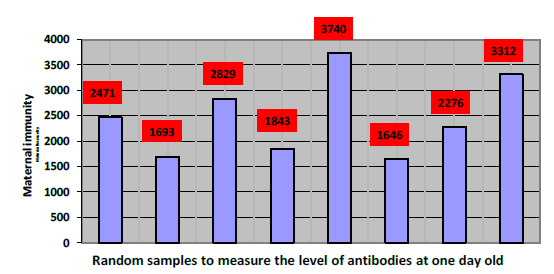
The ELISA test results prior to the addition of turmeric and before vaccination indicated a high level of antibodies against Newcastle disease, as well as for Gumboro, acquired from the mother. Based on the results obtained, the vaccination program has been developed and will be implemented for the first time to address the two diseases, as illustrated in Figures 1 and 2. Previous studies indicate that the level of antibodies acquired from the mother decreases rapidly as the age of the chicks increases.
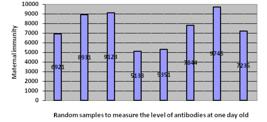
Standard for antibodies acquired from the mother for experimental chicks for Newcastle disease (ND) at the age of 1 day using the Elisa test.

Standard for antibodies acquired from the mother for experimental chicks for Gumboro disease.
Following an 11-day period of incorporating turmeric into the feed, alongside vaccination at 14 days of age, observations indicated that the antibody levels in the serum of chicks in group (B1), which received turmeric at a rate of 1g, increased to 2447 standard units as measured by the ELISA test. In group (B2), where turmeric was administered at a rate of 2.5g, antibody levels rose to 2500 standard units. Group (B3), receiving 5g of turmeric, exhibited an antibody level of 2984 standard units, while group (B4), which was given 10g of turmeric, reached an antibody level of 3966 standard units.
In group (B5), the control group that had no extra turmeric and was vaccinated, the antibody standard measured 2061 standard units (Fig. 3). The reduction in the antibody standard occurred in the control group (B5). The remaining groups exhibited a progressive increase in the antibody standard according to the rising proportion of turmeric.

Antibody standards for experimental chicks whose diet was added with turmeric and vaccinated with Newcastle vaccine using the ELISA test at the age of (14) days.
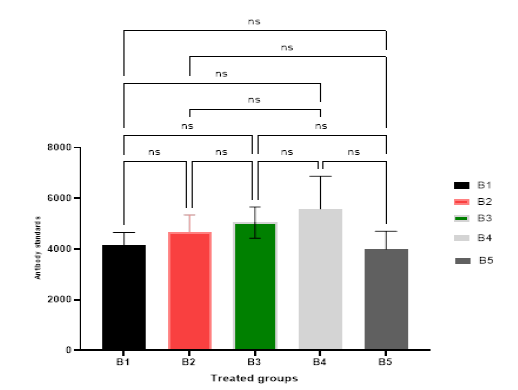
At the of 21 days, following 18 days of turmeric supplementation, the antibody standard for the ELISA test in the serum of the chicks in group B1 was recorded at 4165 standard units. This indicated an increase in antibody levels compared to the control group B5, as well as compared to the 14-day age mark within the same group and across other groups. In group B2, the antibody standard reached 4680 standard units, reflecting a significant increase, although not when compared to groups B3 and B4. In group B3, the antibody standard in the serum of the chicks was 5046 standard units, while group B4 recorded an antibody standard of 5585 standard units. In contrast, the control group exhibited an antibody standard of 3993 standard units in the serum of its chicks. The reduction in antibody titer was notable in group (B5), the control group, when compared to the other groups, which exhibited higher antibody titer levels, as illustrated in Fig. (4).
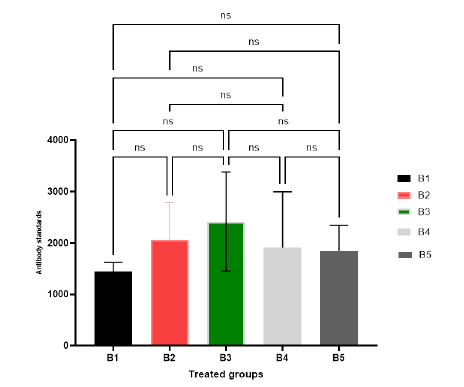
The antibody standard for Gumboro at 21 days of age revealed that group (B1), which received turmeric at a rate of 1g, exhibited a lower antibody standard in the serum of its chicks, measuring 1447 standard units. In contrast, the control group (B5) demonstrated a higher antibody standard, with its chicks showing 1845 standard units in serum. In group (B2), the serum exhibited an antibody standard of 2049 standard units. In group (B3), the serum of its chicks exhibited an antibody standard measurement of 2416 standard units. In group B4, the antibody standard measured 3710 standard units. Consequently, groups B2, B3, and B4 exhibited a notable rise in antibody rates, measuring at 2049, 2416, and 2710 standard units, respectively. In contrast, the control group B5 recorded a lower antibody standard of 1845 standard units Fig. 5.
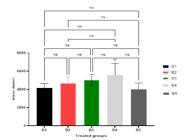
Antibody standards for experimental chickens added to their diet with turmeric and vaccinated with the Newcastle vaccine using the ELISA test at the age of (21) days.

Antibody standards for experimental chicks added to their diet with turmeric and vaccinated with Gumboro vaccine using the ELISA test at the age of (21) days.
DISCUSSION
The results from our study, particularly the observed increase in antibody titers following turmeric supplementation in combination with vaccination, align with several recent studies that highlight turmeric’s immunostimulatory properties. Specifically, turmeric, when incorporated into the diet, appears to enhance the immune response by boosting antibody production. our findings on the positive effects of turmeric supplementation on antibody titers in chicks, particularly for Newcastle Disease, are well-supported by the study of Nur et al. (2023). Both studies demonstrate that turmeric enhances the immune response in poultry through increased antibody production and possibly through modulation of leukocyte activity. While the effect on Gumboro disease is less pronounced, the overall findings reinforce the value of turmeric as a natural immunostimulant that can improve the efficacy of vaccination programs in poultry. Our findings align closely with the research by Nahed et al. (2020), showing that turmeric, like other essential oils, has a significant immunostimulatory effect, particularly on the immune response to Newcastle Disease Virus vaccination. Both studies support the idea that natural supplements can boost vaccine efficacy and sustain immunity over time. Additionally, the dose-dependent nature of turmeric's immune-enhancing properties further highlights the potential of this phytogenic additive in poultry health management. The findings of Naderi et al. (2014) provide strong support for our observations that turmeric supplementation enhances the immune response in broilers, particularly in terms of increasing antibody titers against diseases like ND and Gumboro. Both studies underscore the dose-dependent nature of turmeric's effects, its role as an immunomodulator, and its potential benefits for poultry health and performance. These results suggest that turmeric can be effectively used as a natural supplement to improve immune responses to vaccinations and overall poultry management practices. Our findings are strongly supported by the research of Arslan et al. (2017). Both studies demonstrate that turmeric supplementation enhances immune function, particularly in terms of antibody production following vaccination. The dose-dependent increase in antibody titers against ND and Gumboro observed in our study aligns with Arslan et al. (2017)’s findings that turmeric improves immune responses and overall health in broilers. This consistency suggests that turmeric, due to its immunomodulatory, antioxidant, and anti-inflammatory properties, can be effectively used to support vaccination programs and improve the health and productivity of broilers.
The findings of El-Bahr et al. (2021) closely align with our study's observations regarding turmeric’s immunomodulatory effects. Both studies demonstrate that turmeric enhances immune responses, particularly in the context of vaccination, with a dose-dependent relationship. Turmeric not only improves antibody titers but also supports overall health, as evidenced by its positive effects on blood chemistry and immune parameters in El-Bahr et al. (2021). These results suggest that turmeric is a valuable natural supplement for improving poultry health, especially when integrated into vaccination programs for diseases like ND and Gumboro. Our findings on turmeric’s role in boosting immune responses and antibody production are supported by the broader health benefits reported in Asmany (2022). While Asmany’s research focused more on growth performance and meat quality, it reinforces the idea that turmeric supplementation leads to improved overall health, which in turn supports better immune function. Both studies suggest that turmeric, due to its immunomodulatory and health-promoting properties, is a valuable additive for enhancing not only vaccination responses but also overall performance in poultry production. the findings of Zain Eldeen et al. (2022) complement our research on turmeric by providing additional evidence of the benefits of natural immunostimulants in enhancing immune responses in vaccinated chicks. Both studies underline the importance of dosage in optimizing immune enhancement and suggest that incorporating immunostimulants like turmeric into poultry diets can improve vaccine efficacy, overall health, and potentially growth performance.
CONCLUSION
This study highlights the significant immunomodulatory effects of turmeric (Curcuma longa) supplementation in enhancing antibody production in chicks vaccinated against Newcastle Disease and Gumboro Disease. The results indicate a clear dose-dependent relationship, with higher turmeric concentrations correlating with increased antibody titers, particularly noted at 10g supplementation. This study contributes to the understanding of natural dietary supplements in veterinary medicine and underscores the potential benefits of turmeric in poultry management practices, paving the way for more sustainable and health-oriented approaches in the industry.
ACKNOWLEDGMENTS
The authors sincerely acknowledge the Researcher Support Project (RSP-2024R232) for funding this work at King Saud University, Riyadh, Saudi Arabia.
REFERENCES
- ABDALLAH, N.; TEKELIOĞLU, B.K.; KURŞUN, K. et al. Vaccination and poultry (chicken) production. J. Agric. Food Environ. Anim. Sci., v.4, p.119-136, 2023.
- ABDEL-MAKSOUD, E.M.; DAHA, A.A.E.F.; TAHA, N.M. et al. Effects of ginger extract and/or propolis extract on immune system parameters of vaccinated broilers. Poult. Sci., v.102, p.102903, 2023.
- ADEREMI, F.A.; ALABI, O.M. Turmeric (Curcuma longa): an alternative to antibiotics in poultry nutrition. Transl. Anim. Sci., v.7, txad133, 2023.
- ADRIANTA, K.A.; SOMANTARA, I.G. The curcumin and gingerol combination as an immune regulator and anti-inflammatory agent of SARS-CoV infection according to a Nutrigenomic approach: a mini-review. Nat. Prod. J., v.13, p.3-12, 2023.
- ALI, R.A.S.M.; NASRIN, M.S.; HOSSEN, M.A. et al. Mechanistic insight into immunomodulatory effects of food-functioned plant secondary metabolites. Crit. Rev. Food Sci. Nutr., v.63, p.5546-5576, 2023.
- AQEEL, M.; MIRANI, A.H.; KHOSO, A. et al. A review on the study of immunomodulators and herbal remedies: A natural approach to treating necrotic enteritis. Pure Appl. Biol., v.13, p.275-302, 2024.
- ARSLAN, M.; UL HAQ, A.; ASHRAF, M. et al. Effect of turmeric (curcuma longa) supplementation on growth performance, immune response, carcass characteristics and cholesterol profile in broilers. Veterinaria, v.66, p.16-20, 2017.
- ASMANY, K. Effect of turmeric powder and zinc supplement on the growth performance and meat quality of Kadakhnath chicken. 2022. 89f. Thesis (Doctoral in Science in Animal and Poultry Nutrition degree) - Chattogram Veterinary & Animal Sciences University, Khulshi-Chattogram, BD.
- AWAD, N.; MORSI, H.; AL-BAQIR, A.; EID, A.A. Epidemiological occurrence of the infectious bursal disease virus in chicken flocks receiving various vaccination regimens. Zagazig Vet. J., v.51, p.239-262, 2023.
- BODMAN, H.O.; ROLLIER, C.; IQBAL, M. Approaches to enhance the potency of poultry vaccines. Vaccines, v.12, p.1337, 2024.
- BONDAR, A.; HORODINCU, L.; SOLCAN, G.; SOLCAN, C. Use of spirulina platensis and curcuma longa as nutraceuticals in poultry. Agriculture, v.13, p.1553, 2023.
- CHAPOT, L.; HIBBARD, R.; ARIYANTO, K. et al. Needs and capabilities for improving poultry production and health management in Indonesia. Plos one, v.19, p.e0308379, 2024.
- CHEN, Y.; LIU, L.; YU, L.; LI, S. et al. Curcumin supplementation improves growth performance and anticoccidial index by improving the antioxidant capacity, inhibiting inflammatory responses, and maintaining intestinal barrier function in eimeria tenella-infected broilers. Animals, v.14, p.1223, 2024.
- DEY, P.; AHUJA, A.; PANWAR, J. et al. Immune control of avian influenza virus infection and its vaccine development. Vaccines, v.11, p.593, 2023.
- EL-BAHR, S.M.; AL-ANKARI, A.; SHOUSHA, S. Immune-responsiveness, performance and blood chemistry of broiler chickens fed black cumin seed and/or turmeric. Thai J. Vet. Med., v.51, p.267-275, 2021.
- ELEIWA, N.Z.; EL-SHABRAWI, A.A.; IBRAHIM, D. et al. Dietary curcumin modulating effect on performance, antioxidant status, and immune-related response of broiler chickens exposed to imidacloprid insecticide. Animals, v.13, p.3650, 2023.
- EL-SAADONY, M.T.; YANG, T.; KORMA, S. et al. Impacts of turmeric and its principal bioactive curcumin on human health: pharmaceutical, medicinal, and food applications: a comprehensive review. Front. Nutr., v.9, p.1040259, 2023.
- JI, Y.; LIU, X.; LV, H. et al. Effects of Lonicerae flos and Turmeric extracts on growth performance and intestinal health of yellow-feathered broilers. Poultr. Sci., v.103, p.103488, 2024.
- KĘPIŃSKA-PACELIK, J.; BIEL, W. Turmeric and curcumin-health-promoting properties in humans versus dogs. Int. J. Mol. Sci., v.24, p.14561, 2023.
- LI, J.; DING, J.; CHEN, K. et al. Protective effects of a novel chimeric virus-like particle vaccine against virulent NDV and IBDV challenge. Vaccine, v.42, p.332-338, 2024.
- MACÁRIO, M.S.; DEL VESCO, A.P.; BRITO, C. O. et al. Turmeric essential oil improves intestinal integrity, immunological parameters, and performance of broiler chickens under cyclic heat stress. Anim. Sci. J., v.95, p.e13991, 2024.
- NADERI, M.; AKBARI, M.R.; ASADI-KHOSHOEI, E.; KHAKSAR, K.; KHAJALI, F. Effects of dietary inclusion of turmeric (Curcuma longa) and cinnamon (Cinnamomum verum) powders on performance, organs relative weight and some immune system parameters in broiler chickens. Poult. Sci. J., v.2. p.153-163, 2014.
- NAHED, A.; SHEWITA, R.S.; ABD EL-HACK, M.E. et al. Effect of essential oils on the immune response to some viral vaccines in broiler chickens, with special reference to Newcastle disease virus. Poult. Sci., v.99, p.2944-2954, 2020.
- NUR, A.M.; PURWANTI, S.; RAHARDJA, D.P.; MUTISARI, D. Effect of giving turmeric flour (curcuma domestica) on differential leukocytes, antibody titers of avian influenza and newcastle disease super native chickens. Anim. Prod. Indones. J. Anim. Prod., v.25, n.2, 2023.
- PRATIWY, F.M.; ANDRIANI, Y. Nigella Sativa as A potent natural additive in aquaculture: enhancing growth, immunity, and sustainability. GPH Int. J. Agric. Res., v.7, p.26-35, 2024.
- RAUTENSCHLEIN, S.; SCHAT, K.A. The Immunological basis for vaccination. Avian Dis., v.67, p.366-379, 2024.
- TOKA, T.; GEINORO, T. Vaccine failure and its control methods in poultry production. Br. J. Poult. Sci., v.12, p.63-73, 2023.
- ZAIN ELDEEN, A.I.A.; YOUNES, A.M.; ELBAYOUMI, K. et al. Influence of Different Immunostimulants on Growth, Serological Response and Histological Changes of Newcastle Disease Virus-vaccinated Chicks. J. of Current Vet. Research, v.4, p.31-44, 2022.
- ZHANG, J.; ZHANG, R.; JIN, S.; FENG, X. Curcumin, a plant polyphenol with multiple physiological functions of improving antioxidation, anti‐inflammation, immunomodulation and its application in poultry production. J.Anim. Physiol. Anim. Nutr., v.108, p.1890-1905, 2024.