 Characterization profile, hematological parameters, muscle biochemistry, and carrying capacity of cart horses from Alagoas, Brazil
ABSTRACT
The use of carthorses remains common in rural areas, small towns, and the outskirts of metropolises. The welfare of these animals has only recently received attention, aiming to improve health, longevity, and productivity. This study aimed to characterize urban draft horses from Alagoas, Brazil, through physiological, hematological, and biochemical parameters, and the calculation of carrying capacity, to support the creation of more appropriate public policies. A total of 76 crossbred horses of different ages and sexes were evaluated through physical examination, hematological and biochemical analysis, as well as body condition scoring, body weight measurement, and calculation of pulling capacity. Results showed a predominance of adult females, with an average weight of 320kg. Increased heart and respiratory rates were observed in most animals, along with anemia in 35.5% and elevated CK enzyme in 10.5%, indicating possible muscle injuries. Most horses had body condition scores between 4 and 6, considered adequate for work. Carrying capacity varied according to age and weight, with adults showing higher values (648kg on average), and a categorization by weight range was proposed for regulation. The findings reinforce the need for public policies that consider animal health and welfare, including periodic individual evaluations and standardization of parameters.
Keywords:
animal traction; animal welfare; public policy
RESUMO
O uso de cavalos de tração permanece comum em áreas rurais, pequenas cidades e periferias de metrópoles. O bem-estar desses animais só recentemente tem recebido atenção, com o objetivo de melhorar a saúde, a longevidade e a produtividade. Este estudo teve como objetivo caracterizar cavalos de tração urbanos de Alagoas, Brasil, por meio de parâmetros fisiológicos, hematológicos e bioquímicos, além do cálculo da capacidade de carga, para embasar a criação de políticas públicas mais adequadas. Foram avaliados 76 cavalos mestiços de diferentes idades e sexos, por meio de exame físico, análises hematológicas e bioquímicas, determinação do escore corporal e do peso corporal e cálculo da capacidade de carga. Os resultados mostraram predominância de fêmeas adultas, com peso médio de 320kg. A maioria dos animais apresentou aumento das frequências cardíaca e respiratória, além de anemia em 35,5% e elevação da enzima CK em 10,5%, indicando possíveis lesões musculares. A maior parte dos cavalos apresentou escore corporal entre 4 e 6, considerado adequado para o trabalho. A capacidade de carga variou conforme a idade e o peso, sendo maior em animais adultos (média de 648kg), e foi proposta uma categorização por faixas de peso para regulamentação. Os achados reforçam a necessidade de políticas públicas que considerem a saúde e o bem-estar animal, incluindo avaliações periódicas individuais e a padronização de parâmetros.
Palavras-chave:
tração animal; bem-estar animal; políticas públicas
INTRODUCTION
The use of horses, donkeys, and mules for transportation, loading, and traction has been recorded for approximately 6000 years. Even though it is an ancient activity, the use of horses in carts is still observed in small cities, peripheries of metropolises, and praedial areas, representing approximately 25% of the total driving force used on agrarian properties in Brazil (Clutton-Brock, 1992; Brazil, 2016).
Despite still being an activity widely used by man, little is addressed about the animal welfare of these equids, with just a few studies on the subject, which was initiated by Harryson (1964), in the book “Animal Machines”, opening discussions about adequate conditions for well-being and positive consequences on production capacity, longevity, and health (Harrison, 1964; Fraser, 2001; Mota and Marçal, 2019).
With the first industrial revolution, there was the advent of the creation of mechanized vehicles for transporting cargo and their technological advancement, making animals a temporary or subsistence alternative for traction, transport, freight and work on small rural properties, country cities, or peripheries of metropolises. In this context, most of the time, animals are subjected daily to activities that exceed their physiological carrying capacity, consequently damaging their health and causing significant harm to their well-being, which are even more accentuated by the lack of effective public policies in the regulation of their work activities (Escodro et al., 2012; Lima et al., 2020; Ribeiro et al., 2020).
The efforts of municipal governments, non-governmental organizations (NGOs), and universities have focused on eradicating this type of work activity in capital cities, with laws prohibiting horse traction in Recife (Recife, 2013; Recife, 2021), Porto Alegre (Porto Alegre, 2008; Porto Alegre, 2016) and Curitiba (Curitiba, 2007); However, considering that the activity represents the only source of income for a considerable portion of the population in these communities, regulatory laws must be considered, not only from the perspective of the driver and vehicle, but the health and well-being of the horse.
Decree No. 27,122 of August 28, 2006, of the Federal District, regulates the use of carts within cities through the registration and licensing of cart drivers, driving age, dimensions, and vehicle registration. However, it only addresses the animal in relation to mandatory infectious anemia exams and biannual rabies vaccination, without any indication of health tests, disease prophylaxis, and animal welfare assessment. Furthermore, it generalizes the load weight to 350kg per cart, without considering the horses' aptitude and physiological capacity for such activity. Distrito Federal, 2006; Mariz et al., 2014; Prado et al., 2019).
Parameters such as age, sex, body score (BS), heart rate (HR) and respiratory rate (RR), as well as hematological variables such as packed call volume (PCV), total plasma proteins (TPP), fibrinogen (FB) and the enzyme creatine kinase (CK) are important for determining the health and animal welfare of draft horses. PCV, TPP, and FB are used respectively to evaluate anemia, dehydration (or hypoproteinemia), and inflammation, while CK is mainly used to detect muscle injuries. (Volfinger et al., 1994; Santos et al., 2014).
In addition to the aforementioned parameters, the animal carrying capacity (CC) must be considered essential, considering the variables: body weight (BW), average friction coefficient for all terrains (µr), kinetic friction coefficient between the axes of the cart (µk), and gravitational acceleration at sea level (G). This index indicates the carrying capacity in kilograms that the animals can pull without exerting excessive effort, which could cause risk factors for their health and well-being. (Mariz et al., 2018).
Aiming to evaluate physiological, hematological parameters, and calculation of CC for draft horses in activity in the state of Alagoas, with a focus on the construction of public policies, the present study was conducted to determine a profile for such animals and implications for health and well-being.
ETHICAL ASPECTS
This research was submitted to the Ethics Committee on Animal Use (CEUA) of the Federal University of Alagoas, and approved under the protocol number 18/2022.
MATERIALS AND METHODS
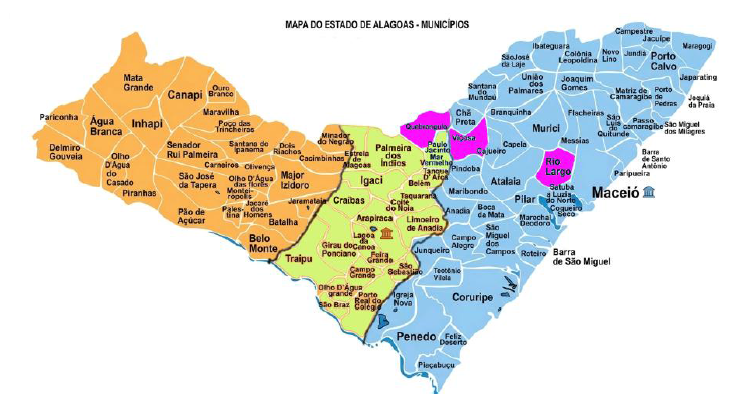
A total of 76 draft horses were selected, with different sexes and ages, attended in social actions conducted in the municipalities of Rio Largo, Quebrangulo, and Viçosa, located in the zona da mata and agreste region of the state of Alagoas (Fig. 1). As for the inclusion criteria, only clinically healthy and active horses were used.

Orange represents the Sertão region, green represents the Agreste region, and blue represents the east or coastal region. Pink are the cities of Quebrangulo, Viçosa and Rio Largo.
All the data was collected by experienced staff of Veterinarians and Zootechnitians on distinct moments during social work for the carthorses. To determine the age of the animals, the dental arch assessment method proposed by Silva et al., (2003) was used, with young animals being aged 18 to 30 months (1.5 to 2.5 years), adult animals aged 36 to 168 months (3 to 14 years), and senile animals aged 192 to 288 months (16 years to 24 years).
The animals were evaluated through a detailed historic and physical examination using standard semiological technique (Feitosa, 2021). The parameters evaluated include Heart Rate (HR) in beats per minute (bpm), measured with a stethoscope in the left thoracic region, caudal to the elbow. Respiratory Rate (RR) observing abdominal and thoracic movement in respiratory movements per minute (mpm) and rectal temperature using a digital thermometer (Cº). These parameters were measured in animals with at least 30 minutes of rest.
For body score assessment, the technique developed by Henneke et al. (1983), and cited by Mariz et al. (2014) was used as a basis. Conducted using the method of visual observation and palpation of the coverage in six areas: dorsal edge of the neck; withers; ribs; posterior part of the scapula; lumbar spinous processes; base area of the tail, using the scale of 1-9, where 1 represents the cachectic animal and 9 the obese animal. The animals' body weight (BW) was measured using a weighing tape, which considers BW to be the product of the thoracic perimeter cubed by the constant 80, with the tape positioned just after the end of the withers between the 8th and 9th intercostal space (Mariz et al., 2014).
To determine the carrying capacity (CC) to which horses can be subjected, the calculation formulated by Mariz et al. (2018) where:
CC= carrying capacity
µk = 0.0015 Coefficient of kinetic friction between the axles
µr= 0.097 Average friction coefficient for all terrain
G = 9.8 Gravitational acceleration at sea level, expressed in meters per second squared (m/s²)
BW = Body weight in kilograms
After physical evaluation, blood samples were collected through puncture of the jugular vein and stored under refrigeration in tubes with EDTA to measure packed cell volume (PCV), total plasma proteins (PPT), and plasma fibrinogen (FB). Samples were also collected in tubes with clot activator for serum separation and serum biochemical evaluation of the Creatine Kinase (CK) enzyme (CK NAC UV kit - Bioclin - Quibasa) using the semi-automatic biochemical analyzer (Max Bio 300 - CONTEC). As an assessment standard, the physiological reference values presented in Table 1 were used.
All parametric data, including physiological parameters from the clinical and laboratory examinations collected, were recorded on individual assessment sheets, and subsequently tabulated to perform statistical calculations.
Initially, descriptive statistics were performed on the variables studied and whether there was a significant effect of location on the weight of the animals. For this purpose, one-way ANOVA was used. Data normality was assessed using the Shapiro-Wilk test and the assumption of data homogeneity using Levene's test. As the location effect was not significant (p>0.05), all animals from distinct locations were grouped together. The animals were then grouped according to their age group and sex, according to the Table 2.
For all variables studied (weight, temperature, respiratory rate, heart rate, body score, fibrinogen, packed cell volume (PCV), total plasma protein, creatine kinase enzyme and carrying capacity) the effects of age group within each sex were evaluated. using univariate ANOVA. The Tukey test was used to assess where the differences were. For all analyses, a significance level of P ≤ 0.05 was considered.
RESULTS AND DISCUSSION
The present research took place on the Zona da Mata and Agreste regions on the State of Alagoas, where 76 cart horses were evaluated, 60% (46/76) females and 40% (30/76) males. The same trend described by Mariz et al. (2014) was observed in 49 horses in the municipality of Arapiraca, located in the Agreste region of Alagoas, showing a predominance of females (64% or 31/49) in relation to males (36% or 18/49). According to this same study, it is believed that there is a preference for females due to their less agitated and aggressive behavior compared to males and because they are used both in traction work and in reproduction, generating one foal per year that could be sold or used on the wagon after adulthood.
The study by Sangioni et al. (2016) conducted in Santa Maria in Rio Grande do Sul showed a prevalence of males (65.4%), and among these, approximately 70% were castrated also due to their more docile behavior in relation to stallions and their greater resistance to work. These studies demonstrate the preference for more gentle and easy-to-handle animals, but with a significant variation between males and females when comparing different regions of Brazil.
In relation to age, the dental arch examination, according (Silva et al. (2003), was conducted in association with the information provided by the tutors. The average age among females was 101.61±77.09 months (8.4±6.4 years) and among males it was 122.40±78.03 months (10.2±6.5 years), indicating that the majority (57.9% or 44/76) of the animals were within the acceptable age for traction work, although excessively young animals were seen, 9/46 females and 5/30 males ( 19% and 17% respectively) aged up to 30 months (2.5 years) or very old with a total of 9/46 females and 9/30 males (19% and 30% respectively) aged up to 288 months (24 years).
In this context, as well as in the present study, studies carried out by Ribeiro et al., (2020) in Viçosa-Alagoas stand out, where the average age of the animals evaluated was 11.45±8.88 years, according to the study of Sangioni et al. (2016) in the city of Santa Maria, Rio Grande do Sul, a large variation was observed between 1 and 21 years of age, with 45.6% (87/191) aged over 11 years. The study by Motta et al. (2018) in Rio Verde, Goias, presenting animals from 4 to 20 years old, thus showing a variation between equine cart drivers in Brazilian cities.
Still regarding age, studies indicate that young horses (≤ 2.5 years) should not be subjected to strenuous exercise activities as this is directly related to their bone and muscular development, considering that the association of excess load with inadequate nutrition and unbalanced hooves can lead the animal to develop angular deviation, compromising its health and well-being, requiring a gradual exercise routine until the horse reaches its peak of strength and ability (Atayde, 2022). The elderly horse (≥ 16 years) is not capable of carrying out strenuous exercises such as traction work due to changes in body composition and a deficit in the immune response, reducing its capacity for work activities, making it necessary to establish a standard limit of age and working time for the animals, aiming for their health and well-being (Mello, 2012; Sangioni et al., 2016).
Evaluating the heart rate (HR) of the animals, it was noted that only 8.7% (4/46) of the females and 3.3 (1/30) of the males had HR within the standards considered normal for the species. Meanwhile, 91.3% (42/46) of females and 93.3% (28/29) of males showed an increased heart rate, with an average of 46 bpm for males and 49 bpm for females. HR monitoring makes it possible to quantify the intensity of the workload, contributing to the control of physical conditioning and the effects of exercise on the cardiovascular system. In endurance races, at each Vet Check, with 20 minutes of rest, the animals only continue in the race if the HR is below 64 bpm, which shows that the increase in HR found is more related to the agitation of the animals at the place of the monitoring actions, rather than lack of physical fitness (Younes et al., 2016; Garcia et al., 2020). Furthermore, the age factor did not significantly influence the HR variable.
The same pattern was observed in relation to respiratory rate (RR), with an overall average of, 31 mpm for males, and 29 mpm for females. However, even if statistically not significant, senile animals showed a higher mean RR at rest, which was 37 mpm, compared to 27 in young and adult animals, as described in Table 3. The increase in RR in clinically healthy animals may be related to chronic respiratory diseases, such as recurrent airway obstruction (RAO), common in more mature animals (Davis and Rush, 2002). This finding may justify the need for an age limit for working with draft horses when creating public policies. Regarding temperature, all animals in the present study were within physiological standards for the species.
However, when evaluating the body score, it was noticed that the majority of animals evaluated (89.1% of females and 86% of males) had an average between 4 and 6, which makes them suitable for work, according to a scale of 1- 9 from Henneke et al. (1983). These results differ from the study carried out by Oliveira (2018), in the city of Recife/PE, which demonstrated that draft horses have a lower body score than other groups of horses, such as vaquejada and racing horses.
The calculation by (Mariz et al., (2018) considers the weight of the animals as the main factor for determining the load that the animal can pull. In the present study, the animals had an average body weight of 320.39±69.56kg, where males had a higher average body weight (332.50±66.46kg) than females (304.00±61.92kg). A significant difference in carrying capacity was found (F (2, 73) =3.638, p=0.31, π2=0.09), however, the effect size was negligible. The carrying capacity of young animals (mean=544.98, SD=117.05) differed significantly from the carrying capacity of working-age animals (mean=648.20, SD=129.01) (Table 4).
Therefore, considering carrying capacity as a dominant factor in the creation of public policies, it is suggested to separate animals into categories, determined by the weight of the animal, using Table 5 as an example.
Regarding hematological parameters, among the horses evaluated, 35.5% (15 females and 12 males) presented PCV below the reference values, in addition to these, 1 animal (1.3%) presented increased TPP, which shows a picture of dehydration associated with anemic conditions. Despite the high number of animals with low PCV, their clinical status, body condition and body score were normal, in line with the study Grizendi et al. (2020) which shows that draft horses have decreased hematological parameters compared to sports animals. This is because these animals do not have the same nutritional and management conditions as animals used for sport. This result demonstrates concern for the health and well-being of these animals, so that studies of cost-benefit diets favorable to cart drivers and that meet nutritional requirements in terms of the need for proteins, energy, vitamins, and minerals for urban draft horses. An analysis of practices for the standardization of hematological and physiological parameters in urban draft horses is also necessary.
In the evaluation of fibrinogen, 11 animals (14.5%) presented increased fibrinogen, indicating possible systemic inflammation, among these, 5 (6.6%) presented anemia, with the possibility of associating such results with a high load of ectoparasites or possible conditions of hemoparasitosis or some chronic condition, such as cardiovascular and respiratory tract conditions, or lameness associated with poor nutrition. Furthermore, among the animals with increased fibrinogen, 1 showed an increase in the CK enzyme, bringing the association of a possible muscle injury with the systemic presentation of increased fibrinogen.
The increase in the CK enzyme is influenced by the intensity and duration of the exercise, being influenced by the animal's physical conditioning, whether due to age, sex, or diet. In the present study, 8 animals (10.5%) showed this parameter increased by up to 30.4%, among them, 5 females and 3 males of adult and senile ages; however the general average for all ages between males and females remained within physiological standards for the species (Table 6). This increase in CK may be related to work carrying loads greater than what the animals are able to carry or even an exceedingly long time of work, thus highlighting the importance of determining this profile and carrying out the present study.
After analyzing the data presented in the present study and unifying it with that presented by the studies by Mariz et al., 2014, 2018 carried out in the Agreste area of Alagoas, it is possible to determine and create state public policies that meet, fairly and accurately, the specific needs of urban traction horses, and it is also important to create studies to determine the profile of traction horses in cities in the Sertão of Alagoas, thus providing a general overview that can be used in the creation of models of regulations. To this end, in addition to determining this profile, it is necessary to standardize the physiological and hematological profile of these animals, as they showed significant differences during physical assessment when compared to the reference values commonly used for the species (Grizendi et al., 2020).
As a conclusion, the data reported in the present study bring key factors to the creation of public policies in favor of horses and cart drivers, taking animal health and well-being into relevant consideration. Some points for this construction must be highlighted: need for minimum and maximum age limits for work; inclusion of plasma fibrinogen and serum CK measurement to build a protocol to regulate its use in horses; there is a need to assess body weight and score to determine load capacity; each horse must have its carrying capacity determined and periodically reevaluated.
There is a need for further research to physiologically validate the formula by Mariz et al. (2018), assisting in the construction of tools that can assist in the inspection of animals in traction activities by municipal organizations, in addition to the need for new studies on sterilization and population control of horses, reducing reproduction on urban roads in the long term and young animals in activity.
REFERENCES
- ATAYDE, M.F.B. Clínica e reprodução de Equinos - deformidades angulares e flexurais em poldros. 2022. 90f. Mestrado (Medicina Veterinária) - Escola de Ciências e Tecnologia, Universidade de Evora, POR.
- BRAZIL, Revisão do Estudo do Complexo do Agronegócio do Cavalo. Ministério da Agricultura, Pecuária e Abastecimento. Brasilia 2016.
- CLUTTON-BROCK, J. Horse Power - a history of the horse and the donkey in human societies. London: National history museum publications, 1992. 182p.
-
CURITIBA. Lei no 12.092, de 21 de dezembro de 2006. Estima a receita e fixa a despesa do município de Curitiba para o exercício financeiro de 2007. Brasil. Http://Domino.Cmc.Pr.Gov.Br/Contlei.Nsf/98454e416897038b052568fc004fc180/E5df879ac6353e7f032572800061df72, 21 dez. 2007.
» Http://Domino.Cmc.Pr.Gov.Br/Contlei.Nsf/98454e416897038b052568fc004fc180/E5df879ac6353e7f032572800061df72 - DAVIS, E.; RUSH, B.R. Equine recurrent airway obstruction: pathogenesis, diagnosis, and patient management. Vet. Clin. North Am. Equine Pract., v.18, p.453-467, 2002.
- DISTRITO FEDERAL. Decreto n° 27.122 de 28 de agosto de 2006. Dispõe sobre o trânsito de veículos de tração animal nas vias públicas urbanas e faixas de domínio das rodovias no Distrito Federal, e dá outras providências. Brasil. Lei Orgânica do Distrito Federal, 28 ago. 2006.
- ESCODRO, P.B.; SILVA, T.J.F.; MARIZ, T.M.A.; LIMA, E.S. Estudo da realidade e propostas de ações transdisciplinares para equídeos de tração carroceiros de Maceió-Alagoas. Rev. Bras. Direito Anim., v.11, p.97-115, 2012.
- FEITOSA, F.L.F. Semiologia veterinária: a arte do diagnostico. 4.ed. São Paulo: Roca, 2021. 686p.
- FRASER, D. The “New Perception” of animal agriculture: Legless cows, featherless chickens, and a need for genuine analysis. J. Anim. Sci, v.79, p.634-641, 2001.
- GARCIA, C.A.S.C.; MARTINS, C.F.; SILVA, L.L. Frequência cardíaca, lactacidemia e gasto energético de equinos da raça Crioula em provas credenciadoras ao Freio de Ouro. Arq. Bras. Med. Vet. Zootec., v.72, p.1631-1638, 2020.
- GRIZENDI, B.M.; DORIA, R.G.S.; PASSARELL, D. Correlation between hematological evaluation and the type of physical activity performed by horses in the state of São Paulo-Brazil. Ciênc. Anim. Bras., v.21, 2020.
- HARRISON, R. Animal Machines London: Vincent Stuart Publishers, 1964. 186p.
- HENNEKE, D.R.; POTTER, G.D.; KREIDER, J.J. Body condition during pregnancy and lactation and reproductive efficiency of mares. Theriogenology, v.21, p.897-909, 1983.
- LIMA, L.P.; SILVEIRA JR., J.A.; SANTOS, D.M. et al Padrão biométrico dos cavalos de tração do município de Itapetinga-BA. Braz. J. Dev., v.6, p.77956-77962, 2020.
- MARIZ, T.M.A.; ESCODRO, P.B.; DITTRICJ, J.R. et al Padrão biométrico, medidas de atrelagem e índice de carga de equideos de tração urbana do município de Arapiraca, Alagoas. Arch. Vet. Sci., v.19, p.1-8, 2014.
- MARIZ, T.M.A.; ESCODRO, P.B.; LIMA, L.P. et al Equation for predicting the load-pulling capacity of traction equids. J. Equine Vet. Sci., v.69, p.115-118, 2018.
- MELLO, E.B.F.R.B. Adaptação ao exercício em potros puro-sangue inglês de corrida 2012. 56f. Tese (Doutorado em Medicina Veterinária, Patologia e Ciências Clínicas) - Universidade Federal Rural do Rio de Janeiro, Seropédica, RJ.
- MOTA, R.G.; MARÇAL, W.S. Behavior and animal welfare of confined cattle: alternatives for efficient, cost-effective and quality production: literature review. Rev. Bras. Hig. Sanidade Anim., v.13, n.1, 2019.
- MOTTA, R.G.; MARTINS, L.S.; CARNEIRO, W.B.C. et al Perfil hematológico dos equideos de tração do projeto “carroceiro legal não maltrata animal”. In: JORNADA CIENTÍFICA E TECNOLÓGIS FA FATEC DE BOTUCATU, 7., 2018, Botucatu. Anais.., Botucatu: [s.n.], 2018. 8p.
- OLIVEIRA, V.T.B. M. Índice de escore corporal em cavalos de trabalho e atletas 2018. 39f. Mestrado (Ciência Animal) - Centro de Ciências Agrárias, Universidade Federal da Paraíba, Recife-PE.
- PORTO ALEGRE. Lei no 10531 de 10/09/2008. Lei no 10531 de 10/09/2008. Institui no Município de Porto Alegre, o Programa de Redução Gradativa do Número de Veículos de Tração Animal e de Veículos de Tração Humana. Brasil, Porto Alegre Câmara Municipal, 10 set. 2008.
- PORTO ALEGRE. Lei no 12117 de 06/09/2016. Altera o Caput e inclui Incs. I e II no Caput do Art. 3o da Lei no 10.531, de 10 de setembro de 2008. Estende o prazo de proibição para a circulação de veículos de tração no município de Porto Alegre. Brasil, Porto Alegre Câmara Municipal, 6 set. 2016.
- PRADO, V.C.M.; HAGE, M.C.F.N.S.; DÓRIA, R.G.S. Welfare and locomotor system disorders in active draft horses (cart horses). Pesqui. Vet. Bras., v.39, p.942-948, 2019.
- RECIFE. Decreto no 34432 de 19/03/2021. Prorroga os prazos previstos no §1o e no §2o do Art. 3o do Decreto Municipal no 32.121, de 08 de fevereiro de 2019. Brasil, Câmara Municipal de Recife, 19 mar. 2021.
- RECIFE. Lei no 17918 de 06/09/2013. Proíbe a circulação de veículos de tração animal, a condução de animais com cargas e o trânsito montado no município do Recife e dá outras providências. Brasil, Câmara Municipal de Recife, 6 set. 2013.
- RIBEIRO, A.A.R.; FONSECA, L.S.; AMORIM, C.V.O. et al Perfil socioeconômico de tutores e proposição de avaliação do bem-estar em muares de tração extratores de areia no Rio Paraíba. Res. Soc. Dev., v.9, p.e617997552, 2020.
- SANGIONI, L.A.; CADORE, G.E.; BETTON, S.A. et al Bem estar de equinos de tração e perfil sócio-econômico dos carroceiros de Santa Maria, Rio Grande do Sul. Vet. Zootec., v.23, p.679-687, 2016.
- SANTOS, F.C.C.; FEIJÓ, L.S.; KASINGER, S. et al Hematologic values of thoroughbred foals from birth to six months of age. Ciênc. Anim. Bras., v.15, p.307-312, 2014.
- SILVA, M.F.; Gomes, A.S. Dias, J. et al Estimativa da idade dos equinos através do exame dentário. Rev. Port. Ciênc. Vet., v.98, p.102-110, 2003.
- SILVA, T.C. Utilização de benzodiazepínicos em protocolos de anestesia total intravenosa (TIVA) em equinos-revisão de literatura 2018. 48f. Monografia (Trabalho de Conclusão de Curso) - Centro de Ciências Agrárias, Ambientais e Biológicas da Universidade Federal do Recôncavo da Bahia, BA.
- VOLFINGER, L.; LASSOURD, V.; MICHAUX, J.M. et al Kinetic evaluation of muscle damage during exercise by calculation of amount of creatine kinase released. Am. J. Physiol., v.266, p.R434-R441, 1994.
- YOUNES, M.; ROBERT, C.; BARREY, E.; COTTIN, F. Effects of age, exercise duration, and test conditions on heart rate variability in young endurance horses. Front. Physiol., v.2, p.155, 2016.
The research data are available within the article itself.