 LONG-TERM SURVIVAL AFTER LAPAROSCOPIC TOTAL GASTRECTOMY FOR EARLY AND ADVANCED GASTRIC CANCER. SINGLE CENTER EXPERIENCE IN 100 CASES
ABSTRACT
BACKGROUND: Laparoscopic gastrectomy offers advantages in the postoperative period compared to the open approach. Most studies have been performed on distal gastrectomies; however, laparoscopic total gastrectomy (LTG) is not universally accepted. AIM: The aim of this study was to assess the results of LTG, on postoperative morbidity outcomes and long-term survival.
METHODS: This is a retrospective cohort study from a prospective database of patients who underwent LTG, from 2005 to 2022, due to early and advanced gastric cancer. A totally laparoscopic technique was utilized, and the Roux-en-Y reconstruction was performed in all cases. Postoperative complications and long-term survival were evaluated.
RESULTS: A total of 100 patients were included (men 57, age 64 years, and body mass index 26). A D2 lymphadenectomy was performed in 68 cases. The postoperative hospitalization period was 8 days (6–62 days). Postoperative complications occurred in 26%, with 7% esophago-jejunal anastomosis leak, 4% abdominal collections, and 2% gastrointestinal bleeding. In 7% of cases, the complication was considered Clavien 3 or greater. Operative mortality was 1%. The pathology findings confirmed advanced gastric cancer in 50 cases. The median lymph node count was 38, and surgery was considered R0 in 99%. The median follow-up was 50 months. Overall 5-year survival was 74%. Survival in T1 cases was 95% at 5 years. For stage I, survival was 95%, and for stages II and III, it was 52% and 43%, at 5 years, respectively.
CONCLUSIONS: These results support the feasibility and oncological adequacy of minimally invasive total gastrectomy. Postoperative morbidity has an acceptable rate. Long-term survival was in accordance with the disease stage.
HEADINGS:
Gastrointestinal Neoplasms; Laparoscopy; Gastrectomy; Postoperative Complications; Survival
RESUMO
RACIONAL: A gastrectomia laparoscópica oferece vantagens no pós-operatório em comparação à abordagem aberta. E a gastrectomia total laparoscópica não é universalmente aceita. OBJETIVOS: Avaliar os resultados da gastrectomia total laparoscópica, nos resultados de morbidade pós-operatória e sobrevida em longo prazo.
MÉTODOS: Este é um estudo de coorte retrospectivo de um banco de dados prospectivo de pacientes submetidos à gastrectomia total laparoscópica, de 2005 a 2022, devido a câncer gástrico precoce e avançado. Foi utilizada a técnica totalmente laparoscópica e a reconstrução em Y de Roux foi realizada em todos os casos. Complicações pós-operatórias e sobrevida em longo prazo foram avaliadas.
RESULTADOS: Foram incluídos 100 pacientes (homens 57, idade 64 anos, IMC 26). Linfadenectomia D2 foi realizada em 68 pacientes. O tempo de hospitalização pós-operatório foi de 8 dias (6-62 dias). Complicações pós-operatórias ocorreram em 26%, com 7% de fístulas da anastomose esôfago-jejunal. Em 7% dos casos a complicação foi considerada Clavien 3 ou superior. A mortalidade operatória foi de 1%. Os achados anátomo-patológicos confirmaram câncer gástrico avançado em 50 casos. A mediana da contagem de linfonodos foi de 38 e a cirurgia foi considerada R0 em 99%. O acompanhamento médio foi de 50 meses. A sobrevida global em 5 anos foi de 74%. A sobrevida nos casos T1 foi de 95% em cinco anos. Para o estágio I a sobrevida foi de 95% e para os estágios II e III foi de 52% e 43% em cinco anos, respectivamente.
CONCLUSÕES: Os resultados apoiam a viabilidade e adequação oncológica da gastrectomia total minimamente invasiva. A morbidade pós-operatória tem uma taxa aceitável. A sobrevida em longo prazo esteve de acordo com o estágio da doença.
DESCRITORES:
Neoplasias Gastrointestinais; Laparoscopia; Gastrectomia; Complicações Pós-Operatórias; Sobrevida
INTRODUCTION
Since the first laparoscopic gastrectomy in gastric cancer (GC) was performed three decades ago23, there is a progressive interest in this technique. It is mainly because most laparoscopic abdominal procedures have proven to be associated with lower morbidity and faster patient recovery40.
A main concern over the past decades was the oncological equivalence and long-term survival with the laparoscopic approach. This has been studied in several publications, and currently, there are randomized controlled trials that demonstrate an equivalent oncological result with laparoscopic surgery for early17,18,20,22,28 and advanced GC6,11,13,27,38,41,45.
However, most of the experience with laparoscopic gastrectomy comes from distal gastrectomy6,11,13,17,18,20,22,27,38,45, mainly because in the Eastern countries with a high incidence of GC, like Japan, Korea, and China, the distally located GC is more prevalent than in Western countries. Thus, laparoscopic distal gastrectomy has been widely studied.
Laparoscopic total gastrectomy (LTG) is not universally accepted, and few studies have evaluated its results12,16,25,28,42. The major concerns about LTG are the requirement for more extensive lymph node dissection and the safety of the reconstructive phase of the surgery3,4,9,24,43,46.
In our center, a public hospital in a country with a high incidence of GC, we started performing LTG in 200632. And now we have a mature experience with LTG and long-term follow-up.
The aims of the study were to assess the postoperative morbidity outcomes and the long-term survival after LTG.
METHODS
Patients
This is a retrospective cohort study, from a prospective database of patients who underwent laparoscopic gastrectomy. We included all consecutive cases of LTG.
We included patients who had noncurative endoscopic resection requiring an LTG31. We included patients with neoadjuvant chemotherapy and LTG that required a conversion to open surgery. We excluded patients with a laparoscopic subtotal gastrectomy, LTG performed by other histology different from adenocarcinoma, and laparoscopic totalizations.
Preoperative workup
The preoperative evaluation included an upper gastrointestinal endoscopy, biopsies, complete blood count, liver function tests, electrocardiogram, and nutritional evaluation. Preoperative imaging included a thorax-abdomen-pelvis computed tomography (CT). All cases were discussed at a multidisciplinary meeting.
LTG was decided depending on tumor location. Lymph node dissection was performed according to the Japanese guidelines1. The decision between LTG and open total gastrectomy was based on the team and surgeon preference and experience. All surgeries were performed by attending surgeons with experience in open gastrectomy and a developing learning curve for LTG.
Laparoscopic total gastrectomy surgical technique
Our LTG technique has been previously described32. Briefly, a pneumoperitoneum with CO2 at 15 mmHg was established, and six laparoscopic ports and a 30º scope were employed. The duodenum is divided using a 60-mm linear stapler, and it is reinforced with an invaginating 3.0 vicryl running suture. The esophagus was also divided using a 60-mm linear stapler, and the surgical specimen was extracted through a 6-cm suprapubic incision. A frozen section of the esophageal margin was evaluated in gastric upper third and esophagogastric junction cancers. An intracorporeal esophago-jejunal anastomosis was performed with a Roux-en-Y reconstruction. Different techniques of esophago-jejunal anastomosis were used, but in most cases, we performed an intracorporeal hand-sewn method, as previously described33. We used two drains, directed to the esophago-jejunal anastomosis and the duodenal stump.
Postoperative period
In the postoperative period, immediate extubation was favored, and patients began physical and respiratory therapy as soon as possible. In the standard postoperative hospitalization, patients spent the first night in a monitored bed, and on the first postoperative day, they were transferred to the general surgical ward. Epidural analgesia and nasogastric tube were not utilized. An oral contrast study was performed with water-soluble contrast 3–4 days after surgery to rule out esophago-jejunal anastomosis fistula. The drains were extracted when the output was under 100 cc, and there were no signs of fistula. We performed a laboratory test on days 3, 5, and 7. The patients were discharged when they were able to tolerate a soft diet for 24 h. We used a standardized protocol for postoperative management.
Complications
All deviations from a normal postoperative course of elective gastrectomy for up to 30 days or during the hospital stay were considered postoperative complications. Readmission was considered for up to 60 postoperative days.
The appearance of contrast outside the esophago-jejunal anastomosis in an oral contrast study or CT scan or by direct evaluation at reoperation was defined as a leak. The impossibility of advancing a standard diagnostic upper digestive endoscopy through the anastomosis or the need for endoscopic dilation was defined as esophago-jejunal anastomosis stenosis. Complications were evaluated according to the Clavien-Dindo classification5.
Follow-up
Staging was based on the seventh edition of TNM-AJCC30 according to definitive pathology. The follow-up program consisted of a physical examination, laboratory blood tests, endoscopy, abdominal ultrasonography, and thorax-abdomen-pelvis CT scan up to 5 years after surgery.
Demographic data, bleeding, operating time, esophageal-jejunal anastomosis methods, postoperative complications, and long-term survival were evaluated. A specialized nurse, prospectively, collected the data.
Statistical analyses
Statistical analyses were performed using SPSS version 22, Inc., Chicago, IL, and Minitab 15. Categorical variables are expressed in percentages (%), and quantitative values are expressed as the median (range). Survival curves were estimated according to the Kaplan-Meier method.
The local Ethics Committee approved the study, and the informed consent of patients was waived because of the retrospective nature of the study.
RESULTS
We included 100 patients, 57 men, aged 64 (22–87) years, body mass index (BMI) 26 (16–40). Notably, 64 patients were either overweight or obese. Seventy-six patients had comorbidities, and 36 had a history of previous laparotomies (Table 1). Five patients had a previous noncurative endoscopic submucosal dissection, and three had preoperative chemotherapy.
Most of the tumors were located in the upper and middle third of the stomach, in 45 and 36 patients, respectively. In six patients, there was a focal invasion of the esophagogastric junction (Table 1).
A D2 or D1+ lymphadenectomy was performed in 68 and 13 cases, respectively (Table 1).
A conversion to open surgery was necessary for six patients, and in five of them, this was necessary for the resective part of the operation, due to bleeding, staple misfire, and difficult dissection. And in one case, a conversion was decided during the esophago-jejunal anastomosis phase. A Roux-en-Y reconstruction was performed in all cases. The access route for the alimentary limb was retrocolic in 73 patients.
A hand-sewn esophago-jejunal anastomosis was performed in 90 cases, and a mechanical suture was used in the remaining 10 cases. A linear stapler overlap method was employed in three cases, and in one of these cases, there was a submucosal stapler firing on the esophageal side of the anastomosis, requiring conversion to open surgery, lower mediastinal dissection, and reanastomosis with a circular stapler. In two cases, we used an OrvilTM device. The remaining five cases were performed with a circular stapler in the cases of conversion (Table 1).
Bleeding was 150 cc (10–600), and operating time was 330 min (180–530). The postoperative length of stay was a median of 8 days (6–62).
Postoperative complications occurred in 26 surgeries. The most frequent complications were esophago-jejunal anastomosis fistula with 7%, intrabdominal abscess-collection 4%, chyle leak 2%, and gastrointestinal bleeding 2% (Table 2).
In 7% of cases, the complication was considered Clavien 3 or greater because of a reoperation. These cases were represented by four cases of esophago-jejunal anastomosis fistula that required peritoneal washing and drainage, one abscess drainage, one case of peritoneal bleeding, and one case of hemobezoar located at the jejuno-jejunal anastomosis. Operative mortality was 1%, this was a patient who presented esophago-jejunal anastomosis fistula requiring a reoperation, in spite of reoperation and intensive care management, the patient died from persistent sepsis and multiple organ failure. None of the patients with medical complications had severe complications (Table 2).
Two patients had delayed complications associated with gastrectomy, and one case of esophago-jejunal anastomosis stenosis was successfully treated with endoscopic dilation. And one case of transverse colon stenosis required surgical resection, 3 months after LTG, due to mesocolic vessel injury that required a colonic resection.
The mechanical esophago-jejunal anastomosis methods were used in five patients, three linear staplers, and two OrvilTM. Two (40%) of these five patients presented anastomotic fistula. The hand-sewn esophago-jejunal anastomosis technique presented a 4% fistula rate.
The pathology findings confirmed early GC (T1) in 50 cases and advanced GC (T2–T4) in 50 cases. There were 19 cases with serosal invasion (Table 3). There was lymph node involvement in 33 patients. The median lymph node count was 38 nodes. Surgery was R0 in 99%, and there was one definitive positive margin case in the proximal margin at the esophagus. Four cases had stage IV disease, because of peritoneal disease in three cases, and liver metastases in one case and were resected for symptom palliation (Table 3).
A total of 31 patients received postoperative adjuvant chemotherapy, mainly FOLFOX and CAPOX.
During follow-up, 18 patients have died due to GC. The median follow-up was 50 months.
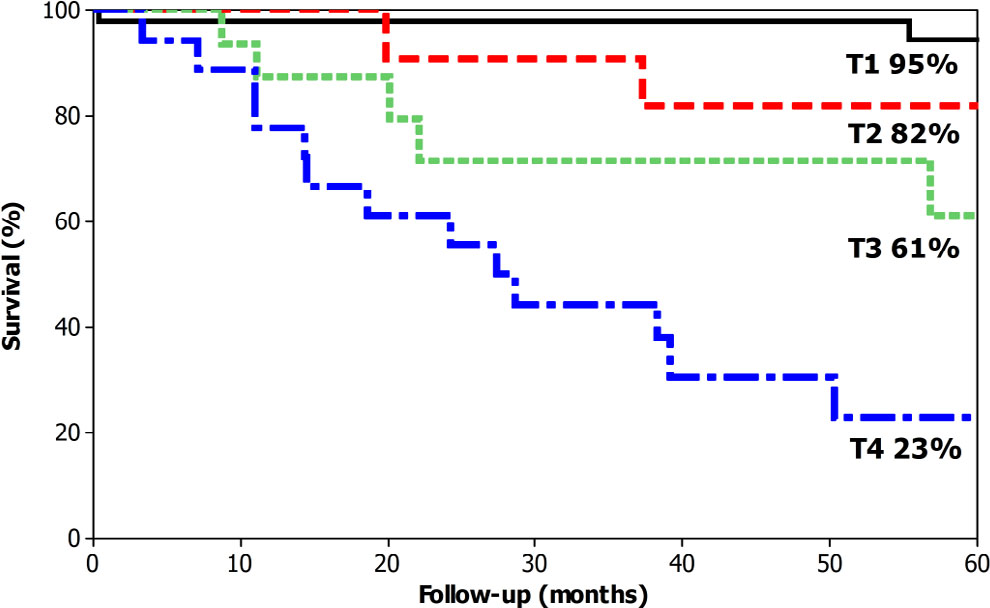
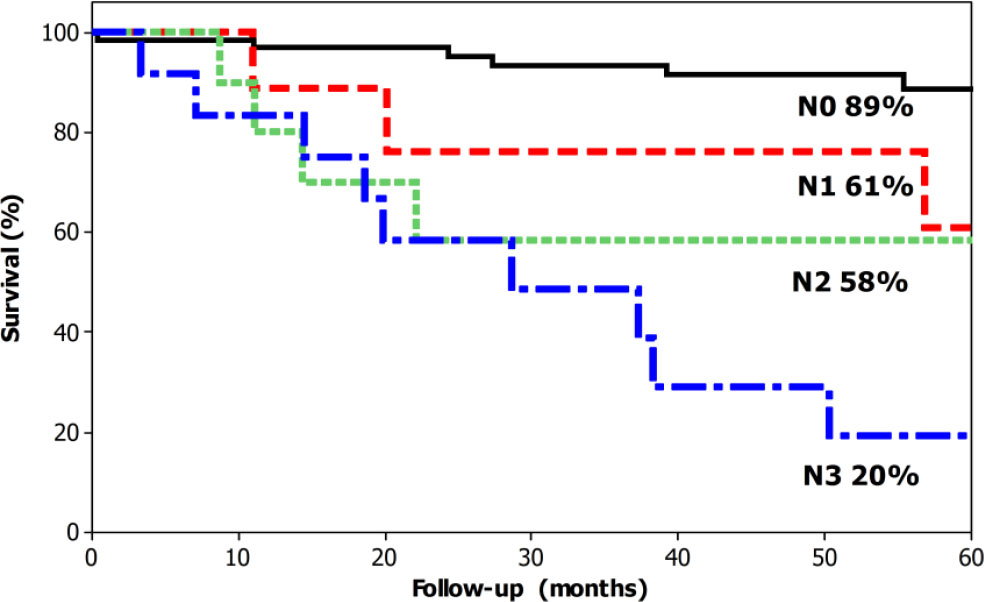
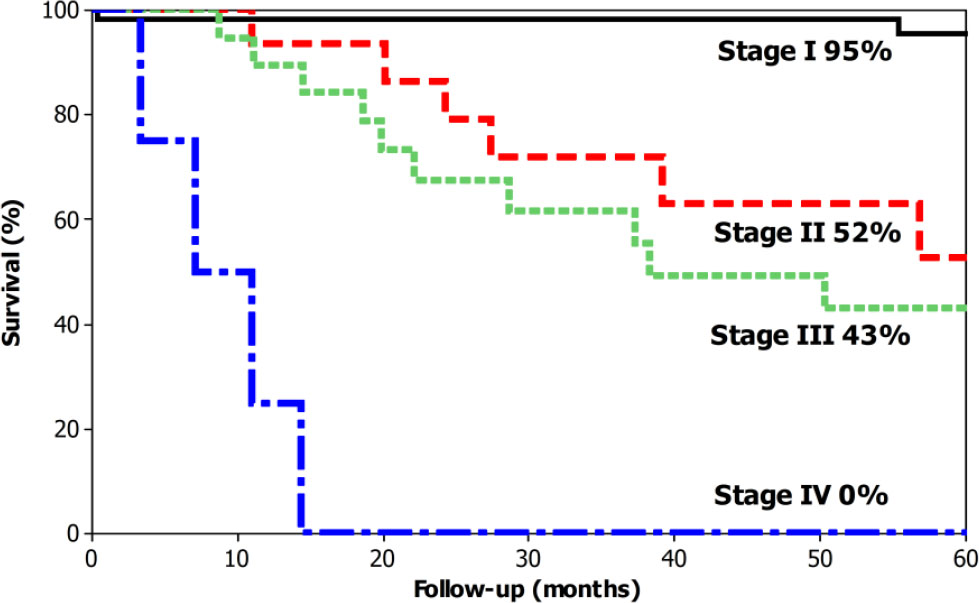
The overall 5-year survival was 74% (Figure 1). The median survival was 171 months for T1 cases (95% overall 5-year survival), not reached for T2 (82% overall 5-year survival), not reached for T3 (61% overall 5-year survival) and 27 months for T4A (23% overall 5-year survival) (Figure 2). The median survival was not reached for N0 cases (89% overall 5-year survival), 111 months for N1 (61% overall 5-year survival), not reached months for N2 (58% overall 5-year survival), and 28 months (20% overall 5-year survival) (Figure 3). The median survival was not reached for stage I (95% overall 5-year survival), not reached for stage II (52% 5-year overall survival), 38 months for stage III (43% overall 5-year survival), and 7 months for stage IV (0% overall 5-year survival) (Figure 4).

Overall 5-year survival for patients with laparoscopic total gastrectomy for gastric cancer.
Overall 5-year survival for patients with laparoscopic total gastrectomy for gastric cancer according to the T status.

Overall 5-year survival for patients with laparoscopic total gastrectomy for gastric cancer according to the N status

Overall 5-year survival for patients with laparoscopic total gastrectomy for gastric cancer according to the stage.
DISCUSSION
During the past three decades, there has been a great progress in the minimally invasive approach of GC surgery, this development is supported by a large experience from the Eastern countries, mainly Japan6,17,18,24,25, Korea12,13,20,22,38, and China11,28,45. In the West, the development of laparoscopic gastrectomy has been slower, mainly due to a lower global incidence of GC, a lower diagnosis in early stages of GC, more proximally located tumors requiring total gastrectomy, and higher BMI among other factors41,42. Thus, this surgical approach has been developed in fewer Western centers37,41,42.
In this study, we describe our results with 100 LTG, using a completely laparoscopic approach. There are few reports with this volume of cases as a single center in Western countries8. In fact, in Latin America, there are only a few series describing this surgical approach with limited experience2,15,36,47. In this series, we present very positive results, with a low conversion rate at 6%, low bleeding at 150 cc, and an operative time of 330 min. The surgical morbidity was lower, compared to prospective series12,16,42. And the length of hospital stay of 8 days was similar to the prospective stomach trial from Europe42.
This experience has been developed in a high-incidence Western country in a public hospital with a large case volume of GC surgery. The annual number of gastrectomies at our hospital for GC is 60–70 cases per year34. The staff surgeons have a large previous experience in open GC surgery and a large experience in benign foregut laparoscopic surgery for hiatal hernia, reflux, and bariatric surgery, which may help in the learning curve of LTG, which represents a difficult surgery, that involves a complex lymph node dissection and a complex reconstruction of the digestive tract, especially in the totally laparoscopic approach.
Compared to our previous historical cohort, with over 1000 gastrectomies, even though it is hard to compare different series, our previous paper described 31% total morbidity34, and in this case series, this compared favorably at 26%. And our historical 30-day mortality was 4.6%34; also in this series, there is a favorable comparison with only 1% postoperative mortality. This may be due to the surgical approach; however, other factors such as patient selection, surgical experience, and the time period of both studies cannot be ruled out.
When we compare our data to prospective studies like the JCOG140116, which included 195 laparoscopic-assisted total gastrectomies, the operative time was 309 min and major morbidity was 29%, and in our study, operative time was similar and major (grade 3 or higher) morbidity was only 7%, comparing favorably. The prospective KLASS-0312 study included 170 patients with an LTG, reported postoperative morbidity of 20% and postoperative mortality at 0.6%, with 9% of patients developing grade 3 or higher morbidity, which is comparable to our study. Both of these prospective studies12,16 included only patients in clinical stage I, and a lower BMI at 22 and 24, respectively, unlike our study which included 50% of patients in stage II or higher and a median BMI of 26.
One of the critical steps in LTG is esophago-jejunal anastomosis, and the lack of universally accepted methods is probably one of the major issues in the acceptance of LTG as routine practice14,21,26,33. Probably, the most employed method for esophago-jejunal anastomosis is the linear stapler overlap method12,14, and one of its main advantages is the higher reproducibility rate, but it has several pitfalls—mainly the need to perform a higher anastomosis in the mediastinal esophagus and the difficulties in the manipulation of the stapler in a narrow space at the level of the hiatus.
There are currently many options for esophago-jejunal anastomosis method14,21,26,33, but none of them have proven superiority, and there are no randomized controlled trials comparing the different options and only few comparative studies3,4,9,10,43,44,46.
In this study, we used a hand-sewn anastomosis in 90% of cases. We have previously reported our results with this technique, with a leak rate of 3.8%33. We developed this anastomosis from a laparoscopic Roux-en-Y gastric bypass performed in our center. In this study, the number of cases with esophago-jejunal anastomosis using a mechanical stapler was only 10, which does not allow a significant comparison of both methods. However, the leak rate was 4% when we used our standard hand-sewn method of esophago-jejunal anastomosis, the same as our initial results33. In a recent meta-analysis, there was no difference in leak and stenosis rate when comparing hand-sewn vs. stapled anastomosis after total gastrectomy10. However, as described by other groups, we believe that the hand-sewn anastomosis is the most adequate method after LTG, as it allows an intraabdominal anastomosis and it has a low leak and stenosis rate, lower anastomosis time, smaller incisions, and lower hospitalization costs4,9,43,44. One disadvantage is that it requires a high experience in intracorporeal laparoscopic suturing and knotting. In the near future with the wider use of barbed sutures7,44 and the robotic platform29,35, we may see an increase in the adoption of this esophago-jejunal anastomosis method. In the future, there is a need to compare the different esophago-jejunal anastomosis methods in a randomized prospective study to identify the best method.
The oncologic results in our study are in accordance with oncologic principles. The median lymph node count was 38 nodes, which supports the adequate lymph node dissection D1+/D2 performed in most cases. This is comparable to other LTG studies, like 41 lymph nodes resected in the LTG study from Japan JCOG 140116, 35 lymph nodes in the laparoscopic group of the CLASS 02 study28, and 41 lymph nodes in the minimally invasive group of the STOMACH study42.
In the current study, we performed a long-term follow-up of our patients, with a median follow-up of 50 months. For stage I cases, the survival was 95%, which is very comparable to the series with stage I GC, with survival over 90% at 5 years17,20. In more advanced stages II and III, even though there are fewer cases, 17 and 20, respectively, the survival was adequate, at 52 and 43%, respectively. Currently, there is evidence from randomized controlled trials on the oncologic equivalence for clinical advanced GC treated with distal laparoscopic gastrectomy compared to open surgery6,11,38, and total gastrectomy has not been validated in an RCT with long-term follow-up. The long-term results of the STOMACH study, which compares LTG to open surgery for advanced gastric cancer after neoadjuvant treatment, are awaited42, and currently, the KLASS-06 is an ongoing phase-III randomized trial comparing open and LTG for advanced gastric cancer, results will be available in the next few years. However, our current results are promising for cases in stage II-III. Amongthe possible oncologic benefits of laparoscopic surgery is the lower morbidity rate and faster recovery that would allow an earlier initiation of adjuvant chemotherapy19,39.
CONCLUSIONS
These results support the feasibility and oncological adequacy of minimally invasive total gastrectomy. Postoperative morbidity has an acceptable rate. Long-term survival was in accordance with the disease stage.
ACKNOWLEDGMENTS
We thank those who have devoted a lot to this study, including residents, nurses, radiologist, pathologists, and doctors. This study was supported by Pontificia Universidad Catolica de Chile and Hospital Sotero del Rio. The funding source had no role in the design and conduct of the study; collection, management, analysis, and interpretation of the data, preparation, review, or approval of the manuscript; and decision to submit the manuscript for publication.
REFERENCES
-
1. Japanese Gastric Cancer Association. Japanese Gastric Cancer Treatment Guidelines 2021 (6th edition). Gastric Cancer. 2023;26(1):1-25. https://doi.org/10.1007/s10120-022-01331-8
» https://doi.org/10.1007/s10120-022-01331-8 -
2. Braghetto I, Lanzarini E, Musleh M, Gutierrez L, Molina JC, Korn O, et al. Lessons learned analyzing complications after laparoscopic total gastrectomy for gastric cancer. Arq Bras Cir Dig. 2020;33(3):e1539. https://doi.org/10.1590/0102-672020200003e1539
» https://doi.org/10.1590/0102-672020200003e1539 -
3. Chen K, Pan Y, Cai JQ, Xu XW, Wu D, Yan JF, et al. Intracorporeal esophagojejunostomy after totally laparoscopic total gastrectomy: a single-center 7-year experience. World J Gastroenterol. 2016;22(12):3432-40. https://doi.org/10.3748/wjg.v22.i12.3432
» https://doi.org/10.3748/wjg.v22.i12.3432 -
4. Chen K, Wu D, Pan Y, Cai JQ, Yan JF, Chen DW, et al. Totally laparoscopic gastrectomy using intracorporeally stapler or hand-sewn anastomosis for gastric cancer: a single-center experience of 478 consecutive cases and outcomes. World J Surg Oncol. 2016;14:115. https://doi.org/10.1186/s12957-016-0868-7
» https://doi.org/10.1186/s12957-016-0868-7 -
5. Clavien PA, Strasberg SM. Severity grading of surgical complications. Ann Surg. 2009;250(2):197-8. https://doi.org/10.1097/SLA.0b013e3181b6dcab
» https://doi.org/10.1097/SLA.0b013e3181b6dcab -
6. Etoh T, Ohyama T, Sakuramoto S, Tsuji T, Lee SW, Yoshida K, et al. Five-year survival outcomes of laparoscopy-assisted vs open distal gastrectomy for advanced gastric cancer: the JLSSG0901 randomized clinical trial. JAMA Surg. 2023;158(5):445-54. https://doi.org/10.1001/jamasurg.2023.0096
» https://doi.org/10.1001/jamasurg.2023.0096 -
7. Facy O, Arru L, Azagra JS. Intestinal anastomosis after laparoscopic total gastrectomy. J Visc Surg. 2012;149(3):e179-84. https://doi.org/10.1016/j.jviscsurg.2012.04.009
» https://doi.org/10.1016/j.jviscsurg.2012.04.009 -
8. Garbarino GM, Laracca GG, Lucarini A, Piccolino G, Mercantini P, Costa A, et al. Laparoscopic versus open surgery for gastric cancer in western countries: a systematic review and meta-analysis of short- and long-term outcomes. J Clin Med. 2022;11(13):3590. https://doi.org/10.3390/jcm11133590
» https://doi.org/10.3390/jcm11133590 -
9. Gu H, Li W, Zhou L. Application of hand-sewn esophagojejunostomy in laparoscopic total gastrectomy. World J Surg Oncol. 2024;22(1):73. https://doi.org/10.1186/s12957-024-03350-4
» https://doi.org/10.1186/s12957-024-03350-4 -
10. Honório FCC, Tustumi F, Pinheiro Filho JEL, Marques SSB, Glina FPA, Henriques AC, et al. Esophagojejunostomy after total gastrectomy: a systematic review and meta-analysis comparing hand-sewn and stapled anastomosis. J Surg Oncol. 2022;126(1):161-7. https://doi.org/10.1002/jso.26909
» https://doi.org/10.1002/jso.26909 -
11. Huang C, Liu H, Hu Y, Sun Y, Su X, Cao H, et al. Laparoscopic vs open distal gastrectomy for locally advanced gastric cancer: five-year outcomes from the CLASS-01 randomized clinical trial. JAMA Surg. 2022;157(1):9-17. https://doi.org/10.1001/jamasurg.2021.5104
» https://doi.org/10.1001/jamasurg.2021.5104 -
12. Hyung WJ, Yang HK, Han SU, Lee YJ, Park JM, Kim JJ, et al. A feasibility study of laparoscopic total gastrectomy for clinical stage I gastric cancer: a prospective multi-center phase II clinical trial, KLASS 03. Gastric Cancer. 2019;22(1):214-22. https://doi.org/10.1007/s10120-018-0864-4
» https://doi.org/10.1007/s10120-018-0864-4 -
13. Hyung WJ, Yang HK, Park YK, Lee HJ, An JY, Kim W, et al. Long-term outcomes of laparoscopic distal gastrectomy for locally advanced gastric cancer: the KLASS-02-RCT randomized clinical trial. J Clin Oncol. 2020;38(28):3304-13. https://doi.org/10.1200/JCO.20.01210
» https://doi.org/10.1200/JCO.20.01210 -
14. Inaba K, Satoh S, Ishida Y, Taniguchi K, Isogaki J, Kanaya S, et al. Overlap method: novel intracorporeal esophagojejunostomy after laparoscopic total gastrectomy. J Am Coll Surg. 2010;211(6):e25-9. https://doi.org/10.1016/j.jamcollsurg.2010.09.005
» https://doi.org/10.1016/j.jamcollsurg.2010.09.005 -
15. Kassab P, Costa Jr WL, Jacob CE, Cordts RM, Castro OAP, Barchi LC, et al. Minimally invasive surgery for gastric cancer in Brazil: current status and perspectives-a report from the Brazilian Laparoscopic Oncologic Gastrectomy Group (BLOGG). Transl Gastroenterol Hepatol. 2017;2:45. https://doi.org/10.21037/tgh.2017.03.17
» https://doi.org/10.21037/tgh.2017.03.17 -
16. Katai H, Mizusawa J, Katayama H, Kunisaki C, Sakuramoto S, Inaki N, et al. Single-arm confirmatory trial of laparoscopy-assisted total or proximal gastrectomy with nodal dissection for clinical stage I gastric cancer: Japan Clinical Oncology Group study JCOG1401. Gastric Cancer. 2019;22(5):999-1008. https://doi.org/10.1007/s10120-019-00929-9
» https://doi.org/10.1007/s10120-019-00929-9 -
17. Katai H, Mizusawa J, Katayama H, Morita S, Yamada T, Bando E, et al. Survival outcomes after laparoscopy-assisted distal gastrectomy versus open distal gastrectomy with nodal dissection for clinical stage IA or IB gastric cancer (JCOG0912): a multicentre, non-inferiority, phase 3 randomised controlled trial. Lancet Gastroenterol Hepatol. 2020;5(2):142-51. https://doi.org/10.1016/S2468-1253(19)30332-2
» https://doi.org/10.1016/S2468-1253(19)30332-2 -
18. Katai H, Mizusawa J, Katayama H, Takagi M, Yoshikawa T, Fukagawa T, et al. Short-term surgical outcomes from a phase III study of laparoscopy-assisted versus open distal gastrectomy with nodal dissection for clinical stage IA/IB gastric cancer: Japan Clinical Oncology Group Study JCOG0912. Gastric Cancer. 2017;20(4):699-708. https://doi.org/10.1007/s10120-016-0646-9
» https://doi.org/10.1007/s10120-016-0646-9 -
19. Kelly KJ, Selby L, Chou JF, Dukleska K, Capanu M, Coit DG, et al. Laparoscopic versus open gastrectomy for gastric adenocarcinoma in the West: a case-control study. Ann Surg Oncol. 2015;22(11):3590-6. https://doi.org/10.1245/s10434-015-4381-y
» https://doi.org/10.1245/s10434-015-4381-y -
20. Kim HH, Han SU, Kim MC, Kim W, Lee HJ, Ryu SW, et al. Effect of laparoscopic distal gastrectomy vs open distal gastrectomy on long-term survival among patients with stage i gastric cancer: the KLASS-01 randomized clinical trial. JAMA Oncol. 2019;5(4):506-13. https://doi.org/10.1001/jamaoncol.2018.6727
» https://doi.org/10.1001/jamaoncol.2018.6727 -
21. Kim JH, Choi CI, Kim DI, Kim DH, Jeon TY, Kim DH, et al. Intracorporeal esophagojejunostomy using the double stapling technique after laparoscopic total gastrectomy: a retrospective case-series study. World J Gastroenterol. 2015;21(10):2973-81. https://doi.org/10.3748/wjg.v21.i10.2973
» https://doi.org/10.3748/wjg.v21.i10.2973 -
22. Kim W, Kim HH, Han SU, Kim MC, Hyung WJ, Ryu SW, et al. Decreased morbidity of laparoscopic distal gastrectomy compared with open distal gastrectomy for stage i gastric cancer: short-term outcomes from a multicenter randomized controlled trial (KLASS-01). Ann Surg. 2016;263(1):28-35. https://doi.org/10.1097/SLA.0000000000001346
» https://doi.org/10.1097/SLA.0000000000001346 - 23. Kitano S, Iso Y, Moriyama M, Sugimachi K. Laparoscopy-assisted Billroth I gastrectomy. Surg Laparosc Endosc. 1994;4(2):146-8. PMID: 8180768.
-
24. Kodera Y, Yoshida K, Kumamaru H, Kakeji Y, Hiki N, Etoh T, et al. Introducing laparoscopic total gastrectomy for gastric cancer in general practice: a retrospective cohort study based on a nationwide registry database in Japan. Gastric Cancer. 2019;22(1):202-13. https://doi.org/10.1007/s10120-018-0795-0
» https://doi.org/10.1007/s10120-018-0795-0 -
25. Kunisaki C, Katai H, Sakuramoto S, Mizusawa J, Katayama H, Kadoya S, et al. A nonrandomized controlled trial: long-term outcomes of LATG/LAPG for cStage I gastric cancer: Japan Clinical Oncology Group Study JCOG1401. Gastric Cancer. 2024;27(1):164-75. https://doi.org/10.1007/s10120-023-01432-y
» https://doi.org/10.1007/s10120-023-01432-y -
26. LaFemina J, Viñuela EF, Schattner MA, Gerdes H, Strong VE. Esophagojejunal reconstruction after total gastrectomy for gastric cancer using a transorally inserted anvil delivery system. Ann Surg Oncol. 2013;20(9):2975-83. https://doi.org/10.1245/s10434-013-2978-6
» https://doi.org/10.1245/s10434-013-2978-6 -
27. Li Z, Shan F, Ying X, Zhang Y, E JY, Wang Y, et al. Assessment of laparoscopic distal gastrectomy after neoadjuvant chemotherapy for locally advanced gastric cancer: a randomized clinical trial. JAMA Surg. 2019;154(12):1093-101. https://doi.org/10.1001/jamasurg.2019.3473
» https://doi.org/10.1001/jamasurg.2019.3473 -
28. Liu F, Huang C, Xu Z, Su X, Zhao G, Ye J, et al. Morbidity and mortality of laparoscopic vs open total gastrectomy for clinical stage i gastric cancer: the CLASS02 multicenter randomized clinical trial. JAMA Oncol. 2020;6(10):1590-7. https://doi.org/10.1001/jamaoncol.2020.3152
» https://doi.org/10.1001/jamaoncol.2020.3152 -
29. Lu J, Zheng CH, Xu BB, Xie JW, Wang JB, Lin JX, et al. Assessment of robotic versus laparoscopic distal gastrectomy for gastric cancer: a randomized controlled trial. Ann Surg. 2021;273(5):858-67. https://doi.org/10.1097/SLA.0000000000004466
» https://doi.org/10.1097/SLA.0000000000004466 -
30. Marrelli D, Morgagni P, Manzoni G, Coniglio A, Marchet A, Saragoni L, et al. Prognostic value of the 7th AJCC/UICC TNM classification of noncardia gastric cancer: analysis of a large series from specialized Western centers. Ann Surg. 2012;255(3):486-91. https://doi.org/10.1097/SLA.0b013e3182389b1a
» https://doi.org/10.1097/SLA.0b013e3182389b1a -
31. Mejía R, Sáez J, Norero E, Briones P, Ceroni M, Martínez C, et al. Long-term results of Endoscopic Submucosal Dissection (ESD) for the treatment of Early Gastric Cancer (EGC) in a high-volume Latin American Center. Surg Laparosc Endosc Percutan Tech. 2020;31(2):165-9. https://doi.org/10.1097/SLE.0000000000000857
» https://doi.org/10.1097/SLE.0000000000000857 -
32. Norero E, Báez S, Briceño E, Martínez C, Ceroni M, Escalona A, et al. Totally laparoscopic gastrectomy for the treatment of gastric tumors. Rev Med Chil. 2015;143(3):281-8. https://doi.org/10.4067/S0034-98872015000300001
» https://doi.org/10.4067/S0034-98872015000300001 -
33. Norero E, Muñoz R, Ceroni M, Manzor M, Crovari F, Gabrielli M. Two-layer hand-sewn esophagojejunostomy in totally laparoscopic total gastrectomy for gastric cancer. J Gastric Cancer. 2017;17(3):267-76. https://doi.org/10.5230/jgc.2017.17.e26
» https://doi.org/10.5230/jgc.2017.17.e26 -
34. Norero E, Vega EA, Diaz C, Cavada G, Ceroni M, Martínez C, et al. Improvement in postoperative mortality in elective gastrectomy for gastric cancer: analysis of predictive factors in 1066 patients from a single centre. Eur J Surg Oncol. 2017;43(7):1330-6. https://doi.org/10.1016/j.ejso.2017.01.004
» https://doi.org/10.1016/j.ejso.2017.01.004 -
35. Ojima T, Nakamura M, Hayata K, Kitadani J, Katsuda M, Takeuchi A, et al. Short-term outcomes of robotic gastrectomy vs laparoscopic gastrectomy for patients with gastric cancer: a randomized clinical trial. JAMA Surg. 2021;156(10):954-63. https://doi.org/10.1001/jamasurg.2021.3182
» https://doi.org/10.1001/jamasurg.2021.3182 -
36. Ramos MFKP, Pereira MA, Dias AR, Ribeiro Jr U, Zilberstein B, Nahas SC. Laparoscopic gastrectomy for early and advanced gastric cancer in a western center: a propensity score-matched analysis. Updates Surg. 2021;73(5):1867-77. https://doi.org/10.1007/s13304-021-01097-1
» https://doi.org/10.1007/s13304-021-01097-1 -
37. Sakamoto E, Ramos MFKP, Pereira MA, Dias AR, Ribeiro Junior U, Zilberstein B, et al. Staging laparoscopy is still a valuable tool for optimal gastric cancer management. Arq Bras Cir Dig. 2023;35:e1700. https://doi.org/10.1590/0102-672020220002e1700
» https://doi.org/10.1590/0102-672020220002e1700 -
38. Son SY, Hur H, Hyung WJ, Park YK, Lee HJ, An JY, et al. Laparoscopic vs open distal gastrectomy for locally advanced gastric cancer: 5-year outcomes of the KLASS-02 randomized clinical trial. JAMA Surg. 2022;157(10):879-86. https://doi.org/10.1001/jamasurg.2022.2749
» https://doi.org/10.1001/jamasurg.2022.2749 -
39. Takashima Y, Komatsu S, Nishibeppu K, Kiuchi J, Ohashi T, Shimizu H, et al. Clinical impact of postoperative interval until adjuvant chemotherapy following curative gastrectomy for advanced gastric cancer. J Cancer. 2021;12(19):5960-6. https://doi.org/10.7150/jca.58154
» https://doi.org/10.7150/jca.58154 -
40. Trastulli S, Desiderio J, Lin JX, Reim D, Zheng CH, Borghi F, et al. Laparoscopic compared with open D2 gastrectomy on perioperative and long-term, stage-stratified oncological outcomes for gastric cancer: a propensity score-matched analysis of the IMIGASTRIC database. Cancers (Basel). 2021;13(18):4526. https://doi.org/10.3390/cancers13184526
» https://doi.org/10.3390/cancers13184526 -
41. van der Veen A, Brenkman HJF, Seesing MFJ, Haverkamp L, Luyer MDP, Nieuwenhuijzen GAP, et al. Laparoscopic versus open gastrectomy for gastric cancer (LOGICA): a multicenter randomized clinical trial. J Clin Oncol. 2021;39(9):978-89. https://doi.org/10.1200/JCO.20.01540
» https://doi.org/10.1200/JCO.20.01540 -
42. van der Wielen N, Straatman J, Daams F, Rosati R, Parise P, Weitz J, et al. Open versus minimally invasive total gastrectomy after neoadjuvant chemotherapy: results of a European randomized trial. Gastric Cancer. 2021;24(1):258-71. https://doi.org/10.1007/s10120-020-01109-w
» https://doi.org/10.1007/s10120-020-01109-w -
43. Wang Z, Wei Y, Liu X, Li Z, Zhu G, Li Y, et al. Application value of hand-sewn anastomosis in totally laparoscopic total gastrectomy for gastric cancer. World J Surg Oncol. 2021;19(1):229. https://doi.org/10.1186/s12957-021-02249-8
» https://doi.org/10.1186/s12957-021-02249-8 -
44. Wei JP, Wang WD, Yang XS, Guo X, Li XH, Ji G. Comparing intracorporeal mechanical anastomosis vs. hand-sewn esophagojejunostomy after total laparoscopic gastrectomy for esophagogastric junction cancer: a single-center study. World J Surg Oncol. 2023;21(1):12. https://doi.org/10.1186/s12957-023-02889-y
» https://doi.org/10.1186/s12957-023-02889-y -
45. Yu J, Huang C, Sun Y, Su X, Cao H, Hu J, et al. Effect of laparoscopic vs open distal gastrectomy on 3-year disease-free survival in patients with locally advanced gastric cancer: the CLASS-01 randomized clinical trial. JAMA. 2019;321(20):1983-92. https://doi.org/10.1001/jama.2019.5359
» https://doi.org/10.1001/jama.2019.5359 -
46. Zheng XY, Pan Y, Chen K, Gao JQ, Cai XJ. Comparison of intracorporeal and extracorporeal esophagojejunostomy after laparoscopic total gastrectomy for gastric cancer: a meta-analysis based on short-term outcomes. Chin Med J (Engl). 2018;131(6):713-20. https://doi.org/10.4103/0366-6999.226899
» https://doi.org/10.4103/0366-6999.226899 -
47. Zilberstein B, Jacob CE, Barchi LC, Yagi OK, Ribeiro Jr U, Coimbra BG, et al. Simplified technique for reconstruction of the digestive tract after total and subtotal gastrectomy for gastric cancer. Arq Bras Cir Dig. 2014;27(2):133-7. https://doi.org/10.1590/s0102-67202014000200010
» https://doi.org/10.1590/s0102-67202014000200010
Central Message
-
Since the first laparoscopic gastrectomy in gastric cancer (GC) was performed three decades ago, there is a progressive interest in this technique. This is mainly because most laparoscopic abdominal procedures have proven to be associated with lower morbidity and faster patient recovery. However, most of the experience with laparoscopic gastrectomy comes from distal gastrectomy, mainly because in the Eastern countries with a high incidence of GC, like Japan, Korea, and China, the distally located GC is more prevalent than in Western countries. Laparoscopic total gastrectomy (LTG) is not universally accepted, and few studies have evaluated its results.
Perspectives
-
The oncologic results in our study are in accordance with oncologic principles and the feasibility and oncological adequacy of minimally invasive total gastrectomy. Postoperative morbidity has an acceptable rate. Long-term survival was in accordance with the disease stage.
Edited by
-
Editorial Support:
National Council for Scientific and Technological Development (CNPq).