 Acutely kidney injury in the postoperative period of elective colorectal surgery: assessment of the age influence
Background: The increase in life expectancy and the development of comorbidities bring a higher rate of complications and mortality in the postoperative period of surgical procedures in general. Among these associations, elective colorectal surgery and acute kidney injury are notable.
Aims: To analyze risk factors associated with acute kidney injury in the postoperative period of elective colorectal surgeries in patients over 65 years of age. Additionally, to outline the epidemiological, clinical-surgical, and laboratory profile of the study population.
Methods: A clinical, observational, longitudinal, prospective, and analytical study with a quantitative approach involving 30 patients from January 2023 to April 2024. Data analysis included pre, intra, and post-operative periods, with renal function assessment on the 3rd and 5th days after surgery.
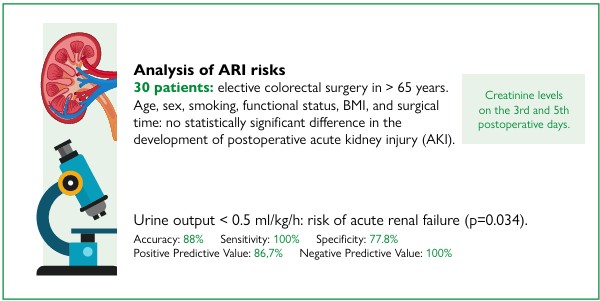
Results: The overall mean age was 70.4 years, 53.3% were female, 46.6% were smokers or former smokers, 63.3% had systemic arterial hypertension, and 23.3% had diabetes mellitus. Ten patients developed acute kidney injury in the postoperative period. The use of angiotensin-converting enzyme inhibitors and postoperative diuresis were significantly associated variables (p=0.039 and 0.034, respectively). The diuresis cutoff value to foretell non-progression to acute kidney injury was 0.5 mL/kg/h, with an accuracy of 88%, sensitivity of 100%, specificity of 77.78%, positive predictive value of 86.67%, and negative predictive value of 100%.
Conclusions: In elderly patients undergoing elective colorectal surgery for oncological treatment, the incidence of acute kidney injury was high.
Headings:
Acute Kidney Injury; Colorectal Surgery; Health of the Elderly; Postoperative Period
Analysis of risk factors associated with acute kidney injury in the postoperative period of elective colorectal surgeries in patients over 65 years of age.
One third of patients developed acute kidney injury in the postoperative period.
The use of angiotensin-converting enzyme inhibitors and postoperative diuresis were acute kidney injury variables (p=0.039 and 0.034, respectively).
The diuresis cutoff value to predict no progression to acute kidney injury was 0.5 mL/kg/h with an accuracy of 88%, sensitivity of 100%, specificity of 77.78%, positive predictive value of 86.67%, and negative predictive value of 100%.

CENTRAL MESSAGE Acute kidney injury, also known as acute renal injury, is a syndrome resulting from an abrupt loss of kidney function due to decreased glomerular filtration rate. Postoperative acute kidney injury is associated with prolonged hospital recovery, increased healthcare costs, and higher mortality following major surgeries, complicating the perioperative period in up to 50% of these patients. Therefore, detecting acute kidney injury in its early stages, even before the onset of symptoms, especially in elderly patients, is essential for improving the management of this condition and reducing postoperative morbidity and mortality in elective colorectal surgery patients.
PERSPECTIVES The increased incidence of acute kidney injury in individuals over 60 years old may be attributed to a combination of factors, including comorbidities, nephrotoxic medications, and structural and functional changes associated with aging. Additionally, high anesthetic risk in elective surgeries, intraoperative complications, and pre-existing chronic kidney disease directly influence the development of acute kidney injury, especially in the elderly. In elderly patients undergoing elective colorectal surgery for oncological treatment, the incidence of Stage 1 acute kidney injury was high and associated with postoperative urine output and the non-use of angiotensin-converting enzyme inhibitors.