 Artificial Intelligence-Enhanced Electrocardiography Analysis for Diagnosing Chagas Disease
Background: Chagas disease affects millions worldwide and remains a leading cause of cardiomyopathy in Latin America. Early diagnosis remains challenging in endemic regions. Artificial intelligence (AI)-based electrocardiography (ECG) analysis may offer a low-cost strategy for large-scale screening in resource-limited settings.
Objectives: To evaluate the performance of an AI-ECG algorithm combined with clinical data for detecting Chagas disease in a community-based screening program conducted in a highly endemic region in Northeastern Brazil.
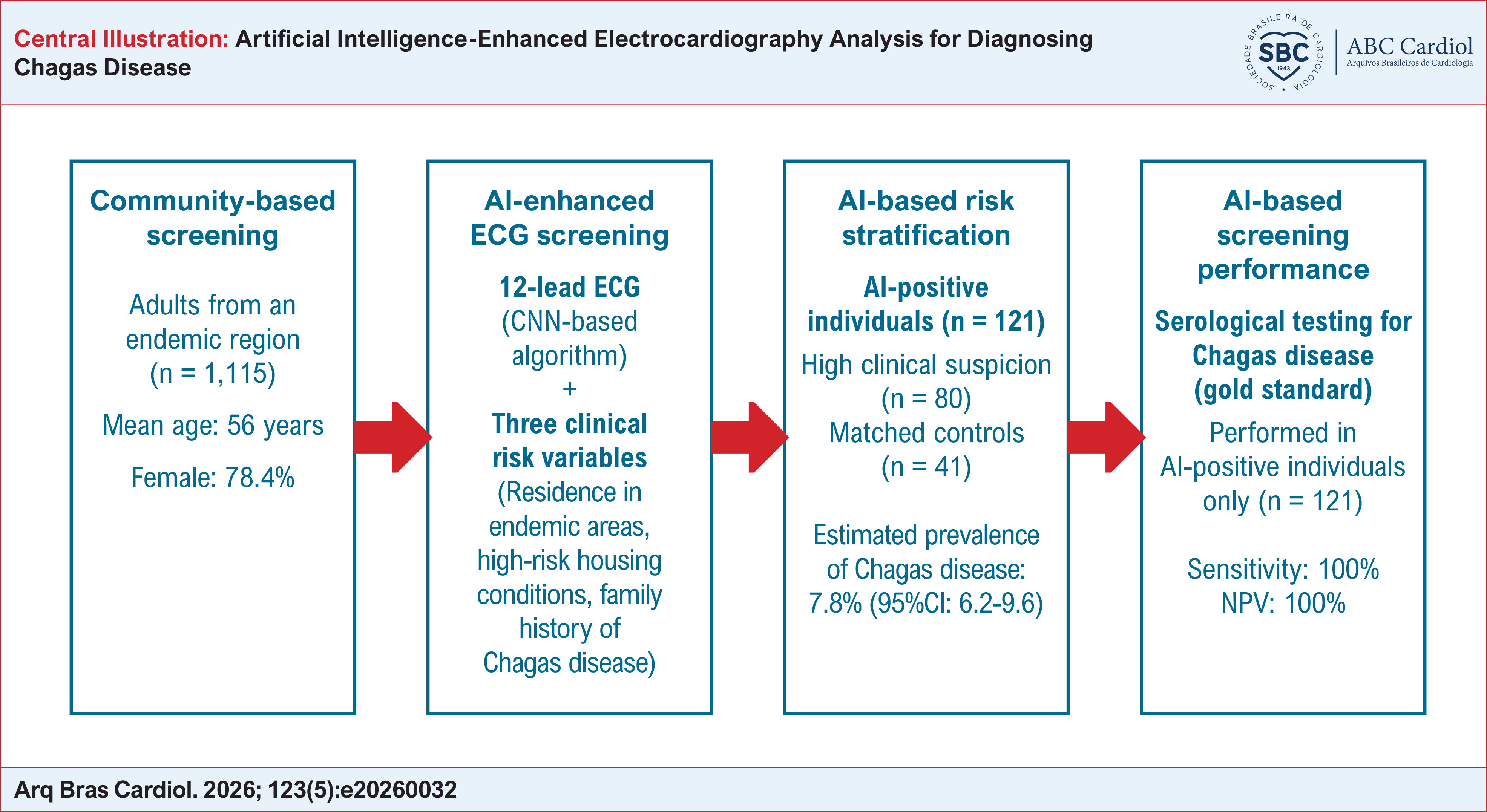
Methods: In August 2024, 1,115 adults underwent standardized 12-lead ECG acquisition during a field campaign in Feira de Santana, Bahia, Northeast Brazil. A previously trained AI model analyzed ECG tracings and incorporated three clinical variables: i) prior residence in triatomine-infested areas, ii) poor housing conditions, and iii) family history of Chagas disease. Individuals flagged as AI-positive were classified as suspected cases. Suspected cases and matched controls (2:1) underwent point-of-care serological testing.
Results: The algorithm flagged 121 individuals (10.9%), corresponding to an estimated AI-based prevalence of Chagas disease of 7.8% (95%CI: 6.2-9.6). Among the 112 individuals who completed serological testing, 13 tested positive, all within the AI-positive suspected group; no seropositive cases were identified among controls. Sensitivity was 100% (95%CI: 69-100), specificity 40% (95%CI: 30-50), negative predictive value 100% (95%CI: 91-100), and positive predictive value 12% (95%CI: 11-14), with a diagnostic odds ratio of 6.6.
Conclusions: An AI-ECG algorithm combined with simple clinical variables demonstrated excellent sensitivity for the detection of Chagas disease and may represent a valuable triage tool in endemic, resource-constrained settings.
Keywords
Chagas Disease; Artificial Intelligence; Electrocardiography; Mass Screening
 Thumbnail
 Thumbnail