 The Impact of Technology-Based Cardiac Rehabilitation on Exercise Capacity and Adherence in Patients with Coronary Artery Disease: An Artificial Intelligence Analysis
Abstract
Background Exercise training programs improve exercise capacity and quality of life (QoL) in patients with coronary artery disease (CAD). Although artificial intelligence (AI) has been used to design such programs, there are still few studies evaluating their effectiveness.
Objectives This study compared the effects of technology-based and traditional programs for cardiac rehabilitation (CR) on exercise capacity and participation in patients with CAD using AI for data analysis.
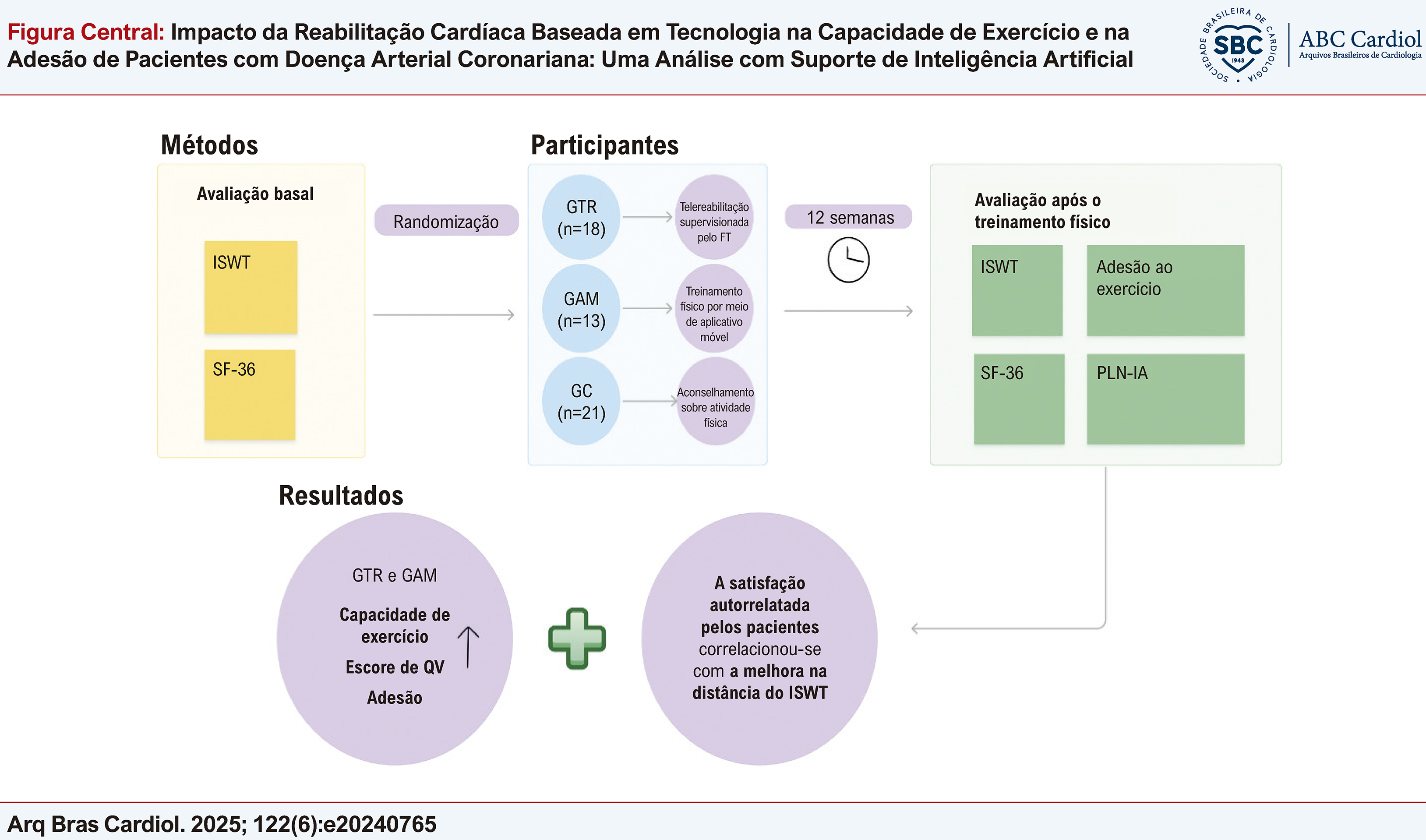
Methods A total of 52 patients with CAD were randomly assigned to three groups: i) telerehabilitation group (TRG) (n=18); ii) mobile application group (MAG) (n=13); and iii) control group (CG), which received only physical activity recommendations (n=21). TRG and MAG participants completed a 12-week program with calisthenic and resistance exercises three times a week. Exercise capacity was assessed using the Incremental Shuttle Walk Test (ISWT), and QoL was measured with the Short Form-36 (SF-36). Patient feedback was analyzed using a fine-tuned BERT-based natural language processing (NLP) model. Anomaly detection methods were applied to find mismatches between self-reported adherence and ISWT results. Statistical significance was set at p<0.05.
Results Both TRG [44.4% female] (Δ=87.2±15.2 m) and MAG [50% female] (Δ=89.4±70.4 m) had significant ISWT improvements compared to CG [47.6% female] (Δ=10.9±28.2 m) (p=0.001). Adherence was higher in TRG (100%) and MAG (80%) than in CG (30%) (p<0.001). Patient-reported satisfaction, analyzed via NLP, showed a significant positive correlation with ISWT improvements (r=0.75, p<0.001). Findings show the potential of AI to support outcome assessment in CR.
Conclusions Technology-based CR programs improve exercise capacity and adherence in patients with CAD, supporting the use of AI-driven tools. NLP analysis helped link patient feedback to exercise outcomes and detect inconsistencies, showing its value in enhancing CR evaluation.
Artificial Intelligence; Cardiac Rehabilitation; Coronary Artery Disease; Exercise

Resumo
Fundamento Programas de treinamento físico melhoram a capacidade de exercício e a qualidade de vida (QV) em pacientes com doença arterial coronariana (DAC). Embora a inteligência artificial (IA) tenha sido utilizada no desenvolvimento desses programas, ainda são escassos os estudos que avaliam sua eficácia.
Objetivo Este estudo comparou os efeitos de programas de reabilitação cardíaca (RC) baseados em tecnologia com os programas tradicionais sobre a capacidade de exercício e a participação de pacientes com DAC utilizando IA para análise dos dados.
Métodos Um total de 52 pacientes com DAC foi distribuído aleatoriamente em três grupos: i) grupo de telereabilitação (GTR) (n=18); ii) grupo de aplicativo móvel (GAM) (n=13); e iii) grupo controle (GC), que recebeu apenas recomendações de atividade física (n=21). Os participantes do GTR e do GAM completaram um programa de 12 semanas com exercícios calistênicos e de resistência, três vezes por semana. A capacidade de exercício foi avaliada por meio do Incremental Shuttle Walk Test (ISWT), e a QV foi medida com o questionário Short Form-36 (SF-36). O feedback dos pacientes foi analisado utilizando um modelo de processamento de linguagem natural (PLN) baseado em BERT ajustado. Métodos de detecção de anomalias foram aplicados para identificar divergências entre a adesão autorrelatada e os resultados do ISWT. O nível de significância estatística foi fixado em p<0,05.
Resultados Tanto o GTR [44,4% mulheres] (Δ=87,2±15,2 m) quanto o GAM [50% mulheres] (Δ=89,4±70,4 m) apresentaram melhora significativa no ISWT em comparação com o GC [47,6% mulheres] (Δ=10,9±28,2 m) (p=0,001). A adesão foi maior no GTR (100%) e no GAM (80%) do que no GC (30%) (p<0,001). A satisfação relatada pelos pacientes, analisada por PLN, mostrou correlação positiva significativa com os ganhos no ISWT (r=0,75, p<0,001). Os achados demonstram o potencial da IA para apoiar a avaliação de resultados na RC.
Conclusões Programas de RC baseados em tecnologia melhoram a capacidade de exercício e a adesão de pacientes com DAC, reforçando o uso de ferramentas com suporte de IA. A análise por PLN ajudou a relacionar o feedback dos pacientes aos resultados do exercício e a detectar inconsistências, demonstrando seu valor na avaliação da RC.
Inteligência Artificial; Reabilitação Cardíaca; Doença da Artéria Coronariana; Exercício Físico
Introduction
Programs for cardiac telerehabilitation (CTR) have been shown to be of comparable benefit and validity to traditional, in-person rehabilitation for patients.1 Beatty et al. confirmed that mobile technology is both reliable and acceptable for use in cardiac rehabilitation (CR) for patients with ischemic heart disease.2 Using technology in CR helps improve access and participation. Research shows that exercise-based programs for CR can increase exercise capacity, strengthen peripheral muscles, and improve quality of life (QoL) in patients with coronary artery disease (CAD).3,4 Clinical guidelines also support the safe use of both aerobic and resistance training in this population.1,5 Calisthenics is another common exercise method used in programs for CR.6
In recent years, CR has increasingly adopted technologies such as electrocardiography (ECG) devices for remote monitoring, heart rate (HR) and blood pressure (BP) sensors, functional capacity testing algorithms, and activity trackers.7,8 CTR, virtual reality, and phone-based CR interventions — which enable patient care without direct supervision — are also receiving growing attention in literature.9,10
Artificial intelligence (AI) has made rapid progress in health care, especially in areas like interpreting radiological images, predicting outcomes, and detecting cardiac events early.11-15 Machine learning has also shown potential in helping design and evaluate the safety of exercise programs for CR.16 In addition, technical challenges such as algorithm transparency, data security, and ethical concerns about patient privacy continue to limit the broader use of AI in CTR.17 More research and better AI model development are needed to improve clinical use and ensure safe, patient-centered outcomes. While many studies focus on using patient data to personalize exercise programs for individuals with CAD, few have explored how AI can analyze patients’ own descriptions of how the programs benefit them.
Natural language processing (NLP) offers a promising way to extract meaningful insights from unstructured text found in electronic health records.18 To date, no studies have leveraged AI to interpret the subjective experiences of patients with CAD regarding the advantages of exercise-based programs for CR.
Participation in programs for CR remains low worldwide. One of the biggest challenges is patient nonadherence and dropout.19 The COVID-19 pandemic has exacerbated this problem, prompting health care providers to seek innovative solutions to increase participation, accessibility, efficiency, and cost-effectiveness of programs for CR.20 In the United States, only 20% to 30% of eligible patients participate in programs for CR. Among those who do start enroll, dropout rates range from 24% to 50%, which means many patients do not receive the full benefits of CR.21 To improve participation and adherence, health care providers have tested several strategies. Successful interventions include automated referral systems and the use of CR liaisons to help patients transition from hospital to outpatient care. These methods have been shown to significantly boost enrollment and program completion rates.22
However, the COVID-19 pandemic has made it even harder for patients to participate in CR, leading to the search for new ways to improve accessibility, efficiency, and cost-effectiveness of such programs. One promising solution is the use of home-based and hybrid CR models, which combine traditional center-based rehab with remote, at-home components. Such models have been shown to be just as safe and effective as traditional CR, while giving patients more flexibility.23
Recent studies have shown that AI can be successfully integrated into cardiology, especially in areas such as ECG analysis and nuclear cardiology imaging.24,25 However, to the best of our knowledge, this is the first study to apply NLP-based methods in the context of CR, making it a novel contribution to the growing intersection of AI and cardiovascular care.
This study aimed to compare the effects of technology-based and traditional programs for CR on exercise capacity and participation in patients with CAD using AI for data analysis.
Methods
This prospective, randomized controlled trial was conducted between April 2022 and May 2024 at the Department of Cardiorespiratory Physiotherapy and Rehabilitation, Faculty of Physiotherapy and Rehabilitation, Hacettepe University.
Patients with a diagnosis of CAD who visited the cardiology outpatient clinic were screened for eligibility. Those diagnosed with CAD by coronary angioplasty, with negative troponin levels, stable clinical status, and a symptom-limited treadmill test (modified Bruce protocol) showing no cardiac symptoms or ECG abnormalities, were referred to a physical therapist for CR and enrolled in an exercise program.
Inclusion criteria were i) clinically stable status; ii) age between 40 and 70 years; iii) access to online exercise training; and iv) ownership of an iOS- or Android-compatible smartphone.
Exclusion criteria were i) diagnosis of chronic heart failure (New York Heart Association [NYHA] class III or IV); ii) ≥50% stenosis of any major coronary artery; iii) any coronary event or surgical revascularization in the past 12 months; iv) left ventricular ejection fraction (LVEF) <40%; v) end-stage renal disease; vi) acute myocarditis or pericarditis; vii) uncontrolled hypertension; viii) chronic lung disease; ix) orthopedic or neurological conditions that would prevent participation in exercise or testing; x) sustained ventricular tachycardia; xi) uncontrollable atrial fibrillation; or xii) high-grade atrioventricular block.
Participants were evaluated at the beginning and at the end of the 12-week exercise program. All assessments followed the same order and were conducted according to the standards set by the lead physical therapist. Demographic, clinical, and exercise-related data were collected.
After the baseline evaluations, patients who met the inclusion criteria and agreed to participate were randomly assigned to one of three groups using the online tool available from https://www.graphpad.com/quickcalcs/randomize1.cfm. The telerehabilitation group (TRG) performed calisthenic and resistance exercises under the remote supervision of a physical therapist through video conferencing. The mobile application group (MAG) followed the same exercises individually guided by videos in a mobile app. The control group (CG) followed a standard home-based exercise program without supervision.
The Incremental Shuttle Walk Test (ISWT) was used to measure exercise capacity due to its proven validity and reliability in patients with CAD.26 It consists of 12 levels, during which participants gradually increase their walking speed every minute. An auditory signal guides them to walk back and forth between two cones placed ten meters apart, and the total distance covered is recorded.
The total number of exercise sessions completed by participants in the TRG was recorded. For the MAG, session attendance was tracked through notifications automatically sent to the physical therapists after each exercise session. Participants in the CG were asked to keep an exercise diary to record the days they engaged in physical activity.
To assess QoL, the Short Form-36 (SF-36) was administered through an interview. The SF-36 is a self-report questionnaire consisting of 36 items designed to evaluate an individual’s overall health status. It covers eight domains: physical functioning (PF), role-physical (RP), bodily pain (BP), general health (GH), vitality, social functioning (SF), role-emotional (RE), and mental health (MH).27
Exercise training protocol
Participants in the TRG followed an online exercise program under the supervision of a physical therapist. Those in the MAG group exercised independently using videos provided through a mobile app installed on their devices by the physical therapist. Each session included a warm-up and cool-down period.
During the first 4 weeks, participants performed calisthenic and postural exercises. Between weeks 4 and 8, upper and lower body resistance training was added to the calisthenic routine. Resistance exercises were done using elastic bands selected based on each individual’s muscle strength. Exercise intensity was adjusted by changing the number of repetitions and sets, with at least 1 min of rest allowed between sets.
From weeks 9 to 12, the difficulty of the exercises increased progressively according to each participant’s fitness level. All participants in TRG and MAG completed the exercises three times per week for 12 weeks (Figure 1, Supplementary File S1). Participants in CG were advised to follow the World Health Organization Physical Activity Guidelines, which recommend 150-300 minutes of moderate-intensity or 75-150 minutes of vigorous-intensity physical activity per week.28

– Flow diagram of patient inclusion in the study. AI: artificial intelligence; CG: control group; CTR: cardiac telerehabilitation; ISWT: Incremental Shuttle Walk Test; MAG: mobile application group; NLP: natural language processing; PT: physical therapist; SF-36: Short-Form-36; TRG: telerehabilitation group.
Participants in the TRG were monitored for fatigue, leg fatigue, and shortness of breath using the modified Borg scale (mBS), along with self-measured BP before and after each exercise session. Exercise intensity was adjusted to maintain a perceived exertion level between 4 and 6 on the mBS. HR was continuously monitored using a smartwatch (Mi Smart Band 4, Anhui Huami Information Technology Co., Ltd.), ensuring participants reached 60%-75% of their maximum HR (HRmax) and maintained an mBS score of 4 to 6 during exercise.29 All devices were calibrated before being given to participants.
Participants in MAG self-reported fatigue, leg fatigue, and shortness of breath using the mBS before and after each session, following video instructions on their phones. They also measured and recorded their HR and BP using a provided smartwatch and BP monitor. The mobile app included a secure login system to protect patient privacy.
Artificial intelligence
The effectiveness of the prescribed exercises was evaluated through regular patient feedback about their exercise experience. Open-ended questions in a questionnaire were used to collect subjective responses, which were then analyzed using AI and machine learning techniques to extract quantitative insights.
To identify potential outliers, anomaly detection methods were applied in cases where patients reported consistent participation but showed limited improvement in ISWT performance — for example, an increase of less than 70 meters, even though 95% of compliant participants improved by at least that amount.
A pre-trained transformer model — NLPtown/BERT-base-multilingual-uncased-sentiment — was used to assess the emotional tone of each patient’s feedback (BERT = Bidirectional Encoder Representations from Transformers).30 Responses to the open-ended questions were processed using AI and NLP techniques.
NLP analysis was performed using the BERT model to evaluate open-ended feedback from patients.31 It was fine-tuned with a domain-specific sentiment dataset focused on patient feedback. This dataset included subjective evaluations of exercise difficulty, perceived benefits, adherence challenges, and overall satisfaction with the CR program. It was built using anonymized patient reviews and structured feedback from previous clinical studies, ensuring a diverse set of sentiment expressions.
The model’s performance was validated using k-fold cross-validation, achieving an average F1-score of 0.89, indicating strong reliability in sentiment classification. NLP analysis focused on two main aspects: overall satisfaction with the program and reports of exercise difficulty or ease.
For each patient’s response, the sentiment analysis pipeline assigned a sentiment label and a corresponding score from 1 to 5 (1 = highly negative, 5 = highly positive) representing the intensity of the emotional tone.
Every step was taken to protect data from third party access. Compliance was monitored regularly.
Statistical analysis
Statistical analysis was performed using IBM SPSS software (Version 20.0, IBM Inc.). A pilot study showed that at least 11 participants per group were needed to achieve 95% power, with a 5% chance of type I error and an effect size of 1.76 for the primary outcome (ISWT distance).
The Shapiro-Wilk test was used to assess whether data followed a normal distribution. Continuous variables with normal distribution were reported as mean ± standard deviation (SD), while those without normal distribution were presented as median and interquartile range. Categorical variables were reported as absolute (counts) and relative frequencies (percentages).
For comparisons within each group, the paired samples t-test was used for normally distributed data, and the Wilcoxon signed-rank test was used for nonnormal data. To compare data between groups, one-way analysis of variance (ANOVA) was used for normally distributed variables, with Tukey’s honestly significant difference (HSD) test for post hoc pairwise comparisons. For nonnormal data, the Kruskal-Wallis test was used, followed by the Dunn’s test for pairwise comparisons. Categorical variables were analyzed using the chi-square test, or Fisher’s exact test when expected counts were below 5.
The Pearson’s correlation coefficient was used to assess the relationship between patients’ natural language feedback on the benefits of exercise training and their changes in ISWT performance. An intention-to-treat analysis was applied to include pre-exercise data from participants who did not complete the program. A p-value of 0.05 or less was considered statistically significant.
Results
Out of 147 patients with CAD screened at the cardiology outpatient clinic of the Faculty of Medicine, Hacettepe University, 55 met the inclusion criteria and agreed to participate in the study. Three participants from the MAG group withdrew, and the study was completed with a total of 52 participants. Figure 2 presents the study flow diagram.

– CONSORT flow diagram of patient inclusion in the study. CG: control group; CONSORT: Consolidated Standards of Reporting Trials; MAG: mobile application group; TRG: telerehabilitation group.
Table 1 shows demographic and clinical characteristics of patients. There were no statistically significant differences between groups in age, body weight, height, body mass index (BMI), waist-hip ratio, cardiovascular risk factors, or metabolic equivalent of task (MET) values from the stress test.
No statistically significant differences were found between groups in ISWT distance, HR, systolic and diastolic BP, dyspnea, or general fatigue levels (measured by the modified Borg scale) before the start of exercise training (Table 2). Both TRG and MAG showed similar improvements in several SF-36 QoL subscales (ie, PF, BP, GH, SF, vitality, RE, and MH) compared to the control group. Both groups also showed better results in the percentage of expected ISWT distance than the control group.
These findings suggest the TRG and MAG interventions provided similar benefits in improving QoL and functional capacity. In addition, TRG showed a significantly greater percentage increase in expected ISWT distance compared to the MAG group (Table 2).
General fatigue and dyspnea scores, measured by the modified Borg scale, showed no significant differences between or within groups before and after the exercise program. Likewise, systolic and diastolic BP remained unchanged across and within groups (Table 2). Such results suggest these physiological measures stayed stable throughout the intervention in all groups.
Changes in HR (ΔHR) before and after exercise, as well as the percentage of HRmax (%HRmax), were significantly lower in the TRG after the exercise program and also compared to the MAG and CG (Table 2). The CG showed no significant changes in exercise capacity measures (Table 2).
The TRG completed 100% of the planned sessions, the MAG completed 80%, and the CG completed 30%. Both the TRG and MAG had significantly higher attendance rates compared to the CG.
Baseline SF-36 subscale scores were similar across all groups (Table 3). After the exercise program, both the TRG and MAG showed significant improvements in the SF-36 subscales for PF, BP, GH, vitality, SF, RE, and MH compared to their baseline scores (Table 3). The CG showed no significant changes in any SF-36 subscale after the intervention (Table 3).
When comparing the changes between groups, both the TRG and MAG had significantly greater improvements than the CG in PF, BP, GH, Vitality, SF, RE, and MH (Table 3). There were no statistically significant differences between the TRG and MAG in any of the SF-36 subscales (Table 3, Central Illustration).
Natural language processing plus artificial intelligence
A total of 52 patients with CAD shared subjective feedback about the benefits of exercise program. Sentiment scores were distributed in the following way: 55% scored 5, 2% scored 4, 12% scored 3, 12% scored 2, and 19% scored 1.
According to the ISWT, a minimum improvement of 70.0 meters (95% CI: 51.5-88.5 m) was considered a positive outcome.32 In this study, 59.62% of participants exceeded this threshold, with 51.5 meters used as the reference value. Among those who surpassed the threshold, 75% reported high satisfaction (a score of 5), while only 25% of those below the threshold reported high satisfaction.
There was a strong positive correlation between patient-reported satisfaction and improvement in ISWT performance (r=0.75, p<0.001). A moderate positive correlation was also found between the number of exercise sessions completed and satisfaction scores (r=0.410).
To further explore patient satisfaction and improvement using NLP analysis, sentiment trends were examined across subgroups based on exercise adherence and ISWT performance. A closer look at outlier cases showed that some patients who reported high satisfaction despite limited ISWT gains often highlighted psychological benefits (eg, as increased motivation, reduced anxiety, and a greater sense of well-being) rather than physical improvements.
The model found a significant relationship between patient-reported satisfaction and objectively measured exercise outcomes with a 95% CI. Anomaly detection techniques, including clustering- and distance-based methods, were used to identify mismatches between subjective satisfaction and actual performance. The model flagged anomalies in 10% of patients who reported high satisfaction despite showing minimal improvement in ISWT results.
Figure 3 shows the emotion map created through anomaly detection and the distribution of patient satisfaction scores in relation to the reference value.

– Scatter plot showing the relationship between NLP analysis results and changes in ISWT distance. ΔISWT: change in Incremental Shuttle Walk Test distance. Review scores: 1 = Did not benefit at all, 2 = Did not benefit, 3: Neither benefited nor did not benefit, 4: Benefited, 5: Benefited greatly. Values inside circles represent anomalies. The model identified patients who reported high satisfaction despite limited ISWT improvement as anomalies, which accounted for 10% of the sample.
Discussion
A previous review of literature shows that integrating AI into CTR has the potential to support early detection of cardiac events, improve monitoring of home-based programs, and enhance clinical decision-making.33 For example, wearable devices used in CTR can accurately assess a patient’s functional capacity through AI-driven algorithms.34
In this study, NLP was applied to demonstrate the effectiveness of technology-based CR. The strong correlation between exercise capacity and the results of NLP-based AI analysis suggests that patients’ benefits from the program are reflected in both subjective feedback and objective outcomes. However, the NLP analysis also identified some anomalies — cases where patient-reported experiences did not align with their measured physical improvements. Such mismatches may be explained by individual perception, psychological factors, or current limitations of NLP models in fully understanding the complexity of patient narratives.
Recognizing and interpreting these anomalies is key to improving AI-based assessment tools and supporting more personalized care. Future research should not only explore the broader effectiveness of NLP in CTR but also take a closer look at the clinical significance of these detected anomalies to enhance the accuracy and real-world use of AI-driven outcome evaluation.
Exercise training through CTR has been shown to improve exercise capacity in patients with CAD.35 Similarly, in our study, both the TRG and MAG showed significant increases in ISWT distance after 12 weeks of training. This supports current guidelines that recommend CTR as an effective way to improve exercise capacity in patients with CAD.1 Consistent with our findings, Brouwers et al. also reported increased exercise capacity and physical activity levels in patients with CAD following CTR.36
These improvements are likely due to physiological changes in both the cardiovascular and musculoskeletal systems.37 Specifically, reductions in end-exercise HR and %HRmax observed in the TRG suggest positive cardiovascular adaptations. Such results align with previous studies showing that exercise training improves cardiac efficiency, thereby allowing patients to perform the same workload at a lower HR.23 A decrease in HR after exercise reflects better cardiovascular adaptation.
We believe the high adherence in the TRG may be due to the increased motivation provided by real-time feedback during supervised sessions.
Beyond physical function, improving QoL is also an important goal for patients with CAD.38 Improvements in physical well-being, energy, fatigue, and daily functioning can contribute to better disease management and long-term outcomes.23 In our study, both the TRG and MAG showed significant improvements in QoL, which aligns with findings by Golbus et al., who reported that digital and hybrid CTR programs improve QoL in cardiac patients.4
However, not all studies have found similar results. One study reported no change in SF-36 scores despite improved functional capacity in a hybrid program for CTR.39 This discrepancy may be due to differences in how QoL is measured in cardiovascular research and the limited number of studies focusing on QoL outcomes in CTR. We also believe that the longer duration of our exercise program may have contributed to the more noticeable improvements.
Our study also found significant improvements in emotional role functioning in both intervention groups, suggesting a positive impact on psychological well-being. This supports findings from a meta-analysis by Gong et al., which showed that programs for CTR lasting at least 3 months can reduce symptoms of depression and anxiety.40
Overall, the improvements in ISWT distance (ΔISWT) in our study were reflected in better scores across several QoL subscales.
Integrating technology into programs for CR plays a key role in improving patient adherence and participation. In our study, both the TRG and the MAG had higher attendance rates compared to the CG, suggesting that technology-based approaches are more accessible and user-friendly. The flexibility offered by the MAG may have further supported participation, allowing patients to exercise at times that best fit their daily routines. Previous research supports the idea that mobile technology can improve adherence to programs for CR.3,41 In our case, the mobile app likely helped by enabling exercise tracking, providing feedback, and keeping patients motivated. Such results are consistent with findings from Maddison et al., who reported higher participation rates in home-based CR compared to traditional center-based programs.20 The convenience of exercising at home, with minimal equipment and no transportation costs, likely played a role in encouraging participation — particularly in the current economic climate. Since the patients in our study had an average exercise capacity of more than 10 METs, these findings are most applicable to low-risk patients with CAD.
This study has several limitations. While AI-based methods show promise, there are important challenges that must be acknowledged. One major limitation is the reliance on the quality and quantity of data used to train AI models. Poor or limited data can introduce bias and limit how well the findings apply to different patient populations. Additionally, NLP algorithms depend on language, which can vary based on cultural and individual differences in how patients describe their symptoms and experiences. Another challenge is the interpretability of AI-generated results. For these tools to be useful in clinical practice, health care providers need clear, understandable insights they can trust and apply in decision-making. Programs for CTR in this study focused only on exercise training and did not include other essential components of comprehensive CR, such as psychosocial support, nutrition counseling, medication management, and smoking cessation. Also, the mobile app used for exercise guidance did not allow for real-time monitoring of HR or BP during sessions. Most participants in this study were low-risk patients with CAD, which limits the generalizability of the findings to higher-risk groups. Despite these limitations, the study has notable strengths. The NLP-AI analysis was at least as effective as traditional assessments in demonstrating the benefits of CTR, showing the innovative potential of digital health tools in cardiac care. It also showed that self-guided exercise programs can be just as effective as traditional methods in improving exercise capacity, adherence, and QoL in patients with CAD.
Conclusion
This study highlights the effectiveness of AI-based analysis in evaluating the impact of exercise on low-risk patients with CAD. Both the TRG and MAG proved to be effective and feasible, potentially offering greater benefits than traditional methods in improving exercise capacity, participation, and QoL. As AI continues to evolve, the role of physical therapists remains essential, particularly in delivering patient-centered care. With the support of multicenter study designs, NLP-based approaches may become a valuable tool in CR. Further research is needed to assess the clinical feasibility and safety of AI-driven CR, explore other AI-powered methods such as virtual reality-based exercise, and evaluate the cost-effectiveness and practical integration of programs for CTR into the broader health care system.
Acknowledgements
The authors are deeply grateful to the individuals who participated in the study, as well as to Ahmet Talha Sen and Cagri Golen for their valuable support throughout the research.
References
-
1 Piepoli MF, Hoes AW, Agewall S, Albus C, Brotons C, Catapano AL, et al. 2016 European Guidelines on Cardiovascular Disease Prevention in Clinical Practice: The Sixth Joint Task Force of the European Society of Cardiology and Other Societies on Cardiovascular Disease Prevention in Clinical Practice (Constituted by Representatives of 10 Societies and by Invited Experts)Developed with the Special Contribution of the European Association for Cardiovascular Prevention & Rehabilitation (EACPR). Eur Heart J. 2016;37(29):2315-81. doi: 10.1093/eurheartj/ehw106.
» https://doi.org/10.1093/eurheartj/ehw106 -
2 Beatty AL, Fukuoka Y, Whooley MA. Using Mobile Technology for Cardiac Rehabilitation: A Review and Framework for Development and Evaluation. J Am Heart Assoc. 2013;2(6):e000568. doi: 10.1161/JAHA.113.000568.
» https://doi.org/10.1161/JAHA.113.000568 - 3 Imran TF, Wang N, Zombeck S, Balady GJ. Mobile Technology Improves Adherence to Cardiac Rehabilitation: A Propensity Score-Matched Study. J Am Heart Assoc. 2021;10(15):e020482. doi: 10.1161/JAHA.120.020482.
-
4 Golbus JR, Lopez-Jimenez F, Barac A, Cornwell WK 3rd, Dunn P, Forman DE, et al. Digital Technologies in Cardiac Rehabilitation: A Science Advisory from the American Heart Association. Circulation. 2023;148(1):95-107. doi: 10.1161/CIR.0000000000001150.
» https://doi.org/10.1161/CIR.0000000000001150 -
5 Fihn SD, Gardin JM, Abrams J, Berra K, Blankenship JC, Dallas AP, et al. 2012 ACCF/AHA/ACP/AATS/PCNA/SCAI/STS Guideline for the Diagnosis and Management of Patients with Stable Ischemic Heart Disease: Executive Summary: A Report of the American College of Cardiology Foundation/American Heart Association task Force on Practice Guidelines, and the American College of Physicians, American Association for Thoracic Surgery, Preventive Cardiovascular Nurses Association, Society for Cardiovascular Angiography and Interventions, and Society of Thoracic Surgeons. Circulation. 2012;126(25):3097-137. doi: 10.1161/CIR.0b013e3182776f83.
» https://doi.org/10.1161/CIR.0b013e3182776f83 -
6 Gleeson PB, Protas EJ. Oxygen Consumption During Calisthenic Exercise in Women with Coronary Artery Disease. Phys Ther. 1989;69(4):260-3. doi: 10.1093/ptj/69.4.260.
» https://doi.org/10.1093/ptj/69.4.260 -
7 Scherrenberg M, Bonneux C, Mahmood DY, Hansen D, Dendale P, Coninx K. A Mobile Application to Perform the Six-Minute Walk Test (6MWT) at Home: A Random Walk in the Park is as Accurate as a Standardized 6MWT. Sensors. 2022;22(11):4277. doi: 10.3390/s22114277.
» https://doi.org/10.3390/s22114277 -
8 Dafny HA, Champion S, Gebremichael LG, Pearson V, Hendriks JM, Clark RA, et al. Cardiac Rehabilitation, Physical Activity, and the Effectiveness of Activity Monitoring Devices on Cardiovascular Patients: An Umbrella Review of Systematic Reviews. Eur Heart J Qual Care Clin Outcomes. 2023;9(4):323-30. doi: 10.1093/ehjqcco/qcad005.
» https://doi.org/10.1093/ehjqcco/qcad005 -
9 Micheluzzi V, Navarese EP, Merella P, Talanas G, Viola G, Bandino S, et al. Clinical Application of Virtual Reality in Patients with Cardiovascular Disease: State of the Art. Front Cardiovasc Med. 2024;11:1356361. doi: 10.3389/fcvm.2024.1356361.
» https://doi.org/10.3389/fcvm.2024.1356361 -
10 Snoek JA, Prescott EI, van der Velde AE, Eijsvogels TMH, Mikkelsen N, Prins LF, et al. Effectiveness of Home-Based Mobile Guided Cardiac Rehabilitation as Alternative Strategy for Nonparticipation in Clinic-Based Cardiac Rehabilitation among Elderly Patients in Europe: A Randomized Clinical Trial. JAMA Cardiol. 2021;6(4):463-8. doi: 10.1001/jamacardio.2020.5218.
» https://doi.org/10.1001/jamacardio.2020.5218 -
11 Chessa M, van de Bruaene A, Farooqi K, Valverde I, Jung C, Votta E, et al. Three-Dimensional Printing, Holograms, Computational Modelling, and Artificial Intelligence for Adult Congenital Heart Disease Care: An Exciting Future. Eur Heart J. 2022;43(28):2672-84. doi: 10.1093/eurheartj/ehac266.
» https://doi.org/10.1093/eurheartj/ehac266 -
12 Sherman E, Alejo D, Wood-Doughty Z, Sussman M, Schena S, Ong CS, et al. Leveraging Machine Learning to Predict 30-Day Hospital Readmission after Cardiac Surgery. Ann Thorac Surg. 2022;114(6):2173-9. doi: 10.1016/j.athoracsur.2021.11.011.
» https://doi.org/10.1016/j.athoracsur.2021.11.011 -
13 Pepera G, Antoniou V, Su JJ, Lin R, Batalik L. Comprehensive and Personalized Approach is a Critical Area for Developing Remote Cardiac Rehabilitation Programs. World J Clin Cases. 2024;12(12):2009-15. doi: 10.12998/wjcc.v12.i12.2009.
» https://doi.org/10.12998/wjcc.v12.i12.2009 -
14 Mor-Avi V, Khandheria B, Klempfner R, Cotella JI, Moreno M, Ignatowski D, et al. Real-Time Artificial Intelligence-Based Guidance of Echocardiographic Imaging by Novices: Image Quality and Suitability for Diagnostic Interpretation and Quantitative Analysis. Circ Cardiovasc Imaging. 2023;16(11):e015569. doi: 10.1161/CIRCIMAGING.123.015569.
» https://doi.org/10.1161/CIRCIMAGING.123.015569 -
15 Silva CGS, Buginga GC, Silva EAS, Arena R, Rouleau CR, Aggarwal S, et al. Prediction of Mortality in Coronary Artery Disease: Role of Machine Learning and Maximal Exercise Capacity. Mayo Clin Proc. 2022;97(8):1472-82. doi: 10.1016/j.mayocp.2022.01.016.
» https://doi.org/10.1016/j.mayocp.2022.01.016 -
16 Prabhu G, O'Connor NE, Moran K. Recognition and Repetition Counting for Local Muscular Endurance Exercises in Exercise-Based Rehabilitation: A Comparative Study Using Artificial Intelligence Models. Sensors (Basel). 2020;20(17):4791. doi: 10.3390/s20174791.
» https://doi.org/10.3390/s20174791 -
17 Witharana P, Chang L, Maier R, Ogundimu E, Wilkinson C, Athanasiou T, et al. Feasibility Study of Rehabilitation for Cardiac Patients Aided by an Artificial Intelligence Web-Based Programme: A Randomised Controlled Trial (RECAP trial)-A Study Protocol. BMJ Open. 2024;14(4):e079404. doi: 10.1136/bmjopen-2023-079404.
» https://doi.org/10.1136/bmjopen-2023-079404 -
18 Garg R, Gupta A. A Systematic Review of NLP Applications in Clinical Healthcare: Advancement and Challenges. Springer. 2024;892:31-44. doi: 10.1007/978-981-99-9521-9_3.
» https://doi.org/10.1007/978-981-99-9521-9_3 -
19 Pio CSA, Chaves GS, Davies P, Taylor RS, Grace SL. Interventions to Promote Patient Utilisation of Cardiac Rehabilitation. Cochrane Database Syst Rev. 2019;2(2):CD007131. doi: 10.1002/14651858.CD007131.pub4.
» https://doi.org/10.1002/14651858.CD007131.pub4 -
20 Maddison R, Rawstorn JC, Stewart RAH, Benatar J, Whittaker R, Rolleston A, et al. Effects and Costs of Real-Time Cardiac Telerehabilitation: Randomised Controlled Non-Inferiority Trial. Heart. 2019;105(2):122-9. doi: 10.1136/heartjnl-2018-313189.
» https://doi.org/10.1136/heartjnl-2018-313189 -
21 Aharon KB, Gershfeld-Litvin A, Amir O, Nabutovsky I, Klempfner R. Improving Cardiac Rehabilitation Patient Adherence via Personalized Interventions. PLoS One. 2022;17(8):e0273815. doi: 10.1371/journal.pone.0273815.
» https://doi.org/10.1371/journal.pone.0273815 -
22 Ades PA, Khadanga S, Savage PD, Gaalema DE. Enhancing Participation in Cardiac Rehabilitation: Focus on Underserved Populations. Prog Cardiovasc Dis. 2022;70:102-10. doi: 10.1016/j.pcad.2022.01.003.
» https://doi.org/10.1016/j.pcad.2022.01.003 -
23 Thomas RJ, Beatty AL, Beckie TM, Brewer LC, Brown TM, Forman DE, et al. Home-Based Cardiac Rehabilitation: A Scientific Statement from the American Association of Cardiovascular and Pulmonary Rehabilitation, the American Heart Association, and the American College of Cardiology. J Am Coll Cardiol. 2019;74(1):133-53. doi: 10.1016/j.jacc.2019.03.008.
» https://doi.org/10.1016/j.jacc.2019.03.008 -
24 Zhang D, Geng S, Zhou Y, Xu W, Wei G, Wang K, et al. Artificial Intelligence System for Detection and Screening of Cardiac Abnormalities Using Electrocardiogram Images. arXiv. 2023;1:1-47. doi: 10.48550/arXiv.2302.10301.
» https://doi.org/10.48550/arXiv.2302.10301 -
25 Karaçavus S. Artificial Intelligence Applications in Nuclear Cardiology. Nucl Med Semin. 2024;10(1):13-8. doi: 10.4274/nts.galenos.2024.0002.
» https://doi.org/10.4274/nts.galenos.2024.0002 -
26 Hanson LC, McBurney H, Taylor NF. Is the 10 m Incremental Shuttle Walk Test a Useful Test of Exercise Capacity for Patients Referred to Cardiac Rehabilitation? Eur J Cardiovasc Nurs. 2018;17(2):159-69. doi: 10.1177/1474515117721129.
» https://doi.org/10.1177/1474515117721129 -
27 Huber A, Oldridge N, Höfer S. International SF-36 Reference Values in Patients with Ischemic Heart Disease. Qual Life Res. 2016;25(11):2787-98. doi: 10.1007/s11136-016-1316-4.
» https://doi.org/10.1007/s11136-016-1316-4 - 28 World Health Organization. WHO Guidelines on Physical Activity and Sedentary Behaviour. Geneva: World Health Organization; 2020.
-
29 Virani SS, Newby LK, Arnold SV, Bittner V, Brewer LC, Demeter SH, et al. 2023 AHA/ACC/ACCP/ASPC/NLA/PCNA Guideline for the Management of Patients with Chronic Coronary Disease: A Report of the American Heart Association/American College of Cardiology Joint Committee on Clinical Practice Guidelines. J Am Coll Cardiol. 2023;82(9):833-955. doi: 10.1016/j.jacc.2023.04.003.
» https://doi.org/10.1016/j.jacc.2023.04.003 -
30 Devlin J, Chang MW, Lee K, Toutanova K. BERT: Pre-training of Deep Bidirectional Transformers for Language Understanding. ArXiv. 2019;2(1):1-16. doi: 10.48550/arXiv.1810.04805.
» https://doi.org/10.48550/arXiv.1810.04805 - 31 Çelikten A, Bulut H. Turkish Medical Text Classification Using BERT. Proceedings of the 29th Signal Processing and Communications Applications Conference (SIU); 2021 Jul. Istanbul: IEEE; 2021.
-
32 Houchen-Wolloff L, Boyce S, Singh S. The Minimum Clinically Important Improvement in the Incremental Shuttle Walk Test Following Cardiac Rehabilitation. Eur J Prev Cardiol. 2015;22(8):972-8. doi: 10.1177/2047487314540840.
» https://doi.org/10.1177/2047487314540840 -
33 Sotirakos S, Fouda B, Razif NAM, Cribben N, Mulhall C, O'Byrne A, et al. Harnessing Artificial Intelligence in Cardiac Rehabilitation, a Systematic Review. Future Cardiol. 2022;18(2):154-64. doi: 10.2217/fca-2021-0010.
» https://doi.org/10.2217/fca-2021-0010 -
34 Su J, Zhang Y, Ke QQ, Su JK, Yang QH. Mobilizing Artificial Intelligence to Cardiac Telerehabilitation. Rev Cardiovasc Med. 2022;23(2):45. doi: 10.31083/j.rcm2302045.
» https://doi.org/10.31083/j.rcm2302045 -
35 Coorey GM, Neubeck L, Mulley J, Redfern J. Effectiveness, Acceptability and Usefulness of Mobile Applications for Cardiovascular Disease Self-Management: Systematic Review with Meta-Synthesis of Quantitative and Qualitative Data. Eur J Prev Cardiol. 2018;25(5):505-21. doi: 10.1177/2047487317750913.
» https://doi.org/10.1177/2047487317750913 -
36 Brouwers RWM, van Exel HJ, van Hal JMC, Jorstad HT, Kluiver EP, Kraaijenhagen RA, et al. Cardiac Telerehabilitation as an Alternative to Centre-Based Cardiac Rehabilitation. Neth Heart J. 2020;28(9):443-51. doi: 10.1007/s12471-020-01432-y.
» https://doi.org/10.1007/s12471-020-01432-y -
37 Seo DY, Kwak HB, Kim AH, Park SH, Heo JW, Kim HK, et al. Cardiac Adaptation to Exercise Training in Health and Disease. Pflugers Arch. 2020;472(2):155-68. doi: 10.1007/s00424-019-02266-3.
» https://doi.org/10.1007/s00424-019-02266-3 -
38 Zhong W, Liu R, Cheng H, Xu L, Wang L, He C, et al. Longer-Term Effects of Cardiac Telerehabilitation on Patients with Coronary Artery Disease: Systematic Review and Meta-Analysis. JMIR Mhealth Uhealth. 2023;11:e46359. doi: 10.2196/46359.
» https://doi.org/10.2196/46359 -
39 Yang Z, Jia X, Li J, Mei Z, Yang L, Yan C, et al. Efficacy and Safety of Hybrid Comprehensive Telerehabilitation (HCTR) for Cardiac Rehabilitation in Patients with Cardiovascular Disease: A Systematic Review and Meta-Analysis of Randomized Controlled Trials. Occup Ther Int. 2023;2023:5147805. doi: 10.1155/2023/5147805.
» https://doi.org/10.1155/2023/5147805 -
40 Gong XY, Cheng J, Wu YT, He F, Wang SH, Liu CY, et al. Effectiveness of Home-Based Cardiac Telerehabilitation Based on Wearable ECG or Heart Rate Monitoring Devices in Patients with Heart Disease: A Meta-Analysis of Randomized Controlled Trials. Geriatr Nurs. 2024;58:238-46. doi: 10.1016/j.gerinurse.2024.05.036.
» https://doi.org/10.1016/j.gerinurse.2024.05.036 -
41 Busnatu ?S, Pana MA, Lacraru AE, Jercalau CE, Paun N, Caprino M, et al. Patient Perception When Transitioning from Classic to Remote Assisted Cardiac Rehabilitation. Diagnostics. 2022;12(4):926. doi: 10.3390/diagnostics12040926.
» https://doi.org/10.3390/diagnostics12040926
-
Study association:
This article is part of the thesis of Doctoral submitted by Dilara Saklica, from Hacettepe University Faculty of Physical Therapy and Rehabilitation.
-
Ethics approval and consent to participate:
This study was approved by the Ethics Committee of the Hacettepe University Clinical under the protocol number KA-20105. All the procedures in this study were in accordance with the 1975 Helsinki Declaration, updated in 2013. Informed consent was obtained from all participants included in the study. The trial was also registered on ClinicalTrials.gov (registry code: NCT05264701).
-
Use of Artificial Intelligence:
The authors did not use any artificial intelligence tools in the development of this work.
-
Data Availability:
The data cannot be made publicly available due to prevent any risk of re-identifying personal information and in accordance with the conditions of ethical approval, patient-level data are not available for use outside this study.
-
*Supplemental Materials
For additional information, please click here.
-
Sources of funding:
There were no external funding sources for this study.
Edited by
-
Editor responsible for the review
Ricardo Stein
The data cannot be made publicly available due to prevent any risk of re-identifying personal information and in accordance with the conditions of ethical approval, patient-level data are not available for use outside this study.