
 New species and a key to members of the Geminata clade (Solanum L.; Solanaceae) in Colombia
Abstract
As part of ongoing studies of Solanum in South America, three new species of the Geminata clade are described for Colombia. Solanum caquetense J.D.Tovar sp. nov., from the Department of Caquetá, is a riverside shrub found in lowland rainforests, with willow-like leaves characteristic of rheophyte plants. Solanum pinguiculum J.D. Tovar sp. nov. is confined to the understory of cloud forests on the eastern Andean slopes in the Departments of Cauca, Huila, and Putumayo, and is a tiny subshrub with somewhat watery stems and minute flowers. Solanum sabu J.D. Tovar sp. nov. is a rare plant, represented by a single collection from the eastern Andean slopes of the Cordillera Central in the Department of Tolima; it is a shrub with loose dendritic trichomes on abaxial leaf surface, and is described here to encourage further investigation in the field and herbaria. Differences between these new taxa and morphologically similar species are discussed, and photos, preliminary conservation status, and distribution maps are provided for all newly described species. To facilitate the identification of these morphologically very similar plants, a dichotomous key for all members of the Geminata clade occurring in Colombia is provided together with a synopsis of their distribution by Department.
Keywords:
Diversity; endemic; neotropical Andes; nightshades
Introduction
The genus Solanum L. as currently circumscribed contains 1,242 species including three economically important crops (potato, tomato, and eggplant) as well as 24 locally cultivated species (solanaceaesource.org). Based on molecular phylogenetic studies, the genus has been divided into informal infrageneric groups which have remained relatively stable independent of the datasets employed (Weese & Bohs, 2007; Särkinen et al., 2013; Gagnon et al., 2022). The number of species in these groups varies considerably, with some containing just a few species to others including hundreds. With 157 recognized species to date, including the three species described here, the Geminata clade is one of the most species-rich clades within Solanum.
Members of the Geminata clade are primarily unarmed shrubs with monochasial branching, leaf-opposed or rarely terminal or internodal inflorescences, unbranched, forked or dendritic (but never stellate) trichomes, and usually white or greenish white flowers (Knapp, 2002; Knapp, 2008; Knapp et al., 2015). Species of the clade are distributed from Mexico to Argentina and the West Indies, with the tropical Andes and Brazilian Atlantic rainforests serving as the two main centers of diversity and endemism, and one species (S. spirale Roxb.) occurring in tropical Asia. The last complete revision of the clade (treated as Solanum sect. Geminata) was provided by Knapp (2002) who recognized 126 species and divided the clade into 16 morphological species groups. Since then, many species have been newly described or recognized as part of the clade (Granados-Tochoy & Orozco, 2006; Granados-Tochoy et al., 2007; Bohs, 2011; Knapp, 2008; Knapp et al., 2015; Sampaio & Agra, 2016; Stehmann & Moreira, 2016; Tovar & Giacomin, 2022). This clade has been traditionally considered taxonomically tricky due to the morphological similarity of dry specimens of some species in herbaria. Recent fieldwork carried out in Colombia, as well as revisionary work in Colombian herbaria, as part of ongoing treatment of all Geminata clade species for the country, has shed light on new species and new records for Colombia. Here we describe three new species and record 55 species for the Geminata clade in Colombia, a 35% increase over the 41 species previously known in the country (Knapp, 2008). We also present a dichotomous key to the Colombian species of the clade to assist species identification in this diverse group. We employed as many vegetative features as possible, but much variation exists, and some species are very similar morphologically when sterile. We therefore advise that the key be used along with distributional data (Tab. 1, Tab. 2) given here by Colombian Department. Complete descriptions of other Geminata clade species should also be consulted and are available from solanaceaesource.org and in previous studies (Knapp, 2002; Knapp, 2008; Knapp et al., 2015).
Geographical distribution of Geminata clade species by Department in Colombia. Colombian endemics are indicated in boldface type. Species names with * are found into the wild and as ornamental plants.
Species of Geminata occurring in each Colombian Department. Colombian endemics are in bold face type.
Materials and methods
The descriptions and distribution data presented are based on the examination of herbarium specimens from CAUP, COAH, COL, FAUC, FMB, HEAA, HECASA, HSTM, HUA, HUQ, INPA, JAUM, JBB, MEDEL, and NY (acronyms from Index Herbariorum; http://sweetgum.nybg.org/science/ih) and field observations. We also used images of types from related and similar species from the Global Plants website (https://plants.jstor.org) and from individual herbaria where available. The morphological cluster species concept of Mallet (1995) was used to define species. Distribution maps were drawn using QGIS (QGIS Development Team, 2023). Specimens with coordinates were carefully checked, and those lacking them were georeferenced using Google Earth. Preliminary conservation status assessments were done using the IUCN Red List Categories and Criteria (IUCN, 2023), based on the extent of occurrence (EOO) and area of occupancy (AOO) calculated with the GeoCat tool (www.geocat.kew.org; Bachman et al., 2011). For the AOO calculation, a cell size of 2 km2 was used.
Results
Taxonomic treatment
Solanum caquetense J.D.Tovar , sp. nov.
urn:lsid:ipni.org:names:77339315-1
Type. Colombia. Caquetá: Municipio de Florencia, Sucre, orillas del Río Hacha, 1,000 m, 3 Apr 1940 (fl, fr) J. Cuatrecasas 9041 (holotype: COL [barcode COL000035529 , acc. # 21135]; isotypes; US [barcode 02832404, acc. # 1798002] F [barcode V0127304F, acc. # 1245035])

Solanum caquetense J.D.Tovar A. Sympodial units B. Stems and flowers C. Fruits. Photos: A. J.D. Tovar [voucher Orejuela et al. 2650 (COL)], B-C. A. Orejuela. [voucher Orejuela et al. 2650 (COL)].
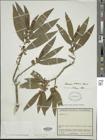
Isotype of Solanum caquetense J.D.Tovar [J. Cuatrecasas 9041 (US acc. # 1798002)]. Image courtesy of the Smithsonian Institution

Distribution of Solanum caquetense (stars), Solanum pinguiculum (triangles) and Solanum sabu (circle).
Diagnosis. Like Solanum imberbe Bitter but with the minor leaves orbicular (vs. linear to lanceolate in S. imberbe) and the new growth densely rusty papillose (vs. glabrous in S. imberbe). Like Solanum anisophyllum Van Heurck & Müll.-Arg. but with shorter nodes, strongly winged stems (vs. terete stems in S. anisophyllum), lanceolate leaves with acute apices (vs. elliptic with acuminate apices in S. anisophyllum), leaves sessile or with petioles less than 2 mm long (vs. leaves with clearly differentiated petioles 10-20 mm long in S. anisophyllum).
Description
Shrubs growing along rocky banks of streams and rivers, 0.5-3 m tall. Stems strongly winged from decurrent leaf bases, often tetrangular; young stems and leaves minutely rusty papillose; bark of older stems grayish green in live plants, not exfoliating, glabrous. Sympodial units difoliate, the leaves geminate, strongly anisophyllous, differing in size and shape. Leaves simple; major leaves with blades 7-13.5 cm × 1.5-3 cm, lanceolate; surfaces glabrous or with a few unbranched uniseriate trichomes along the midvein near the base, adaxially shiny in live plants; primary veins 5-8 pairs, raised on both surfaces and yellowish in live plants; base attenuate, strongly decurrent onto petioles and also somewhat onto the stem; margins entire; apex acute to slightly acuminate; the petioles very short, ca. 2 mm if clearly differentiated (not decurrent); minor leaves with the blades 0.7-2 cm × 0.7-1.2 cm, orbicular, occasionally ovate; surfaces glabrous like the major leaves; base rounded; margins entire; apex rounded to obtuse; petioles absent. Inflorescences opposite the leaves, 6-8 mm long, unbranched, erect and stout, 5-12 flowered, rusty papillose distally; peduncles 2-3 mm long, glabrous or with few unbranched uniseriate trichomes; pedicels 4-7 mm long, deflexed at anthesis, thickening at the apex, pedicels scars very close to each other, almost overlapping. Buds ovoid, rusty papillose, the calyx lobes deltate and sometimes unequal in size when buds very young, the corolla soon exserted from the calyx tube before anthesis. Flowers bisexual. Calyx with the tube ca. 1 mm long, the lobes 0.5-1.5 mm long, deltate, abaxially red-papillose, minutely ciliate at the apex. Corolla 0.8-1 cm in diameter, white, greenish in the center, stellate, lobed nearly to the base, the lobes 3.5-4.5 mm × 2-3 mm, planar or strongly reflexed at anthesis. Stamens equal; filament tube minute; free portion of the filaments ca. 0.25 mm long; anthers 2-3 mm × ca.1 mm, yellow, poricidal at the tips, the pores lengthening to slits with age. Ovary conical, glabrous; style 2-4 mm long, straight, glabrous; stigma clavate. Fruit a globose berry, 1-1.3 cm in diameter, green with white mesocarp, the apex sometimes umbonate; fruiting pedicels 1-1.2 cm long, woody, erect, rugose. Seeds ca. 45 per fruit, 3-3.5 mm × ca. 2 mm, ovoid, greenish white when fresh, black when dry, the surfaces smooth, the testal cells with sinuate lateral walls. Chromosome number not known.
Distribution and ecology
Solanum caquetense is known from the Department of Caquetá on the eastern slopes of the southern Andes of Colombia (Fig. 3), where it forms dense stands on rocky and sandy banks of rivers and streams, from 300 to 1,100 m in elevation.
Phenology
In the examined material of Solanum caquetense we observed specimens in flower and fruit from January to October suggesting it probably blooms throughout the year.
Etymology
The specific epithet refers to the Department of Caquetá in Colombia; the word Caquetá is of unknown etymology.
Preliminary conservation status
Endangered (EN) [EOO (131 km2) and AOO (20 km2)]. We assign S. caquetense a preliminary IUCN Red List status of endangered (EN), based on assessment criteria B2 a, b (i,ii,iv) (IUCN 2023) and the fact that this species has not been recorded in any protected area. The region where it is found is under constant human pressure, especially due to deforestation for agricultural expansion.
Notes
Solanum caquetense is morphologically similar to other members of the Geminata clade that occur exclusively in the sandy or rocky banks of river courses where they are subject to periodic inundation. These species (e.g., S. imberbe of northern Colombia and Central America, S. monadelphum Van Heurck & Müll.-Arg. of Peru, see below) have narrow, willow-like leaves and are usually plants of small stature. Solanum caquetense is most similar to the widely distributed Solanum imberbe, which is distributed from Costa Rica to northern Colombia and Venezuela. Solanum caquetense can be easily distinguished from S. imberbe by its geminate leaves in which the pair differs in size and shape (lanceolate major leaves, orbicular minor leaves) whereas the leaves of S. imberbe, while geminate, differ only in size. In addition, the pedicel scars of S. caquetense are tightly spaced and nearly overlap, whereas in S. imberbe they are evenly spaced and do not overlap. Solanum caquetense also has shorter pedicels at anthesis when compared with S. imberbe (4-7 mm vs. 8-11 mm). The new growth of S. caquetense is rusty papillose, whereas S. imberbe has a completely glabrous new growth.
The rusty papillose new growth of S. caquetense is shared with S. anisophyllum, a sympatric species in the Colombian Amazon foothills. Solanum anisophyllum does not have the distinct rheophyte habit of S. caquetense and has elliptic leaves with long acuminate apices and terete stems in contrast to the lanceolate leaves with acute apices and strongly winged stems of S. caquetense. It is common to find specimens of S. caquetense misidentified as S. anisophyllum in herbaria. Knapp (2002) cited some of these samples in her monograph, however, we recognize these plants as separate entities here.
The leaves of S. caquetense also resemble those of S. monadelphum and S. amnicola S. Knapp from similar habitats in the Peruvian Amazon, but S. monadelphum can be easily distinguished from S. caquetense by the plurifoliate sympodial units and branched inflorescences. Solanum caquetense can be distinguished by the strongly anisophyllous foliage, contrasting with the non-anisophyllous leaves of S. amnicola.
Paratypes
COLOMBIA. Caquetá: Municipio de Belén de los Andaquies, Parque Municipal Natural Belén de Los Andaquies, camino Andaqui, cuenca de la quebrada Finagá, 01°40'57.3"N 75°54'7.3"W, 1150-1380 m, 26 Jan 2017 (fl, fr), J. Betancur et al. 20399 (COL, COAH); Municipio de Belén de los Andaquies, vereda Las Verdes, río Pescado, Parque Natural Municipal Andaki, 01°36'7.2"N 75°54'10"W, 700 m, 28 Oct 2010, (fl, fr), D. Cárdenas et al. 40853 (COAH); Municipio de Belén de los Andaquies, camino entre Acevedo y Belén, 01°40'58"N 75°54'21"W, 1100-1400 m, 23 Jul 2011 (fl, fr), D. Cardenas et al. 41776 (COAH, NY); Municipio de Belén de los Andaquies, camino Andaqui, via que comunica el municipio de Acevedo con Belén, 01°40'01.5"N 75°54'10.5"W, 1000-1200 m, 11 Mar 2016, (fl), D. Cárdenas et al. 45912 (COAH); Municipio de Belén de los Andaquies, Parque Natural Municipal Andaki, vereda Las Verdes, río Pescado, 01°35'47.6"N 75°52'48.5"W, 501 m, 28 Oct 2010, (fr), D.C. Daly et al. 14185 (INPA, NY); Municipio de San José del Fragua, 320-340 m, 11 Jan 1974 (fr), G. Davidse et al. 5748 (COL, MO); Municipio de Florencia, corregimiento El Caraño, camino a la cascada Salto El Caraño, 01°44'11.8"N 75°40'37.8"W, 800-1000 m, 17 Jun 2017, (fl, fr), D. Hoyos & C. Alvarez 22 (COAH, HUAZ); Municipio de Florencia, corregimiento El Caraño, finca Las Brisas, 01°44'11.8"N 75°40'37.8"W, 800-1000 m, 29 Jul 2018, (fl, fr), D. Hoyos et al. 207 (COAH); Municipio de Florencia, corregimiento El Caraño, vereda El Caraño, 01°44'N 75°40'W, 900-1000 m, 3 Apr 2016 (fl), D. Jimenez et al. 17 (MEDEL); Municipio de Florencia, finca de Don Isauro, camino al rio, 01°44'50.8"N 75°40'45.8"W, 330 m, 16 Apr 2016 (fl, fr), A. Orejuela et al. 2650 (COL); Municipio de Florencia, corregimiento El Caraño, finca Las Brisas, vereda La Cascada, 01°37'50"N 75°40'50.9"W, 1000 m, 7 Nov 2015 (fr), D. Sanin 6256 (MEDEL)
Solanum pinguiculum J.D.Tovar , sp. nov.
urn:lsid:ipni.org:names:77339316-1
Type. Colombia. Cauca, Municipio de Santa Rosa, vereda San Juan de Villalobos, La Florida, 1°29'2.02"N 76°14'30.49"W, 1800 m, 26 Dec 2018 (fl,fr), F.L. Chantre 360 (holotype: HEAA [acc. # 100]; isotypes: COL, COAH).

Solanum pinguiculum J.D.Tovar A Leaves B Stems and inflorescence C Flowers D Fruits. Photos: J.D. Tovar [voucher J. D. Tovar 461 (JBB)].

Holotype of Solanum pinguiculum J.D.Tovar [F. Chantre 360 (HEAA acc. # 100)]. Image courtesy of the Instituto Tecnológico del Putumayo.
Diagnosis. Like Solanum goniocaulon S.Knapp, but with a subshrubby habit (vs trees in S. goniocaulon), unifoliate sympodial units (vs. difoliate geminate in S. goniocaulon). Like S. cyclophyllum S.Knapp but new growth with simple uniseriate trichomes (vs. glabrous in S. cyclophyllum) and strongly reflexed corolla lobes (vs. spreading and planar in S. cyclophyllum).
Description
Subshrub up to 1 m tall. Stems strongly winged, often tetragonal, soft and watery in texture; young stems and leaves glabrous; new growth minutely pubescent with translucent unbranched uniseriate trichomes, these golden in dry material; bark of older stems light green in live plants, dark brown when dry, not exfoliating. Sympodial units unifoliate. Leaves simple; blades 10-17 cm × 3.5-7 cm, elliptic to narrowly elliptic; both surfaces glabrous, adaxially matte in live plants; primary veins 9-10 pairs, these strongly brochidodromous, greenish beneath in live plants, the midrib golden lenticellate near the base, raised on both surfaces; base acute and slightly decurrent onto petioles, but not reaching the stem, sometimes somewhat oblique; margins entire; apex acuminate, with an acumen 0.5-1.5 cm long; petioles 2-8 mm long, glabrous. Inflorescences opposite the leaves, 0.7-1 cm long, unbranched, stout, and perpendicular to the stem, 5-8 flowered but with up to 30 pedicels scars, bearing the flowers in the distal third, the axis pubescent with simple uniseriate trichomes like those of the new growth; peduncle 2-5 mm long; pedicels scars closely spaced and overlapping. Buds globose, golden papillose, the calyx lobes rounded, minutely pubescent at the tips with the same trichomes as the rest of the plant, the corolla soon exserted from the calyx tube. Flowers bisexual. Calyx with the tube ca. 1 mm long, cup-shaped, the lobes ca. 1 mm long, rounded and knob-like. Corolla 8-10 mm in diameter, white, green at the insertion of the stamens, stellate, lobed nearly to the base, the lobes 3-4 mm × 2-3 mm, deltate, strongly reflexed in anthesis, papillate at the tips. Stamens equal; filament tube minute; free portion of the filaments less than 1 mm long, glabrous; anthers 2-2.5 mm × ca. 1 mm wide, stout, somewhat curved towards the style, poricidal at the tips, the pores lengthening to slits with age. Ovary conical, glabrous; style ca. 1 mm long, straight, glabrous, stigma clavate. Fruit a globose berry, 1-1.3 cm in diameter, green with whitish cream mesocarp, glabrous, the pericarp shiny in dry material; fruiting pedicels 1.2-1.5 cm long, deflexed or somewhat erect, woody, glabrous, the calyx strongly constricted below the fruit; fruiting calyx lobes rounded and knob-like, whitish cream in live plants. Seeds ca. 20 per fruit, ca. 3 mm × ca. 1.5 mm wide, ovoid, beige in fresh material, black when dry, the surfaces minutely pitted, the testal cells with sinuate lateral walls. Chromosome number not known.
Distribution and ecology
Solanum pinguiculum is only known from the southeastern foothills of the Colombian Andes (Fig. 3), between 700 and 2,100 m in elevation, growing in litter-rich soils in the shady understory of evergreen primary forests. Solanum pinguiculum is a rare plant where it occurs and is difficult to find since it is a small shrub, often hidden by the surrounding vegetation. Like other members of the clade (i.e. S. arboreum Dunal, S. microleprodes Bitter, J.D.Tovar pers. obs.), flowers are guarded by tiny reddish-brown ants, but no detailed studies of these interactions have been undertaken, although the ants may be visiting extrafloral nectaries (Anderson & Symon, 1985).
Phenology
Solanum pinguiculum was observed flowering in November, December and May, and fruiting plants were seen in December and April.
Etymology
The epithet is derived from the Latin word "pinguis", which means plump or fat. It is expressed in its diminutive form and alludes to various features of the plant, including its short and stout anthers, the knob-like calyx lobes during fruiting, and the overall size of the plant.
Preliminary conservation status
Endangered (EN) [EOO (1,065 km2) and AOO (28 km2)]. We assign S. pinguiculum a preliminary IUCN Red List status of endangered (EN), based on assessment criteria B2 a, b (i,ii,iv) (IUCN 2023). It occurs within the protected areas of Reserva Natural La Isla Escondida in the Department of Putumayo, and the Parque Nacional Natural Cueva de Los Guacharos in Huila
Notes
Solanum pinguiculum is similar to S. cyclophyllum, especially in its somewhat herbaceous habit and unifoliate sympodia; however, the new growth with simple uniseriate trichomes, the strongly reflexed corolla lobes and the knob-like calyx lobes of S. pinguiculum easily distinguish it from S. cyclophyllum. Solanum pinguiculum is also similar to S. marantifolium Bitter; both species share the subshrubby habit, knob-like fruiting calyx lobes, and similar anther morphology, however, S. pinguiculum has winged stems contrasting with the terete stems of S. marantifolium, the leaf margins of S. pinguiculum are planar, while those of S. marantifolium are somewhat ruffled. Solanum pinguiculum also possesses shorter petioles (2-8 mm) than those of S. marantifolium (15-30 mm). These two species are not closely related phylogenetically and the similarities between them could be explained by the strong morphological convergence within the Geminata clade (Tovar et al., unpubl data.).
The winged stems of S. pinguiculum resemble those of S. goniocaulon and S. humboldtianum Granados-Tochoy & S.Knapp; however, those species are typically shrubs to treelets and inhabit the mid to high-elevation Andean cloud forests, whereas S. pinguiculum is always a small subshrub or coarse herb with very soft wood and is from lower elevations.
Solanum pinguiculum displays variation in leaf venation, with some populations exhibiting secondary veins somewhat perpendicular to the midrib while others show ascending secondary veins. Intermediate morphologies are present across the distribution range and both extremes in leaf venation share all other diagnostic characteristics of the species, including strongly winged stems, knob-like calyx lobes, and chubby anthers. We therefore consider both morphologies as a single entity.
Paratypes
COLOMBIA. Cauca: Municipio de Santa Rosa, vereda San Juan de Villalobos, San Juan, 1°29'50.81"N 76°22'34.28"W, 1670 m, 9 Dec 2018 (fl,fr), L.A. León & F. Quilindo 351 (HEAA); Municipio Santa Rosa, vereda San Juan de Villalobos, Santo Domingo, 1°40'00.3"N 76°14'50.6"W, 2202 m, 11 Nov 2018 (fl,fr), M. Quilindo & M.E. Toquica 249 (HEAA); Municipio de Santa Rosa, vereda San Juan de Villalobos, San Eduardo, 1°28'52.9"N 76°24'47.7"W, 1600 m, 18 Dec 2018 (fr), M. Quilindo & E. Ñañez 354 (HEAA); Municipio Santa Rosa, vereda San Juan de Villalobos, San Eduardo, 1°28'52.9"N 76°24'47.7"W, 1600 m, 18 Dec 2018 (fl), M. Quilindo & E. Ñañez 369 (HEAA); Municipio Santa Rosa, vereda San Juan de Villalobos, Palmeras, 1°30'12.10"N 76°21'15.57"W, 1500 m, 6 Dec 2017 (fl, fr), A. Samboni & G. Lucena 95 (HEAA); Municipio Santa Rosa, vereda San Juan de Villalobos, Santa María, 1°33'15.0"N 76°19'01.9"W, 1730 m, 4 Apr 2018 (fr), A. Samboni & G. Lucena 137 (CAUP, HEAA). Huila: Municipio de Acevedo, Parque Nacional Natural Cueva de Los Guacharos, entre la Cabaña Anadqui y El Pesebre, 1°36'N 76°06'W, 1900-2100 m, 28 Nov 2001 (fl), B.R. Ramirez et al. 15010 (FMB). Putumayo: Municipio de Orito, Reserva Natural La Isla Escondida, 0°39'04.6"N 77°04'16.7"W, 800 m, 17 May 2019 (fl), J.D. Tovar 461 (JBB).
Solanum sabu J.D.Tovar , sp. nov.
urn:lsid:ipni.org:names:77339317-1
Type. Colombia. Tolima: Municipio de Murillo, Vereda Piemorro, loma Piemorro, 4°45'37.17"N 75°06' 31.77"W, 2370 m, 1 Mar 2003 (fl,fr), E. Correa & C. Duque 2163 (holotype: HUA [acc. # 169972])

Holotype of Solanum sabu J.D.Tovar [E. Correa & C. Duque 2163 (HUA acc. # 169972)]. Image courtesy of the Universidad de Antioquia.
Diagnosis. Like Solanum dolosum S. Knapp but with planar leaf margins and tufts of dendritic trichomes in the vein axils of abaxial leaf surfaces (vs. ruffled leaf margins and simple trichomes distributed along the midrib abaxially in S. dolosum), difoliate sympodial units (vs. unifoliate sympodia in S. dolosum), terete stems (vs. strongly winged stems in S. dolosum).
Description. Shrubs ca. 3 m tall. Stems terete, dark brown in dry specimens; young stems and new growth red papillate; bark of older stems dark brown, glabrescent, not exfoliating. Sympodial units difoliate on reproductive shoots, the leaves geminate, differing in size but not in shape, the minor leaf often deciduous. Leaves simple; major leaves with the blades 11-16 cm × 2.3-3 cm, elliptic; adaxial surface glabrous; abaxial surface pubescent with tufts of dendritic trichomes in the vein axils; primary veins 8-13 pairs, the venation markedly brochidodromous, very faint adaxially, abaxially prominent; base acute and partially decurrent onto petioles; margins entire; apex long acuminate, the acumen 1.5-2.5 cm long; petioles 2-5 mm long, glabrous; minor leaves 5 cm × 1.5 cm, elliptic; glabrous on both surfaces; primary veins 6-9 pairs; base attenuate, oblique and decurrent onto petioles; margins entire; apex acute or rounded; petioles 0.5-0.7 cm long. Inflorescences leaf-opposed, 1-2 mm long, unbranched, 4-6 flowered, glabrous; peduncles less than 1 mm long; pedicels 2-4 mm long, deflexed, with a few papillate trichomes like those on young stems; pedicels scars closely spaced, nearly overlapping. Buds globose, the corolla strongly exserted from the calyx tube prior to anthesis. Flowers are apparently bisexual, but perhaps some flowers function as staminate (see Notes). Calyx with the tube 2-3 mm long, cyathiform, the lobes deltate, 1-1.5 mm long, 1.8-2.2 mm wide, glabrous on both surfaces, with a few single-celled trichomes at the tips. Corolla 5-6 mm in diameter, white, stellate, lobed nearly to the base, the lobes 2.5-3 mm long, 0.8-1 mm wide, glabrous on both surfaces, cucullate at the tips. Stamens equal; filament tube minute; free portion of the filaments ca. 0.1 mm long; anthers 1.5-2 mm long, 0.4-0.5 mm wide, ellipsoid, yellow, poricidal at the tips, the pores lengthening to slits with age. Ovary conical, glabrous; style ca. 1 mm long, terete, glabrous; stigma capitate. Fruit a globose berry, 7-8 mm in diameter, green, the pericarp glabrous, somewhat shiny in dry material; fruiting pedicels ca. 1 cm long, deflexed, woody and rugose. Seeds ca. 14 per fruit, 3-3.5 mm long, 1.6-2.2 mm wide, ovoid-reniform, brown when dry, the surfaces smooth, the testal cells with sinuate lateral walls. Chromosome number not known.
Distribution and ecology
Known only from the type collection in the eastern slopes of the Cordillera Central in the Colombian Department of Tolima (Fig. 3). According to the label data on the only known collection, this species inhabits primary forest. Despite intensive search, we were unable to find additional specimens. The area where it was collected is highly degraded through anthropogenic use.
Phenology
Solanum sabu records show flowers and fruits in March.
Etymology
The specific epithet, a noun in apposition, is the nickname of JDT’s great friend and colleague María Alejandra Buitrago, an expert in Marantaceae systematics, who has accompanied him on many collecting trips, including the fruitless search for more specimens of this enigmatic species. This species is named in her honor.
Preliminary conservation status
With only a single collection from about 20 years ago, S. sabu is assigned here as a data deficient (DD; IUCN 2023). We were unable to find additional specimens of S. sabu in any herbarium we visited nor in the field after two expeditions. Therefore, further expeditions are highly recommended since the type locality is strongly disturbed by human use.
Notes
Despite knowing this species from a single collection, we strongly feel that describing it will encourage the search for additional material and revisionary work in additional herbaria. The morphologically similar S. naucinum S.Knapp from Peru was also described from a single specimen in 2005 (Knapp 2005) and today is known from many more collections.
Solanum sabu is morphologically similar to S. dolosum from the Cordillera Occidental of Colombia. These species can be confused at first glance, but the difoliate sympodial units on reproductive shoots of S. sabu and the dendritic trichomes in the abaxial leaf vein axils distinguish it from S. dolosum which possesses unifoliate sympodial units and unbranched trichomes. Solanum sabu is also similar to Solanum naucinum with which it shares uniseriate dendritic trichomes of mature leaves but the new growth of S. sabu is red-papillate whereas that of S. naucinum is more obviously pubescent with dendritic trichomes to 1 mm long. The color of the fruit in herbarium specimens also helps identify these species; in S. sabu the fruits are dry black, whereas the fruits of S. naucinum are dry yellowish brown.
The very short style held within the anther cone of the single specimen of S. sabu suggests these plants may be andromonecious or functionally dioecious. Further collections are needed to investigate this possibility. Andromonoecy and dioecy are both reported in the Geminata clade (Knapp, 2008).
Artificial key to the Colombian species of the Geminata clade
1 Sympodial units difoliate and the leaves geminate (i.e. two paired leaves per inflorescence)…………...………………………………………………………….…2
- Sympodial units unifoliate, plurifoliate, or difoliate and the leaves not geminate.….50
2 Leaves of a geminate pair markedly differing in shape and size, minor leaf often orbicular……………………………...…………..…………………………………...3
- Leaves of a geminate pair not differing in shape, only in size, with markedly smaller leaves…………….………………………………..………………………….……...22
3 Mature leaves glabrous abaxially or with minute single-celled golden trichomes…...4
- Mature leaves pubescent abaxially, with at least some well-developed multi-celled trichomes present...………………………………………….……………………....19
4 Inflorescence many times branched…………………….………………………...…..5
- Inflorescence unbranched or at most furcate……………...…………………..……...6
5 Leaves sessile or nearly so, leaf base usually cordate to auriculate, sometimes acute, Amazon basin plants…………………..……………………….S. sessile Ruiz & Pav.
- Leaves petiolate, petioles 1.5-3 cm long, base cuneate not attenuate, northwestern Colombia plants……………..………………………...….S. rovirosanum Donn.Sm.
6 Rheophyte shrubs; leaves narrowly elliptic………….…….S. caquetense J.D.Tovar
- Non-rheophyte shrubs; leaves variable, never narrowly elliptic…..…………………7
7 New growth pubescent, the trichomes erect, short, and golden when dry....…...……8
- New growth glabrous, papillose, hirsute or hispidous, when well-developed trichomes present, these prostrate, white or ferrugineous……………….……….….10
8 Leaves linear to lanceolate 6-12 cm long…………...…...…….S. dolosum S.Knapp
- Leaves obovate to elliptic 8-35 cm long…………………………………..………….9
9 Corolla 8-9 mm in diameter; Amazon basin plants…..S. oppositifolium Ruiz & Pav.
- Corolla 12-15 mm in diameter; plants of northwestern Colombia.
………….………………………………………...….…...S. rovirosanum Donn.Sm.
10 Inflorescence sessile; calyx lobes long-triangular and unequal in size
.…..…..………………………………...……….….………S. tanysepalum S.Knapp
- Inflorescence axis with a clearly differentiated peduncle; calyx lobes equal in size, rarely unequal………………………………………………………..…........………11
11 Peduncles filiform or slender, not stout, usually elongate > 2 cm……........………..12
- Peduncles stout < 1 cm……………………………………...……...……………….14
12 Calyx lobes unequal in size…………………...…..………S. irregulare C.V.Morton
- Calyx lobes equal in size………………………………..…………………………...13
13 New growth glabrous or soft pubescent; minor leaf stipule-like; Amazon basin
.………………………………..……..…..S. leptopodum Van Heurck & Müll.-Arg.
- New growth red-papillose; minor leaf orbicular, not like stipules; northern Colombia
.……….………...…………………………...…S. sieberi Van Heurck & Müll.-Arg.
14 New growth pubescent, with arachnoid trichomes; fruits pale ochre
……………………………………………………………….....S. cornifolium Dunal
- New growth glabrous or only papillate; fruits green to white………………………15
15 Bark corky lenticellate; plants of high-elevation cloud forests, above 2000 m.
….…………………………………………………………………………..S. ripense Dunal
- Bark smooth; plants of dry or humid lowland forests…………...…………………..16
16 Leaves surfaces planar; calyx lobes strongly reflexed; plants of dry forests
….…………………………………………………………………S. lucens S.Knapp
- Leaves surfaces bullate from the secondary veins; calyx lobes attached to the corolla; plants of humid lowland forests……………………………………………………..17
17 New growth hispidulous; fruiting pedicel deflexed, seeds flattened
.………………………………………………………………...S. leucocarpon Dunal
- New growth papillose or glabrous; fruiting pedicels erect, seeds ovoid……………18
18 Inflorescence 0.5-4 cm long; inter Andean valleys and Chocó…..S. arboreum Dunal
- Inflorescence 0.5-1 cm long; Amazon....S. anisophyllum Van Heurck & Müll.-Arg.
19 Leaves pubescent abaxially, with simple uniseriate trichomes, these often confined to the vein axils…..……………………..…………………...……S. leucocarpon Dunal
- Leaves pubescent abaxially, with dendritic or echinoid trichomes………….……...20
20 Small shrubs less than 1 m tall; fruits orange when ripe…...….S. pseudocapsicum L.
- Shrubs up to 3 m tall; fruits green when ripe……………………………………..…21
21 Slender shrubs; stem trichomes loosely dendritic; Andean-Amazon transition plants.
…………………………………………………………….……..S. malletii S.Knapp
- Shrubs to treelets up to 5 m tall; stem trichomes echinoid, the branches of the trichomes hard of disentangle; central to northern Colombia..S. microleprodes Bitter
22 Mature leaves glabrous, occasionally papillate………………………..………....….23
- Mature leaves pubescent, at least some well-developed trichomes abaxially, these often confined to the vein axils……………………….…………………....…...…...35
23 Rheophyte shrubs; leaves narrowly elliptic to lanceolate…………..S. imberbe Bitter
- Terrestrial shrubs; leaves variable, not as above………………………….…..…….24
24 Inflorescences furcate to many times branched……………….……….....…………25
- Inflorescences unbranched………………………………..….……………………...28
25 Stems hollow (fistulous) when dry, Amazon basin plants…..…S. robustifrons Bitter
- Stems solid when dry, not fistulous; Andean or Caribbean plants……………..…...26
26 Leaves obovate; Caribbean plants, from sea level to 2000 m in elevation in the Sierra Nevada de Santa Marta…………………………..…….…S. rovirosanum Donn.Sm.
- Leaves elliptic; Andean plants, usually above 2000 m…………………………..….27
27 Leaves markedly discolorous when dry with 7-14 pairs of secondary veins, margin revolute; fruit 1.5-2 cm in diameter.
…………….………………..…..S. humboldtianum Granados-Tochoy & S.Knapp
- Leaves concolorous when dry with 15-17 pairs of secondary veins, margin not revolute; fruit 2-4 cm in diameter…………..………...…….S. abitaguense S.Knapp
28 Leaves usually > 25 cm long, with 15-17 pairs of secondary veins; fruit up to 4 cm in diameter…….………………………………………………S. abitaguense S.Knapp
- Leaves usually < 25 cm long, with 7-13 pairs of secondary veins; fruit < 2 cm in diameter ……………………..………………………………………………………29
29 Young stems densely pubescent with golden erect trichomes, these visible to the naked eye; inflorescence peduncles < 3 mm long…….........S. dissimile C.V.Morton
- Young stems glabrous or pubescent, if pubescent, the trichomes hyaline and not easily visible to the naked eye; inflorescence peduncles > 5 mm long……………..30
30 Seeds ovoid; lowland plants, usually < 1000 m in elevation……………...…......….31
- Seeds flattened; high elevation plants, usually inhabiting cloud forests above 2500 m.
…………………………………………………………………………………...…..32
31 Inflorescence axis slender, fruit pedicels deflexed and curved.
……………………………………….…………….…..…….S. marantifolium Bitter
- Inflorescence axis stout, fruit pedicels erect and straight...S. rovirosanum Donn.Sm.
32 Stems strongly winged; leaf margin revolute; inflorescence axis with up to 50 pedicel scars ………………......……….S. humboldtianum Granados-Tochoy & S.Knapp
- Stems only slightly winged or terete; leaf margin not revolute; inflorescence axis with up to 25 pedicels scars…………………………………………………………33
33 Corolla 8-12 mm in diameter; leaf venation perpendicular to the midrib
….……………………………………………………………..S. barbulatum Zahlbr.
- Corolla 15-20 mm in diameter; leaf venation ascending………………...…..……...34
34 Inflorescence 3-8 flowered, flowers tetramerous; Andean Plants.
…………………………….….S. sagittantherum Granados-Tochoy & C.I.Orozco
- Inflorescence 20-25 flowered, flowers pentamerous; Sierra Nevada de Santa Marta plants …………………...……………………………………...S. lasiopodium Dunal
35 New growth with golden straight erect trichomes; mature leaves with the same trichomes abaxially, these spread along the lamina…...………...…….…………….36
- New growth glabrous, red-papillose, arachnoid or with curly soft trichomes; mature leaves usually with tufts of trichomes in veins axils abaxially………………...……37
36 Corolla 8-9 mm in diameter; Amazon basin plants…...S. oppositifolium Ruiz & Pav
- Corolla 12-15 mm in diameter; plants of northwestern Colombia.
…………………………………………...……………….S. rovirosanum Donn. Sm.
37 Leaves pubescent abaxially with branched trichomes, often in tufts in veins axils or denser along the midrib………….……………..…………….……………………...38
- Leaves pubescent abaxially with simple trichomes only…………….…..……...…..43
38 Leaves > 20 cm long, abaxially with mixed simple and furcate trichomes; inflorescence peduncles stout and erect…………….....……….S. bohsiae J.D.Tovar
- Leaves < 15 cm long, abaxially with dendritic trichomes; inflorescences with curved and deflexed peduncles………………………..………………………...…………..39
39 New growth densely pubescent with beige arachnoid trichomes; fruits erect, seeds ovoid …………….………….…...….………………...………...S. laevigatum Dunal
- New growth red-papillose or glabrous; fruits usually deflexed, if erect, the seeds flattened …………………………..…………………………………………………40
40 Leaves lanceolate; flowers 5-6 mm in diameter…...……………...S. sabu J.D.Tovar
- Leaves elliptic to obovate; flowers 15-20 mm in diameter…………………….……41
41 Leaves with trichomes in vein axils and along the midrib, reddish when dry, plants with a somewhat orange aspect when dry……………..….…S. psychotrioides Dunal
- Leaves with trichomes confined to the vein axils, trichomes drying hyaline, plants olive or black when dry………………….……....………….……………………….42
42 Petioles 7-12 mm; corolla lobes slightly reflexed, calyx lobes knob-like; southern Andes….. ……………….……….………....………….S. acuminatum Ruiz & Pav.
- Petioles 15-20 mm; corolla lobes planar, calyx lobes not knob-like; Sierra Nevada de Santa Marta………………………………….…………...…….S. lasiopodium Dunal
43 Young stems densely pubescent with short erect golden trichomes; seeds ovoid.
……………………………..……………………………….S. dissimile C.V.Morton
- Young stems glabrous or pubescent, if pubescent, the trichomes not golden and soft; seeds flattened……………..………………………………..….……………………44
44 Corolla diameter < 12 mm, corolla membranaceous……...…………...……………45
- Corolla diameter > 13 mm, corolla fleshy……………………...……………...……46
45 Bark of older stems dark brown, plants drying dark; fruiting calyx lobes persistent
....……… ………….…….…….…………...……………………….S. nudum Dunal
- Bark of older stems grayish, plants drying pale yellow; fruiting calyx lobes deciduous ...……………………..……………………….S. aphyodendron S.Knapp
46 Trichomes of the abaxial leaf surface drying reddish, plants with a somewhat orange aspect when dry………...………………..………………….S. psychotrioides Dunal
- Trichomes of the abaxial leaf surface drying translucent, plants drying olive-green.47
47 Petioles < 5 mm; inflorescence 2-8 flowered, < 2 cm long; new growth red-papillose………………...……………………………….…….S. barbulatum Zahlbr
- Petioles 5-22 mm; inflorescences 5-50 flowered, usually > 3 cm long; new growth glabrous or with simple trichomes……...………………………….….……….……48
48 Trichomes of the abaxial leaf surface along the veins and midrib, not confined to the axils; fruit apex strongly apiculate; leaf venation perpendicular.
...…………………………………...…. S. vacciniiflorum Standl. & L.O.Williams
- Trichomes of abaxial leaf surfaces confined to the vein axils; fruit apex obtuse; leaf venation ascending………………………………………………..…..……………..49
49 Petioles 7-12 mm; corolla lobes slightly reflexed at anthesis; southern Andes.
…………………………………………………. …...…S. acuminatum Ruiz & Pav.
- Petioles 15-20 mm; corolla lobes planar at anthesis; Sierra Nevada de Santa Marta
..………………………………………………………...………S. lasiopodium Dunal
50 Sympodial units plurifoliate; inflorescences appearing terminal or lateral and many times branched…………...……………………………………………...…………..51
- Sympodial units unifoliate or difoliate non-geminate; the inflorescence opposite to the leaves or sometimes internodal…………….…....……………...…………….…55
51 Flowers strongly sweet-scented; leaves usually glabrous or with a few simple white trichomes abaxially……….……….....………………...…………S. laurifrons Bitter
- Flowers not sweet scented; leaves densely pubescent with branched or short erect and golden trichomes……………………….……………………………………….52
52 Leaves glabrous or minutely puberulent with unbranched trichomes; Amazon basin plants……….………………………………………………....S. sessile Ruiz & Pav.
- Leaves densely pubescent with branched trichomes; high-elevation Andean plants
….………….……………………………….….…….……………………………...53
53 Trichomes of leaves loose dendritic, hyaline in both live and dry plants.
..……………………………………………………...………S. oblongifolium Dunal
- Trichomes of leaves congested dendritic, the structure hard of disentangle, beige, brown, or reddish in dry and live plants……………………………...…...………...54
54 Stems and abaxial leaf surfaces with trichomes drying reddish, secondary veins 10-20 pairs perpendicular to the midrib, leaves 7-30 cm long………..S. venosum Dunal
- Stems and abaxial leaf surfaces with trichomes drying beige, secondary veins 6-8 ascending pairs, leaves 3-15 cm long………………...….S. hypaleurotrichum Bitter
55 Sympodial units difoliate non-geminate………………………………………...…..56
- Sympodial units unifoliate…………………….…….…….…….………...………...61
56 Inflorescences furcate to many times branched……………………………......……57
- Inflorescences unbranched……………………………………………………...…...58
57 Flowers strongly sweet-scented; stem slightly winged; fruit yellowish when ripe, seeds flattened………………………….….….…….………...….S. laurifrons Bitter
- Odorless flowers; stems strongly winged; fruit green when ripe, seeds ovoid.
………..…………………..…….S. humboldtianum Granados-Tochoy & S.Knapp
58 Flowers strongly sweet-scented; fruit yellow to orange when ripe
…...…………………………………...………S. validinervium Benitez & S.Knapp
- Odorless flowers; fruit green when ripe…………………………………………......59
59 Leaves drying golden abaxially, elliptic to obovate; stems strongly winged.
..……………………..………….S. humboldtianum Granados-Tochoy & S.Knapp
- Leaves drying green, broadly elliptic to ovate; stems terete or only slightly winged
….………………………...….….….….….….....…………………………………...60
60 Leaves ovate with 5-6 pairs of secondary veins; new growth golden pubescent; seeds flattened……………………………………………………. .S. longevirgatum Bitter
- Leaves broadly elliptic with 15-20 pairs of secondary veins; new growth glabrous; seeds ovoid..………………………………………………….S. marantifolium Bitter
61 New growth densely pubescent with dendritic or arachnoid trichomes (i.e. with a felt-like texture) ........……..………….………………………………………………......62
- New growth glabrous, papillose, or pubescent, with unbranched trichomes.…..…...66
62 Leaves abaxially pubescent; fruits shiny green when ripe………………...………...63
- Leave abaxially glabrous; fruits pale green ochre when ripe…..S. cornifolium Dunal
63 Leaves abaxially pubescent with scattered patches of arachnoid trichomes.
………………..…………………………………………….......S. cornifolium Dunal
- Leaves abaxially pubescent with loose or congested dendritic trichomes………......64
64 Leaves densely pubescent abaxially with congested dendritic trichomes; fruit pedicels deflexed, seeds flattened..………………..…..………S. nutans Ruiz & Pav.
- Leaves abaxially sparsely pubescent with loose dendritic trichomes; fruit pedicels erect, seeds ovoid………………………………......………...……………………...65
65 New growth arachnoid pubescent; abaxial leaf surfaces with trichomes confined to the vein axils; leaves smooth adaxially………………..…..…….S. laevigatum Dunal
- New growth dendritic pubescent; abaxial leaf surfaces with trichomes in the vein axils and spread along the lamina; leaves bullate adaxially
….………………………………………………………S. callianthum C.V. Morton
66 Mature leaves glabrous…………………………………………..……...…………..67
- Mature leaves pubescent, at least some well-developed trichomes present…..…….76
67 Inflorescence long up to 30 cm, axis filiform…….……………S. leptorhachis Bitter
- Inflorescences short < 2 cm, axis stout…………….………………………………..68
68 Leaves usually with three main veins attached to the base, these somewhat acrodromous (Melastomataceae like) ……..……...….S. triplinervium C.V.Morton
- Leaves with a single main vein attached to the base, never acrodromous…………..69
69 Stems strongly winged; leaves usually obovate………...….…………..………...….70
- Stems terete or slightly winged from the decurrent petioles; leaves ovate to elliptic.71
70 Subshrubs up to 1 m tall; new growth golden puberulent..S. pinguiculum J.D.Tovar
- Shrubs to treelets up to 10 m tall; new growth glabrous.
…….…………….……………...S. humboldtianum Granados-Tochoy & S.Knapp
71 Leaves broadly elliptic, sometimes almost orbicular, corolla lobes planar at anthesis
.……………………………………………………...…….S. cyclophyllum S. Knapp
- Leaves ovate to narrowly elliptic, corolla lobes reflexed at anthesis………….…....72
72 Young stems glabrous, petioles > 1 cm…………..………..………………………..73
- Young stems pubescent, the trichomes minute, petioles < 1 cm………….…….......74
73 Leaves ovate, 9-11 pairs of secondary veins; inflorescence 2-5 flowered; corolla 8-10 mm in diameter……..………..…………………………...S. ombrophilum S.Knapp
- Leaves elliptic to narrowly elliptic, 5-6 pairs of secondary veins; inflorescence 20-100 flowered; corolla < 6 mm in diameter……………...…..S. unifoliatum S.Knapp
74 Inflorescence 1-4 flowered; lowland Chocó bioregion…...…S. darienense S.Knapp
- Inflorescence 4-15 flowered; Andes and Amazon basin…………………......……..75
75 Secondary veins in 9-11 pairs, impressed above, petioles 6-10 mm; peduncles 5-25 mm long……………………………..…..………………………….S. confine Dunal
- Secondary veins in 5-7 pairs, raised above, petioles 2-4 mm; peduncles 2-3 mm long
….....………………………………………………………..S. dissimile C.V.Morton
76 Fruit pedicels erect……………………………...………………...…………………77
- Fruit pedicels deflexed……….………………………………...…………...……….78
77 Abaxial leaf surfaces with trichomes confined to the vein axils, leaves with 4-6 pairs of secondary veins; Cordillera Occidental and Central…....…S. deflexiflorum Bitter
- Abaxial leaf surfaces with trichomes along the veins and lamina, leaves with 6-9 pairs of secondary veins; Cordillera Oriental……..…..…...S. quebradense S.Knapp
78 Inflorescences 3-30 cm long, 10-100 flowered…………………...……………...….79
- Inflorescences < 2.5 cm long, up to 15 flowered……………….……..…………….80
79 Older stems glabrous; peduncles 6-20 cm long; Cordillera Occidental
….…………………………………………..…….……...S. nematorhachis S.Knapp
- Older stems pubescent with unbranched curled trichomes; peduncles 3-5 cm long; Cordillera Oriental.…………………………..…………….…….S. capillipes Britton
80 Leaves lanceolate to linear; inflorescences 2-6 flowered; Cordillera Occidental and southern Colombia…..………….…………………...………….S. dolosum S.Knapp
- Leaves elliptic; inflorescences 4-15 flowered; Cordillera Oriental, north of the Cordillera Central and Amazon basin ..…………………………….……………….81
81 Leaves 8-15 cm, petioles 6-10 mm; inflorescences 5-25 mm long; Amazon basin.
…....………………………………………..…………….………….S. confine Dunal
- Leaves 5-10 cm, petioles 2-4 mm; inflorescences 2-3 mm long; Andes.
.…..………………………………………………..………..S. dissimile C.V.Morton
Acknowledgements
We acknowledge the curators of the cited herbaria for allowing us to study material at each collection. This work was supported by Coordenação de Aperfeiçoamento de Pessoal de Nível Superior (CAPES) and the Programa de Desenvolvimento da Pós-Graduação (PDPG) na Amazônia Legal, through a PhD fellowship to JDT (Finance Code 001), by the International Association for Plant Taxonomy and the Society of Herbarium Curators (research grants to JDT) and by CNPq (427198/2016-0, 422191/2021-3 and 408914/2023-8) as research grants to LLG. We thank the reviewers for their valuable contributions to the manuscript. We also thank Andres Orejuela for the photos provided.
References
-
Anderson GJ, Symon DE. 1985. Extrafloral nectaries in Solanum Biotropica 17: 40. doi: 10.2307/2388376.
» https://doi.org/10.2307/2388376. -
Bachman S, Moat J, Hill AW, de la Torre J, Scott B. 2011. Supporting Red List threat assessments with GeoCAT: Geospatial conservation assessment tool. ZooKeys 150: 117-126. doi: 10.3897/ZOOKEYS.150.2109.
» https://doi.org/10.3897/ZOOKEYS.150.2109. -
Bohs L. 2011. A new species and combination in Central American Solanaceae. Novon, 21: 23-27. doi: 10.3417/2009019.
» https://doi.org/10.3417/2009019. -
Gagnon E, Hilgenhof R, Orejuela A et al 2022. Phylogenomic discordance suggests polytomies along the backbone of the large genus Solanum American Journal of Botany, 109: 580-601. doi: 10.1002/ajb2.1827.
» https://doi.org/10.1002/ajb2.1827. - Granados-Tochoy JC, Orozco CI. 2006. Una nueva especie de Solanum sección Geminata (Solanaceae) de Colombia. Caldasia 28: 2-7.
-
Granados-Tochoy JC, Knapp S, Orozco CI. 2007. Solanum humboldtianum (Solanaceae): An endangered new species from Colombia rediscovered 200 years after its first collection. Systematic Botany 32: 200-207. doi: 10.1600/036364407780360085.
» https://doi.org/10.1600/036364407780360085. -
IUCN. 2023. Guidelines for Using the IUCN Red List Categories and Criteria. Version 15.1. Prepared by the Standards and Petitions Subcommittee. https://www.iucnredlist.org/documents/RedListGuidelines.pdf 01 Feb. 2024.
» https://www.iucnredlist.org/documents/RedListGuidelines.pdf - Knapp S. 2002. Solanum section Geminata (G. Don) Walpers (Solanaceae). Flora Neotropica 84: 1-405.
- Knapp S. 2005. Taxonomic additions for Solanum section Geminata (Solanaceae) in Peru. Annals of the Missouri Botanical Garden 92: 248-253.
-
Knapp S. 2008. A revision of the Solanum havanense species group and new taxonomic additions to the Geminata clade (Solanum, Solanaceae). Annals of the Missouri Botanical Garden 95: 405-458. doi: 10.3417/2006159.
» https://doi.org/10.3417/2006159. -
Knapp S, Stehmann JR, Giacomin LL. 2015. New species, additions and a key to the Brazilian species of the Geminata clade of Solanum L. (Solanaceae) in Brazil. PhytoKeys 47: 1-48. doi: 10.3897/phytokeys.47.9076.
» https://doi.org/10.3897/phytokeys.47.9076. -
Mallet J. 1995. A species definition for the modern synthesis. Trends in Ecology & Evolution 10: 294-299. doi: 10.1016/0169-5347(95)90031-4.
» https://doi.org/10.1016/0169-5347(95)90031-4. -
QGIS Development Team. 2023. QGIS Geographic Information System v. 3.3. Open Source Geospatial Foundation Project. https://qgis.osgeo.org 01 Feb. 2024.
» https://qgis.osgeo.org -
Sampaio VS, Agra MF. 2016. Solanum knappiae sp. nov. (Solanaceae) from the Atlantic Forest of northeastern Brazil. Nordic Journal of Botany 34: 395-399. doi: 10.1111/njb.01102.
» https://doi.org/10.1111/njb.01102. -
Särkinen T, Bohs L, Olmstead RG, Knapp S. 2013. A phylogenetic framework for evolutionary study of the nightshades (Solanaceae): A dated 1000-tip tree. BMC Evolutionary Biology 13: 214. doi: 10.1186/1471-2148-13-214.
» https://doi.org/10.1186/1471-2148-13-214 -
Stehmann JR, Moreira NC. 2016. Solanum lagoense (Solanaceae, Geminata clade), a new species from Lagoa Santa, Minas Gerais State, Brazil. PhytoKeys 61: 15-25. doi: 10.3897/phytokeys.61.7258.
» https://doi.org/10.3897/phytokeys.61.7258. -
Tovar JD, Giacomin LL. 2022. A new species and new records of Solanum (Solanaceae) from Colombia. PhytoKeys 195: 63-73. doi: 10.3897/phytokeys.195.78832.
» https://doi.org/10.3897/phytokeys.195.78832. -
Weese TL, Bohs L. 2007. A three-gene phylogeny of the genus Solanum (Solanaceae). Systematic Botany 32: 445-463. doi: 10.1600/036364407781179671.
» https://doi.org/10.1600/036364407781179671.


