 A new species of Lippia (Verbenaceae) from the Espinhaço Range, Minas Gerais, Brazil
Abstract
Lantaneae stands out as the largest lineage within the Verbenaceae, and advancing systematic and taxonomic studies within this tribe is crucial to clarify the circumscription of non-monophyletic genera and elucidate its species richness. In Brazil, the taxonomic knowledge of Lantaneae is still in progress, particularly regarding the genera Lantana and Lippia. Here, we describe Lippia aonae, a new species from the campos rupestres of the Espinhaço Range, Cerrado domain, in the north of Minas Gerais state. It is a subshrub 0.4‒0.6 m tall, with viscous and aromatic leaves, inflorescences with small bracts and corollas, and drupaceous fruits. A detailed description, illustrations, comparison with morphologically related species, and a geographical distribution map are provided for its recognition. Following the IUCN criteria, Lippia aonae can be considered as Vulnerable (VU).
Keywords:
campos rupestres; conservation; endemism; Flora of Brazil; Lamiales
Introduction
Linnaeus (1753) described Lantana L. based on species with indehiscent fruits with fleshy mesocarp, while Lippia L. was characterized by species with schizocarpic fruits that split into two dispersal units, referred to as “cluses” in the key literature of Verbenaceae (O’Leary et al., 2012). Chamisso (1832) described Riedelia lippioides Cham., differentiating it from Lantana and Lippia by its fruits with slightly fleshy mesocarp (drupaceous), splitting into two units at maturity. In contrast, Schauer (1847) expanded the circumscription of Lantana, characterizing the fruits as drupes formed by one pyrene or drupaceous with two pyrenes. Lantana sect. Sarcolippia Schauer was founded to accommodate species with drupaceous fruits (Schauer, 1847). However, Silva (1999), based on a morphological phylogeny, proposed that Lantana should only include species with fruits having one pyrene. Consequently, species having drupaceous fruits with two pyrenes were later transferred to Lippia by Silva and Salimena (2002).
These delimitations, based on fruit characteristics, have led to significant taxonomic complexities over time, resulting in a considerable number of combinations and synonyms between Lantana and Lippia (e.g. Salimena & Múlgura, 2015; Valério et al., 2021). Due to the notable morphological similarity, nuances in fruit morphology, and the difficulty in identifying herbarium specimens, Jansen-Jacobs (1988) suggested that Lantana and Lippia could potentially represent, in fact, a single genus. New insights into the evolution of Lantana and Lippia have been made possible by the introduction of molecular phylogenetic techniques, which revealed that Lantana and Lippia, along with other minor genera within Lantaneae, do not constitute monophyletic groups (Lu-Irving & Olmstead, 2013; Lu-Irving et al., 2014; 2021). In this context, Linnaeus (1753) classification needs to be replaced with a new delimitation that recognizes monophyletic groups within Lantaneae.
Recently, based on the results of the molecular phylogeny of Lantaneae, O’Leary et al. (2023a) described two new monotypic genera, Salimenae N.O’Leary & P.Moroni, and Troncosoa N.O’Leary & P.Moroni. Furthermore, aiming to recognize monophyletic groups within this tribe, O’Leary et al. (2023b) proposed a new classification following the PhyloCode (Cantino & de Queiroz, 2020), which is incompatible with Linnaean ranks. In that study, 28 unranked names were established for clades in Lantaneae, but it was impossible to include them all in the provided identification key (O’Leary et al., 2023b). In addition, the ‘Lantaneae’ clade excluded Coelocarpum Balf.f., which had previously been assigned to the tribe according to Marx et al. (2010).
Lantana (ca. 100 spp.) and Lippia (ca. 140 spp.) remain circumscribed as non-monophyletic taxa, as no study has yet proposed a new classification based on Linnaean categories, as recognized by the International Code of Nomenclature for algae, fungi, and plants (ICN, Turland et al., 2018). O’Leary et al. (2023a) point out that recognizing a single large genus (either Lantana or Lippia, as both have equal priority according to the ICN) represents a challenging alternative because this approach would necessitate a substantial number of new combinations and lead to the loss of information regarding morphological differences among taxa. Nonetheless, given the pronounced morphological similarity shared among Lantana and Lippia species, it might be preferable to avoid small genera with unclear morphological circumscriptions and, instead, recognize a single large genus while refining the infrageneric classification. This would likely provide a greater advantage to botanists who are not specialists in the group.
Despite the challenges in the Lantaneae systematics, taxonomic studies are still essential to elucidate its species richness, particularly in Brazil. This country hosts the highest diversity of the tribe, and yet numerous questions persist regarding the number, endemism, and identity of the taxa (Cardoso et al., 2019; Salimena et al., 2024). During taxonomic investigations of Brazilian Lantaneae, in 2021, we analyzed two specimens of unknown identity, which were collected in Espinhaço Range, specifically within the Serra do Espinhaço Biosphere Reserve-a UNESCO-recognized site in the northern region of Minas Gerais state (Gontijo, 2008; Rapini et al., 2008). Since then, field expeditions have been carried out in this region to find new populations. Fortunately, our efforts were successful in collecting additional specimens, and subsequent taxonomic analyses confirmed their identity as a new species within Lippia. Therefore, we present a detailed description of this new species, alongside illustrations, a distribution map, taxonomic notes, and a preliminary assessment of its extinction risk.
Material and methods
Our analyses were initiated in 2021 during the study of Verbenaceae collections housed at the BHCB herbarium, where two specimens of Lantaneae (D.M.G. Oliveira et al., 77 and J.M. Costa et al., 1015) collected in Parque Estadual Caminho dos Gerais (PECG), and Parque Estadual de Serra Nova e Talhado (PESN), respectively, proved challenging to identify at the genus and species levels. Subsequently, we endeavored to locate additional specimens in different herbaria, mainly through databases from REFLORA (2024) and speciesLink (2024), or by attempting to discover new subpopulations during field expeditions. Fortunately, we discovered a new subpopulation in the PESN, exhibiting the same characteristics as these two herborized specimens. The collected individuals were deposited at SPF with duplicates to be distributed to CESJ and HURB herbaria, acronyms following Thiers (2024, continuously updated).
The analyzed specimens were recognized as a distinct species within Lippia through a comprehensive review of the key taxonomic literature of Lantaneae (Silva, 1999; Sanders, 2012; O’Leary et al., 2023 b , Salimena et al., 2024), protologues, and comparisons with morphologically similar species. These comparisons were carried out through analysis of specimens deposited at ALCB, BHCB, CEN, CESJ, ESA, HUEFS, MBM, R, RB, SP, SPF, and UB, as well as high-quality digital images of specimens available online in the databases from REFLORA (2024), speciesLink (2024), and JSTOR Global Plants (Ithaka, 2024). Descriptive terminology was based on Harris & Harris (2001), Gonçalves & Lorenzi (2007), and Beentje (2010). Phenology and distribution data were gathered from specimen labels and field observations. A preliminary threat assessment of the new species was conducted using GeoCat (Bachmann et al., 2011) to quantify the Area of Occupation (AOO) and Extent of Occurrence (EOO), following appropriate guideline criteria (IUCN, 2022). The distribution map was generated using QGIS version 3.16.
Results
Taxonomic treatment
Lippia aonae Zavatin & P.H.Cardoso, sp. nov. (Figs. 1 and 2)
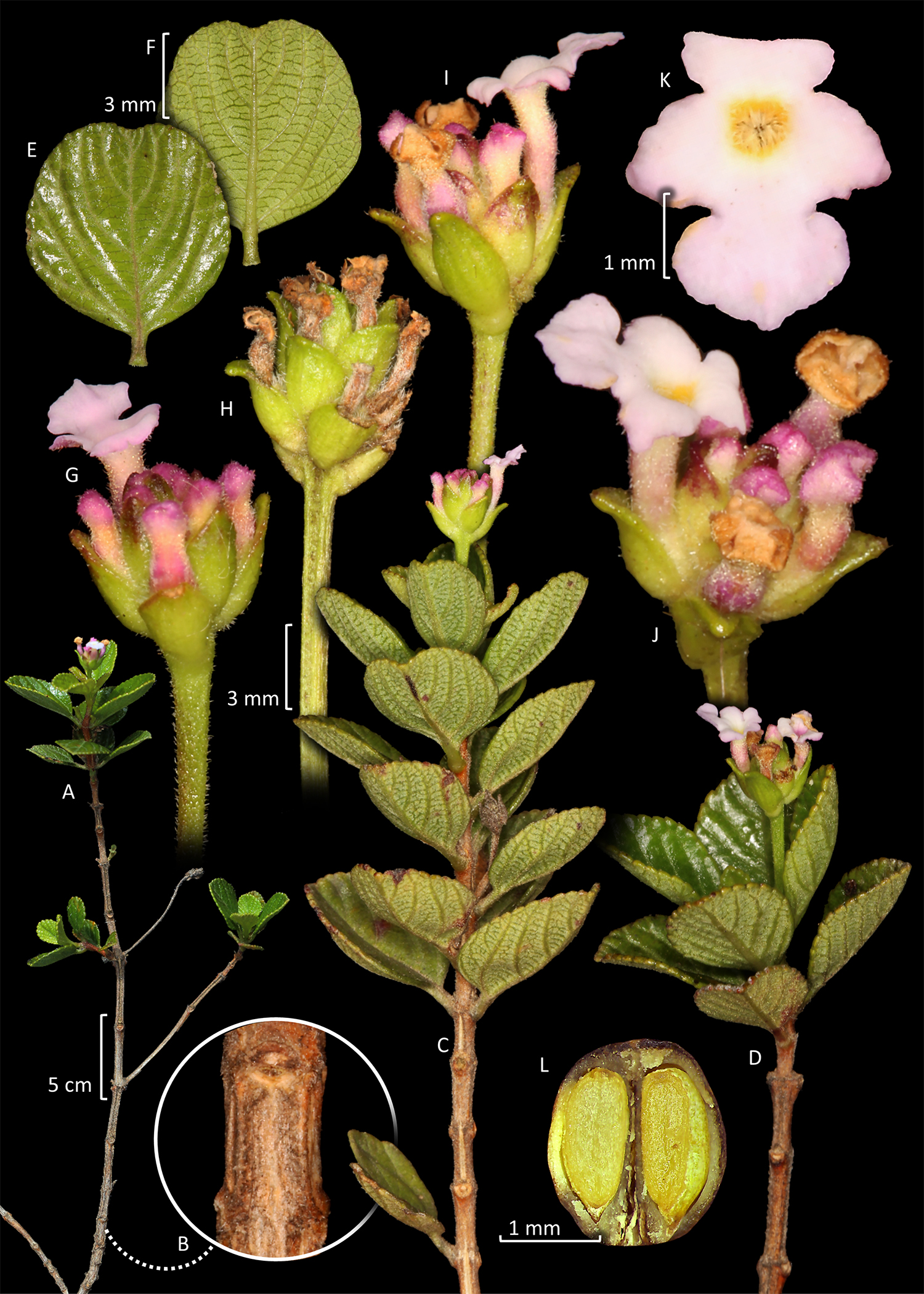
Lippia aonae. (A) Habit. (B) Magnification of the adult branch. (C-D) Branch with inflorescence. (E) Leaf, adaxial surface. (F) Leaf, abaxial surface. (G-I) Inflorescence, showing peduncle, bracts, and corollas. (J) Magnification of the inflorescence. (K) Corolla lobes, frontal view. (L) Dissected fruit. Voucher: Zavatin et al. 2085. Photos: D.A. Zavatin (A-K) and L.J. Sauthier (L).

Lippia aonae. (A) Branch with inflorescence. (B) Detail of the young branch. (C) Leaf, adaxial surface. (D-E) Leaves, abaxial surface. (F) Detail of petiole and leaf base, adaxial surface. (G) Detail of the leaf abaxial surface, showing sessile glandular trichomes. (H) Inflorescence. (I) Bract, abaxial surface. (J) Magnification of the bract vestiture. (K) Corolla. (L) Bracts and fruits. (M) Fruit within the accrescent calyx. (N) Fruit, accrescent calyx removed. Voucher: Zavatin et al. 2085. Drawn by Suzana Souza.
Type: BRAZIL. Minas Gerais: Rio Pardo de Minas, Parque Estadual Serra Nova e Talhado, próximo ao morro do Cruzeiro, 15º30’30.0’’ S, 42º46’24.8’’ W, 1,249 m alt., (fl. and fr.), 6 October 2023, D.A.Zavatin et al. 2085 (Holotype: SPF; Isotypes CESJ and HURB).
Diagnosis: A species more similar to Lippia raoniana P.H.Cardoso & Salimena, but differs by being a smaller plant, with non-sulcate branches, leaves with shorter petioles and blades, orbicular, ovate, or obovate, with glabrescent adaxial surface, lustrous in vivo, and bracts with longer and spreading hairs along the margins, sericeous on the adaxial surface.
Description: Subshrub 40‒60 cm tall, branched, branches erect, tetragonal, strigose when young, becoming glabrescent at maturity, internodes 5‒15 mm long, nodes with conspicuous leaf scars. Leaves aromatic, decussate, patent or suberect, often crowded at the apices of the branches, deciduous at maturity, petioles 2‒2.5 mm long, cylindrical, strigose; blades 7‒15 × 5‒14 mm, subcoriaceous, orbicular, ovate or obovate, discolorous, apex rounded, obtuse, or retuse, base cuneate, obtuse, or rounded, margin entire near the base, crenulate or serrulate towards the apex, plane to revolute, minutely ciliate, adaxial surface lustrous in vivo, glabrescent, abaxial surface densely covered by sessile glandular trichomes, viscous, with prominent veins, sometimes sparsely puberulent. Inflorescences one per axil, spike 4‒10 mm long, hemispherical, rachis not elongated in the infructescence, peduncle 8‒15(‒20) mm long, tetragonal, strigose, with sessile glandular trichomes; bracts equal to each other, free, 3‒4 × 3 mm, ovate to wide-ovate, green, often becoming slightly purple at the apex, apex acute to slightly obtuse, margin conspicuously ciliate with long and spreading hairs, abaxial surface strigose, covered by sessile glandular trichomes, adaxial surface sericeous. Flowers sessile, spirally arranged; calyx 1‒2 mm long, tubular, 2-lobed, apex obtuse, whitish green to light pink, externally densely hirsute and covered with sessile glandular trichomes, accrescent in fruit; corolla tube 5‒8 mm long, limb 2-labiate, lilac, hypocrateriform, externally pubescent, with glandular sessile trichomes, throat light yellow, pubescent; 4 didynamous stamens, inserted at the middle of the corolla tube, included, thecae parallel; ovary ca. 1 mm long, ovoid, glabrous, 2-locular, 1 ovule per locule, stigma oblique, lateral. Fruit spherical, brown, dorsal surface smooth, drupaceous, faintly fleshy mesocarp, 2-pyrenate, separated by a large weakness zone.
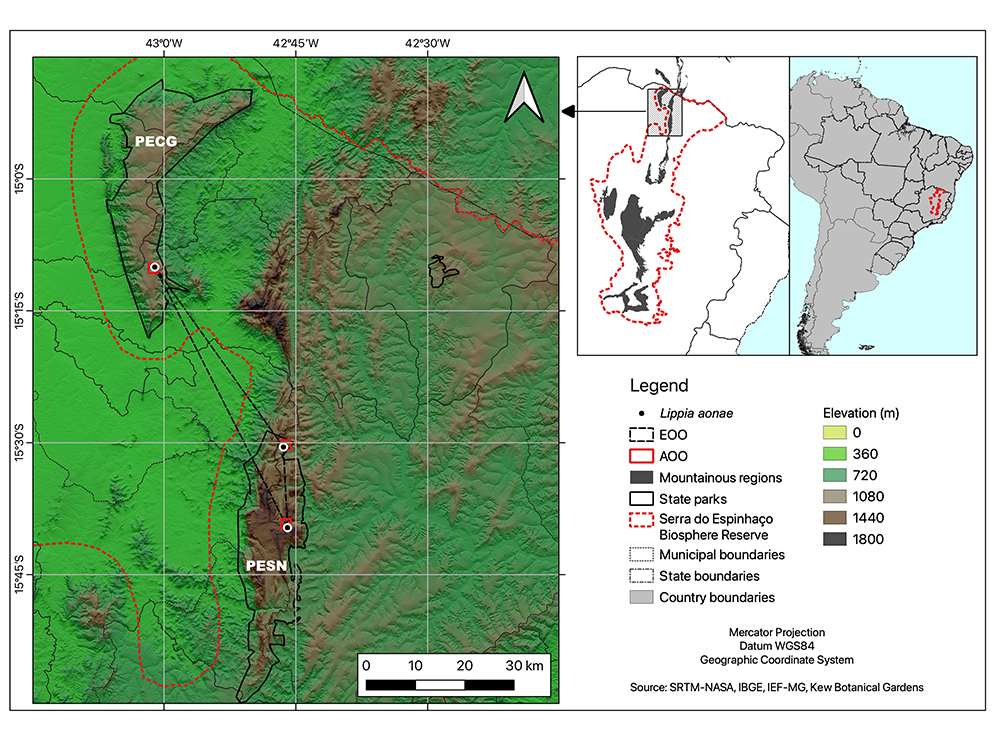
Distribution and habitat: Lippia aonae is endemic to the Espinhaço Range in the northern region of Minas Gerais state (Northern Espinhaço, Serra do Espinhaço Biosphere Reserve), growing in campos rupestres (rocky outcrops, see the concept of Silveira et al., 2016) at altitudes ranging from 900 to 1,250 m, within the Cerrado domain (Fig. 3). Collected with flowers and fruits in March, August, and October.

Map showing the distribution of Lippia aonae in Brazil. PECG (Parque Estadual Caminho dos Gerais), PESN (Parque Estadual de Serra Nova e Talhado).
Conservation status: Lippia aonae has an EOO of 207.21 km2 and an AOO of 12 km2. Fortunately, all three known specimens were collected within two protected areas (PECG and PESN). Significant collection efforts have been undertaken in and around these protected areas in recent years (Zavatin et al., 2023). Even though the individuals of the new species were sterile, the leaf characteristics (lustrous and viscous) represented a point of attention in the search for new subpopulations. However, most of the expeditions were unsuccessful. In the PESN, where we found a new subpopulation, we observed only approximately 10 individuals. Despite the species’ protection, it exhibits a restricted distribution, and the presence of cattle within the limits of PESN (D. Zavatin, personal observation) can pose a significant threat. Additionally, it is important to highlight that several areas of the PECG are undergoing regeneration of native vegetation after the interruption of Eucalyptus forestry projects in 2006. Furthermore, the impacts on the northern region of the Minas Gerais, especially by mining and the installation of wind farms, pose a threat to the survival of many endemic species (Bruner et al., 2001; Zavatin et al., 2023) and may affect the EOO of Lippia aonae. Considering these factors alongside its AOO < 20 km2, Lippia aonae is here classified as VU (D2), and monitoring of its subpopulations within the PECG and PESN is recommended.
Etymology: The specific epithet is an homage to our dear friend, Dr. Lidyanne Yuriko Saleme Aona Pinheiro, an exceptional Brazilian botanist whose career is dedicated to studying Commelinaceae and Cactaceae. Lidyanne currently holds the position of a professor at Universidade Federal do Recôncavo da Bahia and curator of the HURB herbarium. This tribute represents a form of gratitude for Lidyanne’s significant contributions to Brazilian botany.
Additional specimens examined (Paratypes): BRAZIL. Minas Gerais: Monte Azul, Parque Estadual Caminho dos Gerais, Trilha João Éber e Betinha, 15°10’2’’S, 43°01’03’’W, 15 August 2016, D.M.G. Oliveira 77 (BHCB); Rio Pardo de Minas, Parque Estadual de Serra Nova e Talhado, 15°39’40’’S, 42°45’57’’W, 22 March 2012, J.M. Costa et al. 1015 (BHCB).
Notes: Through our collection and herbarium study efforts, we have identified only three gatherings of Lippia aonae. Its reduced habit, with small and deciduous leaves, and inflorescences featuring less showy flowers compared to most species of Lippia and Lantana, can make it difficult to locate and consequently collect this species. These characteristics suggest that Lippia aonae may be under-collected across its range, or it could be characterized by restricted subpopulations with few individuals. As mentioned above, in the PESN, we observed only a subpopulation of Lippia aonae with approximately 10 individuals, while in the PECG, despite conducting dozens of expeditions, we have not encountered any new individuals. Therefore, conducting further field expeditions is crucial to gather more detailed information about the distribution and biology of this species.
In the field, one notable characteristic of the species is the lustrous adaxial surface of its leaves. Furthermore, its leaves are sticky when touched and have a minty odor. The label of paratype D.M.G. Oliveira 77 includes the following note: “Leaf with viscous, sticky secretion with a minty odor”.
Discussion
Lippia aonae most closely resembles L. raoniana, which is also endemic to the Espinhaço Range (Cardoso et al., 2021 a ), due to the leaves densely covered by sessile glandular trichomes, inflorescences with small bracts, lilac corollas, and drupaceous, 2-pyrenate fruit. However, characteristics of the habit, branches, leaves, and bracts distinguish them. Lippia aonae differs by being a subshrub 0.4‒0.6 m tall (vs. shrub 1‒1.5 m tall), with non-sulcate branches (vs. sulcate), leaves with petioles 2‒2.5 mm long, (vs. (2.2‒)3‒7 mm long), blade 7‒15 mm long (vs. 15‒30 mm long), orbicular, ovate or obovate (vs. elliptic or ovate), subcoriaceous (vs. chartaceous), adaxially lustrous in vivo (vs. matte in vivo), glabrescent (vs. sparsely strigose, and densely covered by sessile glandular trichomes), and bracts conspicuously ciliate with long and spreading hairs (vs. ciliate with short and adpressed hairs), adaxially sericeous (vs. sparsely strigose with abundant sessile glandular trichomes in L. raoniana). In addition, both species have distinct distributions along the Espinhaço Range; Lippia aonae occurs in the Northern Espinhaço, while Lippia raoniana is endemic to the Central Espinhaço, particularly in the Diamantina Plateau (Cardoso et al., 2021a).
The leaf morphology of Lippia aonae shows similarities with Lippia bradei Moldenke, a species also found in the Northern Espinhaço, Minas Gerais state (Salimena & Silva, 2009). However, Lippia aonae has smaller bracts, 3‒4 × 3 mm (vs. showy and largest, 5‒10 × 15 mm), with acute to slightly obtuse apex (vs. obtuse to rounded), and a drupaceous fruit (vs. schizocarp splitting into two cluses in Lippia bradei). Additionally, Lippia bradei also differs by its pubescent to hirsute branches and leaves, and its colored bracts, with the basal ones green and the apical ones magenta.
According to traditional classifications, Lippia aonae is morphologically related to species originally circumscribed in Lantana sect. Sarcolippia due to the presence of drupaceous fruits (Schauer, 1847). However, despite the transfer of the species from Lantana sect. Sarcolippia to Lippia (Silva & Salimena, 2002), the section itself has not been combined into Lippia (Lu-Irving et al., 2021). Moreover, in the molecular phylogeny of Lantaneae, species with drupaceous fruits that were sampled emerged in two distinct clades (Lu-Irving et al., 2021). Three species (Lippia brasiliensis (Link) T.R.S.Silva, Lippia macrophylla Cham., and Lippia pubescens (Moldenke) T.Silva) emerged in the ‘Sarcolippia’ clade alongside Lantana speciosa Salimena & T.Silva and Lippia triplinervis Gardner, the last two differing in fruit type. Meanwhile, Lippia raoniana, to which Lippia aonae is morphologically more similar, emerged in the ‘Angustilantaneae’ clade (O’Leary et al., 2023 b ).
As can be seen, the molecular analysis has disrupted taxonomic groups previously recognized, revealing that circumscriptions exclusively based on morphological data are inconsistent. In contrast, the introduction of the phylogenetic classification by O’Leary et al. (2023 b ) lacks robust morphological criteria for delineating some clades. Consequently, employing this classification to elucidate associations between new species and Phylocode-designated clades becomes challenging. This challenge arises, for example, from the difficulty of conducting phylogenetic analyses during the description of new species, impeding their assignment to specific clades, and thereby curtailing the utility of this classification system. Therefore, it becomes essential to conduct further investigations to deepen insights into species interrelationships within Lantaneae, especially considering that only 34% of the species richness of this tribe was represented in the molecular phylogeny (Lu-Irving et al. 2021). This is crucial for developing a taxonomic framework aligned with the classical principles of Linnaeus.
Finally, it is important to highlight that both the taxonomy and nomenclature of Lantaneae in Brazil have advanced considerably in recent years. This progress includes the description of new species (Cardoso et al. 2020a), new synonymizations (Valério et al. 2021), typifications (Cardoso et al. 2021b), reinstatements (Cardoso & Salimena, 2019), and the clarification of some taxonomic confusions (Cardoso et al. 2020b). Such studies are of great importance for a better understanding of species richness, promote nomenclatural stability, and are especially relevant for conservation. Notably, the description of new species not only highlights the exceptional biodiversity of Brazil but also underscores the imperative for the active engagement of taxonomists, field botanists, and conservationists. Their collective efforts are essential in unraveling and safeguarding primarily those species already considered threatened at the time of their description, exemplified here by Lippia aonae.
Acknowledgments
The activities that led to this publication were financed with resources from Copaibas, also by the Global Environment Facility (GEF) through Project 029840 - National Strategy for the Conservation of Threatened Species - Pro-Species: Everyone against extinction. The Pro-Species project is coordinated by the Ministry of the Environment, implemented by the Brazilian Biodiversity Fund (Funbio), and has WWF-Brazil as the executing agency. The activity was coordinated by IEF-MG and included the participation of Parque Estadual Caminho dos Gerais and Parque Estadual Serra Nova e Talhado. We thank Alessandre Custodio Jorge and Jane Cleia Cardoso Santana for the field coordination, and Grazielly dos Santos Costa for the local field planning and the support with the species illustration. Special thanks are extended to Feliciano Rodrigues de Sousa, Ralison Airan Silveira Pereira, Vagner Antônio de Sousa, and Vanilson Fernandes Botelho for the field expedition assistance, and Luana Jacinta Sauthier for her assistance with the fruit cutting and photography. We appreciate the support and permission to collect (053/2022) from IEF-MG. We are also grateful to the two reviewers who contributed to improving the quality of our work. DAZ thanks FAPESP (2022/03949-0) for the fellowship, RRS thanks CNPq (167311/2017-4), and PHC thanks CNPq (150222/2024-6).
References
-
Bachmann S, Moat J, Hill AW, Torre J, Scott B. 2011. Supporting Red List threat assessments with GeoCAT: Geospatial conservation assessment tool. Zookeys 150: 117-126. doi: 10.3897/zookeys.150.2109
» https://doi.org/10.3897/zookeys.150.2109 - Beentje HJ. 2010. The Kew plant glossary. 2nd edition. Richmond, Kew Publishing.
-
Bruner AG, Gullison RE, Rice RE, Fonseca GAB. 2001. Effectiveness of Parks in Protecting Tropical Biodiversity. Science 291: 125-128. doi: 10.1126/science.291.5501.125
» https://doi.org/10.1126/science.291.5501.125 -
Cantino PD, de Queiroz K. 2020. International Code of Phylogenetic Nomenclature (PhyloCode). Boca Raton: CRC Press. doi: 10.1201/9780429446320
» https://doi.org/10.1201/9780429446320 -
Cardoso PH, Salimena FRG. 2019. Notas taxonômicas em Verbenaceae da Flora do Brasil. Hoehnea 46: e032019. doi: 10.1590/2236-8906-03/2019
» https://doi.org/10.1590/2236-8906-03/2019 -
Cardoso PH, Menini Neto L, Cabral A, Salimena FRG. 2019. Lantana caudata (Verbenaceae), a new species from the Brazilian Atlantic forest. Phytotaxa 424(3): 191-196. doi: 10.11646/phytotaxa.424.3.7
» https://doi.org/10.11646/phytotaxa.424.3.7 -
Cardoso PH, Valério VIR, Menini Neto L, Trovó M, Salimena FRG. 2020a. Novelties in Lippia (Verbenaceae) from Minas Gerais State, Brazil. Phytotaxa 455: 47-52. doi: /10.11646/phytotaxa.455.1.6
» https://doi.org//10.11646/phytotaxa.455.1.6 -
Cardoso PH, Santos-Silva F, Menini Neto L, Saraiva RVC, Salimena FRG. 2020b. Heterophylly and post-fire flowering of Lippia horridula (Verbenaceae): A “phoenix” of Brazilian Cerrado. Phytotaxa 441: 95-102. doi: 10.11646/phytotaxa.441.1.9
» https://doi.org/10.11646/phytotaxa.441.1.9 -
Cardoso PH, Menini Neto L, Trovo M, Salimena FRG. 2021a. Checklist and a new species of Lippia (Verbenaceae) from the Diamantina Plateau, Minas Gerais, Brazil. European Journal of Taxonomy 733: 42-55. doi: 10.5852/ejt.2021.733.1219
» https://doi.org/10.5852/ejt.2021.733.1219 -
Cardoso PH, Moroni P, O’Leary N, Salimena FRG. 2021b. Amendments to the nomenclature of Lippia (Verbenaceae: Lantaneae): Typification of names linked to the Brazilian flora. Brittonia 73: 446-458. doi: 10.1007/s12228-021-09674-9
» https://doi.org/10.1007/s12228-021-09674-9 - Chamisso LKA von. 1832. De plantis in expeditione Rommanzoffiana et in Herbariis Regiis, Verbenaceae. Linnaea 7: 213-272.
- Gonçalves EG, Lorenzi H. 2007. Morfologia vegetal: Organografia e dicionário ilustrado de morfologia das plantas vasculares. Nova Odessa, Instituto Plantarum.
- Gontijo BM. 2008. Uma geografia para a Cadeia do Espinhaço. Megadiversidade 4: 7-14.
- Harris JG, Harris MW. 2001. Plant identification terminology: An illustrated glossary. Utah, Spring Lake Publishing.
-
IUCN Standards and Petitions Committee. 2022. Guidelines for using the IUCN Red List Categories and Criteria. Version 15.1. https://www.iucnredlist.org/resources/redlistguidelines 21 Dec. 2023.
» https://www.iucnredlist.org/resources/redlistguidelines -
Ithaka. 2024. JSTOR Global Plants. http://plants.jstor.org/ 20 Jan. 2024.
» http://plants.jstor.org/ - Jansen-Jacobs MJ. 1988. Verbenaceae. In: Görts-Van Rijn A R A (eds.). “Flora of the Guianas”, Series A: Phanerogams. Germany, Hoetz Scientific Books, p. 53-55.
- Linnaeus C. 1753. Species Plantarum 2. L. Stockholm, Salvius.
-
Lu-Irving P, Olmstead RG. 2013. Investigating the evolution of Lantaneae (Verbenaceae) using multiple loci. Botanical Journal of the Linnean Society 171(1): 103-119. doi: 10.1111/j.1095-8339.2012.01305.x
» https://doi.org/10.1111/j.1095-8339.2012.01305.x -
Lu-Irving P, O'Leary N, O'Brien A, Olmstead R.G. 2014. Resolving the genera Aloysia and Acantholippia within the tribe Lantaneae (Verbenaceae), using chloroplast and nuclear sequence data. Systematic Botany 39: 644-655. doi: 10.1600/036364414X680816
» https://doi.org/10.1600/036364414X680816 -
Lu‐Irving P, Bedoya AM, Salimena FR et al 2021. Phylogeny of Lantana, Lippia, and related genera (Lantaneae: Verbenaceae). American Journal of Botany 108: 1354-1373. doi: 10.1002/ajb2.1708
» https://doi.org/10.1002/ajb2.1708 -
Marx H, O'Leary N, Yuan Y et al 2010. A molecular phylogeny and classification of Verbenaceae. American Journal of Botany 97: 1647-1663. doi: 10.3732/ajb.1000144
» https://doi.org/10.3732/ajb.1000144 -
O’Leary N, Calviño CI, Martínez S, Lu-Irving P, Olmstead RG, Múlgura ME. 2012 Evolution of morphological traits in Verbenaceae. American Journal of Botany 99: 1778-1792. doi: 10.3732/ajb.1200123
» https://doi.org/10.3732/ajb.1200123 -
O’Leary N, Moroni P, Lu-Irving P, Mirra F, Olmstead RG. 2023a. Salimenaea and Troncosoa (Verbenaceae, Lantaneae), Two New Monotypic Genera from Southern South America. Novon: A Journal for Botanical Nomenclature 31: 95-107.doi: 10.3417/2023817
» https://doi.org/10.3417/2023817 -
O’Leary N, Lu‐Irving P, Moroni P et al 2023b. Making Lantaneae (Verbenaceae) taxonomy useful: A phylogenetic classification. Taxon 72: 572-589. doi: 10.1002/tax.12934
» https://doi.org/10.1002/tax.12934 - Rapini A, Ribeiro PL, Lambert S, Pirani JR. 2008. A flora dos campos rupestres da Cadeia do Espinhaço. Megadiversidade 4: 16-24.
-
Reflora - Herbário Virtual. 2024. http://reflora.jbrj.gov.br/reflora/herbarioVirtual/ 19 Jan. 2024.
» http://reflora.jbrj.gov.br/reflora/herbarioVirtual/ - Salimena FRG, Silva TRS. 2009. Flora de Grão- Mogol, Minas Gerais: Verbenaceae. Boletim de Botânica da Universidade de São Paulo 27: 119-126.
-
Salimena FRG, Múlgura ME. 2015. Notas taxonômicas em Verbenaceae do Brasil. Rodriguésia 66: 191-197. doi: 10.1590/2175-7860201566110
» https://doi.org/10.1590/2175-7860201566110 -
Salimena FRG, O’Leary N, Cardoso PH et al 2024. Verbenaceae. In: Flora e Funga do Brasil. Rio de Janeiro, Jardim Botânico do Rio de Janeiro. https://floradobrasil.jbrj.gov.br/FB246 20 Jan. 2024.
» https://floradobrasil.jbrj.gov.br/FB246 - Sanders RW. 2012. Taxonomy of Lantana sect. Lantana (Verbenaceae): II. Taxonomic revision. Journal of the Botanical Research Institute of Texas 6: 403-441.
- Schauer JC. 1847. Verbenaceae. In: de Candole, ALPP (eds.). Prodromus Systematis Naturalis Regni Vegetabilis. Paris,Victor Masson. p. 522-700.
- Silva TRS. 1999. Redelimitação e revisão do gênero Lantana L. (Verbenaceae) no Brasil. São Paulo, Universidade de São Paulo.
- Silva TRS, Salimena FR. 2002. Novas combinações e novos sinônimos em Lippia e Lantana (Verbenaceae). Darwiniana 40: 57-59.
- Silveira FA, Negreiros D, Barbosa NP et al 2016. Ecology and evolution of plant diversity in the endangered campo rupestre: A neglected conservation priority. Plant and Soil 403: 129-152.
-
SpeciesLink. 2024. Sistema de informação distribuído para recuperação de dados de acervos de coleções biológicas e de observação em campo. http://splink.cria.org.br/ 20 Jan. 2024.
» http://splink.cria.org.br/ -
Thiers B. 2024. Index Herbariorum: A global directory of public herbaria and associated staff. New York, Botanical Garden’s Virtual Herbarium. http://sweetgum.nybg.org/science/ih/ 20 Jan. 2024.
» http://sweetgum.nybg.org/science/ih/ - Turland NJ, Wiersema JH, Barrie FR et al (eds.). 2018. International Code of Nomenclature for algae, fungi, and plants (Shenzhen Code) adopted by the Nineteenth International Botanical Congress Shenzhen, China, July 2017. Regnum Vegetabile 159. Glashütten, Koeltz Botanical Books.
-
Valério VIDR, Cardoso PH, Menini Neto L, Salimena FRG. 2021. Taxonomic and nomenclatural notes on Lantana and Lippia (Verbenaceae). Phytotaxa 478: 281-286. doi: 10.11646/phytotaxa.478.2.10
» https://doi.org/10.11646/phytotaxa.478.2.10 -
Zavatin DA, Almeida RBP, Ramos R, Lombardi JA. 2023. Chionanthus monteazulensis (Oleaceae), a new species from the campo rupestre of Espinhaço Range, Brazil. Phytotaxa 603: 289-296. doi: 10.11646/phytotaxa.603.3.8
» https://doi.org/10.11646/phytotaxa.603.3.8