 Exploring leaf morphology of Parablechnum cordatum complex (Blechnaceae): An outline analysis approach using Elliptic Fourier Analysis for taxonomic resolution
Abstract
Parablechnum is a genus in the fern family Blechnaceae that exhibits wide morphological variation without a distinct taxonomic discontinuity. To address this problem, we applied the technique of Elliptic Fourier Analysis to evaluate leaf shape by calculating Fourier harmonics based on coordinates derived from a closed outline. Using a combination of contour extraction software and the Momocs package in R, it was possible to analyze 102 specimens of Parablechnum using the pinna as the analytical component, due to its ease of visualization in digitized herbarium specimens. Among the six studied species, three distinct groups were identified using LDA and PCA, with one group consisting exclusively of Parablechnum cordatum. This analysis reaffirmed the segregation found in other studies, helped resolve the P. cordatum complex. This technique enables the use of digitally available herbarium materials, offering the possibility of identifying old specimens and evaluating taxonomic variation in cases like Parablechnum.
Keywords:
Elliptic Fourier Analysis; fern analysis; fern taxonomy; morphometrics
Introduction
The Blechnaceae family, a lineage of leptosporangiate ferns within the Polypodiopsida class (PPG I, 2016), is recognized as a monophyletic group (Smith et al., 2006; Gasper et al., 2017). Parablechnum C.Presl, the richest genus in the family (Gasper et al., 2016; PPG I, 2016), is identified by its pinnate fronds, truncate lamina, sub-conform to conform apices, and numerous scales (Gasper et al., 2016). Phylogenetic studies have confirmed Parablechnum as a monophyletic genus; however, the relationships within the P. cordatum complex remain unresolved, and the status of its component taxa as lineages is currently unclear. However, it is considered challenging to identify due to significant morphological variation, which makes delineating taxonomic boundaries difficult (Smith, 1995; Stolze, 1981).
Brazilian populations of the Parablechnum cordatum complex have historically been challenging to delimit due to morphological variation. Recent morphological and spore ultrastructure studies (Machado & Gasper, 2024) have resolved this highly variable group into four distinct species: Parablechnum brasiliense (Raddi) M.T.Medeiros & Schwartsbund, P. cordatum (Desv.) Gasper & Salino, P. regnellianum (Kunze) G.M.O.Machado & Gasper, and P. usterianum (Christ) Gasper & Salino (Machado & Gasper, 2024). Although these species were recognized in the past (Sehnem, 1968), their delimitation has not been widely accepted (Rolleri, 1976; Dittrich et al., 2018; Grittz et al., 2021), who adopted a broader circumscription. Based on traditional taxonomic analysis (Machado & Gasper, 2024), these species exhibit morphological differences in pinna shape, size, margin features, and apex structure, which aid in their distinction. However, the subtle, often overlapping nature of these differences, combined with the difficulty of examining fine-scale traits in dried specimens, maintains the diagnostic challenge.
The taxonomic complexity of Parablechnum exemplifies broader challenges in botanical systematics. While traditional approaches to species identification rely heavily on expert taxonomists and manual examination of morphological characteristics, this method faces increasing challenges due to a shortage of trained specialists and limited resources (Cope et al., 2012). This scarcity hinders biodiversity research and conservation efforts, particularly in regions with high species diversity. However, advancements in e-taxonomy have begun to address these issues by leveraging digital tools and image analysis techniques, making species identification more accessible and efficient (Mayo et al., 2008). These technological innovations streamline the process of analyzing morphological traits, enabling the rapid comparison of large datasets and reducing reliance on physical specimens. As a result, image analysis has emerged as a valuable tool in modern taxonomy, offering a more cost-effective and scalable solution for identifying species, especially in understudied groups where traditional methods are impractical or too slow to meet urgent conservation needs. This shift towards digital methodologies not only alleviates pressure on limited taxonomic expertise but also enhances the accuracy and consistency of species identification, contributing to more robust and comprehensive biodiversity assessments.
Leaf morphological traits, such as shape, size, and venation patterns, provide valuable information for plant identification and help quantify morphological differences and similarities, offering insights into plant diversity and evolution (Bonhomme et al., 2014). Elliptic Fourier Analysis (EFA) is an effective method that evaluates leaf shape using Fourier harmonics, creating descriptors that are invariant to size, rotation, and location (Kuhl & Giardina, 1982; Cope et al., 2012; Bonhomme et al., 2014). It is important to note that the term 'outline' in EFA encompasses all characteristics of the pinna, including its length, width, area, apex, base, and margin (Cope et al., 2012). Unlike traditional morphological methods, EFA considers all the information contained within the shape of the pinna, enabling it to better capture similarities and dissimilarities among phenotypic variations and associate them with species (Cope et al., 2012; Caple et al., 2017; Wishkerman & Hamilton, 2018). This comprehensive capacity to quantify complex outline characteristics makes EFA highly suitable for discriminating between morphologically overlapping taxa.
In this study, we employ EFA as a potential tool for species discrimination in ferns, specifically to investigate the morphological variation among Brazilian Parablechnum species previously classified within the P. cordatum complex. By focusing on simple morphological characters, such as pinna shape, we aim to delineate species boundaries, providing a better understanding of the patterns of morphological variation in these fern species complexes.
Materials and Methods
Sample Collection
To investigate the morphological variation of Parablechnum cordatum complex pinnae, we accessed 102 specimens through the virtual herbaria JABOT (2023) and INCT-HVFF (2023), and from various physical herbaria (BHCB, C, FURB, HSTM, HUCS, JPCB, MBM, RB, SJRP, UB, UFPR, UNIP, UPCB, and VIES; herbaria abbreviations follow Thiers, 2023). Specimens not available digitally were borrowed from herbaria and scanned at 600 dpi for subsequent image processing (Table S1 - supplementary data). All specimens were identified by the senior author, adhering to the taxonomic framework established by Machado & Gasper (2024) .
We excluded Parablechnum lechleri from the analysis due to an insufficient number of digitized specimens, despite its occurrence in Brazil.
Image Processing
We selected pinnae for the outline analysis based on the following criteria: sterile condition, medium position on the rachis, intact margins, absence of damage or markings that could affect shape information, and presence and length of the petiolule. Five pinnae per specimen were aligned with a millimeter scale and included in the final image. Using the DiaOutline software, we extracted the (x, y) coordinates (Wishkerman & Hamilton, 2018). To standardize the outline tracing, which can affect results, DiaOutline processed specimens from left to right, assuming similar object orientations.
Statistical analysis
For the statistical analysis, R (R Core Team, 2021) was used, specifically the packages Momocs (Bonhomme et al., 2014), tidyverse (Wickham et al., 2019), and readxl (Wickham & Bryan, 2019). Momocs, a software designed for morphometrics (the study of shape and form), enabled us to utilize Fourier coordinates extracted by DiaOutline for statistical classification analyses, such as Linear Discriminant Analysis (LDA) (Bonhomme et al., 2014; Wishkerman & Hamilton, 2018).
For each specimen, we selected five pinnae from the middle portion of the rachis. These pinnae were treated as technical replicates, and their mean values were used for species-level comparisons. This approach accounts for natural intraindividual morphological variation and minimizes the effect of pseudo replication by explicitly incorporating within-specimen variation into our statistical models. This allowed us to distinguish statistically meaningful differences between species from the inherent variation within specimens.
The Fourier analysis was used to retrieve and adjust the coordinates, employing 20 harmonics as the optimal set number, based on McLellan & Endler (1998) . These harmonics describe the pinna outline through a series of sine and cosine coefficients that capture the changing angles and distances along the margin, providing a mathematical representation of the contour shape. This method effectively quantifies the complexity of the margin's curvature through periodic functions, allowing for statistical comparison of outline shapes between specimens.
Following this, Principal Component Analysis (PCA) and Linear Discriminant Analysis (LDA) were conducted to explore the distinctions between shapes and species using Fourier coordinates. PCA was employed to identify the primary factors contributing to the variation in the Fourier coefficients. LDA was used to evaluate discrimination between the six predetermined species groups (P. brasiliense, P. cordatum, P. glaziovii, P. proliferum, P. regnellianum, and P. usterianum), as defined by traditional taxonomic analysis (Machado & Gasper, 2024). This supervised classification approach tested whether the morphometric data supported these a priori species delimitations established through conventional taxonomic methods (Wishkerman & Hamilton, 2018).
Results
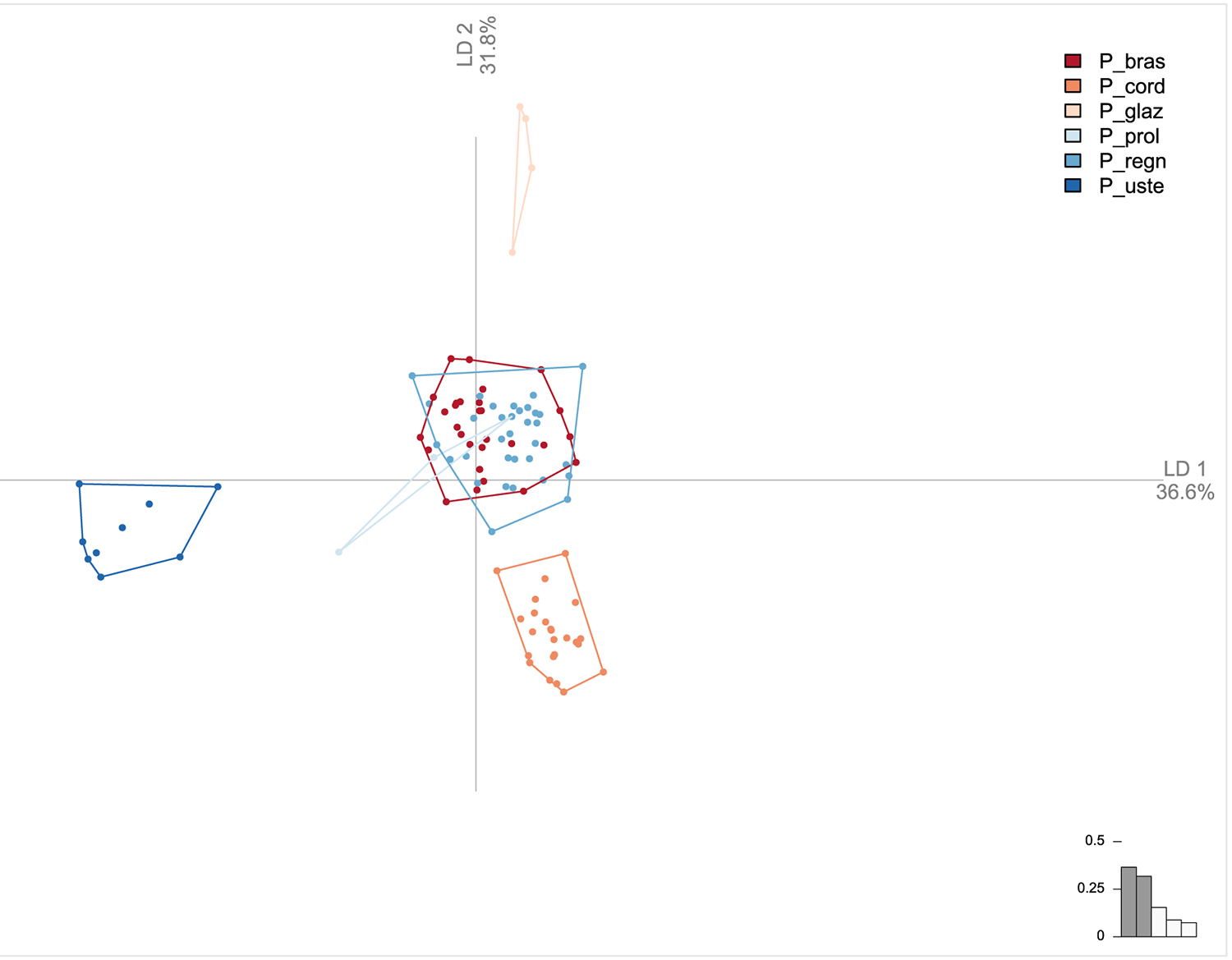
The LDA analysis revealed complex patterns of morphological differentiation among the species groups (Figure 1). Along the first discriminant axis, P. usterianum and P. cordatum showed clear separation from other species. The second discriminant axis partially resolved additional groups, though with notable overlap among P. brasiliense, P. proliferum, and P. regnellianum. Notably, P. glaziovii specimens formed two distinct clusters, suggesting potential substructure within this species that warrants further investigation. The first two discriminant axes accounted for 36.6 % and 31.8 % of the total variance, respectively. Additional discriminant axes explained smaller but potentially important portions of the variation, which might help resolve the overlapping species groups, particularly P. regnellianum from P. brasiliense. While the overall model achieved 95.1 % classification accuracy using all discriminant functions, this high accuracy should be interpreted considering the complete discriminant space rather than just the first two dimensions shown in Figure 1.
LDA results segregating the groups of Parablechnum, forming groups according to their similarity. The six species are indicated by color and presented with the sample size by n= number of individuals sampled: P. brasiliense (red; P_bras), P. cordatum (orange; P_cord), P. glaziovii (beige; P_glaz), P. proliferum (light blue; P_prol), P. regnellianum (blue; P_regn), and P. usterianum (cobalt; P_uste).
Principal Component Analysis (PCA) of the Fourier coefficients showed complete overlap among all species, with no clear separation between any groups (Figure 2). Despite PC1 and PC2 accounting for a substantial portion of the total variance (46.6 % and 14.1 %, respectively, totaling 60.7 %), the results indicate that the majority of morphological variation is continuous and largely independent of current taxonomic boundaries. This complete overlap in PCA space suggests that the shape differences between species are more subtle and complex than can be captured by the primary axes of variation alone, lending support to the premise that this group constitutes a morphospecies complex.

PCA results showing six species of Parablechnum: P. brasiliense (red; P_bras), P. cordatum (orange; P_cord), P. glaziovii (beige; P_glaz), P. proliferum (light blue; P_prol), P. regnellianum (blue; P_regn), and P. usterianum (cobalt; P_uste).
Discussion
The primary goal of utilizing Elliptic Fourier Analysis (EFA) to achieve a deeper understanding of the taxonomy of Parablechnum species has been achieved. We corroborated the taxonomic results suggested by Machado & Gasper (2024) by using a different method to separate species within Parablechnum. This allowed us to gain a better understanding of how EFA can be applied to species complexes. Furthermore, we accomplished this solely using e-taxonomy techniques and by extracting pinna characters from online herbarium exsiccatae.
While EFA is a powerful tool in morphometric studies of outlines, it has some limitations and considerations. A relatively large number of Fourier coefficients are generated, and these are not computationally independent, leading to some redundancy (Haines & Crampton, 2000). Additionally, EFA tends to downweigh higher-order harmonics, which can reduce or suppress the discriminatory power of fine outline details. This means some subtle variations in the outline may not be fully captured by the analysis (Haines & Crampton, 2000; Wishkerman & Hamilton, 2018). Therefore, it is crucial to be aware of these limitations when applying EFA (Wishkerman & Hamilton, 2018).
As expected, not all species were separated in the Linear Discriminant Analysis (LDA) (Figure 1). While Principal Component Analysis (PCA) was not intended to separate groups but rather to show the variance within the data, it revealed complete overlap among all species (Figure 2). Despite this, PCA did indicate some distinction for P. usterianum and P. cordatum, although overlap persisted. The role of LDA, however, is to assess this variation and separate groups based on their similarities. While LDA successfully discriminated P. cordatum, P. glaziovii, and P. usterianum-species historically recognized by morphology (Dittrich et al., 2018)-the complete overlap of P. brasiliense, P. regnellianum, and P. proliferum in both PCA and LDA suggests that pinna shape alone cannot resolve these latter taxa. This aligns with traditional taxonomy, where these species often require additional diagnostic traits (e.g., spore morphology, rhizome scales) for accurate diagnosis (Machado & Gasper, 2024).
Among the analyzed species, P. cordatum, P. glaziovii, and P. usterianum exhibited distinct and identifiable pinna patterns. In the stack plot (Figure 3), P. cordatum is the most distinct, showing a more elongated and narrower shape compared to other species, with notably larger pinnae, reaching 29 cm (Machado & Gasper, 2024). Parablechnum cordatum is similar in shape to P. brasiliense but can be distinguished by its larger pinnae and pinna apex. Parablechnum usterianum also presents larger pinnae (up to 19 cm) but is easily distinguished by its cuneate apex, which differs from the prolonged apex pattern of other species (Dittrich et al., 2018; Machado & Gasper, 2024). Parablechnum glaziovii has the smallest pinnae, measuring about 6 to 10 cm, with an entire to serrate margin (Dittrich et al., 2018).

Stack of outline from all 510 pinna from 102 individuals to visualize the outlines and their differences, to a better size and shape visualization.
Our EFA results reveal both the strengths and limitations of this approach for species discrimination in Parablechnum. The analysis successfully captured overall pinna shape variations, allowing partial separation of species in the LDA. However, several important diagnostic features used in traditional taxonomy were not effectively captured. For example, while traditional analysis uses marginal tooth characteristics as key distinguishing features (such as crispate teeth in P. cordatum versus inward-curved tips in P. brasiliense), these fine-scale features were not resolved in our EFA due to image resolution limitations.
Additionally, while EFA standardization allows shape comparison independent of size, this process eliminates potentially useful size distinctions, such as the significant difference between P. cordatum (up to 29 cm) and P. brasiliense (12-15 cm). The overlap among other species underscores that outline analysis alone is insufficient for delimiting recently segregated or cryptic taxa (e.g., P. brasiliense vs. P. regnellianum), which often rely on microscopic or molecular characters (Sanín et al., 2019). Small sample sizes, particularly for P. proliferum (n=9), limit definitive conclusions, suggesting the need for expanded collections in future studies. This species also presents practical challenges, as its large pinnae often overlap when exsiccatae are mounted, making them difficult to utilize in e-taxonomic studies.
Therefore, while EFA effectively captured broad-scale shape differences (e.g., P. cordatum vs. P. usterianum), it failed to resolve species distinguished by microscopic margin features (e.g., tooth orientation). This aligns with known limitations of outline-based methods (Haines & Crampton, 2000) and highlights the need for complementary approaches like spore microscopy or landmark analyses.
The success of EFA in species discrimination appears to be influenced by both methodological and practical constraints. While our sampling was comprehensive for the P. cordatum complex species, the smaller sample sizes for P. glaziovii and P. proliferum limit our ability to fully assess their morphological variation. Additionally, the quality of herbarium specimens directly affects analysis outcomes-overlapping or folded pinnae during specimen preparation can obscure the very features EFA needs to capture.
Despite these limitations, our study demonstrates that EFA can contribute valuable quantitative support to traditional taxonomic approaches in Parablechnum, particularly when specimens are well-preserved and adequately sampled. Future studies would benefit from larger sample sizes across all species and standardized protocols for digital specimen preparation to maximize the effectiveness of morphometric analyses. The objective of using the EFA technique was to determine if there were significant differences in the outlines of the pinnae among the treated species, which are difficult to identify using traditional methods, and not to segregate the species based solely on pinna size. These species require integrative taxonomy approaches, incorporating additional techniques such as spore analysis and genetic data, for proper classification. EFA facilitates the visual examination of similarities and dissimilarities in pinna outlines that traditional morphological analyses, like measuring height and width, often fail to capture. As part of an integrative approach, EFA becomes a crucial tool for analyzing species complexes with high variation and morphological overlap, allowing for more accurate species delimitation.
Supplementary Material
Table S1 -
References
- Bonhomme V, Picq S, Gaucherel C, Claude J. 2014. Momocs: Outline analysis using R. Journal of Statistical Software 56: 1-24.
- Caple J, Byrd J, Stephan CN. 2017. Elliptical Fourier analysis: Fundamentals, applications, and value for forensic anthropology. International Journal of Legal Medicine 131: 1675-1690.
- Cope JS, Corney D, Clark JY, Remagnino P, Wilkin P. 2012. Plant species identification using digital morphometrics: A review. Expert Systems with Applications 39: 7562-7573.
- Dittrich VAO, Salino A, Monteiro R, Gasper AL. 2018. The fern genera Lomaria, Lomariocycas, and Parablechnum (Blechnaceae, Polypodiopsida) in southern and southeastern Brazil. Phytotaxa 362: 245-262.
- Gasper AL, Almeida TE, Dittrich VAO, Smith AR, Salino A. 2017. Molecular phylogeny of the fern family Blechnaceae (Polypodiales) with a revised genus-level treatment. Cladistics 33: 429-446.
- Gasper AL, Dittrich VAO, Smith AR, Salino A. 2016. A classification for Blechnaceae (Polypodiales: Polypodiopsida): New genera, resurrected names, and combinations. Phytotaxa 275: 191-227.
- Grittz GS, Dittrich VAO, Gasper AL. 2021. A synopsis of the fern family Blechnaceae in Santa Catarina, Brazil: reviewing Sehnem’s 1968 flora. Botanica Complutensis 45: e73056.
- Haines J, Crampton S. 2000. Improvements to the method of Fourier shape analyses as applied in morphometric studies. Palaeontology 43: 765-783.
-
INCT-HVFF. 2023. Instituto Nacional de Ciência e Tecnologia Herbário Virtual da Flora e dos Fungos. https://specieslink.net/ 26 Jan. 2025.
» https://specieslink.net/ -
JABOT. 2023. Plataforma do Jardim Botânica, versão 3.0. http://jabot.jbrj.gov.br/ 26 Jan. 2025.
» http://jabot.jbrj.gov.br/ - Kuhl FP, Giardina CR. 1982. Elliptic Fourier features of a closed contour. Computer Graphics and Image Processing 18: 236-258.
- Machado GMO, Gasper AL. 2024. Unraveling the Parablechnum cordatum (Blechnaceae: Polypodiopsida) complex puzzle. Acta Botanica Brasilica 38: e20230240.
- Mayo SJ, Allkin R, Baker W et al 2008. Alpha e-taxonomy: Responses from the systematics community to the biodiversity crisis. Kew Bulletin 63: 1-16.
- McLellan T, Endler JA. 1998. The relative success of some methods for measuring and describing the shape of complex objects. Systematic Biology 47: 264-281.
- PPG I. 2016. A community-derived classification for extant lycophytes and ferns. Journal of Systematics and Evolution 54: 563-603.
-
R Core Team. 2021. R: A language and environment for statistical computing. https://www.R-project.org/ 25 July 2025.
» https://www.R-project.org/ - Rolleri CH. 1976. Estudio de la morfologia foliar comparada de especies e hibridos interespecificos del genero Blechnum subgenero Blechnum (Blechnaceae - Pteridophyta). Boletín de la Sociedad Argentina de Botánica 17: 5-24.
- Sanín D, Ospina JC, Moura IO, Salino A. 2019. A morphometric analysis of Serpocaulon gilliesii (Polypodiaceae) reveals a new species for Yungas Montane Forest, S. australe Systematic Botany 44: 90-100.
- Sehnem A. 1968. Blecnáceas. In: Reitz R. (org.). Flora Ilustrada Catarinense. Itajaí, Herbário Barbosa Rodrigues. p. 1-90.
- Smith AR. 1995. Blechnaceae. In: Steyermark J, Berry P, Holst B, Yatskievych K (eds.). Flora of the Venezuelan Guayana vol. 2 - Pteridophytes, Spermatophytes - Acanthaceae-Araceae. St. Louis, Missouri Botanical Garden Press. p. 23-29.
- Smith AR, Pryer KM, Schuettpelz E, Korall P, Schneider H, Wolf PG. 2006. A classification for extant ferns. Taxon 55: 705-731.
- Stolze RG. 1981. Ferns and fern allies of Guatemala. Part II Polypodiaceae. Fieldiana Botany - New Series 6: 1-522.
- Thiers B. 2023. Index Herbariorum. A global directory of public herbaria and associated staff. New York, New York Botanical Garden’s Virtual Herbarium.
- Wickham H, Averick M, Bryan J et al 2019. Welcome to the tidyverse. Journal of Open Source Software 4: 1686.
-
Wickham H, Bryan J. 2019. readxl: Read Excel Files. R package version 1.3.1. https://CRAN.R-project.org/package=readxl 25 July 2025.
» https://CRAN.R-project.org/package=readxl - Wishkerman A, Hamilton PB. 2018. Shape outline extraction software (DiaOutline) for elliptic Fourier analysis application in morphometric studies. Applications in Plant Sciences 6: e01204.
-
Data Availability
The datasets related to this article will be available upon request to the corresponding author.
-
Funding Information
NDC thanks the financial support provided by Fundação de Amparo à Pesquisa e Inovação do Estado de Santa Catarina (FAPESC). ALG thanks CNPq for the productivity grant (307861/2023-6) and Fundação de Amparo a Pesquisa e Inovação do Estado de Santa Catarina (FAPESC).
The datasets related to this article will be available upon request to the corresponding author.