 Hematological parameters and plasma biochemistry of tambaqui (Colossoma macropomum) from fish farms in the Amazon Region
Abstract
The tambaqui Colossoma macropomum is the main species of edible fish originating from fish farming in the Amazon region. This study aimed to determine and compare the blood physiology of tambaqui from fish farms in municipalities in the Metropolitan Region of Manaus, Amazonas, Brazil. Two fish farms were sampled in a semi-excavated pond-type breeding system in the five investigated towns. There were notable variations between Iranduba and Novo Airão in the erythrogram’s hematocrit, hemoglobin concentration, and erythrocytes, indicating signs of anemia and dehydration. Fish from Novo Airão and Iranduba have low levels of plasma biochemistry. Low levels of fatty molecules were detected in Manacapuru tambaqui. The leukogram and thrombogram assessed the similarities among tambaqui from different farms and communities and showed significant intraspecific variation. However, as seen by the elevated blood levels of triglycerides and cholesterol, fish from Manacapuru are fed an unsuitable diet. Determining the hematological parameters of C. macropomum tambaqui, the primary native species produced in Brazil, is crucial for defining the boundaries between healthy and diseased conditions for this significant aquaculture species. Supporting rural agricultural regulatory organizations, tambaqui producers, and researchers.
Key words
blood; well-being; Amazon; native; cultivation
INTRODUCTION
Tambaqui (Colossoma macropomum) (Cuvier, 1816) is a good option for national fish farming, presenting several characteristics favorable to confinement, of which its excellent rusticity, tolerance to low concentrations of dissolved oxygen in water, good acceptance of agro-industrial by-products, good food conversion, adaptation to captive cultivation, rapid growth, and promising acceptance by consumers can be highlighted (Aride et al. 2016, Barçante & Sousa 2015). Thus, tambaqui breeding has been intensifying in recent years, and today, it is the second most commercially produced species in Brazil (Peixe BR 2023). This fact has boosted studies on the species, from its physiology, genetics, preservation, and ecology to production technologies (Imtiaz et al. 2020, Lizama et al. 2013).
Among the biological tools used to monitor animal welfare conditions (Santos et al. 2012, Antonopoulou et al. 2023), hematological studies and biochemical profiles are used to monitor the physiological expressions of fish and contribute to certifying the animals’ health. They can also be good bioindicators that can help improve the tambaqui production chain (Higuchi et al. 2011, Pereira et al. 2018). Liebl et al. (2022), when evaluating the inclusion of Lysine in rations to improve the zootechnical performance of tambaqui, observed no change in blood physiology. Thus, nutrition by including Lysine in the ratio improved zootechnical performance and kept the physiology unchanged (Liebl et al. 2022).
Hematological analysis is a methodology that supports dependable animal health outcomes and can identify when interventions are required to resolve or mitigate unfavorable conditions during cultivation (Fazio et al. 2015, Pereira et al. 2018, Nascimento et al. 2020, Polese et al. 2022). This methodology monitors fish physiology (Oliveira et al. 2015, 2017, 2021, Anselmo et al. 2021, Bussons et al. 2021). Blood count becomes more effective when studying the blood’s chemical composition (Oliveira et al. 2012). Blood count measures the quantities of erythrocytes (erythrogram), leukocytes (white blood cells), and thrombocytes (Prado et al. 2016, Sula et al. 2020). Blood cell concentration is involved in gas and nutrition transportation, waste product elimination from metabolism, and biological system protection (Ranzani-Paiva et al. 2013, Conte 2004, Oliveira et al. 2016). Because of this, it can measure how the body reacts to both endogenous and exogenous functional changes, including hormonal action, weight, length variations, and nutritional conjunction brought on by elements absorbed through the diet (Aride et al. 2018, Castro et al. 2020).
Factors such as the quality of the cultivation water, daily management, feeding system, form of slaughter, property infrastructure, and the form of acquisition and handling contribute to animal welfare and, consequently, affect yield and productivity. When these factors are not performed correctly, fish are predisposed to bacterial infections, parasite infestations, and physiological conditions of extreme weakness, thus reducing food conversion rates and animal growth, which can even cause their death, generating production losses (Oliveira et al. 2013). The most appropriate physical and chemical variables for the qualification of pond water are dissolved oxygen, pH, free carbon dioxide, total alkalinity, hardness, electrical conductivity, temperature, transparency, nutrients, and abundance of plankton (Sipaúba Tavares 1994). This study aimed to determine and compare the hematological and biochemical parameters of tambaqui from fish farms in municipalities in the Metropolitan Region of Manaus (MRM), Amazonas, Brazil.
MATERIALS AND METHODS
Animal ethics
This study was developed following the regulations of ethical principles in animal experimentation considered by the National Council for the Control of Animal Experimentation (NCCAE) upon approval by the Ethics Committees on the Use of Animals (CUA) of the Federal University of Amazonas under protocol nº 005/2018. All experiments followed the following (Percie Du Sert et al. 2020).
Study and Sampling Area
The Metropolitan Region of Manaus (MRM), also known as Greater Manaus, is the second largest metropolitan region in the north of Brazil, according to the estimate of the Brazilian Institute of Geography and Statistics (IBGE 2019). Its population is 2,676,936 inhabitants. Established in 2007 by State Complementary Law No. 52, it brings together 13 municipalities in the state of Amazonas in the process of conurbation, namely Autazes, Careiro, Careiro of Várzea, Iranduba, Itacoatiara, Itapiranga, Manacapuru, Manaquiri, Manaus, Presidente Figueiredo, Novo Airão, Rio Preto da Eva, and Silves. For the development of this research, two excavated-tank fish farms (farm dams) were sampled from each of the five municipalities of the MRM, namely Presidente Figueiredo (2°2’4.00””S; 60°1’33.00” W), Manacapuru (3°17’39.00” S; 60°38’4.00”W), Iranduba (3°12’4.00”S; 60°10’42.00”W), Manaus (3°6’26.00”S; 60°1’24.62”W), and Novo Airão (2°37’33.00”S; 60°56’37.00”W), totaling ten fish farms (Figure 1). Ten (n= 10) tambaqui specimens were collected from each farm sampled, constituting one hundred (N = 100).

Animal capture
The fish were confined in excavated-tank fattening ponds (farm dams) and fed with commercial extruded feed containing a composition of 100 g kg−1 of moisture, 320 g kg−1 of crude proteins, 60 g kg−1 of oil fiber, and 100 g kg−1 of crude ash in all locations; they were captured in the early hours of the morning with the aid of a trawl net (Fio 210/6, 5 mn, 400 meshes) after having previously fasted for 24 h (Aride et al. 2020).
Physical examination was carried out on the skin, scales, gills, oral cavity, fins, and eyes of all fish. Changes in color, volume, mucus, and homogeneity were observed in the cavities, skin, and eyes.
Blood collection and biometric analysis
After capture, the animals (N= 100) were anesthetized using eugenol (0.2 g L−1), and blood samples were taken by caudal puncture with disposable syringes (1 mL) containing heparin anticoagulant (5000 IU). The collected blood was divided into two aliquots, one for determining the erythrogram, leukogram, and thrombogram, and the other for obtaining plasma and subsequent measurement of biochemical constituents (Fazio et al. 2015, Pereira et al. 2018). After blood collection, the biometrics of each animal were determined, such as total length (TL, cm) using a measuring tape and body weight (g) using portable scales. After the handling procedures, the animals were returned to the cultivation environment, as shown in Figure 2.

Erythrogram
The erythrocyte count (RBC) was performed in a Neubauer chamber with the aid of a microscope (Leica®, DM 500, Wetzlar, Germany) after fixing the samples in formaldehyde–citrate solution (1:200). The hematocrit percentage (Ht) was determined by the microhematocrit method, using samples centrifuged in microcapillary tubes. To determine the hemoglobin concentration (Hb), the verified blood was included in Drabklin’s solution and analyzed using the cyanmethemoglobin method (Aride et al. 2020, Oliveira et al. 2012). From these data, hematimetric indices were calculated: mean corpuscular volume (MCV), mean corpuscular hemoglobin (MCH) and mean corpuscular hemoglobin concentration (MCHC) using equations available in the literature (Anselmo et al. 2021) (Figure 3).
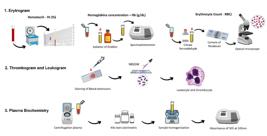
Graphic summary of the steps and processing of the erythrogram, leukogram, thrombogram, and plasma biochemistry.
Leukogram
Slides (n= 3/collected fish) with blood extensions were prepared and stained with May–Grunwald, Giemsa, Wright, and methanol (MGGW) (Oliveira et al. 2021). The material was used to count total leukocytes and thrombocytes (Ortiz & Esteban 2024), in which 2000 cells are counted, and the proportion of leukocytes and thrombocytes identified is determined for the differential count of leukocytes based on 200 leukocyte types (Figure 3).
Plasma biochemistry
Blood plasma was obtained after centrifugation at 750 G, then frozen in liquid nitrogen (−86°C) until biochemical analysis. The concentrations of glucose, triglycerides, total cholesterol, total proteins, urea, and lactate were determined by enzymatic–colorimetric methods quantified by specific commercial kits (LabTest®, Belo Horizonte, Brazil) and processed in a spectrophotometer (Thermo Fisher Scientific®, Waltham, MA, USA). The dosage of sodium (Na+), potassium (K+), and chloride (Cl−) ions was determined by colorimetric method using a commercial kit (LabTest®, Belo Horizonte, Brazil). Figure 3 shows a simplified scheme of blood and plasma processing.
Water analysis
The physical-chemical properties of water, such as temperature (°C), pH, conductivity (μS cm−1), and dissolved oxygen (mg L−1), were determined in each fish farm sampled in the morning and afternoon using a multi-parametric digital device. Other parameters, such as hardness (mg L−1), alkalinity (mg L−1), total ammonia (mg L−1), and nitrite (mg L−1), were determined using a colorimetric kit (Alfakit®, Florianópolis, Brazil).
Statistical analysis
Data were analyzed for normality using the Shapiro–Wilk test and homogeneity of variance using Levene’s test. A Student’s t-test was used to compare farms in the same municipality. Analysis of Variance (ANOVA) was followed by the Tukey test, which was used to compare fish farms between municipalities. The significance level used in all tests was 95% (p-value ≥ 0.05). For this, software R version 4.0.2 was used.
RESULTS
Statistical tests comparing means between the two farms in the municipalities showed no differences, so these data were grouped by municipality. The biometric parameters demonstrate similarities in the total length and weight of the tambaqui in the five sampled municipalities. However, dominant individuals were accentuated in Iranduba and Novo Airão (Table I). This could be caused by incorrect feeding by fish farmers, who do not distribute the feed correctly during feeding, leading to the animals having biometrics without standardization.
Biometric analysis (mean ± standard deviation) of the tambaqui (Colossoma macropomum) from excavated tank ponds (farm dams) from five fish farms in the Metropolitan Region of Manaus, Amazonas, Brazil. Equal letters on the same line mean there were no statistical differences.
For the erythrogram, significant statistical differences were observed with lower values in the Iranduba and Novo Airão municipalities, mainly for hematocrit, Hb, RBC, and MCHC (Table II). The alterations in erythrogram values in Iranduba and Novo Airão fish were different, suggesting different health disturbances: in Iranduba, normocytic anemia occurred with increased RBC, while in Novo Airão, macrocytic anemia was observed.
Erythrogram (mean ± standard deviation) of tambaqui (Colossoma macropomum) from excavated tank ponds (farm dams) from five fish farms in the Metropolitan Region of Manaus, Amazonas, Brazil. Different letters on the same line mean there were statistical differences.
Established the reference ranges for the blood physiology of tambaqui C. macropomum from Rio Preto da Eva, Amazonas, Brazil, in which the values of Ht (26.0-47.0 %), Hb (6.3-12.4 g dL-1), RBC (2.44-5.19 106 µL-1), MVC (70.8-142.9 µm3), MCHC (20.2-36.5 %), White bood cells (50.46-303.3 103 µL-1), thrombocytes (2.8-59.2 103 µL-1), glucose (31.7-102.9 mg dL-1) and total protein (2.9-4.1 g dL-1) (Sipaúba Tavares 1994). This study aimed to determine and compare the hematological and biochemical parameters of tambaqui from fish farms in municipalities in the Metropolitan Region of Manaus (MRM), Amazonas, Brazil.
Six cell types were found in the leukogram and thrombogram: thrombocytes, lymphocytes, eosinophils, monocytes, neutrophils, and PAS-LGs (Table III). Significant statistical differences were found in total leukocytes, thrombocytes, lymphocytes, eosinophils, and monocytes associated with tambaqui from Iranduba and Novo Airão (Table III).
Leukogram and thrombogram (mean ± standard deviation) of tambaqui (Colossoma macropomum) from excavated tank ponds (farm dams) from five fish farms in the Metropolitan Region of Manaus, Amazonas, Brazil. Equal letters on the same line mean there were no statistical differences.
In plasma biochemistry, the total proteins, glucose, cholesterol, triglycerides, and urea levels presented lower values in tambaqui from Iranduba and Novo Airão (Table IV). The phosphorus, chlorides, sodium, and potassium levels did not differ significantly between the five municipalities investigated (Table IV).
Plasma biochemistry (mean ± standard deviation) of tambaqui (Colossoma macropomum) from excavated tank ponds (farm dams) from five fish farms in the Metropolitan Region of Manaus, Amazonas, Brazil. Different letters on the same line mean there were statistical differences.
The physical and chemical properties of the water from the sampled excavated tank ponds showed changes between the municipalities, mainly in the levels of dissolved oxygen, total ammonia, and nitrite, which presented high values in Iranduba and Novo Airão (Table V).
Physical and chemical properties of water (mean ± standard deviation) from excavated-tank ponds (farm dams) used to cultivate tambaqui (Colossoma macropomum) at five fish farms in the Metropolitan Region of Manaus, Amazonas, Brazil. Different letters on the same line mean there were statistical differences.
DISCUSSION
The biometric data of the tambaqui did not show statistical differences across the sampled municipalities; the specimens investigated were juveniles. However, it was possible to observe lower values of the biometrics of the tambaqui, mainly weight, in the fish farms of Iranduba and Novo Airão. The results in Table I corroborate the studies conducted by (Aride et al. 2020), who conducted research with tambaqui under experimental conditions that differ from those in the present study, which took place in excavated tank ponds.
The tambaqui erythrogram values (Table II) of the Presidente Figueiredo, Manaus, and Manacapuru specimens present similar physiological conditions. On the other hand, it should be noted that the tambaqui from Iranduba and Novo Airão present signs of anemic processes caused by low Ht and Hb values; in addition, there is an attempt at physiological compensation due to the reduction in Ht values, which was directly related to the decrease in erythropoiesis (low RBC value) observed. When comparing with the reference variations provided by Pereira et al. (2018), it is observed that the values are within the established limits, except for tambaqui from Iranduba.
The established reference ranges for the blood physiology of tambaqui (C. macropomum) from Rio Preto da Eva, Amazonas, Brazil, include the following values: Ht (26.0–47.0%), Hb (6.3–12.4 g dL−1), RBC (2.44–5.19 × 10⁶ µL−1), MVC (70.8–142.9 µm3), MCHC (20.2–36.5%), white blood cells (50.46–303.3 × 10³ µL−1), thrombocytes (2.8–59.2 × 10³ µL−1), glucose (31.7–102.9 mg dL−1), and total protein (2.9–4.1 g dL−1) (Rocha et al. 2018).
The white blood series (leukogram and thrombogram) mainly indicates fish responses to disturbances of abiotic or biotic factors (Oliveira et al. 2012, Ortiz & Esteban 2024). In the present study, thrombocytes, lymphocytes, eosinophils, neutrophils, and PAS-LGs were identified with morphology similar to that reported in Oliveira et al. (2019). In that study, there was a warning about the difficulty of finding a leukocyte type called PAS-LG in blood samples. PAS-LGs are predominantly phagocytic cells that fight against parasitic, microbial, and viral agents.
In the comparative analysis of white cells, there was a marked intraspecific variation, which resulted in high standard deviation values, directly reflected in the statistical tests for comparing means. Despite this characteristic, total leukocyte values in tambaqui at Iranduba were higher than at other fish farms. Thrombocytopenia was identified in tambaqui from fish farms in Iranduba and Novo Airão; the animals showed paleness and hemorrhagic spots on the body (Tavares-Dias & Moraes 2010). These characteristics may indicate that low numbers of thrombocytes are caused by diseases, parasites, or other environmental conditions imposed on the organism. There was also lymphocytosis, eosinocytosis, and monocytosis among tambaqui from excavated-tanks ponds in Iranduba and Novo Airão, unlike other studies conducted with tambaqui (C. macropomum) that did not observe changes in the values of leukocyte types (Tavares-Dias & Moraes 2004, Bussons et al. 2021, Liebl et al. 2022).
Total protein levels were high in tambaqui from Presidente Figueiredo and Novo Airão (Table IV). Fish from Presidente Figueiredo and Novo Airão had total plasma protein values similar to those of tambaqui fish investigated under experimental conditions (Nascimento et al. 2020, Conte 2004, Aride et al. 2020) and mainly indicate the animal response to the diet (Kusi et al. 2024).
Higher glucose values were found in Manaus fish and lower in Iranduba and Novo Airão (Table IV). However, the tambaqui from Manaus may be overfed and in the process of accumulating energy in the form of glucose; on the other hand, the fish from Iranduba and Novo Airão may be malnourished and in physiological difficulty within the ponds. Tavares-Dias & Moraes (2004, 2010) and Liebl et al. (2022) reiterate that the main difficulty for fish producers in Amazonas is acquiring feed, given the farming systems’ high prices and logistical challenges.
The lipid compounds (cholesterol and triglycerides) investigated reinforce low levels in fish blood from Iranduba and Novo Airão, such as total proteins and glucose. This indicates low levels of fat accumulation in these specimens, which will naturally reflect on the flavor of their meats. Phosphorus was similar in the tambaqui of the five locations investigated, and its values were within those found in other research (Tavares-Dias & Moraes 2010).
There was no significant statistical difference for chloride, sodium, and potassium ions; the values were within those described for the same species (Aride et al. 2020, Oliveira et al. 2012, Tavares-Dias & Moraes 2010). Thus, this indicates good conditions of ionic regulation in the environments of excavated tank nurseries from MRM tambaqui. In plasma biochemistry, only the protein levels of tambaqui from Iranduba and Novo Airão presented values below the confidence intervals.
Temperature levels were similar between the sampled locations, and values were identical to those described (Oliveira et al. 2012, Mariano et al. 2017, Porto et al. 2024, Pantoja-Lima et al. 2015, Andrade et al. 2016) when analyzed this variable in tanks excavated in Amazonas. For pH, there was a significant statistical difference in tambaqui from Presidente Figueiredo, explained by the fact that most of the waters from excavated-tank ponds in the locality come from stream waters, which are black and more acidic (Oliveira et al. 2019, Porto et al. 2024). Dissolved oxygen levels in water from excavated tank ponds (farm dams) were significantly low in Iranduba and Novo Airão. These values were low compared to the recommendations described by Liebl et al. (2022). However, Porto et al. (2024) and Santos et al. (2023) also described these values in a production system located in the MRM. The hardness and alkalinity levels did not present a clearly defined pattern compared to the other parameters, and they were explained by the type of river water that supplies these municipalities. However, the values were within the findings (Soares et al. 2017). For the levels of total ammonia and nitrite, there were accentuated values in Iranduba and Novo Airão, although not predominant (Tavares-Dias & Moraes 2010, Mariano et al. 2017). Similar values were also found in some excavated-tank ponds.
CONCLUSIONS
Determining the hematological parameters of the primary native species produced in Brazil, C. macropomum tambaqui, is essential to establish the limits between health and disease conditions for this species of importance in aquaculture. These values are necessary to assist researchers, tambaqui producers and regulatory agencies for rural production. The results of the present study also serve as a physiological monitoring tool in the face of climate change and extreme flood and drought events that have occurred regularly in the Amazon region and are, therefore, a biological tool for tambaqui management and production strategies for these climatic events.
Acknowledgements
The Instituto Federal de Educação, Ciência e Tecnologia do Amazonas (IFAM) through the Programa de Apoio ao Desenvolvimento Científico e de Inovação Tecnológica (PADCIT), the Fundação de Amparo à Pesquisa do Estado do Amazonas (FAPEAM), and the Conselho Nacional de Desenvolvimento Científico e Tecnológico (CNPq) through the Programa Primeiros Projetos (PPP, process 062.01099/2017), Biodiversa Program (process 01.02.016301.03250/2021-78) Amazonense Primary Sector Development Strategic Program (process 01.02.016301.03216/2021-1) granted the resources to carry out this work. FDFF received a master’s scholarship from FAPEAM, and ATO received a productivity scholarship from CNPq (process 315713/2020-8).
References
-
ANDRADE FS, SILVA AM, ARIDE PHR & OLIVEIRA AT. 2016. Análise físico-química e da microbiota da água do lago Macurany, Parintins, Amazonas. Biota Amazônia 6(2): 132-134. https://doi.org/http://dx.doi.org/10.18561/2179-5746/biotaamazonia.v6n2p132-134.
» https://doi.org/10.18561/2179-5746/biotaamazonia.v6n2p132-134 -
ANSELMO NP, SILVA CKP, FRANCA MFL, SANTOS MQC, ARIDE PHR, PANTOJA-LIMA J & OLIVEIRA AT. 2021. Hematological parameters of captive big-headed Amazon river turtles. Peltocephalus dumerilianus (Testudines: Podocnemididae). Acta Biol Colomb 26: 207-213. https://doi.org/10.15446/abc.v26n2.80616
» https://doi.org/10.15446/abc.v26n2.80616 - ANTONOPOULOU E, KOLYGAS M, PANTELI N, GOUVA E, KONTOGEORGIOU P, FEIDANTSIS K, CHATZOPOULOS A, BITCHAVA K, ZACHARIS C & BONOS E. 2023. Breeding Substrate Containing Distillation Residues of Mediterranean Medicinal Aromatic Plants Modulates the Effects of Tenebrio molitor as Fishmeal Substitute on Blood Signal Transduction and WBC Activation of Gilthead Seabream (Sparus aurata). Animals 13: 2537.
-
ARIDE PHR, OLIVEIRA AM, BATISTA RB, FERREIRA MS, PANTOJA-LIMA J, LADISLAU DS & OLIVEIRA AT. 2018. Changes on physiological parameters of tambaqui (Colossoma macropomum) fed with diets supplemented with Amazonian fruit Camu camu (Myrciaria dubia). Braz J Biol 78(2): 360-367. https://doi.org/10.1590/1519-6984.169442.
» https://doi.org/10.1590/1519-6984.169442 - ARIDE PHR, OLIVEIRA AT, OLIVEIRA AM, FERREIRA MS, BAPTISTA RB, SANTOS SM & PANTOJA-LIMA J. 2016. Growth and hematological responses of tambaqui fed different amounts of cassava (Manihot esculenta). Arq Bras Med Vet Zootec 68(6): 1697-1704.
-
ARIDE PHR ET AL. 2020. Growth and hematological responses of tambaqui, Colossoma macropomum fed different levels of rice, Oryza spp. Braz J Biol 81: 1-7. https://doi.org/10.1590/1519-6984.232560.
» https://doi.org/10.1590/1519-6984.232560 - BARÇANTE B & SOUSA AB. 2015. Zootechnical characteristics and potential of tambaqui (Colossoma macropomum) for fish farming. PubVet 9: 287-347.
-
BUSSONS INB, SOUZA ES, ARIDE PHR, DUNCAN WLP, FURUYA WM, BUSSONS MRFM, OLIVEIRA AT & FAGGIO C. 2021. Growth performance, hematological responses and economic indexes of Colossoma macropomum (Cuvier, 1818) fed graded levels of glycerol. Comp Biochem Physiol 249: 109122. https://doi.org/10.1016/j.cbpc.2021.109122.
» https://doi.org/10.1016/j.cbpc.2021.109122 -
CASTRO PDS, LADISLAU D, RIBEIRO MWS, LOPES ACC, LAVANDER HD, BASSUL LA, MATTOS DC, LIEBL ARS, ARIDE PHR & OLIVEIRA AT. 2020. Hematological parameters of three species of tucunarés (Cichla spp.) from Lake Balbina, Presidente Figueiredo. Amazonas Brazilian J Biol 80: 1-7. https://doi.org/10.1590/1519-6984.219409.
» https://doi.org/10.1590/1519-6984.219409 -
CONTE FS. 2004. Stress and the welfare of cultured fish. Appl Anim Behav Sci 86(3-4): 205-223. https://doi.org/10.1016/j.applanim.2004.02.003.
» https://doi.org/10.1016/j.applanim.2004.02.003 -
FAZIO F, PICCIONE G, ARFUSO F & FAGGIO C. 2015. Peripheral blood and head kidney hematopoietic tissue response to experimental blood loss in mullet (Mugil cephalus). Mar Biol Res 11(2): 197-202. https://doi.org/10.1080/17451000.2014.898850.
» https://doi.org/10.1080/17451000.2014.898850 - HIGUCHI LH, FEIDEN A, MALUF MLF, DALLAGNOL JM, ZAMINHAN M & BOSCOLO WR. 2011. Erythrocyte and biochemical evaluation of catfish (Rhamdia quelen) submitted to a diet with different protein and energy levels. Braz Anim Sci 12: 70-75.
-
IBGE – INSTITUTO BRASILEIRO DE GEOGRAFIA E ESTATÍSTICA. 2019. Available at: http://www.ibge.gov.br/estatística/ Accessed on June 15, 2024.
» http://www.ibge.gov.br/estatística/ - IMTIAZ A, RESHI QM & FAZIO F. 2020. The influence of the endogenous and exogenous factors on hematological parameters in different fish species: a review. Aquac In 28: 869-899. DOI 10.1007/s10499-019-00501-3.
- KUSI IO, OBIRIKORANG KA & ADJEI-BOATENG D. 2024. Diets supplemented with phytobiotics Calopogonium mucunoides, Ocimum gratissimum, and Tridax procumbens improve growth, immunity, and Oreochromis niloticus resistance to Streptococcus agalactiae Aquac Int 32: 7215-7234. https://doi.org/10.1007/s10499-024-01510-7.
-
LIEBL ARS, CAO MA, NASCIMENTO MS, CASTRO PDS, DUNCAN WLP, PANTOJA-LIMA J, ARIDE PHR, BUSSONS MRFM, FURUYA WM, FAGGIO C & OLIVEIRA AT. 2022. Dietary lysine requirements of Colossoma macropomum (Cuvier, 1818) based on growth performance, hepatic and intestinal morphohistology and hematology. Vet Res Commun 46: 9-25. https://doi.org/10.1007/s11259-021-09872-6.
» https://doi.org/10.1007/s11259-021-09872-6 - LIZAMA MAP, FERNANDES ES, ODA FH, MOREIRA LHA & RIBEIRO TS. 2013. Parasites as bioindicators. In: PAVANELLI GC et al. (Eds), Parasitology of Freshwater Fish in Brazil, Eduem: Maringá, Brazil, p. 115-134.
- MARIANO WS, SOUZA FLG, TAVARES-DIAS M, RODRIGUES RLC, AZEVEDO SB & LIMA JO. 2017. Hematological study of tambaqui (Colossoma macropomum) subjected to sublethal concentration of biopesticide based on Bacillus thuringiensis. Mag Sodebras 12: 54-58.
-
NASCIMENTO MS, MATTOS BO, BUSSONS MRFM, OLIVEIRA AT, LIEBL ARS & CARVALHO TB. 2020. Supplementation of citric acid in plant protein-based diets for juvenile tambaqui. J World Aquacult Soc 52: 1-13. https://doi.org/10.1111/jwas.12735.
» https://doi.org/10.1111/jwas.12735 - OLIVEIRA ACB, MIRANDA E & CORREA R. 2013. Nutritional requirements and feeding of the tambaqui. In: FRACALOSSI DM & CYRINO JEP (Eds), Nutrition and Feeding of Species of Interest to Brazilian Aquaculture. Aquabio: Florianópolis, Brazil, p. 231-240.
-
OLIVEIRA AM, SILVA MNP, ALMEIDA-VAL VMF & VAL AL. 2012. Characterization of fish farming activity in the mesoregions of the State of Amazonas, Brazilian Amazon. Colomb J Anim Sci 4: 154-162. https://doi.org/10.24188/recia.v4.n1.2012.303.
» https://doi.org/10.24188/recia.v4.n1.2012.303 -
OLIVEIRA AT, ARAÚJO MLG, LEMOS JRG, SANTOS MQC, PANTOJA-LIMA J, ARIDE PHR, TAVARES-DIAS M & MARCON JL. 2017. Ecophysiological interactions and water-related physicochemical parameters among freshwater stingrays. Braz J Biol 77: 616-621. https://doi.org/10.1590/1519-6984.01816.
» https://doi.org/10.1590/1519-6984.01816 - OLIVEIRA AT, LEMOS J, SANTOS M, ARAÚJO MLG, TAVARES-DIAS M & MARCON J. 2012. Procedimentos de manuseio e de colheita do sangue em Arraias de água Doce. Embrapa Amapá-Documentos (INFOTECA-E), 18 p.
-
OLIVEIRA AT, LEMOS JRG, SANTOS MQC, SALES RSA, PANTOJA-LIMA J, ARIDE PHR, ARAUJO MLG & TAVARES-DIAS M. 2021. Morphological, cytochemical and ultrastructural aspects of blood cells in freshwater stingray species in the middle Rio Negro basin of Amazonian Brazil. Sci Rep 11: 1-11. https://doi.org/10.1038/s41598-021-95183-4.
» https://doi.org/10.1038/s41598-021-95183-4 - OLIVEIRA AT, PANTOJA-LIMA J, ARIDE PHR, TAVARES-DIAS M & MARCON JL. 2015. Fisiologia de Arraias de água Doce: subsidios Para aplicabilidade na aquicultura. In: Tavares-Dias M, Mariano WS. Aquicultura no Brasil: novas perspectivas (p. 45.74). 1st ed., vol. 1, São Carlos: Pedro & João.
-
OLIVEIRA AT, SANTOS MQC, ARAUJO MLG, LEMOS JRG, SALES RSA, PANTOJA-LIMA J, TAVARES-DIAS M & MARCON JL. 2016. Hematological parameters of three freshwater stingray species (Chondrichthyes: Potamotrygonidae) in the middle Rio Negro, Amazonas state. Biochem Syst Ecol 69: 33-40. https://doi.org/10.1590/1519-6984.01816.
» https://doi.org/10.1590/1519-6984.01816 - OLIVEIRA LCD, BRASILIENSE ARP, DIAS MKR, OBA ET & TAVARES-DIAS M. 2019. Toxicological, hematological and immunological effects of levamisole and ivermectin diet supplementation in Colossoma macropomum (Serrasalmidae). Dis Aquat Org 136: 255-263.
-
ORTIZ M & ESTEBAN MÁ. 2024. Biology and functions of fish thrombocytes: A review. Fish Shellfish Immunol 148: 109509. https://doi.org/10.1016/j.fsi.2024.109509.
» https://doi.org/10.1016/j.fsi.2024.109509 - PANTOJA-LIMA J ET AL. 2015. Research and transfer of technology combined for the development of aquaculture in the State of Amazonas. In: Dias MT & Mariano WG (Eds), Aquaculture in Brazil: New Perspectives, 2nd ed., Pedro & João: São Carlos, Brazil, vol. 2, p. 313-332.
-
PEIXE BR – BRAZILIAN FISH FARMING YEARBOOK. 2023. Available at: https://www.peixebr.com.br/anuariopeixe-br-da-piscicultura-2023/ Accessed on June 15, 2024, 65 p.
» https://www.peixebr.com.br/anuariopeixe-br-da-piscicultura-2023/ -
PERCIE DU SERT N ET AL. 2020. The ARRIVE guidelines 2.0: Updated guidelines for reporting animal research. PLoS Biology 18(7): e3000410. https://doi.org/10.1371/journal.pbio.3000410.
» https://doi.org/10.1371/journal.pbio.3000410 - PEREIRA DSP, GUERRA-SANTOS B, MOREIRA ELT, ALBINATI RCB & AYRES MCC. 2018. Hematological and histological parameters of Nile tilapia in response to the challenge of different salinity levels. Fish Inst Bull 42: 635-647.
-
POLESE MF ET AL. 2022. Zootechnical parameters of corn feed particle size in performance, digestibility and rate of passage in juvenile tambaqui Colossoma macropomum Braz J Biol 82: 1-13. https://doi.org/10.1590/1519-6984.232612.
» https://doi.org/10.1590/1519-6984.232612 - PORTO EL, DA CRUZ MG, BOLSON MA, JUNIOR ÉS, MARTINS ML & JERÔNIMO GT. 2024. Trace metal biomonitoring in farming tambaqui (Colossoma macropomum), an Amazonian neotropical fish. Environ Sci Pollut Res 31: 7664-7679.
- PRADO RR, MENDONÇA EP, MONTEIRO GP, MELO RT & ROSSI DA. 2016. Eritrograma em Medicina Veterinária Pubvet 10(1): 61-82.
- RANZANI-PAIVA MJT, PÁDUA SD, TAVARES-DIAS M & EGAMI MI. 2013. Métodos Para análise hematológica em peixes. Eduem, Maringá, 140 p.
- ROCHA MJS, JERÔNIMO GT, COSTA OTFD, MALTA JCO, MARTINS ML, MACIEL PO & CHAGAS EC. 2018. Changes in hematological and biochemical parameters of tambaqui (Colossoma macropomum) parasitized by metazoan species. Rev Bras Parasitol Vet 27(4): 488-494. doi:10.1590/S1984-296120180073.
-
SANTOS MQC, LEMOS JRG, PEREIRA CN, OLIVEIRA AT, TAVARES-DIAS M & MARCON JL. 2012. Length-weight relationships of four freshwater ornamental fish species from the Brazilian Negro River basin. J Appl Ichthyol 28: 148-149. https://doi.org/10.1111/j.1439-0426.2011.01895.x.
» https://doi.org/10.1111/j.1439-0426.2011.01895.x - SANTOS SM, OLIVEIRA AT, ARIDE PHR, LIEBL ARS, MENDONÇA FP, ZUANON J & PANTOJA-LIMA J. 2023. Environmental and ichthyofaunistic characteristics of Amazonian streams with and without fish farm. Braz J Biol 83: e272623.
- SIPAÚBA TAVARES LH. 1994. Limnology Applied to Aquaculture, FUNEP: Jaboticabal, Brazil, 70 p.
-
SOARES BV, NEVES LR, FERREIRA DO, OLIVEIRA MSB, CHAVES FCM, CHAGAS EC & TAVARES-DIAS M. 2017. Antiparasitic activity, histopathology and physiology of Colossoma macropomum (tambaqui) exposed to the essential oil of Lippia sidoides (Verbenaceae). Vet Parasitol 234: 49-56. https://doi.org/10.1016/j.vetpar.2016.12.012.
» https://doi.org/10.1016/j.vetpar.2016.12.012 -
SULA E, ALIKO V, PAGANO M & FAGGIO C. 2020. Digital light microscopy as a tool in toxicological evaluation of fish erythrocyte morphological abnormalitie. Microscopy Res Technique 83(4): 1-8. https://doi.org/10.1002/jemt.23422.
» https://doi.org/10.1002/jemt.23422 - TAVARES-DIAS M & MORAES FR. 2004. Hematologia de Peixes Teleósteos. Villimpress: Ribeirão Preto, Brazil, 144 p.
- TAVARES-DIAS M & MORAES FR. 2010. Biochemical Parameters for Piaractus mesopotamicus, Colossoma macropomum (Characidae) and hybrid tambacu (P. mesopotamicus X C. macropomum). Ciência Animal 11: 363-368.