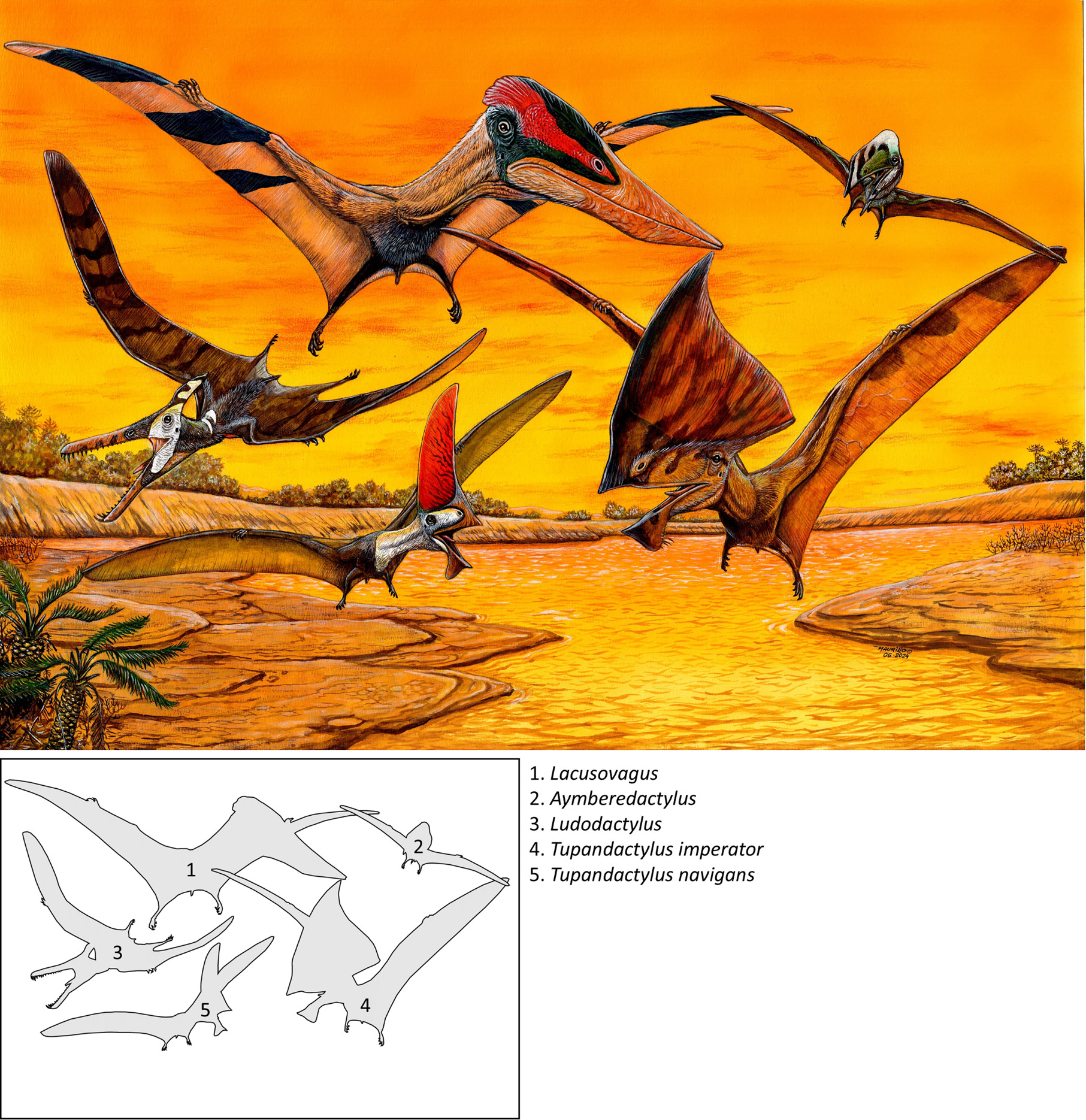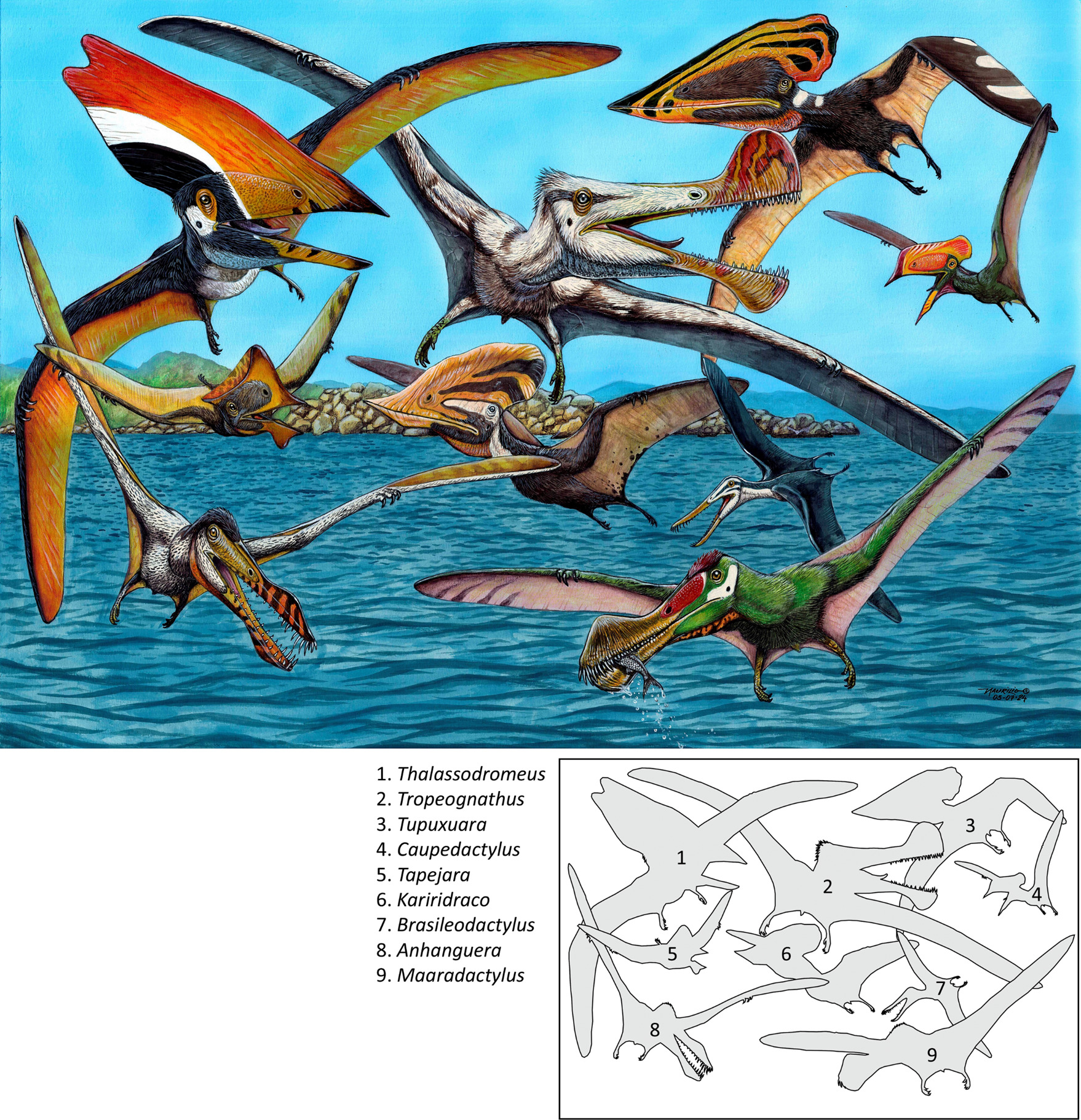
 Cretaceous Pterosaurs of the Araripe Basin: A Comprehensive Taxonomic Update and Paleobiological Insights
Abstract
More than fifty years after the first discoveries of pterosaurs in the Araripe Basin, this sedimentary unit remains one of the most informative windows into the diversity and biology of these fantastic flying reptiles. With dozens of proposed species from two different Lagerstätten, the exceptional preservation of Araripe fossils offers a detailed view of the anatomy, function, and ecology of Cretaceous pterosaurs. These fossils reveal complex faunal assemblages populated by these animals, providing rare snapshots of ancient ecosystems. Today, Araripe pterosaur diversity appears to have reached a plateau, with fewer new taxa and more specimens assigned to known species. This situation calls for a comprehensive reassessment of Araripe pterosaur diversity. Here, we present an in-depth, richly illustrated taxonomic review of all taxa proposed for the basin, along with a synthesis of available paleobiological data. This work aims to establish a solid foundation for future research and proposes guidelines for advancing our understanding of Araripe pterosaurs, especially from biostratigraphic and paleoecological perspectives—areas severely affected by the ongoing threat of illegal collecting and fossil trade.
Key words
Crato Formation; Paleobiology; Pterosauria; Romualdo Formation; Taxonomy
INTRODUCTION
More than 50 years have passed since Brazilian paleontologist Llewellyn Ivor Price (1905–1980) described the first pterosaur specimen from an unknown location of the Araripe Basin (Lower Cretaceous, Northeastern Brazil). The small carbonate concretion containing well-preserved but incomplete bones of a forelimb described by Price in 1971 (Figure 1) might not catch the attention of a paleontologist today, yet at that time it was designated as the holotype of the elusive species Araripesaurus castilhoi. The renowned paleontologist certainly could not have imagined that this specimen would inaugurate research on the winged reptiles from one of the most celebrated and important deposits worldwide for understanding the diversity and biology of these extraordinary creatures.

‘Araripesaurus castilhoi’ A, B, holotype (DGM 549-R), the first pterosaur specimen from the Araripe basin, described by L. I. Price in 1971.
It is no exaggeration to state that the pterosaur fossils found in the Araripe Basin have contributed the most to an integrative understanding of pterosaurs. Not only did their incredible diversity allow for the recognition of unique taxa — which sometimes were later found to have a wide geographic distribution (e.g., Kellner 1989, Cerqueira et al. 2021) — but their exceptional three-dimensional preservation also served as the basis for pioneering paleobiological studies (e.g., Wellnhofer 1988, Witmer et al. 2003). The extraordinary preservation of soft tissues, that includes muscle fibers (Kellner 1996a), even allowed for the chemical characterization of fossilized pigments (Pinheiro et al. 2019).
Time has passed, and the diversity of pterosaurs from the Araripe Basin appears to have reached a plateau. It is now much more common to announce new specimens of already well-known taxa e.g. (Beccari et al. 2021, Cincotta et al. 2022) than to describe new taxa. This shift brings research on these animals to a much-anticipated maturity, and a new phase of research can commence, addressing different questions beyond the description of new taxa. Such research is sometimes hindered by the vulnerability of aesthetically appealing specimens from the Araripe Basin to international fossil trafficking, as well as the consequent lack of geological context for most of the collected materials (Cisneros et al. 2022).
In this context, we present a critical review of the research on pterosaurs from the Araripe Basin. This work aims to provide an updated and richly illustrated taxonomy of Araripe pterosaurs, briefly showcase the paleobiological studies conducted on these animals, present the research from a historical perspective, and discuss potential directions for future studies. This work aims to be a reference for both veterans in the study of flying reptiles and newcomers to the subject, serving as a foundation for future research.
Institutional abbreviations. AMNH, American Museum of Natural History, New York, USA; BSP, Bayerische Staatssammlung für Paläontologie und Geologie, Munich, Germany; CPCA, former Centro de Pesquisas Paleontológicas da Chapada do Araripe, Crato, Brazil (today collections housed at the Museu de Paleontologia Plácido Cidade Nuvens, Santana do Cariri, Ceará, Brazil); CSRL, former Centro Studi e Ricerche Ligabue, Venice, Italy (today collections housed at the Museo di Storia Naturale de Venezia, Venice, Italy); DGEO-CTG-UFPE, Departamento de Geologia, Centro de Tecnologia and Geociências, Universidade Federal de Pernambuco, Recife, Brazil; DGM, MCT, Museu de Ciências da Terra, Brazilian Geological Survey and Agência Nacional de Mineração, Rio de Janeiro, Brazil; GP/2E, Laboratório de Paleontologia Sistemática do Instituto de Geociências da Universidade de São Paulo, São Paulo, Brazil; IMNH, Iwaki City Coal and Fossil Museum, Iwaki, Japan; KPMNH, Kanagawa Prefectural Museum of Natural History, Kanagawa, Japan; MHNS, Museu de História Natural de Sintra, Sintra, Portugal; MN, Museu Nacional, Universidade Federal do Rio de Janeiro, Rio de Janeiro, Brazil; MPSC, Museu de Paleontologia Plácido Cidade Nuvens, Santana do Cariri, Ceará, Brazil; MZ, Instituts und Museums für Paläntologie der Universität Zürich, Zurich, Canton of Zurich, Switzerland; NMSG SAO, Naturmuseum St. Gallen/Sammlung Urs Oberli, St. Gallen, Canton of St. Gallen, Switzerland; NSM, National Science Museum, Tokyo, Japan; Pz-DBAV-UERJ, Universidade do Estado do Rio de Janeiro, Rio de Janeiro, Brazil; RGM, National Natuurhistorisch Museum/Naturalis, Leiden, The Netherlands; SMNK PAL, Staatliches Museum für Naturkunde Karlsruhe, Karlsruhe, Germany; SMNS, Staatliches Museum für Naturkunde Stuttgart, Stuttgart, Germany; UFC, Universidade Federal do Ceará, Fortaleza, Ceará, Brazil; UvA M, former Geological Institute of the University of Amsterdam, Amsterdam, The Netherlands (today collections housed at the National Natuurhistorisch Museum/Naturalis, Leiden, The Netherlands).
Anatomical abbreviations
alv, alveolus; ang, angular; art, articular; ax, axis; bs, basisphenoid; ca, caudal vertebra; ch, choanae; co, coracoid; cp, carpal; cv, cervical vertebra; d, dentary; dcr, dentary crest; dv, dorsal vertebra; ec, ecptopterygoid; f, frontal; fcr, frontal crest; fe, femur; fola, foramen lacrimale; glfo, glenoid fossa; h, humerus; hy, hyoid; il, ilium; is, ischium; ispu, ischiopubis; j, jugal; la, lacrimal; ltf, lower temporal fenestra; m, maxilla; ma, manus; mc, metacarpal; mt, metatarsal; n, nasal; naof, nasoantorbital fenestra; nt, notarium; or, orbit; p, parietal; pasg, palatinal sagittal ridge vertebrae; pcr, parietal crest; pl, palatine; pm, premaxilla; pmcr, premaxillary crest; po, postorbital; pplf, postpalatinal fenestra; pt, pteroid; pty, pterygoid; pu, pubis; q, quadrate; qj, quadratojugal; r, radius; rapr, retroarticular process; rb, rib; s, scapula; sa, sacral vertebra; san, surangular; sq, squamosal; sstf, secondary subtemporal fenestra; st, sternum; stcr, soft tissue crest; stf, subtemporal fenestra; sys, symphyseal shelf; t, tibia; u, ulna; utf, upper temporal fenestra; wph, wing phalanx.
Disclaimer: some of the referred museological institutions were decommissioned and their collections were most times housed in nearby institutions. The codes given by these institutions are upheld in the present work despite the transfer process. Even though there is no concrete stipulation at the International Code of Zoological Nomenclature (1999) on how to handle labelling changes of specimens housed in scientific collections, the code states that ”Every institution in which name-bearing types are deposited should […] publish lists of name-bearing types in its possession or custody; and […] so far as possible, communicate information concerning name-bearing types when requested” (Art. 72 recommendations 72F.4 and 72F.5). The specimens from the former Centro de Pesquisas Paleontológicas da Chapada do Araripe (CPCA) are still being allocated to the Museu de Paleontologia Plácido Cidade Nuvens (Santana do Cariri, Brazil), but the whereabouts of some specimens have not yet been made public.
BRIEF HISTORY OF PTEROSAUR RESEARCH IN THE ARARIPE BASIN — THE EARLY FINDS
The pterosaur record is comparatively extensive (Barrett et al. 2008), with remains of these flying reptiles being found in all continents, albeit in most cases quite fragmentary (Kellner et al. 2019a). Reports of early discoveries in Brazil, which were also the first of the presence of these flying reptiles in South America, came from Cretaceous deposits of Bahia (Woodward 1891). Attributed to taxa found in Europe, these specimens were later reidentified as belonging to coelacanths (see Campos & Kellner 1985). Some teeth, however, appear to be from pterosaurs, more specifically related to Anhangueridae (Rodrigues & Kellner 2010). There are also a few other quite old references to pterosaurs from different areas of Brazil, most lacking scientific support, except for one specimen, the holotype of Nyctosaurus lamegoi (Price, 1953) found in the Late Cretaceous Gramame Formation (see Campos & Kellner 1985, for a review of the older literature).
Regarding the Araripe Basin, as mentioned before, the first reported pterosaur taxon was ‘Araripesaurus castilhoi’, based on a small calcareous concretion with some wing elements that were found in the Romualdo Formation. Described by Price (1971), this specimen was the second confirmed record of these flying reptiles in Brazil and the third in South America. In the original study, Price (1971) also mentions two isolated remains from the Araripe Basin, consisting of the distal part of an ulna (DGM 549-R) and the proximal portion of a metacarpal IV (DGM 550-R) that belonged to a private collection (plaster molds deposited along with the holotype — DGM 529-R — at the Museu de Ciências da Terra). Examining the casts of these specimens, their three-dimensional nature clearly indicates that they come from the Romualdo Formation as, in the context of the Araripe Basin, this is the only sedimentary unit to preserve three-dimensional remains. However, since we presently know that the pterosaur fauna of the Araripe Basin is quite diverse, it seems quite unlikely that these two specimens (the whereabouts of the original bones is unknown) could represent the same taxon described by Price.
The first three pterosaur species from the Araripe Basin came from the Romualdo Formation and consisted of very fragmentary material, including the first phalanx of a wing finger (BSP 1975 I 166) (e.g., Wellnhofer 1977, Campos & Kellner 1985, Kellner & Tomida 2000). Today, such specimens would perhaps not even be described, considering the known abundance of pterosaur remains from the Araripe Basin, much less used as the basis for a new species. The same might be true for the incomplete lower jaw of Brasileodactylus araripensis, which at the time of the description was the first pterosaur lower jaw from this region (Kellner 1984). It should be noted, however, that in some deposits this is exactly what paleontologists are left with, such as the material from the Cambridge Greensand, one of the richest stratigraphic units concerning pterosaurs, albeit very incomplete in nature (e.g., Seeley 1901, Wellnhofer 1978, Kellner 1990, Unwin 2001, Rodrigues & Kellner 2013).
Interestingly, the first specimen described from the Crato Formation (Arthurdactylus conandoylei, based on SMNK 1132 PAL) is fairly complete, albeit lacking a skull (Frey & Martill 1994). Several other specimens from this deposit have been published, including the magnificent skull of Tupandactylus imperator, represented by several cranial materials (Campos & Kellner 1997, Pinheiro et al. 2011, Canejo et al. 2025).
Lastly, several holotypes of pterosaurs from the Araripe Basin were housed in the Museu Nacional/UFRJ, which suffered a major fire in 2018 (e.g., Zamudio et al. 2018). Due to the efforts of a rescue team (Rodrigues-Carvalho 2021), several specimens, including pterosaurs, were recovered from the debris of the palace. A comprehensive publication is being prepared to present all holotypes and other recovered specimens, including pterosaurs (Luciana Carvalho pers. communication 2024).
GEOLOGICAL CONTEXT OF PTEROSAUR OCCURRENCE IN THE ARARIPE BASIN
The Araripe Basin, the largest and most geologically complex of the interior basins of Northeastern Brazil, is notable for the presence of the Araripe Plateau. This plateau, elongated in an east-west direction, is located at the border of the states of Ceará, Piauí, and Pernambuco. The sedimentary fill of the basin is not confined to the plateau; it extends eastward, also occupying the Cariri Valley. This significant intracratonic sedimentary basin covers an area of approximately 9,000 km² (Assine 2007). The Santana Group, part of the post-rift sequence of the Araripe Basin, crops out on the escarpments surrounding the Araripe Plateau and, to a more limited extent, in the Cariri Valley (Assine 2007). Within the Santana Group, only the Crato and Romualdo formations have a significant record of pterosaurs (see Kellner et al. 2013 for a brief review on nomenclatural issues of these units).
The micritic limestones of the Aptian Crato Formation are characterized by laterally discontinuous layers exceeding 20 meters in thickness (Assine 2007). These laminated limestone layers are interbedded with green shales, and the base of each limestone package commonly contains clay-carbonate rhythmites (Assine 2007). The depositional system of the Crato Formation is interpreted as lacustrine in a coastal system, so that the paleolake would frequently have marine inputs following strong seasonal cycles under significantly warm and dry conditions. Marginal and central regions of the paleolake can be distinguished by discontinuous facies, indicating a vast water body (Valença et al. 2003, Varejão et al. 2022). The absence of signs of bioturbation is strong evidence that the deeper waters of the lake were anoxic, while the presence of halite pseudomorphs attests to episodes of hypersalinity in the water body (Heimhofer & Martill 2007). Such conditions, adverse to scavenging organisms, were crucial for the preservation of articulated skeletal remains of vertebrates, which are common in the laminated limestones of the Crato Formation. Recent works have also demonstrated the influence of microbial mats on the exceptional preservation of fossils (Varejão et al. 2019). Although complete or reasonably complete skeletons of pterosaurs from the Crato Formation are not common in the literature (but see Beccari et al. 2021), it is not clear if this is due to a collection bias, as fossil prospecting in the unit is practically restricted to quarry fronts that exploit laminated limestone for paving. Thus, the fate of such materials is often their destruction for the production of cement and other limestone-derived products, or even illegal trade.
Further up in the sedimentary sequence of the Araripe Basin, the Romualdo Formation is characterized by a transgressive sequence, where coastal sandstones transition into green shales, hosting a fossil assemblage typical of estuarine or lagoonal environments with marine influence, as is the case with coquinas rich in echinoderm remains (Assine 2007). Upward, the shales become darker in color, featuring several layers extremely rich in carbonate concretions. Those layers seem to be laterally continuous throughout the basin and likely result from mass mortality events (Assine 2007). The concretion-bearing layers of the Romualdo Formation represent the most fossiliferous stratigraphic levels in the Araripe Basin (Assine 2007). At the top of the Romualdo Formation, a level of coquinas containing marine mollusks and echinoids indicates a fully marine environment (Assine 2007). The Romualdo Formation is dated as extending through the Aptian–Albian boundary based on palynological and micropaleontological evidence. Recently, a U/Pb age of 110.5 ± 7.4 Ma was obtained from a sample of dentin from a fossil fish (Barreto et al. 2022).
Although pterosaurs in collections demonstrate the diversity and relative abundance of these animals in the Romualdo Formation, recent stratigraphically controlled excavations have highlighted the difficulty of finding their remains in the field. The same seems to be true for the pterosaur material from the Crato Formation, where fewer specimens have been reported (see below). This suggests a potential collection bias in our understanding of the pterosaur fauna of the Araripe Basin (Fara et al. 2005, Vila Nova et al. 2011).
A peculiarity of the fossil record of the Crato and Romualdo formations, which has a direct impact on the understanding of pterosaur diversity in these units, is the fact that the overwhelming majority of historically collected specimens come from prospecting without any geological/stratigraphic control (see below). Fossils from the Crato Formation are usually revealed during the prospecting of laminated limestone for commercial purposes, but the actual quarry where the specimens come from are mostly not disclosed by the finder. The Romualdo Formation has historically been exploited through the clandestine collection of fossils for trade, which is illegal in Brazil (Cisneros et al. 2022). Such observation is particularly relevant when we consider that the fish fauna of the Romualdo Formation shows a marked biostratigraphic zonation, transitioning, for example, from a Tharrhias-dominated assemblage to a Vinctifer-dominated assemblage (Fara et al. 2005). This zonation appears to suggest a turnover of faunas within the Romualdo Formation, and we are still completely ignorant regarding how this turnover may have affected the diversity of pterosaurs. Pterosaurs collected in controlled excavations are still exceptionally rare (e.g., Vila Nova et al. 2011, Aureliano et al. 2014, Bantim et al. 2021, Duque & Barreto 2018, Duque et al. 2022, 2023), and the question remains whether the taxa reported for the Romualdo Formation were all contemporaneous (Pinheiro & Rodrigues 2017). Although we also ignore the hypothesis of potential biostratigraphic zonation for the Crato Formation, such a possibility cannot be dismissed. This stratigraphic limitation severely hampers broader, paleoecological studies of pterosaur diversity in both units, making it one of the greatest challenges faced in research on these animals in the Araripe Basin. The geological and biostratigraphic correlation between outcrops with measured sections of the Romualdo Formation, in the context of the occurrence of pterosaurs, is still in its infant phase (Duque et al. 2023). The subject is complex, requiring more intensive field prospecting and, more challengingly, the recovery of diagnosable pterosaur fossils in controlled excavations.
TAXONOMY OF ARARIPE BASIN PTEROSAURS
In this section, we critically address all pterosaur taxa proposed from the Araripe Basin, listing relevant information regarding their diagnoses, historical background, and taxonomic validity. The main information is summarized in Table I.
Summary of the nomina proposed for pterosaurs from the Araripe Basin, including information on their validity (according to our proposal), referred specimens, horizon, and supra-specific attribution.
PTEROSAURIA Kaup 1834
PTERODACTYLOIDEA Plieninger 1901
PTERANODONTOIDEA Kellner 2003
LANCEODONTIA Andres, Clark & Xu 2014
ORNITHOCHEIRAE Seeley 1870
ANHANGUERIA Rodrigues & Kellner 2013
Brasileodactylus Kellner 1984
Type species. Brasileodactylus araripensis Kellner 1984
Diagnosis. As for type and only species.
Brasileodactylus araripensis Kellner 1984
Holotype. MN 4804-V. The anterior part of a mandible, preserving a mandibular symphysis (Figure 2a–c).

Brasileodactylus araripensis, holotype (MN 4804-V) in A, right lateral and B, dorsal view; C, interpretative drawing in dorsal view; referred specimen (SMNS 55414) in C, right lateral and D, dorsal view in D, dorsal and E, right lateral view.
Horizon. Kellner (1984) states that MN 4804-V was found in a calcareous concretion, typical of the Romualdo Formation, probably Chapada do Araripe, Ceará, Brazil. The exact locality is unknown.
Referred specimens. SMNS 55414, an incomplete mandible and three cervical vertebrae (Veldmeijer et al. 2009) (Figure 2d–e).
Diagnosis. From Kellner (1984), as modified by Veldmeijer et al. (2009): The mandible has an elongated, slightly dorsally recurved symphysis with a rounded end and a triangular cross-section in posterior view. It tapers from the posterior part, with a widening at the anterior end from the third alveolus, forming a flat surface. There is a pronounced medial groove on the dorsal part of the symphysis, starting distinctly from the anterior part and widening towards the posterior direction. The elliptical and rounded alveoli are spaced increasingly apart towards the posterior end. The teeth are relatively thin, pointed forward, and extend to the most distal part of the mandible. The first pair of alveoli is directed anteriorly; the second pair of alveoli is positioned anterolaterally, and the third pair of alveoli is laterally positioned. The dentary sagittal groove has small side grooves extending anterolaterally.
Remarks. Brasileodactylus araripensis was one of the first taxa described from the Santana Group, noted for having a series of characters that were later found in other taxa from the Romualdo Formation, such as the medial groove, the shape of the alveoli, and the increasing inter-alveolar distance posteriorly (e.g., Kellner & Tomida 2000). Kellner (1984) first tentatively assigned Brasileodactylus to the Ornithocheiridae, while Kellner (unpublished M. Sc thesis) was more cautious and classified B. araripensis as Pterodactyloidea incertae sedis. Kellner & Tomida (2000) recognized a close affinity of the taxon to the Anhangueridae (sensu Kellner & Tomida 2000; equivalent to sensu Kellner 2003), mainly in virtue of their similar lateral expansion of the jaw tip.
Brasileodactylus araripensis was suggested as belonging to the genus Coloborhynchus by Frey et al. (2003b: p. 60) , in accordance to the proposal by Fastnacht (2001) on the presence of the genus Coloborhynchus in the Araripe Basin. However, a dentary sagittal groove bearing small sub-grooves and the extremely elongated mandibular symphysis, when compared with Anhanguera, “Criorhynchus” (= Ornithocheirus), and Coloborhynchus, seem to be autapomorphic features of Brasileodactylus (Veldmeijer et al. 2005). Veldmeijer et al. (2009) considered the genus to possibly belong to the Anhangueridae due to its shared characteristics with Anhanguera, such as an anterior expansion of the jaws and a mandibular groove.
Rodrigues & Kellner (2013) considered B. araripensis to have an uncertain position, despite exhibiting synapomorphies of the Anhangueria. In the phylogenetic analysis presented by Andres et al. (2014), the genus is included in Anhangueria (which would also include Camposipterus, Cearadactylus, Ludodactylus, Brasileodactylus, and Anhangueridae). Vidovic & Martill (2018) found Brasileodactylus to be an anhanguerid, sister taxon to a clade formed by Cearadactylus, Barbosania, Anhanguera, and Coloborhynchus. Andres (2021) recovered B. araripensis as a non-anhanguerid ornithocheiriform, in a clade with Cearadactylus atrox and Barbosania gracilirostris. Pêgas (2024) recovered B. araripensis within Anhanguerinae as sister-taxon to Maaradactylus kellneri.
After the publication of B. araripensis, several different specimens from the Araripe Basin have been assigned to the genus Brasileodactylus. Sayão & Kellner (2000) presented the only purported individual of this genus from the Crato Formation (MN-4797-V), composed of the anterior ends of upper and lower jaws with teeth, classifying it as Brasileodactylus cf. araripensis. What makes this classification problematic is that, three years later, Ludodactylus sibbicki was described (Frey et al. 2003b), with a complete skull from the same formation, both with notably similar aspects in shape and dentition (Martill et al. 2007). We should also note that Frey et al. 2003b) do not mention MN-4797-V in their work.
Veldmeijer (2003a), in a preliminary description, presents what would be the most complete material attributed to the genus, AMNH 24444, composed of a skull, mandible, and wing elements (scapulocoracoid, radius, ulna, carpal, metacarpal, and phalanx). The preparation state of the specimen was at the time of publication incomplete, with only the right lateral side of the skull exposed, making the ventral and dorsal surfaces of the mandible not visible. The specimen was assigned to Brasileodactylus araripensis mostly in virtue of the lack of a premaxillary crest. As far as can be observed, AMNH 24444 is superficially similar to MN 4804-V, but the former needs a more in-depth assessment for a more detailed comparative analysis.
Veldmeijer et al. (2009) also described and referred to Brasileodactylus SMNS 55414 (a nearly complete mandible and three cervical vertebrae, embedded in matrix) and BSPG 1991 I 27 (part of a maxilla, without the tips of the premaxillaries, four cervical and ten dorsal vertebrae, ribs, fragments of the pelvic girdle, and wing elements). BSPG 1991 I 27 was assigned to Brasileodactylus sp. due to the lack of a premaxillary crest, which is judged to be a weak diagnostic feature (Pinheiro & Rodrigues 2017, Duque et al. 2022), and there is no associated mandible to compare with the holotype. The mandible SMNS 55414 exhibits all the proposed diagnostic features seen in the holotype of B. araripensis, and thus was identified as such. Of all the referred specimens, this is the only one unquestionably attributed to Brasileodactylus.
ANHANGUERIA Rodrigues & Kellner 2013
ANHANGUERIDAE Campos & Kellner 1985
ANHANGUERINAE Campos & Kellner 1985
Anhanguera Campos & Kellner 1985
Type species.Anhanguera blittersdorffi Campos & Kellner 1985
Included species.Anhanguera blittersdorffi, Anhanguera piscator Kellner & Tomida 2000, Anhanguera spielbergi (Veldmeijer 2003b).
Horizon. Romualdo Formation, Araripe Basin.
Diagnosis. According to Pinheiro & Rodrigues (2017, p. 16) – “anhanguerid pterosaurs with premaxillary and dentary median crests at least in advanced ontogenetic stages; premaxillary crest thin; premaxillary crest largely asymmetric; premaxillary crest begins near but not at the tip of the skull; premaxillary crest not confined to the anteriormost tip of the skull; premaxillary crest grows allometrically in height and length during ontogeny; 5th and 6th upper dental alveoli smaller than the 4th and 7th ones; parietal crest blade-like and thin; palatal ridge modest in depth”.
Remarks. The genus Anhanguera was described based on a reasonably complete pterosaur skull without a lower jaw (MN 4805-V) recovered from a carbonate concretion of the Romualdo Formation (Campos & Kellner 1985). The animal, named Anhanguera blittersdorffi by Campos & Kellner (1985), displayed a then unique dorsal premaxillary sagittal crest anteriorly on the rostrum. Since then, further five species from the Romualdo Formation have been assigned to this genus: Anhanguera piscator Kellner & Tomida, 2000, ‘Anhanguera santanae’ (Wellnhofer 1985), ‘Anhanguera araripensis’ (Wellnhofer 1985), ‘Anhanguera robustus’ (Wellnhofer 1987), and Anhanguera spielbergi (Veldmeijer 2003b). A comprehensive diagnosis for the genus, presented by Kellner (2003), included the following characters: (1) presence of an elongate and medially placed nasal process, (2) a foramen on the nasal process, (3) a characteristic size difference in the rostral teeth (in which the 5th and 6th tooth pairs are smaller than the 4th and 7th ones); (4) scapulae length at most 80% of that of the coracoids, (5) a coracoidal articulation surface with the sternum oval and with a posterior expansion, and (6) a pneumatic foramen on the proximal dorsal surface of the humeri.
However, the taxonomic reassessment of the genus Anhanguera by Pinheiro & Rodrigues (2017) recognizes that most of the characters proposed by Kellner (2003) characterize more inclusive groups or are present in particular taxa of Pteranodontoidea. Pinheiro & Rodrigues also consider other definitions of Anhanguera proposed by Fastnacht (2001) and Veldmeijer (2003b) to be inaccurate. An important feature that historically impacted the diagnosis of Anhanguera and the proposition of different species for the genus is the morphology of the premaxillary crest (see Pinheiro & Rodrigues 2017). It is noted that distinct specimens belonging to the genus exhibit visible morphological differences in this structure. Such differences have traditionally been used as key characters in taxonomy, underpinning species-level diagnoses. Pinheiro & Rodrigues (2017), however, demonstrated a profound influence of allometry on the development of the premaxillary crests of Anhanguera. In the genus, the crest increases in height and anteroposterior length, following the increase in skull size. The existence of Anhanguera specimens without a crest (e.g., DGEO-CTG-UFPE 8283) reinforces the influence of ontogeny or potentially sexual dimorphism on this character, highlighting that its use in taxonomic propositions is inappropriate (Duque et al. 2022).
The taxonomic proposal by Pinheiro & Rodrigues (2017), by disregarding ontogenetically variable characters, considers the species ‘Anhanguera araripensis’, ‘Anhanguera santanae’, and ‘Anhanguera robustus’ as nomina dubia (but see Piazentin et al. 2025; and discussion further below). Taking all this into account and incorporating the ontogenetic differences of different specimens within the genus, Pinheiro & Rodrigues (2017) present an updated diagnosis for Anhanguera (see above). Among the characteristics proposed by Kellner (2003), only the third one (5th and 6th tooth pairs are smaller than the 4th and 7th ones) would remain valid and unambiguous.
We also note that the genus Anhanguera appears to be the most abundant in the strata of the Romualdo Formation (and the Araripe Basin as a whole), with several reported specimens (Pinheiros & Rodrigues 2017). Many of these have not been unambiguously assigned to different species of the genus, indicating that Anhanguera still requires a more detailed anatomical/taxonomic evaluation.
Anhanguera blittersdorffi Campos & Kellner 1985
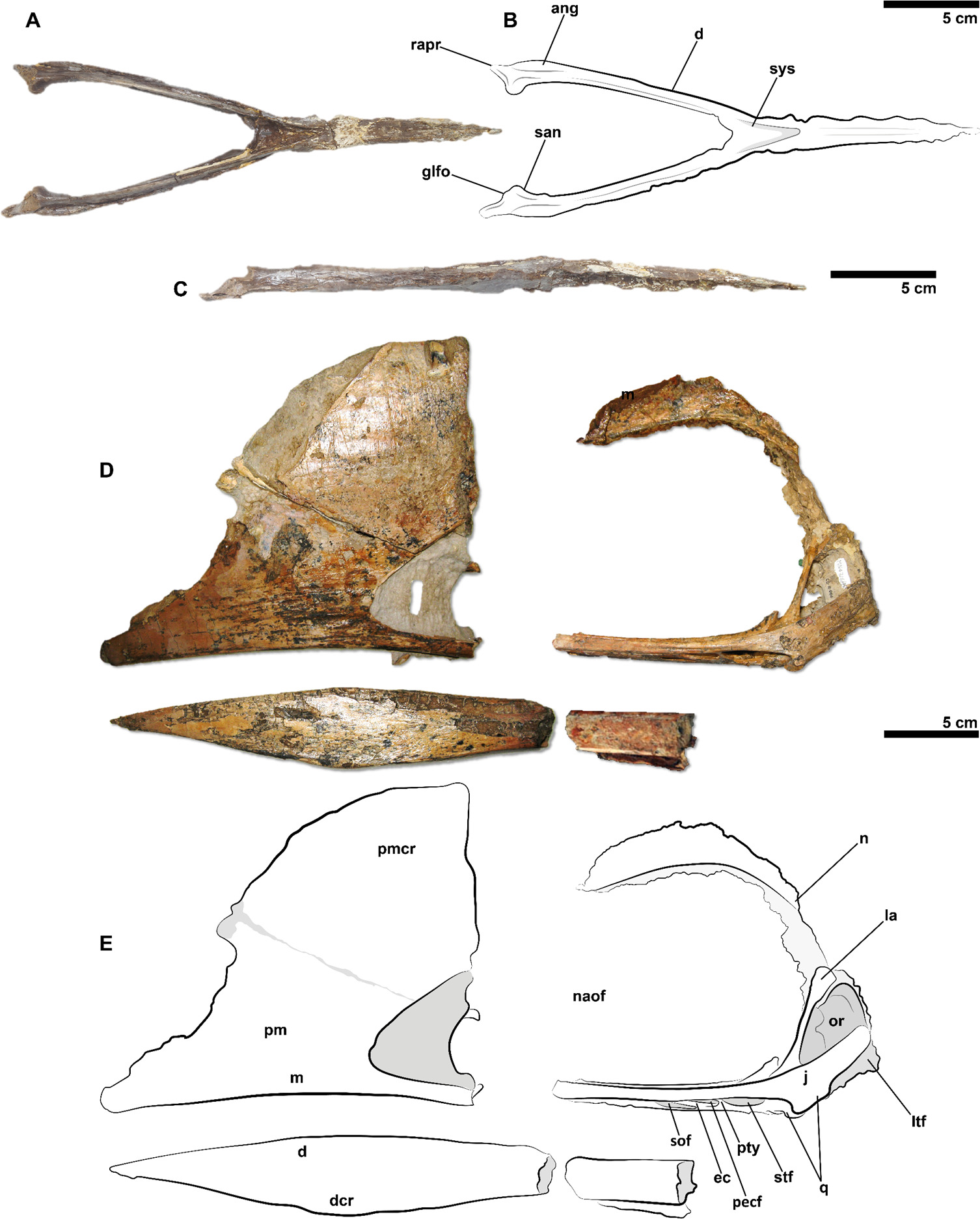
Holotype. MN 4805-V, a nearly complete skull, without the associated lower jaw (Figure 3a–c). In the proposition of the species, no collection number is assigned to the material, as it was deposited in the private collection of Rainer Alexander von Blittersdorff (see Campos & Kellner 1985). The specimen was subsequently donated to the MN fossil vertebrate collection.

Anhanguera blittersdorffi holotype (MN 4805-V) in A, B, right lateral and C, ventral view; D, Anhanguera piscator holotype skull (NSM-PV 19892) in right lateral view, and E, Anhanguera spielbergi (RGM 401 880) holotype skull in right lateral view.
Referred specimens. N.40 Pz-DBAV-UERJ (see Kellner & Tomida 2000).
Horizon. The holotype was preserved in a calcareous concretion typical of the Romualdo Formation. The locality is unknown.
Diagnosis. According to Pinheiro & Rodrigues (2017), An. blittersdorffi differs from other Anhanguera species by the presence of a large number (52) of alveoli on its upper jaw.
Remarks. In the species description, Campos & Kellner (1985) referred to the following diagnostic characteristics: 1) a large sagittal crest on the anterior part of the skull, ending just before the beginning of the nasoantorbital opening; 2) a small parietal sagittal crest located on the posterior part of the skull; 3) dentition present from the most distal part of the skull to the middle of the nasoantorbital fenestra; 4) the presence of a transverse widening in the rostral part of the skull, where the premaxillary teeth, much larger than the others, are located.
Although such characters were, at the time of the original description, exclusive to An. blittersdorffi, today they are recognized as being well distributed within the genus Anhanguera and in more inclusive groups (Pinheiro & Rodrigues 2017). Furthermore, as discussed above, characters related to the size and morphology of the sagittal crest have been demonstrated to be dependent on ontogeny in Anhanguera (Pinheiro & Rodrigues 2017). After the description of other species of the genus Anhanguera, as well as closely related taxa, it became clear that An. blittersdorffi needed a new diagnosis. According to Kellner & Tomida (2000), the species can be differentiated from other species of Anhanguera by the presence of a comparatively short quadrate and a low skull. According to Pinheiro & Rodrigues (2017), however, such characters are vague and lack morphometric definition. Pinheiro & Rodrigues (2017) authors highlight the high number of alveolar positions in the holotype of An. blittersdorffi when compared to other Anhanguera specimens, proposing this as a suitable diagnostic characteristic for the species An. blittersdorffi.
Anhanguera piscator Kellner & Tomida 2000
Holotype. NSM-PV 19892, partial skeleton, comprising a complete skull (Figure 3d), mandible, part of the vertebral column, ribs, sternum, wing elements, and the scapular and pelvic girdles.
Referred specimens. None.
Horizon. Levels of calcareous concretions of the Romualdo Formation. In the original description, it is stated that the holotype was possibly collected near the city of Santana do Cariri, Ceará state.
Diagnosis. From Kellner & Tomida (2000), as modified by Pinheiro & Rodrigues (2017): middle part of the basisphenoid presents a constriction; neural spine of the axis forms a 45° angle; distal articulation of the ulna bears a sharp ventral crest; shaft of the scapula is constricted; coracoid has a small cranial process; caudal vertebrae are elongate; neural spines of the middle caudal vertebrae reach the preceding vertebra; neural spines of the middle caudal vertebrae have a well-developed ventral process.
Remarks. Kellner & Tomida (2000) described Anhanguera piscator based on one of the then most complete and well-preserved pterosaur skeletons from the Santana Group. Since the holotype, according to Kellner & Tomida (2000) likely represents a juvenile animal, the main cranial diagnostic feature of the taxon, a comparatively low premaxillary crest, is probably influenced by ontogeny (Pinheiro & Rodrigues 2017; but see Kellner & Tomida 2000). According to Pinheiro & Rodrigues (2017), the basisphenoid morphology of An. piscator indeed differs from that of An. blittersdorffi, but it is similar to the condition displayed by An. spielbergi. The other proposed diagnostic features are restricted to the postcranial skeleton, which is typically absent in Anhanguera specimens (remarkably, MN 4805-V, the holotype of An. blittersdorffi). Thus, Pinheiro & Rodrigues (2017) consider An. piscator to be valid “at least until more information about the distribution of these postcranial characters and the basisphenoid morphology becomes clearer within Anhangueridae” (p. 20).
Anhanguera spielbergi (Veldmeijer 2003b)
Holotype. RGM 401 880, incomplete skull (Figure 3e), mandible, some vertebrae, elements of the shoulder and pelvic girdles, as well as bones of the forelimbs and hindlimbs.
Referred specimens. None.
Horizon. The holotype was preserved in a large calcareous concretion of the Romualdo Formation. Location unknown.
Diagnosis. From Veldmeijer (2003b), as modified by Pinheiro & Rodrigues (2017): mandibular groove does not extend to the distal lateral expansion of the mandible; sternal plate triangular and as long as wide.
Remarks. Veldmeijer (2003b) considered RGM 401 880 to belong to the genus Coloborhynchus following Fastnacht (2001), diagnosing the then new species by: 1) a poorly defined, almost absent palatal crest; 2) a shallow mandibular groove, not extending to the anterior expansion of the dentaries; 3) poorly defined lateral expansions of the maxillae; 4) a large premaxillary sagittal crest, extending from the anterior end of the skull to the anterior edge of the nasoantorbital fenestra; 5) mandibular rami strongly medially inclined; 6) a rounded sternal blade, with a length comparable to its width. Kellner (2006) considers ‘C’. spielbergi to belong to the genus Anhanguera, which is supported by Rodrigues & Kellner (2008), Pinheiro et al. (2012a), and Rodrigues & Kellner (2013), as well as Pinheiro & Rodrigues (2017) following their revised diagnosis of the genus Anhanguera. The phylogenetic analysis of Jacobs et al. (2019) recovered this species as the sister taxon to Maaradactylus kellneri and was therein renamed as ‘Maaradactylus spielbergi’. Such relationship was based on a single synapomorphy (premaxillary crest reaching rostral tip). However, as noted by Veldmeijer (2003b), the rostral tip of RGM 401 880 is missing (eroded) and thus this feature cannot be accurately assessed. The phylogenetic analysis of Pêgas (2024) tentatively supports the placement of An. spielbergi in the genus Anhanguera, though also poorly supported by a single synapomorphy (distance between teeth surpassing tooth diameter). This species is herein temporarily maintained in the genus Anhanguera, but some work is still needed regarding the comparative anatomy of Romualdo Formation anhanguerids before their interrelationships can be firmly resolved.
Considering the characters originally proposed by Veldmeijer (2003b) for the diagnosis of An. spielbergi, Pinheiro & Rodrigues (2017) evaluate that the palatal crest and the longitudinal mandibular groove of RGM 401 880 indeed appear to be more subtle than those of other Anhanguera, but it is still unclear how such characters are affected by ontogeny. Pinheiro & Rodrigues (2017) also dismiss the potential diagnostic characters related to the morphology and size of the premaxillary sagittal crest, following the rationale presented above. According to these authors, “although the intrageneric variation of the remaining characters is still unclear (…), An. spielbergi [is] a valid taxon, a taxonomic statement that requires further testing through more comprehensive sampling within the genus” (p. 21).
Anhanguera sp.
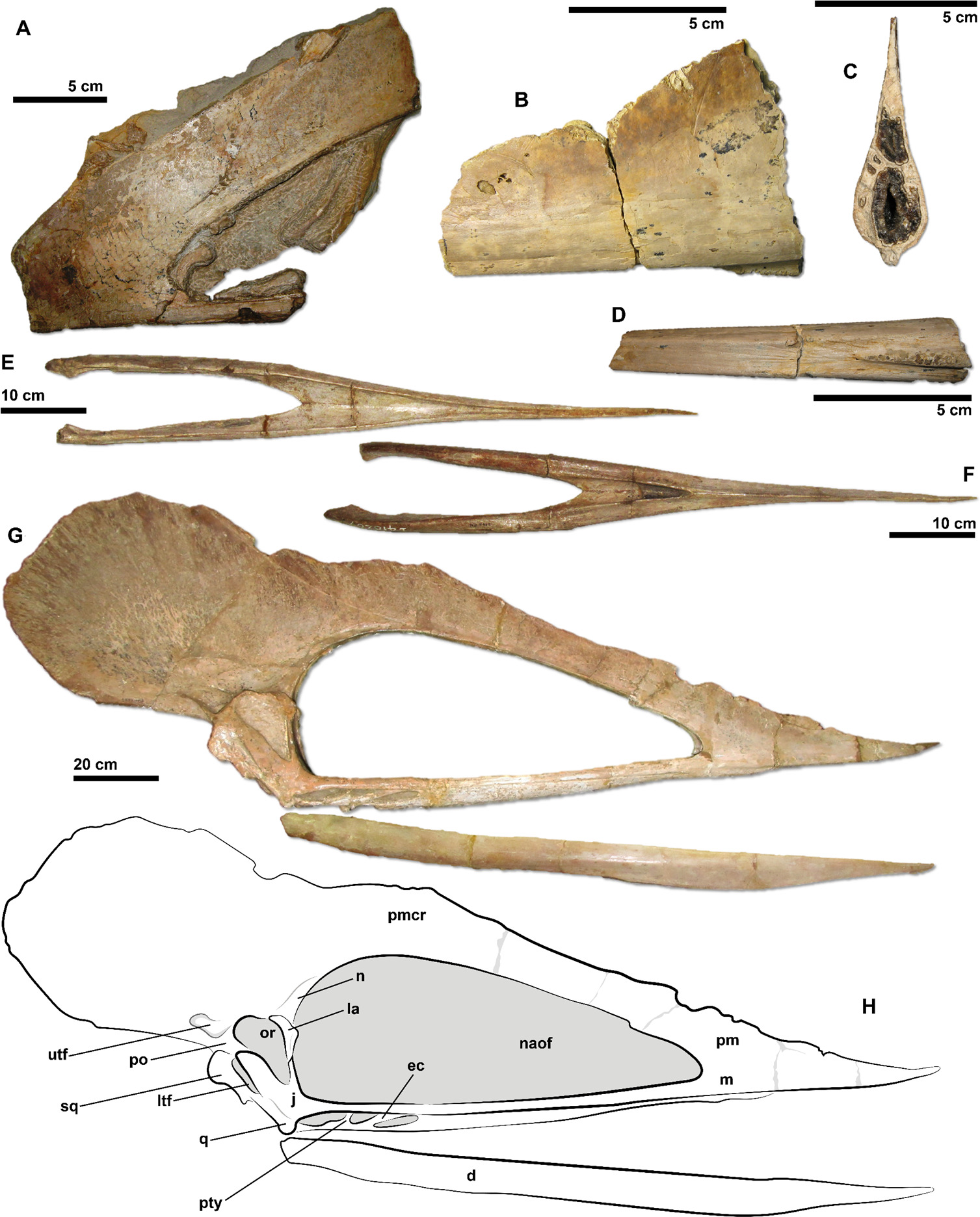
Referred specimens. BSPG 1982 I 89, fragmentary skull, mandible, partial cervical vertebra and wing, the holotype of ‘An. araripensis’ (Wellnhofer 1985, Pinheiro & Rodrigues 2017). BSPG 1982 I 90, fragmentary skull and wing, the holotype of ‘An. santanae’ (Wellnhofer 1985, Pinheiro & Rodrigues 2017). BSPG 1987 I 47, an almost complete mandible, the holotype of ‘An. robustus’ (Wellnhofer 1985, Kellner & Tomida 2000, Pinheiro & Rodrigues 2017). AMNH 22555, a relatively complete skeleton, previously referred to ‘An. santanae’ (Wellnhofer 1991, Kellner & Tomida 2000, Pinheiro & Rodrigues 2017). MN 4735-V, an almost complete skull, previously regarded as cf. ‘An. araripensis (Kellner & Tomida 2000, Pinheiro & Rodrigues 2017). NHMUK R 11978, a complete skull (Pinheiro & Rodrigues 2017). SAO 16494, a complete skull, previously referred to ‘An. araripensis (Veldmeijer 2006). SAO 200602, a partial mandible, previously referred to An. sp. (Veldmeijer et al. 2005). SMNK PAL 1136, a partial skeleton (Frey & Martill 1994, Pinheiro & Rodrigues 2017). DGEO-CTG-UFPE 8283, an incomplete rostrum from a crestless, juvenile individual (Duque et al. 2022).
Remarks. Many specimens have historically been attributed to Anhanguera in the literature, making it the best-represented genus in the Romualdo Formation; however, some species are now considered invalid. For example, Wellnhofer (1985) described a fragmented skull associated with postcranial materials (BSPG 1982 I 89) (Figure 4a–c), attributing the specimen to the species ‘Santanadactylus araripensis’. By tentatively inferring the presence of a sagittal premaxillary crest due to a gradual sharpening of the premaxillae towards the anterior end, Kellner (unpublished MSc thesis) reassigned the species to the genus Anhanguera (i.e., ‘Anhanguera araripensis’). Kellner & Tomida (2000), based on the holotype and another specimen referred to ‘An. araripensis’ (MN 4735-V), recognized only two autapomorphic characteristics for the species: a sagittal premaxillary crest positioned just in front of the nasoantorbital fenestra and the presence of small lateral projections on the pterygoids, directed towards the subtemporal fenestrae. Later, in their taxonomic assessment of the genus Anhanguera, Pinheiro & Rodrigues (2017) noted that the first character is weak (due to the highly variable nature of the premaxillary crest in Anhanguera, potentially influenced by ontogeny and sexual dimorphism), while the second is more widespread among anhanguerids than previously thought. Thus, ‘An. araripensis’ is considered by the authors to be a nomen dubium. However, evidence for the potential validity of ‘An. robustus’ has been recently presented by Piazentin et al. (2025); see further comments below under the Nomina dubia section.

Anhanguera referred specimens. BSPG 1982 I 89 in A, left lateral and B, C, ventral view; BSPG 1987 I 47 in D, right lateral and E, dorsal view; BSPG 1982 I 90 in F, right lateral view; AMNH 22555 in G, H, right lateral view.
Wellnhofer (1985) also presented ‘Araripesaurus santanae’, based on the specimen BSPG 1982 I 90 (partial skull and postcranial elements) (Figure 4f). The animal was also assigned to the genus Anhanguera (i.e., ‘Anhanguera santanae’) by Kellner (unpublished MSc thesis), again primarily based on the probable presence of a premaxillary crest. The description of a supposed new specimen of ‘An. santanae’ by Wellnhofer (1991) (AMNH 22555) (Figure 4g–h), followed by the taxon reassessment by Kellner & Tomida (2000), consolidated a premaxillary crest starting in a position well anterior to the antorbital fenestra as the only purported diagnostic feature for the taxon. Later, Pinheiro & Rodrigues (2017) redescribed AMNH 22555, assigning it to Anhanguera sp. and considered ‘An. santanae’ as non-diagnostic and, consequently, a nomen dubium.
An additional species attributed to the genus Anhanguera was ‘Anhanguera robustus’, described by Wellnhofer (1987) as a second species of the genus Tropeognathus. The species was originally supported by the presence of a well-developed dentary sagittal crest with a straight anterior margin and by the presence of a spatulate expansion of the anterior portion of the mandibular symphysis (Figure 4d–e). Such an expansion is widely observable in Anhangueridae and, following the reasoning of the inadequacy of characters related to the morphology of the typical anhanguerid rostral crests, Pinheiro & Rodrigues (2017) consider ‘An. robustus’ as a nomen dubium. Of further note is ‘Pricesaurus megalodon’, a nomen nudum named in a scientific meeting abstract (Martins Neto 1986). This purported taxon is based on two fragmentary rostra, CPCA 3591 (middle-section of a rostrum) and CPCA 3592 (a rostrum tip), which were reassessed by Pinheiro et al. (2012a). These authors noted that these fragmentary specimens are indistinguishable from Anhanguera sp., and were accordingly identified as Anhanguera sp. specimens (Pinheiro et al. 2012a).
Another relevant specimen, contributing to the understanding of morphological variation within the genus Anhanguera, is DGEO-CTG-UFPE 8283 (Duque et al. 2022). Although fragmentary and represented by an anterior portion of the skull, the specimen has been confirmed through multiple approaches (comparative analysis, phylogenetic analysis, and geometric morphometrics) as belonging to Anhanguera. Nevertheless, DGEO-CTG-UFPE 8283 lacks a premaxillary sagittal crest, drawing attention to the variable nature of this structure within the genus, likely resulting from ontogenetic variation or sexual dimorphism (Duque et al. 2022). This is in agreement with the proposals by Pinheiro & Rodrigues (2017), highlighting the issues inherent in using characters related to the premaxillary sagittal crest for diagnosing different species within the genus.
ANHANGUERINAE Campos & Kellner 1985
Ludodactylus sibbicki Frey, Martill & Buchy 2003
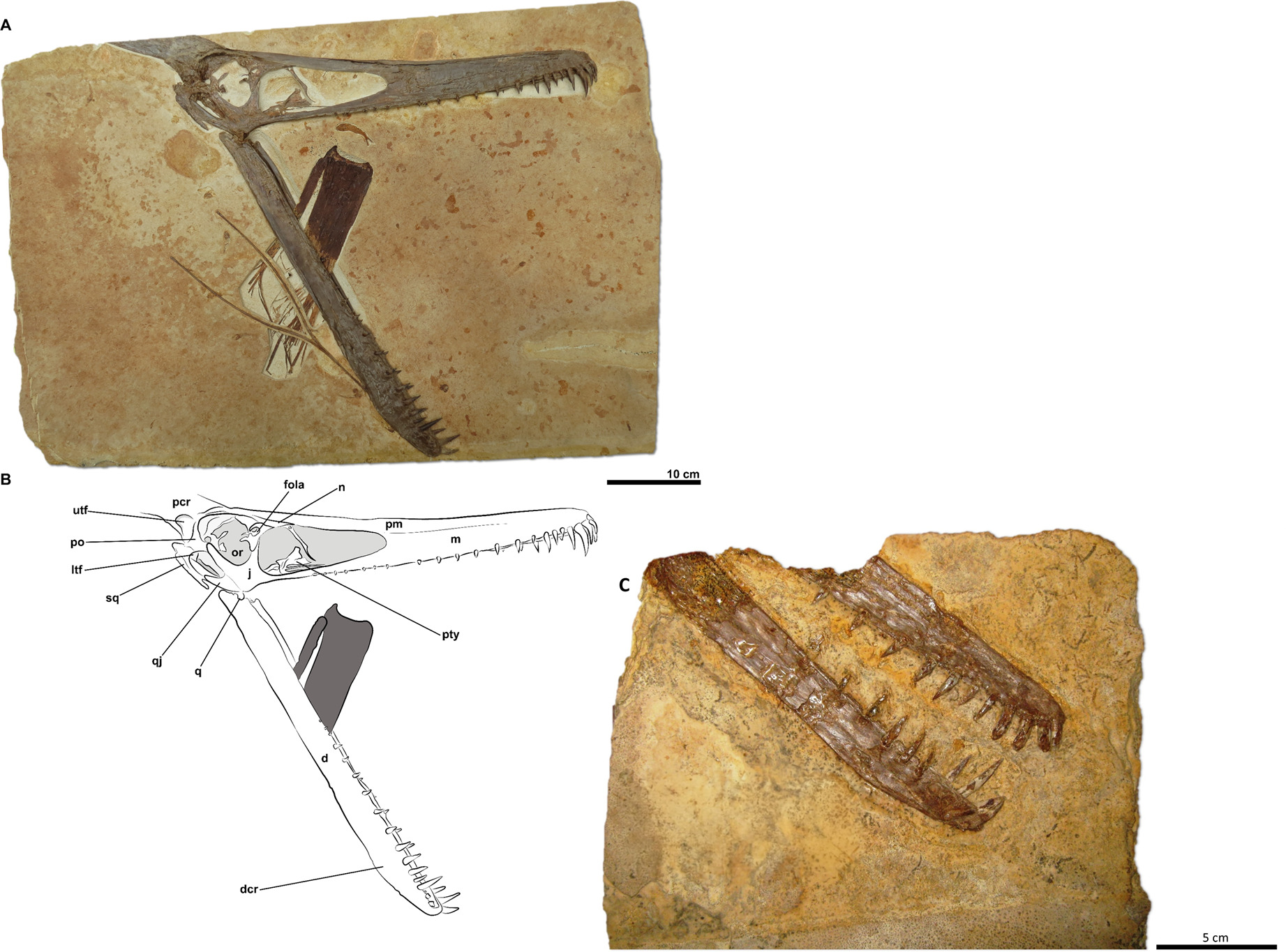
Holotype. SMNK PAL 3828, a nearly complete skull and articulated lower jaw, missing only the most posterior part of the sagittal crest (Figure 5a–b).

Ludodactylus sibbicki. A, B, holotype (SMNK PAL 3828) skull and lower jaw in right lateral view; C, MN-4797-V, referred upper and lower jaws in right lateral view.
Referred specimens. MN 4797-V (Figure 5c), a fragmentary rostrum and anterior portion of the lower jaw.
Horizon. Laminated limestone levels of the Crato Formation. Exact collection location and stratigraphic horizon unknown.
Diagnosis. According to Frey et al. (2003b), Ludodactylus sibbicki would be diagnosed by: 1) presence of a parieto-occipital crest that is laterally compressed and directed caudally; 2) lacrimal process compressed dorsoventrally and directed into the orbit; 3) lacrimal foramen in the shape of a rounded triangle, with one of its vertices directed ventrally; 4) a row of teeth extending to a point near the middle of the nasoantorbital fenestra; 5) absence of a premaxillary crest.
Remarks. Although Frey et al. (2003b) report the presence of a low sagittal crest on the dentaries of L. sibbicki, this was not confirmed in our examination of the holotype. As previously mentioned, the two-dimensional preservation of L. sibbicki hinders detailed comparisons with the younger Brasileodactylus, making it difficult to distinguish materials from the two taxa. Sayão & Kellner (2000) report the presence of Brasileodactylus in the Crato Formation. However, it is most likely that the specimen (MN 4797) presented by these authors may actually be a specimen of Ludodactylus. It should be noted that Wang et al. (2012) pointed out a close relationship of this Brazilian taxon with Guidraco venator Wang, Kellner, Jiang & Cheng 2012 from the Jiufotang Formation, China.
ANHANGUERINAE Campos & Kellner 1985
Cearadactylus Leonardi & Borgomanero 1985
Type species.Cearadactylus atrox Leonardi & Borgomanero 1985
Horizon. Romualdo Formation, Araripe Basin.
Diagnosis. As for type and only species.
Cearadactylus atrox Leonardi & Borgomanero 1985
Holotype. MN 7019-V, an almost complete skull, associated with the mandible (Figure 6a–c). In the original description, no collection number is assigned to the specimen, as it was deposited in the private collection of Mr. Guido Borgomanero.

Cearadactylus atrox holotype (MN 7019-V), A, B, skull in left lateral view; C, skull and lower jaw in right lateral view; Maaradactylus kellneri holotype (MPSC R 2357) in D, E left lateral and F, right lateral views.
Horizon. Romualdo Formation. Locality unknown.
Referred specimens. None.
Diagnosis. From Vila Nova et al. (2014, p. 127): “Large pteranodontoid pterosaur with the following autapomorphies: dentary groove reaching the rostral tip of the bone, with a bifurcated end; posterior and ventral limits of the nasoantorbital fenestra forming a right angle. It can be further distinguished from other pteranodontoids by the following combination of characters: orbit and naris above the middle of the nasoantorbital fenestra; comparatively small number of teeth (16–18 maxillary, 11–13 mandibular on each side); teeth decreasing in size towards the posterior end”.
Remarks.Cearadactylus atrox was described by Leonardi & Borgomanero (1985) from a relatively complete skull, although it was obtained through clandestine collection and was not fully prepared. The original diagnosis includes several characters, mostly related to the peculiar morphology of the rostrum and dentition, with emphasis on an apparent ‘gap’ between the maxillae and dentaries close to the rostral end.
Kellner & Tomida (2000) consider that most of the diagnostic characteristics proposed by Leonardi & Borgomanero (1985) are either widely distributed among other taxa from the Santana Group or influenced by the poor preservation state of the holotype. According to these authors, the supposed space between the premaxillae and mandible is not as pronounced as Leonardi & Borgomanero (1985) suggest, being also influenced by the specimen’s poor preparation as described originally. Kellner & Tomida (2000) therefore argue that the only unequivocal autapomorphy of Ce. atrox is a rostrally expanded dentary more so than the premaxillae.
More recently, Vila Nova et al. (2014), after careful preparation of the Ce. atrox holotype, revealed that the fossil had been adulterated. According to the authors, the rostral end of the mandible and premaxillae had been glued inverted. Therefore, what was interpreted as the anterior end of the premaxillae is actually part of the dentaries, and vice versa (Vila Nova et al. 2014). This finding profoundly impacts the supposed diagnostic characters of Ce. atrox. For example, the supposed gap between the premaxillae and mandible and the more developed rostral expansion in the dentary are actually artifacts of the tampering (Vila Nova et al. 2014). Nevertheless, Vila Nova et al. (2014) recognize some unique characteristics of Ce. atrox, supporting the validity of the species (see above). From our first-hand analysis of the holotype, however, we observed that the anterior part of the rostrum (glued at the time of tampering) does not seem to be compatible in size with the rest of the skull (FLP and RVP, personal observations). This could potentially invalidate some of the diagnostic characteristics of the species. Unfortunately, this specimen was lost during the fire that devasted the Museu Nacional in 2018.
ANHANGUERINAE Campos & Kellner 1985
Maaradactylus Bantim, Saraiva, Oliveira & Sayão 2014
Type species.Maaradactylus kellneri Bantim, Saraiva, Oliveira & Sayão 2014
Diagnosis. As for type and only species.
Maaradactylus kellneri Bantim, Saraiva, Oliveira & Sayão 2014
Holotype. MPSC R 2357, nearly complete skull preserved in a calcareous concretion and fragmented in five parts (Figure 6d–f). Atlas and axis are also preserved.
Horizon. The specimen was collected from an outcrop of the Romualdo Formation at São Gonçalo site, municipality of Santana do Cariri, Ceará State, Brazil.
Referred specimens. None.
Diagnosis. From Bantim et al. (2014, p. 205): “Presence of at least 35 pairs of alveoli in the skull. Premaxillary sagittal crest beginning at the anterior part of the skull and extending to the 22nd pair of alveoli, not covering the nasoantorbital fenestra nor the choanae. Moderate palatal ridge, starting on the 5th pair of alveoli and ending on the 13th pair, which is less developed than in Tropeognathus but more so than in Anhanguera. Palate with convex shape in the anterior portion. Choanae not extending laterally. Small and convex palatal elevation in anterior portion of the skull. The 5th, 6th and 7th alveoli smaller than the 4th and 8th. The alveoli decreasing in size from the 9th to the 12th and increasing from the 13th to 18th, and from the 18th to the 35th they are arranged in triplets”.
Remarks. The primary diagnostic features of Maaradactylus kellneri pertain to its dentition, notably the presence of clusters of three teeth beginning at the 18th pair of alveoli, a feature then unknown in other pterosaurs (Bantim et al. 2014). Maaradactylus kellneri bears some similarites to Tr. mesembrinus: premaxillary crest begins at the first pair of alveoli, that is, positioned at the anterior end of the skull (Bantim et al. 2014). Additionally, a parietal crest is present in both M. kellneri and Tr. mesembrinus, however, given the state of preservation of MPSC R 2357, it is not possible to ascertain if such crest overhangs the occipital region as in Tr. mesembrinus (Pentland & Poropat 2023). In their phylogenetic analysis, Bantim et al. (2014) recovered Maaradactylus as an anhanguerid pterosaur, due to the presence of premaxillary crest confined to the anterior portion of the skull, the shape of the premaxillary crest, expansion of the premaxilla with a high premaxillary end, frontal crest low and short, and a short parietal crest. More precisely, it was found in a polytomy with Tropeognathus and Anhanguera (Bantim et al. 2024). More recently, M. kellneri has been recovered as sister to Cearadactylus atrox, and the clade formed by these taxa is found as sister to members of the genus Anhanguera (Holgado et al. 2019, Pêgas et al. 2019, Holgado & Pêgas 2020, Pentland et al. 2022). Jacobs et al. (2019) proposed that An. spielbergi belongs to the genus Maaradactylus, but this proposal has not been widely accepted (see remarks section on Anhanguera spielbergi above).
ANHANGUERIDAE Campos & Kellner 1985
TROPEOGNATHINAE Holgado & Pêgas 2020
Tropeognathus Wellnhofer 1987
Type species.Tropeognathus mesembrinus Wellnhofer 1987
Diagnosis. As for type and only species.
Tropeognathus mesembrinus Wellnhofer 1987
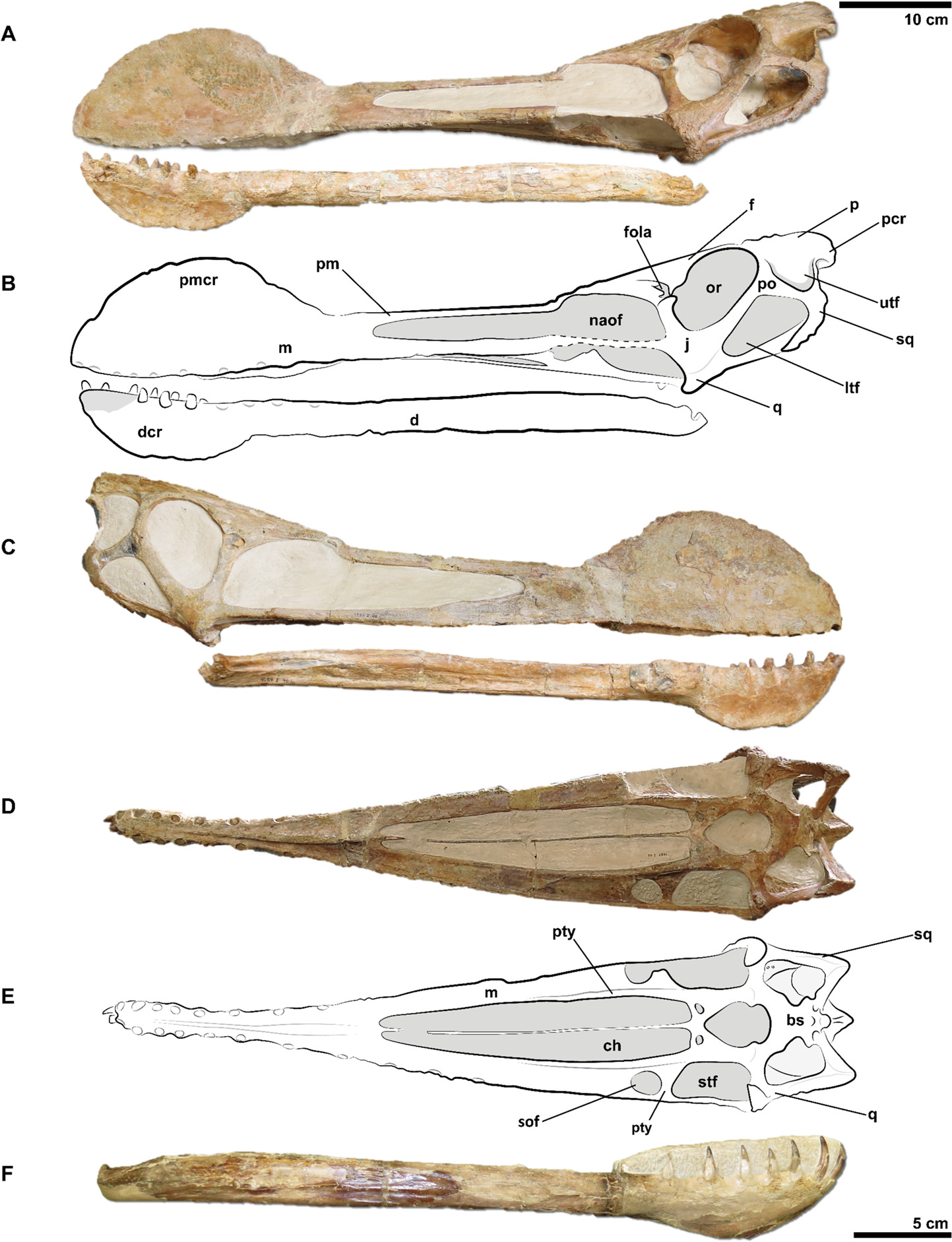
Holotype. Specimen BSPG 1987 I 46, a complete, well-preserved skull with associated lower jaw (Figure 7a–e).

Tropeognathus mesembrinus holotype (BSPG 1987 I 46) in A, B, left lateral; C, right lateral and D, E, ventral views; referred specimen SMNS 56994 in F, right lateral view.
Horizon. Exact locality is unknown. Wellnhofer (1987) states that the holotype comes from the Santana Group of the Araripe Basin, probably from Ceará state. As the specimen was recovered from a calcareous concretion, it certainly comes from the Romualdo Formation.
Referred specimens. Specimen SMNS 56994, a complete mandible (Veldmeijer & Hense 2002) (Figure 7f). Specimen MN 6594-V, a partial skeleton that includes an incomplete skull (with the braincase) and lower jaw, five cervical vertebrae (including part of the axis), twelve dorsal vertebrae (five of which are fused into a notarium), sacrum, incomplete scapula and coracoid on both sides, sternum, pelvic girdle, and wing elements from both sides (Kellner et al. 2013). Both referred specimens come from the Romualdo Formation. Kellner et al. (2013) state that MN 6594-V probably comes from a locality near the municipality of Santana do Cariri, Ceará State.
Diagnosis. After Kellner & Tomida (2000): high and rounded sagittal crest starting on the anterior tip of the premaxillae; short and blunt parietal crest overhanging the occiput; high palatal ridge, corresponding to a deep groove on the mandibular symphysis; dentition composed of 13 upper and 12 lower teeth on each side; and proportionally lowest nasoantorbital fenestra among all anhanguerids (height/length = 0.19).
Remarks. Originally, Wellnhofer (1987) described the new genus Tropeognathus based on specimens from the Romualdo Formation that he attributed to two new species, Tropeognathus mesembrinus and ‘Tropeognathus’ robustus. The latter species was described and named based on specimen BSPG 1987 I 47, which was later referred to ‘Anhanguera robustus’ instead (Kellner & Tomida 2000), and subsequent work by Pinheiro & Rodigues (2017) deemed ‘An. robustus’ as non-diagnostic (see section on Anhanguera). Therefore, Tropeognathus is currently considered to be monospecific. In his 1987 work, Wellnhofer (p. 178) diagnosed Tropeognathus as follows: “Large pterodactyloid pterosaurs with premaxillary and mandibular sagittal crests the front end of the skull and mandible. Strong, curved teeth from the tip of the jaws back to at least half the length of the jaws, decreasing in size.” Species Tropeognathus mesembrinus was diagnosed by Wellnhofer (1987, p. 179) as follows: “Tropeognathus with high, rounded sagittal crest on top of the premaxilla, and similar but smaller mandibular crest on the symphysis. Short and blunt parietal crest overhanging the occiput. High, medial ridge on the palate corresponding to a deep groove on the mandibular symphysis. Upper and lower jaws are not expanded anteriorly. Dentition with 13 premaxillary and maxillary teeth and [sic] 11 mandibular teeth on each side”. As noticed by Veldmeijer & Hense (2002), the mandible of the holotype actually bears 12 alveoli.
However, as noted by Kellner & Tomida (2000), all diagnostic features proposed for the genus by Wellnhofer (1987) are also present in Anhanguera. Moreover, contrary to Wellnhofer’s (1987) interpretation, the examination of the holotype reveals an anterior expansion of the premaxillae and dentaries, although this expansion is less pronounced than in Anhanguera. Kellner & Tomida (2000) affirm the validity of Tr. mesembrinus based on the remaining characters proposed by Wellnhofer (1987) and add that it possesses a dorsoventrally shorter nasoantorbital fenestra compared to Anhanguera. Additionally, the anterior margins of the choanae in Tr. mesembrinus are positioned more anteriorly than the anterior margins of the nasoantorbital fenestrae. However, since this trait is also observed in some Anhanguera specimens, it is not considered diagnostic for Tr. mesembrinus. Another notable difference is that the mandibular symphysis in Tr. mesembrinus accounts for only about 30% of the total jaw length, and that the dental differentiation in size is less pronounced. The last feature is common to Tropeognathinae overall, distinguishing them from Anhanguera as well as from other anhanguerines in general (Holgado & Pêgas 2020).
Unwin (2001, 2003) regarded Tropeognathus mesembrinus as sufficiently similar to Ornithocheirus simus to warrant its reclassification as ‘Ornithocheirus mesembrinus’. However, this proposal later suffered great criticism (Rodrigues & Kellner 2013, Holgado & Pêgas 2020). Despite the holotype of Tr. mesembrinus exhibiting some superficial similarities to Ornithocheirus simus, Rodrigues & Kellner (2013) noted several differences of phylogenetic relevance. Most significantly, Tropeognathus mesembrinus shares with other anhanguerians a dorsally reflected palatal tip and a lateral expansion of the premaxillae (the latter being a synapomorphy of Anhangueria), while both of these features are absent in Ornithocheirus simus (Rodrigues & Kellner 2013). Since Wellnhofer’s (1987) work, the validity of Tropeognathus has been recognized by several authors, for example, Kellner & Tomida (2000), Rodrigues & Kellner (2008), Pinheiro et al. (2012a), Rodrigues & Kellner (2013), and Holgado & Pêgas (2020). Several phylogenetic analyses have corroborated the distinctiveness of these two taxa (Andres et al. 2014, Longrich et al. 2018, Holgado et al. 2019, Jacobs et al. 2019, Andres 2021, Pêgas 2024, Pentland et al. 2024).
Veldmeijer & Hense (2002) referred specimen SMNS 56994, an almost complete mandible, to “Criorhynchus” cf. “Co.” mesembrinus. This mandible (the Stuttgart specimen) is similar to the mandible of BSPG 1987 I 46 in bearing a ventral crest, 12 pairs of teeth, lacking an anterior expansion, and having a comparable dentition pattern (Veldmeijer & Hense 2002). The main difference between the Stuttgart and Munich specimens is that the latter is 35% larger than the former, which may well be an ontogenetic difference. One feature that corroborates this point of view, is that the Munich specimen lacks identifiable sutures, while the Stuttgart one does not (Veldmeijer & Hense 2002). Finally, another specimen (MN 6594-V) was referred to Tropeognathus cf. Tr. mesembrinus, and described by Kellner et al. (2013). This specimen stands out due to its inferred wingspan of over 8 meters, making it the largest pterosaur specimen discovered in the Santana Group, and largest toothed pterosaur in the world (Kellner et al. 2013). Differences between MN 6594-V and the holotype of Tr. mesembrinus, such as body size and the morphology of the premaxillary and parietal crests, were attributed to variations in the ontogenetic stages of the specimens (Kellner et al. 2013).
ANHANGUERIDAE Campos & Kellner 1985 incertae sedis
‘Cearadactylus’ ligabuei Dalla Vecchia 1993
Holotype. CSRL 12692/12713, a partial skull composed mostly of the rostral region, but also with some posterior elements of the skull.
Horizon. Romualdo Formation, locality unknown.
Referred specimens. None.
Diagnosis. According to Dalla Vecchia (1993), ‘Cearadactylus’ ligabuei would be diagnosed by: 1) A low and elongated rostrum; 2) Expanded anterior end; 3) Absence of a premaxillary sagittal crest; 4) Presence of a concavity in the anterior alveolar margin of the maxillae; 5) The first four pairs of teeth are considerably larger than the others; 6) 22 pairs of teeth, extending from the anterior end of the skull to the anterior margin of the nasoantorbital fenestra; 7) Longitudinal striations on the teeth; 8) Premaxillae with a prominent and sharp dorsal margin in the anterior region of the skull; 9) Presence of a palatal keel; 10) Palate configured in a “V” shape in the anterior region of the skull; 11) Maxilla participating in the dorsal margin of the nasoantorbital fenestra; 12) Postorbital process of the jugal less inclined than in Ce. atrox; 13) Jugal more elongated anteroposteriorly than in Ce. atrox and other pterosaurs; 14) Maxillary and lacrimal processes of the jugal do not form a 90° angle.
Remarks. Dalla Vecchia (1993) tentatively classified the new species within the genus Cearadactylus based on similarities in dentition and the presence of a concavity in the anterior alveolar margin (toothline). However, the author stated that a more precise taxonomic assignment could only be made after the complete preparation of the Ce. atrox holotype. Almost all diagnostic characters of ‘C’. ligabuei are widely distributed among pterosaurs from the Romualdo Formation, a fact already noted by Kellner & Tomida (2000). According to these authors, the only two exclusive characteristics of the species would be a proportionally long rostrum (not indicated in the original description) and a large number of teeth. In his review of the genus Cearadactylus, Unwin (2002) stated that ‘C’. ligabuei is not related to Ce. atrox, but rather shows similarities with the genus Anhanguera. More recently, Rodrigues & Kellner (2013) included ‘C’. ligabuei in a phylogenetic analysis, finding a sister taxon relationship between this species and Ludodactylus sibbicki and confirming that Ce. atrox and ‘Ce’. ligabuei do not belong to the same genus. The complete preparation of the Ce. atrox holotype by Vila Nova et al. (2014) allows for more detailed comparisons between the two taxa, which will likely result in a more accurate taxonomic determination of ‘Ce’. ligabuei.
PTERANODONTOIDEA Kellner 2003
ORNITHOCHEIRAE Seeley 1870
TARGARYENDRACONIA Pêgas, Holgado & Leal 2019
TARGARYENDRACONIDAE Pêgas, Holgado & Leal 2019
Barbosania Elgin & Frey 2011
Type species.Barbosania gracilirostris Elgin & Frey 2011
Diagnosis. As for type and only species.
Barbosania gracilirostris Elgin & Frey 2011
Holotype. Specimen MHNS/00/85. It includes a complete but damaged skull and mandible, one cervical vertebra, thirteen dorsal vertebrae, the first sacral vertebra, and four caudal vertebrae from the base of the tail (Figure 8a–b).

Horizon. The holotype is partially enclosed in calcareous concretions, attesting its attribution to the Romualdo Formation. Although its exact locality is unknown, the authors mention that “the bluish color of the concretion strongly suggested a provenance of the Sierra de Maõsina”. Such information seems to demonstrate the authors’ lack of care in collecting accurate location data and their lack of familiarity with the region where the Romualdo Formation crops out. The authors appear to be referring to “Serra da Mãozinha,” Abaiara, Ceará State. Nevertheless, we recommend caution with this collection data, as it is impossible to make an unequivocal correlation between the coloration of the carbonate concretion and its precise locality.
Referred specimens. None.
Diagnosis. From Elgin & Frey (2011, p. 262–263), a combination of several characters: “Keeled but crestless rostrum with a pointed termination. Anteriormost pair of the mandibular and premaxillary alveoli positioned rostroventrally and rostrodorsally, respectively. Tooth positions two and three in both jaws with teeth that are twice as long as those of the subsequent alveoli. The second and third teeth are orientated craniolaterally and together with the anteriormost teeth form a narrow rosette due to a missing expansion of the tip of the rostrum. Lateral margins of the rostrum gradually converge rostrally. An estimated 24 and 20 tooth positions in the upper and the lower jaw, respectively. Interalveolar space gradually increasing caudally, alveolar diameter about constant until tooth position 13. Teeth between the eighth and thirteenth tooth positions in upper and lower jaw with an almost symmetrical interdigitation. Height of the nasoantorbital fenestra approximately 22% that of its length and forming ~24% of the total skull length. Parietal with flat external face, dorsal margin of the short median occipital process is deflected with a triangular transversally convex dorsal face. 13 trunk vertebrae. Caudoventral margin of ischium concave.”
Remarks. Elgin & Frey (2011) recognized that only a “caudoventral margin of ischium concave” is unique to Barbosania, but argued that the combination of several of the features appointed in the diagnosis, although not unique, is still useful to diagnose the genus. Without running any phylogenetic analyses, Elgin & Frey (2011, p. 270) placed Barbosania within the Ornithocheiridae (sensu Unwin 2003) based on anatomical features alone. According to them, specimen MNHS/00/85 is classified within Ornithocheiroidea due to features like “a notarium, a humerus with a warped, sub-triangular deltopectoral crest, an ornithocheiroid carpus, and a reduction of the metacarpalia where only one of the first three would have made contact [sic] the distal face of the carpus”.
The authors acknowledge similarities between Barbosania and Brasileodactylus; however, they emphasize the absence of a rostral expansion in the former. Like Brasileodactylus and Cearadactylus, Barbosania lacks a sagittal mandibular crest, a common feature among toothed pterosaurs from the Araripe Basin. Although the mandible is damaged, Elgin & Frey (2011) considered that the specimen is genuinely crestless, and that its crestless nature is not ontogenetic. Therefore, they agreed with Veldmeijer et al. (2009) that without additional specimens or more information, crestless specimens should be considered separate taxa instead of juvenile members of existing genera. We note, however, that Pinheiro & Rodrigues (2017) argued that when multiple specimens are analyzed, rostral crest morphologies previously thought to be distinct are actually part of a continuum, suggesting they represent individual or temporal variations, a point reinforced by the description of a crestless rostrum attributed to Anhanguera by Duque et al. (2022). Although these authors analyzed rostral crests, it should be taken as cautionary note on the development of a mandibular crest.
Unfortunately, Barbosania has not received proper consideration since its description. Vidovic & Martill (2018) found Barbosania as an anhanguerid, sister taxon to a clade formed by Cearadactylus, Brasileodactylus, Anhanguera and Coloborhynchus. Andres (2021) recovered B. gracilirostris as a non-anhanguerid ornithocheiriform, in a clade with Cearadactylus atrox and Brasileodactylus araripensis. Within the phylogenetic framework proposed by Pêgas et al. (2019), Barbosania gracilirostris, Targaryendraco wiedenrothi, and Aussiedraco molnari form the clade Targaryendraconidae, which according to these authors is supported by the following synapomorphies: a dentary groove extending at the level of the first pair of alveoli, dentary groove lateral rims conspicuously raised above the alveolar margin, and an enlarged lower pair of first teeth. The phylogenetic results of Pêgas et al. (2019) suggested that these raised rims of the dentary groove also evolved independently on the anhanguerine lineage.
LANCEODONTIA Andres, Clark & Xu 2014 incertae sedis
Arthurdactylus conandoylei Frey & Martill 1994
Holotype. SMNK 1133 PAL, partial skeleton, lacking skull, mandible, cervical vertebrae, sternum, and some caudal vertebrae (Figure 9a–b).

Horizon. Crato Formation, locality unknown.
Referred specimens. None.
Diagnosis. According to Frey & Martill (1994), Arthurdactylus conandoylei would be diagnosed based on some unfused bones (ribs and sacral vertebrae, ischium, and pubis), a notarium formed by three dorsal vertebrae, a distally curved fourth phalanx of the wing digit, and a short and sharp post-acetabular process.
Remarks. According to Kellner & Tomida (2000), all characteristics related to the absence of fusion between bones are likely associated with the ontogenetic stage of the animal, a view we support here. However, the sharp post-acetabular process and an oval opening in the pelvic girdle of Ar. conandoylei can be considered diagnostic. The absence of a skull in the holotype prevents a prevents direct comparison with other taxa from the Araripe Basin and thus precludes more precise taxonomic assignment. Kellner & Tomida (2000) assert that An. conandoylei would be a member of Pteranodontoidea and closely related to Anhangueridae. Frey & Martill (1994) classified the species as Ornithocheiridae.
Unwindia trigonus Martill 2011
Holotype. SMNK PAL 6597, partial rostrum, poorly preserved.
Horizon. The holotype is still partially embedded in a limestone nodule typical of the Romualdo Formation. Martill (2011) reports that the fossil was purchased from a local collector and is purportedly from the vicinity of the city of Santana do Cariri, Ceará.
Referred specimens. None.
Diagnosis. According to Martill (2011): 1) reduced dentition in the premaxillae and maxillae, with only 7 pairs of teeth, all anterior to the nasoantorbital fenestra; 2) teeth of similar sizes.
Remarks. Martill (2011) classifies the new animal within the taxon Ctenochasmatoidea. Although the holotype does indeed show marked differences from other taxa of the Santana Group, the assignment of U. trigonus to Ctenochasmatoidea should be approached with caution. This is because SMNK PAL 6597 was in an early stage of preparation at the time of its description, which prevents a clear identification of the diagnostic characteristics proposed by Martill (2011).
PTERODACTYLOIDEA Plieninger 1901
AZHDARCHOIDEA Unwin 1995
TAPEJAROMORPHA Andres, Clark & Xu 2014
CAUPEDACTYLIA Pêgas, Zhou, Jin, Wang & Ma 2023
Aymberedactylus Pêgas, Leal & Kellner 2016
Type species.Aymberedactylus cearensis Pêgas, Leal & Kellner 2016
Diagnosis. As for type and only species.
Aymberedactylus cearensis Pêgas, Leal & Kellner 2016
Holotype. MN 7596-V, an almost complete mandible of a subadult specimen (Figure 10a–c).

Aymberedactylus cearensis holotype (MN 7596-V) in A, B, dorsal and C, right lateral view; Caupedactylus ybaka holotype skull (MN 4726-V) in D, E, left lateral view.
Horizon. Crato Formation. Although the precise locality is unknown, matrix type and coloration are typical of the Nova Olinda Member (Pêgas et al. 2016).
Referred specimens. None.
Diagnosis. According to Pêgas et al. (2016), Aymberedactylus cearensis can be characterized by the following combination of features (autapomorphies marked with an asterisk): occlusal surface of the mandibular symphysis concave throughout entire extent; deep symphyseal shelf; wide lower jaw (0.34 ratio of mandibular width/length); shallow and short dentary fossa; an accentuated angle of divergence between mandibular rami and symphysis of ~165° (angle between the two rami of ~30°); elongated retroarticular process (approximately 7% of total mandibular length)*; and shallow fossa on the splenial exhibiting distinctive rugose texture*.
Remarks. It has been claimed in the literature that Aymberedactylus is “probably = Tupandactylus” (Martill et al. 2018), though no arguments were presented to support this supposed synonymy. However, subsequent papers have retained Ay. cearensis as a valid taxon (Pêgas 2024). We note here that Tupandactylus (both species) differ from Ay. cearensis in exhibiting a shorter retroarticular process and a step-like dorsal eminence of the dentary symphysis (see Pinheiro et al. 2011, Pêgas et al. 2016, Beccari et al. 2021). Of note, the presence of a step-like dorsal eminence represents a synapomorphy of Tapejaridae (Andres 2021, Pêgas 2024), and the lack of such feature in Ay. cearensis is reflective of its position as a non-tapejarid tapejariform (Pêgas 2024), similarly to Caupedactylus ybaka. It is worth noting that this feature manifests early in tapejarid ontogeny, being present even in juvenile specimens (e.g., Eck et al. 2011, Manzig et al. 2014); meaning that ontogenetic variation can be safely excluded as an explanation for the lack of this feature in the holotype of Ay. cearensis (especially considering its subadult status). This species has recently been recovered as the sister taxon of Ca. ybaka, supported by a flat surface of the dentary fossa (Pêgas et al. 2023, Pêgas 2024).
CAUPEDACTYLIA Pêgas, Zhou, Jin, Wang & Ma 2023
Caupedactylus Kellner 2013
Type species.Caupedactylus ybaka Kellner 2013.
Diagnosis. As for type and only species.
Caupedactylus ybaka Kellner 2013
Holotype. MN 4726-V, an almost complete skull and lower jaw (Figure 10d–e), along with some postcranial elements such as the scapula, coracoid, sternum, humerus, part of the right first phalanx of the fourth digit, and some rib fragments.
Horizon. Romualdo Formation, locality unknown.
Referred specimens. A complete skull, potentially attributable to Ca. ybaka, was put up for auction in 2009. Its current whereabouts are unknown. It is also possible that specimen MPSC R 859, described by Pinheiro & Schultz (2012) as an indeterminate Azhdarchoidea, belongs to the taxon, what is based on a peculiarly flat surface on the anterior palate.
Diagnosis. Following its original description (Kellner 2013), the species is characterized by the following combination of characters (autapomorphies are marked with an asterisk): anteroposterior extended premaxillary sagittal crest*; downward curvature of the rostrum presenting the ventral margin of the skull mildly concave; no gap between jaws anterior end; lacrimal process of the jugal inclined posteriorly at about 115°; reduced, slit-like, postpalatinal fenestra*; quadrate inclined 150° relative to the ventral margin of the skull*; absence of developed processes in basisphenoid*; basisphenoid does not contribute to the interpterygoid opening*; thick posterior half of the ventral margin of the mandibular symphysis, shaping a slight convex surface*, thick posterior half of the ventral margin of the mandibular symphysis, forming a slightly convex surface*.
Remarks. The holotype specimen of Caupedactylus ybaka, interpreted as an adult individual (Kellner 2013), was originally classified as an early-diverging tapejarid. Recent analyses now place Ca. ybaka as a sister group to Aymberedactylus cearensis, forming the group Caupedactylia (Pêgas et al. 2023).
In a recent paper, Cerqueira et al. (2023) have demonstrated that the holotype specimen of ‘Tupuxuara deliradamus’ (SMNK PAL 6410), therein regarded as non-diagnostic (see further below), bears strong resemblance to Caupedactylus ybaka in exhibiting a lacrimal process of the jugal posteriorly inclined, a posterodorsal margin of the nasoantorbital fenestra forming an abrupt bend level with the dorsal margin of the orbit, and an inclination of the quadrate with relation to the jugal bar of approximately 150°. We here regard SMNK PAL 6410 as indistinguishable from Ca. ybaka, even though the poor preservation of the specimen may preclude a more precise assignment. We note here that the same is true of the referred specimen KPMNH DL 84 (see Witton 2009, Cerqueira et al. 2023), which requires a detailed reassessment.
We note that the specimen MPSC R 859 (a fragmentary palatal portion of a skull), attributed to an indeterminate azhdarchoid by Pinheiro & Schultz (2012) shares more similarities with Ca. ybaka (which was still undescribed at that time) than to other Santana Group toothless pterosaurs. The main shared characteristic between MPSC R 859 and Ca. ybaka holotype is a flat palate anterior to the choanae. However, the fragmentary state of the former prevents a more assertive attribution.
TAPEJAROMORPHA Andres, Clark & Xu 2014
TAPEJARIDAE Kellner 1989
Tapejara Kellner 1989
Type species.Tapejara wellnhoferi Kellner 1989.
Diagnosis. As for type and only species.
Tapejara wellnhoferi Kellner 1989
Holotype. MN 6595-V, an incomplete skull preserving several cranial elements (Figure 11a–c).

Tapejara wellnhoferi holotype (MN 6595-V) skull in A, left lateral and B, right lateral view; C, right lateral view of the anterior premaxillary crest; D, referred specimen SMNK PAL 1137 skull in right lateral view; E, F, referred specimen AMNH 24440 in right lateral view.
Horizon. Romualdo Formation, locality unknown.
Referred specimens. AMNH 24440, an almost complete skull and lower jaw, along with some cervical vertebrae (Wellnhofer & Kellner 1991) (Figure 11e–f); NMSG SAO 12891, the anterior portion of the skull formed by the premaxillomaxilla (Wellnhofer & Kellner 1991); MCT 1500-R, skull preserving most of the basicranium and mandible (Kellner 1996b); SMNK PAL 1137, partial skull (Figure 11d), along with some postcranial elements of at least two individuals such as cervical, thoracic, and caudal vertebrae, scapulae, coracoids, humeri, radii, ulnae, metacarpals, the phalanges of the wing digit, elements of the ischiopubis, and complete hindlimbs (Eck et al. 2011); SMNK PAL 3986, some disarticulated cranial and postcranial elements (Elgin & Campos 2012); IMNH 1053, an undescribed partial skull (Witton 2013).
Diagnosis. Following Kellner (1989) in its original description, and subsequently amended by Wellnhofer & Kellner (1991) and Eck et al. (2011), the species can be characterized by the following combination of features: toothless jaw; a high premaxillary sagittal crest starting anteriorly and extending to the posterior portion of the skull; a large nasoantorbital fenestra; a downward curvature anteriorly at the rostrum; short frontoparietal crest extending posteriorly to the occipital plate; orbit situated below the dorsal rim of the nasoantorbital fenestra; a concave depression in palatal region; a pointed end of the rostrum; palate lacks a medial ridge; lower jaw presenting a dentary crest; upper margin of the symphysis inclined ventrally; concavity in the occlusal surface of the symphysis following the symphysis inclination; short cervical vertebrae; low neural spine; two large pneumatic foramina lateral to the neural canal; axis lacks a lateral pneumatic foramina; two pneumatic foramina piercing the humerus, one on the dorsal face of the bone at the base of the posterior process and a second on the ventral face of the collum.
Following recent developments in the study of tapejarids (Manzig et al. 2014, Beccari et al. 2021, Canejo et al. 2022, Pêgas 2024), it is clear that the proposed species diagnosis for Tapejara wellnhoferi (Kellner 1989, Wellnhofer & Kellner 1991, Eck et al. 2011) are too general and apply equally to tapejarines overall. Even though it is clear that Tapejara wellnhoferi is distinct from any other tapejarine (Vullo et al. 2012, Beccari et al. 2021, Canejo et al. 2022, Pêgas 2024), its current diagnosis requires revision.
Remarks. After the original description of Tapejara (Kellner 1989), the holotype, originally deposited in a private collection, was donated to the Museu Nacional/UFRJ in April 1998 and renumbered as MN 6595-V. During the accidental fire that affected the Museu Nacional/UFRJ in September 2nd of 2018 (Kellner 2019), the specimen was initially lost. After several efforts to recover the scientific material affected by the fire, the specimen was located, although its current state of preservation remains unknown. Tapejara wellnhoferi is one of the most important pterosaur species from Brazil, as it represents the type genus for the Tapejaridae family, a group that has consistently been recovered as monophyletic (Andres et al. 2014, Holgado et al. 2019, Kellner et al. 2019, Cerqueira et al. 2021, Pêgas et al. 2023) and is abundantly present in deposits from Brazil and China (e.g. Cerqueira et al. 2021).
TAPEJARIDAE Kellner 1989
Tupandactylus Kellner & Campos 2007
Type species.Tupandactylus imperator (Campos & Kellner 1997)
Included species.Tupandactylus navigans (Frey, Martill & Buchy 2003)
Diagnosis. According to Kellner & Campos (2007), the diagnosis for Tupandactylus should be the same as for the type species. However, at that time, Tupandactylus navigans was not taken into consideration for diagnosing the genus. Since both taxa assigned to Tupandactylus show substantial differences, an emended diagnosis for the genus is provided here: large tapejarid with a slender, spine-like dorsal supra-premaxillary process supporting a soft tissue median crest; soft tissue median crest with parallel fibers; large nasoantorbital fenestra (45% of the skull length excluding parietal crest); and deep and rounded median dentary crest. A ventrally concave retroarticular process of the mandible was observed in GP/2E 9266 (Tupa. navigans) and differs from the triangular retroarticular process of other tapejarids (Andres 2021). The presence of a notarium was observed in GP/2E 9266 (Beccari et al. 2021). Both these features (retroarticular morphology and presence of a notarium) might be exclusive to Tupandactylus among tapejarids (Beccari et al. 2021).
Remarks. When initially described by Campos & Kellner (1997), only two taxa had been assigned to Tapejaridae (sensu Kellner 1989), Tapejara wellnhoferi and Tupuxuara longicristatus Kellner & Campos 1988. Therefore, initially, Tupandactylus was compared to these taxa, and its holotype (MCT 1622-R) was assigned to the genus Tapejara due to morphological similarities, such as the presence of a posteriorly elongated parietal crest, and proportionally large (over 45% of the skull length) nasoantorbital fenestra. After a reassessment of MCT 1622-R, the new genus Tupandactylus was provided (Kellner & Campos 2007). Tupandactylus differs from Tapejara in the shape of the premaxillary crest (being triangular to sub-triangular in the former and rounded in the latter), and by the fusion of the dorsal premaxillary process to the frontoparietal in Tupandactylus, opposed to the unfused condition in Tapejara. The genus Tupandactylus has been accepted in most subsequent studies (e.g., Pinheiro et al. 2011, Pêgas et al. 2016, 2021b, Beccari et al. 2021, Cerqueira et al. 2021, 2023) and received further support from phylogenetic analyses where Tupandactylus and Tapejara are recovered the clade Tapejarinae (sensu Andres 2021), but as distinct taxa (e.g., Martill & Naish 2006, Andres et al. 2014, Andres 2021, Pêgas 2024). It is also worth mentioning that Tupandactylus and Tapejara were recovered in different formations of the Santana Group, the former coming from the older Crato Formation, and the latter from the Romualdo Formation. Sayão & Kellner (2006) described specimen MN 6588-V, which comprises a partial and semi-articulated postcranial skeleton with cervical, dorsal, and sacral vertebrae, sternum, and pectoral and pelvic girdles. This specimen was assigned to Tupandactylus sp. by Beccari et al. (2021), due to the overall morphology of the vertebrae, the presence of a notarium (differing from other tapejarids), and well-developed coracoid tubercle.
Tupandactylus imperator (Campos & Kellner 1997)
Holotype. MCT 1622-R, an almost complete skull with associated soft tissue crest impression (Figure 12a–b). The specimen is laterally compressed.

Tupandactylus imperator holotype in A, B, left lateral view; C, referred specimen CPCA 3590, skull and lower jaw in right lateral view; D, Tupandactylus navigans referred material (SMNK PAL 2343) in left lateral view; E, F, Tupa. navigans holotype (SMNK PAL 2344) in right lateral view.
Horizon. Crato Formation, Santana Group. The precise location of the specimen is unknown.
Referred specimens. CPCA 3590, an incomplete skull and lower jaw, with associated soft tissue (Pinheiro et al. 2011) (Figure 12c); SMNK PAL 2839, an incomplete skull, missing the anterior region of the premaxillomaxilla (Frey et al. 2003c); a private specimen with an almost complete skull and associated soft tissue (Unwin & Martill 2007); MCT 1884-R, a partial skull, missing the anterior half and palatal region, including the soft tissue crest (Cincotta et al. 2022); MN 7852-V, a complete skull with associated soft tissue (Canejo et al. 2025).
Diagnosis. The most recent emended diagnosis for Tupandactylus imperator was given by Pinheiro et al. (2011). Tupa. imperator is a large tapejarid with an extremely elongated (almost the same length as the skull length from premaxilla to squamosal) occipital process (parietal crest in Beccari et al. 2021), large soft tissue crest supported by a posterodorsally inclined, spine-like premaxillary process; parallel fibers on the soft tissue crest inclined posteriorly; anteriorly convex blade projected in the premaxilla; and a deep dentary median crest, forming a 60° angle with the anterior margin of the dentary.
Remarks. As mentioned above, Tupandactylus imperator was described initially as a new species of Tapejara by Campos & Kellner (1997), but subsequently assigned to a new genus by Kellner & Campos (2007). The name “Ingridia” imperator was also proposed in a book chapter by Unwin & Martill (2007), with Tupandactylus taking precedence. Since its first description, four new specimens have been assigned to Tupa. imperator, all coming from the Crato. Tupa. imperator bears the largest tapejarid soft tissue crest to date, but the overall morphology of this crest has been debated. Some authors (e.g., Campos & Kellner 1997) argued for a concave posterior margin of the soft tissue crest, resembling a sail. However, it is possible that this crest was convex posteriorly, as suggested for the more complete private specimen depicted in Unwin & Martill (2007). This morphology has been illustrated and is well-accepted (e.g., Frey et al. 2003c, Pinheiro et al. 2011). This convex posterior margin is also present in Tupa. navigans specimens, although the crest shape differs in this taxon (see the Tupandactylus navigans section below).
Tupandactylus navigans (Frey, Martill & Buchy 2003)
Holotype. SMNK PAL 2344, a nearly complete, articulated, laterally compressed skull with soft tissue crest preserved (Figure 12e-f).
Horizon. Crato Formation, Santana Group. The precise location of the specimen is unknown.
Referred specimens. SMNK PAL 2343, an incomplete skull (missing parts of the supraorbital region and parietal crest) with preserved soft tissue crest (Frey et al. 2003c) (Figure 12d); GP/2E 9266, a nearly complete skeleton with skull, mandible, axial series, appendicular bones preserved in partial articulation, and preserved soft tissue crest (Beccari et al. 2021) (Figure 13a–b).

A, B, Tupandactylus navigans, specimen GP/2E 9266. This is the most complete Araripe pterosaur thus far described.
Diagnosis. A revised diagnosis was provided by Beccari et al. (2021). Tupandactylus navigans is a large tapejarid with an anteriorly concave, striated premaxillary crest, short and rounded parietal crest, broad posteroventral (= processus caudalis in Frey et al. 2003c) process of the jugal, deep and striated median dentary crest with sub-vertical posterior margin, and presence of a longitudinal groove in the lateral surface of the cervical vertebrae postzygapophyses.
Remarks. Similar to Tupandactylus imperator, Tupa. navigans was initially described as “Tapejara navigans” (Frey et al. 2003c). During the initial description, two specimens were assigned to Tupa. navigans, and the authors separated it from Tupa. imperator by a combination of morphological traits, i.e., a vertical supra-premaxillary process (posteriorly deflected in Tupa. imperator), a broader posteroventral process of the jugal than in Tupa. imperator and Tapejara wellhoferi, and the shorter and round-ended parietal crest. The latter, however, was argued to be a possible taphonomic feature, due to the poor preservation of the posterodorsal region of the skull in both the holotype and referred specimens of Tupa. navigans (Frey et al. 2003c, Kellner 2004, Kellner & Campos 2007). When Tupandactylus imperator was given a new generic name, it was still unclear whether “Tapejara navigans” was a valid species that should be assigned to the newly coined genus as well (Kellner & Campos 2007). Later, however, new phylogenetic analyses, as well as some authors, regarded Tupandactylus navigans as a valid species of Tupandactylus, differing from Tapejara wellnhoferi (e.g., Pinheiro et al. 2011, Andres et al. 2014, Andres 2021, Beccari et al. 2021). In 2015, a new, almost complete specimen of Tupa. navigans (GP/2E 9266) was deposited in the Vertebrate Paleontology Collection of the Geosciences Institute of the University of São Paulo. This specimen has been CT-scanned, described, and confirms some of the differences proposed for the taxon, such as the short, rounded parietal crest, and the vertical supra-premaxillary process (Beccari et al. 2021). The new specimen also shows further diagnostic features that differentiate Tupa. navigans from Tupa. imperator, such as a deeper median dentary crest with a sub-vertical posterior margin, compared to the convex posterior margin of the median dentary crest of the latter. The specimen GP/2E 9266 shows longitudinal grooves on the lateral surface of the cervical vertebrae postzygapophyses, which, so far, has only been described for this specimen among tapejarines.
At this moment, both species of Tupandactylus are vastly accepted (e.g., Eck et al. 2011, Elgin & Campos 2011, Pinheiro et al. 2011, Pinheiro & Schultz 2012, Andres et al. 2014, Andres 2021, Pêgas et al. 2016, 2021b, Beccari et al. 2021, Cerqueira et al. 2021, 2023, Canejo et al. 2022). However, due to the similar morphology between Tupa. navigans and Tupa. imperator, as well as sympatry of both taxa, it has been argued before that the morphological changes between them could be related to ontogenetic, intraspecific, or sexual variation, as has been suggested for other pterosaurs, e.g., Hamipterus tianshanensis (Wang et al. 2014), Anhanguera (Pinheiro & Rodrigues 2017), Quetzalcoatlus (Andres & Langston 2021), Caiuajara (Canejo et al. 2022, but see Pêgas 2024), Sinopterus (Pêgas et al. 2023), and has been discussed for Tupandactylus before (e.g., Frey et al. 2003c, Pinheiro et al. 2011, Beccari et al. 2021). Nevertheless, there are many arguments in favor of two valid Tupandactylus species. Both Tupa. imperator and Tupa. navigans are known from adult specimens (MCT 1622-R and CPCA 3590 for the former, and at least GP/2E 9266 for the latter), discarding ontogeny as a possible factor for these differences. The parietal and soft tissue crests shape and length, being extremely elongated posteriorly in Tupa. imperator also falls outside the expected crest variability for pterosaurs (see Beccari et al. 2021, Pêgas 2024). Although sexual dimorphism might be hard to discard, the two species further differ in other aspects besides cranial crest morphology, most particularly regarding nasoantorbital fenestra proportions (1.9 times as long as high in Tupa. navigans, and 2.5 times as long as high in Tupa. imperator) as well as orbit position (much lower in the skull in Tupa. imperator than in Tupa. navigans; see Beccari et al. 2021). Presently, no strong arguments can be made for assigning Tupa. navigans and Tupa. imperator to different sexual morphs of the same species.
TAPEJAROMORPHA Andres, Clark & Xu 2014
THALASSODROMIDAE Witton 2008
Kariridraco Cerqueira, Santos, Marks, Sayão & Pinheiro 2021
Type species.Kariridraco dianae Cerqueira et al. 2021.
Diagnosis. As for type and only species.
Kariridraco dianae Cerqueira, Santos, Marks, Sayão & Pinheiro 2021
Holotype. MPSC R 1056. The specimen consists of an almost complete skull, preserving most of temporal, orbital, and preorbital portions, as well as part of the premaxillary crest (Figure 14a–b). It is associated with the partially preserved lower jaw and the first four cervical vertebrae.

Kariridraco dianae holotype (MPSC R 1056) in A, B, right lateral view; Thalassodromeus oberlii cast of holotype (NMSG SAO 251093) in C, dorsal and D, right lateral view; E, F, Thalassodromeus sethi holotype (DGM 1476-R) in left lateral view.
Locality and Horizon. The exact provenance of the holotype of Kariridraco dianae is unknown. The specimen was donated to MPSC by local workers. However, the specimen is preserved within a carbonate concretion typical from the Romualdo Formation (Cerqueira et al. 2021).
Referred specimens. None.
Diagnosis. According to Cerqueira et al. (2021), Kariridraco dianae differs from all other pterosaurs in the following combination of characters: presence of a jugal shelf, a comparatively short and high nasoantorbital fenestra, a single elliptical lateral pneumatic foramen in the left lateral surface of the cervical IV centrum; and the following autapomorphies: premaxillary crest forming an angle of about 45° with respect to the maxilla, and a lacrimal with an anteriorly-directed deep concavity.
Remarks.Kariridraco dianae displays the typical tapejaromorph characteristics, such as a nasoantorbital fenestra corresponding to more than 45% of the total length of the skull; orbit showing an inverted pear shape; long sagittal crest formed mainly by the premaxilla and extending posteriorly; and a thin sub-vertical lacrimal process of the jugal (Kellner 2004, Kellner & Campos 2007, Cerqueira et al. 2021). According to Cerqueira et al. (2021), Kariridraco and Tupuxuara are sister taxa supported by the presence of a convex surface at the mid-length of the palate. Kariridraco and Tupuxuara present some further similarities such as the near triangular-shaped nasoantorbital fenestra, and a 90°angle of the lacrimal process with respect to the jugal bar. They differ in the lack of a jugal shelf in Tupuxuara spp., as well as in the much shorter nasoantorbital fenestra and a steeper sagittal crest present in K. dianae.
THALASSODROMIDAE Witton 2008
Thalassodromeus Kellner & Campos 2002
Type species.Thalassodromeus sethi Kellner & Campos 2002.
Included species.Thalassodromeus oberlii (Headden & Campos 2014).
Diagnosis. Following Pêgas et al. (2018): dentary symphysis exhibiting a symmetrical airfoil-like transverse section (a single, median tomial edge), with the anterior portion of the dentary exhibiting keeled dorsal and ventral edges; and a small longitudinal groove excavating the surface of the mandibular symphyseal shelf. A further potential diagnostic apomorphy of the genus (still unknown in Th. oberlii) is the “scissor-like” morphology of the rostrum, wherein the rostrum is like the dentary symphysis in cross-section in exhibiting a sharply keeled occlusal surface (a single, median tomial edge) (Kellner & Campos 2002, 2007).
Remarks. The genus Thalassodromeus was introduced by Kellner & Campos (2002) to accommodate Th. sethi, a then new species that was very similar to, but distinct from, the two proposed species of Tupuxuara. Their similarities are expressed mostly in the presence of palatal keels, the large height of the nasoantorbital fenestra, and the large bony component of the cranial sagittal crest, comprising posterodorsally extended (and fused) premaxillary and frontoparietal crests (Kellner & Campos 2007). The most striking distinctions originally reported for Thalassodromeus sethi were the “scissor-like” morphology of the jaws (rostrum and dentary symphysis with a single, median tomial edge in the form of a sharp occlusal keel) and the wider occipital region, in sharp contrast to Tupuxuara which lacks a “scissor-like” morphology of the jaws and exhibits a slender occipital region (Kellner & Campos 2002, 2007). The close phylogenetic relationship between Thalassodromeus and Tupuxuara was soon appreciated (Kellner 2003, Unwin 2003), but it was not until 2008 that a clear separation between Thalassodromeus sethi and the two proposed species of Tupuxuara (Tupu. longicristatus + Tupu. leonardi) was demonstrated through a phylogenetic analysis (Andres & Ji 2008) and subsequently corroborated (Andres et al. 2014, Cerqueira et al. 2021, Pêgas 2024).
Thalassodromeus sethi Kellner & Campos 2002
Holotype. DGM 1476-R, an almost complete skull, including lower jaw (Figure 14e–f).
Horizon. Romualdo Formation, possibly near the town of Santana do Cariri, in the state of Ceará (Kellner & Campos 2002).
Referred specimens. None.
Diagnosis. From Kellner & Campos (2002) and Pêgas et al. (2018): posterior end of the premaxillary crest ‘V’-shaped; suture between premaxillae and frontoparietal portion of the crest rectilinear; anterior portion of the premaxillae showing sharp dorsal and ventral (palatal) edges; palatal surface posterior to palatal crest strongly concave; reduced and ovoid postpalatine fenestrae; and lateral region of the ectopterygoid enlarged and plate-like.
Remarks. The most striking features of Thalassodromeus sethi are its large ossified cranial crest and its “scissor-like” jaws, wherein sharp occlusal keels (in the form of single, median tomial edges) are present on both the rostrum and dentary symphysis (Kellner & Campos 2002, 2007, Pêgas et al. 2018). Thalassodromeus sethi was regarded as a junior synonym of Tupuxuara longicristatus (therein including Tupuxuara leonardii) by Martill & Naish (2006), who regarded that differences in cranial crest shape would be due to ontogenetic/sexual variation; and that occlusal surface morphology and occipital width were not valid characters owing to difficulties in making comparisons to most azhdarchoids in virtue of taphonomic compaction. Of course, this reasoning ignores the fact that the known remains of Tupuxuara do not fall into the “compacted category” (Kellner 2004), so that it is taphonomically possible to ascertain that Tupuxuara does lack the “scissor-like” occlusal surfaces of Thalassodromeus, and does exhibit a slenderer occipital region, corroborating their conspicuous distinction as reiterated by Kellner & Campos (2007) and subsequently vastly appreciated (Witton 2009, 2013, Andres et al. 2014, Vidovic & Martill 2018). Upon further preparation of the holotype specimen of Th. sethi, new differences between Thalassodromeus sethi and Tupuxuara spp. were noted, including the presence, in Th. sethi, of a strongly concave posterior palate, a reduced and ovoid postpalatine fenestrae, and a lateral region of the ectopterygoid enlarged and plate-like, contra the convex palate, slit-like postpalatine fenestrae, and rod-like ectopterygoid of Tupuxuara, further corroborating their distinction (Kellner & Campos 2007, Pêgas et al. 2018).
Thalassodromeus oberlii (Headden & Campos 2014)
Holotype. NMSG SAO 251093, an incomplete mandible belonging to a private collection (Veldmeijer et al. 2005, Headden & Campos 2014). Casts exist in the collections of BSPG and MPSC (Figure 14c-d).
Horizon. Romualdo Formation. The exact locality remains unknown (Headden & Campos 2014).
Referred specimens. None.
Diagnosis. From Pêgas et al. (2018): dorsal surface of the dentary symphysis slightly shorter than the ventral surface; and dorsal edge of the mandibular symphysis much sharper than the ventral one.
Remarks. NMSG SAO 251093 was first described in the literature as a referred specimen of Thalassodromeus sethi (Veldmeijer et al. 2005). A few differences between the holotype and the new specimen were acknowledged, but considered to represent individual variation (Veldmeijer et al. 2005). Later, more differences were noticed and the specimen was thus redescribed as a new species and attributed to a different clade, the Dsungaripteridae (Headden & Campos 2014). This interpretation was subsequently challenged, and the purported presence of dsungaripterid features in NMSG SAO 251093 was questioned (Pêgas et al. 2018). Several morphological similarities unite NMSG SAO 251093 with Thalassodromeus sethi, most importantly a dentary symphysis exhibiting a symmetrical airfoil-like transverse section, with the anterior portion of the dentary exhibiting keeled dorsal and ventral edges; and a small longitudinal groove excavating the surface of the mandibular symphyseal shelf. Based on these similarities, a sister group relationship between Th. sethi and Th. oberlli has been recovered by phylogenetic analyses (Pêgas et al. 2018, Pêgas 2024). Still, Thalassodromeus oberlii differs from Thalassodromeus sethi in exhibiting a dorsal surface of the dentary symphysis slightly shorter than the ventral one, and a smoother ventral keel (less sharp relative to the dorsal keel).
THALASSODROMIDAE Witton 2008
Tupuxuara Kellner & Campos 1988
Type species.Tupuxuara longicristatus Kellner & Campos 1988.
Included species.Tupuxuara leonardii Kellner & Campos 1994.
Diagnosis. Revised diagnosis: thalassodromid with a convex palate and an acute anterior border of the nasoantorbital fenestra (see Cerqueira et al. 2021).
Remarks. Originally diagnosed by the presence of a posterior expanded premaxillary crest and presence of a medial palatal keel (Kellner & Campos 1988, 1994), these features later became known as synapomorphies of a more inclusive clade, equivalent to Thalassodromidae (Kellner & Campos 2007, Cerqueira et al. 2021). Following Kellner & Campos (2007), this is a thalassodromid taxon with a convex palate and a relatively thin anteroventral bony bar of the nasoantorbital fenestra (in comparison with Thalassodromeus). According to Witton (2009), Tupuxuara is a thalassodromid with a “distended” (convex) palate and lacking an intranasal foramen. Following Cerqueira et al. (2021), the taxon is distinguished by its convex palate (similar to Kariridraco, but distinct from Thalassodromeus) and an acute anterior border of the nasoantorbital fenestra (distinct from both Kariridraco and Thalassodromeus).
Tupuxuara longicristatus Kellner & Campos 1988
Holotype. The specimen MN 6591-V consists of a partial skull (Figure 15a), associated with postcranial elements, preserving fragments of the right metacarpals I-IV, a fragment of the left metacarpal IV, fragments of the left and right phalanges of the fourth digits, and only one fragment of an ungual phalanx.
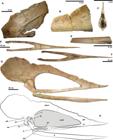
Tupuxuara longicristatus holotype (MN 6591-V) skull in A, left lateral view; Tupuxuara leonardii holotype (MCT 1495-R) in B, left lateral; C, posterior; D, palatal view; Tupu. leonardii referred specimen (IMNH 1052) lower jaw in E, dorsal and F, ventral view; skull and lower jaw of Tupu. leonardii (IMNH 1052) in G, H, right lateral view.
Horizon. The specimen was preserved within a carbonate concretion from the Romualdo Formation (Kellner & Campos 1988).
Referred specimens. None.
Diagnosis. From Kellner & Campos (1988): pterosaur of medium size, presenting a sagittal crest beginning in the anterior part of the premaxilla and extending towards the posterior portion of the skull; lack of teeth; presence of a palatal keel on the ventral part of the palate; first phalanx of the fourth digit and metacarpal relatively thin and long; presence of two pneumatic foramina in the anterior joint of the first phalanx of the fourth digit, with one pneumatic foramen located within the upper portion of the joint with the fourth metacarpal. According to Kellner & Campos (2007) and Witton (2009, 2013), this is a Tupuxuara species that differs from Tupuxuara leonardii in exhibiting a fainter palatal ridge that extends anteriorly on the rostral region.
Remarks.Tupu. longicristatus was the first tapejaromorph to be named in literature. Originally, it seemed to be a distinctively peculiar specimen, presenting a large sagittal crest extending posteriorly and having a large nasoantorbital fenestra. However, after the description of new thalassodromids, it became clear that the cranial diagnostic characters proposed by Kellner & Campos (1988) no longer fit the species level, being instead general of the Thalassodromidae (Kellner & Campos 2007). Still, Tupu. longicristatus is regarded as distinct from Tupuxuara leonardii due to the morphology and extension of the palatal keel (Kellner & Campos 2007, Witton 2009, 2013). Since postcranial remains of Tupuxuara leonardii (known from specimen IMNH 1052) still lack a formal description, it is difficult to verify if the postcranial diagnostics characters proposed by Kellner & Campos (1988) for Tupuxuara longicristatus could really be diagnostic for this species or, alternatively, if they could apply to a genus-level diagnosis.
Tupuxuara leonardii Kellner & Campos 1994
Holotype. Specimen MCT 1495-R, consisting of an extremely fragmentary rostral portion of the skull that was latter transferred to the Museu Nacional (Kellner pers. obs.) (Figure 15b–d).
Horizon. Romualdo Formation, allegedly close to the town of Santana do Cariri, Ceará (Kellner & Campos 1994).
Referred specimens. IMNH 1052, an almost complete specimen preserving skull and postcranial elements (Figure 15e–h), which still lacks a formal description (Pêgas et al., in press.).
Revised diagnosis. Tupuxuara species that presents a strong median keel in the palate, which does not extend anteriorly on the skull (see Kellner & Campos 1994, 2007, Witton, 2009, 2013).
Remarks. According to the original authors, Tupu. leonardii would distinguish from Tupu. longicristatus by having a stronger and shorter median keel, which, unlike in Tupu. longicristatus, would not extend onto the anterior region of the rostrum. According to Martill & Naish (2006), the palatal keel would not represent a sufficient feature to differentiate between Tupu. longicristatus and Tupu. leonardii, claiming that this characteristic sometimes varies intraspecifically, as could purportedly be seen in Azhdarcho lancicollis. Also, Martill & Naish (2006) observe that the holotypes consist of slightly different regions of the skull, hampering comparisons on the extension of the palatal keel between both taxa. Kellner & Campos (2007) reaffirm the distinction of the species, arguing that Martill & Naish (2006) erroneously interpreted Bakhurina & Unwin (1995), who do not mention the presence of a palatal keel in Azhdarcho. Witton (2009, 2013) also recognized Tupuxuara longicristatus and Tupuxuara leonardii as distinct taxa.
AZHDARCHOMORPHA Pêgas, Holgado, Ortiz David, Baiano & Costa 2021
CHAOYANGOPTERIDAE Lü, Unwin, Xu & Zhang 2008
Lacusovagus Witton 2008
Type species.Lacusovagus magnificens Witton 2008.
Diagnosis. As for type and only species.
Lacusovagus magnificens Witton 2008
Holotype. SMNK PAL 4325, a partial skull (Figure 16).

Horizon. Precise locality unknown. Nova Olinda Member, Crato Formation.
Referred specimens. None.
Diagnosis. After Witton (2008): azhdarchoid pterosaur with a maxillary ramus that flares laterally at the posterior extremity, but is subparallel with the skull midline along its middle portion and tapers towards the rostrum at its anterior; crestless, shallow but laterally broad prenasal-rostrum that measures <37 per cent of the jaw length, with a dorsal apex of 70 degrees.
Remarks. Witton (2008) assigned this species to the Chaoyangopteridae, based mostly on the combination of a crestless skull, straight and shallow rostrum, and slender posterior premaxillary processes. Subsequent to its original description, its status as a chaoyangopterid was questioned by Kellner (2013) due to its poor preservation. However, the chaoyangopterid nature of Lacusovagus magnificens was corroborated by Leal et al. (2017), who further presented an additional chaoyangopterid specimen from the Crato Formation: UFC 721, consisting of an associated series of four mid-cervical vertebrae. The chaoyangopterid nature of Lacusovagus magnificens has been corroborated by some subsequent studies (e.g. Pêgas et al. 2023, Pêgas 2024), although other studies have recovered it either as a thalassodromid (Wu et al. 2017) or a tapejarid (Andres 2021). Both of these results must be seen with caution, being based on the erroneous scoring of characters that simply cannot be scored for Lacusovagus magnificens due to its state of preservation. These scorings pertain to values of skull height/length proportions (character 0 of Wu et al. 2017, character 0 of Andres 2021), as well as to the alleged presence of a premaxillary crest, along with its anterior end position, anterior margin orientation, shape, and posterior end position (characters 84–87 of Andres 2021). Skull proportions cannot be seen in the holotype specimen (due to crushing and incompleteness) and a premaxillary crest is altogether unobservable (either absent or, arguably, unpreserved), such that the reasonings behind such coding remain unfounded. Here, we corroborate the interpretation of Lacusogavus magnificens as a chaoyangopterid, on the basis of its slender posterior premaxillary processes and sinusoidal jaw margins in dorsal view (Pêgas 2024).
AMBIGUOUS TAXA
As mentioned above, the history of pterosaur research in the Araripe Basin is quite complex and this is considerably affected the diversity of the unambiguous species known so far. This entails that several species formally proposed have scientific names of unknown or doubtful application, or even requiring further investigation. Hereafter the suprageneric taxa considered as such are listed depending on each particular case.
NOMINA DUBIA
AZHDARCHOIDEA Unwin 1995 incertae sedis
‘Tupuxuara deliradamus’ Witton 2009 (nomen dubium)
Holotype. SMNK PAL 6410, a fragmentary skull comprising the orbitotemporal region and frontoparietal crest, and posterior region of the mandibular rami (Figure 17a–b).

‘Tupuxuara deliradamus’. Holotype (SMNK PAL 6410) in A, B, right lateral view; C,referred specimen (KPMNH DL 84) in right lateral view.
Horizon. Romualdo Formation. Locality unknown.
Referred specimens. KPMNH DL 84 (Figure 17c).
Remarks. The material comprises the posterior region of a skull, composed mainly by the temporal bones and part of the sagittal crest, preserved in the right lateral view (Witton 2009). The specimen preserves the frontal, parietal, squamosal, quadrate, lacrimal, an incomplete jugal, and a mandibular ramus. Associated with the preserved portion of the skull, the SMNK PAL 6410 specimen also has the articular portion of the mandible present (Witton 2009). The internal bone structure of the material is exposed, likely due to splitting of the limestone concretion, a common practice for the Romualdo Formation. This results in poor preservation, with the trabeculae visible in the frontoparietal crest, but this apparently did not alter the skull structure (Cerqueira et al. 2023).
According to Witton (2009), the new species would be diagnostic by: a prominent angle of 120° in the posterior margin of the nasoantorbital fenestra, with the vertice located in the lacrimal fenestra; posterodorsal border of the nasoantorbital fenestra straight; relatively slender quadrate reclined to 150° from the long axis of maxillary bar; and orbit positioned below mid-height of the nasoantorbital fenestra. However, the lack of overlap with the other two species of the Tupuxuara genus from the same formation is sufficient to characterize ‘Tupu’ deliradamus as a problematic taxon. Kellner (2013) doubted the attribution of SMNK PAL 6410 to the genus Tupuxuara, considering ‘Tupu.’ deliradamus as a nomen dubium. According to Kellner (2013), the preservational status of the material, coupled with incomplete preparation, makes the specimen uninformative. He also noted the referred material of ‘Tupu.’ deliradamus (KMNH DL 84) is adulterated, and any anatomical information regarding this material should be treated with care.
Cerqueira et al. (2023), in a revision about the phylogenetic affinities of ‘Tupu.’ deliradamus, recovered ‘Tupu.’ deliradamus and Caupedactylus ybaka as sister taxa in their phylogenetic analysis. The authors further argue that “Tupu.” deliradamus presents significant anatomical differences from the referred specimen of Tupu. leonardii (IMNH 1052), the only Tupuxuara specimen comparable with SMNK PAL 6410. In addition, the specimen shares many similarities with Ca. ybaka, such as a posteriorly inclined lacrimal process of the jugal, an abrupt bend at the posterodorsal margin of the nasoantorbital fenestra level with the dorsal margin of the orbit, and a quadrate inclined at approximately 150° relative to the jugal bar. For these reasons, it seems that SMNK PAL 6410 is best seen as an indeterminate caupedactylian, possibly Caupedactylus itself. However, due to its fragmentary nature, it is not possible to confirm with much certainty whether it represents a valid caupedactylian species or a senior synonym of Ca. ybaka. As it is represented by undiagnostic material, it is regarded here as a nomen dubium and referred to as cf. Caupedactylus sp.
‘Santanadactylus spixi’ Wellnhofer 1985 (nomen dubium)
Holotype. BSPG 1980 I 121, partial right and left wings comprising radius, ulna, carpals, pteroids, and fourth metacarpal.
Horizon. Romualdo Formation. Locality unknown.
Referred specimens. None.
Remarks. The specimen includes parts of both the right and left wings, both of which are restricted to the regions of the forearm and wrist. The left wing includes the distal ends of the radius and ulna, proximal syncarpal, distal syncarpal, lateral carpal, sesamoid, pteroid, the proximal region of the fourth metacarpal, and a sesamoid. The right wing includes the distal ends of radius and ulna, proximal syncarpal, distal syncarpal, lateral carpal, and sesamoid A. Despite its incompleteness, the specimen is well-preserved in that it is three-dimensionally preserved and undistorted, as typical of fossils preserved within Romualdo Formation calcareous concretions.
Wellnhofer (1985) designated BSPG 1980 I 121 as a new species of the genus Santanadactylus De Buisonjé 1980, therein named Santanadactylus spixi. However, as noted by Bennett (1989, 1994), the type species of Santanadactylus seems to represent a pteranodontid (see the Ornithocheiriformes section), while ‘Santanadactylus spixi’ does not, meaning the generic attribution of ‘S. spixi’ needed revision. Bennett (1989, 1994) tentatively assigned ‘S. spixi’ to the Dsungaripteridae, due to many similarities between ‘S. spixi’ and Dsungaripterus weii regarding the morphology of the distal regions of the radius and ulna and of the carpal bones, forming what Bennett (1989) termed a “dsungaripterid carpus”. Later, however, Bennett (1994) noted that some of the features of the “dsungaripterid carpus” seemed to be present in other groups as well, such as azhdarchids — it must be noted that, at the time, the azhdarchoid carpal region was poorly known. It later became clear that the so-called “dsungaripterid carpus” is quite similar to the condition seen in some azhdarchoids, with Kellner & Tomida (2000) assigning ‘S. spixi’ to the Tapejaridae (sensu Kellner 1989, roughly equivalent to Tapejaromorpha), and Unwin (2003) and Martill & Naish (2006) stating that BSPG 1980 I 121 is probably referable to Tupuxuara. More recently, Bennett (2018) regarded ‘S. spixi’ as an indeterminate azhdarchoid. Still, no detailed comparisons between BSPG 1980 I 121 and tapejaromorphs, or azhdarchoids overall, have yet been provided. It is clear that a detailed reassessment of this specimen is still needed before its phylogenetic affinities can be solidly demonstrated. Even though thalassodromid affinities seem likely (Unwin 2003 Martill & Naish 2006), it seems unlikely that fragmentary forearms and wrists could prove much useful in diagnosing a species within this group (or within Azhdarchoidea overall). In this way, we provisionally regard that ‘S. spixi’ is best seen as a dubious species, at least until a detailed reassessment is provided.
Anhanguera Campos & Kellner 1985 incertae sedis
‘Araripesaurus santanae’ Wellnhofer 1985 (nomen dubium)
Holotype. BSPG 1982 I 90, skull without jaw tip and the associated lower jaw without jaw tip, an isolated maxillary tooth, right ulna and radius, two right proximal carpals, three distal carpals, proximal portion of the fourth metacarpal, and a purported first metacarpal.
Horizon. Romualdo Formation. Locality unknown.
Referred specimens. AMNH 22555, a partial pterosaur skeleton, composed of an almost complete skull, proximal end of the right mandibular ramus, nearly all vertebral elements, ribs, an almost complete pelvis, scapulae and coracoids, humeral fragment, incomplete radius and ulna, pteroid, carpals, fourth metacarpal, a femoral fragment, and pedal phalanges (see remarks).
Remarks. The holotype of ‘Araripesaurus santanae’ was prepared from a larger concretion obtaining the aforementioned skeletal elements and, on the basis of this, Wellnhofer (1985, p. 148) stated that “[…] it is safe to assume that all of these skeletal elements come from one individual.”. The diagnosis proposed by Wellnhofer (1985) was characterized by a: skull narrow and long, with upwardly curved jaw ends; straight and lateral jaw edges in ventral view; presence of dentition, probably to the tip of the jaw, with curved teeth increasing in size towards the front; nasal process directed inside the nasoantorbital fenestra; pterygoid articulating with both basipterygoid process of the basisphenoid and the quadrate; dorsal margin of the premaxilla keeled only in front of the nasoantorbital fenestra; fossa depressoria on the lower jaw very large and deep; retroarticular process sloping gently posteriorly; radius much thinner than the ulna; carpus formed by two proximal and three distal elements, and one laterodistal carpal. However, most of these features are today known to be broadly shared by other Romualdo anhanguerians (Pinheiro & Rodrigues 2017). ‘Araripesaurus santanae’ was firstly relocated within the genus Anhanguera (Kellner 1990), which was followed by Wellnhofer (1991) after referring the specimen AMNH 22555 to ‘Anhanguera santanae’. Kellner & Tomida (2000) discussed the validity of the diagnostic characters originally proposed for ‘An. santanae’, affirming that the sole persisting diagnostic character for this taxon would be the position of the premaxillary sagittal crest at the anteriormost portion of the skull, preceding the nasoantorbital fenestra (Kellner & Tomida 2000: fig. 63). In their reassessment of the genus Anhanguera, Pinheiro & Rodrigues (2017) noted that the presence of the premaxillary crest was solely inferred in ‘An. santanae’ by the acute dorsal margin of the premaxillae close to the anterior extremity of the specimen and stated that “[…] premaxillary crest characters are here regarded as unfit for the diagnosis of nominal anhanguerid species […]” (p. 28) on the basis of allometric growth, and consequently considered ‘An. santanae’ as a nomen dubium. Other specimens posteriorly referred to this taxon remaining of uncertain placement within the genus Anhanguera (see Pinheiro & Rodrigues 2017 for further details).
‘Santanadactylus araripensis’ Wellnhofer 1985 (nomen dubium)
Holotype. BSPG 1982 I 89, middle part of a skull surrounding the nasoantorbital fenestrae, posterior part of a lower jaw (without the mandibular symphysis), five isolated teeth, two incomplete ceratobranchialia, and the remains of a right wing formed by the humerus, ulna, distal portion of the radius, distal and proximal carpals, pteroid, proximal portions of the third and fourth metacarpals, two sesamoids, and a fragment of a vertebra.
Horizon. Romualdo Formation. Locality unknown.
Referred specimens. MN 4735-V, a complete skull with developed premaxillary sagittal crest; and NMSG SAO 16494, a complete skull with developed premaxillary sagittal crest.
Remarks. The holotype of ‘Santanadactylus araripensis’ was represented by an incomplete skull with associated postcranial elements from a sole large concretion (Wellnhofer 1985). Its original diagnosis was proposed by Wellnhofer (1985) as “[…] there is no nasal process of the skull, quadrate firmly fused with pterygoid and basisphenoid, the margins of the jaws slightly curved outwards in the norma ventralis, the jaw probably dentate up to the tips of the jaw, the dorsal margin of the premaxilla is sharply jawed up to the anterior end of the nasoantorbital fenestra, fossa depressoria on the lower jaw slightly deepened, retroarticular process sloping steeply posteriorly, proximal margin of the lateral process of the humerus with a bend, proximal and distal carpal fused in one element, and proximal carpal with strong tubercle for the fovea carpalis of the ulna.” (Wellnhofer 1985: p. 110). Kellner (1990) also reassigned this taxon to the genus Anhanguera _ which was followed by Wellnhofer (1991) _, whilst Kellner (1991) highlighted the presence of a small lateral projection on the pterygoid directed toward the subtemporal fenestra as a unique feature of ‘An. araripensis’. Kellner & Tomida (2000) considered that only two characters would be diagnostic for this species: the aforementioned small lateral projection, but also dorsal margin of the premaxilla “keel-shaped” up to the anterior end of the nasoantorbital fenestra (which is present in MN 4735-V, but not in the holotype of ‘An. araripensis’). Pinheiro & Rodrigues (2017) finally challenged the taxonomic value of the latter character due to the deep variability of the premaxillary crest within the genus Anhanguera, and considered that the small lateral projections on the basioccipital processes of the pterygoids “[…] as problematic, because it is probably related to the bone growth between different elements of the adductor musculature that crossed the subtemporal openings.” (Pinheiro & Rodrigues 2017: p. 18). Consequently, the holotype of ‘An. araripensis’ was regarded as non-diagnostic, considering it as a nomen dubium.
‘Tropeognathus robustus’ Wellnhofer 1987 (nomen dubium)
Holotype. BSPG 1987 I 47, a lower jaw.
Horizon. Romualdo Formation. Locality unknown.
Referred specimens. MZSP-PV 368, a lower jaw; and SAO 200602, another lower jaw (see Piazentin et al. 2025).
Remarks. Wellnhofer (1987) originally diagnosed the holotype of ‘Tropeognathus robustus’ by “[…] a deep mandibular crest with a front margin straight, forming an angle about 50° with the upper edge of the lower jaw. In dorsal view anterior end of jaw expanded spoon-like. Strong, and in the front long teeth.” (p. 182). Kellner & Campos (1988) reassigned this species to the genus Anhanguera, whilst Kellner & Tomida (2000) observed that large anterior teeth associated to the lateral expansion of the dentaries are common in anhanguerids (anhanguerines following Holgado et al. 2019). Finally, Pinheiro & Rodrigues (2017) considered as a nomen dubium given that “[the] other supposedly diagnostic characters are related to the dentary sagittal crest and are probably associated to the apparently advanced ontogenetic stage of the specimen.” (p. 20).
A recent paper has presented a new anhanguerid mandible almost indistinguishable from the holotype of ‘An. robustus’ except for its smaller size, sharing with it the characteristic straight anterior margin of the dentary crest (Piazentin et al. 2025). Morphometric analyses have shown that such dentary crest morphology is highly disparate from other Anhanguera specimens, suggesting a potential taxonomic value for this feature (Piazentin et al. 2025). However, sexual dimorphism could not be ruled out, and it remains possible, though difficult to ascertain at the moment, that the distinctive morphology of ‘An. robustus’ could in fact be due to sexual dimorphism within another species such as An. blittersdorffi (Piazentin et al. 2025). The latter hypothesis is preliminary preferred here until more complete specimens come to light.
PTERANODONTOIDEA Kellner 2003 incertae sedis
‘Araripesaurus castilhoi’ Price 1971 (nomen dubium)
Holotype. DGM 529-R. Partial right wing including distal region of radius and ulna, proximal carpals, lateral carpal, pteroid, metacarpus, partial free digits, and partial fourth digit.
Horizon. Romualdo Formation. Price (1971) pointed out that this specimen “...probably from an outcrop of the southern flank of the Chapada [do Araripe], Pernambuco State...” (Price, 1971: p. 454).
Referred specimens. None.
Remarks. ‘Araripesaurus castilhoi’ is notorious for being the first ever nominal pterosaur species reported from the Araripe Basin (Price 1971), even if currently regarded as invalid today. Despite comprising several appendicular elements, none of the preserved bones provide sufficient comparative information to allow for a suitable, valid diagnosis, as already explored in detail before (Kellner & Tomida 2000). In fact, the original proposed diagnosis comprises features which, today, are considered fairly general for pteranodontoids overall, and no autapomorphies can be found (Kellner & Tomida 2000). As pointed out by Kellner & Tomida (2000), ‘Araripesaurus castilhoi’ can be tentatively identified as an indeterminate lanceodontian (sensu Andres et al. 2014) due to the presence of a radius less than half the diameter of the ulna. Its remains are indistinguishable from both Anhanguera piscator and Santanadactylus brasilensis, both of which can be identified as anhanguerids (see below), suggesting ‘Araripesaurus castilhoi’ too could be a member of this clade, or at least a close relative. A detailed reassessment of this specimen would be welcome, perhaps in terms of best establishing its phylogenetic affinities at least — however, current knowledge on anatomical variation in the antebrachial and manual regions in anhanguerids suggest that such material may indeed be insufficient for diagnosing a valid species (e.g., Kellner & Tomida 2000).
Santanadactylus brasilensis De Buisonjé 1980 (nomen dubium)
Holotype. M 4894, incomplete scapulocoracoid and proximal region of a right humerus.
Paratype. M 4895, a partial cervical series.
Horizon. Romualdo Formation. Locality unknown.
Referred specimens. Paul Gigase n. V-201 (Wellnhofer et al. 1983).
Remarks. The holotype specimen is unfortunately very incomplete, and the original proposed diagnosis consists of features that are too general for pterodactyloids overall (Kellner & Tomida 2000). Nonetheless, Kellner & Tomida (2000) have suggested the presence of a single potential autapomorphy: almost straight margins of the proximal and middle portions of the deltopectoral crest, in lateral view. However, the margin of the proximal and middle portions of the deltopectoral crest in M 4894 actually seem sigmoidal (as usual among pteranodontoids) as figured by Hazlehurst & Rayner (1992). Therefore, we regard that Santanadactylus brasilensis is best seen as a nomen dubium. The presence of a warped deltopectoral crest indicates a pteranodontoid nature, while a dorsal humeral pneumatic foramen and a well-developed acrocoracoid process suggest the holotype specimen represents an indeterminate anhanguerid (Kellner & Tomida 2000).
It is worth pointing out that De Buisonjé (1980) designated as paratype the specimen M 4895, a fragmentary specimen that is not comparable to the holotype specimen. The reasoning behind such action is elusive (De Buisonjé 1980). In addition, Wellnhofer et al. (1983) also tentatively referred an isolated notarium (Paul Gigase n. V-201) to S. brasilensis on the grounds of body size alone. As already noted before, no conclusive evidence exists to support the interpretation that either M 4895 (De Buisonjé 1980) or Paul Gigase n. V-201 (Wellnhofer et al. 1983) are conspecific with M 4894, and thus Santanadactylus brasilensis should be restricted to its holotype (Kellner & Tomida 2000). It is worth pointing out that specimen M 4895 has been tentatively interpreted as a member of Azhdarchomorpha, sharing with chaoyangopterids and azhdarchids cervical elongation and cervical neural spine reduction (Pêgas et al. 2021b). Specimen Paul Gigase n. V-201, in turn, bears great resemblance to anhanguerids (Da Silva et al. 2024) and may thus be a member of this clade.
Santanadactylus pricei Wellnhofer 1985 (nomen dubium)
Holotype. BSPG 1980 I 122, a partial left wing comprising ulna, radius, proximal and distal carpals, pteroid, incomplete metacarpals I–III, incomplete first phalanx of the fourth digit, and an ungual.
Paratypes. BSPG 1980 I 43, a left humerus. BSPG 1980 I 120, right distal ulna and radius, proximal fourth metacarpal, and a fragmentary carpal. MZ A/III 522, left first and second phalanges of the fourth digit.
Horizon. Romualdo Formation. Locality unknown.
Referred specimens. None.
Remarks. The holotype specimen (BSPG 1980 I 122) comprises exclusively antebrachial and manual elements, similarly to the holotype of ‘Araripesaurus castilhoi’. As explored above, these elements do not seem to carry much useful taxonomic information at the species level. The diagnosis of Wellnhofer (1991) comprises features that are general for lanceodontians overall, and Kellner & Tomida (2000) were unable to find any valid autapomorphies for this proposed species. As a consequence, this species is best seen as a nomen dubium. It is also worth highlighting that there is no evidence to support conspecificity between the holotype and the paratypes, as already noted by Kellner & Tomida (2000), as the reasoning behind this decision was based exclusively on size (Wellnhofer 1985).
ORNITHOCHEIROIDEA Seeley 1870 incertae sedis
Araripedactylus dehmi Wellnhofer 1977 (nomen dubium)
Holotype. BSPG 1975 I 166, a right first wing phalanx.
Horizon. Romualdo Formation. Wellnhofer (1977) underlined that “The exact location is not known. Probably from the western part of the Araripe Plateau, Prov. Ceará, Northeast Brazil...” (Wellnhofer, 1977: p. 160).
Referred specimens. None.
Remarks. BSPG 1975 I 166 was described as the purported first Araripe pterosaur by Wellnhofer (1977), who was unaware of the work of Price (1971). Unfortunately, the specimen is too incomplete (a first phalanx of the fourth digit) and no autapomorphies can be observed, with its original (Wellnhofer 1977) and revised diagnoses (Wellnhofer 1991) comprising features that are too general for pterodactyloids overall, as already explored in detail before (Kellner & Tomida 2000).
NOMEN NUDUM
Anhanguera Campos & Kellner 1985 incertae sedis
‘Pricesaurus megalodon’ Martins Neto 1986 (nomen nudum)
Holotype. Two specimens were presented: CPCA 3591, the rostral end of a skull, and CPCA 3592, the middle portion of a skull. However, they may represent two different individuals, and Martins Neto (1986) did not designate a holotype.
Horizon. Romualdo Formation. Locality unknown.
Remarks. ‘Pricesaurus megalodon’ was published in a meeting abstract by Martins Neto (1986) on the basis of two skull fragments. After being reassessed by Pinheiro et al. (2012a), ‘Pricesaurus megalodon’ was regarded as a nomen nudum because this taxon is in unconformity with the International Code of Zoological Nomenclature (1999: Art. 8.2). Apart from this, as aforementioned, Pinheiro et al (2012a) identified both fragmentary specimens as Anhanguera sp. as they noted that CPCA 3591-3592 were indistinguishable from any species of the genus Anhanguera.
PALEOZOOGEOGRAPHICAL AND SYSTEMATIC CONSIDERATIONS OF THE PTERODACTYLOID LINEAGES FROM THE ARARIPE BASIN
The relationships of the pterosaurs from the Araripe Basin with pterodactyloid taxa from other regions have been a permanent source of discussion since the earliest findings on the Romualdo Formation. Even though the first considerations were very limited and vague due to the fragmentary postcranial nature of these first taxa (e.g., Price 1971, Wellnhofer 1977, 1978, De Buisonjé 1980), it was already ventured a Criorhynchidae (= Ornithocheiridae) nature within Pterodactyloidea, then a waste-basket family proposed from the pterodactyloid record of the Cambridge Greensand (Eastern England, see Seeley 1870 and Hooley 1914 for further details). In the original description of Tropeognathus, Wellnhofer (1987) published the first systematic discussion of Araripe pterosaurs suggesting that Tropeognathus would had close affinities with Criorhynchus (= Ornithocheirus) simus from Cambridge Greensand, even assuming that it is “ […] fairly clear that the high upper jaw of Criorhynchus [= Ornithocheirus simus] was in fact developed as a premaxillary crest forming the front end of a larger and longer skull similar to Tropeognathus.” (Wellnhofer 1987: p. 184). Even more, Wellnhofer (1987) suggested that Brazilian and English Cretaceous pterosaurs are similar due to corresponding morphological features in the skull and postcranial skeleton and stated that “ [c]onsidering the paleogeographical situation during the Lower Cretaceous, and the high mobility of large flying vertebrates, as they were, the wide paleobiogeographical distribution of the Criorhynchidae and the Ornithocheiridae can be easily explained.” (p. 185). At the same time, other family-level lineages were proposed based on Romualdo taxa as Anhangueridae, Cearadactylidae and Tapejaridae (Campos & Kellner 1985, Kellner 1989, Wellnhofer 1991), then composed exclusively by taxa from that lithostratigraphic unit.
These discussions on the close relationship between Brazilian and English Cretaceous pterodactyloids not only prevailed for many years, but even some authors attempted to rename some English taxa within Brazilian genera (e.g,. ‘Anhanguera cuvieri’, ‘Anhanguera fittoni’) and vice versa (e.g., ‘Coloborhynchus robustus’, ‘Coloborhynchus spielbergi’, ‘Ornithocheirus mesembrinus’, see Fastnacht 2001, Unwin 2001, 2003, Veldmeijer 2003b for further details). Such interpretations were challenged by Rodrigues & Kellner (2013), establishing a guide to the taxonomic controversies and their paleozoogeographical implications, as well as ascertaining how Brazilian and English Cretaceous pterodactyloids were not as closely related as thought. While these controversies were happening, other outcrops from around the world brought light on closely related taxa within Anhangueridae or Tapejaridae (e.g. Wang & Zhou 2003a, b, Kellner et al. 2010a, Vullo et al. 2012).
Sayão et al. (2012) carried out biogeographical considerations on the distribution of the pterodactyloid taxa with what was known until then, resulting on the limitations of the Brazilian lineages to the Araripe Basin: clades equivalent to Anhanguerinae and Tapejaromorpha would be exclusively from Brazilian outcrops until then. But Sayão et al. (2012) followed Wang et al.’s (2009) topology, which did not consider in its phylogenetic analysis the anhanguerines and tapejarids from the Jehol biota. In any case, they engaged the discussion — after Elias et al. (2007) — on linking in the anhanguerid faunas from Northeastern Brazil and the Kem Kem Group (eastern Morocco).
The discovery of Aymberedactylus cearensis highlighted the relevance of early-diverging tapejariforms from the Araripe Basin over other older tapejarids from China and the Iberian Peninsula (Pêgas et al. 2016), raising questions about the origin of the tapejarids, as Laurasian landmasses were previously regarded as the most feasible regions of origin for this pterosaur lineage (Pinheiro et al. 2011, Vullo et al. 2012). Following the proposal of a monophyletic Tapejaromorpha including Tapejaridae and Thalassodromidae (see Kellner 2004, Pêgas et al. 2023) and the then Chinese tapejarids (Holgado et al. 2019), the presence of the caupedactylians and thalassodromids limited to the Araripe Basin allowed to suggest a Gondwanan origin of the clade, as well as two dispersal events to Laurasian landmasses (Pêgas et al. 2016, Cerqueira et al. 2021). On the other hand, the azhdarchoid Lacusovagus magnificens was suggested by Witton (2013) as the first chaoyangopterid out of China (but questioned by Kellner 2013 due to its poor preservation), being later corroborated by Leal et al. (2017) — who described a new chaoyangopterid mid-cervical series specimen (UFC 721) — and subsequent works (Pêgas et al. 2021b, 2023).
Holgado et al. (2019) highlighted the paleobiogeographical dispersion on the clade Anhangueria, which may have a significant ancestry in eastern Laurasia, spreading globally at the mid-Cretaceous (Aptian–Albian record) with a high disparity within the Anhangueridae (see Holgado et al. 2019 for further details, but also Holgado & Pêgas 2020, Jacobs et al. 2020 and Holgado 2021). Pêgas et al. (2019) called attention to the presence of a new clade closely related to the Anhangueria, the Targaryendraconia, as a Romualdo representative was recovered: Barbosania gracilirostris. On the other hand, Martill et al. (2020a, b) published new tapejarid species from other localities (Afrotapejara zouhri from Kem Kem Beds in Morocco, and Wightia declivirostris from the Isle of Wight in England) increasing the presence and distribution of these lineages of pterosaurs with early-diverging affinities in the Araripe Basin, which intrarelationships were recently strengthened (Pêgas et al. 2023, Pêgas 2024).
PALEOBIOLOGICAL INSIGHTS FROM ARARIPE BASIN PTEROSAURS
Paleobiological research methods are constantly improving. Innovations in computing power, simulations, databases, imaging technology, higher quality microscopes, and engineering tool modifications have provided paleobiologists with fresh resources for studying the fossil record. Since pterosaurs are flying reptiles with a unique morphology, many of their functional and mechanical issues have relied on their unusual flight apparatus, which has led much effort to studies of their flight mode and few regarding other capabilities, such as terrestrial locomotion. However, it is worth mentioning that studies of this kind are dependent on undistorted pterosaur fossils that keep their three-dimensionality. This is the case of many Araripe pterosaur species with exquisite three-dimensionally preserved specimens (e.g., Kellner & Tomida 2000), which has been of enormous help in understanding these capabilities in pterosaurs, as other aspects of pterosaur lifestyle, such as ontogeny and growth rates.
Osteohistology
Over nearly 150 years since the advancement of microscopy, a wealth of data has been gathered from bone tissue, providing insights into the life histories of ancient species. Paleohistology, the study of fossilized bone tissues, has emerged as a powerful tool for uncovering the biology and ecology of extinct organisms (Padian 2011, Buffrénil et al. 2021). This field analyzes features such as the number of vascular canals, growth marks like lines of arrested growth (LAGs) and external lamellae (= external fundamental system - EFS), as well as tissue patterns to reconstruct the life histories of extinct animals (Chinsamy et al. 2009). These analyses offer valuable information about growth rates and their cyclical pauses (Chinsamy-Turan 2005, Padian 2013), ontogenetic stages, sexual and somatic maturity (Araújo et al. 2023), biomechanics (Steel 2008, Eleutério et al. 2015), and thermophysiology (Wiemann et al. 2022).
The first microscopic examination of pterosaur bone took place in the mid-1800s (Bowerbank 1848, Steel 2008). Thin sections of these flying reptiles were made in a punctual manner, generally using isolated bones or small fragments (Quekett 1849a,b 1855, Enlow & Brown, 1958). Later, advances in studies were notable from the end of 1990s, with the beginning of work using multiple bones (e.g., Bennett 1993) or more than one taxon (Ricqlès et al. 2000). In this methodological turn, although not the first work involving the osteohistology of Araripe pterosaurs (see Unwin et al. 1996 for the first description), samples from the Crato and Romualdo Formations featured prominently in this type of research, published by Sayão (2003).
In the work of Sayão (2003), fourteen bones of an anhanguerid from the Romualdo Formation were compared with a tapejaromorph from the Crato Formation. Significant histological variation was observed in the anhanguerid specimen (Sayão 2003). The presence of primary and secondary tissues in the bone cortex varied among the examined bones, as did the presence and position of lines of arrested growth. This observation suggests diverse growth rates within the bones of the same individual, highlighting for the first time histovariability and allometric growth in the wings of pterosaurs. Conversely, the specimens from the Crato Formation consistently exhibited evidence of rapid growth. Unfortunately, both specimens and their bone sections were lost during the fire that affected the National Museum in 2018, losing this important historical material on the knowledge of the microstructure of pterosaurs.
Ten years later, Kellner et al. (2013) analyzed the bone histology of Tropeognathus cf. Tr. mesembrinus, the largest pterosaur from the Araripe Basin to date, focusing on a distal phalanx of the fourth digit. The presence of an external fundamental system, a structure previously rarely described in non-dinosaur archosaurs, allowed its identification as an adult. The presence of lines of arrested growth, together with the cortex marked by three reabsorption zones, strengthened the establishment of a pattern, indicating that the individual had reached its asymptotic growth. Other works followed this line of interpretation, helping to determine the ontogeny of an anhanguerid from the southernmost part of the Araripe Basin (Aureliano et al. 2014). Again, the presence of EFS, as well as LAGs in the well-vascularized cortex as observed by Kellner et al. (2013), suggest an advanced ontogenetic stage for that specimen (Aureliano et al. 2014).
Regarding ontogeny, an osteohistological analysis of five bones from the anterior limbs of two anhanguerids from the Romualdo Formation indicated two different ontogenetic stages (Eleutério et al. 2015). Both were non-mature; one was considered a juvenile, and the other a subadult, based on the number of vascular canals and the presence or absence of growth marks (Eleutério et al. 2015). In this study, the authors also identified a plywood-like tissue in a radius, a controversial microstructure in pterosaurs, suggesting that biomechanical aspects influence the deposition of this type of bone tissue (Eleutério et al. 2015). Again, appendicular bones show histovariability, as proposed by Sayão (2003). Additionally, differences in their microstructure may be attributed to the need to resist torsional loads and bending during flight (Eleutério et al. 2015).
Osteohistological analysis of large pterosaurs (wingspans greater than 5 meters) have been relatively rare. Notably, two of these studies have involved specimens from the Araripe Basin. The aforementioned Tropeognathus cf. Tr. mesembrinus (Kellner et al. 2013), and more recently, another anhanguerid, being the largest pterosaur material discovered from the Crato Formation so far, with a maximized wingspan of about 5.5 m (Cheng et al. 2018). Thin sections revealed few vascular canals, secondary bone, and growth marks, all indicative of a sub-adult (Cheng et al. 2018). Multiple bones analyzed from an incomplete left wing pointed to histovariability in the specimen, which did not present EFS, and despite its size, it was assumed that it was a sub-adult (Bantim et al. 2021). This specimen likely achieved giant size when fully grown, underscoring the presence of sizable flying reptiles during the Aptian period in the Araripe Basin (Bantim et al. 2021).
Paleohistology has significantly advanced providing valuable insights into the growth dynamics and maturity of pterosaurs from the Araripe Basin, becoming an indispensable tool in describing materials studied over the years. It has been observed that specimens from Crato and Romualdo formations exhibit large sizes, as evidenced by various osteohistological studies (Kellner et al. 2013, Cheng et al. 2018, Bantim et al. 2021). Large specimens have shown the absence of an EFS, indicating that full growth had not been achieved in most of the recorded specimens in the Araripe region.
Biomechanics
One of the first studies to consider biomechanics in pterosaurs was that of Wellnhofer (1988) who described an anhanguerid pelvis from the Araripe Basin. He hypothesized a more widespread quadruped posture with the puboischiadic plates wide open and femora directed outward, regarding the main axis of the body. Since then, this has been a subject of debate. The subsequent study of Bennett (1990) defended a more erect (bipedal) stance, with narrower puboischiadic plates, bringing femora under the body. Finally, Costa et al. (2014 a, b) upheld a more quadruped posture using 3D virtual animation by studying the exquisitely well-preserved Anhanguera piscator from the Romualdo Formation. The previous study of Witmer et al. (2003) regarding the neuroanatomy of pterosaurs has also analyzed the semicircular canals of ‘Anhanguera santanae’ to defend a more quadrupedal-upright posture with its head slightly inclined downward to corroborate a quadrupedal posture in pterosaurs.
Pterosaurs from the Araripe Basin have also helped to shed light on some aspects of their flight biomechanics since the 1990’s. The study of Hazlehurst & Rayner (1992) was a pioneer in this aspect, wherein an analysis of the pectoral girdle of Santanadactylus brasiliensis was used to uphold the hypothesis that some large pterodactyloids were mostly soarers, and inefficient at continuous flapping-flight (but see Witton & Habib for short-term flapping). Similarly, Frey et al. (2003a) have studied the pectoral girdle of Tapejara wellnhoferi to conclude that, according to the articulation plane of the humerus/glenoid fossa, this tapejarid pterosaur would have presented an unstable, but highly maneuverable, flight. The later work of Chatterjee & Templin (2004) has performed a major biomechanical study with terrestrial and aerodynamic data from Tapejara wellnhoferi and Anhanguera piscator, among others, to support their capability of steady level flight at aerobic power when a limited speed range is considered. Besides, An. piscator would have had a near-erect stance for the femur, which would have led to a nearly vertical position of the hindlimbs. Furthermore, the outstanding preservation of Anhanguera specimens have additionally provided valuable arthrological information regarding wing posture during flight (Wilkinson 2008).
Still regarding pterosaur flight, Thalassodromeus has been used as well by Humphries et al. (2007) to question the ability of this pterosaur to feed by skimming as proposed by Kellner & Campos (2002). Against the suggested morphological convergence of its jaw anatomy with Rynchops, the authors stand up for pterosaurs weighing more than one kilogram not being capable of bearing with skimming, which would be more energetically costly than previously considered, according to their physical and mathematical models.
In addition, potential functions of pterosaur skulls (e.g., to make dietary inferences, to estimate bite forces) are a current issue whose hypotheses have also been raised from studies involving pterosaurs from the Araripe Basin. The peculiarities presented in the jaws of pterosaurs indicate a great diversity of dietary habits. The conical teeth of anhanguerids prove to be extremely advantageous for catching fish (Veldmeijer et al. 2012, Wang et al. 2012, Bestwick et al. 2018). The interaction between Anhangueridae pterosaurs and fish was also established through isotopic data (Amiot et al. 2010, Tütken & Hone 2010). Structural differences in the teeth and the mechanical advantage of the jaw adductor muscles show that Tropeognathus could prey on larger fish in relation to those preyed on by Anhanguera, which demonstrates that both could occupy different niches if they had been contemporary (Pêgas et al. 2021a). More specifically, Pêgas et al. (2021a) suggest Tropeognathus mesembrinus as a larger prey consumer compared to Anhanguera, Thalassodromeus as a possible durophage, Tapejara wellnhoferi as a hard plant consumer, and Caupedactylus ybaka and Tupuxuara leonardii as ground-feeding generalists, in which is considered the first attempt to provide quantitative estimates of absolute bite forces in pterosaurs that allow dietary preferences to be discussed in a more consistent way.
The rostrum of Tapejaridae pterosaurs has features that indicate a completely or partially frugivorous diet, such as in the dentary symphysis and the length and curvature of the beak (Wellnhofer & Kellner 1991, Vullo et al. 2012, Witton 2013, Bestwick et al. 2018). The recognition of a significantly strong skull and jaw adductor muscles in Tapejara wellnhoferi further raises the hypothesis that they could consume hard fruits or seeds (Henderson 2018, Pêgas et al. 2021a). However, the absence of the aforementioned characteristics and the reduction in the mechanical advantage of the jaw adductor muscles suggest that the caupedactylian tapejariforms Caupedactylus ybaka and Aymberedactylus cearensis had a more generalist diet (Pêgas et al. 2021a).
The skulls of Thalassodromidae are more robust and have compressed jaws compared to Tapejaridae (Kellner & Campos 2002). However, divergences in the structure of the skull, joints and mechanical advantage obtained for the jaw adductor muscles indicate possible variations in the diet of thalassodromids (Kellner & Campos 2002, Pêgas et al. 2018, 2021a). According to such analyses, Thalassodromeus sethi could produce a strong bite, which would probably be involved with durophagy or carnivory, while in Tupuxuara, the low mechanical advantage attributed to the jaw adductor muscles would likely mean a generalist diet (Pêgas et al. 2021a).
Pterosaur crests are a quite abundant and conspicuous feature found in many species of the Araripe Basin, and their function has also been an issue of constant debate, especially regarding those bearing enormous crests as Tupandactylus. Whether this structure would have improved maneuverability as suggested by Campos & Kellner (1997), but without considering it as an airbrake system, or a weathervane to readjust the pterosaur into the wind direction as proposed by Frey et al. (2003d), is difficult to test and stands to be corroborated by more studies, exploring experimental data and virtual simulations. Chatterjee & Templin (2012) have performed simulations with the soft tissue crests of Tapejara and Tupandactylus imperator and concluded that large-crested pterosaurs as Tupa. imperator would have had crests as flight-control structures, highly influencing the specimens’ aerodynamics. However, crests’ functions and their interference during flight is still a disputed topic and remains to be better studied in the light of modern technologies coping with well-preserved fossil specimens. The complex ornamentations seen in tapejarids have previously been related to sexual display and/or to assist in the thermoregulation of the animals. Other hypotheses demonstrate that the presence of crests could be advantageous during foraging or locomotion habits, such as the rostral crests of anhanguerids, which would possibly stabilize the jaws during the capture of food in the water (Veldmeijer et al. 2007).
The presence of extremely ornate crests and relatively long skulls provide additional weight to the heads of pterosaurs from the Araripe Basin. Taking into account the presence of synovial cartilage, the resting position of the skull of anhanguerids should be flexed ventrally in relation to the neck, which reduces the moment arm in performing cranial pitching (Buchmann & Rodrigues 2024). The position established for the head is compatible with the probable piscivorous foraging habit of Anhanguera, increasing the range of vision in a ventral direction (Kellner & Tomida 2000, Bestwick et al. 2018, Buchmann & Rodrigues 2024).
The stress generated by a long and ornate skull directly influences the arrangement of the cervical spine, which probably contributed to a slightly sinuous neck resting posture (Buchmann & Rodrigues 2024). Furthermore, the inferred articular and segmented cervical ligaments could contribute to the control of resting position and cervical stabilization, especially in pterosaurs with a robust skull (Dimery et al. 1985, Dzemski & Christian 2007, Buchmann & Rodrigues 2024).
Particularly in Anhanguera, the presence of four cervical ligaments was inferred, including the ligamentum collaterale, ligamentum elasticum interlaminare, ligamentum supraspinale and ligamentum nuchae (Buchmann & Rodrigues 2024). The presence of these ligaments would probably contribute to the stabilization of cervical joints, which corresponds to the capture of prey through rapid lunges of the neck (Buchmann & Rodrigues 2024). These ligaments could also act to help reposition the neck after ventral flexion and keep the skull elevated in relation to the trunk during foraging, which contributes to the low energy cost inferred from the hunting habits recognized for anhanguerids (Habib 2015, Buchmann & Rodrigues 2024). However, there are still inconsistencies regarding the fishing style carried out among pterosaurs from the Araripe Basin (Kellner & Tomida 2000, Humphries et al. 2007, Bestwick et al. 2018).
Scars observed in the occipital region of the skull of Anhanguera piscator indicate the presence of developed muscles responsible for pitching, yawing and rolling, which allowed for the wide mobility required for underwater predation (Buchmann & Rodrigues 2025). In particular, the robustness of muscles that perform dorsoventral flexions of the head and neck are consistent with the performance of rapid movements, which is compatible with the practice of agile capture on the banks of aquatic environments (Buchmann & Rodrigues 2025).
An extremely stable cervical series may also be advantageous in response to the high level of vertebral pneumatization, which is indicated by the common distribution of pneumatic foramina laterally and bordering the neural canal of anhanguerid and tapejarid cervical vertebrae (Wellnhofer 1991, Kellner & Tomida 2000, Aires et al. 2014, Vila Nova et al. 2015, Buchmann et al. 2017, Buchmann & Rodrigues 2019). However, damage to bone integrity can be minimized by a complex system of trabeculae present in the medullary space, as seen in an anhanguerine pterosaur vertebrae (Buchmann et al. 2021). The pneumatic foramina observed allowed inferences regarding the presence of air sacs linked to the respiratory system, which probably implied an optimization of the ventilation flow (O’Connor 2006, Claessens et al. 2009, Holgado 2020).
Paleoneurology
The outstanding three-dimensional preservation found in Romualdo Formation specimens has further allowed for the observation and reconstruction of braincase cavities, something relatively rare for pterosaurs (Kellner 1996b, Witmer et al. 2003, Eck et al. 2011). Computed-tomography scans of a specimen attributed to Anhanguera from the Romualdo Formation, well-preserved and three-dimensional, have allowed for a high-resolution digital reconstruction of its endocranial cavities (Witmer et al. 2003). This study revealed, for the first time, hypertrophied semicircular canals that indicate a refined sense of equilibrium in pterosaurs, as well as a labyrinth orientation that suggests a ventrally inclined head for pterodactyloids (Witmer et al. 2003). Furthermore, a juvenile specimen of Tapejara wellnhoferi preserves a partial skull that, due to breakage, allows for the direct observation of the braincase cavity (Eck et al. 2011). Even though such paleoneurological studies on Araripe pterosaurs are still rare, it is clear that the many well-preserved, three-dimensional pterosaur skulls from the Romualdo Formation offer a great opportunity for the advancement of this research field in future studies.
Soft tissue preservation
As a Konservat-Lagerstätten, the Crato and Romualdo Formations offer not only well-preserved skeletons, but also, at times, exquisite soft tissue preservation. This has been the case for pterosaur fossils in many instances, allowing for the recovery of outstanding paleobiological information that cannot be retrieved from most other deposits. Of particular note is DGM l475-R, and indeterminate pterodactyloid from the Romualdo Formation that includes three-dimensional preservation of skin and muscle from the shoulder region (Kellner 1996a). Examples of soft tissue structures found in Crato Formation pterosaur specimens include rhamphothecae in Tupandactylus specimens (Campos & Kellner 1997, Frey et al. 2003c, Pinheiro et al. 2011, Beccari et al. 2021); and patagium, ungual sheaths, and foot pads covered by scaly skin in an indeterminate tapejaromorph (Frey & Tischlinger 2000).
Of special note is also the preservation of soft tissue head crests in the Crato Formation tapejarid Tupandactylus (Campos & Kellner 1997, Frey et al. 2003c, d, Pinheiro et al. 2011, 2019, Beccari et al. 2021, Cincotta et al. 2022). As explored above (see Taxonomy of Araripe Basin pterosaurs, Tupandactylus), this tapejarid taxon is characterized by the presence of a well-developed soft tissue component of its elaborate cranial crest, besides the bony component. This soft tissue crest is fibrous and skin-covered (Pinheiro et al. 2019, Cincotta et al. 2022) and, as could be inferred due to microstructural preservation, contains eumelanin-bearing melanosomes (Pinheiro et al. 2019). These structures were first identified as autolithified bacteria by Pinheiro et al. (2012b), being recognized later as eumelanosomes (Pinheiro et al. 2019). In fact, the preservation of these microstructures was good enough as to allow the direct chemical characterization of eumelanin, with impact on paleocolor inferences (Pinheiro et al. 2019).
Pycnofibers, which are filaments covering the body of pterosaurs (Kellner et al. 2010b) can also be found in specimens from the Crato Formation, including Tupandactylus imperator, in which pycnofibers are present underneath the mandibular ramus (Pinheiro et al. 2011) and the frontoparietal crest (Cincotta et al. 2022). Tupandactylus pycnofibers were found to exhibit diverse geometries (including monofilaments and branched structures), and to contain at least two distinct melanosome morphologies, providing interesting insights into the nature of the pterosaur integumentary coverage (Cincotta et al. 2022).
NOTE ON THE VULNERABILITY OF ARARIPE BASIN PTEROSAUR FOSSILS
The Araripe Basin is globally recognized for its vast diversity of fossils, especially the record of archosaurs, with a notable emphasis on pterosaurs (Kellner et al. 2013, Bantim et al. 2021). Due to this diversity, combined with the excellent state of preservation and conservation of Araripe pterosaur fossils, many researchers dedicate themselves to studying the specimens preserved in the laminated limestones of the Crato Formation and the calcareous concretions of the Romualdo Formation (see above). These studies aim to achieve results that allow for morphological, systematic, biomechanical, taphonomic, morphometric inferences, among others. However, these studies have not always prioritized geoconservation and the preservation of the fossil heritage of the Araripe Basin (Vilas Boas et al. 2013).
When analyzing the presence of type specimens of pterosaurs from the Araripe Basin deposited in Brazilian research institutions, it becomes evident that their number is minimal compared to those deposited abroad (Bantim et al. 2021, Cisneros et al. 2022). This situation is due to the uncontrolled removal of specimens from the basin and the illegal trade of these fossils overseas, which began several decades ago (Cisneros et al. 2022). According to Brazilian legislation, there is a legal basis for the protection of paleontological heritage (Vilas Boas et al. 2013). Currently, in the Brazilian legal framework, fossils are defined as assets that are part of cultural heritage (article 216 of the Brazilian Federal Constitution - CF) and have the nature of public domain property (as per article 20 of the CF). This legislation establishes that the collection, transport, and export of fossils are activities regulated by the State, aiming to ensure the preservation of these resources for scientific and educational studies (Cisneros et al. 2022). However, the effective application of these rules faces challenges due to insufficient oversight and a lack of awareness about the importance of geoconservation (Saraiva et al. 2021).
Some actions promoted in recent decades by Brazilian researchers and institutions have changed this scenario. Specifically, in the Ceará territory of the Araripe Basin, the Araripe Geopark was established in 2006, which became a UNESCO Global Geopark (Moura Fé et al. 2016). This geopark acts as a promoter, encourager, and showcase for the preservation of the fossil heritage of the Araripe Basin (Saraiva et al. 2021, Cisneros et al. 2022). The strategy adopted for the Araripe Geopark is the promotion of sustainable territorial development of the region, focusing on strengthening scientific, cultural, touristic, and economic activities, emphasizing the evolutionary history of Earth and life (Vilas Boas et al. 2013). As an active arm in the protection and defense of the fossil heritage of the Araripe Basin, the Museu de Paleontologia Plácido Cidade Nuvens (MPSC), linked to the Araripe Geopark and the Universidade Regional do Cariri (URCA), has played a crucial role in the repatriation of fossils that are abroad. A notable example is the repatriation of the dinosaur ‘Ubirajara jubatus (Kellner 2023). This museum houses some holotypes of Brazilian pterosaurs, in particular Maaradactylus kellneri and Kariridraco dianae (Bantim et al. 2021, Cerqueira et al. 2021).
ARARIPE PTEROSAURS: WHERE WE STAND AND WHAT IS NEXT
A significant wave of works with an essentially taxonomic bias regarding pterosaurs from the Araripe Basin is coming to an end. The record seems to be close to exhaustion in terms of the discovery of new species, which are becoming increasingly rare — the latest being Kariridraco dianae, by Cerqueira et al. (2021). This brings research on these animals to a welcome maturity, focusing, for example, on a critical evaluation of a taxonomically inflated record (as by Pinheiro & Rodrigues 2017), or in-depth paleobiological research. The latter explore the preservational quality of the Araripe Basin’s record through studies that, whether addressing biomechanics (e.g., Costa et al. 2014a,b, Pêgas 2023, Buchmann & Rodrigues 2024) or utilizing advanced methodologies to characterize non-biomineralized tissues (e.g., Pinheiro et al. 2019, Cincotta et al. 2022), make the Araripe pterosaurs a unique source of paleobiological information.
Nevertheless, the study of Araripe pterosaurs faces (at least for now) a significant obstacle. This stems from the aesthetic appeal of the fossils and their vulnerability to international illegal trafficking: despite the quality of the record allowing for a wide range of research, we still lack basic information useful for understanding the temporal distribution of Araripe pterosaur diversity and a fundamental understanding of their paleoecology. The prospection of pterosaur fossils in the Araripe Basin, historically mediated by clandestine initiatives, has provided us with knowledge of beautiful specimens without any geological/stratigraphic context or locality data. This prevents us from knowing basic and fundamental information, such as: Were all Araripe pterosaur taxa contemporaneous? Could variations (sometimes subtle) in the morphology of some taxa reflect their temporal distribution, or should they be attributed to intraspecific variation? Where, geographically, are the Araripe pterosaur fossils concentrated, given their difficulty to recover during fieldwork? How much do collection biases influence our understanding of the record?
Thus, a holistic and accurate understanding of the diversity of pterosaurs from the Araripe Basin must necessarily involve stratigraphically controlled collection of specimens and taphonomic analyses. This is an arduous and still embryonic initiative (Saraiva et al. 2007, Vila Nova et al. 2011, Aureliano et al. 2014, Duque & Barreto 2018, Duque et al. 2022, 2023, Holgado et al. 2022), but one whose effort promises invaluable future insights. Simultaneously, the quality of fossils found in both the Crato and Romualdo formations, along with methodological advances in the study of fossil vertebrates, ensures that Araripe pterosaurs will continue to be a primary source of scientific advances in the paleobiology of the group.
In this regard, we highlight the advancement in the application of non-invasive methodologies in refined anatomical studies, which are still uncommon for Brazilian pterosaurs. The three-dimensional preservational quality allows for an as-yet underexplored access to delicate structures and the anatomy of non-ossified tissues (such as brain endocasts). Such studies are of great interest in understanding these unique creatures. Simultaneously, the preservation of soft tissues and the confirmed presence of chemical fossils (Pinheiro et al. 2019) certainly promise a range of future analyses, involving advanced technologies in the study of features such as paleocolor, the evolution of integumentary structures, and anatomy beyond the limitations of bone. Still, it is clear that the Araripe Basin’s fossils, with their exceptional diversity of pterosaurs (Figure 18, 19), will remain a key focus of scientific research for many years to come.

Crato Formation pterosaur diversity – the dawn of Araripe pterosaur era. We emphasize that the coexistence of the taxa is merely illustrative, since the lack of geological context for most pterosaur fossils from the Araripe Basin prevents a precise inference of contemporaneity. Artwork by Maurílio Oliveira.

Romualdo Formation pterosaur diversity – The climax of Araripe pterosaur times. We emphasize that the coexistence of the taxa is merely illustrative, since the lack of geological context for most pterosaur fossils from the Araripe Basin prevents a precise inference of contemporaneity. Artwork by Maurílio Oliveira.
Acknowledgements
We would like to thank the following people for allowing the study of specimens under their care and for kind help during visits: Carl Mehling and Mark Norell (both from the AMNH); Antônio Álamo Feitosa Saraiva (MPPCN); Oliver Rauhut and Markus Moser (both BSPG); Hélder Silva (MN); Eberhard Frey (SMNK); Rainer Schoch (SMNS); Sandra Chapman and Lorna Steel (both Natural History Museum, London, UK); Dan Pemberton and Matt Riley (both Sedgwick Museum of Earth Sciences, Cambridge, UK). The authors would like to thank editor Taissa Rodrigues, as well as Adele Pentland and an anonymous referee, for their valuable comments on the submitted article. This work was funded by the Conselho Nacional de Desenvolvimento Científico e Tecnológico (CNPq #304392/2024-3 to FLP, #404352/2023-5 to FRC, #406902/2022-4 to FLP, and # 308707/2023-0, #406779/2021-0, #406902/2022-4 – INCT PALEOVERT to AWAK, #309245/2023-0 to JMS, #141138/2022-0 to EVA, #178965/2024-3 to RB, and #141114/2023-1 to LC, RAMB, BH and FRC), Fundação de Amparo à Pesquisa do Estado do Rio de Janeiro (FAPERJ #E-26/201.095/2022 to AWAK; and #E-26/210.066/2023, #E-26/210.734/2024 to JMS), Fundação Cearense de Apoio ao Desenvolvimento Científico e Tecnológico (FUNCAP #PV1-0187-00054.01.00/21 to BH), São Paulo Research Foundation (FAPESP, grant #2022/03099-7 to FRC and fellowships #2023/11296-0 and #2025/05605-5 to RVP), Coordenação de Aperfeiçoamento de Pessoal de Nível Superior (CAPES, PhD scholarship #88887.824618/2023-00 to JLS), Deutsche Forschungsgemeinschaft (DFG) grant #RA 1012/29-2 to VB. Lucas Antonietto is acknowledged for discussions on curation.
References
- AIRES AS, KELLNER AWA, MÜLLER RT, DA SILVA LR, PACHECO CP & DIAS-DA-SILVA S. 2014. New postcranial elements of the Thalassodrominae (Pterodactyloidea, Tapejaridae) from the Romualdo Formation (Aptian–Albian), Santana Group, Araripe Basin, Brazil. Paleontology 57: 343-355.
- AMIOT R ET AL. 2010. Oxygen and carbon isotope compositions of middle Cretaceous vertebrates from North Africa and Brazil: ecological and environmental significance. Palaeogeogr Palaeoclimatol Palaeoecol 297: 439-451.
- ANDRES B. 2021. Phylogenetic systematics of Quetzalcoatlus lawsoni 1975 (Pterodactyloidea: Azhdarchoidea). J Vert Paleontol 41(sup1): 203-217.
- ANDRES B & JI Q. 2008. A new pterosaur from the Liaoning province of China, the phylogeny of the Pterodactyloidea, and convergence in their cervical vertebrae. Palaeontology 51(2): 453-469.
- ANDRES B & LANGSTON W. 2021. Morphology and taxonomy of Quetzalcoatlus Lawson 1975 (Pterodactyloidea: Azhdarchoidea). J Vert Paleontol 41(sup1): 46-202.
- ANDRES B, CLARK J & XU X. 2014. The earliest pterodactyloid and the origin of the group. Curr Biol 24(9): 1011-1016.
- ARAÚJO EV, BANTIM RAM, HOLGADO B, SAYÃO JM, WEINSCHÜTZ LC & KELLNER AWA. 2024. Osteohistological characterization and ontogeny of Caiuajara dobruskii (Pterosauria, Pterodactyloidea, Tapejaridae). Hist Biol 36(7): 1204-1219.
- ASSINE ML. 2007. Bacia do Araripe. Bol Geoc Petrobrás 15(2): 371-389.
- AURELIANO T, GHILARDI AM, DUQUE RR & BARRETO AM. 2014. On the occurrence of Pterosauria in Exu, Pernambuco (Lower Cretaceous Romualdo Formation, Araripe Basin), Northeastern Brazil. Est Geol 24(2): 15-27.
- BAKHURINA NN & UNWIN DM. 1995. A survey of pterosaurs from the Jurassic and Cretaceous of the former Soviet Union and Mongolia. Hist Biol 10: 422-434.
- BANTIM RAM, DE ANDRADE RCLP, FERREIRA JS, SARAIVA AAF, KELLNER AWA & SAYÃO JM. 2021. Osteohistology and growth pattern of a large pterosaur from the Lower Cretaceous Romualdo Formation of the Araripe Basin, Northeastern Brazil. Cretac Res 118: e104667.
- BANTIM RAM, SARAIVA AAF, OLIVEIRA GR & SAYÃO JM. 2014. A new toothed pterosaur (Pterodactyloidea: Anhangueridae) from the Early Cretaceous Romualdo Formation, NE Brazil. Zootaxa 3869: 201-223.
- BARRETO AMF ET AL. 2022. U/Pb geochronology of fossil fish dentine from Romualdo Formation, Araripe Basin, northeast of Brazil. J South Am Earth Sci 116: 103774.
- BARRETT PM, BUTLER RJ, EDWARDS NP & MILNER AR. 2008. Pterosaur distribution in time and space: an atlas. Zitteliana B 28: 61-107.
- BECCARI V, PINHEIRO FL, NUNES I, ANELLI LE, MATEUS O & COSTA FR. 2021. Osteology of an exceptionally well-preserved tapejarid skeleton from Brazil: Revealing the anatomy of a curious pterodactyloid clade. PLoS ONE 16(8): e0254789.
- BENNETT SC. 1989. A pteranodontid pterosaur from the Early Cretaceous of Peru, with comments on the relationships of Cretaceous pterosaurs. J Paleontol 63(5): 669-677.
- BENNETT SC. 1990. A pterodactyloid pterosaur pelvis from the Santana Formation of Brazil: implications for terrestrial locomotion. J Vertebr Paleontol 10(1): 80-85.
- BENNETT SC. 1994. Taxonomy and systematics of the Late Cretaceous pterosaur Pteranodon (Pterosauria, Pterodactyloidea). Occ Pap Mus Nat Hist Univ Kansas, Lawrence 169: 1-70.
- BENNETT SC. 2018. A large pterodactyloid pterosaur from the Late Cretaceous Ferron Sandstone of Utah. In: Hone DWE, Witton MP & Martill DM (Eds), New Perspectives on Pterosaur Palaeobiology. Geol Soc London Spec Publ 455: 187-193.
- BESTWICK J, UNWIN DM, BUTLER RJ, HENDERSON DM & PURNELL MA. 2018. Pterosaur dietary hypotheses: a review of ideas and approaches. Biol Rev 93: 2021-2048.
- BOWERBANK JS. 1848. Microscopical observations on the structure of the bones of Pterodactylus giganteus and other fossil animals. Quart J Geol Soc 4: 2-10.
-
BUCHMANN R & RODRIGUES T. 2019. The Evolution of Pneumatic Foramina in Pterosaur Vertebrae. An Acad Bras Cienc 91: e20180782. https://doi.org/10.1590/0001-3765201920180782.
» https://doi.org/10.1590/0001-3765201920180782 - BUCHMANN R & RODRIGUES T. 2024. Arthrological reconstructions of the pterosaur neck and their implications for the cervical position at rest. PeerJ 12: e16884.
-
BUCHMANN R & RODRIGUES T. 2025. Flesh and bone: The musculature and cervical movements of pterosaurs. An Acad Bras Cienc 97: e20240478. https://doi.org/10.1590/0001-3765202520240478.
» https://doi.org/10.1590/0001-3765202520240478 - BUCHMANN R, RODRIGUES T, POLEGARIO S & KELLNER AWA. 2017. New information on the postcranial skeleton of the Thalassodrominae (Pterosauria, Pterodactyloidea, Tapejaridae). Hist Biol 30: 1139-1149.
- BUCHMANN R, HOLGADO B, SOBRAL G, AVILLA LS & RODRIGUES T. 2021. Quantitative assessment of the vertebral pneumaticity in an anhanguerid pterosaur using micro-CT scanning. Sci Rep 11: 18718.
- BUFFRÉNIL V, DE RICQLÈS AJ, ZYLBERBERG L & PADIAN K. 2021. Vertebrate Skeletal Histology and Paleohistology, 1st ed., CRC Press.
- CAMPOS DA & KELLNER AWA. 1985. Panorama of the flying reptiles study in Brazil and South America. An Acad Bras Cienc 57: 453-466.
- CAMPOS DA & KELLNER AWA. 1997. Short note on the first occurrence of Tapejaridae in the Crato Member (Aptian), Santana Formation, Araripe Basin, Northeast Brazil. An Acad Bras Cienc 69: 83-88.
- CANEJO L, HOLGADO B, WEINSCHÜTZ LC, RICETTI JHZ, WILNER E & KELLNER AWA. 2022. Novel information on the cranial anatomy of the tapejarine pterosaur Caiuajara dobruskii PLoS ONE 17(12): e0277780.
- CANEJO L, SAYÃO JM & KELLNER AWA. 2025. Exploring the complex cranial morphology of Tupandactylus imperator (Pterodactyloidea, Tapejaridae) based on a new specimen. An Acad Bras Cienc 97: e20250756. DOI 10.1590/0001-3765202520250756.
- CERQUEIRA GM, MÜLLER RT & PINHEIRO FL. 2023. On the phylogenetic affinities of the tapejarid pterosaur ‘Tupuxuara deliradamus’ from the Lower Cretaceous of Brazil. Hist Biol 36(3): 677-682.
- CERQUEIRA GM, SANTOS MA, MARKS MF, SAYÃO JM & PINHEIRO FL. 2021. A new azhdarchoid pterosaur from the Lower Cretaceous of Brazil and the paleobiogeography of the Tapejaridae. Acta Palaeontol Pol 66(3): 555-570.
- CHATTERJEE S & TEMPLIN RJ. 2004. Posture, locomotion, and paleoecology of pterosaurs. Geol Soc Am 376: 1-64.
- CHATTERJEE S & TEMPLIN RJ. 2012. The flight dynamics of Tapejara, a pterosaur from the Early Cretaceous of Brazil with a large cranial crest. Acta Geol Sin 86(6): 1377-1388.
- CHENG X, BANTIM RAM, SAYÃO JM, KELLNER AWA, WANG X & SARAIVA AA. 2018. The largest flying reptile from the Crato formation, lower Cretaceous, Brazil. Hist Biol 32(3): 321-329.
- CHINSAMY A, CODORNIÚ L & CHIAPPE L. 2009. Palaeobiological implications of the bone histology of Pterodaustro guinazui Anat Rec 292(9): 1462-1477.
- CHINSAMY-TURAN C. 2005. The microstructure of dinosaur bone: Deciphering biology with fine-scale techniques. Baltimore: The Johns Hopkins University Press.
- CINCOTTA A ET AL. 2022. Pterosaur melanosomes support signalling functions for early feathers. Nature 604: 684-688.
- CISNEROS JC ET AL. 2022. Digging deeper into colonial palaeontological practices in modern day Mexico and Brazil. Royal Society Open Science 9(3): 210898.
- CLAESSENS LPAM, O’CONNOR PM & UNWIN DM. 2009. Respiratory evolution facilitated the origin of pterosaur flight and aerial gigantism. PLoS One 4: e4497.
- COSTA FR, ROCHA-BARBOSA O & KELLNER AWA. 2014a. A biomechanical approach on the optimal stance of Anhanguera piscator (Pterodactyloidea) and its implications for pterosaur gait on land. Hist Biol 26: 582-590.
- COSTA FR, ROCHA-BARBOSA O & KELLNER AWA. 2014b. Myological reconstruction of the pelvic girdle of Anhanguera piscator Rev Bras Paleontolog 17(1): 11-21.
- DALLA VECCHIA FM. 1993. Cearadactylus? ligabuei nov. sp., a new early Cretaceous (Aptian) pterosaur from Chapada do Araripe (Northeastern Brazil). Boll Soc Paleontol Ital 32: 401-409.
- DA SILVA JL, BENTES T, PÊGAS RV, KELLNER AWA & COSTA FR. 2024. A new anhanguerid pterosaur specimen from the Romualdo Formation, Araripe Basin (Lower Cretaceous, Northeastern Brazil). Hist Biol 2024: 1-22.
- DE BUISONJÉ PH. 1980. Santanadactylus brasiliensis nov.gen., nov.sp., a long-necked, large pterosaur from the Aptian of Brasil. Proceedings of the Koninklijke Nederlande Akademie van Wetenschappen, B 83: 145-172.
- DE RICQLÈS A, PADIAN K, HORNER JR & FRANCILLON-VIEILLOT H. 2000. Paleohistology of the bones of pterosaurs (Reptilia: Archosauria): anatomy, ontogeny, and biomechanical implications. Zoo J Linn Soc 129 (3): 349-385.
- DIMERY NJ, ALEXANDER RM & DEYST KA. 1985. Mechanics of the ligamentum nuchae of some artiodactyls. J Zool 206(3): 341-351.
- DUQUE RRC & BARRETO AMF. 2018. New exceptionally well-preserved pterosauria from the Lower Cretaceous Araripe Basin, Northeast Brazil. Cretac Res 91: 299-311.
- DUQUE RRC, PINHEIRO FL & BARRETO AMF. 2022. The ontogenetic growth of Anhangueridae (Pterosauria, Pterodactyloidea) premaxillary crests as revealed by a crestless Anhanguera specimen. J Vert Paleontol 42(1): e2116984.
- DUQUE RRC, PINHEIRO FL, COUTINHO DLC & BARRETO AMF. 2023. New Pterosaur Specimens with Geographic and Stratigraphic Procedence from the Romualdo Formation (Lower Cretaceous, Araripe Basin, Brazil). J of S Am Earth Sci 127: e104408.
- DZEMSKI G & CHRISTIAN A. 2007. Flexibility along the neck of the ostrich (Struthio camelus) and consequences for the reconstruction of dinosaurs with extreme neck length. J Morphol 268: 701-714.
-
ECK K, ELGIN RA & FREY E. 2011. On the osteology of Tapejara wellnhoferi KELLNER 1989 and the first occurrence of a multiple specimen assemblage from the Santana Formation, Araripe Basin, NE-Brazil. Swiss J Palaeontol 130: 277-296. https://doi.org/10.1007/s13358-011-0024-5.
» https://doi.org/10.1007/s13358-011-0024-5 - ELEUTÉRIO LHS, BANTIM RAM, SAYÃO JM & SARAIVA AAF. 2015. Osteohistological analysis of pterosaur bones from the Romualdo Formation (Lower Cretaceous, Araripe Basin, Brazil): implications for the paleobiology and flight capabilities of pterosaurs. Cretac Res 55: 156-170.
-
ELGIN RA & CAMPOS HBN. 2011. A new specimen of the azhdarchoid pterosaur Tapejara wellnhoferi Hist Biol 24(6): 586-591. https://doi.org/10.1080/08912963.2011.613467
» https://doi.org/10.1080/08912963.2011.613467 - ELGIN RA & FREY E. 2011. A new ornithocheirid, Barbosania gracilirostris gen. et sp. nov. (Pterosauria, Pterodactyloidea) from the Santana Formation (Cretaceous) of NE Brazil. Swiss J Palaeontol 130: 259-275.
- ELIAS FA, BERTINI RJ & MEDEIROS MAA. 2007. Pterosaur teeth from the Laje do Coringa, middle Cretaceous, São Luís-Grajaú basin, Maranhão state, Northern-Northeastern Brazil. Rev Bras Geociênc 37(4): 668-676.
- ENLOW DH & BROWN SO. 1958. A comparative and histological study of fossil and recent bone tissues. Part III. Tex J Sci 10: 187-230.
- FARA E, SARAIVA AAF, CAMPOS DA, MOREIRA JKR, SIEBRA DC & KELLNER AWA. 2005. Controlled excavations in the Romualdo Member of the Santana Formation (Early Cretaceous, Araripe Basin, northeastern Brazil): stratigraphic, palaeoenvironmental and palaeoecological implications. Palaeogeogr Palaeoclimatol Palaeoecol 218: 145-160.
- FASTNACHT M. 2001. First record of Coloborhynchus (Pterosauria) from the Santana Formation (Lower Cretaceous) of the Chapada do Araripe, Brazil. PalZ 75: 23-36.
- FREY E, BUCHY MC & MARTILL DM. 2003a. Middle-and bottom-decker Cretaceous pterosaurs: unique designs in active flying vertebrates. Geol Soc, Spec Pub 217(1): 267-274.
- FREY E & MARTILL DM. 1994. A new pterosaur from the Crato Formation (Lower Cretaceous, Aptian) of Brazil. Neues Jahrb. Geol Palaeontol 194: 379-412.
- FREY E, MARTILL DM & BUCHY MC. 2003b. A new crested ornithocheirid from the Lower Cretaceous of northeastern Brazil and the unusual death of an unusual pterosaur. Geol Soc Lond Spec Publ 217: 55-63.
- FREY E, MARTILL DM, BUCHY MC. 2003c. A new species of tapejarid pterosaur with soft tissue head crest. Geol Soc Lond Spec Publ 217: 65-72.
- FREY E & TISCHLINGER H. 2000. Weichteilanatomie der flugsaurierfüsse und bau der scheitelkämme: neue pterosaurierfunde aus den Solnhofener Schichten (Bayern) und der Crato-Formation (Brasilien). Archaeopteryx 18: 1-16.
- FREY E, TISCHLINGER H, BUCHY MC, MARTILL DM. 2003d. New specimens of Pterosauria (Reptilia) with soft parts with implications for pterosaurian anatomy and locomotion. Geol Soc Lond Spec Publ 217: 233-266.
- HABIB MB. 2015. Size limits of marine pterosaurs and energetic considerations of plunge versus pluck feeding. In: The 5th International Symposium on Pterosaurs, Portsmouth. University of Portsmouth.
- HAZLEHURST GA & RAYNER JV. 1992. An unusual flight mechanism in the Pterosauria. Palaeontol 35(4): 927-941.
- HEADDEN JA & CAMPOS HBN. 2014. An unusual edentulous pterosaur from the Early Cretaceous Romualdo Formation of Brazil. Hist Biol 27(7): 815-826.
- HEIMHOFER U & MARTILL DM. 2007. The sedimentology and depositional environment of the Crato Formation. In: Martill DM, Bechly G & Loveridge RF (Eds), The Crato Fossil Beds of Brazil - Window into an Ancient World. Cambridge: Cambridge University Press, p. 44-62.
- HENDERSON DM. 2018. Using three-dimensional, digital models of pterosaur skulls for the investigation of their relative bite forces and feeding styles. Geol Soc Spec Pub 455: 25-44.
- HOLGADO B. 2020. New contributions to pterosaur systematics with emphasis on appendicular pneumaticity. PhD thesis, Museu Nacional/Universidade Federal do Rio de Janeiro, 485 p.
-
HOLGADO B. 2021. On the validity of the genus Amblydectes Hooley 1914 (Pterodactyloidea, Anhangueridae) and the presence of Tropeognathinae in the Cambridge Greensand. An Acad Bras Cienc 93: e20201658. https://doi.org/10.1590/0001-3765202120201658.
» https://doi.org/10.1590/0001-3765202120201658 - HOLGADO B, BATISTA TA, BANTIM RAM, LIMA FJ, KELLNER AWA, SARAIVA AAF. 2022. Deeping inside Romualdo Formation vertebrate-bearing fossil sites: Is there possible to recognize their provenance through taphonomy? J Taphon 16(1-4): 77-78.
- HOLGADO B & PÊGAS RV. 2020. A taxonomic and phylogenetic review of the anhanguerid pterosaur group Coloborhynchinae and the new clade Tropeognathinae. Acta Palaeontol Pol 65(4): 743-761.
- HOLGADO B, PÊGAS RV, CANUDO JI, FORTUNY J, RODRIGUES T, COMPANY J & KELLNER AW. 2019. On a new crested pterodactyloid from the Early Cretaceous of the Iberian Peninsula and the radiation of the clade Anhangueria. Sci Rep 9(1): 4940.
- HOOLEY RW. 1914. On the Ornithosaurian genus Ornithocheirus with a review of the specimens from the Cambridge Greensand in the Sedgwick Museum, Cambridge. Ann Mag Nat Hist Ser 8 13: 529-557.
- HUMPHRIES S, BOSNER RHC, WITTON MP & MARTILL DM. 2007. Did pterosaurs feed by skimming? Physical modelling and anatomical evaluation of an unusual feeding method. PLoS Biology 5: 1647-1655.
- INTERNATIONAL COMISSION ON ZOOLOGICAL NOMENCLATURE. 1999. International Code of Zoological Nomenclature. 4th ed., London: The International Trust for Zoological Nomenclature, 306 p.
- JACOBS ML, MARTILL DM, IBRAHIM N & LONGRICH N. 2019. A new species of Coloborhynchus (Pterosauria, Ornithocheiridae) from the mid-Cretaceous of North Africa. Cretac Res 95: 77-88.
- KAUP JJ. 1834. Versuch einer Eintheilung der Saugethiere in 6 Stämme und der Amphibien in 6 Ordnungen. Isis von Oken 1834: 311-324.
- KELLNER AWA. 1984. Ocorrência de uma mandíbula de Pterosauria (Brasileodactylus araripensis nov. gen. sp.) na Formação Santana. In: Cretáceo da chapada do Araripe, Ceará-Brasil-XXXIII Anais Congresso Brasileiro de Geologia, Rio de Janeiro, p. 578-590.
- KELLNER AWA. 1989. A new edentate pterosaur of the Lower Cretaceous from the Araripe Basin, Northeast Brazil. An Acad Bras Cienc 61: 439-446.
- KELLNER AWA. 1990. Os répteis voadores do Cretáceo Brasileiro. Anuário do Instituto de Geociências, (ano 1989): 86-106.
- KELLNER AWA. 1996a. Reinterpretation of a remarkably well preserved pterosaur soft tissue from the Early Cretaceous of Brazil. J Vertebr Paleontol 16: 718-722.
- KELLNER AWA. 1996b. Description of the braincase of two Early Cretaceous pterosaurs (Pterodactyloidea) from Brazil. Am Mus Novit (3175): 1-34.
- KELLNER AWA. 2003. Pterosaur phylogeny and comments on the evolutionary history of the group. Geol Soc Lond Spec Publ 217: 105-137.
- KELLNER AWA. 2004. New information on the Tapejaridae (Pterosauria, Pterodactyloidea) and discussion of the relationships of this clade. Ameghiniana 41(4): 521-534.
- KELLNER AWA. 2006. Pterossauros: os Senhores do Céu do Brasil. Rio de Janeiro: Vieira & Lent, 175 p.
- KELLNER AWA. 2013. A new unusual tapejarid (Pterosauria, Pterodactyloidea) from the Early Cretaceous Romualdo Formation, Araripe Basin, Brazil. Earth Environ Sci Trans R Soc Edinb 103(3-4): 409-421.
- KELLNER AWA. 2023. Cultural objects at risk - the responsibility of reviewers and editors. An Acad Bras Cienc 95: e2023951. DOI 10.1590/0001-37652023951.
- KELLNER AWA. 2019. A reconstrução do Museu Nacional: bom para o Rio, bom para o Brasil. Ciênc Cult 71: 4-5.
- KELLNER AWA, CALDWELL MW, HOLGADO B, DALLA VECCHIA FM, NOHRA R, SAYÃO JM & CURRIE PJ. 2019a. First complete pterosaur from the Afro-Arabian continent: insight into pterodactyloid diversity. Sci Rep 9: 17875.
- KELLNER AWA & CAMPOS DA. 1988. Sobre um novo pterossauro com crista sagital da Bacia do Araripe, Cretáceo Inferior do nordeste do Brasil. An Acad Bras Cienc 60: 459-469.
- KELLNER AWA & CAMPOS DA. 1994. A new species of Tupuxuara (Pterosauria, Tapejaridae) from the Early Cretaceous of Brazil. An Acad Bras Cienc 66: 467-474.
- KELLNER AWA & CAMPOS DA. 2002. The function of the cranial crest and jaws of a unique pterosaur from the Early Cretaceous of Brazil. Science 297(5580): 389-392.
- KELLNER AWA & CAMPOS DA. 2007. Short note on the ingroup relationships of the Tapejaridae (Pterosauria, Pterodactyloidea). Bol Mus Nac 75: 1-14.
-
KELLNER AWA, CAMPOS DA, SAYÃO JM, SARAIVA AA, RODRIGUES T, OLIVEIRA G, CRUZ LA, COSTA FR, SILVA HP & FERREIRA JS. 2013. The largest flying reptile from Gondwana: a new specimen of Tropeognathus cf. T. mesembrinus Wellnhofer, 1987 (Pterodactyloidea, Anhangueridae) and other large pterosaurs from the Romualdo Formation, Lower Cretaceous, Brazil. An Acad Bras Cien 85: 113-135. https://doi.org/10.1590/S0001-37652013000100009.
» https://doi.org/10.1590/S0001-37652013000100009 - KELLNER AWA, RICH TH, COSTA FR, VICKERS-RICH P, KEAR BP, WALTERS M & KOOL L. 2010a. New isolated pterodactyloid bones from the Albian Toolebuc Formation (western Queensland, Australia) with comments on the Australian pterosaur fauna. Alcheringa 34: 219-230.
- KELLNER AWA, RODRIGUES T, COSTA FR, WEINSCHÜTZ LC, FIGUEIREDO RG, SOUZA GA, BRUM AS, ELEUTÉRIO LHS, MUELLER CW & SAYÃO JM. 2019b. Pterodactyloid pterosaur bones from Cretaceous deposits of the Antarctic Peninsula. An Acad Bras Cienc 91: e20191300. DOI 10.1590/00013765201920191300.
- KELLNER AWA & TOMIDA Y. 2000. Description of a new species of Anhangueridae (Pterodactyloidea) with comments on the pterosaur fauna from the Santana Formation (Aptian-Albian), northeastern Brazil. Nat Sci Mus Monogr 17: ix-137.
- KELLNER AWA, WANG X, TISCHLINGER H, CAMPOS DA, HONE DWE & MENG X. 2010b. The soft tissue of Jeholopterus (Pterosauria, Anurognathidae, Batrachognathinae) and the structure of the pterosaur wing membrane. Proceedings of the Royal Society B 277: 321-329. doi: 10.1098/rspb.2009.0846.
- LEAL MEC, PÊGAS RV, BONDE N & KELLNER AWA. 2017. Cervical vertebrae of an enigmatic pterosaur from the Crato Formation (Lower Cretaceous, Araripe Basin, NE Brazil). Geol Soc Lond Spec 455(1): 195-208.
- LEONARDI G & BORGOMANERO G. 1983. Cearadactylus atrox nov. gen., nov. sp., novo Pterosauria (Pterodactyloidea) da Chapada do Araripe, Ceará, Brasil. Resumos do 8 Congresso Brasileiro de Paleontologia, Rio de Janeiro, p. 17.
- LONGRICH NR, MARTILL DM & ANDRES B. 2018. Late Maastrichtian pterosaurs from North Africa and mass extinction of Pterosauria at the Cretaceous-Paleogene boundary. PLoS Biol 16(3): e2001663.
- MANZIG PC, KELLNER AWA, WEINSCHÜTZ LC, FRAGOSO CE, VEGA CS, GUIMARÃES GB, GODOY LC, LICCARDO A, RICETTI JHZ & MOURA CC. 2014. Discovery of a rare pterosaur bone bed in a Cretaceous Desert with insights on ontogeny and behavior of flying reptiles. PLoS ONE 9: e100005.
- MARTILL DM. 2011. A new pterodactyloid pterosaur from the Santana Formation (Cretaceous) of Brazil. Cretac Res 32: 236-243.
- MARTILL DM & NAISH D. 2006. Cranial crest development in the azhdarchoid pterosaur Tupuxuara, with a review of the genus and tapejarid monophyly. Palaeontol 49(4): 925-941.
- MARTILL DM, UNWIN DM, IBRAHIM N & LONGRICH N. 2018. A new edentulous pterosaur from the Cretaceous Kem Kem beds of south eastern Morocco. Cret Res 84: 1-12.
- MARTINS NETO RG. 1986. Pricesaurus megalodon nov. gen. nov. sp. (Pterosauria, Pterodactyloidea), Cretáceo Inferior, Chapada do Araripe (NE-Brasil). Ciência e Cultura (suplemento) 38: 757.
- MOURA-FÉ MM, PINHEIRO MVA, JACÓ DM & OLIVEIRA BA. 2016. Geoeducação: a educação ambiental aplicada na geoconservação. In: Seabra G (Ed), Educação Ambiental e Biogeografia, Ituiutaba: Barlavento, p. 829-842.
- O’CONNOR PM. 2006. Postcranial pneumaticity: an evaluation of soft-tissue influences on the postcranial skeleton and the reconstruction of pulmonary anatomy in archosaurs. J Morph 267: 1199-1226.
- OWEN R. 1874. Monograph on the fossil Reptilia of the Mesozoic Formations, Part I, Pterosauria. London: The Palaeontographical Society, 14 p.
- PADIAN K. 2011. Vertebrate paleohistology then and now: A retrospective in the light of the contributions of Armand de Ricqlès. C R Palevol 10: 303-309.
- PADIAN K. 2013. Why study the bone microstructure of fossil tetrapods? In: Padian K, & Lamm E-T (Eds), Bone histology of fossil tetrapods. Berkeley, University of California Press, p. 1-11.
- PÊGAS RV. 2023. Wing myology and flight biomechanics in Pterosauria (Reptilia, Archosauria). PhD thesis. Universidade Federal do ABC, Santo André, 210 p.
- PÊGAS RV. 2024. A taxonomic note on the tapejarid pterosaurs from the Pterosaur Graveyard site (Caiuá Group, ?Early Cretaceous of Southern Brazil): evidence for the presence of two species. Hist Biol: 1-22.
- PÊGAS RV, COSTA FR & KELLNER AWA. 2018. New information on the osteology and a taxonomic revision of the genus Thalassodromeus (Pterodactyloidea, Tapejaridae, Thalassodrominae). J Vertebr Paleontol 38: e1443273.
- PÊGAS RV, COSTA FR & KELLNER AWA. 2021a. Reconstruction of the adductor chamber and predicted bite force in pterodactyloids (Pterosauria). Zool J Linn Soc 193: 602-635.
- PÊGAS RV, HOLGADO B, DAVID LDO, BAIANO MA & COSTA, FR. 2021b. On the pterosaur Aerotitan sudamericanus (Neuquén Basin, Upper Cretaceous of Argentina), with comments on azhdarchoid phylogeny and jaw anatomy. Crets Res 129: e104998.
- PÊGAS RV, HOLGADO B & LEAL MEC. 2019. On Targaryendraco wiedenrothi gen. nov. (Pterodactyloidea, Pteranodontoidea, Lanceodontia) and recognition of a new cosmopolitan lineage of Cretaceous toothed pterodactyloids. Hist Biol 33(8): 1266-1280.
- PÊGAS RV, LEAL MEC & KELLNER AWA. 2016. A Basal Tapejarine (Pterosauria; Pterodactyloidea; Tapejaridae) from the Crato Formation, Early Cretaceous of Brazil. PLoS ONE 11(9): e0162692.
-
PÊGAS RV, ZHOU X, JIN X, WANG K & MA W. 2023. A taxonomic revision of the Sinopterus complex (Pterosauria, Tapejaridae) from the Early Cretaceous Jehol Biota, with the new genus Huaxiadraco PeerJ 11: e14829. https://doi.org/10.7717/peerj.14829.
» https://doi.org/10.7717/peerj.14829 - PENTLAND AH & POROPAT SF. 2023. A review of the Jurassic and Cretaceous Gondwanan pterosaur record. Gondwana Res 119: 341-383.
- PENTLAND AH, POROPAT SF, WHITE MA, RIGBY SL, VICKERS-RICH P, RICH TH & ELLIOTT DA. 2022. New anhanguerian pterosaur remains from the Lower Cretaceous of Queensland, Australia. Alcheringa: An Australasian Journal of Palaeontology 46(2): 188-197.
-
PENTLAND AH, POROPAT SF, DUNCAN RJ, KELLNER AWA, BANTIM RAM, BEVITT JJ, TAIT AM & GRICE K. 2024. Haliskia peterseni, a new anhanguerian pterosaur from the late Early Cretaceous of Australia. Sci Rep 14: 11789. https://doi.org/10.1038/s41598-024-60889-8.
» https://doi.org/10.1038/s41598-024-60889-8 - PIAZENTIN LC, NAVARRO BA, PÊGAS RV, CARVALHO AB & ZAHER H. 2025. A new pterosaur mandible from the Lower Cretaceous of Brazil, and its implications on the taxonomy of the genus Anhanguera (Pterosauria, Anhangueridae). J South Am Earth Sci: e105684.
- PINHEIRO FL, FORTIER DC, SCHULTZ CL, ANDRADE JAFG & BANTIM RAM. 2011. New information on the pterosaur Tupandactylus imperator, with comments on the relationships of Tapejaridae. Acta Palaeontol Pol 56: 567-580.
- PINHEIRO FL, HORN BLD, SCHULTZ CL, ANDRADE JAFG & SUCERQUIA PA. 2012b. Fossilized bacteria in a Cretaceous pterosaur headcrest. Lethaia 45: 495-499.
- PINHEIRO FL, PRADO G, ITO S, SIMON JD, WAKAMATSU K, ANELLI LE, ANDRADE JAF & GLASS K. 2019. Chemical characterization of pterosaur melanin challenges color inferences in extinct animals. Sci Rep 9: 15947.
- PINHEIRO FL & RODRIGUES T. 2017. Anhanguera taxonomy revisited: is our understanding of Santana Group pterosaur diversity biased by poor biological and stratigraphic control? PeerJ 5: e3285.
- PINHEIRO FL & SCHULTZ CL. 2012. An unusual pterosaur specimen (Pterodactyloidea, Azhdarchoidea) from the Early Cretaceous Romualdo Formation of Brazil, and the evolution of the pterodactyloid palate. PLoS One 7: e50088.
- PINHEIRO FL, SCHULTZ CL, MARTINS NETO RG & ANDRADE JAFG. 2012a. What is “Pricesaurus megalodon”? Reassessment of an enigmatic pterosaur. Rev Bras Paleontol 15: 264-272.
- PLIENINGER F. 1901. Beiträge zur Kenntnis der Flugsaurier. Palaeontographica 48:65-90.
- PRICE LI. 1953. A presença de Pterosauria no Cretáceo Superior do estado da Paraíba. Notas Preliminares e Estudos 71: 1-10.
- PRICE LI. 1971. A presença de Pterosauria no Cretáceo Inferior da Chapada do Araripe, Brasil. An Acad Bras Cienc 43: 451-461.
- QUEKETT JT. 1849a. On the intimate structure of bone, as composing the skeleton in the four great classes of animals, viz., mammals, birds, reptiles, and fishes, with some remarks on the great value of the knowledge of such structure in determining the affinities of minute fragments of organic remains. Trans Micros Soc London 2: 46-58.
- QUEKETT JT. 1849b. Additional observations on the intimate structure of bone. Trans Micros Soc London 2: 59-64.
- QUEKETT JT. 1855. Descriptive and Illustrated Catalogue of the Histological Series Contained in the Museum of the Royal College of Surgeons of England, Vol. 2. London, UK.
- RODRIGUES T & KELLNER AW. 2008. Review of the pterodactyloid pterosaur Coloborhynchus Zitteliana B 28:219-228.
- RODRIGUES T & KELLNER AWA. 2010. Note on the Pterosaur material described by Woodward from the Recôncavo Basin, Lower Cretaceous, Brazil. Revista Brasileira de Paleontologia 13(2): 159-164.
- RODRIGUES T & KELLNER AWA. 2013. Taxonomic review of the Ornithocheirus complex (Pterosauria) from the Cretaceous of England. ZooKeys 308: 1.
-
RODRIGUES-CARVALHO C. 2021. 500 dias de Resgate - Memória, coragem e imagem. Rio de Janeiro: Museu Nacional. https://www.museunacional.ufrj.br/destaques/docs/500_dias_resgate/livreto_500_dias_de_resgate.pdf
» https://www.museunacional.ufrj.br/destaques/docs/500_dias_resgate/livreto_500_dias_de_resgate.pdf - SARAIVA AAF, HESSEL MH, GUERRA NC & FARA E. 2007. Concrecões calcárias da Formação Santana, Bacia do Araripe: Uma proposta de classificação. Estud Geol 17: 40-57.
- SARAIVA AAF, BARROS OA, BANTIM RAM. 2021. Guia de Fósseis da Bacia do Araripe. 1ª ed., Fortaleza: Governo do Estado do Ceará, 377 p.
- SAYÃO JM. 2003. Histovariability in bones of two pterodactyloid pterosaurs from the Santana Formation, Araripe Basin, Brazil: preliminary results. Geol Soc Lond Spec Publ 217: 335-342.
- SAYÃO JM & KELLNER AWA. 2000. Description of a pterosaur rostrum from the Crato Member, Santana Formation (Aptian-Albian), Northeastern, Brazil. Bol Mus Nac Rio de Janeiro Nova Ser Geol 54: 1-8.
- SAYÃO JM & KELLNER AWA. 2006. Novo esqueleto parcial de pterossauro (Pterodactyloidea, Tapejaridae) do Membro Crato (Aptiano), Formação Santana, Bacia do Araripe, Nordeste do Brasil 1. Estud Geol 16(2): 16-40.
- SAYÃO JM, VILA NOVA BC & ROMANO PSR. 2012. Considerações sobre os padrões de distribuição geográfica dos Pterodactyloidea. In: Gallo et al. (Eds), Paleontologia de Vertebrados: Relação entre América do Sul e África, p. 283-302.
- SEELEY HG. 1870. The Ornithosauria: an elementary study of the bones of Pterodactyles. Cambridge, 133 p.
- SEELEY HG. 1901. Dragons of the air. An account of extinct flying reptiles. Methuen & Co., London, 239 p.
- STEEL L. 2008. The palaeohistology of pterosaur bone: an overview. Zitteliana B28: 109-125.
- TÜTKEN T & HONE DWE. 2010. The ecology of pterosaurs based on carbon and oxygen isotope analysis. Acta Geoscientica Sinica 31: 65-67.
- UNWIN DM. 1995. Preliminary results of a phylogenetic analysis of the Pterosauria (Diapsida: Archosauria), p. 69-72. In: Sun A & Wang Y (Eds), Sixth Symposium of Mesozoic Terrestrial Ecosystems and Biota. China Ocean Press, Beijing, China.
- UNWIN DM. 2001. An overview of the pterosaur assemblage from the Cambridge Greensand (Cretaceous) of Eastern England. Foss Rec 4(1): 189-221.
- UNWIN DM. 2002. On the systematic relationships of Cearadactylus atrox, an enigmatic Early Cretaceous pterosaur from the Santana Formation of Brazil. Foss Rec 5: 239-263.
- UNWIN DM. 2003. On the phylogeny and evolutionary history of pterosaurs. In: Buffetaut E & Mazin J-M (Eds), Evolution and palaeobiology of pterosaurs. Geol Soc Spec Publ 217: 139-190.
- UNWIN DM & MARTILL DM. 2007. Pterosaurs of the Crato Formation. In: Martill DM, Bechly G & Loveridge RF (Eds), The Crato Fossil Beds of Brazil - Window into an Ancient World. Cambridge: Cambridge University Press, p. 475-524.
- UNWIN DM, FREY E, MARTILL DM, CLARKE JB & RIESS J. 1996. On the nature of the pteroid in pterosaurs. Proc R Soc Lond B 263: 45-52.
- VALENÇA LMM, NEUMANN VH & MABESOONE JM. 2003. An overview on Callovian-Cenomanian intracratonic basins of northeast Brazil: onshore stratigraphic record of the opening of the southern Atlantic. Geol Acta 1(3): 261-275.
- VAREJÃO FG, WARREN LV, SIMÕES MG, FÜRSICH FT, MATOS SA & ASSINE ML. 2019. Exceptional preservation of soft tissues by microbial entombment: insights into the taphonomy of the Crato Konservat-Lagerstätte PALAIOS 34(7): 331-348.
- VAREJÃO FG, WARREN LV, SIMÕES MG, CERRI RI, ALESANDRETTI L, SANTOS MGM & ASSINE ML. 2022. Evaluation of distinct soft-sediment deformation triggers in mixed carbonate-siliciclastic systems: Lessons from the Brazilian Pre-Salt analogue Crato Formation (Araripe Basin, NE Brazil). Mar Petrol Geol 140:105673.
- VELDMEIJER A. 2003a. Preliminary description of a skull and wing of a Brazilian Cretaceous (Santana Formation; Aptian-Albian) pterosaur (Pterodactyloidea) in the collection of the AMNH. PalArch Ser Vert Paleontol 0(0): 1-14.
- VELDMEIJER A. 2003b. Description of Coloborhynchus spielbergi sp. nov. (Pterodactyloidea) from the Albian (Lower Cretaceous) of Brazil. Scripta Geol 125: 35-139.
- VELDMEIJER A. 2006. Toothed pterosaurs from the Santana Formation (Cretaceous; Aptian - Albian) of northeastern Brazil. A reappraisal on the basis of newly described material. PhD Thesis. Univ Utrecht, Munich, 269 p.
- VELDMEIJER AJ & HENSE AM. 2002. Pterosaurs from the Lower Cretaceous of Brazil in the Stuttgart collection. Stuttgarter Beiträge zur Naturkunde Serie B (Geologie und Paläontologie) 327: 1-27.
- VELDMEIJER AJ, MEIJER JM & SIGNORE M. 2009. Description of pterosaurian (Pterodactyloidea: Anhangueridae, Brasileodactylus) remains from the Lower Cretaceous of Brazil. Deinsea 13(1): 9-40.
- VELDMEIJER AJ, SIGNORE M & BUCCI E. 2007. Predator-prey interaction of Brazilian Cretaceous toothed pterosaurs: a case example. In: Elewa AMT (Ed). Predation in organisms: a distinct phenomenon. Berlin, Heidelberg: Springer, 295-308.
- VELDMEIJER AJ, SIGNORE M & MEIJER H. 2005. Brasileodactylus (Pterosauria, Pterodactyloidea, Anhangueridae); an update. Cranium 22: 45-56.
- VELDMEIJER AJ, WITTON MP & NIEUWLAND I. 2012. Pterosaurs: Flying contemporaries of the dinosaurs. Leiden: Sidestone Press, 133 p.
- VIDOVIC SU & MARTILL DM. 2018. The taxonomy and phylogeny of Diopecephalus kochi (Wagner, 1837) and ‘Germanodactylus rhamphastinus’ (Wagner, 1851). Geol Soc Spec Publ 455: 125-147.
- VILA NOVA BC, SARAIVA AA, MOREIRA JK & SAYÃO JM. 2011. Controlled excavations in the Romualdo Formation lagerstatte (Araripe basin, Brazil) and pterosaur diversity: Remarks based on new findings. Palaios 26(3): 173-179.
- VILA NOVA BC, SAYÃO JM, LANGER MC & KELLNER AWA. 2015. Comments on the cervical vertebrae of the Tapejaridae (Pterosauria, Pterodactyloidea) with description of new specimens. Hist Biol 27: 770-780.
- VILA NOVA BC, SAYÃO JM, NEUMANN VHML, KELLNER AWA. 2014. Redescription of Cearadactylus atrox (Pterosauria, Pterodactyloidea) from the Early Cretaceous Romualdo Formation (Santana Group) of the Araripe Basin, Brazil. J Vert Paleontol 34: 126-134.
- VULLO R, MARUGÁN-LOBÓN J, KELLNER AWA, BUSCALIONI AD, GOMEZ B, DE LA FUENTE M & MORATALLA JJ. 2012. A new crested pterosaur from the Early Cretaceous of Spain: the first European tapejarid (Pterodactyloidea: Azhdarchoidea). PLoS One 7: e38900.
- WANG X, KELLNER AWA, JIANG S & CHENG X. 2012. New toothed flying reptile from Asia: close similarities between early Cretaceous pterosaur faunas from China and Brazil. Sci Nat 99: 249-257.
-
WANG X, KELLNER AWA, JIANG S & MENG X. 2009. An unusual long-tailed pterosaur with elongated neck from western Liaoning of China. An Acad Bras Cienc 81: 793-812. https://doi.org/10.1590/S0001-37652009000400016.
» https://doi.org/10.1590/S0001-37652009000400016 - WANG X, KELLNER AWA, JIANG S, WANG Q, MA Y, PAIDOULA Y, CHENG X, RODRIGUES T, MENG X, ZHANG J, LI N & ZHOU Z. 2014. Sexually dimorphic tridimensionally preserved pterosaurs and their eggs from China. Current Biology 24(12): 1323-1330.
- WANG XL & ZHOU ZH. 2003a. Two new pterodactyloid pterosaurs from the Early Cretaceous Jiufotang Formation of Western Liaoning, China. Vertebrata PalAsiatica 41(1):34-41.
- WANG XL & ZHOU ZH. 2003b. A new pterosaur (Pterodactyloidea, Tapejaridae) from the Early Cretaceous Jiufotang Formation of western Liaoning, China and its implications for biostratigraphy. Chinese Science Bulletin 48 (1): 16-23.
- WELLNHOFER P. 1977. Araripedactylus dehmi nov. gen., nov. sp., ein neuer Flugsaurier aus der Unterkreide von Brasilien. Mitt Bayer Staatsslg Paläontol Hist Geol 17: 157-167.
- WELLNHOFER P. 1978. Pterosauria. Handbuch der Paläoherpetologie, Teil 19. Gustav Fischer Verlag, Stuttgart, Germany.
- WELLNHOFER P. 1985. Neue Pterosaurier aus der Santana-Formation (Apt) der Chapada do Araripe, Brasilien. Palaeontographica Abt 187: 105-182.
- WELLNHOFER P. 1987. New crested pterosaurs from the Lower Cretaceous of Brazil. Mitt Bayer Staatsslg Paläontol Hist Geol 27: 175-186.
- WELLNHOFER P. 1988. Terrestrial locomotion in pterosaurs. Hist Biol 1(1): 3-16.
- WELLNHOFER P. 1991. Weitere Pterosaurierfunde aus der Santana-Formation (Apt) der Chapada do Araripe, Brasilien. Palaeontogr Abt A 215: 43-101.
- WELLNHOFER P, BUFFETAUT E & GIGASE P. 1983. A pterosaurian notarium from the Lower Cretaceous of Brazil. Paläontologische Zeitschrift 57: 147-157.
- WELLNHOFER P & KELLNER AWA. 1991. The skull of Tapejara wellnhoferi Kellner (Reptilia, Pterosauria) from the Lower Cretaceous Santana Formation of the Araripe Basin, Northeastern Brazil. Mitt Bayer Staatsslg Paläont Hist Geol 31: 89-106.
- WIEMANN J, MENÉNDEZ I, CRAWFORD JM, FABBRI M, GAUTHIER JA, HULL PM, NORELL MA & BRIGGS DEG. 2022. Fossil biomolecules reveal an avian metabolism in the ancestral dinosaur. Nature 606: 522-526.
- WILKINSON MT. 2008. Three-dimensional geometry of a pterosaur wing skeleton, and its implications for aerial and terrestrial locomotion. Zool J Linn Soc, 154(1), 27-69.
- WITMER LM, CHATTERJEE S, FRANZOSA J & ROWE T. 2003. Neuroanatomy of flying reptiles and implications for flight, posture, and behavior. Nature 425(6961): 950-953.
- WITTON MP. 2008. A new azhdarchoid pterosaur from the Crato Formation (Lower Cretaceous, Aptian?) of Brazil. Palaeontol 51(6): 1289-1300.
- WITTON MP. 2009. A new species of Tupuxuara (Thalassodromidae, Azhdarchoidea) from the Lower Cretaceous Santana Formation of Brazil, with a note on the nomenclature of Thalassodromidae. Cret Res 30(5): 1293-1300.
- WITTON MP. 2013. Pterosaurs: Natural history, evolution, anatomy. Princeton: Princeton University Press, 304 p.
- WITTON MP & HABIB MB. 2010. On the size and flight diversity of giant pterosaurs, the use of birds as pterosaur analogues and comments on pterosaur flightlessness. PloS One 5(11): e13982.
- WOODWARD AS. 1891. Evidence of the occurrence of pterosaurians and plesiosaurians in the Cretaceous of Brazil, discovered by Joseph Mawson, Esq., F.G.S. Ann Mag Nat Hist 8(46): 314-317.
- WU W-H, ZHOU C-F & ANDRES B. 2017. The toothless pterosaur Jidapterus edentus (Pterodactyloidea: Azhdarchoidea) from the Early Cretaceous Jehol Biota and its paleoecological implications. PLoS ONE 12(9): e0185486.
-
ZAMUDIO KR ET AL. 2018. Lack of science support fails Brazil. Science 361(6409): 1322-1323. DOI: 10.1126/science.aav3296.
» https://doi.org/10.1126/science.aav3296