 Non-catalytic and catalytic co-pyrolysis of neem seed cake and plastic waste: an experimental investigation on product distribution, synergistic interaction and characterization
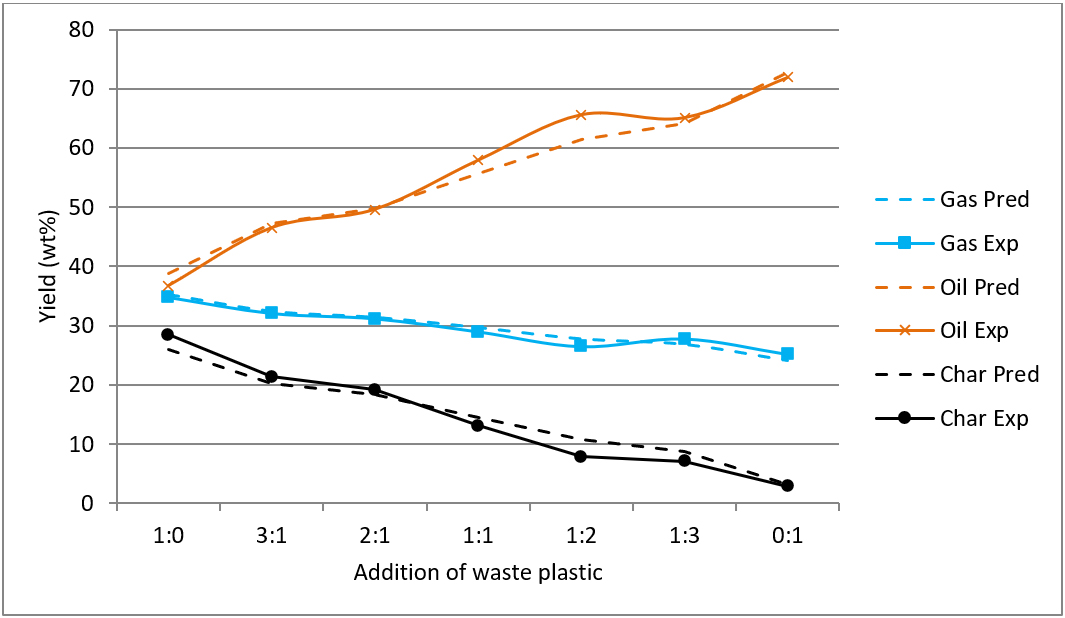
This investigation elucidates the co-pyrolysis of neem seed cake in combination with plastic waste across a spectrum of mass ratios namely, 0:1, 3:1, 2:1, 1:1, 1:2, 1:3, and 1:0 subjected to varying pyrolytic temperatures from 350°C to 650°C, employing a CuO catalyst as a facilitating agent. The research concentrated on elucidating the effect of reaction temperature and the blend ratio of neem seed cake to plastic waste on the distribution of products and the chemical composition of the resultant pyrolysis oil. The co-pyrolysis performed at a 1:2 ratio of neem seed cake to plastic waste yielded an optimal oil production of 69.4 wt% with maximum positive synergy of 6.25% at 500°C. The physicochemical characteristics of the resulting co-pyrolysis oil demonstrated a striking resemblance to those of conventional fossil diesel. Further analysis through FT-IR revealed the presence of a different range of aromatic components. Quantitative analysis utilizing chromatographic peak area evaluations was undertaken to elucidate the compositional profile of the pyrolysis oils, thereby accentuating the presence of synergistic effects. Furthermore, GC-MS analysis provided empirical validation of the interaction between neem seed cake and waste plastics during co-pyrolysis, as indicated by discernible decrease in the concentration of oxygenated compounds.
Key words
Biofuel; characterization; co-pyrolysis; mixed plastics; neem seed cake
 Thumbnail
 Thumbnail
 Thumbnail
 Thumbnail
 Thumbnail
 Thumbnail
 Thumbnail
 Thumbnail