 Avian malaria in birds from Atlantic Rainforest: a record of Plasmodium cathemerium and other novel lineages
Abstract
Parasitic diseases, like avian malaria, play a relevant impact on wild avifauna around the world, putting a threat to biodiversity, principally in endemic zones. For this research, we collected 171 blood samples from 21 wild bird species in different locations within Atlantic Rainforest, a global avian endemism center. These samples were analyzed using a morphological, molecular, and phylogenetic approach. Our findings reveal the presence of Plasmodium cathemerium, a widespread and pathogenic parasite species in bird hosts. Furthermore, we recovered another 4 new genetic lineages of avian malaria parasites, enriching knowledge about these haemosporidians in the Atlantic Rainforest and Brazil.
Key words
Brazil; vector-borne disease; blood parasites; avifauna; cytb; phylogeny
INTRODUCTION
Parasitic diseases play a relevant role in avifauna conservation, leading to the decline of host populations and posing a threat to global biodiversity, principally in endemic zones (Lapointe et al. 2012). These damages can often become irreversible, especially when associated with naive host species not adapted to the introduced parasitic diseases in the ecosystem (McClure et al. 2020, Miranda-Paez et al. 2022).
The Atlantic Rainforest is a global avian biodiversity hotspot with a high level of endemism (Myers et al. 2000). For this biome, approximately 23% of species are exclusive (Pacheco et al. 2021). Despite Atlantic Rainforest importance for maintenance of global biodiversity, the knowledge of some emerging diseases is poorly investigated, including avian malaria parasites (Braga et al. 2011, Clark et al. 2014, Fecchio et al. 2019).
Birds infected by avian malaria parasites, in more acute cases, show a great lethality potential (Atkinson Van Riper 1991). The presence of parasites can also threaten biodiversity, causing a decline in natural populations as it reduces both the survival and reproduction of their hosts (Altizer et al. 2001).
Recently, with climate changes, the impacts of avian malaria draw attention (Loiseau et al. 2013, Liao et al. 2017). Rising temperatures contribute to the rapid life cycle of vectors and disease transmission (Valkiunas 2005). In addition, habitat degradation and the introduction of new vector and parasite species put wild bird populations at imminent risk (Atkinson Lapointe 2009, Miranda-Paez et al. 2022).
Thus, we have chosen to investigate the diversity of avian malaria parasites in wild bird populations from Atlantic Rainforest by combining morphology, PCR, sequencing, and phylogenetic techniques.
MATERIAL AND METHODS
We sampled birds of the families Dendrocolaptidae, Furnariidae, Scleruridae, and Xenopidae (Supplementary Material - Table SI) in Atlantic Rainforest locations in southeastern Brazil (Table SII, Supplementary Material - Figure S1). The capture of birds occurred between March 2013 and December 2015 and was performed with mist nets. After capturing birds, they were photographed, and then the blood collection and release. Blood was collected after local cutaneous asepsis with 70°GL alcohol-soaked cotton through extravasation of the blood from the brachial vein with the sterile needle (13 x 4.5 mm). Blood was used immediately for the preparation of blood smears and was also collected in 1.5ml polypropylene microtubes for molecular analysis. Blood smears were fixed in methanol and already air dried and stained in Giemsa (1:9 in distilled water). Microtubes containing blood samples were stored at -20° C until DNA extraction. All procedures were approved by the Animal Use Ethics Committee of Universidade Federal de Juiz de Fora, under protocol number 042/2012.
For each blood sample, 100 fields were examined to investigate the presence of blood parasites. For morphological analysis, images of parasites were captured in blood smears using a camera (Olympus Evolt E-330) attached to the microscope. Parasite characters were measured as described in Valkiunas Iezhova (2018). The total DNA was extracted from 20 µL of blood from a positive bird sample in microscopic analyses using a Wizard® Genomic DNA Purification Kit (Promega®, São Paulo, Brazil) according to the manufacturer's recommendations. Samples were stored in triplicate at -20° C until molecular analysis.
Two nested PCR protocols were used to amplify the mitochondrial cytb gene of Plasmodium in microscopic positive samples, according to Merino et al. (2008). Ultra-pure water was used as a negative control. Plasmodium gallinaceum genomic DNA was extracted from cell culture and used as a positive control. PCR products were separated by 2% agarose gel electrophoresis, stained with Blue Green Loading Dye I (LGC Biotechnology, Cotia, São Paulo, Brazil), and visualized under ultraviolet light. Amplified products were purified using the QIAquick® Purification Kit (Qiagen®, São Paulo, Brazil), and submitted to bidirectional sequencing with HaemF/HaemR2, HML/HMR primers, on the 3130xL Genetic Analyzer Sequencer (Applied Biosystems®, Carlsbad, California) following the manufacturer's instructions.
The phylogenetic reconstructions were performed using a dataset containing five Plasmodium cytb gene sequences obtained in this study: SITGRI01 (Genbank accession PP158059), LEPSQU01 (PP158060), LOCNEM01 (PP158058), XYPFUS01 (PP158062), LEPANG03 (PP158061) and a dataset of all species sequences available from the MalAvi sequence database (Bensch et al. 2009) in June 2023. Leucocytozoon buteonis, Leucocytozoon fringillinarum, and Leucocytozoon quynzae were chosen as outgroup. The sequences were aligned in the MAFFT software (Katoh et al. 2017) with standard options and then visually inspected. The inference of Plasmodium phylogeny was conducted under a Maximum Likelihood (ML) analysis. The ML implemented in the RaxML program (Stamatakis 2014) using the GTR + GAMMA + I model with 4 gamma categories. Support values ??of clades were evaluated using the RaxML bootstrap self-convergence criterion with 549 pseudo-replicates.
RESULTS
In our results, the blood smears of 171 birds were analyzed under light microscopy, revealing the presence of Plasmodium parasites. Immature forms of trophozoites were the most abundant in blood smears. In the bird host species Lepidocolaptes angustirostris, it was possible to recover all evolutionary forms of the parasite Plasmodium cathemerium (Fig. 1): trophozoites (Fig. 1a-d), merontes (Fig. 1e-h), macrogametocytes (Fig. 1i-m), and microgametocytes (Fig. 1n-q). The forms are identified according to keys of Valkiunas Iezhova (2018) (Fig. 1): presenting the characteristics: “Size of fully grown gametocytes and erythrocytic meronts markedly exceed that of the nuclei of infected erythrocytes"; "Roundish or oval pigment granules predominate in gametocytes. Elongate rod-like in form pigment granules are absent, but single slightly elongate pigment granules might occur occasionally"; and "Rod-like pigment granules are common and might predominate in microgametocytes, but they are less common and often do not predominate in macrogametocytes.".

Plasmodium cathemerium (lineage LEPANG03) from the blood of Lepidocolaptes angustirostris: a-d – trofozoits; e-h – squizontes; i-m – macrogametocytes; n-q – microgametocytes. Giemsa-stained thin blood films. Scale bar = 10µm.
In addition to the characterization of P. cathemerium, another positive sample under optical microscopy was analyzed in PCR. From the 21 positive samples were recovered 5 new Plasmodium cytb gene sequences named according to MalAvi (Bensch et al. 2009) from the hosts: Sittasomus griseicapilus (SITGRI01), Lepidocolaptes squamatus (LEPSQU01), Lochmias nematura (LOCNEM01), Xyphocolaptes fuscus (XYPFUS01), and Lepidocolaptes angustirostris (LEPANG03).
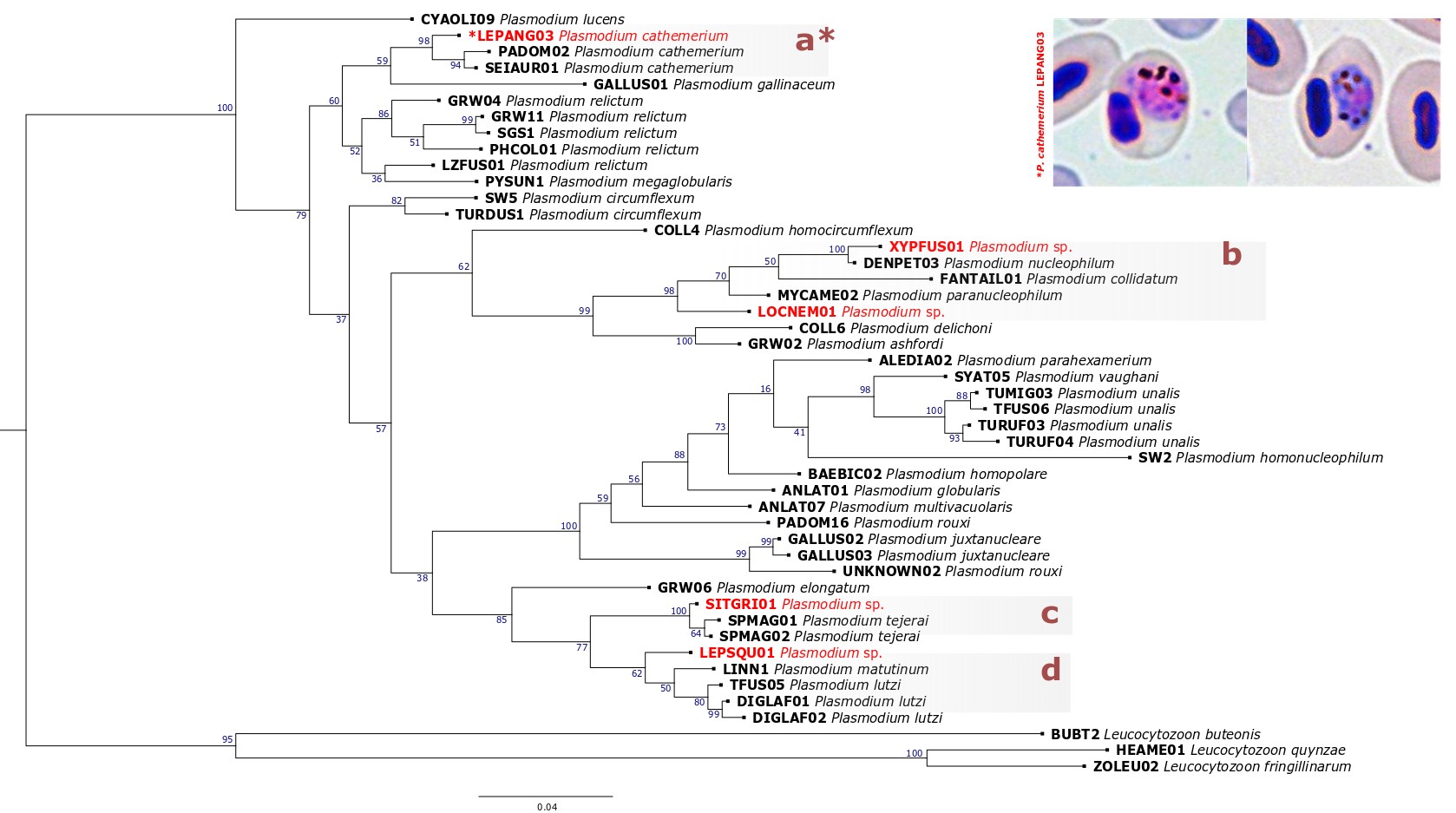
The phylogenetic reconstruction showed the grouping of the five new lineages obtained in this study with parasites of the genus Plasmodium (Fig. 2). The new lineages were grouped into four clades: the lineage LEPANG03 grouped with the species P. cathemerium with a high support value (98) (Fig. 2a); The lineage XYPFUS01 formed a sister group well supported with P. nucleophilum (100) (Fig. 2b); The lineage LOCNEM01 positioned an exterior group of the clade constituted by P. nucleophilum + P. paranucleophilum + P. collidatum + Lineage XYPFUS01 (98) (Fig. 2b); The lineage SITGRI01 was positioned with clade formed by P. tejerai with high support value (100) (Fig. 2c); and the lineage LEPSQU01 was grouped in a clade with species P. lutzi and P. matutinum (68) (Fig. 2d).

Plasmodium phylogeny inferred by maximum likelihood analysis (ML). The values ??colored in blue near the nodes represent the bootstrap values. The four Plasmodium clades (a, b, c and d) with new lineages are shaded in gray. The new lineages obtained in this study are marked with a red color. Bar represents 4 substitutions for positions of 100 nucleotides. The images depict gametocytes from the Plasmodium cathemerium lineage LEPANG03.
DISCUSSION
Currently, there are 55 valid species of Plasmodium based on morphological data (Valkiunas Iezhova 2018), and the MalAvi database contains more than 1,400 cytb gene lineages occurring in 1,500 avian host species around the globe. The cosmopolitan nature of this parasite is attributed to the unspecific relationship of Plasmodium with your hosts (Bensch et al. 2000, Fecchio et al. 2018). Dipteran vectors involved in the transmission of avian malaria are invertebrate hosts (Valkiunas 2005), with a notable emphasis on the species Culex, a global invasive vector with a significant history of causing damage to natural avifauna worldwide (Harvey-Samuel et al. 2021, Chalkowski et al. 2018).
The species P. cathemerium is identified by morphology in our study, a characterization corroborated by the position of the genetic lineage obtained from sample LEPANG03 in the phylogenetic reconstruction (Fig. 2a). Plasmodium cathemerium is a parasite species widely used in experimental studies over time, contributing greatly to the knowledge of avian and human malaria (Valkiunas 2005). Plasmodium cathemerium is a global widespread avian malaria agent, found in Passeriformes (Aly et al. 2020), Galliformes (Ishtiaq et al. 2007), and most other hosts (Valkiunas 2005). For South America, there are records of genetic lineages of P. cathemerium in Passeriformes in Colombia (Pulgarín-R et al. 2019), Ecuador (Cadena-Ortiz et al. 2019) and Argentina (Doussang et al. 2021). In Brazil, P. cathemerium had never been characterized through morphology data. Vanstreels et al. (2015) documented the occurrence of genetic lineage closely related to P. cathemerium in penguins (Spheniscus magellanicus), showing high pathogenicity in hosts during the rehabilitation process.
Investigating the occurrence and diversity of Plasmodium parasites in birds in endemic areas is crucial for understanding their ability to infect new hosts and spread avian malaria across time (Lapointe et al. 2012, Miranda-Paez et al. 2022). The occurrence of widespread Plasmodium species in Atlantic Rainforest hosts in this study emphasizes the significant colonization and distribution capacity of avian malaria. These findings raise questions about the true origin of these species: whether they are native, occurring naturally in Atlantic Rainforest, or if they are introduced, disseminated through natural movements such as bird migration or anthropic actions like the accidental introduction (Atkinson et al. 2009, Lapointe et al. 2012, McClure et al. 2020). The latter scenario raises concerns about the potential for more acute infections due to the non-adaptation of the native host's immune system, leading to substantial losses in avian populations, an increased risk of biodiversity loss (Atkinson et al. 2009, Miranda-Paez et al. 2022).
Despite the constant advance in understanding the diversity of Plasmodium species in birds, the understanding of the impact of avian malaria on wild birds, although important, is still incipient, with most knowledge about the pathology of the disease concentrated in domestic bird species (Valkiunas 2005). However, some data on wild birds have demonstrated that such pathogens can be devastating (Atkinson et al. 1995), and cases of population decline and extinction of bird species because of virulent parasite infections have already been reported, such as the classic case of the accidental introduction of Plasmodium into the Hawaiian Islands (Van Riper III et al. 1986). In this study, we recorded the presence of P. cathemerium, a species of parasite with wide geographic distribution and great pathogenic potential. Although no threatened bird species was sampled, the host species sampled can serve as a reservoir for pathogenic infections, deserving attention regarding the conservation of these bird populations. Furthermore, we recovered another 4 genetic lineages of avian malaria parasites, enriching knowledge about the diversity of these organisms in the Atlantic Rainforest and South America.
SUPPLEMENTARY MATERIAL
ACKNOWLEDGMENTS
This work was supported Fundação de Amparo à Pesquisa do Estado de Minas Gerais (FAPEMIG) (PPM2016, grant number PPM-00734-16) and Conselho Nacional de Desenvolvimento Científico e Tecnológico (CNPq). HAS and RJPD are recipients of CNPq productivity fellowships. The authors also express their appreciation to the Programa de Pós-Graduação em Biodiversidade e Conservação da Natureza at the UFJF for providing logistical support. All procedures were approved by the Ethics Committee at the Universidade Federal de Juiz de Fora (protocol number 042/2012) and the Biodiversity Authorization and Information System (SISBIO) (numbers 29268-3 and 29268-4).
REFERENCES
- ALTIZER S, FOUFOPOULOS J GAGER A. 2001. Conservation and diseases. Encyclopedia of Biodiversity. Academic Press, San Diego, 411 p.
-
ALY MZY, MOHAMED III, SEBAK SI, VANSTREELS RET EL GENDY AM. 2020. Morphological and molecular characterization of Plasmodium cathemerium (lineage PADOM02) from the sparrow Passer domesticus with complete sporogony in Culex pipiens complex. Parasitology 147: 1-9. https://doi.org/10.1017/S0031182020000566 .
» https://doi.org/10.1017/S0031182020000566 -
ATKINSON CT LAPOINTE DA. 2009. Introduced avian diseases, climate change, and the future of Hawaiian honeycreepers. J Avian Med Surg 23(1): 53-63. https://doi.org/10.1647/2008-059.1 .
» https://doi.org/10.1647/2008-059.1 -
ATKINSON CT, THOMAS NJ HUNTER DB. 2009. Parasitic Diseases of Wild Birds. John Wiley Sons, New Jersey, 598 p. https://doi/book/10.1002/9780813804620
» https://doi/book/10.1002/9780813804620 -
ATKINSON CT VAN RIPER C. 1991. Pathogenicity and epizootiology of avian haematozoa: Plasmodium, Leucocytozoon, and Haemoproteus. Bird-parasite. Interactions 1: 19-48. https://doi.org/10.1093/oso/9780198577386.003.0002 .
» https://doi.org/10.1093/oso/9780198577386.003.0002 -
ATKINSON CT, WOODS KL, DUSEK RJ, SILEO LS IKO WM. 1995. Wildlife disease and conservation in Hawaii: pathogenicity of avian malaria (Plasmodium relictum) in experimentally infected iiwi (Vestiaria coccinea). Parasitology 111: 59-69. https://doi.org/10.1017/S003118200007582X .
» https://doi.org/10.1017/S003118200007582X -
BRAGA EM, SILVEIRA P, BELO NO VALKIUNAS G. 2011. Recent advances in the study of avian malaria: an overview with an emphasis on the distribution of Plasmodium spp in Brazil. Mem Inst Oswaldo Cruz 106(1): 3-11. https://doi.org/10.1590/s0074-02762011000900002 .
» https://doi.org/10.1590/s0074-02762011000900002 -
BENSCH S, HELLGREN O PÉREZ-TRIS J. 2009. MalAvi: a public database of malaria parasites and related haemosporidians in avian hosts based on mitochondrial cytochrome b lineages. Mol Ecol Resour 9(5): 1353-1358. https://doi.org/10.1111/j.1755-0998.2009.02692.x .
» https://doi.org/10.1111/j.1755-0998.2009.02692.x -
BENSCH S, STJERNMAN M, HASSELQUIST D, OSTMAN O, HANSSON B, WESTERDAHL H PINHEIRO RT. 2000. Host specificity in avian blood parasites: a study of Plasmodium and Haemoproteus mitochondrial DNA amplified from birds. Proc Biol Sci 267: 1583-1589. https://doi.org/10.1098/rspb.2000.1181 .
» https://doi.org/10.1098/rspb.2000.1181 -
CADENA-ORTIZ H, MANTILLA JS, DE AGUILAR JR, FLORES D, BAHAMONDE D, MATTA NE BONACCORSO E. 2019. Avian haemosporidian infections in rufous-collared sparrows in an Andean dry forest: diversity and factors related to prevalence and parasitaemia. Parasitology 146(6): 765-773. https://doi.org/10.1017/S0031182018002081 .
» https://doi.org/10.1017/S0031182018002081 -
CHALKOWSKI K, LEPCZYK CA ZOHDY S. 2018. Parasite ecology of invasive species: conceptual framework and new hypotheses. Trends Parasitol 34: 655-663. https://doi.org/10.1016/j.pt.2018.05.008 .
» https://doi.org/10.1016/j.pt.2018.05.008 -
CLARK NJ, CLEGG SM LIMA MR. 2014. A review of global diversity in avian haemosporidians (Plasmodium and Haemoproteus: Haemosporida): New insights from molecular data. Int J Parasitol 44(5): 329-338. https://doi.org/10.1016/j.ijpara.2014.01.004 .
» https://doi.org/10.1016/j.ijpara.2014.01.004 -
DOUSSANG D, SALLABERRY-PINCHEIRA N, CABANNE GS, LIJTMAER DA, GONZÁLEZ-ACUÑA D VIANNA JA. 2021. Specialist versus generalist parasites: the interactions between host diversity, environment and geographic barriers in avian malaria. Int J Parasitol 51(11): 899-911. https://doi.org/10.1016/j.ijpara.2021.04.003 .
» https://doi.org/10.1016/j.ijpara.2021.04.003 -
FECCHIO A ET AL. 2019. Avian host composition, local speciation and dispersal drive the regional assembly of avian malaria parasites in South American birds. Mol Ecol 28: 2681-2693. https://doi.org/10.1111/mec.15094 .
» https://doi.org/10.1111/mec.15094 -
FECCHIO A, BELL JA, COLLINS MD, FARIAS IP, TRISOS CH, TOBIAS JA, TKACH VV, WECKSTEIN JD, RICKLEFS RE BATALHA-FILHO H. 2018. Diversification by host switching and dispersal shaped the diversity and distribution of avian malaria parasites in Amazonia. Oikos 127: 1233-1242. https://doi.org/10.1111/oik.05115 .
» https://doi.org/10.1111/oik.05115 -
HARVEY-SAMUEL T, ANT T, SUTTON J, NIEBUHR CN, ASIGAU S, PARKER P, SINKINS S ALPHEY L. 2021. Culex quinquefasciatus: status as a threat to island avifauna and options for genetic control. CABI Agric and Biosci 2: 1-21. https://doi.org/10.1186/s43170-021-00030-1 .
» https://doi.org/10.1186/s43170-021-00030-1 -
ISHTIAQ F, GERING E, RAPPOLE JH, RAHMANI AR, JHALA YV, DOVE CJ, MILENSKY C, OLSON SL, PEIRCE MA FLEISCHER RC. 2007. Prevalence and diversity of avian hematozoan parasites in Asia: a regional survey. J Wildl Dis 43: 382-398. http://doi.org/10.7589/0090-3558-43.3.382 .
» https://doi.org/10.7589/0090-3558-43.3.382 -
KATOH K, ROZEWICKI J YAMADA KD. 2017. MAFFT online service: multiple sequence alignment, interactive sequence choice and visualization. Brief Bioinform 108: 1160-1166. https://doi.org/10.1093/bib/bbx108 .
» https://doi.org/10.1093/bib/bbx108 -
LAPOINTE DA, ATKINSON CT SAMUEL MD. 2012. Ecology and conservation biology of avian malaria. Ann NY Acad Sci 1249: 211-226. https://doi.org/10.1111/j.1749-6632.2011.06431.x.
» https://doi.org/10.1111/j.1749-6632.2011.06431.x -
LIAO W, ATKINSON CT, LAPOINTE DA SAMUEL MD. 2017. Mitigating Future Avian Malaria Threats to Hawaiian Forest Birds from Climate Change. PLoS ONE 12(1): e0168880. https://doi.org/10.1371/journal.pone.0168880 .
» https://doi.org/10.1371/journal.pone.0168880 -
LOISEAU C, HARRIGAN RJ, BICHET C, JULLIARD R, GARNIER S, LENDVAI AZ, CHASTEL O SORCI G. 2013. Predictions of avian Plasmodium expansion under climate change. Sci Rep 3: 1126. https://doi.org/10.1038/srep01126 .
» https://doi.org/10.1038/srep01126 -
MCCLURE KM, FLEISCHER RC KILPATRICK AM. 2020. The role of native and introduced birds in transmission of avian malaria in Hawaii. Ecology Jul 101(7): e03038. https://doi.org/10.1002/ecy.3038 .
» https://doi.org/10.1002/ecy.3038 -
MERINO S, MORENO J, VÁSQUEZ RA, MARTÍNEZ J, SÁNCHEZ-MONSÁLVEZ I ESTADES CF. 2008. Haematozoa in forest birds from southern Chile: latitudinal gradients in prevalence and parasite lineage richness. Austral Ecol 33: 329-340. http://doi.org/10.1111/j.1442-9993.2008.01820.x .
» https://doi.org/10.1111/j.1442-9993.2008.01820.x -
MIRANDA-PAEZ AM, CHALKOWSKI K, ZOHDY S WILLOUGHBY JR. 2022. Management of avian malaria in populations of high conservation concern. Parasit. Vectors 15: 1-6. https://doi.org/10.1186/s13071-022-05327-2 .
» https://doi.org/10.1186/s13071-022-05327-2 -
MYERS N, MITTERMEIER RA, MITTERMEIER CG, KENT GAB FONSECA J. 2000. Biodiversity hotspots for conservation priorities. Nature 403: 853-858. http://doi.org/10.1038/35002501 .
» https://doi.org/10.1038/35002501 -
PACHECO JF ET AL. 2021. Annotated checklist of the birds of Brazil by the Brazilian Ornithological Records Committee-second edition. Ornith Res 29(2): 94-105. https://doi.org/10.1007/s43388-021-00058-x .
» https://doi.org/10.1007/s43388-021-00058-x -
PULGARÍN-R PC ET AL. 2019. Migratory birds as vehicles for parasite dispersal? Infection by avian haemosporidians over the year and throughout the range of a long-distance migrant. J Biogeogr 46: 83-96. https://doi.org/10.1111/jbi.13453 .
» https://doi.org/10.1111/jbi.13453 -
STAMATAKIS A. 2014. RAxML version 8: a tool for phylogenetic analysis and post-analysis of large phylogenies. Bioinformatics 30: 1312-1213. https://doi.org/10.1093/bioinformatics/btu033 .
» https://doi.org/10.1093/bioinformatics/btu033 - VALKIUNAS G. 2005. Avian Malaria Parasites and Other Haemosporidia, CRC Press, Florida, 946 p.
-
VALKIUNAS G IEZHOVA TA. 2018. Keys to the avian malaria parasites. Malar J 17: 1-24. https://doi.org/10.1186/s12936-018-2359-5 .
» https://doi.org/10.1186/s12936-018-2359-5 -
VAN RIPER III C, VAN RIPER SG, GOFF ML LAIRD M. 1986. The Epizootiology and Ecological Significance of Malaria in Hawaiian Land Birds. Ecol Monogr 56: 327-344. https://doi.org/10.2307/1942550 .
» https://doi.org/10.2307/1942550 -
VANSTREELS RET, DA SILVA-FILHO RP, KOLESNIKOVAS CKM, BHERING RCC, RUOPPOLO V, EPIPHANIO S, AMAKU M, FERREIRA-JUNIOR FC, BRAGA EM CATÃO-DIAS JL. 2015. Epidemiology and pathology of avian malaria in penguins undergoing rehabilitation in Brazil. Vet Res 46: 1-12. https://doi.org/10.1186/s13567-015-0160-9 .
» https://doi.org/10.1186/s13567-015-0160-9