 Are freshwater turtles macro-epibionts indicators of water quality of the streams where the turtles live?
Abstract
Organisms that live above others can give information not only about the relation between them but also about the environment they inhabit. In that sense, this work studies the relationship between epibionts living on freshwater turtles and the impact degree of streams where they live. We studied the macro-epibiont assemblages and algal and epipelic biofilm covers in two species of freshwater turtles with contrasting habits (the bottom-dwelling-aquatic basking <italic>Hydromedusa tectifera</italic> and the swimming-aerial basking <italic>Phrynops hilarii</italic>), from streams with different types and degrees of anthropogenic impact. Algal and epipelic biofilm covers and animal epibiont assemblages were, in most cases, greater in <italic>H. tectifera</italic> than in <italic>P. hilarii</italic>. In general, turtles from polluted streams had higher algal and epipelic biofilm covers and poorer epibiont assemblages with low abundance of sensible species. Our results also highlighted a key mutualistic relationship between <italic>H. tectifera</italic> and <italic>Temnocephala brevicornis</italic>,<italic> </italic>for which this turtle is the main host. We provide insights for using this biological unit to monitor water quality, particularly in low impacted streams where temnocephalans offer modulate responses, useful to early detection of pollution.
Key words
Hydromedusa tectifera; Phrynops hilarii; Temnocephala brevicornis; algal cover; pollution
INTRODUCTION
The rate of human population growing has a clear impact on worldwide ecosystems at all scales (Vitousek et al. 1997). Urbanization is a primary and relatively recent manifestation of human landscape alteration. It firstly has converted natural landscapes into agriculture fields and then into commercial, industrial and residential areas (Morello & Matteucci 2000, Mitchell & Jung Brown 2008). This transition generates changes in the abundance of certain species and local extinction of other ones (see urban avoiders, urban adapters, and urban exploiters species in: Blair 2001, McKinney 2006). Many recent studies focused on searching monitor organisms to be used for water quality assessments worldwide. Certain parameters allow the detection of patterns and processes currently affecting freshwater turtle populations and the ecosystems where they live (e.g., unbalanced vs. balanced age structure, high vs. low abundance, biased sex ratio; Reid & Peery 2014, Dupuis-Désormeaux et al. 2017, Bowne et al. 2018, Santoro et al. 2020, Čapkun-Huot et al. 2021). Turtle epibiont assemblages are composed of animal (macro and micro epibionts), bacteria, fungi, and vegetal (clorophytic filamentous algae) components (Richardson 1969, Ernst & Barbour 1972, Sawyer 1972, Hulse 1976, Chessman 1978, Dodd Jr 1988, Marques et al. 2008, Burgin & Betts 2012, Huckembeck & Quintela 2013). The species abundance and the spatial disposition of each epibiont type rest upon dissimilar features such as the habit of turtles (basking hypothesis: Boyer 1965, Ernst 1971, McAuliffe 1977, Dodd Jr 1988, Brooks et al. 1990), habitat preferences of each epibiont type (Ryan & Lambert 2005), interaction between different turtle species (cleaning symbiosis sensu Vogt (1979): Krawchuk et al. 1997), interaction between turtles and fish (Smith et al. 2021), and pollution (Dodd Jr 1988), among others.
The knowledge of animal macro-epibionts (henceforth: epibionts) and algae living on the two turtle species studied here is scarce for Hydromedusa tectifera Cope, 1870 (Huckembeck & Quintela 2013, Alcalde et al. 2021, Vetter et al. 2022) and null for Phrynops hilarii (Duméril & Bibron, 1835). The aim of the present work is to test if algal and epipelic covers and assemblages composition and species abundance of epibionts vary in relation to (i) the turtle mode of life (bottom-dwelling and aquatic basking vs. swimming and aerial basking) independently of age and gender of turtles, and (ii) the degree of water pollution where turtles live (not, low, or highly impacted). Due to the turtles habits, we expected that (i) algal and epipelic biofilm covers will be greater and animal epibiont assemblages will be more abundant and diverse in H. tectifera than in P. hilarii, and in relation to water pollution (ii) it will produce an increase on the algal and epipelic biofilm covers (as response of high nutrient loads) and composition and abundance of epibiont assemblages will be lower (due to the effect of water quality in sensitive species). We hope that our results may be used to construct an index based on freshwater turtles capable of monitoring water quality in early stages of contamination.
MATERIALS AND METHODS
Study area
Field work was conducted in a group of eight plain streams of Buenos Aires province, Argentina, where H. tectifera and P. hilarii live in syntopy (from north to south: Carnaval, Martin, Villa Elisa Channel, Rodriguez, Gato, Cajaravilla (part of the Pescado basin), Tubichamini and Buñirigo streams; Figure 1A) and three mountain streams only inhabited by H. tectifera (Sauce Grande, Buenos Aires province (Figure 1b), and Toro Muerto and Tanti, Córdoba province (Figure 1C)). Globally considered, mountain streams are not impacted, present hard bottom (granitic with loose rocks and gross sand), low turbidity and high slope (Menni 2004). Plain streams present the opposite conditions (clay bottom, high turbidity, and low or null slope) and a variable water quality (from very low to high polluted; Rodrigues Capítulo et al. 2004). In the plain streams of Buenos Aires province, the climate is temperate and humid, with an average annual rainfall of 89 mm and mean annual temperature of 16°C (range = 11-21°C). In the area of Sauce Grande, climate is drier and colder, mostly in winter (average annual rainfall = 63 mm, average annual temperature = 13.6°C (range = 7-21°C)), whereas in mountain streams of Córdoba province the average annual rainfall is 71 mm and mean annual temperature is 17°C (range = 11-24°C) (Database from National Meteorological Service, period 1991-2020; http://smn.gob.ar).

Location of sampling sites in Buenos Aires and Córdoba provinces (Argentina), (a) plain streams that mouth on the Río de La Plata River at northeastern Buenos Aires province (1= Carnaval; 2= Martin; 3= Villa Elisa Channel; 4= Rodriguez; 5= Gato; 6= Pescado (not a sampling site) ; 7= Cajaravilla (tributary of Pescado stream); 8= Tubichamini; 9= up-waters of Buñirigo (Buñirigo1); 10= down-waters of Buñirigo (Buñirigo2); (b) mountain stream that ends on the Atlantic Ocean at southern Buenos Aires province (11= Sauce Grande); and (c) endorheic mountain streams at northwestern Córdoba province (12= Tanti; 13= Toro Muerto). Dots and rectangles indicate sampling points and areas respectively.
Studied streams were ordered in three groups according to water quality and land use: (i) Not impacted (NI): includes the rural plain streams Cajaravilla, Tubichamini and up-waters of Buñirigo (Buñirigo1), which lack significant urban settlements, their channels are unaltered, present good water quality parameters and sensitive species, and land use is dominated by cattle grazing in natural and semi-natural pastures, with small areas of crops (Alvarez et al. 2020, Rodrigues Capítulo et al. 2020, Gómez et al. 2021), and the mountain streams Sauce Grande, Tanti and Toro Muerto, which cross natural and cattle grazing areas and small towns, and receive either no urban discharges or very low amounts (Daga et al. 2020, Zunino et al. 2022), (ii) Low impacted (LI): includes the urban plain streams Carnaval, Martin and Villa Elisa channel, which have horticulture and greenhouse floriculture in their up-waters, and mid-waters are moderately urbanized and receive sewage water discharges from housing and, in the case of the Martin stream, also from a pharmaceutical plant, which generates a bad water quality and dominance of tolerant species (Sierra et al. 2013, Mac Loughlin et al. 2017, 2022, Sansiñena et al. 2018, Gómez et al. 2021), and down-waters of the rural plain Buñirigo stream (Buñirgo2) which receives effluents from food and tannery plants, contributing with a high nutrient load (Mercado 2000, Bauer et al. 2002), and (iii) Highly impacted (HI): includes two urban plain streams (Rodriguez and Gato) with horticulture and greenhouse floriculture in up-waters, and highly urbanized mid-section where they receive domestic and industrial discharges, present high nutrient loads, heavy metal concentrations and fecal contamination, and bad biotic indicators (Mercado 2000, Ronco et al. 2001, 2007, Bauer et al. 2002, Remes Lenicov et al. 2005, López Van Oosterom et al. 2015, Rimoldi et al. 2018, Paracampo et al. 2020, Gómez et al. 2021). Regardless of their impact degree, all studied urban streams suffer periodic channel cleanings (macrophyte removal, grass cutting), major interventions in some sections (profiling, dredging, concrete coating, channelization), and high presence of solid trash (bottles, plastic bags, vehicle parts).
Field methods and turtle trapping
Turtles were caught using a combination of methods (muddling and visual detection (Bury et al. 2012), double funnel traps and trot lines without hooks (Semeñiuk et al. 2017)), mainly on warmest months (early spring to early autumn and a few samplings on winter) between 2016 and 2021. Turtles were straight carapace length (SCL) measured and sexed according to dimorphic features. Juvenile individuals of H. tectifera (<100 mm) and P. hilarii (<210 mm) that lack dimorphic features were sexed by penile eversion (Rodrigues et al. 2014). Turtles were marked on the marginal plates of their carapaces using the method proposed by Cagle (1939). Recaptured individuals were not considered in the study.
Epibionts collection
Animal epibionts were removed immediately after capture and stored in separate containers using Ethanol 70% for their conservation. Individuals with high temnocephalan loads were sampled using a ring of 1.8 cm2, from which all temnocephalans were removed, stored and carried to laboratory for counting. These counts obtained from a known area were extrapolated to the total surface of the turtle occupied by temnocephalans through the analysis of scaled photographs using software Image J.
Algal and epipelic biofilm covers
The algal cover index (ACI) was calculated at the time of capture by adding the cover score of each epidermal plate (0 = no algae, 1 = algae present and short, and 2 = algae present and long forming clear filaments). Thus, the ACI could range from zero (no algae present) to 76 (long algae present in all plates) for the dorsal carapace of both species, and from zero to 26 for the ventral carapace of both species (values for both faces of the carapace together may range from zero to 102). An epipelic biofilm cover index (ECI) was also calculated in field following the same procedure as for the ACI (no samples of algae or epipelic biofilm were collected).
Substrate samples and physico-chemical parameters of aquatic environments
Substrate sampling was conducted from 2020 to 2021 in five selected streams: Tubichamini, Buñirigo1 and Sauce Grande (NI), Carnaval (LI) and Rodriguez (HI). Three samples of various hard substrates (e.g., rocks, woods, glass bottles, bricks, depending on availability) were collected seasonally (except winter season) from each stream, totaling 18 substrates samples per stream. Animals were removed from the substrates in field and preserved in the same manner as turtle epibiont samples for subsequent observation in laboratory. The animal assemblage composition of organisms living over substrates were compared with turtle epibiont assemblages.
Some water parameters (pH, conductivity, dissolved oxygen, and water temperature) were measured using a data logger (Lutron® WA-2015) each time we visited the streams, in order to achieve a general characterization of the study sites (Table I).
Physico-chemical parameters measured in the studied streams, including pH, dissolved oxygen (DO- mg/l) and conductivity (S/m), arranged by impact level. Data are shown as mean ± standard deviation.
Laboratory work and data analysis
Epibionts and organisms from substrate samples were taxonomically identified (class, order, family and, when possible, genera and species). Crustaceans and mollusks were identified to genera or species by the curators of the Carcinological and Mollusk Collection of the Museo de La Plata (MLP), where the specimens are housed (MLP-Cr 27172 and MLP-M 16334-16337). Hirudineans are deposited in the Invertebrate Collection of the MLP (OI 4445-4455). Temnocephalans (adults and eggs- free life nematodes were intermingled among the eggs) are housed in the Helminthological Collection of the MLP (MLP-He 8117-8125). Substrate samples and insects were not deposited in any collection. Some minority samples (aquatic oligochaetes and planarians) dried out before being deposited in the corresponding collections and were therefore lost. To date, three species of temnocephalans have been identified for South American freshwater turtles (Martínez-Aquino et al. 2014, Mascarenhas et al. 2018). One of them (Temnocephala brevicornis Monticelli, 1889) was the only species identified for turtles of Argentina, including the two species studied here (Brusa & Damborenea 2000, Martínez-Aquino et al. 2014), and even from some of the streams studied here (Carnaval and Tubichamini). Nonetheless, 10 adult specimens of each stream were in toto prepared following the protocol used by Brusa & Damborenea (2000) and identified according to features of the penial stylet (Volonterio 2010). Each taxonomic group was counted and volumetrically measured using the water displacement method (Archimedes principle). This information was employed to calculate the variables for the Relative Importance Index (Pinkas et al. 1971): RII = %OF * (%VF + %NF), where %OF = percent occurrence frequency, %VF = percent volumetric frequency, and %NF = percent numeric frequency. Some taxonomic groups were pooled for the RII calculation in cases of numerically underrepresented similar groups. The highest value of RII was used to rank the remaining values, considering the following categories: Accidental (0-25%), Accessory (25.1-50%), Secondary (50.1-75%), and Fundamental (75.1-100%).
Numerosity of temnocephalans was statistically compared among streams employing ANOVA, considering only the turtles that carried temnocephalans. Post-hoc analyses were performed using Scheffe test for samples with different degrees of freedom. Temnocephalan prevalence was compared among streams and between genders of turtles with one-tailed Z-test. ACI and ECI values were statistically compared among streams using the non-parametric Kruskal-Wallis test, with post-hoc Dunn test. Non-parametric Spearman-Rank correlations were made between the SCL of both turtle species and the ACI and ECI values considering all streams globally.
Analysis and graphs were made using the software Statistica 8.0 (StatSoft 2007) and SigmaPlot 10.0 (Systat Software 2006).
RESULTS
We caught a total of 601 turtles distributed almost equitably between species: 325 H. tectifera and 276 P. hilarii, with global numbers favoring males over females and few juveniles (Table II). Most captures of both species occurred in spring and summer with a few during winter and autumn. The SCL of both species was equitable among populations but, in some cases, values differed significantly, particularly in H. tectifera (Table III).
Mann-Whitney pairwise comparisons of mean SCL (rounded value in mm) of P. hilarii (Ph: first column) and H. tectifera (Ht: first file). Inter-stream comparisons within each species are in cells above (Ht) and below (Ph) the diagonal. CR: Carnaval stream; M: Martin stream; VC: Villa Elisa channel; R: Rodriguez stream; G: Gato stream; CJ: Cajaravilla stream; TU: Tubichamini stream; B1: up-waters of Buñirigo stream; B2: down-waters of Buñirigo stream; SG: Sauce Grande River; TA: Tanti stream; TM: Toro Muerto stream (in order of appearance in the table).
Number of captures of both turtle species (Sp.), H. tectifera (Ht) and P. hilarii (Ph), in each studied stream by gender (J: juveniles) and season, and corresponding mean straight carapace length values (SCL, in mm). CR: Carnaval stream; M: Martin stream; VC: Villa Elisa channel; R: Rodriguez stream; G: Gato stream; CJ: Cajaravilla stream; TU: Tubichamini stream; B1: up-waters of Buñirigo stream; B2: down-waters of Buñirigo stream; SG: Sauce Grande River; TA: Tanti stream; TM: Toro Muerto stream (in order of appearance in the table).
Algal and epipelic biofilm covers
Not Impacted streams
Globally, the dorsal algal cover of P. hilarii took a wide range (ACI = 1-76, n = 34), with the highest values corresponding to turtles from Cajaravilla stream, whilst the ACI for the ventral carapace varied between 1 and 56 (n = 12) and was present only in turtles from Tubichamini and Buñirigo2 streams. The epipelic biofilm cover of this species was detected only in ventral carapaces of samples from Tubichamini stream, and it ranged between 3 and 44 (n = 16). Individuals of H. tectifera presented dorsal algal cover in all the streams where the species was present (ACI = 2-76, n = 70), whereas ventral cover took extremely low values in a few individuals (ACI-Tubichamini = 4, n = 1; ACI-Sauce Grande = 3, n= 1).
Low Impacted streams
ACI in P. hilarii had values between 2 and 64 for dorsal carapace (n = 18), and 2-15 for ventral carapace (n = 2), whilst ventral ECI values ranged from 2 to 14 (n = 13). Ventral ACI and ECI were only present in turtles of Buñirigo2 stream. In H. tectifera, dorsal values of ACI had a wider range (4-76, n = 49), and ventral values were between 3 and 16 (n = 2, only present in Buñirigo2 stream). Epipelic biofilm was observed only in turtles of Martin stream (ECI dorsal = 18-29, n = 6; ECI ventral = 2-18, n = 10).
Highly Impacted streams
In P. hilarii, algal cover on dorsal carapace (ACI= 4-27, n= 15) and ventral epipelic biofilm (ECI = 2-20, n = 13) were present in turtles of both streams of this category, whereas ventral ACI (4-8, n = 3) was present only in Gato stream. On the other hand, in H. tectifera dorsal ACI ranged from 2 to 76 (n = 54) with no turtles with ventral algal cover, and ECI values were between 1 and 30 (n = 26) for ventral carapace and between 14 and 66 (n = 14) for dorsal carapace (the last only present in Rodriguez stream).
Global analysis of algae and epipelic biofilm covers
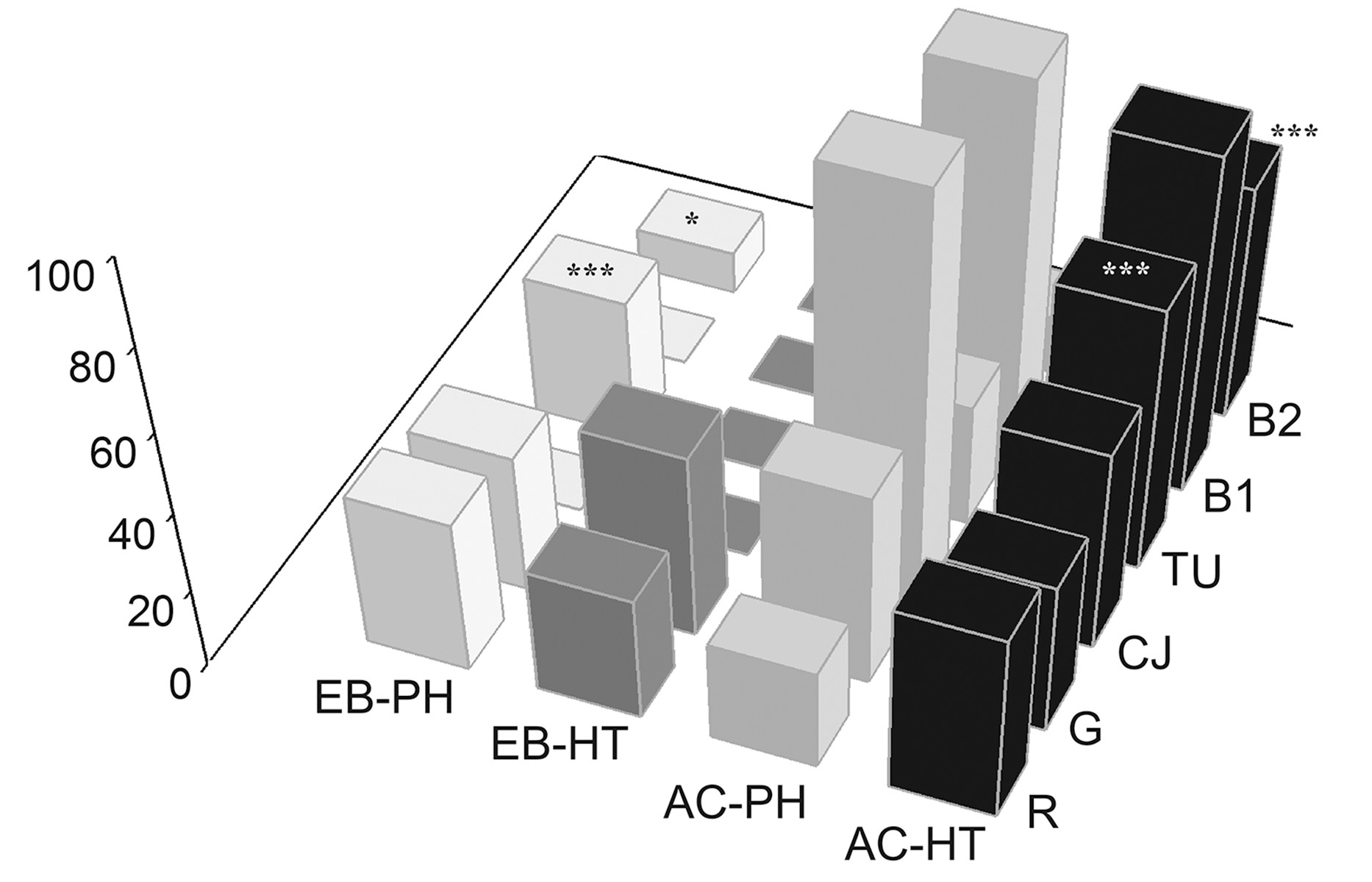
The proportion of turtles with algal cover in their carapace was significantly higher in H. tectifera than in P. hilarii (p < 0.0001) from Tubichamini and Buñirigo2 streams. Although not significant, we also verified this tendency in turtles from Rodriguez stream, whilst for those from Gato, Cajaravilla and Buñirigo1 streams the tendency behaved conversely (P. hilarii > H. tectifera, Figure 2). The proportion of turtles bearing epipelic biofilm was significantly higher in P. hilarii than in H. tectifera (p < 0.0001) from the Tubichamini and Buñirigo2 streams. Although not significant, other streams (Gato, Rodriguez) verified an inverse tendency (H. tectifera > P. hilarii). The epipelic biofilm was absent in both species from Cajaravilla and Buñirigo1 streams (Figure 2).

Percentage of global algal cover (AC) and global epipelic biofilm cover (EB) in stream populations where P. hilarii (PH) and H. tectifera (HT) cohabit. Asterisks indicate statistical significance (*p < 0.05, *** p < 0.001). B1= up-waters of Buñirigo stream; B2= down-waters of Buñirigo stream; CJ= Cajaravilla stream; G= Gato stream; R= Rodriguez stream; TU= Tubichamini stream.
Globally, Kruskal-Wallis comparisons of ACI values for both species from all streams yielded significant differences (H17 = 146.84, n = 600, p < 0.000). The ACI of P. hilarii was highly significantly different (p < 0.001) on the following streams: Cajaravilla > Buñirigo2 and Tubichamini; Buñirigo1 > Buñirigo2, Gato and Tubichamini (Figure 3a). These differences should be interpreted with caution because there is a marked negative correlation between the SCL of P. hilarii and the ACI values (small turtles usually have high index values: R = -0.45, n = 121, p < 0.000000). In fact, the streams where P. hilarii presented the highest ACI values were those on which the mean SCL was significantly smaller: Tubichamini and Buñirgo1 < Buñirigo2, Gato and Rodriguez. Cajaravilla stream showed the same tendency although not significant due to low degrees of freedom (n = 4) (Table III). The ACI of H. tectifera varied significantly in a single case: Tubichamini (NI) > Rodriguez (HI) (p < 0.03) (Figure 3b). In contrast to P. hilarii, there was no significant correlation between the SCL of H. tectifera and ACI values (R = -0.0, n = 171, p = 0.86). The intra-stream comparison of ACI values between H. tectifera and P. hilarii was significant in Buñirigo2 (p < 0.00002) and Tubichamini (p < 0.00005) streams, being higher in the former species in both cases.
Mean values (central squares), 95% confidence intervals (rectangles), and minimum and maximum values (whiskers) of the algal cover index and epipelic biofilm cover index for (a) P. hilarii and (b) H. tectifera. Left and central groups in each panel show algal cover index values by individual stream and grouped by impact degree, respectively, and right group shows epipelic biofilm cover index values by stream. B1= up-waters of Buñirigo stream; B2= down-waters of Buñirigo stream; CJ= Cajaravilla stream; CR= Carnaval stream; G= Gato stream; M= Martin stream; R= Rodriguez stream; SG= Sauce Grande River; TA= Tanti stream; TM= Toro Muerto stream; TU= Tubichamini stream; VC; Villa Elisa channel. Stream group categories: NI= not impacted streams; LI= low impacted streams; HI= highly impacted streams; MS= mountain streams.
The ECI showed no significant differences (H17 = 87.95, n = 600, p = 0.3), neither among different populations of each species nor between H. tectifera and P. hilarii within the same stream (Figure 3a,b). There was no correlation between the SCL of P. hilarii and ECI values (R = -0.05, n = 26, p < 0.78), whereas a significant negative correlation was found in H. tectifera (the index took low values in large turtles: R = -0.37, n = 48, p < 0.009) (Table III).
Epibionts
Not impacted streams
A total of 23 epibiont types were detected in the turtle and substrate samples from not impacted streams. Eight of them were present exclusively in substrate samples, five only on turtles, and the remaining types were shared between both sample types (Table IV).
Relative importance index (RII) results obtained for H. tectifera (Ht), P. hilarii (Ph) and substrate (S) samples in the studied streams. CJ: Cajaravilla stream; TU= Tubichamini; B1: up-waters of Buñirigo stream; SG: Sauce Grande River; TA: Tanti stream; TM: Toro Muerto stream; CR: Carnaval stream; M: Martin stream; VC: Villa Elisa channel; B2: down-waters of Buñirigo stream; R: Rodriguez stream; G: Gato stream (in order of appearance in the table).
Temnocephalans (Temnocephala brevicornis) were the only epibiont present on turtles but absent in substrate samples that RII ranked as Fundamental (in all plain streams for H. tectifera and in a single stream for P. hilarii) (Table IV). In general, the assemblage composition of epibionts was less diverse in P. hilarii (four types) than in H. tectifera (12 types in plain streams /5 types in mountain streams).
Low impacted streams
We recorded 16 epibiont types in samples from these streams, almost all associated with H. tectifera, while the single P. hilarii individual captured had only temnocephalans eggs (T. brevicornis) (Table IV). Seven of the 16 epibiont types were found exclusively on turtles, five only in substrate samples, and the remaining types were present in both sample types. As in not impacted streams, Temnocephala brevicornis was the unique epibiont type present in turtles but absent from substrate samples that RII ranked as Fundamental (Table IV).
Highly impacted streams
Epibionts were present only in H. tectifera, in all cases with a poor assemblage composition. These streams presented 18 epibiont types, six of which were exclusively present in substrate samples, four only in turtle samples, and eight in both sample types. In contrast to the other streams, the four epibiont types that were present only in turtles were ranked as Accidental or Accessory by RII. Leeches were the unique epibiont type present in turtles from Gato stream. Larvae of midge family Chironomidae were ranked as Fundamental in both sample types (turtles/substrate) from Rodriguez stream (Table IV).
Temnocephalan egg numerosity and egg-adult prevalence
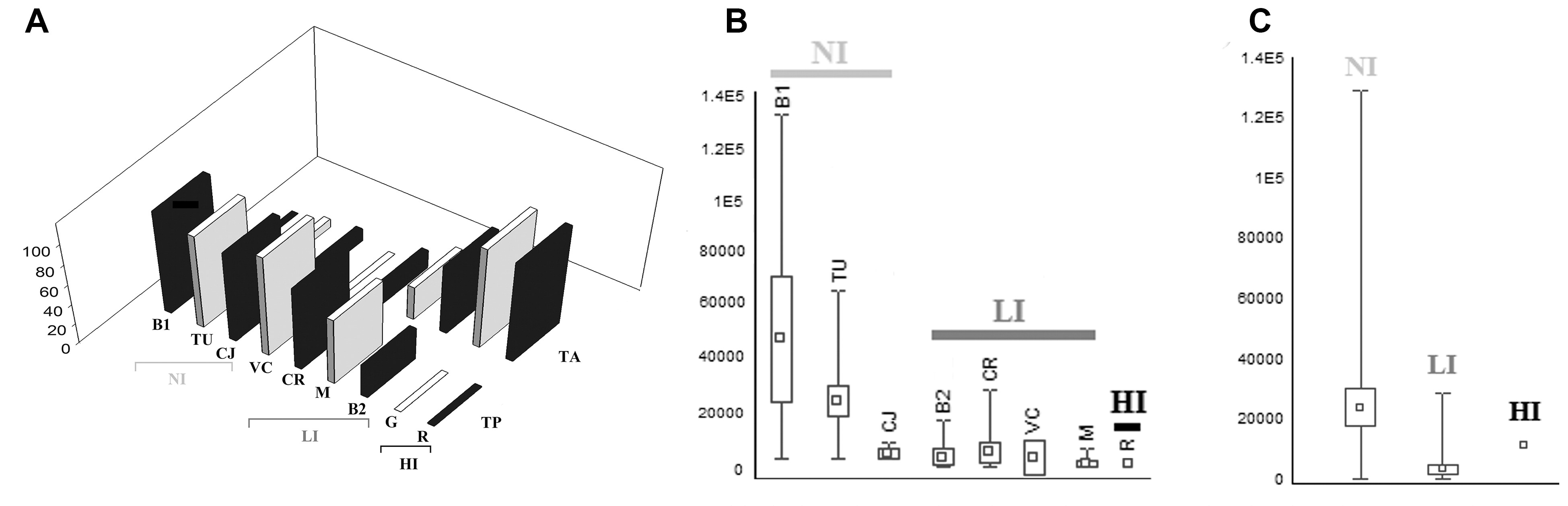
Turtles from mountain streams and from highly impacted plain streams lacked temnocephalans (except for one individual from Rodriguez stream caught at the stream mouth on the Rio de la Plata River, which was excluded from the analysis due to the almost null prevalence in this stream, see Discussion). Although occasionally present, temnocephalans were very uncommon in P. hilarii, being found only in a few individuals from two NI plain streams (Cajaravilla and Buñirigo1). In contrast, temnocephalans were consistently present with high abundance in H. tectifera from all NI and LI streams (Figure 4a, Table V). The prevalence of temnocephalans was not associated to the gender of P. hilarii on the single stream from which it was possible to make such comparison (Buñirigo1). Gender-related differences on global temnocephalan prevalence (eggs + adults) were detected in H. tectifera from Carnaval (p < 0.03) and Buñirigo2 (p = 0.005) streams, whit higher prevalence in males than in females (Table V). In the two cases where comparison between both species was possible, the overall prevalence of temnocephalans significantly favored either H. tectifera (Buñirigo1 stream: p < 0.0000) or P. hilarii (Cajaravilla stream: p < 0.02).
Prevalence (P), mean abundance (MA) and standard deviation (SD) of adults, eggs and both life stages of temnocephalans for each gender of P. hilarii (Ph) and H. tectifera (Ht) from streams they live in sintopy (CR: Carnaval; M: Martin; VC: Villa Elisa channel; CJ: Cajaravilla; TU: Tubichamini; B1: up-waters of Buñirigo stream; B2: down-waters of Buñirigo stream; as they appear in the table). MA and SD were calculated based only on turtles bearing temnocephalans and excluding individuals that did not carry them.

(a) Percentage of individuals of H. tectifera from plain streams with (TP) and without (TA) temnocephalans (eggs, adults, or both), organized by stream impact degree, (b) and (c) mean values (central squares), 95% confidence intervals (rectangles), and minimum and maximum values (whiskers) of temnocephalan egg numerosity for each H. tectifera population from individual plain stream (b) and from streams grouped by impact degree (c). B1= up-waters of Buñirigo stream, B2= down-waters of Buñirigo stream, CJ= Cajaravilla stream, CR= Carnaval stream, G= Gato stream, M= Martin stream, R= Rodriguez stream, TU= Tubichamini stream, VC= Villa Elisa Channel. Impact categories: NI= not impacted streams, LI= low impacted streams, HI= high impacted streams.
The one-way ANOVA detected highly marked significant differences (F1,110 = 13.814, p < 0.000000) on temnocephalan egg numerosity among populations of H. tectifera between low impacted and not impacted plain streams. The Scheffe post-hoc comparisons highlighted a significantly higher temnocephalan egg numerosity in not impacted (Tubichamini and Buñirigo1) than in low impacted streams (Carnaval, Martin, Villa Elisa Channel and Buñirigo2) (p-values < 0.002 to p-values < 0.000003, Figure 4b,c). The single exception was the not impacted Cajaravilla stream for which comparisons were little significant (p < 0.04).
DISCUSSION
The present work provides baseline data on the epibionts that live in two freshwater turtle species with contrasting modes of life, and from streams with varying degrees of impact. We found that (i) both algal and epipelic biofilm covers were generally greater, and the animal epibiont assemblages were in all cases more diverse in the bottom dwelling-aquatic basking H. tectifera than in the swimming-aerial basking P. hilarii, and (ii) turtles from polluted streams in most cases had higher covers of algal and epipelic biofilm, and less diverse epibiont assemblages with low abundance of sensible species (only valid for H. tectifera). The next paragraphs will deeply discuss the topics related to these assertions.
The algal cover in freshwater turtles is usually composed of chlorophytic filamentous algae and, to a lesser extent, by cyanobacterium filamentous colonies (Garbary et al. 2007) and other minority algal groups. The turtles studied here presented their carapace ventral and dorsal covered by colonies of filamentous chlorophytic algae. The highest ACI values were found in the bottom-dwelling aquatic basking H. tectifera, whereas the ACI values of the swimming-aerial basking P. hilarii were related to turtle size (e.g., small turtles usually had higher values). We interpret this as indicative of a size-related plasticity in the mode of sun exposure (see Semeñiuk & Alcalde 2017), a relationship consistent with findings of Garbary et al. (2007) for turtles from Canada, but contrary to evidence reported by Guevara et al. (2022) for the semi-aquatic turtle genus Terrapene. Thus, algal prevalence and cover and composition of epibiont assemblages should be cautiously interpreted considering size, gender, and microhabitat use of turtles. Clearly, interpretations should necessarily be species specific and population specific. Regardless of these considerations and sometimes contradictory information, a recent study proposed assessing water quality by using a Biological Diatom Index (BDI) based on epizoic diatom that live on turtle carapaces (Vassal et al. 2020). Regarding to the epipelic biofilms we found on the turtles studied here, these are a biologic complex composed of algae, fungi, bacteria, and micro-invertebrates embedded in a polysaccharide matrix that usually develops on fine sediments (silt and clay) of freshwater aquatic ecosystems worldwide (Gómez et al. 2009). These authors demonstrated a high load of filamentous bacteria in biofilms from stream sections with low or null dissolved oxygen down-waters of industry pollutant discharges. As far as we know, epipelic biofilm cover has been reported for marine turtles (Majewska et al. 2017) but not for freshwater turtles until now. We detected the presence of epipelic biofilms on the carapaces of H. tectifera and P. hilarii from streams with no, low and high impact. The epipelic biofilm cover was present in both species only in HI streams (Rodriguez and Gato), whereas in LI and NI streams the cover restricted only to P. hilarii. Turtles of both species from HI streams did not differ significantly in their mean ECI values and in the proportion of turtles bearing epipelic cover. However, there was a tendency to higher mean ECI values favoring H. tectifera in both HI streams, and to a great proportion of turtles with epilelic cover in P. hilarii from Rodriguez stream and in H. tectifera from Gato stream. These results, although contradictory and not conclusive, leave an open door to study the significance of the epipelic biofilm cover in freshwater turtles.
As suspected, the epibiont assemblages were more diverse in H. tectifera than in P. hilarii in all studied streams and, particularly for H. tectifera, the assemblage composition and the abundance of sensible species decreased significantly from NI to HI streams. In that sense, temnocephalans that live on turtles appear as a key taxon to be used for water quality assessments (see paragraphs below). A fairly recent review on the host association of diverse species of Temnocephala Blanchard, 1849 (Martínez-Aquino et al. 2014) recognized the following turtles as host: Temnocephala sp. (Acanthochelys spixii (Duméril & Bibron, 1835), Hydromedusa maximiliani (Mikan, 1825), H. tectifera, and Mesoclemmys gibba (Schweigger 1812) from Brazil), T. coucoloi Volonterio, 2010 and T. pereirai Volonterio 2010 (H. tectifera from Uruguay), and T. brevicornis (A. spixii and H. maximiliani from Brazil; Phrynops hilarii from Argentina; H. tectifera from Argentina, Brazil, and Uruguay). Out of Chelidae, the Brazilian emydid Trachemys dorbigni (Duméril & Bibron, 1835) was reported housing T. pereirai (Seixas et al. 2014, Mascarenhas et al. 2018) and T. brevicornis (Ferreira Yuki et al. 1993). Two issues merit to be highlighted about the relationship between temnocephalans and turtles: (i) species of genus Acanthochelys Gray, 1873 and Hydromedusa Wagler, 1830 have aquatic-basking and bottom-dwelling habits whilst M. gibba, P. hilarii, and T. dorbigni display aerial-basking and swimming habits, and (ii) localities reporting temnocephalans in turtles correspond to the Pampa region from Uruguay, southern Brazil, and eastern Argentina, except for few records. Noreña et al. (2004) listed the main ecological features of microturbelareans (including temnocephalans): (i) they act as top predators upon other small organisms (see Mascarenhas et al. 2018 for a detailed prey list), (ii) are highly ubiquitous (present in almost all freshwater environments) and markedly specific in choosing the substrate where they live, and (iii) have an extreme sensitivity to water parameters preferring high dissolved oxygen, acidic pH, low conductivity and not extreme temperatures, with certain species capable to tolerate little gradual changes but not during enough time. These ecological preferences of microturbelareans seem to explain their absence on turtles from highly polluted plain streams (low dissolved oxygen) and from mountain streams (high conductivity and markedly cold winter temperatures, although biogeographical explanations cannot be ruled out). The single exception was the H. tectifera individual captured at the mouth of the HI Rodriguez stream that had temnocephalan eggs and was excluded from the analysis. In this case, the presence of temnocephalans was due to improved water quality caused by the tides of the Rio de la Plata River, which did not represent the poor water quality characteristic of up- and mid- waters. The exclusion of temnocephalans from urban impacted populations of T. dorbigni was reported by Mascarenhas et al. (2018). They found 2401 adult temnocephalans in 15 of 28 turtles (53.6%) from a rural area, while there were no themnocephalans in turtles from urban streams. In the NI streams studied here, we obtained between 2656 (Cajaravilla stream, 7 of 8 turtles) and 200055 adults (Tubichamini stream, 38 of 48 turtles; raw data). In the same work, Mascarenhas et al. (2018) detected a higher temnocephalan abundance in males than in females and suggested that differences in the reproductive behavior are the key explanation (females practice frequent land excursions during the reproductive season). We think that a similar reasoning used by Mascarenhas et al (2018) to explain gender differences on T. dorbigni may be used here to explain the difference on temnocephalan abundance and prevalence between P. hilarii and H. tectifera in the NI streams where both cohabite. Both parameters were significantly lower in P. hilarii than in H. tectifera. Variations in these parameters among populations of P. hilarii seem to be related to the turtle size and the low frequency of sun exposure in small turtles (see Semeñiuk & Alcalde 2017 for the basking habits of the species). A similar situation was reported by Brooks et al. (1990) for leeches in North American turtles. In fact, changes in the frequency of sun exposure seem to modulate the load of epibionts in turtles (see Dodd Jr 1988). We think that the not clear gender-related differences of temnocephalan prevalence and abundance on H. tectifera may be explained by the marked aquatic habit of this turtle (Alcalde et al. 2021) but, even more important, by the fact that the females of this species construct their nests very close to water (from 2 to 22 m from shoreline, whereas P. hilarii and T. dorbigni move around 80 m to 86 m from water, respectively; Bager & Rosado 2010, López et al. 2013).
Clearly, the mode of life of the studied turtles (and of the T. dorbigni populations studied by Mascarenhas et al. 2018) explains the difference in prevalence and abundance of temnocephalans: low prevalence and low abundance may be explained by the basking hypothesis (Boyer 1965), the cleaning hypothesis (Vogt 1979, in the case of the swimming P. hilarii that exposes temnocephalans to predation by fish), or both combined, since H. tectifera has the opposite habits and presents great prevalence and high abundance of temnocephalans in healthy environments. These facts position H. tectifera as a key turtle (main host) for temnocephalans, being P. hilarii (and even T. dorbigni) alternative or secondary hosts. The strong and consistent relationship between H. tectifera and T. brevicornis, the wide distribution of both species (Martínez-Aquino et al. 2014, Sánchez et al. 2019), and the sensibility of temnocephalans to certain water parameters (Noreña et al. 2004) support the consideration of both species as a biological unit for environmental monitoring of water quality in streams and rivers from the Pampa region. This biological unit behaves drastically in response to a marked deterioration of water parameters (temnocephalans were absent on turtles from HI streams and presented high abundance and great prevalence in NI streams). Interestingly, it also offers a modulate response on the grey area of LI streams, where temnocephalans showed abundance and prevalence values that adjust quite to what was expected according to the condition of each stream.
Huckembeck & Quintela (2013) hypothesized a strong negative impact of temnocephalans on H. tectifera based on a single observation. These authors proposed that temnocephalans can damage the skin of the turtle at the attachment site, causing its disease. Our point of view is close but distinct from the authors who consider the relationship between T. brevicornis and H. tectifera as a case of symbiosis (Brusa & Damborenea 2000, Soares et al. 2007). We believe that mutualism would be the appropriate term: data indicated that H. tectifera is the best but not the exclusive host for T. brevicornis, since it can also inhabit alternative turtles (P. hilarii, T. dorbigni) that share habitat with H. tectifera. In addition, we also think that individuals of H. tectifera wearing temnocephalans benefit from them due to (i) removal of bacteria and other microorganisms from the skin and carapace, (ii) improvement of turtle camouflage in combination with the algal and epipelic covers, and (iii) formation of a protective biological layer between the skin-carapace and the environment capable of attenuate the impact of mechanic and chemical injuries of moderate intensity.
Finally, the present work provides the highest number of epibiont types known for P. hilarii (3 vs. null previous knowledge) and H. tectifera (11 vs. 6: Huckembeck & Quintela 2013). Contrary to previous works (Burgin & Betts 2012, Wu & Bergey 2017), the algal and epipelic biofilm covers of H. tectifera seem not to influence the prevalence and abundance of any epibiont type. In general, leeches (mostly ectomensals) were the most common epibiont type in P. hilarii (except on certain NI streams where T. brevicornis was more abundant than leeches), whereas in H. tectifera leeches were also important but not in all cases since they were absent in some LI streams. Within H. tectifera, free life nematodes were present in seven streams, reaching a high abundance on turtles from NI streams, in agreement with results of other authors (Sierra et al. 2013). With respect to midges family Chironomidae, some species have larvae capable of surviving under low dissolved oxygen levels in water (see Walshe 1950 who demonstrated it for Chironomus aff. plumosus (Linnaeus 1758)). We found that turtles from seven streams carried a species related to C. plumosus (C. calligraphus Goeldi 1905), but it was highly abundant only in the HI Rodriguez stream.
The present work provides insights that may be used to construct an easy tool to be used in monitoring water quality on plain rivers and streams subjected to urban pressure. This tool consists of evaluating two key parameters: prevalence and abundance of T. brevicornis in the turtle H. tectifera. Intermediate values of abundance and prevalence are of particular interest to early detection of water quality deterioration in apparently healthy environments, and assessment of water quality improvement in environments subjected to restoration practices.
Acknowledgements
The present work constitutes the Scientific Contribution N° 1244 of the Instituto de Limnología Dr. R.A. Ringuelet (CONICET - CCT La Plata - UNLP). We acknowledge CONICET for doctoral fellowships and continuous support. To Ministerio de Asuntos Agrarios (Buenos Aires province) for fieldworks permissions (N°102/2014-1025 and 69/2016). To F. Drago, F. Brusa, D. Gutiérrez Gregoric, V. H. Merlo Álvarez and A. Díaz for their assistance in the MLP collections. We thank anonymous reviewers whose suggestions clearly improved the manuscript. The entire dataset is available at https://datosdeinvestigacion.conicet.gov.ar/, where the first author´s name should be entered in the search bar to access it.
References
- ALCALDE L, SANCHEZ RM & PRITCHARD P. 2021. Hydromedusa tectifera Cope 1870–South American Snake-necked Turtle, Argentine Snake-necked Turtle, Tortuga Cuello de Vibora, Cágado Pescoço de Cobra. Conservation Biology of Freshwater Turtles and Tortoises: A Compilation Project of the IUCN/SSC Tortoise and Freshwater Turtle Specialist Group. Chelonian Res Monogr 5: 113.1-17.
- ALVAREZ MF, BENÍTEZ HH, DE SOUZA JRG, BAUER DE, TARDA S, NICOLOSI GELIS M, DÍAZ A, SAPARRAT MCN & GÓMEZ N. 2020. Los microorganismos que habitan los bañados de desborde fluvial como indicadores de los efectos de la urbanización y la actividad agropecuaria. Biología Acuática 35: 1-18.
- BAGER A & ROSADO JL. 2010. Estimation of core terrestrial habitats for freshwater turtles in southern Brazil based on nesting areas. J Herpetol 44: 658-662.
- BAUER DE, DONADELLI J, GÓMEZ N, LICURSI M, OCÓN C, PAGGI AC, RODRIGUES CAPÍTULO A & TANGORRA M. 2002. Ecological status of the Pampean plain streams and rivers (Argentina). Verh Internat Verein Limnol 28: 259-262.
- BLAIR RB. 2001. Birds and butterflies along urban gradients in two ecoregions of the U.S. In: Lockwood JL & Mckinney ML (Eds), Biotic Homogenization: Kluwer Academic, Norwell, USA, p. 33-56.
- BOWNE DR ET AL. 2018. Effects of urbanization on the population structure of freshwater turtles across the United States. Conserv Biol 32: 1150-1161.
- BOYER DR. 1965. Ecology of the basking habit in turtles. Ecology 46: 99-118.
- BROOKS RJ, GALBRAITH DA & LAYFIELD JA. 1990. Occurrence of Placobdella parasitica (Hirudinea) on snapping turtles, Chelydra serpentina, in southeastern Ontario. J Parasitol 76: 190-195.
- BRUSA F & DAMBORENEA MC. 2000. First report of Temnocephala brevicornis Monticelli 1889 (Temnocephalidae: Platyhelminthes) in Argentina. Mem Inst Oswaldo Cruz 95: 81-82.
- BURGIN S & BETTS J. 2012. Epibionts of the Australian Eastern Longnecked Turtle (Chelodina longicollis Shaw) from farm dams. Aust Zool 36: 153-158.
- BURY RB, WELSH HH, GERMANO DJ & ASHTON DT. 2012. Western Pond Turtle: Biology, sampling techniques, inventory and monitoring, conservation, and management. Olympia: Society for Northwestern Vertebrate Biology, 128 p.
- CAGLE FR. 1939. A system of marking turtles for future identification. Copeia 1939: 170 173.
- ČAPKUN-HUOT, C, FYSON VK & BLOUIN-DEMERS G. 2021. Landscape composition predicts the local abundance of painted turtles (Chrysemys picta). Herpetol Notes 14: 215-223.
- CHESSMAN BC. 1978. Ecological studies of freshwater turtles in south-eastern Australia. PhD Thesis. Monash University, 856 p.
- DAGA IC, FERNÁNDEZ BELMONTE MC & REYNA SM. 2020. Composición algal y bioindicadores de calidad de agua. Caso de estudio: Embalse San Roque, Córdoba. Argentina. Cuad CURIHAM 26: 1-11.
- DODD JR CK. 1988. Disease and population declines in the flattened musk turtle Sternotherus depressus Am Midl Nat 119: 394-401.
- DUPUIS-DÉSORMEAUX M, D’ELIA V, COOK C, PEARSON J, ADHIKARI V & MACDONALD SE. 2017. Remarkable male bias in a population of midland painted turtles (Chrysemys picta marginata) in Ontario, Canada. Herpetol Conserv Bio 12: 225-232.
- ERNST CH. 1971. Seasonal incidence of leech infestation on the painted turtle, Chrysemys picta J Parasitol 57: 1-32.
- ERNST CH & BARBOUR RW. 1972. Turtles of the United States. University of Kentucky, 347 p.
- FERREIRA YUKI VL, DAMBORENEA MC & OSORIO MALLMAN MT. 1993. Acantochelys spixii (Duméril et Bibron, 1835) (Chelidae) e Trachemys dorbigni (Duméril et Bibron, 1835) (Emydidae) (Testudines) como hospedeiros de Temnocephala brevicornis Monticelli 1889 (Temnocephalidae) (Platyhelminthes). Comun Mus Ciênc PUCRS sér zool 6: 75-83.
- GARBARY DJ, BOURQUE G, HERMAN TB & MCNEIL JA. 2007. Epizoic algae from freshwater turtles in Nova Scotia. J Freshwater Ecol 22: 677-685.
- GÓMEZ N, SIERRA MV, COCHERO J, LICURSI M & BAUER DE. 2009. Epipelic biofilms as indicators of environmental changes in lowland fluvial systems. Chapter 7. In: Baley WC (Ed), Biofilms: formation, development and properties: Nova Science Publishers, Hauppage, p. 259-290.
- GÓMEZ N ET AL. 2021. Effects of urban demand for food and water on physicochemicals and biotic structure of riverine wetlands in the Pampean plain. Ecohydrol Hydrobiol 22: 355-369.
- GUEVARA R, HANCOCK TL & DONINI J. 2022. Identification and frequency of algal epiphytes in a coastal population of Florida Box Turtles, Terrapene carolina bauri Taylor, 1895. Herpetol Notes 15: 471-474.
- HUCKEMBECK S & QUINTELA FM. 2013. Natural History Notes: Hydromedusa tectifera Herpetol Bull 123: 26-30.
- HULSE AC. 1976. Carapacial and plastral flora and fauna of the Sonora mud turtle, Kinosternon sonoriense Le Conte (Reptilia, Testudines, Kinosternidae. J Herpetol 10: 45-48.
- KRAWCHUK MA, KOPER N & BROOKS RJ. 1997. Observations of a possible cleaning symbiosis between painted turtles, Chrysemys picta and snapping turtles, Chelydra serpentina, in central Ontario. Can Field-Nat 111: 315-317.
- LÓPEZ MS, SIONE W, LEYNAUD GC, PRIETO YA & MANZANO AS. 2013. How far from water? Terrestrial dispersal and nesting sites of the freshwater turtle Phrynops hilarii in the floodplain of the Paraná River (Argentina). Zool Sci 30: 1063-1069.
- LÓPEZ VAN OOSTEROM MV, OCON CS, ARMENDÁRIZ LC & RODRIGUES CAPÍTULO A. 2015. Structural and functional responses of the oligochaete and aeolosomatid assemblage in lowland streams: a one-way-pollution-modelled ecosystem. J Limnol 74: 477-490.
- MAC LOUGHLIN TM, PELUSO L & MARINO DJ. 2017. Pesticide impact study in the peri-urban horticultural area of Gran La Plata, Argentina. Sci Total Environ 598: 572-580.
- MAC LOUGHLIN TM, PELUSO ML & MARINO DJ. 2022. Multiple pesticides occurrence, fate, and environmental risk assessment in a small horticultural stream of Argentina. Sci Total Environ 802: 149893.
- MAJEWSKA R, DE STEFANO M, ECTOR L, BOLAÑOS F, FRANKOVICH TA, SULLIVAN MJ, ASHWORTH MP & VAN DE VIJVER B. 2017. Two new epizoic Achnanthes species (Bacillariophyta) living on marine turtles from Costa Rica. Bot Mar 60: 303-318.
- MARQUES TS, FERRONATO BDO, GUARDIA I, LONGO ALB, TRIVINHO-STRIXINO S, BERTOLUCI J & VERDADE LM. 2008. Primeiro registro de larvas de Chironomus inquinatus Correia, Trivinho-Strixino & Michailova (Diptera, Chironomidae) vivendo no casco do cágado Phrynops geoffroanus Schweigger (Testudines, Chelidae) na região Neotropical. Biota Neotrop 8: 201-203.
- MARTÍNEZ-AQUINO A, BRUSA F & DAMBORENEA C. 2014. Checklist of freshwater symbiotic temnocephalans (Platyhelminthes, Rhabditophora, Temnocephalida) from the Neotropics. Zoosyst Evol 90: 147-162.
- MASCARENHAS CS, SILVA RZ & MÜLLER G. 2018. Temnocephalids on Trachemys dorbigni (Duméril & Bibron, 1835) (Testudines, Emydidae): implications of anthropogenic environments and turtle´s genders in symbiotic relationships. Neotrop Helminthol 12: 201-211.
- MCAULIFFE JR. 1977. An hypothesis explaining variations of hemogregarine parasitemia in different aquatic turtle species. J Parasitol 63: 580-581.
- MCKINNEY M. L. 2006. Urbanization as a major cause of biotic homogenization. Biol Conserv 127: 247-260.
- MENNI RC. 2004. Peces y ambientes en la Argentina Continental. Monogr Mus Argentino Cienc Nat 5: 1-316.
- MERCADO L. 2000. Evaluación de la calidad de las aguas de seis sistemas lóticos pampásicos mediante el estudio de variables físicas y químicas. Rev Mus Argent Cienc Nat 2: 27-35.
- MITCHELL JC & JUNG BROWN RE. 2008. Urban Herpetology: Global Overview, Synthesis, and Future Directions. Chapter 1. IN: Mitchell JC et al. (Eds), Urban Herpetology: Society for the Study of Amphibians and Reptiles, Salt Lake City, USA, p. 1-32
- MORELLO JH & MATTEUCCI SD. 2000. Singularidades territoriales y problemas ambientales de un país asimétrico y terminal. Realidad Económica 169: 70-96.
- NOREÑA C, DAMBORENEA C & BRUSA F. 2004. Platyhelminthes de vida libre -Microturbellaria- dulceacuícolas en Argentina. INSUGEO Miscelánea 12: 225-238.
-
PARACAMPO A, MARROCHI N, GARCÍA I, MAIZTEGUI T, CARRIQUIRIBORDE P, BONETTO C & MUGNI H. 2020. Fish assemblages in Pampean streams (Buenos Aires, Argentina): relationship to abiotic and anthropic variables. An Acad Bras Cienc 92: e20190476. https://doi.org/10.1590/0001-3765202020190476.
» https://doi.org/10.1590/0001-3765202020190476 - PINKAS L, OLIPHANT MS & IVERSON ZL. 1971. Food habits of albacore bluefins, tuna and bonito in California waters. Fish Bull 152: 1-105.
- REID BN & PEERY MZ. 2014. Land use patterns skew sex ratios, decrease genetic diversity and trump the effects of recent climate change in an endangered turtle. Diversity Distrib 20: 1425-1437.
- REMES LENICOV M, COLAUTTI DC & LÓPEZ HL. 2005. Ictiofauna de un ambiente lótico suburbano: el arroyo Rodríguez (Buenos Aires, Argentina). Biología Acuática 22: 223-230.
- RICHARDSON LR. 1969. The family Ozobranchidae redefined, and a novel ozobranchiform leech from Murray River turtles (class Hirudinoidea: order Rhynchobdelliformes). Proc Linnean Soc N S W 94: 400-402.
- RIMOLDI F, PELUSO L, ROSSINI GB, RONCO AE & DEMETRIO PM. 2018. Multidisciplinary approach to a study of water and bottom sediment quality of streams associated with mixed land uses: Case study Del Gato Stream, La Plata (Argentina). Ecol Indic 89: 188-198.
- RODRIGUES CAPÍTULO A, OCON CS & TANGORRA M. 2004. Una visión bentónica de arroyos y ríos pampeanos. Biología Acuática 21: 1-18.
- RODRIGUES CAPÍTULO A ET AL. 2020. Caracterización estructural y funcional de los macroinvertebrados en los bañados de desborde fluvial del área pampeana. Biología Acuática 35.
- RODRIGUES J, SOARES D & SILVA J. 2014. Sexing freshwater turtles: penile eversion in Phrynops tuberosus (Testudines: Chelidae). Acta Herpetol 9: 259-263.
- RONCO A, CAMILIÓN C & MANASSERO M. 2001. Geochemistry of heavy metals in bottom sediments from streams of the western coast of the Río de la Plata estuary, Argentina. Environ Geochem Health 23: 89-103.
- RONCO A, CAMILIÓN C & MANASSERO M. 2007. Metal occurrence and textural-compositional properties in bottom sediments from right margin tributaries of the lower del Plata basin. Lat Am J Sedimentol Basin Anal 14: 65-87.
- RYAN TJ & LAMBERT A. 2005. Prevalence and colonization of Placobdella on two species of freshwater turtles (Graptemys geographica and Sternotherus odoratus). J Herpetol 39: 284-287.
- SÁNCHEZ RM, SEMEÑIUK MB, CASSANO MJ, ALCALDE L, LEYNAUD GC & MORENO L. 2019. Review of chelid and emydid turtle distributions in southern South America with emphasis on extralimital populations and new records for Argentina. Herpetol J 29: 219-229.
- SANSIÑENA JA, PELUSO L, SALGADO COSTA C, DEMETRIO PM, MAC LOUGHLIN TM, MARINO DJG, ALCALDE L & NATALE GS. 2018. Evaluation of the toxicity of the sediments from an agroecosystem to two native species, Hyalella curvispina (CRUSTACEA: AMPHIPODA) and Boana pulchella (AMPHIBIA: ANURA), as potential environmental indicators. Ecol Indic 93: 100-110.
- SANTORO A, CHAMBERS JM, ROBSON BJ & BEATTY SJ. 2020. Land use surrounding wetlands influences urban populations of a freshwater turtle. Aquat Conserv: Mar Freshw Ecosyst 30: 1050-1060.
- SAWYER RT. 1972. North American freshwater leeches, exclusive of the Psicicolidae with a key to all species. Ill Biol Monogr 46: 1-154.
- SEIXAS SA, AMATO JFR, AMATO SB & MASCARENHAS CS. 2014. First report of Temnocephala pereirai (Platyhelminthes, Temnocephalidae) on Trachemys dorbigni (Emydidae) from southern Brazil- A complete morphological study. Neotrop Helminthol 8: 23-35.
- SEMEÑIUK MB & ALCALDE L. 2017. Seasonal activity and basking of the southernmost population of the freshwater turtle Phrynops hilarii (Chelidae). Amphib-Reptil 38: 125-132.
- SEMEÑIUK MB, ALCALDE L, SÁNCHEZ RM & CASSANO MJ. 2017. An easy, cheap, and versatile method to trap turtles, with calibrated sampling effort. South Am J Herpetol 12: 107-116.
- SIERRA MV, GÓMEZ N, MARANO AV & DI SIERVI MA. 2013. Caracterización funcional y estructural del biofilm epipélico en relación al aumento de la urbanización en un arroyo de la Llanura Pampeana (Argentina). Ecol Austral 23: 108-118.
- SMITH WO, RETTIG JE, SMITH LE & SMITH GR. 2021. Prevalence of Leeches and Algae on Painted Turtles (Chrysemys picta) in Four Created Ponds in Central Ohio: Effects of Pond, Sex, and Age Class. Chelonian Conserv Biol 20: 304-307.
- SOARES JF, OLIVEIRA CB, SILVA ASD, SOUZA CP & MONTEIRO SG. 2007. Temnocefalídeo em tartaruga de água doce, Hydromedusa tectifera, da região central do Rio Grande do Sul Cienc Rural 37: 901-903.
- STATSOFT INC. 2007. STATISTICA (data analysis software system) (version 8.0).
- SYSTAT SOFTWARE INC. 2006. SigmaPlot for Windows (version 2.0).
- VASSAL V, ECTOR L, VAN DE VIJVER B, ROUBEIX V, OLIVIER A, PAUVERT S, ROY C & FAYOLLE S. 2020. Pond turtle carapaces, an alternative natural substrate for the use of a diatom-based water quality index. Bot Lett 168: 18-24.
- VETTER JR, BAUER F & TORRES NM. 2022. A new record of South American snake-necked turtle Hydromedusa tectifera (Testudines: Chelidae) in the Department Caazapa, Paraguay, with notes on symbiotic organisms. Herpetol Notes 15: 621-623.
- VITOUSEK PM, MOONEY HA, LUBCHENCO J & MELILLO JM. 1997. Human domination of Earth’s ecosystems. Science 277: 494-499.
- VOGT RC. 1979. Cleaning/feeding symbiosis between grackles (Quiscalus: Icteridae) and map turtles (Graptemys: Emydidae). The Auk: Ornithol Adv 96: 608-609.
- VOLONTERIO O. 2010. Two new species of Temnocephala (Platyhelminthes, Temnocephalida) from the South American snake-necked turtle Hydromedusa tectifera (Testudines, Chelidae). Zool Sci 27: 965-970.
- WALSHE BM. 1950. The function of haemoglobin in Chironomus plumosus under natural conditions. J Exp Biol 27: 73-95.
- WU SC & BERGEY EA. 2017. Diatoms on the carapace of common snapping turtles: Luticola spp. dominate despite spatial variation in assemblages. PloS One 12: 1-11.
- ZUNINO J, LA COLLA NS, BRENDEL AS, ALFONSO MB, BOTTÉ SE, PERILLO GM & PICCOLO MC. 2022. Water quality analysis based on phytoplankton and metal indices: a case study in the Sauce Grande River Basin (Argentina). Environ Sci Pollut Res 29: 79053-79066.