
 Balancing conservation, traditional cuisine and pollution: case study of the stingray Hypanus berthalutzae in Pernambuco, Brazil
Abstract
Fish is an important food item in the diet of humans, whereas it is also a major source of exposure to toxic chemicals. Persistent organic pollutants (POPs) and mercury (Hg) are known to have hotspots of contamination across the coast of Pernambuco, Brazil. This study investigated organochlorines and Hg in muscle samples from respectively 17 and 14 individuals of the stingray Hypanus berthalutzae – a fishing resource used to prepare a traditional dish in the local cuisine. DDTs, HCHs and mirex were not detected in the samples. Mean concentrations of PCBs, CHLs and total Hg were 0.032, 0.004 and 60 ng g-1 wet weight (ww), respectively. Ecological and biological parameters are important factors in the bioaccumulation of pollutants in fish. Although the concentrations of POPs and Hg do not present a health risk to consumers in general, they may pose a health risk to certain groups such as children and people who eat H. berthalutzae daily. This paper is relevant for the conservation of an endemic stingray species widely consumed in northeastern Brazil and classified as vulnerable in terms of risk of extinction.
Key words
Elasmobranch; endemic; food safety; mercury; pesticides; POPs
INTRODUCTION
In the 1950s, it was discovered that fish consumption could contaminate domestic animals and humans, triggering illnesses and eventually leading to death. This episode is known as the Minamata disease that was triggered by mercury poisoning (Igata 1993, Eto 2000) and sparked a growing interest in understanding the risk of exposure to toxic pollutants such as trace metals (Hg) and persistent organic pollutants (POPs) (Kiviranta et al. 2004, Darnerud et al. 2006, Baptista et al. 2013, Malarvannan et al. 2014, Lacerda et al. 2016). As fish consumption is a potential source of exposure to these compounds, many studies have been evaluating levels of contaminants in fish (Rodríguez et al. 2015, Bezerra et al. 2019), especially those purchased in fish markets since they are easily available to humans (Lacerda et al. 2016).
In its various forms, mercury (Hg) is recognized as a potentially dangerous pollutant to the marine environment (Dias et al. 2008). Similarly, POPs such as polychlorinated biphenyls (PCBs), dichlorodiphenyltrichloroethane and its metabolites (DDTs), hexachlorocyclohexanes (HCHs), chlordane-related compounds (CHLs) and other chlorinated pesticides are highly toxic to humans and wild animals since they are persistent in the environment, resistant to biodegradation and susceptible to long-range atmospheric transport (Gramatica & Papa 2007, Alves et al. 2010). POPs along with the organic form of Hg (methylmercury) have a strong bioaccumulative nature due to their lipophilic characteristics. Both tend to biomagnify across the food chain so that animals that occupy higher trophic positions such as rays and sharks are particularly exposed to toxic chemicals (Ferreira et al. 2004, Storelli et al. 2011a, b, Good et al. 2014).
Fish is important for human nutrition since it provides proteins, vitamins, minerals and polyunsaturated fatty acids such as omega-3 (Domingo 2007, Pal et al. 2018). Some species of rays are consumed by human populations (Barreto et al. 2017, Bornatowski et al. 2018, Marques et al. 2019). In Brazil, for instance, there is a traditional dish known as moqueca that it is made from stingrays’ meat (e.g. Hypanus berthalutzae) in the north shore of Pernambuco State. Rays of the genus Hypanus along with Aetobatusnarinari are widely consumed in Pernambuco (Lessa et al. 2005), and eight species of rays are commonly observed in local artisanal fishing landings: Hypanus marianae, Hypanus guttatus, Hypanus berthalutzae, Gymnura micrura, Aetobatus narinari, Rhinoptera brasiliensis, Rhinoptera bonasus and Urotrygon microphthalmun (Melo 2016, Santander-Neto et al. 2016, Queiroz et al. 2019, 2023, Araújo et al. 2022). H. berthalutzae is particularly abundant in local fisheries (Lessa et al. 1999) in addition to being an endemic species to Brazil (Petean et al. 2020). Thus, it is a potential route of human exposure to Hg and POPs considering the historical local sources (Yogui et al. 2018, Julio et al. 2022). The average consumption of finfish in Brazil was 4 kg per year in 2008/2009 while the average in northeastern states (including Pernambuco) was 12.8 kg per year (IBGE 2010).
This study quantified organochlorines (OCs) and mercury in the muscle of H. berthalutzae stingrays caught on the north coast of Pernambuco (Brazil). It is hypothesized that levels of such contaminants can pose a threat to local seafood safety due to historical contamination of the study area and its vicinities. Parameters influencing contamination of H. berthalutzae in the study area are discussed, and safety for human consumption is also assessed. Finally, recommendations are provided for future studies of chemical contaminants in fish.
MATERIALS AND METHODS
Study area
Pernambuco is located on the northeastern coast of Brazil. The fishing ground of H. berthalutzae in the study area is the continental shelf off Itamaracá Island (7°42’ S, 34° 48’ W) in the north shore of Pernambuco. Catches take place about 5 to 18 km from the coastline (Figure 1) at depths up to 50 m (Queiroz et al. 2023). The local shelf has a sandy bottom interspaced with sandreefs and rhodoliths (Magalhães et al. 1997, Cocentino et al. 2004, Viana 2005). The northern portion of the Santa Cruz Channel (Barra de Catuama) and surrounding areas (e.g. Ponta de Pedras) is a site historically contaminated by Hg due to past input of Hg-rich effluents from a chlor-alkali industrial plant (Julio et al. 2022). High concentrations of Hg have been found in local sediments, oysters and suspended particulate matter (Meyer & Medeiros 2017).
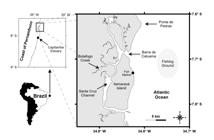
Geographical setting of the study area. The right panel shows the northern coast of Pernambuco (Brazil), including fishing grounds of the stingray Hypanus berthalutzae and the fish market where samples were purchased. Location of the Capibaribe Estuary, a hot spot of pollution along the coast of Pernambuco, is depicted in the upper left panel.
In addition, the Capibaribe River estuary is the main hot spot of contamination across the coast of Pernambuco, and it is located about 30 km south of Itamaracá Island (Macedo et al. 2007, Yogui et al. 2018, Gomes et al. 2022). It is sediments exhibit contamination of DDTs at levels that might trigger adverse biological effects (Yogui et al. 2018). Shore drift along the coast of Pernambuco is mainly northward, carrying contaminants to the study area.
Sampling
Currently known as Hypanus berthalutzae, the species has undergone some recent taxonomic revisions (Last et al. 2016, Petean et al. 2020). Previously, it was referred to as Hypanus americanus (2016 to 2020) and Dasyatis americana (before 2016). Even older scientific names include Pastinaca hastata, Dasibatis hastata, Dasyatis hastata and Dasybatus hastatus (Petean et al. 2020).
H. berthalutzae is typically caught by either gill net or bottom longline at Itamaracá Island (Melo 2016, Queiroz et al. 2023). The latter is selective and catches only adult individuals of H. berthalutzae (Queiroz et al. 2023). Samples were collected during fisheries landing in October, 2020. Stingrays were landed eviscerated and with no head. Species identification was based on the stingray carcass and researcher’s background. Ray disk width was not measured but it was clear that they were all adults since their width was over 75 cm - size at which females are sexually mature (Henningsen 2000, Ramírez-Mosqueda et al. 2012). A total of 17 muscle fillets from the dorsal pectoral fin (near spine) were taken for contaminant analysis. Samples were wrapped in clean aluminum foil and transported to the laboratory in coolers at 4 °C.
In the laboratory, scalpel and tweezers were used for removing skin from muscle. Subsamples were weighed on an analytical balance, placed in an oven (60 °C) for 24 h and weighed again for gravimetric determination of dry weight. Subsequently, samples were freeze-dried for several days at -60 °C, macerated using porcelain pestle and mortar, homogenized, transferred to clean glass jars and stored in freezer at -20 °C until chemical analysis.
Persistent organic pollutants
Analysis of POPs was carried out in all muscle samples according to procedures described in Miranda & Yogui (2016). In brief, approximately 3.0 g of freeze-dried tissues were Soxhlet-extracted using 80 mL of n-hexane and methylene chloride (1:1, v/v) for 8 h. Prior to extraction, 100 ng of internal standards (DBOFB, PCB-103 and PCB-198) were added to the samples. An aliquot of the organic extracts (10%) was taken out for gravimetric determination of lipids using a microanalytical balance. The remaining extracts were sequentially cleaned up with sulfuric acid (95-98%) and organics-free distilled water. The cleaned up extracts were concentrated down under a gentle nitrogen flow and recovery standard (TCMX) was added to the final extracts.
Extracts were injected into a gas chromatograph coupled to a mass spectrometer (GC-MS, Agilent Technologies, models 7820A and 5975C). Splitless injections of 1 μL were done with an autosampler. Helium was the carrier gas at a constant flow rate of 1.2 mL min-1 into the capillary column (HP-5ms: 30 m length × 0.25 mm inner diameter × 0.25 µm film thickness). Detailed description of temperatures and oven programs in the PCBs and OCPs runs are described elsewhere (e.g. Miranda & Yogui 2016). The mass spectrometer was operated with an electron ionization (EI) source at 70 eV. The full list of organochlorines investigated can be checked in the Supplementary Material - Tables SI, SII. Identification of analytes in the GC-MS was based on retention times and relative abundances of major m/z ions, whereas quantification was based on internal standardization. The analytical curves were based on 6-point linear regression with acceptable coefficient of determination (R2) equal to or greater than 0.995.
Less than 5% of target analytes were detected in laboratory blanks. These traces of blank contamination were subtracted from the samples in each analytical batch. The average recovery of internal standards was 64.2 ± 2.4% (95% confidence interval). NIST certified reference material SRM 2974a (organics in freeze-dried mussel tissue) was analyzed to verify the accuracy and precision of the method. Recovery of certified analytes in the SRM averaged 114 ± 8% (confidence interval 95%). The average coefficient of variation (CV) of SRM replicates was 6.5%. Instrumental limits of quantification (LQ) were calculated by dividing the lowest calibration level of a target analyte by the amount of sample extracted (Lauenstein & Cantillo 1998). LQs for PCBs, DDTs, HCHs, CHLs and mirex ranged from 0.071 to 0.089 ng g-1 wet weight (ww), with a mean of 0.073 and a standard deviation of 0.008 ng g-1 ww. Individual LQs are reported in the Tables SI and SII).
Mercury
Due to sample constraints, Hg was analyzed in just 14 out of 17 samples. Analysis of total Hg was done in triplicate samples of ~100 mg of dry muscle tissues. Samples were digested with 2 mL of nitric acid (65%) previously purified in a sub-boiling distillation system. Digestion was carried out in a conventional microwave (model MEO44, Electrolux) with irradiation at 780 W for 5 min followed by further 5 min for cooling. The digested extracts were completed to 5 mL with ultrapure water. Total Hg was determined using an inductively coupled plasma optical emission spectroscopy system (ICP-OES, Spectro Analytical Instruments, model Cirus CCD) equipped with a quartz torch (2.5 mm inner diameter) injector tube. A continuous flow chemical steam generation system was coupled to ICP-OES. Solutions were conducted to a gas/liquid separator and argon was used for transporting vaporized Hg species directly to the ICP-OES plasma. The wavelength used for quantification was 184.950 nm. The average LQ was 10 ng g-1 ww. Certified reference material (DOLT 4 – dogfish liver) was analyzed with the analytical batch for checking method accuracy. Recovery of Hg in DOLT 4 ranged from 95 to 105% of the certified concentration.
Exposure assessment estimation
Discussion of Hg and POPs data is done on wet basis. For POPs, the estimated concentrations were compared with maximum limits recommended by U.S. EPA (United States Environmental Protection Agency; USEPA 2000). Hg food safety calculation was performed as described below. Health risk associated with fish consumption was assessed using the following equation proposed by Newman & Unger (2002):
where HQ is the health risk coefficient, E is the level of exposure or intake of Hg (ng kg-1 body weight day-1) and RfD is the Hg reference dose (470 ng kg-1 body weight day-1) (BCS 2007). The exposure level (E) was calculated as follows:
where C is the concentration of Hg (ng g-1 ww), I is the per capita intake rate (35.06 g day-1; IBGE 2010) and W is the average weight of the local adult population (70 kg). If HQ < 1, the exposure level is lower than the reference dose. It means that daily exposure at this level is unlikely to cause adverse effects to consumers.
Additionally, the estimated daily intake (EDI – expressed as mg kgBW -1 day -1) was calculated for Hg using two finfish consumption rates: 35 g day-1 (IBGE 2010) and 142 g day-1 (Bezerra et al. 2023). The former represents the general per capita fish consumption for the population of northeastern Brazil, whereas the latter represents the specific per capita consumption of traditional communities that eat fish for subsistence. EDI for Hg (EDIHg) can be calculated as follows:
where Cray (mg kg-1) is the Hg concentration in H. berthalutzae, CRlocal (g day-1) is the fish consumption rate, and BW is the consumer body weight (70 kg for adults and 15 kg for children) (USEPA 2000).
Target risk quotient (THQ) was estimated since it represents the chronic non-carcinogenic health risk of exposure to Hg consumed via finfish. Values ththbelow 1 represent no expected health effect while values ththabove 1 represent a potential for adverse health effects. Calculation was made according to the following equation:
where EF is the exposure frequency (365 days per year), ED is the exposure duration (77 years for adults and 6 years for children), RfD is the reference dose of Hg (0.0001 mg kgBW–1 day-1), and AT is the average exposure time (EF × ED) (USEPA 2001, 2022).
The local safety level (FSLlocal) was also calculated (USEPA 2001) according to the equation below. It consists of an upper limit for Hg concentration (ng g-1 ww) in consumed fish. Such limit should not be exceeded due to risk of developing health issues in the consumer.
RESULTS
Concentration of contaminants in muscle of H. berthalutzae is summarized in Table I. DDTs, HCHs and mirex were not detected in samples while PCBs and CHLs were detected below LQ. In this case, average concentrations for PCBs and CHLs were calculated assuming that each sample concentration is half of its respective LQ. This approach is known as the middle-bound principle, and it has been commonly used in dietary intake studies (De Mul et al. 2008, Llobet et al. 2008, Wang et al. 2009). Hg concentrations in muscle of H. berthalutzae ranged from 30 to 100 ng g-1 ww (mean ± SD = 60 ± 5 ng g-1 ww) (Figure 2). Such levels are below the local safety level (FSLLocal) for general adult population (200 ng g-1 ww). In contrast, mean Hg levels found in H. berthalutzae are similar to the safety level for general children population (43 ng g-1 ww), and above both adults (49 ng g-1 ww) and children (11 ng g-1 ww) who consume fish for subsistence.

Box-and-whisker plots of Hg concentration in Hypanus berthalutzae from the coast of Pernambuco, northeastern Brazil.
Concentration (ng g-1) of organochlorine compounds and mercury in muscle samples of stingray Hypanus berthalutzae caught on the northern coast of Pernambuco, Brazil. Legend: ww = wet weight; dw = dry weight; lw = lipid weight.
The health risk coefficient (HQ) ranged from 0.03 to 0.11 (mean ± SD = 0.06 ± 0.03). This is below the reference level of exposure (E) that ranged from 0.01 to 0.05 (mean ± SD = 0.03 ± 0.01). The target risk quotient (THQ) for the general adult population ranged from 0.1 to 0.5 (mean ± SD = 0.3 ± 0.1), and for general children ranged from 0.6 to 2.4 (mean ± SD = 1.4 ± 0.6). THQ calculated for traditional communities that consume fish for subsistence ranged from 0.5 to 2.1 (mean ± SD = 1.2 ± 0.5) in adults, and from 2.4 to 9.8 (mean ± SD = 5.7 ± 2.3) in children.
The estimated daily intake (EDI) ranged from 0.00001 to 0.00005 (mean ± SD = 0.00003 ± 0.00001) for the general adult population, and from 0.00006 to 0.00024 (mean ± SD = 0.00014 ± 0.00006) for children. EDI calculated for traditional communities ranged from 0.00005 to 0.00021 (mean ± SD = 0.00012 ± 0.00005) for adults and from 0.00024 to 0.00098 (mean ± SD = 0.00057 ± 0.00023) for children (Table II).
Parameters calculated for assessment of human exposure to mercury (Hg) contamination in muscle of the stingray Hypanus berthalutzae caught on the northern coast of Pernambuco, Brazil. Legend: EDI = estimated daily intake (expressed as mg kgBW -1 day-1); THQ = target risk quotient; GA = general adult population; SA = subsistence adult population; GC = general children population; SC = subsistence children population; SD = standard deviation.
DISCUSSION
The low concentration of POPs in H. berthalutzae could be attributed to low contamination in the stingray foraging area. Despite no data is available for POPs in sediments of the northern continental shelf of Pernambuco, Silva (2015) analyzed sediment samples in the Santa Cruz Channel and found concentrations of PCBs ranging from < LQ to 5.62 ng g-1 dry weight (dw). The author concluded that sediments of the Santa Cruz Channel have low concentrations of PCBs, typical of poorly industrialized estuaries. The Santa Cruz Channel is over 22 km long and has a width varying from 0.6 to 1.5 km (Paiva et al. 2017). It borders the west side of Itamaracá Island and its northern connection to the ocean (Barra de Catuama) is right away from H. berthalutzae fishing ground (Figure 1).
In Todos os Santos Bay (Bahia State, Brazil), Santos et al. (2020) found average PCBs levels of 0.68 ng g-1 ww in H. berthalutzae muscle (Table III) (LQ = 0.38 in ng g-1 dry weight). This is an order of magnitude greater than the mean concentrations calculated for this study. Todos os Santos Bay is known to be more industrialized than the northern coast of Pernambuco. However, Sotão-Neto et al. (2020) found PCBs concentrations in sediments of the bay ranging from < LQ to 4.66 ng g-1 dw. This range is similar to the one observed at Santa Cruz Channel, evidencing that local sediment contamination is not enough for explaining the low levels of PCBs detected in H. berthalutzae in the northern coast of Pernambuco.
Average concentration (ng g-1 wet weight) of persistent organic pollutants in muscle of fishes from Brazil.
Miranda & Yogui (2016) investigated POPs in Scomberomorus cavalla caught in the coast of Pernambuco. Average concentration of PCBs in muscle was 8.57 ng g-1 ww (LQ = 0.50 ± 0.15 ng g-1 dry weight). S. cavalla is a carnivorous bony fish frequently employed in biomonitoring of contaminants due to its commercial importance (Grady et al. 1989, Adams & McMichael 2007, Ploetz et al. 2007, Costa & Lacerda 2009, Lacerda et al. 2016, Miranda & Yogui 2016, Silva et al. 2021). PCBs levels found in S. cavalla are 50 times higher than those in H. berthalutzae caught in the present study. In comparison to other fish species, low levels of PCBs were also found in muscle of the stingray Hypanus americanus in Florida, USA (Johnson-Restrepo et al. 2005). According to the authors, absorption of organochlorines seems to be associated with the feeding behavior and habitat use of each species. They also argued that accumulation of PCBs is a tissue-specific process controlled by both metabolic and physiological characteristics of each organism. Cascaes et al. (2014) also found significant differences in accumulation of PCBs and DDTs when comparing the demersal shark Rhizoprionodon lalandii with other oceanic species. Based on the discussion above, the low concentration of POPs found in H. berthalutzae in this study might be associated with diet of the local population and/or biochemical composition of tissues over ontogeny of individuals. For example, lipid content varies throughout the species’ life cycle, reaching minimum values during the ovulation period (Marshall et al. 1999, Ababouch 2005).
H. berthalutzae belongs to the infraorder Batoidea. Lower levels of POPs in the species might also be related to biochemical characteristics of Batoidea since individuals of the group exhibit low lipid content in muscle (Krzynowek & Murphy 1987, Ackman 1990). This would make accumulation of POPs more difficult in muscle of stingrays and might even justify the incipient number of studies of POPs in rays worldwide (Bezerra et al. 2019, Fuentes et al. 2023), making comparisons more difficult. Other issues also contribute to such a difficult in comparing different studies: targeted biological tissues and concentration basis for reporting contamination.
In the first case, some studies have investigated either muscle (Santos et al. 2020) or liver contamination (Rosenfelder et al. 2012, Cascaes et al. 2014, Paiva et al. 2021, Corrêa et al. 2022). Overall, muscle is more relevant when addressing food safety since it is the way fish is consumed by humans. In contrast, liver plays a key role in the animal’s metabolism, and it is more important from an ecological point of view. The second issue is the lack of uniformity among papers since different bases have been used for reporting concentration of contaminants. Some studies on fish present results on a wet weight basis (e.g. Silva et al. 2007, 2009, Lavandier et al. 2013) while others use dry weight (e.g. Miranda & Yogui 2016) or lipid weight basis (e.g. Rosenfelder et al. 2012, Cascaes et al. 2014, Paiva et al. 2021, Corrêa et al. 2022). Unfortunately, full data for converting concentrations between distinct bases are not always available for facilitating comparisons. In fact, this reflects the lack of consensus on the basis contaminant data sets should be presented and discussed. It is an issued that remains to be addressed by the scientific community. The easiest way to solve it would be publication of full data sets (see Tables SI, SII) containing individual concentration of contaminants along with wet, dry and lipid weights of each sample tissue. Alternatively, a summary table containing concentrations expressed on the three possible bases (wet, dry and lipid) would be very useful (see Table I) although not common to see in the literature (Miranda & Yogui 2016). Lack of standardization when reporting units of concentration is a minor issue but it would be convenient whether all studies could present data expressed in the smallest unit detectable (i.e. ng g-1). These recommendations are important for supporting public policies toward conservation of fishing resources and human food safety.
A recent review on contaminants in chondrichthyans pointed to lack of data on effects of POPs in Batoidea (Fuentes et al. 2023), highlighting the need for more research in Brazil and elsewhere. The same authors also concluded that variations in the concentration of POPs depend on feeding habits, sex and maturity stage of the specimens. Influence of these variables should be addressed in future studies in order to better understand their role in contaminant accumulation.
Total Hg averaged 60 ng g-1 ww in H. berthalutzae from the northern coast of Pernambuco. This is about an order of magnitude lower than levels found by Moura et al. (2020) in the coast of Ceará, Brazil (Table IV). The same authors investigated several species of rays that exhibited distinct mean concentrations ranging from 6 ng g-1 ww for Aetobatus narinari to 300 ng g-1 ww for H. berthalutzae. Differences of up to three orders of magnitude were attributed to the distinct diets (Moura et al. 2020).
Average total mercury concentration (ng g-1 wet weight) and health risk coefficient (HQ) in muscle of rays from Brazil. Numbers in bracket denote range.
In Pernambuco, Julio et al. (2022) found mean Hg levels of 919 ng g-1 ww in the stingray H. guttatus. This is 15 times higher than average Hg found in H. berthalutzae in this study. Both species have the same foraging habitats but occupy distinct trophic positions. Despite the higher trophic level (Moura et al. 2020, Queiroz et al. 2023), H. berthalutzae exhibited much lower concentrations than H. guttatus in the coast of Pernambuco. Thus, another factor must explain such differences. In this case, higher concentrations of Hg in H. guttatus might reflect ontogenetic changes in the diet since juveniles feed mainly on invertebrates while adults forage benthic fish (Silva et al. 2001, Moura et al. 2020). Furthermore, H. guttatus is a demersal stingray that lives on sandy and muddy estuarine bottoms of the Santa Cruz Channel (Julio et al. 2022, Queiroz et al. 2023), an ecosystem historically contaminated by Hg. There are significant amounts of Hg complexed with organic matter in local estuarine sediments, including methyl-Hg (Lacerda et al. 2020) that turns the metal more available to biota. Juveniles of H. guttatus live in high salinity environments such as the continental shelf while adults prefer environments with lower salinity such as estuarine intertidal zones (Figueiredo 1977, Menni & Lessa 1998, Yokota & Lessa 2007, Gomes et al. 2010, Gianeti 2011, Melo 2016). Therefore, adults of H. guttatus are more exposed to Hg contamination in the Santa Cruz Channel than H. berthalutzae that prefers to inhabit coastal marine habitats (Petean et al. 2020). H. berthalutzae presents ontogenetic segregation between life stages since juveniles live in coastal areas close to beaches and adults live seaward close to the shelf break (Freitas et al. 2019, Queiroz et al. 2023). Queiroz et al. (2023) did not detect statistically significant differences in the diet between life stages of H. berthalutzae. However, younger stages tend to prefer crustaceans while adults have a preference for feeding on cephalopods (Queiroz et al. 2023). Both stingrays (H. guttatus and H. berthalutzae) have a demersal habit but occupy distinct niches and trophic positions in the ecosystem they inhabit. Although a generalist feeder, H. berthalutzae exhibits a less diverse diet when compared to H. gutattus (Queiroz et al. 2023). So foraging habits might also explain distinct accumulation of Hg in both species.
Although disc width of rays was not measured in this study, it is known that all sampled individuals were adults. So it is worth highlighting that Hg tends to exhibit a positive correlation with body size, age and trophic position (Boening 2000, Lacerda et al. 2000). Moura et al. (2020) found a significant correlation between the size of H. guttatus and level of Hg in muscle. Julio et al. (2022) also found a significant positive correlation between Hg concentration in muscle and body size of both stingray H. guttatus and shark Rhizoprionodon porosus.
Environmental contaminants such as POPs and Hg can contribute to the loss of biodiversity (Rolland 2000) since they have the ability to disrupt animals’ endocrine, reproductive and immune systems (Colborn & Clement 1992, Guillette et al. 1994, Guillette 1995, Rolland et al. 1995). The reproductive effects of PCBs include changes in sex steroid hormones, gonadotropins, gonad growth and vitellogenin production (Monosson 2000). The reported developmental effects of the same contaminants include embryonic and larval growth as well as survival (Monosson 2000). PCBs also have a potential long-term effect on the survival of offspring (Monosson 2000). Mercury is an endocrine disruptor that can promote, block, or reduce androgenic and estrogenic activity in fish (Wiener & Spry 1996, Friedmann et al. 2002). Thus, it hinders the reproductive success of species even when found at low concentrations. Furthermore, there is maternal transfer of both PCBs and Hg to embryos (Lyons & Lowe 2013, Lyons 2018). This is alarming because offspring is born contaminated and will likely be exposed to more contaminants throughout their lives.
Rays typically exhibit low fecundity, late sexual maturation and internal fertilization when compared to bony fish (Last & Stevens 1994), making them more susceptible to the risk of extinction as a consequence of anthropogenic factors such as pollution and overfishing (Holden 1974). In relation to sharks, rays are less studied and present deficient data for assessing their risk of extinction although some species can already be considered threatened (Oliveira et al. 2019). About 38% of ray species that occur in Brazil lie on a state of concern (ICMBio 2016, Oliveira et al. 2019) while others have not yet been evaluated or have insufficient knowledge for making decisions toward their conservation (Oliveira et al. 2019). H. berthalutzae is currently classified by the IUCN as a vulnerable species (VU) (ICMBio/MMA 2022, Charvet et al. 2020). This is of great concern since it is endemic to Brazil. In the past decades, several species of elasmobranchs have been threatened and some populations have experienced declines of up to 90% at certain regions (Dent & Clarke 2015). Therefore, they are under a real risk of extinction without public policies for their conservation.
Besides contamination of the species, fishing pressure also contributes to its risk of extinction because it is widely consumed in northeastern Brazil, making fisheries another factor to be addressed for conservation. Studies like this one are important for generating knowledge that supports science-based decisions and avoids loss of biodiversity.
Major factors influencing concentrations of both POPs and Hg in muscle of H. berthalutzae can be attributed to biological variables such as diet. Proximity to known hot spots of contamination such as the Capibaribe Estuary (PCBs and DDTs) and the Santa Cruz Channel (Hg) apparently does not play a relevant role in contamination of the species. This is also supported by a global review on contaminants in rays (Bezerra et al. 2019). According to these authors, ecological characteristics such as bottom feeding and higher trophic position are potential factors that contribute to absorption and accumulation of contaminants along with metabolism of the species and individual physiology. Van der Oost et al. (2003) also highlighted ecological and biological parameters (e.g. habitat use, diet, trophic position, age, sex, body size, season, lipid content and mobility) as important factors in the bioaccumulation of pollutants in fish.
Bezerra et al. (2019) and Fuentes et al. (2023) emphasized the need for more studies of contaminants in rays, particularly POPs. For instance, just 11 studies had been published worldwide on POPs in rays up to 2019 (Bezerra et al. 2019). In South America, Fuentes et al. (2023) reported just five studies in their review considering both Pacific and Atlantic coasts.
Regarding POPs, H. berthalutzae caught on the northern coast of Pernambuco can be considered safe for human consumption. USEPA (2000) recommends maximum limits of 380 ng g-1 ww for PCBs, 904 ng g-1 ww for DDTs and 9400 ng g-1 ww for CHLs. Levels found in this paper are much lower than the safe limits set by the U.S. EPA. Overall, values of HQ ththwere below 1 and do not represent risk of exposure to human consumers but assessing the THQ approach for chronic non-carcinogenic health risk reveals different scenarios when considering four populational groups. Such groups are the general population and the traditional communities that rely on seafood caught by themselves for subsistence. Both were subdivided as children and adults. The general adult population exhibited THQ below 1, confirming no health risk from consumption of H. berthalutzae meat (Table II). Conversely, the general children population and the traditional community population (both children and adults) exhibited mean THQ near to or well above 1 (Table II), suggesting that Hg poses a risk for non-carcinogenic effects over time.
Considering the EDI approach, the average value was higher than the Hg reference dose (RfD = 0.0001 mg kgBW − 1 day− 1) only for children in the traditional community group (Table II), suggesting potential negative effects due to chronic exposure. Bezerra et al. (2023) argued that THQ and EDI are good proxies for evaluating exposure to Hg via seafood consumption. For reducing such risk, it is recommended that children of traditional communities at the northern coast of Pernambuco feed on a variety of seafood protein sources, including vegetables and land animals that are likely to exhibit lower Hg contamination.
The calculated local safety level (FSLLocal) was compared to values ththestimated by Bezerra et al. (2023) from several regulatory agencies worldwide. In this study, FSLLocal ththfor the general adult population (i.e. those who sporadically eat H. berthalutzae meat) was 200 ng g-1 ww. This is below the recommended values for health benefits of fish consumption worldwide (210 ng g-1 ww) and for USA recreational fishermen (290 ng g-1 ww) set by FAO/WHO (2011) and USEPA (2001), respectively. It is also below values set for the general Brazilian population (260 ng g-1 ww) according to MPA (2012) and for the general northeastern population (280 ng g-1 ww) according to IBGE (2021). In this study, FSLLocal value calculated ththfor the general children population was generally in accordance with those set by Brazilian authorities (60 ng g-1 ww) (MPA 2012, IBGE 2021), USA (90 ng g-1 ww) agency (USEPA 2001) and worldwide (50 ng g-1 ww) (FAO/WHO 2011). In Brazil, the regulatory agency does not have issued FSLLocal values ththfor traditional communities that have a high intake of seafood. So, values calculated in this study were compared to those set for subsistence fishermen in the USA. Such FSLLocal reference values are 50 ng g-1 ww for adults and 10 ng g-1 ww for children (USEPA 2001). Adults who feed for subsistence are below the value (49 ng g-1 ww) while children are at risk of Hg contamination, not within safe limits (11 ng g-1 ww). Setting these limits ththis important for avoiding the risk of excessive exposure to Hg through consumption of seafood (Bezerra et al. 2023).
CONCLUSIONS
This study is relevant for both conservation and food safety purposes. It was the first one investigating levels of both POPs and Hg in an endemic stingray that inhabits demersal marine environments at northeastern Brazil. POPs were not detected or detected below the limit of quantification while Hg exhibited low concentrations in muscle of the stingray H. bethalutzae. Therefore, contamination by POPs and Hg is not an issue for the conservation of the species on the north coast of Pernambuco. H. bethalutzae also has cultural importance to the local cuisine since it has been used in the preparation of traditional dishes such as stew and moqueca. The food safety assessment showed that the adult population feeding on this stingray is not at risk. Conversely, H. bethalutzae may pose a health threat to certain populational groups such as children and traditional communities that rely exclusively on the species for subsistence (e.g. local fishermen and their families). Considering that H. bethalutzae is listed as a vulnerable species by the IUCN, monitoring fisheries and level of pollutants over time should be warranted in order to support public policies toward its conservation.
Depending on the methodology used and the most vulnerable subgroups within the human population, the concentration found in the ray’s muscles may or may not present a health risk due to exposure to Hg. Therefore, it is recommended to use different methodologies and population subgroups in addition to considering multiple consumption scenarios when assessing the risk of exposure to Hg and other pollutants.
SUPPLEMENTARY MATERIAL
ACKNOWLEDGMENTS
This study was financially supported by Coordenação de Aperfeiçoamento de Pessoal de Nível Superior (CAPES), Brasil – Finance Code 001. The authors also thank fishermen from the Z11 Fishing Colony at Itamaracá Island, especially Mr. Daniel for providing samples for this study and contributing to local research efforts on rays.
REFERENCES
-
ABABOUCH L. 2005. Fisheries and Aquaculture topics. Composition of fish. Topics Fact Sheets. In: Fisheries and Aquaculture Department. FAO, Rome. http://www.fao.org/fishery/topic/12318/en
» http://www.fao.org/fishery/topic/12318/en - ACKMAN R. 1990. Seafood lipids and fatty acids. Food Rev Int 6(4): 617-646.
- ADAMS DH & MCMICHAEL RH. 2007. Mercury in king mackerel, Scomberomorus cavalla, and Spanish mackerel, S. maculatus, from waters of the south-eastern USA: regional and historical trends. Mar Freshw Res 58(2): 187-193.
- ALVES MIR, FILHO NRA, OLIVEIRA LG & FURTADO STF. 2010. Avaliação da Contaminação por Pesticidas Organoclorados em Recursos Hídricos do Estado de Goiás. Rev Brasil de Rec Hídr 15 (1): 67-74.
- ARAÚJO PRV, ODDONE MC, EVÊNCIO-NETO J & LESSA R. 2022. Reproductive biology of the whitespotted eagle ray Aetobatus narinari (Myliobatiformes) captured in the coast of Paraíba and Pernambuco, Brazil. J Fish Biol 100(4): 944-957.
- BAPTISTA J, PATO P, PEREIRA E, DUARTE AC & PARDAL MA. 2013. PCBs in the fish assemblage of a southern European estuary. J Sea Res 76: 22-30.
- BARRETO RR, BORNATOWSK H, MOTTA FS, SANTANDER-NETO J, VIANNA GMS & LESSA R. 2017. Rethinking use and trade of pelagic sharks from Brazil. Mar Policy 85: 114-122.
-
BCS - BUREAU OF CHEMICAL SAFETY. 2007. Human health risk assessment of mercury in fish and health benefits of fish consumption. Food Directorate, Health Products and Food Branch, 76 p, Ontario. http://hc-sc.gc.ca/fn-an/pubs/mercur/merc_fishpoisson_e.html
» http://hc-sc.gc.ca/fn-an/pubs/mercur/merc_fishpoisson_e.html - BEZERRA MF, GOYANNA FAA & LACERDA LD. 2023. Risk assessment of human Hg exposure through consumption of fishery products in Ceará state, northeastern Brazil. Mar Pollut Bull 189: 114713.
- BEZERRA MF, LACERDA LD & LAI CT. 2019. Trace metals and persistent organic pollutants contamination in batoids (Chondrichthyes: Batoidea): A systematic review. Environ Pollut 248: 684-695.
- BOENING DW. 2000. Ecological effects, transport, and fate of mercury: a general review. Chemosphere 40: 1335-1351.
- BORNATOWSKI H, BRAGA RR & BARRETO RP. 2018. Elasmobranchs consumption in Brazil: impacts and consequences. In Advances in Marine Vertebrate Research in Latin America. J Coast Res 22: 251-262.
- CASCAES MJ, OLIVEIRA RT, UBARANA MM, SATO RM, BALDASSIN P, COLABUONO FI, LEONEL J, TANIGUCHI S & WEBER RR. 2014. Persistent organic pollutants in liver of Brazilian sharpnose shark (Rhizoprionodon lalandii) from southeastern coast of Brazil. Mar Pollut Bull 86 (1-2): 591-593.
- CHARVET P, DERRICK D, FARIA V, MOTTA F & DULVY NK. 2020. The IUCN Red List of Threatened Species 2020: e.T181244306A181246271.
- COCENTINO AM, MAGALHÃES KM & PEREIRA SMB. 2004. Estrutura do macrofitobentos marinho. In: ESKINAZI-LEÇA E, NEUMANN-LEITAO S & COSTA MF (Eds), Oceanografia: um cenário tropical (391-423). Bargaço, Recife.
- COLBORN T & CLEMENT C. 1992. Chemically-Induced Alterations in Sexual and Functional Development: The Wildlife/Human Connection. Princeton Scientific Pub. Co.: Princeton, NJ, USA, 1992, 21: 403.
- CORRÊA B, PAIVA LG, SANTOS-NETO E, VIDAL LG, SILVA CEA, VIANNA M & LAILSON-BRITO JL. 2022. Organochlorine contaminants in Rio skate (Rioraja agassizii), an endangered batoid species, from southeastern coast of Brazil. Mar Pollut Bull 182: 114002.
- COSTA BG & LACERDA LD. 2009. Concentração de mercúrio total em cavala, Scomberomorus cavalla, e serra Scomberomorus brasiliensis, comercializadas nas bancas de pescado do Mucuripe, Fortaleza. Ceará. Arq Ciên Mar 42(1): 22-29.
- DARNERUD PO, ATUMA S, AUNE M, BJERSELIUS R, GLYNN A, GRAWE KP & BECKER W. 2006. Dietary intake estimations of organohalogen contaminants (dioxins, PCB, PBDE and chlorinated pesticides, e.g. DDT) based on Swedish market basket data. Food Chem Toxicol 44: 1597-1606.
- DE MUL A, BAKKER MI, ZEILMAKER MJ, TRAAG WA, LEEUWEN SPJV, HOOGENBOOM RLAP, BOON PE & KLAVEREN JDV. 2008. Dietary exposure to dioxins and dioxin-like PCBs in The Netherlands anno 2004. Regul Toxicol Pharmacol 51: 278-287.
- DENT F & CLARKE S. 2015. State of the global market for shark products. FAO Fisheries and Aquaculture technical paper 590: I.
- DIAS ACL, GUIMARÃES JRD, MALM O & COSTA PAS. 2008. Mercúrio total em músculo de cação Prionace glauca (Linnaeus, 1758) e de espadarte Xiphias gladius Linnaeus, 1758, na costa sul-sudeste do Brasil e suas implicações para a saúde pública. Cad Saúd Públ 24: 2063-2070.
- DOMINGO JL. 2007. Omega-3 fatty acids and the benefits of fish consumption: is all that glitters gold? Environ Int 33: 993-998.
- ETO K. 2000. Minamata disease. Neuropathology 20: 14-19.
- FAO/WHO. 2011. Food and Agriculture Organization of the United Nations; Geneva, World Health Organization. Report of the Joint FAO/WHO Expert Consultation on the Risks and Benefits of Fish Consumption. Rome, 50 p.
- FERREIRA AG, FARIA VV, CARVALHO CEV, LESSA RPT & SILVA FMS. 2004. Total mercury in the night shark, Carcharhinus signatus in the western equatorial Atlantic Ocean. Brazil Arch Biol Technol 47(4): 629-634.
- FIGUEIREDO JL. 1977. Manual de peixes marinhos do sudeste do Brasil. I. Introdução. Cações, Raias e Quimeras. São Paulo, SP, Museu de Zoologia, Universidade de São Paulo, 104 p.
- FREITAS RH, AGUIAR AA, FREITAS AKC, LIMA SM & VALENTIN JL. 2019. Unravelling the foraging behavior of the southern stingray, Hypanus americanus (Myliobatiformes: Dasyatidae) in a Southwestern Atlantic MPA. Neotrop Ichthyol 17: e180131.
- FRIEDMANN AS, COSTAIN EK, MACLATCHY DL, STANSLEY W & WASHUTA EJ. 2002. Effect of mercury on general and reproductive health of largemouth bass (Micropterus salmoides) from three lakes in New Jersey. Ecotoxicol Environ Saf 52: 117-122.
- FUENTES SN, ANDRADE MCD, AWRUCH CA, MOYA AC & ARIAS AH. 2023. Impacts of water pollutants on chondrichthyans species from South America: A review. Chemosphere 324: 138262.
- GIANETI MD. 2011. Reprodução, alimentação, idade e crescimento de Dasyatis guttata (Block e Schneider, 1801) (Elasmobranchii; Dasyatidae) na região de Caiçara do Norte – RN. Tese de Doutorado, Universidade de São Paulo, São Paulo.
- GOMES BRDS, FRANÇA RDS, MORAES AS, BATAGLION GA & SANTOS JM. 2022. Evaluation of sediment contamination by urban sewage in a stretch of Capibaribe River, Pernambuco, Brazil. Quim Nova 45(10): 1205-1213.
- GOMES UL, SIGNORI C, GADIG OBF & SANTOS HRS. 2010. Guia para identificação de tubarões e raias do Rio de Janeiro. Rio de Janeiro, Technical Books, 234 p.
- GOOD TP, PEARSON SF, HODUM P, BOYD D, ANULACION BF & YLITALO GM. 2014. Persistent organic pollutants in forage fish prey of rhinoceros auklets breeding in Puget sound and the northern California current. Mar Pollut Bull 86: 367-378.
- GRADY JR, JOHNSON AG & SANDERS M. 1989. Heavy metal content in otoliths of king mackerel (Scomberomorus cavalla) in relation to body length and age. Contrib Mar Sci 31: 17-23.
- GRAMATICA P & PAPA E. 2007. Screening and ranking of POPs for global half-life: QSAR approaches for prioritization based on molecular structure. Environ Sci Technol 41: 2833-2839.
- GUILLETTE LJ. 1995. Endocrine disrupting environmental contaminants and developmental abnormalities in embryos. Hum Ecol Risk Assess: 25-36.
- GUILLETTE LJ, GROSS TK, MASSON GR, MATTER JM, PERCIVAL HF & WOODWARD AR. 1994. Developmental abnormalities of the gonad and abnormal sex hormone concentrations in juvenile alligators from contaminated and control lakes in Florida. Environ Health Perspect: 680-688.
- HENNINGSEN AD. 2000. Notes on reproduction in the southern stingray, Dasyatis americana (Chondrichthyes, Dasyatidae). Copeia 2000(3): 826-828.
- HOLDEN MJ. 1974. Problems in the rational explotation of elasmobranch populations and some suggest solutions. Sea Fish Res 1: 117-137.
- IBGE - INSTITUTO BRASILEIRO DE GEOGRAFIA E ESTATÍSTICA. 2010. Pesquisa de Orçamentos Familiares 2008-2009: Aquisição alimentar domiciliar per capita. Rio de Janeiro.
-
IBGE. 2021. Produção da Pecuária Municipal, 2020. Rio de Janeiro. https://cidades.ibge.gov.br/brasil/ce/pesquisa/18/16459?localidade1=0&ano=2020&indicador=16512.
» https://cidades.ibge.gov.br/brasil/ce/pesquisa/18/16459?localidade1=0&ano=2020&indicador=16512 -
ICMBIO - INSTITUTO CHICO MENDES DE CONSERVAÇÃO DA BIODIVERSIDADE. 2016. Avaliação do risco de extinção dos elasmobrânquios e quimeras no Brasil: 2010-2012. http://www.icmbio.gov.br/cepsul/images/stories/biblioteca/download/trabalhos_tecnicos/pub_2016_avaliacao_elasmo_2010_2012.pdf
» http://www.icmbio.gov.br/cepsul/images/stories/biblioteca/download/trabalhos_tecnicos/pub_2016_avaliacao_elasmo_2010_2012.pdf - ICMBio/MMA (Ed). 2022. Portaria Ministério do Meio Ambiente No 148, de 7 de Junho de 2022. In: Diário Oficial da União (p. 74). Brasília, Brazil: Diário Oficial da União.
- IGATA A. 1993. Epidemiologic and clinical features of Minamata disease. Environ Res 63(1): 157-169.
- JOHNSON-RESTREPO B, KANNAN K, ADDINK R & ADAMS DH. 2005. Polybrominated diphenyl ethers and polychlorinated biphenyls in a marine foodweb of coastal Florida. Environ Sci Technol 39: 8243-8250.
- JULIO TG, MOURA VL, LACERDA LD & LESSA R. 2022. Mercury concentrations in coastal Elasmobranchs (Hypanus guttatus and Rhizoprionodon porosus) and human exposure in Pernambuco, Northeastern Brazil. An Acad Bras Cienc 94: e20220045.
- KIVIRANTA H, OVASKAINEN MAL & VARTIAINEN T. 2004. Market basket study on dietary intake of PCDD/Fs, PCBs, and PBDEs in Finland. Environ Int 30: 923-932.
- KRZYNOWEK J & MURPHY J. 1987. Proximate composition, energy, fatty acid, sodium, and cholesterol content of finfish, shellfish, and their products. NOAA Technical Report NMFS 55. US Department of Commerce, National Oceanic and Atmospheric Administration, National Marine Fisheries Service, 53p.
- LACERDA LD, BEZERRA MF, COSTA BGB, BRAGA TM & GOYANNA FAA. 2016. Mercury distribution in fish commercialized at the Mucuripe market, Fortaleza, Ceará state, Brazil. Arq Ciênc Mar 49: 50-54.
- LACERDA LD, MARINS RV & DIAS FJDS. 2020. An arctic paradox: response of fluvial Hg inputs and bioavailability to global climate change in an extreme coastal environment. Front Earth Sci 8: 93.
- LACERDA LD, PARAQUETTI HHM, MARINS RV, REZENDE CE, ZALMON IR, GOMES MP & FARIAS V. 2000. Mercury content in shark species from the south-eastern Brazilian coast. Rev Bras Biol 60: 571-576.
- LAST PR, NAYLOR GJ & MANJAJI-MATSUMOTO BM. 2016. A revised classification of the family Dasyatidae (Chondrichthyes: Myliobatiformes) based on new morphological and molecular insights. Zootaxa 4139(3): 345-368.
- LAST PR & STEVENS JD. 1994. Sharks and Rays of Australia. Commonwealth Scientific and Industrial Research Organization (CSIRO), 397 p.
- LAUENSTEIN GG & CANTILLO AY. 1998. Sampling and analytical methods of the National Status and Trends Program Mussel Watch Project: 1993-1996 update. In: NOAA Technical Memorandum NOS ORCA, 130 p.
- LAVANDIER R, QUINETE N, HAUSER-DAVIS RA, DIAS PS, TANIGUCHI S, MONTONE R & MOREIRA I. 2013. Polychlorinated biphenyls (PCBs) and polybrominated diphenyl ethers (PBDEs) in three fish species from an estuary in the southeastern coast of Brazil. Chemosphere 90(9): 2435-2443.
- LESSA R ET AL. 2005. Plano Nacional para Conservação e Manejo dos Estoques de Peixes Elasmobrânquios no Brasil. Recife: Sociedade Brasileira para o Estudo de Elasmobrânquios – SBEEL, 100 p.
- LESSA RPT, SANTANA FM, RINCÓN G, GADIG OBF & EL-DEIR AC. 1999. Biodiversidade de Elasmobrânquios do Brasil: Relatório para o Programa Nacional da Diversidade Biológica (PRONABIO), – Nécton – Elasmobrânquios. Recife. Ministério do Meio Ambiente, dos Recursos Hídricos e da Amazônia Legal (MMA), 119 p.
- LLOBET JM, MARTÍ-CID R, CASTELL V & DOMINGO JL. 2008. Significant decreasing trend in human dietary exposure to PCDD/PCDFs and PCBs in Catalonia Spain. Toxicol Lett 178: 117-126.
- LYONS K. 2018. Physiological consequences of environmental contamination in an elasmobranch with matrotrophic histotrophy, the Round Stingray (Urobatis halleri). Doctoral Thesis, University of Calgary, Calgary.
- LYONS K & LOWE CG. 2013. Quantification of maternal offloading of organic contaminants in elasmobranchs using the histotrophic round stingray (Urobatis halleri) as a model. Environ Sci Techno 47(21): 12450-12458.
- MACEDO SD, SILVA HP, BRAYNER FMM, DUARTE MMMB & BARBOSA ADF. 2007. Heavy metal concentrations in sediments of the Capibaribe River Estuary in the Metropolitan Region of Recife, Pernambuco-Brazil. WIT Transactions on Ecology and the Environment, 102 p.
- MAGALHÃES KM, ESKINAZI-LEÇA E & MOURA JUNIOR AM. 1997. Morfometria e biomassa da fanerógama marinha - Halodule wrightii Ascherson no litoral norte de Pernambuco. Trabalhos Oceanográficos da Universidade Federal de Pernambuco 25: 83-92.
- MALARVANNAN G, BELPAIRE C, GEERAERTS C, EULAERS I, NEELS H & COVACI A. 2014. Assessment of persistent brominated and chlorinated organic contaminants in the European eel (Anguilla anguilla) in Flanders, Belgium: levels, profiles and health risk. Sci Total Environ 482: 222-233.
- MARQUES RA, JULIO TG, SOLE-CAVA AM & VIANNA M. 2019. A new strategy proposal to monitor ray fins landings in south-east Brazil. Aquat Conser Mar Freshwat Ecosyst 30(1): 1-18.
- MARSHALL CT, YARAGINA NA, LAMBERT Y & KJESBU OS. 1999. Total lipid energy as a proxy for total egg production by fish stocks. Nature 402(6759): 288-290.
- MELO ACM. 2016. Biologia reprodutiva e pesca da raia Dasyatis guttata (Block e Schneider, 1801) (Elasmobranchii: Dasyatidae) na plataforma continental de Pernambuco, Brasil. Dissertação de Mestrado, Universidade Federal Rural de Pernambuco, Recife. (Unpublished).
- MENNI RC & LESSA RP. 1998. The Chondrichthyan community off Maranhão (northeastern Brazil). II Biology of species. Acta Zool Lilloana 44: 69-89.
- MEYER U & MEDEIROS C. 2017. Mercury in the Santa Cruz Channel, NE Brazil - A potential risk. Trop Oceanogr 45: 58-75.
- MIRANDA DA & YOGUI GT. 2016. Polychlorinated biphenyls and chlorinated pesticides in king mackerel caught off the coast of Pernambuco, northeastern Brazil: Occurrence, contaminant profile, biological parameters and human intake. Sci Total Environ 569: 1510-1516.
- MONOSSON E. 2000. Reproductive and developmental effects of PCBs in fish: a synthesis of laboratory and field studies. Rev Toxicol 3(1): 25-75.
- MOURA VL, RABELO JN, BEZERRA MF, SILVA GB, FARIA VV, REZENDE CE, BASTOS WR & LACERDA LD. 2020. Ecological and biological factors associated to mercury accumulation in batoids (Chondrichthyes: Batoidea) from northeastern Brazil. Mar Pollut Bull 161: 111761.
- MPA. 2012. Boletim Estatístico da Pesca e Aquicultura – 2011. In: Boletim Estatístico Da Pesca E Aquicultura 2011. Secretaria de Monitoramento e Controle do Ministério da Pesca e Aquicultura – MPA. Coordenação-Geral de Monitoramento e Informações Pesqueiras. Brasília, 60 p.
- NEWMAN MC & UNGER MA. 2002. Fundamentals of ecotoxicology. Lewis Publishers, Boca Raton, 376 p.
- OLIVEIRA CDLD, OLIVEIRA CYBD, SILVA HR & JULIO TG. 2019. Diversidade de raias marinhas na costa do Brasil e seus estados de ameaça nacional e global. Arq Ciênc Mar 52: 7-20.
- PAIVA ACG, COELHO PA & TORRES MFA. 2017. Influência Dos Fatores Abióticos Sobre a Macrofauna De Substratos Inconsolidados Da Zona Entre-Marés No Canal De Santa Cruz, Pernambuco, Brasil. Arq Ciênc Mar 38: 85-92.
- PAIVA LG, VANNUCI-SILVA M, CORREA B, SANTOS-NETO E, VIANNA M & LAILSON-BRITO JL. 2021. Additional pressure to a threatened species: High persistent organic pollutant concentrations in the tropical estuarine batoid Gymnura altavela. Bull Environ Contam Toxicol 107: 37-44.
- PAL J, SHUKLA BN, MAURYA AK, VERMA HO, PANDEY G & AMITHA A. 2018. A review on role of fish in human nutrition with special emphasis to essential fatty acid. Int J Fish Aquat Stud 6(2): 427-430.
- PETEAN FF, NAYLOR GJ & LIMA SM. 2020. Integrative taxonomy identifies a new stingray species of the genus Hypanus Rafinesque, 1818 (Dasyatidae, Myliobatiformes), from the Tropical Southwestern Atlantic. J Fish Biol 97(4): 1120-1142.
- PLOETZ DM, FITTS BE & RICE TM. 2007. Differential accumulation of heavy metals in muscle and liver of a marine fish, (King Mackerel, Scomberomorus cavalla Cuvier) from the Northern Gulf of Mexico, USA. Bull Environ Contam Toxicol 78: 134-137.
- QUEIROZ AP, ARAÚJO ML & LESSA R. 2019. Dietary composition and trophic level of Hypanus marianae (Myliobatiformes: Dasyatidae), captured off Pernambuco coast, Brazil. Lat Am J Aquat Res 47(5): 808-817.
- QUEIROZ APN, ARAÚJO MLG, HUSSEY NE & LESSA RP. 2023. Trophic ecology of three stingrays (Myliobatoidei: Dasyatidae) off the Brazilian north-eastern coast: Habitat use and resource partitioning. J Fish Biol 102(1): 27-43.
- RAMÍREZ-MOSQUEDA E, PÉREZ-JIMÉNEZ JC & MENDOZA-CARRANZA M. 2012. Reproductive parameters of the southern stingray Dasyatis americana in southern gulf of Mexico. Lat Am J Aquat Res 40(2): 355-344.
- RODRÍGUEZ JZ, RÍOS SEG & BOTERO CMR. 2015. Content of Hg, Cd, Pb and As in fish species: a review. Vitae 22(2): 148-159.
- ROLLAND RM. 2000. Ecoepidemiology of the effects of pollution on reproduction and survival of early life stages in teleosts. Fish and Fisheries 1(1): 41-72.
- ROLLAND R, GILBERTSON M & COLBORN T. 1995. Environmentally induced alterations in development: a focus on wildlife. Environ. Health Perspect 103(4): 3-5.
- ROSENFELDER N, LEHNERT K, KAFFARNIK S, TORRES JPM, VIANNA M & VETTER W. 2012. Thorough analysis of polyhalogenated compounds in ray liver samples off the coast of Rio de Janeiro, Brazil. Environ Sci Pollut Res 19: 379-389.
- SANTANDER-NETO J, ARAÚJO MLG & LESSA RP. 2016. Reproductive biology of Urotrygon microphthalmum (Batoidea: Urotrygonidae) from north-eastern Brazil, tropical west Atlantic Ocean. J Fish Biol 89(1): 1026-1042.
- SANTOS LL, MIRANDA D, HATJE V, ALBERGARIA-BARBOSA ACR & LEONEL J. 2020. PCBs occurrence in marine bivalves and fish from Todos os Santos Bay, Bahia, Brazil. Mar Pollut Bull 154: 111070.
- SILVA ATA. 2015. Pesticidas organoclorados e bifenilas policloradas no canal de Santa Cruz, Pernambuco. Monografia de conclusão de curso, Faculdade Frassinetti do Recife, Recife. (Unpublished).
- SILVA CA, GARCIA CA, SANTANA HL, PONTES GC, WASSERMAN JC & COSTA SS. 2021. Metal and metalloid concentrations in marine fish marketed in Salvador, BA, northeastern Brazil, and associated human health risks. Reg Stud Mar Sci 43: 101716.
- SILVA CE, AZEREDO A, DIAS ACL, COSTA P, LAILSON-BRITO J, MALM O, GUIMARÃES JRD & TORRES JP. 2009. Organochlorine compounds in sharks from the Brazilian coast. Mar Pollut Bull 58: 294-298.
- SILVA CE, AZEREDO A, LAILSON-BRITO J, TORRES JPM & MALM O. 2007. Polychlorinated biphenyls and DDT in swordfish (Xiphias gladius) and blue shark (Prionace glauca) from Brazilian coast. Chemosphere 67: S48-S53.
- SILVA GB, VIANA MSR & FURTADO-NETO MAA. 2001. Morfologia e alimentação da raia Dasyatis guttata (chondrichthyes: dasyatidae) na enseada do Mucuripe, Fortaleza, Ceará. Arq Ciên Mar 34(1-2): 67-75.
- SOTÃO-NETO BMT, COMBI T, TANIGUCHI S, ALBERGARIA-BARBOSA ACR, RAMOS RB, FIGUEIRA RCL & MONTONE RC. 2020. Persistent organic pollutants (POPs) and personal care products (PCPs) in the surface sediments of a large tropical bay (Todos os Santos Bay, Brazil). Mar Pollut Bull 161: 111818.
- STORELLI MM, BARONE G, STORELLI A & MARCOTRIGIANO GO. 2011a. Levels and congener profiles of PCBs and PCDD/Fs in blue shark (Prionace glauca) liver from the South-Eastern Mediterranean Sea (Italy). Chemosphere 82(1): 37-42.
- STORELLI MM, PERRONE VG & BARONE G. 2011b. Organochlorine residues (PCBs and DDTs) in two Torpedinid species liver from the Southeastern Mediterranean Sea. Environ Sci Pollut Res 18(7): 1160-1165.
- USEPA - UNITED STATES ENVIRONMENTAL PROTECTION AGENCY. 2000. Fish Sampling and Analysis. Guidance for Assessing Chemical Contaminant Data for Use in Fish Advisories, vol. 1. Office of Science and Technology Office of Water United States Environmental Protection Agency, Washington, DC. EPA 823-B-00-007.
- USEPA - UNITED STATES ENVIRONMENTAL PROTECTION AGENCY. 2001. Water Quality Criterion for the Protection of Human Health: Methylmercury Final, Washington, DC. EPA 823-R-: 303.
-
USEPA - UNITED STATES ENVIRONMENTAL PROTECTION AGENCY. 2022. Regional Screening Levels for Chemical Contaminants at Superfund Sites. United States Environmental Protection Agency. https://www.epa.gov/risk/regional-screening-levels-rsls-users-guide#special
» https://www.epa.gov/risk/regional-screening-levels-rsls-users-guide#special - VAN DER OOST R, BEYER J & VERMEULEN NP. 2003. Fish bioaccumulation and biomarkers in environmental risk assessment: a review. Environ Toxicol Pharmacol 13: 57-149.
- VIANA GFS. 2005. Assentamento, estrutura de comunidade e assentamento de camarões Penaeidea e Caridea no prado de capoim marinho (Halodule wrightii Ascherson) na praia de Forno da Cal, Itamaracá, Pernambuco, Brasil. Tese de Doutorado, Universidade Federal de Pernambuco, Recife.
- WANG I, WU Y, LIN L & CHANG-CHIEN G. 2009. Human dietary exposure to polychlorinated dibenzo-p-dioxins and polychlorinated dibenzofurans in Taiwan. J Hazard Mater 164: 621-626.
- WIENER JG & SPRY DJ. 1996. Toxicological significance of mercury in freshwater fish. In: BEYER WN, HEINZ GH & REDMON-NORWOOD AW (Eds), Environmental Contaminants in Wildlife: Interpreting Tissue Concentrations, Lewis Publishers, Boca Raton, FL, 297-339 p.
- YOGUI GT, TANIGUCHI S, SILVA J, MIRANDA DA & MONTONE RC. 2018. The legacy of man-made organic compounds in surface sediments of Pina Sound and Suape Estuary, northeastern Brazil. Braz J Oceanogr 66: 58-72.
- YOKOTA L & LESSA RP. 2007. Reproductive biology of three ray species: Gymnura micrura (Bloch e Schneider, 1801), Dasyatis guttata (Bloch e Schneider, 1801) and Dasyatis marianae Gomes, Rosa e Gadig, 2000, caught by artisanal fisheries in Northeastern Brazil. Cah Biol Mar 48: 249-257.


