 Contracaecum jorgei in common snooks in Brazil: new host, locality record and remarks on misidentifications of Contracaecum spp. in GenBank
Abstract
Contracaecum jorgei was recently described as a new anisakid species from the Argentine wolffish Hoplias argentinensis. This study aimed to report a new host and locality for C. jorgei and highlight inconsistencies in some Contracaecum spp. deposits based on sequence comparisons. Through morphometric analyses and comparative analyses of genetic sequences in GenBank, using a locus from the cytochrome oxidase subunit 2 gene, present specimens were identified as C. jorgei. Misidentified sequences of Contracaecum spp. were also observed and discussed. Thus, C. jorgei is reported for the first time in the Brazilian common snook Centropomus undecimalis, expanding the reports and, consequently, its geographic distribution in the Neotropical region.
Key words
common snook; Contracaecum multipapillatum; morphology; Rodrigo de Freitas lagoon; sequencing
INTRODUCTION
The common snook Centropomus undecimalis (Bloch, 1792) is a euryhaline species distributed across the western Atlantic (Corrêa et al. 2010, Froese & Pauly 2024). This species is economically important throughout the Brazilian coast, which gives it good market acceptance and high commercial value (Rivas 1986).
Recently, a new anisakid species, Contracaecum jorgei Sardella, Mancini, Salinas, Simões & Luque, 2020, was described from the Argentine wolffish Hoplias argentinensis Rosso, Mabragaña, González-Castro, Bogan, Cardoso, Mabragaña, Delpiani & Díaz de Astarloa, 2018 from a shallow Pampean lake in central Argentina (Sardella et al. 2020).
In this context, this study reports common snooks C. undecimalis caught in the Rodrigo de Freitas lagoon in the State of Rio de Janeiro, as a new host and locality for C. jorgei which was identified by morphological and molecular methods, in addition to highlighting misidentifications of Contracaecum spp. deposited in GenBank that potentially hinder future taxonomic studies.
MATERIALS AND METHODS
Fifteen specimens of C. undecimalis (total length 56.5 cm [44.5-65.5 cm]; weight 1.510g [625–3.992g]) were collected by local fishermen in the Rodrigo de Freitas lagoon (22° 58’ 16.02” S, 43° 12’ 42.18” W), State of Rio de Janeiro, Brazil. These specimens were transported refrigerated to the Laboratório de Biologia e Ecologia de Parasitos (LABEPAR) of the Universidade Federal Rural do Rio de Janeiro (UFRRJ) for parasitological analysis.
Host specimens were identified by Figueiredo-Filho et al. (2021) and necropsied to collection of parasites following the guidelines of Amato et al. (1991). The collected nematodes were stored in 70% ethanol. Later, some of them were transferred to temporary microscope slides in lactophenol and then analyzed morphologically according to Moravec (1998) and Sardella et al. (2020). Nematodes were observed, measured and photographed under an Olympus BX binocular microscope (Olympus Optical, Tokyo, Japan) equipped with a digital camera Eurekam 5.0 (BEL Photonics, Monza, Italy). Measurements are presented in millimeters with the average value shown in parentheses.
For genetic analysis, DNA was extracted from nematodes in 70% ethanol, using the Qiagen DNeasy Blood and Tissue Kit (Qiagen, São Paulo, Brazil) according to the manufacturer’s instructions. The PCR amplification of the cytochrome oxidase subunit 2 gene region (cox2) was carried out from two individuals as previously described by Marigo et al. (2015), with some modifications, using the primers 211F and 210R (Nadler & Hudspeth 2000). The amplicon was purified and sequenced as described by Duarte et al. (2020), using the PCR forward and reverse primers. The results of the sequencing reactions were analyzed and edited using the program Chromas 2.6. and sequence compared with other nematodes available in the GenBank database, using the Basic Local Alignment Search Tool (BLAST). Multiple sequences were aligned using the ClustalW multiple alignments feature of MEGAX (v10.2.6), for the creation of a pairwise distance matrix based on the sequence of this study in comparison with sequences of related Contracaecum spp. (Kumar et al. 2018).
Field-collecting permits were issued by the Chico Mendes Institute for Biodiversity Conservation (Instituto Chico Mendes de Conservação da Biodiversidade – ICMBio), through the Biodiversity Authorization and Information System (Sistema de Autorização e Informação em Biodiversidade – SISBIO) under license number 77963, and Animal Ethics Committee (Comitê de Ética no Uso de Animais – CEUA/ICBS) of the UFRRJ under protocol no. 005/2019.
RESULTS
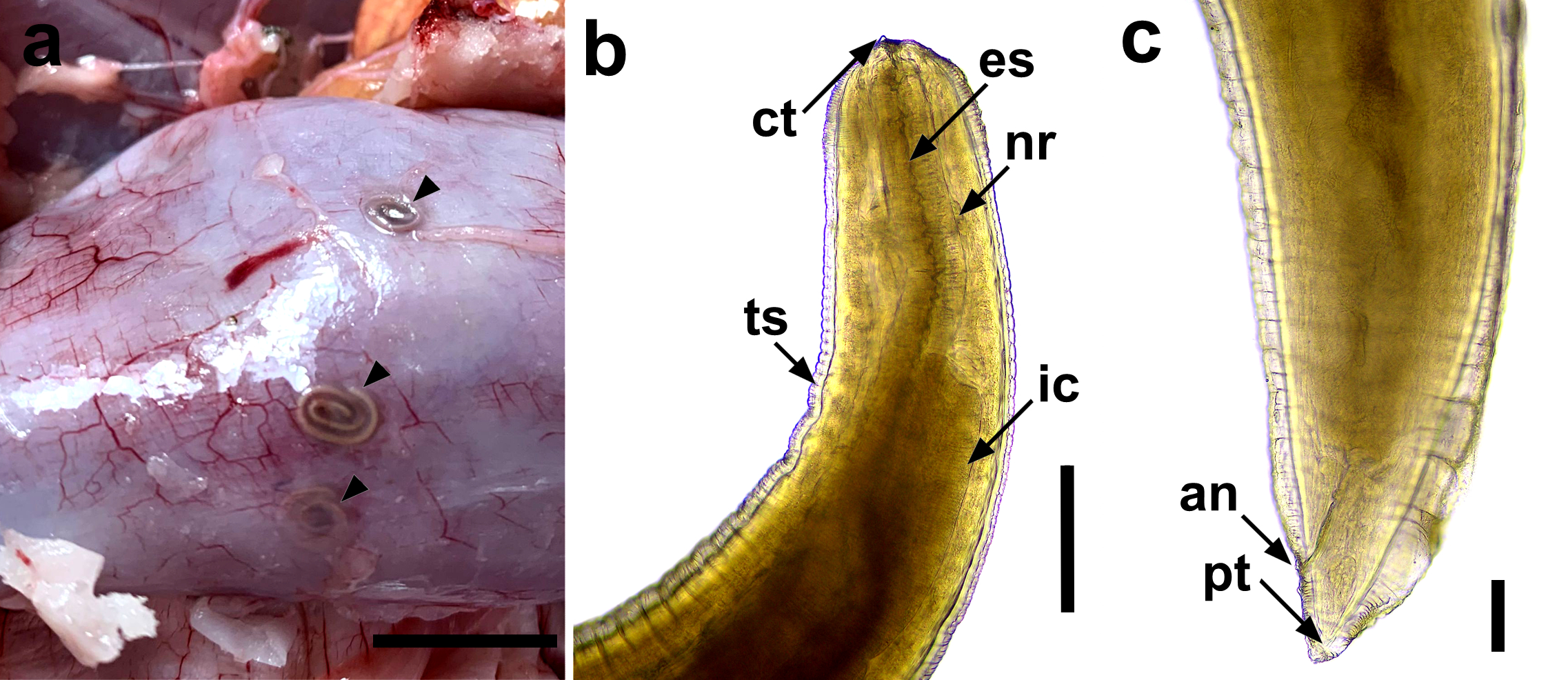
From fifteen specimens of C. undecimalis examined, ten were parasitized by third-stage anisakid larvae encysted in the abdominal cavity (Fig. 1a), totaling 31 specimens of C. jorgei collected. The prevalence was 66.7%, mean intensity 3.1±3.0 and mean abundance 2.1±2,9. The larvae were white in colour with cuticle striated transversely. Body length measured 11.17–18.33 (15.64) and width at the caecum level measured 0.27–0.38 (0.31). Cephalic extremity rounded with three underdeveloped lips, one lip with a small larval tooth (Fig. 1b). Excretory pore situated below the cephalic tooth 0.04–0.05 (0.045) in length. Nerve ring located from the anterior end, 0.19–0.29 (0.25) in length (Fig. 1b). Oesophagus measured 1.60–1.63 length × 0.06–0.16 wide (1.62 × 0.11). Ventriculus small and oval, 0.036–0.05 length × 0.049–0.05 wide (0.04 × 0.05). Intestine distinct and dark. Ventricular appendix measured 0.42 length × 0.06 wide. Intestinal caecum longer than ventricular appendix, 0.90–1.33 length × 0.10–0.15 wide (1.12 × 0.13). Posterior extremity with two anal glands and conical tail with pointed tip 0.11–0.14 (0.13) in length (Fig. 1c). This morphology was compatible with the recent description of L3 specimens of C. jorgei from H. argentinensis (Sardella et al. 2020). Voucher specimens were deposited in the Coleção Helmintológica do Instituto Oswaldo Cruz (CHIOC), State of Rio de Janeiro, RJ, Brazil, in accordance with the number: 39665.
Specimens of the nematode Contracaecum jorgei of the abdominal cavity of common snook Centropomus undecimalis, from Rodrigo de Freitas lagoon, state of Rio de Janeiro, Brazil. 1a – Abdominal cavity of Centropomus undecimalis parasitized by Contracaecum jorgei encysted (arrowhead) in the peritoneum over the stomach. Scale bar: 10 mm. 1b – Anterior end of Contracaecum jorgei with cephalic tooth (ct), transverse striations (ts) on the cuticle, esophagus (es), nerve ring (nr) and intestinal cecum (ic). Scale bar: 0.20 mm. 1c – Posterior end of Contracaecum jorgei with anus (an) and conical tail with pointed tip (pt) (which is less visible due to the detachment of the cyst cover). Scale bar: 0.10 mm.
DNA amplification showed a clear band of 600 bp. The sequence obtained had 100% and 99.4% similarity with sequences of C. jorgei deposited in GenBank (MT304463 and MT304462, respectively); therefore, the molecular analysis corresponded with the morphological identification confirming that the third-stage larvae collected from C. undecimalis in this study are C. jorgei. A representative sequence of this study was deposited in the GenBank database under the accession number PP485039.
DISCUSSION
While the sequence from this study was 99-100% equivalent to C. jorgei sequences deposited in GenBank (Sardella et al. 2020), similarities ranging from 95-100% were observed for sequences (MH044672 to MH044685) identified as Contracaecum multipapillatum (Drasche, 1882) by Choc et al. (2020). In this study (Choc et al. 2020), third-stage larvae were collected from fishes of Parachromis spp., Rhamdia spp. and Hoplias spp. caught in rivers in the province of Guanacaste in Costa Rica, which were identified as C. multipapillatum. Sardella et al. (2020) carried out a detailed morphological study, both of larvae in intermediate hosts and adults in the definitive host, in addition to sequencing (MT304463 and MT304462) with genotypic differences of just 0.6% due to the substitution of 3 nucleotides (456/459). In contrast, Choc et al. (2020) reported third-stage larvae with few morphological details associated with many sequences (MH044672 to MH044685) that varied by more than 5% at the analysed locus. Therefore, it can be concluded that the deposits (MH044672 to MH044680; MH044682 to MH044685) in GenBank by Choc et al. (2020) which varied between 98.7-100% with the deposits of Sardella et al. (2020) must be C. jorgei, and the deposit MH044681 that had 5% dissimilarity must be another Contracaecum spp. The deposits of Sardella et al. (2020) date from September 2020 and therefore postdate the deposits of Choc et al. (2020), which are from May 2018; however, none of these inconsistencies or misidentifications in GenBank were discussed in Sardella et al. (2020).
The sequence correctly associated with the species C. multipapillatum for this locus of the cox2 gene is probably that deposited (AF179910) by Nadler & Hudspeth (2000). In this study (Nadler & Hudspeth 2000), a phylogenetic study was carried out with several species of ascaridoid nematodes based on three genes, including cox2. In addition to this deposit, there are more sequences identified as ‘affinis’ (aff.) for C. multipapillatum deposited in GenBank (EU852343 to EU852348). These were deposited by Mattiucci et al. (2009) in the description of two new Contracaecum spp., Contracaecum gibsoni Mattiucci, Paoletti, Solorzano & Nascetti, 2010 and Contracaecum overstreeti Mattiucci, Paoletti, Solorzano & Nascetti, 2010, originating from the so called C. multipapillatum complex. Anyway, these sequences identified as Contracaecum aff. multipapillatum by Mattiucci et al. (2009) are closer to the sequence (MG495095) of C. overstreeti (similarity of ~99%), than to the sequence (AF179910) deposited by Nadler & Hudspeth (2000) (similarity of ~93%).
By complementation, the pairwise distance matrix created based on the isolated sequence of this study (PP485039) with sequences deposited as C. jorgei and C. multipapillatum (Appendix) show that the sequence of this study has the closest relation with deposits related to C. jorgei (MT304463) and C. multipapillatum (MH044675), which were also closely related to each other. Furthermore, the remaining deposits identified as C. multipapillatum (MH044672 to MH044674; MH044676 to MH044680; MH044682 to MH044685) by Choc et al. (2020) were subsequently also related to C. jorgei. Thus, the pairwise distance matrix corroborates the afore mentioned observations about the inconsistencies in the identifications of these species deposited in GenBank, and that the deposits (MH044672 to MH044680; MH044682 to MH044685) from Choc et al. (2020) should be C. jorgei.
Species delimitation is not a generally consensual process and must undergo adjustments and reorganizations as studies advance, especially in an integrative taxonomy; therefore, it is worth highlighting the inconsistency in identifying distinct species that are genotypically closer than the same species, as observed in this study (Kunz 2002, Valkiūnas et al. 2008). As already evidenced by renowned authors (Valkiūnas et al. 2008), there is a low number of named species in GenBank and, worryingly, an increasing number of incorrectly identified species. Therefore, corrections of generic identifications or misidentifications become urgent, since there are few people in the next generation of scientists who are learning taxonomic skills to correctly associate morphological and molecular identifications (Valkiūnas et al. 2008). Furthermore, phylogenetic analyses, which arise from morphological and molecular studies, if based on misidentifications are likely to be misleading and result in erroneous conclusions (Valkiūnas et al. 2008).
In this sense, the deposits of Choc et al. (2020) reevaluated in this study widely expand the distribution and dispersion area of C. jorgei beyond Argentina (Sardella et al. 2020) to Costa Rica in Central America (Choc et al. 2020), also considering the Atlantic coast from South America, where C. undecimalis is widely distributed up to southeastern Brazil (current study). In fact, phylogenetically distant fish from which C. jorgei was collected in Sardella et al. (2020), Choc et al. (2020) and in this study, highlight its low specificity to the intermediate host, indicating a wide global distribution.
As a last point, the new host and locality records for C. jorgei warn of the potential risk of human anisakiasis. The symptoms of anisakiasis are often unnoticed or confused with other gastrointestinal diseases, indicating that this disease is underestimated globally (Santos et al. 2020). In this context, this infection needs further studies and more comprehensive diagnoses, especially due to its increasing prevalence worldwide driven by new culinary trends (Santos et al. 2020).
In conclusion, in this study the anisakid C. jorgei was identified based on morphology and sequencing and recorded for the first time in the common snook C. undecimalis from southeastern Brazil. In addition, misidentifications were evidenced in GenBank, which directly hinder the taxonomic, phylogenetic and ecological studies of Contracaecum spp. and expands the list of known hosts and its known geographic distribution. Finally, this finding highlights the importance of continued research into parasitic infections in commercial fish populations, especially considering the potential impacts on public health and the fishing industry.
References
-
ALBUQUERQUE RA, PALOMBA M, SANTORO M & MATTIUCCI S. 2020. Molecular identification of zoonotic parasites of the genus Anisakis (Nematoda: Anisakidae) from fish of the Southeastern Pacific Ocean (Off Peru Coast). Pathogens 9: 1-15. https://doi.org/10.3390/pathogens9110910.
» https://doi.org/10.3390/pathogens9110910 - AMATO JFR, BOEGER WA & AMATO SB. 1991. Protocolos para laboratório: coleta e processamento de parasitos do pescado. Imprensa Universitária, Universidade Federal Rural do Rio de Janeiro, Seropédica.
-
CHOC-MLF, JIMÉNEZ-R A, ARGUEDAS-CD & DOLZ G. 2020. Contracaecum multipapillatum (Nematoda: Anisakidae) en peces de aguas continentales de Guanacaste, Costa Rica e Izabal, Guatemala. Rev Colomb Cienc Anim RECIA 12: 1-11. https://doi.org/10.24188/recia.v12.n2.2020.767.
» https://doi.org/10.24188/recia.v12.n2.2020.767 -
CORRÊA CF, LEONARDO AFG, TACHIBANA L & CORRÊA JUNIOR L. 2010. Frequência alimentar para juvenis de robalo-peva criados em água doce. Rev Acad Cien Agrar Ambient 8: 429-436. https://doi.org/10.7213/cienciaanimal.v8i4.10994.
» https://doi.org/10.7213/cienciaanimal.v8i4.10994 -
DUARTE R, MARTINATTI BR, OLIVEIRA AA, GENOVEZ-OLIVEIRA JL, LIMA VM, TUBINO RA, BERTO BP & SANTOS-CLAPP MD. 2020. First report of Myxobolus episquamalis Egusa, Maeno & Sorimachi, 1990 (Myxozoa: Bivalvulida) in Lebranche mullet Mugil liza Valenciennes, 1836 (Teleostei:Mugiliformes) from Neotropical region. Parasitol Res 119: 3869-3872. https://doi.org/10.1007/s00436-020-06803-3.
» https://doi.org/10.1007/s00436-020-06803-3 -
FIGUEIREDO-FILHO JM, MARCENIUK AP, FEIJO A, SICCHA-RAMIREZ R, RIBEIRO GS, OLIVEIRA C & ROSA RS. 2021. Taxonomy of Centropomus Lacépède, 1802 (Perciformes: Centropomidae), with focus on the Atlantic species of the genus. Zootaxa 4942(3): 301-338. https://doi.org/10.11646/zootaxa.4942.3.1.
» https://doi.org/10.11646/zootaxa.4942.3.1 -
FROESE R & PAULY D. 2024. Fishbase. Available from: http://www.fishbase.org Accessed on 04 Fev 2024.
» http://www.fishbase.org -
KUMAR S, STECHER G, LI M, KNYAZ C & TAMURA K. 2018. MEGA X: molecular evolutionary genetics analysis across computing platforms. Mol Biol Evol 35: 1547-1549. https://doi.org/10.1093/molbev/msy096.
» https://doi.org/10.1093/molbev/msy096 -
KUNZ W. 2002. When is a parasite species a species? Trends Parasitol 18: 121-124. https://doi.org/10.1016/S1471-4922(01)02210-3.
» https://doi.org/10.1016/S1471-4922(01)02210-3 -
MARIGO J, TANIWAK SA, PINTO PLS, SOARES RM & CATÃO-DIAS JL. 2015. Molecular identification of Pseudoterrenova azarasi Larvae in COD (Gadus sp.) sold for human consumption in Brazil. Rev Inst Med Trop 57: 537-539. https://doi.org/10.1590/S0036-46652015000600015.
» https://doi.org/10.1590/S0036-46652015000600015 -
MATTIUCCI S, PAOLETTI M & WEBB SC. 2009. Anisakis nascettii n. sp. (Nematoda: Anisakidae) from beaked whales of the southern hemisphere: morphological description, genetic relationships between congeners and ecological data. Syst Parasitol 74: 199-217. https://doi.org/10.1007/s11230-009-9212-8.
» https://doi.org/10.1007/s11230-009-9212-8 - MORAVEC F. 1998. Nematodes of Freshwater Fishes of the Neotropical Region. Praha: Academia, 464 p.
-
NADLER SA & HUDSPETH DSS. 2000. Phylogeny of the Ascaridoidea (Nematoda: Ascaridida) based on three genes and morfhology: hypotheses of structural and sequence evolution. J Parasitol 86: 380-393. https://doi.org/10.1645/0022-3395(2000)086[0380:POTANA]2.0.CO;2.
» https://doi.org/10.1645/0022-3395(2000)086[0380:POTANA]2.0.CO;2 -
RIVAS LR. 1986. Systematic Review of the Perciform Fishes of the Genus Centropomus. Copeia 1986: 579-611. https://doi.org/10.2307/1444940.
» https://doi.org/10.2307/1444940 -
SANTOS MJ, RANGEL LF & CALDEIRA AJR. 2020. Anisaquíase, uma zoonose subestimada globalmente, causada por Anisakis spp. Rev Anápolis Dig 12: 21-40. https://doi.org/10.5281/zenodo.5218634.
» https://doi.org/10.5281/zenodo.5218634 -
SARDELLA CJ, MANCINI M, SALINAS V, SIMÕES RO & LUQUE JL. 2020. A new species of Contracaecum (Nematoda: Anisakidae) found parasitizing Nannopterum brasilianus (Suliformes: Phalacrocoracidae) and Hoplias argentinensis (Characiformes: Erythrinidae) in South America: morphological and molecular characterization of larval and adult stages. J Helminthol 94: 1-11. https://doi.org/10.1017/S0022149X20000644.
» https://doi.org/10.1017/S0022149X20000644 -
VALKIŪNAS G, ATKINSON CT, BENSCH S, SEHGAL M & RICKLEFS RE. 2008. Parasite misidentifications in GenBank: how to minimize their number? Trends Parasitol 24: 247-248. https://doi.org/10.1016/j.pt.2008.03.004.
» https://doi.org/10.1016/j.pt.2008.03.004
Appendix
Estimates of evolutionary divergence between sequences of Contracaecum jorgei from common snook Centropomus undecimalis and Contracaecum spp. sequences deposited in the GenBank database.
#mega
!Title: Phylogenetic Analysis;
!Format DataType=Distance DataFormat=LowerLeft NTaxa=24;
!Description
Analysis ====================
Analysis = ====================
Scope = Pairs of taxa
Estimate Variance = ====================
Variance Estimation Method = None
Substitution Model = ====================
Substitutions Type = Nucleotide
Model/Method = Maximum Composite Likelihood
Substitutions to Include = d: Transitions + Transversions
Rates and Patterns = ====================
Rates among Sites = Uniform Rates
Pattern among Lineages = Same (Homogeneous)
Data Subset to Use = ====================
Gaps/Missing Data Treatment = Pairwise deletion
Select Codon Positions = 1st,2nd,3rd,Non-Coding
No. of Sites = 619
d = Estimate
;
[ 1] #Contracaecum_jorgei(Centropomus_undecimalis)cox2
[ 2] #AF179910.1_Contracaecum_multipapillatum_cytochrome_oxidase_subunit_2_(cox-2)_gene_partial_cds_mitochondrial_gene_for_mitochondrial_product
[ 3] #EU852343.1_Contracaecum_aff._multipapillatum_B_SM-2008_isolate_CMB1_cytochrome_oxidase_subunit_II_(COII)_gene_partial_cds_mitochondrial
[ 4] #EU852344.1_Contracaecum_aff._multipapillatum_B_SM-2008_isolate_CMB2_cytochrome_oxidase_subunit_II_(COII)_gene_partial_cds_mitochondrial
[ 5] #EU852345.1_Contracaecum_aff._multipapillatum_B_SM-2008_isolate_CMB3_cytochrome_oxidase_subunit_II_(COII)_gene_partial_cds_mitochondrial
[ 6] #EU852346.1_Contracaecum_aff._multipapillatum_B_SM-2008_isolate_CMB4_cytochrome_oxidase_subunit_II_(COII)_gene_partial_cds_mitochondrial
[ 7] #EU852347.1_Contracaecum_aff._multipapillatum_B_SM-2008_isolate_CMB5_cytochrome_oxidase_subunit_II_(COII)_gene_partial_cds_mitochondrial
[ 8] #EU852348.1_Contracaecum_aff._multipapillatum_B_SM-2008_isolate_CMB6_cytochrome_oxidase_subunit_II_(COII)_gene_partial_cds_mitochondrial
[ 9] #MH044672.1_Contracaecum_multipapillatum_isolate_Ab_CRC1_cytochrome_oxidase_subunit_II_(COII)_gene_partial_cds_mitochondrial
[10] #MH044673.1_Contracaecum_multipapillatum_isolate_Ab_CRC2_cytochrome_oxidase_subunit_II_(COII)_gene_partial_cds_mitochondrial
[11] #MH044674.1_Contracaecum_multipapillatum_isolate_Can_CRC1_cytochrome_oxidase_subunit_II_(COII)_gene_partial_cds_mitochondrial
[12] #MH044675.1_Contracaecum_multipapillatum_isolate_Can_CRC2_cytochrome_oxidase_subunit_II_(COII)_gene_partial_cds_mitochondrial
[13] #MH044676.1_Contracaecum_multipapillatum_isolate_Hig_CRC1_cytochrome_oxidase_subunit_II_(COII)_gene_partial_cds_mitochondrial
[14] #MH044677.1_Contracaecum_multipapillatum_isolate_Hig_CRC2_cytochrome_oxidase_subunit_II_(COII)_gene_partial_cds_mitochondrial
[15] #MH044678.1_Contracaecum_multipapillatum_isolate_CP_GTM_cytochrome_oxidase_subunit_II_(COII)_gene_partial_cds_mitochondrial
[16] #MH044679.1_Contracaecum_multipapillatum_isolate_Est_GTM1_cytochrome_oxidase_subunit_II_(COII)_gene_partial_cds_mitochondrial
[17] #MH044680.1_Contracaecum_multipapillatum_isolate_Est_GTM2_cytochrome_oxidase_subunit_II_(COII)_gene_partial_cds_mitochondrial
[18] #MH044681.1_Contracaecum_multipapillatum_isolate_EHig_GTM1_cytochrome_oxidase_subunit_II_(COII)_gene_partial_cds_mitochondrial
[19] #MH044682.1_Contracaecum_multipapillatum_isolate_EHig_GTM2_cytochrome_oxidase_subunit_II_(COII)_gene_partial_cds_mitochondrial
[20] #MH044683.1_Contracaecum_multipapillatum_isolate_Mar_GTM_cytochrome_oxidase_subunit_II_(COII)_gene_partial_cds_mitochondrial
[21] #MH044684.1_Contracaecum_multipapillatum_isolate_RD_GTM1_cytochrome_oxidase_subunit_II_(COII)_gene_partial_cds_mitochondrial
[22] #MH044685.1_Contracaecum_multipapillatum_isolate_RD_GTM2_cytochrome_oxidase_subunit_II_(COII)_gene_partial_cds_mitochondrial
[23] #MT304462.1_Contracaecum_jorgei_cytochrome_oxidase_subunit_2_gene_partial_cds_mitochondrial
[24] #MT304463.1_Contracaecum_jorgei_cytochrome_oxidase_subunit_2_gene_partial_cds_mitochondrial
[ 1 2 3 4 5 6 7 8 9 10 11 12 13 14 15 16 17 18 19 20 21 22 23 24 ]
[ 1]
[ 2] 0.085
[ 3] 0.075 0.053
[ 4] 0.071 0.058 0.008
[ 5] 0.075 0.056 0.005 0.008
[ 6] 0.076 0.055 0.004 0.009 0.001
[ 7] 0.073 0.052 0.004 0.009 0.004 0.003
[ 8] 0.075 0.053 0.003 0.008 0.003 0.001 0.001
[ 9] 0.004 0.085 0.074 0.071 0.074 0.076 0.073 0.074
[10] 0.003 0.083 0.073 0.069 0.072 0.074 0.071 0.073 0.009
[11] 0.006 0.093 0.081 0.078 0.081 0.083 0.080 0.081 0.006 0.009
[12] 0.000 0.085 0.074 0.071 0.074 0.076 0.073 0.074 0.006 0.003 0.006
[13] 0.003 0.089 0.076 0.073 0.076 0.078 0.074 0.076 0.006 0.006 0.006 0.003
[14] 0.001 0.083 0.073 0.069 0.072 0.074 0.071 0.073 0.007 0.004 0.007 0.001 0.004
[15] 0.004 0.085 0.078 0.074 0.078 0.080 0.076 0.078 0.010 0.004 0.010 0.004 0.007 0.006
[16] 0.007 0.089 0.078 0.074 0.078 0.080 0.076 0.078 0.009 0.012 0.012 0.009 0.009 0.010 0.013
[17] 0.007 0.089 0.078 0.074 0.078 0.080 0.076 0.078 0.009 0.012 0.012 0.009 0.009 0.010 0.013 0.000
[18] 0.036 0.078 0.055 0.052 0.055 0.057 0.053 0.055 0.036 0.033 0.043 0.036 0.040 0.038 0.038 0.043 0.043
[19] 0.007 0.078 0.078 0.078 0.081 0.080 0.076 0.078 0.013 0.007 0.013 0.007 0.010 0.009 0.006 0.013 0.013 0.041
[20] 0.004 0.081 0.074 0.071 0.074 0.076 0.072 0.074 0.010 0.004 0.010 0.004 0.007 0.006 0.006 0.013 0.013 0.038 0.009
[21] 0.004 0.083 0.076 0.073 0.076 0.078 0.074 0.076 0.007 0.004 0.007 0.004 0.004 0.006 0.009 0.007 0.007 0.038 0.009 0.009
[22] 0.006 0.080 0.072 0.069 0.072 0.074 0.071 0.072 0.012 0.003 0.012 0.006 0.009 0.007 0.007 0.015 0.015 0.037 0.010 0.004 0.007
[23] 0.005 0.083 0.075 0.071 0.075 0.077 0.073 0.075 0.008 0.008 0.011 0.005 0.008 0.006 0.009 0.012 0.012 0.035 0.012 0.009 0.009 0.011
[24] 0.000 0.083 0.074 0.071 0.074 0.076 0.073 0.074 0.006 0.003 0.006 0.000 0.003 0.001 0.004 0.009 0.009 0.037 0.007 0.004 0.004 0.006 0.005