 Clinical evaluation of combined autologous Platelet-Rich Plasma and Volume-Controlled Ozone Therapy in Facial Rejuvenation: A randomized controlled Pilot Study
Abstract
Platelet rich plasma and ozone therapy have been suggested in the clinical setting as promising and adjuvant therapies for managing the symptoms related to the facial aging. However, there is a lack of evidence about the effects of combining both therapies on rejuvenation. Thus, the aim of the present study was to evaluate and to compare the safety and efficacy of both therapies in facial aging. A single-center prospective pilot study was conducted. Female participants, aged 40 to 60 years, were randomized into 2 groups: participants received the platelet rich plasma treatment (PRP); participants received the therapy with platelet rich plasma associated with ozone therapy (PRPOT). Interventions were performed using the facial intradermal technique in 42 pre-established points, for 4 sessions with an interval of 15 days between them. After analyses performed using photographic records, assessment of frontal, periorbital, nasolabial and marionette wrinkles (Wrinkle Assessment Scale), self-esteem assessment (Brazilian Version of Rosenberg’s Self-Esteem Scale) and assessment of patient satisfaction (FACE-Q) can be suggested that the platelet rich plasma protocol performed in the present study, as well as its association with volume-controlled ozone therapy, proved to be safe and potentially promising modalities in the treatment of facial aging.
Key words
skin aging; photoaging; Ozone; ozone therapy; platelet-rich plasma; platelet concentrates
INTRODUCTION
Skin aging is a multifactorial process characterized by a progressive loss of functionality, regenerative potential, wrinkles, pigmentary alterations, skin thinning and telangiectasias (Csekes & Račková 2021). Skin aging is related to intrinsic factors such as genetic background and decrease in the levels of sex hormones and to extrinsic factors such as exposure to sun light and Ultraviolet light (UV) irradiation (Khavkin & Ellis 2011, Wang et al. 2019). Furthermore, it has recently been observed that senescent cells accumulate in aging skin and may contribute to age-related skin changes and diseases (Farage et al. 2008). Essentially, senescent cells increase the production of secretory phenotype associated with the senescent state (SASP), such as interleukins and matrix metalloproteinases, which contribute to the degradation of the extracellular matrix. Also, skin aging is related to a chronic persistent low-grade inflammation, known as “inflammaging” (Lee et al. 2021, Pilkington et al. 2021).
Statistics show a significant increase in the search for dermatological and aesthetic treatments to improve the appearance of the skin since the health of the skin is considered one of the main representative factors of the general well-being and the perception of health of the human being (Zouboulis et al. 2019).
In this perspective, several therapeutic modalities have been employed to treat dermal and epidermal signs of photo- and chronological aging (Zouboulis et al. 2019). Aesthetic dermatology can contribute to healthy aging by playing a significant role in preventing, regenerating and delaying skin aging. Several antiaging strategies have been developed in recent years, such as preventive measures (avoiding exogenous factors of aging, correction of lifestyle and habits), cosmetics, topical and systemic therapeutic agents and invasive procedures (Landau et al. 2017, Zouboulis et al. 2019).
In the last decade, platelet-rich plasma (PRP) has received considerable attention in dermatology since the elucidation of its mechanism of action and reports of its clinical efficacy, mainly because it is considered a minimally invasive method (Evans et al. 2021, Lin et al. 2020). By definition, PRP is an autologous supraphysiological concentration of human platelets suspended in a plasma solution, containing predominant secretory granules and alpha (α) granules, with large reservoirs of bioactive proteins, including immune system messengers, enzymes and growth factors (Hesseler & Shyam 2019, White et al. 2021). In this context, PRP treatment has been shown to have benefits for a variety of skin conditions and cosmetic issues particularly in the areas of hair restoration, skin rejuvenation, acne scars, dermal augmentation and distended stretch marks (Cao et al. 2021, Evans et al. 2021, Jiménez Gómez et al. 2019). Despite the growing popularity of the use of PRP in the dermatological and aesthetic areas, there are a lack of studies investigating the effects of this therapy on the management of the symptoms related to facial aging (Lee et al. 2019).
In addition, another technique that has been gaining prominence in the aesthetic and dermatological area is ozone therapy (OT) (Lacerda et al. 2022, Oliveira Modena et al. 2022). OT is a minimally invasive, well-tolerated and low-cost procedure, with its effect related to the moderate oxidative stress produced by the interactions of O3 with biological components, resulting in analgesic effects, modulator of the inflammatory process, reparative and immunomodulatory and angiogenesis (Elvis & Ekta 2011, Smith et al. 2017).
Although all the evidences about the use of PRP and OT for treating dermatological conditions, there are few studies evaluating the effects of the combined therapy on managing the symptoms of skin aging. In this sense, clinical evidence in this scenario would be of great value to understand the benefits of combining these therapeutic approaches in the treatment of skin aging. Thus, the aim of the present study was to evaluate and compare the safety and efficacy of a PRP protocol and its association with volume-controlled OT in facial aging.
MATERIALS AND METHODS
Study design and setting
This is a double-blind (participants and evaluators) randomized pilot study. Ethical approval (Ethics in Human Research Committee of the Brazil University, approval number 5.450.657) and written informed consent (patients signed) were obtained. The study was conducted at the Aesthetics Clinic D DA S LEITE MARTINS ADVANCED ESTETICA. All participants were recruited via advertisements in local news- papers and social media.
Patients
As eligibility criteria, patients had aged between 40 and 60 years, female gender; phototype II to IV according to the Fitzpatrick scale; presence of signs of facial photoaging grade II to IV according to the Glogau scale; normal platelet count (150,000 to 350,000 µL); consent to participate in the study by signing the informed consent.
Participants were excluded if they present they were smokers; pregnant or breastfeeding women; had a history of neoplasia; had performed an ablative chemical or physical peeling in the last 6 months; had used of botulinum toxin or fillers with facial implants with absorbable material in the last six months; had performed surgical procedures (rhytidoplasty and/or blepharoplasty); being unable to use photoprotection throughout the treatment period; had presented a history of keloids or hypertrophic scars; had presented infection or inflamed skin lesion on the face in the last 12 months; had presented diseases such as uncontrolled systemic arterial hypertension, liver disease, kidney disease, hematological disease (coagulopathies and/or purpura, glucose 6-phosphate deficiency), inflammatory disease, rheumatology, diabetes; hypersensitivity to ozone therapy treatment and refusal to sign the free and informed consent form.
Randomization
All participants met all the inclusion criteria to participate in the study, signed an informed consent form and were randomly allocated into the PRP or PRPOT groups, as described below:
- PRP group: volunteers who received the PRP treatment.
- PRPOT: volunteers who received the PRP treatment associated with ozone therapy.
The randomization process was performed by a researcher who was not involved in the experiment, through a simple raffle using a computer program that created a random table of numbers and placed these numbers (1 and 2) in opaque envelopes corresponding to the group (PRP and PRPOT), respectively.
Assessment and reassessment were performed by a researcher blinded to the experimental groups. Patients were also unaware of the type of treatment (PRP or PRP associated with ozone).
Experimental procedures
After the initial evaluation, the following experimental procedures were made 1 day before the beginning of treatment and 15 days after interventions: evaluation of frontal, periorbital, nasolabial, nasolabial and marionette wrinkles (Wrinkle Assessment Scale - WAS) and global wrinkles (Global Aesthetic Improvement Scale [GAIS]), self-esteem assessment (Brazilian version of the Rosenberg Self-Esteem Scale) and assessment of patient satisfaction (FACE-Q). All participants were oriented to maintain the same habits and do not start any new treatment for the trial period.
Assessments
Wrinkle Assessment Scale (WAS) and Global Wrinkle (GAIS)
The nasolabial, frontal, periorbital, nasolabial and marionette wrinkles could be evaluated using WAS scale. The rating scale has 6 points (0-5 points) and the degree of wrinkles on a patient’s face can be compared with predefined photographic models and established by Lemperle et al. (2001). The increased scores indicate a greater severity of wrinkles. Global wrinkles were assessed using the GAIS Scale. The scale consisted of five categories of evaluation, ranging from 3 (much better) to -3 (much worse) for each side of the face.
Rosenberg Self-Esteem Scale (EAR)
For the assessment of self-esteem, the Brazilian version of the Rosenberg Self-Esteem Scale was used. This instrument is self-administered and consists of 10 statements, five of which are responsible for assessing positive feelings and five for negative feelings of individuals in relation to themselves. Their final score ranges from zero (best state of self-esteem) to 30 (worst state of self-esteem) (Dini et al. 2004).
FACE-Q scale
The participant’s satisfaction with the treatment was assessed using the FACE-Q scale (Satisfaction with Facial Appearance Overall). The scale assesses the current perception of the appearance of the face in terms of characteristics such as symmetry, harmony, proportion, freshness or vitality, appearance over time, appearance under more intense lighting, appearance in photographs and the profile. Participants manifest the degree of agreement ranging from “totally disagree” (level 1) to “totally agree” (level 4). The sum of the scores obtained from the patients’ responses to the 9 items (1 = very dissatisfied, 2 = a little dissatisfied, 3 = a little satisfied and 4 = very satisfied). Higher scores indicate greater satisfaction (Klassen et al. 2016).
Interventions
PRP protocol and PRP associated with ozone
For the production of PRP, 64 mL of blood were collected from each participant. The vacuum collection technique was used with ACD collection tubes (Sodium Citrate). Immediately after collecting the material, it was properly identified and processed with the first centrifugation (CENTRILAB, model CE1161) at 200 g for 10 minutes and later the supernatant was transferred to a sterile tube without additive, allowing the removal of the plasma with the layer of buffy-coat, avoiding contact with red blood cells. A second centrifugation was performed at 400 g for 10 minutes. The platelet concentrate was aspirated, discarding the small portion of PPP supernatant (Platelet-Poor Plasma).
After preparing the PRP, the PRP was associated with the ozone obtained from the portable ozone generator (Ibramed, Amparo, São Paulo). For the procedure, 10 mL of PRP and 10 mL of ozone (1:1) were used at a concentration of 30 µg /ml.
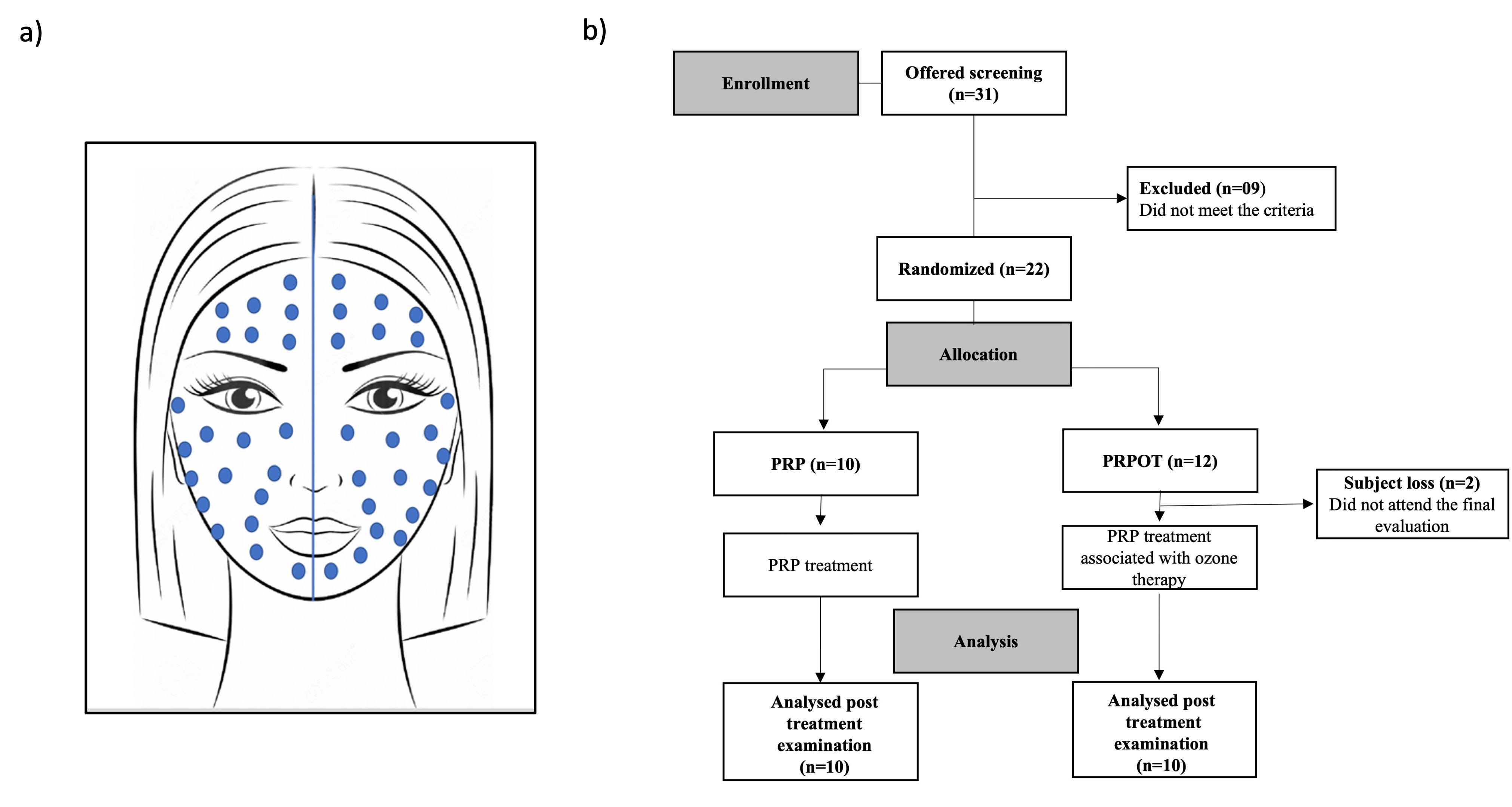
Immediately after both preparations (PRP or PRP associated with ozone) the treatments were performed using a volume of 0.2 mL of PRP or PRP associated with ozone in 42 pre-established points of the face (Figure 1a), through the intradermal technique. Four treatment sessions were performed with an interval of 15 days between sessions.

a) Figure representing the points of application of PRP or PRP associated with ozone; b) Flow diagram.
Statistical analysis
The Shapiro-Wilk’s normality test was used for all variables. To compare the initial and final treatment evaluations, the Wilcoxon T test was used for all analyzed variables. For the comparison among the PRP and PRPOT groups, the non-parametric Mann-Whitney test was used for all variables. Analyzes were performed using GraphPad Prism software, version 6.01. The adopted significant value was α<5%. Data were expressed as mean ± standard deviation (SD).
RESULTS
For the present study, 31 participants were recruited. Of these, 22 participants were selected to enter the study according to the inclusion criteria and randomized into PRP and PRPOT groups. Two participants (from PRPOT) were excluded from the study due to the absence in 2 consecutive treatment sessions (Figure 1b).
The demographic and anthropometric characteristics of the participants were as follows: participants in the PRP group had a mean age of 51.2 years; phototypes II (n = 3); III (n = 3) and IV (n = 4); Glogau II (n = 2), III (n = 6) and IV (n = 2); combination skin (n = 6); menopause (n = 8); daily use of sunscreen (n = 8); daily use of easy moisturizer (n = 2); previous performance of pellings (n = 0) and botulinum toxin (n = 0); mean platelet count of 314,600 uL. PRPOT participants had a mean age of 52.2 years, phototypes II (n = 4), III (n = 4) and IV (n = 2), Glogau II (n = 2), III (n = 5 ) and IV (n = 3); combination skin (n = 7); menopause (n = 8); daily use of sunscreen (n = 7); daily use of easy moisturizer (n = 2); previous performance of pellings (n = 0) and botulinum toxin (n = 0); average platelet count of 320,500 uL. No statistical difference was observed in the evaluated parameters.
Frontal wrinkles
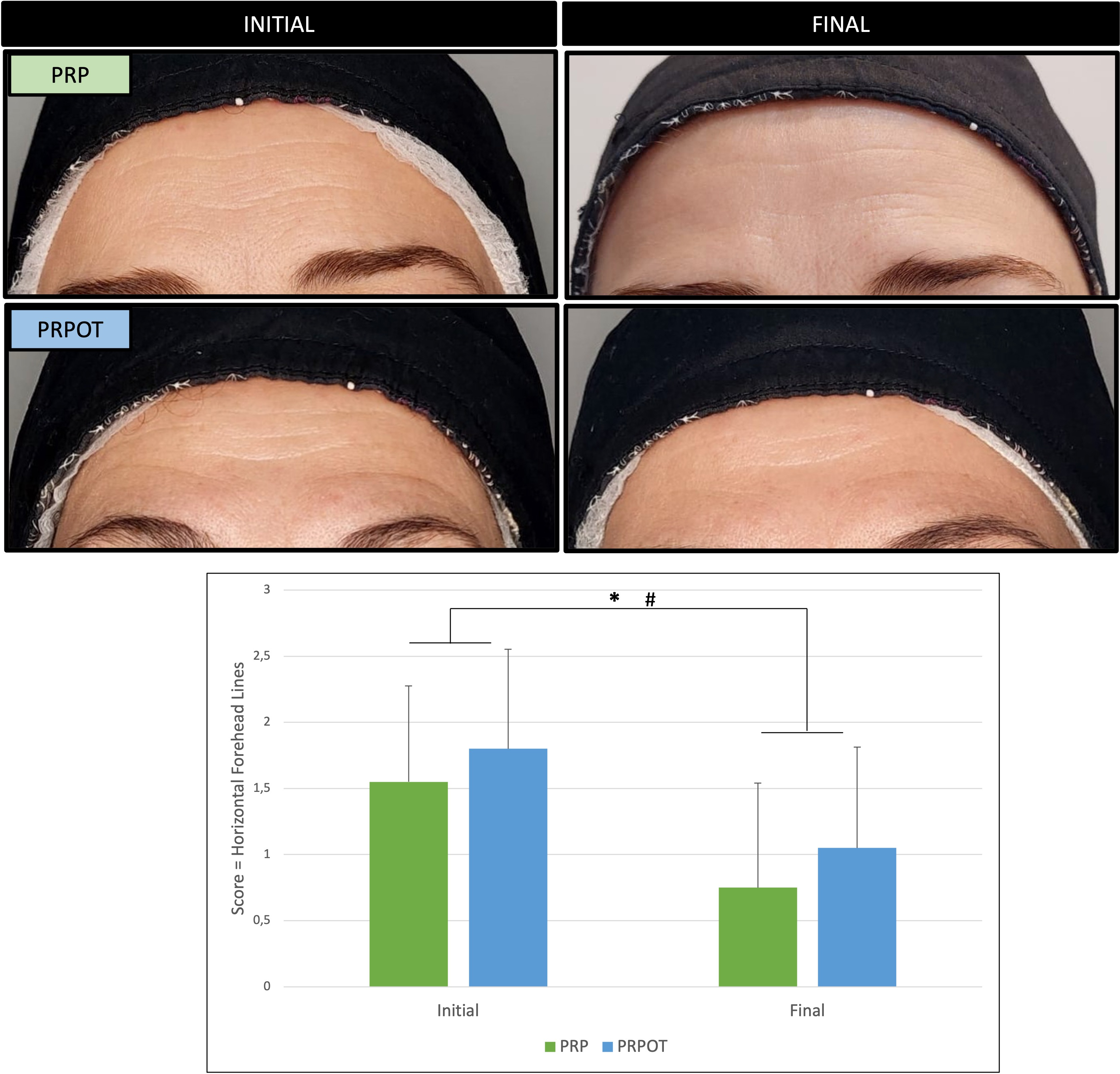
The results of the analysis of frontal wrinkles are shown in Figure 2. The intragroup evaluation demonstrated a significant reduction in wrinkle scores after treatments for both groups, with 60.33% improvement for PRP (*p = 0.0039) and 50% for PROT (# p = 0.0078). However, no difference was observed in the intergroup evaluation.
Figure representing the evaluation values of Frontal Wrinkles (WAS Wrinkle Classification). Group of participants submitted to PRP treatment (PRP); Group of participants submitted to PRP treatment associated with ozone therapy; *p = 0.0039 referring to the comparison of initial PRP vs final PRP (Wilcoxon test); # p = 0.0078 referring to the comparison of initial PRPOT vs final PRPOT (Mann-Whitney test).
Periorbital wrinkles
The evaluations referring to the analysis of periorbital wrinkles are shown in Figure 3a. A significant score reduction was observed after both therapeutical interventions, with 33.09% improvement for PRP (* p = 0.007) and 38.33% (# p < 0.007) for PRPOT. In the intergroup analysis, it was not possible to observe statistical differences.
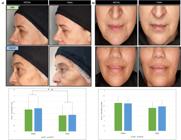
a) Representative figure of the evaluation values of Periorbital Wrinkles, (WAS Wrinkle Classification). *p = 0.007 referring to the comparison of initial PRP vs final PRP (Wilcoxon test); # p = 0.007 referring to the comparison of initial PRPOT vs final PRPOT (Mann-Whitney test). b) Representative figure of the Nasolabial Wrinkle evaluation values, (WAS Wrinkle Classification). Group of participants submitted to PRP treatment (PRP); Group of participants submitted to PRP treatment associated with ozone therapy;
Nasolabial wrinkles
The resulting nasolabial wrinkles are represented in Figure 3b. No intergroup or intragroup differences was observed nor in the initial neither the final evaluation.
Marionette wrinkles
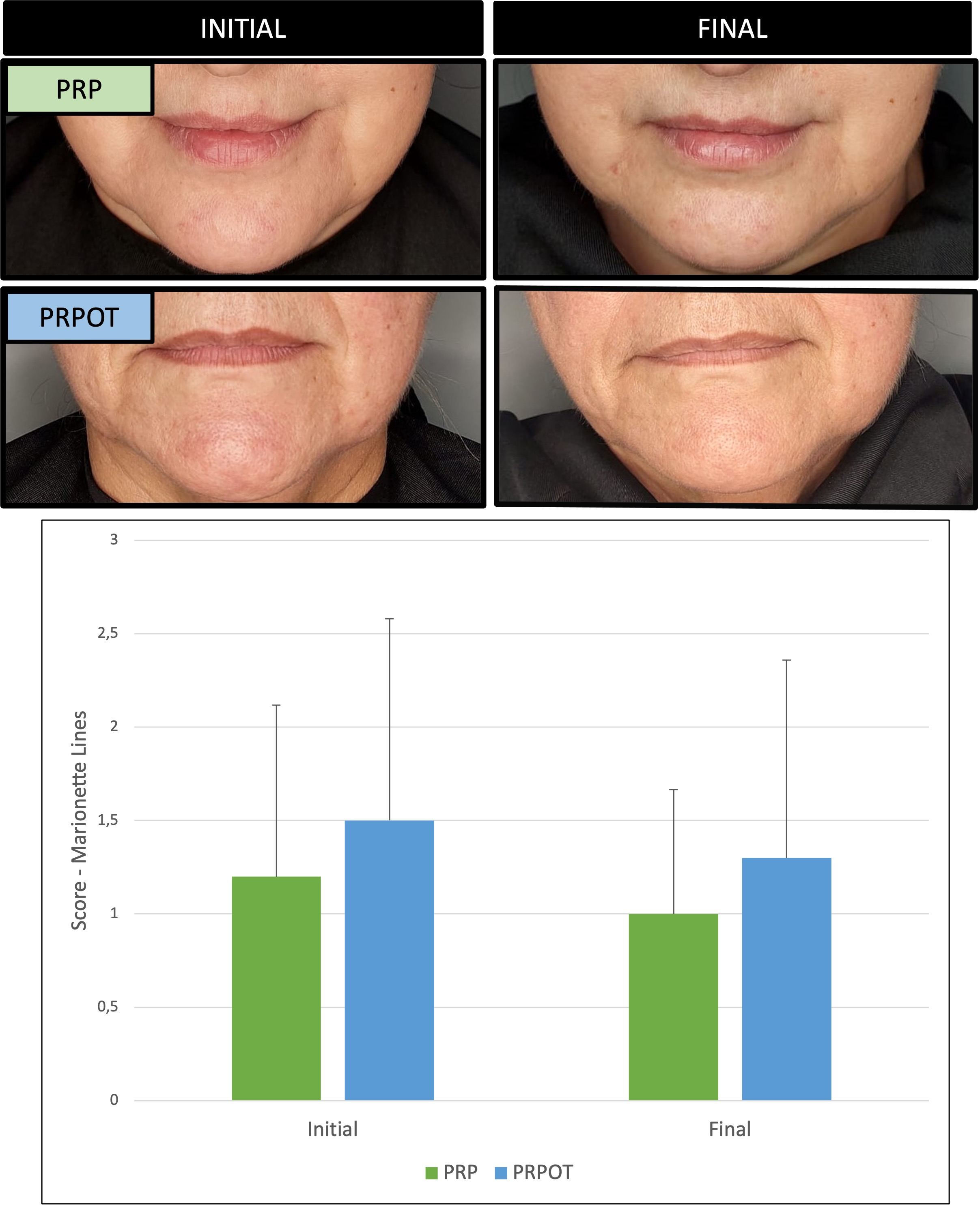
The analyzes referring to the marionette wrinkles are shown in Figure 4. In the statistical analysis, it was not possible to observe differences between the initial and final evaluations or between the experimental groups.

Figure representing the evaluation values of Wrinkles of Marionette, (WAS Wrinkle Classification). Group of participants submitted to PRP treatment (PRP); Group of participants submitted to PRP treatment associated with ozone therapy;
Global wrinkles
Data referring the analysis of global wrinkles are shown in Figure 5a. In the comparison between the experimental groups, an increase in the score of PRPOT was observed when compared to PRP (* p < 0.0027).

a) Global Wrinkle Assessment Values (Global Aesthetic Improvement Scale - GAI). * p = 0.0027 referring to the comparison of PRP vs PRPOT (Mann-Whitney test); b) Self-esteem assessment values (Brazilian version of the Rosenberg Self-Esteem Scale); *p = 0.0059 referring to the comparison of initial PRP vs final PRP (Wilcoxon test); # p = 0.039 referring to the comparison of initial PRPOT vs final PRPOT (Mann-Whitney test); c) Patient Satisfaction assessment values (FACE-Q). *p = 0.007 referring to the comparison of initial PRP vs final PRP (Wilcoxon test); # p = 0.002 referring to the comparison of initial PRPOT vs final PRPOT (Mann-Whitney test); & p < 0.038 referring to the comparison of PRP vs PRPOT (Mann-Whitney test). Group of participants submitted to PRP treatment (PRP); Group of participants submitted to PRP treatment associated with ozone therapy.
Self-esteem evaluation
The average values referring to the evaluation of self-esteem can be seen in Figure 5b. Statistical analysis showed a reduction in the score of both treatments comparing the values found in the evaluation and reevaluation (* p < 0.0059 in the PRP and # p = 0.039 in the PRPOT). It was not possible to observe differences between treatments.
Evaluation of patient satisfaction
Data related to the evaluation regarding the satisfaction of patients after the treatment are shown in Figure 5c. The intragroup evaluation demonstrated an increased score for both groups comparing the values obtained in the evaluation and reevaluation * p = 0.007 for PRP # p < 0.002) for PRPOT. In the intergroup analysis, a higher score was observed in the PRPOT group when compared to the PRP group (& p < 0.038).
DISCUSSION
The present study aimed to evaluate and to compare the effects and safety of a PRP protocol and its association with volume-controlled OT on facial skin aging. The main results demonstrated that volunteers of both groups showed a reduction in the aspects of frontal and periorbital wrinkles assessed by the WAS, an improvement in self-esteem in the Rosenberg questionnaire and increased satisfaction score assessed by the FACE-Q questionnaire and had minimal and transient adverse effects. Furthermore, a higher reduction in global wrinkles and a higher satisfaction score were observed for volunteers who received the combined therapy.
As earlier mentioned, aging results in changes in the appearance of the skin. These changes are correlated with the increasing interest of the population in aesthetic procedures (Lee et al. 2021, Pilkington et al. 2021). Different treatment options for skin rejuvenation are available including non-pharmacological and non-invasive treatment options for skin rejuvenations and more recently, the guidelines for interventions in aesthetic medicine recommended the use of PRP (Landau et al. 2017) and OT (Oliveira Modena et al. 2022).
Most of the studies that have evaluated the effects of PRP in the treatment of aging facial skin have shown encouraging results (Jiménez Gómez et al. 2019, Du & Lei 2020), however, to date, the overall quality of the observed evidence is still low and the results are very variable. This is probably due to the use of different PRP preparation and application techniques used in the studies, which can significantly influence the clinical efficacy of the treatment. Currently, there is no consensus on the best way to prepare the PRP, as well as on the accepted number of treatment sessions or standardized treatment interval supported by the literature. Therefore, this single-center prospective pilot study evaluated the efficacy, treatment safety, and participant-reported satisfaction of four PRP treatment sessions spaced 15 days apart using a simple PRP preparation method that is easily reproducible in clinical practice.
Furthermore, there is a lack of studies in the literature that address the effects of PRP applied in association with OT on facial skin rejuvenation commonly used in clinical practice. As far as we know, the present study is the first one that investigated the effectiveness of PRP treatment associated with OT in the symptoms of skin aging. Data referring the evaluation of wrinkles in the present study showed that both PRP alone and associated to OT promoted significant attenuation of frontal and periorbital wrinkles after 4 treatment sessions. The positive effects of the PRP protocol can be explained due to the activation of a high concentration of several growth factors that will consequently induce the DNA of dermal cells and corresponding gene expression (Du & Lei 2020, Lana et al. 2017). In vitro and in vivo studies show that PRP increases collagen expression, matrix remodeling proteins, fibroblast proliferation, and myofibroblast differentiation (Dernek & Kesiktas 2019, Kushida et al. 2013, Lin et al. 2020). Furthermore, the fibronectin and vitronectin in PRP aggregate with growth factors released by platelets and can act as a scaffold for nascent cells and tissues and promote regeneration of damaged/aging skin (Pavlovic et al. 2016). In a review study carried out by Evans et al. (2021), it was observed that PRP has an effect on the attenuation of signs resulting from aging, in line with the data observed in the present study. Still, Abuaf et al. (2016), through punch and histological analysis, that a single application of intradermal PRP was able to increase the density of collagen and elastin fibers within a period of 28 days after treatment. The authors concluded that PRP increased dermal collagen levels not only through growth factors, but also by needling the skin (the mesotherapy technique).
Additionally, the use of PRP in combination with OT promoted a more pronounced reduction in global wrinkles when there was a combination of stimuli. Only one clinical trial can be found in the literature that obtained satisfactory results in reducing the attenuation of the signs of aging after treatment with OT (Lacerda et al. 2022). The literature shows that OT is able to activate mitochondrial enzymes and possibly modulate mitochondrial biogenesis, optimizing respiratory function to meet energy demands during the tissue repair process. In addition, several antioxidant enzymes are being up-regulated, resulting in the depletion of free radicals, thus, allowing for proper tissue repair (Scassellati et al. 2020). These metabolic changes, and many are still unknown, may facilitate dermal repair and may be the driving force for the adjuvant treatment of many conditions induced by impaired tissue regenerative capacity, as is the case with ageing. Furthermore, several types of growth factors can be activated with the use of OT, resulting in the expression of genes and the synthesis of several proteins necessary for neocollagesis and tissue angiogenesis (Elvis & Ekta 2011, Liu et al. 2023, Zeng & Lu 2018). Thus, the combination of PRP with OT may have produced synergistic reparative effects, leading to better aesthetic results, such as the higher global wrinkle reduction score observed in the present study, inferring promising use in the field of aesthetic dermatology.
In addition to changes in skin appearance (physiological) that occur with aging, psychological and social changes can occur during this period, which can affect self-esteem. Studies show that in middle age, although the presence of sagging and wrinkles is natural, the demand imposed by society still determines physical beauty as a standard for quality of life and many women are faced with low self-esteem since these factors affect personal satisfaction, corroborating the data observed in the present study (Chang et al. 2019, Hooper et al. 2022). It was possible to observe in the present study a reduction in the self-esteem score in both treatments performed.
It is important to highlight the importance of the satisfaction indicator with the appearance of the patient who underwent aesthetic treatment (Fleury et al. 2018, Kappos et al. 2017). Patient satisfaction with treatment, patients’ motivations and expectations are indicators that are currently being taken into account in evidence-based practice (Kappos et al. 2017, Van Der Lei & Bouman 2018). The FACE-Q scale was used in the present study and is intended to accumulate knowledge from the patient’s perspective and increase understanding of what a successful aesthetic procedure is (Van Der Lei & Bouman 2018). Despite being recent, the scale has already been used in several studies (Fleury et al. 2018, Kappos et al. 2017). Regarding the treatments carried out in the present study, both showed improvement in satisfaction rates. Still, it is plausible to describe that the highest index was observed when OT was used as an adjuvant to PRP, corroborating the hypothesis that the association of O3 to PRP can be considered a safe, reliable and effective therapy in the management of facial aging.
The current study is the first to investigate the effectiveness of a PRP protocol applied intradermally at specific points on the face associated with volume-controlled OT in the treatment of facial aging. It should be noted that no major complications or serious adverse events were reported during the treatments. No serious adverse effects were observed in both therapies during or after the treatments. Only the burning sensation was more evident in the treatment where there was an association of therapies, disappearing in less than 24 hours. Therefore, the use of PRT associated with OT are effective and safe therapies and could be imposed as therapeutic modalities for the treatment of facial rejuvenation since it is a minimally invasive method and has relatively low costs.
It should be noted that the present study presented limitations. Although the study used blinded clinical evaluators, the sample size was small and the experimental time of 8 weeks was short. Thus, there is a need to continue the present study with the purpose of carrying out a long-term controlled and randomized clinical study with previously defined follow-ups, and thus elucidating the therapeutic potential of the proposed modalities for the treatment of long term facial rejuvenation. Also, future studies should standardize treatment protocols with PRP and PRP associated with OT for specific clinical indications. In the present study, we present evidence that four sessions of PRP as well as its association with volume-controlled OT proved to be safe and promising treatments in the field of aesthetic dermatology. PRP used alone or in combination with OT has been shown to reduce frontal and periorbital wrinkles, highlighting additional beneficial effects in terms of overall facial aesthetic improvements and more evident patient satisfaction when the therapies are combined. This type of clinical evidence is necessary for the design of other clinical trials in order to elucidate the benefits and limitations of the techniques.
ACKNOWLEDGMENTS
This study was supported by Coordenação de Aperfeiçoamento de Pessoal de Nível Superior, Brazil (CAPES), Finance Code 001. The experiments comply with the current laws of the country in which they were performed. The datasets generated and analyzed during the current study are not publicly available, but are available from the corresponding author.
REFERENCES
- ABUAF OK, YILDIZ H, BALOGLU H, BILGILI ME, SIMSEK HÁ & DOGAN B. 2016. Histologic Evidence of New Collagen Formulation Using Platelet Rich Plasma in Skin Rejuvenation: A Prospective Controlled Clinical Study. Ann Dermatol (6): 718-724. DOI: 10.5021/ad.2016.28.6.718. Epub 2016 Nov 23. PMID: 27904271; PMCID: PMC5125953.
- CAO Y, ZHU X, ZHOU R, HE Y, WU Z & CHEN Y. 2021. A Narrative Review of the Research Progress and Clinical Application of Platelet-Rich Plasma. Ann Palliat Med 10(4): 4823-4829. DOI: 10.21037/apm-20-2223. Epub 2021 Mar 2. PMID: 33691459.
- CHANG SR, YANG CF & CHEN KH. 2019. Relationships Between Body Image, Sexual Dysfunction, and Health-Related Quality of Life Among Middle-Aged Women: A Cross-Sectional Study. Maturitas 126: 45-50. DOI: 10.1016/j.maturitas.2019.04.218. Epub 2019 Apr 23. PMID: 31239117.
- CSEKES E & RAČKOVÁ L. 2021. Skin Aging, Cellular Senescence and Natural Polyphenols. Int J Mol Sci 22(23): 12641. DOI: 10.3390/ijms222312641.
- DERNEK B & KESIKTAS FN. 2019. Efficacy Of Combined Ozone and Platelet-Rich-Plasma Treatment Versus Platelet-Rich-Plasma Treatment Alone in Early-Stage Knee Osteoarthritis. J Back Musculoskelet Rehabil 32(2): 305-311. DOI: 10.3233/BMR-181301. PMID: 30452396.
- DINI GM, QUARESMA MR & FERREIRA LM. 2004. Adaptação Cultural e Validação da Versão Brasileira da Escala de Auto-estima de Rosenberg. Rev Bras Cir Plást 19(1): 41-52.
- DU R & LEI T. 2020. Effects of Autologous Platelet-Rich Plasma Injections on Facial Skin Rejuvenation. Exp Ther Med 19(4): 3024-3030. DOI: 10.3892/etm.2020.8531. Epub 2020 Feb 17. PMID: 32256789; PMCID: PMC7086200.
- ELVIS AM & EKTA JS. 2011. Ozone therapy: A clinical review. J Nat Sci Biol Med 2(1): 66-70. DOI: 10.4103/0976-9668.82319. PMID: 22470237; PMCID: PMC3312702.
- EVANS AG, IVANIC MG, BOTROS MA, POPE RW, HALLE BR, GLASSMAN GE, GENOVA R & AL KASSIS S. 2021. Rejuvenating The Periorbital Area Using Platelet-Rich Plasma: A Systematic Review and Meta-Analysis. Arch Dermatol Res 313(9): 711-727. DOI: 10.1007/s00403-020-02173-z. Epub 2021 Jan 12. PMID: 33433716.
- FARAGE MA, MILLER KW, ELSNER P & MAIBACH HI. 2008. Intrinsic and Extrinsic Factors in Skin Ageing: A Review. Int J Cosmet Sci 30(2): 87-95. DOI: 10.1111/j.1468-2494.2007.00415.x. PMID: 18377617.
- FLEURY CM, SCHWITZER JA, HUNG RW & BAKER SB. 2018. Adverse Event Incidences following Facial Plastic Surgery Procedures: Incorporating FACE-Q Data to Improve Patient Preparation. Plast Reconstr Surg 141(1): 28e-33e. DOI: 10.1097/PRS.0000000000003962. PMID: 29280862.
- HESSELER MJ & SHYAM N. 2019. Platelet-Rich Plasma and its Utility in Medical Dermatology: A Systematic Review. J Am Acad Dermatol 81(3): 834-846. DOI: 10.1016/j.jaad.2019.04.037. Epub 2019 Apr 19. PMID: 31009668.
- HOOPER SC, MARSHALL VB, BECKER CB, LACROIX AZ, KEEL PK & KILPELA LS. 2023. Mental Health And Quality Of Life In Postmenopausal Women as a Function of Retrospective Menopause Symptom Severity. Menopause 29(6): 707-713. DOI: 10.1097/GME.0000000000001961. PMID: 35674651; PMCID: PMC9178181.
- JIMÉNEZ GÓMEZ N, PINO CASTRESANA A, SEGURADO MIRAVALLES G, TRUCHUELO DÍEZ M, TROYA ESTAVILLO M, ANITUA ALDECOA E & JAÉN OLASOLO P. 2019. Autologous Platelet-Rich Gel for Facial Rejuvenation and Wrinkle Amelioration: A Pilot Study. J Cosmet Dermatol 18(5): 1353-1360. DOI: 10.1111/jocd.12823. Epub 2018 Nov 18. PMID: 30450677.
- KAPPOS EA, TEMP M, SCHAEFER DJ, HAUG M, KALBERMATTEN DF & TOTH BA. 2017. Validating Facial Aesthetic Surgery Results with the FACE-Q. Plast Reconstr Surg 139(4): 839-845. DOI: 10.1097/PRS.0000000000003164. PMID: 28002252.
- KHAVKIN J & ELLIS DA. 2011. Aging Skin: Histology, Physiology, and Pathology. Facial Plast Surg Clin North Am 19(2): 229-234. DOI: 10.1016/j.fsc.2011.04.003. PMID: 21763983.
- KLASSEN AF, CANO SJ & PUSIC AL. 2016. FACE-Q Satisfaction with Appearance Scores from Close to 1000 Facial Aesthetic Patients. Plast Reconstr Surg 137(3): 651e-652e. DOI: 10.1097/01.prs.0000480007.03293.ed. PMID: 26910721; PMCID: PMC4819417.
- KUSHIDA S, KAKUDO N, SUZUKI K & KUSUMOTO K. 2013. Effects of Platelet-Rich Plasma on Proliferation and Myofibroblastic Differentiation In Human Dermal Fibroblasts. Ann Plast Surg 71(2): 219-224. DOI: 10.1097/SAP.0b013e31823cd7a4. PMID: 23038148.
- LACERDA AC, GRILLO R, DE BARROS TEP, MARTINS CB & DE CARVALHO LUPOSELI F. 2022. Efficacy of Biostimulatory Ozone Therapy: Case Report and Literature Review. J Cosmet Dermatol 21(1): 130-133. DOI: 10.1111/jocd.14079. Epub 2021 Mar 28. PMID: 33738907.
- LANA JFSD ET AL. 2017. Contributions for classification of platelet rich plasma - proposal of a new classification: MARSPILL. Regen Med 12(5): 565-574. DOI: 10.2217/rme-2017-0042. Epub 2017 Jul 31. PMID: 28758836.
- LANDAU M ET AL. 2017. First Consensus on Primary Prevention and Early Intervention in Aesthetic Medicine. J Drugs Dermatol 16(9): 846-854. PMID: 28915279.
- LEE YI, CHOI S, ROH WS, LEE JH & KIM TG. 2021. Cellular Senescence and Inflammaging in the Skin Microenvironment. Int J Mol Sci 22(8): 3849. DOI: 10.3390/ijms22083849. PMID: 33917737; PMCID: PMC8068194.
- LEE ZH, SINNO S, POUDRIER G, MOTOSKO CC, CHIODO M, SAIA W, GOTHARD D, THOMSON JE & HAZEN A. 2019. Platelet Rich Plasma for Photodamaged Skin: A Pilot Study. J Cosmet Dermatol 18(1): 77-83. DOI: 10.1111/jocd.12676. Epub 2018 May 31. PMID: 29855132.
- LEMPERLE G, HOLMES RE, COHEN SR & LEMPERLE SM. 2001. A Classification of Facial Wrinkles. Plast Reconstr Surg 108(6): 1735-1750; discussion 1751-2. DOI: 10.1097/00006534-200111000-00048. PMID: 11711957.
- LIN MY, LIN CS, HU S & CHUNG WH. 2020. Progress in the Use of Platelet-rich Plasma in Aesthetic and Medical Dermatology. J Clin Aesthet Dermatol 13(8): 28-35. Epub 2020 Aug 1. PMID: 33178379; PMCID: PMC7595356.
- LIU L, ZENG L, GAO L, ZENG J & LU J. 2023. Ozone therapy for skin diseases: Cellular and molecular mechanisms. Int Wound J 20(6): 2376-2385. DOI: 10.1111/iwj.14060. Epub ahead of print. PMID: 36527235.
- OLIVEIRA MODENA DA, DE CASTRO FERREIRA R, FROES PM & ROCHA KC. 2023. Ozone Therapy for Dermatological Conditions: A Systematic Review. J Clin Aesthet Dermatol 15(5): 65-73. PMID: 35642231; PMCID: PMC9122276.
- PAVLOVIC V, CIRIC M, JOVANOVIC V & STOJANOVIC P. 2016. Platelet Rich Plasma: A Short Overview of Certain Bioactive Components. Open Med (Wars) 11(1): 242-247. DOI: 10.1515/med-2016-0048. PMID: 28352802; PMCID: PMC5329835.
- PILKINGTON SM, BULFONE-PAUS S, GRIFFITHS CEM & WATSON REB. 2021. Inflammaging and the Skin. J Invest Dermatol 141(4S): 1087-1095. DOI: 10.1016/j.jid.2020.11.006. Epub 2021 Jan 7. PMID: 33358020.
- SCASSELLATI C, GALOFORO AC, BONVICINI C, ESPOSITO C & RICEVUTI G. 2020. Ozone: A Natural Bioactive Molecule with Antioxidant Property as Potential New Strategy in Aging and in Neurodegenerative Disorders. Ageing Res Rev 63: 101138. DOI: 10.1016/j.arr.2020.101138. Epub 2020 Aug 15. PMID: 32810649; PMCID: PMC7428719.
- SMITH NL, WILSON AL, GANDHI J, VATSIA S & KHAN SA. 2017. Ozone Therapy: an Overview of Pharmacodynamics, Current Research, and Clinical Utility. Med Gas Res 7(3): 212-219. DOI: 10.4103/2045-9912.215752. PMID: 29152215; PMCID: PMC5674660.
- VAN DER LEI B & BOUMAN T. 2018. Validating Facial Aesthetic Surgery Results with the FACE-Q. Plast Reconstr Surg 141(1): 184e-185e. DOI: 10.1097/PRS.0000000000003987. PMID: 28938358.
- WANG Y, WANG L, WEN X, HAO D, ZHANG N, HE G & JIANG X. 2019. NF-κB Signaling In Skin Aging. Mech Ageing Dev 184: 111160. DOI: 10.1016/j.mad.2019.111160. Epub 2019 Oct 18. PMID: 31634486.
- WHITE C, BRAHS A, DORTON D & WITFILL K. 2021. Platelet-Rich Plasma: A Comprehensive Review of Emerging Applications in Medical and Aesthetic Dermatology. J Clin Aesthet Dermatol 14(11): 44-57. PMID: 34980960; PMCID: PMC8675348.
- ZENG J & LU J. 2018. Mechanisms Of Action Involved in Ozone-Therapy in Skin Diseases. Int Immunopharmacol 56: 235-241. DOI: 10.1016/j.intimp.2018.01.040. Epub 2018 Feb 3. PMID: 29414657.
- ZOUBOULIS CC, GANCEVICIENE R, LIAKOU AI, THEODORIDIS A, ELEWA R & MAKRANTONAKI E. 2019. Aesthetic aspects of skin aging, prevention, and local treatment. Clin Dermatol 37(4): 365-372. DOI: 10.1016/j.clindermatol.2019.04.002. Epub 2019 Apr 26. PMID: 31345325.