 Physical Properties of Cassava Starch Bioplastic Fortified with Gelatin from Indonesian Native Chicken Eggshell Membrane
Abstract
Cassava starch bioplastics have gained significant attention in Indonesia due to their economic viability and environmentally friendly characteristics. This study aimed to characterize the physical properties of cassava starch bioplastic supplemented with gelatin derived from the Indonesian native chicken eggshell membrane (INCES). This study employed a completely randomized design (CRD) consisting of six treatment groups, differentiated by gelatin source (bovine skin, commercial bovine skin, and INCES) and concentration (2% and 4% w/v). The evaluated parameters included color, transparency, puncture resistance, and water solubility. These were statistically analyzed using a CRD with three replications, followed by mean comparisons through Tukey’s test. Biodegradability data were assessed and presented using qualitative descriptive methods. The findings revealed that bioplastic containing 4% INCES gelatin had the brightest, yellowish hue, the lowest transparency, the least puncture resistance, and the highest water solubility. Biodegradability tests showed that the bioplastic decomposed readily in soil within five days. In summary, bioplastic incorporating INCES gelatin displayed inadequate physical properties compared to other samples. Further research should consider adding substances such as chitosan, agar, and cellulose to strengthen its mechanical attributes.
Key words
bioplastic; cassava starch; eggshell membrane; gelatin
INTRODUCTION
Plastic is one of the most widely utilized materials globally, spanning applications from industrial production to household use. However, petroleum-based plastics exhibit extreme resistance to natural degradation, resulting in substantial waste accumulation. This has prompted increasing global concern regarding the environmental consequences of plastic pollution. Consequently, current research efforts are focused on identifying alternative materials, such as bioplastics, that offer improved sustainability (Marichelvam et al. 2019).
Bioplastic is a sustainable material often made from natural polymers like starch, cellulose, chitosan, as well as proteins and fats, all sourced from renewable materials. Bioplastics can be naturally decomposed by microorganisms, leaving no harmful toxins in the environment because of their natural ingredients (Kamsiati et al. 2017). According to Dewi et al. (2020), bioplastics can decompose in soil by 60-90% within six days, unlike conventional plastics that take decades to break down. Cassava starch-based bioplastics have gained considerable attention in Indonesia due to their abundance in nature, cost-effectiveness, and eco-friendly properties (Wahyuningtiyas & Suryanto 2018). However, these bioplastics exhibit poor mechanical properties and water resistance due to the hydrophilic nature of starch, which impairs their stability (Winarti et al. 2012). Therefore, adding plasticizers such as gelatin is necessary to enhance their stability and mechanical properties.
Derived from the hydrolyzed collagen found in animal connective tissues, gelatin possesses hydrocolloid properties. These properties enable it to form thin, elastic sheets, making it an ideal material to produce bioplastics (Susilawati et al. 2019). Currently, different types of gelatin are used as plasticizers in bioplastics, affecting their physical and mechanical properties. Incorporating fish, pig, and cow gelatin into potato starch bioplastics has led to bioplastics with low water solubility (38-48%) and high tensile strength (3.6-8.1 MPa) (Mroczkowska et al. 2021). Meanwhile, combining eggshell membrane (ESM) gelatin with chitosan has resulted in edible films exhibiting high tensile strength, reaching up to 32.521 MPa (Mohammadi et al. 2017). ESM gelatin stands out among other gelatin types due to its significant advantages, such as producing bioplastics with superior mechanical properties while also being free from the risk of autoimmune and allergic reactions (Ruff et al. 2012). ESM is a delicate membrane that separates the eggshell from the egg white (Park et al. 2016). ESM is approximately 100 mm thick and contains 800-850 g/kg of protein. Of this, collagen (types I, V, and X)—the source of gelatin—makes up 100 g/kg of the total protein (Balaz 2014, Jain & Anal 2016).
Until recently, ESM was largely considered waste and infrequently utilized. In Indonesia, specifically, the native chicken eggshell membrane (INCES) remains widely available and has not yet been explored as a gelatin source for bioplastic production. According to Febrisiantosa et al. (2024), INCES contains 31% collagen, indicating its high potential as a gelatin source. Unlike other waste materials whose valorization often overlaps with existing industrial applications, eggshell waste presents a distinct advantage. For instance, fish by-products processed into gelatin may compete with their established use in animal feed production. Similarly, waste from large animal slaughter, particularly hides, is a key input for the leather tanning industry, while other components are also utilized in animal nutrition. In contrast, eggshell waste is presently limited to niche applications such as bread flour enrichment, and even then, the membrane component is typically discarded or repurposed as organic fertilizer. Morphological analysis of native chicken eggshell membranes reveals a characteristic network of interconnected fibers, indicating potential for value-added utilization. This fiber shape represents the extracellular matrix of collagen protein. The macrominerals Cl, K, Ca, P, and Mg are found in the eggshell membrane in the following proportions: 1.696%, 1.796%, 14.30%, 0.437%, and 0.146%, respectively. The protein content of native chicken eggshell membrane is 25.32 ± 1.24% (Wahyuningsih et al. 2024). Numerous animal and human studies, mostly conducted in Europe and Asia, have assessed the safety of eggshells, a natural source of calcium (Hirasawa et al. 2001, Schaafsma & Beelen 1999, Schaafsma & Pakan 1999). Since 1982, the Association of American Feed Control Officials (AAFCO) has formally acknowledged eggshell meal (including shell and membrane) as a safe feed ingredient for companion and livestock animals (Association of American Feed Control Officials Official Publication, 2009). Eggshell membranes include the natural proteins and glycosaminoglycans required to preserve connective tissues and healthy joints. Eggshell membranes are safe to eat or turn into various products, according to cytotoxicity, genotoxicity, and toxicity testing (Ruff et al. 2012).
Mutmainna et al. (2025) reported the development of bioplastics from starch and natural fillers with enhanced biodegradability and mechanical performance. It reinforces the importance of choosing both polymer matrix and additives carefully. Bioplastics based on starch are mostly utilized in food packaging, where they add fibers to improve their mechanical qualities and use antibacterial nanoparticles to prolong food’s shelf life (Mutmainna et al. 2024). Therefore, this study aims to evaluate the physical properties of cassava starch bioplastic enhanced with INCES gelatin. It seeks to explore the use of INCES gelatin as an alternative plasticizer to produce biodegradable bioplastics safe for food packaging. The source of starch used to make bioplastics is derived from food waste, such as peels and seeds. The properties of bioplastics made from food waste are used for edible food coating, wound healing, and packaging. They have degradation rates of up to 98% in ten days. Notwithstanding these benefits, it is important to recognize the limitations of the mechanical characteristics of bioplastics made from plant waste, such as their comparatively low tensile strength (Mutmainna et al. 2025). This INCES gelatin approach shares similarities with a previous study that showcases biodegradable films derived from unconventional food waste sources. For bioplastic films, Gadung-starch with chitosan exhibits a high capacity for water absorption and is soluble in water, making it appropriate for both the food packaging and non-food industries. With up to 90% biodegradation in 30 days, adding 1.5 g of starch produced the maximum tensile strength of 21.61 MPa (Mutmainna et al. 2024). Therefore, this study’s objectives include investigating and assessing the physical characteristics of composites made of cassava starch and INCES gelatin for biodegradable plastic.
MATERIALS AND METHODS
Material Sources
INCES gelatin was obtained from previous research by Febrisiantosa et al. (2024). Bovine skin gelatin was sourced from Sigma-Aldrich, while commercial bovine gelatin was acquired from PT. Pondasi Inti Sejahtera in Bantul, Yogyakarta. Cassava starch was purchased from the local brand Tepung Tapioka Cap Pak Tani Gunung®.
Gelatin extraction
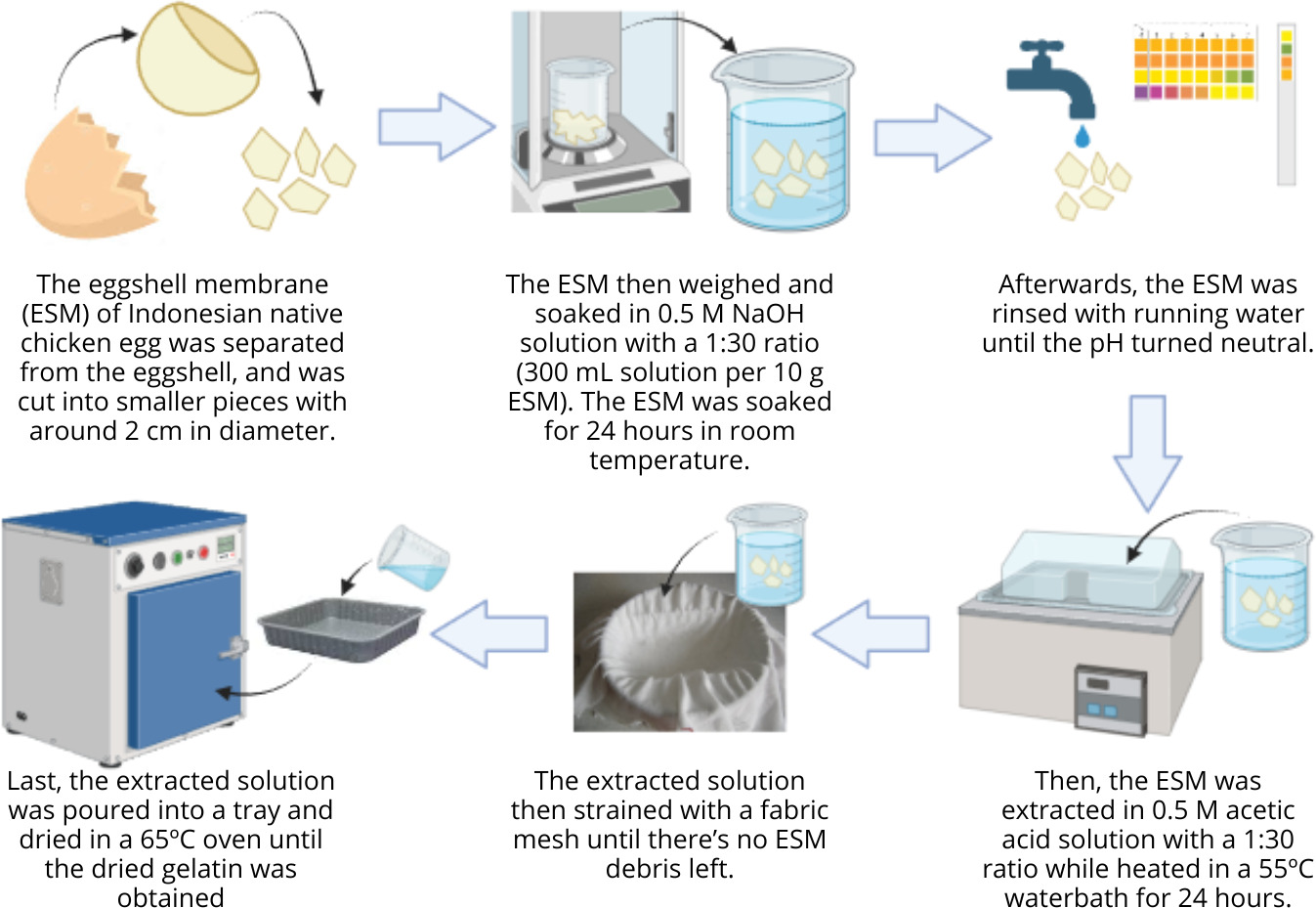
The INCES gelatin was prepared following the methodologies outlined by Chakka et al. (2017) and Febrisiantosa et al. (2024), with some modifications. The mechanism of INCES gelatin production is shown in Figure 1. Initially, the eggshell membrane was separated from the eggshell and soaked in a 0.1 M NaOH solution at a 1:30 ratio for 24 hours. The sample was thoroughly rinsed with tap water until a neutral pH was achieved. The eggshell membrane was then extracted by immersing it in 0.5 M acetic acid at a 1:30 (w/v) ratio and incubating in a water bath at 55 °C for 24 hours. The resulting mixture was filtered through a fabric mesh and subsequently dried in an oven at 65 °C to obtain dried gelatin.

Mechanism of gelatin production from Indonesian native chicken eggshell membrane and the bioplastic manufacturing process (made with Biorender®).
Bioplastic preparation
The bioplastic was created using a modified casting method based on the procedure by Marichelvam et al. (2019). The details of the bioplastic formulation are provided in Table I. Initially, cassava starch, citric acid, glycerol, and gelatin were mixed in 100 mL of distilled water until the solution became homogeneous. The solution without gelatin addition (KT0) will be used as a control. This mixture was then heated on a hot plate at 100°C with continuous stirring for 70 minutes. Subsequently, the solution was evenly spread on a 20 × 15 cm pan and dried in an oven at 55°C for 48 hours. Once dried, the bioplastic could be easily peeled off from the tray.
Color assessment
The color assessment was conducted following the modified method of de Azêvedo et al. (2021). This evaluation utilized the Konica Minolta Spectrophotometer CM-5 in transmittance mode. Bioplastic samples were cut into 3 × 3 cm square sheets and placed on the instrument for measurement. The resulting color values recorded were L* (lightness), a* (redness), and b* (yellowness).
Transparency assessment
The transparency test was conducted following a modified procedure based on Krishnamurthy & Amritkumar (2019). This test utilized the UV-Vis Spectrophotometer Agilent Cary 60 from the US. Bioplastic samples were cut into 1 × 3 cm strips, and their thickness was measured with a micrometer. The prepared strips were mounted onto the inner wall of a cuvette and placed within the instrument, ensuring that the bioplastic surface faced the light source. Transmittance was measured at a wavelength of 600 nm. The transparency value was subsequently determined using the designated formula:
Note:
%T = transmittance percentage at 600 nm
b = bioplastic thickness (mm)
Puncture assessment
The puncture test was conducted following a modified procedure based on Podshivalov et al. (2017). This test employed the Texture Analyzer TA.XT Cplus from Stable Micro Systems, England. Bioplastic samples were cut into 2 × 2 cm square sheets and placed between the plates of the HDP/FSR film support rig. A spherical probe P/55 with a 5 mm diameter was mounted on a 10 kg load cell. The instrument was then operated at a speed of 1 mm/s and a force of 100 g until the bioplastic film was completely punctured. The test measured values for burst strength (g) and distance to burst (mm).
Water solubility test
The water solubility test followed a modified protocol based on Krishnamurthy & Amritkumar (2019). Bioplastic samples were cut into 2 × 2 cm square sheets and dried in an oven at 105°C until they reached a constant weight. The initial weight of the bioplastic was then recorded. Next, the bioplastic was immersed in 100 mL of distilled water with occasional stirring for 24 hours. The remaining bioplastic was retrieved and dried again in the oven at 105°C until it reached a constant weight. The final weight was then measured, and the water solubility percentage was calculated using the specified formula:
Note:
W0 = initial weight (g)
W = final weight (g)
Biodegradability assessment
The biodegradability test was carried out following a modified procedure based on Krishnamurthy & Amritkumar (2019). The soil used in this test, sourced from Tani Binangun, was a mixed medium containing soil, compost, rice husk charcoal, bamboo leaves, and cocopeat. Bioplastic samples were cut into 3 × 3 cm square sheets and buried 6 cm deep in the soil at room temperature. The bioplastic was observed on the 1st, 3rd, 5th, and 7th day after burial by measuring its diameter and noting any changes in appearance.
Statistical analysis
This study was designed using a completely randomized design (CRD) with three replications, followed by mean comparisons through Tukey’s test, with the analysis performed using Minitab Statistical Software 21. The significance level applied in all statistical analyses was set at 95% (p < 0.05). Meanwhile, the data from the biodegradability test were described qualitatively.
RESULTS AND DISCUSSION
Bioplastic products
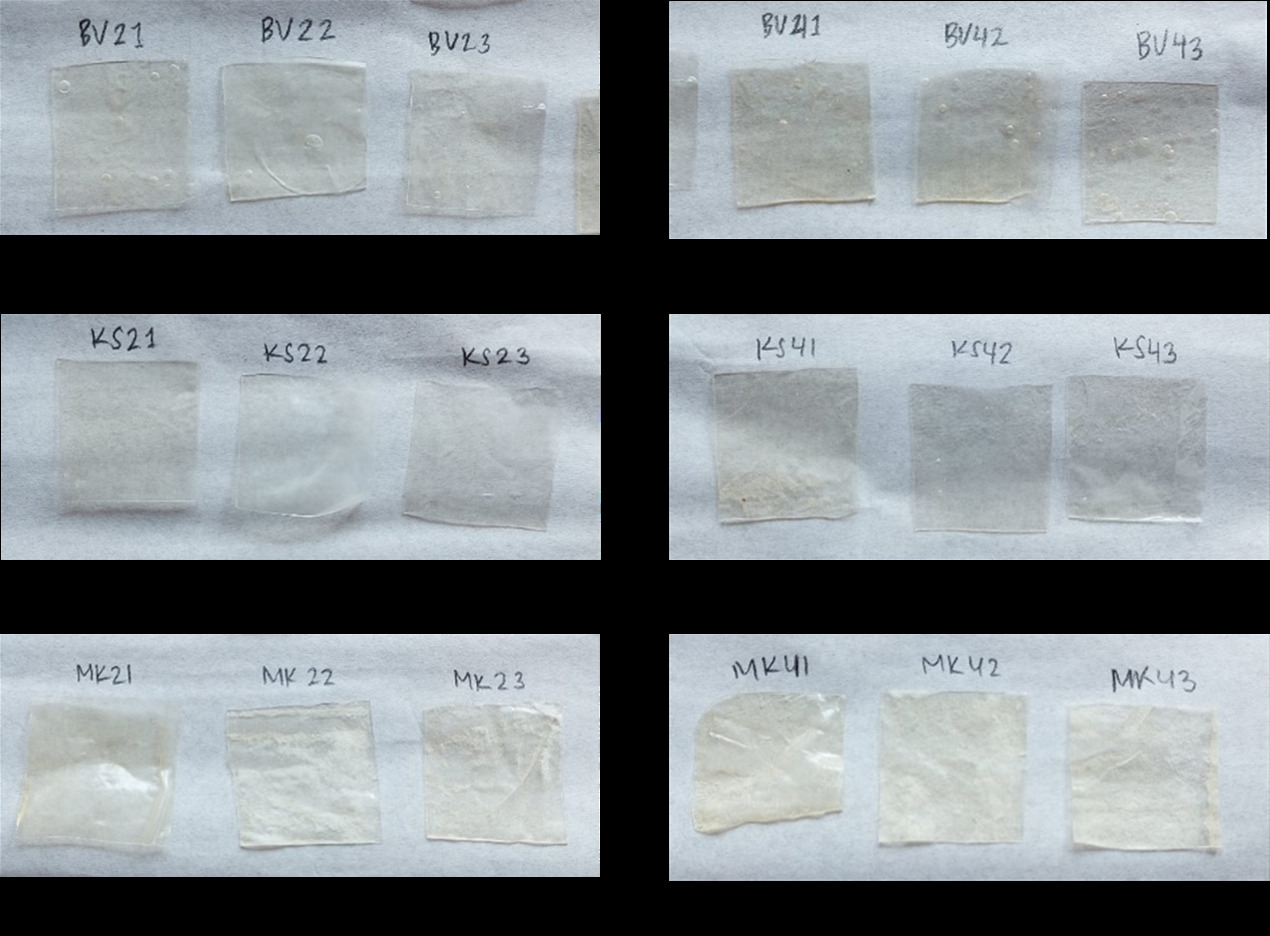
The bioplastics produced using the casting method depicted in Figure 1 exhibited a generally smooth and thin appearance. The bioplastic sheets remained intact with minimal crevices and were relatively easy to peel off the pan. This suggests that the bioplastic film-forming solution was homogeneous, and effective gel formation occurred during heating (Podshivalov et al. 2017). Additionally, this study’s optimal drying temperature and duration ranged from 45-55°C for around 48 hours. Any higher temperatures would result in bioplastics that are too stiff and brittle.
Color assessment
The color units L*, a*, and b* are commonly used to determine the color of materials, with L* representing brightness, a* indicating the chromatic green-red color, and b* signifying the chromatic blue-yellow color (Collins et al. 2015). The brightness level (L*) of bioplastics reflects their light-reflecting ability on the surface (Arifin et al. 2020). The findings (Table II) indicate that the type of gelatin and its concentration significantly influence the L* value of bioplastics. The highest L* value was observed in MK4 (89.75), which showed a significant difference (p < 0.05) from the values of BV4 (59.11) and KS4 (63.48). This demonstrates that bioplastics containing INCES gelatin exhibit a brighter color than those with bovine skin and commercial bovine gelatin. However, the L* values in this study are lower than those reported by Inamura et al. (2015) at 95.50 and Tongnuanchan et al. (2014) at 90.76. The brightness value of bioplastics correlates with their transparency, where a high brightness value indicates lower transparency and vice versa (Galus & Kadzinska 2016). The influence of each gelatin type on bioplastic turbidity may vary (Mroczkowska et al. 2021). Adding INCES gelatin produces bioplastics that are opaquer and thicker, leading to increased light reflection on the bioplastics’ surface and higher L* values on the instrument.
The b* values represent the blue-yellow chromatic color of the bioplastics. According to the results (Table II), different gelatin types and concentrations significantly affect the b* values of bioplastics. The highest b* values (p < 0.05) were observed in MK4 (5.29) and MK2 (2.76), indicating that bioplastics enhanced with INCES gelatin tend to have a yellowish hue. The b* values in this study are higher than those reported by Tongnuanchan et al. (2014) at 0.93 and similar to those by Inamura et al. (2015) at 5.1. This is likely due to ESM gelatin’s generally high b* values, which range from 9.76 to 11.74, giving the bioplastic a yellowish appearance (Aidat et al. 2023).

Visual characteristics of bioplastic products derived from different gelatin components; BV2 = bovine skin gelatin 2%; BV4 = bovine skin gelatin 4%; KS2 = commercial gelatin 2%; KS4 = commercial gelatin 4%; MK2 = INCES gelatin 2%; MK4 = INCES gelatin 4%.
Transparency test
Transparency refers to a material’s ability to transmit light, indicating its level of translucency. As the transparency value increases, the material becomes clearer (Susilawati et al. 2019). High transparency is a crucial quality parameter for bioplastics, as the market generally favors bioplastics with higher transparency (Mroczkowska et al. 2021). According to the results in Table III, adding gelatin to bioplastics significantly reduces their transparency. This finding aligns with Ulyarti et al. (2020), who reported that higher gelatin concentrations decrease bioplastic transparency.
Transparency characteristics of bioplastic products derived from different gelatin components.
In this study, MK4 (3.73%) had the lowest transparency value (p < 0.05) compared to BV2 (7.96%), KS2 (6.46%), KS4 (7.52%), and MK2 (7.17%), indicating that bioplastics with high concentration of INCES gelatin are more turbid (Table III). However, these values are higher than those reported by Mohammadi et al. (2017) and Loo & Sarbon (2020), which ranged from 0.88 to 1.38 and 1.94 to 2.92, respectively. Mroczkowska et al. (2021) suggest that variations in transparency values are likely due to differences in gelatin types and bioplastic thickness. Different gelatin types affect the turbidity rate, while thicker bioplastics allow less light to pass through, reducing the transmission value measured by instruments.
Puncture test
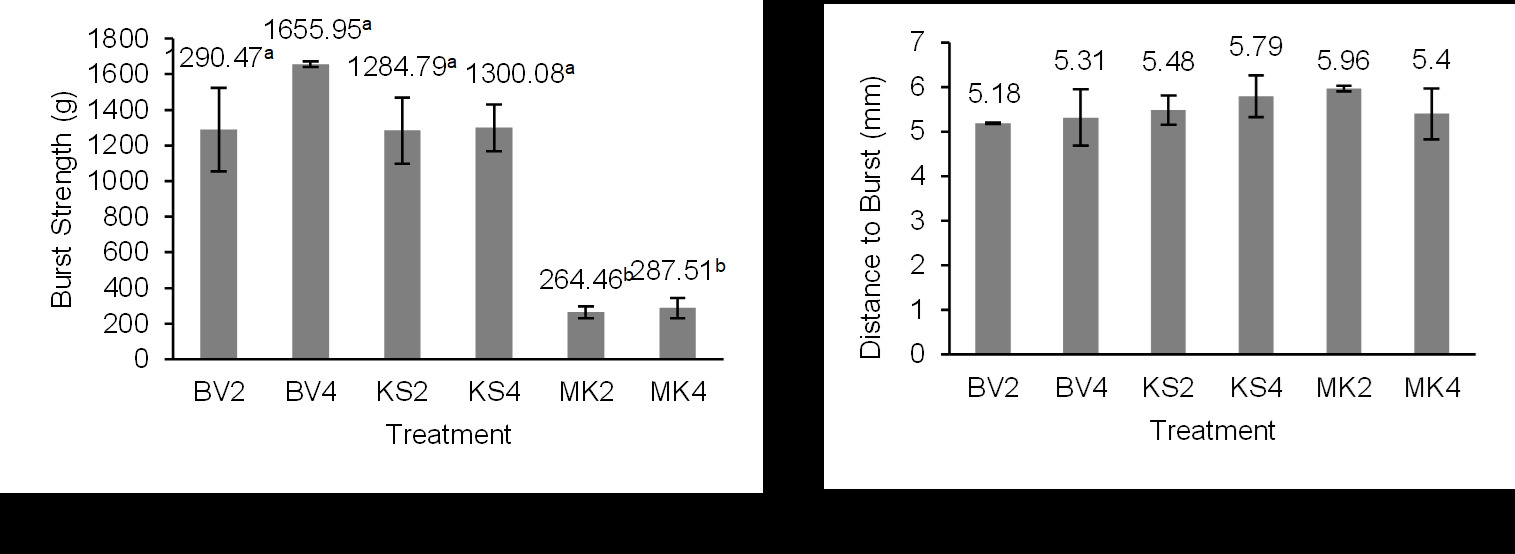
The puncture test in this study was measured through two parameters, which are burst strength and distance to burst. Burst strength is the maximum force required to penetrate bioplastics. Burst strength is measured to determine the resistance of bioplastics when subjected to pressure (Dularia et al. 2019). Based on the burst strength results in Figure 3a, the addition of gelatin significantly influences the burst strength of bioplastics. BV4 (1655.95 g), KS4 (1300.08 g), BV2 (1290.47 g), and KS2 (1284.79 g) have highest burst strength (p < 0.05) compared to MK2 (264.46 g) and MK4 (287.51 g). These results proved that the increase of gelatin concentration in bioplastics improved their burst strength, while the addition of INCES gelatin in bioplastics produced the lowest burst strength compared to others. This contradicts the research by Suderman et al. (2018) that stated chicken skin gelatin-based films have higher burst strength values than bovine gelatin and porcine gelatin (chicken skin gelatin: 2963.29 g; bovine gelatin: 1838.55 g; porcine gelatin: 1687.63 g).
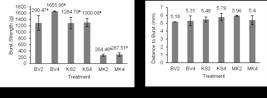
Burst strength (a) and distance to burst (b) of bioplastic products derived from different gelatin components. Bioplastic were analyzed from 2 × 2 cm square sheet samples; BV2 = bovine skin gelatin 2%; BV4 = bovine skin gelatin 4%; KS2 = commercial gelatin 2%; KS4 = commercial gelatin 4%; MK2 = INCES gelatin 2%; MK4 = INCES gelatin 4%. Notations without similar letters indicate significant differences (p < 0.05).
The relatively low burst strength of MK2 and MK4 is very likely related to the difference in gel strength among gelatin types, which affects the structural stability of the gelatin. Gel strength is highly dependent on the type and extraction method of the gelatin. Gelatin with higher gel strength has a stronger structure, and vice versa. INCES gelatin essentially has a lower gel strength than bovine skin gelatin and commercial bovine gelatin. Therefore, the addition of INCES gelatin in bioplastics possibly decreases the stability of its structure and ultimately reduces the burst strength of the bioplastics (Aidat et al. 2023, Ahmad et al. 2021, Sebastian 2014). The low burst strength observed in INCES-based gelatin may stem from structural inconsistencies following acid extraction, potentially leading to excessive fragmentation if the process is not precisely controlled. For instance, Mohammadi et al. (2016) reported that collagen molecules in eggshell membranes were not fully solubilized by extraction with 0.5 mol/L acetic acid. Furthermore, the study suggested that collagen molecules likely underwent covalent cross-linking at the telopeptide regions of the collagen chains, as well as intermolecular cross-links, thereby reducing collagen solubility in acetic acid. The variation in burst strength may also be attributed to differences in the molecular weight profile of gelatin derived from distinct sources. Gelatin obtained from bovine skin typically retains high molecular weight α and β chains, which are essential for mechanical integrity (Ahmad et al. 2019). In contrast, gelatin extracted from eggshell membrane tends to undergo more extensive degradation during processing, yielding shorter peptide fragments and consequently weaker gel networks (Mohammadi et al. 2017). Additionally, the presence of non-collagenous proteins or denatured chains following eggshell membrane extraction could influence the final properties of the gelatin, although this aspect warrants further investigation.
Distance to burst is the maximum distance of the bioplastic strain prior to rupture (Cazon et al. 2018). Based on the results of the distance to burst in Figure 3b, the addition of gelatin did not significantly influence the distance to burst of bioplastics. The distance to burst obtained in this study ranged from 5.18 mm to 5.956 mm and was similar to the research by Flórez et al. (2022), which ranged from 6.19 mm to 7.18 mm and was higher than the research by Cazón et al. (2020), which ranged from 0.39 to 1.86 mm.
Water solubility test
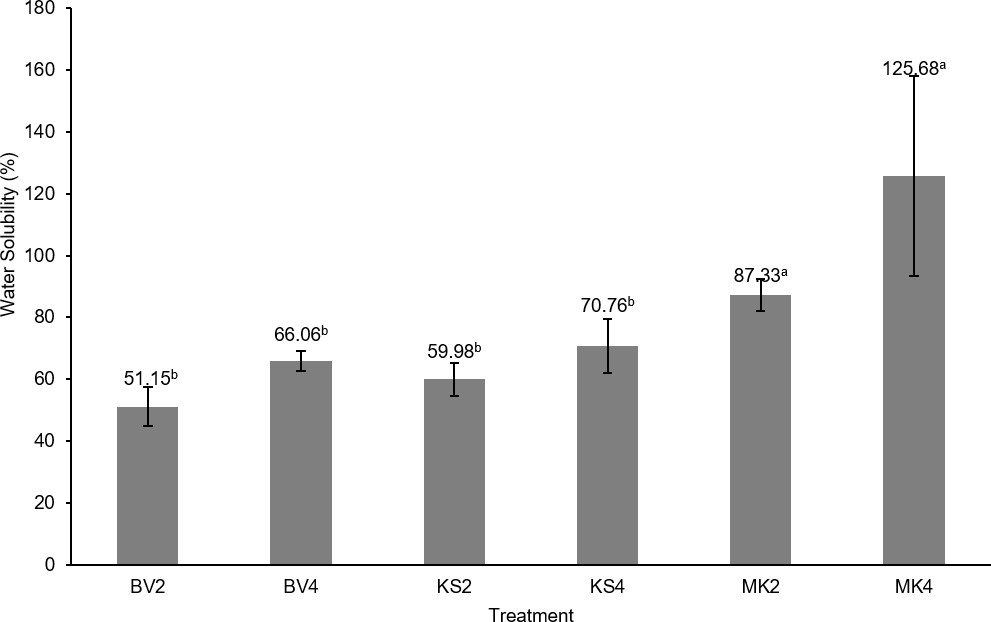
Based on the results shown in Figure 4, the addition of gelatin in bioplastics generally provides a significant influence on the increase of bioplastics’ solubility in water. This result is in parallel with the research by (Castro et al. 2022, Tongdeesoontorn et al. 2012) which stated that the higher the concentration of gelatin in bioplastics further it increases its solubility. In general, gelatin contains many hydrophilic amino acids which increase the formation of hydrogen bonds in the bioplastic structure, thereby forming bonds with water molecules and increasing its solubility (Castro et al. 2022, Fakhouri et al. 2015, Pella et al. 2020).

Water solubility of bioplastic products derived from different gelatin components. Bioplastic were analyzed from 2 × 2 cm square sheet samples; BV2 = bovine skin gelatin 2%; BV4 = bovine skin gelatin 4%; KS2 = commercial gelatin 2%; KS4 = commercial gelatin 4%; MK2 = INCES gelatin 2%; MK4 = INCES gelatin 4%. Notations without similar letters indicate significant differences (p < 0.05).
In addition, different types of gelatin also play a significant role in increasing the solubility of bioplastics. The highest level of solubility (p < 0.05) was found in MK4 and MK2, with a percentage of 125.68% and 87.33%. This shows that bioplastics enhanced with INCES gelatin are most soluble in water compared to other types of gelatin. These results are also similar to edible films from ESM gelatin (91.33%) and films from chicken skin gelatin (94%) (Mohammadi et al. 2017, Loo & Sarbon 2020). This is most likely because gelatin from chicken-derived products has a higher hydrophilic amino acid content than bovine skin or commercial bovine gelatin (Aidat et al. 2023, Aykin-Dincer et al. 2017, Lassoued et al. 2014).
Biodegradability test
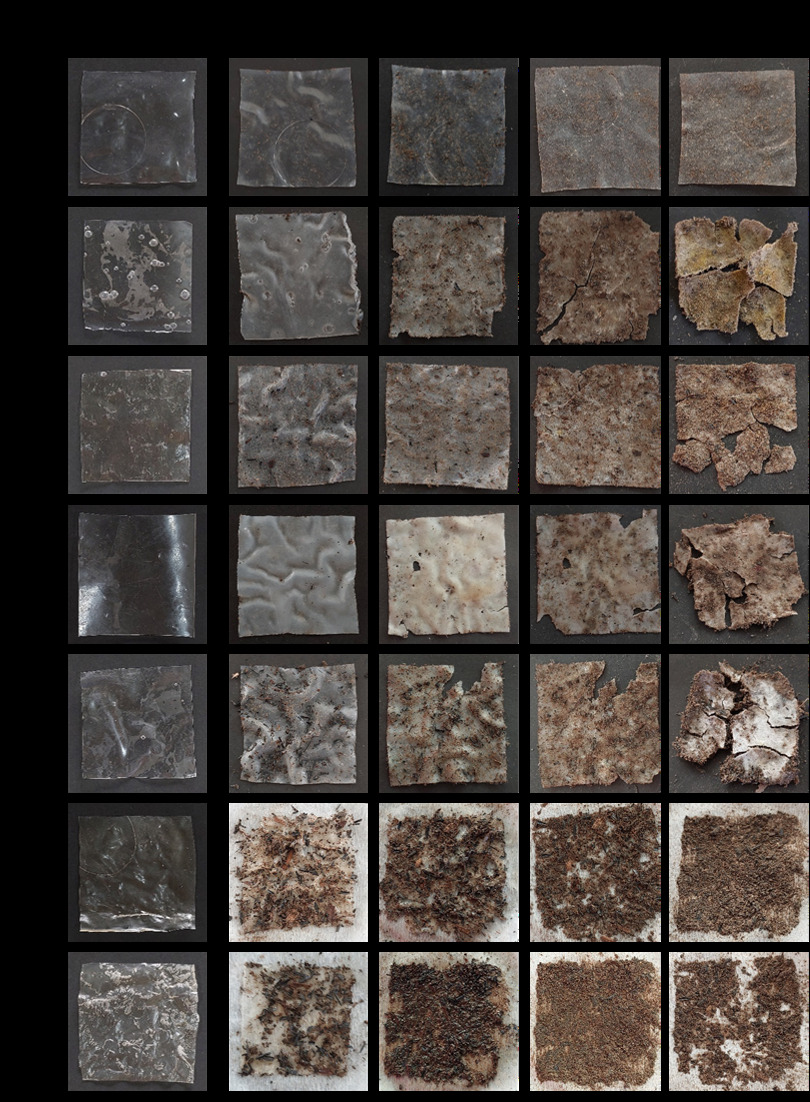
The observation results of the biodegradability test can be seen in Table IV, Figure 5, and Figure 6. After the first day, the appearance of bioplastics was turbid white and had not yet degraded. In addition, swelling occurs which is signified by the increase in the size of bioplastic by 1-5 cm2. Swelling indicates the activity of water absorption in bioplastics which generally occurs due to the formation of bonds between starch hydroxyl groups with water molecules in the soil (Chisenga et al. 2019). The water absorption then initiates the bioplastic degradation process. On the third day, the bioplastics’ sizes did not differ much from the previous day. However, BV2, BV4, KS2 and KS4 began to exhibit discoloration and slight degradation. As for MK2 and MK4, they began to dissolve due to the water content in the soil. On the fifth day, BV2, BV4, KS2, and KS4 turned darker in color, their texture hardened slightly, and many visible cracks appeared. Meanwhile, MK2 and MK4 were completely degraded, making them difficult to identify. On the seventh day, BV2, BV4, KS2 and KS4 began to split and undergo more degradation. Whereas, MK2 and MK4 have become unrecognized.
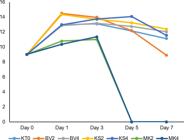
Bioplastics size transformations after burial (cm2); KT0: control unit without gelatin; BV2 = bovine skin gelatin 2%; BV4 = bovine skin gelatin 4%; KS2 = commercial gelatin 2%; KS4 = commercial gelatin 4%; MK2 = INCES gelatin 2%; MK4 = INCES gelatin 4%.
Bioplastics appear on the 1st, 3rd, 5th, and 7th day after burial. Bioplastic samples were cut into 3 × 3 cm square sheets and buried 6 cm; KT0: control unit without gelatin; BV2 = bovine skin gelatin 2%; BV4 = bovine skin gelatin 4%; KS2 = commercial gelatin 2%; KS4 = commercial gelatin 4%; MK2 = INCES gelatin 2%; MK4 = INCES gelatin 4%. Notations without similar letters indicate significant differences (p < 0.05%).
Based on these results, bioplastics enhanced with INCES gelatin have a great biodegradation ability and were able to mostly degraded within 5 days, which is a lot faster compared to other types of gelatin. MK2 and MK4 also degraded faster than the research by Susilawati et al. (2019) which fully degraded in 14 days and by Marichelvam et al. (2019) which 47% degraded in 15 days. The fast degradation of MK2 and MK4 was related to their water solubility. MK2 and MK4 have the highest water solubility due to the higher hydrophilic amino acid content in INCES gelatin. Bioplastics with greater solubility will absorb more water and tend not to be able to maintain their shape upon facing direct contact with moist soil, hence degrade faster.
Reusability and application feasibility
The application of the INCES film is suitable despite its low strength, and can be used in industries that require biofilms that are easily degraded or do not adhere too strongly to surfaces. Some potential applications of INCES such as bioremediation, the food industry, and biomedicine. Biofilms are useful for removing pollutants or contaminants in the environment. If the biofilm is easily broken, it can easily be released from the contaminant and degraded by other microorganisms. In the food industry, if the biofilm is easily lost from the substrate, then the fermentation process can be more easily controlled. In biomedicine as gene therapy or drug. If biofilms are easily degradable in the body, then drugs or genes can be released to the desired target (Donlan & Costerton 2002).
CONCLUSIONS
The incorporation of gelatin derived from Indonesian native chicken eggshell membranes presents a novel method to enhance the physical properties of cassava starch bioplastics. Bioplastics fortified with 2% and 4% of this gelatin exhibit low burst strength, high water solubility, and can degrade in soil within 5 days. Compared with other samples, these bioplastics exhibit suboptimal physical properties. Future research should investigate the addition of other substances, such as chitosan, agar, and cellulose, to improve their mechanical properties.
Acknowledgements
The authors sincerely thank the Research Center for Food Technology and Processing for fostering a collaborative environment that made this work possible. This research received financial support from BRIN Indonesia, under the contract number 9/III.11/HK/2023. The authors declare no conflict of interest.
-
Data availability
The data outlined in this study can be obtained from the corresponding author upon a reasonable request. The datasets generated and analyzed in this study are not publicly accessible due to institutional policy; however, they can be made available for academic purposes upon appropriate justification.
References
-
AHMAD T, ISMAIL A, Ahmad SA, KHALIL KA, KEE LT, AWAD EA & SAZILI AQ. 2019. Physicochemical characteristics and molecular structures of gelatin extracted from bovine skin: effects of actinidin and papain enzymes pretreatment. Int J Food Prop 22(1): 138-153. https://doi.org/10.1080/10942912.2019.1576731.
» https://doi.org/10.1080/10942912.2019.1576731 - AHMAD T, ISMAIL A, AHMAD SA, KHALIL KA, AWAD EA, AKHTAR MT & SAZILI AQ. 2021. Recovery of gelatin from bovine skin with the aid of pepsin and its effects on the characteristics of the extracted gelatin. Polymers 13(10): 1-15.
-
AIDAT O, BELKACEMI L, BELALIA M, ZAINOL MK & BARHOUM HS. 2023. Physicochemical, rheological, and textural properties of gelatin extracted from chicken by-products (feet-heads) blend and application. Int J Gastron Food Sci 32:100708. https://doi.org/10.1016/j.ijgfs.2023.100708.
» https://doi.org/10.1016/j.ijgfs.2023.100708 - ARIFIN HR, INDIARTO R & CIPTANINGTIYAS D. 2020. Physical characteristics of edible film from modified breadfruit starch (Artocarpus atilis F.) with glycerol. IOP Conf Ser Earth Environ Sci 443(1): 012028.
- ASSOCIATION OF AMERICAN FEED CONTROL OFFICIALS. 2009. Section 9.0 – Animal products, in: AAFCO Official Publication. Association of American Feed Control Officials Incorporated (Chapter 5): 341-348.
- AYKIN-DINÇER E, KOÇ A & ERBAS M. 2017. Extraction and physicochemical characterization of broiler (Gallus gallus domesticus) skin gelatin compared to commercial bovine gelatin. Poult Sci 96(11): 4124-4131.
- BALÁŽ M. 2014. Eggshell membrane biomaterial as a platform for applications in materials science. Acta Biomater 10(9): 3827-3843.
- CASTRO JI, NAVIA-PORRAS DP, CORTÉS JAA, HERNÁNDEZ JHM & GRANDE-TOVAR CD. 2022. Synthesis, characterization, and optimization studies of starch/chicken gelatin composites for food packaging applications. Molecules 27(7).
-
CAZÓN P, VELÁZQUEZ G & VÁZQUEZ M. 2020. Bacterial cellulose films: Evaluation of the water interaction. Food Packag Shelf Life 25: 100526. https://doi.org/10.1016/j.fpsl.2020.100526.
» https://doi.org/10.1016/j.fpsl.2020.100526 -
CAZÓN P, VÁZQUEZ M & VELAZQUEZ G. 2018. Cellulose-glycerol-polyvinyl alcohol composite films for food packaging: Evaluation of water adsorption, mechanical properties, light-barrier properties and transparency. Carbohydr Polym 195: 432-443. https://doi.org/10.1016/j.carbpol.2018.04.120.
» https://doi.org/10.1016/j.carbpol.2018.04.120 - CHAKKA AK, MUHAMMED A, SAKHARE PZ & BHASKAR N. 2017. Poultry processing waste as an alternative source for mammalian gelatin: extraction and characterization of gelatin from chicken feet using food grade acids. Waste and Biomass Valorization 8(8): 2583-2593.
-
CHISENGA SM, WORKNEH TS, BULTOSA G & ALIMI BA. 2019. Progress in research and applications of cassava flour and starch: a review. J Food Sci Technol 56(6): 2799-2813. https://doi.org/10.1007/s13197-019-03814-6.
» https://doi.org/10.1007/s13197-019-03814-6 -
COLLINS W, HASS A, JEFFERY K, MARTIN A, MEDEIROS R & TOMLJANOVIC S. 2015. Graphic Design and Print Production Fundamentals, 196 p. Available at: https://opentextbc.ca/graphicdesign/
» https://opentextbc.ca/graphicdesign/ -
DE AZÊVEDO LC, ROVANI S, SANTOS JJ, DIAS DB, NASCIMENTO SS, OLIVEIRA FF, SILVA LGA & FUNGARO DA. 2021. Study of renewable silica powder influence in the preparation of bioplastics from corn and potato starch. J Polym Environ 29(3): 707-720. https://doi.org/10.1007/s10924-020-01911-8.
» https://doi.org/10.1007/s10924-020-01911-8 - DEWI SR, CHAIRUNISA NN, NUGRAHANI RA, NINGSIH TD, FITHRIYAH NH & KOSASIH M. 2020. Preparation and characterization of water solubility and biodegradability of bioplastic from rice bran-corn mixture. Semin Nas Penelit LPPM UMJ 3(7): 2-7.
-
DONLAN RM & COSTERTON JW. 2002. Biofilms: survival mechanisms of clinically relevant microorganisms. Clin Microbiol Rev 15(2): 167-193. https://doi.org/10.1128/CMR.15.2.167-193.2002.
» https://doi.org/10.1128/CMR.15.2.167-193.2002 -
DULARIA C, SINHMAR A, THORY R, PATHERA AK & NAIN V. 2019. Development of starch nanoparticles based composite films from non-conventional source - Water chestnut (Trapa bispinosa). Int J Biol Macromol 136:1161-1168. https://doi.org/10.1016/j.ijbiomac.2019.06.169.
» https://doi.org/10.1016/j.ijbiomac.2019.06.169 -
FAKHOURI FM, MARTELLI SM, CAON T, VELASCO JI & MEI LHI. 2015. Edible films and coatings based on starch/gelatin: Film properties and effect of coatings on quality of refrigerated Red Crimson grapes. Postharvest Biol Technol 109: 57-64. http://dx.doi.org/10.1016/j.postharvbio.2015.05.015.
» https://doi.org/10.1016/j.postharvbio.2015.05.015 - FEBRISIANTOSA A, WAHYONO T, PERTIWI D, UJILESTARI T, PERMADI SN, FAJRI M, HAKIM L & WAHYUNINGSIH R. 2024. Indonesian native chicken eggshell membranes as source for collagen: Optimum conditions and general characteristics. Int Food Res J 31(4): 822-834.
- FLÓREZ M, CAZÓN P & VÁZQUEZ M. 2022. Active packaging film of chitosan and Santalum album essential oil: Characterization and application as butter sachet to retard lipid oxidation. Food Packag Shelf Life 34.
- GALUS S & KADZIŃSKA J. 2016. Moisture Sensitivity, Optical, Mechanical and Structural Properties of Whey Protein-Based Edible Films Incorporated with Rapeseed Oil. Food Technol Biotechnol 54(1): 78-89.
-
HIRASAWA T, OMI N & EZAWA I. 2001. Effect of 1alpha-hydroxyvitamin D3 and egg-shell calcium on bone metabolism in ovariectomized osteoporotic model rats. J Bone Miner Metab 19(2): 84-88. https://doi.org/10.1007/s007740170045.
» https://doi.org/10.1007/s007740170045 - INAMURA PY, REGIS W & MASTRO NL. 2015. Irradiated gelatin-potato starch blends: evaluation of physicochemical properties. Int Nucl Atl Conf - Ina 2015: 1-7.
-
JAIN S & ANAL AK. 2016. Optimization of extraction of functional protein hydrolysates from chicken egg shell membrane (ESM) by ultrasonic assisted extraction (UAE) and enzymatic hydrolysis. Lwt 69: 295-302. http://dx.doi.org/10.1016/j.lwt.2016.01.057.
» https://doi.org/10.1016/j.lwt.2016.01.057 - KAMSIATI E, HERAWATI H & PURWANI EY. 2017. The development potential of sago and cassava starch-based biodegradable plastic in Indonesia. J Penelit dan Pengemb Pertan 36(2): 67.
-
KRISHNAMURTHY A & AMRITKUMAR P. 2019. Synthesis and characterization of eco-friendly bioplastic from low-cost plant resources. SN Appl Sci 1(11): 1-13. https://doi.org/10.1007/s42452-019-1460-x.
» https://doi.org/10.1007/s42452-019-1460-x -
LASSOUED I, JRIDI M, NASRI R, DAMMAK A, HAJJI M, NASRI M & BARKIA A. 2014. Characteristics and functional properties of gelatin from thornback ray skin obtained by pepsin-aided process in comparison with commercial halal bovine gelatin. Food Hydrocoll 41: 309-318. http://dx.doi.org/10.1016/j.foodhyd.2014.04.029.
» https://doi.org/10.1016/j.foodhyd.2014.04.029 -
LOO CPY & SARBON NM. 2020. Chicken skin gelatin films with tapioca starch. Food Biosci 35: 100589. https://doi.org/10.1016/j.fbio.2020.100589.
» https://doi.org/10.1016/j.fbio.2020.100589 - MARICHELVAM MK, JAWAID M & ASIM M. 2019. Corn and rice starch-based bio-plastics as alternative packaging materials. Fibers 7(4): 1-14.
-
MOHAMMADI R, MOHAMMADIFAR MA, MORTAZAVIAN AM, ROUHI M, GHASEMI JB & DELSHADIAN Z. 2016. Extraction optimization of pepsin-soluble collagen from eggshell membrane by response surface methodology (RSM). Food Chem 190: 186-193. https://doi.org/10.1016/j.foodchem.2015.05.073.
» https://doi.org/10.1016/j.foodchem.2015.05.073 -
MOHAMMADI R, MOHAMMADIFAR MA, ROUHI M, KARIMINEJAD M, MORTAZAVIAN AM, SADEGHI E & HASANVAND F. 2017. Physico-mechanical and structural properties of eggshell membrane gelatin- chitosan blend edible films. Int J Biol Macromol 107: 406-412. https://doi.org/10.1016/j.ijbiomac.2017.09.003.
» https://doi.org/10.1016/j.ijbiomac.2017.09.003 - MROCZKOWSKA M, CULLITON D, GERMAINE K & NEVES A. 2021. Comparison of mechanical and physicochemical characteristics of potato starch and gelatine blend bioplastics made with gelatines from different sources. Clean Technol 3(2): 424-436.
-
MUTMAINNA I, GARESO PL, SURYANI S & TAHIR D. 2025. Can agriculture and food waste be a solution to reduce environmental impact of plastic pollution? zero-waste approach for sustainable clean environment. Bioresour Technol 420: 132130. https://doi.org/10.1016/j.biortech.2025.132130.
» https://doi.org/10.1016/j.biortech.2025.132130 -
MUTMAINNA I, SURYANI S, GARESO PL & TAHIR D. 2024. Gadung (Dioscorea hispida Dennst) starch for bifunctional purposes: Wastewater treatment by photocatalytic systems and bioplastic production. Bioresour Technol 26: 101827. https://doi.org/10.1016/j.biteb.2024.101827.
» https://doi.org/10.1016/j.biteb.2024.101827 -
PARK S, CHOI KS, LEE D, KIM D, LIM KT, LEE KH, SEONWOO H & KIM J. 2016. Eggshell membrane: Review and impact on engineering. Biosyst Eng 151: 446-463. http://dx.doi.org/10.1016/j.biosystemseng.2016.10.014.
» https://doi.org/10.1016/j.biosystemseng.2016.10.014 -
PELLÁ MCG, SILVA OA, PELLÁ MG, BENETON AG, CAETANO J, SIMÕES MR & DRAGUNSKI DC. 2020. Effect of gelatin and casein additions on starch edible biodegradable films for fruit surface coating. Food Chem 309: 125764. https://doi.org/10.1016/j.foodchem.2019.125764.
» https://doi.org/10.1016/j.foodchem.2019.125764 -
PODSHIVALOV A, ZAKHAROVA M, GLAZACHEVA E & USPENSKAYA M. 2017. Gelatin/potato starch edible biocomposite films: Correlation between morphology and physical properties. Carbohydr Polym 157: 1162-1172. http://dx.doi.org/10.1016/j.carbpol.2016.10.079.
» https://doi.org/10.1016/j.carbpol.2016.10.079 -
RUFF KJ, ENDRES JR, CLEWELL AE, SZABO JR & SCHAUSS AG. 2012. Safety evaluation of a natural eggshell membrane-derived product. Food Chem Toxicol 50(3-4): 604-611. http://dx.doi.org/10.1016/j.fct.2011.12.036
» https://doi.org/10.1016/j.fct.2011.12.036 - SCHAAFSMA A & BEELEN GM. 1999. Eggshell powder, a comparable or better source of calcium than purified calcium carbonate: piglet studies. J Sci Food Agr 79: 1596-1600. https://doi.org/10.1002/(SICI)1097-0010(199909)79:12<1596:AID-JSFA406>3.0.CO;2-A.
-
SCHAAFSMA A & PAKAN I. 1999. Short-term effects of a chicken egg shell powder enriched dairy-based products on bone mineral density in persons with osteoporosis or osteopenia. Bratisl Lek Listy 100(12): 651-656. https://doi.org/10.1016/s0899-9007(98)00164-6.
» https://doi.org/10.1016/s0899-9007(98)00164-6 -
SEBASTIAN M. 2014. Industrial Gelatin Manufacture- Theory and Practice [cited 2024 Dec 10]. p. 1-88. Available at: https://www.academia.edu/8410348/Industrial_Gelatin_Manufacture_Theory_and_Practice
» https://www.academia.edu/8410348/Industrial_Gelatin_Manufacture_Theory_and_Practice - SUDERMAN N, ISA MIN & SARBON NM. 2018. Characterization on the mechanical and physical properties of chicken skin gelatin films in comparison to mammalian gelatin films. IOP Conf Ser Mater Sci Eng 440(1).
- SUSILAWATI S, ROSTINI I, PRATAMA RI & ROCHIMA E. 2019. Characterization of bioplastic packaging from tapioca flour modified with the addition of chitosan and fish bone gelatin. World Sci News 135: 85-98.
- TONGDEESOONTORN W, MAUER LJ, WONGRUONG S, SRIBURI P & RACHTANAPUN P. 2012. Mechanical and physical properties of cassava starch-gelatin composite films. Int J Polym Mater Polym Biomater 61(10): 778-792.
- TONGNUANCHAN P, BENJAKUL S & PRODPRAN T. 2014. Comparative studies on properties and antioxidative activity of fish skin gelatin films incorporated with essential oils from various sources. Int Aquat Res 6(2): 1-12.
- ULYARTI U, NAZARUDIN N, SURHAINI, LISANI, RAMADON R & LUMBANRAJA P. 2020. Cassava starch edible film with addition of gelatin or modified cassava starch. IOP Conf Ser Earth Environ Sci 515(1): 8-13.
- WAHYUNINGSIH R, FEBRISIANTOSA A, WAHYONO T, PRATIWI D, SETIYAWAN AI, KARIMY MF, KURNIAWAN T, YULIATMO R, ERWANTO Y & ROHMAN A. 2024. Nutrient and morphology of membrane collagen from native chicken eggshell as collagen raw material. J Ilmu Pertan Indones 29(1): 155-161.
- WAHYUNINGTIYAS NE & SURYANTO H. 2018. Properties of cassava starch based bioplastic reinforced by nanoclay. J Mech Eng Sci Technol 2(1): 20-26.
- WINARTI C, MISKIYAH M & WIDANINGRUM W. 2012. Production technology and application of starch based- antimicrobial edible package. J Litbang Pertan 31(3): 85-93.
Edited by
-
Handling editor
Marilia Goulart
The data outlined in this study can be obtained from the corresponding author upon a reasonable request. The datasets generated and analyzed in this study are not publicly accessible due to institutional policy; however, they can be made available for academic purposes upon appropriate justification.