 L. I. Price, a pioneering paleontologist in South America pterosaur description
The recent volume of the Anais da Academia Brasileira de Ciências dedicated to pterosaurs provides a timely opportunity to reflect on the foundational figures of this research field in Brazil. In this context, I wish to call attention to the pivotal, yet sometimes understated, role of Llewellyn Ivor Price (1905–1980, Figure 1).
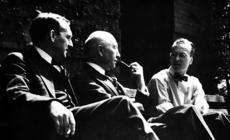
Llewellyn I. Price with both his mentors: Alfred S. Romer on the left and Barnum Brown in the center. Credit: Museu de Ciências da Terra.
L. I. Price was a prominent Brazilian paleontologist, widely regarded as a pioneer and the father of vertebrate paleontology in Brazil. His extensive fossil discoveries and systematic research that helped establish the field in Brazil made him better known. We often celebrate Price for his extensive work on dinosaurs and other terrestrial vertebrates from the Bauru Group, but his contributions extend significantly into the realm of pterosaur paleontology. Price authored the very first description of a pterosaur species in South America. Lately he also described the first pterosaur remains from the Araripe Basin, more specifically from the Romualdo Formation, opening a window for several more discoveries that made this region worldwide known for the exquisite preservation of these flying reptiles (Pinheiro et al. 2025), including the remarkable preservation of soft tissue (Kellner 1996).
Born in Santa Maria, Rio Grande do Sul, Brazil, to American missionary parents, Price and his family lived in the town of Uruguaiana and later in Porto Alegre, where they faced the Spanish flu epidemic. Price moved to the United States to complete his basic education and enroll in a university course. He studied history in college and after some successful attempts and others less positive, Price read in a newspaper that Barnum Braun (1873-1963) was going to dig for fossils in New Mexico. Since he was in Santa Fe, he traveled to Flagstaff and offered to work on the excavation. Mr. Bones hired him for a salary of one dollar per day. After 30 days of excavation, Price enrolled, on Braun’s recommendation, at the University of Oklahoma where he earned a geology degree.
Around that time, on a summer morning, the renowned paleontologist Alfred Sherwood Romer (1894-1973), returning from Texas where he had discovered a new Permian site, stopped by the University of Oklahoma to greet a colleague on the university staff. In that conversation, he told him that he was very busy, as he had a new dig, a book to finish that required countless illustrations, and an assistant for his teaching duties at the University of Chicago, and he concluded, “I need to hire three people”. To which his interlocutor, interrupting that litany, said to him, “I have here a young recent undergraduate who will play the role of all three”, and he introduced Price to him. This dialogue took place at ten in the morning, and by noon, Price was already traveling in a train car, seated next to Romer, to Chicago.
Price worked under Romer’s guidance more as a colleague than as a student did, and when Romer went to Harvard University, Price went with him. Since Price returned from the expedition carried out in 1937 to collect fossils in South America in the company of Theodore E. White (1905-1977), he began to consider the possibility of working in Brazil. This desire could mainly materialize through the invitation and insistence of Mathias Gonçalves de Oliveira Roxo (1885-1954), then head of the Paleontology Section of the Geology and Mineralogy Division (DGM) of the National Department of Mineral Production (DNPM), the Geological Survey of Brazil.
Price returns to Brazil in the early 1940s and begins working at the former National Department of Mineral Production, where he played a key role in expanding fossil collection using appropriate methodology, in creating preparation and research laboratories, in acquiring paleontological literature, and in training of technical and scientific personnel. It is worth mentioning that the paleontological collection that Price helped expand, prepare, illustrate or photograph, identify or describe, in addition to promoting its conservation, today constitutes the fossil collection of the Museum of Earth Sciences of the Geological Survey of Brazil (SGB) in Rio de Janeiro.
Still in the 1950s, Price, examining the fossil collections of the Geology and Mineralogy Division (DGM), described the first bona-fide pterosaur specimen for South America, named ‘Nyctosaurus’ lamegoi, from the Maastrichtian Stage of the Brazilian State of Paraíba. In this same paper (Price 1953), a review of the Bahia Series and Amazon Basin reports the mentions made respectively by Arthur Smith Woodward (1864-1944) and João Barbosa Rodrigues (1842-1909). His work on ´N.´ lamegoi remains a cornerstone of South American pterosaur paleontology and a testament to his foresight and dedication to Brazilian science.
In another seminal paper published in the AABC (Price 1971), Price described a new pterosaur species based on a partial wing specimen collected from the Romualdo Member of the Santana Formation - now the Romualdo Formation of the Santana Group (Pinheiro et al. 2025). This description marked the beginning of a new era of pterosaur research on the continent, demonstrating the immense potential of the Araripe Basin in preserving articulated and often three-dimensionally preserved specimens. His work provided the initial key to unlock the secrets of Gondwanan pterosaur diversity, which subsequent generations of paleontologists, including many contributors to this volume, have built upon. He named the species Araripesaurus castilhoi, which is now on display at the Price Hall of the Museum of Earth Sciences. This landmark publication not only introduced a new taxon to the global scientific community but also firmly established the immense potential of the Araripe Basin as an excellent site for pterosaur fossils.
Price’s meticulous description of A. castilhoi provided a crucial foundation for subsequent studies of the diverse and exceptionally well-preserved pterosaur fauna from the Santana Formation. His work paved the way for future generations of paleontologists who would go on to describe numerous other genera, such as Anhanguera, Tapejara, and Tupuxuara, solidifying Brazil’s position as a global hotspot for pterosaur research (Campos & Kellner 1985, Kellner & Campos 2000).
References
- CAMPOS DA & KELLNER. 1985. Panorama of the flying reptiles study in Brazil and South America. An Acad Bras Cienc 57: 454-466.
- KELLNER AWA. 1996. Reinterpretation of a remarkably well-preserved pterosaur soft tissue from the Early Cretaceous of Brazil. J Vert Paleont 16: 718-722.
- KELLNER AWA & CAMPOS DA. 2000. Vertebrate Paleontology in Brazil – a review. Episodes 22: 238-251.
- PINHEIRO FL ET AL. 2025. Cretaceous Pterosaurs of the Araripe Basin: A Comprehensive Taxonomic Update and Paleobiological Insights. An Acad Bras Cienc 97: e20250622. DOI 10.1590/0001-3765202520250622.
- PRICE LI. 1953. A presença de Pterosauria no Cretáceo Superior do Estado da Paraíba. Notas Preliminares e Estudos do DGM/DNPM 71: 1-10.
- PRICE LI. 1971. A presença de Pterosauria no Cretáceo Inferior da chapada do Araripe, Brasil. An Acad Bras Cienc 43(supl.): 451-461.