 Chitosan/Maleic anhydride and Itaconic acid super porous hydrogels, containing levofloxacin for the treatment of visceral bleeding
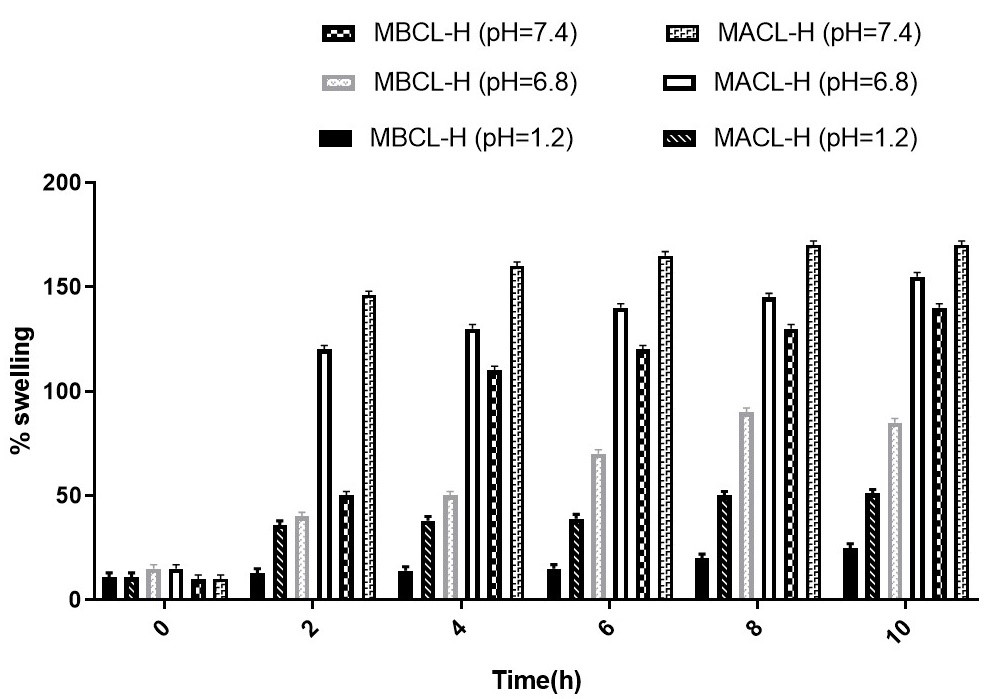
Visceral bleeding poses a significant threat, requiring effective management through positively charged chitosan. This study aimed to address the limitations of chitosan-based hemostatic hydrogels by synthesizing a modified maleic anhydride complex of chitosan (MAC). Biocompatibility, biodegradability, and non-toxicity made MAC a suitable candidate for super porous hydrogels (SPHs) used in hemostatic applications. Graft polymerization synthesized MAC, confirmed via Fourier transform infrared spectroscopy, demonstrating superior antioxidant activity compared to chitosan and maleic anhydride. SPHs were prepared using MAC alone and with N, N-methylene bisacrylamide (MBA) as crosslinkers. MAC exhibited higher water absorbency and pH-dependent swelling than the MBA-chitosan complex. Drug loading and entrapment efficiency varied with the drug-to-SPH ratio. In vitro drug release studies showed sustained release (SR) with SPHs-MAC following zero-order kinetics and SPHs-MBA following Korsmeyer-Peppas. SPHs-MAC gelled more rapidly with temperature changes, and MAC hydrogels showed larger antimicrobial zones of inhibition (28±2).In vivo hemostasis studies revealed rapid hemostatic effects with MACL-H, reducing blood loss to 78.5 ± 1.5 mg in iver rat models. MAC hydrogels significantly lowered blood loss in rat tail amputation models compared to controls. This formulation demonstrates strong potential for effective visceral bleeding management.
Key words
Chitosan; maleic anhydride; super porous hydrogels; hemostasis; antimicrobial activity; in-vivo hemostasis
 Thumbnail
 Thumbnail
 Thumbnail
 Thumbnail
 Thumbnail