 Dual functionality of a waste-derived artificial enzyme: organophosphate degradation and DNA cleavage
Abstract
Pursuing artificial enzymes through materials engineering allows mimicking the high reactivity of natural enzymes while attaching new and desirable properties to the final material. For this, the use of biopolymers – including from waste – as precursors stands out due to their biocompatible features, harmlessness, easy handling, and low cost. Herein, we repurposed Black Wattle gum, an industrial waste from the tannin industry, into an imidazole-functionalized biocatalyst for dephosphorylation reactions. The obtained sample, GNAIMZ, was fully characterized by colorimetric assays, carbon-13 nuclear magnetic resonance, and potentiometric titrations, proving the chemical modification proposed. Then, GNAIMZ was evaluated with organophosphate simulant diethyl 2,4-dinitrophenylphosphate (DEDNPP) and real pesticide Paraoxon, unveiling rate enhancements up to 107-fold compared to the reaction in the absence of biocatalyst. At last, GNAIMZ was applied in DNA cleavage assays, unraveling a nuclease-like activity leading to total degradation of plasmid DNA at pH 7.5 for 12 hours. Overall, this study showcases the successful valorization of a waste-derived gum into a dual-function artificial enzyme for dephosphorylation reactions capable of neutralizing toxic organophosphates and promoting DNA cleavage, reinforcing the promising features of biopolymers as scaffolds for synthetic enzymes – even from byproducts – pursued to chemical security and genetic engineering.
Key words
gum arabic; biocatalyst; organophosphorus compounds; neutralization; functionalization
INTRODUCTION
The design of artificial enzymes has become of great interest, since it makes possible mimicking the high catalytic activity of natural enzymes and improving the processes by adding specific properties, and broadening application fields through genetic engineering (Motherwell et al. 2001, Huang et al. 2019, Lyu & Scrimin 2021, Mathew & Sujatha 2021, Tian et al. 2022, Kumar et al. 2023). A specific target that has been focused on is the class of organophosphates. These compounds are highly stable, present in several biological functions, but can be hydrolyzed through dephosphorylation reactions, e.g., DNA, RNA and ATP (Chambers & Levi 1992, Karalliedde et al. 2001, Corbridge 2013, Chen & Zhang 2021, Gibney & Kellett 2024). However, in biological systems, the transfer of phosphoryl moieties is done by proficient enzymes, without which would be infeasible (e.g., reactions would take over millions of years). Hence, natural enzymes have bioinspired the design of artificial enzymes that could have, for example, nuclease-like activity for medical purposes. These materials can bind segments of DNA (e.g., through phosphodiester backbone) and selectively hydrolyze specific regions, enabling subsequent repair mechanisms. (Motherwell et al. 2001, Huang et al. 2019, Chen & Zhang 2021, Mathew & Sujatha 2021, Kumar et al. 2023, Gibney & Kellett 2024). On the other hand, these artificial enzymes targeted for DNA hydrolysis can be repurposed for hydrolytic processes of phosphoryl moieties aimed at the neutralization and detection of toxic chemicals (Ferreira et al. 2015, Takarada et al. 2022).
While some organophosphates (mono- and diesters) are present in biological systems, the triester family has high toxicity and can be found in many agrochemicals and chemical warfare (Gupta 2011, Jang et al. 2015, Silva et al. 2022, Labaška et al. 2024). There are worldwide concerns with this class of toxic compounds due to: (i) undesired and threatening stockpiles; (ii) abusive use of agrochemicals; (iii) use of these chemicals as weapons in terrorism or other attempts, among others (Jang et al. 2015, Kwon & Jeong 2020, Silva et al. 2022, Labaška et al. 2024, Zhou et al. 2024). In this context, there are numerous efforts towards promoting fast, selective and efficient neutralization and detection of these toxic chemicals, which can benefit from catalysts or artificial enzymes by-design targeted for dephosphorylation processes (Orth et al. 2011, Ferreira et al. 2015, Lyu & Scrimin 2021, Silva et al. 2022).
Many scaffolds have been explored for this such as carbon nanomaterials (Bailey et al. 2014, Santos et al. 2022, Ma et al. 2023), metal-organic frameworks (Hassan et al. 2020, Ma et al. 2023, Biswas et al. 2024), oxidizing agents (Cassagne et al. 2001, Chen et al. 2024, Zhou et al. 2024), macromolecules (Brandhuber et al. 2013, Orth & Campos 2016, Wong et al. 2020, Dastmard et al. 2023), and biopolymers (Ferreira et al. 2015, Ferreira & Orth 2017, Thorat et al. 2018, Kwon & Jeong 2020, Takarada et al. 2022, Takarada et al. 2025). Biopolymers of particular interest are gum arabic derivatives, which are exudates from Acacia trees release. Gums are biocompatible and present a complex polymeric structure containing proteins and polysaccharides (Grein et al. 2013, da Silva et al. 2015, Grein-Iankovski et al. 2018, Sanchez et al. 2018). They can have a broad application in the food, medicinal and pharmaceutical fields, especially when they are chemically modified (da Silva et al. 2015, Ferreira et al. 2015, Ribeiro et al. 2015, Sanchez et al. 2018).
In Brazil, the gum from Acacia mearnsii De Wild (Black Wattle) trees is considered an industrial waste, since the trees are mainly exploited for their tannin (Grein et al. 2013, da Silva et al. 2015, Takarada et al. 2022). Chemically, gum arabic comprises a protein fraction and a complex mixture of polysaccharides, which include uronic acid moieties (Grein et al. 2013, Grein-Iankovski et al. 2018, Sanchez et al. 2018). These uronic acid sites can be targeted for chemical functionalization, adding new functionalities to the biopolymer. Indeed, we have carried out the functionalization of gum arabic – commercial and a residue from Acacia mearnsii gum – with imidazole and hydroxamic acid groups, which lead to biocatalysts extremely efficient in the degradation of organophosphates (Ferreira et al. 2015, Takarada et al. 2022).
Herein, we are interested in benefiting from another residue of Brazilian Black Wattle gum (i.e., extracted using another route) (da Silva et al. 2015, Grein-Iankovski et al. 2018) to functionalize and obtain a biocatalyst. This residue, GNA, has not been exploited for functionalization (da Silva et al. 2015). The functionalized material unveils a dual function: efficient neutralization of toxic organophosphates and nuclease-like activity for cleaving plasmid DNA, comprising a promising artificial enzyme. Figure 1 summarizes the main outcomes of this work: chemical functionalization of a biopolymeric industrial waste and its use for organophosphate neutralization and DNA cleavage, achieving a potential dual functional artificial enzyme.

Schematization of the main features of this study comprising the functionalization of industrial waste from Acacia trees into a dual function artificial enzyme.
MATERIALS AND METHODS
Materials
Black Wattle gum (GNA) was extracted from an alkaline route according to the literature method (Grein et al. 2013, da Silva et al. 2015, Grein-Iankovski et al. 2018), from industrial waste provided by company SETA (Rio Grande do Sul, Brazil). 1-ethyl-3-(3-dimethylaminopropyl)carbodiimide hydrochloride (EDC), N-hydroxysuccinimide (NHS), N-(3-Aminopropyl)-imidazole (API), 3-(Trimethylsilyl)propionic acid sodium salt (TMSP), tetramethylsilane (TMS), pesticide Paraoxon and other chemicals were commercially obtained and used without further purification. The model organophosphate diethyl 2,4-dinitrophenylphosphate (DEDNPP) was synthesized as described in literature (Orth et al. 2011).
Chemical functionalization
GNA was functionalized with imidazoles, via uronic acids, based on methods previously reported (Ferreira et al. 2015, Takarada et al. 2022): in a bottom round flask, 0.25 g of GNA was dissolved in 50 mL of deionized water and the system was stirred overnight at room temperature. Then, 4.4 mmol of EDC and 4.4 mmol of NHS were added to the mixture and the system was left stirring for 2 h (1h in an ice bath and then 1 h at room temperature). After this, 4.4 mmol of API was added, the final mixture was adjusted to pH 7.0, and then it was left stirring for 24 h. Later, the sample was dialyzed against deionized water for 3 days. The resulting sample GNAIMZ was then stored under refrigeration.
Characterization
The carboxylic acids content of the samples was determined by quantifying the uronic acids content in GNA and GNAIMZ, according to the colorimetric assays described in the literature (Filisetti-Cozzi & Carpita 1991).
13C NMR analyses were carried out to verify the chemical modification. GNA (i.e., non-modified sample) spectrum was obtained using a 400 MHz Bruker model DRZ Advance spectrometer and GNAIMZ (i.e., functionalized sample) spectrum was obtained using a 200 MHz Bruker DPX200® equipment accoupled with a 5 mm inverse probe. Analyses were performed at 30 °C in D2O and chemical shifts are expressed in ppm (δ) related to acetone external standard (δ 30.2).
Potentiometric titrations were accomplished according to the literature using a double-wall thermostatic cell at 25 °C and a PHS-3B Phtek® pHmeter. First, the samples were acidified by CO2-free HCl (0.4 mol L-1) to protonate all the ionic species. Then, aliquots of CO2-free KOH solution (0.009953 mol L-1, previously standardized) were added with pH monitoring to proceed with the experiment. Later, the titrations were adjusted using BEST7® software (Martell & Hancock 2013) to identify and estimate equilibrium constants value related to ionic groups in the samples (i.e., carboxylic acids, amines and imidazoles).
Kinetics studies with organophosphates
The reactions were carried out on a UV-Vis Agilent Cary 60 spectrophotometer at 25 °C. The reaction started by adding 10.0 µL of a stock solution of DEDNPP (6.07x10⁻³ mol L-1 in acetonitrile) into a quartz cuvette containing 3.0 mL of the sample (5 mg). The solutions were buffered with 0.01 mol L-1 of K2HPO4 (pH 6.0-7.0) or KHCO3 (7.5-10.5). The kinetics were followed by the appearance of the product 2,4-dinitrophenolate (DNP), under pseudo-first order conditions.
Catalytic activity against organophosphates was also evaluated in the reaction of GNAIMZ with the real pesticide Paraoxon. The reaction was carried out under pseudo-first order conditions at 30 °C in a sealed eppendorf containing 2 mL of the sample (5.0 mg) previously prepared in 0.01 mol L-1 KHCO3 buffer and pH 8.0. The reactions started by adding 10.0 µL of Paraoxon stock solution (1.0x10⁻³ mol L-1 in acetonitrile), and then following the appearance of 4-nitrophenolate product, which presents a band at 400 nm.
Later, for all the reactions, the rate constants were obtained from non-linear plots against time using pseudo-first order equation, and the algorithm of Levenberg-Marquardt in the software Origin 9.0 was used with correlation coefficients >0.98 and for at least 90% of the reaction (Takarada et al. 2025).
Cleavage DNA assays
The catalytic activity of GNAIMZ against plasmid DNA was tested according to adapted method previously described1. The plasmid pBlueScriptKS II + (Genbank: X52327.1)2 was replicated in vivo using Escherichia coli Top10 (Invitrogen) as host, and purified from 3 mL of bacterial culture using the QIAprep® Spin Miniprep Kit (QIAGEN #27104) following manufacturer instructions. The purified DNA was quantified as a function of the absorbance at 260 nm using the NanoDrop 2000 spectrophotometer (Thermo Scientific) and subsequently used for the assays. The catalytic assay was performed incubating 120 ng of purified plasmid DNA with varying amounts (1, 3, 5 and 7 µL) of GNAIMZ prepared in two different pHs (6.5 or 7.5). Reactions were made up to 10 µL with the same buffer of the gum sample preparation. The reactions were incubated at 37 °C for 6, 8 and 12 hours in a Veritti thermal cycler (Applied Biosystems). After the incubation time, the entire reaction was mixed to 1x GelPilot® DNA Loading Dye (part of QIAGEN #27104) and immediately loaded into 1% agarose gel prepared in 1X Tris-Acetate-EDTA buffer and run at 60 mA for 90 minutes3. The DNA was stained in 10 mg mL-1 ethidium bromide solution for 10 minutes and visualized under UV-light (312 nm) using an EC3 transilluminator system (UVP BioImaging Systems) coupled to a CCD camera.
RESULTS AND DISCUSSION
Characterization
The determined uronic acids content of GNAIMZ was 8.4% in contrast to 14.5% reported for the unmodified gum GNA (da Silva et al. 2015) following the same methodology. The decrease in uronic acids content suggests a conversion of 42% of carboxylic acids into imidazole groups after chemical modification. This result is in agreement with the literature (Ferreira et al. 2015), in which conversion rate of 42% was also achieved for commercial gum arabic with imidazoles. The moderate degree of functionalization (in contrast to a complete functionalization) is also desirable for the application of GNAIMZ as a biocatalyst. Recent trends have shown that neighboring effects of nucleophilic groups (imidazoles, in this case) with others ionic groups in the biopolymer (such as carboxylic acids and hydroxyls) can help to promote a more efficient catalysis, instead of the nucleophilic groups alone – mimicking a real enzyme system (Santos et al. 2022, Takarada et al. 2022).
13C NMR was performed to verify the chemical modification of the gum. The 13C NMR spectra for non-modified GNA and GNAIMZ (Figure 1) show signals at δ 173.9 and δ 175.6 ascribed to carboxyl groups of glucuronic acids moieties of the gum in different chemical environments: since GNA is a complex hyperbranched biopolymer, monomers can be positioned with different neighboring groups, which can affect the chemical shifts. This behavior was previously reported in the literature (Grein et al. 2013, Ferreira et al. 2015, Daoub et al. 2018, Sabet et al. 2021, Takarada et al. 2022). Also, exclusively for GNAIMZ, there is a signal at δ 160.1 related to the amide bond formed after chemical functionalization, indicating the successful covalent anchoring of the proposed imidazole-derivative in the polymeric backbone (Ferreira et al. 2015, Ferreira & Orth 2017). Other signals from the imidazole-derivative (i.e., API) in the gum can be assigned and indicate the functionalization: at δ 135.3 and δ 121.3 (related to the imidazol ring) and at δ 46.3, δ 42.7 and δ 34.6/δ 35.7/δ 36.7 (related to secondary carbons in the API chain: CH2(c), CH2(a) and CH2(b), respectively) (Grein et al. 2013, Ferreira et al. 2015, Ferreira & Orth 2017, Zakharova et al. 2024). Multiple and very similar signals are assigned for CH2(b) due to imidazole-functionalization at uronic groups in different chemical environments. Furthermore, compared to the literature (da Silva et al. 2015, Sabet et al. 2021, Takarada et al. 2022), it can be noticed that the polymeric backbone is maintained after the functionalization reaction, since there was no modification in other 13C assignments.
Potentiometric titrations were carried out to determine and to understand the acid-base equilibria of ionic groups in GNA and GNAIMZ. The titrations profiles, as well as the proposed equilibria for the samples are represented in Figure 2 and the main information from titrations is described in Based on data from potentiometric titrations, both samples present two expected and typical pK as values related to the deprotonation of uronic acids (pK a1 = 2.76 and 4.54 for GNA and GNAIMZ, respectively) and to deprotonation of amino acids residues from the protein fraction (pK a2 = 5.69 and 6.55 for GNA and GNAIMZ, respectively). These pK as values are in accordance with the literature for these species and were observed in other gum arabic derivatives (da Silva et al. 2015, Ferreira et al. 2015, Takarada et al. 2022, Tan et al. 2023). Exclusively for GNAIMZ, an additional pK a3 = 8.58 was determined and assigned to the deprotonation of imidazole to its neutral form, indicating the successful chemical functionalization proposed.

13C NMR spectra for GNA and GNAIMZ (at D2O and 30 °C) highlighting the signals related to the chemical modification.
It is noticed that after chemical modification, there is an increase in all pK as values: pK a1-2 increase when comparing GNAIMZ to GNA, and pK a3 for imidazole is higher than usually found in the literature for the free molecule (which pK a ≈ 7). This behavior is also expected due to the additional ionic species (such as imidazole): it promotes neighboring effects that help to stabilize the acidic (or protonated) form, increasing the pK a for all the species involved (Santos et al. 2022, Takarada et al. 2025). Higher pK a value for imidazole-functionalized polymers compared to free imidazole was also stated in the literature, e.g., rice husk-imidazole (pK a(imidazole) = 7.44) (Ferreira & Orth 2017), commercial arabic gum-imidazole (pK a(imidazole) = 7.48) (Ferreira et al. 2015), polyvinyl-imidazole (pK a(imidazole) = 8.25) (Orth & Campos 2016) and carboxymethyl cellulose-imidazole (pK a(imidazole) = 8.63) (Takarada et al. 2025).
Kinetics studies with organophosphates
Catalytic activity against organophosphates was evaluated by reactions of the samples GNA and GNAIMZ with the model diethyl 2,4-dinitrophenylphosphate (DEDNPP). Figure 3 shows a pH rate profile for the functionalized GNAIMZ, compared to the non-functionalized GNA, and to spontaneous hydrolysis (i.e., the aqueous reaction in absence of sample).

Potentiometric titrations profiles and the proposed acid-base equilibria for the ionic species in the gums.
The sample GNAIMZ presents activity towards organophosphate degradation in all pH range studied. The catalytic activity increases with the pH increase, which suits with the deprotonation of imidazole to its neutral form-the most reactive. Also, it is noticed that unmodified GNA has insignificant activity in the reaction, once kobs values are close to those of spontaneous hydrolysis.
The pH rate profile for the reaction with GNAIMZ was adequately fitted considering three parallel reactions (Orth et al. 2011, Ferreira et al. 2015, Ferreira & Orth 2017): i) spontaneous hydrolysis in H2O (k0); ii) alkaline hydrolysis from OH- ions (kOH-) and iii) nucleophilic attack promoted by imidazole (kIMZ). The fitting reveals a catalytic rate kIMZ = 1.40 x10⁻⁵ L g-1 s-1 (considering the concentration of GNAIMZ 2.5 mg mL-1. Since the concentration in mol L-1 is difficult to access for this complex material). Further parameters for the hydrolysis are coherent to the literature (k0 = 1x10⁻⁵ s-1 and kOH- = 0,18 M-1 s-1) (Orth et al. 2011). For better comparison to other studies, the rate constant for GNAIMZ regarding imidazole moieties (kIMZ) was normalized by the total mass, giving the catalytic rate constant kcat = 4.6x10⁻³ s-1 g-1, which means a rate enhancement of 2x10³-fold compared to the spontaneous hydrolysis of DEDNPP (i.e., the reaction in the absence of catalyst). It is also possible to compare the rate enhancement of GNAIMZ to other imidazole-derived biocatalysts also evaluated with DEDNPP, e.g., rice husk-imidazole (3x10³-fold) (Ferreira & Orth 2017) and commercial gum arabic-imidazole (6x10³-fold) (Ferreira et al. 2015). It reveals catalytic increment within the same order of magnitude for GNAIMZ compared to rice-husk-derived biocatalyst and to commercial gum arabic-imidazole, indicating a successful reuse of the byproduct-gum with analogous features to a commercial one.

pH rate profiles for GNA and GNAIMZ (2,5 mg mL-1) with DEDNPP (at 25 °C); The solid line was obtained from the fitting discussed above; DEDNPP spontaneous hydrolysis reaction are shown for comparison (Orth et al. 2011).
Given the catalytic activity of GNAIMZ achieved with DEDNPP, the biocatalyst was also evaluated in neutralization reactions of the real-life pesticide Paraoxon. Reactions were accomplished at 30 °C and pH 8.0. High reactivity of GNAIMZ was also disclosed with Paraoxon, leading to 88.4% degradation after 21 days. It means a normalized rate constant by total mass of kcat = 2.0x10⁻⁴ s-1 g-1 and a rate enhancement of 6x10⁷-fold compared to the reaction in absence of biocatalyst, results among the best in the literature, similar to rice husk-imidazole (107-fold) (Ferreira & Orth 2017) and even higher than free-molecule of imidazole (3x10⁶-fold) (Orth et al. 2011). These results confirm the great catalytic activity of GNAIMZ for neutralizing pesticide Paraoxon and the potential of engineering biocatalysts, once a functionalized imidazole-material (i.e., GNAIMZ) showed higher reactivity than the imidazole molecule. This behavior is ascribed to steric and synergic effects promoted by neighboring groups of the biopolymers (e.g., carboxylates and hydroxyls), which affect the reactivity of imidazole, improving its activity (Takarada et al. 2025). The results are outstanding for a waste-derived material and unveil the potential of reusing waste to design biocatalysts, since GNA is an industrial byproduct without commercial interest.
After the studies with organophosphates DEDNPP and Paraoxon, and based on previous works comprising imidazole-derived biocatalysts (Orth et al. 2011, Ferreira et al. 2015, Takarada et al. 2025), it was also possible to propose a reaction path for the dephosphorylation (i.e., neutralization) reaction, as schematized in Figure 5. Herein, the imidazole moiety act as a nucleophile, attacking the phosphorus center of the organophosphate, leading to a nitrophenolate (2,4-dinitrophenolate (2,4-DNP) for DEDNPP and 4-nitrophenolate (4-NP) for Paraoxon) and to an unstable phosphoryl-imidazole intermediate that easily hydrolyzes into a less toxic phosphate diester and recovering the imidazole group.

Proposed reaction path for dephosphorylation reactions of DEDNPP and Paraoxon into less toxic products, evidencing the imidazole recovery after the process.
Overall, kinetics studies have proved that GNAIMZ act as a biocatalyst in dephosphorylation reactions. The sample revealed high catalytic activity in these neutralization reactions, with rate enhancements up to 103 and 107-fold for simulant DEDNPP and real pesticide Paraoxon, respectively, results among the best in literature. Furthermore, a reaction path was proposed, comprising the imidazole attack on phosphorus center of organophosphate, leading to less toxic products. Moreover, the results so far validated a successful – and efficient – waste-derived biocatalyst benefited from tannin industry.
Table I pK as values determined from potentiometric titrations at 25 °C.| GNA | GNAIMZ | |
|---|---|---|
| pKa1 (COO-) | 2.76±0.02 | 4.54±0.05 |
| pKa2 (NH2) | 5.69±0.02 | 6.55±0.05 |
| pKa3 (IMZ) | 8.58±0.05 |

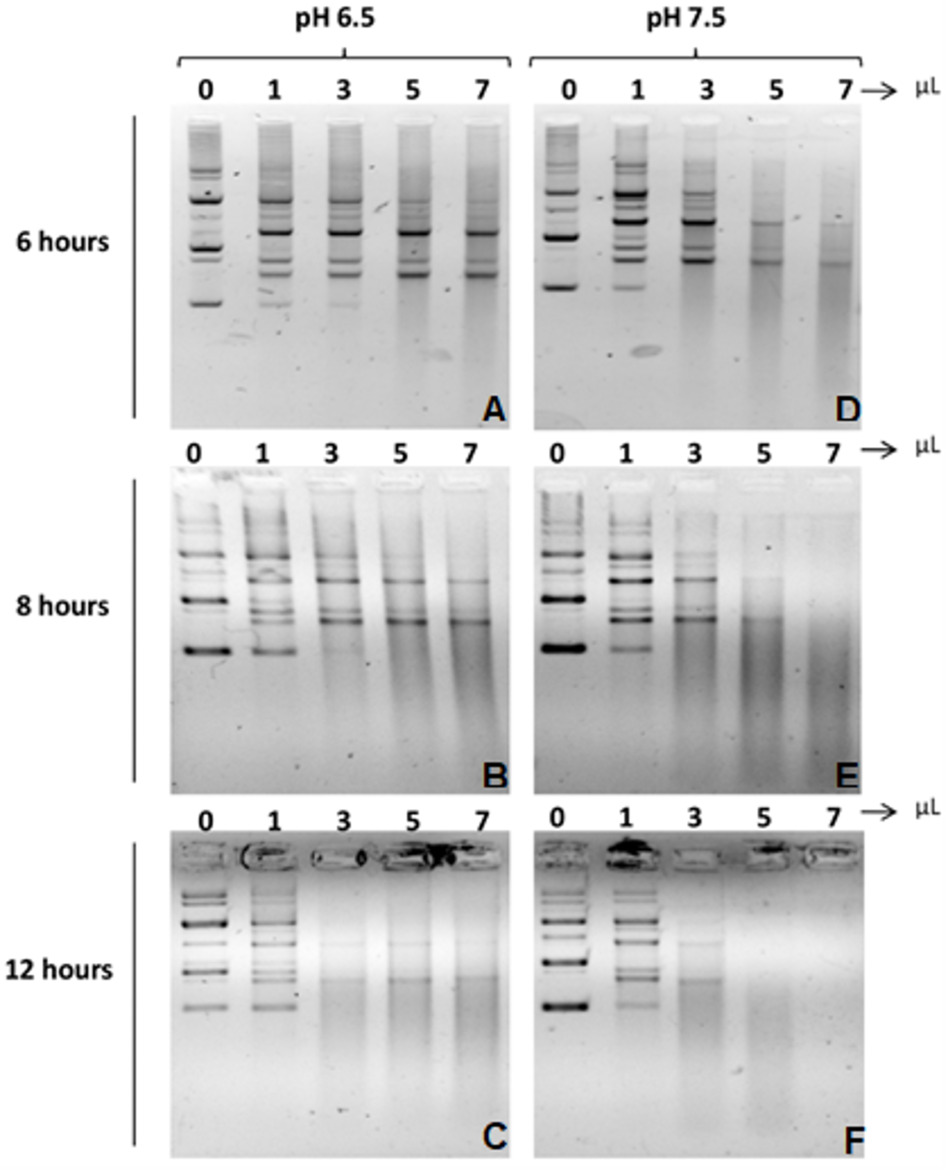
Cleavage of plasmid DNA with GNAIMZ at varying relative amounts (0, 1, 3, 5 and 7 µL), incubated for 6h, 8h and 12h, at 37 °C and pHs 6.5 and 7.5.
Cleavage DNA assays
Imidazole is a versatile and well-known group present in several enzymes. To verify the potential of GNAIMZ as an artificial enzyme, DNA cleavage assays were performed as described in the methods.
Briefly, purified plasmid DNA was incubated with the GNAIMZ as indicated and subsequently analysed in an agarose gel for verification of the nuclease activity. Each panel (A-E) shows the image of the agarose gel electrophoresis performed to evaluate the extent of the plasmid degradation by the gum nuclease activity in different pHs. The reactions carried out under pH 6.5 are presented on the left-hand side (panels A, B, and C), whilst reactions carried out under pH 7.5 are presented on the right-hand side (panels D, E, and F). The reactions were incubated for 6 hours (panels A and D), 8 hours (panels B and E), and 12 hours (panels C and F). The numbers above the gel lanes in each panel, refers to the amount of the gum used (1, 3, 5 or 7 µL) in each cleavage assay. Zero (0) denotes the negative control, where no gum was added to the assay tubes.
Analysis of the electrophoresis pattern upon incubation with GNAIMZ, clearly demonstrates its catalytic activity (Figure 5). In the absence of the gum (lane 0 in panels A to E), the characteristic pattern of intact plasmid migration is observed. The electrophoresis bands are representative of the different plasmid conformations of intact plasmid DNA. After the incubation with the gum (lanes 1, 3, 5 and 7 in panels A to E) the pattern of plasmid migration completely changes. As the volume of gum and the time of incubation increases, we clearly see that the number of intact plasmid bands (compared to lane 0) starts to decrease while a smearing (representative of plasmid degradation) starts to appear. In addition to that, we also observed that the activity of the GNAIMZ against the plasmid DNA is higher under pH 7.5. Strikingly, we observed that the plasmid was completely degraded when incubated with 7 µL of gum under pH 7.5 for 12 hours (lane 7, panel E).
CONCLUSIONS
In summary, we showcase the great potential of functionalized biopolymers, benefiting an unexploited industrial waste – GNA. The imidazole-derived GNAIMZ from the gum proved to have good reactivity for toxic organophosphates degradation and an excellent nuclease-like activity, comprising a real dual-function artificial enzyme. Mild conditions of synthesis and analysis were applied to green up the approach and improve performance without affecting the material. GNAIMZ was characterized confirming moderate chemical modification via amidic bonds and the maintenance of the polymeric backbone. The approach herein can be used to explore other waste-derived and commercial biopolymers with other functional groups, aiming neutralization of toxic pesticides – and even chemical warfare, and development of (bio)sensors and artificial enzymes.
Acknowledgements
This work was supported by UFPR, Conselho Nacional de Desenvolvimento Científico e Tecnológico (CNPq), Coordenação de Aperfeiçoamento de Pessoal de Nível Superior (CAPES), L’Oréal-UNESCO-ABC, PhosAgro/UNESCO/IUPAC, National Institute of Science and Technology of Nanomaterials for Life (INCT Nanovida), National Institute of Science and Technology of Carbon Nanomaterials (INCT Nanocarbon), and Academic Cooperation Program in Public Security and Forensic Sciences-CAPES.
References
- BAILEY MM, HEDDLESTON JM, DAVIS J, STAYMATES JL & HIGHT WALKER AR. 2014. Functionalized, carbon nanotube material for the catalytic degradation of organophosphate nerve agents. Nano Res 7(3): 390-398.
- BISWAS S, GAY R, BZDRENGA J, SOIROT T, BELVERGE N, TAUDON N, BRAZZOLOTTO X, HAOUAS M, STEUNOU N & MAHY JP. 2024. Detoxification of Chemical Warfare Agents by a Zr-Based MOF with High Recycling Ability at Physiological pH. ChemNanoMat 10(8): e202400132.
- BRANDHUBER F, ZENGERLE M, PORWOL L, BIERWISCH A, KOLLER M, REITER G, WOREK F & KUBIK S. 2013. Tabun scavengers based on hydroxamic acid containing cyclodextrins. Chem Comm 49(33): 3425-3427.
- CASSAGNE T, CRISTAU HJ, DELMAS G, DESGRANGES M, LION C, MAGNAUD G, TORREILLES E & VIRIEUX D. 2001. Destruction of chemical warfare agents VX and soman by α-nucleophiles as oxidizing agents. Heteroat Chem 12(6): 485-490.
- CHAMBERS JE & LEVI PE. 1992. Organophosphates: Chemistry, Fate and Effects, Academic Press.
- CHEN H & ZHANG Y-HPJ. 2021. Enzymatic regeneration and conservation of ATP: challenges and opportunities. Crit Rev Biotechnol 41(1): 16-33.
- CHEN X, WANG S, SU L, ZHANG J & XIANG H. 2024. Degradation of organophosphate esters by UV/persulfate: Kinetic, mechanistic and toxicity evaluation. J Water Process Eng 64: 105648.
- CORBRIDGE DE. 2013. Phosphorus: chemistry, biochemistry and technology, CRC press.
- DA SILVA BC, DE OLIVEIRA M, FERREIRA JG, SIERAKOWSKI MR, SIMAS-TOSIN FF, ORTH ES & RIEGEL-VIDOTTI IC. 2015. Polyelectrolyte complexes from gum arabic and gelatin: Optimal complexation pH as a key parameter to obtain reproducible microcapsules. Food Hydrocoll 46: 201-207.
- DAOUB RMA, ELMUBARAK AH, MISRAN M, HASSAN EA & OSMAN ME. 2018. Characterization and functional properties of some natural Acacia gums. J Saudi Soc Agric Sci 17(3): 241-249.
- DASTMARD R, KAVEH F, MEHRABIAN RZ, EBADI M & LEMESKI ET. 2023. Diazinon removal from aqueous solutions using rice husk-carbonized macromolecule. Paddy Water Environ 21(3): 377-387.
- FERREIRA JG, GREIN-IANKOVSKI A, OLIVEIRA MA, SIMAS-TOSIN FF, RIEGEL-VIDOTTI IC & ORTH ES. 2015. A tailored biocatalyst achieved by the rational anchoring of imidazole groups on a natural polymer: furnishing a potential artificial nuclease by sustainable materials engineering. Chem Comm 51(28): 6210-6213.
- FERREIRA JG & ORTH ES. 2017. Degrading Pesticides with Waste Product: Imidazole-Functionalized Rice Husk Catalyst for Organophosphate Detoxification. J Braz Chem Soc 28(9): 1760-1767.
- FILISETTI-COZZI TM & CARPITA NC. 1991. Measurement of uronic acids without interference from neutral sugars. Anal Biochem 197(1): 157-162.
- GIBNEY A & KELLETT A. 2024. Gene Editing with Artificial DNA Scissors. Chem Eur J 30(57): e202401621.
- GREIN A, DA SILVA BC, WENDEL CF, TISCHER CA, SIERAKOWSKI MR, MOURA ABD, IACOMINI M, GORIN PA, SIMAS-TOSIN FF & RIEGEL-VIDOTTI IC. 2013. Structural characterization and emulsifying properties of polysaccharides of Acacia mearnsii de Wild gum. Carbohydr Polym 92(1): 312-320.
- GREIN-IANKOVSKI A, FERREIRA JG, ORTH ES, SIERAKOWSKI M-R, CARDOSO MB, SIMAS FF & RIEGEL-VIDOTTI IC. 2018. A comprehensive study of the relation between structural and physical chemical properties of acacia gums. Food Hydrocoll 85: 167-175.
- GUPTA RC. 2011. Toxicology of organophosphate and carbamate compounds, Academic Press.
- HASSAN MH, ANDREESCU D & ANDREESCU S. 2020. Cerium oxide nanoparticles stabilized within metal–organic frameworks for the degradation of nerve agents. ACS Appl Nano Mater 3(4): 3288-3294.
- HUANG Y, REN J & QU X. 2019. Nanozymes: classification, catalytic mechanisms, activity regulation, and applications. Chem Rev 119(6): 4357-4412.
- JANG YJ, KIM K, TSAY OG, ATWOOD DA & CHURCHILL DG. 2015. Update 1 of: Destruction and Detection of Chemical Warfare Agents. Chem Rev 115(24): PR1-PR76.
- KARALLIEDDE L, FELDMAN S, HENRY J & MARRS T. 2001. Organophosphates and health, Imperial College Press.
- KUMAR P, TOMAR S, KUMAR K & KUMAR S. 2023. Transition metal complexes as self-activating chemical nucleases: proficient DNA cleavage without any exogenous redox agents. Dalton Trans 52(21): 6961-6977.
- KWON W & JEONG E. 2020. Detoxification Properties of Guanidinylated Chitosan Against Chemical Warfare Agents and Its Application to Military Protective Clothing. J Polym 12(7): 1461.
- LABAŠKA M, GÁL M, MACKUĽAK T, ŠVOREC J, KUČERA J, HELENIN J, SVITKOVÁ V & RYBA J. 2024. Neutralizing the threat: a comprehensive review of chemical warfare agent decontamination strategies. J Environ Chem Eng: 11 42-43.
- LYU Y & SCRIMIN P. 2021. Mimicking Enzymes: The Quest for Powerful Catalysts from Simple Molecules to Nanozymes. ACS Catal 11(18): 11501-11509.
- MA X, OU Q, YUAN J, YANG J, XU S & ZHANG X. 2023. Multifunctional Fe-doped carbon dots and metal-organic frameworks nanoreactor for cascade degradation and detection of organophosphorus pesticides. Chem Eng J 464: 142480.
- MARTELL AE & HANCOCK RD. 2013. Metal complexes in aqueous solutions, Springer Science & Business Media.
- MATHEW D & SUJATHA S. 2021. Interactions of porphyrins with DNA: A review focusing recent advances in chemical modifications on porphyrins as artificial nucleases. J Inorg Biochem 219: 111434.
- MOTHERWELL W, BINGHAM M & SIX Y. 2001. Recent progress in the design and synthesis of artificial enzymes. Tetrahedron 57(22): 4663-4686.
- ORTH ES & CAMPOS RB. 2016. Multifunctional imidazole-derived polymeric catalyst for dephosphorylation reactions potentiated by cationic and anionic micelles. J Braz Chem Soc 27: 285-294.
- ORTH ES, WANDERLIND EH, MEDEIROS M, OLIVEIRA PS, VAZ BG, EBERLIN MN, KIRBY AJ & NOME F. 2011. Phosphorylimidazole derivatives: potentially biosignaling molecules. J Org Chem 76(19): 8003-8008.
-
RIBEIRO FWM, LAURENTINO LDS, ALVES CR, BASTOS MDSR, COSTA JMCD, CANUTO KM & FURTADO RF. 2015. Chemical modification of gum arabic and its application in the encapsulation of Cymbopogon citratus essential oil. J Appl Polym Sci 132(8). https://doi.org/10.1002/app.41519
» https://doi.org/10.1002/app.41519 - SABET S, RASHIDINEJAD A, MELTON LD, ZUJOVIC Z, AKBARINEJAD A, NIEUWOUDT M, SEAL CK & MCGILLIVRAY DJ. 2021. The interactions between the two negatively charged polysaccharides: Gum Arabic and alginate. Food Hydrocoll 112: 106343.
- SANCHEZ C, NIGEN M, TAMAYO VM, DOCO T, WILLIAMS P, AMINE C & RENARD D. 2018. Acacia gum: History of the future. Food Hydrocoll 78: 140-160.
- SANTOS YH, MARTINEZ AH, VEIGA AG, ROCCO MLM, ZARBIN AJ & ORTH ES. 2022. Neighboring effects on the selective bifunctionalization of graphene oxide for nanocatalytic organophosphate neutralization. ACS Appl Nano Mater 5(5): 6001-6012.
- SILVA VB, SANTOS YH, HELLINGER R, MANSOUR S, DELAUNE A, LEGROS J, ZINOVIEV S, NOGUEIRA ES & ORTH ES. 2022. Organophosphorus chemical security from a peaceful perspective: sustainable practices in its synthesis, decontamination and detection. Green Chem 24(2): 585-613.
- TAKARADA WH, FERREIRA JG, RIEGEL-VIDOTTI IC & ORTH ES. 2022. Functionalization of gum arabic derivatives for catalytic neutralization of organophosphates. React Funct Polym 181: 105422.
- TAKARADA WH, NAZARENO MH, DE FREITAS RA & ORTH ES. 2025. Cellulose-derived biocatalysts and neutralizing gels for pesticides: how to eliminate and avoid intoxication? J Hazard Mater: 13 75-76.
- TAN C, SUN Y, YAO X, ZHU Y, JAFARI SM, SUN B & WANG J. 2023. Stabilization of anthocyanins by simultaneous encapsulation-copigmentation via protein-polysaccharide polyelectrolyte complexes. Food Chem 416: 135732.
- THORAT K, PANDEY S, CHANDRASHEKHARAPPA S, VAVILTHOTA N, HIWALE AA, SHAH P, SREEKUMAR S, UPADHYAY S, PHUNTSOK T & MAHATO M. 2018. Prevention of pesticide-induced neuronal dysfunction and mortality with nucleophilic poly-Oxime topical gel. Sci Adv 4(10): eaau1780.
- TIAN R, LI Y, XU J, HOU C, LUO Q & LIU J. 2022. Recent development in the design of artificial enzymes through molecular imprinting technology. J Mater Chem B 10(35): 6590-6606.
- WONG PT, TANG S, CANNON J, YANG K, HARRISON R, RUGE M, O’KONEK JJ & CHOI SK. 2020. Shielded α-nucleophile nanoreactor for topical decontamination of reactive organophosphate. ACS Appl Mater Interfaces 12(30): 33500-33515.
- ZAKHAROVA NV, ZELINSKIY SN, STRELOVA MS, DANILOVTSEVA EN & ANNENKOV VV. 2024. Thermo-and pH-sensitive Polymer with Pendant Spacer-linked Imidazole Cycles. Chin J Polym Sci 42(4): 437-445.
- ZHOU X, WANG C, HUANG M, ZHANG J, CHENG B, ZHENG Y, CHEN S, XIANG M, LI Y, BEDIA J, BELVER C & LI H. 2024. A review of the present methods used to remediate soil and water contaminated with organophosphate esters and developmental directions. J Hazard Mater 475: 134834.