 Growth, first maturation and reproduction of Colossoma macropomum (Cuvier, 1818) under controlled conditions
Abstract
This study assessed the growth, gonadal development, first maturation, sperm quality, and first reproduction of Colossoma macropomum raised under controlled conditions. The animals were maintained under consistent conditions. The mean weights reached after the first, second, and third years were 0.94 kg (0.50–1.42 kg), 3.78 kg (3.02–5.19 kg), and 5.66 kg (3.88–8.17 kg), respectively. The highest biomass was 14.1 kg/m³ at 890 days after hatching (DAH), while at the end of the study it was 5.6 kg/m³. Feed conversion remained below 2.0. No differences in weight or length were observed between males and females of the same age. Of the three males analyzed at 590 DAH, one was at rest and two were in initial maturation. Advanced male maturation was first recorded at 710 DAH. Six females showed initial maturation at 710 DAH, while advanced female maturation was first recorded at 890 DAH. Data on VFI, HSI, and GSI throughout development are presented. Sperm quality parameters did not differ between males at 890 and those at 990 DAH. Two out of four induced females spawned. This study is the first to provide evidence suggesting that the life cycle of C. macropomum can be completed in RAS.
Key words
Tambaqui; Reproduction; Sexual maturation; Gonads
INTRODUCTION
The global growth of aquaculture has increased the demand for sustainably produced food. However, aquaculture production faces bottlenecks in some phases of the sector, such as in the formation of breeding stocks and, consequently, in the production of young forms (Amoussou et al. 2022). Resolving this issue requires an understanding of the reproductive biology of the species that are used in production to seek and optimize management alternatives for increased production of viable gametes (Pires et al. 2018). Therefore, research that addresses first maturation is crucially relevant, as it represents a very important point in the animal’s life cycle, marking the beginning of the adult phase (Almeida et al. 2016). Furthermore, such studies have the potential to identify animals that can begin the reproductive process, which allows for their appropriate selection without compromising their well-being. (Rebouças et al. 2014).
The amount of time it takes for animals to reach first maturation is also important, as gonadal development is accompanied by physiological changes in the structure of the gonads, which may cause problems, such as decreased growth rate, changes in behavior and alterations to the immune system that can increase susceptibility to pathogen entry (Taranger et al. 2010, Quagio-Grassiotto et al. 2013). The gonads undergo morphological changes throughout maturation, such as increases in size and vascularization, with the presence of vitellogenic oocytes in the case of females and the appearance of seminiferous tubules with a large quantity of sperm in the lumen in males (Bazzoli 2003, Melillo Filho et al. 2020).
Several complex processes are also initiated in the final maturation stage, such as increased hormone production, which starts gametogenesis and spermatogenesis and changes the behavior of females and males (Lubzens et al. 2010, Schulz et al. 2010). The entire process of sexual maturation is interconnected and begins via external environmental stimuli, such as photoperiod (Li et al. 2023) and water temperature (Gonçalves Junior et al. 2022). These stimuli are captured by chemoreceptors and reach the hypothalamic-pituitary axis, where the production of sex hormones begins (Almeida 2013). Females that are already mature can be identified macroscopically by their red genital papillae and bulging coelomic cavity, indicating an advanced stage of maturation (Sevignani et al. 2020). Males that are ready for reproduction can be identified by observing an exit of a whitish, viscous liquid from the genital pore after performing a simple cranio-caudal massage (Bazzoli 2003).
Tambaqui, Colossoma macropomum Cuvier 1818, is a native fish species of the Amazon basin in South America. Belonging to the family Characidae (order Characiformes), it can reach up to one meter in length and weigh 30 kg (Goulding & Carvalho 1982). It is rheophilic and requires migration to reproduce in the wild, which occurs during the hottest times of the year, while in captivity it requires induction through hormonal doses to stimulate gametogenesis (Goulding & Carvalho 1982, Chellappa et al. 1996, Pires et al. 2019, Sevignani et al. 2020). Recent data demonstrate the importance of this species in Brazil as the most produced native fish and second overall to the non-native tilapia (Oreochromis niloticus) (IBGE 2022). A single study carried out to date with animals kept in excavated nurseries found the first signs of spermatogenesis to appear in five-month-old males, weighing on average 750.0g, while the start of folliculogenesis was observed in seven-month-old females, weighing approximately 1,200g (Almeida et al. 2016). However, there is still no study on the initial maturation of this species in a recirculating aquaculture system (RAS).
Using RAS to evaluate the growth and gonadal development of fish opens new possibilities for aquaculture production. RAS allows for greater animal density, and thus reduced water usage. It also makes cultivation more intensive due to effective temperature and oxygen control, in addition to the treatment of animal waste and the conversion of nitrogenous compounds (Dalsgaard et al. 2013, Lekang 2013, Farias Lima et al. 2019, Shao et al. 2019).
Thus, this study aimed to explore the potential growth, gonadal development, first maturation, quality of first spermiation, and first reproduction of C. macropomum raised in RAS. We hypothesized that under fully controlled environmental conditions, C. macropomum would be capable of completing its life cycle in a laboratory setting, including initial gonadal maturation and reproduction.
MATERIALS AND METHODS
The study was performed in the Laboratório de Aquacultura (LAQUA) of the Universidade Federal de Minas Gerais, with approval by the Comissão de Ética no Uso de Animais (Protocol 80/2021, Belo Horizonte, Brazil).
Juvenile production
One hundred and fifty juvenile C. macropomum, at 50 days after hatching (DAH) and with a mean weight of 0.10 g, from Fazenda Tataueira, Rural Zone of Peixe-Boi in the state of Pará, were acclimatized and divided equally among 16 tanks in a RAS.
Water quality parameters were monitored daily during the entire experimental period. Temperature, pH and dissolved oxygen were measured with an Asko AK88® multiparameter meter while total ammonia was measured using a Labcon colorimetric test. The photoperiod was maintained with a 12-hour light/12-hour dark cycle, with light intensity adjusted so as not to exceed 300 lux in the culture areas. During this first phase, the temperature was maintained at 27.5±0.8 °C, with dissolved oxygen at 4.5±0.5 mg/L and total ammonia at 0.5±0.1 mg/L. The fish were kept in the tanks until they reached the size to begin the growth phase. The animals were fed with Supra Juvenil® 46% 1.7-mm crushed feed, containing: 46% Crude Protein, 8% Ether Extract, 3% Crude Fiber, 14% Mineral Matter, 1.5–3% Calcium, and 750 mg/kg Vitamin C (manufacturer’s data). Feeding was carried out three times a day (at 09:00, 13:00 and 17:00 h), until the animals reached approximately 5.0 g, at which point they started to receive WeaN PRIME 1.8-mm BernAqua® extruded feed, containing: 40% Crude Protein, 7% Ether Extract, 5% Crude Fiber, 14% Mineral Matter, 1.0–2.5% Calcium, and 1000 mg/kg Vitamin C (manufacturer’s data).
Growth and first maturation stage
Table I summarizes the biometrics, cultivation periods, RAS arrangements, sample sizes and diets used during the growth and first maturation phase.
Distribution of Colossoma macropomum among the different biometrics, cultivation periods, and RAS arrangements, along with the types of feed provided.
At 155 DAH, 150 animals with a mean weight of 56.54±22.59g and a mean length of 14.44±1.57 cm were transferred to a 3-m3 tank in a static and thermostatically controlled system (27.6±0. 5 °C, dissolved oxygen maintained at 4.0±0.5 mg/L, total ammonia at 0.5±0.1 mg/L and pH at 6.5±0.5). The fish were fed Laguna Sport 32% 4–6mm Socil®, containing 32% Crude Protein, 5% Ether Extract, 10% Crude Fiber, 14% Mineral Matter 1.5–3.0% Calcium, and 200 mg/Kg Vitamin C (manufacturer’s data), twice a day (09:00 and 16:00 h) ad libitum, for 15 days. Due to rapid growth, at 171 DAH, the animals were divided into two 3-m3 tanks as previously described, where they remained for another 60 days.
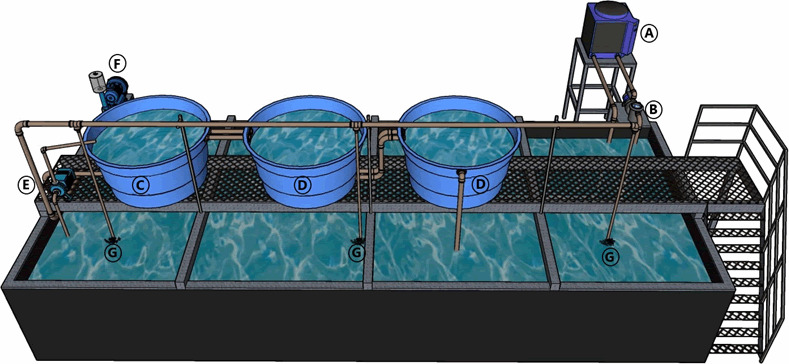
At 231 DAH, the animals were transferred to a 23-m3 tank in a RAS with temperature control (Figure 1; 27.5±0.8 °C, dissolved oxygen at 4.0±0.5 mg/L, total ammonia at 0.5±0.1 mg/L and pH at 6.7 ±0.5). The fish were fed Laguna Sport 32% 4–6mm Socil®, containing 32% Crude Protein, 5% Ether Extract, 10% Crude Fiber, 14% Mineral Matter, 1.5–3.0% Calcium, and 200 mg/Kg Vitamin C (manufacturer’s data) until 590 DAH. At 590 DAH, the fish were offered Laguna Sport 32% 6–8mm Socil®, containing 32% Crude Protein, 5% Ether Extract, 10% Crude Fiber, 14% Material Matter, 1.5–3.0% Calcium, and 200 mg/Kg Vitamin C (manufacturer’s data) until the end of the experiment at 1080 DAH.
Recirculating aquaculture system (RAS): (a) tank with a useful volume of 23m3, equipped with a Nautilus® AA-45 Aquahot Automatic series heat exchanger; (b) Nautilus® Nbfc-2 1/2CV motor pump; (c) mechanical filter/settler with a total capacity of 1m3; (d) biological filter with a total capacity of 1m3 each, equipped with biological media with a surface area of 800 m2/m3, occupying 2/3 of the total capacity of each filter; (e) Dancor® centrifugal pump without pre- 1/3CV filter; (f) 4CV three-phase radial compressor; (g) and air diffusers spread across the tank. Image credit: Helder Guilherme.
The fish were fed twice a day (09:00 and 16:00 h) until apparent satiety. Feeding behavior was observed directly to identify the moment when the animals stopped ingesting feed, at which point the leftover extruded (floating) feed was immediately collected, with care to avoid its dispersion in the system and interference in the consumption estimate. Residual feed was frozen after every daily collection and subsequently dried in an oven at 56°C, which occurred once a week. The moisture content of the feed was corrected after drying to assure the accurate calculation of consumption. The use of extruded feed, and the voracious feeding behavior of the tambaqui, contributed to rapid ingestion, which facilitated efficient recovery of leftovers, even in the large-volume tank with mechanical filtration at the bottom.
Due to animal growth and high biomass, seven animals were randomly removed from the tank during Biometric 13 (890 DAH) and eight during Biometric 14 (946 DAH). Males that released semen were also stored in another tank. The remaining animals were kept in the same tank until 1350 DAH, when hormonal induction was performed.
Evaluation of animal growth
Data on weight, length and feed consumption were used to calculate the following:
-
Weight gain (g) (WG) = final weight (Wf) - mean initial weight (Wi);
-
Daily weight gain (g/day) (DWG) = mean weight gain/days of experiment;
-
Mean length gain (cm) (LG) = mean final length (Lf) - mean initial length (Li);
-
Feed conversion (FC) = feed consumption/biomass gain.
-
SGR (%/day) = [(ln Wf - ln Wi)/t] x 100, where Wf is final weight (g), Wi is initial weight (g), and t is the interval between biometrics.
Indices and gonadal development
Thirteen gonad collections were made during the experiment, beginning at Biometric 4 (290 DAH) (Table I). Each biometric (Table I) involved 10 randomly collected animals, except for Biometric 15 (990 DAH) and Biometric 16 (1080 DAH) for which seven animals were collected each. After blood collection, the animals were euthanized with eugenol solution (285 mg/L) (CEUA Protocol 396/2012). The gonads and liver were then removed through a longitudinal incision (made caudo-cranially from the urogenital pore) in the coelomic cavity. The viscera, gonads and liver were weighed to determine the indices. The Gonadosomatic Index (GSI) was calculated for each individual using the following formula:
where Wg represents the weight of the gonads and Wt the total body weight (Vazzoler 1996).
The Hepatosomatic Index (HSI) was calculated for each individual using the following formulae:
where Wl represents liver weight and Wt the total body weight (Santos et al. 2023).
The Viscerosomatic Fat Index (VFI) was calculated for each individual using the following formula:
where Wfa represents the weight of fat removed from the viscera and Wt the total body weight (Santos et al. 2023).
Gonadal development was evaluated using samples fixed in Bouin’s solution for 24 hours and transferred to 70% alcohol until routine histological processing with paraffin inclusion through dehydration in increasing concentrations of ethyl alcohol, clearing in xylene, and staining with Hematoxylin-Eosin. Microtomy was performed at a thickness of 5–7μm under an optical microscope. Biometric analysis was performed using a stereomicroscope and a light criterion (Olympus BX50 coupled to an Olympus SC-30 camera).
Seminal evaluation
During biometrics, abdominal massage was performed in the cephalo-caudal direction to identify the release of semen. The first semen collection for analysis was done with five males during Biometric 13 (890 DAH), followed by six more males identified during Biometric 14 (946 DAH). The animals were restrained with a damp cloth while material was collected using an automatic micropipette, following the protocol described by Poupard et al. (1998). The material was then stored in a thermal box with ice and taken for analysis in the reproduction laboratory. Semen samples were activated using distilled water at a ratio of 10:200μl (semen:distilled water). Next, 5 μl of the activated semen was placed in a Makler chamber and inserted into a Nikon Eclipse Ci® microscope for assessment of motility, curvilinear velocity (CLV), progressive velocity (VSL) and trajectory velocity (VAP) through computerized analysis using CASA (Computer Assisted Sperm Analysis) software, according to the methodology described by Verstegen et al. (2002).
Induced reproduction
During the experiment, some animals were also cannulated using a #10 urethral probe that was introduced into the genital papilla to collect oocytes. The aim of this procedure was observing the position of the germinal vesicle through ovarian biopsy. The oocytes collected by cannulation were placed in a Petri dish with 5 ml of Serra solution for one minute. The solution was then discarded, and 5 ml of fixative solution (40% formalin and distilled water) was added. After five minutes, the oocytes were placed under a light microscope (Olympus BX50) at 10x magnification for observation. A female was found at 990 DAH weighing 3.120 kg, from which gonads were collected and the advanced stage of maturation identified. The procedure was carried out again on animals that were kept in the tank until 1,350 DAH, when three females weighing 5.795, 6.235 and 7.390 kg were identified as in the advanced stage of maturation and used for hormonal induction, as described by Woynárovich & Horváth (1983) and Harvey & Carolsfeld (1993). Accordingly, females received two doses of crude carp pituitary extract (CPE) that was macerated and diluted in saline solution (0.9% NaCl), the first being 0.5 mg/kg of body weight and the second, 12 hours after the first, being 5.0 mg/kg. Males, previously separated from the batch of animals, received a single dose dosage of 3.0 mg of CPE/kg, together with the application of the second dose to females. Extrusion took place for 230 degree-hours at a temperature of 28 °C.
Statistical analysis
General data on growth, feed conversion, survival, histology and induced reproduction are presented descriptively. Comparative data between the sexes (performance, indices and sperm analysis) are given as mean and standard deviation. Performance and indices were subjected to Levene’s homoscedasticity test and the Shapiro-Wilk normality test. The parameters analyzed between the sexes of the animals at the end of each cultivation period were subjected to Student’s t-test at 5% significance. The parameters analyzed between animals of the same sex at the same biometric (end of each cultivation period) were subjected to ANOVA followed by Tukey’s test at 5% significance. Sperm analysis was subjected to Student’s t-test at 5% significance. All statistical analyses were performed using InfoStat software, Córdoba, Argentina.
RESULTS
There was no animal mortality during the entire experimental period
The animals showed gain in final weight and gain in weight and length throughout the study (Table II). They reached mean weights of 0.94 kg (0.50–1.42 kg), 3.78 kg (3.02–5.19 kg) and 5.66 kg (3.88–8.17 kg) after the first, second and third year, respectively. The greatest biomass reached was 14.1 kg/m3 at 890 DAH, while at the end it was 5.6 kg/m3. The highest values recorded for DWG were between 530 and 990 DAH. Length gain was variable throughout the collections. Feed conversion remained below 2.0 during the entire study. Males and females showed gains in weight and length throughout the study, with no difference between the sexes (Figure 2a, b) (P<0.05). However, there were no differences in weight and length when comparing males and females of the same age (P>0.05). The highest SGR for females was during 590–650 DAH while that for males was during 710–800 DAH (P<0.05) (Figure 2c). The lowest SGR for females was during 650–710 DAH while that for males was during 990–1080 DAH. Comparison of the sexes for each cultivation period (biometric) revealed higher SGR for females during 590–650 DAH and 890–990 DAH and higher SGR for males during 650–710 DAH (P<0.05).
Descriptive data (mean ± standard deviation) of biomass, growth and feed conversion evaluated according to growth phase of Colossoma macropomum fed with commercial feed in RAS.

Mean weight (a), length (b) and specific growth rate (c) (mean ± standard deviation) of Colossoma macropomum in a recirculating aquaculture system (RAS) during sexual maturation. Different uppercase letters indicate significant differences between the different biometrics of each sex by ANOVA followed by Tukey’s test (5%). Different lowercase letters indicate significant differences between the sexes of each biometric by Student’s t-test.
The first collection that identified males, at 470 DAH (Figure 3a), found two, both immature (Table III). At 530 DAH, males were recorded at rest, but with the presence of the first spermatogonia (Figure 3b). However, of the three males analyzed at 590 DAH, one was at rest and two were in initial maturation (Figure 3c). Of the three males analyzed at 650 DAH, two were in intermediate maturity. Advanced maturation was first recorded at 710 DAH (Figure 3d). It is worth noting here that the males that released semen through abdominal pressure at 890 and 946 DAH were separated for semen analysis.
Histological characteristics of testes of Colossoma macropomum during growth at different stages of gonadal maturation.
Transverse sections of testes of Colossoma macropomum stained by HE: A= 470 DAH, immature stage containing randomly distributed spermatogonia (arrows); B= 530 DAH, rest showing seminiferous tubules containing only spermatogonia in the closed lumen wall (*); C= 590 DAH, initial maturation with seminiferous tubules with different cells of the spermatogenic lineage in the wall and lumen with a small amount of spermatozoa (z); D= 710 DAH, advanced maturation (mature) with seminiferous tubules filled with sperm (z).
Of the four females identified at 590 DAH (Figure 4a), two were at rest (Table IV). At 650 DAH, one female was at rest, showing organization of ovigerous lamellae, and two had a predominance of advanced perinucleolar oocytes (Figure 4b). At 710 DAH, six females showed initial maturation (Figure 4c). Advanced maturation was recorded for the two females analyzed at 890 DAH (Figure 4d).
Histological characteristics of Colossoma macropomum ovaries during growth at different stages of gonadal maturation.
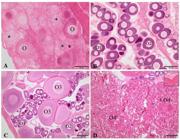
Transverse sections of ovaries of Colossoma macropomum stained by HE: A= 590 DAH, immature stage containing nests of oogonia (*) and some randomly-distributed oocytes (O) in formation; B= 650 DAH, rest showing ovuligerous lamellae containing early perinucleolar (O1) and advanced perinucleolar (O2) oocytes; C= 710 DAH, initial maturation containing O1, O2 and pre-vitellogenic oocytes (O3); D= 890 DAH, advanced maturation (mature) with numerous vitellogenic oocytes (O4), insert = micropyle detail.
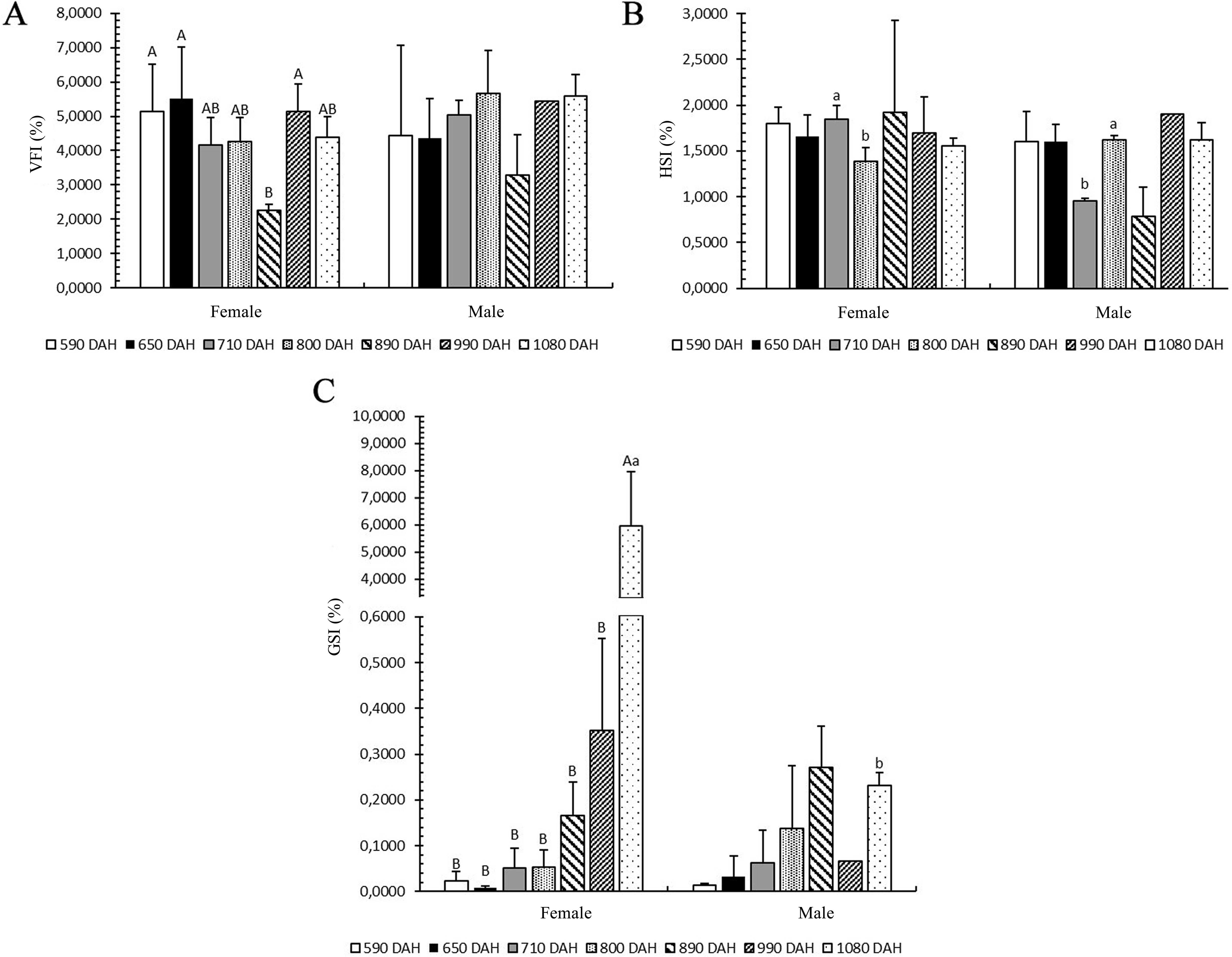
Female VFI was significantly higher at 590, 650 and 990 DAH and lower at 890 DAH (Figure 5a) (P<0.05). There was no difference in male VFI among collections (P>0.05). There were also no differences in VFI between males and females in the same collection (P>0.05).
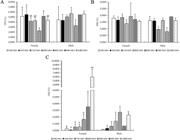
Viscerosomatic Fat Index (a), Hepatosomatic Index (b) and Gonadosomatic Index (c) (mean ± standard deviation) for Colossoma macropomum cultivated in a recirculating aquaculture system (RAS) during sexual maturation. Different uppercase letters indicate significant differences between the different biometrics of each sex by ANOVA followed by Tukey’s test (5%). Different lowercase letters indicate significant differences between the sexes of each biometric by Student’s t-test.
There were no differences in HSI throughout growth for males and females (Figure 5b) (P>0.05). Comparison of males and females in the same collection found females to have higher HSI at 710 DAH and males to have higher HSI at 800 DAH (P<0.05).
The highest GSI for females was at 1080 DAH (P<0.05), while males showed no differences among collections (P>0.05) (Figure 5c). This result was due to differences in the stage of gonadal maturation of the evaluated fish. Comparison of males and females in the same collection found females to have higher GSI at 1080 DAH (P<0.05).
Comparison of sperm quality between males at 890 and those at 990 DAH showed no differences for the evaluated parameters (Table V).
Four females were subjected to induced reproduction. One female, at 990 DAH, had a positive response, spawning 135 g of oocytes with a fertilization rate of 95%. Of the other three females (1350 DAH), one had a positive response, spawning 650 g of oocytes, although fertilization rate could not be determined due to problems with incubation. The other two females did not show a positive response.
DISCUSSION
This is the first study to provide evidence indicating the first sexual maturation of C. macropomum under controlled conditions, demonstrating the adaptability of the species and its successful growth, initial maturation, spermiation, and first spawning. The original hypothesis was that, under stable environmental conditions, C. macropomum would be able to grow, mature and reach first reproduction in the laboratory. Although there have been previous studies on the reproductive development of the species (Lima 1997, Almeida et al. 2016), information on the complete reproductive cycle is has been limited, mainly due to the short observation period of existing research. Therefore, the present study shows the promising potential of using a RAS to enable the production of the species outside its natural range.
Previous studies on the reproduction of C. macropomum in captivity were mostly conducted in earth ponds, net cages or semi-intensive systems, where environmental control is limited and subject to seasonal variation (Lima 1997, Almeida et al. 2016). In contrast, the use of RAS in this study allowed precise control of variables, such as temperature, photoperiod and water quality, throughout the life cycle, which may have been decisive for the success observed in gonadal maturation and spermiation, without the need for transfer to natural environments. The present study suggests that RAS provides a viable alternative, with logistical and sanitary advantages over conventional methods. In addition, RAS favors fish production in regions with subtropical or temperate climates, which expands the geographic area for cultivation of Amazonian species. This approach represents a significant advance in the context of sustainable aquaculture by combining productive efficiency with reduced environmental impacts. The environmental control provided by RAS allows the maintenance of ideal thermal conditions even in regions with milder climates, enabling the reproduction and commercial production in places previously unviable for the species. This thermal flexibility, combined with water use efficiency and the possibility of intensive management, positions RAS as a promising alternative for the expansion of C. macropomum fish farming in different geographic regions, with the potential to meet the growing demand for this native species of high commercial value. The present results confirm this hypothesis and open new perspectives for the reproduction of the species in regions where temperatures may be outside the ideal range for its natural development.
The animals showed growth throughout the study, reaching average weights of 0.94 kg (0.50–1.42 kg), 3.78 kg (3.02–5.19 kg) and 5.66 kg (3.88–8.17 kg) after the first, second and third year of life, respectively. Furthermore, differences in SGR were observed between males and females over time. Females achieved their highest SGR between 590–650 DAH, while males achieved their highest between 710–800 DAH. The lowest SGR values were observed between 650–710 DAH for females and between 990–1080 DAH for males. Comparing the sexes within each cultivation period found that females had higher SGR during 590–650 DAH and 890–990 DAH, while males had higher SGR during 650–710 DAH. These results suggest that the growth of C. macropomum may be related to distinct phases of gonadal development between the sexes, which reinforces the importance of considering sexual differences in the nutritional and reproductive management of the species in RAS. The growth of C. macropomum in RAS during the fattening phase had already been reported by Santos et al. (2021), who found that animals with an average weight of 34.8 g reached between 0.72 and 1.12 kg after 173 days of rearing. In a semi-intensive system, juveniles with an average weight of 160 g, stocked at 1.85 kg/m² in earth ponds, reached an average final weight of 2.620 kg after 300 days of rearing (Izel & Melo 2004). Sousa et al. (2017), using a semi-intensive system with supplemental aeration, also found good results using a biomass of 0.78 kg/m², with juveniles having an initial weight of 42.7 ± 16.3 g reaching a final weight of 1949.0 ± 239 g after 356 days of culture. Good performance was also observed in semi-intensive systems, such as those used by Almeida et al. (2016) and Pires et al. (2018), in terms of growth and maturation of C. macropomum with the use of earth ponds and aeration supplementation, however, these systems present lower water use efficiency and greater dependence on renewal of the environment. In comparison, RAS stands out for its greater water use efficiency, which allows maintaining high stocking densities and optimizing the use of resources, such as feed. Furthermore, data from Santos et al. (2021) showed that the growth rates of C. macropomum in RAS are competitive, with results similar to, or even superior than, those observed in traditional systems, even when considering space limitations and management challenges in semi-intensive systems. However, these results can still be enhanced through more specific nutrition and management studies for the cultivation of C. macropomum in RAS.
The greatest biomass reached with the RAS system used in the present study was 14.1 kg/m3 at 890 DAH, while at the end of the experiment it was 5.6 kg/m3. This biomass is much greater than the 0.10 kg/m2 achieved when maintaining reproducers of this species in earth ponds with low water renewal (Pires et al. 2018). These results highlight the possibility of maintaining C. macropomum breeders at higher densities in RAS for future work. There have been few studies on breeding density in RAS. Anil et al. (2019) used RAS to maintain breeder emperor fish (Lethrinus lentjan), but at a density of 12 animals weighing between 0.7 and 1.2 kg in a tank with a 10-ton capacity fish.
The highest DWG values were recorded between 530 and 990 DAH, ranging from 6.4 to 9.7 g/day. In RAS, Santos et al. (2021) found that DWG varies according to the size of the animals, as in the present study. Furthermore, the authors found similar results, with fish between 300-400 g and fish above 500 g presenting DWG values between 5.74 and 8.36 g/day during 60 days of cultivation. However, López & Anzoátegui (2013) obtained a DWG of 2.67 g/day for the same species, also in RAS, with an average final weight of 818.0 g, a difference attributable to the different managements used in the studies.
Feed conversion remained below 2.0 throughout the study. In RAS, during fattening, the FC for animals with a mean weight of 34.8 g until reaching between 0.72 and 1.12 kg after 173 days of rearing at different stocking densities, varied from 0.79 to 1.76 (Santos et al. 2021). Food conversion values below 2.0 were also recorded for C. macropomum in other rearing systems, such as a net tank (Brandão et al. 2004), at low density in a net tank (Gomes et al. 2006), and in an earth pond (Santos et al. 2014). As for performance, these results confirm the adaptation of C. macropomum to different cultivation systems, with low FC values, which is extremely relevant as food can represent up to 78% of production costs (Freitas 2019).
The present study found no differences in weight and length between males and females of the same age of 590 DAH. Almeida et al. (2016) also found no differences in weight and length between males and females of C. macropomum over time when reared in earth ponds. Morais (2023) reared males and females of C. macropomum in masonry tanks and found that females, although heavier than males in percentage, did not differ significantly from males after 32 months of age, approximately 960 DAH. However, the authors noted that females had greater weight compared to males of the same age in the last two collections of their study. Similar to the present study, Melillo-Filho et al. (2020) evaluated the first maturation of pacamã (Lophiosilurus alexandri) under controlled conditions, and also verified no differences in weight and length between males and females throughout the study. Therefore, this growth relationship between males and females needs further evaluation by future studies.
Advanced maturation in males was recorded at 710 DAH, with the first semen collection being carried out at 890 DAH. Using earth ponds, Almeida et al. (2016) identified initial spermatogenesis in C. macropomum males at 150 DAH, but without identifying final maturation. In another study, carried out in nature, Villacorta-Correa & Saint-Paul (1999) found mature males of C. macropomum with an average length of 60.69 cm, a larger size than that of the males that reached sexual maturity in the present study. Thus, RAS becomes another alternative for forming a group of C. macropomum males.
At 710 DAH, C. macropomum females weighing 2.8 kg showed initial maturation, while at 890 DAH females weighing 4.2 kg showed advanced maturation. In an extensive rearing system, C. macropomum females at 360 DAH reached a mean weight of 3.0 kg but did not reach the initial maturation stage (Almeida et al. 2016). Thus, complete oogenesis does not seem to occur in C. macropomum females with a live weight of less than 3.0 kg. Results for L. alexandri, another native species reared in laboratory conditions from larvae, differ from those for C. macropomum, with females reaching sexual maturity at 783.05 ± 48.57 g live weight (Melillo-Filho et al. 2020).
It was evident in the present study with RAS that C. macropomum males reached sexual maturity before females. This finding corroborates that of Villacorta-Correa & Saint-Paul (1999) for C. macropomum, and was also recorded for corvina (Micropogonias furnieri) (Silva Santos et al. 2015), pintado (Pseudoplatystoma corruscans) (Barzotto et al. 2016) and pacamã (L. alexandri) (Melillo-Filho et al. 2020).
Female VFI was higher at 590, 650 and 990 DAH (rest and regression stages) and lower at 890 DAH (advanced maturation stage). An increase in HSI values during periods in which the animals presented advanced sexual maturation may be related to the accumulation of liver reserves that are used to meet the animals’ energy needs, as verified by Villacorta-Correa & Saint-Paul (1999). No differences were recorded in HSI throughout growth for both males and females in the present study. However, comparisons of the sexes from the same collection found females to have higher HSI at 710 DAH and males to have higher HSI at 800 DAH. As the analyzed individuals did not develop synchronously, males and females presented different HSI values. These results differ from those found by Almeida et al. (2016), where HSI decreased significantly as GSI increased. In the present study, female GSI was highest at 1080 DAH, while males showed no differences among collection days, which may be due to finding males at different stages of maturation in the collections. Male GSI values were similar to those found by Almeida et al. (2016) in their study of first maturation. Comparison of the sexes from the same collection found females to have a higher GSI than males at 1080 DAH. This difference can be explained by the morphological characteristics of the gonads, which are extremely vascularized and full of vitellogenic oocytes that are larger and heavier than sperm, thus requiring a larger structure for storage resulting, consequently, in a greater GSI for females (DeVlaming et al. 1982, Taranger et al. 2010, Flores et al. 2019).
The GSI, HSI and VFI data reveal that these indices varied throughout the rearing period for females, reflecting changes in the nutritional and reproductive status of these breeders. The decrease in VFI observed at 890 DAH can be explained by the mobilization of energy during gonadal development, as females direct their resources to gamete maturation. The higher GSI in females at 1080 DAH is in line with the advanced stage of ovarian maturation. Although data on egg fertilization were not fully evaluated, it is important to highlight that factors such as water flow and oxygenation can have a direct impact on egg viability in RAS. Water quality control in RAS, although efficient, can affect egg oxygenation, especially during critical incubation phases. In the present study, fertilized eggs were incubated directly in the RAS itself. The high quantity of eggs produced resulted in a substantial increase in organic load, leading to elevated ammonia levels during the incubation period. This condition may have negatively affected embryonic development and reduced hatching rates. Although water flow and oxygenation were maintained within adequate parameters, the accumulation of nitrogen compounds appears to have been the main limiting factor for egg viability. Furthermore, the hormonal induction used to stimulate spawning may have variable influences on gamete quality. Variations in hormonal response may affect egg quality and fertilization success, which should be considered to optimize the hormonal induction protocols of future studies. Therefore, the optimization of management parameters, such as water flow and oxygenation, and improvement of the RAS biological filtration system, together with improved hormonal induction protocols, are important steps to maximize reproductive viability and RAS efficiency in the production of juvenile C. macropomum.
Male sperm quality showed no differences for the evaluated parameters at 890 and 990 DAH. However, the sperm quality of animals in the present first maturation study was lower than that found by Pires et al. (2019). We highlight, however, that the animals of the present study were smaller and not induced, with semen collection being done naturally during biometrics. Pires et al. (2019) used 4-year-old animals with an average weight of 6.4 kg and induced them with carp pituitary extract to stimulate spermiation. Pinheiro et al. (2016) also analyzed sperm quality in C. macropomum males induced with pituitary extract, using cryoprotectant and extender to freeze the semen. After thawing, the authors observed much lower motility than that of the present study, showing the higher quality of fresh semen compared to cryopreserved semen.
Although the present study did not directly evaluate parameters such as physiological stress, immunological response and histological quality of gametes, these aspects are recognized as relevant for reproduction. Complementary studies aiming at a more in-depth characterization of these factors in C. macropomum breeders kept in RAS are essential. This integrated approach will allow consolidating the bases for more effective and sustainable reproductive protocols for the species in RAS. This study was the first to explore potential life cycle, considering the literature on large Neotropical freshwater migratory fish, culminating in first reproduction in RAS for C. macropoum. However, despite the first reproductive event, fertilized C. macropoum eggs need to be kept in funnel-type incubators with continuous water flow (Woynárovich & Van Anrooy 2019), as we noticed problems with incubation in RAS. Thus, specific studies are needed for this stage.
CONCLUSIONS
It is possible to rear a breeding stock of C. macropomum in RAS with male spermiation and female final maturation and spawning. Males reached advanced sexual maturity first (710 DAH) followed by females (890 DAH).
Acknowledgements
This research was funded by the Conselho Nacional de Desenvolvimento Científico e Tecnológico (CNPq-Brasil, 402952/2021-9), Fundação de Amparo à Pesquisa do Estado de Minas Gerais (FAPEMIG-Brasil, APQ-01531-21), and Coordenação de Aperfeiçoamento de Pessoal de Nível Superior (CAPES-Brasil). Ronald Kennedy Luz received research grants from CNPq (No. 308547/2018-7).
References
- ALMEIDA FL. 2013. Endocrinologia aplicada na reprodução de peixes. Rev Bras Reprod Anim 37(2): 174-180.
-
ALMEIDA FL, LOPES JS, CRESCENCIO R, IZEL ACU, CHAGAS EC & BOIJINK C. 2016. Early puberty of farmed tambaqui (Colossoma macropomum): Possible influence of male sexual maturation on harvest weight. Aquaculture 452: 224-232. https://dx.doi.org/10.1016/j.aquaculture.2015.10.031.
» https://doi.org/10.1016/j.aquaculture.2015.10.031 -
AMOUSSOU N, LECOCQ T, FOURRIER C, NIVELLE R, FLECK C, FONTAINE P, PASQUET A & THOMAS M. 2022. A multi-trait evaluation framework to assess the consequences of polyculture in fish production: An application for pikeperch in recirculated aquaculture systems. Aquac Rep 27: 101349. https://doi.org/10.1016/j.aqrep.2022.101349.
» https://doi.org/10.1016/j.aqrep.2022.101349 -
ANIL MK, GOMATHI P, SUGI VV, RAHEEM PK, RAJU BG, GOP AP, SANTHOSH B, PHILIPOSE KK, GOPAKUMAR G & GOPALAKRISHNAN A. 2019. Captive maturation, breeding and seed production of Pink ear emperor, Lethrinus lentjan (Lacepède, 1802) (Family: Lethrinidae) in recirculating aquaculture system (RAS). Aquaculture 503: 207-216. https://doi.org/10.1016/j.aquaculture.2018.12.084.
» https://doi.org/10.1016/j.aquaculture.2018.12.084 -
BARZOTTO E, OLIVEIRA M & MATEUS L. 2016. Reproductive biology of Pseudoplatystoma corruscans (Spix and Agassiz, 1829) and Pseudoplatystoma reticulatum (Eigenmann and Eigenmann, 1889), two species of fisheries importance in the Cuiabá River Basin, Brazil. J Appl Ichthyol 33: 29-36. https://doi.org/10.1111/jai.13162.
» https://doi.org/10.1111/jai.13162 - BAZZOLI N. 2003. Parâmetros reprodutivos de peixes de interesse comercial na região de Pirapora. In: Godinho HP & Godinho AL (Eds), Águas, peixes e pescadores do São Francisco da Minas Gerais. Belo Horizonte: PUC Minas, p. 291-306.
-
BRANDÃO FR, GOMES LC, CHAGAS EC & ARAÚJO LD. 2004. Densidade de estocagem de juvenis de tambaqui durante a recria em tanques-rede. Pesq Agropec Bras 39: 357-362. https://dx.doi.org/10.1590/S0100-204X2004000400009.
» https://doi.org/10.1590/S0100-204X2004000400009 -
CHELLAPPA S, CACHO MSRF, HUNTINGFORD FA & BEVERIDGE MCM. 1996. Observations on induced breeding of the Amazonian fish tambaqui, Colossoma macropomum (Cuvier) using CPE and HCG treatments. Aquac Res 27: 91-94. https://dx.doi.org/10.1111/j.1365-2109.1996.tb00971.x.
» https://doi.org/10.1111/j.1365-2109.1996.tb00971.x -
DALSGAARD J, LUND I, THORARINSDOTTIR R, DRENGSTIG A, ARVONEN K & PEDERSEN PB. 2013. Farming different species in RAS in Nordic countries: Current status and future perspectives. Aquac Eng 53: 2-13. https://doi.org/10.1016/j.aquaeng.2012.11.008.
» https://doi.org/10.1016/j.aquaeng.2012.11.008 -
DEVLAMING V, GROSSMAN G & CHAPMAN F. 1982. On the use of the gonosomatic index. Comp Biochem Physiol A 73: 31-39. https://dx.doi.org/10.1016/0300-9629(82)90088-3.
» https://doi.org/10.1016/0300-9629(82)90088-3 -
FARIAS LIMA J, MONTAGNER D, DUARTE SS, YOSHIOKA ETO, DIAS MKR & TAVARES-DIAS M. 2019. Recirculating system using biological aerated filters on tambaqui fingerling farming. Pesq Agropec Bras 54: e00294. https://doi.org/10.1590/S1678-3921.PAB2019.V54.00294.
» https://doi.org/10.1590/S1678-3921.PAB2019.V54.00294 -
FLORES A, WIFF R, GANIAS K & MARSHALL CT. 2019. Accuracy of gonadosomatic index in maturity classification and estimation of maturity ogive. Fish Res 210: 50-62. https://dx.doi.org/10.1016/j.fishres.2018.10.009.
» https://doi.org/10.1016/j.fishres.2018.10.009 - FREITAS SR. 2019. Análise da relação custo/volume/lucro na produção de tilápias em tanques-rede. Artigo acadêmico apresentado à Faculdade de Ciências Contábeis da Universidade Federal de Uberlândia como requisito parcial para obtenção do título de Bacharel em Ciências Contábeis. (Unpublished).
-
GOMES LC, CHAGAS EC, MARTINS-JUNIOR H, ROUBACH R, ONO EA & LOURENÇO JNP. 2006. Cage culture of tambaqui (Colossoma macropomum) in a central Amazon floodplain lake. Aquaculture 253: 374-384. https://doi.org/10.1016/j.aquaculture.2005.08.020.
» https://doi.org/10.1016/j.aquaculture.2005.08.020 -
GONÇALVES JÚNIOR LP, COSTA DC, TAKATA R & LUZ RK. 2022. Effect of temperature on food intake and digestion of Artemia in Lophiosilurus alexandri larvae. J Appl Aquac 36: 57-74. https://doi.org/10.1080/10454438.2022.2115330.
» https://doi.org/10.1080/10454438.2022.2115330 -
GOULDING M & CARVALHO ML. 1982. Life history and management of the Tambaqui (Colossoma macropomum, Characidae): An important Amazonian food fish. Rev Bras Zool 1: 107-133. https://doi.org/10.1590/S0101-81751982000200001.
» https://doi.org/10.1590/S0101-81751982000200001 - HARVEY BJ & CAROLSFELD J. 1993. Induced breeding in tropical fish culture. Ottawa: International Development Research Centre, 144 p.
-
IBGE - INSTITUTO BRASILEIRO DE GEOGRAFIA E ESTATÍSTICA. 2022. Produção da Pecuária Municipal. Available at: https://cidades.ibge.gov.br/brasil/pesquisa/18/16459 Acesso em: 18 nov, 2023.
» https://cidades.ibge.gov.br/brasil/pesquisa/18/16459 - IZEL ACU & MELO LAS. 2004. Criação de tambaqui (Colossoma macropomum) em tanques escavados no Estado do Amazonas. Brasília: Embrapa, Documento 32.
- LEKANG OI. 2013. Aquaculture Engineering. 2. ed. Chichester: Wiley-Blackwell, 432 p.
- LIMA RLVA. 1997. Determinação de esteróides e eletrólitos plasmáticos em fêmeas adultas de tambaqui Colossoma macropomum (Cuvier, 1818) Pisces, Teleostei durante a maturação gonadal. Tese (Doutorado) – Universidade de São Paulo, São Paulo. Acesso em: 8 nov, 2023.
-
LI W ET AL. 2023. Effects of different photoperiod conditions on survival, growth, and gonadal development of Takifugu rubripes adults. Aquaculture 564: 739048. https://doi.org/10.1016/j.aquaculture.2022.739048.
» https://doi.org/10.1016/j.aquaculture.2022.739048 - LÓPEZ P & ANZOÁTEGUI D. 2013. Engorde de la cachama (Colossoma macropomum, Cuvier, 1816) cultivada en un sistema de recirculación de agua. Zoo Trop 31: 271-277. ISSN 0798-7269.
-
LUBZENS E, YOUNG G, BOBE J & CERDÀ J. 2010. Oogenesis in teleosts: how fish eggs are formed. Gen Comp Endocrinol 165: 367-389. https://doi.org/10.1016/j.ygcen.2009.05.022.
» https://doi.org/10.1016/j.ygcen.2009.05.022 -
MELILLO-FILHO R, BAZZOLI N, SOUZA E SILVA W, COSTA DC, BOAVENTURA TP, JULIO GSC & LUZ RK. 2020. Rearing and maturation of Lophiosilurus alexandri (Steindachner, 1876) in controlled conditions: First reports and future perspective. Anim Reprod Sci 214: 106311. https://doi.org/10.1016/j.anireprosci.2020.106311.
» https://doi.org/10.1016/j.anireprosci.2020.106311 - MORAIS IS. 2023. Avaliação da puberdade e indução de neomachos de tambaqui Colossoma macropomum através da administração de esteroides sexuais na ração. Tese (Doutorado em Ciência Animal e Recursos Pesqueiros) - Universidade Federal do Amazonas, Manaus (AM), p. 129.
-
PINHEIRO JPS, LEITE-CASTRO LV, OLIVEIRA FCE, LINHARES FRA, LOPES JT & SALMITO-VANDERLEY CSB. 2016. Qualidade do sêmen de tambaqui (Colossoma macropomum) criopreservado em diferentes concentrações de gema de ovo. Ciênc Anim Bras 17: 267-273. https://doi.org/10.1590/1089-6891v17i22 5386.
» https://doi.org/10.1590/1089-6891v17i22 -
PIRES LB, FILHO RACC, SANCHES EA, ROMAGOSA E, DA SILVA TG, RECH S, STREIT DP & POVH JA. 2018. Colossoma macropomum females can reproduce more than once in the same reproductive period. Anim Reprod Sci 196: 138-142. https://doi.org/10.1016/j.anireprosci.2018.07.006.
» https://doi.org/10.1016/j.anireprosci.2018.07.006 -
PIRES LB, SANCHES EA, ROMAGOSA E, FILHO RACC, NASS RAR, LOPERA-BARRERO NM & POVH JA. 2019. Sperm quality of Colossoma macropomum after room temperature and cold storage. J Appl Ichthyol 35: 747-753. https://doi.org/10.1111/jai.13864.
» https://doi.org/10.1111/jai.13864 -
POUPARD GP, PAXION C, COSSON J, JEULIN C, FIERVILLE F & BILLARD R. 1998. Initiation of carp spermatozoa motility and early ATP reduction after milt contamination by urine. Aquaculture 160(3-4): 317-328. https://doi.org/10.1016/S0044-8486(97)00301-3.
» https://doi.org/10.1016/S0044-8486(97)00301-3 - QUAGIO-GRASSIOTTO I, WILDNER DD & ISHIBA R. 2013. Gametogênese em peixes: aspectos relevantes para o manejo reprodutivo. Rev Bras Reprod Anim 37: 181-191.
- REBOUÇAS PM, MACIEL RL, COSTA BGB, GALVÃO JAS & BARBOSA FILHO JAD. 2014. Análise do bem-estar dos reprodutores de Arapaima gigas (Schinz, 1822) através da relação peso-comprimento, fator de condição e produção de alevinos. Biosci J 30: 873-881.
- SANTOS BLT, ANDRADE JE & SOUSA RGC. 2014. Densidade de estocagem utilizada no desenvolvimento do tambaqui em fase de pré-engorda. Sci Amaz 3: 41-50.
-
SANTOS FAC, BOAVENTURA TP, JULIO GSC, CORTEZZI PP, FIGUEIREDO LG, FAVERO GC, PALHETA GDA, CORREIO DE MELO NFA & LUZ RK. 2021. Growth performance and physiological parameters of Colossoma macropomum in a recirculating aquaculture system (RAS): Importance of stocking density and classification. Aquaculture 534: e736274. https://doi.org/10.1016/j.aquaculture.2020.736274.
» https://doi.org/10.1016/j.aquaculture.2020.736274 -
SANTOS FAC ET AL. 2023. Growth performance and histomorphology of intestine, skin, gills and liver of juvenile Colossoma macropomum fed diets containing different levels of the essential oil of Nectandra grandiflora Fishes 8(10): 509. https://doi.org/10.3390/fishes8100509.
» https://doi.org/10.3390/fishes8100509 -
SCHULZ WR, FRANÇA LR, LAREYRE JJ, LEGAC F, CHIARINI-GARCIA H, NOBREGA RH & MIURA T. 2010. Spermatogenesis in fish. Gen Comp Endocrinol 165: 390-411. https://doi.org/10.1016/j.ygcen.2009.02.013.
» https://doi.org/10.1016/j.ygcen.2009.02.013 -
SEVIGNANI D, BUZZACARO E & FORTUNA NB. 2020. Monitoring the time-grade required for extrusion of oocytes reproductive from Colossoma macropomum Sci Electron Arch 13: 6. https://doi.org/10.36560/1362020946.
» https://doi.org/10.36560/1362020946 -
SHAO T, CHEN X, ZHAI D, WANG T, LONG X & LIU Z. 2019. Evaluation of the effects of different stocking densities on growth and stress responses of juvenile hybrid grouper ♀ Epinephelus fuscoguttatus × ♂ Epinephelus lanceolatus in recirculating aquaculture systems. J Fish Biol 95: 1022-1029. https://doi.org/10.1111/jfb.14093.
» https://doi.org/10.1111/jfb.14093 - SILVA SANTOS R, SILVA JPC, COSTA MR & ARAÚJO FG. 2015. O tamanho de primeira maturação como parâmetro para estabelecimento de tamanho mínimo de captura para corvina no Sudeste do Brasil. Bol Inst Pesca 690(41): 507-518.
-
SOUSA RGC, ROCHA MM, PONTUSCHKA RB & BARBOSA HTR. 2017. Effects of mechanical aeration on tambaqui farming (Colossoma macropomum) in excavated tanks. Acta Fish Aquat Res 5: 122-128. https://doi.org/10.2312/ActaFish.2017.5.3.122-128.
» https://doi.org/10.2312/ActaFish.2017.5.3.122-128 -
TARANGER GL ET AL. 2010. Control of puberty in farmed fish. General and Comp Endocrinol 165: 483-515. https://doi.org/10.1016/j.ygcen.2009.05.004.
» https://doi.org/10.1016/j.ygcen.2009.05.004 - VERSTEGEN J, IGUER-OUADA M & ONCLIN K. 2002. Computer assisted semen analyzers in andrology research and veterinary practice. Theriogenology 57: 149-179.
- VILLACORTA-CORREA MA & SAINT-PAUL U. 1999. Structural indexes and sexual maturity of tambaqui Colossoma macropomum (Cuvier, 1818) (Characiformes: CharaciDAH) in central Amazon, Brazil. Rev Bras Biol 59: 637-652.
- WOYNÁROVICH A & VAN ANROOY R. 2019. Field guide to the culture of tambaqui (Colossoma macropomum, Cuvier, 1816). FAO Fisheries and Aquaculture Technical Paper 624. FAO, p. 1-121.
- WOYNÁROVICH E & HORVÁTH L. 1983. The artificial propagation of warmwater finfishes – A manual for extension (Portuguese). Brasília, Brazil: FAO Fish Tech Pap 201, 183 p.