 A general analysis of the impact of international collaboration on the citation indices of scientific publications from 60 institutions across five continents
Abstract
Several studies suggest that international collaboration increases the impact of science. In this study, we selected 50 universities and 10 research institutes to analyze whether publications produced over a 10-year period would gain more visibility through the occurrence of international collaboration. To address this question, we selected the top 10 ranked universities in the world (2023), along with the top-ranked universities in Africa, Asia, Latin America, and Oceania. Additionally, we included 10 research institutes from different areas of the globe in our analysis. The percentage of publications including international collaboration varied widely among these institutions. Analysis of the average number of citations per publication, in addition to the determination of the field-weighted citation impact, confirmed that international collaboration resulted in higher citation indices. Our study employed approaches to partially quantify the influence of international collaboration on the impact of science, which could serve as the basis for scientific policies aimed at stimulating international partnerships and increasing scientific visibility.
Key words
general; impact; international; collaborations; citations; indices
INTRODUCTION
Science is international by nature, and there is evidence that international collaboration is linked to better science (Rodrigues et al. 2016). International collaboration provides a space where talented minds from diverse parts of the world come together to address complex challenges and make remarkable discoveries (Robinson 2021, Finn & Wylie 2021). With the rise of the internet, international partnerships have increased, and this type of relationship can enhance the quality of scientific projects (Cooke et al. 2021, Khan et al. 2020). Among the various types of collaboration, including national collaborations, industry-academy partnerships, and others, international collaboration seems to have a greater positive impact (Kwiek 2021, Rybnicek & Königsgruber 2019, Sjöö & Hellström 2019). The benefits of international collaboration include the exchange of knowledge and scientific views, exploration of different methodologies, as well as the sharing of equipment and facilities (Patel et al. 2012, Eslami & Lakemond 2016). By integrating diverse talents from different cultures and specialties, an environment conducive to the exchange of ideas is created (Jackson 2018). This type of interaction not only accelerates the pace of scientific advancements but also leads to more comprehensive and innovative solutions for the challenges faced by science (Graesser et al. 2018).
When considering international collaboration as an essential catalyst for scientific progress, the pursuit of tangible metrics and indicators emerges as a crucial approach. This not only validates the effectiveness of collaboration but also guides the scientific community in maximizing the global potential for discoveries that can be achieved through collaborative and intercultural efforts (Orzech et al. 2023). One widely accepted way of measuring the impact of scientific research is counting the frequency of citations (Chen et al. 2019, Onyancha 2020, Paphawasit & Wudhikarn 2022). Quantifying the impact of science not only reinforces the importance of collaboration but also provides valuable insights into optimizing these partnerships for lasting scientific impact (Beck et al. 2022).
In this study, we utilized scientific metrics as an attempt to quantify the perception that international collaboration increases the impact of science. Through the analysis of the citation indices of the scholarly output of 60 scientific institutions all over the world, we observed that scientific impact was unequivocally higher when publications involved international collaboration.
MATERIALS AND METHODS
General approach for data collection
Our analysis was based on scientific articles published in the time window from 2014 to 2023. Scientific institutions were selected based on their classification in the top 10 of the Times Higher Education World University Rankings 2023 (https://www.timeshighereducation.com/world-university-rankings/2023/world-ranking). In this context, we selected the top 10 universities globally, along with the top 10 ranked universities from Latin America, Africa, Asia, and Oceania. Additionally, we included 10 non-university research institutes selected randomly, totaling 60 scientific institutions. For data collection, the analytical base was generated on the SciVal-Elsevier platform (http://scival.com), which utilizes data available on the Scopus-Elsevier platform (http://scopus.com). The institutions selected for our study will be described in Tables I-VI, which are listed in descending order of scholarly output between 2014 and 2023.
Measurement of collaboration
Collaboration in SciVal platform indicates the extent to which an entity’s publications have i) international, ii) national, iii) institutional co-authorship, and iv) single authorship, where no collaboration exists. Each publication is assigned to one of these four possibilities. A single publication may of course display each of international, national and institutional collaboration in its affiliation information, but a single collaboration type is assigned to ensure that the sum of an entity’s publications across the 4 categories adds up to 100% of the publications with the necessary affiliation information.
Field-Weighted Citation Impact (FWCI) analysis
According to Scival, the FWCI Impact accounts for variations in research practices across disciplines. This metric compares the number of citations received by a researcher’s publications with the average citations received by similar publications indexed in the Scopus database. A FWCI of 1.00 signifies that the publications have received citations at the world average for similar works. A FWCI exceeding 1.00 indicates that the publications have received more citations than expected based on the world average for similar works. For instance, a score of 1.51 indicates that the publications have been cited 51% more frequently than expected. Conversely, a FWCI below 1.00 suggests that the publications have received fewer citations than expected based on the world average for similar works. For example, a score of 0.75 indicates that the publications have been cited 25% less frequently than the world average.
Citations per publication
Citations per Publication in the SciVal platform indicates the average citation impact of each scholarly output, through the calculation of the number of citations a publication received on average.
Statistical analysis
To analyze the distribution of different types of collaboration (international, national, institutional, and individual) across regions and institutions, we calculated the relative frequency of scholarly output for each type of collaboration. These results are presented in stacked bar charts shown in Figure 1, and 5-10. To investigate the relationship between type of collaboration and scientific metrics, we calculated the average number of citations per publication and the mean FWCI for each type of collaboration across regions and institutions. These indicators are displayed in the scatter plots in Figure 4, and 5-10. Finally, to evaluate the impact of different types of collaboration on the number of citations per publication and on the FWCI, we employed the Friedman test, as each institution was evaluated under the four types of collaboration. To further explore pairwise comparisons, we conducted Wilcoxon tests with Bonferroni correction for multiple comparisons. For both tests, we considered a significance level of 5%.

General profile of scholarly outputs of the 60 institutions analyzed in this study. Types of collaborations in all regions/groups to which the 60 institutions belong, including international (blue), national (orange), intrainstitutional (red), and no collaboration (single authorship, green). Each bar displays the proportion of values within each colored area, with the total scholarly output indicated at the top of each bar. “Latam” refers to Latin American universities, while “World” refers to the top-ranked universities in the globe.

Citation indices in the 60 institutions analyzed in this study. Types of collaborations in all regions/groups to which the 60 institutions belong, including international (blue), national (orange), intrainstitutional (red), and no collaboration (single authorship, green). Left panel: Average number of citations per publication for the 60 institutions. Right panel: FWCI values for the 60 institutions and types of collaboration. “Latam” refers to Latin American universities, while “World” refers to the top-ranked universities in the globe.
RESULTS
We initially investigated whether the general publication profile of the institutions aggregated by region included significant proportions of international collaboration. The percentage of scholarly output involving international collaboration varied from 32% in the non-university institutions (research institutes) to 54% in a university from Oceania (Figure 1). The research institutes represented the only case where national collaborations predominated (63%). The Friedman test revealed significant differences across the collaboration types, as shown in Figure 2 for number of citations per publication and in Figure 3 for FWCI. Additionally, the post-hoc comparisons indicated that international collaboration resulted in significantly higher values for both citation per publication and FWCI compared to the other types of collaboration.

Statistical analysis of citations per publication using the Friedman test and pairwise comparisons using the Wilcoxon tests with Bonferroni correction for multiple comparisons. Significance levels of 5% were considered. Significant differences across the collaboration types were observed. The post-hoc comparisons indicated that international collaboration resulted in significantly higher values for citation per publication compared to the other types of collaboration or single authorship. “Latam” refers to Latin American universities, while “World” refers to the top-ranked universities in the globe.

Statistical analysis of FCWI using the Friedman test and pairwise comparisons using the Wilcoxon tests with Bonferroni correction for multiple comparisons. Significance levels of 5% were considered. Significant differences across the collaboration types were observed. The post-hoc comparisons indicated that international collaboration resulted in significantly higher values for FCWI compared to the other types of collaboration or single authorship. “Latam” refers to Latin American universities, while “World” refers to the top-ranked universities in the globe.
Subsequently, we examined whether international collaboration would impact the number of citations per scholarly output in the 60 institutions sampled in our analysis. Without any exception, these numbers were higher than those observed for publications involving single authorship, national or intrainstitutional collaboration (Figure 4, left panel). Similar profiles were observed for the FWCI (Figure 4, right panel), which was always higher when publications including international collaboration. These results are suggestive that international partnerships increase the impact of science.
The indication that international collaboration was correlated to higher impact led us to analyze each group separately to include individual analysis of all institutions. In African universities (Table I), the percentage of scholarly output involving international collaboration varied from 42 to 74% (Figure 5), with the Muhimbili University of Health and Allied Sciences from Tanzania showing the highest levels of international collaboration. In all African universities, citations per publication were higher when the articles included international collaboration (Figure 5, lower, left panel). The FWCI analysis was also impactful. In all universities, FCWI values were equal or below the global average (< 1.0) when publications did not include international collaboration. In contrast, when articles included international collaboration, FCWI values were always superior to the global average (Figure 5, lower, right panel).

General profile of scholarly outputs of African universities analyzed in this study. Upper panel: Types of collaborations in the African universities, including international (blue), national (orange), intrainstitutional (red), and no collaboration (single authorship, green). Each bar displays the proportion of values within each colored area, with the total scholarly output indicated at the top of each bar. Lower panel, left: Average number of citations per publication for the African universities. Lower panel, right: FWCI values for the African universities. In all panels, the color codes correspond to those shown in the upper panel.
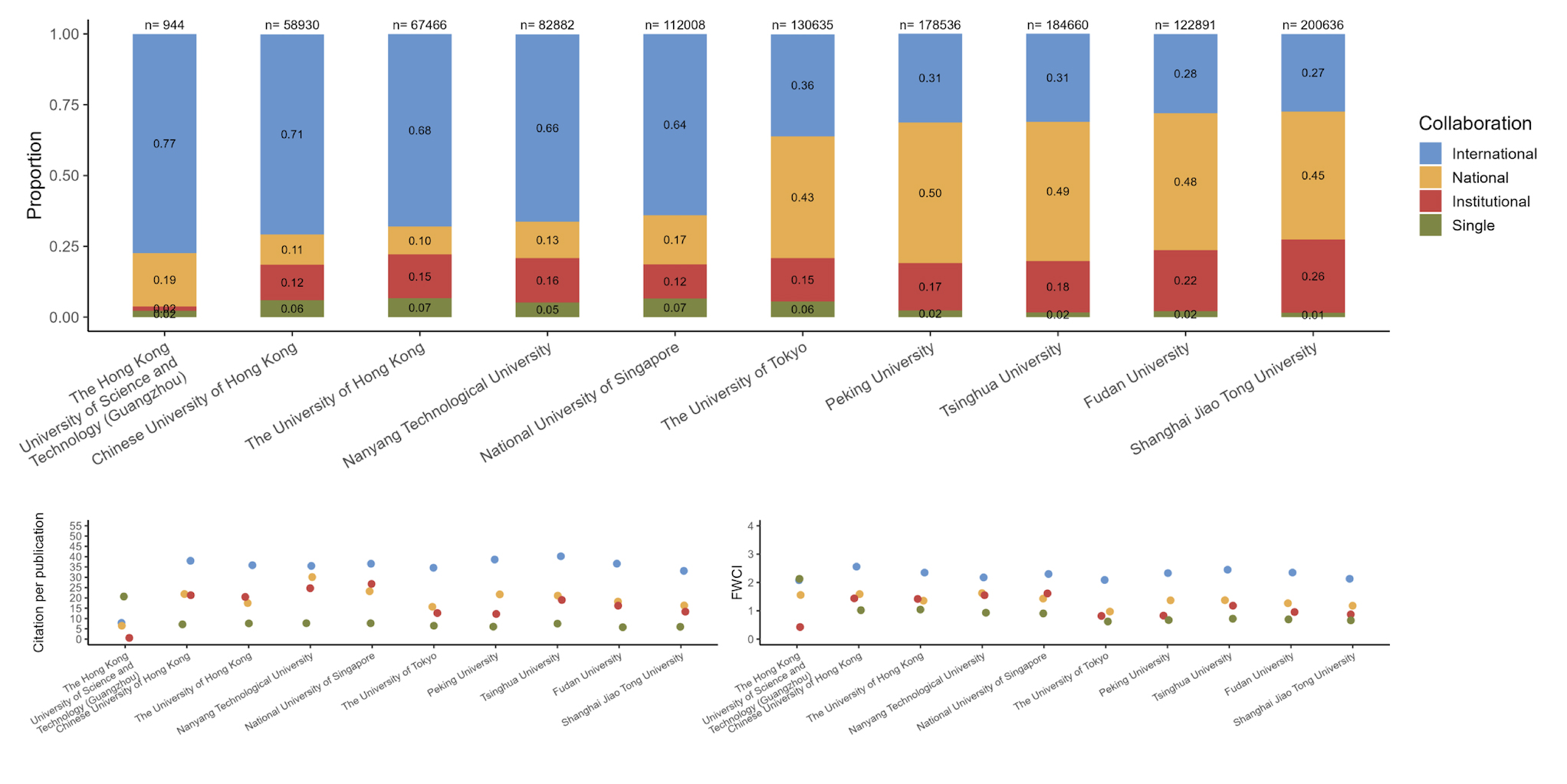
To investigate whether the results observed for Africa represented local particularities or reflected a general profile, we extended our analysis to 50 additional institutions from different regions, beginning with the top 10 Asian universities (Table II), which included proportions of scientific output comprising international collaboration varying from 0.27 to 0.77 (Figure 6). Once again, average citations per publication (Figure 6, lower, left panel) were higher when articles included international collaboration. FWCI values were generally higher when involving national or institutional collaboration, with the exception of the Hong Kong University of Science and Technology (Figure 6, lower, right panel).

General profile of scholarly outputs of Asian universities analyzed in this study. Upper panel: Types of collaborations in the Asian universities, including international (blue), national (orange), intrainstitutional (red), and no collaboration (single authorship, green). Each bar displays the proportion of values within each colored area, with the total scholarly output indicated at the top of each bar. Lower panel, left: Average number of citations per publication for the Asian universities. Lower panel, right: FWCI values for the Asian universities. In all panels, the color codes correspond to those shown in the upper panel.
The analysis of the top ranked Latin American universities (Table III), once again, revealed a positive impact of international collaboration on the citation indices. In this group, the percentage of publications including international collaboration varied from 32 to 57% (Figure 7). These articles were those showing the highest indices of citations per publication, in comparison to publications including only institutional or national collaboration (Figure 7, lower, left panel). Analysis of FWCI revealed that, with no international collaboration, the average values were always equal or below the global mean, while existence of international collaboration resulted in values that were higher than the global average in all cases (Figure 7, lower, right panel).

General profile of scholarly outputs of Latin American (LATAM) universities analyzed in this study. Upper panel: Types of collaborations in the LATAM universities, including international (blue), national (orange), intrainstitutional (red), and no collaboration (single authorship, green). Each bar displays the proportion of values within each colored area, with the total scholarly output indicated at the top of each bar. Lower panel, left: Average number of citations per publication for the LATAM universities. Lower panel, right: FWCI values for the LATAM universities. In all panels, the color codes correspond to those shown in the upper panel.
In the universities of Oceania (Table IV), scholarly output including international collaboration predominated in the entire group (Figure 8). Once again, citations per publication was much higher in the group of articles including international collaboration (Figure 8, lower, left panel). Similar results were observed for FCWI numbers (Figure 8, lower, right panel).

General profile of scholarly outputs of Oceanian universities analyzed in this study. Upper panel: Types of collaborations in the Oceanian universities, including international (blue), national (orange), intrainstitutional (red), and no collaboration (single authorship, green). Each bar displays the proportion of values within each colored area, with the total scholarly output indicated at the top of each bar. Lower panel, left: Average number of citations per publication for the Oceanian universities. Lower panel, right: FWCI values for the Oceanian universities. In all panels, the color codes correspond to those shown in the upper panel.
None of the 40 universities analyzed so far appeared in the group of top-ranked universities in the world, which included 3 European (restricted to the UK) and 7 US-based universities (Table V). Therefore, one could suppose that international collaboration could benefit the impact of the scholarly output of universities that would depend on international partners to improve their scientific impact. To address this hypothesis, we analyzed the profile of international collaboration in the output of the top 10 ranked universities in the world. In this group, publications including international collaboration varied from 40 to 64% (Figure 9). Once again, publications including international collaborators received more citations (Figure 9, lower, left panel), which also occurred for the most of the FWCI values (Figure 9, lower, right). Therefore, at this point, we concluded that the positive impact of international collaboration was independent of geographic location or position in the university rankings.

General profile of scholarly outputs of the top ranked universities in the world. Upper panel: Types of collaborations, including international (blue), national (orange), intrainstitutional (red), and no collaboration (single authorship, green). Each bar displays the proportion of values within each colored area, with the total scholarly output indicated at the top of each bar. Lower panel, left: Average number of citations per publication. Lower panel, right: FWCI values. In all panels, the color codes correspond to those shown in the upper panel.
We finally asked whether the results observed so far represented characteristics restricted to universities or if they would be typical of any scientific institution. To address this question, we randomly selected ten scientific, non-university institutions in different areas of the globe (Table VI) and proceeded with the analysis of the same parameters used for the 50 universities studied so far. In these research institutes, we observed more heterogeneous values. The percentage of publications including international collaborators ranged from 27 to the impressive value of 94% (Institut Pasteur of Madagascar, Figure 10). Of note, single authorship predominated in two institutes, revealing particularities that were not observed in the university group. As for the citation values, the differences between international and local collaborations were more discrete, and in one institution (Max Planck Institute of Biochemistry), national collaborations were more cited (Figure 10, lower, left panel). A similar profile was observed for the FCWI values (Figure 10, lower, right panel), reinforcing the particularities of research institutes in comparison to the top-ranked universities.

General profile of scholarly outputs of different research institutes. Upper panel: Types of collaborations in the non-university institutes, including international (blue), national (orange), intrainstitutional (red), and no collaboration (single authorship, green). Each bar displays the proportion of values within each colored area, with the total scholarly output indicated at the top of each bar. Lower panel, left: Average number of citations per publication. Lower panel, right: FWCI values. In all panels, the color codes correspond to those shown in the upper panel.
DISCUSSION
Scientific metrics are tricky and must be evaluated with extreme caution, as they can mask or omit institutional strengths that cannot be determined depending on the metrics used (Casadevall & Fang 2014). That said, scientometrics can be applied to straightforward systems that compare clearly defined groups of analysis. In our study, these groups corresponded to scientific articles produced by several institutions, involving or not involving international collaboration. This clear definition allowed us to measure the repercussion of scholarly output as a function of their citation indices. In this context, it is important to clarify that we did not measure the scientific quality of the published articles; instead, we directly determined how much they were cited in the literature. Our study may serve as a useful example of a metric platform for mapping institutional collaboration profiles. We believe it is beyond the scope of our study to judge whether an institution needs to expand its collaboration profile; instead, our aim was to provide tools and maps for institutions and policymakers to make strategic decisions.
According to our data, international collaboration enhances the visibility of scientific articles, as evidenced by the comparison of citation profiles in the presence or absence of international partners. This notion aligns with several previous studies that have highlighted the association between high-quality science and international collaboration (Momtazmanesh et al. 2021, Coccia & Wang 2016). Notably, the increased citation indices were characteristic of the top-ranked universities, and these numbers might not be comparable to those observed in the research institutes. First, while we selected the university group from an international ranking, research institutes were chosen randomly, which means that high-performing institutes comparable to the top-ranked universities may have been missed in our study. Additionally, universities typically cover multiple disciplines, while research institutes often focus on more specialized research areas, as is the case with the Max Planck Institutes for the Study of Religious and Ethnic Diversity and the Study of Societies. In these research institutes, single authorship predominated, likely reflecting the nature of the research areas covered. Finally, the research output of universities, generally higher due to their larger size, directly affects the subject of this study (scholarly output), further suggesting that comparisons between institutions of such diverse nature might not be informative.
It is worth noting that international collaboration often arises as a result of international mobility (Rodrigues et al. 2016). In this sense, our results might also encourage programs promoting international mobility aimed at strengthening international partnerships. Furthermore, international collaboration often involves additional funding from international agencies or organizations, allowing for more extensive, high-quality research to be carried out. This additional funding can be crucial to achieving impactful results (Aksnes et al. 2019, Velez-Estevez et al. 2022, Zhao 2010).
Geographic distribution did not affect our overall conclusions, but it revealed important particularities. Differentiation between regions is evident in the number of citations per publication, with Latin America and Africa presenting the lowest values. In contrast, Asia and the world’s leading institutions record the highest numbers of citations per publication. Another interesting point is the distribution of universities. The majority of universities in each region or ranking are located in a few countries, resulting in an uneven distribution. This disparity may reflect differences in inequality practices between countries, financing, and collaboration among regions (Confraria et al. 2017). Overall, international collaboration often provides access to advanced resources and technologies that may not be available through national partnerships. This contributes to high-quality research, which, in turn, is more likely to be cited in subsequent work (Lancho-Barrantes et al. 2013, Velez-Estevez et al. 2020). The expansion of global contact networks is another important factor. By engaging in international collaborations, researchers expand their presence in the global academic community, which can result in greater dissemination and recognition of their research (Heitor 2015, Patricio & Santos 2020).
We initially speculated that international collaboration could have a more positive impact for institutions outside the Europe-USA axis, given the socio-economic conditions of these countries and their generally high positions in university rankings. However, highly ranked universities and research institutes in their respective regions have often already attained a high level of academic excellence. Nevertheless, international collaboration offers unique opportunities to further expand their research horizons (Cimini et al. 2016). By teaming up with colleagues and institutions in different parts of the world, researchers have access to a wealth of knowledge, experience and resources that can significantly enrich their research projects (Bozeman et al. 2013). In this context, our results suggest that highly-ranked institutions from the Europe-USA axis also benefit from international collaboration, as indicated by citation metrics. These findings imply that international partnerships positively impact scientific visibility regardless of geographical location.
The high rate of international collaboration among universities can serve as an indicator of success in terms of the impact and citations of research works. These partnerships offer unique opportunities to generate innovative research, reach a broader audience, and access additional resources (George et al. 2024, de Wit & Altbach 2021). Therefore, it is increasingly important for research institutions to promote and support international collaboration as an integral part of their research and development strategy (de Wit & Altbach 2021). In this sense, international collaboration stands as an essential component of the global research landscape and offers significant benefits to all participating institutions. By promoting and supporting such collaboration, institutions can broaden their impact, enhance their research capabilities, and contribute more effectively to advancing knowledge and addressing global challenges.
ACKNOWLEDGMENTS
MLR is on leave from the position of associate professor at the Universidade Federal do Rio de Janeiro. MLR was funded by Conselho Nacional de Desenvolvimento Científico e Tecnológico (CNPq) grants 404365/2023-0 and 304998/2022-2, and the Programa de Estímulo à Pesquisa (PEP) of the Instituto Carlos Chagas of Fiocruz.
REFERENCES
- AKSNES DW, LANGFELDT L & WOUTERS P. 2019. Citations, Citation Indicators, and Research Quality: An Overview of Basic Concepts and Theories. Sage Open 9: 215824401982957.
- BECK S ET AL. 2022. The Open Innovation in Science research field: a collaborative conceptualisation approach. Ind Innov 29: 136-185.
- BOZEMAN B, FAY D & SLADE CP. 2013. Research collaboration in universities and academic entrepreneurship: the-state-of-the-art. J Technol Transf 38: 1-67.
- CASADEVALL A & FANG FC. 2014. Causes for the Persistence of Impact Factor Mania. mBio 5(2): e00064-14.
- CHEN K, ZHANG Y & FU X. 2019. International research collaboration: An emerging domain of innovation studies? Res Policy 48: 149-168.
- CIMINI G, ZACCARIA A & GABRIELLI A. 2016. Investigating the interplay between fundamentals of national research systems: Performance, investments and international collaborations. J Informetr 10: 200-211.
- COCCIA M & WANG L. 2016. Evolution and convergence of the patterns of international scientific collaboration. Proc Natl Acad Sci USA 113: 2057-2061.
- CONFRARIA H, MIRA GODINHO M & WANG L. 2017. Determinants of citation impact: A comparative analysis of the Global South versus the Global North. Res Policy 46: 265-279.
- COOKE SJ, NGUYEN VM, CHAPMAN JM, REID AJ, LANDSMAN SJ, YOUNG N, HINCH SG, SCHOTT S, MANDRAK NE & SEMENIUK CAD. 2021. Knowledge co-production: A pathway to effective fisheries management, conservation, and governance. Fisheries (Bethesda) 46: 89-97.
- DE WIT H & ALTBACH PG. 2021. Internationalization in Higher Education. In: Higher Education in the Next Decade, BRILL, p. 303-325.
- ESLAMI MH & LAKEMOND N. 2016. Knowledge integration with customers in collaborative product development projects. J Bus Ind Mark 31: 889-900.
- FINN E & WYLIE R. 2021. Collaborative imagination: A methodological approach. Futures 132: S0016328721000975.
- GEORGE G, FEWER TJ, LAZZARINI S, MCGAHAN AM & PURANAM P. 2024. Partnering for Grand Challenges: A Review of Organizational Design Considerations in Public–Private Collaborations. J Manage 50: 10-40.
- GRAESSER AC, FIORE SM, GREIFF S, ANDREWS-TODD J, FOLTZ PW & HESSE FW. 2018. Advancing the Science of Collaborative Problem Solving. Psychol Sci Public Interest 19: 59-92.
- HEITOR M. 2015. How university global partnerships may facilitate a new era of international affairs and foster political and economic relations. Technol Forecast Soc Change 95: 276-293.
- JACKSON J. 2018. Intervening in the intercultural learning of L2 study abroad students: From research to practice. Lang Teach 51: 365-382.
- KHAN Z, ALI M, KIRIKKALELI D, WAHAB S & JIAO Z. 2020. The impact of technological innovation and public-private partnership investment on sustainable environment in China: Consumption-based carbon emissions analysis. Sustain Dev 28: 1317-1330.
- KWIEK M. 2021. What large-scale publication and citation data tell us about international research collaboration in Europe: changing national patterns in global contexts. Stud High Educ 46: 2629-2649.
- LANCHO-BARRANTES BS, GUERRERO-BOTE VP & DE MOYA-ANEGÓN F. 2013. Citation increments between collaborating countries. Scientometrics 94: 817-831.
- MOMTAZMANESH S ET AL. 2021. International Scientific Collaboration Is Needed to Bridge Science to Society: USERN2020 Consensus Statement. SN Compr Clin Med 3: 1699-1703.
- ONYANCHA OB. 2020. Regional and international research collaboration and citation impact in selected sub-Saharan African countries in the period 2000 to 2019. Glob Knowl Mem Commun 70: 577-594.
- ORZECH MJ, ZHANG J, KEGLER JL, PEARLMAN AG & GREENFIELD V. 2023. Building Global Relationships: Open Educational Resources and Collaborative Online International Learning Courses. J Educ Technol Syst 52: 145-164.
- PAPHAWASIT B & WUDHIKARN R. 2022. Investigating Patterns of Research Collaboration and Citations in Science and Technology: A Case of Chiang Mai University. Adm Sci 12: 71.
- PATEL H, PETTITT M & WILSON JR. 2012. Factors of collaborative working: A framework for a collaboration model. Appl Ergon 43: 1-26.
- PATRICIO MT & SANTOS P. 2020. Collaborative research projects in doctoral programs: a case study in Portugal. Stud High Educ 45: 2311-2323.
- ROBINSON M. 2021. Big Science Collaborations; Lessons for Global Governance and Leadership. Glob Policy 12: 66-80.
- RODRIGUES ML, NIMRICHTER L & CORDERO RJB. 2016. The benefits of scientific mobility and international collaboration. FEMS Microbiol Lett 363(21): fnw247.
- RYBNICEK R & KÖNIGSGRUBER R. 2019. What makes industry–university collaboration succeed? A systematic review of the literature. J Bus Econ 89: 221-250.
- SJÖÖ K & HELLSTRÖM T. 2019. University–industry collaboration: A literature review and synthesis. Ind High Educ 33: 275-285.
- VELEZ-ESTEVEZ A, GARCIA-SANCHEZ P, MORAL-MUNOZ JA & COBO MJ. 2020. Thematical and Impact Differences Between National and International Collaboration on Artificial Intelligence Research. In: 2020 IEEE Conference on Evolving and Adaptive Intelligent Systems (EAIS), IEEE, p. 1-8.
- VELEZ-ESTEVEZ A, GARCÍA-SÁNCHEZ P, MORAL-MUNOZ JA & COBO MJ. 2022. Why do papers from international collaborations get more citations? A bibliometric analysis of Library and Information Science papers. Scientometrics 127: 7517-7555.
- ZHAO D. 2010. Characteristics and impact of grant-funded research: a case study of the library and information science field. Scientometrics 84: 293-306.