
 Sustainable Recycling of Mooring Ropes from Decommissioned Offshore Platforms: Development of New Products Based on Post-Consumer Polyethylene and Polyester Fibers
Abstract
Decommissioning Offshore Floating Production Storage and Offloading (FPSO) platforms is a process that requires technical expertise in a variety of technical endeavors. The mooring systems of FPSO platforms use high-tenacity polyester yarn, which is based on high molecular weight polyethylene terephthalate (PET). They are of high value and shouldn’t be thrown away like any other trash. The present study aims to evaluate the development of new materials based on post-consumer polyethylene with the addition of different content of PET fibers (0, 5, 10, and 15 wt.%) processed by fusion in a twin-screw extruder with a side feeder. The processing conditions were set so that the polyester remained in the fiber shape in the melt bulk. In a second step of the study, a compatibilizer agent (polyethylene grafted maleic anhydride—PE-g-MA) was added in the PE/PET fiber blends to evaluate the improvement in the interaction between phases. Mechanical, rheological, and morphological analyses were carried out and showed that PE/PET fiber blends are promising structured materials to be used for the development of new materials with different properties. This study is in line with the goals of the global circular economy.
Key words
circular economy; FPSO decommissioning; polyester fibers; post-consumed polyethylene; polymer blend
INTRODUCTION
The plastics industry used to concentrate on increasing the productivity, quality, and design of its goods in order to better meet consumer demands. Consequently, an enormous volume of improperly disposed of polymer waste found its way into the ecosystem (Erol et al. 2024, Dey et al. 2024, Atlas 2020, Conservancy 2019). Since polymers and their released chemicals are not biodegradable, they pose a threat to the environment and to living things (Malafeev et al. 2023, Schmidt et al. 2020, Hermabessiere et al. 2017). Increasing concern for the environment at communal and legislative levels has encouraged the plastics industry to adopt the worldwide circular economy model in recent years. The recycling of plastic waste produced after its useful life can be done effectively and efficiently, according to this model (Kubiczek et al. 2023, Ghosh 2020). For instance, the recycling rate of plastic packaging was 41% in the EU, Switzerland, and Norway in 2018 (Conversion Market & Strategy 2020). The European Union set recycling goals for the same year: 65% by 2025 for all packaging, 70% by 2030 for packaging, and 50% by 2025 and 55% by 2030 for plastics (European Commission 2020). This implies that the European plastics industry will consume 10 million metric tons of recycled plastic by 2025 (Conversion Market & Strategy 2020). Plastics have varying degrees of life cycles and use and open up to varying global circular economy approaches to effectively manage their waste generation and recycling (Hu et al. 2024). Two notable thermoplastics that are of concern in the global circular economy drive in the recycling of plastic solid waste are polyethylene (PE) and polyethylene terephthalate (PET) (Lamba et al. 2022, Askar et al. 2023).
Recycling is the process of breaking a product into its constituent raw components so that those materials can be recovered and used to create new products (Payne 2015, Lamba et al. 2022). A number of researchers have investigated the closed-loop and open-loop recycling (CLR and OLR) methods for efficient management of plastic solid waste and production of the same or different products with high, equal, or lower quality. (Huang et al. 2024, Blanco et al. 2024, Jadayil & Aqil 2023, Singh et al. 2016). The recycling approach prioritizes the CLR possibilities, which need to be optimally utilized (Morseletto 2020). However, most materials lose quality with each application (Guo et al. 2022, Kim et al. 1997). Therefore, searching for new applications outside of the CLR is imperative (Larrain et al. 2020).
Kumar et al. (2011) stated that the CLR of low-density polyethylene requires extremely high shear forces. This high-pressure polymerization process produces polyethylene, resulting in the formation of several branches due to intra- and intermolecular chain transfer. This high number of branches results in weak attributes, which limit the low-density polyethylene uses. Furthermore, most recyclers are not interested in the CLR of plastic bottle materials that are PET-based since they are highly complex, expensive, and require heavy machinery, a similar substance as the mooring rope utilized in this study (Sudaia et al. 2018).
Several comparison studies have demonstrated that the use of OLR to PET and PE yields products with enhanced properties suitable for other good uses. For example, in low-strength cement-based concretes with high water/cement ratios (0.53) (Fraternali et al. 2014), PET fibers with high tensile strength seem to be the most advantageous in terms of compressive and tensile properties.
Packaging primarily uses polyethylene, which typically has a one-month service life. This high yield, short service life, and low natural degradation rate of PE inevitably lead to the increasing production of waste plastics of this type (Al-Salem et al. 2010). Only about 7% of the 100 billion plastic bags used annually in Europe are recycled (Davies 2014). If the waste is clean and uncontaminated, plastic retail bags and other wrap films can be recycled into high-quality materials appropriate for the same application as the original one. However, curbside garbage collection makes it more challenging to meet this requirement. Usually regarded as a pollutant, flexible film from curbside pickup is taken out of the waste stream. Its intended use is, at most, energy recovery, yet it frequently winds up in landfills. On the other hand, synthetic fiber mooring ropes used for offshore service have a long service life of more than 12 years and shouldn’t be of much concern in plastic solid waste generation, but offshore decommissioning is on the increase with its attendants’ enormous hundreds of thousands of tons of discarded ropes (Rossi et al. 2010, Correa & Russel 2017). Over 10,000 floating production, storage, and offloading (FPSO) platforms exist globally, with a significant number having been in operation for a minimum of 15 years (Al-Ghuribi et al. 2016). Since their installation, these platforms have remained at sea for a sizable amount of time. As a result, the practice of decommissioning offshore rigs is becoming more commonplace globally. For instance, in the upcoming years, the FPSO platforms that were put in place along the Brazilian coast in the late 1990s will come to the end of their operational lives. Additionally, an estimated 38 new units are being erected in deeper water, resulting in an estimated 70,000 tons of mooring ropes being used (Correa & Russel 2017).
Meanwhile, the waste hierarchy system was established to facilitate the maximum resource reuse in managing waste from decommissioned FPSOs. It states that reuse of decommissioned FPSO platformed materials, one of which is the mooring rope, is better than disposal, and disposal on land is better than disposal at sea (Michetti et al. 2010). Following this waste hierarchy approach in the decommissioning of FPSO and the global circular economy of plastic solid waste management, researchers have created methods for implementing various circular approaches with the priority of ‘reuse,’ ‘repair,’ ‘refurbishment,’ ‘remanufacturing,’ ‘repurposing,’ and ‘recycling,’ also known as the 6Rs (Askar et al. 2023, Jadayil & Aqil 2023, Lamba et al. 2022, MacArthur 2013).
The possibility of recycling and reusing mooring ropes waste produced from the decommissioning of FPSO platforms, along with post-consumer polyethylene plastic solid waste, is explored in this paper. To the best of our knowledge, no one has conducted a study similar to ours. Thus, this study aims to evaluate the effects of the discarded mooring ropes (PET fibers) obtained from decommissioned FPSO platforms on the PE matrix obtained from post-consumer polyethylene. It is expected that the treatment and processing of these non-biodegradable, discarded mooring ropes made from polyester will be useful for the development of new materials with properties different from those of their virgin polymers and enhance comparatively new uses. PET and polyolefins, such as high-density polyethylene (HDPE), are the most widely used thermoplastics. However, the production of PET/HDPE blends is a challenging task due to the intrinsic nature of the two polymers. Since HDPE is a non-polar polyolefin and PET is a polyester (presence of polar groups), the polymers are thermodynamically immiscible, leading to a poor blend performance. Thus, the commonly used strategy to enhance the interaction between the two phases is the addition of compatibilizer (Schyns & Shaver 2021, Santos et al. 2022).
MATERIALS AND METHODS
Materials
The polymer matrix was a post-consumed polyethylene (PE), provided by a plastic packaging recycler. The melt flow rate (MFR), measured by the ASTM D1238 standard and at the same conditions as the final compositions, was 0.92 g.10min-1. The temperature at maximum degradation rate was 452 °C (value similar to that of a virgin polymer) (Zorzanelli et al. 2023).
Mooring ropes from platforms offshore were kindly provided by an oil industry. In Figure 1, it is possible to observe that the PET fibers maintain a good appearance, even after the operating time of the mooring rope. The intrinsic viscosity of the PET fibers (ASTM D1238 standard) was 0.54 dl.g-1 and the temperature at maximum degradation rate was 437 °C. It is important to highlight that the fibers, during their manufacture, receive a residual spin finish, such as a lubricant, whose function is to prevent friction between the fibers.

Polyethylene grafted maleic anhydride (PE-g-MA), with 0.4 wt.% maleic anhydride, Mw 15,000 g/mol was supplied by Sigma Aldrich company.
Blend preparation
Initially, the mooring ropes were dismantled to obtain fibers that would be fed into the extruder (Figure 2).

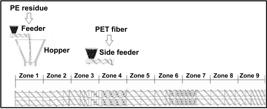
Blends based on PE/PET, with 0, 5, 10, and 15 wt.% of PET fibers, were processed using a twin-screw extruder (TeckTril, DCT-20, diameter 20 mm, ratio L/D = 36), equipped with a sider feeder, where the fibers were fed, as schematically shown in Figure 3. The temperature profile was 90 (feeder) to 200 °C (die). This temperature profile was established so that there was no fusion of PET fibers. The screw profile was set with four KB45 kneading elements in the compression zone (zone 4), which ensure adequate dispersion of the fibers into the melt.
HDPE/PA11 blends were produced by adding HDPE-g-MA (3.0 wt.%), used as a compatibilizer agent between HDPE and PA11 phases. The compositions of all the produced blends were tabulated in Table I for better viewing.
Characterization
Test specimens for mechanical evaluations were prepared using an Arbourg injection-molding machine, model 270S. Tensile tests were performed using a universal testing machine (EMIC, model DL3000) following ASTM D638 - 2014 (Type I) standard method.
The Melt Flow Rate (MFR) analyses were conducted in the melt flow analyzer model LMI 4000, from DYNISCO Instruments, according to ASTM D1238.
The surface morphology of blends was analyzed using a Jeol JSM-6510LV microscope (SEM). The samples were fractured using liquid nitrogen and then coated with gold.
RESULTS AND DISCUSSION
Evaluation of the potential use of post-consumer materials - PE and PET fibers
Table II shows the mechanical properties of PE/PET fiber blends, with or without the presence of the compatibilizer agent (HDPE-g-MA) and with different contents of fibers.
The results show that adding PET fibers to the PE matrix led to an increase in the rigidity of the final blend. The elastic modulus rose by 4%, 27% and 8% when the compatibilizer agent was added to the compositions with 5%, 10%, and 15% of PET fibers, respectively.
But adding 15% PET fibers made the material less tough because the elongation at break properties went down when the fibers were there, but the tensile strength stayed the same.
The PE/ PE-g-MA (3 wt.%)/PET (10 wt.%) composition showed a higher toughness behavior, since the blend tends to present a high elongation at break and elastic modulus properties.
Chen & Ahmad (2017) studied the mechanical performance and flame retardancy property of a rice husk/organoclay-reinforced blend of recycled PE and PET (obtained from a local plastic recycling plant, with an intrinsic viscosity of 0.68 dl.g-1). The recycled PE (PEr) and PET (PETr) composition was 75/25 (wt.%). The results showed that the tensile strength value (15 MPa) was similar compared to PE/PET (15%) and PE/ PE-g-MA (3 wt.%)/PET (15 wt.%) compositions. However, the elastic modulus of the PEr/PETr (75/25) composition was around 750 MPa, lower than the values obtained in the PE/PE-g-MA (3 wt.%)/PET (10 wt.%) and PE/PE-g-MA (3 wt.%)/PET (15 wt.%) compositions.
Figure 4 shows a comparison between the tensile properties of the neat PE, PE/PET fibers, and PE/PET fiber compositions with compatibilizer for better visualization of the results.

He et al. (2020) prepared blends based on PE and commercial PET in the presence of the ethylene-co-glycidyl methacrylate (E-MA-GMA) compatibilizer. The authors concluded that the blends with the compatibilizer showed relatively higher rigidity and lower elongation at break compared to those without the compatibilizer. These results are in accordance with those obtained in our study.
Table III shows the MFR data of the PE/PET fiber blends, with or without the presence of the compatibilizer agent (HDPE-g-MA) and with different contents of fibers.
The results in Table III show that when PET fibers were added to the PE matrix, the flow behavior of the blends changed. The MFR values changed even more when the compatibilizer agent was present, which suggests that adding PET fibers makes the final blend stronger. Beyond this, the incorporation of the compatibilizer, PE-g-MA, compared to the systems without the compatibilizer, decreases the flow behavior of the materials in 45%, 42% and 9% for the blends with 5%, 10% and 15% of PET fibers, respectively. These results indicate that the efficiency of the PE-g-MA’s effect as compatibilizer is lower in the presence of higher PET fiber.
Lima et al. (2023) studied composites based on a blend of recycled HDPE, post-consumer PET from soft drink bottles, and bentonite clay. The authors observed that there was a decrease in the MFI value as clay was added. The HDPE/PET composition was 50/50 (wt.%). The average decrease obtained was 11%, and it was attributed to the compatibilizing effect of the clay. For the PE/PET fiber compositions, more pronounced decreases in the MFI values were observed when compared with the study by Lima et al. (2023). However, the added contents of PET fibers in the post-consumer PE matrix were lower (5 to 15%, wt.%). But it should be considered that the PET is not melted in the PE phase but rather maintained in the fiber form, which may hinder its interaction with the PE matrix. However, the compatibilizing effect of PE-g-MA between the post-consumer PE and PET fiber phases is evident.
Figure 5 shows the SEM morphology of the neat PE and PE/PET compositions without the presence of the PE-g-MA compatibilizer. This shows that they have a good distribution of the PET fibers in the PE matrix, even without the compatibilizer. This result demonstrates that PE/PET fiber blends have the potential to be employed in new applications, and that adding a compatibilizer agent improves interaction between the PE and PET phases, resulting in materials with good mechanical behavior.

Uehara et al. (2015) investigated the effect of different compatibilizers (E-GMA, glycidyl methacrylate, and PE-g-MA) in recycled blends based on PE/PET. The authors observed that the compatibilization using E-GMA copolymer reduced the elastic modulus. However, this reduction when compared with the one produced by the PE-g-MA compatibilizer was only half of the value. This was attributed to the different kinds of structures that both compatibilizers have. PE-g-MA has elastomeric behavior, reducing even more the values of elastic modulus. This behavior was not observed in our study in the composition range analyzed.
Circular economy and the development of new material
In 2022, the Organization for Economic Cooperation and Development (OECD) reported that just 9% of plastic solid waste was recycled, with the majority ending up in landfills (50%) or burned (19%) (OECD 2022). The report also emphasizes how little of the world’s plastics are produced using recycled polymers, just 6%, and how much room there is for improvement in this area, particularly in light of the European Commission’s sustainable development goals and the plastics industry’s adoption of a circular economy (Plan 2020, COM 2018). A solid argument for a feasible thermomechanical transformation of waste post-consumer polyester fibers and polyethylene into reusable plastic polymers is made in this study by the desire to attain these goals, which will require a variety of creative research projects that will turn numerous wastes into wealth. If these waste plastic polymers are not treated, they will eventually end up in the ocean and other bodies of water, among other ecological spaces (Mai et al. 2022). It is anticipated that the thermomechanical process used in this study to generate novel plastic material satisfies some of the “R-behaviors” of the circular economy strategy (Khaw-ngern et al. 2021). The 3-R concept (reduce, reuse, recycle) was the initial name for these “R-behaviors.” After then, the idea was broadened to include recovery, redesign, and remanufacture (the 6-R) and eventually developed into the 9-R concept (which included the additional elements of refurbish, repair, and refuse (MacArthur 2013, Khaw-ngern et al. 2021). This study supports the circular economy process by creating new materials with notable mechanical performance.
Reusing a large amount of abandoned mooring ropes and used polyethylene recovered from end-of-life products proposed in this study, as opposed to extracting virgin resources for the creation of new products, is a key component of the circular economy and is fundamental to economic progress. Increasing reuse across the value chain is known as the “power of cascaded use” (MacArthur 2013). It may be possible that some mooring ropes from decommissioned platforms can be reused in other maritime or shipping operations before they are recycled by the thermomechanical process described in this study. This will stop new materials from entering the economy until the product has reached the end of its useful life and is safely returned to nature or used in another recycling process.
Implementing repurposing is a value-retaining tactic after product utilization. Because of this, repurposing involves being reactive and innovative in order to cope with items that have become outdated and find new uses for them. This is the case with the used polyethylene and abandoned mooring ropes in this study, since their original purpose was not to be reused for another purpose. Consequently, repurposing them into a new product seems like a reactive way to meet the circular economy’s objective (Schild 2020). As this study shows, creating and manufacturing items that can be reused for new purposes is a proactive way to develop repurposing further into a more realistic circular strategy.
The idea of rethinking as a circular strategy motivates the requirement for increased product consumption. Rethinking product reuse necessitates taking some products’ extended service lives into account. For example, the new structural material product with good mechanical properties established in this study will have a substantially longer service life than the polyethene post-consumer used in this study. In general, everything from how we use natural resources to how we create and design goods to how we instruct and prepare the next generation. As a “rethinking device,” circularity has proven to be a potent new framework that can inspire original ideas and foster innovation (MacArthur 2013).
The main objective of this study is sustainable recycling, which is best described by the thermomechanical process in an OLR system. By recycling materials reclaimed from discarded mooring ropes and polyethylene, the OLR employed in this study substantially decreases the usage of raw materials in the new product, extending their service life delaying their eventual disposal (Muthu 2015). The main types of commercially recycled products in the OLR mode right now are technical textiles (SOEX 2024a, b), car interiors (Blue Sky Lab), home goods (Trützschler spinning) (like felt blankets, films, and carpets), fillers and building materials (SOEX 2024a, b) (like wall materials), insulation materials (Islam & Bhat 2019), and others. These items are manufactured from recycled nonwoven fabrics, fishing nets turned into recycled nylon yarns, and yarns from PET bottle flakes (similar properties to the discarded mooring ropes) turned into recycled polyester yarns (Huang et al. 2024). One of the most valuable and profitable items in the OLR sector is recycled yarn (Huang et al. 2024). Recycled materials are used in this recycling method to create new goods that are distinct from their initial products. For example, in 2007 UNIFI began manufacturing yarn manufactured from post-industrial waste and plastic bottles under the REPREVE® product trademark. These yarns include nylon, polyester, and staple fibers. A series of procedures are used to transform these waste materials into premium chips, including cutting, grinding, washing, melting, and reformulating. Then, using thermomechanical techniques, they are converted into regenerated fibers/yarns. The company is committed to creating superior, multipurpose recycled yarns made entirely of recycled materials, having recycled over 27.6 billion PET bottles (Huang et al. 2024, UNIFI 2024a, b). These high-value products are what this study is all about. It has shown that post-consumer polyethylene and polyester fibers can be used to make a new, promising structural material with the help of a compatibilizer agent.
The study offered a conceptual framework that ensures that plastic solid waste is recycled for similar or equivalent purposes, in line with the goals of the global circular economy (Figure 6). The methodology section describes the processes for evaluating the acquired PET and PE fibers. The results and their discussion were then considered. The study concluded with conclusions and recommendations for further research.

It is important to highlight that the study of technical and scientific feasibility should be substantiated by the approach known as Open Innovation (OI). Openly innovating means interacting with external agents, given that the new form of competition is focused on strengthening relationships and seeking shared knowledge, with lower costs and greater opportunities (Chesbrough 2003). OI is a concept that originated from research focused on observing the practices of companies with innovative characteristics in the United States. Its development evolved due to the complexity of technology management in this market (Vanhaverbeke et al. 2009). Currently, there are a large number of research areas that use this perspective, including studies that provide evidence of cooperation in the automotive industry (Badillo et al. 2017).
In the economic and innovation scenario, the oil & gas industry plays a strategic role due to its energy importance and the benefits it provides to society, such as attracting investment and generating jobs and revenue for the country.
In Brazil, the sector represents 10% of the country’s industrial PIB and will continue to contribute to economic growth through planned investments in exploration and production of around US$ 180 billion between 2022 and 2031 (IBP 2024).
Investments by the oil industry involve the installation of new floating platforms. These devices are installed with high-tenacity polyester fiber anchoring cables, which are lighter and more resistant to fatigue than the old steel cables and moorings (chains) used before the 1990s. As these ropes are removed from the platforms due to their useful life or due to their useful life or damage during operation, a pile of scrapped cables is generated. This environmental liability represents a major sustainability problem for oil companies, which are the main operators of the vast majority of oil platforms. In this scenario, it is important to highlight the responsibility of the companies that produce mooring ropes. These companies, with the establishment of the National Solid Waste Policy, become jointly responsible for the proper disposal of products at the end of their life cycle. In this sense, it is important to develop projects capable of establishing a new business management system, with a focus on the sustainable management of solid waste, going beyond the threshold of conscious disposal through a socio-environmental technology that adds value, promoting the reuse of a product as an input for a new production process. Thus, as technological contributions, the innovation process has the potential to generate value in use for a product that is at the end of its life cycle, that is, a technological development in a secondary sector of the economy. In this sense, discarding existing waste with low commercial value as scrap can generate incremental revenue. The proposed innovation is based on sustainability and the circular economy model, which means instead of disposing of solid waste in landfills, it is used in industry and contributes to social responsibility by making jobs and money from scrap waste from the oil, gas, and biofuel industries.
CONCLUSIONS
The study aims to evaluate the potential use of PET fibers from discarded mooring ropes from decommissioned FPSO platforms and post-consumer polyethylene in the production of new materials with good mechanical behavior. This work is in line with the goals of the global circular economy.
The characterization of the materials shows that PE/PET fiber blends have the potential to be used in the production of new materials with good mechanical behavior. The improvement of the properties is pronounced in the presence of a traditional compatibilizer agent, such as PE-g-MA. Compared to other blends, the one that had 10 wt.% of PET fibers and the compatibilizer agent showed better toughness.
The SEM micrographs show that even without the compatibilizer agent, the PET fibers showed a good distribution into the PE matrix.
Recycling PET-based mooring ropes from FPSO platforms is an important way of reusing products generated in the decommissioning process. These fibers have high added value and should not be discarded as scrap, showing their potential to develop a new promising structural material with a post-consumer polyethylene.
The findings of the study suggest that the use of polyester-based mooring ropes to produce new materials holds great potential for driving the circular economy across various industry sectors, including construction. This approach opens up the possibility of using other types of post-consumer yarn in addition to polyester. Studies for developing innovative applications for mooring ropes from the decommissioning of offshore oil and gas platforms and other marine engineering projects are essential for preserving ecological equilibrium and mitigating the adverse impact on the marine environment caused by improper waste disposal.
Acknowledgements
The authors would like to thank the financial support from the Conselho Nacional de Desenvolvimento Científico e Tecnológico (CNPq), Coordenação de Aperfeiçoamento de Pessoal de Nível Superior (CAPES), and Fundação Carlos Chagas Filho de Amparo à Pesquisa do Estado do Rio de Janeiro (FAPERJ) for supporting the research. The authors also thank Dr. Milton Briguet Bastos (in memorian) for encouraging the offshore mooring ropes recycling process. This work was supported by Conselho Nacional de Desenvolvimento Científico e Tecnológico – CNPQ (Grant numbers PQ-2/2021:309461/2021-9 and CNPQ-307889/2022), Coordenação de Aperfeiçoamento de Pessoal de Nível Superior – CAPES (Financing code 001), and Fundação Carlos Chagas Filho de Amparo à Pesquisa do Estado do Rio de Janeiro – FAPERJ (SEI-260003/006163/2024 - APQ1) for supporting the research.
References
- AL-GHURIBI TMQ, LIEW MS, ZAWAWI NA & AYOUB MA. 2016. Decommissioning decision criteria for offshore installations and well abandonment, in: Engineering Challenges for Sustainable Future-Proceedings of the 3rd International Conference on Civil, Offshore and Environmental Engineering. ICCOEE, p. 81-86.
- AL-SALEM SM, LETTIERI P & BAEYENS J. 2010. The valorization of plastic solid waste (PSW) by primary to quaternary routes: From re-use to energy and chemicals. Prog Energy Combust Sci 36: 103-129.
- ASKAR MK, AL-KAMAKI YSS & HASSAN A. 2023. Utilizing polyethylene terephthalate PET in concrete: A review. Polymers (Basel) 15: 3320.
- BADILLO ER, GALERA FL & MORENO SERRANO R. 2017. Cooperation in R&D, firm size and type of partnership: evidence for the Spanish automotive industry. European J Management Bus Econ 26: 123-143.
- BLANCO A, JUAN R, ISTRATE R, PAREDES B, MARTIN-GAMBOA M, DOMÍNGUEZ C, DUFOUR J & GARCÍA-MUÑOZ RA. 2024. Assessing the circularity of post-consumer HDPE milk bottles through open-loop recycling and their environmental impact. Clean Environ Sys 13: 100185.
- CHEN RS & AHMAD S. 2017. Mechanical performance and flame retardancy of rice husk/organoclay-reinforced blend of recycled plastics. Mater Chem Phys 198: 57-65.
- CHESBROUGH HW. 2003. Open Innovation: The New Imperative for Creating and Profiting from Technology. HBS Press: 325-326.
- COM A. 2018. A European Strategy for Plastics in a Circular Economy. Brussels: 218AD.
- CONSERVANCY O. 2019. The beach and beyond, International Coastal Cleanup 2019 report. The Ocean Conserv: 1-32.
-
CORREA R & RUSSEL M. 2017. Decomissioning opportunities in Brazil’s oil and gas field horizon. Export Gov. published in 06/08/2017. Available at. https://www.export.gov/Decomissioining-opportunities-Brazil’s-Oil-Gas-Horizon
» https://www.export.gov/Decomissioining-opportunities-Brazil’s-Oil-Gas-Horizon - CONVERSION MARKET & STRATEGY. 2020. GmbH, Global Plastics Flow.
- DAVIES A. 2014. Lightweight Plastic Carrier Bags: Initial Appraisal of the Commission’s Impact Assessment: 1-7.
- DEY S, VEERENDRA GTN, BABU PSSA, MANOJ AVP & NAGARJUNA K. 2024. Degradation of plastics waste and its effects on biological ecosystems: A scientific analysis and comprehensive review. Biomed Mat & Devices 2: 70-112.
-
EROL T, ÖZALTUN DH, ÇAVUSOGLU FC, ACAR I & GÜÇLÜ G. 2024. The effect of linseed oil/canola oil blend on the coating and thermal properties of waste PET-based alkyd resins. An Acad Bras Cienc 96: e20230859. https://doi.org/10.1590/0001-3765202420230859.
» https://doi.org/10.1590/0001-3765202420230859 - FRATERNALI F, SPADEA S & BERARDI VP. 2014. Effects of recycled PET fibres on the mechanical properties and seawater curing of Portland cement-based concretes. Constr Build Mater 61: 293-302.
- GHOSH SK. 2020. Circular economy: global perspective. Singapore: Springer, p. 368-369.
- GUO Y-T, SHI C, DU T-Y, CHENG X-Y, DU F-S & LI Z-C. 2022. Closed-loop recyclable aliphatic poly (ester-amide) s with tunable mechanical properties. Macromolecules 55: 4000-4010.
- HE H-Z, XUE F, XUE B, LIU S-M, HUANG Z-X & ZHANG H. 2020. Improved properties of metallocene polyethylene/poly (ethylene terephthalate) blends processed by an innovative eccentric rotor extruder. Polymers (Basel) 12: 585.
- HERMABESSIERE L, DEHAUT A, PAUL-PONT I, LACROIX C, JEZEQUEL R, SOUDANT P & DUFLOS G. 2017. Occurrence and effects of plastic additives on marine environments and organisms: a review. Chemosphere 182: 781-793.
- HU B, WANG S, YAN J, ZHANG H, QIU L, LIU W, GUO Y, SHEN J, CHEN B & SHI C. 2024. Review of Waste Plastics Treatment and Utilization: Efficient Conversion and High Value Utilization. Process Safe Environ Protect 183: 378-398.
- HUANG X, TAN Y, HUANG J, ZHU G, YIN R, TAO X & TIAN X. 2024. Industrialization of open-and closed-loop waste textiles recycling towards sustainability: A review. J Clean Prod 140676.
-
IBP – INSTITUTO BRASILEIRO DE PETRÓLEO E GÁS. 2024. Panorama Geral do Setor de Petróleo e Gás: Uma Agenda para o Futuro. https://www.ibp.org.br/2024/05/panorama-geral-do-setor-de-og-portugues.pdf
» https://www.ibp.org.br/2024/05/panorama-geral-do-setor-de-og-portugues.pdf - ISLAM S & BHAT G. 2019. Environmentally-friendly thermal and acoustic insulation materials from recycled textiles. J Environ Manage 251: 109536.
- JADAYIL WA & AQIL E. 2023. Building a Deposit–Refund System (DRS) for Closed-Loop Recycling of Water Bottles in the United Arab Emirates. Recycling 8: 76.
- KHAW-NGERN K, PEUCHTHONGLANG P, KLOMKUL L & KHAW-NGERN C. 2021. The 9Rs strategies for the circular economy 3.0. Psychol Educ J 58: 1440-1446.
- KIM S, HWANG T & LEE KM. 1997. Allocation for cascade recycling system. Int J Life Cycle Assess 2: 217-222.
- KHOURY C. 2020. Plastic Atlas. Ramallah: Heinrich Böll Foundation, 66 p.
- KUBICZEK J, DEREJ W, HADASIK B & MATUSZEWSKA A. 2023. Chemical recycling of plastic waste as a means to implement the circular economy model in the European Union. J Clean Prod 406: 136951.
- KUMAR S, PANDA AK & SINGH RK. 2011. A review on tertiary recycling of high-density polyethylene to fuel. Resour Conserv Recycl 55: 893-910.
- LAMBA P, KAUR DP, RAJ S & SOROUT J. 2022. Recycling/reuse of plastic waste as construction material for sustainable development: a review. Environ Sci Poll Res 29: 86156-86179.
- LARRAIN M, VAN PASSEL S, THOMASSEN G, KRESOVIC U, ALDERWEIRELDT N, MOERMAN E & BILLEN P. 2020. Economic performance of pyrolysis of mixed plastic waste: Open-loop versus closed-loop recycling. J Clean Prod 270: 122442.
- LIMA ML, BARROS GS, SANTOS MCC, CONCEIÇÃO MN, BASTOS DC, PEREIRA PSC & LIBANO EVDG. 2023. Development of composites based on a blend of recycled HDPE/post-consumer PET and bentonite clay. Braz J Dev 4: 13185-13200.
- MACARTHUR E. 2013. Towards the circular economy. J Ind Ecol 2: 23-44.
- MAI L, HE H & ZENG EY. 2022. Plastic pollution in waterways and in the oceans, in: Water and Climate Change. Elsevier, p. 179-195.
- MALAFEEV KV, APICELLA A, INCARNATO L & SCARFATO P. 2023. Understanding the impact of biodegradable microplastics on living organisms entering the food Chain: a Review. Polymers (Basel) 15: 3680.
- MICHETTI V, NICOTRA G, DRESDA F, TIGNANELLI A & MOORE W. 2010. The Key Drivers Determination for Offshore Plants Decommissioning and Abandonment Cost Estimate, in: SPE North Africa Technical Conference and Exhibition. SPE, p. 127412.
- MORSELETTO P. 2020. Targets for a circular economy. Resour Conserv Recycl 153: 104553.
- MUTHU SS. 2015. Handbook of life cycle assessment (LCA) of textiles and clothing. Woodhead Publishing, p. 367-377.
-
OECD - ORGANISATION FOR ECONOMIC CO-OPERATION AND DEVELOPMENT. 2022. Global Plastics Outlook. https://doi.org/10.1787/de747aef-en
» https://doi.org/10.1787/de747aef-en - PAYNE A. 2015. Open-and closed-loop recycling of textile and apparel products, in: Handbook of Life Cycle Assessment (LCA) of Textiles and Clothing. Elsevier, p. 103-123.
- PLAN CEA. 2020. For a cleaner and more competitive Europe. European Commission (EC): Brussels, Belgium, 28 p.
- ROSSI R, DEL VECCHIO CJM & GONÇALVES RCF. 2010. SS: Fiber Moorings, Recent Experiences and Research: Moorings with Polyester Ropes in Petrobras: Experience and the Evolution of Life Cycle Management, in: Offshore Technology Conference. OTC, p. 20845.
- SANTOS RM, COSTA ARM, ALMEIDA YMB, CARVALHO LH, DELGADO JMPQ, LIMA ES, MAGALHÃES HLF, GOMEZ RS, LEITE BE & ROLIM FD. 2022. Thermal and Rheological Characterization of Recycled PET/Virgin HDPE Blend Compatibilized with PE-g-MA and an Epoxy Chain Extender. Polymers (Basel) 14: 1144.
- SCHILD T. 2020. Design for repurpose towards a circular economy, p. 48-49.
- SCHMIDT N, CASTRO-JIMÉNEZ J, FAUVELLE V, OURGAUD M & SEMPERE R. 2020. Occurrence of organic plastic additives in surface waters of the Rhône River (France). Environ Pollut 257: 113637.
- SCHYNS ZOG & SHAVER MP. 2021. Mechanical recycling of packaging plastics: A review. Macromol Rapid Commun 42: 2000415.
- SINGH R, SINGH S, FRATERNALI F. 2016. Development of in-house composite wire based feed stock filaments of fused deposition modelling for wear-resistant materials and structures. Compos B Eng 98: 244-249.
-
SOEX. 2024a. https://www.soex.de/en/ (Accessed 11 July, 2024).
» https://www.soex.de/en/ -
SOEX. 2024b. Recycling. https://www.soex.de/en/services/recycling/ (Accessed 11 July, 2024).
» https://www.soex.de/en/services/recycling/ - SUDAIA DP, BASTOS MB, FERNANDES EB, NASCIMENTO CR, PACHECO EBAV & DA SILVA ALN. 2018. Sustainable recycling of mooring ropes from decommissioned offshore platforms. Mar Pollut Bull 135: 357-360.
- UEHARA GA, FRANÇA MP & CANEVAROLO SVC. 2015. Recycling assessment of multilayer flexible packaging films using design of experiments. Polímeros 4: 371-381.
-
UNIFI. 2024a. Made for the good of tomorrow. https://unifi.com/repreve (Accessed 11 July, 2024).
» https://unifi.com/repreve -
UNIFI. 2024b. https://unifi.com/products/recycled-materials (Accessed 11 July, 2024).
» https://unifi.com/products/recycled-materials - VANHAVERBEKE W, CLOODT M & VAN DE VRANDE V. 2009. Connecting absorptive capacity and open innovation. Proceedings of the ISPIM Conference: The Future of Innovation. Vienna, AT, 20 p.
- ZORZANELLI LC, PEREIRA EC, SALIMENA LM, PACHECO EBAV, SILVA AHMFT, BERTOLINO LC, BASTOS MB, SOUSA AMF & SILVA ALN. 2023. Hybrid Nanostructures Based on Polyethylene and Polyester Fiber Residue from Platforms Ofshore: Efect of Nanoclay as Co‑Compatibilizer Agent in Immiscible Blends. Fibers Polymers 24: 195-206.


