
 Influence of limnological variables on aquatic macrophytes in the Belo Monte reservoir, Amazon, Brazil
Abstract
The demand for electricity grows with human expansion. Hydroelectric plants harness river energy but impact freshwater ecosystems. Reservoirs alter water flow, sediment, and local aquatic communities. Environmental variables affect aquatic macrophytes, which play crucial roles in ecosystem balance. This study examines the effects of pH, conductivity, oxygen, temperature, and depth on macrophytes in Belo Monte reservoirs. The study sampled 34 sites in the Xingu and Intermediate reservoirs, measuring the variables pH, conductivity, oxygen, and temperature. We used linear models to assess the relationship between macrophytes and environmental characteristics. Aquatic macrophytes, identified and categorized into life forms, showed significant variation in species richness. Results indicated that pH negatively affects macrophyte richness. Most species were emergent, belonging to Poaceae and Cyperaceae families. The study underscores the importance of pH in determining macrophyte diversity, possibly due to the ecophysiological responses of macrophyte to ionic variations. Temperature was a determining factor for the occurrence of emergent species. We highlight the need for further research on how environmental changes impact aquatic ecosystems, especially considering ongoing and future dam projects in the Amazon biome.
Key words
Altered aquatic environments; Aquatic plants; Freshwater biodiversity; Hydroelectric power plant; Xingu River
INTRODUCTION
The electricity demand grows alongside human expansion. Meanwhile, the construction of hydroelectric power plants stands out as a viable solution for power generation by making the energy potential of rivers usable. Despite the importance of freshwater ecosystems for power generation, we mustn’t lose sight of its importance in biodiversity maintenance. In recent decades, anthropogenic changes have significantly affected natural aquatic environments. Freshwater environments are among the most impacted by these changes, and the threats become even clearer when water quality and biodiversity losses are analyzed (Allan 2004, Dudgeon 2006).
The primary purpose of building large reservoirs is to generate energy and enable multiple uses of a waterbody, including recreation, irrigation, public supply, or industrial activities, which alter the lotic environment (Wetzel 2001). Reservoirs are closed systems that exhibit physical (morphometry, water retention, coupling with the watershed, hydrodynamics) and chemical differences (modification of water pH and turbidity, nutrient concentration) from natural environments (Cunha-Santino et al. 2017). Changes made to the riverine ecosystem upon reservoir formation include reduced water flow, changes in the coastal zone, sediment accumulation, reduced water transparency, and significant effects on the local aquatic community (Agostinho et al. 2007, Cunha-Santino 2017).
Environmental characteristics of ecosystems, including productivity and disturbance levels, explain the biodiversity differences that exist between locations and/or through time (Myers et al. 2000). Understanding which factors are the most relevant in structuring a community can help predict community structure and ecosystem functioning (Díaz et al. 2007). Given global environmental changes, the need for information on the relationship between species and the environment has increased, and understanding how different variables can affect species’ composition has become a necessity (Alahuhta et al. 2018). The dynamics of species richness in reservoirs are strongly influenced by abiotic factors, such as water level fluctuations, nutrient availability, and temperature, which shape the composition and distribution of aquatic communities (Hobæk et al. 2002, Thomaz et al. 2003).
Studies have shown a relationship between environmental characteristics and aquatic macrophytes in tropical reservoirs. Changes in water and sediment quality caused by reservoir formation benefit the macrophyte community by enabling their rapid colonization (Rørslett & Johansen 1996, Thomaz & Bini 1998). Aquatic macrophytes play important roles in maintaining and balancing aquatic environments, increasing environmental complexity, providing food and habitat for fish, zooplankton, and other aquatic invertebrates, and participating in nutrient cycling (Bento et al. 2007, Mormul et al. 2010, Padial et al. 2009, Pelicice & Agostinho 2006, Thomaz et al. 2002, 2008).
Environmental variables are known to structure the assemblage of aquatic macrophytes (Bando et al. 2015); however, the different life forms of macrophytes exhibit different responses (Alahuhta et al. 2018, Pozzobom et al. 2020). Emergent macrophyte species are dispersed through anemochory, more tolerant of environmental conditions, and are good colonizers (Soons et al. 2016). In contrast, free-floating or submerged species rely on other dispersal vectors and are sensitive to the connectivity between aquatic environments, making them more responsive to changes in water quality (e.g., water transparency) (Soons et al. 2016, Trindade et al. 2018). In addition, the formation of a reservoir often leaves increased submerged plant biomass that takes years to decompose, affecting environmental variables (Abril et al. 2013).
Given this context of differentiated responses to the environment, we aimed to assess the effect of environmental variables (specifically pH, conductivity, dissolved oxygen, temperature, and depth) on the richness and life forms of aquatic macrophytes present in the Belo Monte Hydroelectric reservoirs (Amazon biome, state of Pará, Brazil). Our hypothesis was that the number of species in a plot was a consequence of variations in the limnological characteristics of the waterbody (i.e., environmental filtering).
MATERIALS AND METHODS
Study area
The Xingu River, a right-bank tributary of the Amazon River, is the second largest clear-water river in the Amazon basin (Sioli 1985). Clearwater rivers have neutral to slightly alkaline pH values, low solids concentration, and a high radiation penetration into the water column (Sioli 1984). The region experiences an equatorial climate, characterized by distinct dry and rainy seasons (INMET 2019). Over ten years from 2004 to 2014, the monthly mean rainfall and temperatures averaged approximately 188 ± 145 mm and 27.5 ± 1.0 °C, respectively (INMET 2019). The vegetation of the region comprises shrubs that become naturally flooded during the rainy season, a pasture area (secondary vegetation), and an extensive area covered by dryland forest (a term used to describe areas within the Amazon that do not undergo periodic flooding) (Eletrobrás 2009).
Belo Monte is the third-largest hydroelectric power plant in the world in terms of hydroelectric potential, with an installed capacity of 11,233 MW (equivalent to 25.4 km²/MW, Eletrobrás 2009, Lessa et al. 2015, Ritter et al. 2017). It operates as a run-of-the-river complex, which is known for its shorter water residence time compared to traditional reservoirs. Unlike traditional dams, run-of-river hydroelectric facilities generate energy from the natural flow of the river without regulating its flow (EIA RIMA 2009). The water flow at the Belo Monte power plant varies throughout the year, and during the rainy period in the region, the plant operates at its full capacity (EIA RIMA 2009).
The construction of Belo Monte began in 2011, and its reservoirs were flooded in 2015 (EPE 2011). The Xingu Reservoir has a maximum depth of 20.5 m and the Intermediate Reservoir of 58.3 m. Together, the two reservoirs occupy an area of 516 km² and are connected by a derivation channel (Eletrobrás 2009, EPE 2009).
Sampling of macrophytes and environmental variables
The sampling procedures were conducted upstream of the Belo Monte Hydroelectric power plant, specifically in the Xingu and Intermediate reservoirs, both located near the municipality of Altamira, Pará (Fig. 1). Field expeditions occurred in July 2019, marking the beginning of the dry season in the region. A total of 34 sites were sampled, chosen for having the highest availability of macrophyte banks, typically found in the littoral zones of the reservoir.

Four limnological variables, pH, conductivity (μS/cm), dissolved oxygen (mg/l), and water temperature (°C), were affered using a multiparameter Horiba U50 device. Additionally, transparency (measured in centimeters) was determined using a Secchi disk, and the depth was measured with a 2-meter measuring tape at each sampling site.
The aquatic macrophyte banks evaluated were selected and georeferenced using a GPS device (Global Positioning System) (Fig. 1). The composition and species richness of aquatic macrophytes were determined following Fidalgo & Bononi (1989), and Westlake (1971). A one-square-meter quadrant made of polyvinyl chloride (PVC) was used to determine each sampling point. The quadrant was randomly placed over the macrophyte bank at each site, and the species present were recorded (Michelan et al. 2010, Bando et al. 2015, Fares et al. 2020). Species were identified in the field using specialized literature and by consulting macrophyte taxonomists (Flora e Funga do Brasil 2024, Moura-Júnior et al. 2015, Pott & Pott 2000). The macrophytes were categorized according to their life forms, i.e., emergent, free-floating, rooted with floating leaves, submerged rooted, or free-submerged species (Moura-Júnior et al. 2015).
Data analysis
To address collinearity among limnological variables and reduce the number of variables we checked for variables with zero and near-zero variances (function nearZeroVar(), Package Caret) and removed those with linear dependencies (Pearson correlation). When two variables were correlated (r<0.7, Dormann 2013) we retained for analysis the one deemed most relevant considering our research questions and the environment being studied. Accordingly, we retained the variables water temperature (°C), dissolved oxygen (mg/l), electrical conductivity (μS/cm), pH, and depth (cm) after removing those that showed signs of collinearity. The variables’ depth and transparency exhibited a correlation value above 0.7 (Table I). Thus, we retained the variable depth and removed transparency because the environment studied is of clear water, such that the Secchi disk touched the bottom of the water body. Therefore, we did not expect transparency to be a relevant/limiting factor in determining species richness in this study.
We performed a Multiple Regression (function glm(), package Stats) to assess which variables affect the species composition of aquatic macrophytes after determining that the premises were met. In addition, we used a multinomial regression (function multinom(), package Nnet) to assess which of the environmental variables (if any) filtered the occurrence of the different life forms recorded and used the forward selection protocol to select the variables to be included in the model. We conducted the forward selection protocol manually, and to make result interpretation clearer. All variables used for the analysis were standardized (function decostand(), package Vegan) and expressed in the logit scale to ensure a 0 to 1 outcome expressed as a probability (Stoltzfus 2011). All analyses were performed in the R environment (R Development Core Team 2016).
RESULTS
A total of 15 families, 20 genera, 25 species, and four biological forms of aquatic macrophytes were recorded (emerging, free-floating, rooted with floating leaves, and submerged). The species Salvinia auriculata (17 occurrences), Hymenachne amplexicaulis (11 occurrences), Ludwigia sp. (10 occurrences), and Eichhornia crassipes (8 occurrences) were the most frequent. The species Echinodorus grandiflorus, Poligonum sp., Spermacoce verticillata, Najas guadalupensis, and Hyptis brevipes were each found only once among the samples.
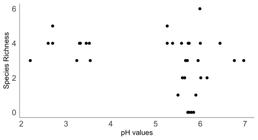
Most species recorded were of the family Poaceae (58%), followed by Salviniaceae (50%), Onagraceae (41%), and Pontederiaceae (29%). The most dominant life form category comprised emerging species (19 species, 76%), followed by floating species (four species, 16%), and species that are submerged and rooted with floating leaves (one species each). The environmental variable with the highest standard deviation was depth (91.26±50.10). pH values also varied from very acidic (2.20) to neutral (6.97), and temperature from 15.7 to 35.2 oC (see Table II).
Values of limnological variables, means, standard deviation, and maximum and minimum values.
The multiple regression analysis showed that pH explained 14% of the variation in species richness (Table III, Fig. 2). This variable negatively affected the richness of macrophytes (t=-2.17, P=0.04). Temperature was associated with the occurrence of emergent macrophyte species (P=0.01, Table IV).
Results of the multinomial regression analysis with temperature, conductivity, pH, depth, and dissolved oxygen as the explanatory variables for the occurrence of the different life forms of macrophytes. Significant values are shown in boldface.
Results of the Multivariate Regression analysis where species richness was the dependent variable and the limnological variables were independent variables. Statistically significant values are shown in boldface. Model R2adj = 0.08, F= 1.595, P=0.19.
DISCUSSION
We observed a higher frequency of emergent species, followed by floating and submerged species, particularly those that tend to thrive in environments with some anthropic intervention. However, this pattern was not statistically tested. The macrophyte species recorded most frequently belonged to the Poaceae and Cyperaceae families, both known for having a high number of easily dispersed taxa, which potentially explains their prevalence in aquatic flora surveys (Lorenzi 2008, Campelo et al. 2012, Valadares et al. 2011). Poaceae species have a high seed production that favors wind dispersal, and Cyperaceae species can easily propagate through rhizomes or stolons. Both families are categorized as being composed of emergent species, commonly found near aquatic environments subject to intense water level variations, such as reservoirs (Pitelli et al. 2008, Pott & Pott 2000). The recent flooding for the construction of the Belo Monte reservoirs likely resulted in changes in water and sediment quality, which could potentially influence the establishment of various taxa. This possibility warrants further investigations. Similar findings have been reported in other studies conducted in tropical reservoirs (Ferreira et al. 2010, Henry-Silva et al. 2010, Mormul et al. 2010).
The aquatic macrophyte community is composed of species sensitive to changes in limnological variables, and that thus vary in their responses to different limnological contexts, such as variations in pH, light incidence, nutrient availability, water depth, and others (see examples of indicator species in Bini et al. 1999, Bando et al. 2015, Lacoul & Freedman 2006, Søndergaard et al. 2010). Accordingly, different combinations of variables explain different attributes of the macrophyte assemblage (Kisson et al. 2013, Neiff et al. 2014, Rooney et al. 2013, Steffen et al. 2014).
Our findings support the idea that the composition of aquatic macrophytes is related to at least one limnological variable (i.e., pH; Schneider et al. 2015, Wang et al. 2016, Riera et al. 2017). The capacity of aquatic plants to occur in acidic versus non-acidic waters is associated with their ability to use different forms of dissolved inorganic carbon (Lacoul & Freedman 2006), once carbon is available in different forms in the water depending on pH levels (Pulido et al. 2016, Lacoul & Freedman 2006). However, most species we recorded were emergent or free-floating, which means that photosynthesis takes place with atmospheric carbon.
Low pH values in these Amazonian waters significantly affected the diversity and composition of macrophytes, favoring some species when pH values are lower. However, the low effect size obtained (r2=0.14) limits our ability to make generalizations and may be due to several reasons that include weak effect or strong parametric effect detected with small sample sizes and/or limited replicates within pH ranges. Thus, the results must be considered with caution. The variable pH is one of the most important predictors of macrophyte species distribution (Bini et al. 1999) and may affect the occurrence of macrophyte species even upon small variations. The species Eichhornia azurea (also recorded in our study), for example, has been reported to support pH>7 to an extent in a tropical environment, but as water alkalinity increases (even small increases from pH=7) phytoplankton blooms and/or deeper water and no macrophytes were reported (Bini et al. 1999). Macrophytes develop morphological and physiological adaptations to manage acidity and nutrient availability. These adaptations can include variations in density, morphology and biomass, allowing the plants to maximize nutrient uptake and resist adverse conditions (Lopes et al. 2016, Nixdorf et al. 2001).
We have shown evidence (by testing the relationship between species richness and the limnological variables) that pH values may determine macrophyte diversity (considering species richness as a measure of diversity). Other studies have shown that environmental filtering by pH also shapes the functional diversity of macrophyte communities (Chmara et al. 2015, Lopes et al. 2016, Nixdorf et al. 2001). However, only temperature was a filter for the occurrence of macrophyte life forms.
The damming caused by the construction of a reservoir leaves a lot of submerged plant biomass that takes years to decompose (Abril et al. 2013). The decomposition of this organic matter influences and is influenced by the pH of the water, as is observed in the very low pH values recorded for the sites within the reservoir (See Fig.1). Belo Monte is a recently formed reservoir, with less than 10 years of flooding. Thus, the differences associated with pH recorded in this study may also be related to the decomposition of large trees remaining within the reservoir, consequently affecting the richness of the aquatic macrophytes found in this environment.
Environmental variables such as pH and water temperature can filter the occurrence of macrophyte species while also be affected by the presence of macrophytes. Therefore, in lentic environments, the macrophytes may be acting, to an extent, as ecosystem engineers. The occurrence of emergent species was associated with water temperature. Emergent aquatic macrophytes may reduce water temperature fluctuations stream heating, maximum temperatures, and temperature variability, by reducing solar radiation (Willis et al. 2017). Despite being associated with species richness, pH would not be a relevant factor in explaining the occurrence of different life forms of macrophytes. Some macrophyte life forms were very dominant while others were poorly represented. Thus, the lack of effect of environmental variables in some life forms may also be a numerical effect and not necessarily a biological lack of effect.
Our results highlight the importance of pH for the richness of aquatic macrophytes in a reservoir and show that these important organisms can be affected differently depending on the aquatic ecosystem being studied. Biodiversity results for reservoirs are especially relevant within the Amazon biome due to existing projects for building dams in this biome. Understanding the impact of reservoir formation on the aquatic biota and its effect on limnology will help predict and understand the environmental changes that may occur.
Acknowledgements
We wish to thank Dr. Bruno Godoy for his input on the final draft. This study we received financial support from Conselho Nacional de Desenvolvimento Científico e Tecnológico - (CNPq, process: 433125/2018-7) and Coordenação de Aperfeiçoamento de Pessoal de Nível Superior - Brasil (CAPES) - Finance Code 001. We are also grateful for the pos-doc scholarship granted to Lodi, S by FAPESPA and CNPQ for productivity research grants TSM number process (311835/2023-6) and KDS number process (311550/2023-1).
References
-
ABRIL G, PARIZE M, PÉREZ MAP & FILIZOLA N. 2013. Wood decomposition in Amazonian hydropower reservoirs: An additional source of greenhouse gases. J S Am Earth Sci 44: 104-107. DOI: 10.1016/j.jsames.2012.11.007.
» https://doi.org/10.1016/j.jsames.2012.11.007 - AGOSTINHO AA, GOMES LC & PELICICE FM. 2007. Ecology and management of fishery resources in Brazilian reservoirs (in Portuguese). Eduem, Maringá, 501 p.
-
ALAHUHTA J ET AL. 2018. Global patterns in the metacommunity structuring of lake macrophytes: regional variations and driving factors. Oecol 188: 1167-1182. doi: 10.1007/s00442-018-4294-0.
» https://doi.org/10.1007/s00442-018-4294-0 - ALLAN JD. 2004. Influence of land use and landscape setting on the ecological status of rivers. Limne 23: 87-198.
-
BANDO FM, MICHELAN TS, CUNHA ER, FIGUEIREDO BRS & THOMAZ SM. 2015. Macrophyte species richness and composition are correlated with canopy openness and water depth in tropical floodplain lakes. Braz J Bot 38: 289-294. DOI: 10.1007/s40415-015-0137-y.
» https://doi.org/10.1007/s40415-015-0137-y - BENTO L, MAROTTA H & ENRICH-PRAST A. 2007. The role of emergent aquatic macrophytes in the phosphorus cycle in shallow lakes (in Portuguese). Oecol Bras 11(4): 580-589.
-
BINI LM, THOMAZ SM, MURPHY KJ & CAMARGO AFM. 1999. Aquatic macrophyte distribution in relation to water and sediment conditions in the Itaipu Reservoir, Brazil. Hydrob 415: 147-154. DOI: 10.1023/A:1003856629837.
» https://doi.org/10.1023/A:1003856629837 - CAMPELO MJA, SIQUEIRA-FILHO JA, COTARELLI VM, SOUZA EB, PIMENTA WA & POTT JV. 2012. Aquatic Macrophytes in the São Francisco River Integration Project Areas (in portuguese). In: Siqueira-Filho já & Leme EMC (Eds), Flora of the Caatingas of the São Francisco River. Andrea Jakobsson Estúdio Editorial, Rio de Janeiro, p. 192-229.
-
CHMARA R, BANAŚ K & SZMEJA J. 2015. Changes in the structural and functional diversity of macrophyte communities along an acidity gradient in softwater lakes. Flora 216: 57-64. DOI:10.1016/j.flora.2015.09.002.
» https://doi.org/10.1016/j.flora.2015.09.002 -
CUNHA-SANTINO MB, FUSHITA AT & BIANCHINI-JUNIOR I. 2017. A modeling approach for a cascade of reservoirs in the Juquiá-Guaçu River (Atlantic Forest, Brazil). Ecol Mod 356: 48-58. DOI: 10.1016/j.ecolmodel.2017.04.008.
» https://doi.org/10.1016/j.ecolmodel.2017.04.008 - DÍAZ S, LAVOREL S, CHAPIN FS, TECCO PA, GURVICH DE & GRIGULIS K. 2007. Functional Diversity — at the Crossroads between Ecosystem Functioning and Environmental Filters. In: Canadell JG, Pataki DE & Pitelka LF (Eds), Terrestrial Ecosystems in a Changing World. Global Change — The IGBP Series. Springer, Berlin, Heidelberg. doi: 10.1007/978-3-540-32730-1_7.
- DORMANN CF ET AL. 2013. Collinearity: a review of methods to deal with it and a simulation study evaluating their performance. Ecography 36(1): 27-46.
-
DUDGEON D ET AL. 2006. Freshwater biodiversity: importance, threats, status and conservation challenges. BiolRev 81: 163-182. DOI: 10.1007/s004420100662.
» https://doi.org/10.1007/s004420100662 - EIA RIMA. 2009. Environmental Impact Report - Rima, Environmental Impact Study: Belo Monte hydroelectric project. Brasília: Ministry of Mines and Energy, Eletrobrás, May.
- ELETROBRÁS. 2009. AAI - Integrated Environmental Assessment of the Xingu River Basin, I.
- EPE – EMPRESA DE PESQUISA ENERGÉTICA. 2009. Generation expansion bidding studies AHE Belo Monte, Technical Evaluation, Mines and Energy Ministry, Rio de Janeiro, 87 p.
- EPE – EMPRESA DE PESQUISA ENERGÉTICA. 2011. Ten Year Expansion Plan 2020, Final Report, Mines and Energy Ministry, Brasília, 319 p.
-
FARES ALB, CALVÃO LB, TORRES NR, GURGEL ESC & MICHELAN TS. 2020. Environmental factors affect macrophyte diversity on Amazonian aquatic ecosystems inserted in an anthropogenic landscape. Ecol Ind 113: 106231. DOI: 10.1016/j.ecolind.2020.106231.
» https://doi.org/10.1016/j.ecolind.2020.106231 -
FERREIRA FA, MORMUL RP, PEDRALLI G, POTT VJ & POTT A. 2010. Structure of the aquatic macrophyte community in three ponds of the Rio Doce State Park, Minas Gerais, Brazil. Hoehnea 37(1): 43-52. DOI: 10.1590/S2236-89062010000100003.
» https://doi.org/10.1590/S2236-89062010000100003 - FIDALGO O & BONONI VLR. 1989. Techniques for collecting, preserving and herborizing botanical material. São Paulo: Instituto de Botânica, 62 p.
-
FLORA E FUNGA DO BRASIL. 2024. Rio de Janeiro Botanical Garden (in Portuguese). Available at http://floradobrasil.jbrj.gov.br/ Accessed on: January 2024.
» http://floradobrasil.jbrj.gov.br/ -
HENRY-SILVA GG, MOURA RST & DANTAS LLO. 2010. Richness and distribution of aquatic macrophytes in Brazilian semi-arid aquatic ecosystems. Acta Limnol Bras 22: 147-156. DOI: 10.4322/actalb.02202004.
» https://doi.org/10.4322/actalb.02202004 -
HOBÆK A, MANCA M & ANDERSEN T. 2002. Factors influencing species richness in lacustrine zooplankton. Acta Oec 23(3):1 55-163. DOI: 10.1016/S1146-609X(02)01147-5.
» https://doi.org/10.1016/S1146-609X(02)01147-5 -
INMET - INSTITUTO NACIONAL DE METEOROLOGIA. 2019. National Institute of Meteorology, available via http://www.inmet.gov.br/projetos/rede/pesquisa/Cited July 12 2019.
» http://www.inmet.gov.br/projetos/rede/pesquisa/ -
KISSON LTT, JACOB DL, HANSON MA, HERWIG BR, BOW SE & OTTE ML. 2013. Macrophytes in shallow lakes: relationships with water, sediment and watershed characteristics. Aquat Bot 109: 39-48. DOI: 10.1016/j.aquabot.2013.04.001.
» https://doi.org/10.1016/j.aquabot.2013.04.001 - LACOUL P & FREEDMAN B. 2006. Environmental influences on aquatic plants in freshwater ecosystems. Environm Rev 14: 89-136.
-
LESSA ACR, SANTOS MA, MADDOCK JEL & BEZERRA CS. 2015. Emissions of greenhouse gases in terrestrial areas pre-existing to hydroelectric plant reservoirs in the Amazon: The case of Belo Monte hydroelectric plant. Ren and Sust Ener Rev 51: 1728-1736. DOI: 10.1016/j.rser.2015.07.067.
» https://doi.org/10.1016/j.rser.2015.07.067 -
LOPES A, PAROLIN P & PIEDADE MTF. 2016. Morphological and physiological traits of aquatic macrophytes respond to water chemistry in the Amazon Basin: an example of the genus Montrichardia Crueg (Araceae). Hydrobiologia 766: 1-15. DOI: 10.1007/s10750-015-2431-x.
» https://doi.org/10.1007/s10750-015-2431-x - LORENZI H. 2008 Weeds of Brazil: Terrestrial, Aquatic, Parasitic and Toxic (in Portuguese). Nova Odessa: Instituto Plantarum, 261 p.
- MICHELAN TS, THOMAZ SM, MORMUL RP & CARVALHO P. 2010. Effects of an exotic-invasive macrophyte (tropical signalgrass) on native plant community composition, species richness and functional diversity. Fresh Biol 55: 1315-1326.
- MORMUL RP, FERREIRA FA, CARVALHO P, MICHELAN TS, SILVEIRA MJ & THOMAZ SM. 2010. Aquatic macrophytes in the large, sub-tropical Itaipu Reservoir. Rev de Biol Trop 58: 1437-1452.
-
MOURA-JÚNIOR EG, DE PAIVA RMS, FERREIRA AC, PACOPAHYBA LD, TAVARES AS, FERREIRA FA & POTT A. 2015. Updated checklist of aquatic macrophytes from Northern Brazil. Acta Amaz 45: 111-132. DOI: 10.1590/1809-4392201402662.
» https://doi.org/10.1590/1809-4392201402662 - MYERS N, MITTERMEIER RA, FONSECA GAB & KENT J. 2000. Biodiversity hotspots for conservation priorities. Nature 403(6772): 853-858.
-
NEIFF JJ, CASCO SL, MARI ECK, DI RIENZO JA & POI ASG. 2014. Do aquatic plant assemblages in the Paraná River change along the river’s length? Aquat Bot 114: 50-57. DOI: 10.1016/j.aquabot.2013.12.005.
» https://doi.org/10.1016/j.aquabot.2013.12.005 -
NIXDORF B, FYSON A & KRUMBECK H. 2001. Review: plant life in extremely acidic waters. Env Exp Bot 46(3): 203-211. DOI: 10.1016/S0098-8472(01)00104-6.
» https://doi.org/10.1016/S0098-8472(01)00104-6 -
PADIAL AA, THOMAZ SM & AGOSTINHO AA. 2009. Effects of structural heterogeneity provided by floating macrophyte Eichhornia azurea on the predation efficiency and habitat use of the small neotropical fish Moenkhausia sanctaefilomenae. Hydrobiologia 624: 161-170. DOI: 10.1007/s10750-008-9690-8.
» https://doi.org/10.1007/s10750-008-9690-8 -
PELICICE FM & AGOSTINHO AA. 2006. Feeding ecology of fishes associated with Egeria spp. patches in a tropical reservoir, Brazil. Ecol FresH Fish 15: 10-19. DOI: 10.1111/j.1600-0633.2005.00121.x.
» https://doi.org/10.1111/j.1600-0633.2005.00121.x -
PITELLI RLCM, TOFFANELI CM, VIEIRA EA, PITELLI RA & VELINI ED. 2008. Dynamics of the aquatic macrophyte community in the Santana reservoir. Planta Daninha 26: 473-480. DOI: 10.1590/S0100-83582008000300001.
» https://doi.org/10.1590/S0100-83582008000300001 - POTT VJ & POTT A. 2000. Aquatic plants of the Pantanal. Brasília: Embrapa para Comunicação para Transferência de Tecnologia, 404 p.
-
POZZOBOM UM, HEINO J, BRITO MT & LANDEIRO VL. 2020. Untangling the determinants of macrophyte beta diversity in tropical floodplain lakes: insights from ecological uniqueness and species contributions. Aqua Sci 82(3): 56. DOI: 10.1007/s00027-020-00730-2.
» https://doi.org/10.1007/s00027-020-00730-2 -
PULIDO M, SCHNABEL S, CONTADOR JFL, PARRA JL & GONZALEZ F. 2016. The impact of heavy grazing on soil quality and pasture production in rangelands in SW Spain. Land Degr Dev 1: 1-12. DOI: 10.1002/ldr.2501.
» https://doi.org/10.1002/ldr.2501 - R DEVELOPMENT CORE TEAM. 2016. A Language and Environment for Statistical Computing. R Foundation for Statistical Computing, Vienna, Austria.
-
RIERA JL, BALLESTEROS E, PULIDO C, CHAPPUIS E & GACIA E. 2017. Recovery of submerged vegetation in a high mountain oligotrophic freshwater lake more than two decades after the damming. Hydrobiologia 794: 139-151. DOI: 10.1007/s10750-017-3087-5
» https://doi.org/10.1007/s10750-017-3087-5 - RITTER CD, MCCRATE G, NILSSON RH, FEARNSIDE M, PALME U & ANTONELLI A. 2017. Environmental impact assessment in Brazilian Amazonia: challenges and prospects to assess biodiversity. Biol Conserv 206: 161-168.
-
ROONEY RC, CARLI C & BAYLEY SE. 2013. River connectivity affects submerged and floating aquatic vegetation in floodplain wetlands. Wetlands 33: 1165-1177. DOI: 10.1007/s13157-013-0471-4.
» https://doi.org/10.1007/s13157-013-0471-4 -
RØRSLETT B & JOHANSEN S. 1996. Remedial measures connected with aquatic macrophytes in Norwegian regulated rivers and reservoirs. Regul Rivers Res Manag 12: 509-522. DOI: 10.1002/(SICI)1099-1646(199607)12:4/5<509::AID-RRR410>3.0.CO;2-3.
» https://doi.org/10.1002/(SICI)1099-1646(199607)12:4/5 -
SCHNEIDER B, CUNHA ER, MARCHESE M & THOMAZ SM. 2015. Explanatory variables associated with the diversity and composition of aquatic macrophytes in a large subtropical river floodplain. Aquat Bot 121: 67-75. DOI: 10.1016/j.aquabot.2014.11.003.
» https://doi.org/10.1016/j.aquabot.2014.11.003 - SIOLI H. 1984. The Amazon. Limnology and landscape ecology of mighty tropical river and its basin. Dordrecht, Pub Junk, 800 p.
- SIOLI H. 1985. Amazonia: Fundamentals of the Ecology of the Largest Tropical Forest Region (in Portuguese). Vozes: Petrópolis, 72 p.
-
SØNDERGAARD M, JOHANSSON LS, LAURIDSEN TL, JØRGENSEN TB, LIBORIUSSEN L & JEPPESEN A. 2010. Submerged macrophytes as indicators of the ecological quality of lakes. Fresh Biol 55: 893-908. DOI: 10.1111/j.1365-2427.2009.02331.x.
» https://doi.org/10.1111/j.1365-2427.2009.02331.x -
SOONS MB, BROCHET A-L, KLEYHEEG E & GREEN AJ. 2016. Seed dispersal by dabbling ducks: an overlooked dispersal pathway for a broad spectrum of plant species. J Ecol 104: 443-455. DOI: 10.1111/1365-2745.12531.
» https://doi.org/10.1111/1365-2745.12531 -
STEFFEN K, LEUSCHNER C, MÜLLER U, WIEGLEB G & BECKER T. 2014. Relationships between macrophyte vegetation and physical and chemical conditions in northwest German running waters. Aqua Bot 113: 46-55. DOI: 10.1016/j.aquabot.2013.10.006.
» https://doi.org/10.1016/j.aquabot.2013.10.006 -
STOLTZFUS JC. 2011. Logistic Regression: A Brief Primer. AcadEmer Med 18: 1099-1104. DOI: 10.1111/j.1553-2712.2011.01185.x.
» https://doi.org/10.1111/j.1553-2712.2011.01185.x -
THOMAZ SM. 2002. Ecological factors associated with the colonization and development of aquatic macrophytes and management challenges (in Portuguese). Planta Daninha 20: 21-33. DOI: 10.1590/S0100-83582002000400003.
» https://doi.org/10.1590/S0100-83582002000400003 - THOMAZ SM & BINI LM. 1998. Ecology and management of aquatic macrophytes in reservoirs. Acta Limnol Bras 10: 103-116.
-
THOMAZ SM, DIBBLE ED, EVANGELISTA LR, HIGUTI J & BINI LM. 2008. Influence of aquatic macrophyte habitat complexity on invertebrate abundance and richness in tropical lagoons. Fresh Biol 53: 358-367. DOI: 10.1111/j.1365-2427.2007.01898.x.
» https://doi.org/10.1111/j.1365-2427.2007.01898.x -
THOMAZ SM, SOUZA DC & BINI LM. 2003. Species richness and beta diversity of aquatic macrophytes in a large subtropical reservoir (Itaipu Reservoir, Brazil): the influence of limnology and morphometry. Hydrob 505: 119-128. DOI: 10.1023/B:HYDR.0000007300.78143.e1.
» https://doi.org/10.1023/B:HYDR.0000007300.78143.e1 -
TRINDADE CRT, LANDEIRO VL & SCHNECK F. 2018. Macrophyte functional groups elucidate the relative role of environmental and spatial factors on species richness and assemblage structure. Hydrobiologia 823: 217-230. DOI: 10.1007/s10750-018-3709-6.
» https://doi.org/10.1007/s10750-018-3709-6 -
VALADARES RT, SOUZA FBC, CASTRO NGD, PERES ALSS, SCHNEIDER SZ & MARTINS MLL. 2011. Floristic survey of a herbaceous marsh located in the Morada do Sol restinga, municipality of Vila Velha, Espírito Santo, Brazil. Rodriguésia 62(4): 827-834. DOI: 10.1590/S2175-78602011000400010.
» https://doi.org/10.1590/S2175-78602011000400010 -
WANG MZ, LIU ZY, LUO FL, LEI GC & LI HL. 2016. Do amplitudes of water level fluctuations affect the growth and community structure of submerged macrophytes? PLoS ONE 11: e0146528. DOI: 10.1371/journal.pone.0146528.
» https://doi.org/10.1371/journal.pone.0146528 - WESTLAKE DF. 1971. Macrophytes. In: Vollenweider RA (Ed), A manual on methods for measuring primary productions in aquatic environments, 2nd ed., Blackwell: Oxford.
- WETZEL RG. 2001. Limnology: Lake and River Ecosystems, 3rd ed., Academic Press.
-
WILLIS A, NICHOLS A, HOLMES E, JEFFRES C, FOWLER A, BABCOCK C & DEAS M. 2017. Seasonal aquatic macrophytes reduce water temperatures via a riverine canopy in a spring-fed stream. Freshw Sci 36: 508-522. DOI: 10.1086/693000.
» https://doi.org/10.1086/693000


