 A study on the pollen of selected species of Sapindales A. Juss. ex Bercht. & J. Presl (Magnoliophyta) occurring in an urban forest fragment in southeastern Brazil
Abstract
Order Sapindales includes species with high economic potential and wide geographic distribution, for which there are taxonomic divergences and gaps in knowledge of pollen morphology. The Atlantic Forest, albeit fragmented, houses many Sapindales species for which palynological studies are still incipient. The present study aims to investigate the morphology of pollen grains of Sapindales species occurring in an urban forest fragment located in southeastern Brazil. This forest fragment presents high species richness, which include five families of Sapindales: Anacardiaceae R.Br., Burseraceae Kunth, Meliaceae A. Juss., Rutaceae A. Juss., and Sapindaceae A. Juss. The botanical material used belongs to the Leopoldo Krieger Herbarium collection. Our observations were done under light microscope and scanning electron microscope, using standardized methodologies adopted in Palynology. Our findings show that the pollen grains have a subcircular, triangular or quadrangular amb; peroblate to prolate shape; the apertural types are 3-porate, 3-colporate, 3-syncolporate and 3-parasyncolporate; and ornamentation varies from psilate, reticulate, microreticulate to striate.
Key words
Anacardiaceae; Burseraceae; Meliaceae; Palynology; Rutaceae; Sapindaceae
INTRODUCTION
The Sapindales order is monophyletic, within the Rosids-Malvids clade, and includes species with a wide distribution in temperate and tropical regions (APG IV 2016, Ferrucci 1998). The order represents approximately 3% of the global plant diversity, with 5,264 species in 470 genera (Magallón et al. 1999). In Brazil, it is represented by six families: Anacardiaceae R.Br., Burseraceae Kunth, Meliaceae A. Juss., Rutaceae A. Juss., Sapindaceae A. Juss., and Simaroubaceae DC., with a higher species richness in the Amazon and the Atlantic Forest (Flora do Brasil 2020, Pirani & Silva-Luz 2018). The Atlantic Forest is considered a biodiversity hotspot, housing 200 thousand species of vascular plants, eight thousand of which are endemic (Myers et al. 2000). As a phytogeographic domain, it encompasses a set of ecosystems which extends along the Atlantic coast of Brazil, exhibiting different climatic characteristics and vegetation types (Fiaschi & Pirani 2009, Stehmann et al. 2009).
In Brazil, the state of Minas Gerais has many forest areas that have undergone intense changes due to anthropic action, mainly related to coffee cultivation and livestock farming. The municipality of Juiz de Fora needs to be highlighted in the state as it is considered an area of “very high” biological importance (Drummond et al. 2005, 2009).
The Botanical Garden of the Federal University of Juiz de Fora is located within an urban fragment of Atlantic Forest, it is an important ecological corridor for biodiversity conservation, and contains some threatened species (Fonseca & Carvalho 2012, Santiago et al. 2014, Silva et al. 2020). Within the area of the Botanical Garden, there are five families of Sapindales: Anacardiaceae R.Br., Burseraceae Kunth, Meliaceae A. Juss., Rutaceae A. Juss., and Sapindaceae A. Juss. (Silva et al. 2020).
Some palynological studies on Sapindales species were carried out by different authors (Aguilar-Sierra & Melhem 1998, Barth 1980, 1982, Barth et al. 1998, Bellonzi et al. 2020, Cancelli et al. 2012, Cruz 1982, Dutra & Gasparino 2017, Freitas et al. 2020, Freitas & Carvalho 2012, Garralla & Cuadrado 1997, Gonçalves-Esteves et al. 2021, Gonçalves-Esteves & Ferreira 1994, González et al. 2014, Harley et al. 2007, Luz & Barth 1999, Mitra et al. 1977, Pereira et al. 2014, Salgado-Labouriau 1973, Silva 2007, Roubik & Moreno 1991), and more recently, Fernandes & Luizi-Ponzo (2023) studied two species of Cedrela P. Browne (Meliaceae), that occur in the Botanical Garden of the Federal University of Juiz de Fora, but there are still some gaps of knowledge regarding the pollen morphology of some Sapindales species. In this way, the present work aims to study the morphology of pollen grains of Sapindales species that occur in an urban fragment of Atlantic Forest in the state of Minas Gerais, and to evaluate the relevance of palynological attributes for expanding the taxonomic information of these species.
MATERIALS AND METHODS
The study area is the Botanical Garden of the Federal University of Juiz de Fora, located within an urban fragment of Atlantic Forest, whose extension is estimated at 82 ha (Fonseca & Carvalho 2012, Silva et al. 2020), it is characterized as a Montane Semideciduous Seasonal Forest, in a secondary stage of ecological succession, due to human action over time, with the presence of many pioneer, native and exotic species (Brito & Carvalho 2014, Santiago et al. 2014).
Silva et al. (2020) indicate 23 species of Sapindales occurring in the study area. Two species were previously studied by the authors of the present work (Fernandes & Luizi-Ponzo 2023), who highlighted pollen grains morphology of two Cedrela species. By now, we examined about 300 vouchers of Sapindales kept in the Leopoldo Krieger Herbarium at the Federal University of Juiz de Fora (CESJ, acronym according to Thiers (2022)). Some vouchers did not present ideal conditions for carrying out palynological studies, as there were few flowers or fruits and, therefore, when possible, we used materials from the same species, but collected in other locations. They comprise the 16 species studied here:
Anacardiaceae: Anacardium humile A. St.-Hil. – BRASIL. São Paulo: São Paulo, 2/VIII/1949, W. Hoehne (CESJ 40666); Minas Gerais: Belo Horizonte, 12/VII/1955, L. Roth (CESJ 2309). Anacardium occidentale L. – BRASIL. Minas Gerais: Descoberto, 25/X/2004, A.S.M. Valente 381; V.R. Almeida (CESJ); Araçuaí, 16/VII/1981, L. Krieger (CESJ 18431). Tapirira guianensis Aubl. – BRASIL. Minas Gerais: Descoberto, 13/X/2001, R.C. Forzza 1866; V.R. Almeida; L.C.S. Assis; L.F.A. Fazza (CESJ); Barroso, 21/X/2001, R.M. Castro 628, L.C.S. Assis, A.S.M. Valente, M.G.M. Garcia, R. C. Forzza, G.E.P. Silva (CESJ). Burseraceae: Protium heptaphyllum (Aubl.) Marchand. – BRASIL. Minas Gerais: Rio Preto, 13/IX/2003, F.R.G. Salimena 1112 & Pedro H. Nobre (CESJ). Meliaceae: Cabralea canjerana (Vell.) Mart. – BRASIL. Minas Gerais: Juiz de Fora, 18/X/2008, F.S. Souza 596, I.A. Almeida, B. Paixão, A.L. Santiago, R. Grazul (CESJ); Rio Preto, 06/X/1996, R.G. Silveira, F.R. Pires, L.G. Canani, K. Oliveira e C.A.N. Ribeiro (CESJ). Guarea guidonia (L.) Sleumer – BRASIL. Minas Gerais: Juiz de Fora, 25/XI/2006, A.S.M. Valente 425, L. Menini Neto, P.O. Garcia, A.L. Santiago, L.B.V. Matta, E. A. Feliciano (CESJ). Guarea macrophylla Vahl – BRASIL. Paraná: Guaratuba, XII/I969, L. Krieger (CESJ 7927). Rutaceae: Dictyoloma vandelianum A. A. Juss. - BRASIL. Minas Gerais: Barroso, 30/IV/2001, L.C.S. Assis 119 (CESJ). Zanthoxylum rhoifolium Lam. – BRASIL. Paraná: São José dos Pinhais, 30/XI/1999, J.M. Cruz 222 & J. Cordeiro (CESJ). Sapindaceae: Allophylus edulis (A. St.-Hil., A. Juss. & Cambess.) Hieron. ex Niederl. – BRASIL. Minas Gerais: Barroso, 25/IX/2001, L.C.S Assis 258 e M.K. Ladeira (CESJ). Cupania ludowigii Somner & Ferrucci – BRASIL. Minas Gerais: Laranjal, XX 7/II/1971, L. Krieger & Marilene (CESJ 10005); Descoberto, 26/I/2002, R.C. Forzza 2055 & B.K.S. Franco (CESJ). Cupania oblongifolia Mart. – BRASIL. Minas Gerais: Juiz de Fora, 12/V/2001, A.S.M. Valente; N.C Vitarelli & Viviane Scalon (CESJ 33983). Cupania vernalis Cambess. – BRASIL. Santa Catarina: Bombinhas, 06/V/2011, A. Nuernberg 54 & A.S. Mello (CESJ). Matayba elaeagnoides Radlk. – BRASIL. Paraná: Ventania, 23/X/1998, J.A. Francisco et al. (CESJ 65114). Matayba juglandifolia Radlk. – BRASIL. Minas Gerais: Juiz de Fora, 27/IX/1980, L. Krieger (CESJ 20468). Paullinia rubiginosa Cambess. – BRASIL. Minas Gerais: Juiz de Fora, 14/IX/2011, C.N. Silva 94, J.H.C. Ribeiro (CESJ).
The pollen grains were prepared according to the Wodehouse (1935) method, which allows the observation of cellular content, and Erdtman (1960) acetolysis, used as a standard for observing sporoderm and measuring pollen grains. The measuring was carried out from acetolysed pollen grains, under light microscope, with the aid of an eyepiece micrometer. We obtained polar and equatorial diameter measurements, under equatorial view, from 25 pollen grains randomly chosen from three slides (Salgado-Labouriau 1973), and the largest diameter under polar view, apocolpium side, apertures, and exine, from 10 pollen grains chosen randomly. Quantitative and qualitative data for pollen are summarized and provided in Tables I–III. For the analyses under scanning electron microscope, the pollen grains were separated from the anthers using tweezers and a needle, and then they were dispersed over the stubs previously numbered and covered with double-sided adhesive tape. The samples were then metallized with a thin layer of gold (20nm) and taken in for observation; for the species of Sapindaceae, the samples were observed without prior metallization, using low vacuum. The terminology adopted to describe pollen grains follows Punt et al. (2007). The statistic treatment was carried out after checking normality and data distribution by means of the Shapiro-Wilk normality test in the PAST software (Hammer et al. 2001), and it provided: size range (Xmin–Xmax), arithmetic mean (X), standard deviation (S), standard error (sx), 95% confidence interval (CI (95%)), and coefficient of variation (CV (%)).
RESULTS
The pollen grains of the studied species are monad, small to medium-sized (Tables I, II, and III), radial symmetry, isopolar or slightly heteropolar, subcircular, triangular or quadrangular amb (Figs. 1, 2, 3, and 4); peroblate to prolate (Table III); apertural types are 3-porate, 3-colporate, 3-syncolporate, and 3-parasyncolporate, ornamentation varies from psilate, reticulate, microreticulate, to striate.
Morphometric data on polar diameter (P) of the pollen grains for the studied species (in micrometers).
Anacardiaceae
Anacardium humile A. St.-Hil.
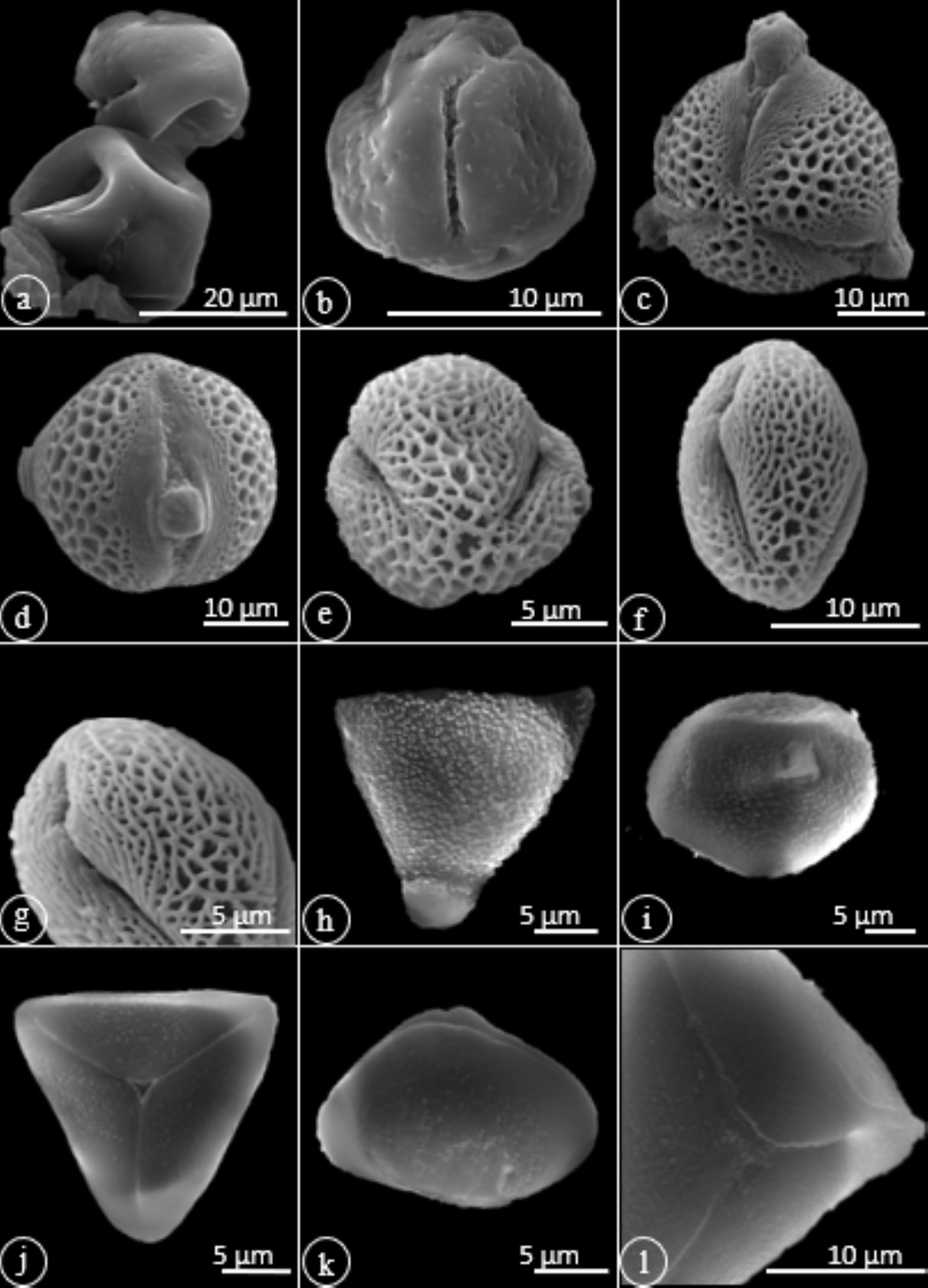
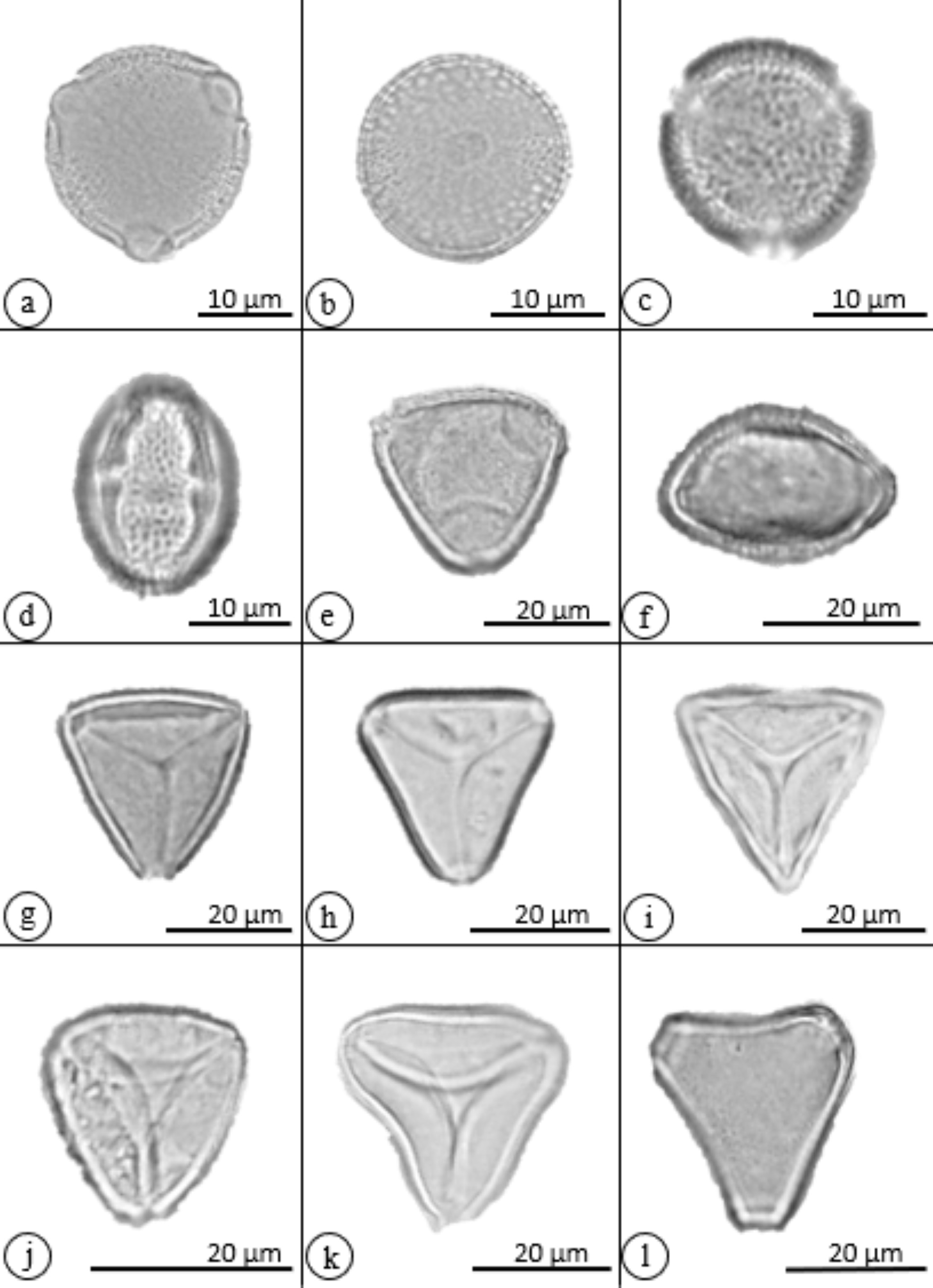
Medium-sized pollen grains (Tables I and II), radial symmetry, isopolar, circular amb (Figs. 1a, 3a), prolate shape (Figs. 1b, 3b; Table III), 3-colporate, colpus elongate and narrow, endoaperture small and circular (Figs. 1a-b, 3a-c; Table III). Ornamentation striate-reticulate, with some perforations below the striations, which are parallel to the colpi. Ornamentation details are more noticeable near the poles (Fig. 3c).
Morphometric data on equatorial diameter (E) of the pollen grains for the studied species (in micrometers).

Scanning electron microscopy of pollen grains of the studied species: a-c. Anacardium humile. a. Polar view. b. Equatorial view. c. Detail of ornamentation. d-f. Anacardium occidentale. d. Polar view. e. Equatorial view. f. Detail of ornamentation. g-h. Tapirira guianensis. g. Polar view and Equatorial view. h. Detail of ornamentation. i. Protium heptaphyllum, Equatorial view. j. Cabralea canjerana, Equatorial view. k-l. Guarea guidonia. k. Polar view. l. Equatorial view.
Anacardium occidentale L.
Medium-sized pollen grains (Tables I and II), radial symmetry, isopolar, subtriangular amb (Figs. 1c, 3d), prolate-spheroidal shape (Figs. 1d, 3e; Table III), 3-colporate, with colpus elongate and narrow, endoaperture small and circular to lalongate (Figs. 1c-d, 3d-f). Ornamentation is striate-reticulate, more evident in the region near the poles, solely reticulate on apocolpium (Fig. 3f), striations distributed parallelly to the colpi. (Fig. 3f).
Tapirira guianensis Aubl.
Small to medium-sized pollen grains (Tables I and II), radial symmetry, isopolar, subtriangular amb (Figs. 1e, 3g), prolate-spheroidal shape (Figs. 1f, 3g; Table III), 3-colporate, colpus elongate and narrow, with granules (Fig. 3g), lalongate endoaperture and small (Figs. 1e-f, 3g). Ornamentation is striate, striations juxtaposed, perpendicular to the poles and parallel to each other (Fig. 3h).
Burseraceae
Protium heptaphyllum (Aubl.) Marchand
Small to medium-szied pollen grains (Tables I and II), radial symmetry, isopolar, triangular amb (Figs. 1g), prolate-spheroidal shape (Figs. 1h, 3i; Table III), 3-colporate, colpus narrow, margin evident (Fig. 1h), lalongate endoaperture (Table III), psilate ornamentation (Fig. 1h).

Pollen grains of the studied species of Sapindales: a-b. Anacardium humile. a. Polar view. b. Equatorial view. c-d. Anacardium occidentale. c. Polar view. d. Equatorial view. e-f. Tapirira guianensis. e. Polar view. f. Equatorial view. g-h. Protium heptaphyllum. g. Polar view. h. Equatorial view. i. Cabralea canjerana, Equatorial view. j-k. Guarea guidonia. j. Polar view. k. Equatorial view. l. Guarea macrophylla, Polar view.
Meliaceae
Cabralea canjerana (Vell.) Mart.
Medium-sized pollen grains (Tables I and II), radial symmetry, isopolar, subcircular amb, oblate-spheroidal shape (Figs. 1i, 3j; Table III), 4-colporate, colpus narrow, presence of margin, lalongate endoaperture, psilate ornamentation (Fig. 3j).
Guarea guidonia (L.) Sleumer
Medium-sized pollen grains (Table I and II), radial symmetry, isopolar, subcircular amb (Figs. 1j, 3k), prolate-spheroidal shape (Figs. 1k, 3l; Table III), 4,5-colporate, colpus narrow, brevicolpate, granulate colpus membrane (Fig. 3l), presenting margin, lalongate endoaperture (Table III), psilate ornamentation (Figs. 3k-l).
Guarea macrophylla Vahl
Medium-sized pollen grains (Tables I and II), radial symmetry, isopolar, subcircular amb (Figs. 1l, 4a), oblate-spheroidal shape (Fig. 4b; Table III), 4-6-colporate (Fig. 1l), colpus narrow, brevicolpate, granulate colpus membrane (Fig. 4b), presenting margin, lalongate endoaperture (Table III). Ornamentation is psilate-perforate, psilate on apocolpium, perforate on mesocolpium (Fig. 4b).

Scanning electron microscopy of pollen grains of the studied species: a-b. Guarea macrophylla. a. Polar view. b. Equatorial view. c-d. Dictyoloma vandelianum. c. Polar view. d. Equatorial view. e-g. Zantoxyllum rhoifolium. e. Polar view. f. Equatorial view. g. Detail of ornamentation and aperture. h-i. Allophylus edulis. h. Polar view. i. Equatorial view. j-k. Cupania ludowigii. j. Polar view. k. Equatorial view. l. Cupania oblongifolia, Polar view – Detail of aperture.
Rutaceae
Dictyoloma vandellianum A. Juss.
Medium-sized pollen grains (Tables I and II), radial symmetry, isopolar, subtriangular amb (Figs. 2a, 4c), prolate-spheroidal shape (Figs. 2b, 4d; Table III), 3-colporate (Fig. 2a), colpus narrow, granulate colpus membrane, endoaperture circular (Table III), reticulate ornamentation, heterobrochate reticulum (Figs. 4c-d). Reticulum is looser near the mesocolpium, closer to the apertures, the muri become denser with small perforations, forming a margin.

Pollen grains of the studied species of Sapindales: a-b. Dictyoloma vandelianum. a. Polar view. b. Equatorial view. c-d. Zantoxyllum rhoifolium. c. Polar view. d. Equatorial view. e-f. Allophylus edulis. e. Polar view. f. Equatorial view. g. Cupania ludowigii, Polar view. h. Cupania oblongifolia, Polar view. i. Cupania vernalis, Polar view. j. Matayba elaeagnoides, Polar view. k. Matayba juglandifolia, Polar view. l. Paullinia rubiginosa, Polar view.
Zanthoxylum rhoifolium Lam.
Small-sized pollen grains (Tables I and II), radial symmetry, isopolar, subtriangular amb (Figs. 2c, 4e), prolate-spheroidal shape (Figs. 2d, 4f; Table III), 3-colporate (Figs. 2c-d), colpus elongate and narrow, granulate colpus membrane (Fig. 4e), lalongate endoaperture (Table III), striato-reticulate ornamentation, striations are more evident near the apertures (Fig. 4e), heterobrochate reticulum (Fig. 4g).
Sapindaceae
Allophylus edulis (A. St.-Hil., A. Juss. & Cambess.) Hieron. ex Niederl.
Medium-sized pollen grains (Table I and II), radial symmetry, slightly heteropolar, subtriangular to quadrangular amb (Figs. 2e, 4h), oblate shape (Fig. 2f, 4i; Table III), 3-porate, rarely, with 4 apertures, microreticulate ornamentation (Figs. 4h-i).
Cupania ludowigii Somner & Ferrucci
Medium-sized (rarely small-sized) pollen grains, (Tables I and II), radial symmetry, slightly heteropolar, triangular amb (Figs. 2g, 4j), oblate shape (Fig. 4k; Table III), 3-syncolporate (Figs. 2g, 4j), colpus narrow, (Table III), microreticulate ornamentation (Figs. 4j-k).
Cupania oblongifolia Mart.
Medium-sized pollen grains (Table I and II), radial symmetry, slightly heteropolar, triangular amb, angulaperturate (Fig. 2h), peroblate shape (Table III), 3-syncolporate (Figs. 2h, 4l), colpus narrow, microreticulate ornamentation (Fig. 4l).
Cupania vernalis Cambess.
Medium-sized pollen grains (Table I and II), radial symmetry, slightly heteropolar, triangular amb (Figs. 2i, 5a), oblate shape (Table III), 3-parasyncolporate (Figs. 2i; 5a), colpus narrow, microreticulate ornamentation.
Matayba elaeagnoides Radlk.
Medium-sized pollen grains (Table I and II), radial symmetry, slightly heteropolar, triangular amb, angulaperturate (Figs. 2j, 5b), oblate shape (Table III), 3-parasyncolporate (Figs. 2j, 5b), colpus narrow, lalongate endoaperture (Table III), microreticulate ornamentation.
Matayba juglandifolia Radlk.
Medium-sized pollen grains (Table I and II), radial symmetry, slightly heteropolar, triangular amb, angulaperturate (Fig. 2k, 5c), oblate shape (Fig. 5d; Table III), 3-parasyncolporate (Fig. 2k), colpus narrow and elongate, lalongate endoaperture (Table III), microreticulate ornamentation.

Scanning electron microscopy of pollen grains of the studied species: a. Cupania vernalis. Polar view. b. Matayba elaeagnoides, Polar view. c-d. Matayba juglandifolia. c. Polar view. d. Equatorial view. e-f. Paullinia rubiginosa. e. Detail of ornamentation. f. Polar view.
Paullinia rubiginosa Cambess.
Medium-sized pollen grains (Table I and II), radial symmetry, slightly heteropolar, triangular amb (Fig. 2l, 5f), oblate shape (Table III), 3-porate (Fig. 2l), pores that are a little wider than long (Table III), microreticulate ornamentation (Fig. 5e).
Observing the species studied, the pollen grains present some characteristics that support taxonomic distinction for each family: Burseraceae and Meliaceae have psilate pollen grains, however, they are 3-colporate in Burseraceae, and always have four or more apertures in Meliaceae. For Sapindaceae, the pollen grains of the species studied here exhibit microreticulate ornamentation. Both Anacardiaceae and Rutaceae species have pollen grains that vary between striate to reticulate, but Rutaceae pollen grains have colpus membrane, and this characteristic was not observed in Anacardiaceae pollen grains.
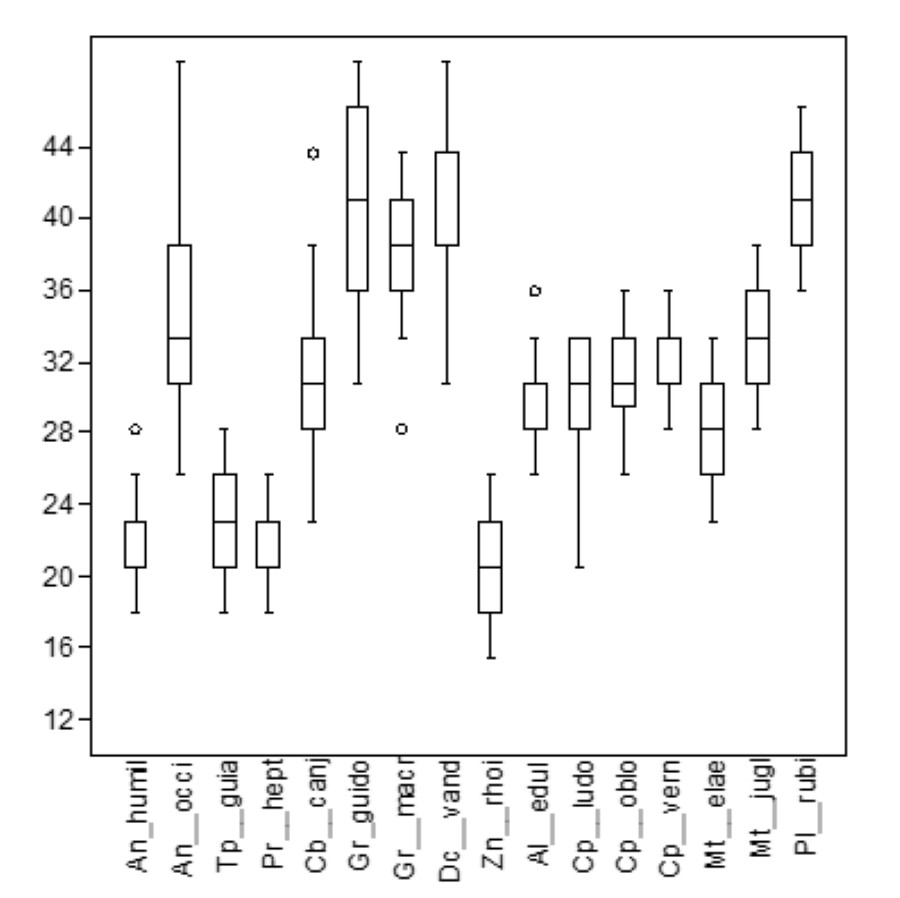
Regarding the assessment of pollen grain size, we could observe the normal distribution of data for P and E, as the Shapiro-Wilk test gave results of p>0.05 for all samples. Observing the polar diameter data (Table I), the species of Meliaceae had the highest coefficients of variation when compared to the species of the other families, exhibiting values above 12%. The polar diameter boxplot for the species in this family (Fig. 6) shows that there is a lot of variation between maximum and minimum values, as well as in relation to the position of quartiles and median, even within the same genus: Guarea. We highlight that there was an outlier (Fig. 6), above the superior limit for the Guarea macrophyllla species. In the graph, another three species presented the same condition, Tapirira guianensis presented an outlier below the inferior limit, as well as Cupania vernalis, and Matayba juglandifolia had two outliers, one above the superior limit and one below the inferior limit (Fig. 6).

Graphic representation of polar diameter (P) mensuration of the studied species, showing range of diameter measurements, CI 95%, median and outliers. An_humil: Anacardium humile; An_ occid: Anacardium occidentale; Tp_ guian: Tapirira guianensis; Pr_ hepta: Protium heptaphyllum; Cb_ canje: Cabralea canjerana; Gr_guido: Guarea guidonia; Gr_ macro: Guarea macrophylla; Dc_ vande: Dictyoloma vandelianum; Zn_ rhoif: Zanthoxylum rhoifolium; Al_ eduli: Allophylus edulis; Cp_ ludow: Cupania ludowigii; Cp_ oblon: Cupania oblongifolia; Cp_ verna: Cupania vernalis; Mt_ elaea: Matayba elaeagnoides; Mt_ jugla: Matayba juglandifolia; Pl_ rubig: Paullinia rubiginosa.
We see a high coefficient of variation, especially for the polar diameter measurements, for the pollen grains in most of the studied species, with emphasis on the Cupania, Matayba and Paullinia genera, belonging to Sapindaceae (Table I). In the Anacardiaceae family, the two species included within the Anacardium genus showed great differences in their polar and equatorial diameter measurements, A. humile exhibit pollen grains smaller in comparison to A. occidentale, which had high coefficients of variation for both measurements, P and E (Tables I, II). A. humile showed an outlier above the superior limit for the equatorial diameter measurement (Fig. 7).

Graphic representation of equatorial diameter (E) mensuration of the studied species, showing range of diameter measurements, CI 95%, median and outliers. An_humil: Anacardium humile; An_ occid: Anacardium occidentale; Tp_ guian: Tapirira guianensis; Pr_ hepta: Protium heptaphyllum; Cb_ canje: Cabralea canjerana; Gr_guido: Guarea guidonia; Gr_ macro: Guarea macrophylla; Dc_ vande: Dictyoloma vandelianum; Zn_ rhoif: Zanthoxylum rhoifolium; Al_ eduli: Allophylus edulis; Cp_ ludow: Cupania ludowigii; Cp_ oblon: Cupania oblongifolia; Cp_ verna: Cupania vernalis; Mt_ elaea: Matayba elaeagnoides; Mt_ jugla: Matayba juglandifolia; Pl_ rubig: Paullinia rubiginosa.
DISCUSSION
For the species belonging to the Anacardium genus, we found that amb varied from circular for Anacardium humile to subtriangular for Anacardium occidentale. Previous studies indicated circular amb for both species (Silva 2007) or circular amb as more frequent for both, although it could be triangular (Pereira et al. 2014) or subcircular (Gonçalves-Esteves & Ferreira 1994) for A. occidentale. For Anacardiaceae, Gonçalves-Esteves et al. (2021) reported the occurrence of circular to triangular pollen grains.
Dealing with the shape, we found pollen grains varying from prolate, in A. humile, to prolate-spheroidal, in A. occidentale. Pereira et al. (2014) and Gonçalves-Esteves & Ferreira (1994) described the shape of the pollen grains from A. occidentale as prolate-spheroidal, which matches the findings in the present study. However, Freitas et al. (2020) found a subprolate shape for the Anacardium genus. Gonçalves-Esteves et al. (2021) pointed out that shape, for the Anacardiaceae family, included variations of pollen grains from oblate-spheroidal to prolate.
In our study, we found medium-sized, 3-colporate pollen grains with striato-reticulate ornamentation for the species belonging to the Anacardium genus. There is a consensus among authors regarding size, number and type of apertures, except for the characterization of the ectoaperture by Salgado-Labouriau (1973), who described the colpi of A. humile as “quite aperture”, different from what was found in the present study, in which we have described them as narrow. Regarding ornamentation, the same author describes it as reticulate, but Roubik & Moreno (1991) investigated A. occidentale pollen grains and questioned the presence of striations, classifying the ornamentation as reticulate and heterobrochate, this diverges from the results found in the present study, in which we point out that ornamentation is striato-reticulate. It is worth of note that, despite exhibiting quite similar ornamentation, the species belonging to the Anacardium genus have great differences in polar and equatorial diameter measurements, pollen grains of A. humile are smaller than those of A. occidentale, which had higher coefficients of variation for both measurements.
Tapirira guianensis pollen grains have subtriangular amb. Gonçalves-Esteves & Ferreira (1994) described amb as triangular, very similar to what we observe here. Freitas & Carvalho (2012) and Gonçalves-Esteves & Ferreira (1994) reported tricolporate pollen grains, and lalongate endoaperture, which is corroborated by the present study. Regarding ornamentation, we found striations disposed parallelly to each other and perpendicular to the poles. Gonçalves-Esteves & Ferreira (1994) also found the very same ornamentation, as well as Freitas & Carvalho (2012), including striation distribution, which the authors described as perpendicular. The pollen grains shape of this species was prolate-spheroidal, with the P/E ratio being 1.13µm. This data corroborates the findings by Gonçalves-Esteves & Ferreira (1994). However, Freitas & Carvalho (2012) described the pollen grains as having a prolate shape. It is worth mentioning that the taking of measurements is standardized in Palynology.
For the Protium heptaphyllum species, we found triangular amb and prolate-spheroidal shape. Mitra et al. (1977) found the same characteristics for the species. However, Aguilar-Sierra & Melhem (1998) described the pollen grain shape of P. heptaphyllum as subprolate, unlike the present study, in which the P/E ratio was above 1.23µm. Gonçalves-Esteves et al. (2021) indicated that the shape of the pollen grains in the Burseraceae family could range from subprolate to prolate. As for ornamentation, in the present study, we described it as psilate, as well as Aguilar-Sierra & Melhem (1998). Mitra et al. (1977) described it as smooth (psilate) or rugulate, and Harley et al. (2007), as psilate or perforate-psilate, in disagreement with our present results, in which the surface of the pollen grain was found to be smooth under both under light microscopy and scanning electron microscopy.
For Cabralea canjerana, we found pollen grains of subcircular amb and prolate-spheroidal shape. Barth et al. (1998) described the amb for the Cabralea genus as circular, and its shape as oblate-spheroidal, different from the present study, in which the P/E ratio was found to be 0.94µm. Garralla & Cuadrado (1997) investigated this species and defined the pollen grains as spheroidal, and their ornamentation as slightly scabrate, differing from the present study, in which we found psilate ornamentation, as well as Barth et al. (1998). The number of apertures found in the present work was of four colpori, which is in accordance with the descriptions by Barth et al. (1998). Garralla & Cuadrado (1997) reported 3 to 4 colpori, differently from our findings.
The species belonging to the Guarea genus described in the present study share characteristics such as brevicolpate pollen grains with narrow colpi, granules in colpus membrane, and the presence of margin, as well as lalongate endoaperture. Barth et al. (1998) and Garralla & Cuadrado (1997) found the same characteristics, with few differences, such as in terminology, referring to the margin as annulus, which does not apply, as we are referring to colpi (Punt et al. 2007). In the present study, we described colpi membrane as granulate, which was also observed by Garralla & Cuadrado (1997).
The pollen grains of Guarea guidonia have subcircular amb and prolate-spheroidal shape, whereas the pollen grains of Guarea macrophylla differ with their oblate-spheroidal shape. Barth et al. (1998) found, for the Guarea genus, spheroidal pollen grains with amb ranging from circular to quadrangular. Garralla & Cuadrado (1997) found oblate-spheroidal pollen grains and apertures ranging from four to five colpori in G. guidonia, and spheroidal shape with an apertures number of three to four colpori for the pollen grains of G. macrophylla. There is a great difference from our findings, as only the number of apertures for G. guidonia pollen grains is in accordance with the present study, in which we found the P/E ratio to be 1.03µm. For G. macrophylla, we observed pollen grains with an aperture number of four to six colpori and a P/E ratio of 0.89µm.
Regarding ornamentation, previous studies reported a psilate surface for the pollen grains of the Cedrela genus, belonging to the Meliaceae family (Fernandes & Luizi-Ponzo 2023), and for Guarea (Barth et al. 1998, Garralla & Cuadrado 1997). In our study, we found a psilate surface for the G. guidonia pollen grains, however, we could also observe perforations in the mesocolpium region for the G. macrophylla pollen grains, which had not previously been described in other studies, evidencing that the detailed observation of pollen grains may improve existing descriptions and contribute to the taxonomic delineation of species.
For the Zanthoxylum rhoifolium species, we found small pollen grains of subtriangular amb and prolate-spheroidal shape. Dutra & Gasparino (2017) described the pollen grains of this species as small to medium-sized, with circular amb and oblate-spheroidal shape, and Barth (1980) characterized the shape of the grains as prolate. Regarding number of apertures, Barth (1980, 1982) found tricolporate pollen grains for the Zanthoxylum genus and for the Zanthoxylum rhoifolium species, in accordance with the data found in the present study. Dutra & Gasparino (2017) found four colpori for this species, and striate-reticulate ornamentation. In the present study, we found reticulate-striate ornamentation in this order, as we considered that reticulum is predominant in relation to striae. Barth (1980, 1982) described the surface of the pollen grains as partially striate. For the Dictyoloma vandellianum species, we found prolate-spheroidal pollen grains with reticulate ornamentation and heterobrochate reticulum, which corroborated the findings of Barth (1982), who also reported spheroidal pollen grains with heterobrochate reticulum for the genus, although we failed to find palynological descriptions for the Dictyoloma vandellianum species in the consulted literature.
Allophylus edulis has pollen grains with three or rarely four pores. González et al. (2014) presented a detailed study, and highlighted the highest percentage of 3-porate pollen grains for this species when compared to 4-porate ones, respectively: 79.5% and 20.5%. The authors also described amb as triangular and exine as microreticulate. The data regarding ornamentation is similar to what was found in the present study. However, it was different in regard to amb, as here we report it as ranging from subtriangular in 3-porate pollen grains to quadrangular in 4-porate ones. Cruz (1982) observed triangular amb and oblate shape, and corroborate these informations. In the present study, we described ornamentation for the species as microreticulate. Freitas et al. (2020) reported quadrangular amb and scabrate ornamentation for the Allophylus genus, but the quadrangular amb was rarely found here, and so it could not be considered a standard for the genus.
The Cupania species have very similar pollen grains with variations in shape and apertural type. According to Cruz (1982), the genus has isopolar grains with syncolporate apertures, ranging from three to four colpori. In the present study, we reported a slight heteropolarity and three apertures in the pollen grains. C. oblongifolia and C. ludowigii had syncolporate pollen grains, but C. vernalis has parasyncolporate pollen grains. Our results fit with Luz & Barth (1999), who previously found the same type of apertures for C. oblongifolia and C. vernalis pollen grains, and Bellonzi et al. (2020), that investigated the morphology of C. vernalis and found parasyncolporate pollen grains. Regarding size and shape, for Cupania vernalis, we found medium-sized, oblate pollen grains. Luz & Barth (1999) found small and oblate grains, in accordance with the findings of our study. Bellonzi et al. (2020) described the same species as having pollen grains ranging from small to medium-sized and peroblate shape, slightly differing from the present study, in which P/E ratio was 0.59 µm. These differences show a great variation in the pollen grains of this species and of the Cupania genus. The coefficient of variation data for the polar diameter measurements of the species belonging to this taxon revealed high numbers ranging from 15.61µm to 25.86µm, confirming the great variation reported in the consulted literature. For C. oblongifolia, we found pollen grains of triangular amb with rounded corners and peroblate shape. Luz & Barth (1999) also described amb as triangular and shape as oblate, unlike the present study, in which we found the P/E ratio to be 0.39µm.
The pollen grains of the Matayba species present triangular amb, 3-parasyncolporate, lalongate endoapertures, colpi narrow and elongate, fused at the poles, and microreticulate ornamentation. Cancelli et al. (2012) indicated syncoporate, reticulate pollen grains for the genus. However, Bellonzi et al. (2020), Cruz (1982), and Luz & Barth (1999) characterized the Matayba pollen grains as parasyncolporate, as we found here. The pollen grains of Matayba elaeagnoides are subprolate, and those of M. juglandifolia are oblate, in accordance with Bellonzi et al. (2020), Cruz (1982), and Luz & Barth (1999). Pollen grains of Paullinia rubiginosa are triporate with triangular amb. Bellonzi et al. (2020), Cruz (1982), and Freitas et al. (2020) also found this aperture type and amb for the Paullinia genus. Regarding ornamentation, we found microreticulum on the exine surface. Cruz (1982) investigated two species of the genus and defined the ornamentation as reticulate. Freitas et al. (2020) indicated a microreticulate ornamentation, as in the present study. Bellonzi et al. (2020) highlighted that both Paullinia and Allophylus may exhibit variations in wall ornamentation, and that reticulate, microreticulate, and perforate patterns can be observed.
CONCLUSIONS
In the present study, it was possible to investigate the pollen morphology of 16 species from Anacardiaceae, Burseraceae, Meliaceae, Rutaceae, and Sapindaceae, belonging to Sapindales, that occur in an urban fragment of Atlantic Forest in the state of Minas Gerais. Pollen morphology for the Sapindales order is quite varied and may be described as medium-sized pollen grains, with few exceptions of very small size, isopolar, of radial symmetry, triaperturate as well as including some variations of four up to six apertures. The Anacardiaceae family had medium-sized pollen grains ranging from reticulate to striate, and it could present both ornamentation types in the same pollen grain. Burseraceae had psilate exine and sizes ranging from small to medium. Meliaceae had the greatest variation among the groups regarding shape and aperture types, which could be syncolporate, parasyncolporate, and colporate. Sapindaceae was characterized by microreticulate ornamentation and amb varying from subtriangular to triangular. Rutaceae had medium-sized and small pollen grains, presenting a heterobrochate reticulum. The pollen grains of Sapindales studied here exhibit great morphological diversity and peculiar characteristics to each taxonomic group. The results allowed us to expand information on palynological characterization and, therefore, contribute to the circumscription of the taxa represented here.
Acknowledgements
The authors would like to thank the Programa de Pós-Graduação em Biodiversidade e Conservação da Natureza and Departamento de Botânica of the Universidade Federal de Juiz de Fora for their support in the development of the activities, the Centro de Microscopia Eletrônica da Universidade Federal de Juiz de Fora for the use of the equipment and the technician Pedro Loureiro for his help in the preparation and observation of the samples, the Professor Roberto Júnio Pedroso Dias for allowing us access to the Laboratory to use the equipment necessary for the photomicrographs and the Fundação de Amparo à Pesquisa do Estado de Minas Gerais (FAPEMIG) for the equipments acquired in previous projects. The first author would like to thank the Universidade Federal de Juiz de Fora for granting her a Master’s Scholarship. This work is part of the first author’s Master’s dissertation.
References
- AGUILAR-SIERRA CI & MELHEM TSA. 1998. Morfologia polínica da tribo Protieae (Burseraceae) na América do Sul. Braz J Bot 21: 35-63.
- APG - ANGIOSPERM PHYLOGENY GROUP. 2016. An update of the Angiosperm Phylogeny Group classification for the orders and families of flowering plants: APG IV. Bot J Linn Soc 181: 1-20.
- BARTH OM. 1980. Pollen morphology of a Brazilian Rutaceae: Zanthoxylum (Fagara). Pollen et spores 22: 425-436.
- BARTH OM. 1982. Variações polínicas em espécies brasileiras da família Rutaceae. Boletim IG 13: 129-134.
- BARTH OM, JUSTO RL & BARROS MAD. 1998. Catálogo sistemático do pólen das plantas arbóreas do Brasil meridional. XXX: Meliaceae. Rev Bras Biol 58: 497-509.
- BELLONZI TK, DUTRA FV, SOUZA CND, REZENDE AA & GASPARINO EC. 2020. Pollen types of Sapindaceae from Brazilian forest fragments: apertural variation. Acta Bot Bras 34: 327-341.
- BRITO PSD & CARVALHO FA. 2014. Estrutura e diversidade arbórea da Floresta Estacional Semidecidual secundária no Jardim Botânico da Universidade Federal de Juiz de Fora. Rodriguésia 65: 817-830.
- CANCELLI RR, SOUZA PAD & NEVES PCPD. 2012. Grãos de pólen de angiospermas do Holoceno (7908 ±30 anos AP-atual) da Planície Costeira sul catarinense, Brasil. Acta Bot Bras 26: 866-885.
-
CRUZ MAV. 1982. Contribuição ao estudo palinológico das Sapindaceae. Dissertação de mestrado - Universidade Estadual de Campinas, Campinas, SP, Brasil. DOI: https://doi.org/10.47749/T/UNICAMP.1982.47885 (Unpublished).
» https://doi.org/10.47749/T/UNICAMP.1982.47885 - DRUMMOND GM, MARTINS CS, GRECO MB & VIEIRA F. 2009. Biota Minas: Diagnóstico do conhecimento sobre a biodiversidade no Estado de Minas Gerais-subsídio ao Programa Biota Minas. In Biota Minas: Diagnóstico do conhecimento sobre a biodiversidade no Estado de Minas Gerais-subsídio ao Programa Biota Minas, 624 p.
- DRUMMOND GM, MARTINS CS, MACHADO ABM, SEBAIO FA & ANTONINI Y. 2005. Biodiversidade em Minas Gerais, um atlas para sua conservação. Belo Horizonte: Fundação Biodiversitas, 2ⁿd ed., 222 p.
- DUTRA FV & GASPARINO EC. 2017. Pollen morphology of Rutaceae from Brazilian forest fragments. Palynology 42: 43-54.
- ERDTMAN G. 1960. The acetolysis method. A revised description. Sven Bot Tidskr 39: 561-564.
-
FERNANDES FC & LUIZI-PONZO AP. 2023. Morphology of pollen grains and orbicules of two threatened species of Cedrela P. Browne (Meliaceae A. Juss.). An Acad Bras Cienc 95: e20221015. https://doi.org/10.1590/0001-3765202320221015.
» https://doi.org/10.1590/0001-3765202320221015 - FERRUCCI MS. 1998. Sapindaceae. In: Hunziker AT (Ed), Flora Fanerogámica Argentina, Proflora (conicet) 52: 1-44.
- FIASCHI P & PIRANI JR. 2009. Review of plant biogeographic studies in Brazil. J Syst Evol 47: 477-496.
-
FLORA DO BRASIL. 2020. Jardim Botânico do Rio de Janeiro. Available at: http://floradobrasil.jbrj.gov.br/
» http://floradobrasil.jbrj.gov.br/ - FONSECA CR & CARVALHO FA. 2012. Aspectos florísticos e fitossociológicos da comunidade arbórea de um fragmento urbano de floresta atlântica (Juiz de Fora, MG, Brasil). Biosc J 28: 820-832.
- FREITAS A & CARVALHO MA. 2012. Análise morfológica e inferências ecológicas de grãos de pólen e esporos (últimos ~ 8.000 Anos) da Lagoa da Ferradura, Armação dos Búzios, RJ, Brasil. Rev Bra Aleo 15: 300-318.
- FREITAS A, GONCALVES-ESTEVES V, MENDONÇA CBF, FERNANDEZ S & CARRION J. 2020. First Quaternary Brazilian cave pollen record: morphological descriptions, taxonomic and ecological data. Rev Bra Paleo 23: 32-47.
- GARRALLA SS & CUADRADO GA. 1997. Morfologia polinica de las Meliaceae de la Argentina. Bol Soc Argent Bot 32: 227-224.
- GONÇALVES-ESTEVES V ET AL. 2021. Pollen morphology and evolutionary history of Sapindales. Braz J Bot 45: 341-366.
- GONÇALVES-ESTEVES V & FERREIRA BC. 1994. Estudo polínico em plantas de restinga do Estado do Rio de Janeiro. Anacardiaceae Lindl, e Capparaceae A. Juss. Bol Mus Nac 90: 1-13.
- GONZÁLEZ VV, SOLÍS SM & FERRUCCI MS. 2014. Anatomía reproductiva en flores estaminadas y pistiladas de Allophylus edulis (Sapindaceae). Bol Soc Argent Bot 49: 207-216.
- HAMMER Ø, HARPER DA & RYAN PD. 2001. PAST: Paleontological statistics software package for education and data analysis. Palaeontol Electron 4: 1-9.
- HARLEY MM, SONG U & BANKS HI. 2007. Pollen morphology and systematics of Burseraceae. Grana 44: 282-299.
- LUZ CFP & BARTH OM. 1999. Catálogo Sistemático do pólen das plantas arbóreas do Brasil meridional XXXIII: Sapindaceae. Leandra 14: 25-36.
- MAGALLON S, CRANE PR & HERENDEEN PS. 1999. Phylogenetic pattern, diversity, and diversification of eudicots. Ann Mo Bot Gard 86: 297-372.
- MITRA K, MONDAL M & SAHA S. 1977. The pollen morphology of Burseraceae. Grana 16: 75-79.
- MYERS N, MITTERMEIER RA, MITTERMEIER CG, DA FONSECA GA & KENT J. 2000. Biodiversity hotspots for conservation priorities. Nature 403: 853-858.
- PEREIRA AS, FÉLIX-DA-SILVA MM, OLIVEIRA BARBOSA CV & SMITH CB. 2014. Estudo polínico de Anacardium L. (Anacardiaceae) no Estado do Pará (Amazônia Oriental), Brasil. Biota Amazônia 4: 57-61.
- PIRANI JR & SILVA-LUZ CL. 2018. Check-list de Picramniales e Sapindales (exceto Sapindaceae) do estado de Mato Grosso do Sul. Iheringia, Ser Bot 73: 301-307.
- PUNT W, NILSON S, BLACKMORE S & LE THOMAS A. 2007. Glossary of pollen and spore terminology. Rev Palaeobot Palyno 143: 1-81.
- ROUBIK DW & MORENO PJE. 1991. Pollen and spores of Barro Colorado Island [Panama]. Monographs in Systematic Botany from the Mo Bot Gard 36.
- SALGADO-LABOURIAU ML. 1973. Contribuição à palinologia dos cerrados. Rio de Janeiro. Acad Bras Cienc, 293 p.
- SANTIAGO DS, FONSECA CR & CARVALHO FA. 2014. Fitossociologia da regeneração natural de um fragmento urbano de Floresta Estacional Semidecidual (Juiz de Fora, MG). Rev Bras Ciênc Agrár 9: 117-123.
- SILVA CN, SALIMENA FRG, CARVALHO FA, NETO LM, RIBEIRO JHC, FONSECA CR, MOREIRA B, VALENTE ASM & PIFANO DS. 2020. Flora fanerogâmica do Jardim Botânico da Universidade Federal de Juiz de Fora, Minas Gerais, Brasil. Rodriguésia 71: 1-11.
-
SILVA FHM. 2007. Contribuição à palinologia das caatingas Dr Sc Diss Universidade Estadual de Feira de Santana, Feira de Santana, Bahia, Brazil. Available at: https://rcpol.mn.ufrj.br/wp-content/uploads/2016/07/162-Silva-2007-Contribui%C3%A7%C3%A3o-a-palinologia-das-caatingas.pdf
» https://rcpol.mn.ufrj.br/wp-content/uploads/2016/07/162-Silva-2007-Contribui%C3%A7%C3%A3o-a-palinologia-das-caatingas.pdf - STEHMANN JR, FORZZA RC, SOBRAL M & KAMINO LHY. 2009. Gimnospermas e angiospermas. In: Stehmann JR, Forzza RC, Sobral M & Kamino LHY, (Eds), Plantas da Floresta Atlântica. Jardim Botânico do Rio de Janeiro, 27-37 p. Available at: https://www.gov.br/jbrj/pt-br/centrais-de-conteudo/publicacoes/plantas_floresta_atlantica.pdf/.
-
THIERS B. 2022. [continuamente atualizado]. Index Herbariorum: A global directory of public herbaria and associated staff. New York Botanical Garden’s Virtual Herbarium. Available at: http://sweetgum.nybg.org/ih/
» http://sweetgum.nybg.org/ih/ - WODEHOUSE RP. 1935. Pollen grains. Their structure, identification and significance in Science and Medicine. New York: McGraw-Hill Book Company, 574 p.