 Studies on new isolates of native entomopathogenic fungi from the Argentinean Pampas region affecting grasshopper pest
Abstract
Fungi are the most important entomopathogens in the natural regulation of insect populations. They have a wide distribution and significant advantages as biological control agents. Prospecting for new native strains of entomopathogenic fungi in the Pampas region has not yet been carried out. The main objectives of this study were isolating and identifying strains of different species of entomopathogenic fungi that naturally infect grasshopper species in the Pampas region and determining, through laboratory tests, their virulence and pathogenicity on nymphs of the pest grasshopper Dichroplus maculipennis. Furthermore, whether the phylogenetic relationships between Beauveria bassiana isolates would be associated with virulence and pathogenicity or geographical distribution. Thirty-four isolates of entomopathogenic fungi were obtained from different grasshopper species corresponding to eleven sites in three counties in the center of Buenos Aires province. There were 31 isolates of B. bassiana and 3 of Metarhizium genus. These isolates scored 66.6% (LPSc 1443) and 100% (LPSc 1441, LPSc 1445, and LPSc 1476) of mortality against third-instar nymphs of D. maculipennis, and these last cause death at 4.86 ± 0.20, 4.80 ± 0.17 and 5 ± 0.15 MST days, respectively. An association between phylogenetic relationships and geographical distances in B. bassiana was found.
Key words
Biocontrol; entomopathogenic fungi; Beauveria bassiana; Metarhizium sp.; native isolates; pathogenicity
INTRODUCTION
Several grasshopper species are native insects of the grassland ecosystems in the Pampas region, and other grasslands. They have an important ecological role as primary consumers, as components of the trophic network, and in the cycling of nutrients and energy (Guo et al. 2006, Song et al. 2018). Nevertheless, some species constitute real agricultural pests, and during outbreak years, they can destroy various crops and compete with livestock for available forage (Branson et al. 2006, Mariottini et al. 2012, Lecoq & Zhang 2019, Carbonell et al. 2024). One of the most severe grasshopper pests is Dichroplus maculipennis (Blanchard 1851), mainly in areas of the Pampas and Patagonia regions, where it constitutes a significant problem to several crops and natural pastures (Carbonell et al. 2024). This species has experienced outbreaks of historical magnitude that occurred between 2008 and 2010 years in ten counties of the South of Buenos Aires province and in different areas of Patagonia (Mariottini et al. 2012, 2013, 2022). In Argentina, chemical insecticides are still the most common tool used to control pest grasshoppers, without considering the adverse effects it causes on the environment, such as their high toxicity, low selectivity, and bioaccumulation (Gonzalez et al. 2010, Álvarez et al. 2013). The requirement for non-chemical alternatives has become increasingly important in recent years (Foster et al. 2010) due to the more significant environmental awareness, food safety concerns, and less chance of developing resistance compared to modernized chemicals (Ilondu & Enwemiwe 2020). Fungi are probably the most important entomopathogens in the natural regulation of insect populations with a wide distribution; around 700 species of entomopathogenic fungi are known worldwide (Goettel et al. 1995). However, relatively few of them have been found to affect grasshoppers (Prior & Greathead 1989). The most common of these insects are Beauveria bassiana (Ascomycota: Hypocreales) (Bals.-Criv.) Vuill., Metarhizium anisopliae (Ascomycota: Clavicipitaceae) (Metschn.) Sorokin., Metarhizium flavoviride (Ascomycota: Clavicipitaceae) (Gams & Rozsypal) and Entomophaga grylli (Zygomycota: Entomophthorales) (Fresen.) A. Batko (Goettel et al. 1995, Lacey & Brooks 1997). Entomopathogenic fungi have great importance in the biocontrol of insects because they have advantages such as high pathogenicity and specificity, adequate virulence contact transmission, in vitro culture capacity maintaining pathogenicity, harmless to invertebrates, the possibility of maintaining lasting biocontrol once established in the environment (Vega et al. 2012). These organisms offer benefits as sustainable biocontrol agents protecting biodiversity, soil, and human health while contributing to the reduction of the carbon footprint and mitigating the climate change (Garrido-Jurado et al. 2023). Besides, the ability of different genera of entomopathogenic fungi to colonize various host plants as endophytes provides an exciting opportunity to improve their effectiveness (Vega 2018) since pest insects can be affected by ingesting infected plants. In Argentina, various studies have been carried out in recent years on different aspects of this microorganism to reaffirm its potential as biocontrol agents (Mariottini et al. 2019, 2022, Pelizza et al. 2017, 2019, 2023). However, prospecting for new native strains of entomopathogenic fungi in the Pampas region has not yet occurred. In this sense, the main objectives of this study were isolating and identifying strains of different species of entomopathogenic fungi that naturally infect grasshopper species in the Pampas region and determining through laboratory tests, their virulence and pathogenicity on nymphs of the pest grasshopper Dichroplus maculipennis. Furthermore, it was analyzed whether the phylogenetic relationships between B. bassiana isolates would be associated with virulence and pathogenicity or geographical distribution.
MATERIALS AND METHODS
Collection of insects
Adult males and females of D. maculipennis, were collected with sweep nets in native grasslands of Tandil, Olavarría, Rauch, and Benito Juarez counties in the South Central of Buenos Aires province, Argentina (Fig. 1).

Location of collection sites in Olavarria, Benito Juárez, Tandil y Rauch counties, Buenos Aires province, Argentina
Samples were immediately taken to the laboratory where they were kept in groups in wire-screened cages in a rearing room under controlled conditions (30°C; 14:10. L:D photoperiod; 40% relative humidity). These insects were kept in quarantine under high-density conditions to stimulate the expression of diseases or latent infections that they could bring from the field (Madelin 1963, Shah et al. 1997).
Fungi isolation
The entomopathogenic fungi obtained from specimens of grasshoppers collected in the field and kept in quarantine were isolated and deposited in the Spegazzini Institute culture collection. Morphological species identification was corroborated by extracting DNA of the monosporic cultures, according to Stenglein & Balatti (2006). DNA extraction was performed starting from mycelium ground with liquid nitrogen using a nucleic acid extraction kit (Qiagen. Germany) following the manufacturer’s protocol. The polymerase chain reactions (PCR) were performed to amplify two genes widely used in phylogenetic analyses, the translation elongation factor-1α (TEF) and the nuclear intergenic region Bloc (Rehner et al. 2011, Khonsanit et al. 2020). PCR reactions were verified by means of agarose gel electrophoresis, and the band corresponding to each region was purified using an extraction kit (Qiagen) for subsequent sequencing through a third-party service with the company Macrogen Ltd. (Sanger Sequencing, Macrogen Ltd. South Korea).
Pathogenicity assays
Conidia from the different isolates were obtained from cultures on potato-dextrose-agar medium after incubation for ten days at 25°C in the dark. Conidia were harvested with disposable cell scrapers (FisherbrandTM) and placed in test tubes containing 0.01% (v/v) Tween 80TM (polyoxyethylene sorbitan monolaurate) (Merck). Suspensions were vortexed for 2 minutes, filtered through four layers of sterile muslin, and adjusted to 1x10⁸ conidia/ml after cell counting in a Neubauer hemocytometer. The viability of the conidia from each isolate used in the tests was determined after 24 h, as Goettel & Inglis (1997) described. This germination test was repeated for each stock suspension to maintain the constancy of the viability assessments. In all cases, the average viability of the conidia was over 95%.
Nymphs of D. maculipennis used in this study belonged to the first laboratory generation [F1] of specimens initially collected in the southern Pampas region, Argentina. The nymphs were kept at (30°C, photoperiod 14–10 h L-D, 40% RH) according to Mariottini et al. (2011). Three replicates (on different dates) of 10 third-instar D. maculipennis nymphs each were sprayed with 1 ml of a suspension containing 1x10⁸ conidia/ml (in 0.01% [v/v] Tween 80TM) through the use of a 35-ml glass atomizer. Three additional replicates of 10 grasshoppers, each to be used to control were sprayed with 1 ml of 0.01% [v/v] Tween 80TM only. The grasshoppers were kept in groups of 10 individuals in 50 x 9-cm acetate tubes with screened ends (Henry 1985) and fed with lettuce, cabbage, and wheat bran. Treated and controlled grasshoppers were maintained at 30°C, 60% relative humidity, and 14:10-h light: dark photoperiod. The cumulative mortality was recorded daily for ten days. Mycosis was confirmed by microscopic examination of dead grasshoppers.
Phylogenetic analysis
The phylogenetic analysis was conducted only on the most frequently found species B. bassiana. Analyses were conducted using sequences from TEF and Bloc genes for the 31 isolates, combined with reference sequences from five specimens of B. bassiana (Rehner et al. 2011). Detailed taxon information and GenBank accession numbers can be found in Table II. Sequences for the two gene regions were examined, trimmed, and aligned using BioEdit software (Hall 1999). The JModelTest v2.1.7 (Posada 2008) was used to infer the most appropriate model of molecular evolution for each dataset (TEF: TrN + G; Block: K80 + I) based on the Bayesian information criterion (BIC) (Schwarz 1978). The phylogenetic analysis was performed using the Metropolis-coupled Markov chain Monte Carlo (MC3) algorithm as implemented in BEAST2 v2.7.5 (Bouckaert et al. 2014). An input file for BEAST was generated using the program BEAUti v2.7.5 (Bouckaert et al. 2014). The two genetic regions were simultaneously analyzed; each partition was treated as unlinked for substitution models but as linked for clock models and trees. The analysis was run for 15.000.000 generations to ensure convergence; trees were sampled every 5000 generations, and the Coalescence Exponential Population was chosen as the tree prior. Convergence was inferred through the effective sample sizes, which were all above 200. The first 1.500.000 trees (10%) were discarded as burn-in after ensuring the likelihood scores reached a plateau, which was determined with the program Tracer 1.7.1 (Rambaut et al. 2014). The maximum clade credibility tree was calculated with TreeAnnotator v2.7.5 (Drummond & Rambaut 2007). The tree was visualized in FigTree 1.4.4 (http://tree.bio.ed.ac.uk/software/figtree/), displaying posterior probabilities as branch support.
Number of individuals of D. maculipennis deaths per day for each of the thirty-four isolates used. The three replicates of each isolate were considered together.
Entomopathogenic fungi species with their respective LPSc numbers and GenBanck accession numbers, grasshopper species and geographical location from which they were isolated.
The phylogenetic signal was evaluated for the percentage of mortality and virulence. The analyses were performed using the “phylosignal” function of the “picante” package in R, evaluating its significance through 9999 permutations.
In addition, the phylogenetic signal was analyzed by comparing the phylogenetic relationships with the geographic distance through Mantel’s test. The phylogenetic distance matrix was calculated between pairs of species using the ‘ape’ package versión 5.7-1 (Paradis & Schliep 2019). A distances matrix with distm {geosphere} function was generated depending on the latitude and longitude to evaluate the geographical distance between collect sites of the specimens.
Statistical analysis
For all analyses, the three replicates of each isolate were considered together. First, the summary measures associated with the mortality and the media survival time for each one of thirty-four isolates were calculated (Table I). The Kaplan-Maier curves about each isolate were estimated and analyzed.
In order to describe the behavior of the thirty-four isolates, the survival curves of each of them were analyzed. The curves were compared through the same behavior groups of isolates by means of the logarithmic ranges test of Peto & Peto (1972); this comparison is about the complete distribution.
Media survival time (MST), 95% confidence interval of the survival times per treatment, and survival curves were calculated through the Kaplan–Meier survival analysis (Surfvfit function of R). In this sense, a response was obtained for each isolate.
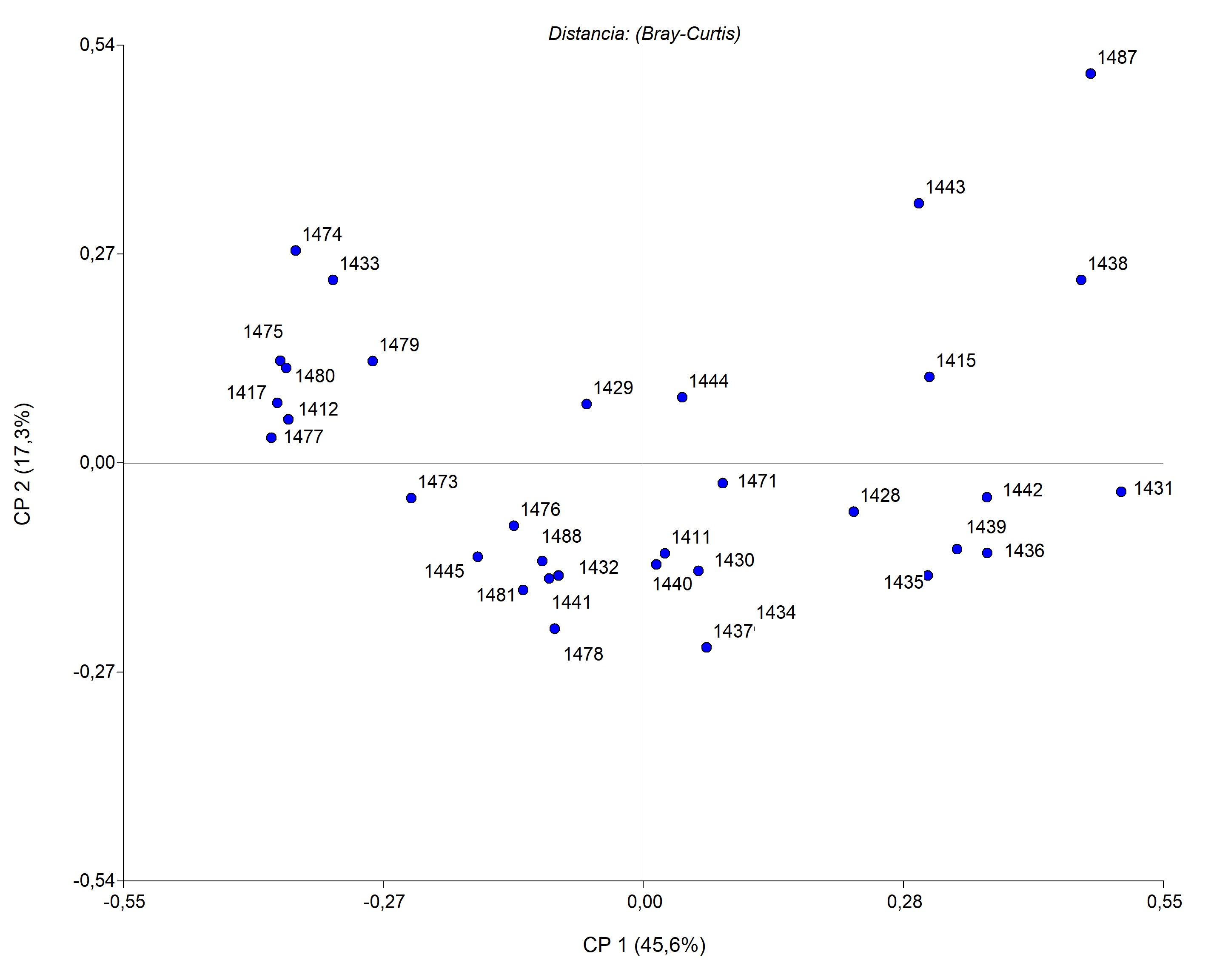
Since comparing so many curves is complex, the number of deaths of each of the ten days was considered for each of the forty-four isolates, using the Bray-Curtis distance. To describe and compare multivariately the isolates, we perform a Principal Coordinate Analysis (PCoA) with the mortality values of Table I.
RESULTS
In this study, thirty-four isolates of entomopathogenic fungi were obtained from different grasshopper species (Table II), corresponding to eleven sites in three counties in the center of Buenos Aires province.
Thirty-one of these isolates of entomopathogenic fungi correspond to Beauveria bassiana species, and three of them are from the genus Metarhizium (Fig. 2).

These isolates were deposited in the Spegazzini Institute culture collection with different accession numbers (Table II).
Mortality test
In assessing the pathogenicity of the thirty-four isolates on third-instar nymphs of D. maculipennis, we observed that the isolates LPSc 1441, LPSc 1445, and LPSc 1476 produced 100% of mortality (Table III).
Entomopathogenic fungi species, mean mortality in percentage with standard errors (SE), Media Survival Times (MST) and lower and upper confidence limit 95% (LCL-UCL) of all treatments.
In contrast, the fungal isolate that showed the lowest mortality was LPSc 1443 with 66.7 + 13.3%, and according to the confidence interval, they began to cause death on the eighth day (Table III). No mortality was observed in the controls.
The LPSc 1441, LPSc 1445, and LPSc 1476 isolates were the most efficient, with media survival time (MST) of 4.86 ± 0.20, 4.80 ± 0.17, and 5 ± 0.15 days after starting the trial, respectively (Table III, Fig. 3).

Survival curves (Kaplan-Meier) of most efficient isolates: a) LPSc 1441, b) LPSc 1476, and c) LPSc 1445.
The isolates that caused the lowest MST were LPSc 1474 with 3,82 ± 0,15 days and LPSc 1433 with 3,87 ± 0,24 days after starting the test. The isolates LPSc 1438, LPSc 1443, and LPSc 1487 showed the highest MST values with 7.09 ± 0.36, 7.25 ± 0.43, and 8.57 ± 3.3 days, respectively (Table III).
Phylogenetic analyses
The phylogenetic data matrix included two loci of 37 isolates and 1775 characters after removal of ambiguously aligned and gaps (Bloc: 816, TEF: 959). The analysis evidenced two major groups, one encompasses all the local isolates except for the LPSc 1438, which is associated with the outgroups (Fig. 4). Among the local group, we can observe four highly supported clades, first the LPSc1434 isolate sister to the rest of this species, the second groups would contain the sister isolates LPSc 1436 and LPSc1471, and the third grouping would be composed of LPSc1431 and LPSc1440 isolates. The fourth group comprises all the remaining isolates with very low internal support values (Fig. 4).

Coalescence Exponential Population tree based on the combined translation elongation factor 1-α (TEF) and intergenic Bloc region of the Beauveria bassiana isolates. Reference sequences (ARSEF_1040, ARSEF_1478, ARSEF_1564, ARSEF_1848, ARSEF_300) proceed from Serna-Domínguez et al. (2019).
The percentage of mortality and virulence did not evidence a phylogenetic signal for the mean and standard deviation values. Mantel’s test showed a significant positive correlation between the phylogenetic and geographic distances (p= 0.0062).
Bray Curtis multivariate analysis
Principal Coordinates analysis allowed us to compare the behaviors of fungal isolates. We identified three groups with clear behaviors. Firstly, a group composed of isolates LPSc 1474, LPSc 1433, LPSc 1479, LPSc 1475, LPSc 1480, LPSc 1417, LPSc 1412, and LPSc 1477 that causes the highest mortality on the first days of the trial until the sixth day. Secondly, a group composed of isolates LPSc 1487, LPSc 1438, LPSc 1431, LPSc 1443, and LPSc 1415 presented extreme behaviors, causing the death of the third-instar nymphs of D. maculipennis since the fifth day of the trial.
The rest of the isolates presented an average behavior. Therefore, they were analyzed separately to find a pattern. We observed that the isolates LPSc 1428, LPSc 1442, LPSc 1439, LPSc 1436, and LPSc 1437 could be a third group with similar behaviors causing the highest mortality from day 4 to day 7 of the trial (Fig. 5).

DISCUSSION
Entomopathogenic fungi (especially M. anisopliae and B. bassiana) are the main microorganisms used to control different species of grasshoppers and locust pests (Lomer et al. 2001, Mariottini et al. 2022, Pelizza et al. 2023). So far, eleven fungal formulations are commercially available to control grasshoppers and locusts in different regions of the world (de Faria & Wraight 2007). Green Muscle and Green Guard on the basis of Metarhizium acridum (Driv. & Miln.) Bisch., Rehn. and Humb, are the most popular formulations. Recently, antilocust mycoinsecticides Mycolar B (Beauveria bassiana (Bals.-Criv.) Vuill.) and Mycolar M (Metarhizium anisopliae (Metschn. Sorok.) have been developed by All-Russian Institute of Plant Protection in collaboration with colleagues from Kazakhstan. In this work, it was possible to find 34 new isolates of entomopathogenic fungi that were found in different grasshopper species in several sites in Buenos Aires province. There have been few records in Argentina of entomopathogenic fungi that naturally affect different species of grasshopper pests (Pelizza et al. 2010, 2018).
For the first time, this work prospected entomopathogenic fungi species that naturally infect grasshoppers in the Pampas Region. We found entomopathogenic fungi isolates in each of the eleven sampling sites, which suggests that they could be common natural enemies of grasshoppers in this region.
Isolates LPSc 1441, LPSc 1445, and LPSc 1476 of entomopathogenic fungi B. bassiana ended up being the most efficient to control the third-instar nymph of D. maculipennis, since they caused a 100% mortality with MST values around the fifth day after starting the trial. The isolate LPSc 1441 is the most virulent due to its lower MST (Fig. 3).
Likewise, the isolates LPSc 1474 and LPSc 1477 caused less mortality (ca. 90 %), nevertheless they also had good potential since they presented the lowest MST. They belong to the most efficient group obtained from Coordinates Principal analyses (Fig. 5). They are followed by isolated LPSc 1479 of the entomopathogenic fungi species M. robertsii which caused high mortality (ca. 80 %) and recorded a lower MST.
Similar results were recorded by Pelizza et al. 2023 which obtained 100% of mortality in the same species of grasshopper and with the same dose of B. bassiana (isolate LPSc 1067). As regards the MST, they registered 5.96 ± 0.26 days. However, in our study, the most efficient B. bassiana isolates (LPSc 1441, LPSc 1445 and LPSc 1476), all recorded lower MST (ca. 4.89 days).
The most efficient isolates (LPSc 1441, LPSc 1445, and LPSc 1476) were found within the group with low internal support values since no synapomorphy was found in its bases. In this sense, the isolates LPSc 1441, and LPSc 1445 were found in the same sampling site (Sierra Alta, Tandil), but they were isolated from a different grasshopper species (Beacris pseudopunctulata and Dichroplus elongatus respectively). However, LPSc 1476 was isolated from a different sampling site (Paraje El Luchador, Benito Juárez) from 90 km away and isolated from B. pseudopunctulata. The B. bassiana isolates that composed the most efficient group obtained from the Principal Coordinates analysis (LPSc 1474, LPSc 1475, LPSc 1480, LPSc 1417, LPSc 1412, and LPSc 1477) presented very low internal support values, which suggests that they could be different isolates belonging to the same strain of B. bassiana.
We found an association between phylogenetic relationships and geographical distances in B. bassiana, a pattern that has been previously mentioned in several studies (Bidochka et al. 2002, Aquino de Muro et al. 2003, Wang et al. 2005, 2013, Estrada et al. 2007, Rehner et al. 2006, Fernandes et al. 2009, Garrido-Jurado et al. 2015). However, a relationship between the phylogeny and the mortality and virulence capacity was not evident; similar results were found by Aynalem et al. (2021).
The discovery of these native entomopathogenic fungi strains enhances our understanding of the biodiversity in the ecosystems of the Pampas region.
Due to the high mortality and short time of action, we consider that three isolates would have the potential to be biological control agents of the grasshopper pest D. maculipennis in the Pampas.
The knowledge obtained in this study could contribute to the development of an alternative to the commonly used chemical insecticides for pest grasshopper control. We demonstrated that the entomopathogenic fungi are effective as biological control agents for these insects. Furthermore, the pest insects used in this study and the entomopathogens that we found are naturally present in the same ecosystems.
Nevertheless, further studies are needed on the virulence of these isolates on other harmful grasshopper species such as Dichroplus elongatus Giglio-Tos (Melanoplinae), Bufonacris claraziana Saussure (Tristiridae), or Tropidacris collaris Stoll (Romaleidae) is necessary, and their potential applicability in other regions of Argentina where the mentioned pest grasshopper species are present. In addition, their efficiency in semi-field conditions must be tested to evaluate their potential as bio input.
ACKNOWLEDGMENTS
This work was partially supported by Agencia Nacional de Promoción Científica y Tecnológica with a Scientific and Technological Research Project (Proyecto de Investigación Científica y Tecnológica) PICT 2021 I-A 00127.
REFERENCES
-
ÁLVAREZ M, DU MORTIER C & FERNÁNDEZ CIRELLI A. 2013. Behavior of insecticide chlorpyrifos on soils and sediments with different organic matter content from Buenos Aires Province, República Argentina. Water Air Soil Pollut 224: 1-6. https://doi.org/10.1007/s11270-013-1453-0.
» https://doi.org/10.1007/s11270-013-1453-0 -
AQUINO DE MURO M, MEHTA S & MOORE D. 2003. The use of amplified fragment length polymorphism for molecular analysis of Beauveria bassiana isolates from Kenya and other countries, and their correlation with host and geographical origin. FEMS Microbiol Lett 229: 249-257. https://doi.org/10.1016/S0378-1097(03)00841-3.
» https://doi.org/10.1016/S0378-1097(03)00841-3 -
AYNALEM B, MULETA D, VENEGAS J & ASSEFA F. 2021. Molecular phylogeny and pathogenicity of indigenous Beauveria bassiana against the tomato leafminer, Tuta absoluta Meyrick 1917 (Lepidoptera: Gelechiidae), in Ethiopia. J Genet Eng Biotechnol 19(1): 127. https://doi.org/10.1186/s43141-021-00227-x.
» https://doi.org/10.1186/s43141-021-00227-x -
BIDOCHKA MJ, MENZIES FV & KAMP AM. 2002. Genetic groups of the insect pathogenic fungus Beauveria bassiana are associated with habitat and thermal growth preferences. Arch Microbiol 178: 531-537. https://doi.org/10.1007/s00203-002-0490-7.
» https://doi.org/10.1007/s00203-002-0490-7 - BLANCHARD CE. 1851. Description des insects. In: Gay C (Ed), Historia física y política de Chile (Voyage au Pôle Sud et dans l’Océanie sur les corvettes l’Astrolabe et la Zélé, Zool.), vol. 5, 422 p.
-
BOUCKAERT R, HELED J, KÜHNERT D, VAUGHAN T, WU CH, XIE D, SUCHARD MA, RAMBAUT A & DRUMMOND AJ. 2014. BEAST 2: a software platform for Bayesian evolutionary analysis. PLoS Computational Biol 10: 1-6. https://doi.org/10.1371/journal.pcbi.1003537.
» https://doi.org/10.1371/journal.pcbi.1003537 -
BRANSON DH, JOERN A & SWORD GA. 2006. Sustainable Management of Insect Herbivores in Grassland Ecosystems: New Perspectives in Grasshopper Control. Biosci 56(9): 743-755. https://doi.org/10.1641/0006-3568(2006)56[743:SMOIHI]2.0.CO;2.
» https://doi.org/10.1641/0006-3568(2006)56[743:SMOIHI]2.0.CO;2 -
CARBONELL CS, CIGLIANO MM & LANGE CE. 2024. Acridomorph (Orthoptera) species from Argentina and Uruguay. Versión II. Available at: https://biodar.unlp.edu.ar/acridomorph/ Accessed on January 18, 2024.
» https://biodar.unlp.edu.ar/acridomorph/ -
DE FARIA MR & WRAIGHT SP. 2007. Mycoinsecticides and mycoacaricides: a comprehensive list with worldwide coverage and international classification of formulation types. Biol Control 43(3): 237-256. .https://doi.org/10.1016/j.biocontrol.2007.08.001
» https://doi.org/10.1016/j.biocontrol.2007.08.001 -
DRUMMOND AJ & RAMBAUT A. 2007. BEAST: Bayesian evolutionary analysis by sampling trees. In: Lemey P, Salemi M & Vandamme A-M, The Phylogenetic Handbook: A Practical Approach to Phylogenetic Analysis and Hypothesis Testing, p. 564-591. Accessed on February 22, 2024. https://doi.org/10.1017/CBO9780511819049.020
» https://doi.org/10.1017/CBO9780511819049.020 -
ESTRADA ME, CAMACHO MV & BENITO C. 2007. The molecular diversity of different isolates of Beauveria bassiana (Bals.) Vuill. as assessed using intermicrosatellites (ISSR s). Cell Mol Biol Lett 12: 240-252. https://doi.org/10.2478/s11658-006-0069-4.
» https://doi.org/10.2478/s11658-006-0069-4 -
FERNANDES ÉK, MORAES AM, PACHECO RS, RANGEL DE, MILLER MP, BITTENCOURT VR & ROBERTS DW. 2009. Genetic diversity among Brazilian isolates of Beauveria bassiana: comparisons with non-Brazilian isolates and other Beauveria species. J Appl Microbiol 107(3): 760-774. https://doi.org/10.1111/j.1365-2672.2009.04258.x.
» https://doi.org/10.1111/j.1365-2672.2009.04258.x - FOSTER RN, JARONSKI SK, REUTER LC, BLACK R & SCHLOTHAUER R. 2010. Explaining Mycoinsecticide activity: poor performance of spray and bait formulations of Beauveria bassiana and Metarhizium brunneum against Mormon cricket in field cage studies. J Orthoptera Res 19(2): 303-313. http://www.jstor.org/stable/25822716.
-
GARRIDO-JURADO I, FERNÁNDEZ-BRAVO M, CAMPOS C & QUESADA-MORAGA E. 2015. Diversity of entomopathogenic Hypocreales in soil and phylloplanes of five Mediterrean cropping systems. J Invertebr Pathol 130: 97-106. https://doi.org/10.1016/j.jip.2015.06.001.
» https://doi.org/10.1016/j.jip.2015.06.001 - GARRIDO-JURADO I, GONZÁLEZ-MAS N & YOUSEF-YOUSEF M. 2023. Ecosystem services of entomopathogenic ascomycetes. J Invertebr Pathol 201: 108015.
-
GOETTEL MS & INGLIS GD. 1997. Fungi: Hyphomycetes. In: Lacey LA (Ed), Manual of techniques in insect pathology, San Diego, CA: Academic Press, p. 213-248. https://doi.org/10.1016/B978-012432555-5/50013-0
» https://doi.org/10.1016/B978-012432555-5/50013-0 -
GOETTEL MS, JOHNSON DL & INGLIS GD. 1995. The role of fungi in the control of grasshoppers. Can J Bot 73: 71-75. https://doi.org/10.1139/b95-227.
» https://doi.org/10.1139/b95-227 -
GONZALEZ MKS, MIGLIORANZA JE, AIZPÚN FL & PEÑA A. 2010. Assessing pesticide leaching and desorption in soils with different agricultural activities from Argentina (Pampa and Patagonia). Chemosphere 81: 351-358. https://doi.org/10.1016/j.chemosphere.2010.07.021.
» https://doi.org/10.1016/j.chemosphere.2010.07.021 -
GUO Z, LI HC & GAN YL. 2006. Grasshopper (Orthoptera: Acrididae) biodiversity and grassland ecosystems. Insect Sci 13: 221-227. https://doi.org/10.1111/j.1744-7917.2006.00086.x.
» https://doi.org/10.1111/j.1744-7917.2006.00086.x - HALL TA. 1999. BioEdit: a user-friendly biological sequence alignment editor and analysis program for Windows 95/98/NT. Nucl Acids Symp Ser 41: 95-98. Accessed on March 15, 2024.
- HENRY JE. 1985. Melanoplus spp. In: Singh P & Moore RF (Eds), Handbook of Insect Rearing, vol. 1, p. 451-464.
- ILONDU EM & ENWEMIWE VN. 2020. Entomopathogenic fungi: diversity and their application as biopesticidal agents. Nigerian J Mycol 12(2): 1.
-
KHONSANIT A, LUANGSA-ARD JJ, THANAKITPIPATTANA D, NOISRIPOOM W, CHAITIKA T & KOBMOO N. 2020. Cryptic diversity of the genus Beauveria with a new species from Thailand. Mycological Prog 19: 291-315. https://doi.org/10.1007/s11557-020-01557-9.
» https://doi.org/10.1007/s11557-020-01557-9 -
LACEY LA & BROOKS WM. 1997. Initial handling and diagnosis of diseased insects. In: Lacey LA (Ed), Manual of techniques in Insect Pathology, Academic Press, USA, p. 1-15. https://doi.org/10.1016/B978-012432555-5/50004-X
» https://doi.org/10.1016/B978-012432555-5/50004-X - LECOQ M & ZHANG L. 2019. Encyclopedia of Pest Orthoptera of the World. China Agricultural University Press, Beijing China, 310 p.
-
LOMER CJ, BATEMAN RP, JOHNSON DL, LANGEWALD J & THOMAS M. 2001. Biological control of locusts and grasshoppers. Annu Rev Entomol 46: 667-702. https://doi.org/10.1146/annurev.ento.46.1.667.
» https://doi.org/10.1146/annurev.ento.46.1.667 - MADELIN MF. 1963. Diseases caused by hyphomycetous fungi. In: Steinhaus EA (Ed), Insect pathology an advanced treatise, vol. 2, New York and London, p. 687.
-
MARIOTTINI Y, DE WYSIECKI ML & LANGE CE. 2011. Longevity and fecundity of Dichroplus maculipennis (Orthoptera, Acrididae) at non-outbreaking and outbreaking situations. Rev Bras Entomol 55: 435-438. https://doi.org/10.1590/S0085-56262011005000024.
» https://doi.org/10.1590/S0085-56262011005000024 - MARIOTTINI Y, DE WYSIECKI ML & LANGE CE. 2012. Variación temporal de la riqueza, composición y densidad de acridios (orthoptera: acridoidea) en diferentes comunidades vegetales del sur de la provincia de buenos aires. Rev Soc Entomol Argent Mendoza 71: 3-4.
- MARIOTTINI Y, DE WYSIECKI ML & LANGE CE. 2013. Diversidad y distribución de acridios (Orthoptera: Acridoidea) en pastizales del sur de la región Pampeana, Argentina. Rev Biol Trop 61(1): 111-124.
-
MARIOTTINI Y, LANGE CE & PELIZZA SE. 2022. Laboratory test of Beauveria bassiana (Balsamo-Crivelli) Vuillemin sl (Hypocreales: Clavicipitaceae) baits for the biocontrol of the Toad grasshopper pest. Bufonacris claraziana (Saussure) (Orthoptera: Tristiridae). Egypt J Biol Pest Control 32(1): 110. https://doi.org/10.1186/s41938-022-00609-4.
» https://doi.org/10.1186/s41938-022-00609-4 -
MARIOTTINI Y, PELIZZA S & LANGE CE. 2019. Susceptibility of Bufonacris claraziana (Orthoptera: Tristiridae) to Beauveria bassiana (Ascomycota: Hypocreales) under controlled conditions. Biocontrol Sci and Technol 29(8): 817-821. https://doi.org/10.1080/09583157.2019.1597335.
» https://doi.org/10.1080/09583157.2019.1597335 - PARADIS E & SCHLIEP K. 2019. ape 5.0: an environment for modern phylogenetics and evolutionary analyses in R. Bioinform 35: 526-528. doi:10.1093/bioinformatics/bty633.
- PELIZZA SA, CABELLO MN & LANGE CE. 2010. Nuevos registros de hongos entomopatógenos en acridios (Orthoptera: Acridoidea) de la República Argentina. Revista Soc Entomol Argent 69(3-4): 287-291. http://ref.scielo.org/wn26r8.
-
PELIZZA SA, MANCINI M, RUSSO L, VIANNA F & SCORSETTI AC. 2023. Control capacity of the LPSc 1067 strain of Beauveria bassiana (Ascomycota: Hypocreales) on different species of grasshoppers (Orthoptera: Acrididae: Melanoplinae), agricultural pests in Argentina. Rev Facultad de Cienc Agrarias UNCuyo 55(1): 98-103. https://doi.org/10.48162/rev.39.099.
» https://doi.org/10.48162/rev.39.099 -
PELIZZA SA, MARIOTTINI Y, RUSSO LM, VIANNA MF, SCORSETTI AC & LANGE CE. 2017. Beauveria bassiana (Ascomycota: Hypocreales) introduced as an endophyte in corn plants and its effects on consumption, reproductive capacity, and food preference of Dichroplus maculipennis (Orthoptera: Acrididae: Melanoplinae). J Insect Sci 17(2): 53. https://doi.org/10.1093/jisesa/iex024.
» https://doi.org/10.1093/jisesa/iex024 -
PELIZZA SA, MARIOTTINI Y, RUSSO LM, VIANNA FM, SCORSETTI AC & LANGE CE. 2019. Application of Beauveria bassiana using different baits for the control of grasshopper pest Dichroplus maculipennis under field cage conditions. J King Saud Univ-Sci 31(4): 1511-1515. https://doi.org/10.1016/j.jksus.2019.02.014.
» https://doi.org/10.1016/j.jksus.2019.02.014 -
PELIZZA SA, SCHALAMUK S, SIMÓN MR, STENGLEIN SA, PACHECO-MARINO SG & SCORSETTI AC. 2018. Compatibility of chemical insecticides and entomopathogenic fungi for control of soybean defoliating pest, Rachiplusia nu. Rev Argent Microbiol 50(2): 189-201. https://doi.org/10.1016/j.ram.2017.06.002.
» https://doi.org/10.1016/j.ram.2017.06.002 -
PETO R & PETO J. 1972. Asymptotically Efficient Rank Invariant Test Procedures. J R Stat Soc: Ser A 135: 185-206. https://doi.org/10.2307/2344317.
» https://doi.org/10.2307/2344317 -
POSADA D. 2008. jModelTest: phylogenetic model averaging. Mol Biol and Evolut 25(7): 1253-1256. https://doi.org/10.1093/molbev/msn083.
» https://doi.org/10.1093/molbev/msn083 - PRIOR C & GREATHEAD DJ. 1989. Biological control of locusts: the potential for the exploitation of pathogens. FAO Plant Prot Bull 37(1): 37-48.
-
RAMBAUT A, SUCHARD MA, XIE D & DRUMMOND AJ. 2014. Tracer v1.6. Available at: http://tree.bio.ed.ac.uk/software/tracer/ Accessed on February 24, 2024.
» http://tree.bio.ed.ac.uk/software/tracer/ -
REHNER SA, MINNIS AM, SUNG GH, LUANGSA-ARD JJ, DEVOTTO L & HUMBER RA. 2011. Phylogeny and systematics of the anamorphic, entomopathogenic genus Beauveria. Mycol 103: 1055-1073. https://doi.org/10.3852/10-302.
» https://doi.org/10.3852/10-302 -
REHNER SA, POSADA F, BUCKLEY EP, INFANTE F, CASTILLO A & VEGA F. 2006. Phylogenetic origins of African and Neotropical Beauveria bassiana s.l. pathogens of the coffee berry borer, Hypothenemus hampei. J Invertebr Pathol 93: 11-21. https://doi.org/10.1016/j.jip.2006.04.005.
» https://doi.org/10.1016/j.jip.2006.04.005 - SCHWARZ G. 1978. Estimating the dimension of a model. Annals Stat 6(2): 461-464. https://www.jstor.org/stable/2958889.
-
SERNA-DOMÍNGUEZ MG, ANDRADE-MICHEL GY, ROSAS-VALDEZ R, CASTRO-FÉLIX P, ARREDONDO-BERNAL HC & GALLOU A. 2019 High genetic diversity of the entomopathogenic fungus Beauveria bassiana in Colima, Mexico. J Invertebr Pathol 163: 67-74. https://doi.org/10.1016/j.jip.2019.03.007.
» https://doi.org/10.1016/j.jip.2019.03.007 - SHAH PA, KOOYMAN C & PARAISO A. 1997. Surveys for fungal pathogens of locust and grasshoppers in Africa and near east. In: Goettel M & Johnson D (Eds), Microbial control of grasshoppers and locust, Mem Entom Soc Can 171: 27-35. doi:10.4039/entm129171027-1.
-
SONG H, MARIÑO-PÉREZ R, WOLLER DA & CIGLIANO MM. 2018. Evolution, Diversification, and Biogeography of Grasshoppers (Orthoptera: Acrididae). Syst Divers 2(4): 3. https://doi.org/10.1093/isd/ixy008.
» https://doi.org/10.1093/isd/ixy008 -
STENGLEIN S & BALATTI P. 2006. Genetic diversity of Phaeoisariopsis grise ola in Argentina as revealed by pathogenic and molecular markers. Physiol Mol Plant Pathol 68: 158-167. https://doi.org/10.1016/j.pmpp.2006.10.001.
» https://doi.org/10.1016/j.pmpp.2006.10.001 - VEGA FE. 2018. The use of fungal entomopathogens as endophytes in biological control: a review. Mycol 110: 4-30. doi:10.1080/00275514.2017.1418578.
- VEGA FE, MEYLING NV, LUANGSA-ARD JJ & BLACKWELL M. 2012. Fungal entomopathogenes. Insect Pathol 2: 171-220. doi:10.1016/B978-0-12-384984-7.00006-3.
-
WANG J, YANG L, QIU X, LIU YG, ZHOU W & WAN YJ. 2013. Diversity analysis of Beauveria bassiana isolated from infected silkworm in southwest China based on molecular data and morphological features of colony. World J Microbiol Biotechnol 29: 1263-1269. https://doi.org/10.1007/s11274-013-1289-1.
» https://doi.org/10.1007/s11274-013-1289-1 -
WANG S, MIAO X, ZHAO W, HUANG B, FAN M, LI Z & HUANG Y. 2005. Genetic diversity and population structure among strains of the entomopathogenic fungus, Beauveria bassiana, as revealed by inter-simple sequence repeats (ISSR). Mycol Res 109: 1364-1372. https://doi.org/10.1017/S0953756205003709.
» https://doi.org/10.1017/S0953756205003709