 Ligatureless Low Friction Self-Ligating Bracket: A Finite Element Study
Abstract
This study used the finite element method to evaluate a new orthodontic bracket design aiming to reduce friction during tooth movement, thereby minimizing tissue damage. The analysis focused on sliding resistance, retention capacity, and activation using stainless steel brackets (slot: 0.022”x0.027”) and various archwire types: square (0.022”x0.022”), rectangular (0.021”x0.025”), and round (0.020”). Simulations were performed under dry (µ=0.5) and lubricated (µ=0.3) conditions, totaling 40 models. Loads were applied to the arches, and von Mises stresses and forces were computed. The passive self-ligating sliding contact bracket showed up to 15% lower resistance to mesiodistal sliding under constant movement and up to 80% under variable movement with a 1N load; under 10N, the reduction reached 80% in both conditions. The active variant demonstrated full engagement of all wire edges and lower resistance to sliding. The distribution of stress varied with arch type and load direction, with round wires showing higher peak stresses. These results indicate promising mechanical advantages of the new bracket design in reducing sliding resistance while enhancing wire control. However, since this is a numerical simulation, clinical studies are required to confirm these findings and determine their practical relevance in orthodontic treatment.
Key words
Orthodontics; Self-ligating; Friction; Sliding contact; Finite element method
INTRODUCTION
Efficient, precise and aesthetic orthodontic treatment is increasingly desired in a short intervention period. Therefore, factors that can influence this practice, such as arch and bracket set, position, gap size, bracket material property, must be considered for good tooth positioning in the three planes (Ehsani et al. 2009, Tominaga et al. 2014, Amaral et al. 2014, Papageorgiou et al. 2017).
Obtaining quick and efficient results must be pertinent to tooth movement without tissue damage. A major challenge to the success of this process is controlling the mechanical friction generated between the bracket and the archwire, which can interfere with tissue responses. Therefore, a force system that generates maximum tooth movement with minimum damage would be ideal (Montesinos 2015, Gómez-Gómez et al. 2019).
Friction forces, which are defined as the resistance force that each body exerts on the other when sliding against each other and act in the opposite direction of movement, will be present associated with the mesiodistal sliding between the archwire and the bracket, regardless of the stage of treatment orthodontic. As a consequence, there will be a loss of the total force applied to the orthodontic sliding mechanics, which will be dissipated due to the frictional resistance to sliding (Vellini-Ferreira 2008, Proffit et al. 2021), therefore, it is necessary to apply more force to initiate and maintain the movement. Eliminating friction during orthodontic movement is impractical, however improvements can contribute significantly to reducing negative impacts. Changes in the characteristics of the arch and bracket set can improve the transformation of mechanical stimulation in the remodelling process (Kusy & Whitley 1990, Melsen 2001, Cossetin et al. 2012, Jung 2021).
To minimize the friction generated by conventional brackets, self-ligating brackets emerged. These have projections similar to locks/caps/clips, on the bracket body capable of retaining and activating the archwire. In clinical reproductions, simulations showed a high estimate of reduction in orthodontic force due to friction (Kojima & Fukui 2005).
In recent years, manufacturers have developed brackets that feature reduced friction. Changes in shape, material and lashing contribute to reducing friction force (Redlich et al. 2003, Wichelhaus 2017, Al-Thomali et al. 2017).
The passive sliding contact self-ligating bracket (PSCB) and the active sliding contact self-ligating bracket (ASCB) emerged with the aim of minimizing friction force, improving sliding mechanics, retaining and activating the arch without the need for locks/caps /clips. The use of locks/caps/clips may reduce normal strength, however, there is a record of frequent failures, high price and large volume (Chen et al. 2010, Huang et al. 2012).
The PSCB and ASCB feature multiple rotating and sliding floating cylinders incorporated into the bottom surface of the slot (Patent BR 10 2021 013185 3). Whenever two parts have relative movement, they constitute a bearing (sliding contact), without regard to their shape or configuration (Norton 2013). Furthermore, the PSCB has retention technology (Patent BR 10 2021 013194 2) with mushroom-shaped sliding contacts on the sides of the slot, while the ASCB has retention and activation technology (Patent BR 10 2021 013185 3) with sliding contacts in hyperbolic format on the sides of the slot. Consequently, the arch contact will be on freely moving parts, the SCs, and not directly on the bracket surface. Evidently, the PSCB and ASCB do not have locks/caps/clips and have a smaller volume.
The objective of this study is to evaluate the performance of the passive sliding contact self-ligating bracket (PSCB), active sliding contact self-ligating bracket (ASCB), passive self-ligating bracket (PB) and active self-ligating bracket (AB) regarding sliding resistance, retention and activation associated with rectangular and round stainless-steel arches, during sliding mechanics using the numerical method of three-dimensional finite elements.
The null hypothesis tested in this study was that there would be no significant difference in sliding resistance and stress distribution among the evaluated bracket systems, regardless of the bracket design or archwire configuration. The alternative hypothesis was that the new clipless self-ligating designs (PSCB and ASCB) would exhibit lower frictional resistance and improved mechanical performance compared to conventional systems.
MATERIALS AND METHODS
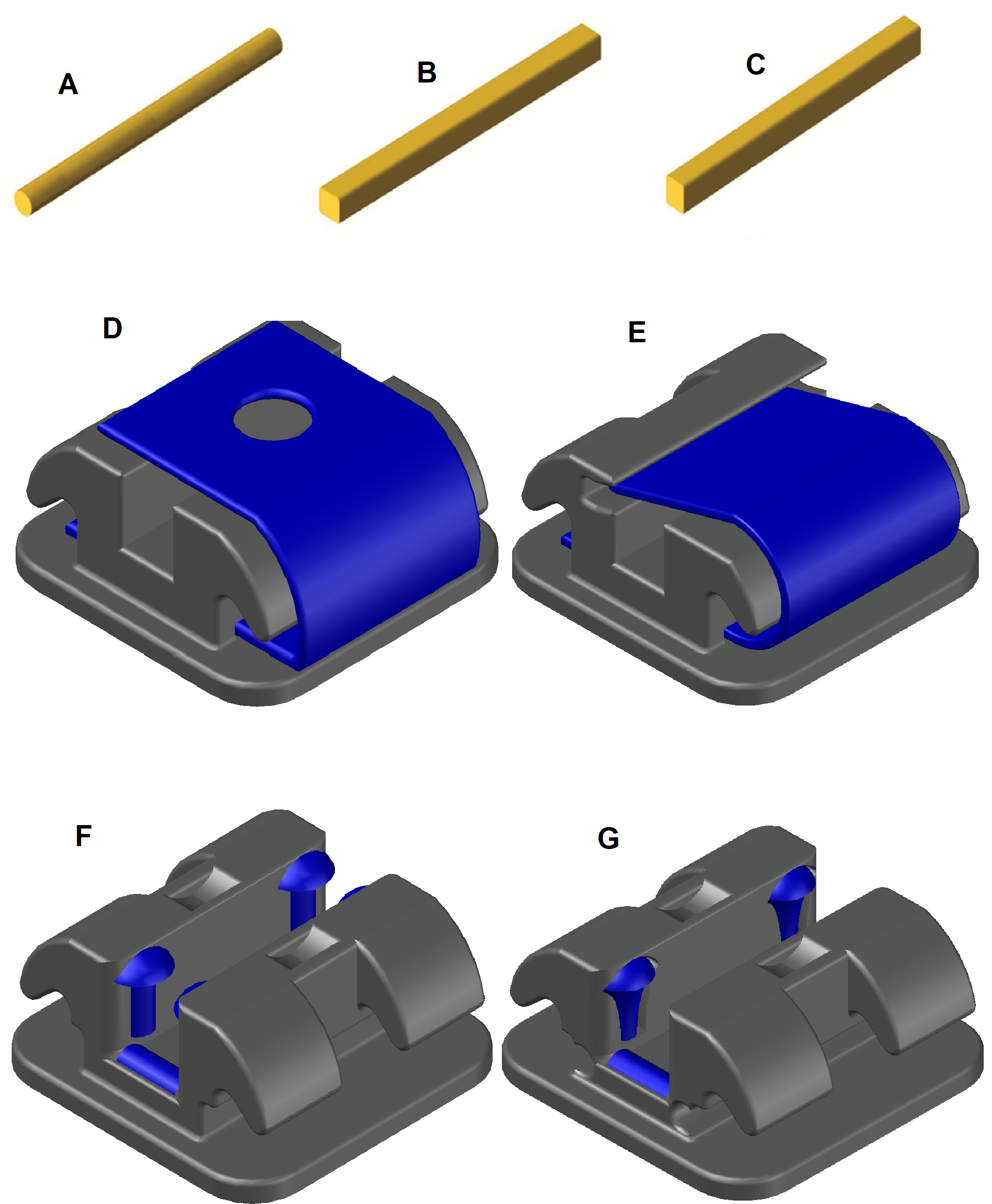
The study was carried out using the finite element method (FEM). For this purpose, models of stainless steel upper central incisor brackets were selected, PB with a slot of 0.022” x 0.027” prescription Edgewise, AB with a slot of 0.022” x 0.027” prescription Edgewise, patented PSCB with a slot of 0.022” Edgewise and the patented ASCB with 0.022” x 0.027” slot Edgewise prescription. In addition, 0.022” x 0.022”, rectangular 0.021” x 0.025” and 0.020” round stainless steel arches were used. Three-dimensional (3D) solid models of the brackets and arches were created in SolidWorks modelling software (Concord, Massachusetts, EUA, 1993) Figure 1.

Generated Models – Round arcs (a) 0.020”, square (b) 0.022” x 0.022”, rectangular (c) 0.021” x 0.025”, PB (d), AB (e), PSCB (f) and ASCB (g).
Surface-to-surface contact with finite sliding was applied between the archwire and bracket slot in the EF Abaqus 6.21 program. Tangential behavior followed Coulomb friction using a penalty formulation. Normal contact was modeled as hard contact to prevent penetration and permit separation upon unloading. Stabilization and automatic step control were employed to improve computational convergence.
A mesh convergence test was carried out to ensure that the numerical results were independent of the refinement of spatial discretization. This step is fundamental to validate the reliability of the simulations, preventing differences between models from being influenced by the element size. The progressive refinement was focused on the contact region between the archwire and the bracket slot, varying the element size from 0.08 mm to 0.02 mm. During this process, the von Mises stresses at the slot base and the frictional force were monitored as convergence control criteria. The results showed numerical stabilization with variation below 3% for element sizes smaller than 0.03 mm, indicating mesh independence. Therefore, this convergent mesh density was uniformly adopted for all analyzed models, ensuring consistency and reliability in the comparative results.
The friction coefficients (µ) used for the mechanical contact between the archwires, brackets and SCs were based on previous studies with µ=0.5 for a dry environment and µ=0.3 for a lubricated environment (Barbosa et al. 2019). The 3D solid model had an average of 500.000 isoparametric tetrahedral and hexahedral solid elements.
The material properties of the stainless steel brackets and archwires were obtained from previously published literature and assigned to the model (Naceur et al. 2014, Papageorgiou et al. 2016) as shown in Table I.
The method presented here was applied for a dynamic structural analysis with homogeneous, quadratic and isotropic material conditions. The simulation was programmed to reflect the clinical situation of mesiodistal orthodontic sliding mechanics, and different archwire and bracket combinations were used. The archwire was previously inserted into the bracket slot, and the bracket base was fixed in all degrees of freedom, simulating the clinical bonding condition. Although the main objective of this study was to compare different bracket and archwire systems to validate the patented model, this condition may overestimate stiffness and stress magnitudes. The finite element model of this study was developed with a focus on the mechanical analysis of the bracket–archwire system, without simulating biological tissues or biological responses. Future studies may incorporate additional modeling complexities, such as the inclusion of biological tissues (e.g., the periodontal ligament), depending on the objectives of each investigation.
To carry out the simulation, normal loads were exerted on the arch in different situations, except for the ASCB and AB, which press the arch through the SCs and clip, respectively. The load magnitudes of 1 N and 10 N were selected to simulate typical orthodontic forces acting on brackets during sliding mechanics. Previous studies have reported average clinical forces ranging from 0.5 N to 2 N for anterior tooth movement and up to 10 N for posterior segments, depending on wire stiffness and activation method (Kojima & Fukui 2005, Proffit et al. 2021). These values were therefore considered representative of light and high clinical loading conditions.
The loads were applied to the upper part of the arch, and similarly to the upper and lateral parts of the arch, and maintained during the arch displacement of 2 mm at a speed of 2 mm/min in all simulations. The deformations, stresses and forces were then collected and discriminated. The models were created on a Dell XPS 8920 workstation at Advanced Computation Laboratory (Diamantina, Brazil) and took an average of 84 hours per individual simulation.
Although this study is purely numerical, the proposed models can be validated in future experimental setups using frictional tests with orthodontic dynamometers or tribometers under dry and lubricated conditions to correlate numerical predictions with in vitro performance.
RESULTS
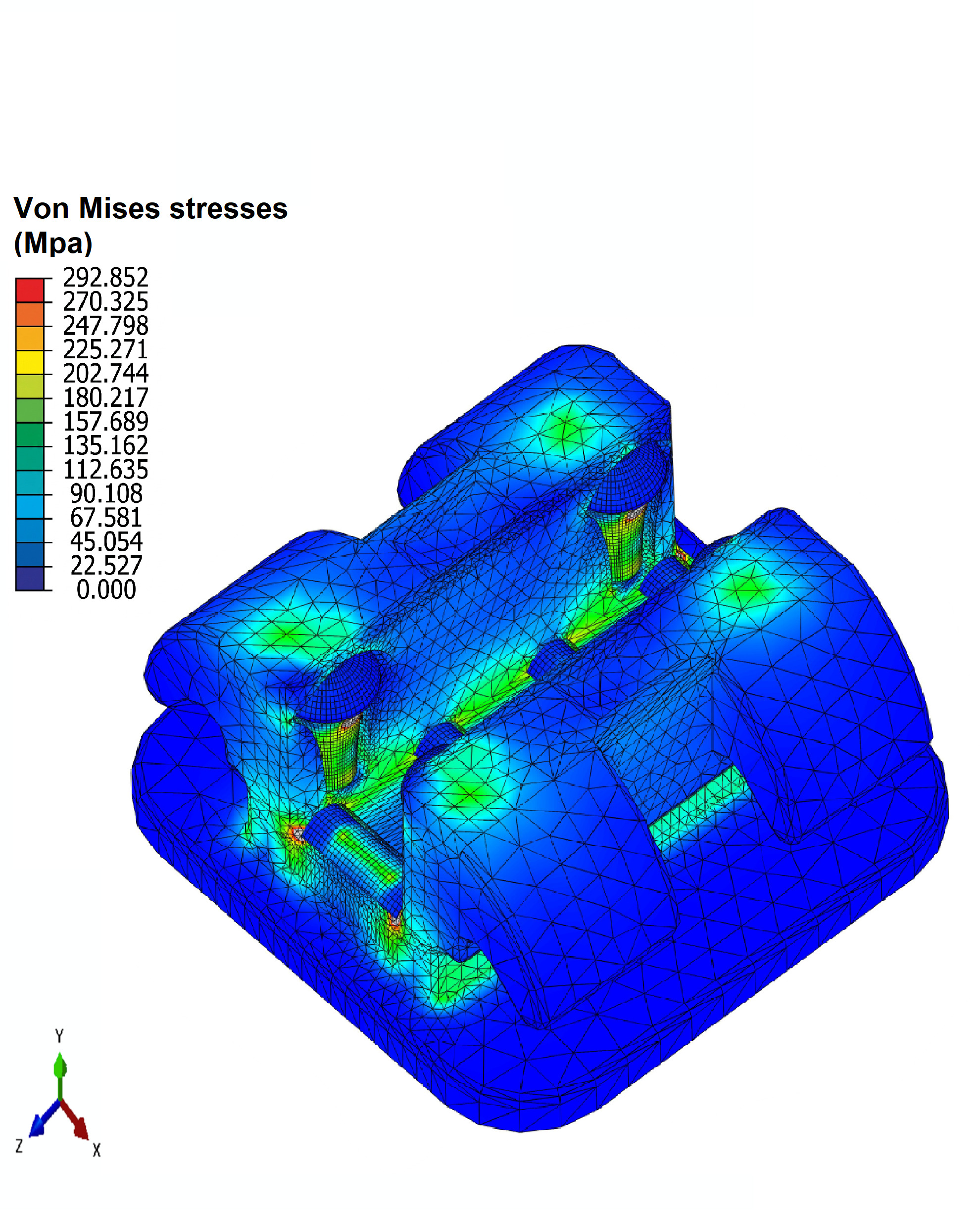
For the PB, the lower part of the slot presented the highest stress distribution for a load of 1 N applied only to the upper part of the arch, regardless of the type of arch used. Similarly, SCs presented the highest tension points for PSCB and ASCB, Figure 2.

It is observed in the contact region of the edge of the round arch 0.020” stress concentration lines for the PB, Figure 3a, at the bottom and side of the slot, when subjecting the arch to normal forces of 1 N on the top and side face. The same applies to PSCB, however with stress concentration points located in the SCs, Figure 3b.

Distribution of von Mises stress for different combinations. PB (a) (round arc 0.020”), AB (c) (rectangular arc 0.021” x 0.025”), PSCB (b) (round arc 0.020”), PSCB (d) (square arc 0.022” x 0.022”), ASCB (e) (rectangular arch 0.021” x 0.025”.
For square arches 0.022” x 0.022” and rectangular arches 0.021” x 0.025”, the stresses were distributed at the base of the slot for the AB, with the clip presenting the highest stresses, Figure 3c. For these same arcs, the PSCB and ASCB externalized stress concentration points located in the SCs, Figure 3d and Figure 3e. Furthermore, as expected, the ASCB presented tensions distributed throughout the bracket body, since it has the ability to retain and activate when acting on all edges of the arch, Figure 3e and Figure 4. At this point, it can be clarified that for AB and ASCB there is no external load applied to the arches.

Table II presents the maximum stress observed for different combinations of archwires and brackets. The PB showed lower tension for different associations with arches. The combination with round arches exhibited a higher contact stress, followed by rectangular arches 0.021” x 0.025” and square arches 0.022” x 0.022”, respectively. Although some models presented peak stresses above 500 MPa, these localized values occur at small contact regions where numerical concentration is expected. Similar magnitudes have been reported in previous finite element analyses of stainless-steel brackets (Papageorgiou et al. 2016, Naceur et al. 2014).
The magnitude of the average frictional force is shown in table III for sliding the arch over a distance of 2 mm. The PSCB showed an average resistance of 15% lower to the mesiodistal sliding mechanics for arch combinations when a stationary force was reached, compared to the PB. However, for the transient force regime, the resistance to sliding mechanics can be up to 80% lower, as seen in Figure 5.

For different friction coefficients, the force to initiate the movement was governed by the surface with the lowest friction. In addition, the SCs demonstrated resistance to sliding mechanics that tends to decrease with the increase in the applied normal force, limited up to the maximum load tested, as seen in Figure 6. AB presented lower slip resistance than ASCB, Table III. From a clinical perspective, the PSCB and ASCB demonstrated lower frictional resistance during mesiodistal sliding, suggesting potential for smoother tooth movement with reduced applied forces and shorter treatment times.

DISCUSSION
In this study, the improvement of sliding contact technology, retention and activation of arches in orthodontic brackets free of locks/caps/clips was evaluated for better mesiodistal sliding mechanics with von Mises stresses and deformations developed in the arch and bracket assembly. When searching for possible design flaws, the search for points that can reach yield stresses is practiced, for this purpose the combination of the main stresses into an equivalent stress is used. Therefore, the finite element method has great success with von Mises stresses (Lee et al. 2009, Papageorgiou et al. 2016).
Round archwires generated greater tensions in the same bracket through the same normal force, due to their smaller contact area. Furthermore, the distribution was shown to be related to the direction of the normal force exerted. For forces only at the top of the arc, the stresses were distributed to the bottom of the slot, however, they diffused to the side of the slot, when force was inserted on the side of the arc. There are many factors that affect friction resistance in orthodontic systems, such as environmental conditions, finish, type of bracket, material and finish. The stress values were not affected by the mechanical properties entered into the FEM (Young’s modulus, Poisson’s Ratio and Density), but visibly, by the geometric model of the contact surface and the applied force. What reveals tension as an intensive form of applied force (Ehsani et al. 2009, Papageorgiou et al. 2017).
The transient regime corresponded to the initial oscillatory phase (0–0.2 mm displacement) during static-to-kinetic transition. The steady-state regime was defined when frictional force stabilized (<2% variation), indicating kinetic sliding conditions. It was analysed that the PSCB showed a reduction in the force required to move the arc, on average 15% in the stationary regime and up to 90% less in the transient regime, influenced by the freedom that the SCs have to rotate freely. In Orthodontics, once the tooth is subjected to displacement forces, the sliding movement along the arch occurs alternately, moving in a transitive manner, which would make the lowest PSCB resistance relevant to the process (Nanda & Ghosh 1997, Proffit et al. 2021). However, this value may not be exact, since all analysis via FEM are approximate results. Naturally, this does not detract from the technique, as qualitatively it is possible to reach decisive inferences about how the process occurs. Many variables related to friction, difficult to control in experiments, are precisely governed in a numerical model (Gallagher 1975).
Affected only by the coefficient of friction and normal force, the PB presented the same resistance to sliding force, regardless of the arch. Expected fact given the classical laws of friction. The friction coefficient is independent of the contact area, for the same force, according to the first law of friction, in addition, the second law informs that the friction force is proportional to the applied perpendicular force (Halliday et al. 2016). Divergently, possibly influenced by the lack of control in experiments, for example, surface finish, normal force and contact wear, experimental studies show greater resistance to friction in rectangular, square and round arches, respectively, which violates the laws classic friction (Piozzoni et al. 1998, Halliday et al. 2016).
The surface finish is easily affected by the manufacturing process (sintering) of the brackets, with the presence of pores on the surface of the slot. The normal force, which in many experiments, is not controlled (Huang et al. 2009, Phukaoluana et al. 2017), is another impacting factor on slip resistance. When using, for example, elastomeric bandages as a tying technique, increasing the caliber of the arch may increase the normal force generated by the ligature, given that the elastomeric ligature presents an elastic force managed by Hooke’s Law (Halliday et al. 2016). As for the tribological behaviour of bodies, the friction coefficient can be changed by contact wear (Stachowiak & Batchelor 2005). Furthermore, the oscillating behaviour at the beginning of the movement, as observed in Figures 6 and 7, which are presented by PSCB and ASCB, can be explained by the SCs being floating, that is, the gap existing between the bracket and the SCS so that they can rotate freely.
It was found that ASCB expressed greater resistance to displacement compared to AB. This difference is directly linked to the way in which the arc is activated in the slot. The model adopted for the activation clip in the AB was superelastic, which generated a lower normal force on the arch, however, it could possibly generate gaps and impair the control of the applied torque. ASCB activates the arch through hyperbolic sliding contacts with force generated by the bracket body, which naturally can be a more robust form of arc control (Wichelhaus 2017). However, future changes to the proposed geometric model for the ASCB should result in increases in its benefits.
Furthermore, it was noted that the behaviour of PSCB and ASCB is more efficient with a decrease in the coefficient of friction between the SCs and the bracket. In other words, the sliding force is influenced by the surface with the lowest friction. This provides an indication for the use of self-lubricating materials, such as polymers, in the bracket body (Ratner et al. 2004). Since the SCs are the bodies subjected to the highest tensions in the group.
Clinically, the reduction in frictional resistance can decrease anchorage demands and allow the use of lighter orthodontic forces to achieve controlled tooth movement. This may contribute to greater patient comfort, reduced risk of root resorption, and improved overall treatment efficiency. Furthermore, the simplified clipless configuration offers potential advantages in terms of durability and cost-effectiveness, by reducing maintenance requirements and manufacturing complexity compared with conventional self-ligating systems.
The newly developed PSCB and ASCB designs address key limitations of traditional self-ligating brackets by eliminating clips and caps, thereby reducing fracture susceptibility and maintenance issues. In addition, their refined, smoother slot geometry enhances archwire guidance and control while maintaining mechanical stability and low friction throughout sliding mechanics.
The limitations of the present study include the absence of simulation of material aging, saliva presence, temperature variations, and masticatory loads, all of which can significantly influence frictional behavior under clinical conditions. In addition, long-term wear of the SC–bracket assembly was not simulated, which limits the direct extrapolation of the results to real situations.
Nevertheless, the new technology proved suitable for its intended purpose, showing favorable outcomes when only its geometric configuration was considered, with stress levels within acceptable limits and some aspects open for optimization.
Evidently, the PSCB and ASCB models promoted a reduction in friction generated by mesiodistal sliding mechanics, but future studies should include experimental tribological tests and more complex numerical modeling to validate and expand the understanding of the friction and wear behavior of these systems over the long term.
CONCLUSIONS
Within the limitations of this numerical study, the new clipless self-ligating brackets (PSCB and ASCB) exhibited lower frictional resistance and improved sliding performance compared with conventional self-ligating systems. These findings suggest potential clinical advantages in terms of mechanical efficiency, tooth movement control, and patient comfort, underscoring the importance of future experimental investigations, both in vitro and in vivo, to validate and strengthen the numerical evidence obtained.
Acknowledgements
We thank the Institute of Science and Technology of the Federal University of Vales do Jequitinhonha and Mucuri (UFVJM) for providing the use of computers and software for this research.
References
-
AL-THOMALI Y, MOHAMED RN & BASHA S. 2017. Torque expression in self-ligating orthodontic brackets and conventionally ligated brackets: A systematic review. J Clin Exp Dent 1: e123-e128. doi: 10.4317/jced.53187.
» https://doi.org/10.4317/jced.53187 -
AMARAL MRD, NETO OS, PITHON MM & OLIVEIRA DD. 2014. Evaluation In Vitro of Frictional Resistance of Self-Ligating Esthetic and Conventional Brackets. Int J Odontostomatol 8: 261-266. https://doi.org/10.4067/S0718-381X2014000200019.
» https://doi.org/10.4067/S0718-381X2014000200019 -
BARBOSA LM, SILVA JWM & MELLO JDB. 2019. Orthomicrotribometer. Wear 426: 1729-1739. https://doi.org/10.1016/j.wear.2018.12.067.
» https://doi.org/10.1016/j.wear.2018.12.067 -
CHEN SSH, GREENLEE GM, KIM JE, SMITH CL & HUANG GJ. 2010. Systematic review of self-ligating brackets. AJO-DO 137: 726.e1-726.e18. https://doi.org/10.1016/j.ajodo.2009.11.009.
» https://doi.org/10.1016/j.ajodo.2009.11.009 -
COSSETIN E, NÓBREGA SHS & CARVALHO MGF. 2012. Study of tension in the periodontal ligament using the finite elements method. DPJO 14: e1-e8. https://doi.org/10.1590/S2176-94512012000100006.
» https://doi.org/10.1590/S2176-94512012000100006 -
EHSANI S, MANDICH MA, EL-BIALY TH & FLORES-MIR C. 2009. Frictional Resistance in Self-Ligating Orthodontic Brackets and Conventionally Ligated Brackets: A Systematic Review. Angle Orthod 79: 592-601. https://doi.org/10.2319/060208-288.1.
» https://doi.org/10.2319/060208-288.1 - GALLAGHER RH. 1975. Finite element analysis - Fundamentals. Newmark NM & Hall WJ (Eds), Englewood Cliffs: Prentice-Hall, 420 p.
-
GÓMEZ-GÓMEZ SL, SÁNCHEZ-OBANDO N, ÁLVAREZ-CASTRILLÓN MA, MONTOYA-GOEZ Y & ARDILA CM. 2019. Comparison of frictional forces during the closure of extraction spaces in passive self-ligating brackets and conventionally ligated brackets using the finite element method. J Clin Exp Dent 11: 439-446. doi: 10.4317/jced.55739.
» https://doi.org/10.4317/jced.55739 - HALLIDAY D, RESNICK R & WALKER J. 2016. Fundamentos de Física – Mecânica. Vol. 1, 10th ed. [S.l.]: Rio de Janeiro, LTC, 371 p.
-
HUANG TH, LUK HS, HSU YC & KAO CT. 2012. An in vitro comparison of the frictional forces between archwires and self-ligating brackets of passive and active types. Eur J Orthod 34: 625-632. https://doi.org/10.1093/ejo/cjr065.
» https://doi.org/10.1093/ejo/cjr065 -
HUANG Y, KEILIG L, RAHIMI A, REIMANN S, ELIADES T, JÄGER A & BOURAUEL C. 2009. Numeric modeling of torque capabilities of self-ligating and conventional brackets. AJO-DO 136: 638-643. https://doi.org/10.1016/j.ajodo.2009.04.018.
» https://doi.org/10.1016/j.ajodo.2009.04.018 -
JUNG MH. 2021. Effects of self-ligating brackets and other factors influencing orthodontic treatment outcomes: A prospective cohort study. Korean J Orthod 51: 397-406. https://doi.org/10.4041/kjod.2021.51.6.397.
» https://doi.org/10.4041/kjod.2021.51.6.397 -
KOJIMA Y & FUKUI H. 2005. Numerical simulation of canine retraction by sliding mechanics. AJO-DO 127: 542-551. DOI: 10.1016/j.ajodo.2004.12.007.
» https://doi.org/10.1016/j.ajodo.2004.12.007 -
KUSY RP & WHITLEY JQ. 1990. Effects of surface roughness on the coefficients of friction in model orthodontic systems. J Biomech 23: 913-925. https://doi.org/10.1016/0021-9290(90)90356-8.
» https://doi.org/10.1016/0021-9290(90)90356-8 -
LEE H, TING K, NELSON M, SUN N & SUNG SJ. 2009. Maxillary expansion in customized finite element method models. AJO-DO 136: 367-374. https://doi.org/10.1016/j.ajodo.2008.08.023.
» https://doi.org/10.1016/j.ajodo.2008.08.023 -
MELSEN B. 2001. Tissue reaction to orthodontic tooth movement – a new paradigm. Eur J Orthod 23: 671-681. https://doi.org/10.1093/EJO/23.6.671.
» https://doi.org/10.1093/EJO/23.6.671 -
MONTESINOS AA. 2015. Comparative Study of Static and Kinetic Frictional Resistance during the Sliding of Arch Wires through Orthodontic Brackets, using Different Methods of Ligation, in the Dry State. Bioceram Dev Appl 5: 1000085. DOI: 10.4172/2090-5025.1000085.
» https://doi.org/10.4172/2090-5025.1000085 -
NACEUR IB, CHARFI A, BOURAOUI T & ELLEUCH K. 2014. Finite element modeling of superelastic nickel–titanium orthodontic wires. J Biomech 47: 3630-3638. https://doi.org/10.1016/j.jbiomech.2014.10.007.
» https://doi.org/10.1016/j.jbiomech.2014.10.007 - NANDA RS & GHOSH J. 2020 Biomechanical considerations in sliding mechanics. In: Biomechanics in clinical Orthodontics. Nanda RS (Ed), 1st ed, Philadelphia: W. B. Saunders, p. 188-217.
- NORTON RL. 2013. Projeto de Máquinas: Uma abordagem integrada. 4th Ed, Porto Alegre, RS: Bookman, 1060 p.
-
PAPAGEORGIOU S, KEILIG L, HASAN I, JÄGER A & BOURAUEL C. 2016. Effect of material variation on the biomechanical behaviour of orthodontic fixed appliances: a finite element analysis. Eur J Orthod 38: 300-307. doi: 10.1093/ejo/cjv050.
» https://doi.org/10.1093/ejo/cjv050 -
PAPAGEORGIOU S, KEILIG L, VANDEVSKA-RADUNOVIC V, ELIADES T & BOURAUEL C. 2017. Torque differences due to the material variation of the orthodontic appliance: a finite element study. Prog Orthod 18: 6. https://doi.org/10.1186/s40510-017-0161-5.
» https://doi.org/10.1186/s40510-017-0161-5 -
PHUKAOLUANA A, KHANTACHAWANA A, KAEWTATIP P, DECHKUNAKORN S, ANUWONGNUKROH N, SANTIWONG P & KAJORNCHAIYAKUL J. 2017. Comparison of friction forces between stainless orthodontic steel brackets and TiNi wires in wet and dry conditions. Int Orthod 15: 13-24. https://doi.org/10.1016/j.ortho.2016.12.017.
» https://doi.org/10.1016/j.ortho.2016.12.017 -
PIOZZONI L, RAVNHOLT G & MELSEN B. 1998. Frictional forces related to self-ligating brackets. Eur J Orthod 20: 283-291. https://doi.org/10.1093/ejo/20.3.283.
» https://doi.org/10.1093/ejo/20.3.283 - PROFFIT WR, FIELDS H, LARSON B & SARVER DM. 2021. Contemporary Orthodontics. 6th Ed, Mosby: St. Louis, 768 p.
- RATNER BD, HOFFMAN AS, SCHOEN FJ & LEMONS JE. 2004. Biomaterials Science - An Introduction to Materials in Medicine. 2nd ed, San Diego: Elsevier Academic Press, 1586 p. DOI: 10.1016/C2017-0-02323-6.
-
REDLICH M, MAYER Y, HARARI D & LEWINSTEIN I. 2003. In vitro study of frictional forces during sliding mechanics of “reduced-friction” brackets. Am J Orthod Dentofacial Orthop 124: 69-73. https://doi.org/10.1016/S0889-5406(03)00238-5.
» https://doi.org/10.1016/S0889-5406(03)00238-5 - STACHOWIAK G & BATCHELOR AW. 2005. Engineering Tribology. 3rd ed, [S.l.]: Butterworth-Heinemann, 300 p.
-
TOMINAGA JY, OZAKI H, CHIANG PC, SUMI M, TANAKA M, KOGA Y, BOURAUEL C & YOSHIDA N. 2014. Effect of bracket slot and archwire dimensions on anterior tooth movement during space closure in sliding mechanics: A 3-dimensional finite. Am J Orthod Dentofacial Orthop 146(2): 166-174. https://doi.org/10.1016/j.ajodo.2014.04.016.
» https://doi.org/10.1016/j.ajodo.2014.04.016 - VELLINI-FERREIRA F. 2008. Ortodontia Diagnostico e Planejamento Clinico. São Paulo, SP: Editora Artes Medicas LTDA, 576 p.
-
WICHELHAUS A. 2017. A new elastic slot system and V-wire mechanics. Angle Orthodontist 87(5): 774-781. doi: 10.2319/121516-899.
» https://doi.org/10.2319/121516-899
Edited by
-
Handling editor
Andrea Paula-Lima
The data underlying this article are available in the article and in its online supplementary material.