 Descriptions of the first Ciidae (Coleoptera: Tenebrionoidea) from the oceanic archipelago of Fernando de Noronha, Brazil
Abstract
In this study, we describe four new species of Ciidae from Fernando de Noronha, representing the first ciid species recorded from the archipelago and from any Brazilian oceanic island: Ceracis caio Souza-Gonçalves & Lopes-Andrade sp. nov., Ceracis italo Souza-Gonçalves & Lopes-Andrade sp. nov., Cis ayessa Souza-Gonçalves & Lopes-Andrade sp. nov., and Cis paula Souza-Gonçalves & Lopes-Andrade sp. nov.. These discoveries underscore the significance of investigating the ciid fauna of Brazilian islands, which appears to be entirely distinct from that of the mainland.
Key words
Ciinae; Ciini; Checklist; Minute tree-fungus beetle; Neotropical; New species
INTRODUCTION
The faunistic and taxonomic knowledge of Brazilian Ciidae has grown substantially over recent decades, expanding from just 16 species across seven genera (Costa 2000) to 70 species in 15 genera (e.g. Lopes-Andrade & Lawrence 2005, 2011, Lopes-Andrade 2008a, b, 2024, Antunes-Carvalho et al. 2012, Antunes-Carvalho & Lopes-Andrade 2013, Oliveira et al. 2013, Pecci-Maddalena & Lopes-Andrade 2017, Borlini & Lopes-Andrade 2023, Rosa-Oliveira & Lopes-Andrade 2023, Rosa-Oliveira et al. 2024, Souza-Gonçalves & Lopes-Andrade 2025). However, most of this knowledge remains focused on the Atlantic Forest and Amazon biomes, with limited studies on Ciidae from the Caatinga and Cerrado (Araujo & Lopes-Andrade 2024, Lopes-Andrade 2024, Souza-Gonçalves & Lopes-Andrade 2024), and virtually no information about the fauna of the Brazilian Chaco and Pantanal. The most significant knowledge gap, however, concerns the insular fauna. The only Brazilian ciid beetle known from an island is Ceracis cassumbensis Antunes-Carvalho & Lopes-Andrade, 2011, recorded on the continental island of Cassumba, with no records outside its type locality. Furthermore, nothing is known about the Ciidae of Brazil’s oceanic islands, primarily due to a lack of material in scientific collections.
The Brazilian oceanic archipelago of Fernando de Noronha is situated in the southern Atlantic Oceanic (coordinates 32°28’ to 32°24’W and 3°52’ to 3°50’S), approximately 345 km from the nearest Brazilian coastline. Administratively part of the state of Pernambuco, it is also designated as a National Park managed by the Instituto Chico Mendes de Conservação da Biodiversidade (ICMBio). The archipelago covers a total area of 18.4 km2 and includes one large island (Fernando de Noronha, which names the archipelago) and several smaller ones (e.g. Cuscuz, São José, Rasa, Sela Gineta, do Meio, Rata). It is entirely volcanic in origin and has never been connected to the mainland (Lopes & Ulbrich 2015, Rafael et al. 2020).
The human impact on biodiversity has grown considerably, necessitating intensified efforts to develop conservation strategies (Myers et al. 2000). These efforts are particularly critical in insular areas, which have significant barriers to dispersal and colonization, especially for terrestrial fauna (Lima & Zeppelini 2015). Since the sixteenth century, Fernando de Noronha has been a focus of attention due to its strategic position and rich natural and cultural heritage. Despite this, much of its geology, fauna, and flora remains poorly known to both the general public and the scientific community (Costa et al. 2023). Unfortunately, Fernando de Noronha has experienced substantial ecological disturbances for nearly 200 years, including deforestation, the introduction of exotic plants and animals, and the impacts of tourism (Teixeira et al. 2003, Serafini et al. 2010).
These disturbances may have contributed to the local extinction of native biodiversity, underscoring the need to monitor the impacts of human activity and their effects on local ecosystems. Biodiversity inventories are critical tools for enabling such monitoring. As part of a long-term project aimed at documenting both native and non-native insect species in Fernando de Noronha, Rafael et al. (2020) published an updated taxonomic checklist. However, no ciid beetles collected during their expedition were included in that checklist at the time. Recently, this material was made available to us, and we identified a unique and previously unrecorded ciid beetle fauna in the archipelago.
In this study, we present the first records of ciid beetles from the oceanic archipelago of Fernando de Noronha (Pernambuco, Brazil). We describe four new species: Ceracis caio Souza-Gonçalves-Lopes-Andrade sp. nov., Ceracis italo Souza-Gonçalves-Lopes-Andrade sp. nov., Cis ayessa Souza-Gonçalves-Lopes-Andrade sp. nov., and Cis paula Souza-Gonçalves-Lopes-Andrade sp. nov..
MATERIALS AND METHODS
Museum acronyms are as follows (name of curator between parentheses):
CELC: Coleção Entomológica do Laboratório de Sistemática e Biologia de Coleoptera da Universidade Federal de Viçosa, Viçosa, Minas Gerais, Brazil (Cristiano Lopes-Andrade).
CERPE: Coleção Entomológica da Universidade Federal Rural de Pernambuco, Recife, Pernambuco, Brazil (Paschoal Coelho Grossi).
INPA: Instituto Nacional de Pesquisas da Amazônia, Manaus, Amazonas, Brazil (José Albertino Rafael, Márcio Luiz de Oliveira).
Terms for external morphology and male terminalia of ciids follow Lawrence et al. (2011), Lawrence (2016), and Lopes-Andrade & Lawrence (2005, 2011), but see also Oliveira et al. (2013) for the use of “tegmen”. The term “anterocephalic edge” is used in place of “frontoclypeal ridge” to refer to the anterior part of the head dorsum, whose constitution is not clearly known. The terms “single” and “dual” refer to setae or punctures that fall into one or two size classes, respectively, and are traditionally used in Ciidae taxonomy (Rosa-Oliveira & Lopes-Andrade 2023, Souza-Gonçalves & Lopes-Andrade 2025). All measurements of the body and exposed sclerites are provided in millimeters (mm). The following abbreviations are used for measurements (in mm) and ratios of body and exposed sclerites (based on Souza-Gonçalves et al. 2020): BW (width of anterior edge of scutellar shield), CL (length of antennal club), EL (elytral length along the midline), EW (greatest width of elytra), FL (length of antennal funicle, which includes the antennomeres between the pedicel and the first antennomere of the club), GD (greatest depth of body measured in lateral view), GW (greatest diameter of eye), PL (pronotal length along midline), PW (greatest pronotal width), SL (length of scutellar shield), TL (total length counted as EL+PL, i.e. excluding head). The sums and ratios of antenna measurements are based on gross values, while individual antennomere measurements are approximate.
Dissection, photography, and measurement of specimens follow the methods outlined by Araujo & Lopes-Andrade (2016). Specimens of the new species were measured from all localities, with the number of measured specimens depending on availability and observed size variation. Differences in measurements are provided in the “Variation” section, along with standard measurements (mean and standard deviation) and ratios. The distribution map (Fig. 15) was created using QGIS 3.34.3-Prizren.
The abdominal terminalia of the following specimens were extracted: one male and one female of Ceracis caio sp. nov. from “Praia do Sancho”, one male and one female of Ceracis italo sp. nov. from “Praia da Conceição”, one male and one female of Cis ayessa sp. nov. from “Trilha Capim Açú”, one male and one female of Cis paula sp. nov. from “Praia do Boldró”.
Systematics
Family CIIDAE Leach, 1819
Subfamily CIINAE Leach, 1819
Tribe CIINI Leach, 1819
Ceracis caio Souza-Gonçalves & Lopes-Andrade sp. nov.
(Figs. 1a–d, 2a–i, 3a–f, 4a–d, 15).

Ceracis caio Souza-Gonçalves & Lopes-Andrade sp. nov., male holotype (a–d) from “Praia do Sancho” (Fernando de Noronha, Pernambuco, Brazil): a Dorsal view. b Lateral view. c Ventral view. d Scutellar shield and part of the pronotum and elytra. Scale bars: 0.5 mm (a–c); 0.2 mm (d).
Type locality: “Praia do Sancho”, coordinates 3°51’S, 32°26’W (Fernando de Noronha, Pernambuco, Brazil).
Etymology: In honor of the coleopterist Dr. Caio Antunes de Carvalho, who contributed to the taxonomy of the Ceracis cucullatus species-group during his master’s degree.
Diagnosis: Among the Neotropical Ceracis, characterized mainly by the robust body (Fig. 1a), antennae with eight antennomeres (Fig. 2a), dual and confuse elytral punctation (Fig. 1d), males with anterocephalic edge produced to form a wide lamina broadly emarginate apically (when seen from above), and with anterior pronotal edge produced forward as a plate deeply emarginate at middle to form two slightly divergent triangular horns with acute apices (Fig. 1a, c). Ceracis caio sp. nov. resembles Ceracis californicus (Casey, 1884) and Ceracis sallei Mellié, 1849, in the cephalic and pronotal ornaments and robust body. Ceracis californicus differs in the antennae with nine antennomeres, anterocephalic edges with a comparatively narrower and longer plate, more divergent pronotal horns, more impressed disc, and coarser and denser punctation. Ceracis sallei also has antennae with eight antennomeres, but the third antennomere is 2x as large as the fourth, and it has comparatively shorter elytra. Ceracis italo sp. nov. differs in possessing a less robust body, sparser pronotal punctation, inconspicuous discrimen, and male pronotum with rounded horns, the disc not impressed behind them.

Ceracis caio Souza-Gonçalves & Lopes-Andrade sp. nov., male holotype (a–d) from “Praia do Sancho” (Fernando de Noronha, Pernambuco, Brazil): a Dorsal view. b Lateral view. c Ventral view. d Scutellar shield and part of the pronotum and elytra. Scale bars: 0.5 mm (a–c); 0.2 mm (d).
Description, adult male holotype (Fig. 1a–d): fully pigmented, lacking one tarsus. Measurements in mm: TL 1.55, PL 0.63, PW 0.63, EL 0.93, EW 0.63, GD 0.53. Ratios: PL/PW 1.00, EL/EW 1.48, EL/PL 1.48, GD/EW 0.84, TL/EW 2.48. Body elongate, convex, subparallel-sided, dorsum and venter reddish dark brown, with elytra lightening from base to apex; antennae yellowish brown with dark brown club; palpi and tarsi yellowish brown; dorsal vestiture single, consisting of minute suberect setae barely visible in high magnification (100x); ventral vestiture of fine decumbent setae, easily discernible in high magnification (100x). Head with the anteriormost portion visible from above; dorsum widely concave, with a large elevation on vertexal disc; dorsal punctation single; anterocephalic edge produced forward, elevated upward, forming a wide broadly emarginate apically (when seen from above). Antennae (Fig. 2a, right antenna of a male paratype) with eight antennomeres; length of antennomeres as follows (in mm, left antenna measured): 0.06, 0.05, 0.03, 0.02, 0.02, 0.05, 0.05, 0.06 (FL 0.07 mm, CL 0.16 mm, CL/FL 2.29). Eyes coarsely facetted, each with about 80 ommatidia; GW 0.11 mm. Gula 0.41x as wide as head. Pronotum (Fig. 1d) coarsely, shallowly punctate; punctation single; punctures separated from each other by 1–2 puncture-widths; interspaces, markedly microreticulate; vestiture single, consisting of minute suberect grayish setae (<0.01 mm); anterior edge produced forward as a plate, deeply emarginate at middle forming two slightly divergent triangular horns with acute apices; disc impressed just behind the plate; lateral carinae not crenulate, not explanate and not visible when seen from above; anterior corners rounded; posterior corners broadly rounded. Scutellar shield (Fig. 1d) triangular, with few punctures and setae; BW 0.10 mm; SL 0.06 mm. Elytra (Fig. 1d) punctation finer and shallower than pronotal punctation, confuse, dual; macropunctures about 2x as large as micropunctures, separated from each other 1–2 macropuncture-widths; interspaces, rugose and shiny; vestiture single, consisting of one minute suberect greyish seta (~0.01 mm) arising from each macropuncture. Metathoracic wings developed, apparently functional. Hypomera punctation fine, shallow; each puncture bearing one fine decumbent seta; interspaces, markedly microreticulate. Prosternum in front of coxae concave; interspaces, markedly microreticulate. Prosternal process laminate, 1.4x as long as prosternum at midline. Protibiae (Fig. 2b, right protibia of a male paratype) maximum width about one-third its length, expanded at apex; outer apical angle rounded and bearing a few thick spines; outer edge slightly sinuous and devoid of spines. Meso- and metatibiae (Fig. 2c–d, right meso- and metatibia of a male paratype, respectively) with slender spines in apical edge; outer edge almost straight, devoid of spines. Metaventrite punctation fine, shallow; interspaces, markedly microreticulate; discrimen about one-fourth the length of metaventrite at the midline. Abdominal ventrites (Fig. 2e, abdominal ventrites of a male paratype) punctures fine, shallow, sparse, each with one slender decumbent yellowish seta; interspaces, markedly microreticulate; length of ventrites (in mm, from base to apex at the longitudinal midline) as follows: 0.21, 0.07, 0.06, 0.07, 0.08; first abdominal ventrite with margined, circular, setose sex patch posteriorly of center, with transverse diameter of 0.05 mm (Fig. 2e, arrow). Male terminalia in a paratype (Fig. 2f–i): sternite VIII (Fig. 2f) apical edge slightly emarginate, with short setae at middle and long setae at broadly rounded corners; lateral edges diverging; anterior edge almost straight. Tegmen (Fig. 2h) 2.5x as long as wide, widest near base, apical portion deeply, narrowly emarginate; apex with an emargination on the inner side (Fig. 2h, black arrow); lateral edges subparallel-sided; basolateral edges wide (Fig. 2h, red arrows); basal portion truncate. Basal piece (Fig. 2g) triangular, 0.9x as long as wide. Penis (Fig. 2i) elongate, 0.8x as long as tegmen, 3.7x as long as wide; lateral edges diverging at basal one-fifth, then subparallel-sided, converging near apex to form two sclerotized struts (Fig. 2i, black arrows); basal portion subrounded.
Adult females (Fig. 3a–f): like males, but without cephalic and pronotal ornaments, and abdominal sex patch. Female terminalia in a paratype (Fig. 3e–f): spiculum ventrale (Fig. 3e) 1.11x as long as ovipositor (Fig. 3f); ovipositor 0.76x as long as wide; paraprocts (Fig. 3f) 1.51x as long as gonocoxites; each baculus of paraprocts bowed and fused to the respective proctigeral baculus (Fig. 3f); gonocoxites (Fig. 3f) 0.29x as long as their combined widths, with two ventral lobes; each gonostylus (Fig. 3f) 0.42x as long as the respective gonocoxite, 2.46x as long as wide.

Ceracis caio Souza-Gonçalves & Lopes-Andrade sp. nov., antenna, tibiae, abdominal ventrites, and aedeagus of a male (a–i) from “Praia do Sancho” (Fernando de Noronha, Pernambuco, Brazil): a Right antenna. b Right protibia. c Right mesotibia. d Right metatibia. e Abdominal ventrites; note the margined sex patch (arrow). f Sternite VIII. g Basal piece. h Tegmen, note the emargination on the inner side of apex (black arrow), and the wide basolateral edges (red arrows). i Penis, note the apex with two sclerotized struts (black arrows). Scale bars: 0.1 mm (a–e); 0.05 mm (f–i).
Variation: Males, measurements in mm (n = 21, including the holotype): TL 1.30–1.60 (1.46 ± 0.08), PL 0.53–0.68 (0.61 ± 0.05), PW 0.53–0.70 (0.63 ± 0.05), EL 0.78–0.93 (0.85 ± 0.05), EW 0.58–0.68 (0.63 ± 0.02), GD 0.50–0.58 (0.54 ± 0.02), PL/PW 0.92–1.04 (0.97 ± 0.04), EL/EW 1.28–1.46 (1.36 ± 0.06), EL/PL 1.26–1.59 (1.40 ± 0.09), GD/EW 0.80–0.92 (0.85 ± 0.03), TL/EW 2.17–2.48 (2.33 ± 0.09). The degree of development of pronotal and cephalic ornaments varies between males (Fig. 4a–d). In small males, the disc is not impressed behind the pronotal plate (Fig. 4a). Females, measurements in mm (n = 14): TL 1.20–1.55 (1.37 ± 0.09), PL 0.50–0.65 (0.56 ± 0.05), PW 0.50–0.68 (0.58 ± 0.04), EL 0.70–0.90 (0.81 ± 0.06), EW 0.55–0.70 (0.63 ± 0.04), GD 0.50–0.65 (0.55 ± 0.04), PL/PW 0.83–1.18 (0.96 ± 0.08), EL/EW 1.20–1.40 (1.29 ± 0.05), EL/PL 1.23–1.75 (1.45 ± 0.13), GD/EW 0.84–0.93 (0.87 ± 0.03), TL/EW 1.20–1.55 (1.37 ± 0.09).

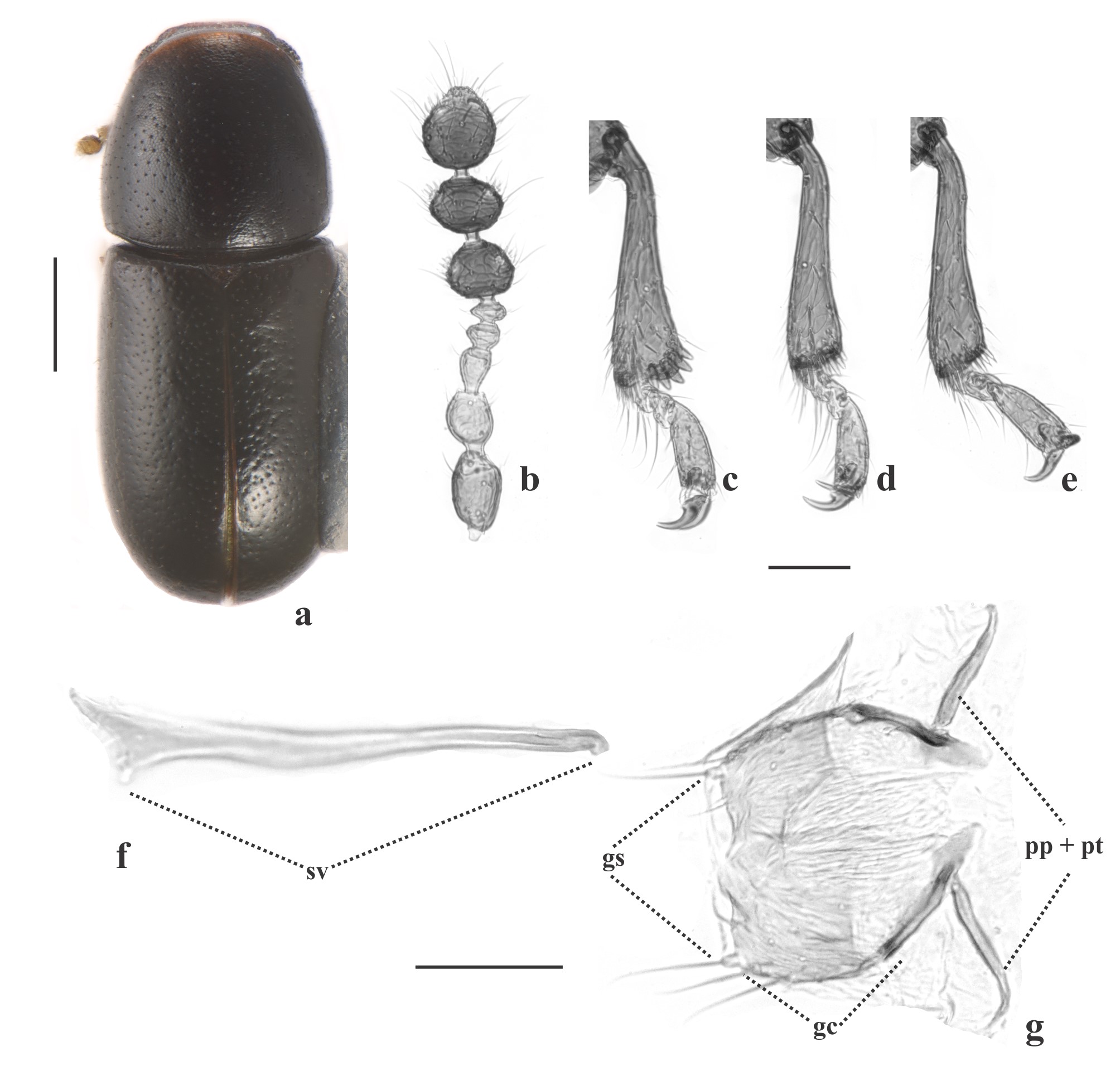
Ceracis caio Souza-Gonçalves & Lopes-Andrade sp. nov., female paratype (a) from “Mangue Sueste” (Fernando de Noronha, Pernambuco, Brazil), tibiae, and terminalia (b–f) of a female from “Praia do Sancho” (Fernando de Noronha, Pernambuco, Brazil): a Dorsal view. b Right protibia. c Right mesotibia. d Right metatibia. e Spiculum ventrale (sv) at anterior portion of sternite VIII. f Ovipositor, showing gonostyli (gs), gonocoxites (gc), and paraprocts plus proctiger (pp + pt). Scale bars: 0.5 mm (a); 0.1 mm (b–d); 0.05 mm (e–f).
Type material: Holotype ♂ (CERPE) “BR: PE, PARNA Fernando de Noronha, Praia do Sancho, 20-28.ii.2020 Grossi, Rafael, Limeira-de-Oliveira leg.\ Ceracis caio Souza-Gonçalves & Lopes-Andrade HOLOTYPUS [red paper; printed]”. Paratypes: 30 ♂♂ and 26 ♀♀ as follows: 16 ♂♂ (8 CELC, one completely dissected and mounted in a card, 8 CERPE, 1 INPA) and 16 ♀♀ ( 7 CELC, one completely dissected and mounted in a card, 8 CERPE, 1 INPA) same data as the holotype; 7 ♂♂ (4 CELC, 3 CERPE) and 6 ♀♀ (3 CELC, 3 CERPE) “Brasil, Pernambuco, Fernando de Noronha, Mangue Sueste, 20-28.ii.2020, Grossi, Rafael, Limeira-de-Oliveira legs.”; 3 ♂♂ and 1 ♀ (CELC) “BR: PE, PARNA Fernando de Noronha, trilha dos Golfinhos, Ganoderma sp., 20-28.ii.2020 Grossi, Rafael, Limeira-de-Oliveira leg.”; 3 ♂♂ and 3 ♀♀ (CELC) “BR: PE, PARNA Fernando de Noronha, Praia do Boldró, 20-28.ii.2020 Grossi, Rafael, Limeira-de-Oliveira leg.”. All paratypes are additionally labeled “Ceracis caio Souza-Gonçalves & Lopes-Andrade PARATYPUS [yellow paper; printed]”.
Host fungus:Ganoderma sp. (Polyporaceae), one breeding record.
Distribution: Known only from Fernando de Noronha, Pernambuco, Brazil (Fig. 15).
Ceracis italo Souza-Gonçalves & Lopes-Andrade sp. nov.
(Figs. 5a–d, 6a–h, 7a–g, 8, 15).
Type locality: “Praia da Conceição”, coordinates 3°50’S, 32°25’W (Fernado de Noronha, Pernambuco, Brazil).
Etymology: In honor of the coleopterist Dr. Italo Salvatore de Castro Pecci-Maddalena, who contributed to the taxonomy of the Ceracis furcifer species-group during his master’s degree.
Diagnosis: Among the Neotropical Ceracis, characterized mainly by the small and elongate body (Fig. 5a), antennae with eight antennomeres (Fig. 7a), dual and confuse elytral punctation (Fig. 5d), males with anterocephalic edge produced forward and elevated upward forming a wide and short lamina broadly emarginate apically (when seen from above), anterior pronotal edge produced forward as a plate deeply emarginate at middle to form two divergent horns, longitudinally keeled above and rounded apically (Fig. 5a, c), and first abdominal ventrite with a very large, circular setose sex patch (Fig. 6d). Ceracis italo sp. nov. resembles Ceracis luci Souza-Gonçalves & Lopes-Andrade, 2024 in body shape, and male anterocephalic and pronotal ornaments, but in Cer. luci the pronotal surface is more markedly microreticulate, the elytral punctation is subseriate, the males have the anterocephalic edge slightly elevated upward forming a lamina with straight edge (when seen from above) and the anterior pronotal plate deeply emarginate at middle forming two wide subparallel horns, and the females’ ovipositor lacks gonostyli. Ceracis pullulus (Casey, 1898) has a more robust body, antennae with nine antennomeres, seriate elytral punctation, and males with anterior pronotal horns less divergent, closer to each other, with subrounded apices. Ceracis quadricornis Gorham, 1886 has a more elongate elytra, males with the anterocephalic edge produced to form a short, broad, slightly concave lamina, and the anterior pronotal horns more divergent, closer to each other, wider and weakly keeled above. Ceracis furcatus (Bosc, 1791), Ceracis militaris Mellié, 1849, Ceracis minutissimus (Mellié, 1849), Ceracis minutus Dury, 1917, and Ceracis variabilis Mellié, 1849 also have antennae of eight antennomeres and males have two divergent pronotal horns, but are all comparatively shorter and broader species. Ceracis caio sp. nov. differs in the robust body, denser pronotal punctation, conspicuous discrimen, and male pronotum with less divergent horns, with acute apices and not keeled above.

Male paratypes of Ceracis caio Souza-Gonçalves & Lopes-Andrade sp. nov. from “Mangue Sueste” (Fernando de Noronha, Pernambuco, Brazil) (a) and from “Trilha dos Golfinhos” (Fernando de Noronha, Pernambuco, Brazil) (b–d) showing the variation of cephalic and pronotal ornaments. Scale bar: 0.5 mm.

Ceracis italo Souza-Gonçalves & Lopes-Andrade sp. nov., male holotype (a–d) from “Praia da Conceição” (Fernando de Noronha, Pernambuco, Brazil): a Dorsal view. b Lateral view. c Ventral view. d Scutellar shield and part of the pronotum and elytra. Scale bars: 0.2 mm (a–d).

Male paratypes of Ceracis italo Souza-Gonçalves & Lopes-Andrade sp. nov. from “Praia da Conceição” (Fernando de Noronha, Pernambuco, Brazil), showing the variation of cephalic and pronotal ornaments. Scale bar: 0.2 mm.

Male paratypes of Ceracis italo Souza-Gonçalves & Lopes-Andrade sp. nov. from “Praia da Conceição” (Fernando de Noronha, Pernambuco, Brazil), showing the variation of cephalic and pronotal ornaments. Scale bar: 0.2 mm.
Description, adult male holotype (Fig. 5a–d) fully pigmented, lacking two tarsi. Measurements in mm: TL 1.13, PL 0.50, PW 0.43, EL 0.63, EW 0.48, GD 0.38. Ratios: PL/PW 1.18, EL/EW 1.32, EL/PL 1.25, GD/EW 0.79, TL/EW 2.37. Body elongate, convex, subparallel-sided, dorsum and venter reddish dark brown; antennae yellowish brown with dark brown club; palpi and tarsi yellowish brown; dorsal vestiture single, consisting of minute suberect setae barely visible in high magnification (100x); ventral vestiture of fine decumbent setae, easily discernible in high magnification (100x). Head with the anteriormost portion visible from above; dorsum widely concave, with a small elevation on vertexal disc; dorsal punctation single; anterocephalic edge produced forward, elevated upward, forming a wide and short lamina with a broadly emarginate edge (when seen from above). Antennae (Fig. 7b, right antenna of a female paratype) with eight antennomeres; length of antennomeres as follows (in mm, left antenna measured): 0.05, 0.03, 0.03, 0.02, 0.01, 0.03, 0.04, 0.05 (FL 0.06 mm, CL 0.13 mm, CL/FL 2.10). Eyes coarsely facetted, each with about 50 ommatidia; GW 0.10 mm. Gula 0.48x as wide as head. Pronotum (Fig. 5d) coarsely, shallowly punctate; punctation single; punctures separated from each other by 2–3 puncture-widths; interspaces, markedly microreticulate; vestiture single, consisting of minute suberect grayish setae (<0.01 mm); anterior edge produced forward as a plate, deeply emarginate at middle forming two divergent horns markedly keeled above and with rounded apices; lateral carinae not crenulate, not explanate and not visible when seen from above; anterior corners rounded; posterior corners broadly rounded. Scutellar shield (Fig. 5d) triangular, with few punctures, apparently glabrous; BW 0.07 mm; SL 0.05 mm. Elytra (Fig. 5d) punctation finer and denser than pronotal punctation, confuse, dual; macropunctures about 2x as large as micropunctures; macropunctures separated from each other by 1–2 macropuncture-widths; interspaces, rugose and shiny; vestiture single, consisting of one minute suberect grayish seta (<0.01 mm) arising from each macropuncture. Metathoracic wings developed, apparently functional. Hypomera punctation fine, shallow; each puncture bearing one fine decumbent seta; interspaces, markedly microreticulate. Prosternum in front of coxae concave; interspaces, markedly microreticulate. Prosternal process laminate, 1.2x as long as prosternum at midline. Protibiae (Fig. 6a, right protibia in a male paratype) maximum width about one-third its length, expanded at apex; outer apical angle rounded and bearing a few thick spines; outer edge slightly sinuous and devoid of spines. Meso- and metatibiae (Fig. 6b–c, right meso- and metatibia of a male paratype, respectively) with slender spines in apical edge; outer edge almost straight, devoid of spines. Metaventrite punctation fine, shallow; interspaces, markedly microreticulate; discrimen indiscernible. Abdominal ventrites (Fig. 6d, abdominal ventrites of a male paratype) punctures fine, shallow, sparse, each with one slender decumbent yellowish seta; interspaces, markedly microreticulate; length of ventrites (in mm, from base to apex at the longitudinal midline) as follows: 0.14, 0.05, 0.05, 0.05, 0.05; first abdominal ventrite with margined, circular, setose sex patch posteriorly of center, with transverse diameter of 0.04 mm (Fig. 6d, arrow). Male terminalia in a paratype (Fig.6e–h): sternite VIII (Fig. 6e) apical edge slightly emarginate, with short setae at middle and long setae at broadly rounded corners; lateral edges diverging; anterior edge biconcave. Tegmen (Fig. 6g) 1.7x as long as wide, widest near apex, apical portion deeply, broadly emarginate; lateral edges sinuous, with broadly rounded corners near apex (Fig. 6g, black arrows); basolateral edges wide (Fig. 6g, red arrows); basal portion subrounded. Basal piece (Fig. 6f) subpentagonal, 0.7x as long as wide. Penis (Fig. 6h) short, 0.7x as long as tegmen, 2.8x as long as wide; lateral edges converging to apex; apical half with a membranous flap on each side (Fig. 6h, black arrows); basal portion rounded.
Adult females (Fig. 7a–g): Like males, but without cephalic and pronotal ornaments, and abdominal sex patch. Female terminalia in a paratype (Fig. 7f–g): spiculum ventrale (Fig. 7f) 1.57x as long as ovipositor (Fig. 7g); ovipositor 0.77x as long as wide; paraprocts (Fig. 7g) 1.48x as long as gonocoxites; each baculus of paraprocts bowed and fused to the respective proctigeral baculus (Fig. 7g); gonocoxites (Fig. 7g) 0.47x as long as their combined widths, not distinctly lobed ventrally; each gonostylus (Fig. 7g) 0.15x as long as respective gonocoxite, 1.41x as long as wide.
Variation: Males, measurements in mm (n = 11, including the holotype): TL 0.93–1.30 (1.12 ± 0.11), PL 0.35–0.58 (0.47 ± 0.07), PW 0.38–0.50 (0.43 ± 0.04), EL 0.58–0.73 (0.65 ± 0.05), EW 0.43–0.53 (0.47 ± 0.04), GD 0.33–0.43 (0.38 ± 0.03), PL/PW 0.93–1.22 (1.10 ± 0.08), EL/EW 1.26–1.65 (1.39 ± 0.11), EL/PL 1.20–1.64 (1.39 ± 0.15), GD/EW 0.74–0.94 (0.81 ± 0.06), TL/EW 2.16–2.71 (2.41 ± 0.14). The degree of development of pronotal and cephalic ornaments varies between males (Fig. 4). In the largest males, the disc is impressed behind the pronotal plate (Fig. 4, right male). Females, measurements in mm (n = 11): TL 0.90–1.13 (0.98 ± 0.06), PL 0.35–0.43 (0.37 ± 0.02), PW 0.33–0.45 (0.38 ± 0.03), EL 0.55–0.70 (0.62 ± 0.05), EW 0.38–0.48 (0.42 ± 0.03), GD 0.35–0.40 (0.37 ± 0.02), PL/PW 0.88–1.08 (0.97 ± 0.07), EL/EW 1.35–1.73 (1.49 ± 0.13), EL/PL 1.53–1.80 (1.67 ± 0.11), GD/EW 0.90–1.13 (0.98 ± 0.06), TL/EW 2.18–2.73 (2.37 ± 0.17).
Type material: Holotype ♂ (CERPE) “Brasil, Pernambuco, Fernando de Noronha, Praia da Conceição, 20-28.ii.2020, manual, Grossi, Rafael, Limeira-de-Oliveira \ Ceracis italo Souza-Gonçalves & Lopes-Andrade HOLOTYPUS [red paper; printed]”. Paratypes: 24 ♂♂ and 14 ♀♀ as follows: 7 ♂♂ (4 CELC, 3 CERPE) and 3 ♀♀ (1 CELC, 2 CERPE) same data as the holotype; 17 ♂♂ (7 CELC, one completely dissected and mounted in a card, 9 CERPE, 1 INPA) and 11 ♀♀ (6 CELC, one completely dissected and mounted in a card, 4 CERPE, 1 INPA) “BR: PE, PARNA Fernando de Noronha, Praia da Conceição, 20-28.ii.2020 Grossi, Rafael, Limeira-de-Oliveira leg.”. All paratypes are additionally labeled “Ceracis italo Souza-Gonçalves & Lopes-Andrade PARATYPUS [yellow paper; printed]”.
Host fungus: Unknown.
Distribution: Known only from Fernando de Noronha, Pernambuco, Brazil (Fig. 15).
Cis ayessa Souza-Gonçalves & Lopes-Andrade sp. nov.
(Figs. 9a–d, 10a–i, 11a–f, 15).
Type locality: “Praia da Conceição”, coordinates 3°50’S, 32°25’W (Fernando de Noronha, Pernambuco, Brazil).
Etymology: In honor of the coleopterist Msc. Ayessa Rosa-Oliveira, who is contributing to the taxonomy and ecology of ciid beetles.
Diagnosis: Among the Neotropical Cis, characterized mainly by the single vestiture of short bristles, dual and subseriate elytral punctation (Fig. 9d), males with anterocephalic edge slightly produced forward with subacute angulations on each side, and anterior pronotal edge slightly emarginate at the middle (Fig. 9a). It resembles members in the comptus group, which differ in the distinct seriate elytral punctation and vestiture. Cis ayessa sp. nov. resembles Cis makrosoma Souza-Gonçalves & Lopes-Andrade, 2018, in the body shape and male tegmen, but the latter differs in the very elongate and flattened body, dual elytral punctation with subseriate macropunctures, in-between rows filled with micropunctures each bearing a short bristle, anterocephalic edge truncate, anterior pronotal edge rounded in both sexes and prosternum moderately long. Cis grobbelaarae Souza-Gonçalves & Lopes-Andrade, 2018 has a very similar tegmen, but it belongs to the comptus group and can be distinguished by the features that define this species-group. Cis paula sp. nov. has a stouter, light-colored body, with longer dorsal vestiture, pronotum with denser punctation and crenulate lateral carinae, confuse elytral punctation, and male anterocephalic edge with two small, close subrounded tubercles with many bristles.

Ceracis italo Souza-Gonçalves & Lopes-Andrade sp. nov., female paratype (a) from “Praia da Conceição” (Fernando de Noronha, Pernambuco, Brazil); antenna, tibiae, and terminalia (b–g) of a female from the same locality: a Dorsal view. b Right antenna. c Right protibia. d Right mesotibia. e Right metatibia. f Spiculum ventrale (sv). g Ovipositor, showing gonostyli (gs), gonocoxites (gc), and paraprocts plus proctiger (pp + pt). Scale bars: 0.2 mm (a); 0.05 mm (b–g).
Description, adult male holotype (Fig. 9a–d) fully pigmented, lacking the left antenna and two tarsi. Measurements in mm: TL 1.38, PL 0.58, PW 0.58, EL 0.85, EW 0.63, GD 0.48. Ratios: PL/PW 0.91, EL/EW 1.36, EL/PL 1.63, GD/EW 0.76, TL/EW 2.20. Body elongate, slightly convex, subparallel-sided, dorsum and venter reddish dark brown; antennae, palpi, and tarsi yellowish brown; dorsal vestiture single, consisting of short suberect bristles easily discernible in high magnification (100x); ventral vestiture of fine decumbent setae, easily discernible in high magnification (100x). Head with the anteriormost portion visible from above; dorsum slightly concave; dorsal punctation single; anterocephalic edge slightly produced forward, with subacute angulations on each side. Antennae (Fig. 10a, right antenna of a male paratype) with ten antennomeres, length of antennomeres as follows (in mm, right antenna measured): 0.06, 0.04, 0.03, 0.02, 0.02, 0.02, 0.01, 0.03, 0.04, 0.06 (FL 0.09 mm, CL 0.13 mm, CL/FL 1.55). Eyes coarsely facetted, each with about 70 ommatidia; GW 0.13 mm. Gula 0.44x as wide as head. Pronotum (Fig. 9d) with coarse, single punctation; punctures separated from each other by 1–2 puncture-widths; interspaces, markedly microreticulate; vestiture single, consisting of short suberect yellowish bristles (~0.01 mm); anterior edge slightly emarginate at middle; lateral carinae not crenulate, not explanate and not visible when seen from above; anterior corners rounded; posterior corners broadly rounded. Scutellar shield (Fig. 9d) triangular, with few punctures and bristles; BW 0.05 mm; SL 0.04 mm. Elytra (Fig. 9d) punctation coarser and deeper than pronotal punctation, subseriate, dual; macropunctures about 2x as large as micropunctures, separated from each other by 1–2 macropuncture-widths; interspaces, smooth and shiny; vestiture single, consisting of one minute suberect yellowish bristle (0.01 mm) arising from each micropuncture. Metathoracic wings developed, apparently functional. Hypomera punctation fine, shallow; each puncture bearing one fine decumbent seta; interspaces, markedly microreticulate. Prosternum in front of coxae flat; interspaces, markedly microreticulate. Prosternal process subparallel-sided, apex rounded, 0.9x as long as prosternum at midline. Protibiae (Fig. 10b, right protibia of a male paratype) maximum width about one-fourth its length, expanded at apex; outer apical angle with a stout tooth; outer edge slightly sinuous, devoid of spines. Meso- and metatibiae (Fig. 10c–d, right meso- and metatibia of a male paratype, respectively) with slender spines in apical edge; outer edge almost straight, devoid of spines. Metaventrite punctation fine, shallow; interspaces, markedly microreticulate; discrimen about one-third the length of metaventrite at midline. Abdominal ventrites (Fig. 10e, abdominal ventrites of a male paratype) punctures fine, shallow, sparse, each with one slender decumbent yellowish seta; interspaces, markedly microreticulate; length of ventrites (in mm, from base to apex at the longitudinal midline) as follows: 0.20, 0.09, 0.07, 0.06, 0.07; first abdominal ventrite with one oval, setose sex patch at the center, not margined, with transverse diameter of 0.03 mm (Fig. 10e, arrow). Male terminalia in a paratype (Fig. 10f–i): sternite VIII (Fig. 10f) apical edge subrounded, with short setae at middle and long setae at subacute corners; lateral edges diverging; anterior edge almost straight. Tegmen (Fig. 10h) 2x as long as wide, widest at apical third; lateral edges expanding to apical third; one broad emargination in each side at apex, forming very acute angulations (Fig. 10h, small black arrows) and with subacute corners (Fig. 10h, big black arrows); basal portion rounded. Basal piece (Fig. 10g) triangular, 0.6x as long as wide. Penis (Fig. 10i) short, mask-shaped, 0.3x as long as tegmen, 2.1x as long as wide; lateral edges diverging until the half-length, then converging to the rounded apex; medial portion with dorsal sclerotization (Fig. 10i, black arrow); basal portion with two acute sclerotizations (Fig. 10i, red arrows).

Cis ayessa Souza-Gonçalves & Lopes-Andrade sp. nov., male holotype (a–d) from “Praia da Conceição” (Fernando de Noronha, Pernambuco, Brazil): a Dorsal view. b Lateral view. c Ventral view. d Scutellar shield and part of the pronotum and elytra. Scale bars: 0.5 mm (a–c); 0.2 mm (d).
Adult females (Fig. 11a–f): like males, but with smaller protibial tooth, without cephalic and pronotal ornaments, and abdominal sex patch. Female terminalia in a paratype (Fig. 11e–f): spiculum ventrale (Fig. 11e) 0.98x as long as ovipositor (Fig. 11f); ovipositor 1.88x as long as wide; paraprocts (Fig. 11f) 1.21x as long as gonocoxites; gonocoxites (Fig. 11f) 0.94x as long as their combined widths with two ventral lobes, the basal shorter than the apical lobe; each gonostylus (Fig. 11f) 0.20x as long as respective gonocoxite, 4.20x as long as wide.

Cis ayessa Souza-Gonçalves & Lopes-Andrade sp. nov., antenna, tibiae, abdominal ventrites, and aedeagus of a male (a–i) from “Trilha Capim Açu” (Fernando de Noronha, Pernambuco, Brazil): a Right antenna. b Right protibia. c Right mesotibia. d Right metatibia. e Abdominal ventrites, note the margined sex patch (arrow). f Sternite VIII. g Basal piece. h Tegmen, note the very acute angulations (small black arrows) and subacute corners (big black arrows) at the apex. i Penis, note the medial dorsal sclerotization (black arrow) and the two acute sclerotizations at the basal portion (red arrows). Scale bars: 0.1 mm (e); 0.05 mm (a–d, f–i).
Variation: Males, measurements in mm (n = 7, including the holotype): TL 1.15–1.38 (1.30 ± 0.08), PL 0.45–0.53 (0.49 ± 0.02), PW 0.48–0.58 (0.53 ± 0.04), EL 0.70–0.88 (0.81 ± 0.06), EW 0.53–0.63 (0.58 ± 0.04), GD 0.45–0.53 (0.47 ± 0.03), PL/PW 0.83–1.05 (0.92 ± 0.07), EL/EW 1.27–1.67 (1.41 ± 0.13), EL/PL 1.56–1.74 (1.67 ± 0.08), GD/EW 0.75–1.00 (0.81 ± 0.06), TL/EW 2.08–2.62 (2.25 ± 0.18). Females, measurements in mm (n = 6): TL 1.18–1.38 (1.25 ± 0.07), PL 0.43–0.50 (0.48 ± 0.03), PW 0.48–0.53 (0.52 ± 0.03), EL 0.75–0.88 (0.78 ± 0.05), EW 0.53–0.63 (0.57 ± 0.03), GD 0.43–0.48 (0.46 ± 0.02), PL/PW 0.87–0.95 (0.91 ± 0.03), EL/EW 1.30–1.43 (1.38 ± 0.06), EL/PL 1.50–1.76 (1.64 ± 0.10), GD/EW 0.74–0.86 (0.81 ± 0.05), TL/EW 2.13–2.27 (2.21 ± 0.06).
Type material: Holotype ♂ (CERPE) “Brasil, Pernambuco, Fernando de Noronha, Praia da Conceição, 20-28.ii.2020, manual, Grossi, Rafael, Limeira-de-Oliveira \ Cis ayessa Souza-Gonçalves & Lopes-Andrade HOLOTYPUS [red paper; printed]”. Paratypes: 7 ♂♂ and 7 ♀♀ as follows: 6 ♂♂ (5 CELC, one completely dissected and mounted in a card, 1 CERPE) and 6 ♀♀ (5 CELC, one completely dissected and mounted in a card, 1 CERPE) “BR: PE, PARNA Fernando de Noronha, trilha Capim Açú, 20-28.ii.2020 Grossi, Rafael, Limeira-de-Oliveira leg.”; 1 ♂ and 1 ♀ (INPA) “BR: PE, PARNA Fernando de Noronha, Praia da Conceição, 20-28.ii.2020 Grossi, Rafael, Limeira-de-Oliveira leg.”. All paratypes are additionally labeled “Cis ayessa Souza-Gonçalves & Lopes-Andrade PARATYPUS [yellow paper; printed]”.
Host fungus: Unknown.
Distribution: Known only from Fernando de Noronha, Pernambuco, Brazil (Fig. 15).
Cis paula Souza-Gonçalves & Lopes-Andrade sp. nov.
(Figs. 12a–d, 13a–i, 14a–c, 15).
Type locality: “Mangue Sueste”, coordinates 3°51’S, 32°25’W (Fernando de Noronha, Pernambuco, Brazil).
Etymology: In honor of the coleopterist Msc. Paula Vieira Borlini, who is contributing to the taxonomy and ecology of ciid beetles.
Diagnosis: Among the Neotropical Cis, characterized mainly by the single vestiture of short bristles, dual and confuse elytral punctation (Fig. 12d), fifth abdominal ventrite with long setae at the posterior edge (Fig. 13e), males with anterocephalic edge produced forward forming two close, small subrounded tubercles with many bristles, and anterior pronotal edge slightly emarginate at the middle (Fig. 12a). It resembles species in the comptus group, but those differ in the seriate elytral punctation and vestiture. Cis paula sp. nov. resembles Cis olivieri Mellié, 1849, Cis stereophilus Lawrence, 1971, and Cis tristis Melllié, 1849 in the shape of body, tegmen, and penis. But Cis olivieri differs in the shorter dorsal vestiture, and in males with anterocephalic edge slightly produced forward with two small triangular tubercles. Cis stereophilus differs in the smooth pronotal surface and fifth abdominal ventrite lacking long setae at the posterior edge. Cis tristis differs in the vestiture of stout, blunt colorless bristles, and males with anterocephalic edge with four teeth and anterior pronotal edge with six very small sharp protuberances. In Cis krausi Dalla Torre, 1911 the elytra are yellowish with black markings, with subseriate punctation and vestiture of colorless bristles. Cis subtilis Mellié, 1849 has a similar body shape but differs in having vestiture of stout, colorless bristles, and males lack an abdominal sex patch. Cis ayessa sp. nov. has narrower, more elongate, and darker body, shorter dorsal vestiture, sparser pronotal punctation, lateral carinae of pronotum not crenulate and not visible when seen from above, subseriate elytral punctation, and the anterocephalic edge of males with subacute angulations on each side.

Cis ayessa Souza-Gonçalves & Lopes-Andrade sp. nov., female paratype (a) from “Trilha Capim Açú” (Fernando de Noronha, Pernambuco, Brazil), tibiae, and terminalia (b–f) of a female from the same locality: a Dorsal view. b Right protibia. c Right mesotibia. d Right metatibia. e Spiculum ventrale (sv). f Ovipositor, showing gonostylus (gs, the right one lost), gonocoxites (gc), paraprocts (pp), baculi of paraprocts (b. pp), baculi of proctiger (b. pt). Scale bars: 0.5 mm (a); 0.1 mm (e–f); 0.05 mm (b–d).

Cis paula Souza-Gonçalves & Lopes-Andrade sp. nov., male holotype (a–d) from “Mangue Sueste” (Fernando de Noronha, Pernambuco, Brazil): a Dorsal view. b Lateral view. c Ventral view. d Scutellar shield and part of the pronotum and elytra. Scale bars: 0.5 mm (a–c); 0.2 mm (d).
Description, adult male holotype (Fig. 12a–d): apparently not fully pigmented, lacking two tarsi. Measurements in mm: TL 1.65, PL 0.65, PW 0.63, EL 1.00, EW 0.68, GD 0.88. Ratios: PL/PW 1.04, EL/EW 1.48, EL/PL 1.54, GD/EW 0.85, TL/EW 2.44. Body elongate, convex, subparallel-sided, dorsum reddish brown and venter reddish dark brown; antennae yellowish brown with dark brown club; palpi and tarsi yellowish brown; dorsal vestiture single, consisting of short suberect bristles easily discernible in low magnification (50x); ventral vestiture of fine decumbent setae, easily discernible in low magnification (50x). Head with anteriormost portion visible from above; dorsum slightly concave; dorsal punctation single; anterocephalic edge produced forward, forming two small subrounded tubercles, separated from each other by approximately the width of each tubercle at base, with many bristles. Antennae (Fig. 13a, right antenna of a male paratype) with ten antennomeres, length of antennomeres as follows (in mm, left antenna measured): 0.06, 0.04, 0.04, 0.03, 0.02, 0.01, 0,01, 0.04, 0.04, 0.06 (FL 0.11 mm, CL 0.14 mm, CL/FL 1.27). Eyes coarsely facetted, each with about 80 ommatidia; GW 0.14 mm. Gula 0.49x as wide as head. Pronotum (Fig. 12d) with punctation coarse, single; punctures separated from each other by 1 puncture-width or less; interspaces, markedly microreticulate; vestiture single, consisting of short suberect yellowish bristles (0.01–0.02 mm); anterior edge slightly emarginate at middle; lateral carinae slightly crenulate, not explanate and visible for most of their length when seen from above; anterior corners rounded, barely produced forward; posterior corners broadly rounded. Scutellar shield (Fig. 12d) subtriangular, with few punctures and bristles; BW 0.07 mm; SL 0.06 mm. Elytra (Fig. 12d) punctation coarser and deeper than pronotal punctation, confuse, dual; macropunctures about 2x as large as micropunctures, separated from each other by 1–2 macropuncture-widths; interspaces, rugose and shiny; vestiture single, consisting of one short suberect yellowish seta (0.02–0.03 mm) arising from each micropuncture. Metathoracic wings developed, apparently functional. Hypomera punctation fine, shallow; each puncture bearing one fine decumbent seta; interspaces, markedly microreticulate. Prosternum in front of coxae biconcave; interspaces, markedly microreticulate. Prosternal process subparallel-sided, apex rounded, 1.2x as long as prosternum at midline. Protibiae (Fig. 13b, right protibia of a male paratype) maximum width about one-fourth its length, expanded at apex; outer apical angle with a stout, blunt tooth; outer edge slightly sinuous and devoid of spines. Meso- and metatibiae (Fig. 13c–d, right meso- and metatibia of a male paratype, respectively) with slender spines in apical edge; outer edge almost straight, devoid of spines. Metaventrite punctation fine, shallow; interspaces, markedly microreticulate; discrimen about two-fifths the length of metaventrite at midline. Abdominal ventrites (Fig. 13e, abdominal ventrites of a male paratype) punctures fine, shallow, sparse, each with one slender decumbent yellowish seta; interspaces, markedly microreticulate; length of ventrites (in mm, from base to apex at the longitudinal midline) as follows: 0.22, 0.09, 0.08, 0.08, 0.07; first abdominal ventrite with margined, circular, setose sex patch at the center, with transverse diameter of 0.05 mm (Fig. 13e, white arrow); fifth abdominal ventrite with long setae at the posterior edge (Fig. 13e, black arrows). Male terminalia in a paratype (Fig. 13f–i): sternite VIII (Fig. 13f) apical edge almost straight, with short setae at middle and long setae at broadly rounded corners; lateral edges diverging; anterior edge biconcave and subacute medially. Tegmen (Fig. 13h) 2.7x as long as wide, widest near base; apical portion deeply, narrowly emarginate; lateral edges subparallel-sided; apex with angulations on each side (Fig. 13h, big black arrows) and excavations before angulations (Fig. 13h, small black arrows); basal portion subrounded. Basal piece (Fig. 13g) suboval, 0.9x as long as wide. Penis (Fig. 13i) elongate, 0.9x as long as tegmen, 3.1x as long as wide; lateral edges diverging before membranous apex; ventral portion with acute sclerotization (Fig. 13i, black arrow); basal portion with a rounded emargination (Fig. 13i, red arrow).
Adult females (Fig. 14a–c): like males, but without cephalic and pronotal ornaments, and abdominal sex patch. Female terminalia in a paratype (Fig. 14b–c): spiculum ventrale (Fig. 14b) as long as ovipositor (Fig. 14c); ovipositor 2.23x as long as wide; paraprocts (Fig. 14c) 1.14x as long as gonocoxites; gonocoxites (Fig. 14c) 1.34x as long as their combined widths, with two ventral lobes, basal lobe shorter than apical lobe; each gonostylus (Fig. 14c) 0.18x as long as respective gonocoxite, 3.97x as long as wide.

Known geographic distributions of Ceracis caio Souza-Gonçalves & Lopes-Andrade sp. nov. (yellow circle), Ceracis italo Souza-Gonçalves & Lopes-Andrade sp. nov. (black circle), Cis ayessa Souza-Gonçalves & Lopes-Andrade sp. nov. (red diamond), and Cis paula Souza-Gonçalves & Lopes-Andrade sp. nov. (blue diamond).

Cis paula Souza-Gonçalves & Lopes-Andrade sp. nov., tibiae and aedeagus of a male (a–g) from “Praia do Boldró” (Fernando de Noronha, Pernambuco, Brazil): a Right antenna. b Right protibia. c Right mesotibia. d Right metatibia. e Abdominal ventrites, note the margined sex patch (white arrow) and the long setae at the posterior edge of the fifth ventrite (black arrows). f Sternite VIII. g Basal piece. h Tegmen, note the angulations on each side of the apex (big black arrows) and the excavations before angulations (small black arrows). i Penis, note the acute sclerotization in the ventral portion (black arrow) and the rounded emargination in the basal portion (red arrow). Scale bars: 0.1 mm (b–e); 0.05 mm (a, f–i).
Variation: Males, measurements in mm (n = 5, including the holotype): TL 1.43–1.65 (1.43 ± 0.12), PL 0.43–0.55 (0.50 ± 0.04), PW 0.55–0.65 (0.59 ± 0.04), EL 0.93–1.08 (0.98 ± 0.06), EW 0.63–0.70 (0.67 ± 0.03), GD 0.48–0.58 (0.52 ± 0.05), PL/PW 0.80–1.04 (0.89 ± 0.10), EL/EW 1.42–1.54 (1.47 ± 0.04), EL/PL 1.54–1.95 (1.81 ± 0.17), GD/EW 0.73–0.85 (0.77 ± 0.05), TL/EW 2.19–2.44 (2.29 ± 0.11). Females, measurements in mm (n = 6): TL 1.30–1.63 (1.43 ± 0.12), PL 0.43–0.55 (0.50 ± 0.04), PW 0.55–0.65 (0.59 ± 0.04), EL 0.83–1,08 (0.93 ± 0.09), EW 0.60–0.70 (0.64 ± 0.04), GD 0.45–0.63 (0.54 ± 0.08), PL/PW 0.77–0.91 (0.85 ± 0.06), EL/EW 1.38–1.54 (1.46 ± 0.07), EL/PL 1.65–2.06 (1.89 ± 0.15), GD/EW 0.75–0.92 (0.84 ± 0.07), TL/EW 2.15–2.38 (2.24 ± 0.09).
Type material: Holotype ♂ (CERPE) “Brasil, Pernambuco, Fernando de Noronha, Mangue Sueste, 20-28.ii.2020, Grossi, Rafael, Limeira-de-Oliveira legs. \ Cis paula Souza-Gonçalves & Lopes-Andrade HOLOTYPUS [red paper; printed]”. Paratypes: 5 ♂♂ and 7 ♀♀ as follows: 1 ♂ (CELC) and 1 ♀ (CERPE) same data as the holotype; 1 ♂ (CELC, completely dissected and mounted in a card) and 2 ♀♀ (CELC, one completely dissected and mounted in a card) “BR: PE, PARNA Fernando de Noronha, Praia do Boldró, 20-28.ii.2020 Grossi, Rafael, Limeira-de-Oliveira leg.”; 3 ♂♂ (2 CELC, 1 INPA) and 4 ♀♀ (3 CELC, 1 INPA) “BR: PE, PARNA Fernando de Noronha, Praia do Sancho, 20-28.ii.2020 Grossi, Rafael, Limeira-de-Oliveira leg.”. All paratypes are additionally labeled “Cis paula Souza-Gonçalves & Lopes-Andrade PARATYPUS [yellow paper; printed]”.
Host fungus: Unknown.
Distribution: Known only from Fernando de Noronha, Pernambuco, Brazil (Fig. 15).
DISCUSSION
The Ciidae fauna of the Fernando de Noronha archipelago currently includes only the four species described in this study. These are the first ciid species recorded from any oceanic island in Brazil and are highly distinct from ciid species found on the mainland of Brazil and in neighboring countries. The only previously known insular species of Ciidae from Brazil, Cer. cassumbensis, occurs on a continental rather than an oceanic island and is listed among Brazil’s threatened species (ICMBio 2018). This species is known solely from “Ilha da Cassumba”, a continental island within the Caravelas-Peruípe estuarine system (Antunes-Carvalho & Lopes-Andrade 2011). Ilha da Cassumba spans approximately 120 km2 and forms part of the “Reserva Extrativista de Cassurubá” (Cassurubá Extractive Reserve). The island is covered with remnants of the Atlantic Forest, while the coastal areas are dominated by restinga vegetation. Its complex history of land use includes the replacement of the Atlantic Forest with eucalyptus plantations, alongside fishing and tourism activities. The conservation status of Cer. cassumbensis raises concerns for the four Ciidae species of Fernando de Noronha. The archipelago shares a history of intensive land use and extractivism, coupled with significant tourism pressure. Unlike Ilha da Cassumba, Fernando de Noronha is much smaller, with an area of 18.4 km2, and is located 345 km offshore. Given that these four species have not yet been recorded elsewhere, they may warrant consideration as threatened.
The new Ceracis species described here share morphological affinities with Neotropical and Nearctic Ciidae species. Ceracis caio resembles Cer. californicus (western Canada and USA to Mexico) and Cer. sallei (eastern Canada and USA) in the robust body and in the shape of anterocephalic and pronotal ornaments (Lawrence 1967, 1971). Ceracis italo shares morphological affinities, such as the small size and the shape of anterocephalic and pronotal ornaments of males, mostly with Ceracis species of southern Nearctic and northern Neotropical areas, such as Cer. furcatus from Jamaica; Cer. luci from the Northeast Region of Brazil; Cer. militaris from Mexico and Saint Vicent; Cer. minutissimus from eastern Canada and USA; Cer. minutus from southern Texas and Florida (USA), Bahamas, and Greater Antilles; Cer. pullulus from the southeastern USA, Mexico, Greater Antilles, and Ecuador; Cer. quadricornis from southern Texas (USA), and Mexico to Costa Rica, and Cer. variabilis from Cuba (Lawrence 1967, 1971, Souza-Gonçalves & Lopes-Andrade 2024).
Among the new Cis species described here, C. ayessa shares morphological affinities as the subparallel-sided body, the anterocephalic edge weakly ornamented, the dual and subseriate elytral punctation, and the shape of the tegmen, with Ethiopian species such as C. grobbelaarae and C. makrosoma from the Republic of South Africa. The body shape of C. paula resembles species from the Nearctic and Neotropical regions such as C. krausi from Georgia, Florida, and southern Texas (USA); in the shape of the body, tegmen and penis with C. olivieri from French Guiana and Brazil, C. stereophilus from the eastern coast of USA and northeastern Mexico, C. subtilis from eastern Canada and USA, and C. tristis from eastern Canada and USA and northeastern Mexico (Lawrence 1971, Souza-Gonçalves et al. 2018, 2025).
Evaluating the phylogenetic relationships of the Ceracis and Cis species from Fernando de Noronha would be crucial to better understanding the origin of the ciid fauna of the archipelago and its uniqueness within the global Ciidae. Such insights would enhance efforts to characterize and protect the biodiversity of Fernando de Noronha, while also contributing to our understanding of the biogeography of this ecologically significant oceanic formation.
Acknowledgements
Financial support was provided by Conselho Nacional de Desenvolvimento Científico e Tecnológico (CNPq; research grant 3004339/2022-9 to Cristiano Lopes-Andrade; research grant 312917/2022-8 and PROTAX 441841/2020-1 to Paschoal C. Grossi), Fundação de Amparo à Ciência e Tecnologia do Estado de Pernambuco (FACEPE; postdoctoral fellowship BFP-0113-2.04/23 to Igor Souza-Gonçalves; APQ-0066-2.04/23 to Paschoal C. Grossi), Fundação de Amparo à Pesquisa do Estado de Minas Gerais (FAPEMIG), Programa de Pós-Graduação em Biologia Animal da UFV, and Coordenação de Aperfeiçoamento de Pessoal de Nível Superior (CAPES; finance code 001).
References
- ANTUNES-CARVALHO C & LOPES-ANDRADE C. 2011. Two new Neotropical species of Ceracis Mellié (Coleoptera, Ciidae) and redefinition of the cucullatus group. ZooKeys 132: 51-64.
- ANTUNES-CARVALHO C & LOPES-ANDRADE C. 2013. Two invaders instead of one: the true identity of species under the name Ceracis cucullatus (Coleoptera, Ciidae). PLoS ONE 8(8): e72319.
- ANTUNES-CARVALHO C, SANDOVAL-GÓMEZ VE & LOPES-ANDRADE C. 2012. Grossicis, a new genus of Neotropical minute tree-fungus beetles (Coleoptera; Ciidae), with a detailed discussion on its systematic position in the family. Biol 335: 107-119.
- ARAUJO LS & LOPES-ANDRADE C. 2016. A new species of Falsocis (Coleoptera: Ciidae) from the Atlantic Forest biome with new geographic records and an updated identification key for the species of the genus. Zoologia 33(1): e20150173.
- ARAUJO LS & LOPES-ANDRADE C. 2024. Description of the first Brazilian species of the genus Malacocis Gorham (Coleoptera: Ciidae). Zootaxa 5506(4): 548-554.
- BORLINI PV & LOPES-ANDRADE C. 2023. Two new Neotropical species of Cis tricornis species-group (Coleoptera: Ciidae). Zootaxa 5277(3): 565-572.
- BOSC L. 1791. Description d’un nouveau Bostriche. Bull Sc Soc Philom Paris 1: 6.
- CASEY TL. 1884. Contributions to the Descriptive and Systematic Coleopterology of North America. Part I. Philadelphia: Collins Printing House, 60 p.
- CASEY TL. 1898. Studies in the Ptinidae, Cioidae and Sphindidae of America. JNY Entomol Soc 6(2): 61-92.
- COSTA AG, SILVA JDEP, MURTA MC & DA SILVA RBL. 2023. Geological Trails for the Fernando de Noronha Archipelago, Brazil: a Geodiversity Approach. Geoheritage 15(1): 27.
- COSTA C. 2000. Estado de conocimiento de los Coleoptera neotropicales. In: Martin-Piera F et al. (Eds), Hacia un Proyecto CYTED para el Inventario y Estimación de la Diversidad Entomológica en Iberoamérica, PrIBES-2000. Zaragoza: SEA, Zaragoza, Spain, p. 99-114.
- DALLA TORRE KW VON. 1911. Pars. 30. Cioidae. In: Junk W et al. (Eds), Coleopterorum Catalogus. W. Junk, Berlin, Germany, p. 1-32.
- DURY C. 1917. Synopsis of the coleopterous family Cisidae (Cioidae) of America north of Mexico. J Cincinnati Soc Nat Hist 22(2): 2-28.
- GORHAM HS. 1886. Supplement to Malacodermata. In: Godman FD et al. (Eds), Biologia Centrali-Americana. Insecta. Coleoptera. Vol. 3, Part 2. London: Porter, England, p. 313-360.
- ICMBIO - INSTITUTO CHICO MENDES DE CONSERVAÇÃO DA BIODIVERSIDADE. 2018. Livro Vermelho da Fauna Brasileira Ameaçada de Extinção: Volume VII - Invertebrados. In: INSTITUTO CHICO MENDES DE CONSERVAÇÃO E BIODIVERSIDADE (Ed), Livro Vermelho da Fauna Brasileira Ameaçada de Extinção. Brasília: ICMBio, Brazil, p. 238-240.
- LAWRENCE JF. 1967. Delimitation of the genus Ceracis (Coleoptera: Ciidae) with a revision of North American species. Bull Mus Comp Zool 136: 91-143.
- LAWRENCE JF. 1971. Revision of the North American Ciidae (Coleoptera). Bull Mus Comp Zool 142(5): 419-522.
- LAWRENCE JF. 2016. The Australian Ciidae (Coleoptera: Tenebrionoidea): A Preliminary Revision. Zootaxa 4198(1): 1-208.
- LAWRENCE JF, ŚLIPIŃSKI A, SEAGO AE, THAYER MK, NEWTON AF & MARVALDI AE. 2011. Phylogeny of the Coleoptera based on morphological characters of adults and larvae. Ann Zool 61(1): 1-217.
- LEACH WE. 1819. Fam. XXXIX. Cisidae. Leach. In: Samouelle G (Ed), The entomologist’s useful compendium. London: Thomas Boys, England, p. 206.
- LIMA ECA DE & ZEPPELINI D. 2015. First survey of Collembola (Hexapoda: Entognatha) fauna in soil of Archipelago Fernando de Noronha, Brazil. Fla Entomol 98(1): 368-369.
- LOPES RP & ULBRICH MNC. 2015. Geochemistry of the alkaline volcanic-subvolcanic rocks of the Fernando de Noronha Archipelago, southern Atlantic Ocean. Braz J Geol 45(2): 307-333.
- LOPES-ANDRADE C. 2008a. An essay on the tribe Xylographellini (Coleoptera: Tenebrionoidea: Ciidae). Zootaxa 1832: 1-110.
- LOPES-ANDRADE C. 2008b. The first record of Cis chinensis Lawrence from Brazil, with the delimitation of the Cis multidentatus species-group (Coleoptera: Ciidae). Zootaxa 1755: 35-46.
- LOPES-ANDRADE C. 2024. A new genus of Ciidae (Coleoptera: Tenebrionoidea) from the Cerrado biome of Brazil. Ann Zool 74(4): 593-602.
- LOPES-ANDRADE C & LAWRENCE JF. 2005. Phellinocis, a new genus of Neotropical Ciidae (Coleoptera: Tenebrionoidea). Zootaxa 1034: 43-60.
- LOPES-ANDRADE C & LAWRENCE JF. 2011. Synopsis of Falsocis Pic (Coleoptera: Ciidae), new species, new records and an identification key. ZooKeys 145: 59-78.
- MELLIÉ J. 1849. Monographie de l’ancien genre Cis des auteurs. Ann Soc Entomol Fr (2)6: 205-274, 313-396.
- MYERS N, MITTERMEIER R, MITTERMEIER CG, FONSECA AB & KENT J. 2000. Biodiversity hotspots for conservation priorities. Nature 403: 853-858.
- OLIVEIRA EH, LOPES-ANDRADE C & LAWRENCE JF. 2013. Review of the Neotropical Ciidae (Insecta: Coleoptera) in the Cis taurus species-group. Arthropod Syst Phylogeny 71: 181-210.
- PECCI-MADDALENA ISC & LOPES-ANDRADE C. 2017. Systematics of the Ceracis furcifer Species-Group (Coleoptera: Ciidae): The Specialized Consumers of the Blood-Red Bracket Fungus Pycnoporus sanguineus Insects 8(70): 1-33.
- RAFAEL JA ET AL. 2020. Insect (Hexapoda) diversity in the oceanic archipelago of Fernando de Noronha, Brazil: updated taxonomic checklist and new records. Rev Bras Entomol 64(3): e20200052.
- ROSA-OLIVEIRA A, BORLINI P & LOPES-ANDRADE C. 2024. A new species of Cis Latreille (Coleoptera: Ciidae) widespread in Brazil but with similarities to the African fauna. Zootaxa 5538(4): 381-390.
- ROSA-OLIVEIRA A & LOPES-ANDRADE C. 2023. Cis occamy sp. nov., the first representative of the Cis bilamellatus species-group (Coleoptera, Ciidae) in the Neotropical region. Zootaxa 5323(2): 268-274.
- SERAFINI TZ, FRANÇA GB & ANDRIGUETTO-FILHO JM. 2010. Ilhas oceânicas brasileiras: biodiversidade conhecida e sua relação com o histórico de uso e ocupação humana. Rev Gest Costeira Integr 10(3): 281-301.
- SOUZA-GONÇALVES I & LOPES-ANDRADE C. 2024. Ceracis luci sp. nov., the first Ciidae species (Coleoptera: Tenebrionoidea) from the Caatinga biome. Zootaxa 5512(1): 67-79.
- SOUZA-GONÇALVES I & LOPES-ANDRADE C. 2025. Morphology-based phylogeny of the genus Ceracis Mellié (Coleoptera: Ciidae), with descriptions of seven new genera and twelve new species from the Neotropical region. Ann Zool 75(1): 167-282.
- SOUZA-GONÇALVES I, LOPES-ANDRADE C & LAWRENCE JF. 2020. Three new species of Hadreule Thomson (Coleoptera: Ciidae) from the Southern Hemisphere with an identification key to world species. Austral Entomol 59(1): 74-87.
- SOUZA-GONÇALVES I, LOPES-ANDRADE C, SANDOVAL-GÓMEZ VE & GROSSI PC. 2025. Redescription of Cis olivieri Mellié, 1849, with a new synonym and the first records from Brazil. Pap Avulsos Zool 65: e202565004.
- SOUZA-GONÇALVES I, ORSETTI A & LOPES-ANDRADE C. 2018. Synopsis of Cis Latreille (Coleoptera: Ciidae) from southern Africa. Insects 9(184): 1-49.
- TEIXEIRA W, CORDANI UG, LINSKER R & TEIXEIRA W. 2003. Arquipélago Fernando de Noronha: o paraíso do vulcão. São Paulo: Terra Virgem Editora, 167 p.