 The first ornithocheiromorph humerus from Wuerho (Urho), China, with a new isotopic age of the Tugulu Group
Abstract
Pterosaur remains are rare from the lowermost Cretaceous, hampering our understanding of the taxonomic and morphological diversities of pterosaurs during this period. The Lower Cretaceous Tugulu Group in Wuerho, China is renowned for hosting the Wuerho Pterosaurian Fauna (WPF), which has so far yielded numerous fossil remains of two dsungaripterid pterosaurs, Dsungaripterus weii and Noripterus complicidens. Here we report a partial ornithocheiromorph humerus from the WPF, representing a deeply divergent clade from Dsungaripteridae. The scarcity of ornithocheiromorphs from the WPF might be interpreted by niche partitioning with dsungaripterids. Meanwhile, we also report a U-Pb zircon age of 134.27 ± 0.36 Ma dated by LA-ICP-MS for the tuffaceous layer at the uppermost part of the Shengjinkou Formation, confirming the Valanginian age of the WPF presented by a previous study. The Wuerho region is one of the few localities producing abundant pterosaur fossils and the only one with an earliest Cretaceous age. The new finding here also suggests that Ornithocheiromorpha had rapidly diversified and achieved a global distribution during the earliest Cretaceous, presumably through a series of modifications on the locomotor apparatus including the warped deltopectoral crest of the humerus, which might substantially improve their flight efficiency.
Key words
ornithocheiromorpha; Tugulu Group; Valanginian; Wuerho (Urho); China
INTRODUCTION
Pterosauria is known to have scattered fossil records controlled by sampling biases (Butler et al. 2013). In contrast to the abundant pterosaurian fossil records of the Late Jurassic and middle-late Early Cretaceous, which fortunately benefit from the presence of several Lagerstätten such as the Solnhofen Limestone (Tithonian) from Germany, Tiaojishan (Oxfordian), Yixian and Jiufotang Formations (Barremian–Aptian) from northeastern China, and Crato and Romuldo Formations (Aptian–Albian) from Brazil (Barrett et al. 2008), the records of the lowermost Cretaceous (Berriasian–Valanginian) largely comprise of isolated and fragmentary materials, such as ornithocheiromorphs from the Hastings Group, England (Rigal et al. 2018), and jaws and postcranial remains of highly controversial taxonomic status from the Cornet bauxite of Romania (Dyke et al. 2011, Averianov et al. 2014). Such sampling hiatus was in accordance with the lack of Lagerstätten during this period, resulting in a dramatic drop in character completeness and taxonomic diversity of pterosaurs (Butler et al. 2013, Dean et al. 2016), which severely hampers our understanding of the faunal turnover between pterosaur assemblages of the Upper Jurassic, which are dominated by rhamphorhynchids, wukongopterids and basal pterodactyloids, and those of middle to upper Lower Cretaceous, which are otherwise dominated by ornithocheiroids (sensu Kellner 2003). The extent to which pterosaur evolution was affected by the Jurassic–Cretaceous transition is thus obscured (Tennant et al. 2017).
More than 60 pterosaur species have been described from China (Wu et al. 2017), preponderantly from the Middle–Late Jurassic Yanliao Biota (e.g., Wang et al. 2002, Lü et al. 2010) and the Early Cretaceous Jehol Biota (e.g., Wang et al. 2005, Jiang et al. 2023), both flourishing in northeastern China. The Lower Cretaceous Tugulu Group in Wuerho has yielded the first two named pterosaurs from China, Dsungaripterus weii (Young 1964) and Noripterus complicidens (Young 1973), which are important components of the Wuerho Pterosaurian Fauna (WPF) and both pertain to Dsungaripteridae. However, since the first descriptions of these two species, reports of new pterosaur specimens from Wuerho were limited (Chen et al. 2020, Song et al. 2024), without the introduction of pterosaurs other than dsungaripterids. This rendered WPF extremely low in pterosaur diversity. Except for body fossils, numerous pterosaur tracks were also recovered from this area, with N. complicidens being hypothesized to be possible trackmakers of some (Li et al. 2021).
During the last decade, we have spent several field seasons collecting fossils from the Tugulu Group in Wuerho. D. weii is the most abundant vertebrate taxon from the WPF, whereas N. complicidens is much less common (Young 1973, pers. obs.). New materials of fishes, turtles, crocodiliforms, saurischians, and stegosaurs were also recovered, with most of them still under study. Among these discoveries, we noticed a partial pterosaur humerus with a distinct morphology from those of dsungaripterids, demonstrating that it could be assigned to Ornithocheiromorpha (sensu Andres et al. 2014, following phylogeny of Andres 2021). This new finding increases the phylogenetic diversity of the pterosaur assemblage from Wuerho. We also report another U-Pb zircon age for the tuffaceous layer of the uppermost Shengjinkou Formation, and the result is indistinguishable from Zheng et al. (2024), providing additional support for the Valanginian age of the WPF. This renders Wuerho among the few earliest Cretaceous pterosaur-bearing sites, and probably the most productive one.
Institutional Abbreviations–AMNH, American Museum of Natural History New York, USA; IVPP, Institute of Vertebrate Paleontology and Paleoanthropology, Beijing, China; MGUH, Geological Museum, Copenhagen, Denmark; NHMUK, Natural History Museum, London, UK; USNM, United States National Museum of Natural History, Washington, D.C., USA.
GEOLOGICAL SETTING
In the Wuerho region, the Lower Cretaceous Tugulu Group is divided into the Hutubihe, Shengjinkou, and Lianmuqin formations in ascending order (Figure 1, Zhao 1980; but see the different division scheme in Jiang et al. 2008), dipping southeastward and unconformably overlain by the Upper Cretaceous Ailikehu Formation. The lithology of the Tugulu Group has been described by Zhao (1980) and Li et al. (2021). The age of the strata was poorly resolved, generally attributed to the Early Cretaceous (Zhao 1980). Based on the occurrence of Psittacosaurus xinjiangensis, Lucas (2006) suggested a Barremian–Aptian age for the Tugulu Group. Wang et al. (2020) inferred that the age of the pterosaur-bearing layers, mainly parts of Shengjinkou and Lianmuqin formations, was 130~120 Ma, based on the vertebrate fossil comparisons. In the review of the lithostratigraphy of Cretaceous strata in China, the Shengjinkou and Lianmuqin Formations were dated as Hauterivian–Barremian and Aptian–Albian, respectively (Xi et al. 2021). Recently, Zheng et al. (2024) obtained a U-Pb zircon age of 135.2 ± 0.9 Ma for the whitish tuffaceous sandstones on the top of the Shengjinkou Formation, suggesting a Valanginian age of the WPF.

Sketch map of the fossil site and the tuffaceous sample sites. a) the study area; and b) its sketch geological map; c) sample area of the tuffaceous sandstones; d) simplified stratigraphic column of the study area according to Zhao (1980). The red triangles in b and c indicate the tuffaceous sites.
The new humerus (IVPP V 33251, Figures 2 and 3) was collected at the site about 6 km northwest of Ailik Lake in Wuerho District, Kalamay City, Xinjiang Uygur Autonomous Region, China. This site is roughly equal to locality 64043 of Young, 1973 (Dong 1973, Figure 1). The humerus-bearing horizon belongs to the Lianmuqin Formation, Tugulu Group.

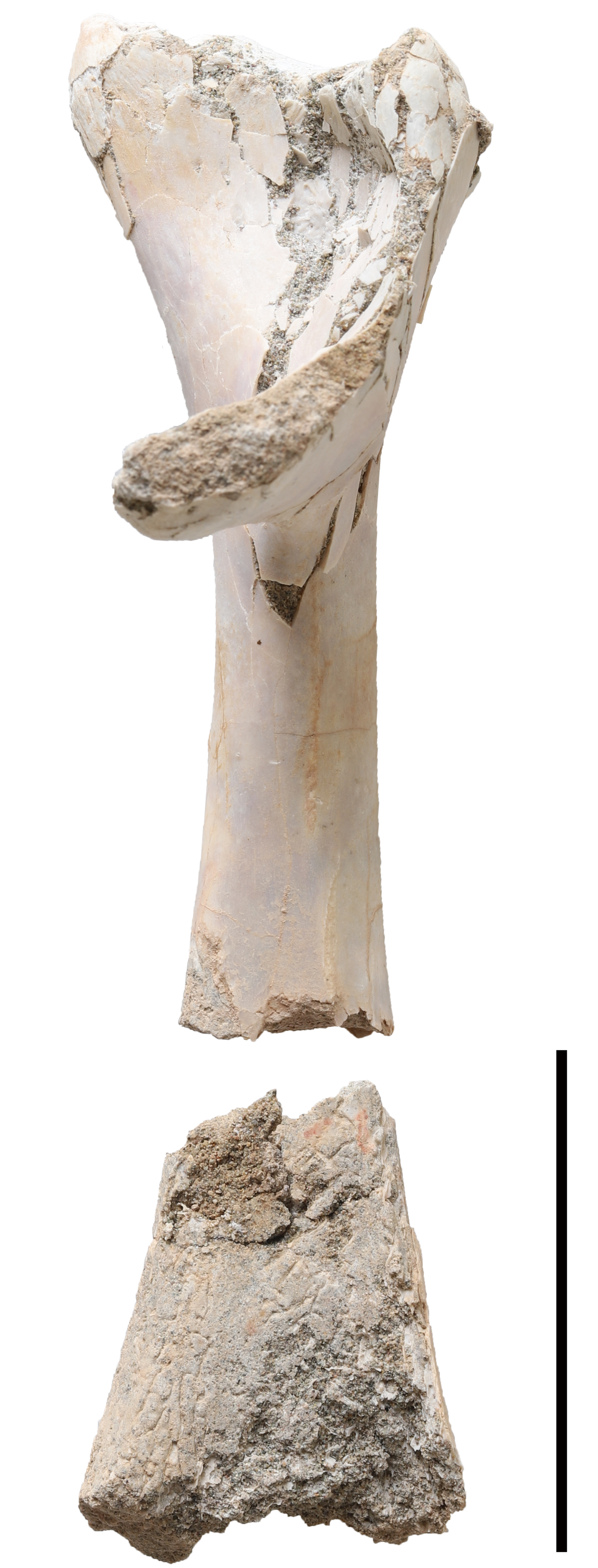
The left ornithocheiromorph humerus (IVPP V 33251) from Lianmuqin Formation, Tugulu Group, Wuerho, in ventral view. Scale bar, 50 mm.
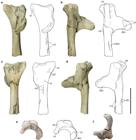
Proximal fragment of the left ornithocheiromorph humerus (IVPP V 33251) in ventral (a), posterior (b), dorsal (c), anterior (d), proximal (e), and distal (f) views. Abbreviations: dpc, deltopectoral crest; hh, humerus head; i.ld, insertion for M. latissimus dorsi; i.p, insertion for M. pectoralis; nf, nutrient foramen; o.b, origin for M. brachialis; o.tbm, origin for M. triceps brachii caput medialis; o.tbl, origin for M. triceps brachii caput lateralis; pf, pneumatic foramen; uc, ulnar crest. Scale bar, 50 mm.
MATERIALS AND METHODS
Isotopic analytical material
The only sample WE-01 was collected from the two-meter-thick whitish tuffaceous sandstone layer at the uppermost of the Shengjinkou Formation. This layer is widely distributed in northwestern Wuerho, and the sample site is about 9 km to the northwest of the IVPP V 33251 site, near road G217 (Figure 1).
Isotopic analytical methods
Zircons extracted from sample WE-01 for U-Pb isotopic analyses were processed by conventional heavy liquid and magnetic separation techniques. Zircon grains were set in epoxy mounts, which were then polished to expose the interior of the grains. Zircons were documented with transmitted and reflected light micrographs as well as cathodoluminescence (CL) images to reveal their external and internal structures prior to U–Pb isotopic analyses to observe the erosion degree and choose potential target sites for U-Pb dating.
Zircon U-Pb dating were conducted by laser ablation-inductively coupled plasma-mass spectrometry (LA-ICP-MS) at the Wuhan SampleSolution Analytical Technology Co., Ltd., Wuhan, China. The spot size and frequency of the laser were set to 32 µm and 10 Hz, respectively, in this study. Detailed operating conditions for the laser ablation system, the ICP-MS instrument, and data reduction are the same as described by Zong et al. (2017). Concordia diagrams and weighted mean calculations were made using Isoplot/Ex_ver3.75 (Ludwig 2012). Seven measurements of Plešovice zircon during the course of this study yielded a Concordia Age of 337.5 ± 2.3 Ma (2σ, MSWD = 0.54), which is consistent within errors with the reported value of 337.13 ± 0.37 Ma (Sláma et al. 2008).
RESULTS
Description of the new humerus (IVPP V 33251)
IVPP V 33251 is a partial left humerus broken into two pieces missing the distal extremity (Figures 2 and 3, Table I). The proximal and distal fragments have preserved lengths of 98.5 mm and 46 mm, respectively. The total length of the humerus is estimated to be around 158 mm. The proximal end suffers from distortion and crushing, evidenced by the fact that the anterior half of the humeral head is set at an unnatural angle with the posterior half in proximal view (Figure 3e). The deltopectoral crest is also slightly dislocated distally suggested by the unmatched bone patches with the shaft near its distal end (Figure 3b and d). Fortunately, this does not affect the general morphology of the proximal end.
The humeral head is crescent-shaped with a concave ventral margin and a convex dorsal margin (Figure 3e) and is only moderately deflected dorsally (Figure 3b). It is weakly saddle-shaped, i.e., anteroposteriorly concave and dorsoventrally convex. The deltopectoral crest is warped and thickened towards its anterior margin (Figure 3a and f) as in pteranodontoids (Bennett 1989). Its proximal margin has been eroded, yet the preserved portion suggests that the former slopes distally and is confluent with the anterior margin. The deltopectoral crest is anteroposteriorly longer than wide with a slightly concave distal margin. A reversed ‘7’-shaped (left element in posteroventral view) scar on the ventral surface of the deltopectoral crest probably defines the insertion for M. pectoralis anteriorly (Bennett 2003). This scar extends posteroproximally from the anterior portion of the distal margin towards the proximal margin for most width of the deltopectoral crest, and then sharply turns anteriorly. Anteroposteriorly elongated striations with elongated pits surround the reversed ‘7’-shaped scar. These elongated pits are especially dense anterior to the scar, and fewer along the distal margin. The ventral surface of the deltopectoral crest closer to the shaft is instead rather smooth. The ulnar crest is moderately expanded in dorsoventral views (Figure 3a and c) and projects posteroventrally in proximal view (Figure 3e), similar to Hamipterus but in contrast to the condition in Anhanguera piscator and Istiodactylus latidens that it is much weaker and posteriorly directed (Kellner & Tomida 2000, Kellner 2003). A distinct constriction connects the humeral head and ulnar crest at their dorsal aspect (Figure 3e). A small dorsally opening nutrient foramen is present on the posterodorsal aspect of the shaft distal to the ulnar crest (Figure 3c), as in Pteranodon (Bennett 2001). There is no pneumatic foramen between the humeral head and deltopectoral crest on the ventral surface. A possible pneumatic foramen is present between the humeral head and ulnar crest on the dorsal surface, but its fidelity cannot be ascertained as its preserved margin is wavy and unnatural (Figure 3c).
The shaft gradually expands anteroposteriorly towards the distal end, as commonly seen in pteranodontoids but unlike most other pterosaurs in which the mid-shaft has a nearly constant width. The cortical bone is extremely thin, with the R/t value measured at around 15 at the breakage close to the mid-shaft, typical for most ornithocheiroids but higher than those seen in dsungaripterids (Jiang et al. 2023). Several muscle scars on the shaft could be easily identified. The scar for M. latissimus dorsi is longitudinally oriented on the dorsal surface and roughly level with the distal end of the deltopectoral crest (Figure 3c), with no indication of subdivision for M. teres major as reported in Anhanguera (AMNH 22555, Bennett 2003). On the posterior surface, the origin for the medial head of M. triceps brachii is longitudinally oriented and positioned distal to the ulnar crest (Figure 3b), similar to Anhanguera and Barbosania (Bennett 2003, Elgin & Frey 2011). This scar curves ventrally near its preserved distal end. Another broader scar closely ventral to its distal end seen in Hamipterus (Wang et al. 2017) is not preserved in this specimen. On the ventral surface, a jagged intermuscular line runs distally from the distal end of the deltopectoral crest for around 25 mm (Figure 3a). Anterodistally not far from it occurs another longitudinal scar. These two possibly correlate to the origin of M. brachialis as reconstructed in Anhanguera (Bennett 2008). Another two much fainter and obliquely oriented scars lie anterodorsal to the purported origin of M. brachialis, with dense striations around them (Figure 3d). This area is likely to be the origin of the lateral head of M. triceps brachii (Bennett 2003). These two scars are not seen in Hamipterus (IVPP V 18946.1), however, the significance of such differences is unclear.
Isotopic result of sample WE-01
Zircons from tuffaceous sample WE-01 were dated by LA-ICP-MS. The U-Pb isotopic ratios and calculated ages are listed in Table SI (Supplementary Material). Most zircon grains are colorless to light yellow, euhedral, and range from 60 to 180 μm in length with aspect ratios between 2:1 and 5:1. The analyzed zircon grains have high Th/U ratios (0.36-1.97) and mostly oscillatory zoning (Figure 4a), indicating a magmatic origin (Hoskin & Schaltegger 2003). As shown in Figure 4, 206Pb/238U ages of thirty-five spot analyses range from ~805 Ma to ~131 Ma, with a prominent peak at ~134 Ma. The twenty-four youngest grains give a Concordia age of 134.27 ± 0.36 Ma (MSWD = 2.9, n=24; 1σ) (Figure 4a), which is considered the best estimate for the maximum depositional age for sample WE-01.

a) U-Pb Concordia diagram for sample WE-01; cathodoluminescence images of representative zircons are shown in the upper left corner; b) histogram of zircon LA-ICP-MS U-Pb ages from sample WE-01.
DISCUSSION
The new humerus (IVPP V 33251) can be undoubtedly referred to Pteranodontoidea based on the warped deltopectoral crest, an unambiguous synapomorphy of the latter clade (Bennett 1989). Pteranodontoidea is composed of two main clades, i.e., Pteranodontia and Ornithocheiromorpha (sensu Andres et al. 2014). IVPP V 33251 could be excluded from Pteranodontia by the absence of the ventral pneumatic foramen immediately distal to the humeral head (Unwin 2003, Bennett 2001, Longrich et al. 2018). Although this foramen is absent in the nyctosaurid Alcione, this most probably represents a reversal (Longrich et al. 2018). Thus IVPP V 33251 most likely represents an ornithocheiromorph.
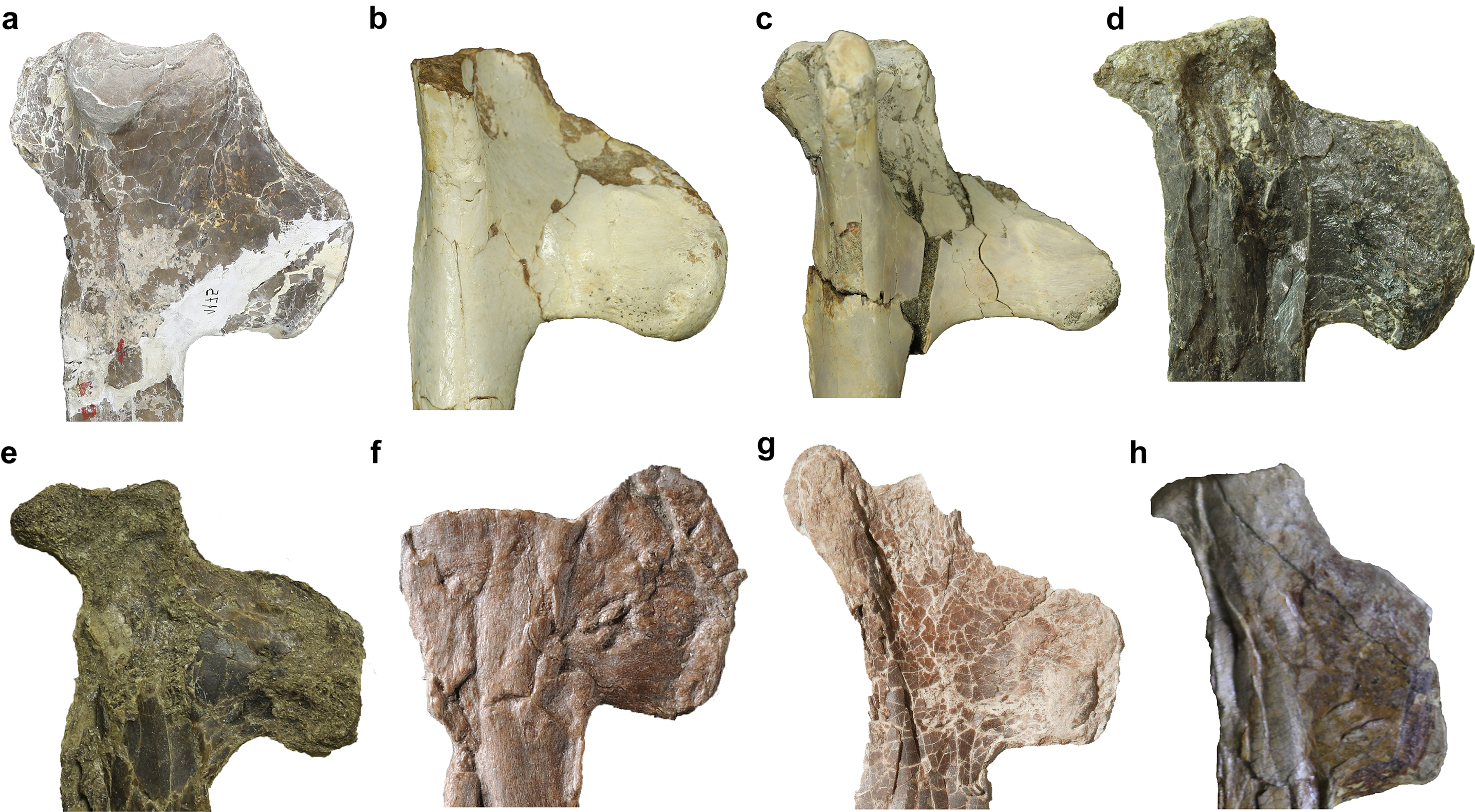
In Ornithocheiromorpha, the morphology of the deltopectoral crest is quite variable aside from its ‘warped’ nature and probably has taxonomic significance (Figure 5), although this received little interest in previous studies. In Anhanguera piscator (Kellner & Tomida 2000), Barbosania (Elgin & Frey 2011), USNM 13804 (Bennett 1989) and Zhenyuanopterus (Figure 5h), the deltopectoral crest is anteroposteriorly much shorter than proximodistally wide, with a distally sloping proximal margin. Deltopectoral crests of Mimodactylus and Haopterus are also much shorter than wide but without a distally sloping proximal margin (Figure 5g). In contrast, deltopectoral crests of the Yixian pteranodontoid IVPP V 26166 (Jiang et al. 2021), IVPP V 33251, Hamipterus, Ikrandraco, and some istiodactylids like Istiodactylus sinensis and Nurhachius are instead as long as wide, or longer than wide (Figure 5b–e and g), similar to the condition in pteranodontids (Figure 5a). In addition, deltopectoral crests of Anhanguera piscator and USNM 13804, as three-dimensionally preserved, possess a distinct anterior deflection near the anterodistal corner (Kellner & Tomida 2000, Bennett 1989) that gives their anterior margin a wavy profile. Such deflection is absent in Hamipterus, Ikrandraco, IVPP V 33251 and possibly also Istiodactylus latidens (Hooley 1913, Wang et al. 2014b, 2017). This feature, however, cannot be confirmed in many ornithocheiromorph taxa as most specimens are preserved flattened. The pteranodontids Pteranodon (Bennett 2001) and Tethydraco (Longrich et al. 2018, but see Labita & Martill 2021), and nyctosaurids (Longrich et al. 2018) also do not have such an anterior deflection, suggesting that its absence might be primitive to pteranodontoids.

Proximal ends of pteranodontoid humeri. a) Pteranodon (YPM 1175, left reversed; available at YPM website); b) Hamipterus (IVPP V 18946.1, left); c) IVPP V 33251 (left); d) Ikrandraco (IVPP V 18199, left); e) IVPP V 26166 (right reversed); f) Haopterus (IVPP V 11726, right); g) Nurhachius (IVPP V 13288); and h) Zhenyuanopterus (GLGMV 0001, right). Not in Scale.
A posteriorly directed ulnar crest was considered common to pteranodontoids (Bennett 1989, Kellner 2003), as opposed to the ventrally or posteroventrally oriented ulnar crests of non-pteranodontoid pterosaurs. However, among pteranodontoids, a posteroventrally oriented ulnar crest is at least present in IVPP V 33251 and Hamipterus. Given that Hamipterus is deeply nested within Ornithocheiromorpha as recovered in recent phylogenetic analyses (Andres 2021, Kellner et al. 2019), the presence of a posteriorly directed ulnar crest should have a more complex distribution among pteranodontoids. However, we noted that proximal views of the pteranodontoid humeri have been rarely documented or figured, mainly due to their poor preservations, thus a thorough examination of this feature proves hard at present.
Pneumatic features are also of great importance to pterosaur taxonomy. Among ornithocheiromorphs, Hamipterus differs from IVPP V 33251 in its autapomorphic presence of a ventral pneumatic foramen between the humeral head and deltopectoral crest (Wang et al. 2014a), representing a convergence with Pteranodontia and Azhdarchoidea (Unwin 2003, Kellner 2003, Longrich et al. 2018), although we note that this feature is possibly not universal to all the specimens of Hamipterus. This pneumatic foramen has otherwise not been reported in ornithocheiromorphs. A dorsal pneumatic foramen was seen in I. latidens, A. piscator and Hamipterus (Kellner & Tomida 2000, Unwin 2003, Wang et al. 2014a), but this feature cannot be assessed in IVPP V 33251. The distally displaced dorsal nutrient foramen seen in IVPP V 33251 is widely present in pterodactyloids like Elanodactylus (Andres & Ji 2008), Pteranodon (Bennett 2001), Noripterus complicidens (Young 1973), Tapejara (Eck et al. 2011) and Quetzalcoatlus northropi (Andres & Langston 2021). It was sometimes misidentified as a pneumatic foramen (e.g., Andres & Ji 2008) but probably has little taxonomic value.
IVPP V 33251 represents the first ornithocheiromorph from the Tugulu Group of Wuerho. Comparison with other ornithocheiromorphs suggests that this individual achieved a wingspan of around 3 m at death. The rarity of ornithocheiromorphs in this region might be attributed to taphonomic biases, or represent true signals, which are not mutually exclusive. Taphonomic biases could result from different sizes, shapes or other properties of the bones. Size-dependent taphonomic biases have been well documented in fossil records (Brown et al. 2021) and recent bone assemblages (Behrensmeyer et al. 1979). It could not explain the rarity of ornithocheiromorphs in the Tugulu Group, because the humerus reported here (IVPP V 33251) is similar in dimension to those of D. weii, whose remains are much more common in the same area. Another possibility remains that, ornithocheiromorph long bones are extremely thin-walled and probably more prone to damage pre-transport or during transportation than the thicker-walled long bones of dsungaripterids. However, although this might account for the scarcity of ornithocheiromorph long bones, the more robust-constructed bones of ornithocheiromorphs like syncarpals, articular ends of long bones and jaws should be similar in preservational potential to those of dsungaripterids. These elements are indeed very common in the Wuerho pterosaurian collection, yet they all pertain to dsungaripterids and none could be referred to Ornithocheiromorpha (Young 1964, Young 1973, pers. obs.). This indicates that taphonomic biases, if ever present, should not be the primary factor. If the relative abundance of ornithocheiromorphs and dsungaripterids in Wuerho represents a true signal, it could be explained by niche partitioning between these two clades. Dsungaripterids were hypothesized to forage along the shore, leaving abundant pterosaur footprints (Xing et al. 2011, Li et al. 2021). In contrast, ornithocheiromorphs, although representing a much more inclusive clade, were generally hypothesized to be piscivorous and commonly inhabit an environment away from the shoreline, with the possible exception of istiodactylids (Bestwick et al. 2018). The Tugulu Group in Wuerho represents a shallow-water deltaic depositional system (Jiang et al. 2008). This environment might favour the preservation of organisms that frequently inhabit the shoreline, such as dsungaripterids.
Although the tuffaceous sample was collected at a distinct site from the previous one (Zheng et al. 2024), they are only two kilometers away and from the same horizon. These two ages are indistinguishable considering the analytical uncertainties of the two dating methods. The new result confirms that the top of the Shengjinkou Formation is middle Valanginian in age and the WPF should be at least in part earlier than the early stage of Jehol Biota in northeast Asia (Yang et al. 2020, Yu et al. 2022). However, the lower and upper temporal constraints of the WPF are unclear, and thus the duration of the WPF is still an open question. Providing that fossil remains of D. weii, the most important component of the WPF, have been recorded in all three formations of the Tugulu Group (Young 1973, Zhao 1980, Song et al. 2024) cropped out in Wuerho, there should be no significant faunal turnover within the Tugulu Group in this region, and the WPF might not last for a long period. Zheng et al. (2024) argued that Jehol Biota did not expand as far west as the Junggar Basin, but it is also plausible that the deposition during the age of Jehol Biota, especially its second and third stages (Zhou et al. 2021), is entirely missing in Wuerho, which is marked by the unconformity between the Lower Cretaceous Lianmuqin Formation and the Upper Cretaceous Ailikehu Formation (Zhao 1980).
Dsungaripterids were also reported from the Tugulu Group of other regions of the Junggar Basin. Li & Ji (2010) briefly reported one complete skull of D. weii from the Wucaiwan area, the northeastern margin of the basin. A partial skeleton of Lonchognathosaurus acutirostris (Maisch et al. 2004, Augustin et al. 2021c), and indetermined dsungaripterid postcranial remains (Augustin et al. 2021a, b) were recovered from the southern margin of the basin. Unfortunately, no radiometric age is available for these two sites. However, the persistence of dsungaripterids in all formations of the Tugulu Group except for the basalmost Qingshuihe Formation in the southern Junggar basin (Augustin et al. 2021a, b, c), and the existence of D. weii in both northwestern and northeastern margins of the Junggar basin provide evidence for coeval deposition of Tugulu Group at these three sites. The Tsagan-Tsab Formation of Tatal, western Mongolia produced numerous remains of another dsungaripterid ‘Phobetor’ parvus (Unwin & Bakhurina 2000). Shuvalov (2000) suggested a Berriasian–Valanginian age for the stratum based on biostratigraphic correlation, and K-Ar and Rb-Sr datings. Graham et al. (2001) reported two Ar-Ar ages, 131 ± 1 Ma and 126 ± 1 Ma, for the intercalated basalt of the Tsagan-Tsab Formation. More recently, Hasegawa et al. (2018) reported K-Ar ages of 131.1 ± 2.8 Ma and 129.0 ± 2.8 Ma for the basalt layer, which is consistent with the results of Graham et al. (2001). The radiometric ages from the latter two studies demonstrated that the Tsagan-Tsab Formation is Hauterivian, much younger than the Shengjinkou Formation in Wuerho, but presumably coeval with the Huajiying Formation that hosted the early stage of the Jehol Biota (Yang et al. 2020). In combination with the age data from the WPF, dsungaripterids might have thrived for more than 5 million years in East Asia and went extinct before the flourishing of the Jehol Biota. Recently, Averianov et al. (2022) reported a fragmentary wing metacarpal distal end from the Aptian Ilek Formation of western Siberia and referred it to Lonchognathosaurus. If true, this would significantly delay the last appearance of dsungaripterids. However, the main ground for this attribution, i.e., an anteroposteriorly oriented ridge on the dorsal condyle, is poorly sampled across pterosaur phylogeny and its taxonomic value needs to be attested.
Pterosaur records of the Berriasian–Valanginian are quite limited as universally recognized (Barrett et al. 2008, Butler et al. 2013, Dean et al. 2016). Some occurrences, despite first thought to be the earliest Cretaceous, have highly ambiguous ages (e.g., Andres & Norell 2005, Haddoumi et al. 2016). Besides the Tugulu Group, pterosaur remains from this period were also reported from a handful of sites in East Asia, Europe and South America (Table II), dominated by poorly preserved specimens of which the phylogenetic positions were hardly tested by cladistic analyses. Nearly all main clades of Cretaceous pterosaurs except for Pteranodontia, including ctenochasmatoids, ornithocheiromorphs, dsungaripterids and azhdarchoids, have been documented from this period. Among these, ctenochasmatoids have already diversified during the Late Jurassic and seem resilient to the Jurassic–Cretaceous transition (Tennant et al. 2017). Dsungaripterids are likely endemic to East Asia in the earliest Cretaceous (the age of Domeykodactylus-bearing stratum still pends further investigation), and the existence of azhdarchoids during this interval still pends further examination. Intriguingly, the patchy pterosaur fossil records of the lowermost Cretaceous notwithstanding, ornithocheiromorph occurrences have been recorded both in Laurasia and Gondwana, implying its global distribution. Moreover, Ornithocheiromorpha probably has already diversified during this period as implied by the establishment of several subclades like the Anhangueridae, Istiodactylidae and Lonchodectidae, although the presence of the latter two clades received some controversy (Table II). Nevertheless, this is quite in contrast to the condition in the Late Jurassic, when the fossil records of pterosaurs are much better but no unambiguous ornithocheiromorph has been documented (but see imprecise ages of some pterosaur-bearing strata in Table II).
Berriasian–Valanginian pterosaur occurences beyond identification of Pterosauria or Pterodactyloidea. Taxonomy based on the phylogeny of Andres (2021) and clade definitions utilized therein.
The drivers for the rapid diversification and dispersal of Ornithocheiromorpha near the Jurassic/Cretaceous boundary remain unclear. Rhamphorhynchids are globally distributed during Late Jurassic (Alarcón et al. 2021) and have a similar piscivorous dietary to most ornithocheiromorphs (Bestwick et al. 2018, 2020). Rhamphorhynchids like Rhamphorhynchus and Angustinaripterus have elongated conical teeth at the mesial end of their dentition that are likely adapted for fish grasping, reminiscent of some ornithocheiromorphs like Hamipterus, Anhanguera and Guidraco. The morphological and functional convergences of rhamphorhynchids and ornithocheiromorphs imply that the demise of rhamphorhynchids at the Jurassic–Cretaceous transition might provide empty niches subsequently occupied by ornithocheiromorphs. However, that a much wider array of non-overlapping morphotypes, especially regarding the dentition, exist in the Ornithocheiromorpha than in Rhamphorhynchidae or other pterosaur clades thrived in Late Jurassic (Bestwick et al. 2018), and their markedly disintct body sizes, indicate that the opportunistic replacement of the Late Jurassic pterosaur clades (Tennant et al. 2017) cannot exclusively account for the success of Ornithocheiromorpha during the Early Cretaceous. On the other hand, the uniquely constructed forelimb of ornithocheiromorphs, characterized by a series of modifications of muscle attachments and joint structures, like the dorsoventrally expanded notarial articulation of the scapula (Kellner 2003), warped deltopectoral crest (Bennett 1989) and the “ornithocheiroid carpus” (Unwin 2003, which itself comprises a set of modifications of the syncarpals, and accordingly the articular ends of the antebrachium and metacarpals), was established at deep nodes of Ornithocheiromorpha or Pteranodontoidea. These specializations in the locomotor apparatus are shared by all ornithocheiromorphs and potentially improve their flight efficiency, providing opportunities for them to explore new niches. For example, the warped deltopectoral crest as in IVPP V 33251, compared with the non-warped deltopectoral crest of non-pterandontoid pterosaurs, alters the orientation of M. pectoralis, the principal depresser of the wing, hereby increasing its moment arm about the glenohumeral joint (Figure 6). The increased moment arm of M. pectoralis was presumably adapted to holding the wing in a static position more efficiently, which plays a vital role in soaring flight.

Pectoral regions of pterosaurs in anterior view, with a) a warped deltopectoral crest; and b) a non-warped deltopectoral crest. The black point indicates the glenohumeral joint. The red-shaded area indicates M. pectoralis and the red line approximates its average line of action; ma is the moment arm of M. pectoralis.
SUPPLEMENTARY MATERIAL
ACKNOWLEDGMENTS
We thank Hongjiao Zhou (IVPP) for the preparation and Zhiqiang Yu (IGG) for his helpful discussions. We also appreciate two reviewers, Alexander Averianov and Richard Buchmann, and the associate editor for their valuable comments and suggestions which greatly improve our manuscript. This study was supported by the National Natural Science Foundation of China (42072028 and 42288201).
REFERENCES
- ABEL P, HORNUNG J, KEAR BP & SACHS S. 2021. An anhanguerian pterodactyloid mandible from the lower Valanginian of Northern Germany, and the German record of Cretaceous pterosaurs. Acta Palaeontol Pol 66: S5-S12.
- ALARCÓN J, OTERO R, SOTO S, VARGAS A, ROJAS & ROJAS O. 2021. First record of a Late Jurassic rhamphorhynchine pterosaur from Gondwana. Acta Palaeontol Pol 66: 571-583.
- ANDRES B. 2021. Phylogenetic systematics of Quetzalcoatlus Lawson 1975 (Pterodactyloidea: Azhdarchoidea). J Vert Paleont 41: 203-217.
- ANDRES B, CLARK JM & XU X. 2014. The earliest pterodactyloid and the origin of the group. Curr Biol 24: 1011-1016.
- ANDRES B & JI Q. 2008. A new pterosaur from the Liaoning Province of China, the phylogeny of the Pterodactyloidea, and convergence in their cervical vertebrae. Palaeontology 51: 453-469.
- ANDRES B & LANGSTON W. 2021. Morphology and taxonomy of Quetzalcoatlus Lawson 1975 (Pterodactyloidea: Azhdarchoidea). J Vert Paleont 41: 46-202.
- ANDRES B & NORELL MA. 2005. The first record of a pterosaur from the Early Cretaceous strata of Öösh (Övörkhangai; Mongolia). Am Mus Novit 3472: 1-6.
- AUGUSTIN FJ, MATZKE AT, MAISCH MW & CSIKI-SAVA Z. 2021a. Pterosaur remains from the Lower Cretaceous Lianmuxin Formation (upper Tugulu Group) of the southern Junggar Basin (NW China). Hist Biol 34: 312-321.
- AUGUSTIN FJ, MATZKE AT, MAISCH MW, KAMPOURIDIS & CSIKI-SAVA Z. 2021b. The first record of pterosaurs from the Lower Cretaceous Hutubei Formation (lower Tugulu Group) of the southern Junggar Basin (NW China) – a glimpse into an unusual ecosystem. Cretaceous Res 130: 312-321.
- AUGUSTIN FJ, MATZKE AT, MAISCH MW & PFRETZSCHNER H-U. 2021c. New information on Lonchognathosaurus (Pterosauria: Dsungaripteridae) from the Lower Cretaceous of the southern Junggar Basin (NW China). Cretaceous Res 124: 104808.
- AVERIANOV AO. 2012. Ornithostoma sedgwicki – valid taxon of azhdarchoid pterosaurs. Proc Zool Inst Russ Acad Sci 316: 40-49.
- AVERIANOV AO. 2014. Review of taxonomy, geographic distribution, and paleoenvironments of Azhdarchidae (Pterosauria). ZooKeys 432: 1-107.
- AVERIANOV AO. 2020. Taxonomy of the Lonchodectidae (Pterosauria, Pterodactyloidea). Proc Zool Inst Russ Acad Sci 324: 41-55.
- AVERIANOV AO, IVANTSOV SV, LESHCHINSKIY SV & SKUTSCHAS PP. 2022. First pterosaur bone from the Lower Cretaceous of Siberia, Russia. Cretaceous Res 137: 105230.
- BARRETT PM, BUTLER RJ, EDWARDS NP & MILNER AR. 2008. Pterosaur distribution in time and space: an atlas. Zitteliana B28: 61-107.
- BEHRENSMEYER AK, WESTERN D & BOAZ DED. 1979. New perspectives in vertebrate paleoecology from a recent bone assemblage. Paleobiology 5: 12-21.
- BENNETT SC. 1989. A pteranodontid pterosaur from the Early Cretaceous of Peru, with comments on the relationships of Cretaceous pterosaurs. J Paleontol 63: 669-677.
- BENNETT SC. 2001. The osteology and functional morphology of the Late Cretaceous pterosaur Pteranodon Part I. General description of osteology. Palaeontogr Abt A 260: 1-112.
- BENNETT SC. 2003. Morphological evolution of the pectoral girdle of pterosaurs: myology and function. Geol Soc London Spec Publ 217: 191-215.
- BENNETT SC. 2007. A review of the pterosaur Ctenochasma: taxonomy and ontogeny. N Jb Geol Paläont Abh 245: 23-31.
- BENNETT SC. 2008. Morphological evolution of the wing of pterosaurs: myology and function. Zitteliana B28: 127-141.
- BESTWICK J, UNWIN DM, BUTLER RJ, HENDERSON DM & PURNELL MA. 2018. Pterosaur dietary hypotheses: a review of ideas and approaches. Biol Rev 93: 2021-2048.
- BESTWICK J, UNWIN DM, BUTLER RJ & PURNELL MA. 2020. Dietary diversity and evolution of the earliest flying vertebrates revealed by dental microwear texture analysis. Nat Commun 11: 5293.
- BROWN CM, CAMPIONE NE, WILSON MANTILLA GP & EVANS DC. 2021. Size-driven preservational and macroecological biases in the latest Maastrichtian terrestrial vertebrate assemblages of North America. Paleobiology 48: 210-238.
- BUFFETAUT E, SUTEETHORN V, TONG H, CUNY G & CAVIN L. 2003. A pterodactyloid tooth from the Sao Khua Formation (early Cretaceous) of Thailand. Mahasarakham Univ J 22: 92-98.
- BUTLER RJ, BENSON RBJ & BARRETT PM. 2013. Pterosaur diversity: Untangling the influence of sampling biases, Lagerstätten, and genuine biodiversity signals. Palaeogeogr Palaeoclimatol Palaeoecol 372: 78-87.
- CADENA E-A, UNWIN DM & MARTILL DM. 2020. Lower Cretaceous pterosaurs from Colombia. Cretaceous Res 114: 104526.
- CHEN H, JIANG S, KELLNER AWA, CHENG X, ZHANG X, QIU R, LI Y & WANG X. 2020. New anatomical information on Dsungaripterus weii Young, 1964 with focus on the palatal region. PeerJ 8: e8741.
- DEAN CD, MANNION PD & BUTLER RJ. 2016. Preservational bias controls the fossil record of pterosaurs. Palaeontology 59: 225-247.
- DONG Z 1973. Cretaceous strata of Wuerho region. Reports of paleontological expedition to Sinkiang (II): Pterosaurian fauna from Wuerho, Sinkiang, Beijing: Science Press, p. 1-7.
- DYKE GJ, BENTON MJ, POSMOSANU E & NAISH D. 2011. Early Cretaceous (Berriasian) birds and pterosaurs from the Cornet bauxite mine, Romania. Palaeontology 54: 79-95.
- ECK K, ELGIN RA & FREY E. 2011. On the osteology of Tapejara wellnhoferi KELLNER 1989 and the first occurrence of a multiple specimen assemblage from the Santana Formation, Araripe Basin, NE-Brazil. Swiss J Palaeontol 130: 277-296.
- ELGIN RA & FREY E. 2011. A new ornithocheirid, Barbosania gracilirostris gen. et sp. nov. (Pterosauria, Pterodactyloidea) from the Santana Formation (Cretaceous) of NE Brazil. Swiss J Palaeontol 130: 259-275.
- GRAHAM SA, HENDRIX MS, JOHNSON CL, BADAMGARAV D, BADARCH G, AMORY J, PORTER M, BARSBOLD R, WEBB LE & HACKER BR. 2001. Sedimentary record and tectonic implications of Mesozoic rifting in southeast Mongolia. Geol Soc Am Bull 113: 1560-1579.
- HADDOUMI H, ALLAIN R, MESLOUH S, METAIS G, MONBARON M, PONS D, RAGE J-C, VULLO R, ZOUHRI S & GHEERBRANT E. 2016. Guelb el Ahmar (Bathonian, Anoual Syncline, eastern Morocco): First continental flora and fauna including mammals from the Middle Jurassic of Africa. Gondwana Res 29: 290-319.
- HASEGAWA ET AL. 2018. Depositional ages and characteristics of Middle–Upper Jurassic and Lower Cretaceous lacustrine deposits in southeastern Mongolia. Isl Arc 27: e12243.
- HOOLEY RW. 1913. On the skeleton of Ornithodesmus latidens; an ornithosaur from the Wealden Shales of Atherfield (Isle of Wight). Q J Geol Soc 69: 372-422.
- HOSKIN PW & SCHALTEGGER U. 2003. The composition of zircon and igneous and metamorphic petrogenesis. Rev Mineral Geochem 53: 27-62.
- HOWSE SCB & MILNER AR. 1995. The pterodactyloids from the Purbeck Limestone Formation of Dorset. Bull Nat Hist Mus Lond (Geol) 51: 73-88.
- JIANG Y, LIU S, WU J, RAO M, LU K & ZHU C. 2008. Depositional system analysis of Tugulu group in the northwestern Junggar basin of Xingjiang. Uranium Geol 24: 17-23.
- JIANG S, SONG J, ZHANG X, CHENG X & WANG X. 2023. A new pterosaur from the early stage of the Jehol biota in China, with a study on the relative thickness of bone walls. Heliyon 9.
- JIANG S, ZHANG X, CHENG X & WANG X. 2021. A new pteranodontoid pterosaur forelimb from the upper Yixian Formation, with a revision of Yixianopterus jingangshanensis. Vert PalAs 59: 81-94.
- KELLNER AWA. 2003. Pterosaur phylogeny and comments on the evolutionary history of the group. Geol Soc London Spec Publ 217: 105-137.
- KELLNER AWA, CALDWELL MW, HOLGADO B, VECCHIA FMD, NOHRA R, SAYAO JM & CURRIE PJ. 2019. First complete pterosaur from the Afro-Arabian continent: insight into pterodactyloid diversity. Sci Rep 9: 17875.
- KELLNER AWA & TOMIDA Y. 2000. Description of a new species of Anhangueridae (Pterodactyloidea) with comments on the pterosaur fauna from the Santana Formation (Aptian-Albian), northeastern Brazil. Natl Sci Mus Monogr 17: 1-137.
- LABITA C & MARTILL DM. 2021. An articulated pterosaur wing from the Upper Cretaceous (Maastrichtian) phosphates of Morocco. Cretaceous Res 119: 104679.
- LI D & JI SA. 2010. New material of the Early Cretaceous pterosaur Dsungaripterus weii from northern Xinjiang northwest China. Acta Geosci Sin 31: 38-39.
- LI Y, WANG X & JIANG S. 2021. A new pterosaur tracksite from the Lower Cretaceous of Wuerho, Junggar Basin, China: inferring the first putative pterosaur trackmaker. PeerJ 9: e11361.
- LONGRICH NR, MARTILL DM & ANDRES B. 2018. Late Maastrichtian pterosaurs from North Africa and mass extinction of Pterosauria at the Cretaceous-Paleogene boundary. PLoS Biol 16: e2001663.
- LÜ J, UNWIN DM, JIN X, LIU Y & JI Q. 2010. Evidence for modular evolution in a long-tailed pterosaur with a pterodactyloid skull. Proc R Soc B 277: 383-389.
- MAISCH MW, MATZKE AT & SUN G. 2004. A new dsungaripteroid pterosaur from LUCAS SG. 2006. The Psittacosaurus biochron, Early Cretaceous of Asia. Cretaceous Res 27: 189-198.
- LUDWIG KR. 2012. User’s manual for Isoplot 3.75: A geochronological toolkit for Microsoft Excel. Berkeley Geochronology Centre Special Publication 5: 75.
- MARTILL DM, O’SULLIVAN M & NEWMAN C. 2013. A possible azhdarchid pterosaur (Pterosauria, Azhdarchidae) in the Durlston Formation (Early Cretaceous, Berriasian) of southern England. Cretaceous Res 43: 26-39.
- PUÉRTOLAS-PASCUAL E, AURELL M, BERMÚDEZ-ROCHAS DD, CANUDO JI, FERNANDES AE, GALOBART A, MORENO-AZANZA M, PÉREZ-GARCÍA A & CASTANERA D. 2023. A new vertebrate assemblage from the matute formation of the Cameros Basin (Ágreda, Spain): implications for the diversity during the Jurassic/Cretaceous boundary. J Iber Geol: 1-21.
- RIGAL S, MARTILL DM & SWEETMAN SC. 2018. A new pterosaur specimen from the Upper Tunbridge Wells Sand Formation (Cretaceous, Valanginian) of southern England and a review of Lonchodectes sagittirostris (Owen 1874). Geol Soc London Spec Publ 455: 221-232.
- SHUVALOV VF. 2000. The Cretaceous stratigraphy and palaeobiogeography of Mongolia. In: Benton MJ, Shishkin MA, Unwin DM & Kurochkin EN (Eds.), The Age of Dinosaurs in Russia and Mongolia, Cambridge: Cambridge University, p. 256-278.
- SLÁMA J ET AL. 2008. Plešovice zircon — A new natural reference material for U–Pb and Hf isotopic microanalysis. Chem Geol 249: 1-35.
- SONG J, JIANG S & WANG X. 2024. Postcranial anatomy of Dsungaripterus weii (Pterosauria: Ornithocheiroidea) from the Lower Cretaceous of Wuerho, China. J Vert Paleont: e2402042.
- SWEETMAN SC. 2023. Pterosaur teeth from the Lower Cretaceous (Valanginian) Cliff End Bone Bed, Wadhurst Clay Formation, Wealden Supergroup of southern England, and their possible affinities. Cretaceous Res 151: 105622.
- TENNANT JP, MANNION PD, UPCHURCH P, SUTTON MD & PRICE GD. 2017. Biotic and environmental dynamics through the Late Jurassic-Early Cretaceous transition: evidence for protracted faunal and ecological turnover. Biol Rev 92: 776-814.
- TUCKER ET AL. 2022. Age, depositional history, and paleoclimatic setting of Early Cretaceous dinosaur assemblages from the Sao Khua Formation (Khorat Group), Thailand. Palaeogeogr Palaeoclimatol Palaeoecol 601: 111107.
- UNWIN DM. 2003. On the phylogeny and evolutionary history of pterosaurs. Geol Soc London Spec Publ 217: 139-190.
- UNWIN DM & BAKHURINA NN 2000. Pterosaurs from Russia, Middle Asia and Mongolia. In: Benton MJ, Shishkin MA, Unwin DM & Kurochkin EN (Eds.), The Age of Dinosaurs in Russia and Mongolia, Cambridge: Cambridge University, p. 420-433.
- WANG X ET AL. 2014a. Sexually dimorphic tridimensionally preserved pterosaurs and their eggs from China. Curr Biol 24: 1323-1330.
- WANG X ET AL. 2017. Egg accumulation with 3D embryos provides insight into the life history of a pterosaur. Science 358: 1197-1201.
- WANG X, KELLNER AWA, ZHOU Z & CAMPOS DA. 2005. Pterosaur diversity and faunal turnover in Cretaceous terrestrial ecosystems in China. Nature 437: 875-879.
- WANG X, LI Y, QIU R, JIANG S, ZHANG X, CHEN H, WANG J & CHENG X. 2020. Comparison of biodiversity of the Early Cretaceous pterosaur faunas in China. Earth Sci Front 27: 347-364.
- WANG X, RODRIGUES T, JIANG S, CHENG X & KELLNER AWA. 2014b. An Early Cretaceous pterosaur with an unusual mandibular crest from China and a potential novel feeding strategy. Sci Rep 4: 6329.
- WANG X, ZHOU Z, ZHANG F & XU X. 2002. A nearly completely articulated rhamphorhynchoid pterosaur with exceptionally well-preserved wing membranes and “hairs” from Inner Mongolia, northeast China. Chin Sci Bull 47: 226-230.
- WU X, LI J, WANG X, JIANG S & CHENG X 2017. Amphibians, Reptilians, and Avians. Palaeovertebrata Sinica, n. 2, Beijing: Science Press, 285 p.
- XI D, SUN L, QIN Z, LI G, LI G & WAN X. 2021. Lithostratigraphic subdivision and correlation of the Cretaceous in China. J Stratigr 45: 375-401.
- XING L, HARRIS JD, JIA C-K, LUO Z-J, WANG S & AN J. 2011. Early cretaceous bird-dominated and dinosaur footprint assemblages from the northwestern margin of the Junggar Basin, Xinjiang, China. Palaeoworld 20: 308-321.
- XU J & LI Z. 2015. Middle–Late Mesozoic sedimentary provenances of the Luxi and Jiaolai areas: Implications for tectonic evolution of the North China Block. J Asian Earth Sci 111: 284-301.
- YANG S ET AL. 2020. The appearance and duration of the Jehol Biota: Constraint from SIMS U-Pb zircon dating for the Huajiying Formation in northern China. PNAS 117: 14299-14305.
- YOUNG CC. 1964. On a new pterosaurian from Sinkiang, China. Vert PalAs 8: 221-255.
- YOUNG CC. 1973. Pterosaurs from Wuerho. Reports of paleontological expedition to Sinkiang (II): Pterosaurian fauna from Wuerho, Sinkiang, Beijing: Science Press, p. 18-35.
- YU Z, QIN Z, XI D, DENG C, HE H & ZHOU Z. 2022. New geochronology of the Lower Cretaceous in the Luanping Basin, northern Hebei: Age constraints on the development of early Jehol Biota. Palaeogeogr Palaeoclimatol Palaeoecol 586: 110768.
- ZHAO X. 1980. Reports of paleontological expedition to Sinkiang (IV): Mesozoic vertebrate-bearing beds and stratigraphy of northern Xinjiang. n. 15, Beijing: Science Press.
- ZHENG D, CHANG S-C, RAMEZANI J, XU X, XU H, WANG H, PEI R, FANG Y, WANG J & WANG B. 2024. Calibrating the Early Cretaceous Urho Pterosaur Fauna in Junggar Basin and implications for the evolution of the Jehol Biota. Geol Soc Am Bull 136: 765-773.
- ZHOU Z, MENG Q, ZHU R & WANG M. 2021. Spatiotemporal evolution of the Jehol Biota: Responses to the North China craton destruction in the Early Cretaceous. PNAS 118: e2107859118.
- ZONG K, KLEMD R, YUAN Y, HE Z, GUO J, SHI X, LIU Y, HU Z & ZHANG Z. 2017. The assembly of Rodinia: The correlation of early Neoproterozoic (ca. 900 Ma) high-grade metamorphism and continental arc formation in the southern Beishan Orogen, southern Central Asian Orogenic Belt (CAOB). Precambrian Res 20: 32-48.