 Taxonomic and Faunistic Novelties on Macrobiotids (Tardigrada: Macrobiotidae) from Neotropical Peripheral Mountain Systems
Abstract
The Neotropical peripheral mountain systems in Colombia, including the Sierra Nevada de Santa Marta, Montes de María, and Serranía de Piojó, have remained underexplored due mainly to historical armed conflicts. This study focuses on tardigrade diversity, particularly the Macrobiotidae family, in these regions. By reviewing specimens (in collections and newly sampled) from the Sierra Nevada de Santa Marta, and new samples from Montes de María and Serranía de Piojó, this research expands the known geographic distribution of certain species and provides new data and amendments to species descriptions. Four potentially new species are reported: Calcarobiotus (Calcarobiotus) aff. gildae, Macrobiotus aff. ragonesei, Paramacrobiotus aff. centesimus, and Paramacrobiotus aff. gerlachae. Additionally, three new records for Colombia (Macrobiotus ocotensis, Mesobiotus coronatus, and Minibiotus continuus) are documented, increasing the known species for the country from 26 to 29. In addition, some specimens of the type series were reanalyzed, and new characters were found, leading to the addition of taxonomic comments on some Macrobiotidae species and an amendment of the description of Pam. centesimus. This research underscores the need for further studies (e.g. including molecular techniques), but it already contributes to the broader understanding of the unique and high biodiversity rich tropical ecosystems.
Key words
Biodiversity; Biological collections; Montes de María; Serranía de Piojó; Sierra Nevada de Santa Marta; Water bears
INTRODUCTION
The Neotropical peripheral mountain systems represent a unique set of mountain ranges that are geographically distinct from the Andes (Romero et al. 2020). This geographical isolation, particularly notable in the Caribbean region of Colombia, has given rise to distinct zones characterized by the presence of specific mountain ranges, such as the Serranía del Baudó, Serranía del Darién, Serranía de Macuira, Sierra Nevada de Santa Marta (SNSM), Montes de María, and Serranía de Piojó. Regrettably, these areas have undergone limited exploration and research, particularly concerning biodiversity, due to historical armed conflicts (Arías Ortiz 2010).
The present investigation focused on three mountain systems: SNSM, Montes de María, and Serranía de Piojó. Located on the northern Caribbean coast of Colombia, the SNSM is one of the highest coastal mountain systems in the world; it covers an area of 18,000 km2 and rises from sea level to 5,755 meters above sea level (m a.s.l.) (Meisel & Perez 2006, Viloria de la Hoz 1998). Due to its variety of climates and ecosystems, ranging from warm Tropical Dry Forests (TDF) to snow-capped peaks, the SNSM is a biogeographic island that exhibits a great richness of species and a high degree of endemism (Rangel et al. 2016). Furthermore, the region offers optimal conditions for coffee cultivation, with the so-called coffee belt, situated between 600 and 1,600 m a.s.l., encompassing approximately 18,000 hectares of coffee plantations, an essential source of income for local communities (Castillo 2023). In contrast, the Montes de María, situated in the Bolívar and Sucre Departments, and the Serranía de Piojó in the Atlántico Department, represent significantly lower elevations compared to the SNSM, with altitudes not exceeding 1,000 m a.s.l. These mountain ranges belong to the province of the Caribbean Arid Belt and are characterized as predominantly Tropical Dry Forests ecosystems (Vásquez & Serrano 2009).
Amidst this diverse landscape, tardigrades, microscopic hydrophilic metazoans, might play an important role. The phylum Tardigrada Doyère, 1840 comprises approximately 1,500 species (Degma & Guidetti 2007, 2025, Guidetti & Bertolani 2005), with the species-rich family Macrobiotidae Thulin, 1928, constituted by approximately 360 species. It is mainly characterized by the presence of “Y-shaped” double claws arranged symmetrically with respect to the median plane of each leg, a buccal tube with ventral lamina, the presence of peribuccal lamellae or papulae, and ornamented eggs that are laid free in the environment (Marley et al. 2011, Pilato & Binda 2010, Stec et al. 2021).
In the past decade, there has been a significant increase in the exploration of invertebrate biodiversity within the SNSM, resulting in the identification of noteworthy taxonomic novelties across various organismal groups (González-Maya et al. 2015, Lamas et al. 2004, Uribe & Wolff 2013). While the Montes de María and the Serranía de Piojó remained completely unexplored in terms of tardigrade biodiversity, the SNSM stands out as the most extensively investigated area, providing valuable insights into the tardigrade-fauna, despite the overall scarcity of knowledge about tardigrades in Colombia. To date, 26 reliable species records have been registered in the country, including 10 species and one genus described from type material from this region (Daza et al. 2017, Lisi et al. 2014, 2017, 2019, 2020, 2022, Londoño et al. 2015, 2017, Stec et al. 2017, Venencia-Sayas et al. 2024).
With the objective of providing novel insights to advance the comprehension of the biodiversity of tardigrades, specimens of macrobiotids housed at the Centro de Colecciones Científicas de la Universidad del Magdalena (CCC), collected between 2016 and 2019 from the SNSM, were reviewed. Furthermore, samples collected in 2022 from the Montes de María and Serranía de Piojó, and in the SNSM in 2023, were subjected to analysis. This endeavour resulted in the expansion of the geographic distribution range for certain species and updates to the description of some other species, filling crucial gaps in our knowledge and contributing to the conservation and sustainable management of these diverse Neotropical Mountain systems. Additionally, the re-examination of the type material of Paramacrobiotus centesimus led to an amendment of its description.
MATERIALS AND METHODS
Review of specimens in collections
Specimens of tardigrades belonging to the family Macrobiotidae, collected in different localities during 2016 and 2019, whithin the SNSM (Figure 1) and previously deposited in the Centro de Colecciones Científicas de la Universidad del Magdalena (CCC), were examined (Table I).
Detailed information on the material examined from the Centro de Colecciones Científicas de la Universidad del Magdalena. All the specimens that were mounted on permanent slides were prepared using polyvinyl alcohol mounting medium (PVA). All the samples were collected in the Magdalena Department (Sierra Nevada de Santa Marta). Then there is the full-stop and it proceeds with the already present “CCC-C: sample from coffee plantation. CCC-F: sample from forest.” CCC-C: sample from coffee plantation. CCC-F: sample from forest.

The first analysis of the specimens was based on mounted specimens, but new samplings were conducted to obtain specimens suitable for Scanning Electron Microscopy (SEM). However, success was achieved only in some cases. The new samplings were performed in the following locality and dates: Bella Vista (SNSM) in August and September of 2023.
Sampling and identification of tardigrades
Eighteen samples of corticolous bryophytes and lichens (identified genera and/or species are indicated in Table II) were collected between October and November 2022 in several places of two Colombian departments (Figure 1): Reserva Natural “Luriza”, San Juan de Tocagua, and the Reserva Campesina “La Montaña” (Serranía de Piojó, Atlántico Department); and within the Reserva Brasilar and the Santuario de Flora y Fauna “Los Colorados” (Montes de María, Bolívar Department) (Table II).
Detailed information of the material collected in Tropical Dry Forest (TDF). Atlántico Department (Serranía de Piojó); Bolívar Department (Montes de María).
Samples were rehydrated for 24–48 hours in mineral water and filtered through 500 and 38 μm sieves. All material retained by the second sieve was examined using dissecting microscopes (Zeiss Stemi DV4) to isolate tardigrade specimens with micropipettes, which were mounted directly in PVA (polyvinyl alcohol mounting medium, Bio-Quip #6371A). All specimens obtained during the collection process were deposited in the CCC. Species were identified based on the original descriptions and diagnoses (Binda et al. 2001, de Barros 1942, Maucci & Durante Pasa 1980, Meyer et al. 2017, Pilato 2000, 2006, Pilato et al. 2004a, Pilato & Lisi 2006). For comparisons, we examined type material from different collections as follows, Maucci Collection (University of Modena): holotype of Calcarobiotus (Calcarobiotus) gildae (Maucci & Durante Pasa, 1980) (slide No. 6918); Pilato and Binda Collection (University of Catania): Paramacrobiotus centesimus (Pilato, 2000) (holotype, one paratype, and eggs, slide Nos. 4740, 4781–4787), Macrobiotus deceptor Meyer, Hinton, Gladney & Klumpp, 2017 (paratypes and eggs kindly donated by Harry Meyer, slide No. AB3(i)), Macrobiotus ocotensis Pilato, 2006 (holotype, paratypes, and eggs, slide Nos. 5093, 5094, 5096), Macrobiotus ragonesei Binda, Pilato, Moncada & Napolitano, 2001 (holotype, paratypes, and eggs, slide Nos. 4642–4648, 4660), Minibiotus continuus Pilato & Lisi, 2006 (holotype, paratypes, and the single type egg, slide Nos. 5088–5092).
Taxonomic, morphological and morphometric analysis
Taxonomic classification follows Degma & Guidetti (2025). Tardigrade genera abbreviations were made according to Perry et al. (2019). The bucco-pharyngeal apparatus and claws were classified according to Pilato & Binda (2010). Terminology used to describe oral cavity armature (OCA) and eggshell morphology follows Kaczmarek & Michalczyk (2017). Macroplacoid length sequence is given according to Kaczmarek et al. (2014a). Buccal tube length and the level of the stylet support insertion point were measured according to Pilato (1981). The pt index is the ratio of the length of a given structure to the length of the buccal tube expressed as a percentage (Pilato 1981). Measurements (given in μm) were taken according to Kaczmarek & Michalczyk (2017). Morphometric data were handled using the “Parachela” version 1.8 template available from the Tardigrada Register (Michalczyk & Kaczmarek 2013). Structures were measured with software Zen 3.5 (blue edition) and Leica Enersight, only if undamaged and in a suitable position.
Microscopy and imaging
The specimens were observed under a Zeiss Axiolab 5 and Leica DM1000 Phase Contrast Microscope (PCM). Photographs were taken with an Axiocam 208 and with Flexacam C3 digital cameras. When feasible, specimens were prepared for Scanning Electron Microscopy (SEM) according to the protocol A2 described by Camarda et al. (2024). Specimens prepared for SEM were observed with a Phenom XL G2 Scanning Electron Microscope. Images were improved and assembled with Adobe Photoshop 24.0 and GIMP 2.10. The map of the samplings was created with Q-GIS (version 3.34 Prizren) and improved with GIMP 2.10.
RESULTS
Faunistic and taxonomic account
Phylum Tardigrada Doyère, 1840
Class Eutardigrada Richters, 1926
Order Parachela Schuster, Nelson, Grigarick & Christenberry, 1980
Family Macrobiotidae Thulin, 1928
Genus Calcarobiotus Dastych, 1993
Subgenus Calcarobiotus Dastych, 1993
Calcarobiotus (Calcarobiotus) aff. gildae (Maucci & Durante Pasa, 1980) (Figure 2 and Supplemental Material – Figure S1)

Material Examined: 20 animals and two eggs. The material analyzed was collected from Tropical Dry Forest, samples: TDF-1 and TDF-2 (Table II). Code of collection CBUMAG:TAR:01729 – 01735.
Type Locality of Cal. (Cal.) gildae: Port Blair, Andaman Islands, India (Maucci & Durante Pasa 1980).
Geographic Distribution: Cal. (Cal.) gildae is only reported for the type locality in India. For Colombia, the only record of the genus Calcarobiotus was in Magdalena Department (Caicedo et al. 2014), but still, is considered doubtful (Venencia-Sayas et al. 2024). Therefore, the present study provides the first confirmed record of the genus in Colombia.
Taxonomic/morphological remarks: The morphological and morphometric characters of the Colombian specimens and eggs are similar to those of Cal. (Cal.) gildae (Guidetti & Bertolani 2001, Kaczmarek et al. 2006, Maucci & Durante Pasa 1980). However, the observed specimens from TDF-1 and TDF-2 (Table II) showed a granulation in the latero-dorsal portion of the body (Figure 2c), also present, but less visible, in the deteriorated type material (Figure 2b). Additionally, we provide new photographs with PCM to provide additional details of the taxonomic characters of Cal. (Cal.) aff. gildae from Colombia (Figure 2 and Figure S1). Given the geographical distance from the type locality, our specimens represent a potential new species currently known only from Colombia. Therefore, we prefer to adopt a cautious approach and report the species as Cal. (Cal.) aff. gildae.
Genus Macrobiotus C.A.S. Schultze, 1834
Macrobiotus ocotensis Pilato, 2006 (Figure 3)

Map of northern Colombia showing the sample sites for each mountain system. (a) SNSM: Sierra Nevada de Santa Marta (Magdalena Department), circles 1-7; (b) SP: Serranía de Piojó (Atlántico Department), squares: 8-11; (c) MM: Montes de María (Bolívar Department), triangles: 12-21. The records from SNSM correspond to museum material collected between 2016 and 2023, specimens from SP and MM correspond to material collected in 2023.
Material Examined: 41 animals (29 animals from coffee plantations and 12 from forests) and 31 eggs (22 eggs from coffee plantations and nine from forests). The material analyzed was collected from coffee plantations, samples: CCC-C7; and forests, samples: CCC-F11 and CCC-F12) (Table I).
Type Locality of Mac. ocotensis: Chiapas, Mexico (Pilato 2006).
Geographic Distribution: Mac. ocotensis is classified within the polyopus group, the latter seeming to have a Gondwanan distribution. This species had been exclusively documented in Mexico (Pilato 2006). However, this study reveals an expanded distribution to Colombia, specifically in the Magdalena Department.
Taxonomic/morphological remarks: The characteristics of the animals and eggs fit with the original description but here we provide additional information, based on the revision of the type material and our Colombian specimens of Mac. ocotensis, to update and correct the species diagnosis. In the original description (Pilato 2006), pores around the mouth and granulation on legs fourth were not mentioned. Our observation of the type material and Colombian specimens found round or oval pores around the mouth (Figure 3a–b), and granulation on the fourth pair of legs (Figure 3c–d). The lunulae of legs fourth were described as smooth in the original description (Pilato 2006), while our observations revealed slightly indented lunulae of the fourth pair of legs (Figure 3c–d).
Macrobiotus aff. ragonesei Binda, Pilato, Moncada & Napolitano, 2001
Material Examined: 43 animals and 17 eggs. The material analyzed was collected from coffee plantations, samples: CCC-C1 to CCC-C5 (Table I).
Type Locality of Mac. ragonesei: Mohanga, Democratic Republic of Congo (Binda et al. 2001).
Geographic Distribution: Mac. ragonesei is endemic to the Democratic Republic of Congo. Mac. aff. ragonesei is a potential new species currently known to be distributed in Colombia.
Taxonomic/morphological remarks: Our specimens and eggs exhibit partial resemblance to Mac. deceptor, and more closely resemble to Mac. ragonesei. Through a direct comparison of our material with types and eggs of Mac. deceptor generously provided by Harry Meyer, we were able to notice differences and exclude it from our diagnosis. Instead, we have not currently been able to solve the comparative diagnosis with Mac. ragonesei. Our observations of the Colombian material provided some characters that were not mentioned in the original description (Binda et al. 2001), nor (or no longer) visible in the type material which we also examined. Consequently, a modern redescription of Mac. ragonesei based on new specimens from the locus typicus will resolve the pending issue regarding the Colombian specimens, clarifying the relationship between these two species or populations. Until that moment, we consider it appropriate to report the specimens found in Colombia as Mac. aff. ragonesei.
Genus Mesobiotus Vecchi, Cesari, Bertolani, Jönsson, Rebecchi & Guidetti, 2016.
Mesobiotuscoronatus (de Barros, 1942)(Figure S2)
Material Examined: 55 animals and 40 eggs. The material analyzed was collected from Tropical Dry Forests, samples: TDF-10 to TDF-16. Code of collection CBUMAG:TAR: 01784, 01791, 01793 – 01797, 01799, 01801 – 01802, 01804 – 01805, 01807, 01809 – 01817, 01839 – 01850, 01853 – 01861, 01865 – 01866, 01880 – 01883, 01885 (Table II).
Type Locality of Meb. coronatus: São Paulo, Brazil (de Barros 1942).
Geographic Distribution: In addition to the type locality of Meb. coronatus in Brazil, the species has been largely documented in South America: Argentina, Chile, Ecuador, Peru, and Uruguay, and for Central America in Dominican Republic, Costa Rica, and Mexico. It has also been documented in the United States (Kaczmarek et al. 2015, Pilato et al. 2004b), and for different countries in Europe (Ramazzotti & Maucci 1982). However, today, the presence of the species in regions outside of South America should be subject to scrutiny (Kaczmarek et al. 2015). The present record further extends the distribution of the species to Colombia, specifically in the Bolívar Department.
Taxonomic/morphological remarks: The characteristics of the specimens and eggs were compared to the original description and commentaries on the specific value of Meb. coronatus (de Barros 1942, Pilato et al. 2000), finding total correspondence with our material. We provide photographs under SEM which constitute the first documentation of this kind for the species (Figure S2).
Genus Minibiotus R.O. Schuster, 1980.
Minibiotus continuus Pilato & Lisi, 2006 (Figure 4)

Calcarobiotus (Calcarobiotus) aff. gildae (a, c–e, PCM from Colombia), and Calcarobiotus (Calcarobiotus) gildae (b, DIC, type material). (a) Bucco-pharyngeal apparatus (CBUMAG:TAR:01735-3); (b) Granulation of the cuticle of type material (Holotype, slide No. 6918, Maucci Collection); (c) Granulation on the latero-dorsal portion of the cuticle in a Colombian specimen (CBUMAG:TAR:01732-2); (d) Claws of the third pair of legs (CBUMAG:TAR:01729-1); (e) Claws of the fourth pair of legs (CBUMAG:TAR:01729-1). The black arrows indicate the granulation of the cuticle, the white indented arrowheads indicate the spurs of the basal portion of the claws of the third pair of legs, the black indented arrowhead indicates the indentation of the lunules of the fourth pair of legs, the asterisk indicates the granulation on the fourth pair of legs. Scale bars a–c: 20 µm, d–e: 10 µm.
Material Examined: 45 animals and nine eggs. The material analyzed was collected from Tropical Dry Forests, samples: TDF-3 to TDF-5, TDF-11 to TDF-13, TDF-17 and TDF-18. Code of collection CBUMAG:TAR: 01783, 01787 – 1788, 01792 – 01804, 01806, 01808 – 01810, 01812, 01814, 01816 – 01817, 01843, 01850, 01887, 01970 – 01971, 01973, 01975 – 01978 (Table II).
Type Locality of Min. continuus: Chiapas, Mexico (Pilato & Lisi 2006).
Geographic Distribution: Min. continuus was originally described for Mexico; later, by Kaczmarek et al. (2014b), it was found in Costa Rica and those authors affirmed that this species has a largely Central American distribution. The present register for the Atlántico and Bolívar Departments provided new data on the species distribution and represent the first record of this species for Colombia and the entire South America.
Taxonomic/morphological remarks: We examined the type material of Min. continuus and the Colombian specimens perfectly fit with the morphology and morphometry. This species was mainly differentiated from Min. intermedius (Plate, 1888) by the egg processes included in a continuous hyaline membrane layer. However, we now revise this character for both the Colombian and type series egg, as the layer does not always appear continuous. The eggs of our material, as well as the type material, do not always show a truly continuous membrane including all processes. We observed that between some adjacent, but not very close processes, the membrane may lower to the chorion surface (Figure 4). Despite this, the difference from Min. intermedius is still clear, as the eggs of this latter species always have separate membrane processes. An integrative redescription of Min. continuus is still necessary and will help to draw its relationship with the commonly reported species Min. intermedius and others in this genus.
Genus Paramacrobiotus Guidetti, Schill, Bertolani, Dandekar & Wolf, 2009.
Paramacrobiotus aff. centesimus (Pilato, 2000) (Figures 5–7, Supplementary Material – Figure S3; Tables SI, SII)
Material Examined: 50 animals (26 animals from a coffee plantation, 14 from forests, and 10 from Tropical Dry Forest) and 27 eggs (16 eggs from coffee plantations, nine from forests, and two from Tropical Dry Forest). The material analyzed was collected from coffee plantations, samples: CCC-C2, CCC-C4 and CCC-C6; from forests, samples: CCC-F8 to CCC-F10 (Table I); and from Tropical Dry Forests, samples: TDF-6, TDF-7 and TDF-8; code of collection of Tropical Dry Forests specimens: CBUMAG:TAR: 01935 – 01936, 01938 – 01940, 01942 (Table II).
Type Locality of Pam. centesimus: Iguazu Falls, Brazil (Pilato 2000).
Geographic Distribution: Pam. centesimus was previously documented only in Brazil and Ecuador (Pilato 2000). Pam. aff. centesimus is a potential new species currently known to be distributed in Colombia.
Taxonomic/morphological remarks: The animal morphology and morphometry (Table SI) fit well with the species description (for morphometry, see: “Table. I” in Pilato 2000). We also compared our specimens with the characters of the type material for Pam. centesimus (measurements provided in Table SI). However, for the eggs we found a noticeable difference (plus some possible minor differences), as discussed below.
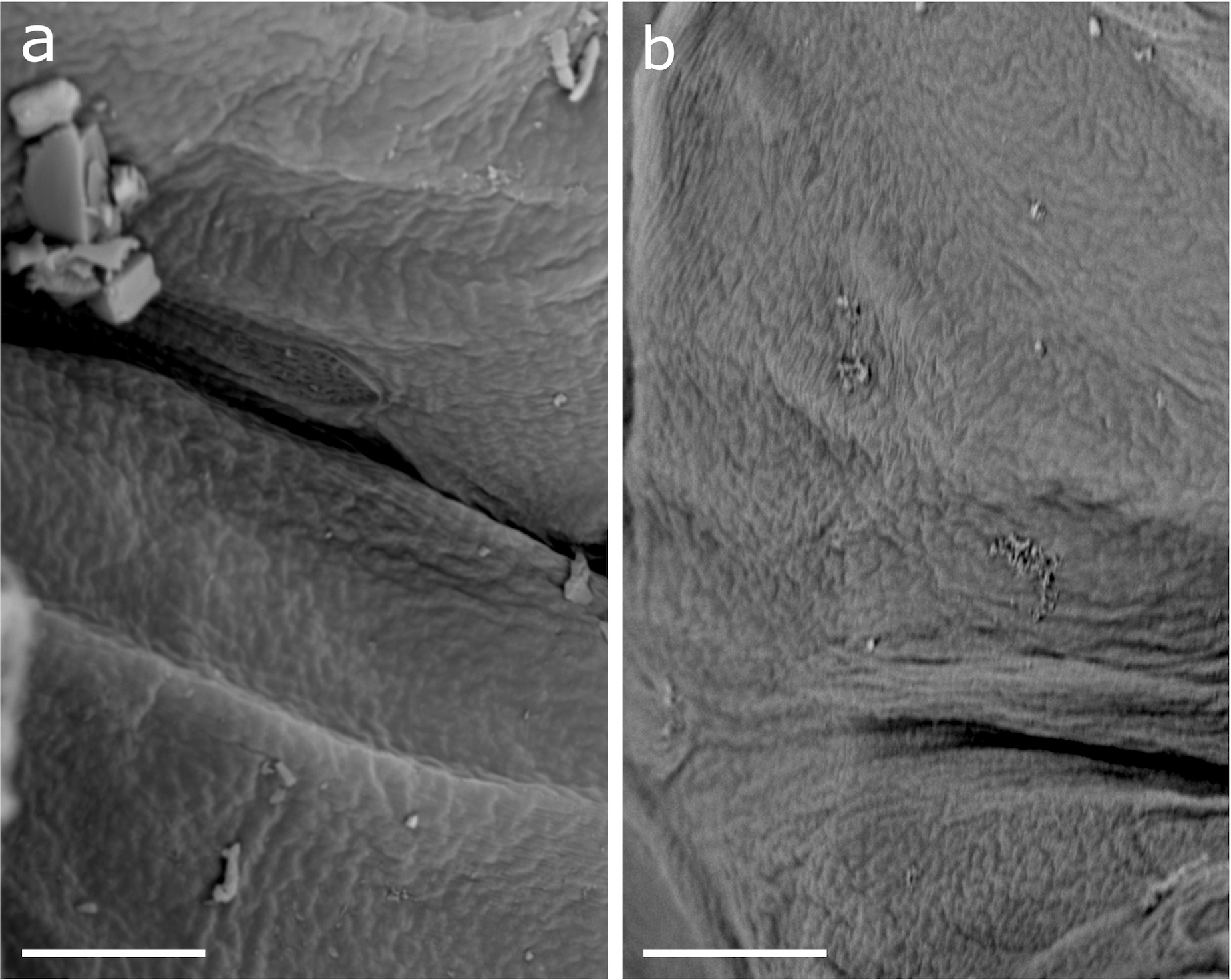
Starting with the Colombian animals, which look identical to the type material, we noticed a cuticular ornamentation visible under PCM as a slight rugosity and cuticular “dots”; these are also present in the type material (Figure 5). The “dots” are better visible dorsally but are also present ventrally. Under SEM (Colombian specimens; Figure 6) we observed a dorsal and ventral rugosity outlining tiny adjacent areas of thicker cuticle that clearly correspond to the “dots” observed under PCM in the same population. Equally clear is the similarity between the Colombian and the type material regarding the appearance of the “dots” under PCM. All this considered, we assume that Pam. centesimus sensu stricto also possesses the same detailed cuticle morphology observed under SEM in the Colombian specimens.

Macrobiotus ocotensis (PCM). (a) Pores around the mouth opening (Holotype, slide No. 5095 Pilato and Binda Collection); (b) Pores around the mouth opening (Colombian specimen, CBUMAG:TAR:02045-17); (c) Crenate lunules of fourth pair of legs (Paratype slide No. 5093 Pilato and Binda Collection); (d) Crenate lunules of fourth pair of legs in Colombian specimens (CBUMAG:TAR:02062-7). White circles highlight indicate pores around the mouth opening, the indented arrowheads indicate the slight indentation of lunules of the fourth pair of legs, and the asterisks indicate the granulation of the fourth pair of legs. Scale bars a, c–d: 10 µm, b: 5 µm.

Egg of Minibiotus continuus (type series, slide No. 5091) (PCM). (a–b) Details of the egg processes and hyaline membrane. The white indented arrowheads indicate the discontinuous hyaline membrane, and the black indented arrowhead indicates the continuous hyaline membrane. Scale bars a–b: 10 µm.
We found 27 eggs (see Table SII for morphometry) that were compared with eight eggs of the type material. Unfortunately, only five eggs of the Colombian material were suitable for measurements. In fact, the majority of the eggs from all reported locations were in a poor condition that did not allow the measurement of the diagnostic characters and prevented a proper morphometrical comparison with the type series. The measured eggs differ mainly in the egg dimension (bare diameter 82.5 – 94.8 µm in the Colombian eggs vs 61.5 – 79.3 µm in the examined eggs of the type series of Pam. centesimus), and shape and size of the reticular mesh of the processes (i.e. the labyrinthine layer of the process walls). In the type material eggs, the mesh is smaller and more often isodiametric rather than elongated (Figure 7b–c) while in the Colombian material it is noticeably bigger, and more often elongated (Figure 8c, e–h). Such difference is rather obvious and constant, and the moderate variability found in each of the two populations tended not to overlap.

Appearance of the dorso-lateral ornamented cuticle (PCM) of Paramacrobiotus centesimus, type material, and Paramacrobiotus aff. centesimus from Colombia. (a–b) Paramacrobiotus centesimus (Paratype, slide No. 4781 Pilato and Binda Collection); (c–d) Paramacrobiotus aff. centesimus. White circles highlight areas of the cuticle where “dots” are more evident, and the arrows indicate faintly visible “dots” observable in the profile of the cuticle. Scale bars a–d: 20 µm.

Paramacrobiotus aff. centesimus from Colombia (SEM). Wrinkled appearance of the dorso-lateral and ventral cuticle in (a) Ventral cuticle; (b) Dorso-lateral cuticle. Scale bars a–b: 5 µm.
Other possible, non-constant, differences between the eggs of the two populations regarded the process shape and, in particular, the process tips. These may be just an ordinary cone end, or more or less thickened, papillose, truncated, rounded, branched, and/or elongated (Figure 7 in the type material; Figure S2 in the Colombian). More commonly, the eggs of our material have cones ending in a long, tapering tip (Figure S2a, c, e), while eggs of the type material have cones ending in a thickened and papillose (jagged) tip usually short, undivided and partially truncated (Figure 7a–c, e, f, i). However, the variability range of each population, regarding process shapes and tips (greater in the Colombian material probably due to the larger sample size), partially overlap between the two populations.
We cannot prove at present whether the differences in the process reticulum and tips indicate the belonging to different species, or to a single one (with interpopulational variability). This, also considering the different sample sizes (too small, in particular, for the type material) and the difference in the egg diameter between the two populations, which add more variables and thus increase the difficulty in the interpretation of the morphological data.
Until specimens of Pam. centesimus from the locus typicus, and specimens of the Colombian samples, are studied using molecular techniques, this problem cannot be solved and prevents us, for caution, from attributing our material to Pam. centesimus s.s.
Amended description of Paramacrobiotus centesimus (Pilato, 2000) (Table III; Figures 5, 7, 8; Figure S4, S5; Table SIII)
Quantitative characters of Paramacrobiotus centesimus type eggs. Process base/height ratio is expressed as percentage; N: number of eggs/structures measured; range: refers to the smallest and largest structure between all eggs; SD: standard deviation.
Material examined: holotype (slide No. 4740), one paratype (slide No. 4781), eight eggs (slide Nos. 4781, 4783, 4784, 4786, 4787) from the locus typicus (Pilato and Binda Collection).
Animals
Colourless and lacking eyespots before mounting. Holotype habitus shown in Figure S4. Cuticle slightly rugous and “dotted” under PCM, both dorsally (Figure 5a–b) and (less visible) ventrally. It is assumed that the “dots” will correspond to tiny adjacent areas of thicker cuticle outlined by the rugosity if they were observed under SEM.
Ten peribuccal lamellae present; oral cavity armature (OCA; Figure 8b–d) with first band rather long, made of many disordered rows of small, rounded teeth; second band showing a single crown of big, elongated teeth, more or less rectangular; third band composed by three dorsal and three ventral ridges, but the medio-ventral ridge tends to be divided into two rounded teeth.
Bucco-pharyngeal apparatus (Figure 8a) as typical for the genus, with three rod-shaped macroplacoids in the pharynx with a sequence of 2<1<3, and no microplacoid (Paramacrobiotus areolatus group). The first macroplacoid with a slight central incision, the third macroplacoid with a preterminal constriction. Thin cuticular lining behind the third macroplacoid is often thick enough to be called vestigial microplacoid.
Claws of the hufelandi type (Figure S5), with accessory points and smooth lunules at the base (Figure S5a, c). All legs with granulation (Figure S5a–c). Cuticular bars present on legs I–III. Morphometric data are reported in Table SII for the holotype and the only paratype available.
Eggs
Eggs showing some degree of variability, laid free, the conical processes with areolae around the base. Processes vary in shape from short (Figure 7f) to relatively tall cones (Figure 7c, d, i), with a large degree of variability of the process tips: these may be just a simple cone ending (Figure 7a, c), or more or less elongated (Figure 7d), truncated (Figure 7e), rounded (Figure 7f), or bifurcated (Figure 7g–h); to varying degrees, many process tips also are papillose (Figure 7d–i). Process walls with internal cavities (the labyrinthine layer), as usual for the genus, giving under PCM the appearance of a reticulation, made of very small isodiametric (Figure 7a–b) or slightly elongated mesh (Figure 7c). Process bases with projections on the chorion also provided with the same process reticulation (Figure 7a), delimiting 7 – 11 apparently smooth areolae around each process base. Egg quantitative characters are given in Table III.
Paramacrobiotus aff. gerlachae (Pilato, Binda & Lisi, 2004)
Material Examined: seven animals and three eggs. The material analyzed was collected from Tropical Dry Forest, sample: TDF-9. Code of collection CBUMAG:TAR: 01699 – 01701 (Table II).
Type Locality of Pam. gerlachae: Bijoutier Island, Seychelles (Pilato et al. 2004a).
Geographic Distribution: Outside the type locality, Pam. gerlachae has been reported in São Tomé and Príncipe (Africa) by Fontoura et al. (2010) and in Costa Rica by Kaczmarek et al. (2015). Pam. aff. gerlachae is a potential new species currently known to be distributed in Colombia.
Taxonomic/morphological remarks: The observed individuals generally align with the characteristics of Pam. gerlachae as described by Pilato et al. (2004a). However, our material shows a higher degree of variability that does not always fit perfectly with the original description. These issues regard the buccal tube width (wider than in the type material) and egg morphology: our eggs do not present a “cap-like” structure (Michalczyk et al. 2006), the egg process shape varies from trunco-conical to nearly conical, and also some papillae are present on many process apices. Given the partial discrepancy in morphological characters between our specimens and the type series and considering the geographical distance between the type locality and our sampling site, we prefer to adopt a cautious approach and report the species as Pam. aff. gerlachae.
DISCUSSION AND CONCLUSIONS
A total of 26 species records were considered reliable for Colombia, including 10 species and one genus described from type material from this region, being the Magdalena Department, the most extensively studied department of the country in terms of tardigrade biodiversity (Daza et al. 2017, Lisi et al. 2014, 2017, 2019, 2020, 2022, Londoño et al. 2015, 2017, Stec et al. 2017, Venencia-Sayas et al. 2024). The present study has increased the species records to 29 and added data for the more understudied departments of Colombia (Atlántico and Bolívar) and, one of the most threatened ecosystems in the world, the Tropical Dry Forest.
The tardigrade diversity of Colombia is still far from being well known, with the majority of the country still unexplored; this also reflects on our results, by the fact that three of the taxa reported in the present work are new records for Colombia and the remaining four are potential new species: Cal. (Cal.) aff. gildae, Mac. aff. ragonesei, Pam. aff. centesimus, Pam. aff. gerlachae. This underscores the importance of biological collections and the need to intensify and diversify sampling efforts in other regions and ecosystems across Colombia. Moreover, Mac. ocotensis, and Min. continuus represent new records for South America, and the finding of a Calcarobiotus species represents the first reliable record for this genus in Colombia.
In the process of our study using type material for comparisons, we noted several taxonomic details that had not been included in some of the previously published original descriptions of the species we encountered in Colombia. We have therefore provided more modern PCM photographic documentation for Cal. (Cal.) gildae (holotype), Mac. ocotensis (holotype and Colombian specimens), Pam. centesimus (holotype, a paratype, and type series eggs), Min. continuus (the only egg belonging to the type series), offered the first SEM photograph of a Meb. coronatus egg found in Colombia, and report on the additional morphological characters of these taxa. In particular, we include amendments of the description of Pam. centesimus through our study of the type series. The species description is updated with the addition of new morphometric and morphological data for the animal and egg characters and their variability.
Acknowledgements
We thank Kevin Ramírez Roncallo, for his valuable assistance in identifying bryophytes and lichens. We are grateful to G. Pilato and M.G. Binda for having left to O. Lisi and D. Camarda the precious Pilato and Binda Tardigrade Collection for permanent availability and curation. Access to this Collection was essential for developing the present study. We also thank H. Meyer who generously donated (to the Pilato and Binda Collection) a slide with types of Mac. deceptor, which was useful for the present study, and to enrich said collection. We are also grateful to Edoardo Massa for providing photographs of the holotype of Cal. (Cal.) gildae from the Maucci Collection.
References
- ARÍAS ORTIZ A. 2010. Contexto de violencia y conflicto armado. In: Lópes Hernández C (Ed), Monografía Político Electoral, Departamento del Atlántico 1997-2007.
-
BINDA MG, PILATO E, MONCADA E & NAPOLITANO A. 2001. Some tardigrades from Central Africa with the description of two new species: Macrobiotus ragonosei and M. priviterae (Eutardigrada Macrobiotidae). Trop Zool 14: 233-242. https://doi.org/10.1080/03946975.2001.10531155.
» https://doi.org/10.1080/03946975.2001.10531155 - CAICEDO M, LONDOÑO R & QUIROGA S. 2014. Catálogo taxonómico de los ositos de agua (Tardigrada) de la cuenca baja de los ríos Manzanares y Gaira, Santa Marta, Colombia. Bol Cient Mus Hist Nat 18(1): 197-209.
-
CAMARDA D, MASSA E, GUIDETTI R & LISI O. 2024. A new, simplified, drying protocol to prepare tardigrades for scanning electron microscopy. Microsc Res Tech 87: 716-726. https://doi.org/10.1002/jemt.24460.
» https://doi.org/10.1002/jemt.24460 -
CASTILLO L. 2023. Élites agrarias y paramilitares en el Magdalena: El caso del sector cafetero. Análisis Político 36(107): 224-247. https://doi.org/10.15446/ANPOL.V36N107.112567.
» https://doi.org/10.15446/ANPOL.V36N107.112567 - DAZA A, LISI O & QUIROGA S. 2017. New records of tardigrades from Colombia with the description of Paramacrobiotus sagani sp. nov. and Doryphoribius rosanae sp. nov. Zootaxa 4362(1): 29-50.
- DE BARROS R. 1942. Tardígrados do estado de São Paulo, Brasil II. Género “Macrobiotus”. Bras Biol 2(4): 373-386.
-
DEGMA P & GUIDETTI R. 2007. Notes to the current checklist of Tardigrada. Zootaxa 53(1579): 41-53. https://doi.org/10.11646/zootaxa.1579.1.2.
» https://doi.org/10.11646/zootaxa.1579.1.2 -
DEGMA P & GUIDETTI R. 2025. Actual checklist of Tardigrada species, 44th, University of Modena and Reggio Emilia: Modena, Italy (accessed date on 12 June 2025). https://doi.org/10.25431/11380_1178608
» https://doi.org/10.25431/11380_1178608 -
FONTOURA P, PILATO G & LISI O. 2010. First record of Tardigrada from São Tomé (Gulf of Guinea, Western Equatorial Africa) and description of Pseudechiniscus santomensis sp. nov. (Heterotardigrada: Echiniscidae). Zootaxa 2564: 31-42. https://doi.org/10.5281/zenodo.197214.
» https://doi.org/10.5281/zenodo.197214 - GONZÁLEZ-MAYA JF, LONDOÑO-MURCIA MC & GUTIÉRREZ-ORTEGA JS. 2015. Prioritizing areas for conservation of ants (Hymenoptera: Formicidae) in the Sierra Nevada de Santa Marta, Colombia. Sociobiology 62(2): 200-210.
-
GUIDETTI R & BERTOLANI R. 2001. Phylogenetic relationships in the Macrobiotidae (Tardigrada: Eutardigrada: Parachela). Zool Anz 240(3-4): 371-376. https://doi.org/10.1078/0044-5231-00044.
» https://doi.org/10.1078/0044-5231-00044 - GUIDETTI R & BERTOLANI R. 2005. Tardigrade taxonomy: an updated check list of the taxa and a list of characters for their identification. Zootaxa 845: 1-46.
-
KACZMAREK Ł, CYTAN J, ZAWIERUCHA K, DIDUSZKO D & MICHALCZYK Ł. 2014a. Tardigrades from Peru (South America), with descriptions of three new species of Parachela. Zootaxa 3790(2): 357-379. https://doi.org/10.11646/zootaxa.3790.2.5.
» https://doi.org/10.11646/zootaxa.3790.2.5 -
KACZMAREK Ł & MICHALCZYK Ł. 2017. The Macrobiotus hufelandi group (Tardigrada) revisited. Zootaxa 4363(1): 101-123. https://doi.org/10.11646/zootaxa.4363.1.4.
» https://doi.org/10.11646/zootaxa.4363.1.4 -
KACZMAREK Ł, MICHALCZYK Ł & GUIDETTI R. 2006. Description of the new species Calcarobiotus (C) longinoi sp. nov. (Eutardigrada, Macrobiotidae) from Costa Rica with the diagnostic key to the genus Calcarobiotus Ital J Zool 73(3): 247-253. https://doi.org/10.1080/11250000600831642.
» https://doi.org/10.1080/11250000600831642 -
KACZMAREK Ł, MICHALCZYK Ł & MCINNES SJ. 2014b. Annotated zoogeography of non-marine Tardigrada. Part I: Central America. Zootaxa 3763(1): 1-62. https://doi.org/10.11646/zootaxa.3763.1.1.
» https://doi.org/10.11646/zootaxa.3763.1.1 -
KACZMAREK Ł, MICHALCZYK Ł & MCINNES SJ. 2015. Annotated zoogeography of non-marine Tardigrada. Part II: South America. Zootaxa 3923(1): 1-107. https://doi.org/10.11646/zootaxa.3923.1.1.
» https://doi.org/10.11646/zootaxa.3923.1.1 - LAMAS G, SALAZAR JA & CALLAGHAN CJ. 2004. Checklist of butterflies of the Sierra Nevada de Santa Marta, Colombia, 3rd ed., London: Taylor & Francis Group, p. 163-171.
-
LISI O, DAZA A, LONDOÑO R & QUIROGA S. 2017. Echiniscidae from the Sierra Nevada de Santa Marta, Colombia, new records and a new species of Bryodelphax Thulin, 1928 (Tardigrada). Zookeys 703: 1-14. https://doi.org/10.3897/zookeys.703.12537.
» https://doi.org/10.3897/zookeys.703.12537 -
LISI O, DAZA A, LONDONO R & QUIROGA S. 2022. New species and records of tardigrades from a biological repository collection from the Sierra Nevada de Santa Marta, Colombia. An Acad Bras Cienc 94: e20201522. https://doi.org/10.1590/0001-3765202220201522.
» https://doi.org/10.1590/0001-3765202220201522 -
LISI O, DAZA A, LONDOÑO R, QUIROGA S & PILATO G. 2019. Meplitumen aluna gen. nov., sp. nov. an interesting Eutardigrade (Hypsibiidae, Itaquasconinae) from the Sierra Nevada de Santa Marta, Colombia. ZooKeys 865: 1-20. https://doi.org/10.3897/zookeys.865.30705.
» https://doi.org/10.3897/zookeys.865.30705 - LISI O, LONDOÑO R & QUIROGA S. 2014. Tardigrada from a sub-Andean forest in the Sierra Nevada de Santa Marta (Colombia) with the description of Itaquascon pilatoi sp. nov. Zootaxa 3841(4): 551-562.
-
LISI O, LONDOÑO R & QUIROGA S. 2020. Description of a new genus and species (Eutardigrada: Richtersiidae) from Colombia, with comments on the family Richtersiidae. Zootaxa 4822(4): 531-550. https://doi.org/10.11646/zootaxa.4822.4.4.
» https://doi.org/10.11646/zootaxa.4822.4.4 - LONDOÑO R, DAZA A, CAICEDO M, QUIROGA S & KACZMAREK Ł. 2015. The genus Milnesium (Eutardigrada: Milnesiidae) in the Sierra Nevada de Santa Marta (Colombia), with the description of Milnesium kogui sp. nov. Zootaxa 3955(4): 561-568.
-
LONDOÑO R, DAZA A, LISI O & QUIROGA S. 2017. New species of waterbear Minibiotus pentannulatus (Tardigrada: Macrobiotidae) from Colombia. Rev Mex Biodivers 88(4): 807-814. https://doi.org/10.1016/j.rmb.2017.10.040.
» https://doi.org/10.1016/j.rmb.2017.10.040 -
MARLEY NJ, MCINNES SJ & SANDS CJ. 2011. Phylum Tardigrada: A re-evaluation of the Parachela. Zootaxa 64(2819): 51-64. https://doi.org/10.11646/zootaxa.2819.1.2.
» https://doi.org/10.11646/zootaxa.2819.1.2 - MAUCCI W & DURANTE PASA MV. 1980. Tardigradi muscoli delle isole Andamane. Boll Mus Civ Stor Nat Verona 7: 281-291.
-
MEISEL A & PEREZ G. 2006. Geografía física y poblamiento en la Costa Caribe colombiana. Editorial Banco de la República. Available at: https://d1b4gd4m8561gs.cloudfront.net/sites/default/files/publicaciones/archivos/DTSER-73.pdf
» https://d1b4gd4m8561gs.cloudfront.net/sites/default/files/publicaciones/archivos/DTSER-73.pdf - MEYER H, HINTON J, GLADNEY L & KLUMPP M. 2017. Water Bears from the Caribbean Island of Antigua, with the Description of a New Macrobiotus Species (Tardigrada: Eutardigrada: Macrobiotidae). Caribbean Naturalist 39: 1-13.
-
MICHALCZYK Ł & KACZMAREK Ł. 2013. The Tardigrada Register: A comprehensive online data repository for tardigrade taxonomy. J Limnol 72: 175-181. https://doi.org/10.4081/jlimnol.2013.s1.e22.
» https://doi.org/10.4081/jlimnol.2013.s1.e22 - MICHALCZYK Ł, KACZMAREK Ł & WĘGLARSKA B. 2006. Macrobiotus sklodowskae sp. nov. (Tardigrada: Eutardigrada: Macrobiotidae, richtersi group) from Cyprus. Zootaxa 1371: 45-56. Available at: www.mapress.com/zootaxa/.
-
PERRY E, MILLER WR & KACZMAREK Ł. 2019. Recommended abbreviations for the names of genera of the phylum Tardigrada. Zootaxa 4608(1). https://doi.org/10.11646/ZOOTAXA.4608.1.8
» https://doi.org/10.11646/ZOOTAXA.4608.1.8 - PILATO G. 1981. Analisi di nuovi caratteri nello studio degli Eutardigradi. Animalia 8: 51-57.
- PILATO G. 2000. Macrobiotus centesimus, new species of Eutardigrade from the South America. Boll Sedute Accad Gioenia Sci Nat 33(358): 97-101.
-
PILATO G. 2006. Remarks on the Macrobiotus polyopus group, with the description of two new species (Eutardigrada, Macrobiotidae). Zootaxa 47(1298): 37-47. https://doi.org/10.11646/zootaxa.1298.1.4.
» https://doi.org/10.11646/zootaxa.1298.1.4 - PILATO G & BINDA MG. 2010. Definition of families, subfamilies, genera and subgenera of the Eutardigrada, and keys to their identification. Zootaxa 2404: 1-54.
- PILATO G, BINDA MG & LISI O. 2004a. Notes on tardigrades of the Seychelles with the description of three new species. Ital J Zool 71: 171-178.
- PILATO G, BINDA MG, NAPOLITANO A & MONCADA E. 2000. The specific value of Macrobiotus coronatus De Barros 1942, and description of two new species of the harmsworthi group (Eutardigrada). Boll Sedute Accad Gioenia Sci Nat 33(358): 103-120.
-
PILATO G, BINDA MG, NAPOLITANO A & MONCADA E. 2004b. Remarks on some species of tardigrades from South America with the description of two new species. J Nat Hist 38: 1081-1086. https://doi.org/10.1080/0022293031000071541.
» https://doi.org/10.1080/0022293031000071541 -
PILATO G & LISI O. 2006. Notes on some tardigrades from southern Mexico with description of three new species. Zootaxa 1236: 53-68. https://doi.org/10.11646/zootaxa.1236.1.4.
» https://doi.org/10.11646/zootaxa.1236.1.4 - RAMAZZOTTI G & MAUCCI W. 1982. A history of tardigrade taxonomy. In: Proceedings of the third International Symposium on the Tardigrada (Ed), East Tennessee State University Press. 11-30 p.
- RANGEL JO, AGUIRRE N & AMAYA L. 2016. Endemism in the flora of the Sierra Nevada de Santa Marta, Colombia. Rev Biol Trop 64(2): 633-647.
-
ROMERO GQ ET AL. 2020. Extreme rainfall events alter the trophic structure in bromeliad tanks across the Neotropics. Nat Commun 11(1): 215. https://doi.org/10.1038/s41467-020-17036-4.
» https://doi.org/10.1038/s41467-020-17036-4 -
STEC D, ROSZKOWSKA M, KACZMAREK Ł & MICHALCZYK Ł. 2017. Paramacrobiotus lachowskae, a new species of Tardigrada from Colombia (Eutardigrada: Parachela: Macrobiotidae). NZ J Zool 45(1): 43-60. https://doi.org/10.1080/03014223.2017.1354896.
» https://doi.org/10.1080/03014223.2017.1354896 -
STEC D, VECCHI M, CALHIM S & MICHALCZYK Ł. 2021. New multilocus phylogeny reorganises the family Macrobiotidae (Eutardigrada) and unveils complex morphological evolution of the Macrobiotus hufelandi group. Mol Phylogenet Evol 160: 106987. https://doi.org/10.1016/j.ympev.2020.106987.
» https://doi.org/10.1016/j.ympev.2020.106987 - URIBE S & WOLFF M. 2013. Spiders from the highest point of the Sierra Nevada de Santa Marta, Colombia, with notes on distribution patterns. J Arachnol 41(3): 261-269.
- VÁSQUEZ VH & SERRANO MA. 2009. Las áreas naturales protegidas de Colombia. In: Conservación Internacional Colombia, Fundación Biocolombia, p. 1-696.
-
VENENCIA-SAYAS D, LONDOÑO R, DAZA A, PERTUZ L, MARÍN-MUÑOZ G, LONDOÑO-MESA MH, LISI O, CAMARDA D & QUIROGA S. 2024. Tardigrades (Tardigrada) of Colombia: Historical Overview, Distribution, New Records, and an Updated Taxonomic Checklist. Divers 16(13): 1-18. https://doi.org/10.3390/d16010013.
» https://doi.org/10.3390/d16010013 -
VILORIA DE LA HOZ J. 1998. La economía del carbón en el Caribe colombiano. Documentos de Trabajo Sobre Economía Regional y Urbana, 4. Available at: https://babel.banrepcultural.org/digital/collection/p17054coll18/id/113/
» https://babel.banrepcultural.org/digital/collection/p17054coll18/id/113/