 Population dynamics of Brachidontes darwinianus (Mytilidae) occurring in sympatry with the invasive Mytilopsis leucophaeata (Dreissenidae) in a coastal lagoon (Rio de Janeiro, Brazil)
Abstract
The native bivalve <italic>Brachidontes darwinianus</italic> occurs in sympatry with the invasive bivalve <italic>Mytilopsis leucophaeata</italic> in Rodrigo de Freitas Lagoon, an urban coastal lagoon located in the city of Rio de Janeiro, Brazil. Both species are found in hard substrates and form clusters around the lagoon. This study aimed to evaluate the population aspects, such as growth and mortality rates, of the native bivalve <italic>B. darwinianus</italic> and compare with data available for <italic>M. leucophaeata</italic> for this lagoon. Population data were analyzed and compared between bivalve species over two years: 2016-2017 and 2017-2018. In both years, the growth rate of <italic>B. darwinianus</italic> remained similar (K = 0.5), while the mortality rate showed a slight increase in the second year (Z2016-2017 = 2.25; Z2017-2018 = 2.9). The densities of <italic>M. leucophaeata</italic> were significantly higher than those of <italic>B. darwinianus</italic> regardless of the year analyzed. However, an increasing trend in the densities of the native bivalve was observed in the second year, suggesting a coexistence of native and invasive bivalves in the lagoon. Therefore, more studies are needed to understand the ecological interactions between these species, given that the invasive bivalve is established and can induce changes in the benthic community of this environment.
Key words
Bivalvia; dark false mussel; Rodrigo de Freitas Lagoon; scorched mussel
INTRODUCTION
Bivalves of the genus Brachidontes are usually small, with an average length of 2 cm, found in the intertidal zone of rocky shores and mangroves around the world (Tanaka & Magalhães 1999, Introíni et al. 2004). Brachidontes darwinianus (d’Orbigny, 1842) is an abundant native bivalve of South America that occurs in estuaries from southeastern Brazil to northern Patagonia in Argentina, and features individuals of up to 4 cm that can tolerate low salinities (Avelar & Narchi 1983, Rios 1995, Introíni et al. 2004, Tanaka 2005). In the Rodrigo de Freitas Lagoon (Rio de Janeiro, Brazil), this species occupies hard substrates and occurs in sympatry with the invasive dreissenid Mytilopsis leucophaeata (Conrad, 1831), in which spatial and temporal oscillations in bivalve’s populations suggested some antagonistic relationship between the native and invasive species (e.g., competition) (Rodrigues et al. 2021).
The estuarine bivalve M. leucophaeata, popularly known as dark false mussel, is native to the Gulf of Mexico and the southeast of the U.S.A., but it has been introduced to several localities in Europe, Asia, Caribbean, South America and northeast of the U.S.A. (Kennedy 2011, Brzana et al. 2017, Fernandes et al. 2021, Rodrigues et al. 2022). In Brazil, this species has been recorded in three coastal lagoons in the state of Rio de Janeiro: Rodrigo de Freitas, Marapendi and Maricá (Rizzo et al. 2014, Fernandes et al. 2020, Rocha et al. 2023). Mytilopsis leucophaeata is found in estuaries with oligohaline or mesohaline waters, tolerating a salinity range from 0.1 to 21 and this species usually presents low densities in its native range (Verween et al. 2010, Kennedy 2011, Fernandes et al. 2018, Rodrigues et al. 2022). However, large clusters of individuals are formed in non-native areas (e.g., Kennedy 2011, Fernandes et al. 2020), promoting the filtration of a huge volume of water and representing a new food resource for higher trophic levels (Milke & Kennedy 2001, Rajagopal et al. 2005, Neves et al. 2020). Therefore, the large clusters of M. leucophaeata can promote changes in habitat physical structure and quality by shifting nutrient balance, plankton community and water transparency (Neves et al. 2020, Rodrigues et al. 2023a), which may affect the fitness of native species in introduced systems.
The occurrence in sympatry of B. darwinianus and M. leucophaeata in mixed bivalve clusters at the Rodrigo de Freitas Lagoon has suggested a competition for space and/or resources (Rodrigues et al. 2021). However, results from an experimental study using seston from Rodrigo de Freitas Lagoon did not suggest food competition between these species (Rodrigues et al. 2023b), and there is still no evidence of which ecological interactions occur between these two species. The population dynamics of M. leucophaeata was evaluated in Rodrigo de Freitas Lagoon by Maia-Neto et al. (2020), while population aspects (e.g., growth rate, length) of B. darwinianus were only studied at estuaries in São Paulo state (Southeast Brazil) (R.C. Nalesso, unpublished data, Tanaka & Magalhães 1999), but not in sympatry with invasive dreissenids. In the Capibaribe estuary (Pernambuco state, Brazil), the invasive Mytilopsis cf. sallei has displaced the population of the native mytilid Mytella strigata (Hanley, 1843), which has economic importance in the region (Freitas-Galeão & Souza 2015, Fernandes et al. 2018). Mytilopsis sallei (Récluz, 1849) was considered more resistant to organic pollution than Brachidontes exustus (Linnaeus, 1758) in Chetumal Bay (Mexico) (Llanes-Baeza & González 2002), and possibly take advantage in an impacted environment. A recent experimental study demonstrated that M. leucophaeata can benefit of certain levels of suspended particulate matter in scenarios of hypereutrophic conditions at coastal lagoons, but particulate matter concentrations equal or higher than 226 mg/L limited its ability to clear and ingest suspended organic particles (Rodrigues et al. 2023a).
Bioinvasion of aquatic environments has been recurrent in the last decades, causing impacts on native species and invaded ecosystems (e.g., Cai et al. 2014, Neves et al. 2020). Data regarding the dynamics of native populations that occurs in sympatry with invasive species is essential to understand local effects of the invasion process over the native fauna; therefore, population aspects of the native B. darwinianus were compared with available data on population dynamics of the invasive M. leucophaeata simultaneously obtained in the Rodrigo de Freitas Lagoon. Considering that population dynamics of the native species can be affected by the invasive counterparts, this study aims to assess the population aspects (e.g., growth, recruitment and mortality rates) of the native B. darwinianus that occur in sympatry with the invasive M. leucophaeata in clusters at Rodrigo de Freitas Lagoon (Rio de Janeiro, Brazil).
MATERIALS AND METHODS
Study area
Rodrigo de Freitas Lagoon (22°57’02” - 22°58’09”S, 43°11’09” - 43°13’03”W) is a brackish system with salinity ranging from 6 to 25 (mesohaline) located in an urban area of the municipality of Rio de Janeiro, southeast Brazil, being recognized as one of the main tourist attractions of the city (Enrich-Prast 2012, Soares et al. 2012, Neves et al. 2020). However, there is a low renewal of its waters, as well as a constant inflow of organic matter into the Rodrigo de Freitas Lagoon, resulting in a eutrophic system whose fish massive die-offs events have constantly been observed in this lagoon (Soares et al. 2012).
This coastal aquatic system has an area of 2.2 km², approximately 6,200,000 m³ in volume and an average depth of 2.8 m (Soares et al. 2012). The connection of this coastal lagoon with Atlantic Ocean, as well as the input of freshwater from rivers, is controlled by a system of channels and floodgates. The high degree of silting of these channels leads to a low renewal of its waters, promoting the accumulation of organic matter on the benthic compartment and suspended particles in the water column (Soares et al. 2012, Rioáguas 2013).
The environmental conditions in Rodrigo de Freitas Lagoon present low annual variation in water temperature (26.98 ± 3.02 °C) and dissolved oxygen (7.6 ± 4.78 mg/L) (Neves & Santos 2022). In addition, after the introduction of dark false mussel in 2014 (Rizzo et al. 2014), historical values of some water quality variables shifted such as the water transparency that reached 89.31 ± 37.05 cm, and mean values of chlorophyll a and phytoplankton abundance reached, respectively, 13.65 ± 18.52 µg/L and 4.02 x 10⁵ ± 5.77 x 10⁵ cells/mL (Neves et al. 2020).
Sampling and laboratory procedures
Individuals of B. darwinianus were monthly collected between March 2016 and March 2018 (n = 24 sampling events) associated with clusters of the invasive bivalve M. leucophaeata at four stations (P1, P2, P3 and P4) around the perimeter of Rodrigo de Freitas Lagoon (see more details in Maia-Neto et al. 2020, Rodrigues et al. 2021). The selected sampling stations presented similar characteristics (i.e., artificial hard substrate), but were located at strategic sites considering the three distinct areas set by the municipal regulation regarding water circulation and environmental conditions in the lagoon (Leis Municipais 2000). In addition, field sampling of a previous study conducted with the invasive bivalve was carried out in the same stations (Maia-Neto et al. 2020), using the same clusters, thus making possible data comparisons. The first sampling year consisted of the period between March 2016 and March 2017, while the second year was the period between April 2017 and March 2018. At each sampling station (n = 4), triplicates of clusters containing both species of bivalves were collected at the hard substrate using a spatula in an area of 0.04 m2. A multiparameter probe (YSI 6-6920-V2-4) was used to measure five physicochemical variables in the water column (temperature, salinity, pH, chlorophyll a, and dissolved oxygen) at each of the sampling stations by month. Monthly rainfall data were obtained from the Jardim Botânico rainfall station (22°58’22.008”S; 43° 13’26.004”W), located less than 1 km away from the lagoon, between the years of 2016 and 2018. Meteorological data is available online at http://alertario.rio.rj.gov.br/.
In the laboratory, samples were sorted, and the specimens were fixed in 70% ethanol. The length of B. darwinianus specimens were measured using a digital caliper with 0.01 mm precision, and measurements were grouped into 1 mm size classes. After obtaining all the individual’s information, voucher specimens of B. darwinianus were deposited in the malacological collection of the Museu Nacional of the Universidade Federal do Rio de Janeiro (MNRJ) and of the Universidade do Estado do Rio de Janeiro (UERJ).
Genetic identification
In order to confirm the taxonomic identification of native bivalve, two specimens from station P4 had the DNA sequenced, targeting the COI gene (cytochrome c oxidase subunit I). Mantle tissue was used for DNA extraction through a Macherey-Nagel NucleoSpin Tissue kit, and DNA amplification followed procedures described by Fernandes et al. (2021), using primers HCO2198/LCO1490 (Folmer et al. 1994). DNA purification and sequencing was conducted at Macrogen Inc. (Korea), with sequences aligned by the algorithm MUSCLE in the software MEGA 7. The two sequences (GenBank codes PP579996 and PP579997) were identical and had 660 bp. A BLAST search resulted in 100% similarity with GenBank sequences of individuals taxonomically identified as B. darwinianus in Brazilian coast: KT318196 from Paraty (Rio de Janeiro state), KT318214 from Niterói (Rio de Janeiro state) and KT318215 from Praia do Cassino (Rio Grande do Sul state) (Trovant et al. 2016) and MW548966 from Arraial do Cabo (Rio de Janeiro state) (Quintanilha et al. 2022).
Data analysis
A two-way analysis of variance (ANOVA) was performed to assess the effect of sampling year (i.e., 1st and 2nd) and station (i.e., P1, P2, P3 and P4) on density (log10 x + 1 transformed data) of B. darwinianus (dependent variable), and Tukey test was applied a posteriori.
The population parameters were obtained from the subroutine ELEFAN I (“Electronic Length Frequency Analysis”) using FiSAT II 1.2.2 software (“FAO-ICLARM Fish Stock Assessment Tools”) (Gayanilo et al. 2005). To perform the growth analyses, length-frequency data were used for the growth function of von Bertalanffy (VBGF) for seasonality (Gayanilo et al. 2005), described by the equation:
Where Lt is length (mm) at time t, L∞ is the theorical maximum length, K is the curvature parameter, t0 is the theoretical age at zero length, C is the intensity of seasonal growth oscillations, and WP is the period of growth reduction.
The growth performance index (ϕ’) was calculated through the equation:
Mortality (Z) was calculated by the negative exponential model using the length-converted catch curve method by the FiSAT II 1.2.2 software (Gayanilo et al. 2005).
Life span (Tmax) was based on the maximum length (L) obtained per year using the inverse von Bertalanffy growth equation (King 2007):
For recruitment data, only individuals smaller than 5 mm were considered recruits (Tanaka & Magalhães 2002).
Available data of the population dynamics of M. leucophaeata in Rodrigo de Freitas Lagoon was compiled from Maia-Neto et al. (2020) for comparisons with data obtained in the present study for B. darwinianus. The study conducted with the invasive species was performed in collaboration and simultaneously with the present study, in which specimens of the native species were removed from the same clusters; thus, bivalves were sampled at the same sampling stations and during the same period of time. Wilcoxon pairs test was performed with density data of B. darwinianus and M. leucophaeata to verify differences between bivalve densities in the first and second years of sampling. All the statistical analyses were performed using the PAST 4.03 and graphs were made in GraphPad Prism 8.0.2.
RESULTS
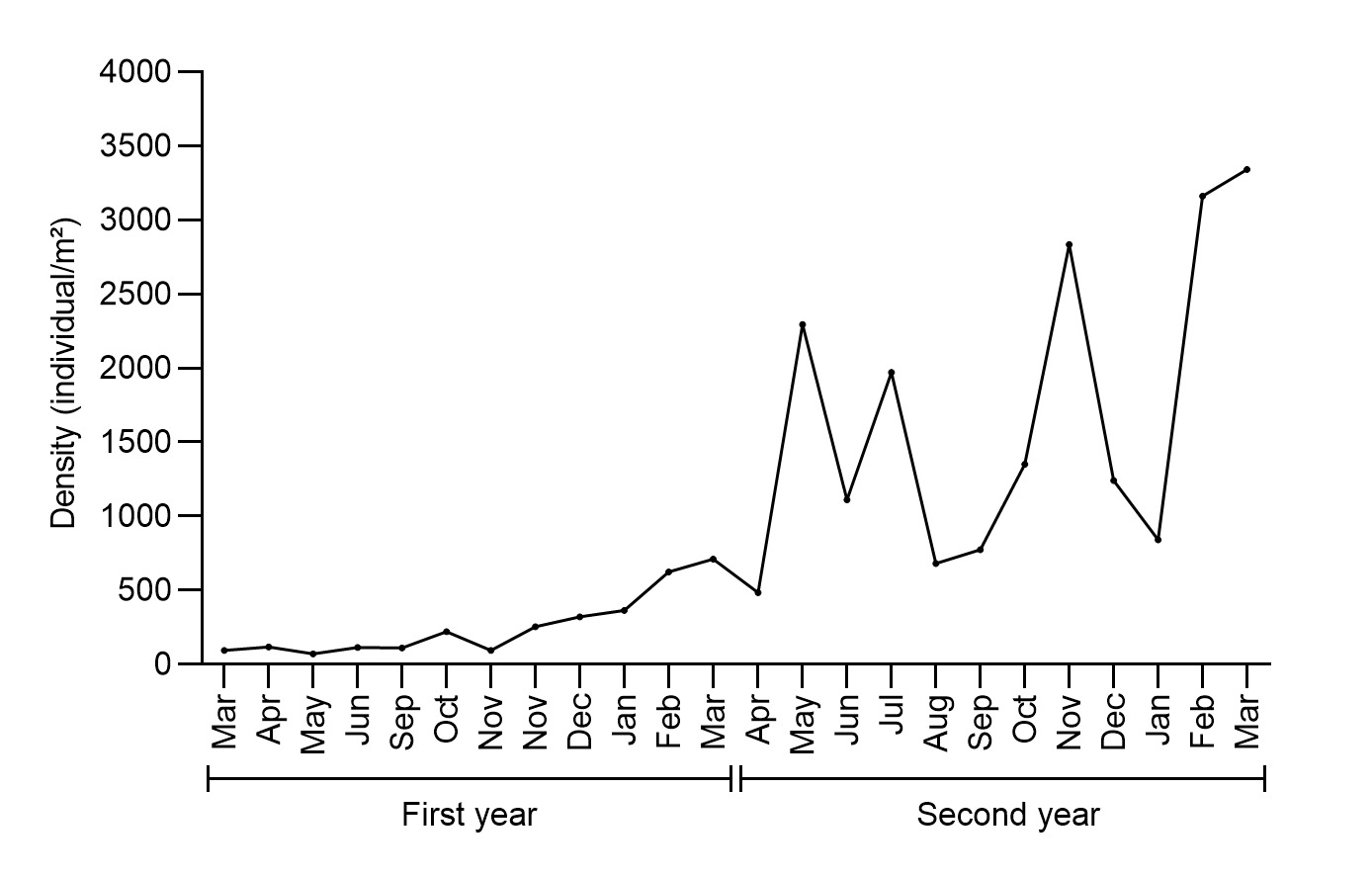
The population of the native bivalve B. darwinianus presented a general tendency of increase during the studied period, despite some fluctuations over the months (Figure 1). Significant differences in B. darwinianus densities were found among the sampling years (two-way ANOVA; F = 37.56; p < 0.001), between sampling stations (two-way ANOVA; F = 14.39; p < 0.001), and in the interaction years*sampling stations (two-way ANOVA; F = 9.57; p < 0.001). The mean density of B. darwinianus was significantly higher in the second year (1,675 ± 1,014 individual/m²) compared to the first year of sampling (258 ± 214 individuals/m²). The sampling station that showed the highest mean density of B. darwinianus throughout the study was P2, while the lowest density was found at P1 (Figure 2). Likewise, significant differences were found in the densities of B. darwinianus between the sampling stations and interaction (year*sampling stations), in which the Tukey test results are demonstrated in Table I.
Significant results (p-value < 0.05) for the a posteriori Tukey test for density of Brachidontes darwinianus between years, sampling stations and in the interaction (years*sampling stations). The highest density values observed are expressed in bold.

Density (individual/m²) of Brachidontes darwinianus in the Rodrigo de Freitas Lagoon during two years of study: first (March 2016 - March 2017) and second years (April 2017 - March 2018).
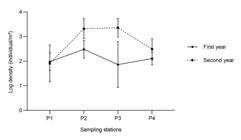
Density (log10 (x+1) - individual/m²) of Brachidontes darwinianus in the Rodrigo de Freitas Lagoon during first (March 2016 - March 2017) and second years (April 2017 - March 2018) by sampling stations.
Considering the invasive species, significant differences were observed between the densities of B. darwinianus and M. leucophaeata in the first (Wilcoxon pair test; p < 0.001) and second sampling years (Wilcoxon pair test; p < 0.001), with the densities of the invasive species being higher than the native one in both years (Figure 3).

Density (log10 (x+1) - individual/m²) of Brachidontes darwinianus (B) (present study) and Mytilopsis leucophaeata (M) (data compiled from Maia-Neto et al. 2020) in the Rodrigo de Freitas Lagoon during two years of study: first (March 2016 - March 2017) and second years (April 2017 - March 2018).
The minimum, mean and maximum values of the environmental variables found at the sampling stations throughout the study are shown in Table II.
Minimum, mean ± SD and maximum values of the environmental variables by sampling stations throughout the study.
Based on shell-size of bivalves, the largest individual with 41.4 mm in length was found in the second year of study, while in the first year the largest individual was 39.1 mm. Regarding the smallest lengths, the first and second years had individuals measuring 1.47 mm and 1.32 mm, respectively. The average length (± SD) in the first year was 12.98 (± 8.63) mm and 17.14 (± 6.74) mm in the second year. In the first year, the most predominant size class was 3 mm, while in the second year it was 19 mm. In general, a greater variety in the length of B. darwinianus individuals was observed throughout the second year (Figure 4). The population parameters L∞, WP, Z and Tmax presented the highest values in the second year when compared to the first year (Table III).
Population parameters of Brachidontes darwinianus and Mytilopsis leucophaeata that occur in sympatry within bivalve clusters in Rodrigo de Freitas Lagoon, and other mytilids species (Lmax = length maximum in mm; L∞ = asymptotic length; K = growth constant; C = seasonal oscillation; WP = point where the growth is minimum; Rn = goodness-of-fit index; Z = mortality; ϕ’ = growth performance index; and Tmax = life span).

Seasonal growth of the native bivalve Brachidontes darwinianus in the Rodrigo de Freitas Lagoon during (a) first year (March 2016 - March 2017) and (b) second year (April 2017 - March 2018) with von Bertalanffy growth curve.
Recruitment of B. darwinianus in the Rodrigo de Freitas Lagoon showed the lowest densities in the middle of the first year and at the end of the second year, although there was considerable fluctuation throughout the study (Figure 5). The period with the highest density of recruits was between the months of December of the first year and August of the second year.

Density of recruits of Brachidontes darwinianus (< 5 mm) in the Rodrigo de Freitas Lagoon during the first (March 2016 - March 2017) and second years (April 2017 - March 2018).
DISCUSSION
The maintenance of populations of the native bivalve B. darwinianus during the two years of sampling shows that this species coexisted with the invasive bivalve M. leucophaeata in Rodrigo de Freitas Lagoon, although with significant lower densities. Interactions between native bivalves and introduced dreissenids have been reported in several places with different outputs. Population densities of invasive bivalves are generally higher than their native counterparts (Cai et al. 2014, Morton & Leung 2015, Astudillo et al. 2017). Mytilopsis species are known to reach high densities in non-native areas and to displace native bivalve populations (e.g., Kennedy 2011, Freitas-Galeão & Souza 2015). In Rodrigo de Freitas Lagoon, the densities of M. leucophaeata were always higher than those observed for B darwinianus, regardless of the month analyzed. However, B. darwinianus showed a general tendency to an increase in population numbers over the second year, suggesting that the native species can coexist with the dark false mussel. Although, estimated mortality was also higher in the second year of the study. According to Rodrigues et al. (2021), in a time span correspondent to our first year, B. darwinianus occurred only in the cores of the bivalve’s clusters. In the second year, the native and invasive species were found mixed in the clusters, especially at the sampling stations P2 and P3. Water circulation where P2 and P3 are located is mostly influenced by riverine and pluvial water inputs, while at P4 and close to P1 water conditions are mostly influenced by exchange between the Atlantic Ocean and the lagoon (Neves & Santos 2022).
Modifications in the distribution of B. darwinianus within bivalve’s clusters may indicate a shift in the behavior of native species in relation to the dominant presence of the invasive M. leucophaeata. In addition, some environmental changes in the lagoon may have favored B. darwinianus and controlled the vigorous growth of M. leucophaeata, considering that Maia-Neto et al. (2020) observed a decline of the invasive population in 2017-2018 (second year). The density of M. leucophaeata in Rodrigo de Freitas Lagoon was significantly and positively related to salinity among other environmental variables (e.g., temperature, pH, chlorophyll a, and dissolved oxygen) (Maia-Neto et al. 2020). Areas in the lagoon with lower salinity may affect the invasive population which could indirectly affect the population of B. darwinianus. In agreement with this point, in the present study, the sampling station (P1) most influenced by seawater intrusion from the Atlantic Ocean showed the lowest density of the native bivalve. Despite B. darwinianus is usually found in estuarine environments (R.C. Nalesso, unpublished data, Tanaka 2005), entrance of seawater with higher salinity seems to benefit the invasive species thus negatively affecting the native one; although the salinity values remained very similar among sampling stations throughout this study. During the years of 2017-2018, significant environmental changes were noticed in the Rodrigo de Freitas Lagoon associated with an increase in lagoon water level, a peak in chlorophyll a and phytoplankton, and a decline in water transparency (Neves et al. 2020). Further studies are needed for a better compression of the influence of environmental variables on the spatial and temporal distribution of these native and invasive populations, as well as environmental effects on species ecological relationship.
According to Llanes-Baeza & González (2002), B. exustus is considered a sensitive species to organic matter input presenting low abundance in areas impacted by organic pollution. The Rodrigo de Freitas Lagoon is continuously submitted to input of sewage-derived nutrients from urban neighborhoods and pluvial waters (i.e., predominantly terrestrial sources), in addition to the high occurrences and densities of enteric bacteria (total coliform and Escherichia coli) in the lagoon water which reinforce the occurrence of illegal inputs of domestic sewage (Neves et al. 2020, Neves & Santos 2022). In the present study, the sampling station (P2) with the highest density of B. darwinianus was located next to a discharge point of pluvial waters that lead to the input of terrestrial organic matter sources and illegal entrance of domestic sewage, especially during heavy rainfalls (Neves & Santos 2022), suggesting that B. darwinianus is more resistant to organic pollution than its congeneric species. Similarly, the invasive species M. leucophaeata tolerates high concentrations of suspended particulate matter, including in scenarios of hypereutrophic conditions (Rodrigues et al. 2023a). Therefore, the trophic conditions of this coastal lagoon do not seem to limit the populations of native and invasive bivalves.
The maximum individual length found for B. darwinianus in the Rodrigo de Freitas Lagoon (41.4 mm) is higher than that reported from other localities in southeastern Brazil (R.C. Nalesso, unpublished data, Tanaka & Magalhães 1999). Nalesso R.C. (unpublished data) performed growth experiments with this species in Verde and Escuro river estuaries at São Paulo state (southeast Brazil) and observed individuals up to 33 mm, while Tanaka & Magalhães (1999) observed individuals with maximum length of 36 mm through morphometric studies in rocky shores of São Paulo state. Rodrigo de Freitas Lagoon is a small shallow coastal lagoon with water entrance artificially controlled by three floodgates presenting more stability and less hydrodynamics than estuaries or rocky shores, which may favor individual’s growth to larger sizes. Compared to other Brachidontes species, the maximum length obtained during this study was still considered one of the largest. The invasive Brachidontes pharaonis (Fischer, 1870) in the Mediterranean Sea reached up to 40 mm in length (Terranova et al. 2006, Sará et al. 2008, El-Sayed et al. 2016). Other species of Brachidontes in their native range do not reach the size observed in Rodrigo de Freitas Lagoon. In Villa Gesell, Argentina, individuals of up to 26.3 mm of Brachidontes rodriguezii (d’Orbigny, 1842) were used in experiments on reproduction and aerial exposure (Torroglosa & Giménez 2016, Torroglosa & Giménez 2019). Therefore, despite the cooccurrence within an invasive species, conditions provided in bivalve’s clusters (e.g., food availability, protection from predators) seem to be enough to the growth of B. darwinianus individuals in Rodrigo de Freitas Lagoon, making possible these individuals to reach larger sizes.
Studies on the population dynamics of Brachidontes species are scarce, although the populations aspects of other mytilids of interest such as Limnoperna fortunei (Dunker, 1857) and Perna perna (Linnaeus, 1758) are better known (e.g., Hicks et al. 2001, Henriques & Casarini 2009, Belz et al. 2010, Bonel & Lorda 2015). Population aspects for the invasive bivalve M. leucophaeata from Rodrigo de Freitas Lagoon, as also other mytilids are presented in Table III. The growth rate (K) of B. darwinianus was similar in the both studied years (2016-2017 and 2017-2018 = 0.5), while the growth rates of M. leucophaeata from the bivalve cluster analyzed in the same stations were lower in 2016-2017 (K = 0.4) and higher in 2017-2018 (K = 0.8) (Maia-Neto et al. 2020). These results indicate that the invasive bivalve M. leucophaeata has a higher growth rate than the native bivalve B. darwinianus in the same environmental conditions. Thus, M. leucophaeata can overgrowth B. darwinianus in the Rodrigo de Freitas Lagoon, promptly colonizing empty spaces. Moreover, invasive populations of Mytilopsis exhibit remarkable plasticity for habitat colonization being more frequently found on artificial substrata (Rodrigues et al. 2022), thus invaded systems with highly modified habitats such as the urban Rodrigo de Freitas Lagoon seem to be more vulnerable to the spread of dark false mussels. Another well-known invasive species is L. fortunei, which also showed higher growth rates than B. darwinianus, although this species presented low growth rates in some populations (Maroñas et al. 2003).
The mortality rate (Z) of B. darwinianus was low during the two years when compared to M. leucophaeata, suggesting that native population remained constant through studied years with lower growth rate, but also with lower mortality than the invasive species. In the second year (2017-2018), M. leucophaeata presented high estimated mortality (~2.17 times) when compared to the first year (2016-2017) as pointed by Maia-Neto et al. (2020). In contrast, B. darwinianus showed just a slight increase in estimated mortality in 2017-2018 (~1.29 times). These observations suggest that an external factor that occurred in 2017-2018 (e.g., increase in water transparency) may have affected both populations of bivalve, but with more impact on the population of M. leucophaeata.
The recruitment period of B. darwinianus showed fluctuations over the two years, being more accentuated in the second year (Figure 5). The preferred season for recruitment was summer in the first year and fall in the second year, however a considerable density of recruits was observed in winter during the second year. An environmental and hydrological stable environment as Rodrigo de Freitas Lagoon can favor this type of strategy, as there are few apparent limitations. No recruitment data is available for M. leucophaeata at Rodrigo de Freitas Lagoon. The rapid growth, high mortality rates and a short life cycle are typical characteristics of invasive species that usually quickly dominates invaded systems (Van der Gaag et al. 2018, Darrigran et al. 2020, Arterburn & McMahon 2022, Boltovskoy et al. 2022). Thus, in a scenario that an environmental change affect both species negatively, M. leucophaeata have a better chance for a fast recovery.
After an invasive species is established in the new environment is really difficult to be removed (Sousa et al. 2014). However, mitigation measurements can be taken to avoid the growth and spread of invasive species. Rodrigo de Freitas Lagoon is an artificially controlled system that are constantly manipulated, which has undergone several changes over the years (e.g., salinity changes). Thus, based on population dynamics and environmental preferences of studied species, the conditions of Rodrigo de Freitas Lagoon seem to favor the predominance of the invasive species over the native one. However, further studies on the interactions between these two species are also needed to establish such measurements, since decisions taken without knowledge about the native community can be harmful to the ecosystem. Field and laboratory studies are recommended for both species, especially using niche models, evaluation of settlement, feeding rates, and tolerance limits for environmental variables.
Acknowledgements
We are grateful to Dr. Vinícius Neres de Lima (UERJ) and Dr. Tatiana Medeiros Barbosa Cabrini (UNIRIO) for their contributions to the previous version of this manuscript, and to Dr. Maurício Romulo Fernandes (UNIRIO) for his help with the genetic identification of B. darwinianus. The authors acknowledge the Coordenação de Aperfeiçoamento de Pessoal de Nível Superior (CAPES) for the scholarship to Antonio J. S. Rodrigues - Finance Code 001. This study was financially supported by Fundação Carlos Chagas Filho de Amparo à Pesquisa do Estado do Rio de Janeiro (FAPERJ) through the Program for Emerging Research Groups in the State of Rio de Janeiro - 2019 (E-26/211.127/2019250845). Research Grants were also attributed by FAPERJ to Raquel A. F. Neves (E-26/201.283/2021; E-26/210.024/2024) and Igor C. Miyahira (E-26/201.347/2021), and by Conselho Nacional de Desenvolvimento Científico e Tecnológico (CNPq) through Research Grant attributed to Raquel A. F. Neves (PQ2; 306212/2022-6).
References
- AGUIRRE ML, PEREZ SI & SIRCH YN. 2006. Morphological variability of Brachidontes swainson (Bivalvia, Mytilidae) in the marine Quaternary of Argentina (SW Atlantic). Palaeogeogr Palaeoclimatol Palaeoecol 239: 100-125.
- ARTERBURN HM & MCMAHON RF. 2022. Population and reproductive dynamics of zebra mussels (Dreissena polymorpha) in warm, low-latitude North American waters. Biol Bull 242: 207-221.
- ASTUDILLO JC, BONEBRAKE TC & LEUNG KMY. 2017. The recently introduced bivalve Xenostrobus securis has higher thermal and salinity tolerance than the native Brachidontes variabilis and established Mytilopsis sallei Mar Pollut Bull 118: 229-236.
- AVELAR WEP & NARCHI W. 1983. Anatomia funcional de Brachidontes darwinianus darwinianus (Orbigny, 1846) (Mollusca: Bivalvia). Pap Avulsos Zool 35: 331-359.
- AVELAR WEP & NARCHI W. 1984. Functional anatomy of Brachidontes solisianus (Orbigny, 1846) (Bivalvia: Mytilidae). Bolm Zool 8: 215-237.
- BARBOSA NPU, SILVA FA, OLIVEIRA MD, SANTOS-NETO MA, CARVALHO MD & CARDOSO AV. 2016. Limnoperna fortunei (Dunker, 1857) (Mollusca, Bivalvia, Mytilidae): first record in the São Francisco River basin, Brazil. Check List 12: 1846.
- BELZ CE, DARRIGRAN G, BONEL N & MÄDER-NETTO OS. 2010. Density, recruitment, and shell growth of Limnoperna fortunei (Mytilidae), an invasive mussel in tropical South America. J Freshwater Ecol 25: 227-233.
- BOLTOVSKOY D & CATALDO DH. 1999. Population dynamics of Limnoperna fortunei, an invasive fouling mollusc, in the lower Parana river (Argentina). Biofouling: J Bioadhesion and Biofilm Res 14: 255-263.
- BOLTOVSKOY D, PAOLUCCI E, MACISAAC HJ, ZHAN A, XIA Z & CORREA N. 2022. What we know and don’t know about the invasive golden mussel Limnoperna fortunei Hydrobiologia.
- BONEL N & LORDA J. 2015. Growth and body weight variability of the invasive mussel Limnoperna fortunei (Mytilidae) across habitat and season. Malacologia 58: 129-145.
- BRZANA R, JANAS U & BORECKA A. 2017. New records of Conrad’s false mussel Mytilopsis leucophaeata (Conrad, 1831) in the Vistula Delta. Oceanol Hydrobiol St 46: 231-236.
- CAI LZ, HWANG JS, DAHMS HU, FU SJ, ZHUO Y & GUO T. 2014. Effect of the invasive bivalve Mytilopsis sallei on the macrofaunal fouling community and the environment of Yundang Lagoon, Xiamen, China. Hydrobiologia 741: 101-111.
- DARRIGRAN G ET AL. 2020. Non-native mollusks throughout South America: emergent patterns in an understudied continent. Biol Invasions 22: 853-871.
- EL-SAYED AA, IBRAHIM NEMO, NASSEF AM, EL-HAMMADY MA & EL-MEKAWY HA. 2016. Biometric relationships for the bivalve mussel, Brachidontes pharaonis populations from the North-Western Coast of Suez Gulf, Egypt. Egypt Acad J Biol Sci 8: 61-73.
- ENRICH-PRAST A. 2012. Lagoa Rodrigo de Freitas: futuro. Oecol Aust 16: 721-727.
- FERNANDES MR, SALGUEIRO F, MIYAHIRA IC & CAETANO CHS. 2018. mtDNA analysis of Mytilopsis (Bivalvia, Dreissenidae) invasion in Brazil reveals the existence of two species. Hydrobiologia 817: 97-110.
-
FERNANDES MR, MIYAHIRA IC, CAETANO CHS & SALGUEIRO F. 2020. The spreading of the invasive bivalve Mytilopsis leucophaeata (Dreissenidae) into estuaries of Rio de Janeiro, Brazil. An Acad Bras Cienc 92(suppl 2): e20190045. DOI: https://doi.org/10.1590/0001-3765202020190045.
» https://doi.org/10.1590/0001-3765202020190045 - FERNANDES MR, SALGUEIRO F & MIYAHIRA IC. 2021. A global invader is possibly two: first genetic investigation of native populations of the estuarine bivalve Mytilopsis leucophaeata (Dreissenidae). Estuaries Coast 45: 812-826.
- FOLMER O, BLACK M, HOEH W, LUTZ R & VRIJENHOEK R. 1994. DNA primers for amplification of mitochondrial cytochrome c oxidase subunit I from diverse metazoan invertebrates. Mol Mar Biol Biotech 3: 294-299.
- FONSECA DG & TANAKA MO. 2020. Evidence of self-thinning on two coexisting mussel species in tropical rocky shores: a methodological approach. Acta Oecol 107: 103603.
- FREITAS-GALEÃO GMR & SOUZA JRB. 2015. Distribuição espaço-temporal do bivalve exótico Mytilopsis leucophaeta (Conrad, 1831) em áreas estuarinas do Rio Capibaribe, Recife, Estado de Pernambuco. Arq Ciênc Mar 48: 33-38.
- GAYANILO FC, SPARRE P & PAULY D. 2005. FAO-ICLARM Stock Assessment Tools II (FiSAT II). User’s guide. Computerized Information Series (Fisheries), n. 8, Rome: FAO, 168 p.
- HENRIQUES MB & CASARINI LM. 2009. Avaliação do crescimento do mexilhão Perna perna e da espécie invasora Isognomon bicolor em banco natural da Ilha das Palmas, Baía de Santos, estado de São Paulo, Brasil. B Inst Pesca 35: 577-586.
- HICKS DW, TUNNELL JW & MCMAHON RF. 2001. Population dynamics of the nonindigenous brown mussel Perna perna in the Gulf of Mexico compared to other world-wide populations. Mar Ecol Prog Ser 211: 181-192.
- INTROÍNI GO, MAGALHÃES CA, AGUIAR O, QUARESMA AJC, LINO-NETO J & RECCO-PIMENTEL SM. 2004. Spermatozoan morphology of Brachidontes darwinianus and Brachidontes solisianus (Bivalvia, Mytilidae) from the southern Brazilian coast. Invertebr Reprod Dev 46: 149-158.
- KENNEDY VS. 2011. The invasive dark falsemussel Mytilopsis leucophaeata (Bivalvia: Dreissenidae): a literature review. Aquat Ecol 45: 163-183.
- KING M. 2007. Fisheries biology, assessment and management, 2nd ed., Oxford: Blackwell Publishing Ltd, 400 p.
- LLANES-BAEZA CA & GONZÁLEZ NE. 2002. Evaluación de los mejillones Mytilopsis sallei (Reclúz) y Brachidontes exustus (Linné) como bioindicadores de materia orgánica en la Bahía de Chetumal, México. Ecosis Recur Agropec 18: 29-41.
-
LEIS MUNICIPAIS. 2000. Decreto nº 18415 de 01 de Março de 2000, Estabelece parâmetros de uso para o espelho d`água da Lagoa Rodrigo de Freitas. Available at: http://leismunicipa.is/ijrku
» http://leismunicipa.is/ijrku - MAIA-NETO AS, CAETANO CHS & CARDOSO RS. 2020. Population dynamics and secondary production of the invasive bivalve Mytilopsis leucophaeata (Bivalvia, Dreissenidae) in Lagoa Rodrigo de Freitas, Rio de Janeiro, Brazil. J Shellfish Res 39: 655-669.
- MAROÑAS ME, DARRIGRAN GA, SENDRA ED & BRECKON G. 2003. Shell growth of the golden mussel, Limnoperna fortunei (Dunker, 1857) (Mytilidae), in the Río de la Plata, Argentina. Hydrobiologia 495: 41-45.
- MILKE LM & KENNEDY VS. 2001. Mud crabs (Xanthidae) in Chesapeake Bay: claw characteristics and predation on epifaunal bivalves. Invertebr Biol 120: 67-77.
- MORTON B & LEUNG KF. 2015. Introduction of the alien Xenostrobus securis (Bivalvia: Mytilidae) into Hong Kong, China: interactions with and impacts upon native species and the earlier introduced Mytilopsis sallei (Bivalvia: Dreissenidae). Mar Pollut Bull 92: 134-142.
- NEVES RAF, NAVEIRA C, MIYAHIRA IC, PORTUGAL SGM, KREPSKY N & SANTOS LN. 2020. Are invasive species always negative to aquatic ecosystem services? The role of dark false mussel for water quality improvement in a multi-impacted urban coastal lagoon. Water Res 184: 116108.
- NEVES RAF & SANTOS LN. 2022. Short-term effects of very heavy rainfall events on the water quality of a shallow coastal lagoon. Hydrobiologia 849: 3947-3961.
- QUINTANILHA DB, FERNANDES FC, GUERRA CR, CAMPOS SHC & WEBER LI. 2022. Molecular and morphometric analysis of nominal Brachidontes exustus (Mollusca, Mytilidae) in Brazilian waters. Genet Mol Biol 45: e20210247.
- RAJAGOPAL S, VAN DER GAAG M, VAN DER VELDE G & JENNER HA. 2005. Upper temperature tolerances of exotic brackish-water mussel, Mytilopsis leucophaeata (Conrad): an experimental study. Mar Environ Res 60: 512-530.
-
RIOÁGUAS. 2013. Atualização do plano de gestão ambiental da Lagoa Rodrigo de Freitas (PGALRF). Prefeitura da Cidade do Rio de Janeiro. Fundação Instituto das Águas do Município do Rio de Janeiro. Available at: https://www.rio.rj.gov.br/documents/91265/2972533/10+-+RIOAGUAS+-+Plano+de+Gest%C3%A3o+Ambiental+da+Lagoa+Rodrigo+de+Freitas+-2013
» https://www.rio.rj.gov.br/documents/91265/2972533/10+-+RIOAGUAS+-+Plano+de+Gest%C3%A3o+Ambiental+da+Lagoa+Rodrigo+de+Freitas+-2013 - RIOS EC. 1995. Seashells of Brazil, 2nd ed., Rio Grande do Sul: Museu Oceanográfico da FURG, 368 p.
- RIZZO AE, MIYAHIRA IC, MOSER G & SANTOS SB. 2014. A new record of Mytilopsis leucophaeata (Bivalvia: Dreissenidae) in Rio de Janeiro (Brazil). Mar Biodivers Rec 7: e129.
- ROCHA CD, FERNANDES MR & MIYAHIRA IC. 2023. One more place to call home: the invasive bivalve Mytilopsis leucophaeata reaches the Maricá-Guarapina lagoon system (Rio de Janeiro, Brazil). Biota Neotrop 23: e20231503.
-
RODRIGUES AJS, FERNANDES MR, MIYAHIRA IC, SANTOS LN & CAETANO CHS. 2021. Benthic macrofauna associated to the invasive bivalve Mytilopsis leucophaeata (Dreissenidae) in a coastal lagoon in Rio de Janeiro, Brazil. An Acad Bras Cienc 93(4): e20191221. DOI: https://doi.org/10.1590/0001-3765202120191221.
» https://doi.org/10.1590/0001-3765202120191221 - RODRIGUES AJS, MIYAHIRA IC, RODRIGUES N, RIBEIRO D, SANTOS LN & NEVES RAF. 2022. Wide tolerance to environmental conditions and substrate colonization mediates the invasion of false mussels (Bivalvia: Dreissenidae) in brackish systems. Biol Invasions 24: 2245-2260.
- RODRIGUES N, RIBEIRO D, MIYAHIRA IC, PORTUGAL SGM, SANTOS LN & NEVES RAF. 2023a. Hypereutrophic conditions limit the removal of suspended particulate matter by the invasive bivalve Mytilopsis leucophaeata (Conrad, 1831) (Dreissenidae). Hydrobiologia 850: 1461-1476.
- RODRIGUES N, RIBEIRO D, MIYAHIRA IC, PORTUGAL SGM, SANTOS LN & NEVES RAF. 2023b. Do feeding responses of a non-native bivalve outperform the native one in a coastal lagoon? A possible explanation for the invasion success of the dark false mussel Mytilopsis leucophaeata PeerJ 11: e15848.
- SARÁ G, ROMANO C & MAZZOLA A. 2008. A new lessepsian species in the western Mediterranean (Brachidontes pharaonis Bivalvia: Mytilidae): density, resource allocation and biomass. Mar Biodivers Rec 1: e8.
- SOARES MF, DOMINGOS P, SOARES FFL & TELLES LFR. 2012. 10 anos de monitoramento da qualidade ambiental das águas da Lagoa Rodrigo de Freitas. Oecol Aust 16: 581-614.
- SOUSA R, NOVAIS A, COSTA R & STRAYER DL. 2014. Invasive bivalves in fresh waters: impacts from individuals to ecosystems and possible control strategies. Hydrobiologia 735: 233-251.
- TANAKA MO. 2005. Recolonization of experimental gaps by the mussels Brachidontes darwinianus and B. solisianus in a subtropical rocky shore. Braz Arch Biol Technol 48: 115-119.
- TANAKA MO & MAGALHÃES CA. 1999. Morphometric species recognition in Brachidontes darwinianus and Brachidontes solisianus (Bivalvia: Mytilidae). Veliger 42: 267-274.
- TANAKA MO & MAGALHÃES CA. 2002. Edge effects and succession dynamics in Brachidontes mussel beds. Mar Ecol Prog Ser 237: 151-158.
- TERRANOVA MS, BRUTTO SL, ARCULEO M & MITTON JB. 2006. Population structure of Brachidontes pharaonis (P. Fisher, 1870) (Bivalvia, Mytilidae) in the Mediterranean Sea, and evolution of a novel mtDNA polymorphism. Mar Biol 150: 89-101.
- TORROGLOSA ME & GIMÉNEZ J. 2016. Size at first maturity of Brachidontes rodriguezii (d’Orbigny, 1846) from the South-western Atlantic Ocean. J Mar Biol Assoc UK 98: 457-462.
- TORROGLOSA ME & GIMÉNEZ J. 2019. Responses of the mussel Brachidontes rodriguezii to aerial exposure: implications on growth and physiological condition. Can J Zool 97: 612-618.
- TROVANT B, BASSO NG, ORENSANZ JM, LESSA EP, DINCAO F & RUZZANTE DE. 2016. Scorched mussels (Brachidontes spp., Bivalvia: Mytilidae) from the tropical and warm-temperate southwestern Atlantic: the role of the Amazon River in their speciation. Ecol Evol 6: 1778-1798.
- VAN DER GAAG M, VAN DER VELDE G, COLLAS FPL & LEUVEN RSEW. 2018. Growth, survival, and mortality of juvenile and adult alien Conrad’s false mussel Mytilopsis leucophaeata (Conrad, 1831) (Mollusca, Bivalvia, Dreissenidae) in a brackish canal. J Shellfish Res 37: 139-147.
- VERWEEN A, VINCX M & DEGRAER S. 2010. Mytilopsis leucophaeata: the brackish water equivalent of Dreissena polymorpha? A review. In: van der Velde G, Rajagopal S & Bij de Vaate A (Eds), The zebra mussel in Europe, Weikersheim and Vienna: Leiden Margraf Publishers, p. 29-44.