 A closer look reveals the first records of Campsurus Eaton, 1868 (Ephemeroptera: Polymitarcyidae: Campsurinae) from Maranhão state, Northeast Brazil, including a new species
Abstract
The male of Campsurus barreirinhas sp. nov. is described and illustrated, representing the first records of Campsurus from Maranhão State, Northeast Brazil region. It is nearly related to C. litaninensis, both showing a unique genitalia, with the sternum IX extremely projected medially, pedestals bases distinctly separated in the middle, and pedestal rotated. The new species differentiates from C. litaninensis because the projection of IX sternum is rounded distally and the penes are stouter. This new species was collected along with Campsurus essequibo and Campsurus lucidus, representing the first records of these species in the Northeast Brazilian region.
Key words
aquatic insects; burrowing mayfly; Neotropical region; taxonomy
INTRODUCTION
Ephemeroptera is a worldwide order of aquatic insects, with species found in various aquatic ecosystems where they play important ecological roles. In Brazil, Ephemeroptera comprises 462 species distributed among the families Baetidae, Caenidae, Coryphoridae, Ephemeridae, Euthyplociidae, Leptohyphidae, Leptophlebiidae, Melanemerellidae, Oligoneuriidae, and Polymitarcyidae (Salles et al. 2024). Polymitarcyidae, in particular, is represented by the subfamilies Asthenopodinae (Asthenopodes Ulmer, 1924, Asthenopus Eaton, 1871, Hubbardipes Molineri, Salles & Peters, 2015 and Priasthenopus Molineri, Salles & Peters, 2015 genera) and Campsurinae (Campsurus Eaton, 1868, Tortopsis Molineri, 2010, and Tortopus Needham & Murphy, 1924 genera) (Salles et al. 2024).
The Pan American genus Campsurus was established by Eaton (1868) to accommodate Campsurus latipennis (Walker, 1853), which was originally designated as Pallingenia latipennis Walker. Adult males of Campsurus can be distinguished from other genera by the unreticulated anal margin of the hind wings, the middle and hind legs reduced to a small flap without tibiae and tarsi, the unsegmented forceps arising from a basal pedestal, and the relatively complex penis with two or more prominent projections of various shapes (Domínguez et al. 2006). Currently, Campsurus has 45 Neotropical species (Molineri et al. 2020, Salles et al. 2024) divided into four species groups: albifilum, major, segnis, and violaceus (Domínguez et al. 2006, Molineri et al. 2015).
Campsurus is highly diverse in Brazil, with 39 species records from all Brazil’s geographic regions (Salles et al. 2024). The regions with the highest species richness are the Northern and the Midwest regions, with 26 and 16 species, respectively. The Northeast region has the fewest species records, with only five species recorded so far. Maranhão state, in particular, the second largest state in the Northeast Brazil region in terms of area, has no records of Campsurus species to date (Salles et al. 2024).
The aim of this paper is to present descriptions and illustrations of a new species of Campsurus based on adult males from Maranhão state, Northeast Brazil region. In addition, we present the first records of Campsurus from Maranhão state and the first records of Campsurus essequibo Traver, 1947 and Campsurus lucidus Needham & Murphy, 1924 from the Northeast Brazil region.
The ZooBank Life Science Identifier (LSID) of this publication is: urn:lsid:zoobank.org: pub: 9098520E-6C3B-47F7-B4EE-186E30976A13.
MATERIALS AND METHODS
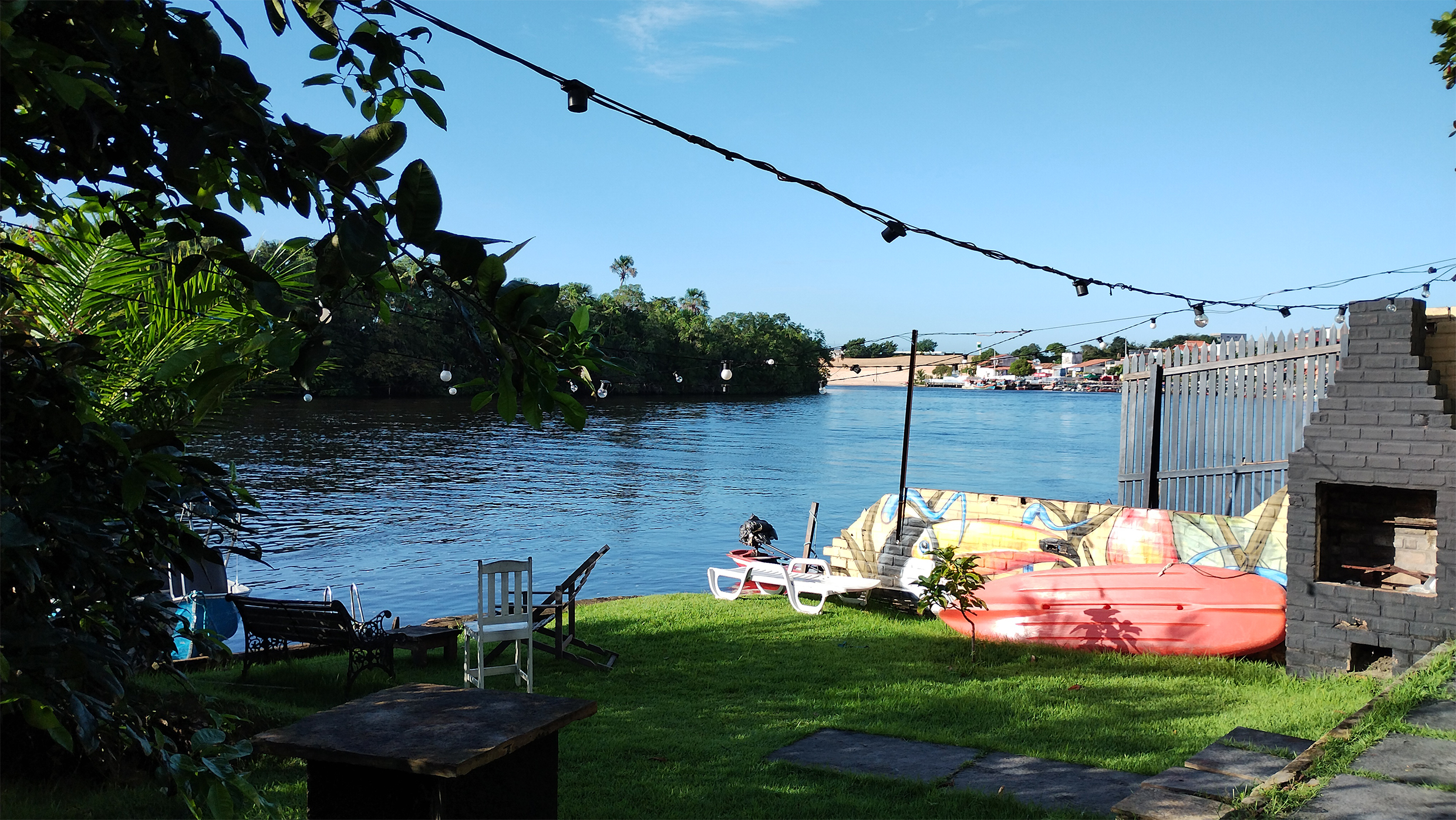
Campsurus specimens were collected on 31 May 2024, in an urban stretch of the Preguiças river located in the municipality of Barreirinhas, north of Maranhão state (Fig. 1). The specimens were collected manually when attracted by LED lamps installed on the river banks (Fig. 2). The Preguiças river, with a length of approximately 135 km, rises in the municipality of Santana do Maranhão and flows into the Atlantic Ocean, crossing the city of Barreirinhas (Costa et al. 2021). The collection point is characterized by an urban stretch of the Preguiças river containing restaurants, bars, hotels, and houses, as well as an intense flow of speedboats (Fig. 2).

Map of Maranhão state showing the limits of Barreirinhas municipality (green poligone) and the collection point (blue marker).

Urban stretch of the Preguiças river in the municipality of Barreirinhas, the habitat of Campsurus barreirinhas sp. nov.
Species identification was based on characters of the male imago genitalia (Molineri & Salles 2017). For examination of the genital structures, the end of the abdomen was removed and cleared in a solution of 10 % NaOH, followed by a rinse in phenolic acid, and mounted in glycerin on a temporary slide for viewing and drawing. After that, specimens were stored in microvials containing 70% ethanol. Photographs were taken using a motorola g71 cell phone coupled to a stereomicroscope Olympus SZ51 or to a Nikon Eclipse E-200 microscope and used as templates for tracing vector graphics using Adobe Illustrator CS6® software. Final illustrations were created using Adobe Photoshop CS6® software. Measurements were performed using a Nikon SZ51 stereomicroscope or Nikon Eclipse E-200 microscope with an ocular micrometer and a ruler. Maps showing the collection site was created using the free software QGIS 3.28.0 ‘Firenze’ (QGIS Development Team 2024).
Descriptive terminology follows that of Molineri & Salles (2017). Holotype and paratypes are housed in the Coleção Zoológica do Maranhão (CZMA - Universidade Estadual do Maranhão, Caxias, Brazil). Some paratypes are housed in the Coleção Entomológica Iraci de Paiva Coelho (CEIPC - Universidade Estadual do Maranhão, São Luis, Brazil)
RESULTS
Campsurus barreirinhas sp. nov.
ZooBankLifeScienceIdentifier(LSID)-urn:lsid:zoobank.org:act: 57024229-E47B-49EA-9E71-03C69AAEF368.
Diagnosis. The male of Campsurus barreirinhas sp. nov. can be distinguished from other species of Campsurus by: 1) sternum IX projected medially, projection rounded apically (Figs. 4a, 4b); 2) pedestals bases distinctly separated in the middle but extending basomedially toward the medial line (Fig. 4b), pedestal rotated (the parastylus is in a dorsal position, instead of lateral) (Fig. 4e); 3) penes base large, visible above the apex of the IX sternum, main lobe of penes thumb-like, curved ventrally (Figs. 4a, 4b), secondary lobe very small, membranous, digitate, located in the apical third of the inner margin of the main lobe of the penes (Fig. 4d); 4) medium size (length of male forewings ca 9.9 mm).

Campsurus barreirinhassp. nov. Male imago genitalia. a, b) Ventral view, c) Lateral view, d) Penis lobe (ventral view, enlarged), e) Pedestal (ventral view, enlarged). sl = penis secondary lobe, ps= parastylus. Scale = 0.5 mm.
Description. Male imago (Fig. 3a–b). Length (mm): body, 10.4; foreleg, 5.25; forewing, 9.2–10.5; hind wing, 4.2–4.3; cerci, 32–34. General coloration yellowish light brown. Head: yellowish, shaded with black almost completely (Fig. 3a). Antenna: scape and pedicel grayish, flagellum whitish (Fig. 3a). Thorax (Figs. 3a, 3b). Pronotum yellowish medially, whitish laterally; shaded with dark gray medially. Mesonotum yellowish light brown shaded with gray, darker on carinae and along medial line (Fig. 3a). Metanotum yellowish, shaded more slightly with gray. Pleura and sterna paler, almost without gray shading (Fig. 3b). Legs: yellowish white, foreleg shaded completely with grayish brown, darker on apex of tibia and 1st tarsite (Fig. 3b). Wings: Membrane whitish translucent; veins translucent yellowish, shaded with grayish brown on Sc and R1; hind wing veins yellowish, shaded gray basally. Abdomen: (Figs. 3a, 3b) yellowish white shaded widely with grayish brown on all terga, medial longitudinal unpigmented band on terga 2-8, other small pale areas as in figures 3a and 3b. Sterna whitish shaded with gray medially, gill sclerites yellowish. Male Genitalia (Figs. 4a–e). Yellowish white, hind margin of sternum IX strongly projected posteriorly, projection broadly rounded apically (Fig. 4a, 4b); pedestal bases distinctly separated, but with narrow basomedial extension directed towards medial line (arrow in Fig. 4b); pedestal rotated (“inner” corner located ventrally), with well-developed and apically rounded parastylus (ps in Fig. 4e), inner corner roundly projected and covered with short spine-like setae; penes base large, main lobe of penes thumb-like, more strongly sclerotized dorsally than ventrally, strongly curved and with a small acute point, ventral surface with pigmented ponctuations (Fig. 4d), secondary lobe of penes very short, membranous, digitate, located in the apical third of the inner margin of the main lobe (sl in Fig. 4d). Caudal filaments whitish translucent.

Female imago, larva and egg. Unknown.
Holotype male. BRAZIL: Maranhão: Barreirinhas municipality, Preguiças river, 02°44’54.65” S / 42°49’31.78” W, 1.41 m a.s.l., 31 May 2024, manual collection, J.L. Gama Neto, leg. (alcohol; CZMA).
Paratype. 6 males, same data as holotype (alcohol; 3 CZMA, 3 CEIPC).
Distribution. Brazil (Maranhão state, type locality only).
Etymology. The term “barreirinhas” is a noun used in apposition, referring to the type locality.
DISCUSSION
Campsurus barreirinhas sp. nov. is similar to Campsurus litaninensis Spieth, 1943, but three characteristics clearly differentiate both species (in brackets the feature of the second species): the projection of the sternum IX is apically rounded (apically truncated), the pedestals bases are completely detached (connected by a narrow band), and the penes are shorter and stouter (slender). This pair of species is unique in the genus because of the shape of the IX sternum, which is widely projected medially, what makes the pedestals to stand broadly separated from each other at the sides of this projection.
This new species belongs to the Campsurus segnis Species Group (Domínguez et al. 2006) because it shares characters present in several species of this group such as the subrectangular pedestals with a projection at the outer corner (parastylus), and the penis lobes each composed of a larger sclerotized lobe and a smaller membranous secondary lobe (Domínguez et al. 2006, Molineri et al. 2015).
Campsurus barreirinhas sp. nov. was collected along with two other Campsurus species: Campsurus essequibo Traver 1947 and Campsurus lucidus Needham & Murphy, 1924. The findings of C. essequibo and C. lucidus in this study represent the first records of these species in the Northeast Brazil region, expanding their geographical distribution within the country.
Campsurus essequibo is a very common and abundant species, with recorded occurrences in Brazil, Bolivia, Colombia, Guyana, and Venezuela (Molineri & Salles 2017). In Brazil, it is widely distributed in the Amazon basin, in the states of Amazonas, Pará, and Roraima (Northern Brazil region) (Salles et al. 2024). Campsurus lucidus is a species that is widely distributed in South America, with recorded occurrences in Argentina, Brazil, Bolivia, Colombia, Guyana, and Peru (Molineri & Salles 2017). In Brazil, it has a fairly wide geographical distribution, although it is found only in four brazilian states: Mato Grosso do Sul (Midwest Brazil region), Pará and Roraima (Northern Brazil region), and Santa Catarina (Southern Brazil region) (Salles et al. 2024).
The results observed in this study indicate that the late discovery of Campsurus in the Maranhão state was a consequence of the lack of collections directed at this genus. With more consistent collections, other Campsurus species would have been recorded in that state.
New records of species
Examined Material
Campsurus essequibo Traver 1947
BRAZIL: Maranhão: Barreirinhas municipality, Preguiças river, 02°44’54.65” S / 42°49’31.78” W, 1.41 m a.s.l., 31 May 2024, manual collection, J.L. Gama Neto, leg., 5 males imagoes (alcohol; CEIPC).
Campsurus lucidus Needham & Murphy, 1924
BRAZIL: Maranhão: Barreirinhas municipality, Preguiças river, 02°44’54.65” S / 42°49’31.78” W, 1.41 m a.s.l., 31 May 2024, manual collection, J.L. Gama Neto, leg., 6 males imagoes (alcohol; CEIPC).
ACKNOWLEDGMENTS
We thank Dr. Carlos Molineri, Dr. Frederico Falcão Salles and an anonymous reviewer for corrections and comments that improved this manuscript.
REFERENCES
- COSTA BN, COSTA BN, MARQUES AM. 2021. Avaliação das condições ambientais do rio Preguiças no município de Barreirinhas, Maranhão, Brasil. Recima 21 2(5): 1-8.
- DOMÍNGUEZ E, MOLINERI C, PESCADOR M, HUBBARD MD NIETO C. 2006. Ephemeroptera of South America. Aquatic Biodiversity in Latin America. ABLA Series. v.2, Sofia-Moscow: Pensoft, 646 p.
- EATON AE. 1868. An outline of a re-arrangement of the genera of Ephemeridae. Entomol Mon Mag 6: 131-132.
-
MOLINERI C, NIETO C, ZÚÑIGA MC, EMMERICH D DOMÍNGUEZ E. 2020. Lista de especies de Ephemeroptera Sudamericanos. Available from: https://ibn.conicet.gov.ar/wp-content/uploads/sites/113/2020/04/catalogo2020_version1abril.pdf (accessed 30 August 2024).
» https://ibn.conicet.gov.ar/wp-content/uploads/sites/113/2020/04/catalogo2020_version1abril.pdf - MOLINERI C SALLES FF. 2017. Review of selected species of Campsurus Eaton 1868 (Ephemeroptera: Polymitarcyidae), with description of eleven new species and a key to male imagos of the genus. Zootaxa 4300(3): 301-354.
- MOLINERI C, SALLES FF EMMERICH D. 2015. Revision of Campsurus violaceus species group (Ephemeroptera: Polymitarcyidae) with new synonymies and nomina dubia in Campsurus Eaton, 1868. Zootaxa, 3920(1): 51-68.
-
QGIS DEVELOPMENT TEAM. 2024. QGIS—Geographic Information System. Open Source Geospatial Foundation Project. Available from: http://qgis.osgeo.org (accessed 12 July 2024).
» http://qgis.osgeo.org -
SALLES FF, BOLDRINI R, MARIANO R, ALVIM JB LIMA LRC. 2024. Polymitarcyidae. In: Catálogo Taxonômico da Fauna do Brasil. Available from: http://fauna.jbrj.gov.br/fauna/faunadobrasil/19288 (accessed 26 August 2024).
» http://fauna.jbrj.gov.br/fauna/faunadobrasil/19288